Learning Objectives
• Definewhat a perspective is in philosophy
• Explain the difference between holistic
perspective and partial thinking
• Give simple examples of each type of thinking
• Show why holistic thinking is important in
understanding people
• Reflect on how we use these perspectives in
daily life
3.
What is aPerspective?
- A perspective is a way of viewing or
interpreting reality
- Influences how we understand
events, people, and experiences
- Two major types: Holistic Perspective
and Partial Thinking
Holistic Perspective
Looks atthe whole picture
Sees the human person as a complete
being (body, mind, emotions, spirit)
Emphasizes interconnectedness of parts.
Example: A doctor not only treats the
illness but also considers the patient’s
lifestyle, emotions, and environment.
6.
Characteristics of HolisticPerspective
Comprehensive
Interdisciplinary
Inclusive of different dimensions
(social, emotional, physical, spiritual)
Focused on unity and integration
7.
Partial Thinking
Focuses onspecific parts or isolated
aspects.
Can lead to a fragmented view of reality.
May overlook connections and context.
Example: An engineer focusing only on
technical aspects of a project without
considering environmental impact
8.
Characteristics of PartialThinking
Detailed and narrow
Problem-focused
May ignore other important
factors
Sometimes necessary for
specialization
9.
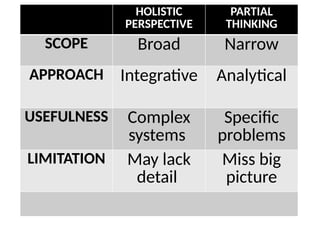
HOLISTIC PERSPECTIVE PARTIALTHINKING
HOLISTIC
PERSPECTIVE
PARTIAL
THINKING
SCOPE Broad Narrow
APPROACH Integrative Analytical
USEFULNESS Complex
systems
Specific
problems
LIMITATION May lack
detail
Miss big
picture
10.
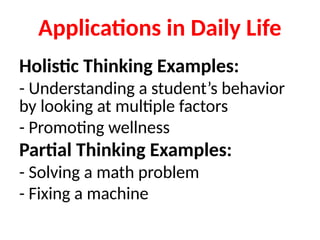
Applications in DailyLife
Holistic Thinking Examples:
- Understanding a student’s behavior
by looking at multiple factors
- Promoting wellness
Partial Thinking Examples:
- Solving a math problem
- Fixing a machine
11.
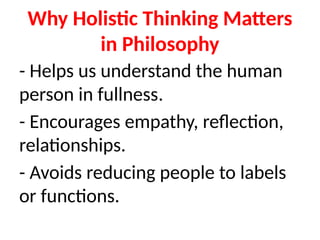
Why Holistic ThinkingMatters
in Philosophy
- Helps us understand the human
person in fullness.
- Encourages empathy, reflection,
relationships.
- Avoids reducing people to labels
or functions.
#9 BROAD- very wide: We walked down a broad avenue lined with trees.
NARROW- of little breadth or width; not broad or wide; not as wide as usual or expected. a narrow path. limited in extent or space; affording little room. narrow quarters.