Emotion Regulation of Car Drivers
by Physical and Psychological
Paramters of Music
Rainer Höger, Sabine Wollstädter,
Sabine Eichhorst, & Laura Becker
Leuphana University of Lüneburg/Germany
 Emotions in car driving
 Anger and aggressive driving
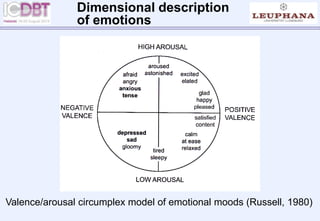
 Dimensional description of emotions
 Study I: Musical preference and anger regulation
in driving
 Study II: Musical tempo and anger regulation in
driving
 Conclusions
Agenda
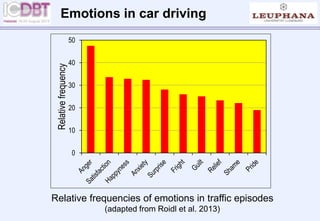
Emotions in car driving
0
10
20
30
40
50
Relativefrequency
Relative frequencies of emotions in traffic episodes
(adapted from Roidl et al. 2013)
Anger and aggressive driving
 About 56% of all motor vehicle accidents in the
US included at least one aggressive action of
one of the participants (American Automobile
Association Foundation of Traffic Safety, 2009)
 Idea of the study: Accident prevention by
downsizing driving anger.
 Anger develops when driving goals are blocked
 The consequences of anger in car driving are –
in some cases – aggressive driving acts (e.g.
blocking or chasing other drivers)
Dimensional description
of emotions
Valence/arousal circumplex model of emotional moods (Russell, 1980)
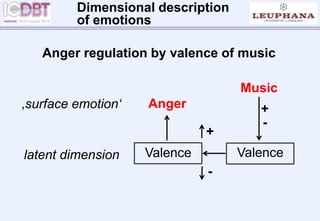
Anger regulation by valence of music
Valence
Anger
Music
‚surface emotion‘
latent dimension
+
-
Valence
+
-
Dimensional description
of emotions
Study I: Musical preference
and anger regulation
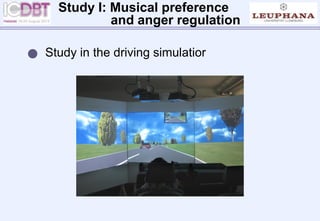
 Study in the driving simulatior
Study I: Musical preference
and anger regulation
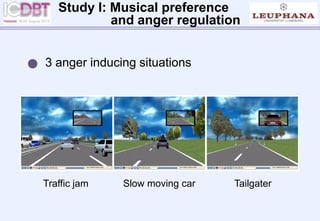
 3 anger inducing situations
Traffic jam Slow moving car Tailgater
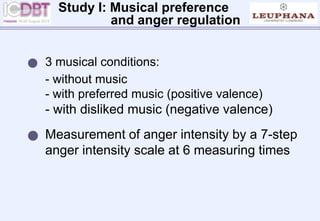
 3 musical conditions:
- without music
- with preferred music (positive valence)
Study I: Musical preference
and anger regulation
- with disliked music (negative valence)
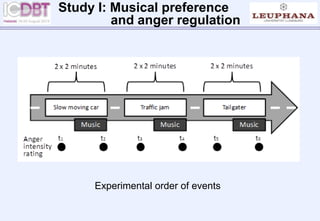
 Measurement of anger intensity by a 7-step
anger intensity scale at 6 measuring times
Experimental order of events
Study I: Musical preference
and anger regulation
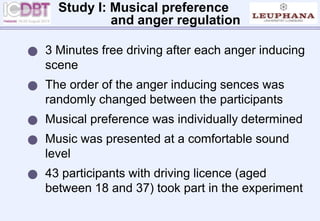
 3 Minutes free driving after each anger inducing
scene
 The order of the anger inducing sences was
randomly changed between the participants
 Musical preference was individually determined
 Music was presented at a comfortable sound
level
 43 participants with driving licence (aged
between 18 and 37) took part in the experiment
Study I: Musical preference
and anger regulation
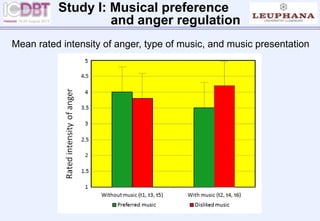
Mean rated intensity of anger, type of music, and music presentation
Study I: Musical preference
and anger regulation
Study II: Musical tempo and
anger regulation
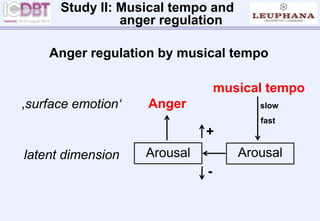
Anger regulation by musical tempo
Arousal
Anger
musical tempo
‚surface emotion‘
latent dimension
+
-
Arousal
slow
fast
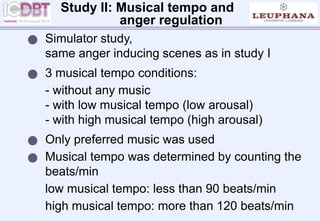
 Simulator study,
same anger inducing scenes as in study I
 3 musical tempo conditions:
- without any music
- with low musical tempo (low arousal)
- with high musical tempo (high arousal)
 Only preferred music was used
 Musical tempo was determined by counting the
beats/min
low musical tempo: less than 90 beats/min
high musical tempo: more than 120 beats/min
Study II: Musical tempo and
anger regulation
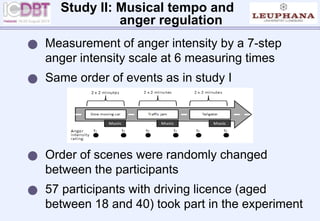
 Measurement of anger intensity by a 7-step
anger intensity scale at 6 measuring times
 Same order of events as in study I
 Order of scenes were randomly changed
between the participants
 57 participants with driving licence (aged
between 18 and 40) took part in the experiment
Study II: Musical tempo and
anger regulation
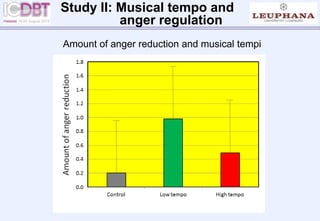
Amount of anger reduction and musical tempi
Study II: Musical tempo and
anger regulation
Conclusions
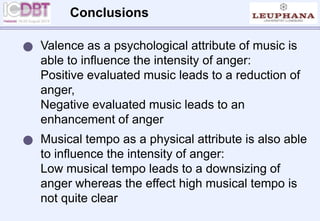
 Valence as a psychological attribute of music is
able to influence the intensity of anger:
Positive evaluated music leads to a reduction of
anger,
Negative evaluated music leads to an
enhancement of anger
 Musical tempo as a physical attribute is also able
to influence the intensity of anger:
Low musical tempo leads to a downsizing of
anger whereas the effect high musical tempo is
not quite clear
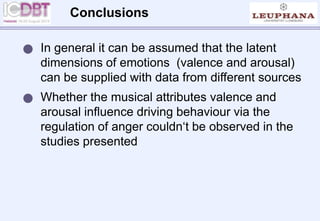
 In general it can be assumed that the latent
dimensions of emotions (valence and arousal)
can be supplied with data from different sources
 Whether the musical attributes valence and
arousal influence driving behaviour via the
regulation of anger couldn‘t be observed in the
studies presented
Conclusions
Thank you
for your
attention!
Prof. Dr. Rainer Höger
Institut für Experimentelle
Wirtschaftspsychologie
Wilschenbrucher Weg 84
D-21335 Lüneburg/Germany
email: hoeger@leuphana.de

Hoger

  • 1.
    Emotion Regulation ofCar Drivers by Physical and Psychological Paramters of Music Rainer Höger, Sabine Wollstädter, Sabine Eichhorst, & Laura Becker Leuphana University of Lüneburg/Germany
  • 2.
     Emotions incar driving  Anger and aggressive driving  Dimensional description of emotions  Study I: Musical preference and anger regulation in driving  Study II: Musical tempo and anger regulation in driving  Conclusions Agenda
  • 3.
    Emotions in cardriving 0 10 20 30 40 50 Relativefrequency Relative frequencies of emotions in traffic episodes (adapted from Roidl et al. 2013)
  • 4.
    Anger and aggressivedriving  About 56% of all motor vehicle accidents in the US included at least one aggressive action of one of the participants (American Automobile Association Foundation of Traffic Safety, 2009)  Idea of the study: Accident prevention by downsizing driving anger.  Anger develops when driving goals are blocked  The consequences of anger in car driving are – in some cases – aggressive driving acts (e.g. blocking or chasing other drivers)
  • 5.
    Dimensional description of emotions Valence/arousalcircumplex model of emotional moods (Russell, 1980)
  • 6.
    Anger regulation byvalence of music Valence Anger Music ‚surface emotion‘ latent dimension + - Valence + - Dimensional description of emotions
  • 7.
    Study I: Musicalpreference and anger regulation  Study in the driving simulatior
  • 8.
    Study I: Musicalpreference and anger regulation  3 anger inducing situations Traffic jam Slow moving car Tailgater
  • 9.
     3 musicalconditions: - without music - with preferred music (positive valence) Study I: Musical preference and anger regulation - with disliked music (negative valence)  Measurement of anger intensity by a 7-step anger intensity scale at 6 measuring times
  • 10.
    Experimental order ofevents Study I: Musical preference and anger regulation
  • 11.
     3 Minutesfree driving after each anger inducing scene  The order of the anger inducing sences was randomly changed between the participants  Musical preference was individually determined  Music was presented at a comfortable sound level  43 participants with driving licence (aged between 18 and 37) took part in the experiment Study I: Musical preference and anger regulation
  • 12.
    Mean rated intensityof anger, type of music, and music presentation Study I: Musical preference and anger regulation
  • 13.
    Study II: Musicaltempo and anger regulation Anger regulation by musical tempo Arousal Anger musical tempo ‚surface emotion‘ latent dimension + - Arousal slow fast
  • 14.
     Simulator study, sameanger inducing scenes as in study I  3 musical tempo conditions: - without any music - with low musical tempo (low arousal) - with high musical tempo (high arousal)  Only preferred music was used  Musical tempo was determined by counting the beats/min low musical tempo: less than 90 beats/min high musical tempo: more than 120 beats/min Study II: Musical tempo and anger regulation
  • 15.
     Measurement ofanger intensity by a 7-step anger intensity scale at 6 measuring times  Same order of events as in study I  Order of scenes were randomly changed between the participants  57 participants with driving licence (aged between 18 and 40) took part in the experiment Study II: Musical tempo and anger regulation
  • 16.
    Amount of angerreduction and musical tempi Study II: Musical tempo and anger regulation
  • 17.
    Conclusions  Valence asa psychological attribute of music is able to influence the intensity of anger: Positive evaluated music leads to a reduction of anger, Negative evaluated music leads to an enhancement of anger  Musical tempo as a physical attribute is also able to influence the intensity of anger: Low musical tempo leads to a downsizing of anger whereas the effect high musical tempo is not quite clear
  • 18.
     In generalit can be assumed that the latent dimensions of emotions (valence and arousal) can be supplied with data from different sources  Whether the musical attributes valence and arousal influence driving behaviour via the regulation of anger couldn‘t be observed in the studies presented Conclusions
  • 19.
    Thank you for your attention! Prof.Dr. Rainer Höger Institut für Experimentelle Wirtschaftspsychologie Wilschenbrucher Weg 84 D-21335 Lüneburg/Germany email: hoeger@leuphana.de