UNIT 4
Franchising in Retailing
• Introduction to franchising
• Types of franchising agreement
• Franchising in India
• Business format franchising
• Key success factor in franchising
Role of personal selling in retailing
• Role of retail sales personnel
• The process of personnel selling
Introduction to franchising
“A franchise operation is a contractual relationship between the
franchisor and franchisee in which the franchisor offers or is
obligated to maintain a continuing interest in the business of the
franchise in such areas as know-how and training; wherein the
franchisee operates under a common trade name, format, and or
procedure owned or controlled by the franchisor, and in which the
franchisee has or will make a substantial capital investment in his
business from his own pocket.”
Benefits of Franchise Agreement
for the franchisee
• Business Privilege : A franchise agreement gives you the power to
access to the trademarked business logo, the products and all kinds
of marketing expertise that a franchise can provide you. Franchise
agreement legally gives you the permission to use a known
trademarked business name and logo as part of business plan.
• Control of the Brand : Once legally coming into an agreement the
franchiser shall be able to states the terms and conditions regarding
the usage of the brand, penalty to be imposed and rules and
regulations to be followed.
• Lower failure rate : In general, franchises have a lower failure rate
than solo businesses. When a franchisee buys into a franchise,
they’re joining a successful brand, as well as a network that will offer
them support and advice, making it less likely they’ll go out of
business. As well, franchises have already proven their business
concept, so you have reassurance that the products or services
you’ll be offering are in demand.
• Brand recognition : A big benefit that franchisees receive when opening a
franchise is brand recognition. If you start a business from scratch, you would have
to build your brand and customer base from the ground up, which would take
time. Franchises, on the other hand, are already well-known businesses with
established customer bases built in. So when you open a franchise with this
recognizable branding, people will automatically know what your business is, what
you provide, and what they can expect.
• Buying power: Another benefit of franchising is the sheer size of the network. If
you’re operating a standalone business and need to order products or supplies to
make your products, you’re paying more money per item because your order is
relatively small. However, a network of franchises has the opportunity to purchase
goods at a deep discount by buying in bulk. The parent company can use the size
of the network to negotiate deals that every franchisee benefits from. A lower cost
of goods lowers the overall operation costs of the franchise.
• Profits: In general, franchises see higher profits than independently established
businesses. Most franchises have recognizable brands that bring customers in
droves. This popularity results in higher profits. Even franchises that require a high
initial investment for the franchise fee see high return on investment.
• Lower risk: Starting a business is risky. This is true whether a business
owner is opening an independent business or purchasing a franchise. That
being said, the risk is lower when opening a franchise. One of the reasons
franchise owners face lower risk than independent business owners is the
franchise network. Most franchises are owned by established corporations
that have tested and proven the business model of the franchise in
multiple markets. This lower risk may also make it easier to access loans,
including the best SBA franchise loans, to help you launch your business.
• Built-in customer base: One of the biggest struggles of any new business
is finding customers. Franchises, on the other hand, come with instant
brand recognition and a loyal customer base. Even if you’re opening the
first branch of a franchise in a small town, the likelihood is that potential
customers are already familiar with the brand from exposure to TV
commercials or travel to other cities.
• Be your own boss: One of the biggest benefits of owning a business is
being your own boss. When starting a franchise business, you get to be
your own boss with the added benefit of receiving support from the
franchise’s knowledge base. Owning a business is hard work, but when
you’re your own boss, you get to create your own schedule, have
autonomy over your career, and potentially work from home. A franchise
gives you the benefit of being your own boss without the risk of starting
your own independent business.
Disadvantages of franchising for
the franchisee
• Restricting regulations: While a franchise allows the franchisee to be
their own boss, they’re not entirely in control of their business, nor can
they make decisions without taking into account the opinion of the
franchisor. For most franchisees, the most frustrating disadvantage that
they face is that they must follow the restrictions laid out in the
franchise agreement. The franchisor can exert a degree of control over
the majority of the franchise business and decisions made by the
franchisee.
• Initial cost: While the initial investment of the franchise fee buys a lot of
benefits for the franchisee, it can also be costly—especially if you’re
joining a very well-known and profitable franchise. While this often
translates to larger profits, coming up with this initial money can put a
strain on any small business owner.
• Ongoing investment: In addition to the initial investment you’ll have to
provide to start your franchise, there are additional, ongoing costs that
are unique to franchises. Within the franchise agreement, the ongoing
costs of the franchise should be enumerated. These costs might include
royalty fees, advertising costs, and a charge for training services.
• Potential for conflict: While one of the benefits of owning a
franchise is the network of support you receive, it also has the
potential for conflict. Any close business relationship,
especially when there’s an imbalance of power, comes with a
risk that the parties won’t get along.
• Lack of financial privacy: Another disadvantage of franchising
is a lack of privacy. The franchise agreement will likely
stipulate that the franchisor can oversee the entire financial
ecosystem of the franchise. This lack of financial privacy can
be seen by franchisee as a disadvantage of owning a
franchise; however, it may be less of an issue if you welcome
financial guidance.
Advantages of franchising for
the franchisor
• Access to capital: One of the biggest barriers to expansion for
small business is the money it costs to expand. And while
there are several business loan options, they don’t always pan
out. Franchising your business will take some time and money
on your end, but it also has the potential to make you a lot of
money in the form of franchise fees.
• Efficient growth: Opening the first unit of a business is costly
and time consuming. Opening a second unit can be almost as
difficult. When that burden is shared with another business
owner, it makes the process more efficient and takes the onus
off the initial business owner. When trying to grow your small
business, starting a franchise can make opening multiple
locations a much simpler process.
• Minimal employee supervision: One of the big stresses as a
business owner is hiring and managing employees. As a franchisor,
the only support that you have to provide to the franchisee is
training and business knowledge. In general, the franchisor has no
hand in the management, hiring, and firing of employees.
• Increased brand awareness: One of the many benefits of
franchising is increased brand awareness. The more locations the
brand has, the more people who are aware of the brand. And the
more these customers come to know and love the brand, the more
profitable and successful the brand can be. This increased brand
awareness of a multi-location franchise can be highly beneficial to
the franchisor and their franchisees—a win-win.
• Reduced risk: One of the biggest benefits to the franchisor in a
franchise agreement is the ability to expand without an increase in
risk. Because the franchisee takes on the debt and liability of
opening a unit under the name of the franchise, the franchisor gets
all the benefit of an additional location without taking on the risk
themselves.
Disadvantages of franchising for
the franchisor
• Loss of complete brand control: When a business owner opens an
independent business, they maintain complete control over their
brand and every decision that happens within the business. When a
franchisor allows a franchisee to open a business under their brand,
they’re giving away (actually, selling) some of the control over their
small business branding. While the franchise agreement should
contain strong stipulations and rules to guide the decisions made by
the franchisee, your franchisees won’t be clones of you. They will
think and act differently, and your brand could wind up suffering
because of it.
• Increased potential for legal disputes: Any time you enter into a
close business agreement with other people, you open yourself to
the risk of legal disputes. While a well-crafted and lawyer-approved
franchise agreement should limit a lot of the possibilities for legal
disputes between the franchisor and franchisees, these disputes are
still possible. Any legal disputes that must be resolved in mediation
or through the court system can be costly in both time and money,
which takes away from the success of the franchise.
• Initial investment: While much conversation is devoted to the
initial investment that a franchisee must make in the franchise, that
ignores the initial cost that is taken on by the franchisor. When a
franchisor starts a franchise, there’s a startup cost to get the
business in operation. A franchisor must make sure that the
franchise agreement is written clearly and reviewed by a lawyer
experienced in franchise law. You may also hire a franchise
consultant for expertise during this process. Starting a franchise
requires an initial investment of both time and money on the part
of the franchisor.
• Federal and state regulation: While not entirely a drawback,
dealing with the federal regulations set down by the Federal Trade
Commission for franchises can be a nuisance for franchisors. These
regulations ensure that franchises are operated fairly, but it also
requires time and effort from the franchisors to meet all of these
regulations.
Franchising: Types
1. Product Franchising
2. Manufacturing Franchising
3. Business-format Franchising
Product Franchising
Product-driven franchises are based on suplier-dealer
relationships, where franchisee distributes the franchisor’s
products. The franchisor licenses its trademark but usually does
not provide franchisees an entire system for running their
business. Product franchises deal mainly with large products,
such as cars and car repair parts, vending machines, computers,
bicycles, appliances, etc. Product distribution franchising
represents the highest percentage of total retail sales. Some
well-known product distribution franchises are Exxon,Texaco,
GoodYear Tires, Ford, Chrysler, John Deere and other
automobile producers. Sometimes franchisor licenses not only
distribution, but also part of the manufacturing process, like in
the cases of soft drink manufacturers Coca-Cola and Pepsi.
Manufacturing Franchising
Under this arrangement, the franchisor (manufacturer) gives the
dealer (bottler) the exclusive right to produce and distribute the
product in a particular area. This type of franchising is
commonly used in the soft-drink industry.
Business-format Franchising or
Pure Franchising
The business format franchisee also gets to use the franchisor’s
trademark, but more importantly, it gets the entire system to
operate the business and market the product and/or service.
The franchisor offers a detailed plan and procedures on almost
every aspect of the business, provides initial and ongoing
training and support. Business format franchising is the most
popular type of franchise system and the one generally referred
to when talking franchising. Businesses from more than 70
industries can be franchised, and the most popular are fast food,
retail, restaurant, business services, fitness.
When franchisor sells the complete business format and system
of his/her product to the franchisee, it is called ‘pure
franchising.’ In other words, this type of franchising provides the
franchisee with a complete business format including license for
a trade name, the product or service to be marketed, the
physical plant, methods of operation, a marketing strategy plan,
a quality control process, and so on. Such type of franchising is
common among fast-food restaurants (such as McDonalds)
hotels, educational institutions (such as Delhi Public School,
(DPS), and many others.
Franchising in India
• Expansion of any business, especially in rural India, involves
significant investments of both capital and human resources. The
franchising business model is a viable alternative to overcome such
challenges. In India, this model currently offers excellent
opportunities to new international and local brands entering the
market. Franchising is not only a great way to encourage self-
employment but also a huge employment generator.
• According to Franchise India, franchising has witnessed an
impressive growth of around 30-35% over the last four-five years
and the overall turnover is estimated at around INR 938 billion.
Currently, the sector contributes nearly 1.8% to the Indian GDP and
is estimated to contribute to around 4% by 2022. Even the COVID-
19 crisis offers a pool of opportunities for businesses, such as
franchise, which are highly capable of making a difference at local
level using technology.
FewProfitableFranchiseBusinessOpportunitiesInIndia
• Tumbledry
• Kalyan Jewellers
• Domino's
• Dr Lal Pathlabs
• FirstCry
• VLCC
• Kidzee
• Jockey
• Delhivery
• Lakme
Key success factor in franchising
1. Having a loyal customer base: A loyal customer base improves the
likelihood that clients will become repeat buyers.
“If you can attract a client base and retain them that gives a strong basis to
continued revenue,” Gargano says.
2. Having a clear market position
Franchisees need to follow the business structure as set out by their
franchisor. With a defined market position, the business and its customers can
aim for the same target market.
“You need to be able to provide a product that falls into an area where there is
a need and really show customers how you are fulfilling that need for them,”
Gargano says.
3. Business expertise of operators
Franchisees stand to benefit from the expertise of their franchisor, along with
their guidance and leadership, in growing the business model into the future.
“There is a high reliance on the operator to have business knowledge and a
strong work ethic,” Gargano says.
4. Ability to control stock on hand
Operators benefit from controlling stock on hand to meet client demand, reduce
inventory costs and ensure adequate stock turn.
Gargano says this is particularly crucial for food service providers as many run on a
low profit margin, so being successful relies on minimising wastage.
5. Establishment of brand names
Many franchises have established brand names, and people buying into a franchise
license the particular product or service.
“Franchisers benefit from having that really recognisable brand name that
consumers are aware of and they know what they are going to get,” Gargano says.
“If you walk into a McDonald’s or Subway you almost know what you are going to
order before you walk in.”
6. Workforce
Franchisees should ensure that employees have sufficient knowledge to provide
sound advice and quality customer service.
“You want a base level of the workforce to retain the loyal customer base, provide
the product and provide good quality operation,” Gargano says.
“But at the same time it does depend on the industry as to how it works, for
example in fast food they rely on much younger workers.”
Personal selling
Personal selling is also known as face-to-face selling in which
one person who is the salesman tries to convince the customer
in buying a product. It is a promotional method by which the
salesperson uses his or her skills and abilities in an attempt to
make a sale.
Personal selling is a face-to-face selling technique by which a
salesperson uses his or her interpersonal skills to persuade a
customer in buying a particular product. The salesperson tries to
highlight various features of the product to convince the
customer that it will only add value. However, getting a
customer to buy a product is not the motive behind personal
selling every time. Often companies try to follow this approach
with customers to make them aware of a new product.
Advantages of PS
BUSINESS
• Effective promotional
tool
• flexible tool
• Minimum wastage of
resources
• Customer attention
• Better customer
Relationship
• Personal support
CUSTOMER
• Identifying needs
• latest market info
• Expert advice
Disadvantages of PS
• Highly expensive
• Poor salesmen-poor sales
• It is an extremely labor intensive method because a large sales
force is required to carry out personal selling successfully.
• The training of the salesperson is also a very time consuming
and costly process.
• And the method can only reach a limited number of people.
Unlike TV or Radio ads it does not cover a huge demographic.
Role of retail sales personnel
1. Selling
The fundamental duty of a salesman is selling. This duty includes
meeting the prospects, presenting and demonstrating the
products, inducing the prospects to buy, taking orders and
effecting sales.
2. Guiding the buyers
A salesman should guide the buyers in buying the goods they
want.
3. Attending to complaints
A salesman should attend to the complaints of the customers
immediately and try to settle their grievances quickly and
sincerely.
4. Collection of bills
Sometimes, a salesman may be required to collect the outstanding
bills relating to the goods sold by him. In such a case, he has to collect
the bills and remit the amount to his firm.
5. Collection of credit information
A salesman may, sometimes, be required to collect information about
the credit-worthiness of the customers. In such a case, he has to
collect detailed information and submit it to his firm in time.
6. Reporting
A salesman, especially a traveling salesman, is required to send daily,
weekly or monthly reports to his firm, providing information about the
calls made, sales effected, services rendered, route schedule, expenses
incurred, business conditions, competition, if any, etc.
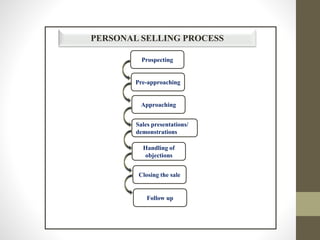
PERSONAL SELLING PROCESS
Prospecting
Pre-approaching
Approaching
Sales presentations/
demonstrations
Handling of
objections
Closing the sale
Follow up
PERSONAL SELLING PROCESS
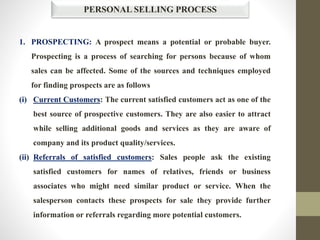
1. PROSPECTING: A prospect means a potential or probable buyer.
Prospecting is a process of searching for persons because of whom
sales can be affected. Some of the sources and techniques employed
for finding prospects are as follows
(i) Current Customers: The current satisfied customers act as one of the
best source of prospective customers. They are also easier to attract
while selling additional goods and services as they are aware of
company and its product quality/services.
(ii) Referrals of satisfied customers: Sales people ask the existing
satisfied customers for names of relatives, friends or business
associates who might need similar product or service. When the
salesperson contacts these prospects for sale they provide further
information or referrals regarding more potential customers.
PERSONAL SELLING PROCESS
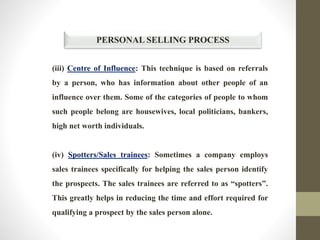
(iii) Centre of Influence: This technique is based on referrals
by a person, who has information about other people of an
influence over them. Some of the categories of people to whom
such people belong are housewives, local politicians, bankers,
high net worth individuals.
(iv) Spotters/Sales trainees: Sometimes a company employs
sales trainees specifically for helping the sales person identify
the prospects. The sales trainees are referred to as “spotters”.
This greatly helps in reducing the time and effort required for
qualifying a prospect by the sales person alone.
PERSONAL SELLING PROCESS
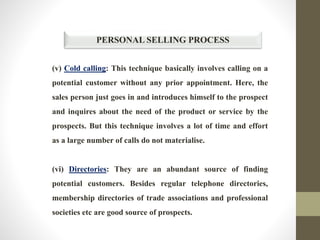
(v) Cold calling: This technique basically involves calling on a
potential customer without any prior appointment. Here, the
sales person just goes in and introduces himself to the prospect
and inquires about the need of the product or service by the
prospects. But this technique involves a lot of time and effort
as a large number of calls do not materialise.
(vi) Directories: They are an abundant source of finding
potential customers. Besides regular telephone directories,
membership directories of trade associations and professional
societies etc are good source of prospects.
PERSONAL SELLING PROCESS
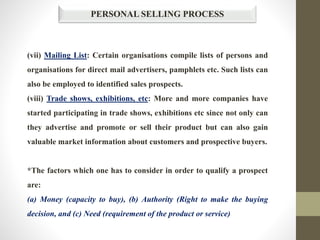
(vii) Mailing List: Certain organisations compile lists of persons and
organisations for direct mail advertisers, pamphlets etc. Such lists can
also be employed to identified sales prospects.
(viii) Trade shows, exhibitions, etc: More and more companies have
started participating in trade shows, exhibitions etc since not only can
they advertise and promote or sell their product but can also gain
valuable market information about customers and prospective buyers.
*The factors which one has to consider in order to qualify a prospect
are:
(a) Money (capacity to buy), (b) Authority (Right to make the buying
decision, and (c) Need (requirement of the product or service)
PERSONAL SELLING PROCESS
2. PRE-APPROACHING: It involves developing an
understanding about the prospective buyer or qualified buyers
like their needs, problems, preference, attitude, buying
motives, personal character, etc. Before meeting the prospects
the sales person should try to get information about their
nature and behaviour. He should try to ascertain what
products or brands they are using. The pre-approach is
effective in making ground work for approach.
PERSONAL SELLING PROCESS
3. APPROACHING: In this stage, the sales person comes face-
to-face with the prospects. The salesman has an opportunity to
understand and interact with prospect in a better way. The
first impression of salesman may bring a long run benefit, The
salesman should put forward his best efforts to the best use of
this opportunity in getting the attention of the prospect to
convince them to buy the product.
The basic ways of approaching are as follows:
(i) Introductory Approach: Here the salesperson introduces
himself and the product Company.
PERSONAL SELLING PROCESS
(ii) Product Approach: Here the sales person hands over the
product to the prospects for examination after briefly
explaining it to them.
(iii) Referral Approach: The sales person can give the name of a
present satisfied customer to the prospect as a reference during
the meeting.
4. Presentation and Demonstration: Fully automated (highly
structured, e.g. life insurance/industrial products)
(a) Semi automated (help from brochures/literature e.g.
pharmaceuticals)
(b) Memorised (no reference document)
(c) Organised Presentation (Attention, Interest, Desire, Action/
Flexible)
(d) Unstructured (Problem solving)
PERSONAL SELLING PROCESS
5. Handling of objections:
• Handling sales Resistance (actions or statements by
prospects that postpone, hinder, or prevent the completion
of sale).
• Key is to provide additional information.
• Alter the product to suit the customer.
PERSONAL SELLING PROCESS
6. Closing the sale:
1. Action Close Technique (high-priced products needing
financial assistance)
2. Gift Close Technique (added incentive for taking immediate
buying action)
3. Direct Close Technique (summarise the presentation and
ask for sale)

hm-rm unit 4.pptx 12356747890055225974789

  • 1.
    UNIT 4 Franchising inRetailing • Introduction to franchising • Types of franchising agreement • Franchising in India • Business format franchising • Key success factor in franchising Role of personal selling in retailing • Role of retail sales personnel • The process of personnel selling
  • 2.
    Introduction to franchising “Afranchise operation is a contractual relationship between the franchisor and franchisee in which the franchisor offers or is obligated to maintain a continuing interest in the business of the franchise in such areas as know-how and training; wherein the franchisee operates under a common trade name, format, and or procedure owned or controlled by the franchisor, and in which the franchisee has or will make a substantial capital investment in his business from his own pocket.”
  • 3.
    Benefits of FranchiseAgreement for the franchisee • Business Privilege : A franchise agreement gives you the power to access to the trademarked business logo, the products and all kinds of marketing expertise that a franchise can provide you. Franchise agreement legally gives you the permission to use a known trademarked business name and logo as part of business plan. • Control of the Brand : Once legally coming into an agreement the franchiser shall be able to states the terms and conditions regarding the usage of the brand, penalty to be imposed and rules and regulations to be followed. • Lower failure rate : In general, franchises have a lower failure rate than solo businesses. When a franchisee buys into a franchise, they’re joining a successful brand, as well as a network that will offer them support and advice, making it less likely they’ll go out of business. As well, franchises have already proven their business concept, so you have reassurance that the products or services you’ll be offering are in demand.
  • 4.
    • Brand recognition: A big benefit that franchisees receive when opening a franchise is brand recognition. If you start a business from scratch, you would have to build your brand and customer base from the ground up, which would take time. Franchises, on the other hand, are already well-known businesses with established customer bases built in. So when you open a franchise with this recognizable branding, people will automatically know what your business is, what you provide, and what they can expect. • Buying power: Another benefit of franchising is the sheer size of the network. If you’re operating a standalone business and need to order products or supplies to make your products, you’re paying more money per item because your order is relatively small. However, a network of franchises has the opportunity to purchase goods at a deep discount by buying in bulk. The parent company can use the size of the network to negotiate deals that every franchisee benefits from. A lower cost of goods lowers the overall operation costs of the franchise. • Profits: In general, franchises see higher profits than independently established businesses. Most franchises have recognizable brands that bring customers in droves. This popularity results in higher profits. Even franchises that require a high initial investment for the franchise fee see high return on investment.
  • 5.
    • Lower risk:Starting a business is risky. This is true whether a business owner is opening an independent business or purchasing a franchise. That being said, the risk is lower when opening a franchise. One of the reasons franchise owners face lower risk than independent business owners is the franchise network. Most franchises are owned by established corporations that have tested and proven the business model of the franchise in multiple markets. This lower risk may also make it easier to access loans, including the best SBA franchise loans, to help you launch your business. • Built-in customer base: One of the biggest struggles of any new business is finding customers. Franchises, on the other hand, come with instant brand recognition and a loyal customer base. Even if you’re opening the first branch of a franchise in a small town, the likelihood is that potential customers are already familiar with the brand from exposure to TV commercials or travel to other cities. • Be your own boss: One of the biggest benefits of owning a business is being your own boss. When starting a franchise business, you get to be your own boss with the added benefit of receiving support from the franchise’s knowledge base. Owning a business is hard work, but when you’re your own boss, you get to create your own schedule, have autonomy over your career, and potentially work from home. A franchise gives you the benefit of being your own boss without the risk of starting your own independent business.
  • 6.
    Disadvantages of franchisingfor the franchisee • Restricting regulations: While a franchise allows the franchisee to be their own boss, they’re not entirely in control of their business, nor can they make decisions without taking into account the opinion of the franchisor. For most franchisees, the most frustrating disadvantage that they face is that they must follow the restrictions laid out in the franchise agreement. The franchisor can exert a degree of control over the majority of the franchise business and decisions made by the franchisee. • Initial cost: While the initial investment of the franchise fee buys a lot of benefits for the franchisee, it can also be costly—especially if you’re joining a very well-known and profitable franchise. While this often translates to larger profits, coming up with this initial money can put a strain on any small business owner. • Ongoing investment: In addition to the initial investment you’ll have to provide to start your franchise, there are additional, ongoing costs that are unique to franchises. Within the franchise agreement, the ongoing costs of the franchise should be enumerated. These costs might include royalty fees, advertising costs, and a charge for training services.
  • 7.
    • Potential forconflict: While one of the benefits of owning a franchise is the network of support you receive, it also has the potential for conflict. Any close business relationship, especially when there’s an imbalance of power, comes with a risk that the parties won’t get along. • Lack of financial privacy: Another disadvantage of franchising is a lack of privacy. The franchise agreement will likely stipulate that the franchisor can oversee the entire financial ecosystem of the franchise. This lack of financial privacy can be seen by franchisee as a disadvantage of owning a franchise; however, it may be less of an issue if you welcome financial guidance.
  • 8.
    Advantages of franchisingfor the franchisor • Access to capital: One of the biggest barriers to expansion for small business is the money it costs to expand. And while there are several business loan options, they don’t always pan out. Franchising your business will take some time and money on your end, but it also has the potential to make you a lot of money in the form of franchise fees. • Efficient growth: Opening the first unit of a business is costly and time consuming. Opening a second unit can be almost as difficult. When that burden is shared with another business owner, it makes the process more efficient and takes the onus off the initial business owner. When trying to grow your small business, starting a franchise can make opening multiple locations a much simpler process.
  • 9.
    • Minimal employeesupervision: One of the big stresses as a business owner is hiring and managing employees. As a franchisor, the only support that you have to provide to the franchisee is training and business knowledge. In general, the franchisor has no hand in the management, hiring, and firing of employees. • Increased brand awareness: One of the many benefits of franchising is increased brand awareness. The more locations the brand has, the more people who are aware of the brand. And the more these customers come to know and love the brand, the more profitable and successful the brand can be. This increased brand awareness of a multi-location franchise can be highly beneficial to the franchisor and their franchisees—a win-win. • Reduced risk: One of the biggest benefits to the franchisor in a franchise agreement is the ability to expand without an increase in risk. Because the franchisee takes on the debt and liability of opening a unit under the name of the franchise, the franchisor gets all the benefit of an additional location without taking on the risk themselves.
  • 10.
    Disadvantages of franchisingfor the franchisor • Loss of complete brand control: When a business owner opens an independent business, they maintain complete control over their brand and every decision that happens within the business. When a franchisor allows a franchisee to open a business under their brand, they’re giving away (actually, selling) some of the control over their small business branding. While the franchise agreement should contain strong stipulations and rules to guide the decisions made by the franchisee, your franchisees won’t be clones of you. They will think and act differently, and your brand could wind up suffering because of it. • Increased potential for legal disputes: Any time you enter into a close business agreement with other people, you open yourself to the risk of legal disputes. While a well-crafted and lawyer-approved franchise agreement should limit a lot of the possibilities for legal disputes between the franchisor and franchisees, these disputes are still possible. Any legal disputes that must be resolved in mediation or through the court system can be costly in both time and money, which takes away from the success of the franchise.
  • 11.
    • Initial investment:While much conversation is devoted to the initial investment that a franchisee must make in the franchise, that ignores the initial cost that is taken on by the franchisor. When a franchisor starts a franchise, there’s a startup cost to get the business in operation. A franchisor must make sure that the franchise agreement is written clearly and reviewed by a lawyer experienced in franchise law. You may also hire a franchise consultant for expertise during this process. Starting a franchise requires an initial investment of both time and money on the part of the franchisor. • Federal and state regulation: While not entirely a drawback, dealing with the federal regulations set down by the Federal Trade Commission for franchises can be a nuisance for franchisors. These regulations ensure that franchises are operated fairly, but it also requires time and effort from the franchisors to meet all of these regulations.
  • 12.
    Franchising: Types 1. ProductFranchising 2. Manufacturing Franchising 3. Business-format Franchising
  • 13.
    Product Franchising Product-driven franchisesare based on suplier-dealer relationships, where franchisee distributes the franchisor’s products. The franchisor licenses its trademark but usually does not provide franchisees an entire system for running their business. Product franchises deal mainly with large products, such as cars and car repair parts, vending machines, computers, bicycles, appliances, etc. Product distribution franchising represents the highest percentage of total retail sales. Some well-known product distribution franchises are Exxon,Texaco, GoodYear Tires, Ford, Chrysler, John Deere and other automobile producers. Sometimes franchisor licenses not only distribution, but also part of the manufacturing process, like in the cases of soft drink manufacturers Coca-Cola and Pepsi.
  • 14.
    Manufacturing Franchising Under thisarrangement, the franchisor (manufacturer) gives the dealer (bottler) the exclusive right to produce and distribute the product in a particular area. This type of franchising is commonly used in the soft-drink industry.
  • 15.
    Business-format Franchising or PureFranchising The business format franchisee also gets to use the franchisor’s trademark, but more importantly, it gets the entire system to operate the business and market the product and/or service. The franchisor offers a detailed plan and procedures on almost every aspect of the business, provides initial and ongoing training and support. Business format franchising is the most popular type of franchise system and the one generally referred to when talking franchising. Businesses from more than 70 industries can be franchised, and the most popular are fast food, retail, restaurant, business services, fitness.
  • 16.
    When franchisor sellsthe complete business format and system of his/her product to the franchisee, it is called ‘pure franchising.’ In other words, this type of franchising provides the franchisee with a complete business format including license for a trade name, the product or service to be marketed, the physical plant, methods of operation, a marketing strategy plan, a quality control process, and so on. Such type of franchising is common among fast-food restaurants (such as McDonalds) hotels, educational institutions (such as Delhi Public School, (DPS), and many others.
  • 17.
    Franchising in India •Expansion of any business, especially in rural India, involves significant investments of both capital and human resources. The franchising business model is a viable alternative to overcome such challenges. In India, this model currently offers excellent opportunities to new international and local brands entering the market. Franchising is not only a great way to encourage self- employment but also a huge employment generator. • According to Franchise India, franchising has witnessed an impressive growth of around 30-35% over the last four-five years and the overall turnover is estimated at around INR 938 billion. Currently, the sector contributes nearly 1.8% to the Indian GDP and is estimated to contribute to around 4% by 2022. Even the COVID- 19 crisis offers a pool of opportunities for businesses, such as franchise, which are highly capable of making a difference at local level using technology.
  • 18.
    FewProfitableFranchiseBusinessOpportunitiesInIndia • Tumbledry • KalyanJewellers • Domino's • Dr Lal Pathlabs • FirstCry • VLCC • Kidzee • Jockey • Delhivery • Lakme
  • 19.
    Key success factorin franchising 1. Having a loyal customer base: A loyal customer base improves the likelihood that clients will become repeat buyers. “If you can attract a client base and retain them that gives a strong basis to continued revenue,” Gargano says. 2. Having a clear market position Franchisees need to follow the business structure as set out by their franchisor. With a defined market position, the business and its customers can aim for the same target market. “You need to be able to provide a product that falls into an area where there is a need and really show customers how you are fulfilling that need for them,” Gargano says. 3. Business expertise of operators Franchisees stand to benefit from the expertise of their franchisor, along with their guidance and leadership, in growing the business model into the future. “There is a high reliance on the operator to have business knowledge and a strong work ethic,” Gargano says.
  • 20.
    4. Ability tocontrol stock on hand Operators benefit from controlling stock on hand to meet client demand, reduce inventory costs and ensure adequate stock turn. Gargano says this is particularly crucial for food service providers as many run on a low profit margin, so being successful relies on minimising wastage. 5. Establishment of brand names Many franchises have established brand names, and people buying into a franchise license the particular product or service. “Franchisers benefit from having that really recognisable brand name that consumers are aware of and they know what they are going to get,” Gargano says. “If you walk into a McDonald’s or Subway you almost know what you are going to order before you walk in.” 6. Workforce Franchisees should ensure that employees have sufficient knowledge to provide sound advice and quality customer service. “You want a base level of the workforce to retain the loyal customer base, provide the product and provide good quality operation,” Gargano says. “But at the same time it does depend on the industry as to how it works, for example in fast food they rely on much younger workers.”
  • 21.
    Personal selling Personal sellingis also known as face-to-face selling in which one person who is the salesman tries to convince the customer in buying a product. It is a promotional method by which the salesperson uses his or her skills and abilities in an attempt to make a sale. Personal selling is a face-to-face selling technique by which a salesperson uses his or her interpersonal skills to persuade a customer in buying a particular product. The salesperson tries to highlight various features of the product to convince the customer that it will only add value. However, getting a customer to buy a product is not the motive behind personal selling every time. Often companies try to follow this approach with customers to make them aware of a new product.
  • 22.
    Advantages of PS BUSINESS •Effective promotional tool • flexible tool • Minimum wastage of resources • Customer attention • Better customer Relationship • Personal support CUSTOMER • Identifying needs • latest market info • Expert advice
  • 23.
    Disadvantages of PS •Highly expensive • Poor salesmen-poor sales • It is an extremely labor intensive method because a large sales force is required to carry out personal selling successfully. • The training of the salesperson is also a very time consuming and costly process. • And the method can only reach a limited number of people. Unlike TV or Radio ads it does not cover a huge demographic.
  • 24.
    Role of retailsales personnel 1. Selling The fundamental duty of a salesman is selling. This duty includes meeting the prospects, presenting and demonstrating the products, inducing the prospects to buy, taking orders and effecting sales. 2. Guiding the buyers A salesman should guide the buyers in buying the goods they want. 3. Attending to complaints A salesman should attend to the complaints of the customers immediately and try to settle their grievances quickly and sincerely.
  • 25.
    4. Collection ofbills Sometimes, a salesman may be required to collect the outstanding bills relating to the goods sold by him. In such a case, he has to collect the bills and remit the amount to his firm. 5. Collection of credit information A salesman may, sometimes, be required to collect information about the credit-worthiness of the customers. In such a case, he has to collect detailed information and submit it to his firm in time. 6. Reporting A salesman, especially a traveling salesman, is required to send daily, weekly or monthly reports to his firm, providing information about the calls made, sales effected, services rendered, route schedule, expenses incurred, business conditions, competition, if any, etc.
  • 26.
    PERSONAL SELLING PROCESS Prospecting Pre-approaching Approaching Salespresentations/ demonstrations Handling of objections Closing the sale Follow up
  • 27.
    PERSONAL SELLING PROCESS 1.PROSPECTING: A prospect means a potential or probable buyer. Prospecting is a process of searching for persons because of whom sales can be affected. Some of the sources and techniques employed for finding prospects are as follows (i) Current Customers: The current satisfied customers act as one of the best source of prospective customers. They are also easier to attract while selling additional goods and services as they are aware of company and its product quality/services. (ii) Referrals of satisfied customers: Sales people ask the existing satisfied customers for names of relatives, friends or business associates who might need similar product or service. When the salesperson contacts these prospects for sale they provide further information or referrals regarding more potential customers.
  • 28.
    PERSONAL SELLING PROCESS (iii)Centre of Influence: This technique is based on referrals by a person, who has information about other people of an influence over them. Some of the categories of people to whom such people belong are housewives, local politicians, bankers, high net worth individuals. (iv) Spotters/Sales trainees: Sometimes a company employs sales trainees specifically for helping the sales person identify the prospects. The sales trainees are referred to as “spotters”. This greatly helps in reducing the time and effort required for qualifying a prospect by the sales person alone.
  • 29.
    PERSONAL SELLING PROCESS (v)Cold calling: This technique basically involves calling on a potential customer without any prior appointment. Here, the sales person just goes in and introduces himself to the prospect and inquires about the need of the product or service by the prospects. But this technique involves a lot of time and effort as a large number of calls do not materialise. (vi) Directories: They are an abundant source of finding potential customers. Besides regular telephone directories, membership directories of trade associations and professional societies etc are good source of prospects.
  • 30.
    PERSONAL SELLING PROCESS (vii)Mailing List: Certain organisations compile lists of persons and organisations for direct mail advertisers, pamphlets etc. Such lists can also be employed to identified sales prospects. (viii) Trade shows, exhibitions, etc: More and more companies have started participating in trade shows, exhibitions etc since not only can they advertise and promote or sell their product but can also gain valuable market information about customers and prospective buyers. *The factors which one has to consider in order to qualify a prospect are: (a) Money (capacity to buy), (b) Authority (Right to make the buying decision, and (c) Need (requirement of the product or service)
  • 31.
    PERSONAL SELLING PROCESS 2.PRE-APPROACHING: It involves developing an understanding about the prospective buyer or qualified buyers like their needs, problems, preference, attitude, buying motives, personal character, etc. Before meeting the prospects the sales person should try to get information about their nature and behaviour. He should try to ascertain what products or brands they are using. The pre-approach is effective in making ground work for approach.
  • 32.
    PERSONAL SELLING PROCESS 3.APPROACHING: In this stage, the sales person comes face- to-face with the prospects. The salesman has an opportunity to understand and interact with prospect in a better way. The first impression of salesman may bring a long run benefit, The salesman should put forward his best efforts to the best use of this opportunity in getting the attention of the prospect to convince them to buy the product. The basic ways of approaching are as follows: (i) Introductory Approach: Here the salesperson introduces himself and the product Company.
  • 33.
    PERSONAL SELLING PROCESS (ii)Product Approach: Here the sales person hands over the product to the prospects for examination after briefly explaining it to them. (iii) Referral Approach: The sales person can give the name of a present satisfied customer to the prospect as a reference during the meeting.
  • 34.
    4. Presentation andDemonstration: Fully automated (highly structured, e.g. life insurance/industrial products) (a) Semi automated (help from brochures/literature e.g. pharmaceuticals) (b) Memorised (no reference document) (c) Organised Presentation (Attention, Interest, Desire, Action/ Flexible) (d) Unstructured (Problem solving) PERSONAL SELLING PROCESS
  • 35.
    PERSONAL SELLING PROCESS 5.Handling of objections: • Handling sales Resistance (actions or statements by prospects that postpone, hinder, or prevent the completion of sale). • Key is to provide additional information. • Alter the product to suit the customer.
  • 36.
    PERSONAL SELLING PROCESS 6.Closing the sale: 1. Action Close Technique (high-priced products needing financial assistance) 2. Gift Close Technique (added incentive for taking immediate buying action) 3. Direct Close Technique (summarise the presentation and ask for sale)