Copyright © 2019 Pearson Education, Ltd. All Rights Reserved.
Entrepreneurship: Successfully Launching New
Ventures
Sixth Edition, Global Edition
Chapter 15
Franchising
Learning Objectives
15.1 Explain franchising and how this form of business ownership works.
15.2 Describe steps entrepreneurs can take to establish a franchise system.
15.3 Become familiar with the advantages and disadvantages of establishing a
franchise system.
15.4 Describe actions and issues associated with a decision to buy a franchise.
15.5 Explain the steps an entrepreneur goes through to buy a franchise.
15.6 Identify and explain the various legal aspects associated with the
franchise relationship.
15.7 Discuss two additional issues—franchise ethics and international
franchising—entrepreneurs should think about when considering
franchising.
What is Franchising?
− Franchising is a form of business organization in which a firm that already has a
successful product or service (franchisor) licenses its trademark and method of
doing business to another business or individual (franchisee) in exchange for a
franchise fee and an ongoing royalty payment.
Two Types of Franchise Systems
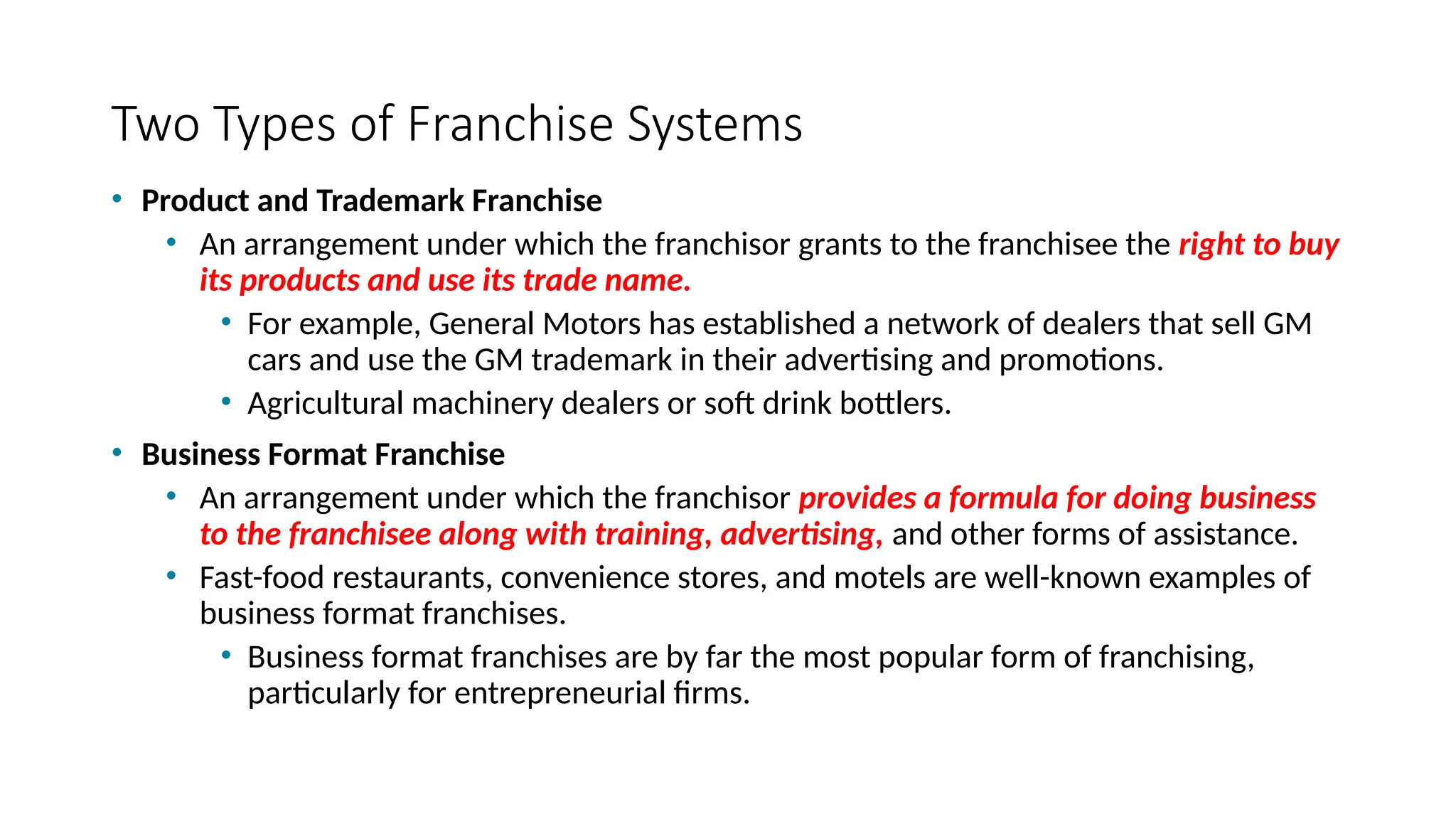
• Product and Trademark Franchise
• An arrangement under which the franchisor grants to the franchisee the right to buy
its products and use its trade name.
• For example, General Motors has established a network of dealers that sell GM
cars and use the GM trademark in their advertising and promotions.
• Agricultural machinery dealers or soft drink bottlers.
• Business Format Franchise
• An arrangement under which the franchisor provides a formula for doing business
to the franchisee along with training, advertising, and other forms of assistance.
• Fast-food restaurants, convenience stores, and motels are well-known examples of
business format franchises.
• Business format franchises are by far the most popular form of franchising,
particularly for entrepreneurial firms.
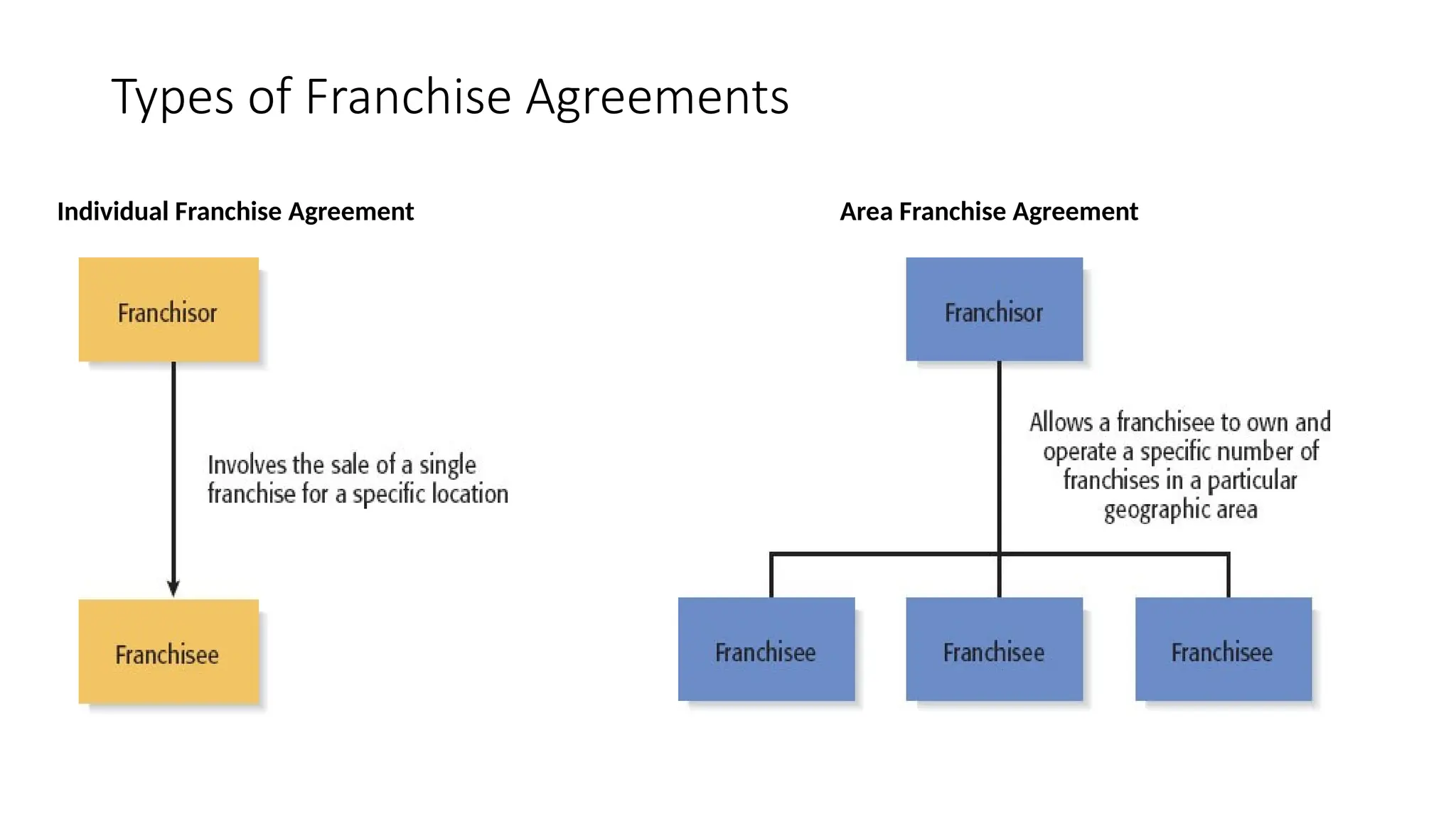
Types of Franchise Agreements
Individual Franchise Agreement Area Franchise Agreement
Types of Franchise Agreement
Master Franchise Agreement
When to Franchise? (1 of 2)
• When Is Franchising Most Appropriate?
• Franchising is most appropriate when a firm has a strong or potentially strong trademark, a
well-designed business method, and a desire to grow.
• In some instances franchising is not appropriate.
• For example, franchising works for Burger King but would not work for Walmart.
• Each individual Burger King store is relatively small and policies and procedures can be
written for almost any contingency, in contrast to Walmart stores which are much larger and
more expensive to build compared to Burger King.
Steps of Setting a Franchise
Figure 15.2 Nine Steps in Setting Up a Franchise System
Selecting and Developing Effective Franchisees (1 of 2)
Table 15.2 Qualities to Look for in Prospective Franchisees
• Good work ethic
• Ability to follow instructions
• Ability to operate with minimal supervision
• Team oriented
• Experience in the industry in which the franchise competes
• Adequate financial resources and good credit history
• Ability to make suggestions without becoming confrontational or upset if the
suggestions are not adopted
• Ability to represent the franchisor in a positive manner
Selecting and Developing Effective Franchisees (2 of 2)
Table 15.2 Ways Franchisors Can Develop Their Franchisees’ Potential
• Keep operating manuals up-to-date
• Keep product, services, and business systems up-to-date
• Solicit input from franchisees to reinforce their importance in the larger system
• Encourage franchisees to develop a franchise association
• Maintain the franchise system’s integrity
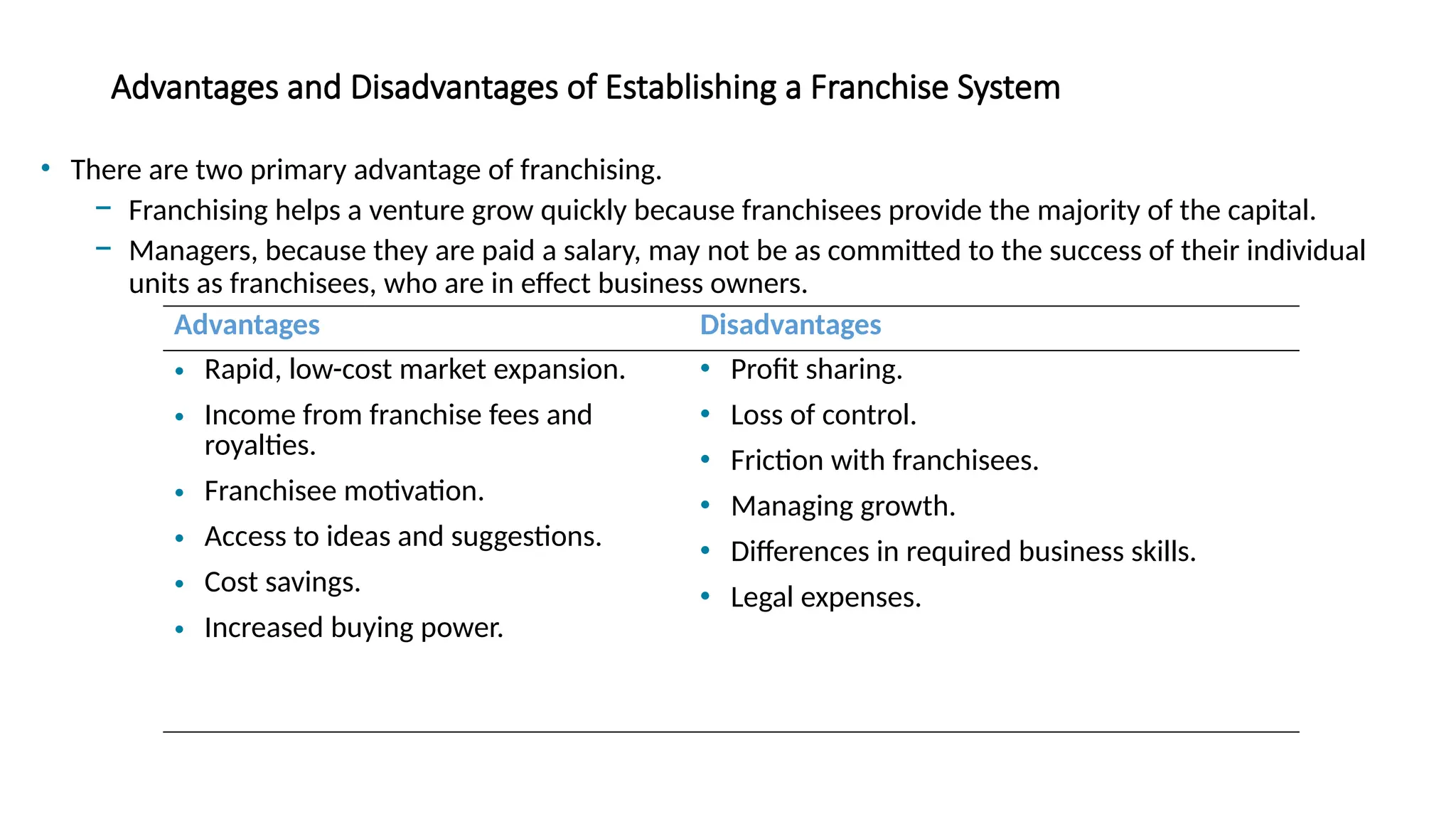
Advantages and Disadvantages of Establishing a Franchise System
• There are two primary advantage of franchising.
− Franchising helps a venture grow quickly because franchisees provide the majority of the capital.
− Managers, because they are paid a salary, may not be as committed to the success of their individual
units as franchisees, who are in effect business owners.
Advantages Disadvantages
• Rapid, low-cost market expansion.
• Income from franchise fees and
royalties.
• Franchisee motivation.
• Access to ideas and suggestions.
• Cost savings.
• Increased buying power.
• Profit sharing.
• Loss of control.
• Friction with franchisees.
• Managing growth.
• Differences in required business skills.
• Legal expenses.
Buying a Franchise
• From the Franchisee’s Point of View
• Purchasing a franchise is an important business decision involving a substantial financial
commitment.
• Potential franchise owners should strive to be as well informed as possible before purchasing a
franchise and should be aware that it is often legally and financially difficult to exit a franchise
relationship.
• Franchising may be a particularly good choice for someone who wants to start a business but
has no prior business experience.
• Many franchise systems provide their franchisees substantial training and support.
Buying a Franchise
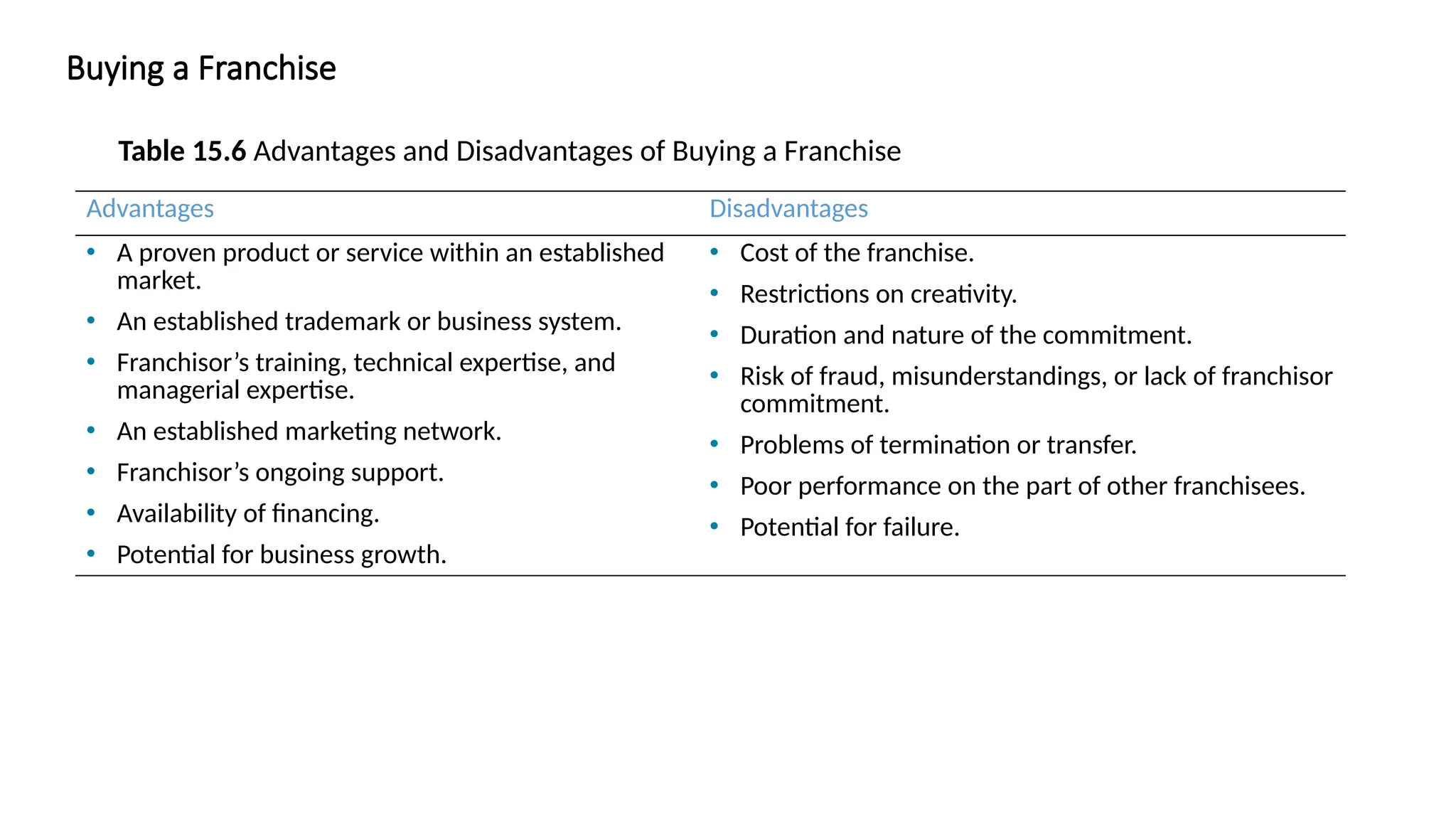
Advantages Disadvantages
• A proven product or service within an established
market.
• An established trademark or business system.
• Franchisor’s training, technical expertise, and
managerial expertise.
• An established marketing network.
• Franchisor’s ongoing support.
• Availability of financing.
• Potential for business growth.
• Cost of the franchise.
• Restrictions on creativity.
• Duration and nature of the commitment.
• Risk of fraud, misunderstandings, or lack of franchisor
commitment.
• Problems of termination or transfer.
• Poor performance on the part of other franchisees.
• Potential for failure.
Table 15.6 Advantages and Disadvantages of Buying a Franchise
The Cost of a Franchise
• Initial Franchise Fee
• The initial fee varies depending on the franchisor.
• Capital Requirements
• The costs vary but may include the cost of buying real estate, the cost of putting up a building, the
purchase of inventory, and the cost of obtaining a business license.
• Continuing Royalty Payment
• Is usually around 5% of monthly gross income.
• Advertising Fees
• Franchisees are often required to pay into a national or regional advertising fund.
• Other Fees
• Other fees may be charged for various activities, including:
• Training additional staff.
• Providing management expertise when needed.
• Providing a host of other items or support services.
Steps in Purchasing a Franchise
• The first rule of buying a franchise is to avoid making a hasty decision.
• Owning a franchise is typically costly and labor-intensive. As a result, the purchase of a franchise
should be a careful, deliberate decision.
• Purchasing a franchise system is a seven-step process, as illustrated in the following slide.
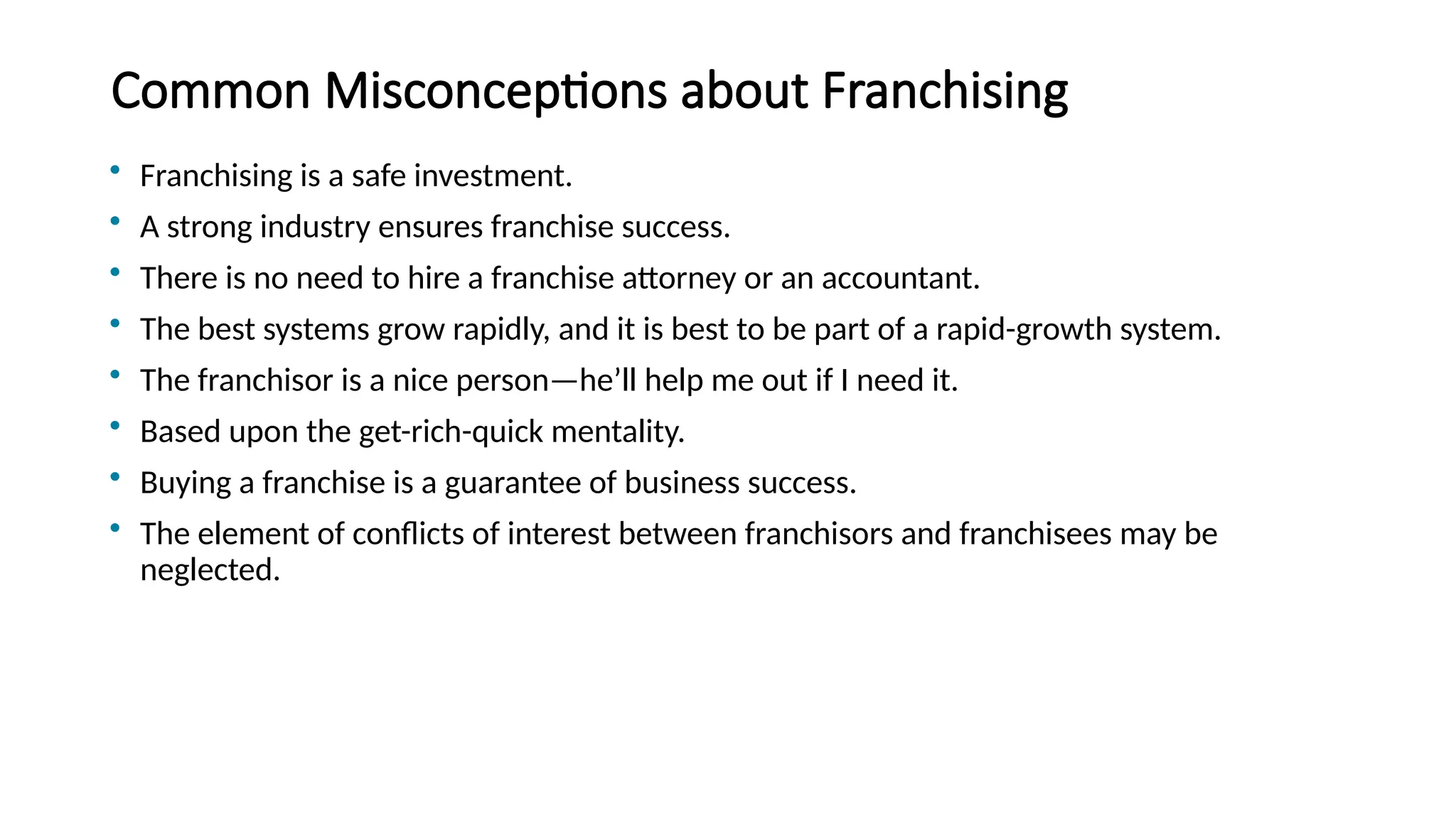
Common Misconceptions about Franchising
• Franchising is a safe investment.
• A strong industry ensures franchise success.
• There is no need to hire a franchise attorney or an accountant.
• The best systems grow rapidly, and it is best to be part of a rapid-growth system.
• The franchisor is a nice person—he’ll help me out if I need it.
• Based upon the get-rich-quick mentality.
• Buying a franchise is a guarantee of business success.
• The element of conflicts of interest between franchisors and franchisees may be
neglected.
Legal Aspects of the Franchise Relationship
• Federal Rules and Regulations
• The offer and sale of a franchise are regulated at the federal level.
• According to Federal Trade Commission (FTC) rule 436, franchisors must furnish potential
franchisees with written disclosures that provide information about the franchisor, the
franchised business, and the franchise relationship.
• In most cases, the disclosures are made through a lengthy document referred to as the
Franchisor Disclosure Document (FDD).
• The FDD contains 23 categories of information that give a prospective franchisee a broad
base of information about the background and financial health of the franchisor.
International Franchising
• International opportunities for franchising are becoming more prevalent for the following two
reasons:
• The markets for certain franchised products in the U.S. have become saturated (i.e., fast food).
• The trend toward globalization continues.
• Steps to take before buying a franchise overseas:
• Consider the value of the franchisor’s name in the foreign country.
• Work with a knowledgeable lawyer.
• Determine whether the product or service is saleable in a foreign country.
• Uncover whether the franchisor has experience in international markets.
• Find out how much training and support you will receive from the franchisor.

14 Frenchising (1) lecture notes........

  • 1.
    Copyright © 2019Pearson Education, Ltd. All Rights Reserved. Entrepreneurship: Successfully Launching New Ventures Sixth Edition, Global Edition Chapter 15 Franchising
  • 2.
    Learning Objectives 15.1 Explainfranchising and how this form of business ownership works. 15.2 Describe steps entrepreneurs can take to establish a franchise system. 15.3 Become familiar with the advantages and disadvantages of establishing a franchise system. 15.4 Describe actions and issues associated with a decision to buy a franchise. 15.5 Explain the steps an entrepreneur goes through to buy a franchise. 15.6 Identify and explain the various legal aspects associated with the franchise relationship. 15.7 Discuss two additional issues—franchise ethics and international franchising—entrepreneurs should think about when considering franchising.
  • 3.
    What is Franchising? −Franchising is a form of business organization in which a firm that already has a successful product or service (franchisor) licenses its trademark and method of doing business to another business or individual (franchisee) in exchange for a franchise fee and an ongoing royalty payment.
  • 4.
    Two Types ofFranchise Systems • Product and Trademark Franchise • An arrangement under which the franchisor grants to the franchisee the right to buy its products and use its trade name. • For example, General Motors has established a network of dealers that sell GM cars and use the GM trademark in their advertising and promotions. • Agricultural machinery dealers or soft drink bottlers. • Business Format Franchise • An arrangement under which the franchisor provides a formula for doing business to the franchisee along with training, advertising, and other forms of assistance. • Fast-food restaurants, convenience stores, and motels are well-known examples of business format franchises. • Business format franchises are by far the most popular form of franchising, particularly for entrepreneurial firms.
  • 5.
    Types of FranchiseAgreements Individual Franchise Agreement Area Franchise Agreement
  • 6.
    Types of FranchiseAgreement Master Franchise Agreement
  • 7.
    When to Franchise?(1 of 2) • When Is Franchising Most Appropriate? • Franchising is most appropriate when a firm has a strong or potentially strong trademark, a well-designed business method, and a desire to grow. • In some instances franchising is not appropriate. • For example, franchising works for Burger King but would not work for Walmart. • Each individual Burger King store is relatively small and policies and procedures can be written for almost any contingency, in contrast to Walmart stores which are much larger and more expensive to build compared to Burger King.
  • 8.
    Steps of Settinga Franchise Figure 15.2 Nine Steps in Setting Up a Franchise System
  • 9.
    Selecting and DevelopingEffective Franchisees (1 of 2) Table 15.2 Qualities to Look for in Prospective Franchisees • Good work ethic • Ability to follow instructions • Ability to operate with minimal supervision • Team oriented • Experience in the industry in which the franchise competes • Adequate financial resources and good credit history • Ability to make suggestions without becoming confrontational or upset if the suggestions are not adopted • Ability to represent the franchisor in a positive manner
  • 10.
    Selecting and DevelopingEffective Franchisees (2 of 2) Table 15.2 Ways Franchisors Can Develop Their Franchisees’ Potential • Keep operating manuals up-to-date • Keep product, services, and business systems up-to-date • Solicit input from franchisees to reinforce their importance in the larger system • Encourage franchisees to develop a franchise association • Maintain the franchise system’s integrity
  • 11.
    Advantages and Disadvantagesof Establishing a Franchise System • There are two primary advantage of franchising. − Franchising helps a venture grow quickly because franchisees provide the majority of the capital. − Managers, because they are paid a salary, may not be as committed to the success of their individual units as franchisees, who are in effect business owners. Advantages Disadvantages • Rapid, low-cost market expansion. • Income from franchise fees and royalties. • Franchisee motivation. • Access to ideas and suggestions. • Cost savings. • Increased buying power. • Profit sharing. • Loss of control. • Friction with franchisees. • Managing growth. • Differences in required business skills. • Legal expenses.
  • 12.
    Buying a Franchise •From the Franchisee’s Point of View • Purchasing a franchise is an important business decision involving a substantial financial commitment. • Potential franchise owners should strive to be as well informed as possible before purchasing a franchise and should be aware that it is often legally and financially difficult to exit a franchise relationship. • Franchising may be a particularly good choice for someone who wants to start a business but has no prior business experience. • Many franchise systems provide their franchisees substantial training and support.
  • 13.
    Buying a Franchise AdvantagesDisadvantages • A proven product or service within an established market. • An established trademark or business system. • Franchisor’s training, technical expertise, and managerial expertise. • An established marketing network. • Franchisor’s ongoing support. • Availability of financing. • Potential for business growth. • Cost of the franchise. • Restrictions on creativity. • Duration and nature of the commitment. • Risk of fraud, misunderstandings, or lack of franchisor commitment. • Problems of termination or transfer. • Poor performance on the part of other franchisees. • Potential for failure. Table 15.6 Advantages and Disadvantages of Buying a Franchise
  • 14.
    The Cost ofa Franchise • Initial Franchise Fee • The initial fee varies depending on the franchisor. • Capital Requirements • The costs vary but may include the cost of buying real estate, the cost of putting up a building, the purchase of inventory, and the cost of obtaining a business license. • Continuing Royalty Payment • Is usually around 5% of monthly gross income. • Advertising Fees • Franchisees are often required to pay into a national or regional advertising fund. • Other Fees • Other fees may be charged for various activities, including: • Training additional staff. • Providing management expertise when needed. • Providing a host of other items or support services.
  • 15.
    Steps in Purchasinga Franchise • The first rule of buying a franchise is to avoid making a hasty decision. • Owning a franchise is typically costly and labor-intensive. As a result, the purchase of a franchise should be a careful, deliberate decision. • Purchasing a franchise system is a seven-step process, as illustrated in the following slide.
  • 16.
    Common Misconceptions aboutFranchising • Franchising is a safe investment. • A strong industry ensures franchise success. • There is no need to hire a franchise attorney or an accountant. • The best systems grow rapidly, and it is best to be part of a rapid-growth system. • The franchisor is a nice person—he’ll help me out if I need it. • Based upon the get-rich-quick mentality. • Buying a franchise is a guarantee of business success. • The element of conflicts of interest between franchisors and franchisees may be neglected.
  • 17.
    Legal Aspects ofthe Franchise Relationship • Federal Rules and Regulations • The offer and sale of a franchise are regulated at the federal level. • According to Federal Trade Commission (FTC) rule 436, franchisors must furnish potential franchisees with written disclosures that provide information about the franchisor, the franchised business, and the franchise relationship. • In most cases, the disclosures are made through a lengthy document referred to as the Franchisor Disclosure Document (FDD). • The FDD contains 23 categories of information that give a prospective franchisee a broad base of information about the background and financial health of the franchisor.
  • 18.
    International Franchising • Internationalopportunities for franchising are becoming more prevalent for the following two reasons: • The markets for certain franchised products in the U.S. have become saturated (i.e., fast food). • The trend toward globalization continues. • Steps to take before buying a franchise overseas: • Consider the value of the franchisor’s name in the foreign country. • Work with a knowledgeable lawyer. • Determine whether the product or service is saleable in a foreign country. • Uncover whether the franchisor has experience in international markets. • Find out how much training and support you will receive from the franchisor.

Editor's Notes

  • #1 If this PowerPoint presentation contains mathematical equations, you may need to check that your computer has the following installed: 1) MathType Plugin 2) Math Player (free versions available) 3) NVDA Reader (free versions available)