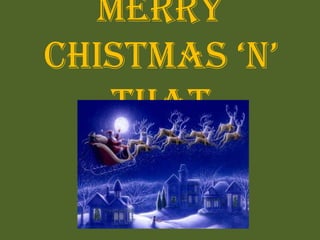
Merry
Chistmas ‘n’
   That
Secret Santa...
• Most Christmas motifs have their roots in some kind of folk tradition or
  practice, but are trotted out every year with little awareness of their origins.

• Note how every time a Hollywood film tries to meddle with Christmas
  folklore, a new generation takes on the previous one‟s traditions and
  symbols in a superficial fashion and proceeds to „update‟ them for „modern
  times‟ - usually resulting a massively surreal mishmash of nonsensical, ill-
  fitting elements that they then have to try to force some kind of sense into.
  (Santa Claus the Movie, The Santa Clause, Fred Claus etc.)

• But this doesn‟t just happen in films – it happens in society in general.
  When we look at other cultures‟ rituals and traditions they often look
  utterly baffling, alien, and relentlessly oddball, and you wonder how they
  ever came up with that. Well, Santa Claus is a case in point.
  How would you explain Him and his world, in all its glorious absurd detail,
  to an alien?
Myth 1 # Coca-Cola
         invented Santa Claus
Coca-Cola‟s Santa first appeared in 1931, and undoubtedly had a hand in making that
   the standard image of Him – but the character had already evolved to look like that,
   often (but not always) portrayed in red and white.


     1931
     Haddon Sundblom                                      1955
     First Coca-Cola Santa                                Haddon Sundblom
One of the earliest known portrayals of what is recognisably “our” Santa was by
   German-born illustrator Thomas Nast in around 1869.


     ca 1869                                            1881
     Thomas Nast                                        Thomas Nast
     Santa Claus and his                                Harper's Weekly
     Works
Postcards ca1900


               1908
                                     1925
1905           E. Boyd Smith
                                     N. C. Wyeth
Carl Stetson   Santa Claus and All
                                     Old Kris
Crawford       About Him
                                     The Country Gentleman
1922              1925                1939
Norman Rockwell   J. C. Leyendecker   Norman Rockwell
Sante Claus
• This image (Nast‟s pictures in particular)                                                   The
  were heavily influenced by two                                                               Children's
  anonymous poems – one poem from the                                                          Friend, 1821

  Children’s Friend in 1821 which had
  "Sante Claus" arriving from the North in
  a sleigh with a flying reindeer, rewarding
  good behaviour with educational toys
  and punishing bad by leaving birch rods
  to beat kids with.


• The other poem, more famous
                                                                             1848
                                                                             T. C. Boyd
                                                                             A Visit from Saint Nicholas
  today, was A Visit from St
  Nicholas in 1823 – now also
  known as The Night Before
  Christmas, which has a full
  description of “jolly old elf” St
  Nicholas, his reindeer and his
  nocturnal activities.
                                                                     1862
                                                           F. O. C. Darley
                                               A Visit from Saint Nicholas
Myth #2 – Santa Claus is
          Dutch
These were in turn influenced by the work of Washington Irving who,
  as a member of the New York Historical Society, wrote
  Knickerbocker's History of New York – a fictional satirical history of
  New York which had numerous references to a jolly St Nicholas
  character, portrayed as Dutch burgher with a clay pipe.

It said the first Dutch immigrant ship had a figurehead of St. Nicholas,
   that St Nicholas Day was observed in the colony, that the first
   church was dedicated to him, and that St. Nicholas comes down
   chimneys to bring gifts, but it wasn‟t meant to be taken seriously -
   however, there is some truth to it - St Nicholas was an important
   figure to many European immigrants and the Society adopted St
   Nicholas as their patron saint in the first place to honour New York‟s
   Dutch origins.
Myth # 3 – Our Santa
 is just St Nicholas
         • The real St Nicholas was a 4th
           Century Bishop from Myra, an area
           now part of modern Day Turkey.
           His feast day was celebrated in the
           medieval church as December 6. He
           may have attended the Council of
           Nicea, and there are lots of stories
           surrounding him as a gift-giver and
           protector of children.
         • The most famous has him hearing of
           a man who could not afford the
           dowries for his three daughters, with
           the result that he intended -
           regretfully - to send them to the
           brothel to work. St Nicholas saves
           them from this fate by throwing
           three bags of gold through their
           window at night.
So is that it?
• Was all that Lapland/Reindeer/Elves/Flying
  Sleigh/Stockings by the chimney stuff just
  made up?
• No – a lot of older traditions seem to bear a
  striking resemblance to our modern Santa – it
  looks like a lot of pagan trappings were
  absorbed by Him along the way...
Norse Gods:
                     Odin
                                          Odin was sometimes recorded, at the native
                                          Germanic holiday of Yule, as leading a great
                                          hunting party through the sky. Odin was referred to
                                          by many names in Skaldic poetry, some of which
                                          describe his appearance or functions. These
                                          include Síðgrani, Síðskeggr, Langbarðr, (all
                                          meaning "long beard") and Jólnir ("Yule figure").
                                          According to some traditions, children would place
                                          their boots, filled with carrots, straw, or sugar, near
                                          the chimney for Odin's flying horse, Sleipnir, to eat.
                                          Odin would then reward those children for their
                                          kindness by replacing Sleipnir's food with gifts or
                                          candy.

Georg von Rosen - Oden som vandringsman
1886 (Odin, the Wanderer)
Norse Gods:
                  Thor                              "Thor was the god of the peasants
                                                    and the common people. He was represented
                                                    as an eld-erly man, jovial and friendly,
                                                    of heavy build, with a long white beard.
                                                    His element was the fire, his color red.
                                                    The rumble and roar of thunder were said
                                                    to be caused by the rolling of his chariot,
                                                    for he alone among the gods never rode on
                                                    horse-back but drove in a chariot drawn by
                                                    two white goats called Cracker and Gnasher.
                                                    He was said to live in the 'North-land'
                                                    where he had his palace among icebergs.
                                                    The fireplace in every home was especially
"Thor was fighting the giants of ice and snow,      sacred to him, and he was said to come down
and thus became the Yule-god. He was said to live   through the chimney into his element, the fire."
in the "Northland" where he had his palace among    - -Francis X. Weiser,
icebergs. By our pagan forefathers he was           Handbook of Christian Feasts and Customs
considered as the cheerful and friendly god,        (New York: Harcourt, Brace and World, Inc., 1958)
never harming the humans but rather helping and
protecting them. The fireplace in every home was
especially sacred to him, and he was said to come
down through the chimney into his element, the
fire."
-(Guerber, H.A. Myths of Northern Lands.
New York: American Book Company, 1895, p. 61)
Yule/Father
                 Christmas
In Scandinavian and Germanic countries, the festival of Yule was
celebrated at the winter solstice with a wild hunt and a bountiful
feast and is tied to traditions such as the Yule log, the Yule goat
or boar. With Christianisation many Yule traditions merged with
Christmas festivities. The folkloric figure of Yule (aka Father
Christmas) certainly predates the modern Coca-Cola Santa, and
has the distinct whiff of a pagan green-man style nature spirit
about him, as alluded to in Dickens’ Christmas Carol with the
Ghost of Christmas Present.
Pagan Nature
             Spirits
The figure of Yule was in turn almost certainly derived from the kind of wild nature spirits that
    inhabit pagan traditions across Europe. There are echoes of the Santa figure in the furry,
    bearded, wilderness dwelling, magical wild-men figures of the middle ages, as well as linking
    with wild, untamed personifications of nature and fertility such as the “green man”, Dionysus
    and Pan – such figures, were of course, demonised in medieval times as the very image of the
    devil.
Krampus
Which is why “Krampus” looks so alarming.
In many countries St Nicholas (or Sinterklaas) retains the form of a saintly Bishop, but is
    accompanied by various “dark helpers” – in some Alpine countries (notably Bavaria) the
    figure of Krampus is a frightening-looking wild-man/goat-man figure and direct hang-over
    from pagan Yule festivities that was incorporated into Christian celebrations around the 17 th
    century.


Krampus is the dark side of St Nicholas – where he brings kindness, blessings and gifts for good
   children, Krampus takes children away in his sack to be punished – Our Santa is almost like
   an amalgam of the priestly St Nicholas and the pagan beast-man of Krampus – and, in a way,
   very possibly is. Variations on Santa‟s “dark helpers” include the decidedly racist “Black
   Peter” of Belgium/Netherlands
Krampus
"In the English-speaking countries,     "What may surprise you is that
we combined Santa and his helpers       Santa Claus has not always been
(Krampus and Black Peter) into a        a jolly ole elf, or even human.
composite which arrives at              In fact, he has been depicted
Christmas time to stuff the stockings   as an evil gnome as well as a
and reward children who have been       goat."
naughty and nice. But the pagan         - Will the Real Santa Claus Please
history shows that St. Nicholas is a    Stand Up? The Many Faces of
vastly more complex being...            Santa
“This ‘Yuletide’ spirit-being           Denise Alvarado
is a duality. Part of him is
the kindly priest in flowing robes      "Ol Saint Nick as it turns out
and part of him is the evil fiend       has a bunch of demonic buddies.
with slashing teeth and claws."         You wouldn't know it from the
- The Antinoopolis Gayzette, Meet       Christian American Coca Cola
Santa’s Helpers – Krampus and           interpretation of Christmas
Antinous/Apollo                         but there's some really disturbing
                                        stories surrounding that special
                                        time of the year..."
                                        - Monster Brains Presents...
                                        Krampus!
                                        Aeron Alfrey
"And, of course, there’s Santa Claus.
As the ancient beast-god of old,
he continues to bring bounty and promise
to us each year. There are gods, religions,
nations and even hominid species that have
risen and fallen - while he somehow persists.
No wonder he winks as he sips his Coca-Cola."
- The Last Wild Man
 by PHYLLIS SIEFKER
 FT 118 - January 2000
 Fortean Times
Hmmm Squad Santa Special

Hmmm Squad Santa Special

  • 1.
  • 2.
    Secret Santa... • MostChristmas motifs have their roots in some kind of folk tradition or practice, but are trotted out every year with little awareness of their origins. • Note how every time a Hollywood film tries to meddle with Christmas folklore, a new generation takes on the previous one‟s traditions and symbols in a superficial fashion and proceeds to „update‟ them for „modern times‟ - usually resulting a massively surreal mishmash of nonsensical, ill- fitting elements that they then have to try to force some kind of sense into. (Santa Claus the Movie, The Santa Clause, Fred Claus etc.) • But this doesn‟t just happen in films – it happens in society in general. When we look at other cultures‟ rituals and traditions they often look utterly baffling, alien, and relentlessly oddball, and you wonder how they ever came up with that. Well, Santa Claus is a case in point. How would you explain Him and his world, in all its glorious absurd detail, to an alien?
  • 3.
    Myth 1 #Coca-Cola invented Santa Claus Coca-Cola‟s Santa first appeared in 1931, and undoubtedly had a hand in making that the standard image of Him – but the character had already evolved to look like that, often (but not always) portrayed in red and white. 1931 Haddon Sundblom 1955 First Coca-Cola Santa Haddon Sundblom
  • 4.
    One of theearliest known portrayals of what is recognisably “our” Santa was by German-born illustrator Thomas Nast in around 1869. ca 1869 1881 Thomas Nast Thomas Nast Santa Claus and his Harper's Weekly Works
  • 5.
    Postcards ca1900 1908 1925 1905 E. Boyd Smith N. C. Wyeth Carl Stetson Santa Claus and All Old Kris Crawford About Him The Country Gentleman
  • 6.
    1922 1925 1939 Norman Rockwell J. C. Leyendecker Norman Rockwell
  • 7.
    Sante Claus • Thisimage (Nast‟s pictures in particular) The were heavily influenced by two Children's anonymous poems – one poem from the Friend, 1821 Children’s Friend in 1821 which had "Sante Claus" arriving from the North in a sleigh with a flying reindeer, rewarding good behaviour with educational toys and punishing bad by leaving birch rods to beat kids with. • The other poem, more famous 1848 T. C. Boyd A Visit from Saint Nicholas today, was A Visit from St Nicholas in 1823 – now also known as The Night Before Christmas, which has a full description of “jolly old elf” St Nicholas, his reindeer and his nocturnal activities. 1862 F. O. C. Darley A Visit from Saint Nicholas
  • 8.
    Myth #2 –Santa Claus is Dutch These were in turn influenced by the work of Washington Irving who, as a member of the New York Historical Society, wrote Knickerbocker's History of New York – a fictional satirical history of New York which had numerous references to a jolly St Nicholas character, portrayed as Dutch burgher with a clay pipe. It said the first Dutch immigrant ship had a figurehead of St. Nicholas, that St Nicholas Day was observed in the colony, that the first church was dedicated to him, and that St. Nicholas comes down chimneys to bring gifts, but it wasn‟t meant to be taken seriously - however, there is some truth to it - St Nicholas was an important figure to many European immigrants and the Society adopted St Nicholas as their patron saint in the first place to honour New York‟s Dutch origins.
  • 9.
    Myth # 3– Our Santa is just St Nicholas • The real St Nicholas was a 4th Century Bishop from Myra, an area now part of modern Day Turkey. His feast day was celebrated in the medieval church as December 6. He may have attended the Council of Nicea, and there are lots of stories surrounding him as a gift-giver and protector of children. • The most famous has him hearing of a man who could not afford the dowries for his three daughters, with the result that he intended - regretfully - to send them to the brothel to work. St Nicholas saves them from this fate by throwing three bags of gold through their window at night.
  • 10.
    So is thatit? • Was all that Lapland/Reindeer/Elves/Flying Sleigh/Stockings by the chimney stuff just made up? • No – a lot of older traditions seem to bear a striking resemblance to our modern Santa – it looks like a lot of pagan trappings were absorbed by Him along the way...
  • 11.
    Norse Gods: Odin Odin was sometimes recorded, at the native Germanic holiday of Yule, as leading a great hunting party through the sky. Odin was referred to by many names in Skaldic poetry, some of which describe his appearance or functions. These include Síðgrani, Síðskeggr, Langbarðr, (all meaning "long beard") and Jólnir ("Yule figure"). According to some traditions, children would place their boots, filled with carrots, straw, or sugar, near the chimney for Odin's flying horse, Sleipnir, to eat. Odin would then reward those children for their kindness by replacing Sleipnir's food with gifts or candy. Georg von Rosen - Oden som vandringsman 1886 (Odin, the Wanderer)
  • 12.
    Norse Gods: Thor "Thor was the god of the peasants and the common people. He was represented as an eld-erly man, jovial and friendly, of heavy build, with a long white beard. His element was the fire, his color red. The rumble and roar of thunder were said to be caused by the rolling of his chariot, for he alone among the gods never rode on horse-back but drove in a chariot drawn by two white goats called Cracker and Gnasher. He was said to live in the 'North-land' where he had his palace among icebergs. The fireplace in every home was especially "Thor was fighting the giants of ice and snow, sacred to him, and he was said to come down and thus became the Yule-god. He was said to live through the chimney into his element, the fire." in the "Northland" where he had his palace among - -Francis X. Weiser, icebergs. By our pagan forefathers he was Handbook of Christian Feasts and Customs considered as the cheerful and friendly god, (New York: Harcourt, Brace and World, Inc., 1958) never harming the humans but rather helping and protecting them. The fireplace in every home was especially sacred to him, and he was said to come down through the chimney into his element, the fire." -(Guerber, H.A. Myths of Northern Lands. New York: American Book Company, 1895, p. 61)
  • 13.
    Yule/Father Christmas In Scandinavian and Germanic countries, the festival of Yule was celebrated at the winter solstice with a wild hunt and a bountiful feast and is tied to traditions such as the Yule log, the Yule goat or boar. With Christianisation many Yule traditions merged with Christmas festivities. The folkloric figure of Yule (aka Father Christmas) certainly predates the modern Coca-Cola Santa, and has the distinct whiff of a pagan green-man style nature spirit about him, as alluded to in Dickens’ Christmas Carol with the Ghost of Christmas Present.
  • 14.
    Pagan Nature Spirits The figure of Yule was in turn almost certainly derived from the kind of wild nature spirits that inhabit pagan traditions across Europe. There are echoes of the Santa figure in the furry, bearded, wilderness dwelling, magical wild-men figures of the middle ages, as well as linking with wild, untamed personifications of nature and fertility such as the “green man”, Dionysus and Pan – such figures, were of course, demonised in medieval times as the very image of the devil.
  • 15.
    Krampus Which is why“Krampus” looks so alarming. In many countries St Nicholas (or Sinterklaas) retains the form of a saintly Bishop, but is accompanied by various “dark helpers” – in some Alpine countries (notably Bavaria) the figure of Krampus is a frightening-looking wild-man/goat-man figure and direct hang-over from pagan Yule festivities that was incorporated into Christian celebrations around the 17 th century. Krampus is the dark side of St Nicholas – where he brings kindness, blessings and gifts for good children, Krampus takes children away in his sack to be punished – Our Santa is almost like an amalgam of the priestly St Nicholas and the pagan beast-man of Krampus – and, in a way, very possibly is. Variations on Santa‟s “dark helpers” include the decidedly racist “Black Peter” of Belgium/Netherlands
  • 16.
  • 17.
    "In the English-speakingcountries, "What may surprise you is that we combined Santa and his helpers Santa Claus has not always been (Krampus and Black Peter) into a a jolly ole elf, or even human. composite which arrives at In fact, he has been depicted Christmas time to stuff the stockings as an evil gnome as well as a and reward children who have been goat." naughty and nice. But the pagan - Will the Real Santa Claus Please history shows that St. Nicholas is a Stand Up? The Many Faces of vastly more complex being... Santa “This ‘Yuletide’ spirit-being Denise Alvarado is a duality. Part of him is the kindly priest in flowing robes "Ol Saint Nick as it turns out and part of him is the evil fiend has a bunch of demonic buddies. with slashing teeth and claws." You wouldn't know it from the - The Antinoopolis Gayzette, Meet Christian American Coca Cola Santa’s Helpers – Krampus and interpretation of Christmas Antinous/Apollo but there's some really disturbing stories surrounding that special time of the year..." - Monster Brains Presents... Krampus! Aeron Alfrey
  • 19.
    "And, of course,there’s Santa Claus. As the ancient beast-god of old, he continues to bring bounty and promise to us each year. There are gods, religions, nations and even hominid species that have risen and fallen - while he somehow persists. No wonder he winks as he sips his Coca-Cola." - The Last Wild Man by PHYLLIS SIEFKER FT 118 - January 2000 Fortean Times