Merry Christmas.
The History of Christmas Trees
 The evergreen fir tree has traditionally been used to celebrate winter
festivals (pagan and Christian) for thousands of years. Pagans used
branches of it to decorate their homes during the winter solstice, as it made
them think of the spring to come. The Romans used Fir Trees to decorate
their temples at the festival of Saturnalia. Christians use it as a sign of
everlasting life with God.
 Nobody is really sure when Fir trees were first used as Christmas trees. It
probably began about 1000 years ago in Northern Europe. Many early
Christmas Trees seem to have been hung upside down from the ceiling
using chains (hung from chandeliers/lighting hooks).
 Other early Christmas Trees, across many parts of northern Europe, were
cherry or hawthorn plants (or a branch of the plant) that were put into pots
and brought inside so they would hopefully flower at Christmas time. If you
couldn't afford a real plant, people made pyramids of woods and they were
decorated to look like a tree with paper, apples and candles. Sometimes
they were carried around from house to house, rather than being displayed
in a home.
 It's possible that the wooden pyramid trees were meant to be like Paradise
Trees. These were used in medieval German Mystery or Miracle Plays that
were acted out in front of Churches on Christmas Eve. In early church
calendars of saints, 24th December was Adam and Eve's day. The Paradise
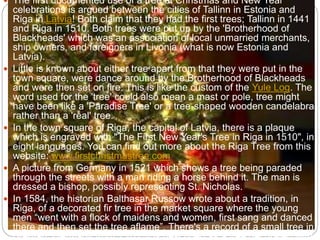
 The first documented use of a tree at Christmas and New Year
celebrations is argued between the cities of Tallinn in Estonia and
Riga in Latvia! Both claim that they had the first trees; Tallinn in 1441
and Riga in 1510. Both trees were put up by the 'Brotherhood of
Blackheads' which was an association of local unmarried merchants,
ship owners, and foreigners in Livonia (what is now Estonia and
Latvia).
 Little is known about either tree apart from that they were put in the
town square, were dance around by the Brotherhood of Blackheads
and were then set on fire. This is like the custom of the Yule Log. The
word used for the 'tree' could also mean a mast or pole, tree might
have been like a 'Paradise Tree' or a tree-shaped wooden candelabra
rather than a 'real' tree.
 In the town square of Riga, the capital of Latvia, there is a plaque
which is engraved with "The First New Year's Tree in Riga in 1510", in
eight languages. You can find out more about the Riga Tree from this
website: www.firstchristmastree.com
 A picture from Germany in 1521 which shows a tree being paraded
through the streets with a man riding a horse behind it. The man is
dressed a bishop, possibly representing St. Nicholas.
 In 1584, the historian Balthasar Russow wrote about a tradition, in
Riga, of a decorated fir tree in the market square where the young
men “went with a flock of maidens and women, first sang and danced
there and then set the tree aflame”. There's a record of a small tree in
Breman, Germany from 1570. It is described as a tree decorated with
 The first first person to bring a Christmas Tree into a house, in the way we know it
today, may have been the 16th century German preacher Martin Luther. A story is
told that, one night before Christmas, he was walking through the forest and
looked up to see the stars shining through the tree branches. It was so beautiful,
that he went home and told his children that it reminded him of Jesus, who left the
stars of heaven to come to earth at Christmas. Some people say this is the same
tree as the 'Riga' tree, but it isn't! The Riga tree originally took place a few
decades earlier.
 The custom of having Christmas trees could well have travelled along the Baltic
sea, from Latvia to Germany. In the 1400s and 1500s, the countries which are
now Germany and Latvia were them part of two larger empires which were
neighbors.
 Another story says that St. Boniface of Crediton (a village in Devon, UK) left
England and traveled to Germany to preach to the pagan German tribes and
convert them to Christianity. He is said to have come across a group of pagans
about to sacrifice a young boy while worshipping an oak tree. In anger, and to
stop the sacrifice, St. Boniface is said to have cut down the oak tree and, to his
amazement, a young fir tree sprang up from the roots of the oak tree. St. Boniface
took this as a sign of the Christian faith and his followers decorated the tree with
candles so that St. Boniface could preach to the pagans at night.
 There is another legend, from Germany, about how the Christmas Tree came into
being, it goes:
 Once on a cold Christmas Eve night, a forester and his family were in their
cottage gathered round the fire to keep warm. Suddenly there was a knock on the
door. When the forester opened the door, he found a poor little boy standing on
the door step, lost and alone. The forester welcomed him into his house and the
family fed and washed him and put him to bed in the youngest sons own bed (he
had to share with his brother that night!). The next morning, Christmas Morning,
the family were woken up by a choir of angels, and the poor little boy had turned
 In Germany, the first Christmas Trees were decorated with
edible things, such as gingerbread and gold covered apples.
Then glass makers made special small ornaments similar to
some of the decorations used today. In 1605 an unknown
German wrote: "At Christmas they set up fir trees in the parlours
of Strasbourg and hang thereon roses cut out of many-colored
paper, apples, wafers, gold foil, sweets, etc."
 At first, a figure of the Baby Jesus was put on the top of the tree.
Over time it changed to an angel/fairy that told the shepherds
about Jesus, or a star like the Wise Men saw.
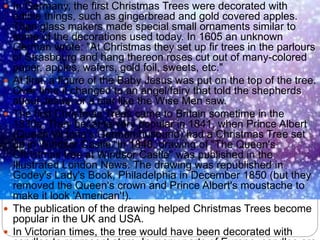
 The first Christmas Trees came to Britain sometime in the
1830s. They became very popular in 1841, when Prince Albert
(Queen Victoria's German husband) had a Christmas Tree set
up in Windsor Castle. In 1848, drawing of "The Queen's
Christmas tree at Windsor Castle" was published in the
Illustrated London News. The drawing was republished in
Godey's Lady's Book, Philadelphia in December 1850 (but they
removed the Queen's crown and Prince Albert's moustache to
make it look 'American'!).
 The publication of the drawing helped Christmas Trees become
popular in the UK and USA.
 In Victorian times, the tree would have been decorated with
Santa
 St. Nicholas was a Bishop who lived in the fourth century in a place called Myra in Asia Minor (now called
Turkey). He was a very rich man because his parents died when he was young and left him a lot of
money. He was also a very kind man and had a reputation for helping the poor and giving secret gifts to
people who needed it. There are several legends about St. Nicholas, although we don't know if any of
them are true!
 Image from the St. Nicholas Center
www.stnicholascenter.orgThe most famous story about St. Nicholas tells how the custom of hanging up
stockings to get presents in first started! It goes like this:
 There was a poor man who had three daughters. He was so poor, he did not have enough money for a
dowry, so his daughters couldn't get married. (A dowry is a sum of money paid to the bridegroom by the
brides parents on the wedding day. This still happens in some countries, even today.) One night, Nicholas
secretly dropped a bag of gold down the chimney and into the house (This meant that the oldest daughter
was then able to be married.). The bag fell into a stocking that had been hung by the fire to dry! This was
repeated later with the second daughter. Finally, determined to discover the person who had given him
the money, the father secretly hid by the fire every evening until he caught Nicholas dropping in a bag of
gold. Nicholas begged the man to not tell anyone what he had done, because he did not want to bring
attention to himself. But soon the news got out and when anyone received a secret gift, it was thought that
maybe it was from Nicholas.
 Because of his kindness Nicholas was made a Saint. St. Nicholas is not only the saint of children but also
of sailors! One story tells of him helping some sailors that were caught in a dreadful storm off the coast of
Turkey. The storm was raging around them and all the men were terrified that their ship would sink
beneath the giant waves. They prayed to St. Nicholas to help them. Suddenly, he was standing on the
deck before them. He ordered the sea to be calm, the storm died away, and they were able to sail their
ship safely to port.
 St. Nicholas was exiled from Myra and later put in prison during the persecution by the Emperor
Diocletian. No one is really knows when he died, but it was on 6th December in either 345 or 352. In
1087, his bones were stolen from Turkey by some Italian merchant sailors. The bones are now kept in the
Church named after him in the Italian port of Bari. On St. Nicholas feast day (6th December), the sailors of
Bari still carry his statue from the Cathedral out to sea, so that he can bless the waters and so give them
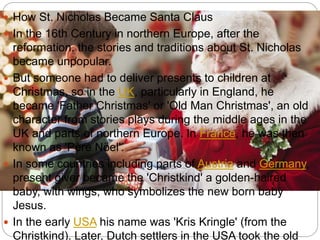
 How St. Nicholas Became Santa Claus
 In the 16th Century in northern Europe, after the
reformation, the stories and traditions about St. Nicholas
became unpopular.
 But someone had to deliver presents to children at
Christmas, so in the UK, particularly in England, he
became 'Father Christmas' or 'Old Man Christmas', an old
character from stories plays during the middle ages in the
UK and parts of northern Europe. In France, he was then
known as 'Père Nöel'.
 In some countries including parts of Austria and Germany,
present giver became the 'Christkind' a golden-haired
baby, with wings, who symbolizes the new born baby
Jesus.
 In the early USA his name was 'Kris Kringle' (from the
Christkind). Later, Dutch settlers in the USA took the old
Merry Chirstmas

Chirstmas

  • 1.
  • 2.
    The History ofChristmas Trees  The evergreen fir tree has traditionally been used to celebrate winter festivals (pagan and Christian) for thousands of years. Pagans used branches of it to decorate their homes during the winter solstice, as it made them think of the spring to come. The Romans used Fir Trees to decorate their temples at the festival of Saturnalia. Christians use it as a sign of everlasting life with God.  Nobody is really sure when Fir trees were first used as Christmas trees. It probably began about 1000 years ago in Northern Europe. Many early Christmas Trees seem to have been hung upside down from the ceiling using chains (hung from chandeliers/lighting hooks).  Other early Christmas Trees, across many parts of northern Europe, were cherry or hawthorn plants (or a branch of the plant) that were put into pots and brought inside so they would hopefully flower at Christmas time. If you couldn't afford a real plant, people made pyramids of woods and they were decorated to look like a tree with paper, apples and candles. Sometimes they were carried around from house to house, rather than being displayed in a home.  It's possible that the wooden pyramid trees were meant to be like Paradise Trees. These were used in medieval German Mystery or Miracle Plays that were acted out in front of Churches on Christmas Eve. In early church calendars of saints, 24th December was Adam and Eve's day. The Paradise
  • 3.
     The firstdocumented use of a tree at Christmas and New Year celebrations is argued between the cities of Tallinn in Estonia and Riga in Latvia! Both claim that they had the first trees; Tallinn in 1441 and Riga in 1510. Both trees were put up by the 'Brotherhood of Blackheads' which was an association of local unmarried merchants, ship owners, and foreigners in Livonia (what is now Estonia and Latvia).  Little is known about either tree apart from that they were put in the town square, were dance around by the Brotherhood of Blackheads and were then set on fire. This is like the custom of the Yule Log. The word used for the 'tree' could also mean a mast or pole, tree might have been like a 'Paradise Tree' or a tree-shaped wooden candelabra rather than a 'real' tree.  In the town square of Riga, the capital of Latvia, there is a plaque which is engraved with "The First New Year's Tree in Riga in 1510", in eight languages. You can find out more about the Riga Tree from this website: www.firstchristmastree.com  A picture from Germany in 1521 which shows a tree being paraded through the streets with a man riding a horse behind it. The man is dressed a bishop, possibly representing St. Nicholas.  In 1584, the historian Balthasar Russow wrote about a tradition, in Riga, of a decorated fir tree in the market square where the young men “went with a flock of maidens and women, first sang and danced there and then set the tree aflame”. There's a record of a small tree in Breman, Germany from 1570. It is described as a tree decorated with
  • 4.
     The firstfirst person to bring a Christmas Tree into a house, in the way we know it today, may have been the 16th century German preacher Martin Luther. A story is told that, one night before Christmas, he was walking through the forest and looked up to see the stars shining through the tree branches. It was so beautiful, that he went home and told his children that it reminded him of Jesus, who left the stars of heaven to come to earth at Christmas. Some people say this is the same tree as the 'Riga' tree, but it isn't! The Riga tree originally took place a few decades earlier.  The custom of having Christmas trees could well have travelled along the Baltic sea, from Latvia to Germany. In the 1400s and 1500s, the countries which are now Germany and Latvia were them part of two larger empires which were neighbors.  Another story says that St. Boniface of Crediton (a village in Devon, UK) left England and traveled to Germany to preach to the pagan German tribes and convert them to Christianity. He is said to have come across a group of pagans about to sacrifice a young boy while worshipping an oak tree. In anger, and to stop the sacrifice, St. Boniface is said to have cut down the oak tree and, to his amazement, a young fir tree sprang up from the roots of the oak tree. St. Boniface took this as a sign of the Christian faith and his followers decorated the tree with candles so that St. Boniface could preach to the pagans at night.  There is another legend, from Germany, about how the Christmas Tree came into being, it goes:  Once on a cold Christmas Eve night, a forester and his family were in their cottage gathered round the fire to keep warm. Suddenly there was a knock on the door. When the forester opened the door, he found a poor little boy standing on the door step, lost and alone. The forester welcomed him into his house and the family fed and washed him and put him to bed in the youngest sons own bed (he had to share with his brother that night!). The next morning, Christmas Morning, the family were woken up by a choir of angels, and the poor little boy had turned
  • 5.
     In Germany,the first Christmas Trees were decorated with edible things, such as gingerbread and gold covered apples. Then glass makers made special small ornaments similar to some of the decorations used today. In 1605 an unknown German wrote: "At Christmas they set up fir trees in the parlours of Strasbourg and hang thereon roses cut out of many-colored paper, apples, wafers, gold foil, sweets, etc."  At first, a figure of the Baby Jesus was put on the top of the tree. Over time it changed to an angel/fairy that told the shepherds about Jesus, or a star like the Wise Men saw.  The first Christmas Trees came to Britain sometime in the 1830s. They became very popular in 1841, when Prince Albert (Queen Victoria's German husband) had a Christmas Tree set up in Windsor Castle. In 1848, drawing of "The Queen's Christmas tree at Windsor Castle" was published in the Illustrated London News. The drawing was republished in Godey's Lady's Book, Philadelphia in December 1850 (but they removed the Queen's crown and Prince Albert's moustache to make it look 'American'!).  The publication of the drawing helped Christmas Trees become popular in the UK and USA.  In Victorian times, the tree would have been decorated with
  • 6.
    Santa  St. Nicholaswas a Bishop who lived in the fourth century in a place called Myra in Asia Minor (now called Turkey). He was a very rich man because his parents died when he was young and left him a lot of money. He was also a very kind man and had a reputation for helping the poor and giving secret gifts to people who needed it. There are several legends about St. Nicholas, although we don't know if any of them are true!  Image from the St. Nicholas Center www.stnicholascenter.orgThe most famous story about St. Nicholas tells how the custom of hanging up stockings to get presents in first started! It goes like this:  There was a poor man who had three daughters. He was so poor, he did not have enough money for a dowry, so his daughters couldn't get married. (A dowry is a sum of money paid to the bridegroom by the brides parents on the wedding day. This still happens in some countries, even today.) One night, Nicholas secretly dropped a bag of gold down the chimney and into the house (This meant that the oldest daughter was then able to be married.). The bag fell into a stocking that had been hung by the fire to dry! This was repeated later with the second daughter. Finally, determined to discover the person who had given him the money, the father secretly hid by the fire every evening until he caught Nicholas dropping in a bag of gold. Nicholas begged the man to not tell anyone what he had done, because he did not want to bring attention to himself. But soon the news got out and when anyone received a secret gift, it was thought that maybe it was from Nicholas.  Because of his kindness Nicholas was made a Saint. St. Nicholas is not only the saint of children but also of sailors! One story tells of him helping some sailors that were caught in a dreadful storm off the coast of Turkey. The storm was raging around them and all the men were terrified that their ship would sink beneath the giant waves. They prayed to St. Nicholas to help them. Suddenly, he was standing on the deck before them. He ordered the sea to be calm, the storm died away, and they were able to sail their ship safely to port.  St. Nicholas was exiled from Myra and later put in prison during the persecution by the Emperor Diocletian. No one is really knows when he died, but it was on 6th December in either 345 or 352. In 1087, his bones were stolen from Turkey by some Italian merchant sailors. The bones are now kept in the Church named after him in the Italian port of Bari. On St. Nicholas feast day (6th December), the sailors of Bari still carry his statue from the Cathedral out to sea, so that he can bless the waters and so give them
  • 7.
     How St.Nicholas Became Santa Claus  In the 16th Century in northern Europe, after the reformation, the stories and traditions about St. Nicholas became unpopular.  But someone had to deliver presents to children at Christmas, so in the UK, particularly in England, he became 'Father Christmas' or 'Old Man Christmas', an old character from stories plays during the middle ages in the UK and parts of northern Europe. In France, he was then known as 'Père Nöel'.  In some countries including parts of Austria and Germany, present giver became the 'Christkind' a golden-haired baby, with wings, who symbolizes the new born baby Jesus.  In the early USA his name was 'Kris Kringle' (from the Christkind). Later, Dutch settlers in the USA took the old
  • 8.