
How HIV and its treatment (ART) cause
diabetes mellitus
Dr. Abbas A Assayed
MBBS, MPH, MSc
25.2.1439
14.11.2017
• HIV andTB
Agree
• HIV and STIs
Agree
• HIV and Opportunistic infections
Agree
• HIV and Malaria
mmm?
• HIV and Ca Cervix?
mmm?
• HIV and Diabetes?
???
Definition of Diabetes
Diabetes is a chronic disease, which occurs when the pancreas
does not produce enough insulin, or when the body cannot
effectively use the insulin it produces.
This leads to an increased concentration of glucose in the blood
(hyperglycaemia)
WHO. Health topics, diabetes [Internet]; http://www.who.int/topics/diabetes_mellitus/en/
Epidemiology; global
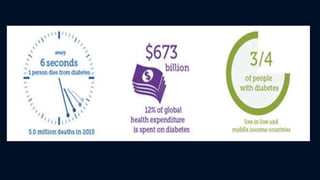
• Diabetes Mellitus (DM) since the past three decades has been a
major public health problem worldwide.
• The disease affects all countries alike but during the past decade
countries of Low and Middle Income Class (LMIC) were hard hit
by the epidemic.
• Increasing prevalence from 4.7 in 1980 to 8.5 in 2014.
• This prevalence accounts for about 422 million cases in 2014
compared to 108 million cases in 1980.
Mathers, Colin D. et.al. http://journals.plos.org/plosmedicine/article?id=10.1371/journal.pmed.0030442
Epidemiology; Middle East
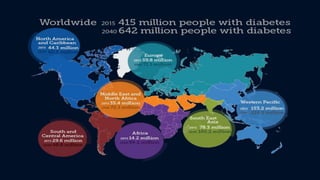
Diabetes has been in an increasing pattern in all Arab countries
since 1980s
Abuyassin, Bisher. Laher, Ismail. World J Diabetes. 2016 Apr 25; 7(8): 165–174.
And the number of people living with DM is projected to
increase by 96.2% by the year 2035.
IDF Diabetes Atlas, 6th edition. Brussels, Belgium: IDF; 2013.
Epidemiology; Saudi Arabia
•Saudi Arabia, Kuwait and Qatar are among the top 10
countries with highest prevalence
IDF Diabetes Atlas, 6th edition. Brussels, Belgium: IDF; 2013
• In Saudi Arabia the prevalence increased from 2.4% in
1982 to 25.4 in 2014
Abuyassin, Bisher. Laher, Ismail. World J Diabetes. 2016 Apr 25; 7(8): 165–174.
HUMAN IMMUNODEFICIENCY VIRUS (HIV)
Definition of HIV
The human immunodeficiency virus (HIV) infects cells (CD4)
of the immune system, destroying or impairing their function.
Infection with the virus results in progressive deterioration of
the immune system, leading to “immune deficiency”
Acquired immunodeficiency syndrome (AIDS) is a term which
applies to the most advanced stages of HIV infection.
who. http://www.who.int/features/qa/71/en/
Epidemiology; global
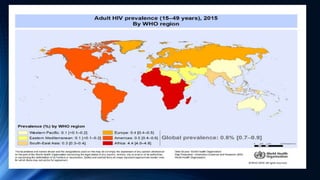
The Global prevalence is 0.8% (0.7-0.9)
(who 2016)
oIn 2015 the number of PLWHA was 36.7 million.
o1.8 million were children under 15 years old
oAbout 2.1 million were newly infected in the same year, 2015.
https://www.hiv.gov/ hiv-basics/overview/data-andtrends/global-statistics
Epidemiology; Africa
The African prevalence in 2016 is 4.4% (4.0-4.8)
oThe mostly affected region
oNumber of PLWHA was estimated to be 25.6 million
Epidemiology; Middle East
• The prevalence in the MENA region is the second lowest in the
world 0.01-.02%
Joint UN Programme on HIV/AIDS and WHO. AIDS epidemic update 2006. Geneva: UNAIDS, 2006.
•Mainly among the high risk groups.
Abu-Raddad, L J, et al. Epidemiology of HIV infection in the Middle East and North Africa. AIDS: July 2010 - Volume 24 - Issue - p S5–S23
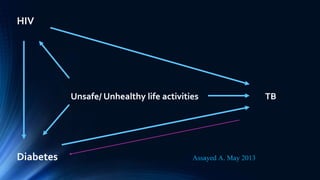
DIABETES AND HIV
HIV
Unsafe/ Unhealthy life activities TB
Diabetes Assayed A. May 2013
 It has been confirmed that HIV/ AIDS increases the prevalence
of DM
(Allain and Bothmer, 2011)
 Higher prevalence of DM among HIV positive patients who
receive medical care
Alfonso C Hernandez-Romieu,et al. http://dx.doi.org/10.1136/bmjdrc-2016-000304
 19.5 million patients were on HAART by December 2016 (53%)
http://www.who.int/hiv/data/en/
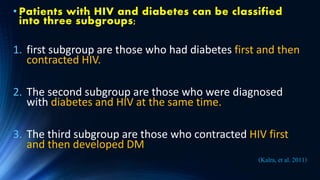
• Patients with HIV and diabetes can be classified
into three subgroups;
1. first subgroup are those who had diabetes first and then
contracted HIV.
2. The second subgroup are those who were diagnosed
with diabetes and HIV at the same time.
3. The third subgroup are those who contracted HIV first
and then developed DM
(Kalra, et al. 2011)
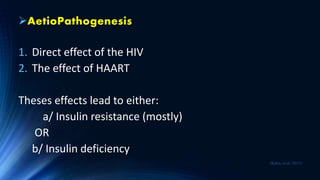
AetioPathogenesis
1. Direct effect of the HIV
2. The effect of HAART
Theses effects lead to either:
a/ Insulin resistance (mostly)
OR
b/ Insulin deficiency
(Kalra, et al. 2011)
•Highly associated with type 2 DM than type 1(Kalra, et al. 2011)
•Higher risk with:
1. Longer duration of the infection
2. High viral load
3. Low CD4 cells count (Fichtenbaum, et al. 2005).
4. Increasing age
5. Obesity Guaraldi G, et al.
6. Vitamine D deficiency
7. Co-infection with HCV (TNC α)
8. Abdominal fats (higher waist circumference)
Effects of the HIV itself
1. Autoimmune diabetes after immune restoration by HAART (T1DM)
2. HIV => Growth hormone deficiency => insulin resistance
3. May implicated in pancreatic dysfunction
Adverse effects of HAART
• Protease Inhibitors (PIs) = atazanavir, saquinavir and ritonavir.
1. Increase insulin resistance and reduce secretion
2. and interferes with glucose transporter type 4-mediated glucose
transport
3. Adipocyte inflammation, release of free fatty acids => insulin
resistance
When PIs stopped hyperglycemia resolves in all patients.
Different PIs have different effects
• Nucleoside reverse transcriptase Inhibitors (NRTIs)
1. stavudine, zidovudine => Insulin resistance,
2. Lipodystrophy syndrome and
3. mitochondrial dysfunction
• Drugs to manage opportunistic infections:
1. e.g. Pentamidine (P.carini pneumonia) => β cell toxicity
2. Megesterol acetate for stimulation of appetite =>
glucocorticoid-like activity
• Improvement of nutritional status
References
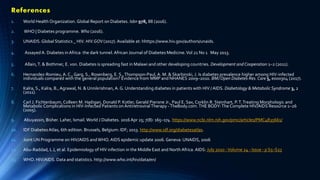
1. World Health Organization. Global Report on Diabetes. Isbn 978, 88 (2016).
2. WHO | Diabetes programme. Who (2016).
3. UNAIDS.Global Statistics _ HIV. HIV.GOV (2017). Available at: hhttps://www.hiv.gov/authors/unaids.
4. Assayed A. Diabetes inAfrica: the dark tunnel.African Journal of Diabetes Medicine.Vol 21 No 1 May 2013.
5. Allain,T. & Bothmer, E. von. Diabetes is spreading fast in Malawi and other developing countries. Development and Cooperation 1–2 (2011).
6. Hernandez-Romieu,A. C., Garg, S., Rosenberg, E. S.,Thompson-Paul,A. M. & Skarbinski, J. Is diabetes prevalence higher among HIV-infected
individuals compared with the general population? Evidence from MMP and NHANES 2009–2010. BMJ Open Diabetes Res. Care 5, e000304 (2017).
7. Kalra, S., Kalra, B., Agrawal, N. & Unnikrishnan,A. G. Understanding diabetes in patients with HIV /AIDS. Diabetology & Metabolic Syndrome 3, 2
(2011).
8. Carl J. Fichtenbaum,Colleen M. Hadigan, Donald P. Kotler, Gerald Pierone Jr., Paul E. Sax, Corklin R. Steinhart, P.T.Treating Morphologic and
Metabolic Complications in HIV-Infected Patients on AntiretroviralTherapy -TheBody.com.THE BODY:The Complete HIV/AIDS Resource 1–26
(2005).
9. Abuyassin, Bisher. Laher, Ismail. World J Diabetes. 2016 Apr 25; 7(8): 165–174. https://www.ncbi.nlm.nih.gov/pmc/articles/PMC4835661/
10. IDF DiabetesAtlas, 6th edition. Brussels, Belgium: IDF; 2013. http://www.idf.org/diabetesatlas.
11. Joint UN Programme on HIV/AIDS andWHO. AIDS epidemic update 2006. Geneva: UNAIDS, 2006
12. Abu-Raddad, L J, et al. Epidemiology of HIV infection in the Middle East and North Africa. AIDS: July 2010 -Volume 24 - Issue - p S5–S23
13. WHO. HIV/AIDS. Data and statistics. http://www.who.int/hiv/data/en/
Hiv and diabetes

Hiv and diabetes

  • 1.
    How HIV andits treatment (ART) cause diabetes mellitus Dr. Abbas A Assayed MBBS, MPH, MSc 25.2.1439 14.11.2017
  • 2.
    • HIV andTB Agree •HIV and STIs Agree • HIV and Opportunistic infections Agree • HIV and Malaria mmm? • HIV and Ca Cervix? mmm? • HIV and Diabetes? ???
  • 3.
    Definition of Diabetes Diabetesis a chronic disease, which occurs when the pancreas does not produce enough insulin, or when the body cannot effectively use the insulin it produces. This leads to an increased concentration of glucose in the blood (hyperglycaemia) WHO. Health topics, diabetes [Internet]; http://www.who.int/topics/diabetes_mellitus/en/
  • 4.
    Epidemiology; global • DiabetesMellitus (DM) since the past three decades has been a major public health problem worldwide. • The disease affects all countries alike but during the past decade countries of Low and Middle Income Class (LMIC) were hard hit by the epidemic. • Increasing prevalence from 4.7 in 1980 to 8.5 in 2014. • This prevalence accounts for about 422 million cases in 2014 compared to 108 million cases in 1980. Mathers, Colin D. et.al. http://journals.plos.org/plosmedicine/article?id=10.1371/journal.pmed.0030442
  • 5.
    Epidemiology; Middle East Diabeteshas been in an increasing pattern in all Arab countries since 1980s Abuyassin, Bisher. Laher, Ismail. World J Diabetes. 2016 Apr 25; 7(8): 165–174. And the number of people living with DM is projected to increase by 96.2% by the year 2035. IDF Diabetes Atlas, 6th edition. Brussels, Belgium: IDF; 2013.
  • 6.
    Epidemiology; Saudi Arabia •SaudiArabia, Kuwait and Qatar are among the top 10 countries with highest prevalence IDF Diabetes Atlas, 6th edition. Brussels, Belgium: IDF; 2013 • In Saudi Arabia the prevalence increased from 2.4% in 1982 to 25.4 in 2014 Abuyassin, Bisher. Laher, Ismail. World J Diabetes. 2016 Apr 25; 7(8): 165–174.
  • 9.
  • 10.
    Definition of HIV Thehuman immunodeficiency virus (HIV) infects cells (CD4) of the immune system, destroying or impairing their function. Infection with the virus results in progressive deterioration of the immune system, leading to “immune deficiency” Acquired immunodeficiency syndrome (AIDS) is a term which applies to the most advanced stages of HIV infection. who. http://www.who.int/features/qa/71/en/
  • 11.
    Epidemiology; global The Globalprevalence is 0.8% (0.7-0.9) (who 2016) oIn 2015 the number of PLWHA was 36.7 million. o1.8 million were children under 15 years old oAbout 2.1 million were newly infected in the same year, 2015. https://www.hiv.gov/ hiv-basics/overview/data-andtrends/global-statistics
  • 12.
    Epidemiology; Africa The Africanprevalence in 2016 is 4.4% (4.0-4.8) oThe mostly affected region oNumber of PLWHA was estimated to be 25.6 million
  • 13.
    Epidemiology; Middle East •The prevalence in the MENA region is the second lowest in the world 0.01-.02% Joint UN Programme on HIV/AIDS and WHO. AIDS epidemic update 2006. Geneva: UNAIDS, 2006. •Mainly among the high risk groups. Abu-Raddad, L J, et al. Epidemiology of HIV infection in the Middle East and North Africa. AIDS: July 2010 - Volume 24 - Issue - p S5–S23
  • 15.
  • 16.
    HIV Unsafe/ Unhealthy lifeactivities TB Diabetes Assayed A. May 2013
  • 17.
     It hasbeen confirmed that HIV/ AIDS increases the prevalence of DM (Allain and Bothmer, 2011)  Higher prevalence of DM among HIV positive patients who receive medical care Alfonso C Hernandez-Romieu,et al. http://dx.doi.org/10.1136/bmjdrc-2016-000304  19.5 million patients were on HAART by December 2016 (53%) http://www.who.int/hiv/data/en/
  • 18.
    • Patients withHIV and diabetes can be classified into three subgroups; 1. first subgroup are those who had diabetes first and then contracted HIV. 2. The second subgroup are those who were diagnosed with diabetes and HIV at the same time. 3. The third subgroup are those who contracted HIV first and then developed DM (Kalra, et al. 2011)
  • 19.
    AetioPathogenesis 1. Direct effectof the HIV 2. The effect of HAART Theses effects lead to either: a/ Insulin resistance (mostly) OR b/ Insulin deficiency (Kalra, et al. 2011)
  • 20.
    •Highly associated withtype 2 DM than type 1(Kalra, et al. 2011) •Higher risk with: 1. Longer duration of the infection 2. High viral load 3. Low CD4 cells count (Fichtenbaum, et al. 2005). 4. Increasing age 5. Obesity Guaraldi G, et al. 6. Vitamine D deficiency 7. Co-infection with HCV (TNC α) 8. Abdominal fats (higher waist circumference)
  • 21.
    Effects of theHIV itself 1. Autoimmune diabetes after immune restoration by HAART (T1DM) 2. HIV => Growth hormone deficiency => insulin resistance 3. May implicated in pancreatic dysfunction
  • 22.
    Adverse effects ofHAART • Protease Inhibitors (PIs) = atazanavir, saquinavir and ritonavir. 1. Increase insulin resistance and reduce secretion 2. and interferes with glucose transporter type 4-mediated glucose transport 3. Adipocyte inflammation, release of free fatty acids => insulin resistance When PIs stopped hyperglycemia resolves in all patients. Different PIs have different effects
  • 23.
    • Nucleoside reversetranscriptase Inhibitors (NRTIs) 1. stavudine, zidovudine => Insulin resistance, 2. Lipodystrophy syndrome and 3. mitochondrial dysfunction • Drugs to manage opportunistic infections: 1. e.g. Pentamidine (P.carini pneumonia) => β cell toxicity 2. Megesterol acetate for stimulation of appetite => glucocorticoid-like activity • Improvement of nutritional status
  • 24.
    References 1. World HealthOrganization. Global Report on Diabetes. Isbn 978, 88 (2016). 2. WHO | Diabetes programme. Who (2016). 3. UNAIDS.Global Statistics _ HIV. HIV.GOV (2017). Available at: hhttps://www.hiv.gov/authors/unaids. 4. Assayed A. Diabetes inAfrica: the dark tunnel.African Journal of Diabetes Medicine.Vol 21 No 1 May 2013. 5. Allain,T. & Bothmer, E. von. Diabetes is spreading fast in Malawi and other developing countries. Development and Cooperation 1–2 (2011). 6. Hernandez-Romieu,A. C., Garg, S., Rosenberg, E. S.,Thompson-Paul,A. M. & Skarbinski, J. Is diabetes prevalence higher among HIV-infected individuals compared with the general population? Evidence from MMP and NHANES 2009–2010. BMJ Open Diabetes Res. Care 5, e000304 (2017). 7. Kalra, S., Kalra, B., Agrawal, N. & Unnikrishnan,A. G. Understanding diabetes in patients with HIV /AIDS. Diabetology & Metabolic Syndrome 3, 2 (2011). 8. Carl J. Fichtenbaum,Colleen M. Hadigan, Donald P. Kotler, Gerald Pierone Jr., Paul E. Sax, Corklin R. Steinhart, P.T.Treating Morphologic and Metabolic Complications in HIV-Infected Patients on AntiretroviralTherapy -TheBody.com.THE BODY:The Complete HIV/AIDS Resource 1–26 (2005). 9. Abuyassin, Bisher. Laher, Ismail. World J Diabetes. 2016 Apr 25; 7(8): 165–174. https://www.ncbi.nlm.nih.gov/pmc/articles/PMC4835661/ 10. IDF DiabetesAtlas, 6th edition. Brussels, Belgium: IDF; 2013. http://www.idf.org/diabetesatlas. 11. Joint UN Programme on HIV/AIDS andWHO. AIDS epidemic update 2006. Geneva: UNAIDS, 2006 12. Abu-Raddad, L J, et al. Epidemiology of HIV infection in the Middle East and North Africa. AIDS: July 2010 -Volume 24 - Issue - p S5–S23 13. WHO. HIV/AIDS. Data and statistics. http://www.who.int/hiv/data/en/

Editor's Notes

  • #22 Glutamic acid decarboxylase =