F RENSICS
   CORPORATION            TM


 HITECH for HIPAA


 www.forensicscorp.com
 info@forensicscorp.com
      877.248.DATA
      480.747.1732
Overview
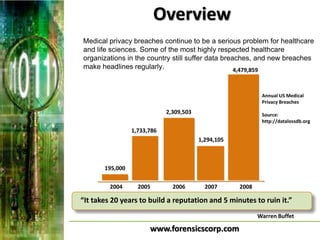
Medical privacy breaches continue to be a serious problem for healthcare
and life sciences. Some of the most highly respected healthcare
organizations in the country still suffer data breaches, and new breaches
make headlines regularly.                          4,479,859


                                                             Annual US Medical
                                                             Privacy Breaches
                             2,309,503                       Source:
                                                             http://datalossdb.org
                 1,733,786
                                         1,294,105


       195,000

         2004      2005        2006        2007      2008

“It takes 20 years to build a reputation and 5 minutes to ruin it.”
                                                            Warren Buffet

                       www.forensicscorp.com
The Good
•   Buried within the Economic Stimulus Bill is the Health Information
    Technology for Economic and Clinical Health (HITECH) Act.
•   The HITECH Act provides approximately $31.2 billion for healthcare
    infrastructure and adoption of electronic health records (EHR). The
    Congressional Budget Office assumes that the Act will save federal healthcare
    programs an estimated $12 billion from higher EHR use, resulting in a net
    cost to the federal government of $19.2 billion.
•   The money largely flows from Medicare and Medicaid incentives to
    physicians and hospitals for the "meaningful use" of certified EHRs, including
    existing systems as well as new installations or upgrades. Non-hospital based
    physicians could receive up to $44,000 from Medicare or $64,000 from
    Medicaid, and hospitals with high Medicare and Medicaid volumes could
    receive up to $11 million. These incentives will be paid out over a 4- to 5-year
    period beginning in 2011.


                        www.forensicscorp.com
The Bad
•     Medical privacy breaches continue to be a serious problem for healthcare
      and life sciences. Some of the most highly respected healthcare
      organizations in the country still suffer data breaches, and new breaches
      make headlines regularly.
•      The HITECH Act expands HIPAA's coverage, increases compliance obligations,
      and strengthens enforcement penalties.
•     In response to the growing number of privacy breaches, the ARRA expands
      the scope of the HIPAA Privacy and Security Rules.2
•     Beginning on September 15, 2009, HIPAA-covered entities will be required
      to notify individuals when their “unsecured” PHI has been compromised.
      The new enforcement provisions will make compliance failure more costly
      and visible to the public. These new requirements will require greater
      efforts by healthcare-related organizations to protect PHI and increase the
      risk of penalties, fines, and litigation.
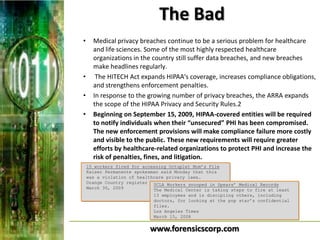
    15 workers fired for accessing Octuplet Mom’s File
    Kaiser Permanente spokesman said Monday that this
    was a violation of healthcare privacy laws…
    Orange Country register UCLA Workers snooped in Spears’ Medical Records
    March 30, 2009           The Medical Center is taking steps to fire at least
                             13 employees and is discipling others, including
                             doctors, for looking at the pop star’s confidential
                             files.
                             Los Angeles Times
                             March 15, 2008


                           www.forensicscorp.com
and The Ugly
•   Medical privacy breaches continue to be a serious problem for healthcare
    and life sciences. Some of the most highly respected healthcare
    organizations in the country still suffer data breaches, and new breaches
    make headlines regularly and consequences can be severe.

•   To date, the consequences of health data breaches have fallen into two
    categories: financial; and damage to an organization’s image and reputation.

•   Monetary losses resulting from privacy breaches are due to fines, penalties,
    legal fees, staff time spent responding to the incident, lost business, and in
    the case for-profit HCOs, decreased stock valuation.

•   Based on a recent Ponemon Institute study, the average cost per lost
    healthcare record was projected to be $282 per record in 2008, or nearly $3
    million for breach of 10,000 records.

•   Across all industries, the average per-incident cost of privacy breaches in
    2008 was $6.7 million, up from $6.3 million in 2007.


                        www.forensicscorp.com
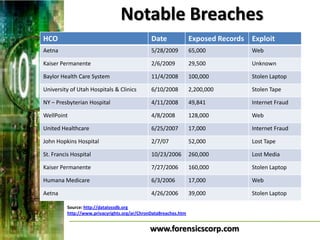
Notable Breaches
HCO                                            Date               Exposed Records Exploit
Aetna                                          5/28/2009          65,000          Web

Kaiser Permanente                              2/6/2009           29,500          Unknown

Baylor Health Care System                      11/4/2008          100,000         Stolen Laptop

University of Utah Hospitals & Clinics         6/10/2008          2,200,000       Stolen Tape

NY – Presbyterian Hospital                     4/11/2008          49,841          Internet Fraud

WellPoint                                      4/8/2008           128,000         Web

United Healthcare                              6/25/2007          17,000          Internet Fraud

John Hopkins Hospital                          2/7/07             52,000          Lost Tape

St. Francis Hospital                           10/23/2006         260,000         Lost Media

Kaiser Permanente                              7/27/2006          160,000         Stolen Laptop

Humana Medicare                                6/3/2006           17,000          Web

Aetna                                          4/26/2006          39,000          Stolen Laptop

          Source: http://datalossdb.org
          http://www.privacyrights.org/ar/ChronDataBreaches.htm


                                              www.forensicscorp.com
The Need for New Approach
• Electronic PHI (protected health information) can reside anywhere, which
  means that healthcare organizations need to focus their efforts on protecting
  sensitive information wherever it is stored. The aggressive promotion of HIT
  systems, coupled with the exponential growth of digital storage, increases the
  potential number and severity of data breaches and other security issues.

• Whether a result of hackers or employees, companies remain at risk of losing
  or compromising information assets. In this difficult economic environment
  with increasing regulatory demands, HCOs need to consider a more holistic
  and efficient approach to information management based on a strategic
  data classification program that discovers and controls PHI wherever it is
  stored.


                       www.forensicscorp.com
The Challenge
• The fragmented approach to healthcare delivery also hinders efforts to
  systematically and comprehensively manage PHI, resulting in inconsistent
  approaches involving the use of ineffective methods and variable application
  of methods known to be effective, and yielding unpredictable results.

• Most healthcare providers place a high priority on protecting the privacy of
  PHI. However, with so many people from so many entities accessing PHI in so
  many ways, their understanding of both the importance of this protection and
  how to effectively facilitate it will inevitably vary. Something will undoubtedly
  fall through.

• “Most companies do not have adequate processes or technologies to manage
  their unstructured data. 75 percent said they were concerned that their
  unstructured data was growing too rapidly. 63 percent said they did not have
  adequate systems to manage it.” Computerworld survey of 250 large
  companies


In 25 percent of reported data breaches, the organization did not
   know how many records were compromised by the breach.


                       www.forensicscorp.com
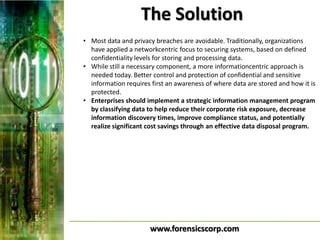
The Solution
• Most data and privacy breaches are avoidable. Traditionally, organizations
  have applied a networkcentric focus to securing systems, based on defined
  confidentiality levels for storing and processing data.
• While still a necessary component, a more informationcentric approach is
  needed today. Better control and protection of confidential and sensitive
  information requires first an awareness of where data are stored and how it is
  protected.
• Enterprises should implement a strategic information management program
  by classifying data to help reduce their corporate risk exposure, decrease
  information discovery times, improve compliance status, and potentially
  realize significant cost savings through an effective data disposal program.


                       www.forensicscorp.com
The Solution
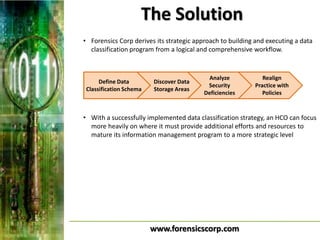
• Forensics Corp derives its strategic approach to building and executing a data
  classification program from a logical and comprehensive workflow.


                                           Analyze            Realign
      Define Data        Discover Data
                                           Security        Practice with
 Classification Schema   Storage Areas
                                          Deficiencies        Policies


• With a successfully implemented data classification strategy, an HCO can focus
  more heavily on where it must provide additional efforts and resources to
  mature its information management program to a more strategic level


                         www.forensicscorp.com
The Solution
Because PHI can now be stored in digital form in myriad locations, healthcare-
related organizations must intensify their efforts to know where patient-
sensitive information is located and ensure that it is protected wherever it is
stored. The aggressive promotion of HIT systems, coupled with the exponential
growth of digital storage, exacerbates the number and severity of data breaches
and other security issues. Whether a privacy breach is caused by hackers or well-
intentioned employees, the damages and other consequences are the same. To
achieve the goals of the new legal requirements, healthcare-related
organizations will need to execute a strategic data classification program and
utilize a more holistic approach to information security management to better
safeguard protected health information.


                       www.forensicscorp.com
Forensics Corporation
Partnering Together To:

•   Review, assess and update policies and processes.
•   Establish a Data Classification / HITECH Team.
•   Discover Data Storage areas.
•   Analyze Risk.
•   Realign Practice with Policy.
•   Leverage technology to enforce policy.
•   Provide training and good communication policies for
    employees.


                    www.forensicscorp.com
Contact Us
Email: info@forensicscorp.com

Tel.: +1.480.747.1732 or
Tel.: 1.877.248.DATA (3282)

Or for more information visit us at:
www.forensicscorp.com


            www.forensicscorp.com

Hitech for HIPAA

  • 1.
    F RENSICS CORPORATION TM HITECH for HIPAA www.forensicscorp.com info@forensicscorp.com 877.248.DATA 480.747.1732
  • 2.
    Overview Medical privacy breachescontinue to be a serious problem for healthcare and life sciences. Some of the most highly respected healthcare organizations in the country still suffer data breaches, and new breaches make headlines regularly. 4,479,859 Annual US Medical Privacy Breaches 2,309,503 Source: http://datalossdb.org 1,733,786 1,294,105 195,000 2004 2005 2006 2007 2008 “It takes 20 years to build a reputation and 5 minutes to ruin it.” Warren Buffet www.forensicscorp.com
  • 3.
    The Good • Buried within the Economic Stimulus Bill is the Health Information Technology for Economic and Clinical Health (HITECH) Act. • The HITECH Act provides approximately $31.2 billion for healthcare infrastructure and adoption of electronic health records (EHR). The Congressional Budget Office assumes that the Act will save federal healthcare programs an estimated $12 billion from higher EHR use, resulting in a net cost to the federal government of $19.2 billion. • The money largely flows from Medicare and Medicaid incentives to physicians and hospitals for the "meaningful use" of certified EHRs, including existing systems as well as new installations or upgrades. Non-hospital based physicians could receive up to $44,000 from Medicare or $64,000 from Medicaid, and hospitals with high Medicare and Medicaid volumes could receive up to $11 million. These incentives will be paid out over a 4- to 5-year period beginning in 2011. www.forensicscorp.com
  • 4.
    The Bad • Medical privacy breaches continue to be a serious problem for healthcare and life sciences. Some of the most highly respected healthcare organizations in the country still suffer data breaches, and new breaches make headlines regularly. • The HITECH Act expands HIPAA's coverage, increases compliance obligations, and strengthens enforcement penalties. • In response to the growing number of privacy breaches, the ARRA expands the scope of the HIPAA Privacy and Security Rules.2 • Beginning on September 15, 2009, HIPAA-covered entities will be required to notify individuals when their “unsecured” PHI has been compromised. The new enforcement provisions will make compliance failure more costly and visible to the public. These new requirements will require greater efforts by healthcare-related organizations to protect PHI and increase the risk of penalties, fines, and litigation. 15 workers fired for accessing Octuplet Mom’s File Kaiser Permanente spokesman said Monday that this was a violation of healthcare privacy laws… Orange Country register UCLA Workers snooped in Spears’ Medical Records March 30, 2009 The Medical Center is taking steps to fire at least 13 employees and is discipling others, including doctors, for looking at the pop star’s confidential files. Los Angeles Times March 15, 2008 www.forensicscorp.com
  • 5.
    and The Ugly • Medical privacy breaches continue to be a serious problem for healthcare and life sciences. Some of the most highly respected healthcare organizations in the country still suffer data breaches, and new breaches make headlines regularly and consequences can be severe. • To date, the consequences of health data breaches have fallen into two categories: financial; and damage to an organization’s image and reputation. • Monetary losses resulting from privacy breaches are due to fines, penalties, legal fees, staff time spent responding to the incident, lost business, and in the case for-profit HCOs, decreased stock valuation. • Based on a recent Ponemon Institute study, the average cost per lost healthcare record was projected to be $282 per record in 2008, or nearly $3 million for breach of 10,000 records. • Across all industries, the average per-incident cost of privacy breaches in 2008 was $6.7 million, up from $6.3 million in 2007. www.forensicscorp.com
  • 6.
    Notable Breaches HCO Date Exposed Records Exploit Aetna 5/28/2009 65,000 Web Kaiser Permanente 2/6/2009 29,500 Unknown Baylor Health Care System 11/4/2008 100,000 Stolen Laptop University of Utah Hospitals & Clinics 6/10/2008 2,200,000 Stolen Tape NY – Presbyterian Hospital 4/11/2008 49,841 Internet Fraud WellPoint 4/8/2008 128,000 Web United Healthcare 6/25/2007 17,000 Internet Fraud John Hopkins Hospital 2/7/07 52,000 Lost Tape St. Francis Hospital 10/23/2006 260,000 Lost Media Kaiser Permanente 7/27/2006 160,000 Stolen Laptop Humana Medicare 6/3/2006 17,000 Web Aetna 4/26/2006 39,000 Stolen Laptop Source: http://datalossdb.org http://www.privacyrights.org/ar/ChronDataBreaches.htm www.forensicscorp.com
  • 7.
    The Need forNew Approach • Electronic PHI (protected health information) can reside anywhere, which means that healthcare organizations need to focus their efforts on protecting sensitive information wherever it is stored. The aggressive promotion of HIT systems, coupled with the exponential growth of digital storage, increases the potential number and severity of data breaches and other security issues. • Whether a result of hackers or employees, companies remain at risk of losing or compromising information assets. In this difficult economic environment with increasing regulatory demands, HCOs need to consider a more holistic and efficient approach to information management based on a strategic data classification program that discovers and controls PHI wherever it is stored. www.forensicscorp.com
  • 8.
    The Challenge • Thefragmented approach to healthcare delivery also hinders efforts to systematically and comprehensively manage PHI, resulting in inconsistent approaches involving the use of ineffective methods and variable application of methods known to be effective, and yielding unpredictable results. • Most healthcare providers place a high priority on protecting the privacy of PHI. However, with so many people from so many entities accessing PHI in so many ways, their understanding of both the importance of this protection and how to effectively facilitate it will inevitably vary. Something will undoubtedly fall through. • “Most companies do not have adequate processes or technologies to manage their unstructured data. 75 percent said they were concerned that their unstructured data was growing too rapidly. 63 percent said they did not have adequate systems to manage it.” Computerworld survey of 250 large companies In 25 percent of reported data breaches, the organization did not know how many records were compromised by the breach. www.forensicscorp.com
  • 9.
    The Solution • Mostdata and privacy breaches are avoidable. Traditionally, organizations have applied a networkcentric focus to securing systems, based on defined confidentiality levels for storing and processing data. • While still a necessary component, a more informationcentric approach is needed today. Better control and protection of confidential and sensitive information requires first an awareness of where data are stored and how it is protected. • Enterprises should implement a strategic information management program by classifying data to help reduce their corporate risk exposure, decrease information discovery times, improve compliance status, and potentially realize significant cost savings through an effective data disposal program. www.forensicscorp.com
  • 10.
    The Solution • ForensicsCorp derives its strategic approach to building and executing a data classification program from a logical and comprehensive workflow. Analyze Realign Define Data Discover Data Security Practice with Classification Schema Storage Areas Deficiencies Policies • With a successfully implemented data classification strategy, an HCO can focus more heavily on where it must provide additional efforts and resources to mature its information management program to a more strategic level www.forensicscorp.com
  • 11.
    The Solution Because PHIcan now be stored in digital form in myriad locations, healthcare- related organizations must intensify their efforts to know where patient- sensitive information is located and ensure that it is protected wherever it is stored. The aggressive promotion of HIT systems, coupled with the exponential growth of digital storage, exacerbates the number and severity of data breaches and other security issues. Whether a privacy breach is caused by hackers or well- intentioned employees, the damages and other consequences are the same. To achieve the goals of the new legal requirements, healthcare-related organizations will need to execute a strategic data classification program and utilize a more holistic approach to information security management to better safeguard protected health information. www.forensicscorp.com
  • 12.
    Forensics Corporation Partnering TogetherTo: • Review, assess and update policies and processes. • Establish a Data Classification / HITECH Team. • Discover Data Storage areas. • Analyze Risk. • Realign Practice with Policy. • Leverage technology to enforce policy. • Provide training and good communication policies for employees. www.forensicscorp.com
  • 13.
    Contact Us Email: info@forensicscorp.com Tel.:+1.480.747.1732 or Tel.: 1.877.248.DATA (3282) Or for more information visit us at: www.forensicscorp.com www.forensicscorp.com