Hitachi Elevator
			 VFI-II
2 3
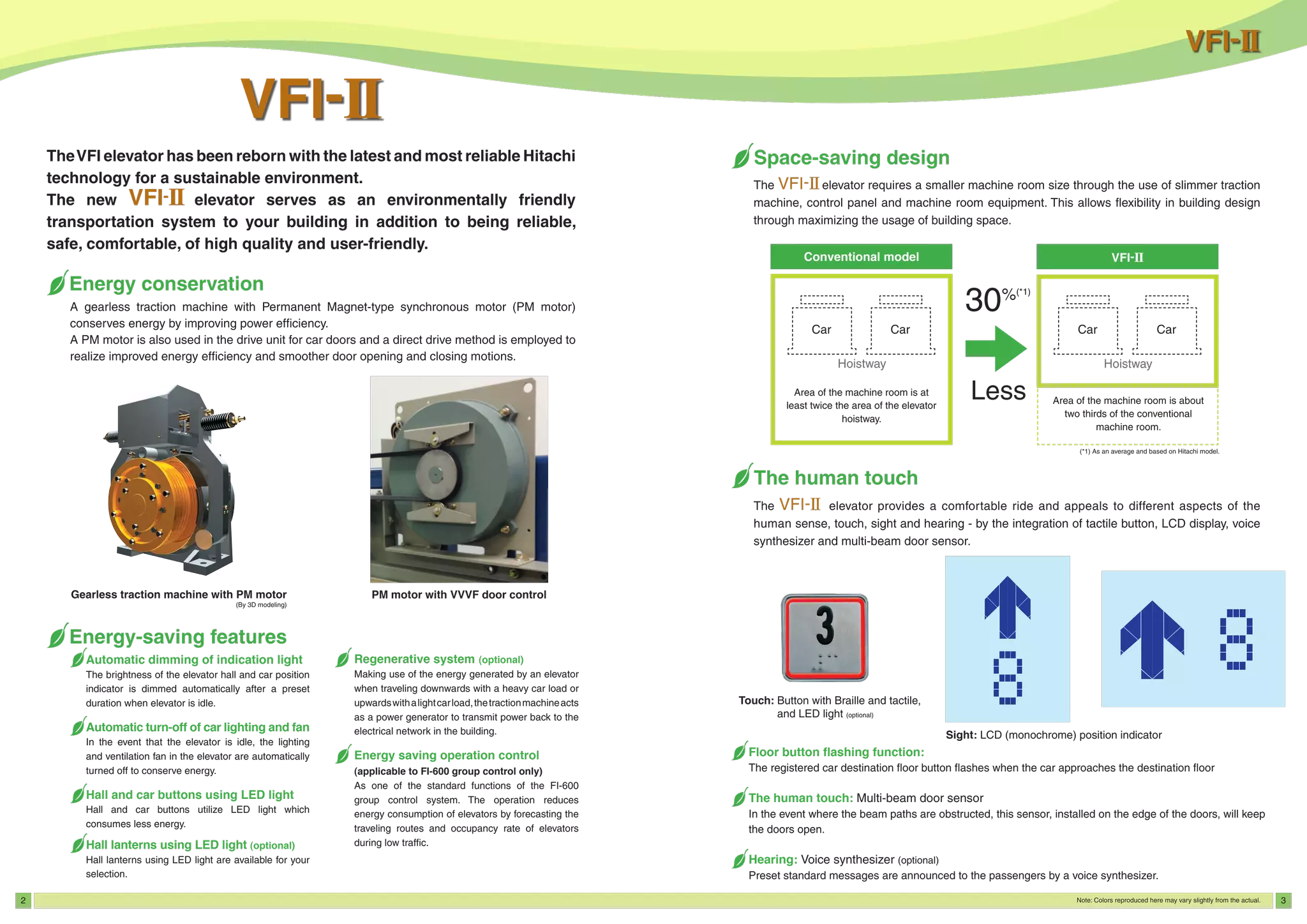
Car Car
Hoistway
Area of the machine room is at
least twice the area of the elevator
hoistway.
Conventional model
PM motor with VVVF door control
Automatic dimming of indication light
The brightness of the elevator hall and car position
indicator is dimmed automatically after a preset
duration when elevator is idle.
Automatic turn-off of car lighting and fan
In the event that the elevator is idle, the lighting
and ventilation fan in the elevator are automatically
turned off to conserve energy.
Hall and car buttons using LED light
Hall and car buttons utilize LED light which
consumes less energy.
Hall lanterns using LED light (optional)
Hall lanterns using LED light are available for your
selection.
Regenerative system (optional)
Making use of the energy generated by an elevator
when traveling downwards with a heavy car load or
upwardswithalightcarload,thetractionmachineacts
as a power generator to transmit power back to the
electrical network in the building.
Energy saving operation control
(applicable to FI-600 group control only)
As one of the standard functions of the FI-600
group control system. The operation reduces
energy consumption of elevators by forecasting the
traveling routes and occupancy rate of elevators
during low traffic.
Floor button flashing function:
The registered car destination floor button flashes when the car approaches the destination floor
The human touch: Multi-beam door sensor
In the event where the beam paths are obstructed, this sensor, installed on the edge of the doors, will keep
the doors open.
Hearing: Voice synthesizer (optional)
Preset standard messages are announced to the passengers by a voice synthesizer.
Sight: LCD (monochrome) position indicator
4 5
(*1) In case the number of floor buttons is more than 20, OPE-10B-TNS3 shall be applied.
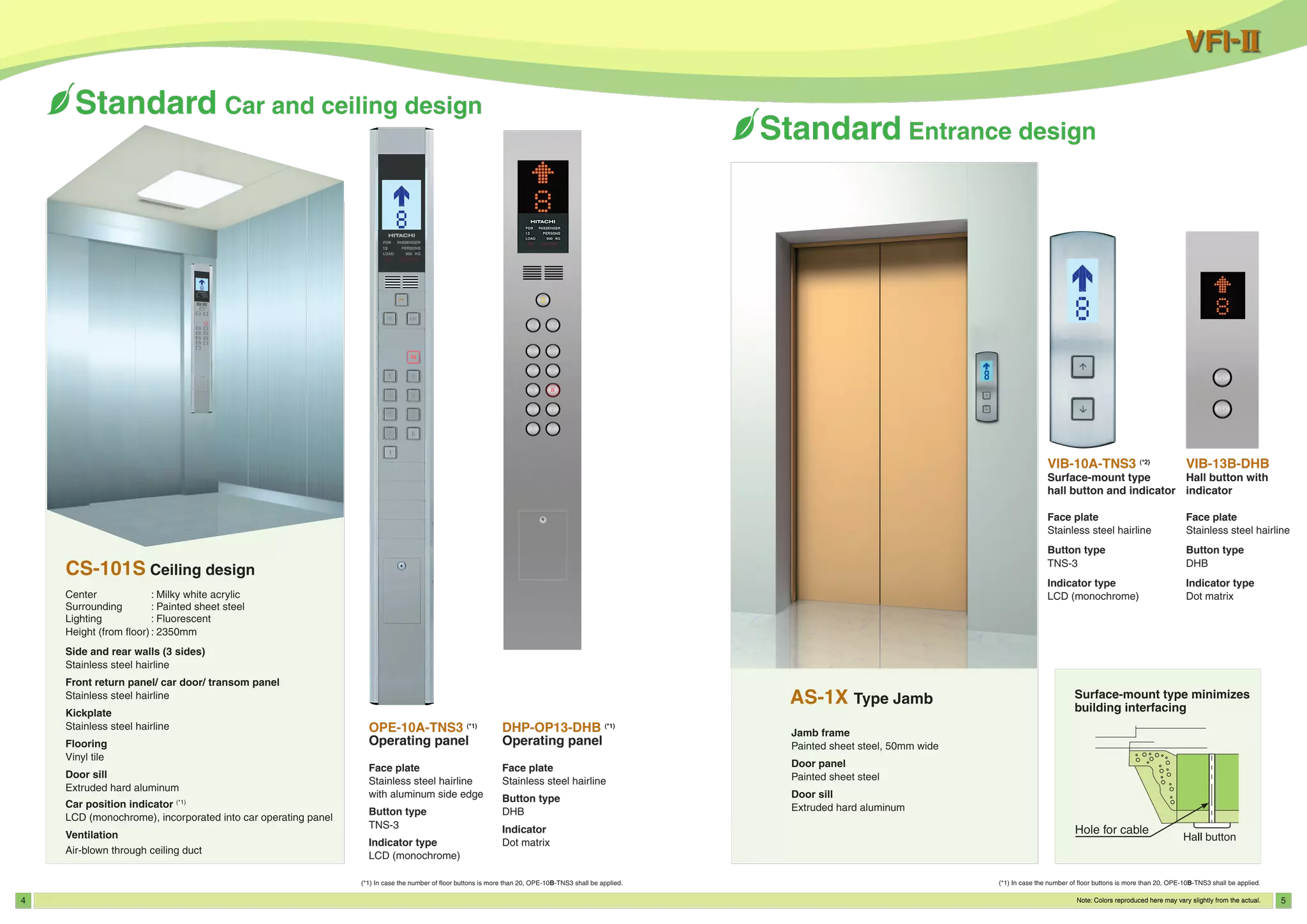
OPE-10A-TNS3 (*1)
Operating panel
Face plate
Stainless steel hairline
with aluminum side edge
Button type
TNS-3
Indicator type
LCD (monochrome)
DHP-OP13-DHB (*1)
Operating panel
Face plate
Stainless steel hairline
Button type
DHB
Indicator
Dot matrix
VIB-10A-TNS3 (*2)
Surface-mount type
hall button and indicator
Face plate
Stainless steel hairline
Button type
TNS-3
Indicator type
LCD (monochrome)
VIB-13B-DHB
Hall button with
indicator
Face plate
Stainless steel hairline
Button type
DHB
Indicator type
Dot matrix
6 7
Cars and ceilings
8 9
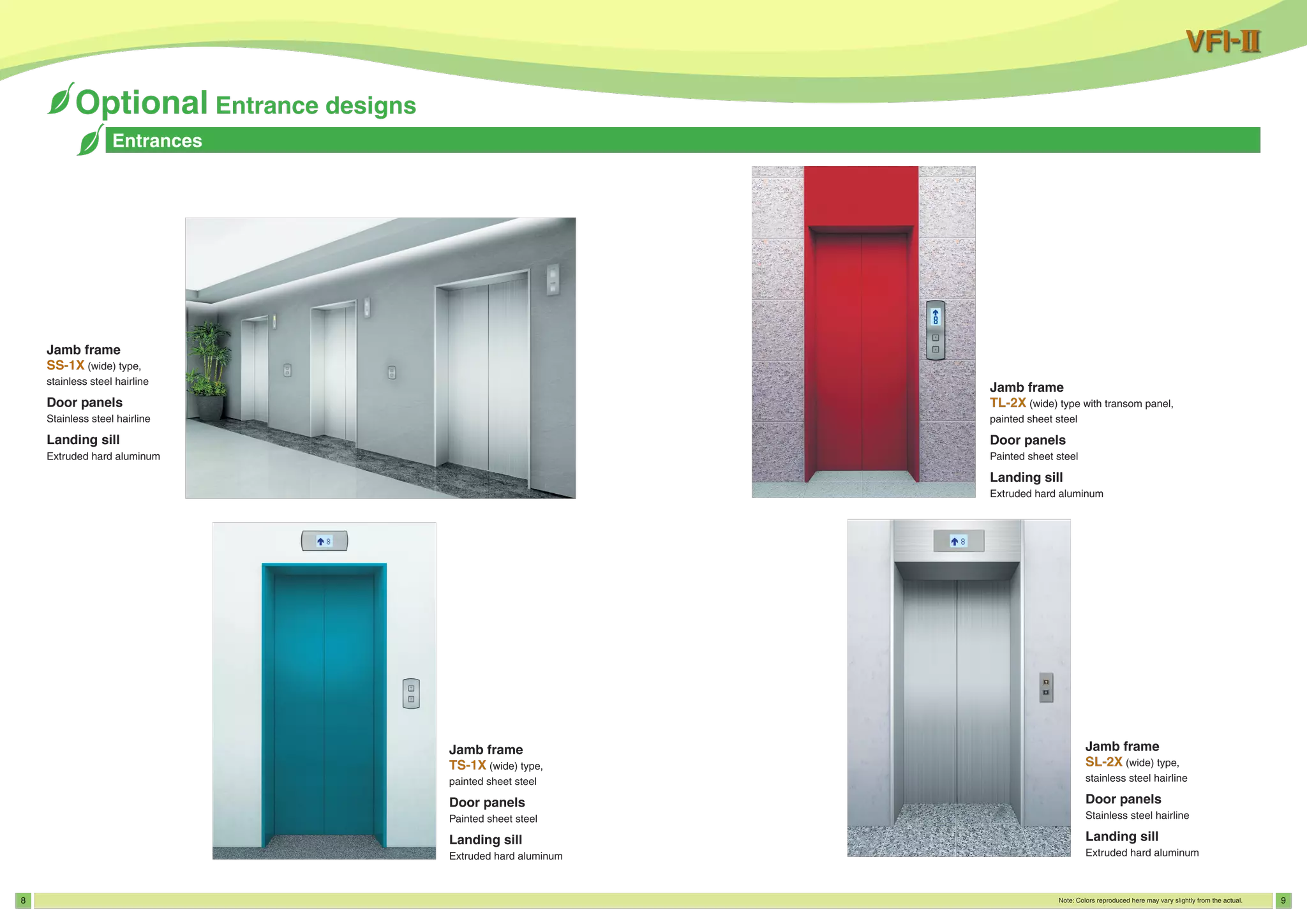
Jamb frame
SS-1X (wide) type,
stainless steel hairline
Door panels
Stainless steel hairline
Landing sill
Extruded hard aluminum
10 11
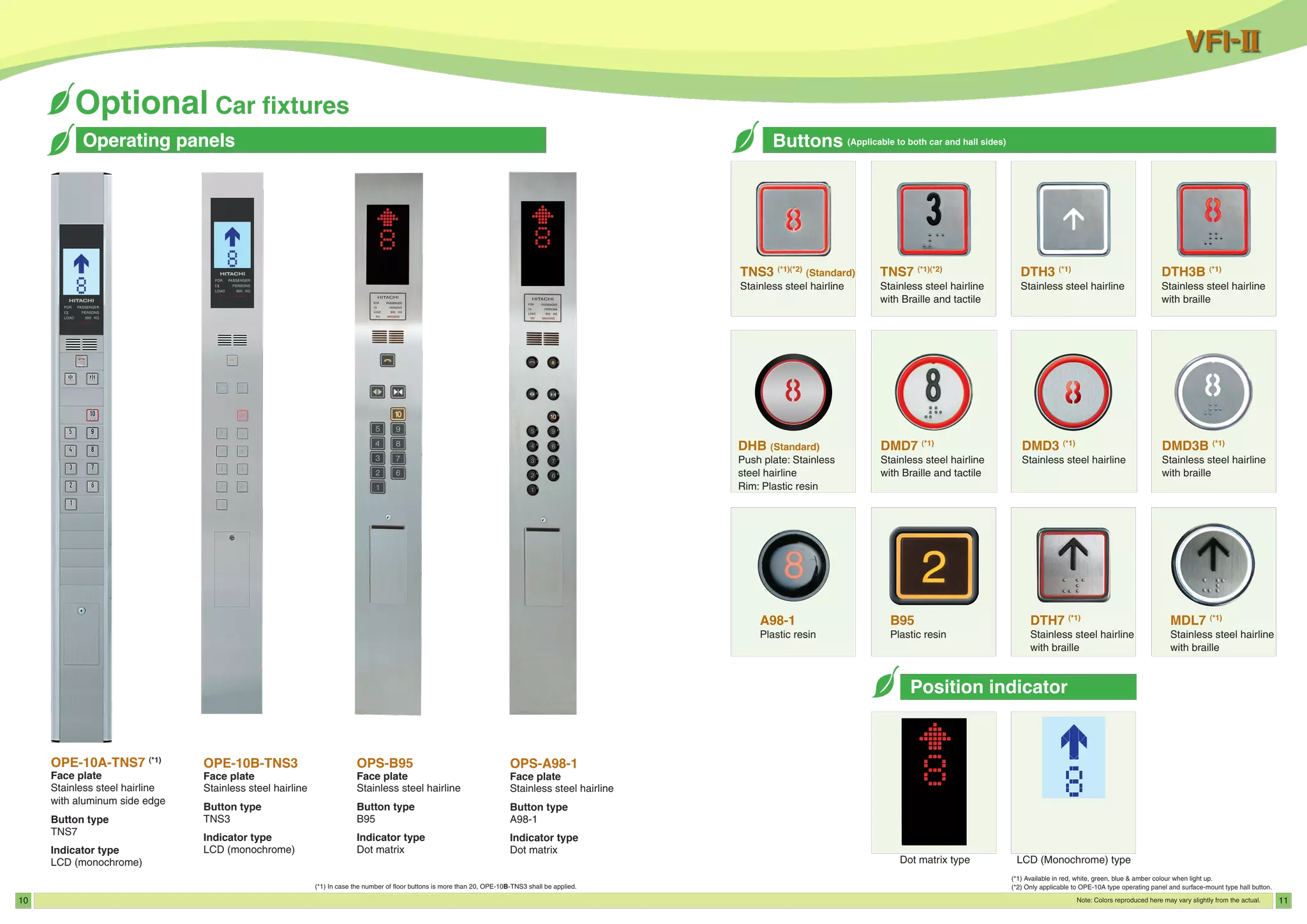
Operating panelsOperating panels
OPE-10A-TNS7 (*1)
Face plate
Stainless steel hairline
with aluminum side edge
Button type
TNS7
Indicator type
LCD (monochrome)
OPE-10B-TNS3
Face plate
Stainless steel hairline
Button type
TNS3
Indicator type
LCD (monochrome)
OPS-B95
Face plate
Stainless steel hairline
Button type
B95
Indicator type
Dot matrix
OPS-A98-1
Face plate
Stainless steel hairline
Button type
A98-1
Indicator type
Dot matrix
DMD3 (*1)
Stainless steel hairline
DMD7 (*1)
Stainless steel hairline
with Braille and tactile
DTH7 (*1)
Stainless steel hairline
with braille
MDL7 (*1)
Stainless steel hairline
with braille
Dot matrix type LCD (Monochrome) type
TNS3 (*1)(*2)
(Standard)
Stainless steel hairline
TNS7 (*1)(*2)
Stainless steel hairline
with Braille and tactile
Position indicator
(*1) Available in red, white, green, blue & amber colour when light up.
(*2) Only applicable to OPE-10A type operating panel and surface-mount type hall button.
DHB (Standard)
Push plate: Stainless
steel hairline
Rim: Plastic resin
DMD3B (*1)
Stainless steel hairline
with braille
DTH3B (*1)
Stainless steel hairline
with braille
DTH3 (*1)
Stainless steel hairline
A98-1
Plastic resin
B95
Plastic resin
(*1) In case the number of floor buttons is more than 20, OPE-10B-TNS3 shall be applied.
12 13
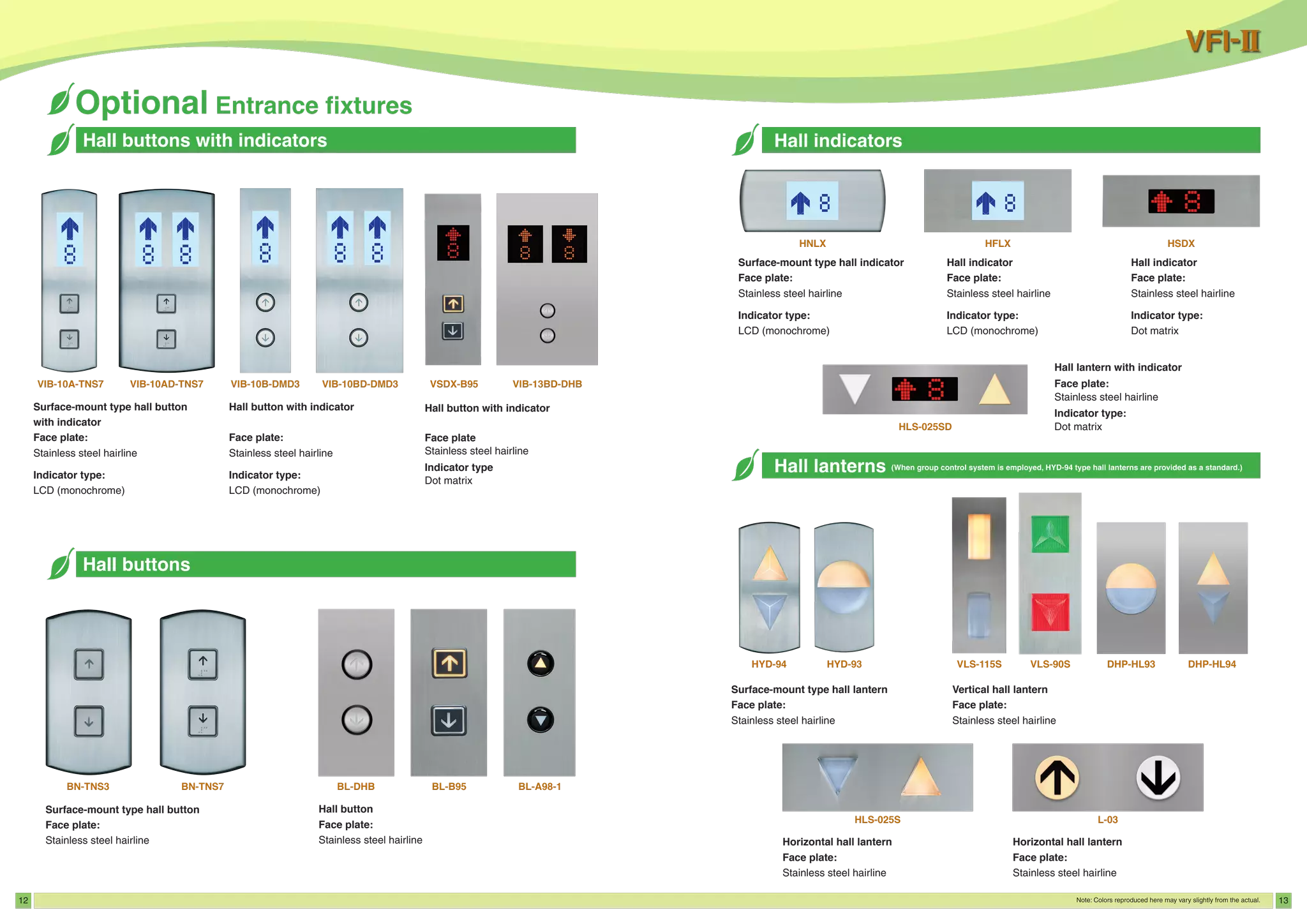
Hall buttons
Hall buttons with indicators
Surface-mount type hall button
with indicator
Face plate:
Stainless steel hairline
Indicator type:
LCD (monochrome)
Hall button with indicator
Face plate:
Stainless steel hairline
Indicator type:
LCD (monochrome)
VIB-10A-TNS7 VIB-10AD-TNS7 VIB-10B-DMD3 VIB-10BD-DMD3 VSDX-B95 VIB-13BD-DHB
Hall button with indicator
Face plate
Stainless steel hairline
Indicator type
Dot matrix
Surface-mount type hall button
Face plate:
Stainless steel hairline
Hall button
Face plate:
Stainless steel hairline
BN-TNS3 BN-TNS7 BL-DHB BL-B95 BL-A98-1
Surface-mount type hall indicator
Face plate:
Stainless steel hairline
Indicator type:
LCD (monochrome)
Hall indicator
Face plate:
Stainless steel hairline
Indicator type:
Dot matrix
Hall indicator
Face plate:
Stainless steel hairline
Indicator type:
LCD (monochrome)
HNLX HSDX
HLS-025SD
HFLX
Hall lantern with indicator
Face plate:
Stainless steel hairline
Indicator type:
Dot matrix
Vertical hall lantern
Face plate:
Stainless steel hairline
Horizontal hall lantern
Face plate:
Stainless steel hairline
Horizontal hall lantern
Face plate:
Stainless steel hairline
Surface-mount type hall lantern
Face plate:
Stainless steel hairline
HYD-94 HYD-93 VLS-115S VLS-90S DHP-HL93 DHP-HL94
HLS-025S L-03
14 15
16 17
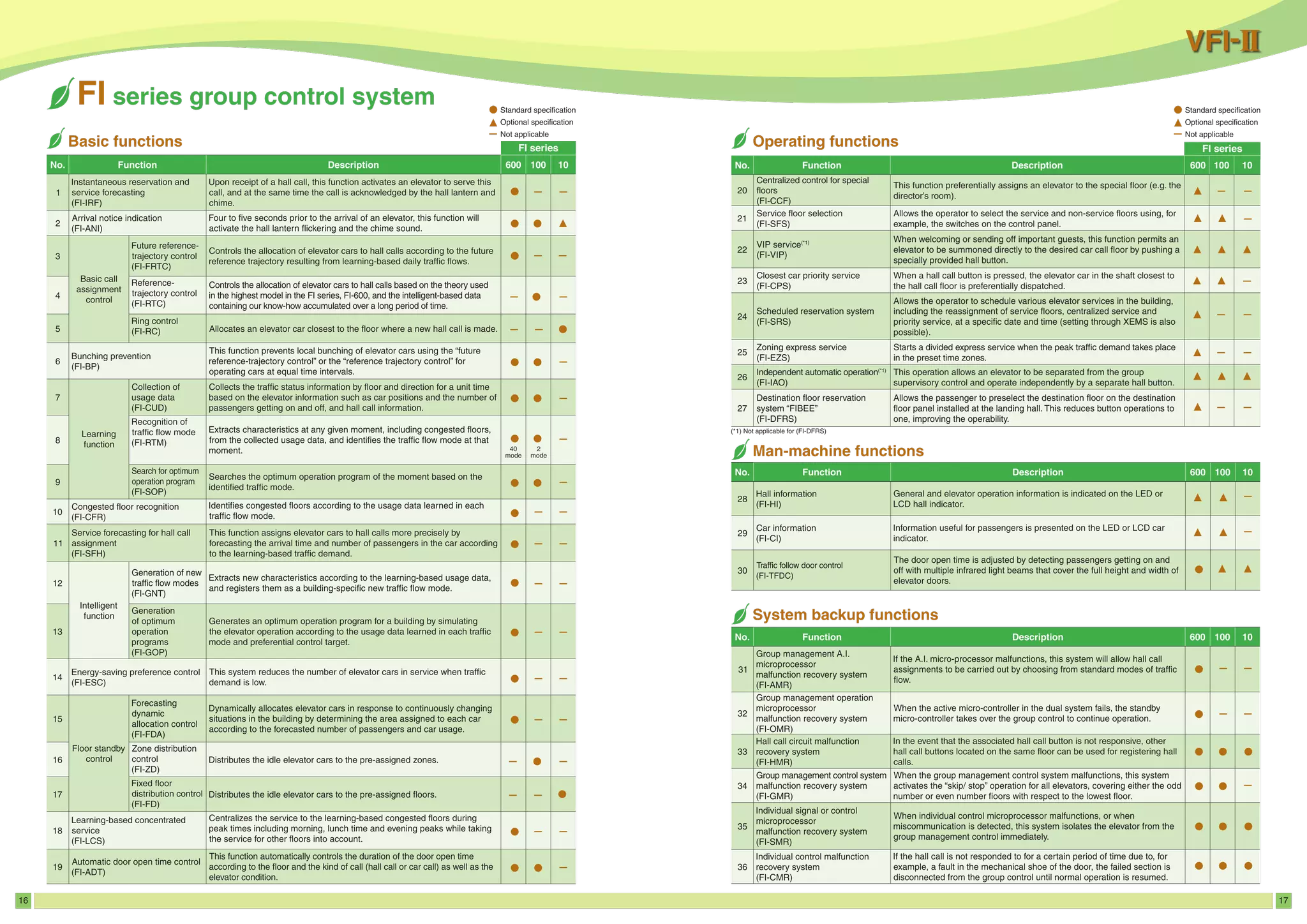
FI series FI series
No. Function Description 600 100 10
20
Centralized control for special
floors
(FI-CCF)
This function preferentially assigns an elevator to the special floor (e.g. the
director’s room).
21
Service floor selection
(FI-SFS)
Allows the operator to select the service and non-service floors using, for
example, the switches on the control panel.
22
VIP service(*1)
(FI-VIP)
When welcoming or sending off important guests, this function permits an
elevator to be summoned directly to the desired car call floor by pushing a
specially provided hall button.
23
Closest car priority service
(FI-CPS)
When a hall call button is pressed, the elevator car in the shaft closest to
the hall call floor is preferentially dispatched.
24
Scheduled reservation system
(FI-SRS)
Allows the operator to schedule various elevator services in the building,
including the reassignment of service floors, centralized service and
priority service, at a specific date and time (setting through XEMS is also
possible).
25
Zoning express service
(FI-EZS)
Starts a divided express service when the peak traffic demand takes place
in the preset time zones.
26
Independent automatic operation(*1)
(FI-IAO)
This operation allows an elevator to be separated from the group
supervisory control and operate independently by a separate hall button.
27
Destination floor reservation
system “FIBEE”
(FI-DFRS)
Allows the passenger to preselect the destination floor on the destination
floor panel installed at the landing hall. This reduces button operations to
one, improving the operability.
	 (*1) Not applicable for (FI-DFRS)
18 19
No. Name Description STD OPT
1
Simplex collective control
(CCTL)
This is a fully automatic operation used for a single elevator system. Hall
calls in the direction in which the elevator is travelling are responded to
sequentially and when all calls in that direction are cleared, calls in the
opposite direction are responded to. When there are no more calls, the
elevator will stop at the last floor served.
○
2
Duplex collective control
(DCTL)
This is a fully automatic operation used for a two-elevator system. Hall
calls are responded to by whichever elevator that can serve the hall call
faster. When there are no more calls, one of the elevators will stand-by at
the start floor while the other elevator will stay at the last floor served.
○
3
Group
control
FI-600
This is a group control system used to operate three to eight elevators in a
large-sized building.This control system consists of 3 smart systems; “future
reference-trajectory control”, “learning system” and “intelligent system”.
○
4 FI-100
This is a group control system used to operate three to six elevators in
a medium-sized building. This control system uses “reference-trajectory
control”, which is based on the theory used in the highest model of the
“future reference-trajectory control”.
○
5 FI-10
This is a simplified group control system used to operate three or four
elevators. The system provides a ring control to allocate the elevator car
closed to the floor where a new hall call is registered.
○
6
Down collective control
(DWCC)
For this system, all floors have “down” call buttons only, except for the start
floor, where there is “up” call button only. The other operations are the
same as in selective-collective and duplex selective-collective operations.
○
7 Attendant operation(ATT)
For this system, the stop floor is manually set by an attendant, such as in
a department store.
○
8
Independent operation
(INOC)
This operation system is used when there is a need to serve special
passengers. Under this operation, all hall calls are disabledfor the elevator
and it is reserved for exclusive use of the special passengers.
○
No. Name Description STD OPT
1
Mischievous call cancellation
(MCCC)
In the event that a large number of calls is registered by a small number
of passengers, the calls are determined to be mischievous and will be
automatically cancelled upon responding to the next call. This thus
eliminates unnecessary stops.
○
2
Automatic door open time
adjustment(DTAD)
The duration of the door open timing is tailored to usage conditions,
substantially improving operational efficiency.
○
3
Floor “deselect” function
(FDSF)
This function allows passenger to cancel the selection of a floor which is
accidentally pressed by pressing the button again. (This thus eliminates
unnecessary stops.)
○
4 Automatic return function (ARTF)
After all the calls have been served, the elevator will return to the start
floor for stand-by.
○
5 Car floor button flashing (CCBF)
The registered car destination floor button flashes when the car
approaches the destination floor
6 Door open prolong button(DOPB)
In the event that this button on the car operation board is pressed, the
elevator doors remain open for a pre-set period of time.
○
7
Automatic bypass
Operation(ABPO)
In the event that the elevator is fully loaded, this operation will not respond
to any hall calls and will only respond to the car calls.
○
8
Keypad sub-operating
board(KSOP)
In order to comply with the barrier-free code, especially for high-rise
buildings, individual car call buttons can be replaced by a keypad system.
○
9 Sub-operating panel (SOPB)
Additional floor selection and door open/close buttons are located on the
opposite side of the main operating panel in the elevator. This will be
extremely convenient during rush hours.
○
10 Voice synthesizer (VSYS)
Preset standard messages are announced to the passengers by a voice
synthesizer.
○
11 Arrival signal(ASGN)
An electronic chime (located at the top and bottom of the elevator) will be
sound just before the arrival of the elevator.
○
12
Interfacing with BGM speaker
(BGMS)
A speaker for background music and public announcements for the
building can be installed in the elevator. (Music and announcement
systems, including wiring, is to be provided by others)
○
13
Emergency Battery Operated
Power Supply(EBOPS)
In the event of a power failure, this emergency supply will allows the
operation of a light, fan and alarm bell.
○
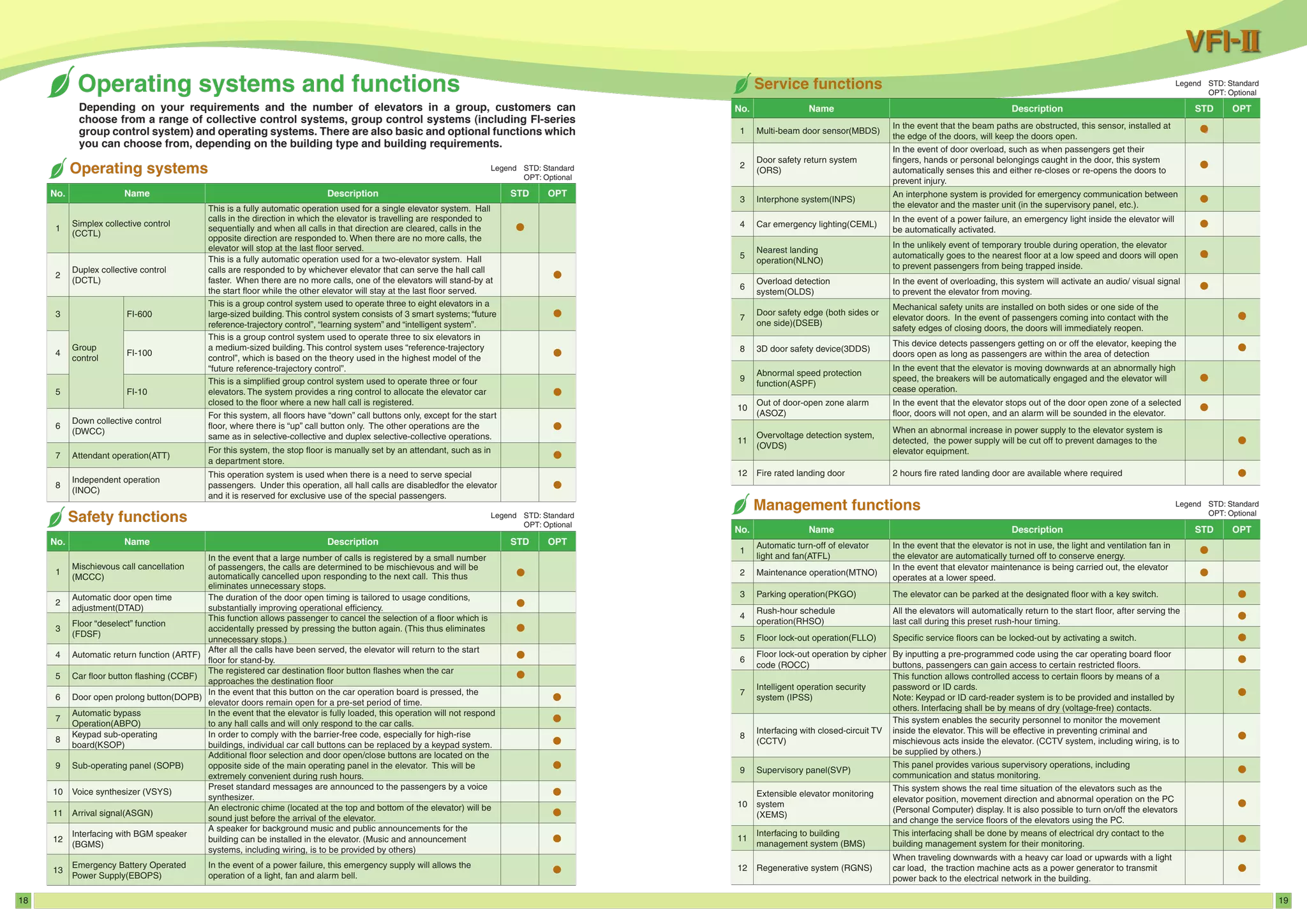
Depending on your requirements and the number of elevators in a group, customers can
choose from a range of collective control systems, group control systems (including FI-series
group control system) and operating systems. There are also basic and optional functions which
you can choose from, depending on the building type and building requirements.
No. Name Description STD OPT
1
Automatic turn-off of elevator
light and fan(ATFL)
In the event that the elevator is not in use, the light and ventilation fan in
the elevator are automatically turned off to conserve energy.
○
2 Maintenance operation(MTNO)
In the event that elevator maintenance is being carried out, the elevator
operates at a lower speed.
○
3 Parking operation(PKGO) The elevator can be parked at the designated floor with a key switch. ○
4
Rush-hour schedule
operation(RHSO)
All the elevators will automatically return to the start floor, after serving the
last call during this preset rush-hour timing.
○
5 Floor lock-out operation(FLLO) Specific service floors can be locked-out by activating a switch. ○
6
Floor lock-out operation by cipher
code (ROCC)
By inputting a pre-programmed code using the car operating board floor
buttons, passengers can gain access to certain restricted floors.
○
7
Intelligent operation security
system (IPSS)
This function allows controlled access to certain floors by means of a
password or ID cards.
Note: Keypad or ID card-reader system is to be provided and installed by
others. Interfacing shall be by means of dry (voltage-free) contacts.
○
8
Interfacing with closed-circuit TV
(CCTV)
This system enables the security personnel to monitor the movement
inside the elevator. This will be effective in preventing criminal and
mischievous acts inside the elevator. (CCTV system, including wiring, is to
be supplied by others.)
○
9 Supervisory panel(SVP)
This panel provides various supervisory operations, including
communication and status monitoring.
○
10
Extensible elevator monitoring
system
(XEMS)
This system shows the real time situation of the elevators such as the
elevator position, movement direction and abnormal operation on the PC
(Personal Computer) display. It is also possible to turn on/off the elevators
and change the service floors of the elevators using the PC.
○
11
Interfacing to building
management system (BMS)
This interfacing shall be done by means of electrical dry contact to the
building management system for their monitoring.
○
12 Regenerative system (RGNS)
When traveling downwards with a heavy car load or upwards with a light
car load, the traction machine acts as a power generator to transmit
power back to the electrical network in the building.
○
No. Name Description STD OPT
1 Multi-beam door sensor(MBDS)
In the event that the beam paths are obstructed, this sensor, installed at
the edge of the doors, will keep the doors open.
○
2
Door safety return system
(ORS)
In the event of door overload, such as when passengers get their
fingers, hands or personal belongings caught in the door, this system
automatically senses this and either re-closes or re-opens the doors to
prevent injury.
○
3 Interphone system(INPS)
An interphone system is provided for emergency communication between
the elevator and the master unit (in the supervisory panel, etc.).
○
4 Car emergency lighting(CEML)
In the event of a power failure, an emergency light inside the elevator will
be automatically activated.
○
5
Nearest landing
operation(NLNO)
In the unlikely event of temporary trouble during operation, the elevator
automatically goes to the nearest floor at a low speed and doors will open
to prevent passengers from being trapped inside.
○
6
Overload detection
system(OLDS)
In the event of overloading, this system will activate an audio/ visual signal
to prevent the elevator from moving.
○
7
Door safety edge (both sides or
one side)(DSEB)
Mechanical safety units are installed on both sides or one side of the
elevator doors. In the event of passengers coming into contact with the
safety edges of closing doors, the doors will immediately reopen.
○
8 3D door safety device(3DDS)
This device detects passengers getting on or off the elevator, keeping the
doors open as long as passengers are within the area of detection
○
9
Abnormal speed protection
function(ASPF)
In the event that the elevator is moving downwards at an abnormally high
speed, the breakers will be automatically engaged and the elevator will
cease operation.
○
10
Out of door-open zone alarm
(ASOZ)
In the event that the elevator stops out of the door open zone of a selected
floor, doors will not open, and an alarm will be sounded in the elevator.
○
11
Overvoltage detection system,
(OVDS)
When an abnormal increase in power supply to the elevator system is
detected, the power supply will be cut off to prevent damages to the
elevator equipment.
○
12 Fire rated landing door 2 hours fire rated landing door are available where required ○
Legend 	STD: Standard
	 OPT: Optional
Management functions
Legend 	STD: Standard
	 OPT: Optional
Legend 	STD: Standard
	 OPT: Optional
Legend 	STD: Standard
	 OPT: Optional
20 21
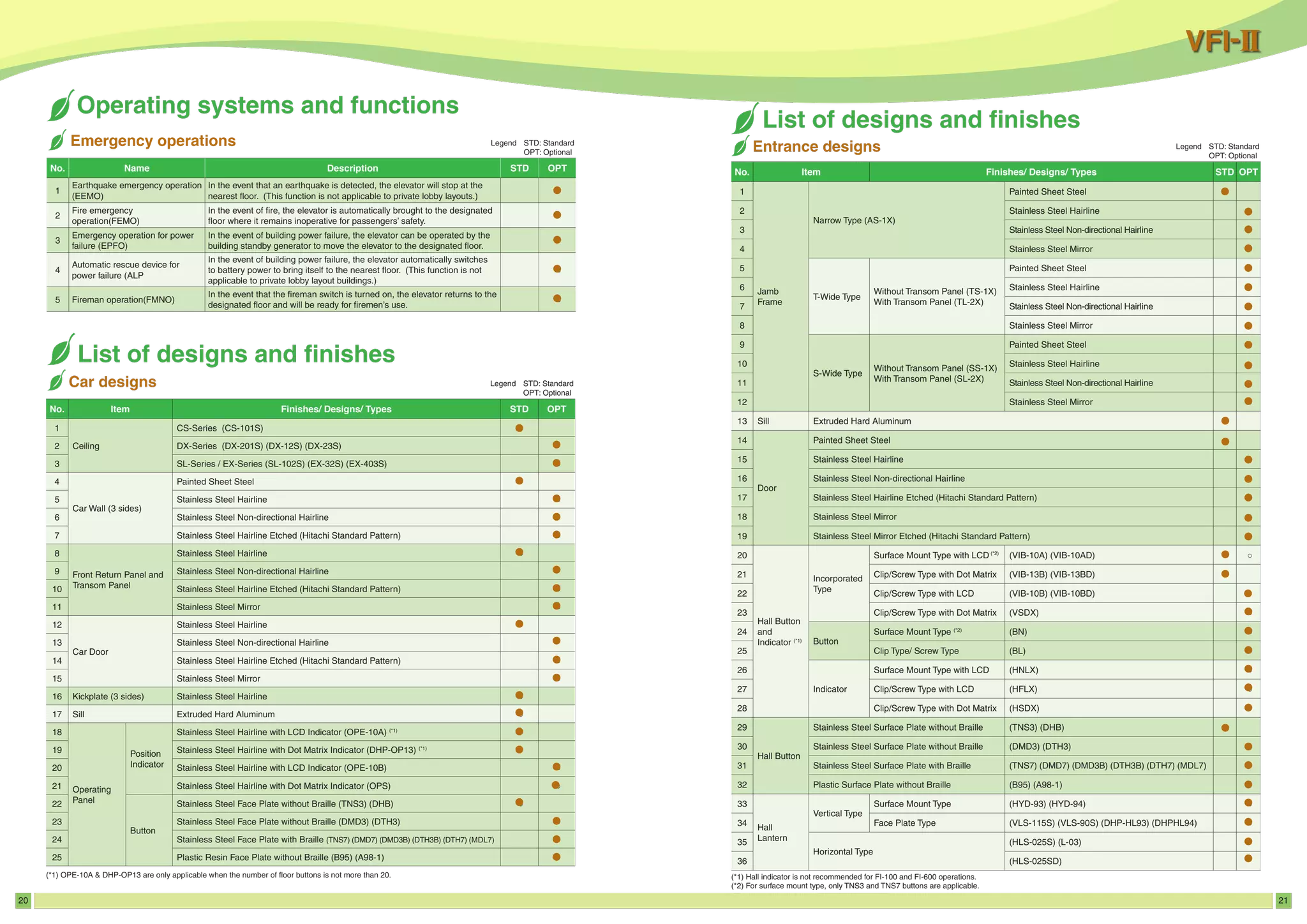
Emergency operations
No. Name Description STD OPT
1
Earthquake emergency operation
(EEMO)
In the event that an earthquake is detected, the elevator will stop at the
nearest floor. (This function is not applicable to private lobby layouts.)
○
2
Fire emergency
operation(FEMO)
In the event of fire, the elevator is automatically brought to the designated
floor where it remains inoperative for passengers’ safety.
○
3
Emergency operation for power
failure (EPFO)
In the event of building power failure, the elevator can be operated by the
building standby generator to move the elevator to the designated floor.
○
4
Automatic rescue device for
power failure (ALP
In the event of building power failure, the elevator automatically switches
to battery power to bring itself to the nearest floor. (This function is not
applicable to private lobby layout buildings.)
○
5 Fireman operation(FMNO)
In the event that the fireman switch is turned on, the elevator returns to the
designated floor and will be ready for firemen’s use.
○
Legend 	STD: Standard
	 OPT: Optional
No. Item Finishes/ Designs/ Types STD OPT
1
Ceiling
CS-Series (CS-101S) ○
2 DX-Series (DX-201S) (DX-12S) (DX-23S)
3 SL-Series / EX-Series (SL-102S) (EX-32S) (EX-403S) ○
4
Car Wall (3 sides)
Painted Sheet Steel ○
5 Stainless Steel Hairline ○
6 Stainless Steel Non-directional Hairline
7 Stainless Steel Hairline Etched (Hitachi Standard Pattern) ○
8
Front Return Panel and
Transom Panel
Stainless Steel Hairline ○
9 Stainless Steel Non-directional Hairline
10 Stainless Steel Hairline Etched (Hitachi Standard Pattern) ○
11 Stainless Steel Mirror ○
12
Car Door
Stainless Steel Hairline ○
13 Stainless Steel Non-directional Hairline
14 Stainless Steel Hairline Etched (Hitachi Standard Pattern) ○
15 Stainless Steel Mirror ○
16 Kickplate (3 sides) Stainless Steel Hairline ○
17 Sill Extruded Hard Aluminum ○
18
Operating
Panel
Position
Indicator
Stainless Steel Hairline with LCD Indicator (OPE-10A) (*1)
○
19 Stainless Steel Hairline with Dot Matrix Indicator (DHP-OP13) (*1)
20 Stainless Steel Hairline with LCD Indicator (OPE-10B) ○
21 Stainless Steel Hairline with Dot Matrix Indicator (OPS) ○
22
Button
Stainless Steel Face Plate without Braille (TNS3) (DHB) ○
23 Stainless Steel Face Plate without Braille (DMD3) (DTH3) ○
24 Stainless Steel Face Plate with Braille (TNS7) (DMD7) (DMD3B) (DTH3B) (DTH7) (MDL7) ○
25 Plastic Resin Face Plate without Braille (B95) (A98-1) ○
Legend 	STD: Standard
	 OPT: Optional
(*1) OPE-10A & DHP-OP13 are only applicable when the number of floor buttons is not more than 20.
No. Item Finishes/ Designs/ Types STD OPT
1
Jamb
Frame
Narrow Type (AS-1X)
Painted Sheet Steel ○
2 Stainless Steel Hairline ○
3 Stainless Steel Non-directional Hairline
4 Stainless Steel Mirror ○
5
T-Wide Type
Without Transom Panel (TS-1X)
With Transom Panel (TL-2X)
Painted Sheet Steel ○
6 Stainless Steel Hairline ○
7 Stainless Steel Non-directional Hairline ○
8 Stainless Steel Mirror ○
9
S-Wide Type
Without Transom Panel (SS-1X)
With Transom Panel (SL-2X)
Painted Sheet Steel ○
10 Stainless Steel Hairline ○
11 Stainless Steel Non-directional Hairline ○
12 Stainless Steel Mirror ○
13 Sill Extruded Hard Aluminum ○
14
Door
Painted Sheet Steel ○
15 Stainless Steel Hairline ○
16 Stainless Steel Non-directional Hairline ○
17 Stainless Steel Hairline Etched (Hitachi Standard Pattern) ○
18 Stainless Steel Mirror ○
19 Stainless Steel Mirror Etched (Hitachi Standard Pattern) ○
20
Hall Button
and
Indicator (*1)
Incorporated
Type
Surface Mount Type with LCD (*2)
(VIB-10A) (VIB-10AD) ○
21 Clip/Screw Type with Dot Matrix (VIB-13B) (VIB-13BD) ○
22 Clip/Screw Type with LCD (VIB-10B) (VIB-10BD)
23 Clip/Screw Type with Dot Matrix (VSDX) ○
24
Button
Surface Mount Type (*2)
(BN) ○
25 Clip Type/ Screw Type (BL) ○
26
Indicator
Surface Mount Type with LCD (HNLX) ○
27 Clip/Screw Type with LCD (HFLX) ○
28 Clip/Screw Type with Dot Matrix (HSDX) ○
29
Hall Button
Stainless Steel Surface Plate without Braille (TNS3) (DHB) ○
30 Stainless Steel Surface Plate without Braille (DMD3) (DTH3) ○
31 Stainless Steel Surface Plate with Braille (TNS7) (DMD7) (DMD3B) (DTH3B) (DTH7) (MDL7) ○
32 Plastic Surface Plate without Braille (B95) (A98-1) ○
33
Hall
Lantern
Vertical Type
Surface Mount Type (HYD-93) (HYD-94) ○
34 Face Plate Type (VLS-115S) (VLS-90S) (DHP-HL93) (DHPHL94) ○
35
Horizontal Type
(HLS-025S) (L-03) ○
36 (HLS-025SD)
Legend 	STD: Standard
	 OPT: Optional
(*1) Hall indicator is not recommended for FI-100 and FI-600 operations.
(*2) For surface mount type, only TNS3 and TNS7 buttons are applicable.
22 23Note: Colors reproduced here may vary slightly from the actual.
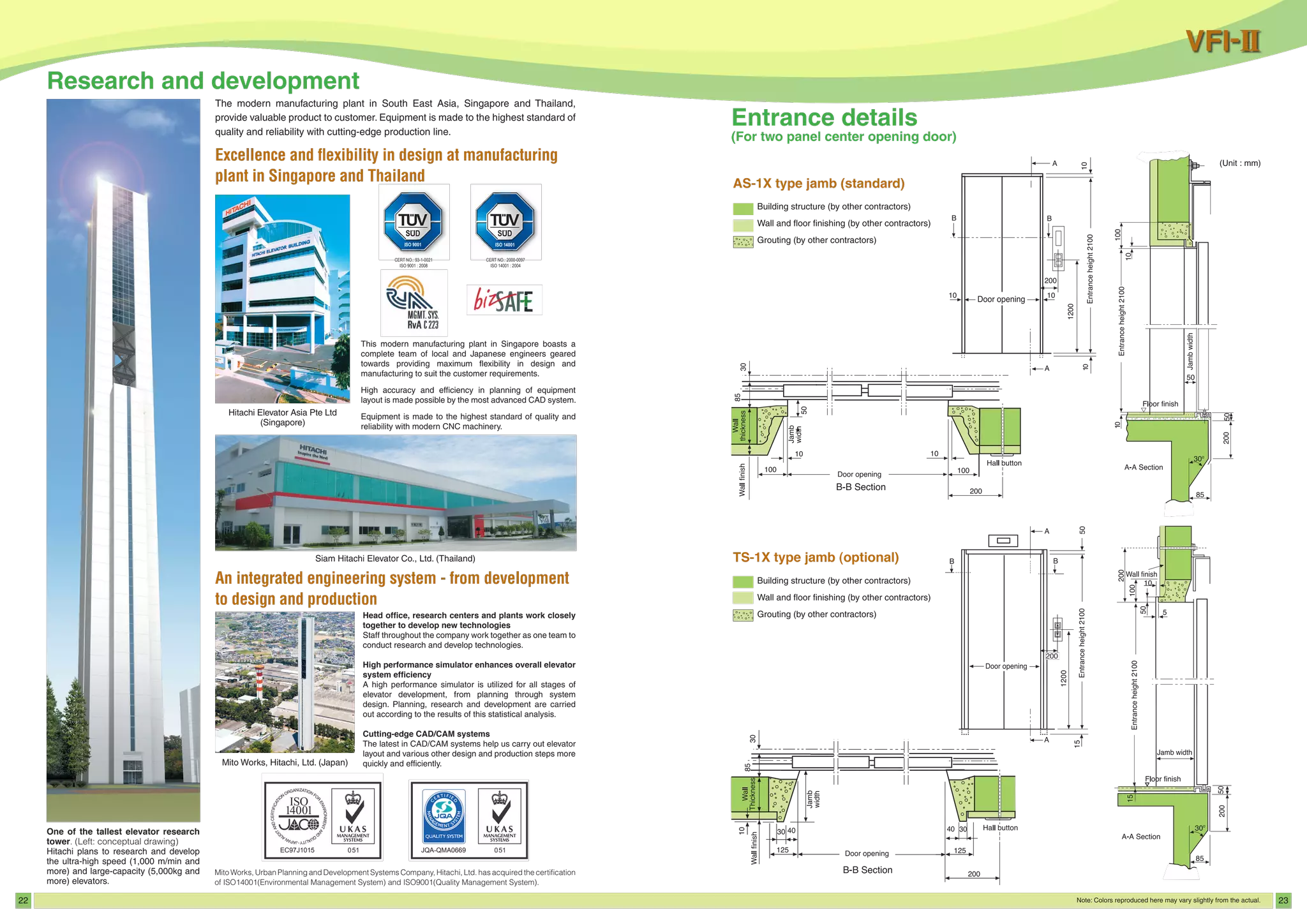
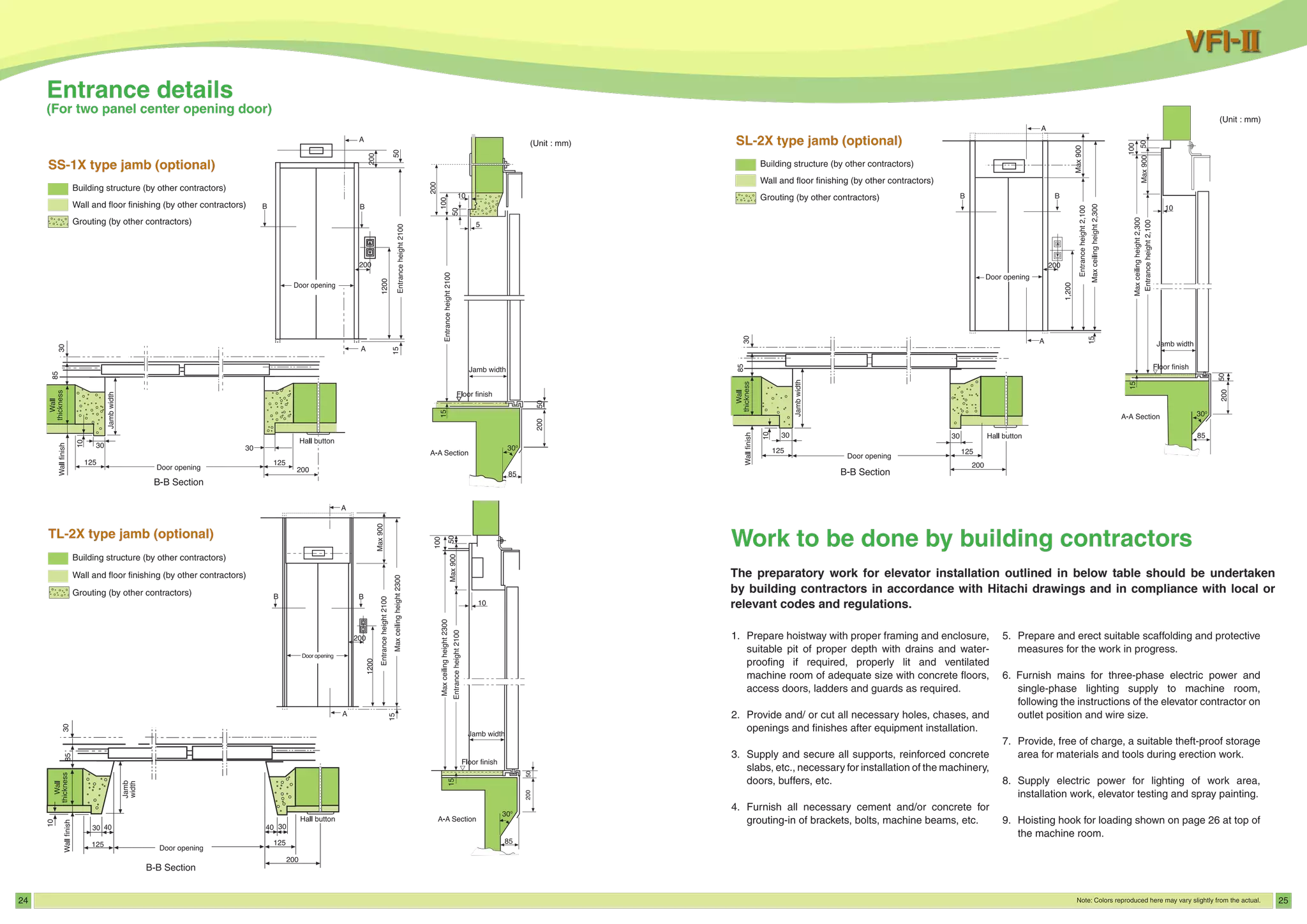
TS-1X type jamb (optional)
An integrated engineering system - from development
to design and production
Excellence and flexibility in design at manufacturing
plant in Singapore and Thailand
The modern manufacturing plant in South East Asia, Singapore and Thailand,
provide valuable product to customer. Equipment is made to the highest standard of
quality and reliability with cutting-edge production line.
Siam Hitachi Elevator Co., Ltd. (Thailand)
Hitachi Elevator Asia Pte Ltd
(Singapore)
Mito Works, Hitachi, Ltd. (Japan)
Head office, research centers and plants work closely
together to develop new technologies
Staff throughout the company work together as one team to
conduct research and develop technologies.
High performance simulator enhances overall elevator
system efficiency
A high performance simulator is utilized for all stages of
elevator development, from planning through system
design. Planning, research and development are carried
out according to the results of this statistical analysis.
Cutting-edge CAD/CAM systems
The latest in CAD/CAM systems help us carry out elevator
layout and various other design and production steps more
quickly and efficiently.
One of the tallest elevator research
tower. (Left: conceptual drawing)
Hitachi plans to research and develop
the ultra-high speed (1,000 m/min and
more) and large-capacity (5,000kg and
more) elevators.
CERT NO.: 2000-0097
ISO 14001 : 2004
CERT NO.: 93-1-0021
ISO 9001 : 2008
This modern manufacturing plant in Singapore boasts a
complete team of local and Japanese engineers geared
towards providing maximum flexibility in design and
manufacturing to suit the customer requirements.
High accuracy and efficiency in planning of equipment
layout is made possible by the most advanced CAD system.
Equipment is made to the highest standard of quality and
reliability with modern CNC machinery.
Mito Works, Urban Planning and Development Systems Company, Hitachi, Ltd. has acquired the certification
of ISO14001(Environmental Management System) and ISO9001(Quality Management System).
EC97J1015 JQA-QMA0669
24 25
The preparatory work for elevator installation outlined in below table should be undertaken
by building contractors in accordance with Hitachi drawings and in compliance with local or
relevant codes and regulations.
26 27
Ventilationgrille
Entrancedoor
MachineroomdepthT
Ventilationfan
R2
R1
Lowest Floor
R3 R4
PitDepthTravel
TotalHeight
Overhead
EntranceHeight
Top Floor
PLFHeight
R2 R1
(*1)Hoisting Hook
MinM/CRoomHeight
2100
(By others)
Door OP width
HoistwaydepthY
Carinsidedepthb
Car inside width a
Control
panel
Optional
Panel
(Byothers)
(Byothers)
(Byothers)
2100
VentilationGrille(*)
EntranceDoor(*)
MachineRoomDepthT
VentilationFan(*)
R2
Machine Room Width S
R1
Lowest floor
R3 R4
PitdepthTravel
Totalheight
Overheadheight
Entranceheight
Top floor
PLFheight
R2 R1
Hoisting hook
MinMachineroomheight
MH
(By others)
Ladder, lighting & outlet
(By others)
Hoistway Width, HW X
Opening OP
HoistwayDepth,Y
CarInsideDepthb
Car Inside width a
Control
Panel
Optional
Panel
(Byothers)
(Byothers)
(Byothers)
Note: Machine room temperature should be maintained below 38o
C 	
with ventilating fan or air conditioner.
Hoistway widthX
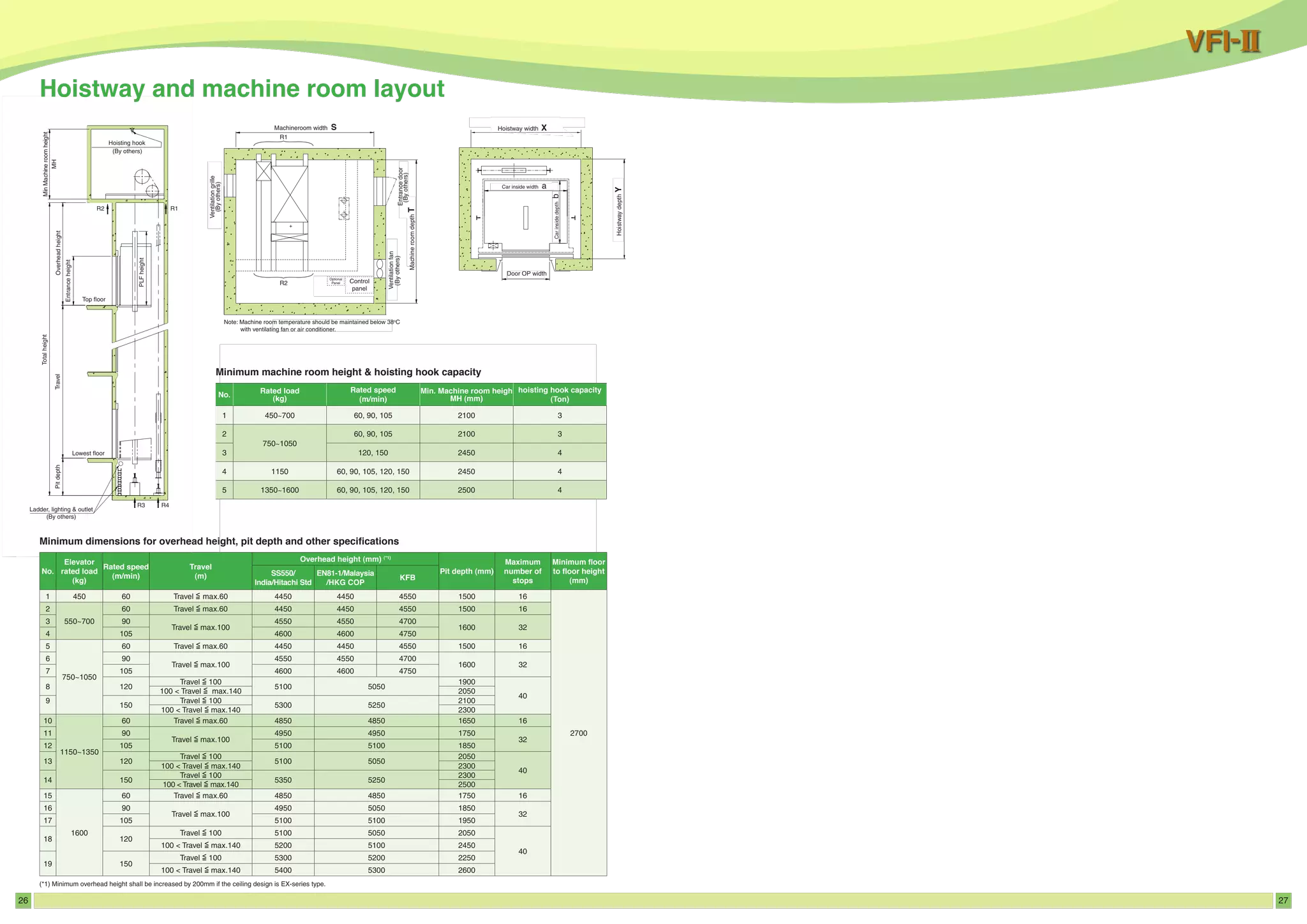
Hoistway and machine room layout
27
VFI-II
Machineroom
Ventilationfan
R2
Lowest Floor
R3 R4
PitDepthTravel
TotalHeight
Overhead
EntranceHeight
Top Floor
PLFHeight
R2 R1
Door OP width
HoistwaydepthY
Carinsidedepthb
Car inside width a
Control
panel
Optional
Panel
(Byothers)
2100
M
Ventilation
R2
Lowest floor
R3 R4
PitdepthTravel
Totalheight
Overheadheigh
Entranceheight
Top floor
PLFheight
Ladder, lighting & outlet
(By others)
Hoistway Width, HW X
Opening OP
HoistwayDepth,Y
CarInsideDepthb
Car Inside width a
Control
Panel
Optional
Panel
(Byothe
Note: Machine room temperature should be maintained below 38o
C 	
with ventilating fan or air conditioner.
Hoistway width X
No.
Rated load
(kg)
Rated speed
(m/min)
Min. Machine room heigh
MH (mm)
hoisting hook capacity
(Ton)
1 450~700 60, 90, 105 2100 3
2
750~1050
60, 90, 105 2100 3
3 120, 150 2450 4
4 1150 60, 90, 105, 120, 150 2450 4
5 1350~1600 60, 90, 105, 120, 150 2500 4
Minimum machine room height & hoisting hook capacity
No.
Elevator
rated load
(kg)
Rated speed
(m/min)
Travel
(m)
Overhead height (mm) (*1)
Pit depth (mm)
Maximum
number of
stops
Minimum floor
to floor height
(mm)
SS550/
India/Hitachi Std
EN81-1/Malaysia
/HKG COP
KFB
1 450 60 Travel ≦ max.60 4450 4450 4550 1500 16
2700
2
550~700
60 Travel ≦ max.60 4450 4450 4550 1500 16
3 90
Travel ≦ max.100
4550 4550 4700
1600 32
4 105 4600 4600 4750
5
750~1050
60 Travel ≦ max.60 4450 4450 4550 1500 16
6 90
Travel ≦ max.100
4550 4550 4700
1600 32
7 105 4600 4600 4750
8 120
Travel ≦ 100
5100 5050
1900
40
100 < Travel ≦ max.140 2050
9
150
Travel ≦ 100
5300 5250
2100
100 < Travel ≦ max.140 2300
10
1150~1350
60 Travel ≦ max.60 4850 4850 1650 16
11 90
Travel ≦ max.100
4950 4950 1750
32
12 105 5100 5100 1850
13 120
Travel ≦ 100
5100 5050
2050
40
100 < Travel ≦ max.140 2300
14 150
Travel ≦ 100
5350 5250
2300
100 < Travel ≦ max.140 2500
15
1600
60 Travel ≦ max.60 4850 4850 1750 16
16 90
Travel ≦ max.100
4950 5050 1850
32
17 105 5100 5100 1950
18 120
Travel ≦ 100 5100 5050 2050
40
100 < Travel ≦ max.140 5200 5100 2450
19 150
Travel ≦ 100 5300 5200 2250
100 < Travel ≦ max.140 5400 5300 2600
Minimum dimensions for overhead height, pit depth and other specifications
Machineroom width S
(*1) Minimum overhead height shall be increased by 200mm if the ceiling design is EX-series type.
Distributor
Specifications and designs in this catalogue are subjected to change without notice.
HEES-007(2) 1013 (PIS)
Hitachi, Ltd.
14-1, Sotokanda 4-chome,
Chiyoda-ku, Tokyo, Japan 101-8010
http://www.hitachi.co.jp/prod/ elv/en
Hitachi Elevator Asia Pte Ltd
10 Toh Guan Road East
Hitachi Elevator Building
Singapore 608597
Tel: (65) 6416 1711
http://www.hitachi.com.sg/eles/
Printed on recycled paper. Please recycle.

Hitachi elevator, vfi ii (updated oct 2013) full

  • 1.
  • 2.
    2 3 Car Car Hoistway Areaof the machine room is at least twice the area of the elevator hoistway. Conventional model PM motor with VVVF door control Automatic dimming of indication light The brightness of the elevator hall and car position indicator is dimmed automatically after a preset duration when elevator is idle. Automatic turn-off of car lighting and fan In the event that the elevator is idle, the lighting and ventilation fan in the elevator are automatically turned off to conserve energy. Hall and car buttons using LED light Hall and car buttons utilize LED light which consumes less energy. Hall lanterns using LED light (optional) Hall lanterns using LED light are available for your selection. Regenerative system (optional) Making use of the energy generated by an elevator when traveling downwards with a heavy car load or upwardswithalightcarload,thetractionmachineacts as a power generator to transmit power back to the electrical network in the building. Energy saving operation control (applicable to FI-600 group control only) As one of the standard functions of the FI-600 group control system. The operation reduces energy consumption of elevators by forecasting the traveling routes and occupancy rate of elevators during low traffic. Floor button flashing function: The registered car destination floor button flashes when the car approaches the destination floor The human touch: Multi-beam door sensor In the event where the beam paths are obstructed, this sensor, installed on the edge of the doors, will keep the doors open. Hearing: Voice synthesizer (optional) Preset standard messages are announced to the passengers by a voice synthesizer. Sight: LCD (monochrome) position indicator
  • 3.
    4 5 (*1) Incase the number of floor buttons is more than 20, OPE-10B-TNS3 shall be applied. OPE-10A-TNS3 (*1) Operating panel Face plate Stainless steel hairline with aluminum side edge Button type TNS-3 Indicator type LCD (monochrome) DHP-OP13-DHB (*1) Operating panel Face plate Stainless steel hairline Button type DHB Indicator Dot matrix VIB-10A-TNS3 (*2) Surface-mount type hall button and indicator Face plate Stainless steel hairline Button type TNS-3 Indicator type LCD (monochrome) VIB-13B-DHB Hall button with indicator Face plate Stainless steel hairline Button type DHB Indicator type Dot matrix
  • 4.
    6 7 Cars andceilings
  • 5.
    8 9 Jamb frame SS-1X(wide) type, stainless steel hairline Door panels Stainless steel hairline Landing sill Extruded hard aluminum
  • 6.
    10 11 Operating panelsOperatingpanels OPE-10A-TNS7 (*1) Face plate Stainless steel hairline with aluminum side edge Button type TNS7 Indicator type LCD (monochrome) OPE-10B-TNS3 Face plate Stainless steel hairline Button type TNS3 Indicator type LCD (monochrome) OPS-B95 Face plate Stainless steel hairline Button type B95 Indicator type Dot matrix OPS-A98-1 Face plate Stainless steel hairline Button type A98-1 Indicator type Dot matrix DMD3 (*1) Stainless steel hairline DMD7 (*1) Stainless steel hairline with Braille and tactile DTH7 (*1) Stainless steel hairline with braille MDL7 (*1) Stainless steel hairline with braille Dot matrix type LCD (Monochrome) type TNS3 (*1)(*2) (Standard) Stainless steel hairline TNS7 (*1)(*2) Stainless steel hairline with Braille and tactile Position indicator (*1) Available in red, white, green, blue & amber colour when light up. (*2) Only applicable to OPE-10A type operating panel and surface-mount type hall button. DHB (Standard) Push plate: Stainless steel hairline Rim: Plastic resin DMD3B (*1) Stainless steel hairline with braille DTH3B (*1) Stainless steel hairline with braille DTH3 (*1) Stainless steel hairline A98-1 Plastic resin B95 Plastic resin (*1) In case the number of floor buttons is more than 20, OPE-10B-TNS3 shall be applied.
  • 7.
    12 13 Hall buttons Hallbuttons with indicators Surface-mount type hall button with indicator Face plate: Stainless steel hairline Indicator type: LCD (monochrome) Hall button with indicator Face plate: Stainless steel hairline Indicator type: LCD (monochrome) VIB-10A-TNS7 VIB-10AD-TNS7 VIB-10B-DMD3 VIB-10BD-DMD3 VSDX-B95 VIB-13BD-DHB Hall button with indicator Face plate Stainless steel hairline Indicator type Dot matrix Surface-mount type hall button Face plate: Stainless steel hairline Hall button Face plate: Stainless steel hairline BN-TNS3 BN-TNS7 BL-DHB BL-B95 BL-A98-1 Surface-mount type hall indicator Face plate: Stainless steel hairline Indicator type: LCD (monochrome) Hall indicator Face plate: Stainless steel hairline Indicator type: Dot matrix Hall indicator Face plate: Stainless steel hairline Indicator type: LCD (monochrome) HNLX HSDX HLS-025SD HFLX Hall lantern with indicator Face plate: Stainless steel hairline Indicator type: Dot matrix Vertical hall lantern Face plate: Stainless steel hairline Horizontal hall lantern Face plate: Stainless steel hairline Horizontal hall lantern Face plate: Stainless steel hairline Surface-mount type hall lantern Face plate: Stainless steel hairline HYD-94 HYD-93 VLS-115S VLS-90S DHP-HL93 DHP-HL94 HLS-025S L-03
  • 8.
  • 9.
    16 17 FI seriesFI series No. Function Description 600 100 10 20 Centralized control for special floors (FI-CCF) This function preferentially assigns an elevator to the special floor (e.g. the director’s room). 21 Service floor selection (FI-SFS) Allows the operator to select the service and non-service floors using, for example, the switches on the control panel. 22 VIP service(*1) (FI-VIP) When welcoming or sending off important guests, this function permits an elevator to be summoned directly to the desired car call floor by pushing a specially provided hall button. 23 Closest car priority service (FI-CPS) When a hall call button is pressed, the elevator car in the shaft closest to the hall call floor is preferentially dispatched. 24 Scheduled reservation system (FI-SRS) Allows the operator to schedule various elevator services in the building, including the reassignment of service floors, centralized service and priority service, at a specific date and time (setting through XEMS is also possible). 25 Zoning express service (FI-EZS) Starts a divided express service when the peak traffic demand takes place in the preset time zones. 26 Independent automatic operation(*1) (FI-IAO) This operation allows an elevator to be separated from the group supervisory control and operate independently by a separate hall button. 27 Destination floor reservation system “FIBEE” (FI-DFRS) Allows the passenger to preselect the destination floor on the destination floor panel installed at the landing hall. This reduces button operations to one, improving the operability. (*1) Not applicable for (FI-DFRS)
  • 10.
    18 19 No. NameDescription STD OPT 1 Simplex collective control (CCTL) This is a fully automatic operation used for a single elevator system. Hall calls in the direction in which the elevator is travelling are responded to sequentially and when all calls in that direction are cleared, calls in the opposite direction are responded to. When there are no more calls, the elevator will stop at the last floor served. ○ 2 Duplex collective control (DCTL) This is a fully automatic operation used for a two-elevator system. Hall calls are responded to by whichever elevator that can serve the hall call faster. When there are no more calls, one of the elevators will stand-by at the start floor while the other elevator will stay at the last floor served. ○ 3 Group control FI-600 This is a group control system used to operate three to eight elevators in a large-sized building.This control system consists of 3 smart systems; “future reference-trajectory control”, “learning system” and “intelligent system”. ○ 4 FI-100 This is a group control system used to operate three to six elevators in a medium-sized building. This control system uses “reference-trajectory control”, which is based on the theory used in the highest model of the “future reference-trajectory control”. ○ 5 FI-10 This is a simplified group control system used to operate three or four elevators. The system provides a ring control to allocate the elevator car closed to the floor where a new hall call is registered. ○ 6 Down collective control (DWCC) For this system, all floors have “down” call buttons only, except for the start floor, where there is “up” call button only. The other operations are the same as in selective-collective and duplex selective-collective operations. ○ 7 Attendant operation(ATT) For this system, the stop floor is manually set by an attendant, such as in a department store. ○ 8 Independent operation (INOC) This operation system is used when there is a need to serve special passengers. Under this operation, all hall calls are disabledfor the elevator and it is reserved for exclusive use of the special passengers. ○ No. Name Description STD OPT 1 Mischievous call cancellation (MCCC) In the event that a large number of calls is registered by a small number of passengers, the calls are determined to be mischievous and will be automatically cancelled upon responding to the next call. This thus eliminates unnecessary stops. ○ 2 Automatic door open time adjustment(DTAD) The duration of the door open timing is tailored to usage conditions, substantially improving operational efficiency. ○ 3 Floor “deselect” function (FDSF) This function allows passenger to cancel the selection of a floor which is accidentally pressed by pressing the button again. (This thus eliminates unnecessary stops.) ○ 4 Automatic return function (ARTF) After all the calls have been served, the elevator will return to the start floor for stand-by. ○ 5 Car floor button flashing (CCBF) The registered car destination floor button flashes when the car approaches the destination floor 6 Door open prolong button(DOPB) In the event that this button on the car operation board is pressed, the elevator doors remain open for a pre-set period of time. ○ 7 Automatic bypass Operation(ABPO) In the event that the elevator is fully loaded, this operation will not respond to any hall calls and will only respond to the car calls. ○ 8 Keypad sub-operating board(KSOP) In order to comply with the barrier-free code, especially for high-rise buildings, individual car call buttons can be replaced by a keypad system. ○ 9 Sub-operating panel (SOPB) Additional floor selection and door open/close buttons are located on the opposite side of the main operating panel in the elevator. This will be extremely convenient during rush hours. ○ 10 Voice synthesizer (VSYS) Preset standard messages are announced to the passengers by a voice synthesizer. ○ 11 Arrival signal(ASGN) An electronic chime (located at the top and bottom of the elevator) will be sound just before the arrival of the elevator. ○ 12 Interfacing with BGM speaker (BGMS) A speaker for background music and public announcements for the building can be installed in the elevator. (Music and announcement systems, including wiring, is to be provided by others) ○ 13 Emergency Battery Operated Power Supply(EBOPS) In the event of a power failure, this emergency supply will allows the operation of a light, fan and alarm bell. ○ Depending on your requirements and the number of elevators in a group, customers can choose from a range of collective control systems, group control systems (including FI-series group control system) and operating systems. There are also basic and optional functions which you can choose from, depending on the building type and building requirements. No. Name Description STD OPT 1 Automatic turn-off of elevator light and fan(ATFL) In the event that the elevator is not in use, the light and ventilation fan in the elevator are automatically turned off to conserve energy. ○ 2 Maintenance operation(MTNO) In the event that elevator maintenance is being carried out, the elevator operates at a lower speed. ○ 3 Parking operation(PKGO) The elevator can be parked at the designated floor with a key switch. ○ 4 Rush-hour schedule operation(RHSO) All the elevators will automatically return to the start floor, after serving the last call during this preset rush-hour timing. ○ 5 Floor lock-out operation(FLLO) Specific service floors can be locked-out by activating a switch. ○ 6 Floor lock-out operation by cipher code (ROCC) By inputting a pre-programmed code using the car operating board floor buttons, passengers can gain access to certain restricted floors. ○ 7 Intelligent operation security system (IPSS) This function allows controlled access to certain floors by means of a password or ID cards. Note: Keypad or ID card-reader system is to be provided and installed by others. Interfacing shall be by means of dry (voltage-free) contacts. ○ 8 Interfacing with closed-circuit TV (CCTV) This system enables the security personnel to monitor the movement inside the elevator. This will be effective in preventing criminal and mischievous acts inside the elevator. (CCTV system, including wiring, is to be supplied by others.) ○ 9 Supervisory panel(SVP) This panel provides various supervisory operations, including communication and status monitoring. ○ 10 Extensible elevator monitoring system (XEMS) This system shows the real time situation of the elevators such as the elevator position, movement direction and abnormal operation on the PC (Personal Computer) display. It is also possible to turn on/off the elevators and change the service floors of the elevators using the PC. ○ 11 Interfacing to building management system (BMS) This interfacing shall be done by means of electrical dry contact to the building management system for their monitoring. ○ 12 Regenerative system (RGNS) When traveling downwards with a heavy car load or upwards with a light car load, the traction machine acts as a power generator to transmit power back to the electrical network in the building. ○ No. Name Description STD OPT 1 Multi-beam door sensor(MBDS) In the event that the beam paths are obstructed, this sensor, installed at the edge of the doors, will keep the doors open. ○ 2 Door safety return system (ORS) In the event of door overload, such as when passengers get their fingers, hands or personal belongings caught in the door, this system automatically senses this and either re-closes or re-opens the doors to prevent injury. ○ 3 Interphone system(INPS) An interphone system is provided for emergency communication between the elevator and the master unit (in the supervisory panel, etc.). ○ 4 Car emergency lighting(CEML) In the event of a power failure, an emergency light inside the elevator will be automatically activated. ○ 5 Nearest landing operation(NLNO) In the unlikely event of temporary trouble during operation, the elevator automatically goes to the nearest floor at a low speed and doors will open to prevent passengers from being trapped inside. ○ 6 Overload detection system(OLDS) In the event of overloading, this system will activate an audio/ visual signal to prevent the elevator from moving. ○ 7 Door safety edge (both sides or one side)(DSEB) Mechanical safety units are installed on both sides or one side of the elevator doors. In the event of passengers coming into contact with the safety edges of closing doors, the doors will immediately reopen. ○ 8 3D door safety device(3DDS) This device detects passengers getting on or off the elevator, keeping the doors open as long as passengers are within the area of detection ○ 9 Abnormal speed protection function(ASPF) In the event that the elevator is moving downwards at an abnormally high speed, the breakers will be automatically engaged and the elevator will cease operation. ○ 10 Out of door-open zone alarm (ASOZ) In the event that the elevator stops out of the door open zone of a selected floor, doors will not open, and an alarm will be sounded in the elevator. ○ 11 Overvoltage detection system, (OVDS) When an abnormal increase in power supply to the elevator system is detected, the power supply will be cut off to prevent damages to the elevator equipment. ○ 12 Fire rated landing door 2 hours fire rated landing door are available where required ○ Legend STD: Standard OPT: Optional Management functions Legend STD: Standard OPT: Optional Legend STD: Standard OPT: Optional Legend STD: Standard OPT: Optional
  • 11.
    20 21 Emergency operations No.Name Description STD OPT 1 Earthquake emergency operation (EEMO) In the event that an earthquake is detected, the elevator will stop at the nearest floor. (This function is not applicable to private lobby layouts.) ○ 2 Fire emergency operation(FEMO) In the event of fire, the elevator is automatically brought to the designated floor where it remains inoperative for passengers’ safety. ○ 3 Emergency operation for power failure (EPFO) In the event of building power failure, the elevator can be operated by the building standby generator to move the elevator to the designated floor. ○ 4 Automatic rescue device for power failure (ALP In the event of building power failure, the elevator automatically switches to battery power to bring itself to the nearest floor. (This function is not applicable to private lobby layout buildings.) ○ 5 Fireman operation(FMNO) In the event that the fireman switch is turned on, the elevator returns to the designated floor and will be ready for firemen’s use. ○ Legend STD: Standard OPT: Optional No. Item Finishes/ Designs/ Types STD OPT 1 Ceiling CS-Series (CS-101S) ○ 2 DX-Series (DX-201S) (DX-12S) (DX-23S) 3 SL-Series / EX-Series (SL-102S) (EX-32S) (EX-403S) ○ 4 Car Wall (3 sides) Painted Sheet Steel ○ 5 Stainless Steel Hairline ○ 6 Stainless Steel Non-directional Hairline 7 Stainless Steel Hairline Etched (Hitachi Standard Pattern) ○ 8 Front Return Panel and Transom Panel Stainless Steel Hairline ○ 9 Stainless Steel Non-directional Hairline 10 Stainless Steel Hairline Etched (Hitachi Standard Pattern) ○ 11 Stainless Steel Mirror ○ 12 Car Door Stainless Steel Hairline ○ 13 Stainless Steel Non-directional Hairline 14 Stainless Steel Hairline Etched (Hitachi Standard Pattern) ○ 15 Stainless Steel Mirror ○ 16 Kickplate (3 sides) Stainless Steel Hairline ○ 17 Sill Extruded Hard Aluminum ○ 18 Operating Panel Position Indicator Stainless Steel Hairline with LCD Indicator (OPE-10A) (*1) ○ 19 Stainless Steel Hairline with Dot Matrix Indicator (DHP-OP13) (*1) 20 Stainless Steel Hairline with LCD Indicator (OPE-10B) ○ 21 Stainless Steel Hairline with Dot Matrix Indicator (OPS) ○ 22 Button Stainless Steel Face Plate without Braille (TNS3) (DHB) ○ 23 Stainless Steel Face Plate without Braille (DMD3) (DTH3) ○ 24 Stainless Steel Face Plate with Braille (TNS7) (DMD7) (DMD3B) (DTH3B) (DTH7) (MDL7) ○ 25 Plastic Resin Face Plate without Braille (B95) (A98-1) ○ Legend STD: Standard OPT: Optional (*1) OPE-10A & DHP-OP13 are only applicable when the number of floor buttons is not more than 20. No. Item Finishes/ Designs/ Types STD OPT 1 Jamb Frame Narrow Type (AS-1X) Painted Sheet Steel ○ 2 Stainless Steel Hairline ○ 3 Stainless Steel Non-directional Hairline 4 Stainless Steel Mirror ○ 5 T-Wide Type Without Transom Panel (TS-1X) With Transom Panel (TL-2X) Painted Sheet Steel ○ 6 Stainless Steel Hairline ○ 7 Stainless Steel Non-directional Hairline ○ 8 Stainless Steel Mirror ○ 9 S-Wide Type Without Transom Panel (SS-1X) With Transom Panel (SL-2X) Painted Sheet Steel ○ 10 Stainless Steel Hairline ○ 11 Stainless Steel Non-directional Hairline ○ 12 Stainless Steel Mirror ○ 13 Sill Extruded Hard Aluminum ○ 14 Door Painted Sheet Steel ○ 15 Stainless Steel Hairline ○ 16 Stainless Steel Non-directional Hairline ○ 17 Stainless Steel Hairline Etched (Hitachi Standard Pattern) ○ 18 Stainless Steel Mirror ○ 19 Stainless Steel Mirror Etched (Hitachi Standard Pattern) ○ 20 Hall Button and Indicator (*1) Incorporated Type Surface Mount Type with LCD (*2) (VIB-10A) (VIB-10AD) ○ 21 Clip/Screw Type with Dot Matrix (VIB-13B) (VIB-13BD) ○ 22 Clip/Screw Type with LCD (VIB-10B) (VIB-10BD) 23 Clip/Screw Type with Dot Matrix (VSDX) ○ 24 Button Surface Mount Type (*2) (BN) ○ 25 Clip Type/ Screw Type (BL) ○ 26 Indicator Surface Mount Type with LCD (HNLX) ○ 27 Clip/Screw Type with LCD (HFLX) ○ 28 Clip/Screw Type with Dot Matrix (HSDX) ○ 29 Hall Button Stainless Steel Surface Plate without Braille (TNS3) (DHB) ○ 30 Stainless Steel Surface Plate without Braille (DMD3) (DTH3) ○ 31 Stainless Steel Surface Plate with Braille (TNS7) (DMD7) (DMD3B) (DTH3B) (DTH7) (MDL7) ○ 32 Plastic Surface Plate without Braille (B95) (A98-1) ○ 33 Hall Lantern Vertical Type Surface Mount Type (HYD-93) (HYD-94) ○ 34 Face Plate Type (VLS-115S) (VLS-90S) (DHP-HL93) (DHPHL94) ○ 35 Horizontal Type (HLS-025S) (L-03) ○ 36 (HLS-025SD) Legend STD: Standard OPT: Optional (*1) Hall indicator is not recommended for FI-100 and FI-600 operations. (*2) For surface mount type, only TNS3 and TNS7 buttons are applicable.
  • 12.
    22 23Note: Colorsreproduced here may vary slightly from the actual. TS-1X type jamb (optional) An integrated engineering system - from development to design and production Excellence and flexibility in design at manufacturing plant in Singapore and Thailand The modern manufacturing plant in South East Asia, Singapore and Thailand, provide valuable product to customer. Equipment is made to the highest standard of quality and reliability with cutting-edge production line. Siam Hitachi Elevator Co., Ltd. (Thailand) Hitachi Elevator Asia Pte Ltd (Singapore) Mito Works, Hitachi, Ltd. (Japan) Head office, research centers and plants work closely together to develop new technologies Staff throughout the company work together as one team to conduct research and develop technologies. High performance simulator enhances overall elevator system efficiency A high performance simulator is utilized for all stages of elevator development, from planning through system design. Planning, research and development are carried out according to the results of this statistical analysis. Cutting-edge CAD/CAM systems The latest in CAD/CAM systems help us carry out elevator layout and various other design and production steps more quickly and efficiently. One of the tallest elevator research tower. (Left: conceptual drawing) Hitachi plans to research and develop the ultra-high speed (1,000 m/min and more) and large-capacity (5,000kg and more) elevators. CERT NO.: 2000-0097 ISO 14001 : 2004 CERT NO.: 93-1-0021 ISO 9001 : 2008 This modern manufacturing plant in Singapore boasts a complete team of local and Japanese engineers geared towards providing maximum flexibility in design and manufacturing to suit the customer requirements. High accuracy and efficiency in planning of equipment layout is made possible by the most advanced CAD system. Equipment is made to the highest standard of quality and reliability with modern CNC machinery. Mito Works, Urban Planning and Development Systems Company, Hitachi, Ltd. has acquired the certification of ISO14001(Environmental Management System) and ISO9001(Quality Management System). EC97J1015 JQA-QMA0669
  • 13.
    24 25 The preparatorywork for elevator installation outlined in below table should be undertaken by building contractors in accordance with Hitachi drawings and in compliance with local or relevant codes and regulations.
  • 14.
    26 27 Ventilationgrille Entrancedoor MachineroomdepthT Ventilationfan R2 R1 Lowest Floor R3R4 PitDepthTravel TotalHeight Overhead EntranceHeight Top Floor PLFHeight R2 R1 (*1)Hoisting Hook MinM/CRoomHeight 2100 (By others) Door OP width HoistwaydepthY Carinsidedepthb Car inside width a Control panel Optional Panel (Byothers) (Byothers) (Byothers) 2100 VentilationGrille(*) EntranceDoor(*) MachineRoomDepthT VentilationFan(*) R2 Machine Room Width S R1 Lowest floor R3 R4 PitdepthTravel Totalheight Overheadheight Entranceheight Top floor PLFheight R2 R1 Hoisting hook MinMachineroomheight MH (By others) Ladder, lighting & outlet (By others) Hoistway Width, HW X Opening OP HoistwayDepth,Y CarInsideDepthb Car Inside width a Control Panel Optional Panel (Byothers) (Byothers) (Byothers) Note: Machine room temperature should be maintained below 38o C with ventilating fan or air conditioner. Hoistway widthX Hoistway and machine room layout 27 VFI-II Machineroom Ventilationfan R2 Lowest Floor R3 R4 PitDepthTravel TotalHeight Overhead EntranceHeight Top Floor PLFHeight R2 R1 Door OP width HoistwaydepthY Carinsidedepthb Car inside width a Control panel Optional Panel (Byothers) 2100 M Ventilation R2 Lowest floor R3 R4 PitdepthTravel Totalheight Overheadheigh Entranceheight Top floor PLFheight Ladder, lighting & outlet (By others) Hoistway Width, HW X Opening OP HoistwayDepth,Y CarInsideDepthb Car Inside width a Control Panel Optional Panel (Byothe Note: Machine room temperature should be maintained below 38o C with ventilating fan or air conditioner. Hoistway width X No. Rated load (kg) Rated speed (m/min) Min. Machine room heigh MH (mm) hoisting hook capacity (Ton) 1 450~700 60, 90, 105 2100 3 2 750~1050 60, 90, 105 2100 3 3 120, 150 2450 4 4 1150 60, 90, 105, 120, 150 2450 4 5 1350~1600 60, 90, 105, 120, 150 2500 4 Minimum machine room height & hoisting hook capacity No. Elevator rated load (kg) Rated speed (m/min) Travel (m) Overhead height (mm) (*1) Pit depth (mm) Maximum number of stops Minimum floor to floor height (mm) SS550/ India/Hitachi Std EN81-1/Malaysia /HKG COP KFB 1 450 60 Travel ≦ max.60 4450 4450 4550 1500 16 2700 2 550~700 60 Travel ≦ max.60 4450 4450 4550 1500 16 3 90 Travel ≦ max.100 4550 4550 4700 1600 32 4 105 4600 4600 4750 5 750~1050 60 Travel ≦ max.60 4450 4450 4550 1500 16 6 90 Travel ≦ max.100 4550 4550 4700 1600 32 7 105 4600 4600 4750 8 120 Travel ≦ 100 5100 5050 1900 40 100 < Travel ≦ max.140 2050 9 150 Travel ≦ 100 5300 5250 2100 100 < Travel ≦ max.140 2300 10 1150~1350 60 Travel ≦ max.60 4850 4850 1650 16 11 90 Travel ≦ max.100 4950 4950 1750 32 12 105 5100 5100 1850 13 120 Travel ≦ 100 5100 5050 2050 40 100 < Travel ≦ max.140 2300 14 150 Travel ≦ 100 5350 5250 2300 100 < Travel ≦ max.140 2500 15 1600 60 Travel ≦ max.60 4850 4850 1750 16 16 90 Travel ≦ max.100 4950 5050 1850 32 17 105 5100 5100 1950 18 120 Travel ≦ 100 5100 5050 2050 40 100 < Travel ≦ max.140 5200 5100 2450 19 150 Travel ≦ 100 5300 5200 2250 100 < Travel ≦ max.140 5400 5300 2600 Minimum dimensions for overhead height, pit depth and other specifications Machineroom width S (*1) Minimum overhead height shall be increased by 200mm if the ceiling design is EX-series type.
  • 17.
    Distributor Specifications and designsin this catalogue are subjected to change without notice. HEES-007(2) 1013 (PIS) Hitachi, Ltd. 14-1, Sotokanda 4-chome, Chiyoda-ku, Tokyo, Japan 101-8010 http://www.hitachi.co.jp/prod/ elv/en Hitachi Elevator Asia Pte Ltd 10 Toh Guan Road East Hitachi Elevator Building Singapore 608597 Tel: (65) 6416 1711 http://www.hitachi.com.sg/eles/ Printed on recycled paper. Please recycle.