History of the
Microscope
I. Microscope=
An instrument that makes
small objects look larger.
A. The Inventors:
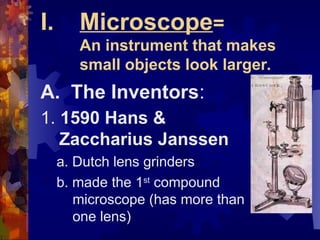
1. 1590 Hans &
Zaccharius Janssen
a. Dutch lens grinders
b. made the 1st
compound
microscope (has more than
one lens)
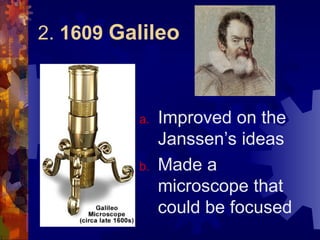
2. 1609 Galileo
a. Improved on the
Janssen’s ideas
b. Made a
microscope that
could be focused
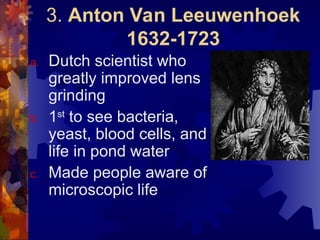
3. Anton Van Leeuwenhoek
1632-1723
a. Dutch scientist who
greatly improved lens
grinding
b. 1st
to see bacteria,
yeast, blood cells, and
life in pond water
c. Made people aware of
microscopic life
And now, time out
for a word from
your sponsor….
k
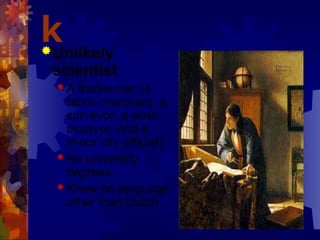
Unlikely
scientist
 A tradesman (a
fabric merchant, a
surveyor, a wine
assayer, and a
minor city official)
 No university
degrees
 Knew no language
other than Dutch
…oh Leeuwenhoek
 But he had skill, he was hardworking,
had an endless curiosity, and he kept
an open mind
 His researches opened up the world of
microscopic life to scientists
His Inspirations…
 Leeuwenhoek saw Robert Hooke’s
illustrated book Micrographia which
showed Hooke’s own observations with
a microscope
Anton’s
creations:
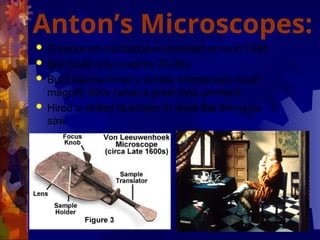
 Made over 500 simple
“microscopes”
 Microscopes were simply
powerful magnifying
lenses
 Specimens were mounted
on the sharp point that
sticks up in front of the
lens
Anton’s Microscopes:
 Compound microscopes invented around 1595
 But could only magnify 20-30x
 But Leeuwenhoek’s simple microscope could
magnify 200x (what a great lens grinder)!
 Hired a skilled illustrator to draw the things he
saw
All good researchers
share their findings….
 1673 Leeuwenhoek began writing
letters to the Royal Society of London
describing what he’d seen with his
microscopes
Eeeeewww…
 17 September 1683 wrote about
observations on his own plaque “a little
white matter, which is as thick as if it
‘twere batter”
 Repeated observations on two men who
had never cleaned their teeth
 Found “an unbelievingly great company
of living animalcules, a-swimming more
nimbly than any I had ever seen up to this
time. Moreover…the animalcules…
seemed to be alive.”
WEE BEASTIES!
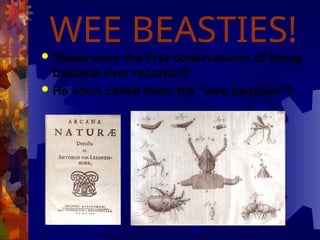
 These were the first observations of living
bacteria ever recorded!
 He soon called them his “wee beasties”!
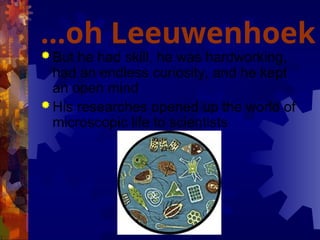
Oooh What He Saw!
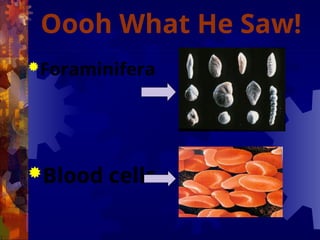
Foraminifera
Blood cells
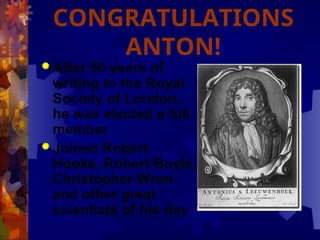
CONGRATULATIONS
ANTON!
 After 50 years of
writing to the Royal
Society of London,
he was elected a full
member
 Joined Robert
Hooke, Robert Boyle,
Christopher Wren
and other great
scientists of his day
…Now, back to
your notes…
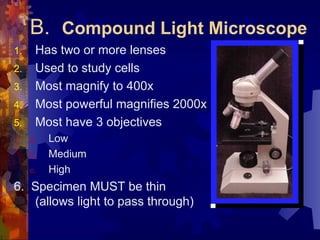
B. Compound Light Microscope
1. Has two or more lenses
2. Used to study cells
3. Most magnify to 400x
4. Most powerful magnifies 2000x
5. Most have 3 objectives
a. Low
b. Medium
c. High
6. Specimen MUST be thin
(allows light to pass through)
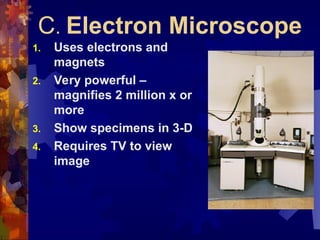
C. Electron Microscope
1. Uses electrons and
magnets
2. Very powerful –
magnifies 2 million x or
more
3. Show specimens in 3-D
4. Requires TV to view
image
Congratulations!
You’re finished.

History of the Microscope. Timeline on developmentsppt

  • 1.
  • 2.
    I. Microscope= An instrumentthat makes small objects look larger. A. The Inventors: 1. 1590 Hans & Zaccharius Janssen a. Dutch lens grinders b. made the 1st compound microscope (has more than one lens)
  • 3.
    2. 1609 Galileo a.Improved on the Janssen’s ideas b. Made a microscope that could be focused
  • 4.
    3. Anton VanLeeuwenhoek 1632-1723 a. Dutch scientist who greatly improved lens grinding b. 1st to see bacteria, yeast, blood cells, and life in pond water c. Made people aware of microscopic life
  • 5.
    And now, timeout for a word from your sponsor….
  • 6.
    k Unlikely scientist  A tradesman(a fabric merchant, a surveyor, a wine assayer, and a minor city official)  No university degrees  Knew no language other than Dutch
  • 7.
    …oh Leeuwenhoek  Buthe had skill, he was hardworking, had an endless curiosity, and he kept an open mind  His researches opened up the world of microscopic life to scientists
  • 8.
    His Inspirations…  Leeuwenhoeksaw Robert Hooke’s illustrated book Micrographia which showed Hooke’s own observations with a microscope
  • 9.
    Anton’s creations:  Made over500 simple “microscopes”  Microscopes were simply powerful magnifying lenses  Specimens were mounted on the sharp point that sticks up in front of the lens
  • 10.
    Anton’s Microscopes:  Compoundmicroscopes invented around 1595  But could only magnify 20-30x  But Leeuwenhoek’s simple microscope could magnify 200x (what a great lens grinder)!  Hired a skilled illustrator to draw the things he saw
  • 11.
    All good researchers sharetheir findings….  1673 Leeuwenhoek began writing letters to the Royal Society of London describing what he’d seen with his microscopes
  • 12.
    Eeeeewww…  17 September1683 wrote about observations on his own plaque “a little white matter, which is as thick as if it ‘twere batter”  Repeated observations on two men who had never cleaned their teeth  Found “an unbelievingly great company of living animalcules, a-swimming more nimbly than any I had ever seen up to this time. Moreover…the animalcules… seemed to be alive.”
  • 13.
    WEE BEASTIES!  Thesewere the first observations of living bacteria ever recorded!  He soon called them his “wee beasties”!
  • 14.
    Oooh What HeSaw! Foraminifera Blood cells
  • 15.
    CONGRATULATIONS ANTON!  After 50years of writing to the Royal Society of London, he was elected a full member  Joined Robert Hooke, Robert Boyle, Christopher Wren and other great scientists of his day
  • 16.
  • 17.
    B. Compound LightMicroscope 1. Has two or more lenses 2. Used to study cells 3. Most magnify to 400x 4. Most powerful magnifies 2000x 5. Most have 3 objectives a. Low b. Medium c. High 6. Specimen MUST be thin (allows light to pass through)
  • 18.
    C. Electron Microscope 1.Uses electrons and magnets 2. Very powerful – magnifies 2 million x or more 3. Show specimens in 3-D 4. Requires TV to view image
  • 19.