Short History of the
Microscope
Microscope
Background
Background
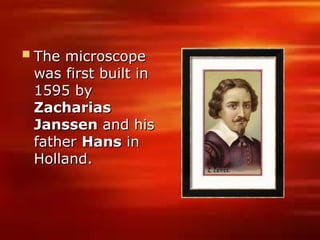
 The microscope was first built in 1595 by
The microscope was first built in 1595 by Hans and
Hans and
Zacharias Janssen
Zacharias Janssen (1588-1631) in Holland.
(1588-1631) in Holland.
 Later, it was perfected in the 17th century in several
Later, it was perfected in the 17th century in several
countries, including by
countries, including by Robert Hooke
Robert Hooke (1635-1703), in
(1635-1703), in
England but most notably by a Dutchman,
England but most notably by a Dutchman, Anton van
Anton van
Leeuwenhoek
Leeuwenhoek (1632-1723).
(1632-1723).
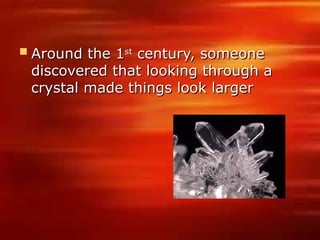
 Around the 1
Around the 1st
st
century, someone
century, someone
discovered that looking through a
crystal made things look larger
 That piece of crystal was called a
That piece of crystal was called a
“
“magnifying glass
magnifying glass” and then later
” and then later
was called a
was called a lens
lens because it was
because it was
shaped like a lentil seed.
=
=
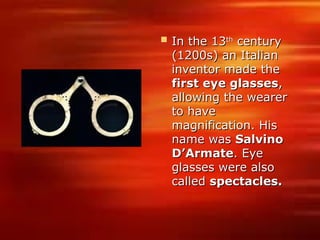
 In the 13
In the 13th
th
century
century
(1200s) an Italian
(1200s) an Italian
inventor made the
inventor made the
first eye glasses
first eye glasses,
,
allowing the wearer
allowing the wearer
to have
to have
magnification. His
magnification. His
name was
name was Salvino
Salvino
D’Armate
D’Armate. Eye
. Eye
glasses were also
glasses were also
called
called spectacles.
spectacles.
 The earliest forms of
The earliest forms of
magnification were
magnification were
magnifying glasses,
magnifying glasses,
usually between
usually between 6x to
6x to
10x
10x, and were used for
, and were used for
looking at tiny insects.
 These excited general
These excited general
wonder when used to
wonder when used to
view fleas or tiny
view fleas or tiny
creeping things and so
were dubbed
were dubbed "flea
"flea
glasses."
glasses."
 The microscope
The microscope
was first built in
was first built in
1595 by
1595 by
Zacharias
Zacharias
Janssen
Janssen and his
and his
father
father Hans
Hans in
in
Holland.
Holland.
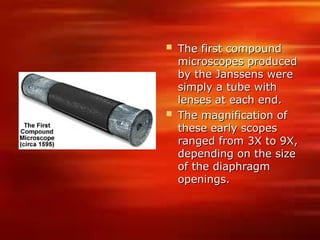
 The first compound
The first compound
microscopes produced
by the Janssens were
simply a tube with
simply a tube with
lenses at each end.
lenses at each end.
 The magnification of
The magnification of
these early scopes
these early scopes
ranged from 3X to 9X,
depending on the size
of the diaphragm
of the diaphragm
openings.
openings.
 14
14th
th
century lenses were used
in spectacles
in spectacles
 Late 16
Late 16th
th
century the Dutch refined the art
of lens grinding
of lens grinding 
 significant magnification.
significant magnification.
 1600s – lenses first mounted on permanent
1600s – lenses first mounted on permanent
frameworks (
frameworks (so distance could be changed)
so distance could be changed)
– Why would this be important?
Why would this be important?
 To focus the image
To focus the image
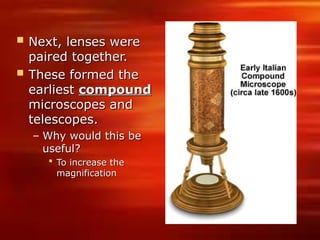
 Next, lenses were
Next, lenses were
paired together.
paired together.
 These formed the
These formed the
earliest
earliest compound
compound
microscopes and
microscopes and
telescopes.
telescopes.
– Why would this be
Why would this be
useful?
useful?
 To increase the
To increase the
magnification
magnification
Robert Hooke (1635-1703)
 Developed a primitive compound
Developed a primitive compound
microscope
microscope
 In Micrographia (1665), he coined
In Micrographia (1665), he coined
the word
the word cell
cell to describe the
to describe the
features of plant tissue (cork from
the bark of an oak tree) he was able
to discover under the microscope.
Illustration of Cork Cells by Robert
Hooke
Using a much improved microscope, with a monocular
eyepiece, a wooden tube, a stage for holding a specimen, and a
glass globe full of water to concentrate light onto it, Hooke
produced marvelous illustrations, which were published in
1667, in his famous book Micrographia, which fired the
imagination of his contemporaries, including van Leeuwenhoek.
Robert Hooke’s Cork Cells
Illustrations from
Illustrations from Micrographia
Micrographia
Anton van Leeuwenhoek (1632-1723)
 He gained much of his
He gained much of his
inspiration form reading Hooke's
Micrographia
Micrographia.
.
 Used his new instrument,
Used his new instrument,
reaching 300x with a single lens
(more powerful than Hooke’s)
and discovered startling
microscopic things, such as
protozoa
protozoa and
and spermatozoa
spermatozoa, or
, or
to discover the microscopic
structure of known things, such
as
as fleas and plant leaves
fleas and plant leaves.
.
 Anton Van Leeuwenhoek was
Anton Van Leeuwenhoek was
the
the first to see bacteria,
first to see bacteria,
yeast, and life found in a
drop of pond water
drop of pond water.
.
 He refined lens grinding so
He refined lens grinding so
that living things could be
seen through the microscope.
 Then there was little change until the
Then there was little change until the
Industrial Revolution (1750-1850)
Changes of the Industrial
Revolution
Revolution
 Standardized parts
Standardized parts (which were
(which were
interchangeable with other
microscopes) lead to mass production
 This triggered a drop in price
This triggered a drop in price 

increased access
increased access 
 new discoveries
new discoveries

 clearer images
clearer images
 In approx. 1880
In approx. 1880 
 modern
modern
microscopes were being used
 With the
With the
advancement of
advancement of
technology and
technology and
improved optics,
improved optics,
the
the compound
compound
light
light
microscope
microscope
came into being.
came into being.
Other types of microscopes:
Electron Microscope
Electron Microscope
 Developed in the 1930s
Developed in the 1930s
 Allowed for higher
Allowed for higher
magnification
magnification
 Used electron beams (instead
Used electron beams (instead
of light) and focused with an
electromagnet (no lenses)
 Light microscope magnifies
Light microscope magnifies
up to 2000X
up to 2000X
 Electron microscope
Electron microscope
magnifies up to 50000X or
higher
higher
 Better quality images at
Better quality images at
higher magnification
Electron Microscope Images
Resources:
Resources:
http://inventors.about.com/od/mstartinv
entions/a/microscope.htm
http://www.cas.muohio.edu/mbi-ws/
microscopes/fathers.html

pphistoryofthemicroscope-120725013621-phpapp02.ppt

  • 1.
    Short History ofthe Short History of the Microscope Microscope
  • 2.
    Background Background  The microscopewas first built in 1595 by The microscope was first built in 1595 by Hans and Hans and Zacharias Janssen Zacharias Janssen (1588-1631) in Holland. (1588-1631) in Holland.  Later, it was perfected in the 17th century in several Later, it was perfected in the 17th century in several countries, including by countries, including by Robert Hooke Robert Hooke (1635-1703), in (1635-1703), in England but most notably by a Dutchman, England but most notably by a Dutchman, Anton van Anton van Leeuwenhoek Leeuwenhoek (1632-1723). (1632-1723).
  • 3.
     Around the1 Around the 1st st century, someone century, someone discovered that looking through a discovered that looking through a crystal made things look larger crystal made things look larger
  • 4.
     That pieceof crystal was called a That piece of crystal was called a “ “magnifying glass magnifying glass” and then later ” and then later was called a was called a lens lens because it was because it was shaped like a lentil seed. shaped like a lentil seed. = =
  • 5.
     In the13 In the 13th th century century (1200s) an Italian (1200s) an Italian inventor made the inventor made the first eye glasses first eye glasses, , allowing the wearer allowing the wearer to have to have magnification. His magnification. His name was name was Salvino Salvino D’Armate D’Armate. Eye . Eye glasses were also glasses were also called called spectacles. spectacles.
  • 6.
     The earliestforms of The earliest forms of magnification were magnification were magnifying glasses, magnifying glasses, usually between usually between 6x to 6x to 10x 10x, and were used for , and were used for looking at tiny insects. looking at tiny insects.  These excited general These excited general wonder when used to wonder when used to view fleas or tiny view fleas or tiny creeping things and so creeping things and so were dubbed were dubbed "flea "flea glasses." glasses."
  • 7.
     The microscope Themicroscope was first built in was first built in 1595 by 1595 by Zacharias Zacharias Janssen Janssen and his and his father father Hans Hans in in Holland. Holland.
  • 8.
     The firstcompound The first compound microscopes produced microscopes produced by the Janssens were by the Janssens were simply a tube with simply a tube with lenses at each end. lenses at each end.  The magnification of The magnification of these early scopes these early scopes ranged from 3X to 9X, ranged from 3X to 9X, depending on the size depending on the size of the diaphragm of the diaphragm openings. openings.
  • 9.
     14 14th th century lenseswere used century lenses were used in spectacles in spectacles  Late 16 Late 16th th century the Dutch refined the art century the Dutch refined the art of lens grinding of lens grinding   significant magnification. significant magnification.  1600s – lenses first mounted on permanent 1600s – lenses first mounted on permanent frameworks ( frameworks (so distance could be changed) so distance could be changed) – Why would this be important? Why would this be important?  To focus the image To focus the image
  • 10.
     Next, lenseswere Next, lenses were paired together. paired together.  These formed the These formed the earliest earliest compound compound microscopes and microscopes and telescopes. telescopes. – Why would this be Why would this be useful? useful?  To increase the To increase the magnification magnification
  • 11.
    Robert Hooke (1635-1703) RobertHooke (1635-1703)  Developed a primitive compound Developed a primitive compound microscope microscope  In Micrographia (1665), he coined In Micrographia (1665), he coined the word the word cell cell to describe the to describe the features of plant tissue (cork from features of plant tissue (cork from the bark of an oak tree) he was able the bark of an oak tree) he was able to discover under the microscope. to discover under the microscope.
  • 12.
    Illustration of CorkCells by Robert Hooke
  • 13.
    Using a muchimproved microscope, with a monocular eyepiece, a wooden tube, a stage for holding a specimen, and a glass globe full of water to concentrate light onto it, Hooke produced marvelous illustrations, which were published in 1667, in his famous book Micrographia, which fired the imagination of his contemporaries, including van Leeuwenhoek.
  • 14.
    Robert Hooke’s CorkCells Robert Hooke’s Cork Cells
  • 15.
    Illustrations from Illustrations fromMicrographia Micrographia
  • 16.
    Anton van Leeuwenhoek(1632-1723) Anton van Leeuwenhoek (1632-1723)  He gained much of his He gained much of his inspiration form reading Hooke's inspiration form reading Hooke's Micrographia Micrographia. .  Used his new instrument, Used his new instrument, reaching 300x with a single lens reaching 300x with a single lens (more powerful than Hooke’s) (more powerful than Hooke’s) and discovered startling and discovered startling microscopic things, such as microscopic things, such as protozoa protozoa and and spermatozoa spermatozoa, or , or to discover the microscopic to discover the microscopic structure of known things, such structure of known things, such as as fleas and plant leaves fleas and plant leaves. .
  • 17.
     Anton VanLeeuwenhoek was Anton Van Leeuwenhoek was the the first to see bacteria, first to see bacteria, yeast, and life found in a yeast, and life found in a drop of pond water drop of pond water. .  He refined lens grinding so He refined lens grinding so that living things could be that living things could be seen through the microscope. seen through the microscope.
  • 18.
     Then therewas little change until the Then there was little change until the Industrial Revolution (1750-1850) Industrial Revolution (1750-1850)
  • 19.
    Changes of theIndustrial Changes of the Industrial Revolution Revolution  Standardized parts Standardized parts (which were (which were interchangeable with other interchangeable with other microscopes) lead to mass production microscopes) lead to mass production  This triggered a drop in price This triggered a drop in price   increased access increased access   new discoveries new discoveries   clearer images clearer images  In approx. 1880 In approx. 1880   modern modern microscopes were being used microscopes were being used
  • 20.
     With the Withthe advancement of advancement of technology and technology and improved optics, improved optics, the the compound compound light light microscope microscope came into being. came into being.
  • 21.
    Other types ofmicroscopes: Other types of microscopes: Electron Microscope Electron Microscope  Developed in the 1930s Developed in the 1930s  Allowed for higher Allowed for higher magnification magnification  Used electron beams (instead Used electron beams (instead of light) and focused with an of light) and focused with an electromagnet (no lenses) electromagnet (no lenses)  Light microscope magnifies Light microscope magnifies up to 2000X up to 2000X  Electron microscope Electron microscope magnifies up to 50000X or magnifies up to 50000X or higher higher  Better quality images at Better quality images at higher magnification higher magnification
  • 22.
  • 23.

Editor's Notes

  • #17 http://www.microscopy-uk.org.uk/index.html?http://www.microscopy-uk.org.uk/ponddip/index.html