History of Documentaries
Jessica Mills
Pre 1900
The term ‘documentary’ was not coiled until 1926, so the short films of
this era were named ‘actuality films’. Many of the first films were a
minute or less in length, due to technological limitations. The early films
were single-shot moments captured on film, such as a train entering a
station, a boat docking, or factory workers leaving work.

1900–1920
Travelogue films were very popular during the early part of the
twentieth century and were often referred to by distributors as
‘scenics’, which were amongst the most popular type of films of the
time.
Early colour motion picture processes such as Kinemacolour used
Travelogues to promote the new colour processes.
Also during this period, Frank Hurley's feature documentary film, South
(1919), about the Imperial Trans-Antarctic Expedition was released. The
film documented the failed Antarctic expedition led by Ernest
Shackleton in 1914.
1920s
The term ‘documentary’ was not coiled until 1926, so the short films of
this era were named ‘actuality films’. Many of the first films were a
minute or less in length, due to technological limitations. The early films
were single-shot moments captured on film, such as a train entering a
station, a boat docking, or factory workers leaving work.
Popular traditions and types of documentaries at this time included:
Romanticism; The city symphony (the continental, or realist, tradition
focused on humans within human-made environments); Kino-Pravda
(‘cinematic truth’; Dziga Vertov believed the camera could portray
reality more accurately than the human eye); and the Newsreel
tradition (important in documentary film; sometimes staged but usually
re-enactments of events that had already happened).
Various European filmmakers began to work in styles that incorporated
avant-garde cinema tic filming and editing techniques (e.g. fluid camera
work
and
montage)
and
abstract
narratives
to
create
impressionistic, highly poetic quasi-documentary works.
1920s–1940s
This era brought about the propagandist tradition, consisting of films
made with the explicit purpose of persuading an audience of a point. In
Britain, a number of different filmmakers came together under John
Grierson, who created the Film Board in Canada for propaganda. They
became known as the Documentary Film Movement and succeeded in
blending propaganda, information and education with a more poetic
aesthetic approach to documentary.

1950s–1970s
A new generation of young filmmakers in the US and Europe attempted
to redefine the nature of the documentary film in this era, by using
newly developed, lightweight, hand-held cameras with synchronised
sound. These filmed strived for immediacy, spontaneity and authenticity
with attempt to bring the filmmaker and audience closer to the subject.
They were termed variously as Direct Cinema, Cinema Verite, and Free
Cinema.
Also during this era, CBS Television inaugurates the first regular new
magazine series, the National Educational Television was founded, the
Armstrong Circle Theatre was first broadcasted on TV and Sony
introduced the first consumer ½ inch video tape recorder.
1970s–1990s
The late 60s and 70s and later decades see shifts in the narrative
approach of many documentaries. Although other earlier documentary
forms, like Cinema Verite and third-person narrative, continue, firstperson storytelling begins to emerge.
In this era, the New Day Films cooperative is formed by feminist
filmmakers Liane Brandon and Amalie Rothschild to distribute social
issue films by independent filmmakers. This was the first distributor to
be run entirely by and for filmmakers.
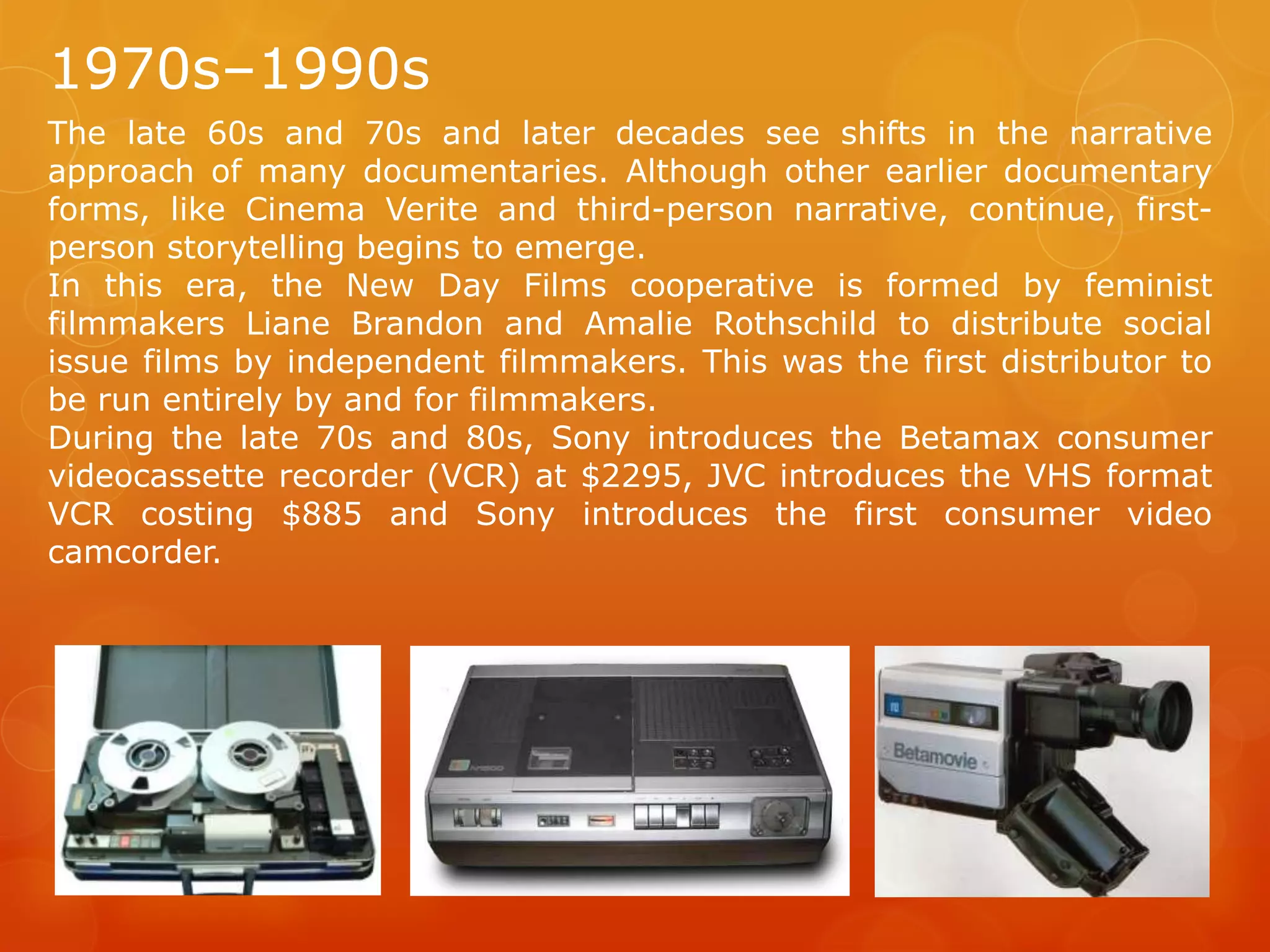
During the late 70s and 80s, Sony introduces the Betamax consumer
videocassette recorder (VCR) at $2295, JVC introduces the VHS format
VCR costing $885 and Sony introduces the first consumer video
camcorder.
Modern Documentaries
Film genre has become increasingly successful in the theatrical release.
Compared to dramatic narrative films, documentaries typically hve far
lower budgets, making them attractive to film companies. An enormous
rash of television programmes utilising some of the techniques of
Cinema Verite hit the network and cable airwaves – so-called ‘reality
TV’. However, the nature of documentary films has changed in the past
20 years from the Cinema Verite tradition. The commercial success of
some documentaries like The Thin Blue Line and Roger and Me may
contribute to the narrative shift.
Documentaries have become financially viable even without cinema
release due the their recent success and the advent of DVDs.
Broadcasters have become their largest funding source, causing
opportunities to emerge within the broadcast market.
Modern documentaries have the overlap with some television forms with
the development of reality TV. This occasionally verges on
documentary, but more often veers to the fictional or staged.
Modern lightweight digital video cameras have greatly aided
documentary makers, as has the dramatic drop in equipment prices.

History of documentaries

  • 1.
  • 2.
    Pre 1900 The term‘documentary’ was not coiled until 1926, so the short films of this era were named ‘actuality films’. Many of the first films were a minute or less in length, due to technological limitations. The early films were single-shot moments captured on film, such as a train entering a station, a boat docking, or factory workers leaving work. 1900–1920 Travelogue films were very popular during the early part of the twentieth century and were often referred to by distributors as ‘scenics’, which were amongst the most popular type of films of the time. Early colour motion picture processes such as Kinemacolour used Travelogues to promote the new colour processes. Also during this period, Frank Hurley's feature documentary film, South (1919), about the Imperial Trans-Antarctic Expedition was released. The film documented the failed Antarctic expedition led by Ernest Shackleton in 1914.
  • 3.
    1920s The term ‘documentary’was not coiled until 1926, so the short films of this era were named ‘actuality films’. Many of the first films were a minute or less in length, due to technological limitations. The early films were single-shot moments captured on film, such as a train entering a station, a boat docking, or factory workers leaving work. Popular traditions and types of documentaries at this time included: Romanticism; The city symphony (the continental, or realist, tradition focused on humans within human-made environments); Kino-Pravda (‘cinematic truth’; Dziga Vertov believed the camera could portray reality more accurately than the human eye); and the Newsreel tradition (important in documentary film; sometimes staged but usually re-enactments of events that had already happened). Various European filmmakers began to work in styles that incorporated avant-garde cinema tic filming and editing techniques (e.g. fluid camera work and montage) and abstract narratives to create impressionistic, highly poetic quasi-documentary works.
  • 4.
    1920s–1940s This era broughtabout the propagandist tradition, consisting of films made with the explicit purpose of persuading an audience of a point. In Britain, a number of different filmmakers came together under John Grierson, who created the Film Board in Canada for propaganda. They became known as the Documentary Film Movement and succeeded in blending propaganda, information and education with a more poetic aesthetic approach to documentary. 1950s–1970s A new generation of young filmmakers in the US and Europe attempted to redefine the nature of the documentary film in this era, by using newly developed, lightweight, hand-held cameras with synchronised sound. These filmed strived for immediacy, spontaneity and authenticity with attempt to bring the filmmaker and audience closer to the subject. They were termed variously as Direct Cinema, Cinema Verite, and Free Cinema. Also during this era, CBS Television inaugurates the first regular new magazine series, the National Educational Television was founded, the Armstrong Circle Theatre was first broadcasted on TV and Sony introduced the first consumer ½ inch video tape recorder.
  • 5.
    1970s–1990s The late 60sand 70s and later decades see shifts in the narrative approach of many documentaries. Although other earlier documentary forms, like Cinema Verite and third-person narrative, continue, firstperson storytelling begins to emerge. In this era, the New Day Films cooperative is formed by feminist filmmakers Liane Brandon and Amalie Rothschild to distribute social issue films by independent filmmakers. This was the first distributor to be run entirely by and for filmmakers. During the late 70s and 80s, Sony introduces the Betamax consumer videocassette recorder (VCR) at $2295, JVC introduces the VHS format VCR costing $885 and Sony introduces the first consumer video camcorder.
  • 6.
    Modern Documentaries Film genrehas become increasingly successful in the theatrical release. Compared to dramatic narrative films, documentaries typically hve far lower budgets, making them attractive to film companies. An enormous rash of television programmes utilising some of the techniques of Cinema Verite hit the network and cable airwaves – so-called ‘reality TV’. However, the nature of documentary films has changed in the past 20 years from the Cinema Verite tradition. The commercial success of some documentaries like The Thin Blue Line and Roger and Me may contribute to the narrative shift. Documentaries have become financially viable even without cinema release due the their recent success and the advent of DVDs. Broadcasters have become their largest funding source, causing opportunities to emerge within the broadcast market. Modern documentaries have the overlap with some television forms with the development of reality TV. This occasionally verges on documentary, but more often veers to the fictional or staged. Modern lightweight digital video cameras have greatly aided documentary makers, as has the dramatic drop in equipment prices.