A Short History of Computing Tim Bergin Computing History Museum American University
Ancient History
Abacus 3000 BCE, early form of beads on wires, used in China From semitic  abaq , meaning dust.
Table Abacus  100,000  ------  ---  ---------------------------- 50,000  -----  ---------------------------------- 10,000  -----  ---   ---   ----------------------- 5,000  -----  ---------------------------------- 1,000  -----  ---  ----------------------------- 500  ----------------------------------------- 100  -----  ---  ---  ---  --------------------    50 -----  --- ------------------------------- 10  ------------------------------------------ 5  ------------------------------------------ 1  -----  ---  -------------------------------
Chinese Swan Pan
The Middle Ages
Charles Babbage (1791-1871)
Charles Babbage (1791-1871) Born: December 26, 1791 son of Benjamin Babbage a London banker (part of the emerging  middle class: property, education, wealth, and status ) Trinity College, Cambridge  [MA, 1817] with John Herschel and George Peacock, produced a translation of LaCroix’s calculus text.
A vision of calculating by steam! My friend Herschel, calling upon me, brought with him the calculations of the computers, and we commenced the tedious process of verification.  After a time many discrepancies occurred, and at one point these discordances were so numerous that I exclaimed, “I wish to God these calculations had been executed by steam.”  1821
Never to be completed December 1830, a dispute with his chief engineer, Joseph Clement, over control of the project, ends work on the difference engine Clement is allowed to keep all  tools  and drawings by English law
Importance of the Difference Engine 1. First attempt to  devise  a computing machine that was  automatic in action  and well adapted, by its printing mechanism, to  a mathematical task of considerable importance . 2. An example of  government subsidization   of innovation and technology development 3.  Spin offs  to the  machine-tool “industry ”
Science Museum’s Reconstruction Difference Engine Number 2  (1847 to 1849) constructed according to Babbage’s original drawings ( minor modifications ) 1991 Bicentenary Celebration 4,000 parts 7 feet high, 11 feet long, 18 inches deep 500,000 pounds
Science Museum Recreation 1991 ( Doron Swade, Curator )
 
Analytical Engine
 
Ada Augusta Byron ,  1815-1852 born on 10 December 1815. named after Byron's half sister, Augusta, who had been his mistress. After Byron had left for the Continent with a parting shot -- 'When shall we three meet again?' -- Ada was brought up by her mother.
Ada Augusta Byron,  Countess of Lovelace Translated Menebrea’s paper into English Taylor’s:  “ The editorial notes are by the translator, the Countess of Lovelace .” Footnotes enhance the text and provide examples of how the Analytical Engine could be used, i.e., how it would be programmed to solve problems! Myth: “world’s first programmer”
Herman Hollerith and the Evolution of Electronic Accounting Machines
Herman Hollerith (1860-1929)
Herman Hollerith Born: February 29, 1860 Civil War: 1861-1865 Columbia School of Mines (New York) 1879 hired at Census Office 1882 MIT faculty ( T is for technology !) 1883 St. Louis ( inventor ) 1884 Patent Office (Wash, DC) 1885 “Expert and Solicitor of  Patents ”
Census Article I, Section 2: Representatives and direct Taxes shall be apportioned among the several states... according to their respective numbers ...(and)  every ...term of ten years 1790: 1st US census Population: 3,929,214 Census Office
Population Growth: 1790 4 million 1840 17 million 1870 40 million 1880 50 million fear of not being able to enumerate the census in the 10 intervening years 1890 63 million
Smithsonian Exhibit (old)
Computing Tabulating Recording Company,(C-T-R) 1911: Charles Flint  Computing  Scale Company (Dayton, OH) Tabulating  Machine Company, and International Time   Recording   Company (Binghamton, NY)
Thomas J. Watson (1874-1956)  hired as first president In1924, Watson renames CTR as  International Business Machines
Electronic Numerical Integrator and Computer   1st large scale electronic digital computer designed and constructed at the  Moore School  of Electrical Engineering of the University of Pennsylvania since 1920s, faculty had worked with Aberdeen Proving Ground’s  Ballistics Research Laboratory (BRL)
Inspiration and Perspiration Unite 1943  Mauchly and Eckert prepare a proposal for the US Army to build an  Electronic Numerical Integrator calculate a trajectory in 1 second May 31, 1943  Construction of ENIAC starts 1944  early thoughts on  stored program  computers by members of the ENIAC team July 1944   two  accumulators  working
Accumulator (28 vacuum tubes)
 
ENIAC at Moore School, University of Pennsylvania
 
Early Thoughts about   Stored Program  Computing January 1944   Moore School team thinks of better ways to do things; leverages delay line memories from War research September 1944   John von Neumann visits  Goldstine’s meeting at Aberdeen Train Station October 1944   Army extends the ENIAC contract  to include research on the  EDVAC  and the  stored-program concept Spring 1945   ENIAC working well June 1945   First Draft of a Report on the EDVAC: Electronic Discrete Variable Automatic Computer
First Draft Report (June 1945) John von Neumann prepares ( ? ) a report on the EDVAC which identifies how the machine could be programmed (unfinished very rough draft) academic: publish for the good of science engineers: patents, patents, patents von Neumann never repudiates the myth that he wrote it;  most members of the ENIAC team ontribute ideas
British Efforts
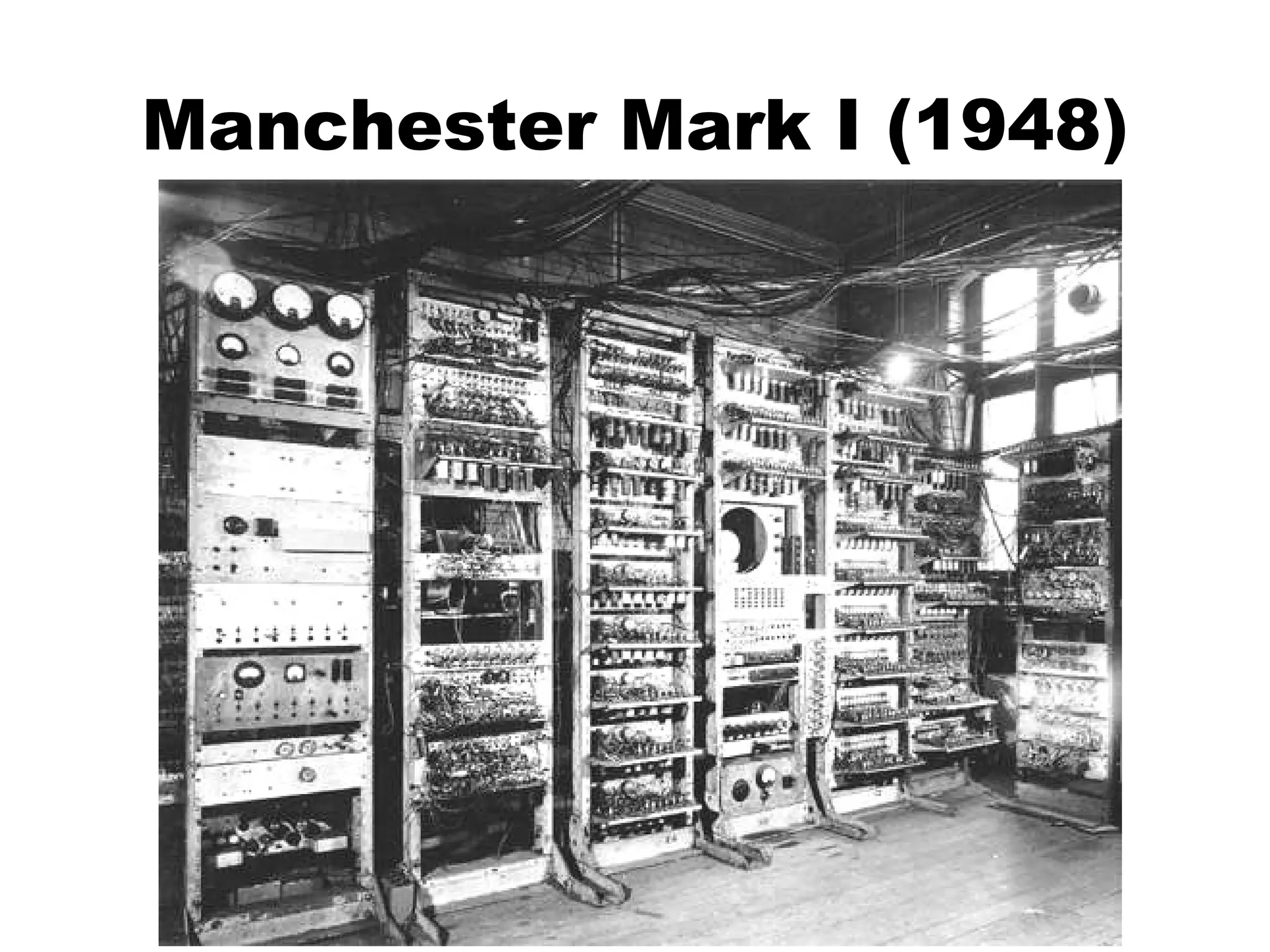
Manchester Mark I (1948)
Manchester Mark I (1948) Freddy Williams and Tom Kilburn Developed an electrostatic memory Prototype operational June 21, 1948 and machine to execute a stored program Memory: 32 words of 32 bits each Storage: single Williams tube (CRT) Fully operational: October 1949 Ferranti Mark I delivered in February 1951
EDSAC Maurice Wilkes ,  University Mathematical Laboratory,  Cambridge University Moore School Lectures Electronic Delay Storage Automatic Calculator, EDSAC  operational   May, 1949 J. Lyons Company and the LEO, Lyons Electronic Office , operational fall 1951
 
National Physical Laboratory Alan Turing Automatic Computing Engine (ACE) Basic design by spring, 1946 Harry Huskey joins project Pilot ACE working, May 10, 1950 English Electric: DEUCE, 1954 Full version of ACE at NPL, 1959
Alan Turing (1912-1954) On Computable Numbers with an application to the Entscheidungs-problem Code breaker
 
Mainframe Computers
 
John Mauchly leaning on  the  UNIV ersal  A utomatic  C omputer
Remington Rand  UNIVAC 43 UNIVACs  were delivered to government and industry  Memory: mercury delay lines : 1000 words of 12 alphanumeric characters Secondary storage: metal oxide tape Access time: 222 microseconds (average) Instruction set: 45 operation codes Accumulators: 4 Clock: 2.25 Mhz
IBM 701  (Defense Calculator) Addition time: 60 microseconds Multiplication: 456 microseconds Memory: 2048 (36 bit) words using Williams tubes Secondary memory:   Magnetic drum: 8192 words Magnetic tape: plastic Delivered:  December 1952 : IBM World Headquarters  (total of 19 installed)
Second Generation (1958-1964) 1958 Philco introduces TRANSAC S-2000 first transistorized commercial machine IBM 7070, 7074 (1960), 7072(1961) 1959  IBM 7090, 7040 (1961), 7094 (1962) 1959 IBM 1401, 1410 (1960), 1440 (1962) FORTRAN, ALGOL , and  COBOL  are first standardized programming languages
Third Generation (1964-1971) April 1964  IBM announces the System/360 solid logic technology (integrated circuits) family of “compatible” computers 1964 Control Data delivers the CDC 6600 nanoseconds telecommunications BASIC , Beginners All-purpose Symbolic Instruction Code
Fourth Generation (1971- ) Large scale integrated circuits (MSI, LSI) Nanoseconds and picoseconds Databases (large) Structured languages ( Pascal ) Structured techniques Business packages
Digital Equipment Corporation (Mini-computers)
Assabet Mills, Maynard, MA
Flipchip
PDP-8, first mass-produced Mini
PDP-11 (1970)
Microcomputers
Intel Noyce, Moore , and  Andrew Grove  leave Fairchild and found Intel in 1968 focus on random access memory (RAM) chips Question: if you can put transistors, capacitors, etc. on a chip, why couldn’t you put a central processor on a chip? Ted Hoff  designs the  Intel 4004 , the first microprocessor in  1969 based on  Digital’s PDP-8
Microcomputers Ed Roberts  founds  Micro Instrumentation Telemetry Systems (MITS)  in 1968 Popular Electronics  puts the MITS  Altair  on the cover in January 1975  [ Intel 8080 ] Les Solomon’s  12 year old daughter,  Lauren , was a lover of  Star Trek .  He asked her what the name of the computer on the  Enterprise  was. She said “ ‘computer’ but why don’t you call it  Altair  because that is where they are going tonight!”
Altair 8800 Computer
Intel processors CPU Year Data Memory MIPS 4004 1971 4 1K 8008 1972 8 16K 8080 1974 8 64K 8088 1980 8 1M .33 80286 1982 16 1M 3 80386 1985 32 4G 11 80486 1989 32 4G 41 Pentium1993 64 4G   111

History of computer

  • 1.
    A Short Historyof Computing Tim Bergin Computing History Museum American University
  • 2.
  • 3.
    Abacus 3000 BCE,early form of beads on wires, used in China From semitic abaq , meaning dust.
  • 4.
    Table Abacus 100,000 ------  ---  ---------------------------- 50,000 -----  ---------------------------------- 10,000 -----  ---  ---  ----------------------- 5,000 -----  ---------------------------------- 1,000 -----  ---  ----------------------------- 500 ----------------------------------------- 100 -----  ---  ---  ---  -------------------- 50 -----  --- ------------------------------- 10 ------------------------------------------ 5 ------------------------------------------ 1 -----  ---  -------------------------------
  • 5.
  • 6.
  • 7.
  • 8.
    Charles Babbage (1791-1871)Born: December 26, 1791 son of Benjamin Babbage a London banker (part of the emerging middle class: property, education, wealth, and status ) Trinity College, Cambridge [MA, 1817] with John Herschel and George Peacock, produced a translation of LaCroix’s calculus text.
  • 9.
    A vision ofcalculating by steam! My friend Herschel, calling upon me, brought with him the calculations of the computers, and we commenced the tedious process of verification. After a time many discrepancies occurred, and at one point these discordances were so numerous that I exclaimed, “I wish to God these calculations had been executed by steam.” 1821
  • 10.
    Never to becompleted December 1830, a dispute with his chief engineer, Joseph Clement, over control of the project, ends work on the difference engine Clement is allowed to keep all tools and drawings by English law
  • 11.
    Importance of theDifference Engine 1. First attempt to devise a computing machine that was automatic in action and well adapted, by its printing mechanism, to a mathematical task of considerable importance . 2. An example of government subsidization of innovation and technology development 3. Spin offs to the machine-tool “industry ”
  • 12.
    Science Museum’s ReconstructionDifference Engine Number 2 (1847 to 1849) constructed according to Babbage’s original drawings ( minor modifications ) 1991 Bicentenary Celebration 4,000 parts 7 feet high, 11 feet long, 18 inches deep 500,000 pounds
  • 13.
    Science Museum Recreation1991 ( Doron Swade, Curator )
  • 14.
  • 15.
  • 16.
  • 17.
    Ada Augusta Byron, 1815-1852 born on 10 December 1815. named after Byron's half sister, Augusta, who had been his mistress. After Byron had left for the Continent with a parting shot -- 'When shall we three meet again?' -- Ada was brought up by her mother.
  • 18.
    Ada Augusta Byron, Countess of Lovelace Translated Menebrea’s paper into English Taylor’s: “ The editorial notes are by the translator, the Countess of Lovelace .” Footnotes enhance the text and provide examples of how the Analytical Engine could be used, i.e., how it would be programmed to solve problems! Myth: “world’s first programmer”
  • 19.
    Herman Hollerith andthe Evolution of Electronic Accounting Machines
  • 20.
  • 21.
    Herman Hollerith Born:February 29, 1860 Civil War: 1861-1865 Columbia School of Mines (New York) 1879 hired at Census Office 1882 MIT faculty ( T is for technology !) 1883 St. Louis ( inventor ) 1884 Patent Office (Wash, DC) 1885 “Expert and Solicitor of Patents ”
  • 22.
    Census Article I,Section 2: Representatives and direct Taxes shall be apportioned among the several states... according to their respective numbers ...(and) every ...term of ten years 1790: 1st US census Population: 3,929,214 Census Office
  • 23.
    Population Growth: 17904 million 1840 17 million 1870 40 million 1880 50 million fear of not being able to enumerate the census in the 10 intervening years 1890 63 million
  • 24.
  • 25.
    Computing Tabulating RecordingCompany,(C-T-R) 1911: Charles Flint Computing Scale Company (Dayton, OH) Tabulating Machine Company, and International Time Recording Company (Binghamton, NY)
  • 26.
    Thomas J. Watson(1874-1956) hired as first president In1924, Watson renames CTR as International Business Machines
  • 27.
    Electronic Numerical Integratorand Computer 1st large scale electronic digital computer designed and constructed at the Moore School of Electrical Engineering of the University of Pennsylvania since 1920s, faculty had worked with Aberdeen Proving Ground’s Ballistics Research Laboratory (BRL)
  • 28.
    Inspiration and PerspirationUnite 1943 Mauchly and Eckert prepare a proposal for the US Army to build an Electronic Numerical Integrator calculate a trajectory in 1 second May 31, 1943 Construction of ENIAC starts 1944 early thoughts on stored program computers by members of the ENIAC team July 1944 two accumulators working
  • 29.
  • 30.
  • 31.
    ENIAC at MooreSchool, University of Pennsylvania
  • 32.
  • 33.
    Early Thoughts about Stored Program Computing January 1944 Moore School team thinks of better ways to do things; leverages delay line memories from War research September 1944 John von Neumann visits Goldstine’s meeting at Aberdeen Train Station October 1944 Army extends the ENIAC contract to include research on the EDVAC and the stored-program concept Spring 1945 ENIAC working well June 1945 First Draft of a Report on the EDVAC: Electronic Discrete Variable Automatic Computer
  • 34.
    First Draft Report(June 1945) John von Neumann prepares ( ? ) a report on the EDVAC which identifies how the machine could be programmed (unfinished very rough draft) academic: publish for the good of science engineers: patents, patents, patents von Neumann never repudiates the myth that he wrote it; most members of the ENIAC team ontribute ideas
  • 35.
  • 36.
  • 37.
    Manchester Mark I(1948) Freddy Williams and Tom Kilburn Developed an electrostatic memory Prototype operational June 21, 1948 and machine to execute a stored program Memory: 32 words of 32 bits each Storage: single Williams tube (CRT) Fully operational: October 1949 Ferranti Mark I delivered in February 1951
  • 38.
    EDSAC Maurice Wilkes, University Mathematical Laboratory, Cambridge University Moore School Lectures Electronic Delay Storage Automatic Calculator, EDSAC operational May, 1949 J. Lyons Company and the LEO, Lyons Electronic Office , operational fall 1951
  • 39.
  • 40.
    National Physical LaboratoryAlan Turing Automatic Computing Engine (ACE) Basic design by spring, 1946 Harry Huskey joins project Pilot ACE working, May 10, 1950 English Electric: DEUCE, 1954 Full version of ACE at NPL, 1959
  • 41.
    Alan Turing (1912-1954)On Computable Numbers with an application to the Entscheidungs-problem Code breaker
  • 42.
  • 43.
  • 44.
  • 45.
    John Mauchly leaningon the UNIV ersal A utomatic C omputer
  • 46.
    Remington Rand UNIVAC 43 UNIVACs were delivered to government and industry Memory: mercury delay lines : 1000 words of 12 alphanumeric characters Secondary storage: metal oxide tape Access time: 222 microseconds (average) Instruction set: 45 operation codes Accumulators: 4 Clock: 2.25 Mhz
  • 47.
    IBM 701 (Defense Calculator) Addition time: 60 microseconds Multiplication: 456 microseconds Memory: 2048 (36 bit) words using Williams tubes Secondary memory: Magnetic drum: 8192 words Magnetic tape: plastic Delivered: December 1952 : IBM World Headquarters (total of 19 installed)
  • 48.
    Second Generation (1958-1964)1958 Philco introduces TRANSAC S-2000 first transistorized commercial machine IBM 7070, 7074 (1960), 7072(1961) 1959 IBM 7090, 7040 (1961), 7094 (1962) 1959 IBM 1401, 1410 (1960), 1440 (1962) FORTRAN, ALGOL , and COBOL are first standardized programming languages
  • 49.
    Third Generation (1964-1971)April 1964 IBM announces the System/360 solid logic technology (integrated circuits) family of “compatible” computers 1964 Control Data delivers the CDC 6600 nanoseconds telecommunications BASIC , Beginners All-purpose Symbolic Instruction Code
  • 50.
    Fourth Generation (1971-) Large scale integrated circuits (MSI, LSI) Nanoseconds and picoseconds Databases (large) Structured languages ( Pascal ) Structured techniques Business packages
  • 51.
  • 52.
  • 53.
  • 54.
  • 55.
  • 56.
  • 57.
    Intel Noyce, Moore, and Andrew Grove leave Fairchild and found Intel in 1968 focus on random access memory (RAM) chips Question: if you can put transistors, capacitors, etc. on a chip, why couldn’t you put a central processor on a chip? Ted Hoff designs the Intel 4004 , the first microprocessor in 1969 based on Digital’s PDP-8
  • 58.
    Microcomputers Ed Roberts founds Micro Instrumentation Telemetry Systems (MITS) in 1968 Popular Electronics puts the MITS Altair on the cover in January 1975 [ Intel 8080 ] Les Solomon’s 12 year old daughter, Lauren , was a lover of Star Trek . He asked her what the name of the computer on the Enterprise was. She said “ ‘computer’ but why don’t you call it Altair because that is where they are going tonight!”
  • 59.
  • 60.
    Intel processors CPUYear Data Memory MIPS 4004 1971 4 1K 8008 1972 8 16K 8080 1974 8 64K 8088 1980 8 1M .33 80286 1982 16 1M 3 80386 1985 32 4G 11 80486 1989 32 4G 41 Pentium1993 64 4G 111