


ARCHAEOLOGY & THE
BIBLE
Friends or Foes?
Lecture 3: Feb 24, 2013
5 Questions about
Archaeology & the Bible
You Always Wanted to Ask
1. What (description) is the art and science of archaeology?
2. Who (people) are biblical archaeologists?
3. When (history) and where (geography) did archaeology begin?
4. How (method) did archaeology shaped biblical studies?
5. Why (purpose) should Christians be interested in archaeology?
1. What is the art and science of archaeology?
Archaeology is the historical and scientific study of material things (rather
than abstract ideas) from the human past.
'Biblical Archaeology’ began in the 19th
century by American clergymen in
response to general archaeology, with the goal of discovering proof of the
scientific and historical accuracy of the Bible.
European biblical archaeologists tend to be laypeople more concerned about
the findings whatever the conclusions.
Today, every Bible commentary draws from archaeological research to
support their interpretations, so every sermon is inevitably influenced by the
research of field excavators.
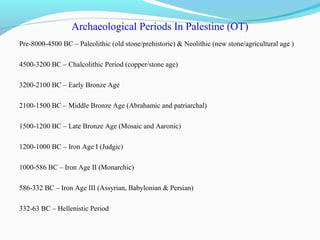
Archaeological Periods In Palestine (OT)
Pre-8000-4500 BC – Paleolithic (old stone/prehistoric) & Neolithic (new stone/agricultural age )
4500-3200 BC – Chalcolithic Period (copper/stone age)
3200-2100 BC – Early Bronze Age
2100-1500 BC – Middle Bronze Age (Abrahamic and patriarchal)
1500-1200 BC – Late Bronze Age (Mosaic and Aaronic)
1200-1000 BC – Iron Age I (Judgic)
1000-586 BC – Iron Age II (Monarchic)
586-332 BC – Iron Age III (Assyrian, Babylonian & Persian)
332-63 BC – Hellenistic Period
Archaeological Periods In Palestine (NT & Church)
63 BC – AD 324 – Roman Period
AD 324-638 – Byzantine Period
AD 638-1099 – Muslim Arab Period
AD 1099-1291 – Crusader Period
AD 1250-1517 – Mamluk Period
AD 1517-1918 – Ottoman Period
AD 1918-1948 – British Period
After 1948 – State of Israel Period
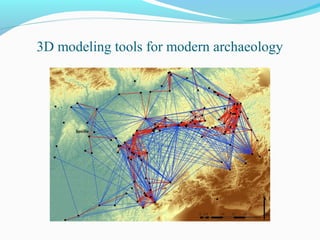
3D modeling tools for modern archaeology
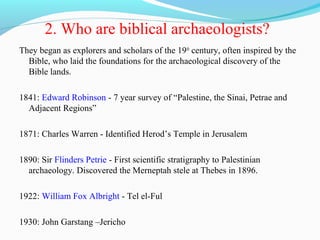
2. Who are biblical archaeologists?
They began as explorers and scholars of the 19th
century, often inspired by the
Bible, who laid the foundations for the archaeological discovery of the
Bible lands.
1841: Edward Robinson - 7 year survey of “Palestine, the Sinai, Petrae and
Adjacent Regions”
1871: Charles Warren - Identified Herod’s Temple in Jerusalem
1890: Sir Flinders Petrie - First scientific stratigraphy to Palestinian
archaeology. Discovered the Merneptah stele at Thebes in 1896.
1922: William Fox Albright - Tel el-Ful
1930: John Garstang –Jericho
More biblical archaeologists?
1955: Yigael Yadin – Hazor & Masada (1963)
1956: James Pritchard – Gibeon
1961: Dame Kathleen Kenyon – City of David (near Jerusalem)
1964: George Ernest Wright and William Dever – Gezer
1968: Benjamin Mazar – Temple Mount
1979: Gabriel Barkay – Ketef Hinnom
1994: Israel Finkelstein and David Ussishkin - Megiddo
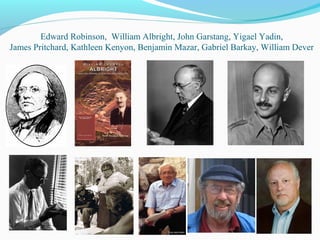
Edward Robinson, William Albright, John Garstang, Yigael Yadin,
James Pritchard, Kathleen Kenyon, Benjamin Mazar, Gabriel Barkay, William Dever
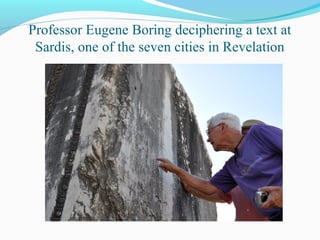
Professor Eugene Boring deciphering a text at
Sardis, one of the seven cities in Revelation
3. Where and when did archaeology begin?
Geography:
All over the world where land is cheap, with political advantages or is
accessible to excavators. For biblical archaeology, the Bible lands include:
Egypt, Greece, Iraq, Iran, Israel, Jordan, Lebanon, Italy, Syria and Turkey.
History:
4th
century: Empress Helena.
19th century. The earliest attempts to map the Bible lands.
1918: Fall of the Ottoman empire opened up the ancient biblical lands to
systematic investigation for material remains of human habitation.
1950s: Advances in long-distance air travel prompted an increase in interest.
21st
century: Advances in scientific discovery, technological inventions of
more complex tools, and interdisciplinary contributions of other scientific
fields led to a more professional approach.
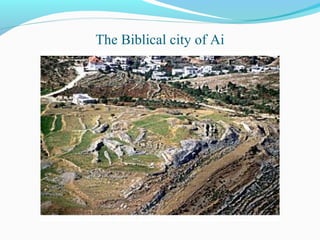
The Biblical city of Ai
4. How archaeology shaped biblical studies
4a. Archaeology helps biblical studies?
By providing an external witness to the people, places and events in the Bible.
Allows us to better appreciate Israel’s distinctiveness by comparison with its
geohistorically contemporary neighbors.
Helps lexicographers more carefully define the semantic range of words used
in the original languages of the Bible (Hebrew, Aramaic & Greek).
Provides the geographical setting in which some of the biblical events
occurred. Jericho has many centers (over 20 successive settlements over a
9000 year period) but the NT Jericho where Jesus healed Bartimaeus (Luke
18:35) has yet to be found.
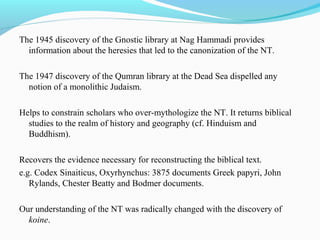
The 1945 discovery of the Gnostic library at Nag Hammadi provides
information about the heresies that led to the canonization of the NT.
The 1947 discovery of the Qumran library at the Dead Sea dispelled any
notion of a monolithic Judaism.
Helps to constrain scholars who over-mythologize the NT. It returns biblical
studies to the realm of history and geography (cf. Hinduism and
Buddhism).
Recovers the evidence necessary for reconstructing the biblical text.
e.g. Codex Sinaiticus, Oxyrhynchus: 3875 documents Greek papyri, John
Rylands, Chester Beatty and Bodmer documents.
Our understanding of the NT was radically changed with the discovery of
koine.
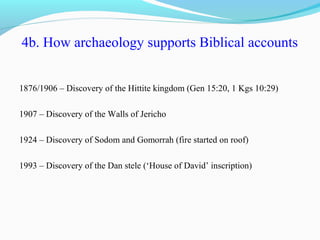
4b. How archaeology supports Biblical accounts
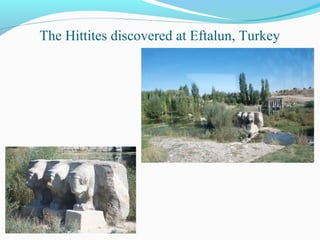
1876/1906 – Discovery of the Hittite kingdom (Gen 15:20, 1 Kgs 10:29)
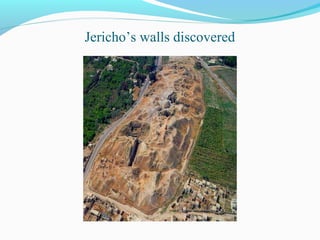
1907 – Discovery of the Walls of Jericho
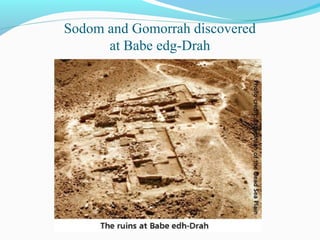
1924 – Discovery of Sodom and Gomorrah (fire started on roof)
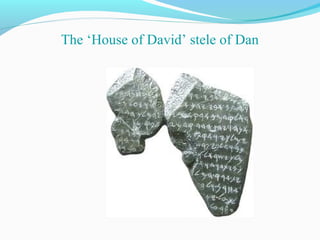
1993 – Discovery of the Dan stele (‘House of David’ inscription)
The Hittites discovered at Eftalun, Turkey
Jericho’s walls discovered
Sodom and Gomorrah discovered
at Babe edg-Drah
The ‘House of David’ stele of Dan
4c. How archaeology changed the way we
translate and interpret the Bible
Proverbs 26:23
(KJV): “Burning lips and a wicked heart are like a potsherd covered with
silver dross”
With the 1929 discovery of Ugaritic, the correct rendering was made possible
(NLT): Smooth words may hide a wicked heart, just as a pretty glaze covers a
common clay pot”
Luke 2:2 and its historical reliability. According to Luke, was Jesus born
before 4 BC (death of Herod the Great) or at AD 6 (Roman census under
Governor Quirinius of Syria). Which is the correct interpretation?
4d. How biblical studies helps archaeology?
The Hebrew Bible is virtually the only extant literature from Iron Age
Palestine.
Biblical disciplines such as philology, literary-critical analyses, as well as
exegetical and hermeneutical principles help archaeologists.
The biblical narratives of say, Paul’s missionary journeys, help archaeologists
pinpoint locations for excavations.
The Bible is the major source of historical information on the Biblical era, so
what it says cannot be ignored by the conscientious archaeologist.
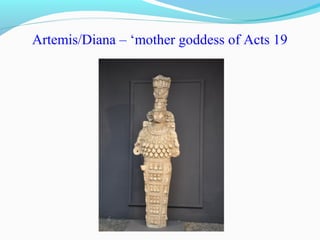
Artemis/Diana – ‘mother goddess of Acts 19
4e. Limitations of archaeology
Excavations only take place at locations where the owners offer permission for a
lengthy period during which no economic interests may be realized.
Expert investigators from a variety of specialized fields must be found who agree
to work as a team for little monetary recompense under grueling conditions.
Reliance on a large team of unskilled volunteers and laborers tax the integrity of
any dig. Supervision and willingness to abandon a contaminated site is crucial.
Contrary interpretations of the same artifact are commonplace and ambiguity
must be expected.
New research tools often lead to re-interpretation and correction of earlier
conclusions.
4f. Politics of biblical archaeology
Early explorations were devoted to apologetics rather than to independent
research.
The Palestinian Exploration Fund (PEF) 1865 in Great Britain –
“for biblical illustration.”
Committee for the Palestine Exploration Society (CPES) 1870 in New York –
“for the illustration and defense of the Bible”
Today, ‘new archeology’ has changed the purpose of biblical archaeology so that
it is now more concerned about the history of events than it is about supporting
theological interpretations of the Bible.
4g. Does archaeology prove or disprove
the Bible?
Neither. Archaeology illuminates but cannot confirm the Bible, it brings
understanding but not belief in the theology of faith.
History –archaeology cannot confirm the existence of Adam, Noah, Abraham or
Moses.
Science–archaeology cannot confirm the OT accounts of David and Solomon or
the NT signs (miracles).
4h. Why archaeology cannot either prove or
disprove the Bible?
While physical remains can offer a statistical probability of identification, two
levels of uncertainty remains –accurate interpretation of the biblical texts
and the identification of the ‘correct’ version of the variants that exist.
Archaeology tools can affirm but not confirm identifications with certainty.
Archaeology cannot either prove or disprove the theological inspiration nor
the historical accuracy of the New Testament since the writers did not
write their accounts with a view to demonstrate their veracity based on
modern historical or scientific tests.
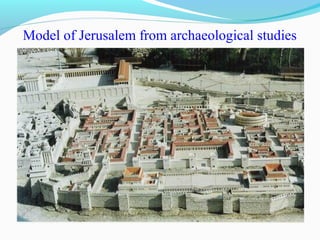
Model of Jerusalem from archaeological studies
Statistics
In Palestine, of the 6000+ archaeological sites have been surveyed.
About 200 have been excavated to some extent, with around 30 sites
excavated to any major extent.
Over 1 million documents recovered from OT times, but less than 10% have
been published.
The typical time between recovery and publication is 10 years since almost all
archaeologists work only during the summer months.
The precise locations of many OT places remain in dispute because of
uncertainty and changing local names.
5. Why should Christians be interested in
archaeology?
Because it is God’s gift, along with all the other fields of inquiry we call the
arts and sciences, to better understand God and his creation.
Because to deliberately ignore the tools that help us avoid errors of
interpretation amounts to a defiance of God when we make proclamations
about God with biblical references.
Because the very integrity and credibility of the Christian witness bears upon
whether we really know what we are talking about – especially when it
may result in harm and even death to others.
Because variations of archaeology have existed from the very beginnings of
Christianity.
Conclusion: Friends of Foes?
1. The Bible, while not a book of history, should be considered a book with
elements of history. Despite the ideological slant of the biblical authors, the
Bible contains much verifiable historical data.
2. Archaeology cannot either prove or disprove the Bible because historical
data cannot prove/disprove theological claims.
3. Archaeology is essential to properly understand the geohistorical context of
the Bible – because the Bible relates a literary, elitist version of the religion
of Israel, whereas archaeology reveals the social context of Israelite
religion, including folk religion and counterculture.
Academy for Christian Thought
Who Are We?
We are a resource for Christian organizations seeking to understand the roles
of history, the natural sciences and philosophy in their ministries.
We are an adoptive authority for both believer and skeptic seeking an
informed approach to understanding of divine reality with integrity.
Why is ACT different?
1. We provide a safe space to learn and to discuss topical issues pertinent both
to the academy and the religious life of people.
2. We initiated a ‘copyleft’ program to distribute our materials royalty-free in
the Two-Thirds World, to counter limited access to our materials due to
economic disparity.
3. We engage the academy through participation in international conferences
on religion and the natural sciences - to narrow the distance of mutual
suspicion between academy and church.
4. We partner with churches and campus ministries - to bridge the
cognitive gap between the pulpit and the pew and serve as a clearing house
of ideas and a trusted resource.

L3 Archaeology & the Bible

  • 1.
    ARCHAEOLOGY & THE BIBLE Friendsor Foes? Lecture 3: Feb 24, 2013
  • 2.
    5 Questions about Archaeology& the Bible You Always Wanted to Ask 1. What (description) is the art and science of archaeology? 2. Who (people) are biblical archaeologists? 3. When (history) and where (geography) did archaeology begin? 4. How (method) did archaeology shaped biblical studies? 5. Why (purpose) should Christians be interested in archaeology?
  • 3.
    1. What isthe art and science of archaeology? Archaeology is the historical and scientific study of material things (rather than abstract ideas) from the human past. 'Biblical Archaeology’ began in the 19th century by American clergymen in response to general archaeology, with the goal of discovering proof of the scientific and historical accuracy of the Bible. European biblical archaeologists tend to be laypeople more concerned about the findings whatever the conclusions. Today, every Bible commentary draws from archaeological research to support their interpretations, so every sermon is inevitably influenced by the research of field excavators.
  • 4.
    Archaeological Periods InPalestine (OT) Pre-8000-4500 BC – Paleolithic (old stone/prehistoric) & Neolithic (new stone/agricultural age ) 4500-3200 BC – Chalcolithic Period (copper/stone age) 3200-2100 BC – Early Bronze Age 2100-1500 BC – Middle Bronze Age (Abrahamic and patriarchal) 1500-1200 BC – Late Bronze Age (Mosaic and Aaronic) 1200-1000 BC – Iron Age I (Judgic) 1000-586 BC – Iron Age II (Monarchic) 586-332 BC – Iron Age III (Assyrian, Babylonian & Persian) 332-63 BC – Hellenistic Period
  • 5.
    Archaeological Periods InPalestine (NT & Church) 63 BC – AD 324 – Roman Period AD 324-638 – Byzantine Period AD 638-1099 – Muslim Arab Period AD 1099-1291 – Crusader Period AD 1250-1517 – Mamluk Period AD 1517-1918 – Ottoman Period AD 1918-1948 – British Period After 1948 – State of Israel Period
  • 6.
    3D modeling toolsfor modern archaeology
  • 7.
    2. Who arebiblical archaeologists? They began as explorers and scholars of the 19th century, often inspired by the Bible, who laid the foundations for the archaeological discovery of the Bible lands. 1841: Edward Robinson - 7 year survey of “Palestine, the Sinai, Petrae and Adjacent Regions” 1871: Charles Warren - Identified Herod’s Temple in Jerusalem 1890: Sir Flinders Petrie - First scientific stratigraphy to Palestinian archaeology. Discovered the Merneptah stele at Thebes in 1896. 1922: William Fox Albright - Tel el-Ful 1930: John Garstang –Jericho
  • 8.
    More biblical archaeologists? 1955:Yigael Yadin – Hazor & Masada (1963) 1956: James Pritchard – Gibeon 1961: Dame Kathleen Kenyon – City of David (near Jerusalem) 1964: George Ernest Wright and William Dever – Gezer 1968: Benjamin Mazar – Temple Mount 1979: Gabriel Barkay – Ketef Hinnom 1994: Israel Finkelstein and David Ussishkin - Megiddo
  • 9.
    Edward Robinson, WilliamAlbright, John Garstang, Yigael Yadin, James Pritchard, Kathleen Kenyon, Benjamin Mazar, Gabriel Barkay, William Dever
  • 10.
    Professor Eugene Boringdeciphering a text at Sardis, one of the seven cities in Revelation
  • 11.
    3. Where andwhen did archaeology begin? Geography: All over the world where land is cheap, with political advantages or is accessible to excavators. For biblical archaeology, the Bible lands include: Egypt, Greece, Iraq, Iran, Israel, Jordan, Lebanon, Italy, Syria and Turkey. History: 4th century: Empress Helena. 19th century. The earliest attempts to map the Bible lands. 1918: Fall of the Ottoman empire opened up the ancient biblical lands to systematic investigation for material remains of human habitation. 1950s: Advances in long-distance air travel prompted an increase in interest. 21st century: Advances in scientific discovery, technological inventions of more complex tools, and interdisciplinary contributions of other scientific fields led to a more professional approach.
  • 12.
  • 13.
    4. How archaeologyshaped biblical studies 4a. Archaeology helps biblical studies? By providing an external witness to the people, places and events in the Bible. Allows us to better appreciate Israel’s distinctiveness by comparison with its geohistorically contemporary neighbors. Helps lexicographers more carefully define the semantic range of words used in the original languages of the Bible (Hebrew, Aramaic & Greek). Provides the geographical setting in which some of the biblical events occurred. Jericho has many centers (over 20 successive settlements over a 9000 year period) but the NT Jericho where Jesus healed Bartimaeus (Luke 18:35) has yet to be found.
  • 14.
    The 1945 discoveryof the Gnostic library at Nag Hammadi provides information about the heresies that led to the canonization of the NT. The 1947 discovery of the Qumran library at the Dead Sea dispelled any notion of a monolithic Judaism. Helps to constrain scholars who over-mythologize the NT. It returns biblical studies to the realm of history and geography (cf. Hinduism and Buddhism). Recovers the evidence necessary for reconstructing the biblical text. e.g. Codex Sinaiticus, Oxyrhynchus: 3875 documents Greek papyri, John Rylands, Chester Beatty and Bodmer documents. Our understanding of the NT was radically changed with the discovery of koine.
  • 15.
    4b. How archaeologysupports Biblical accounts 1876/1906 – Discovery of the Hittite kingdom (Gen 15:20, 1 Kgs 10:29) 1907 – Discovery of the Walls of Jericho 1924 – Discovery of Sodom and Gomorrah (fire started on roof) 1993 – Discovery of the Dan stele (‘House of David’ inscription)
  • 16.
    The Hittites discoveredat Eftalun, Turkey
  • 17.
  • 18.
    Sodom and Gomorrahdiscovered at Babe edg-Drah
  • 19.
    The ‘House ofDavid’ stele of Dan
  • 20.
    4c. How archaeologychanged the way we translate and interpret the Bible Proverbs 26:23 (KJV): “Burning lips and a wicked heart are like a potsherd covered with silver dross” With the 1929 discovery of Ugaritic, the correct rendering was made possible (NLT): Smooth words may hide a wicked heart, just as a pretty glaze covers a common clay pot” Luke 2:2 and its historical reliability. According to Luke, was Jesus born before 4 BC (death of Herod the Great) or at AD 6 (Roman census under Governor Quirinius of Syria). Which is the correct interpretation?
  • 21.
    4d. How biblicalstudies helps archaeology? The Hebrew Bible is virtually the only extant literature from Iron Age Palestine. Biblical disciplines such as philology, literary-critical analyses, as well as exegetical and hermeneutical principles help archaeologists. The biblical narratives of say, Paul’s missionary journeys, help archaeologists pinpoint locations for excavations. The Bible is the major source of historical information on the Biblical era, so what it says cannot be ignored by the conscientious archaeologist.
  • 22.
    Artemis/Diana – ‘mothergoddess of Acts 19
  • 23.
    4e. Limitations ofarchaeology Excavations only take place at locations where the owners offer permission for a lengthy period during which no economic interests may be realized. Expert investigators from a variety of specialized fields must be found who agree to work as a team for little monetary recompense under grueling conditions. Reliance on a large team of unskilled volunteers and laborers tax the integrity of any dig. Supervision and willingness to abandon a contaminated site is crucial. Contrary interpretations of the same artifact are commonplace and ambiguity must be expected. New research tools often lead to re-interpretation and correction of earlier conclusions.
  • 24.
    4f. Politics ofbiblical archaeology Early explorations were devoted to apologetics rather than to independent research. The Palestinian Exploration Fund (PEF) 1865 in Great Britain – “for biblical illustration.” Committee for the Palestine Exploration Society (CPES) 1870 in New York – “for the illustration and defense of the Bible” Today, ‘new archeology’ has changed the purpose of biblical archaeology so that it is now more concerned about the history of events than it is about supporting theological interpretations of the Bible.
  • 25.
    4g. Does archaeologyprove or disprove the Bible? Neither. Archaeology illuminates but cannot confirm the Bible, it brings understanding but not belief in the theology of faith. History –archaeology cannot confirm the existence of Adam, Noah, Abraham or Moses. Science–archaeology cannot confirm the OT accounts of David and Solomon or the NT signs (miracles).
  • 26.
    4h. Why archaeologycannot either prove or disprove the Bible? While physical remains can offer a statistical probability of identification, two levels of uncertainty remains –accurate interpretation of the biblical texts and the identification of the ‘correct’ version of the variants that exist. Archaeology tools can affirm but not confirm identifications with certainty. Archaeology cannot either prove or disprove the theological inspiration nor the historical accuracy of the New Testament since the writers did not write their accounts with a view to demonstrate their veracity based on modern historical or scientific tests.
  • 27.
    Model of Jerusalemfrom archaeological studies
  • 28.
    Statistics In Palestine, ofthe 6000+ archaeological sites have been surveyed. About 200 have been excavated to some extent, with around 30 sites excavated to any major extent. Over 1 million documents recovered from OT times, but less than 10% have been published. The typical time between recovery and publication is 10 years since almost all archaeologists work only during the summer months. The precise locations of many OT places remain in dispute because of uncertainty and changing local names.
  • 29.
    5. Why shouldChristians be interested in archaeology? Because it is God’s gift, along with all the other fields of inquiry we call the arts and sciences, to better understand God and his creation. Because to deliberately ignore the tools that help us avoid errors of interpretation amounts to a defiance of God when we make proclamations about God with biblical references. Because the very integrity and credibility of the Christian witness bears upon whether we really know what we are talking about – especially when it may result in harm and even death to others. Because variations of archaeology have existed from the very beginnings of Christianity.
  • 30.
    Conclusion: Friends ofFoes? 1. The Bible, while not a book of history, should be considered a book with elements of history. Despite the ideological slant of the biblical authors, the Bible contains much verifiable historical data. 2. Archaeology cannot either prove or disprove the Bible because historical data cannot prove/disprove theological claims. 3. Archaeology is essential to properly understand the geohistorical context of the Bible – because the Bible relates a literary, elitist version of the religion of Israel, whereas archaeology reveals the social context of Israelite religion, including folk religion and counterculture.
  • 31.
    Academy for ChristianThought Who Are We? We are a resource for Christian organizations seeking to understand the roles of history, the natural sciences and philosophy in their ministries. We are an adoptive authority for both believer and skeptic seeking an informed approach to understanding of divine reality with integrity.
  • 32.
    Why is ACTdifferent? 1. We provide a safe space to learn and to discuss topical issues pertinent both to the academy and the religious life of people. 2. We initiated a ‘copyleft’ program to distribute our materials royalty-free in the Two-Thirds World, to counter limited access to our materials due to economic disparity. 3. We engage the academy through participation in international conferences on religion and the natural sciences - to narrow the distance of mutual suspicion between academy and church. 4. We partner with churches and campus ministries - to bridge the cognitive gap between the pulpit and the pew and serve as a clearing house of ideas and a trusted resource.

Editor's Notes

  • #6 Mamluk means ‘owned’ (slave)