Overview
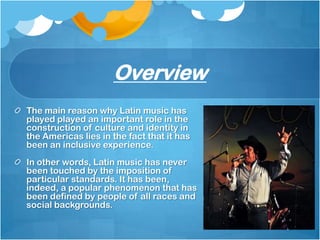
The main reason why Latin music has
played played an important role in the
construction of culture and identity in
the Americas lies in the fact that it has
been an inclusive experience.
In other words, Latin music has never
been touched by the imposition of
particular standards. It has been,
indeed, a popular phenomenon that has
been defined by people of all races and
social backgrounds.
Argentina
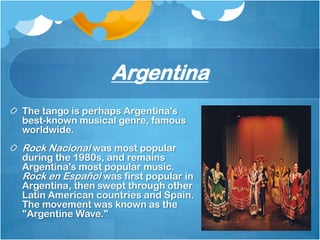
The tango is perhaps Argentina's
best-known musical genre, famous
worldwide.
Rock Nacional was most popular
during the 1980s, and remains
Argentina's most popular music.
Rock en Español was first popular in
Argentina, then swept through other
Latin American countries and Spain.
The movement was known as the
"Argentine Wave."
Mexico
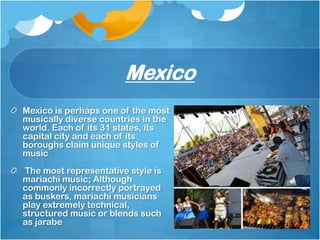
Mexico is perhaps one of the most
musically diverse countries in the
world. Each of its 31 states, its
capital city and each of its
boroughs claim unique styles of
music
The most representative style is
mariachi music; Although
commonly incorrectly portrayed
as buskers, mariachi musicians
play extremely technical,
structured music or blends such
as jarabe
Panama
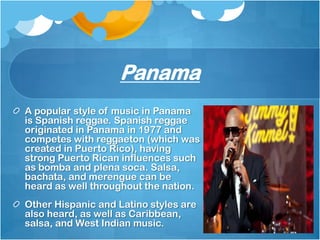
A popular style of music in Panama
is Spanish reggae. Spanish reggae
originated in Panama in 1977 and
competes with reggaeton (which was
created in Puerto Rico), having
strong Puerto Rican influences such
as bomba and plena soca. Salsa,
bachata, and merengue can be
heard as well throughout the nation.
Other Hispanic and Latino styles are
also heard, as well as Caribbean,
salsa, and West Indian music.
El Fin
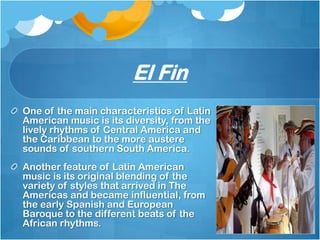
One of the main characteristics of Latin
American music is its diversity, from the
lively rhythms of Central America and
the Caribbean to the more austere
sounds of southern South America.
Another feature of Latin American
music is its original blending of the
variety of styles that arrived in The
Americas and became influential, from
the early Spanish and European
Baroque to the different beats of the
African rhythms.

Hispanic Music

  • 2.
    Overview The main reasonwhy Latin music has played played an important role in the construction of culture and identity in the Americas lies in the fact that it has been an inclusive experience. In other words, Latin music has never been touched by the imposition of particular standards. It has been, indeed, a popular phenomenon that has been defined by people of all races and social backgrounds.
  • 3.
    Argentina The tango isperhaps Argentina's best-known musical genre, famous worldwide. Rock Nacional was most popular during the 1980s, and remains Argentina's most popular music. Rock en Español was first popular in Argentina, then swept through other Latin American countries and Spain. The movement was known as the "Argentine Wave."
  • 4.
    Mexico Mexico is perhapsone of the most musically diverse countries in the world. Each of its 31 states, its capital city and each of its boroughs claim unique styles of music The most representative style is mariachi music; Although commonly incorrectly portrayed as buskers, mariachi musicians play extremely technical, structured music or blends such as jarabe
  • 5.
    Panama A popular styleof music in Panama is Spanish reggae. Spanish reggae originated in Panama in 1977 and competes with reggaeton (which was created in Puerto Rico), having strong Puerto Rican influences such as bomba and plena soca. Salsa, bachata, and merengue can be heard as well throughout the nation. Other Hispanic and Latino styles are also heard, as well as Caribbean, salsa, and West Indian music.
  • 6.
    El Fin One ofthe main characteristics of Latin American music is its diversity, from the lively rhythms of Central America and the Caribbean to the more austere sounds of southern South America. Another feature of Latin American music is its original blending of the variety of styles that arrived in The Americas and became influential, from the early Spanish and European Baroque to the different beats of the African rhythms.