Nerea Yáñez, Alicia Martínez, Josu Azkargorta, Paula
García and Javier Susaeta
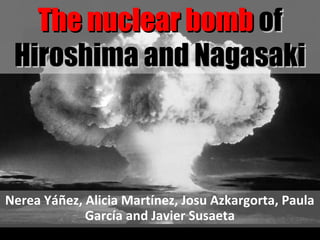
The nuclear bombThe nuclear bomb ofof
Hiroshima and NagasakiHiroshima and Nagasaki
INDEXINDEX
• WHAT HAPPENED?
• CAUSES
• CONSEQUENCES
• NOW AND THEN
• SOLUTIONS
HIROSHIMA
LOCATIONLOCATION
•Hiroshima is the capital of
Hiroshima, in Chugoku
(west of Japan)
•Near the river Ota
HiroshimaHiroshima
POPULATIONPOPULATION
1.160.000 inhabitants
DENSITYDENSITY
 1.280 inhabitants/km²
A city with…
• Militar
• Industrial
importance
Very industrialised city
Militar importance
NAGASAKI
LOCATIONLOCATION
•Nagasaki is the largest
city of Nagasaki
Prefecture.
•In the Kyushu island.
POPULATIONPOPULATION
446.000 inhabitants
DENSITYDENSITY
 1.100 inhabitants/km²
WHAT HAPPENED?WHAT HAPPENED?
The disaster happened:
6 and 9 of august in 1945
The Secondary World War
“Little Boy” bomb exploded in
Hiroshima – 6th of august
“Fat Man” bomb exploted in
Hiroshima – 9th of august
It was one of the greatest disasters
in history!
It was created by the project Manhattan,
that designed the two first atomic bombs:
•Little Boy – attacked Hiroshima
•Fat Man – attacked Nagasaki
These bombs were created of uranium
With a very simple design
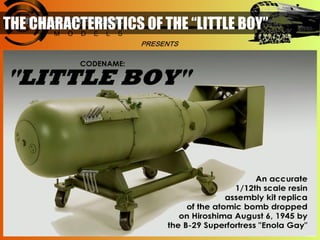
THE CHARACTERISTICS OF THE “LITTLE BOY”
VERY SIMPLE DESIGN
• DIAMETRE: 71 cm
• TYPE OF REACTION: fusion
• WEIGHT: 4.000 kg
• Explosive power: like 12 kilotones
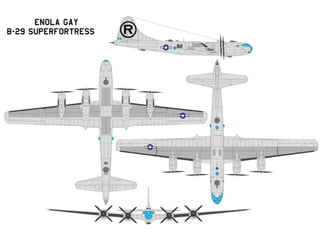
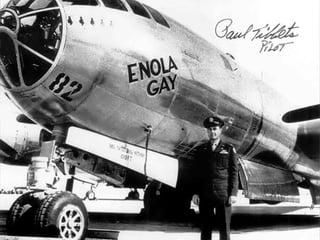
CHARACTERISTICS OF “THE ENOLA GAY”
• Tripulation: 10 passengers
• Length: 30 m
• Dimension: 43 m
•It was the plane that threw
the “Little Boy” over
Hiroshima
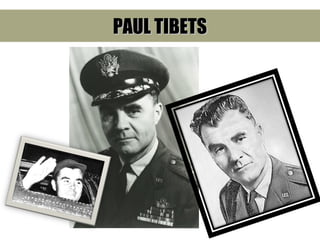
PAUL TIBETSPAUL TIBETS
•He was born in Ilinosis in
1950
•He died in Ohio, USA – 1st
November in 2007
• He was the pilot that threw the bomb
over Hiroshima
• The plane that he piloted: B-29 Enola
Gay
• He had an important militar career
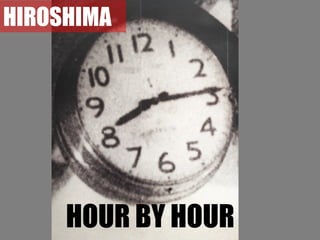
HOUR BY HOUR
HIROSHIMA
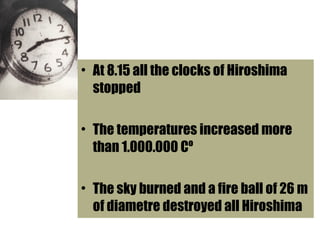
• At 8.15 all the clocks of Hiroshima
stopped
• The temperatures increased more
than 1.000.000 Cº
• The sky burned and a fire ball of 26 m
of diametre destroyed all Hiroshima
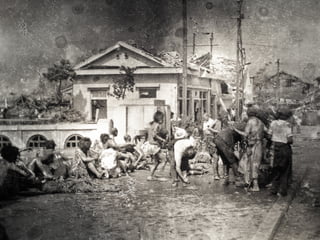
• At 8.45 the photografer Yoshito
Matsushige took the first photo
after the explosion
• It took it in the Miyuki bridge, 2
km from the hipocentre of the
explotion
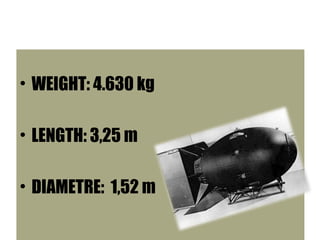
CHARACTERISTICS OF THE “FAT MAN”
• WEIGHT: 4.630 kg
• LENGTH: 3,25 m
• DIAMETRE: 1,52 m
CHARACTERISTICS OF THE “B-29 BOCKSCAR”
• TRIPULATION: 13 passengers
• LENGTH: 21 m
• DIMENSION: 35 m
•It was the plane that threw
the “Fat Man” over
Nagasaki.
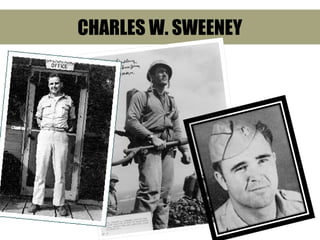
CHARLES W. SWEENEY
• He was born the 27th of December in
1919.
• He was from Lowell, Massachusetts.
• He died the 16th of july in 2004 (84
years old) in Boston, USA.
• He formed part of the US Army Air
Corps.
• He piloted the B-29 Bockscar.
• He threw the “Fat Man” over Nagasaki.
HOUR BY HOUR
NAGASAKI
• At 7:50 the alert of the air bombing was
announced.
• At 8:30 the alert of the distancing of the
danger was announced.
• At 10:30 they saw the planes but didn´t
gave any importance to them.
• At 11:01 the bomb exploded.
• The temperatures increased to 3.900 Cº.
• The bomb was thrown to 469 m of
altitude
CAUSES
CAUSES
JAPANJAPAN VSVS USAUSA
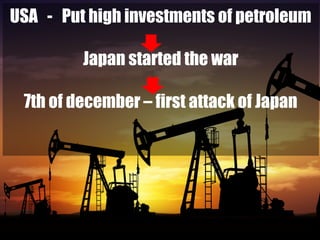
USA - Put high investments of petroleum
Japan started the war
7th of december – first attack of Japan
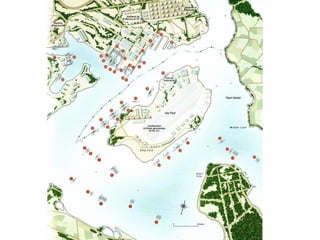
ATTACK TO PEARL HARBOR
PLACE: Hawaii
DATE: 7th December 1941
•A flote of 353 japanese boats bombardated
the american boat
•Japan won
•America declarated war to Japan
USA had accomplices:
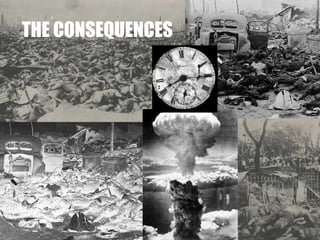
THE CONSEQUENCES
After the explotion
A black rain with
radioactive elements fell
to the ground
Destroyed all the environment
Caused anaemia, spasms and
convulsions
• This bomb killed the 30% of the
Hiroshima´s population
• 140.000 people died directly
• 10.000 people died caused of the
radioactive rain
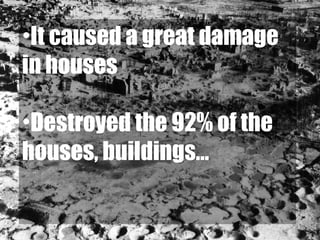
•It caused a great damage
in houses
•Destroyed the 92% of the
houses, buildings…
FIRST THEN
HIROSHIMA
• The “Fat Man” bomb killed 400.000
persons of Nagasaki.
• It destroyed the 40% of buildings.
• The damage expanded to 3 km from the
hipocentre.
NAGASAKI
FIRST THEN
•140.000 persons died
•100.000 wounded
•200.000 people without house
Peoplediedbecauseof…
Poisoning of radiation
Cancer
Bomb radiation
10%
50%
40%
• The burns that people suffered were of
3rd grade
• Affected some generations
• Also affected to doctors, investigators…
that went to Hiroshima and Nagasaki
after the explotion.
The only survivor
• He was called Tsutomu Yamaguchi.
• He was the only recognised survivor of
the bombs.
• But he died the last 4th of January in 2010
of stomache cancer. (related with the
radiation of the bombs.
• He was at a distance of about 3 km of
the bomb.
• He was at a bussiness trip when the
bomb exploded.
• He suffered burns in the left side of
his body but didn´t die.
• The 8th of august he returned to his
city, Nagasaki
• He tried to find his family, although
the radiation of the bomb.
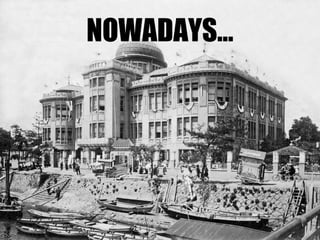
NOWADAYS…
Solutions have been taken
• Construction of new buildings: schools,
shops, officies…
• Made Hiroshima the new symbol of pace
• Reforestation of trees, flowers and other
plants…
• Developed and rich country
• Very good trade
• They export fish (that is of high
quality) to other countries
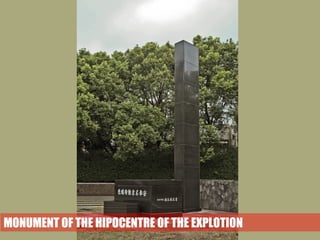
• They constructed a monument in the
place where there was the
hipocentre of the explotion.
• They did a type of tomb in which are
all the names of people that died in
the explotion.
MONUMENT OF THE HIPOCENTRE OF THE EXPLOTION
THE TOMB OF ALL DEAD PEOPLE
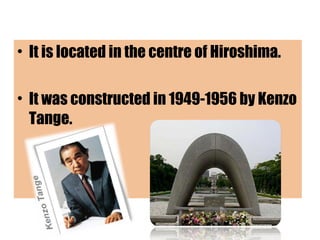
• It is located in the centre of Hiroshima.
• It was constructed in 1949-1956 by Kenzo
Tange.
• 122.100 m of squares of homenage to the
victims of the explotion.
• It was declarated worldwide patrimony
of the humanity by UNESCO.
• It was constructed in the 1955 by  Kenzo
Tange.
• The opening of the museum was the 27th of
November in 2008.
• It was constructing with the intention of
remember people that died in the explotion.
• It collects: objects, clothes, images of the
disaster…
• This has attracted more than 50 million of
tourists.
• They have also a
very curious wall
with the shape of a
man and a ladder.
• They were marked
after the explotion.
A MAP THAT RECREATES THE DISASTER
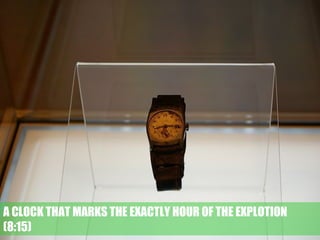
A CLOCK THAT MARKS THE EXACTLY HOUR OF THE EXPLOTION
(8:15)
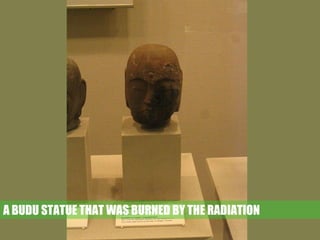
A BUDU STATUE THAT WAS BURNED BY THE RADIATION
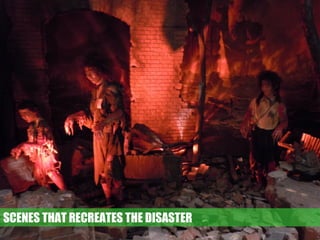
SCENES THAT RECREATES THE DISASTER
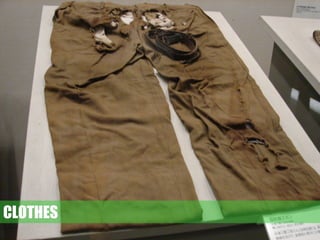
CLOTHES
OBJECTS THAT THE RADIATION AFFECTED
• It also participates in the
international movement of the
peace.
• It organises memorial
ceremonies.
• All years (6th and 9th of august) they
celebrate the anniversary of the atomic
bombing.
• These atrack tourists because all want to
know more about the disaster.
It appears in the cinema…
• In the 50s, Kaneto Sindo, a cinema director
• Shoot a documental
in Hiroshima about the
consequences that affected
mainly children after the
bomb
THE END

Hiroshima