HIPAAA Patient’s Business is not Everybody’s BusinessTracy Stibick, BAMHA 390: CapstoneDr. David ColeOctober 6, 2011
KEY WORDSCovered Entities:  a health care plan, provider or clearinghouse.PHI – Personal Health InformationEHR – Electronic Health RecordEDI – Electronic Data InterchangeEOB – Explanation of Benefits
PURPOSE of TRAININGTo stress the importance of HIPPA RegulationsTo comply with HIPAA Regulations
WHAT IS HIPAA?HIPAA stands for the Health Insurance Portability and Accountability Act of 1996Also known as The Privacy RuleHIPAA regulates how “Covered Entities” can use and/or disseminate patient information Two rules under HIPAA:Security Rule – sets standards for the security of EHRsPatient Safety Rule – protects identifiable patient information from being used to analyze events and improve patient safety
HIPAA BACKGROUNDIncrease of EDI  caused concerns regarding portability and transferability of patient informationConcerns also grew for those with pre-existing conditions and the ability to be covered by health insurance
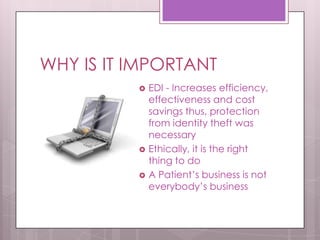
WHY IS IT IMPORTANTEDI - Increases efficiency, effectiveness and cost savings thus, protection from identity theft was necessaryEthically, it is the right thing to doA Patient’s business is not everybody’s business
WHO HAS TO FOLLOW THE LAW & WHAT INFORMATON NEEDS PROTECTION?Everyone needs to comply with HIPAA regulations PHIs need to be secure, such asName, address, phone number, date of birth, age, and/or email addressMedical information such as diagnosis, lab tests and results, prescriptionsBilling history such as claims, referrals, and EOBs
HOW DOES HIPAA AFFECT ME AND MY JOBOne can only look, use, give or talk about  a person’s PHI if it is required to perform your job.Ask yourself this question:  Does my job require me to do this?  HIPAA will affect you if you deal directly with patients or have access to their PHI as part of your job.
PENALTIES FOR NON-COMPLIANCECan result in civil and criminal penalties Unknowingly can result in a minimum penalty of $100 fine per violation with an annual maximum of $25,000 for repeat violation or a maximum penalty of $50,000 per violation with an annual maximum of $1.5 Million for repeat violationsViolations due to willful neglect can result in a minimum of a $1000 fine per violation with an annual Maximum of $100,000 for repeat violations and a maximum penalty of $50,000 per violation with an annual maximum of $1.5 Million for repeat violations
PENALTIES FOR NON-COMPLIANCEWillful neglect but with corrective actions taken can result in a minimum of a $10,000 fine per violation with an annual Maximum of $250,000 for repeat violations and a maximum penalty of $50,000 per violation with an annual maximum of $1.5 Million for repeat violationsWillful neglect without corrective actions can result in a minimum of a $50,000 fine per violation with an annual Maximum of $1.5 Million for repeat violations and a maximum penalty of $50,000 per violation with an annual maximum of $1.5 Million for repeat violations
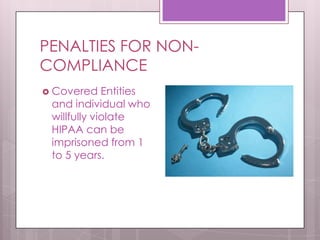
PENALTIES FOR NON-COMPLIANCECovered Entities and individual who willfully violate HIPAA can be imprisoned from 1 to 5 years.
CONTACT INFORMATIONYour SupervisorYour HR DepartmentA Privacy OfficerAdditional information can be found on the US Department of Health and Human Services website	http://www.hhs.gov/ocr/privacy/
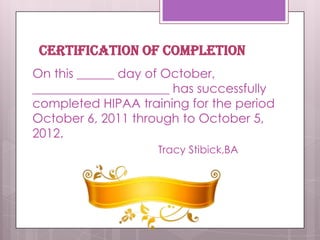
CERTIFICATION OF COMPLETIONOn this ______ day of October, ______________________ has successfully completed HIPAA training for the period October 6, 2011 through to October 5, 2012.			Tracy Stibick,BA

Hipaa

  • 1.
    HIPAAA Patient’s Businessis not Everybody’s BusinessTracy Stibick, BAMHA 390: CapstoneDr. David ColeOctober 6, 2011
  • 2.
    KEY WORDSCovered Entities: a health care plan, provider or clearinghouse.PHI – Personal Health InformationEHR – Electronic Health RecordEDI – Electronic Data InterchangeEOB – Explanation of Benefits
  • 3.
    PURPOSE of TRAININGTostress the importance of HIPPA RegulationsTo comply with HIPAA Regulations
  • 4.
    WHAT IS HIPAA?HIPAAstands for the Health Insurance Portability and Accountability Act of 1996Also known as The Privacy RuleHIPAA regulates how “Covered Entities” can use and/or disseminate patient information Two rules under HIPAA:Security Rule – sets standards for the security of EHRsPatient Safety Rule – protects identifiable patient information from being used to analyze events and improve patient safety
  • 5.
    HIPAA BACKGROUNDIncrease ofEDI caused concerns regarding portability and transferability of patient informationConcerns also grew for those with pre-existing conditions and the ability to be covered by health insurance
  • 6.
    WHY IS ITIMPORTANTEDI - Increases efficiency, effectiveness and cost savings thus, protection from identity theft was necessaryEthically, it is the right thing to doA Patient’s business is not everybody’s business
  • 7.
    WHO HAS TOFOLLOW THE LAW & WHAT INFORMATON NEEDS PROTECTION?Everyone needs to comply with HIPAA regulations PHIs need to be secure, such asName, address, phone number, date of birth, age, and/or email addressMedical information such as diagnosis, lab tests and results, prescriptionsBilling history such as claims, referrals, and EOBs
  • 8.
    HOW DOES HIPAAAFFECT ME AND MY JOBOne can only look, use, give or talk about a person’s PHI if it is required to perform your job.Ask yourself this question: Does my job require me to do this? HIPAA will affect you if you deal directly with patients or have access to their PHI as part of your job.
  • 9.
    PENALTIES FOR NON-COMPLIANCECanresult in civil and criminal penalties Unknowingly can result in a minimum penalty of $100 fine per violation with an annual maximum of $25,000 for repeat violation or a maximum penalty of $50,000 per violation with an annual maximum of $1.5 Million for repeat violationsViolations due to willful neglect can result in a minimum of a $1000 fine per violation with an annual Maximum of $100,000 for repeat violations and a maximum penalty of $50,000 per violation with an annual maximum of $1.5 Million for repeat violations
  • 10.
    PENALTIES FOR NON-COMPLIANCEWillfulneglect but with corrective actions taken can result in a minimum of a $10,000 fine per violation with an annual Maximum of $250,000 for repeat violations and a maximum penalty of $50,000 per violation with an annual maximum of $1.5 Million for repeat violationsWillful neglect without corrective actions can result in a minimum of a $50,000 fine per violation with an annual Maximum of $1.5 Million for repeat violations and a maximum penalty of $50,000 per violation with an annual maximum of $1.5 Million for repeat violations
  • 11.
    PENALTIES FOR NON-COMPLIANCECoveredEntities and individual who willfully violate HIPAA can be imprisoned from 1 to 5 years.
  • 12.
    CONTACT INFORMATIONYour SupervisorYourHR DepartmentA Privacy OfficerAdditional information can be found on the US Department of Health and Human Services website http://www.hhs.gov/ocr/privacy/
  • 13.
    CERTIFICATION OF COMPLETIONOnthis ______ day of October, ______________________ has successfully completed HIPAA training for the period October 6, 2011 through to October 5, 2012. Tracy Stibick,BA