Hinduism
What is Hinduism?
 What   is Hinduism?:
 Hinduism is the world's oldest extant
  religion, with a billion followers, which
  makes it the world's third largest religion.
REINCARNATION
 ideas and practices that originated in
 India, characterized by the belief in
 reincarnation,
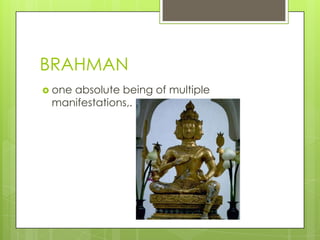
BRAHMAN
 one
    absolute being of multiple
 manifestations,.
One GOD with various
manifestations.
 Within
       Hinduism a large number of
 personal gods are worshipped as murtis.
 These beings are either
      aspects of the supreme Brahman,
     avatars of the supreme being, or
     significantly powerful entities known as
      devas.
     In total, there are 330 thousand of these
      supernatural beings in various Hindu
      traditions.
One God with many
manifestations….like krishna.
RELIGIOUS SACRED TEXTS
 The   VEDAS recited as Mantras
Purusha
 The   Cosmic Man
    The Self that Pervades the Universe
     The Gods are the many “facets” of Purusha
PURUSHA
 Dismemberedby the DEVAS
 (gods/goddesses)
    Mind = Moon
    Eyes = Sun
    Breath = Wind
Purusha
   From his dismembered body come the World
    and Castes
       MOUTH = Brahamin (Priests and Teachers of the
        Law)
       ARMS = Ksatriya (Monarchs and Ruling Class)
        THIGHS = Vaisyras (Cattle-herders, merchant-
        traders, farmers and some artisan castes)
        FEET = Sudra (labourers, some farming castes
        and other artisan castes)
What of the Dalit?
 Dalit   = the unmentioned “fifth” caste:
     Suppressed, crushed, ground. Considered
      of “mixed race” hence, outcast,
     Do work ritually impure:
       Butchering
       Removal  of rubbish, animal carcasses, wastes
       Manual labourers cleaning streets, latrines
        sewers. Pollution considered contagious,
        hence segregated and banned from social
        life.
SAMSKARAS/ LIFE JOURNEY
RITUALS
 SAMSKARAS/     What do they do?
    CONSTRUCT
    ACCOMPSH
    PERFECT
    REFINE

 RITUALS: CELEBRATE COMPLETION OF ONE
 STAGE OF LIFE AND ACCOMPLISH SUCCESSFUL
 PASSAGE TO ANOTHER.
8 sacred rituals
 Naming    …………………………..


 Solid   Food…


 Ear   Piercing …………………
8 sacred rituals
   Head Shaving …………………………


   Beginning
    Education…………


   Sacred Thread (adolescence) …………………………..
8 sacred rituals
 Marriage………………….


 Death….
CONTEMPORARY “SAMSKARA”
 RITUAL   ADVANCEMENT OF A LIFE-BODY
 FROM
    Moment of conception
    To immediately beyond bodily death.

 Why? Refinement of life body by elimination
 of “impurities”.
 Attention to previous life and passage from
 body to body.
FINAL SAMSKARA: DISPOSAL
OF BODY.
 FINAL SAMSKARA = ANTYESTI: final
 sacrifice. WHAT IS SACRIFICED? THE
 DECEASED PERSON?

 ELIMINATESIMPURITIES OF THE LIFE BODY
 CONSTRUCTS ANOTHER BODY FOR
  ANOTHER BIRTH
The body and the spirit
 The Soul can never exist without some sort
 of body. The death ritual helps to
 develop an Thumb sized“air body” which
 gives way to the forearm sized “preta
 body” and then to the full grown glorified
 (pitr) body.
Hindu Funerals
 http://www.youtube.com/watch?v=HMO
  JXPizC5E
 Therapeutic and consoling to prepare
  body:
    Body not embalmed or cosmeticized.

    A Hindu funeral in the West:
    http://www.youtube.com/watch?v=8THoiD
     ZhblQ
Karma & Reincarnation
Karma
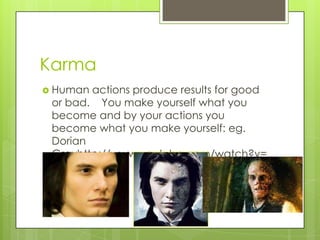
 Human actions produce results for good
 or bad. You make yourself what you
 become and by your actions you
 become what you make yourself: eg.
 Dorian
 Grayhttp://www.youtube.com/watch?v=
 8THoiDZhblQ
SAMSARA
 THEPOTENTIALLY ENDLESS PROCESS OF
 BIRTH DEATH, REBIRTH AND RE-DEATH
MOKSHA = Liberation
 From cycle of birth and death. Heaven
  and Hell not eternal….only as long as
  merited.
 Moksha not the most urgent personal
  ambition of every Hindu
Four aims
 Pleasure: aesthetic, erotic, sensual
 Success: economic and social
 Duty: social responsibilities and obligations
 Moksha: liberation and release from birth
  and death and all embodiments.
Four stages of life are
 Student
 Householder
 Forest
       dweller
 Sunyasin or enlightened renunciant.
Life movement?
 From aim to aim & stage to stage.
 Not all aims are appropriate at all stages.
     Householder: marriage, career, family
       Pleasure:  Sacred literature on pursuit of erotic
        pleasure. Kama sutra.
       Success
       Social obligations
Is Moksha or seeking „release‟
from re-incarnation the final
aim of all?
 NO!  Since life is pleasurable and there is
  an infinity of life-times there is an infinity of
  pleasure and hopes for the next life-time.
 So the life of the ascetic, and renunciant
  who seeks freedom is not popular!
What is most popular form of
religious practice?
 DEVOTIONAL      THEISM …. Many ways to
 freedom.
    MOKSHA IS ATTAINABLE BY GOD‟S GRACE
     THROUGH FAITH. It is God‟s presence.
    It is deep dreamless sleep, no pain, no
     suffering.
    It is pure consciousness, direct awareness of
     infinite depth of one‟s own being.
Who are the most famous
practitioners of modern Hinduism?
 SriRAMAKRISHNA Paramhansa (1836 –
  1886)
 Narendra Dutta aka Swami Vivekenanda
  (1863-1902)
 Mohandas Gandhi (1869 – 1948) aka the
  Mahatma Gandhi
Mystical & Practical Hinduism
 Rama   Krishna:
    Called for ethical conduct
    Direct mystical illumination.
    Direct rapturous devotion/to God and the
     Goddess Kali
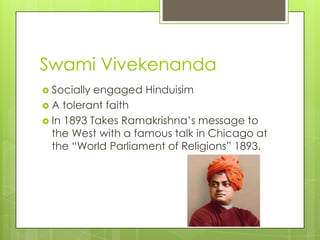
Swami Vivekenanda
 Socially engaged Hinduisim
 A tolerant faith
 In 1893 Takes Ramakrishna‟s message to
  the West with a famous talk in Chicago at
  the “World Parliament of Religions” 1893.
Mohandas K. Gandhi
 Primacy  of conscience over text
 Dialogue with other faiths
 Satygraha or non-violent resistance.
 Non-violence ahimsa
 Against the caste system.

Hinduism: Summary of "On Death and After in Brahmanic Hindu India" William Cully Allen in "Death & Dying in World Religions" ed by Lucy Bregman &

  • 1.
  • 2.
    What is Hinduism? What is Hinduism?:  Hinduism is the world's oldest extant religion, with a billion followers, which makes it the world's third largest religion.
  • 3.
    REINCARNATION  ideas andpractices that originated in India, characterized by the belief in reincarnation,
  • 4.
    BRAHMAN  one absolute being of multiple manifestations,.
  • 5.
    One GOD withvarious manifestations.  Within Hinduism a large number of personal gods are worshipped as murtis. These beings are either  aspects of the supreme Brahman,  avatars of the supreme being, or  significantly powerful entities known as devas.  In total, there are 330 thousand of these supernatural beings in various Hindu traditions.
  • 6.
    One God withmany manifestations….like krishna.
  • 7.
    RELIGIOUS SACRED TEXTS The VEDAS recited as Mantras
  • 8.
    Purusha  The Cosmic Man  The Self that Pervades the Universe  The Gods are the many “facets” of Purusha
  • 9.
    PURUSHA  Dismemberedby theDEVAS (gods/goddesses)  Mind = Moon  Eyes = Sun  Breath = Wind
  • 10.
    Purusha  From his dismembered body come the World and Castes  MOUTH = Brahamin (Priests and Teachers of the Law)  ARMS = Ksatriya (Monarchs and Ruling Class)  THIGHS = Vaisyras (Cattle-herders, merchant- traders, farmers and some artisan castes)  FEET = Sudra (labourers, some farming castes and other artisan castes)
  • 11.
    What of theDalit?  Dalit = the unmentioned “fifth” caste:  Suppressed, crushed, ground. Considered of “mixed race” hence, outcast,  Do work ritually impure:  Butchering  Removal of rubbish, animal carcasses, wastes  Manual labourers cleaning streets, latrines sewers. Pollution considered contagious, hence segregated and banned from social life.
  • 12.
    SAMSKARAS/ LIFE JOURNEY RITUALS SAMSKARAS/ What do they do?  CONSTRUCT  ACCOMPSH  PERFECT  REFINE RITUALS: CELEBRATE COMPLETION OF ONE STAGE OF LIFE AND ACCOMPLISH SUCCESSFUL PASSAGE TO ANOTHER.
  • 13.
    8 sacred rituals Naming …………………………..  Solid Food…  Ear Piercing …………………
  • 14.
    8 sacred rituals  Head Shaving …………………………  Beginning Education…………  Sacred Thread (adolescence) …………………………..
  • 15.
    8 sacred rituals Marriage………………….  Death….
  • 16.
    CONTEMPORARY “SAMSKARA”  RITUAL ADVANCEMENT OF A LIFE-BODY FROM  Moment of conception  To immediately beyond bodily death. Why? Refinement of life body by elimination of “impurities”. Attention to previous life and passage from body to body.
  • 17.
    FINAL SAMSKARA: DISPOSAL OFBODY.  FINAL SAMSKARA = ANTYESTI: final sacrifice. WHAT IS SACRIFICED? THE DECEASED PERSON?  ELIMINATESIMPURITIES OF THE LIFE BODY  CONSTRUCTS ANOTHER BODY FOR ANOTHER BIRTH
  • 18.
    The body andthe spirit  The Soul can never exist without some sort of body. The death ritual helps to develop an Thumb sized“air body” which gives way to the forearm sized “preta body” and then to the full grown glorified (pitr) body.
  • 19.
    Hindu Funerals  http://www.youtube.com/watch?v=HMO JXPizC5E  Therapeutic and consoling to prepare body:  Body not embalmed or cosmeticized.  A Hindu funeral in the West:  http://www.youtube.com/watch?v=8THoiD ZhblQ
  • 20.
  • 21.
    Karma  Human actionsproduce results for good or bad. You make yourself what you become and by your actions you become what you make yourself: eg. Dorian Grayhttp://www.youtube.com/watch?v= 8THoiDZhblQ
  • 22.
    SAMSARA  THEPOTENTIALLY ENDLESSPROCESS OF BIRTH DEATH, REBIRTH AND RE-DEATH
  • 23.
    MOKSHA = Liberation From cycle of birth and death. Heaven and Hell not eternal….only as long as merited.  Moksha not the most urgent personal ambition of every Hindu
  • 24.
    Four aims  Pleasure:aesthetic, erotic, sensual  Success: economic and social  Duty: social responsibilities and obligations  Moksha: liberation and release from birth and death and all embodiments.
  • 25.
    Four stages oflife are  Student  Householder  Forest dweller  Sunyasin or enlightened renunciant.
  • 26.
    Life movement?  Fromaim to aim & stage to stage.  Not all aims are appropriate at all stages.  Householder: marriage, career, family  Pleasure: Sacred literature on pursuit of erotic pleasure. Kama sutra.  Success  Social obligations
  • 27.
    Is Moksha orseeking „release‟ from re-incarnation the final aim of all?  NO! Since life is pleasurable and there is an infinity of life-times there is an infinity of pleasure and hopes for the next life-time.  So the life of the ascetic, and renunciant who seeks freedom is not popular!
  • 28.
    What is mostpopular form of religious practice?  DEVOTIONAL THEISM …. Many ways to freedom.  MOKSHA IS ATTAINABLE BY GOD‟S GRACE THROUGH FAITH. It is God‟s presence.  It is deep dreamless sleep, no pain, no suffering.  It is pure consciousness, direct awareness of infinite depth of one‟s own being.
  • 29.
    Who are themost famous practitioners of modern Hinduism?  SriRAMAKRISHNA Paramhansa (1836 – 1886)  Narendra Dutta aka Swami Vivekenanda (1863-1902)  Mohandas Gandhi (1869 – 1948) aka the Mahatma Gandhi
  • 30.
    Mystical & PracticalHinduism  Rama Krishna:  Called for ethical conduct  Direct mystical illumination.  Direct rapturous devotion/to God and the Goddess Kali
  • 31.
    Swami Vivekenanda  Sociallyengaged Hinduisim  A tolerant faith  In 1893 Takes Ramakrishna‟s message to the West with a famous talk in Chicago at the “World Parliament of Religions” 1893.
  • 32.
    Mohandas K. Gandhi Primacy of conscience over text  Dialogue with other faiths  Satygraha or non-violent resistance.  Non-violence ahimsa  Against the caste system.