NSCET
E-LEARNING
PRESENTATION
LISTEN … LEARN… LEAD…
1
DEPARTMENT OF CIVIL ENGINEERING
Sub Name: CE8604 / HIGHWAY ENGINEERING
Branch/Year/Sem: B.E. Civil Engineering/III/VI
2
Mr.K.Kirubakaran.,M.E.,
Assistant Professor, Civil,
Nadar Saraswathi College of Engineering & Technology,
Vadapudupatti, Annanji (po), Theni – 625531.
OBJECTIVE
To give an overview about the highway
engineering with respect to, planning,
design, construction and maintenance of
highways as per IRC standards,
specifications and methods.
3
Pavement distress in flexible and rigid
pavements – Types of maintenance –
Pavement Management Systems - Pavement
evaluation, roughness, present serviceability
index, skid resistance, structural evaluation,
evaluation by deflection measurements –
Strengthening of pavements –Highway
Project formulation.
Department of Civil Engineering, NSCET, Theni
4
UNIT V EVALUATION AND MAINTENANCE OF PAVEMENTS
• Pavement distress in flexible and rigid pavements
• Types of maintenance
• Pavement Management Systems, roughness, present
serviceability index, skid resistance, structural
evaluation, evaluation by deflection measurements
• Strengthening of pavements
INTRODUCTION
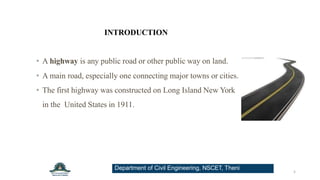
• A highway is any public road or other public way on land.
• A main road, especially one connecting major towns or cities.
• The first highway was constructed on Long Island New York
in the United States in 1911.
5
Department of Civil Engineering, NSCET, Theni
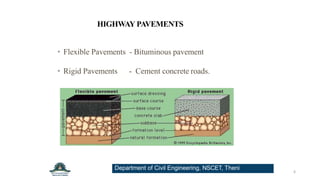
HIGHWAY PAVEMENTS
• Flexible Pavements - Bituminous pavement
• Rigid Pavements - Cement concrete roads.
6
Department of Civil Engineering, NSCET, Theni
HIGHWAY FAILURE
Main causes of pavement failures are:-
• Rutting due to high variation in ambient temperature.
• Uncontrolled heavy axle loads.
• Inadequate Stability.
• Loss of binding action.
• Poor Design and Fabrication.
7
Department of Civil Engineering, NSCET, Theni
HIGHWAYFAILURE TYPES
TYPES OF FAILURES OF FLEXIBLE PAVEMENT
• Alligator cracking or Map cracking (Fatigue)
• Consolidation of pavement layers (Rutting)
• Shear failure cracking
• Longitudinal cracking
• Frost heaving
• Lack of binding to the lower course
• Reflection cracking
• Formation of waves and corrugation
• Bleeding
• Pumping
• Ravelling
• Depression
8
Department of Civil Engineering, NSCET, Theni
9
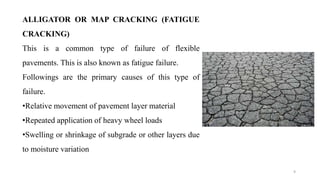
ALLIGATOR OR MAP CRACKING (FATIGUE
CRACKING)
This is a common type of failure of flexible
pavements. This is also known as fatigue failure.
Followings are the primary causes of this type of
failure.
•Relative movement of pavement layer material
•Repeated application of heavy wheel loads
•Swelling or shrinkage of subgrade or other layers due
to moisture variation

highway engineering study materials.pptx

  • 1.
  • 2.
    DEPARTMENT OF CIVILENGINEERING Sub Name: CE8604 / HIGHWAY ENGINEERING Branch/Year/Sem: B.E. Civil Engineering/III/VI 2 Mr.K.Kirubakaran.,M.E., Assistant Professor, Civil, Nadar Saraswathi College of Engineering & Technology, Vadapudupatti, Annanji (po), Theni – 625531.
  • 3.
    OBJECTIVE To give anoverview about the highway engineering with respect to, planning, design, construction and maintenance of highways as per IRC standards, specifications and methods. 3
  • 4.
    Pavement distress inflexible and rigid pavements – Types of maintenance – Pavement Management Systems - Pavement evaluation, roughness, present serviceability index, skid resistance, structural evaluation, evaluation by deflection measurements – Strengthening of pavements –Highway Project formulation. Department of Civil Engineering, NSCET, Theni 4 UNIT V EVALUATION AND MAINTENANCE OF PAVEMENTS • Pavement distress in flexible and rigid pavements • Types of maintenance • Pavement Management Systems, roughness, present serviceability index, skid resistance, structural evaluation, evaluation by deflection measurements • Strengthening of pavements
  • 5.
    INTRODUCTION • A highwayis any public road or other public way on land. • A main road, especially one connecting major towns or cities. • The first highway was constructed on Long Island New York in the United States in 1911. 5 Department of Civil Engineering, NSCET, Theni
  • 6.
    HIGHWAY PAVEMENTS • FlexiblePavements - Bituminous pavement • Rigid Pavements - Cement concrete roads. 6 Department of Civil Engineering, NSCET, Theni
  • 7.
    HIGHWAY FAILURE Main causesof pavement failures are:- • Rutting due to high variation in ambient temperature. • Uncontrolled heavy axle loads. • Inadequate Stability. • Loss of binding action. • Poor Design and Fabrication. 7 Department of Civil Engineering, NSCET, Theni
  • 8.
    HIGHWAYFAILURE TYPES TYPES OFFAILURES OF FLEXIBLE PAVEMENT • Alligator cracking or Map cracking (Fatigue) • Consolidation of pavement layers (Rutting) • Shear failure cracking • Longitudinal cracking • Frost heaving • Lack of binding to the lower course • Reflection cracking • Formation of waves and corrugation • Bleeding • Pumping • Ravelling • Depression 8 Department of Civil Engineering, NSCET, Theni
  • 9.
    9 ALLIGATOR OR MAPCRACKING (FATIGUE CRACKING) This is a common type of failure of flexible pavements. This is also known as fatigue failure. Followings are the primary causes of this type of failure. •Relative movement of pavement layer material •Repeated application of heavy wheel loads •Swelling or shrinkage of subgrade or other layers due to moisture variation