HHV 8
Dr. Rasika Deshmukh
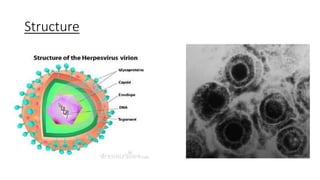
Structure
Epidemiology
• The seroprevalence of human herpesvirus-8 (HHV-8)—a/k/a Kaposi
sarcoma-associated herpesvirus (KSHV
• 1% to 5% in the general U.S. population
• 10% to 20% in certain Mediterranean countries and
• 30% to 80% in parts of sub-Saharan Africa.
Risk population
• men who have sex with men (MSM)
• persons with HIV infection
• MSW without HIV sero prevalence ranges from 13% to 20%
• MSW with HIV sero prevalence ranges from 30% to 35%
• Injection drug
• CD4 T lymphocyte [CD4] cell counts <200 cells/mm3
HHV 8 a/w
• Kaposi sarcoma (KS) including classic, endemic, transplant-related,
and AIDS-related,
• primary effusion lymphoma [PEL] and solid organ variants
• multicentric Castleman’s disease (MCD)
Clinical Manifestations
Immunocompetent children and organ transplant recipients
• fever, rash, lymphadenopathy, bone marrow failure, and occasional rapid
progression to KS
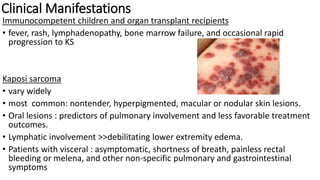
Kaposi sarcoma
• vary widely
• most common: nontender, hyperpigmented, macular or nodular skin lesions.
• Oral lesions : predictors of pulmonary involvement and less favorable treatment
outcomes.
• Lymphatic involvement >>debilitating lower extremity edema.
• Patients with visceral : asymptomatic, shortness of breath, painless rectal
bleeding or melena, and other non-specific pulmonary and gastrointestinal
symptoms
Clinical Manifestations
PEL
• effusions isolated within the pleural, pericardial, or abdominal cavities, but
mass lesions and “extracavitary” disease within skin, hematopoietic
organs, and the gastrointestinal tract have been described
MCD
• fever and night sweats, generalized adenopathy, fever and
hepatosplenomegaly
• mimic other inflammatory conditions including sepsis, with hypotension,
clinical evidence of a systemic inflammatory response, and progression to
multi-organ failure.
Clinical Manifestations
KSHV inflammatory cytokine syndrome (KICS)
• frequently critically ill and
• demonstrate marked elevations in IL-6 and IL-10, as well as high
plasma HHV-8 viral loads
Diagnosis
• cytologic and immunologic cell markers, as well as histology
• tissue examination is needed to confirm the diagnosis
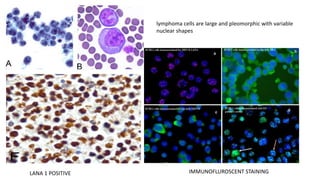
• immunohistochemical staining of tumors with antibodies recognizing
the HHV-8-encoded latency-associated nuclear antigen (LANA)
• polymerase chain reaction (PCR) to identify HHV-8 DNA
• serologic testing for HHV-8 antibodies is currently not indicated
• due to lack of standardization and poor sensitivity and specificity of
these assays.
lymphoma cells are large and pleomorphic with variable
nuclear shapes
LANA 1 POSITIVE IMMUNOFLUROSCENT STAINING
Transmission/ Preventing Exposure
Transmission
• mode(s) of transmission remains unclear
• epidemiologic and virologic data suggest that saliva and genital
secretions is a source>>viral shedding saliva and occasional shedding in
genital secretions
Preventing Exposure
• Recommendations do not yet exist
Preventing Disease
• supporting a role >>the toxicity of current anti-HHV-8 treatments
outweighs the potential use for prophylaxis
• early initiation of ART is likely to be the most effective measure
Treating Disease
KS:
• Chemotherapy, in combination with ART, should be administered to
patients with visceral involvement
• Liposomal doxorubicin preferred as first-line therapy> exhibits less high-
grade toxicity relative to paclitaxel
• Paclitaxel effective with relapse following treatment failure with liposomal
doxorubicin
• avoid concurrent use of corticosteroids
• ganciclovir, foscarnet, and cidofovir exhibit in vitro activity
PEL:
• Chemotherapy, in combination with ART,
• combination of cyclophosphamide, doxorubicin, vincristine, and
prednisolone (CHOP)
• combination of infusional etoposide, (EPOCH) demonstrated superior
survival
• valganciclovir or zidovudine, may be used as adjunctive therapies
Treating Disease
• MCD:
• no standardized treatments
• IV ganciclovir or oral valganciclovir are options
• Rituximab :as an important adjunctive treatment
• Therapeutic monoclonal antibodies targeting either interleukin-6 (IL-
6) or the IL-6 receptor
Preventing Recurrence
• Effective suppression of HIV replication with ART

HHV 8.pptx

  • 1.
  • 2.
  • 3.
    Epidemiology • The seroprevalenceof human herpesvirus-8 (HHV-8)—a/k/a Kaposi sarcoma-associated herpesvirus (KSHV • 1% to 5% in the general U.S. population • 10% to 20% in certain Mediterranean countries and • 30% to 80% in parts of sub-Saharan Africa.
  • 4.
    Risk population • menwho have sex with men (MSM) • persons with HIV infection • MSW without HIV sero prevalence ranges from 13% to 20% • MSW with HIV sero prevalence ranges from 30% to 35% • Injection drug • CD4 T lymphocyte [CD4] cell counts <200 cells/mm3
  • 5.
    HHV 8 a/w •Kaposi sarcoma (KS) including classic, endemic, transplant-related, and AIDS-related, • primary effusion lymphoma [PEL] and solid organ variants • multicentric Castleman’s disease (MCD)
  • 6.
    Clinical Manifestations Immunocompetent childrenand organ transplant recipients • fever, rash, lymphadenopathy, bone marrow failure, and occasional rapid progression to KS Kaposi sarcoma • vary widely • most common: nontender, hyperpigmented, macular or nodular skin lesions. • Oral lesions : predictors of pulmonary involvement and less favorable treatment outcomes. • Lymphatic involvement >>debilitating lower extremity edema. • Patients with visceral : asymptomatic, shortness of breath, painless rectal bleeding or melena, and other non-specific pulmonary and gastrointestinal symptoms
  • 7.
    Clinical Manifestations PEL • effusionsisolated within the pleural, pericardial, or abdominal cavities, but mass lesions and “extracavitary” disease within skin, hematopoietic organs, and the gastrointestinal tract have been described MCD • fever and night sweats, generalized adenopathy, fever and hepatosplenomegaly • mimic other inflammatory conditions including sepsis, with hypotension, clinical evidence of a systemic inflammatory response, and progression to multi-organ failure.
  • 8.
    Clinical Manifestations KSHV inflammatorycytokine syndrome (KICS) • frequently critically ill and • demonstrate marked elevations in IL-6 and IL-10, as well as high plasma HHV-8 viral loads
  • 9.
    Diagnosis • cytologic andimmunologic cell markers, as well as histology • tissue examination is needed to confirm the diagnosis • immunohistochemical staining of tumors with antibodies recognizing the HHV-8-encoded latency-associated nuclear antigen (LANA) • polymerase chain reaction (PCR) to identify HHV-8 DNA • serologic testing for HHV-8 antibodies is currently not indicated • due to lack of standardization and poor sensitivity and specificity of these assays.
  • 10.
    lymphoma cells arelarge and pleomorphic with variable nuclear shapes LANA 1 POSITIVE IMMUNOFLUROSCENT STAINING
  • 11.
    Transmission/ Preventing Exposure Transmission •mode(s) of transmission remains unclear • epidemiologic and virologic data suggest that saliva and genital secretions is a source>>viral shedding saliva and occasional shedding in genital secretions Preventing Exposure • Recommendations do not yet exist Preventing Disease • supporting a role >>the toxicity of current anti-HHV-8 treatments outweighs the potential use for prophylaxis • early initiation of ART is likely to be the most effective measure
  • 12.
    Treating Disease KS: • Chemotherapy,in combination with ART, should be administered to patients with visceral involvement • Liposomal doxorubicin preferred as first-line therapy> exhibits less high- grade toxicity relative to paclitaxel • Paclitaxel effective with relapse following treatment failure with liposomal doxorubicin • avoid concurrent use of corticosteroids • ganciclovir, foscarnet, and cidofovir exhibit in vitro activity PEL: • Chemotherapy, in combination with ART, • combination of cyclophosphamide, doxorubicin, vincristine, and prednisolone (CHOP) • combination of infusional etoposide, (EPOCH) demonstrated superior survival • valganciclovir or zidovudine, may be used as adjunctive therapies
  • 13.
    Treating Disease • MCD: •no standardized treatments • IV ganciclovir or oral valganciclovir are options • Rituximab :as an important adjunctive treatment • Therapeutic monoclonal antibodies targeting either interleukin-6 (IL- 6) or the IL-6 receptor
  • 14.
    Preventing Recurrence • Effectivesuppression of HIV replication with ART