By Rebecca Harris.
TEXTUAL ANALYSIS
"HEY THERE DELILAH"-PLAIN
WHITE T'S.
https://www.youtube.com/watch?v=h_m-BjrxmgI
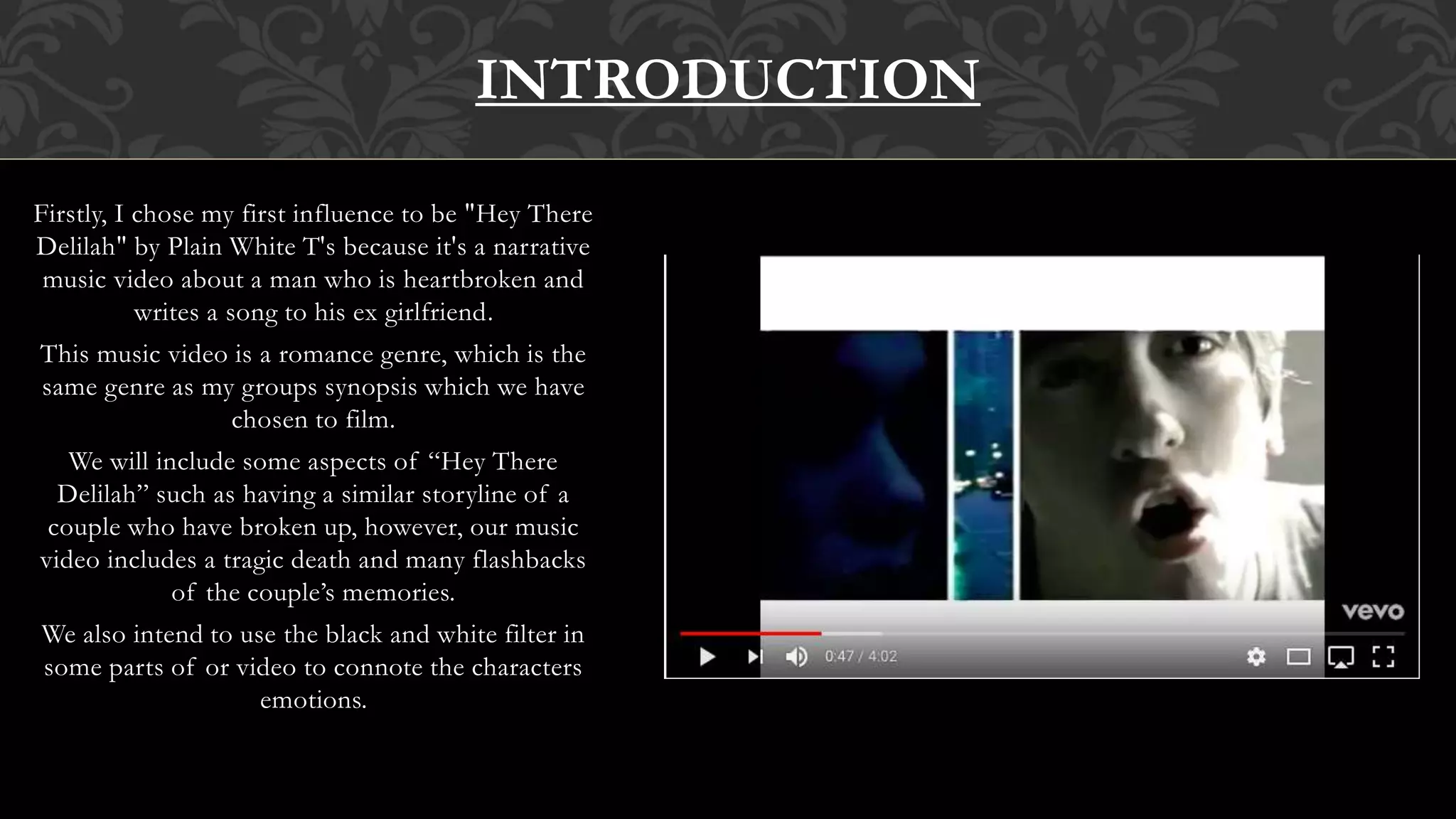
Firstly, I chose my first influence to be "Hey There
Delilah" by Plain White T's because it's a narrative
music video about a man who is heartbroken and
writes a song to his ex girlfriend.
This music video is a romance genre, which is the
same genre as my groups synopsis which we have
chosen to film.
We will include some aspects of “Hey There
Delilah” such as having a similar storyline of a
couple who have broken up, however, our music
video includes a tragic death and many flashbacks
of the couple’s memories.
We also intend to use the black and white filter in
some parts of or video to connote the characters
emotions.
INTRODUCTION
The use of the guitar (mise-en-scene) connotes
that it's the only friend that the main singer has
due to him being alone with no friends
surrounding him, whereas the ex girlfriend is
happily moving on by going out with her mates.
The mise-en-scene also used is the dim grey
lighting throughout the video, which signifies
the emotion of the main character, whom is
also the singer. The emotion is sadness and
emptiness. The costumes which each character
wears is also dull, which can connote that both
of them haven't fully moved on yet and still feel
empty as the breakup is still quite new.
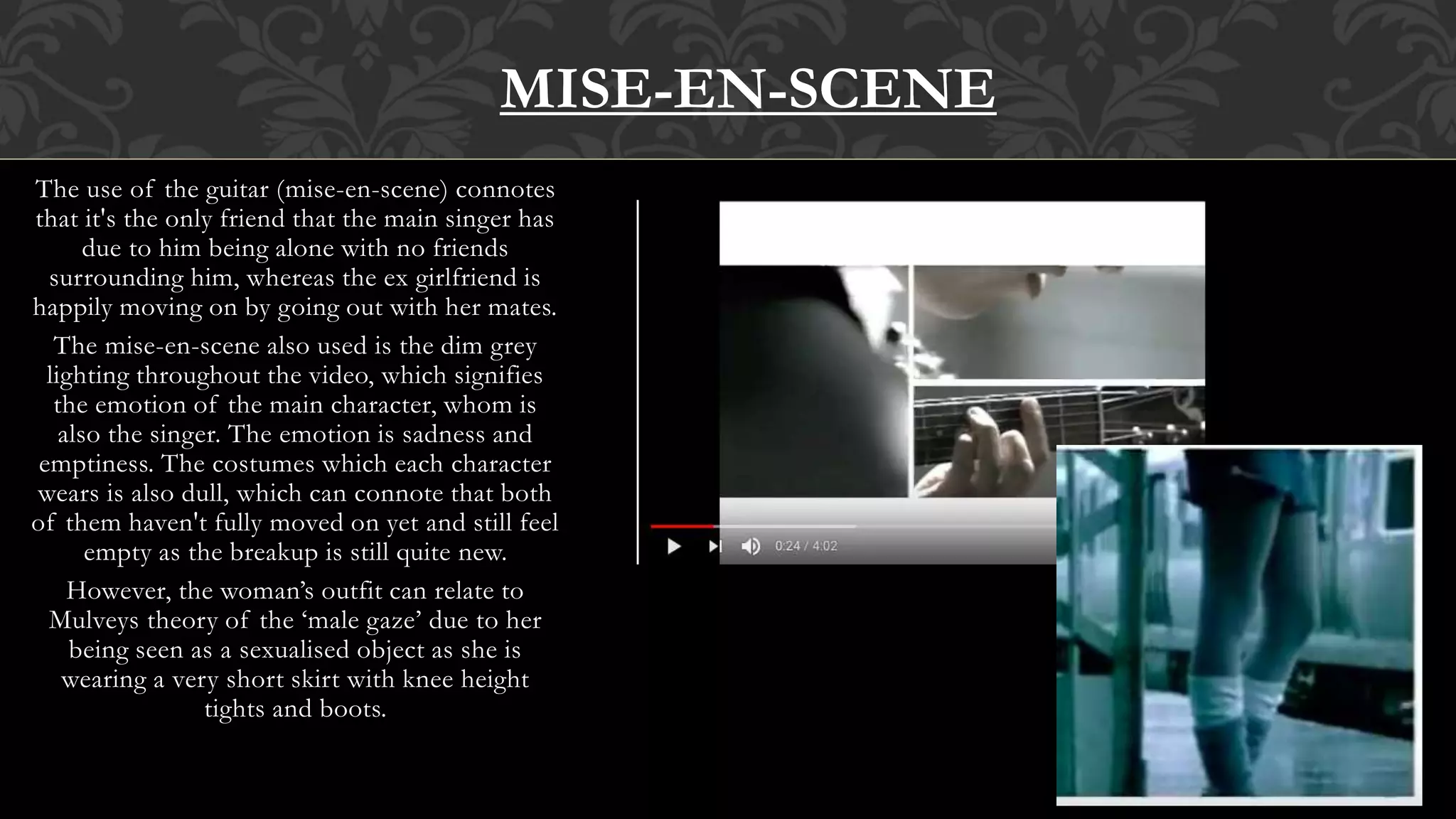
However, the woman’s outfit can relate to
Mulveys theory of the ‘male gaze’ due to her
being seen as a sexualised object as she is
wearing a very short skirt with knee height
tights and boots.
MISE-EN-SCENE
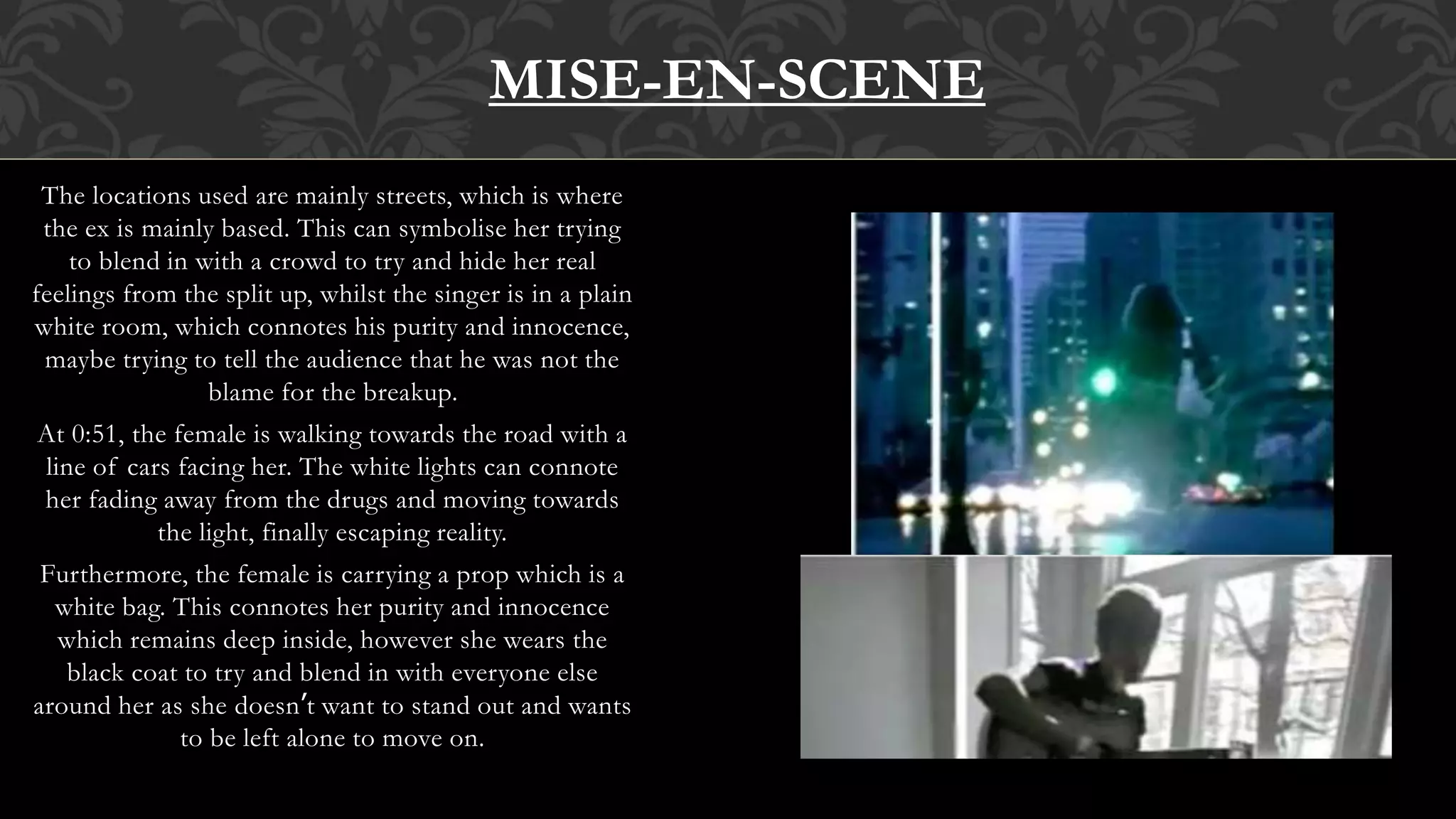
The locations used are mainly streets, which is where
the ex is mainly based. This can symbolise her trying
to blend in with a crowd to try and hide her real
feelings from the split up, whilst the singer is in a plain
white room, which connotes his purity and innocence,
maybe trying to tell the audience that he was not the
blame for the breakup.
At 0:51, the female is walking towards the road with a
line of cars facing her. The white lights can connote
her fading away from the drugs and moving towards
the light, finally escaping reality.
Furthermore, the female is carrying a prop which is a
white bag. This connotes her purity and innocence
which remains deep inside, however she wears the
black coat to try and blend in with everyone else
around her as she doesn’t want to stand out and wants
to be left alone to move on.
MISE-EN-SCENE
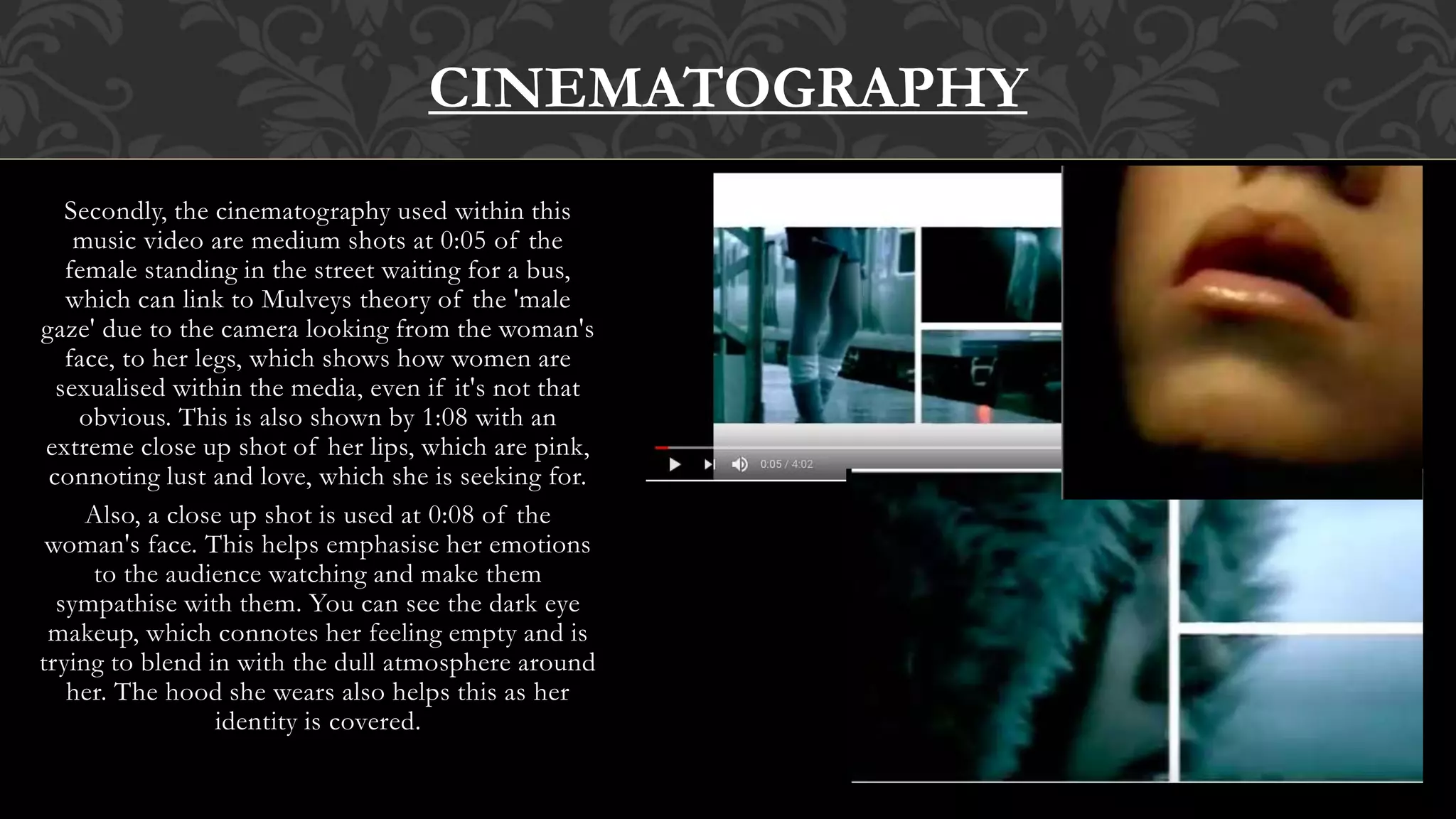
Secondly, the cinematography used within this
music video are medium shots at 0:05 of the
female standing in the street waiting for a bus,
which can link to Mulveys theory of the 'male
gaze' due to the camera looking from the woman's
face, to her legs, which shows how women are
sexualised within the media, even if it's not that
obvious. This is also shown by 1:08 with an
extreme close up shot of her lips, which are pink,
connoting lust and love, which she is seeking for.
Also, a close up shot is used at 0:08 of the
woman's face. This helps emphasise her emotions
to the audience watching and make them
sympathise with them. You can see the dark eye
makeup, which connotes her feeling empty and is
trying to blend in with the dull atmosphere around
her. The hood she wears also helps this as her
identity is covered.
CINEMATOGRAPHY
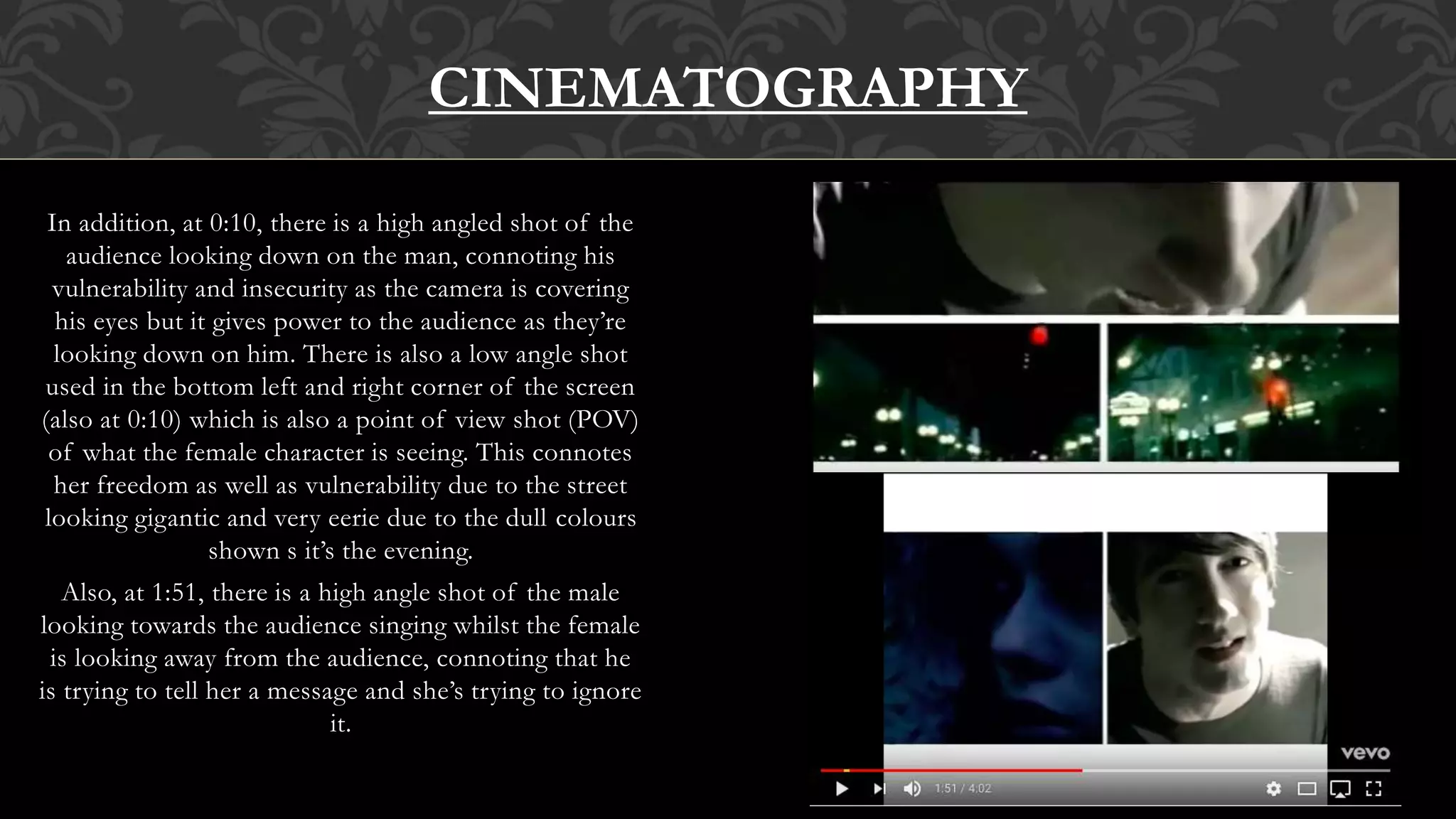
In addition, at 0:10, there is a high angled shot of the
audience looking down on the man, connoting his
vulnerability and insecurity as the camera is covering
his eyes but it gives power to the audience as they’re
looking down on him. There is also a low angle shot
used in the bottom left and right corner of the screen
(also at 0:10) which is also a point of view shot (POV)
of what the female character is seeing. This connotes
her freedom as well as vulnerability due to the street
looking gigantic and very eerie due to the dull colours
shown s it’s the evening.
Also, at 1:51, there is a high angle shot of the male
looking towards the audience singing whilst the female
is looking away from the audience, connoting that he
is trying to tell her a message and she’s trying to ignore
it.
CINEMATOGRAPHY
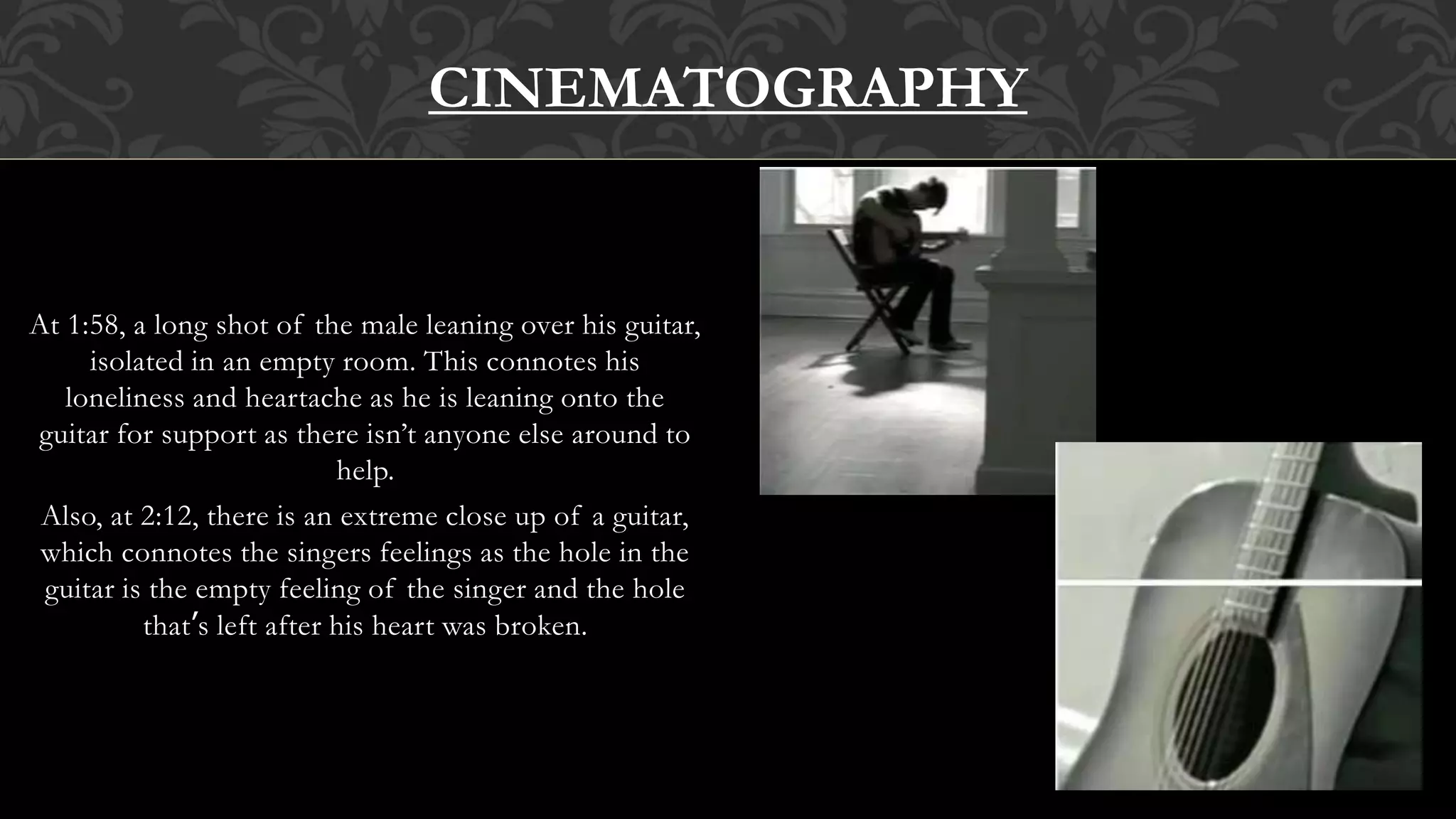
At 1:58, a long shot of the male leaning over his guitar,
isolated in an empty room. This connotes his
loneliness and heartache as he is leaning onto the
guitar for support as there isn’t anyone else around to
help.
Also, at 2:12, there is an extreme close up of a guitar,
which connotes the singers feelings as the hole in the
guitar is the empty feeling of the singer and the hole
that’s left after his heart was broken.
CINEMATOGRAPHY
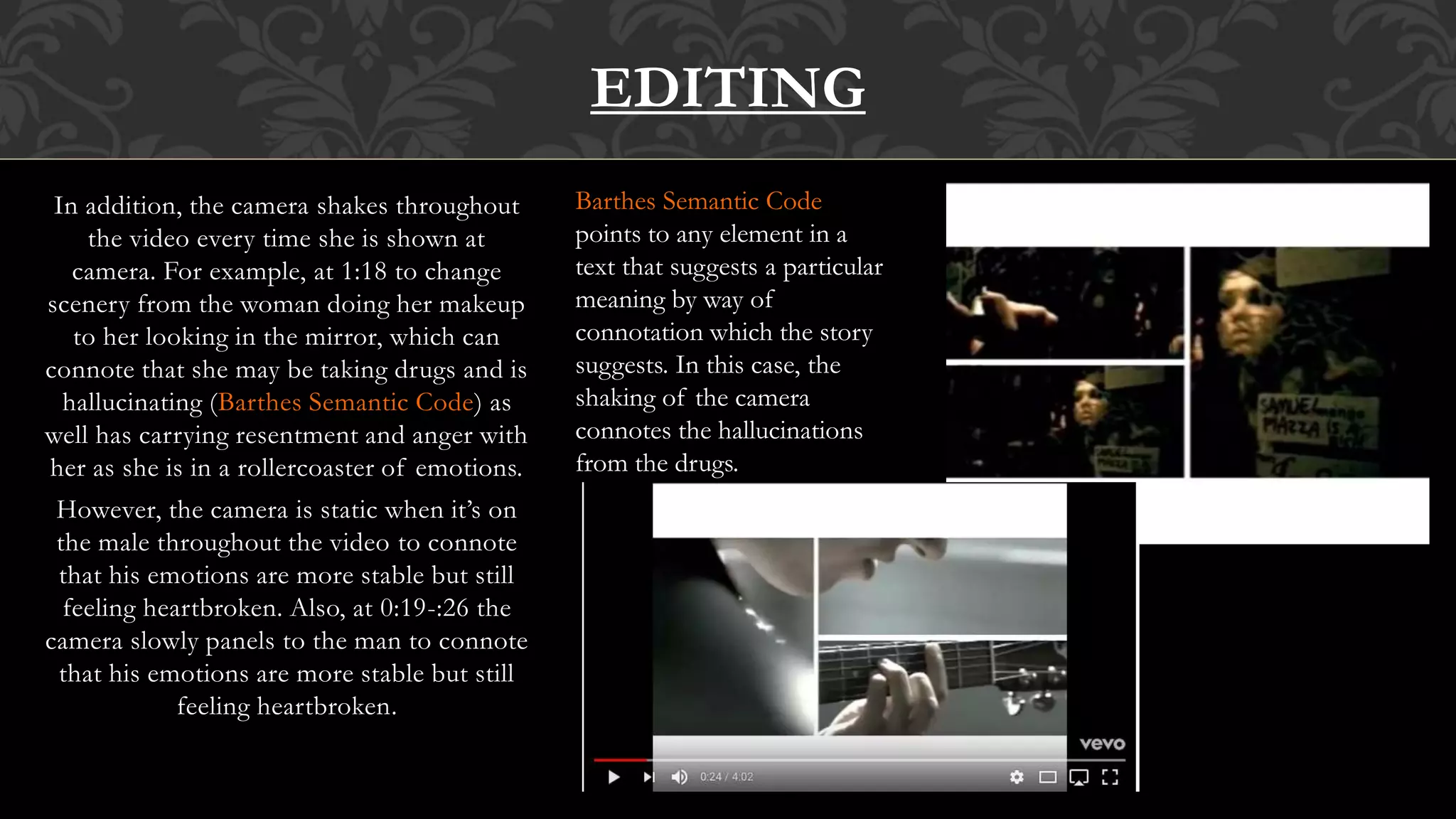
In addition, the camera shakes throughout
the video every time she is shown at
camera. For example, at 1:18 to change
scenery from the woman doing her makeup
to her looking in the mirror, which can
connote that she may be taking drugs and is
hallucinating (Barthes Semantic Code) as
well has carrying resentment and anger with
her as she is in a rollercoaster of emotions.
However, the camera is static when it’s on
the male throughout the video to connote
that his emotions are more stable but still
feeling heartbroken. Also, at 0:19-:26 the
camera slowly panels to the man to connote
that his emotions are more stable but still
feeling heartbroken.
EDITING
Barthes Semantic Code
points to any element in a
text that suggests a particular
meaning by way of
connotation which the story
suggests. In this case, the
shaking of the camera
connotes the hallucinations
from the drugs.
The editing used in this video is many fast cuts, which
connotes how fast time goes as well as how fast people
can move on with their lives after a breakup.
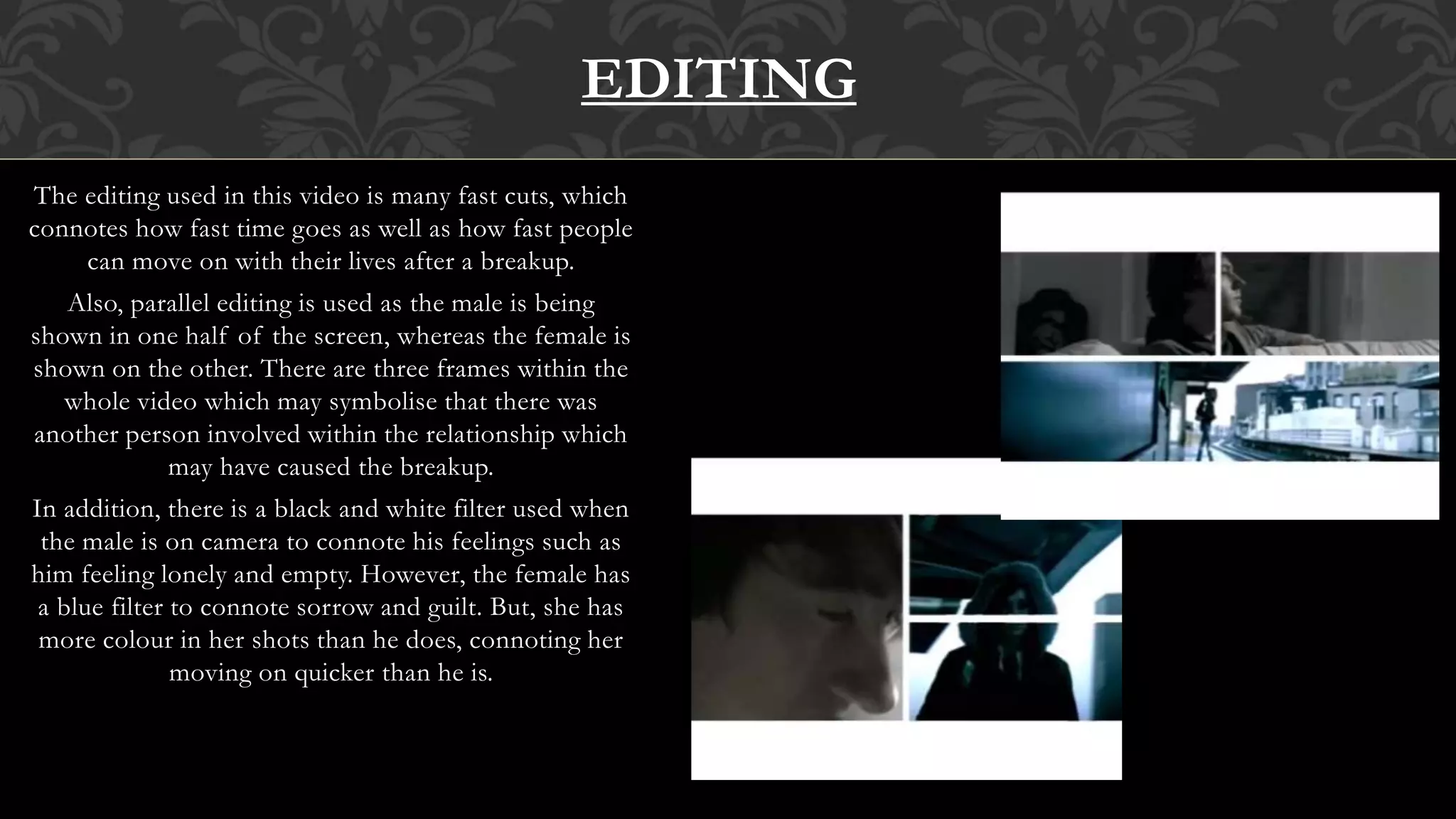
Also, parallel editing is used as the male is being
shown in one half of the screen, whereas the female is
shown on the other. There are three frames within the
whole video which may symbolise that there was
another person involved within the relationship which
may have caused the breakup.
In addition, there is a black and white filter used when
the male is on camera to connote his feelings such as
him feeling lonely and empty. However, the female has
a blue filter to connote sorrow and guilt. But, she has
more colour in her shots than he does, connoting her
moving on quicker than he is.
EDITING
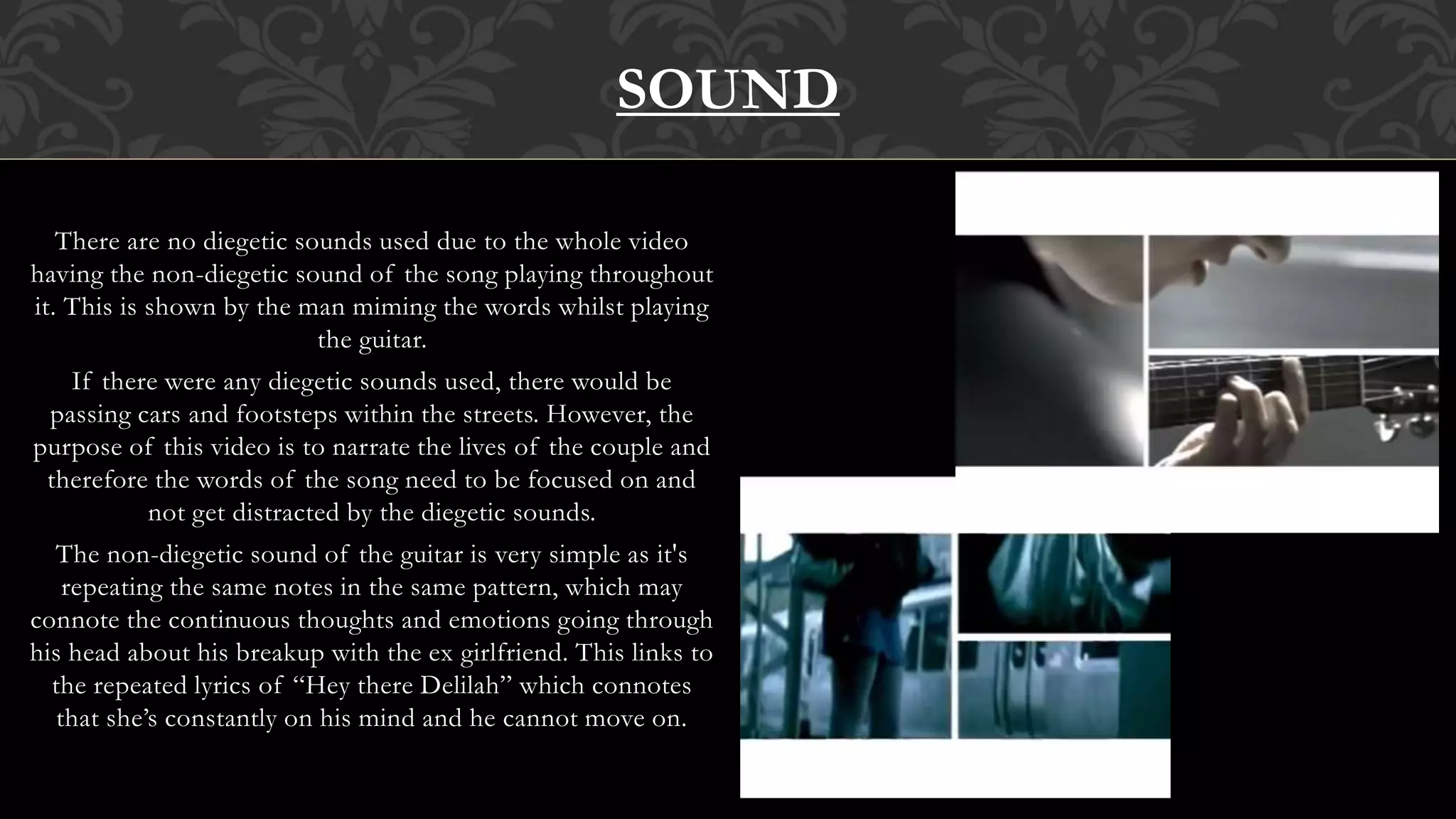
There are no diegetic sounds used due to the whole video
having the non-diegetic sound of the song playing throughout
it. This is shown by the man miming the words whilst playing
the guitar.
If there were any diegetic sounds used, there would be
passing cars and footsteps within the streets. However, the
purpose of this video is to narrate the lives of the couple and
therefore the words of the song need to be focused on and
not get distracted by the diegetic sounds.
The non-diegetic sound of the guitar is very simple as it's
repeating the same notes in the same pattern, which may
connote the continuous thoughts and emotions going through
his head about his breakup with the ex girlfriend. This links to
the repeated lyrics of “Hey there Delilah” which connotes
that she’s constantly on his mind and he cannot move on.
SOUND
Furthermore, there is a repetition of “Oh it's what you do
to me”, which connotes that the male is in pain. This
portrays the stereotype of males as they’re stereotypically
seen as strong, brave and powerful.
Also, he says “I know times are getting hard
But just believe me, girl
Someday I'll pay the bills with this guitar
We'll have it good
We'll have the life we knew we would
My word is good”.
SOUND
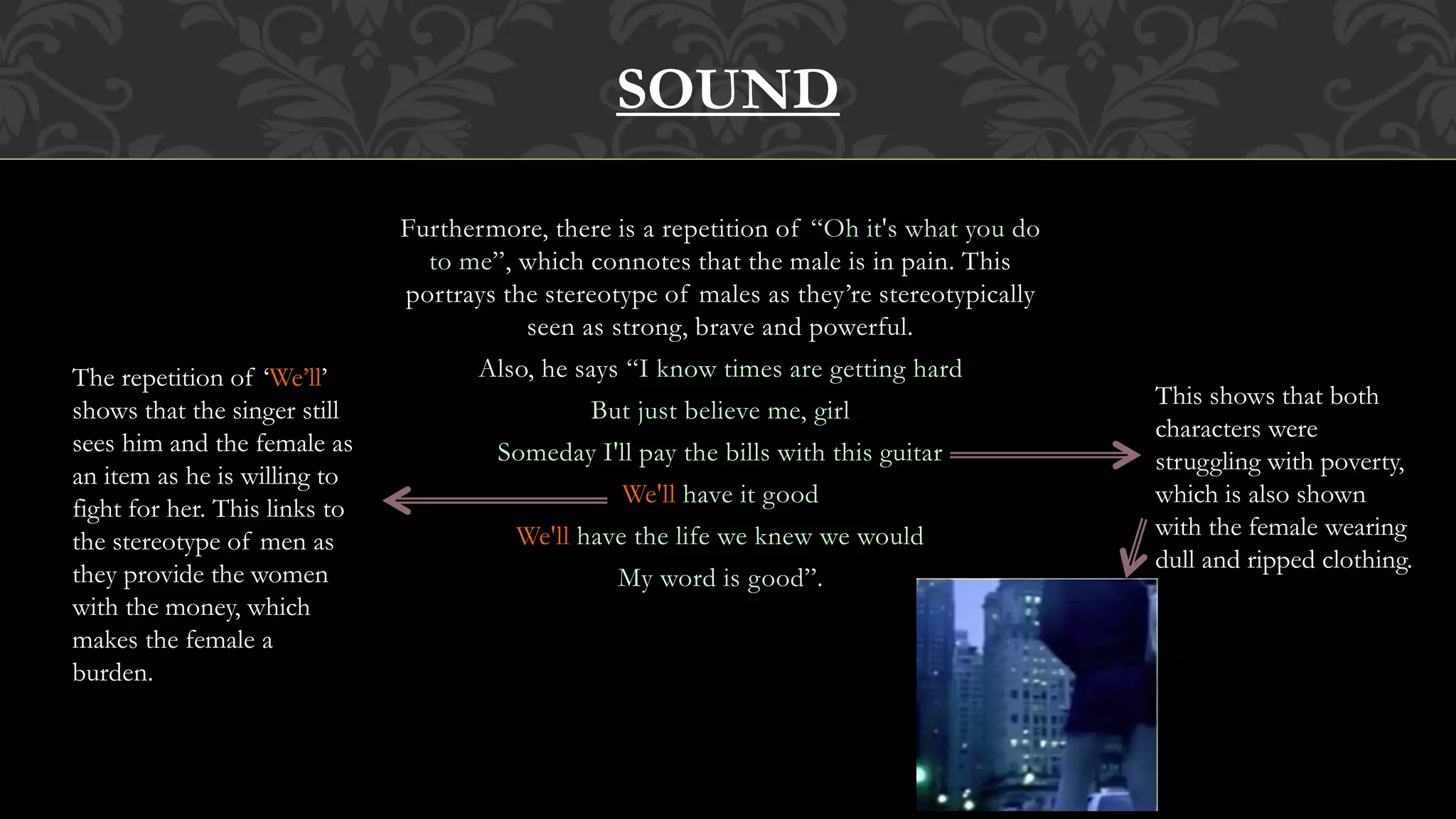
This shows that both
characters were
struggling with poverty,
which is also shown
with the female wearing
dull and ripped clothing.
The repetition of ‘We’ll’
shows that the singer still
sees him and the female as
an item as he is willing to
fight for her. This links to
the stereotype of men as
they provide the women
with the money, which
makes the female a
burden.

'Hey There Delilah' Textual Analysis

  • 1.
    By Rebecca Harris. TEXTUALANALYSIS "HEY THERE DELILAH"-PLAIN WHITE T'S. https://www.youtube.com/watch?v=h_m-BjrxmgI
  • 2.
    Firstly, I chosemy first influence to be "Hey There Delilah" by Plain White T's because it's a narrative music video about a man who is heartbroken and writes a song to his ex girlfriend. This music video is a romance genre, which is the same genre as my groups synopsis which we have chosen to film. We will include some aspects of “Hey There Delilah” such as having a similar storyline of a couple who have broken up, however, our music video includes a tragic death and many flashbacks of the couple’s memories. We also intend to use the black and white filter in some parts of or video to connote the characters emotions. INTRODUCTION
  • 3.
    The use ofthe guitar (mise-en-scene) connotes that it's the only friend that the main singer has due to him being alone with no friends surrounding him, whereas the ex girlfriend is happily moving on by going out with her mates. The mise-en-scene also used is the dim grey lighting throughout the video, which signifies the emotion of the main character, whom is also the singer. The emotion is sadness and emptiness. The costumes which each character wears is also dull, which can connote that both of them haven't fully moved on yet and still feel empty as the breakup is still quite new. However, the woman’s outfit can relate to Mulveys theory of the ‘male gaze’ due to her being seen as a sexualised object as she is wearing a very short skirt with knee height tights and boots. MISE-EN-SCENE
  • 4.
    The locations usedare mainly streets, which is where the ex is mainly based. This can symbolise her trying to blend in with a crowd to try and hide her real feelings from the split up, whilst the singer is in a plain white room, which connotes his purity and innocence, maybe trying to tell the audience that he was not the blame for the breakup. At 0:51, the female is walking towards the road with a line of cars facing her. The white lights can connote her fading away from the drugs and moving towards the light, finally escaping reality. Furthermore, the female is carrying a prop which is a white bag. This connotes her purity and innocence which remains deep inside, however she wears the black coat to try and blend in with everyone else around her as she doesn’t want to stand out and wants to be left alone to move on. MISE-EN-SCENE
  • 5.
    Secondly, the cinematographyused within this music video are medium shots at 0:05 of the female standing in the street waiting for a bus, which can link to Mulveys theory of the 'male gaze' due to the camera looking from the woman's face, to her legs, which shows how women are sexualised within the media, even if it's not that obvious. This is also shown by 1:08 with an extreme close up shot of her lips, which are pink, connoting lust and love, which she is seeking for. Also, a close up shot is used at 0:08 of the woman's face. This helps emphasise her emotions to the audience watching and make them sympathise with them. You can see the dark eye makeup, which connotes her feeling empty and is trying to blend in with the dull atmosphere around her. The hood she wears also helps this as her identity is covered. CINEMATOGRAPHY
  • 6.
    In addition, at0:10, there is a high angled shot of the audience looking down on the man, connoting his vulnerability and insecurity as the camera is covering his eyes but it gives power to the audience as they’re looking down on him. There is also a low angle shot used in the bottom left and right corner of the screen (also at 0:10) which is also a point of view shot (POV) of what the female character is seeing. This connotes her freedom as well as vulnerability due to the street looking gigantic and very eerie due to the dull colours shown s it’s the evening. Also, at 1:51, there is a high angle shot of the male looking towards the audience singing whilst the female is looking away from the audience, connoting that he is trying to tell her a message and she’s trying to ignore it. CINEMATOGRAPHY
  • 7.
    At 1:58, along shot of the male leaning over his guitar, isolated in an empty room. This connotes his loneliness and heartache as he is leaning onto the guitar for support as there isn’t anyone else around to help. Also, at 2:12, there is an extreme close up of a guitar, which connotes the singers feelings as the hole in the guitar is the empty feeling of the singer and the hole that’s left after his heart was broken. CINEMATOGRAPHY
  • 8.
    In addition, thecamera shakes throughout the video every time she is shown at camera. For example, at 1:18 to change scenery from the woman doing her makeup to her looking in the mirror, which can connote that she may be taking drugs and is hallucinating (Barthes Semantic Code) as well has carrying resentment and anger with her as she is in a rollercoaster of emotions. However, the camera is static when it’s on the male throughout the video to connote that his emotions are more stable but still feeling heartbroken. Also, at 0:19-:26 the camera slowly panels to the man to connote that his emotions are more stable but still feeling heartbroken. EDITING Barthes Semantic Code points to any element in a text that suggests a particular meaning by way of connotation which the story suggests. In this case, the shaking of the camera connotes the hallucinations from the drugs.
  • 9.
    The editing usedin this video is many fast cuts, which connotes how fast time goes as well as how fast people can move on with their lives after a breakup. Also, parallel editing is used as the male is being shown in one half of the screen, whereas the female is shown on the other. There are three frames within the whole video which may symbolise that there was another person involved within the relationship which may have caused the breakup. In addition, there is a black and white filter used when the male is on camera to connote his feelings such as him feeling lonely and empty. However, the female has a blue filter to connote sorrow and guilt. But, she has more colour in her shots than he does, connoting her moving on quicker than he is. EDITING
  • 10.
    There are nodiegetic sounds used due to the whole video having the non-diegetic sound of the song playing throughout it. This is shown by the man miming the words whilst playing the guitar. If there were any diegetic sounds used, there would be passing cars and footsteps within the streets. However, the purpose of this video is to narrate the lives of the couple and therefore the words of the song need to be focused on and not get distracted by the diegetic sounds. The non-diegetic sound of the guitar is very simple as it's repeating the same notes in the same pattern, which may connote the continuous thoughts and emotions going through his head about his breakup with the ex girlfriend. This links to the repeated lyrics of “Hey there Delilah” which connotes that she’s constantly on his mind and he cannot move on. SOUND
  • 11.
    Furthermore, there isa repetition of “Oh it's what you do to me”, which connotes that the male is in pain. This portrays the stereotype of males as they’re stereotypically seen as strong, brave and powerful. Also, he says “I know times are getting hard But just believe me, girl Someday I'll pay the bills with this guitar We'll have it good We'll have the life we knew we would My word is good”. SOUND This shows that both characters were struggling with poverty, which is also shown with the female wearing dull and ripped clothing. The repetition of ‘We’ll’ shows that the singer still sees him and the female as an item as he is willing to fight for her. This links to the stereotype of men as they provide the women with the money, which makes the female a burden.