Abdelhamid Serwah, MD
Professor of Internal Medicine
Suez Canal University
Suggested Program
3
4
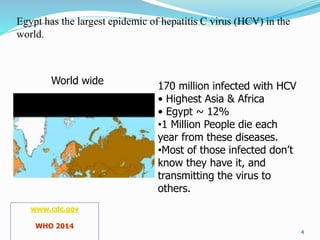
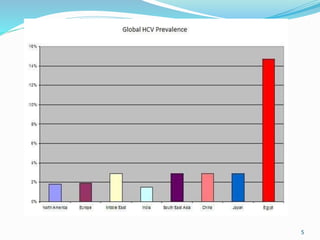
Egypt has the largest epidemic of hepatitis C virus (HCV) in the
world.
170 million infected with HCV
• Highest Asia & Africa
• Egypt ~ 12%
•1 Million People die each
year from these diseases.
•Most of those infected don’t
know they have it, and
transmitting the virus to
others.
World wide
www.cdc.gov
WHO 2014
5
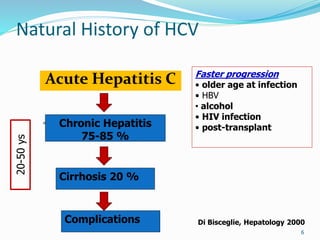
Natural History of HCV
Acute Hepatitis C
Di Bisceglie, Hepatology 2000
6
Chronic Hepatitis
75-85 %
Cirrhosis 20 %
Faster progression
• older age at infection
• HBV
• alcohol
• HIV infection
• post-transplant
20-50
ys
Di Bisceglie, Hepatology 2000
Complications
7
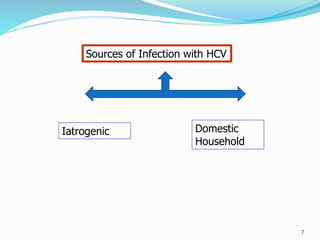
Sources of Infection with HCV
Iatrogenic Domestic
Household
Iatrogenic Infection !!!!!!!!!!!!!
 Transmission of Viral Hepatitis by Unsafe Injections
and Medical Practices
8
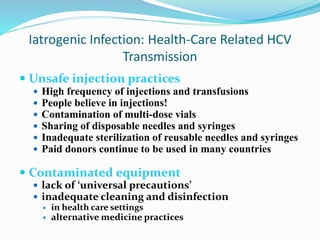
Iatrogenic Infection: Health-Care Related HCV
Transmission
 Unsafe injection practices
 High frequency of injections and transfusions
 People believe in injections!
 Contamination of multi-dose vials
 Sharing of disposable needles and syringes
 Inadequate sterilization of reusable needles and syringes
 Paid donors continue to be used in many countries
 Contaminated equipment
 lack of ‘universal precautions’
 inadequate cleaning and disinfection
 in health care settings
 alternative medicine practices
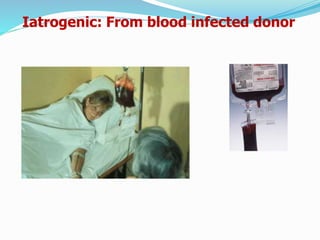
Iatrogenic: From blood infected donor
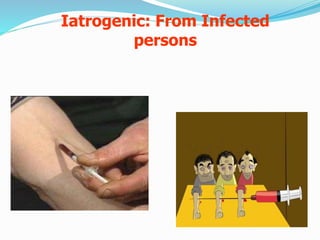
Iatrogenic: From Infected
persons
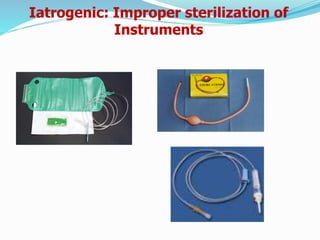
Iatrogenic: Improper sterilization of
Instruments
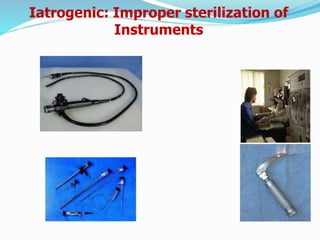
Iatrogenic: Improper sterilization of
Instruments
Iatrogenic: Dentists and improper
sterilization of Instruments
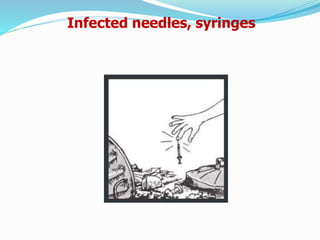
Infected needles, syringes
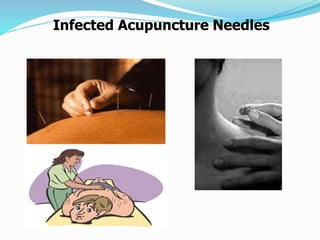
Infected Acupuncture Needles
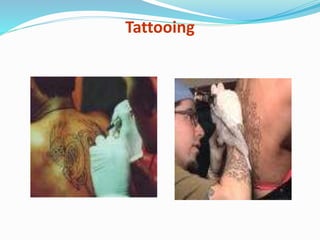
Tattooing
‫؟‬ ‫اآلمن‬ ‫الحقن‬ ‫يعنى‬ ‫ذا‬ ‫ما‬
‫هو‬
‫الحقن‬
‫الذى‬
‫ال‬
‫يسبب‬
‫ضرر‬
‫للشخص‬
‫ن‬‫المحقو‬
‫ال‬
‫و‬
‫يعرض‬
‫الحاق‬
‫ن‬
‫ألى‬
‫أخطار‬
‫ال‬
‫و‬
‫ينتج‬
‫عنه‬
‫أى‬
‫مخلفات‬
‫ة‬
‫ر‬‫خطي‬
‫تضر‬
‫ين‬‫ر‬‫باآلخ‬
.
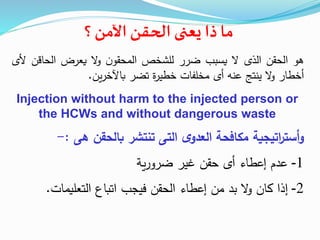
Injection without harm to the injected person or
the HCWs and without dangerous waste
‫اتيجية‬
‫ر‬‫أست‬‫و‬
‫مكافحة‬
‫ى‬‫العدو‬
‫التى‬
‫تنتشر‬
‫بالحقن‬
‫هى‬
:
-
1
-
‫عدم‬
‫إعطاء‬
‫أى‬
‫حقن‬
‫غير‬
‫ي‬‫ر‬‫ضرو‬
‫ة‬
2
-
‫إذا‬
‫كان‬
‫ال‬
‫و‬
‫بد‬
‫من‬
‫إعطاء‬
‫الحقن‬
‫فيجب‬
‫اتباع‬
‫التعليمات‬
.
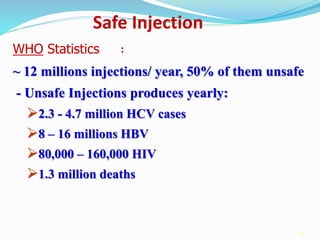
Safe Injection
WHO Statistics :
~ 12 millions injections/ year, 50% of them unsafe
- Unsafe Injections produces yearly:
2.3 - 4.7 million HCV cases
8 – 16 millions HBV
80,000 – 160,000 HIV
1.3 million deaths
-
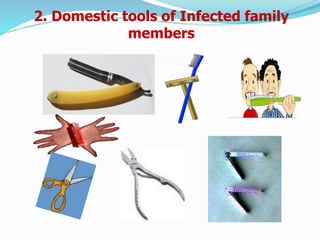
2. Domestic tools of Infected family
members
The Good News: HCV Does Not Spread BY Casual
Contact:
 Sharing Food or water
 Sharing eating utensils or drinking glasses
 Breastfeeding
 Sneezing
 Coughing
 Hugging
Hepatitis C is spread through direct blood-to-blood
contact.
21
22
Why prevention ?
Paradigm shift of HCV Rx, BUT !!!!
 Treatment is not available to every one.
 Available drugs are not 100% curable
 ~150,000 – 200,000 cases of HCV are added every
year.
 Every patient with HCV can infect at least 3 cases.
 Complications of the disease are dangerous
 So, prevention strategies are highly mandated
23
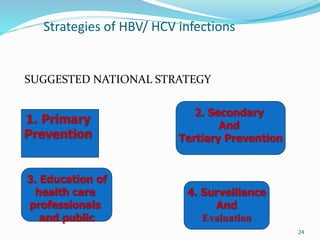
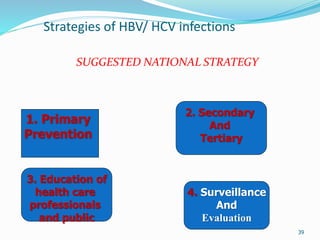
Strategies of HBV/ HCV infections
SUGGESTED NATIONAL STRATEGY
24
1. Primary
Prevention
3. Education of
health care
professionals
and public
4. Surveillance
And
Evaluation
2. Secondary
And
Tertiary Prevention
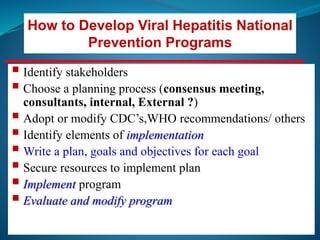
 Identify stakeholders
 Choose a planning process (consensus meeting,
consultants, internal, External ?)
 Adopt or modify CDC’s,WHO recommendations/ others
 Identify elements of implementation framework
 Write a plan, goals and objectives for each goal
 Secure resources to implement plan
 Implement program
 Evaluate and modify program
How to Develop Viral Hepatitis National
Prevention Programs
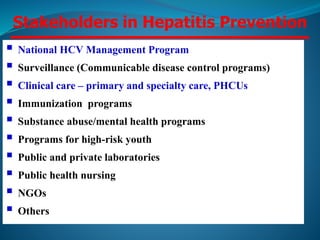
Stakeholders in Hepatitis Prevention
 National HCV Management Program
 Surveillance (Communicable disease control programs)
 Clinical care – primary and specialty care, PHCUs
 Immunization programs
 Substance abuse/mental health programs
 Programs for high-risk youth
 Public and private laboratories
 Public health nursing
 NGOs
 Others
Primary Prevention
Strategies and Activities
27
Primary Prevention Strategies and
Activities
 Identify person at risk of infection) = Prevent new infections
high risk activities – anemias, high risk sex, CRF,
nosocomial, transfusions and transplant, HCWs
SCOPE
 1ry prevention activities aim to reduce risks for
contracting HBV/HCV infection.
These activities focus on reducing or eliminating
potential risk for transmission from an infected person
to an uninfected person.
Goals of Primary Prevention
 Implementation and maintenance of appropriate
infection control practices by Health Care Providers.
 Health care delivery system have to be served by a
system that screens and tests blood and tissue
 People are to be informed about risk reduction
strategies to prevent new infections.
 Injecting Drug Users must have access to sterile
injection equipment.
29
Examples of Primary Prevention
interventions / activities (WHO)
 improving access to safe blood.
 training of health personnel on hand hygiene:
including surgical hand preparation, hand washing and use of
gloves.
 safe handling and disposal of sharps and waste.
 safe cleaning and Proper sterilization of reusable equipment;
(Endoscopies- dentists- circumcision ,, etc)
 Safe Injection Practices / multi-dose vials
 Education of the public
.
Prevention Activities
Primary (Identify person at risk of infection) = Prevent HCV
Acquisition/ Prevent new infections
 high risk activities – anaemias, high risk sex, CRF
 nosocomial, transfusions and transplant, occupational
Secondary and Tertiary (Identify infected persons) =
1. Reduce Risk of Transmission to Others
Test, counsel - harm reduction
2. Reduce Risk of Chronic Liver Disease
Test, counsel - medical management
Surveillance and Evaluation:
• Conduct surveillance and research- Evaluate effectiveness of activities
31
II. Secondary and Tertiary Prevention Strategies
SCOPE
Secondary and tertiary prevention focuses on
persons already infected with HCV.
These activities aim to:
1. Reduce Risk of Transmission to Others
2. Reduce Risk of Chronic Liver Disease and its
morbidities
WHO Recommendations For people
infected with HCV
Goals of Secondary and tertiary prevention
 Regular monitoring for early diagnosis of CLD.
 Infected peoples should:
 have early medical management. (National program)
 have to be educated, counseled about:
o measures to prevent virus transmission and
o liver complications
o and other HCV-associated chronic diseases.
 immunization with the hepatitis A and B vaccines
What must infected people do?
Precautions: infected persons should:
 protect family members by avoiding share
of private tools
 Cover wounds and burns and open places in the skin
 Have healthy diets and avoid alcohol and smoking
 Be vaccinated against HBV and HAV
 Ask medical advices for regular follow-up
III. Professional and Public Education
SCOPE
 Control and prevention of HCV infection requires
not only well-educated health care professionals
but also a well-informed general public.
.
III. Educational Goals, Objectives and Activities
1. Health care providers should have a high level of awareness
concerning HCV prevention and control, including:
a. national recommendations
b. resources available for prevention.
2. Survey to assess the awareness of providers
3. Assessment of the used prevention services
4. Provision of health care providers with information
5. Making national guidelines available
6. Provision of community based organizations with HCV
educational materials
36
III. Educational Goals and Objectives
Health education materials should include:
1. general information about HCV infection.
2. risk factors, transmission, disease progression, and
treatment.
3. detailed prevention messages appropriate for the
targeted population.
Making HCV Prevention and Control Plan available to the
public general (internet or other modalites)
37
 Avoid having medical or dental treatment with unsterile
instruments
 Avoid receiving a blood transfusion in a centre that does not
test for hepatitis
Where possible, choose oral medications instead of injections
NEVER share needles, razors or toothbrushes
Use only sterilized tattoo and piercing instruments!!!
Try to have HBV vaccine
38
Examples of Educational Advices to the Public
Strategies of HBV/ HCV infections
SUGGESTED NATIONAL STRATEGY
39
1. Primary
Prevention
3. Education of
health care
professionals
and public
4. Surveillance
And
Evaluation
2. Secondary
And
Tertiary
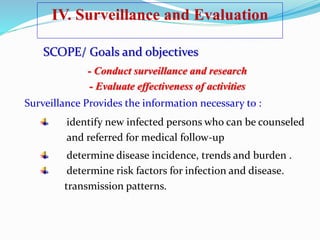
SCOPE/ Goals and objectives
- Conduct surveillance and research
- Evaluate effectiveness of activities
Surveillance Provides the information necessary to :
identify new infected persons who can be counseled
and referred for medical follow-up
determine disease incidence, trends and burden .
determine risk factors for infection and disease.
transmission patterns.
IV. Surveillance and Evaluation
Evaluation Means Helps Adopting
Policies and Procedures for
Evaluation of the effectiveness of the
program
Take Home Messages
 In spite of the great successes in treatment of HCV,
still prevention is of utmost importance.
 Effective prevention program should include:
 1ry, 2ndary and Tertiary prevention as well as proper
surveillance and evaluation of the activities.
 Health education of health care workers and public
 Cooperation with all stakeholders and parners; NGOs,
etc
42
Relevant References
 Egyptian control program
 CDC guidelines and HCV Prevention Strategies
 WHO guidelines
 National Institute of Health (NIH)
43
Thank You!

HCV prevention Final Delta 2015.pptx

  • 2.
    Abdelhamid Serwah, MD Professorof Internal Medicine Suez Canal University Suggested Program
  • 3.
  • 4.
    4 Egypt has thelargest epidemic of hepatitis C virus (HCV) in the world. 170 million infected with HCV • Highest Asia & Africa • Egypt ~ 12% •1 Million People die each year from these diseases. •Most of those infected don’t know they have it, and transmitting the virus to others. World wide www.cdc.gov WHO 2014
  • 5.
  • 6.
    Natural History ofHCV Acute Hepatitis C Di Bisceglie, Hepatology 2000 6 Chronic Hepatitis 75-85 % Cirrhosis 20 % Faster progression • older age at infection • HBV • alcohol • HIV infection • post-transplant 20-50 ys Di Bisceglie, Hepatology 2000 Complications
  • 7.
    7 Sources of Infectionwith HCV Iatrogenic Domestic Household
  • 8.
    Iatrogenic Infection !!!!!!!!!!!!! Transmission of Viral Hepatitis by Unsafe Injections and Medical Practices 8
  • 9.
    Iatrogenic Infection: Health-CareRelated HCV Transmission  Unsafe injection practices  High frequency of injections and transfusions  People believe in injections!  Contamination of multi-dose vials  Sharing of disposable needles and syringes  Inadequate sterilization of reusable needles and syringes  Paid donors continue to be used in many countries  Contaminated equipment  lack of ‘universal precautions’  inadequate cleaning and disinfection  in health care settings  alternative medicine practices
  • 10.
    Iatrogenic: From bloodinfected donor
  • 11.
  • 12.
  • 13.
  • 14.
    Iatrogenic: Dentists andimproper sterilization of Instruments
  • 15.
  • 16.
  • 17.
  • 18.
    ‫؟‬ ‫اآلمن‬ ‫الحقن‬‫يعنى‬ ‫ذا‬ ‫ما‬ ‫هو‬ ‫الحقن‬ ‫الذى‬ ‫ال‬ ‫يسبب‬ ‫ضرر‬ ‫للشخص‬ ‫ن‬‫المحقو‬ ‫ال‬ ‫و‬ ‫يعرض‬ ‫الحاق‬ ‫ن‬ ‫ألى‬ ‫أخطار‬ ‫ال‬ ‫و‬ ‫ينتج‬ ‫عنه‬ ‫أى‬ ‫مخلفات‬ ‫ة‬ ‫ر‬‫خطي‬ ‫تضر‬ ‫ين‬‫ر‬‫باآلخ‬ . Injection without harm to the injected person or the HCWs and without dangerous waste ‫اتيجية‬ ‫ر‬‫أست‬‫و‬ ‫مكافحة‬ ‫ى‬‫العدو‬ ‫التى‬ ‫تنتشر‬ ‫بالحقن‬ ‫هى‬ : - 1 - ‫عدم‬ ‫إعطاء‬ ‫أى‬ ‫حقن‬ ‫غير‬ ‫ي‬‫ر‬‫ضرو‬ ‫ة‬ 2 - ‫إذا‬ ‫كان‬ ‫ال‬ ‫و‬ ‫بد‬ ‫من‬ ‫إعطاء‬ ‫الحقن‬ ‫فيجب‬ ‫اتباع‬ ‫التعليمات‬ .
  • 19.
    Safe Injection WHO Statistics: ~ 12 millions injections/ year, 50% of them unsafe - Unsafe Injections produces yearly: 2.3 - 4.7 million HCV cases 8 – 16 millions HBV 80,000 – 160,000 HIV 1.3 million deaths -
  • 20.
    2. Domestic toolsof Infected family members
  • 21.
    The Good News:HCV Does Not Spread BY Casual Contact:  Sharing Food or water  Sharing eating utensils or drinking glasses  Breastfeeding  Sneezing  Coughing  Hugging Hepatitis C is spread through direct blood-to-blood contact. 21
  • 22.
  • 23.
    Why prevention ? Paradigmshift of HCV Rx, BUT !!!!  Treatment is not available to every one.  Available drugs are not 100% curable  ~150,000 – 200,000 cases of HCV are added every year.  Every patient with HCV can infect at least 3 cases.  Complications of the disease are dangerous  So, prevention strategies are highly mandated 23
  • 24.
    Strategies of HBV/HCV infections SUGGESTED NATIONAL STRATEGY 24 1. Primary Prevention 3. Education of health care professionals and public 4. Surveillance And Evaluation 2. Secondary And Tertiary Prevention
  • 25.
     Identify stakeholders Choose a planning process (consensus meeting, consultants, internal, External ?)  Adopt or modify CDC’s,WHO recommendations/ others  Identify elements of implementation framework  Write a plan, goals and objectives for each goal  Secure resources to implement plan  Implement program  Evaluate and modify program How to Develop Viral Hepatitis National Prevention Programs
  • 26.
    Stakeholders in HepatitisPrevention  National HCV Management Program  Surveillance (Communicable disease control programs)  Clinical care – primary and specialty care, PHCUs  Immunization programs  Substance abuse/mental health programs  Programs for high-risk youth  Public and private laboratories  Public health nursing  NGOs  Others
  • 27.
  • 28.
    Primary Prevention Strategiesand Activities  Identify person at risk of infection) = Prevent new infections high risk activities – anemias, high risk sex, CRF, nosocomial, transfusions and transplant, HCWs SCOPE  1ry prevention activities aim to reduce risks for contracting HBV/HCV infection. These activities focus on reducing or eliminating potential risk for transmission from an infected person to an uninfected person.
  • 29.
    Goals of PrimaryPrevention  Implementation and maintenance of appropriate infection control practices by Health Care Providers.  Health care delivery system have to be served by a system that screens and tests blood and tissue  People are to be informed about risk reduction strategies to prevent new infections.  Injecting Drug Users must have access to sterile injection equipment. 29
  • 30.
    Examples of PrimaryPrevention interventions / activities (WHO)  improving access to safe blood.  training of health personnel on hand hygiene: including surgical hand preparation, hand washing and use of gloves.  safe handling and disposal of sharps and waste.  safe cleaning and Proper sterilization of reusable equipment; (Endoscopies- dentists- circumcision ,, etc)  Safe Injection Practices / multi-dose vials  Education of the public .
  • 31.
    Prevention Activities Primary (Identifyperson at risk of infection) = Prevent HCV Acquisition/ Prevent new infections  high risk activities – anaemias, high risk sex, CRF  nosocomial, transfusions and transplant, occupational Secondary and Tertiary (Identify infected persons) = 1. Reduce Risk of Transmission to Others Test, counsel - harm reduction 2. Reduce Risk of Chronic Liver Disease Test, counsel - medical management Surveillance and Evaluation: • Conduct surveillance and research- Evaluate effectiveness of activities 31
  • 32.
    II. Secondary andTertiary Prevention Strategies SCOPE Secondary and tertiary prevention focuses on persons already infected with HCV. These activities aim to: 1. Reduce Risk of Transmission to Others 2. Reduce Risk of Chronic Liver Disease and its morbidities
  • 33.
    WHO Recommendations Forpeople infected with HCV Goals of Secondary and tertiary prevention  Regular monitoring for early diagnosis of CLD.  Infected peoples should:  have early medical management. (National program)  have to be educated, counseled about: o measures to prevent virus transmission and o liver complications o and other HCV-associated chronic diseases.  immunization with the hepatitis A and B vaccines
  • 34.
    What must infectedpeople do? Precautions: infected persons should:  protect family members by avoiding share of private tools  Cover wounds and burns and open places in the skin  Have healthy diets and avoid alcohol and smoking  Be vaccinated against HBV and HAV  Ask medical advices for regular follow-up
  • 35.
    III. Professional andPublic Education SCOPE  Control and prevention of HCV infection requires not only well-educated health care professionals but also a well-informed general public. .
  • 36.
    III. Educational Goals,Objectives and Activities 1. Health care providers should have a high level of awareness concerning HCV prevention and control, including: a. national recommendations b. resources available for prevention. 2. Survey to assess the awareness of providers 3. Assessment of the used prevention services 4. Provision of health care providers with information 5. Making national guidelines available 6. Provision of community based organizations with HCV educational materials 36
  • 37.
    III. Educational Goalsand Objectives Health education materials should include: 1. general information about HCV infection. 2. risk factors, transmission, disease progression, and treatment. 3. detailed prevention messages appropriate for the targeted population. Making HCV Prevention and Control Plan available to the public general (internet or other modalites) 37
  • 38.
     Avoid havingmedical or dental treatment with unsterile instruments  Avoid receiving a blood transfusion in a centre that does not test for hepatitis Where possible, choose oral medications instead of injections NEVER share needles, razors or toothbrushes Use only sterilized tattoo and piercing instruments!!! Try to have HBV vaccine 38 Examples of Educational Advices to the Public
  • 39.
    Strategies of HBV/HCV infections SUGGESTED NATIONAL STRATEGY 39 1. Primary Prevention 3. Education of health care professionals and public 4. Surveillance And Evaluation 2. Secondary And Tertiary
  • 40.
    SCOPE/ Goals andobjectives - Conduct surveillance and research - Evaluate effectiveness of activities Surveillance Provides the information necessary to : identify new infected persons who can be counseled and referred for medical follow-up determine disease incidence, trends and burden . determine risk factors for infection and disease. transmission patterns. IV. Surveillance and Evaluation
  • 41.
    IV. Surveillance andEvaluation Evaluation Means Helps Adopting Policies and Procedures for Evaluation of the effectiveness of the program
  • 42.
    Take Home Messages In spite of the great successes in treatment of HCV, still prevention is of utmost importance.  Effective prevention program should include:  1ry, 2ndary and Tertiary prevention as well as proper surveillance and evaluation of the activities.  Health education of health care workers and public  Cooperation with all stakeholders and parners; NGOs, etc 42
  • 43.
    Relevant References  Egyptiancontrol program  CDC guidelines and HCV Prevention Strategies  WHO guidelines  National Institute of Health (NIH) 43
  • 44.