UNIVERSITY OF DAR ES SALAAM
COLLEGE OF NATURALAND APPLIED SCIENCE
NAME :CHARLES ANTONY KIMARIO
REGISTRATION NO:2017-04-07021
DEGREE PROGRAM:BSC GENERAL
TITLE:THE DIAGNOSIS OF
HEPATITIS B AND C AT AMANA
REFERRAL HOSPITAL
INTRODUCTION:HEPATITIS
Hepatitis describes inflammation of the liver . the name hepatitis is from
ancient Greek hepar or hepato,meaning liver ,and suffix –its meaning
“inflammation”. Hepatitis may be caused by alcohols, drugs, autoimmune
diseases ,metabolic diseases and viruses
There are different types of Hepatitis viruses which are:- Hepatitis
A(HVA), Hepatitis B (HBV), Hepatitis C (HCV), Hepatitis D
(HDV),Hepatitis E (HEV).All these are RNA viruses except HBV which
is DNA viruses
Hepatitis screening Involves testing a small sample of blood for antigens
and antibodies to determine whether the individual has been infected with
viral hepatitis. Hepatitis blood tests look for antigens or antibodies specific
to each type of hepatitis virus.
HEPATITIS B
Hepatitis B is a potentially life-threatening liver infection caused by the
hepatitis B virus (HBV).It can cause both acute and chronic infection and
puts people at high risk of death from cirrhosis and liver cancer.
Hepatitis B virus (HBV), a small, circular, partially double-stranded
DNA virus in the family Hepadnaviridae
Hepatitis can be prevented by vaccines that are safe, available and
effective
The symptoms of hepatitis B are: nausea, vomiting, loss of appetite,
abdominal pain, jaundice (the skin turns yellow), weakness, fatigue,
or brown urine (may look like tea).
Hepatitis B screening
• HBV has three antigens (surface, core, and e), some of which can be
detected in the blood.
• The body’s immune response produces antibodies tailored to each type of
antigen (surface antibody, core antibody, and e antibody), which can also
be detected from a blood test
• The basic blood test for hepatitis B consists of three screening tests:
a hepatitis B surface antigen test, which determines whether a
person currently has the infection; a hepatitis B core antibody test,
which determines whether a person has ever been infected; and a
hepatitis B surface antibody test, which determines whether a
person has cleared the virus after infection, or has been vaccinated
and is now immune to future infections.
• The virus is commonly transmitted from mother to child during birth and
delivery, as well as through contact with blood or other body fluids, in addition
carrier can transmit the disease for many years.
HEPATITIS C
The hepatitis C virus is a blood borne virus: the most common modes of
infection are through exposure to small quantities of blood.
 This may happen through injection drug use, unsafe injection practices, unsafe
health care, transfusion of unscreened blood and blood products, and sexual
practices that lead to exposure to blood.
 Hepatitis C is not spread through breast milk, food, water or casual contact such
as hugging, kissing and sharing food or drinks with an infected person. .
A significant number of those who are chronically infected will develop
cirrhosis or liver cancer.
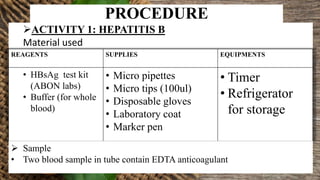
PROCEDURE
ACTIVITY 1: HEPATITIS B
Material used
REAGENTS SUPPLIES EQUIPMENTS
• HBsAg test kit
(ABON labs)
• Buffer (for whole
blood)
• Micro pipettes
• Micro tips (100ul)
• Disposable gloves
• Laboratory coat
• Marker pen
• Timer
• Refrigerator
for storage
 Sample
• Two blood sample in tube contain EDTA anticoagulant
Procedure
1. Wear gloves
2. Blood samples were centrifuged in the centrifuge for 5 minutes
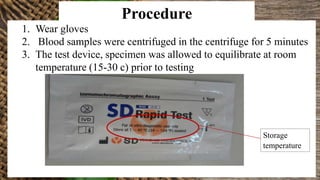
3. The test device, specimen was allowed to equilibrate at room
temperature (15-30 c) prior to testing
Fig 01: Test kit show storage temperature
Storage
temperature
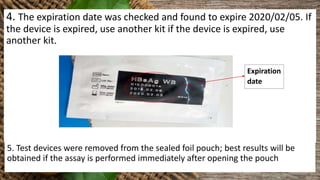
Expiration
date
4. The expiration date was checked and found to expire 2020/02/05. If
the device is expired, use another kit if the device is expired, use
another kit.
5. Test devices were removed from the sealed foil pouch; best results will be
obtained if the assay is performed immediately after opening the pouch
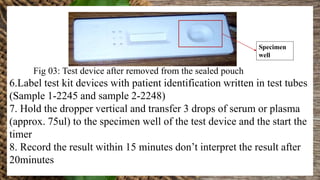
Fig 03: Test device after removed from the sealed pouch
6.Label test kit devices with patient identification written in test tubes
(Sample 1-2245 and sample 2-2248)
7. Hold the dropper vertical and transfer 3 drops of serum or plasma
(approx. 75ul) to the specimen well of the test device and the start the
timer
8. Record the result within 15 minutes don’t interpret the result after
20minutes
Specimen
well
Sample
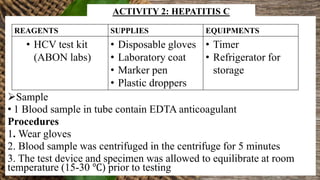
• 1 Blood sample in tube contain EDTA anticoagulant
Procedures
1. Wear gloves
2. Blood sample was centrifuged in the centrifuge for 5 minutes
3. The test device and specimen was allowed to equilibrate at room
temperature (15-30 ℃) prior to testing
REAGENTS SUPPLIES EQUIPMENTS
• HCV test kit
(ABON labs)
• Disposable gloves
• Laboratory coat
• Marker pen
• Plastic droppers
• Timer
• Refrigerator for
storage
ACTIVITY 2: HEPATITIS C
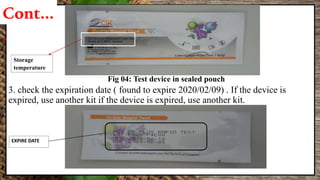
3. check the expiration date ( found to expire 2020/02/09) . If the device is
expired, use another kit if the device is expired, use another kit.
Storage
temperature
Fig 04: Test device in sealed pouch
Cont…
.
EXPIRE DATE
Cont…..
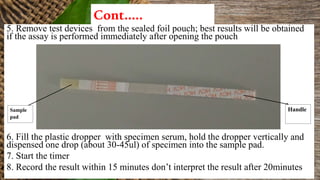
5. Remove test devices from the sealed foil pouch; best results will be obtained
if the assay is performed immediately after opening the pouch
6. Fill the plastic dropper with specimen serum, hold the dropper vertically and
dispensed one drop (about 30-45ul) of specimen into the sample pad.
7. Start the timer
8. Record the result within 15 minutes don’t interpret the result after 20minutes
HandleSample
pad
OBSERVATION AND RESULT
ACTIVITY 1: HEPATITIS B
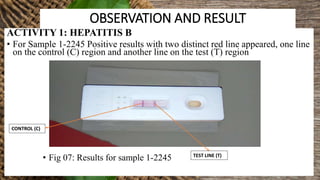
• For Sample 1-2245 Positive results with two distinct red line appeared, one line
on the control (C) region and another line on the test (T) region
• Fig 07: Results for sample 1-2245
CONTROL (C)
TEST LINE (T)
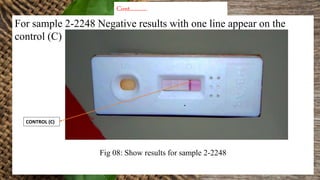
For sample 2-2248 Negative results with one line appear on the
control (C)
Fig 08: Show results for sample 2-2248
Cont…………
CONTROL (C)
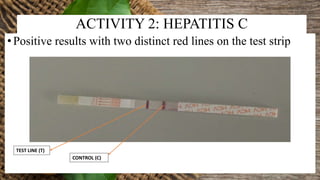
Fig 09: Show positive results
ACTIVITY 2: HEPATITIS C
•Positive results with two distinct red lines on the test strip
TEST LINE (T)
CONTROL (C)
HEPATITIS B HEPATITIS C
MONTH POSITIVE
RESULTS
NEGATIVE
RESULTS TOTAL
POSITIVE
RESULTS
NEGATIVE
RESULTS
TOTAL
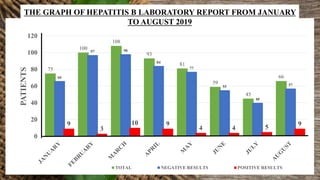
JANUARY 9 66 75 1 18 19
FEBRUARY 3 97 100 0 12 12
MARCH 10 98 108 0 12 12
APRIL 9 84 93 2 10 12
MAY 4 77 81 0 9 9
JUNE 4 55 59 0 1 1
JULY 5 40 45 1 2 3
AUGUST 9 57 66 2 7 9
TOTAL 53 574 627 6 71 77
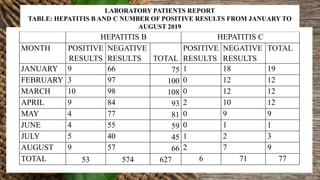
LABORATORY PATIENTS REPORT
TABLE: HEPATITIS B AND C NUMBER OF POSITIVE RESULTS FROM JANUARY TO
AUGUST 2019
75
100
108
93
81
59
45
6666
97 98
84
77
55
40
57
9
3
10 9
4 4 5
9
0
20
40
60
80
100
120
PATIENTS
TOTAL NEGATIVE RESULTS POSITIVE RESULTS
THE GRAPH OF HEPATITIS B LABORATORY REPORT FROM JANUARY
TO AUGUST 2019
DISCUSSION
 The membrane is pre coated with anti HBsAg antibody conjugated particles on the
test line region of the test.
 During testing the serum or plasma reacts with the particle coated with anti-
HBsAg antibody the mixture move up chromatographically by capillary action to
react with anti HBsAg antibody coated on the membrane and produce coloured
line .
 The presence which indicate positive test (Fig.07) while it is absence indicate a
negative results (Fig.09) a coloured line appears in the control region serving as
procedure control regardless of the result
 The HCV rapid test strip is a rapid chromatographic immunoassay for the
qualitative Detection of antibody to Hepatitis C virus (Fig.06).The mixture
migrates upward on the membrane chromatographically by capillary action to react
with recombinant HCV Antigen on the membrane and generate a colored line; the
presence of this colored line indicates a positive result (Fig.09). While its absence
indicates negative result, a colored line will always appear at the control line..
 The screening test for hepatitis B surface antigens detects the
presence of HBV in the blood. A positive test result means the person
is currently infected and can pass the infection to others. There are no
medications available to treat acute HBV and negative results
indicates that the person is not infected and should take the vaccine
 Among of 574 patients with negative results for Hepatitis B at
Amana Referral Hospital only 23 people took the vaccination against
Hepatitis B which cost 5200Tshs per dose which require three dose
total 15600Tshs.
 About a third of the people who have Hepatitis disease don’t exhibit
any symptoms. They only find out through a blood test.
CONCLUSION
REFERENCES
• Viral Hepatitis, Fourth Edition by Howard C. Thomas ,Anna S.F. Lok, Stephen
A. Locarnini, Arie J. Zuckerman :26 July 2013
 Viral Hepatitis: 1985 Update Saul Krugman, Pediatr Rev, 1985
 CDC. Updated US Public Health Service guidelines for the management of
occupational exposures to HBV, HCV, and HIV Rep. 2001 Jun
 Abara WE, Qaseem A, Schillie S, McMahon BJ, Harris AM. Hepatitis B
vaccination and screening Ann Intern Med. 2017.
 Johnson DF, Leder K, Torresi J. Hepatitis B and C infection in international
travelers. J of Trop Med. 2013 May–Jun;2015
 UK Essays. November 2018. Hepatitis B infection: An overview. [online].
Available from: https://www.ukessays.com/essays/medical/hepatitis-b-
infection.php?vref=1 [Accessed 20 November 2019].
END

HEPATITIS B AND C PRESENTATION

  • 1.
    UNIVERSITY OF DARES SALAAM COLLEGE OF NATURALAND APPLIED SCIENCE NAME :CHARLES ANTONY KIMARIO REGISTRATION NO:2017-04-07021 DEGREE PROGRAM:BSC GENERAL TITLE:THE DIAGNOSIS OF HEPATITIS B AND C AT AMANA REFERRAL HOSPITAL
  • 2.
    INTRODUCTION:HEPATITIS Hepatitis describes inflammationof the liver . the name hepatitis is from ancient Greek hepar or hepato,meaning liver ,and suffix –its meaning “inflammation”. Hepatitis may be caused by alcohols, drugs, autoimmune diseases ,metabolic diseases and viruses There are different types of Hepatitis viruses which are:- Hepatitis A(HVA), Hepatitis B (HBV), Hepatitis C (HCV), Hepatitis D (HDV),Hepatitis E (HEV).All these are RNA viruses except HBV which is DNA viruses Hepatitis screening Involves testing a small sample of blood for antigens and antibodies to determine whether the individual has been infected with viral hepatitis. Hepatitis blood tests look for antigens or antibodies specific to each type of hepatitis virus.
  • 3.
    HEPATITIS B Hepatitis Bis a potentially life-threatening liver infection caused by the hepatitis B virus (HBV).It can cause both acute and chronic infection and puts people at high risk of death from cirrhosis and liver cancer. Hepatitis B virus (HBV), a small, circular, partially double-stranded DNA virus in the family Hepadnaviridae Hepatitis can be prevented by vaccines that are safe, available and effective The symptoms of hepatitis B are: nausea, vomiting, loss of appetite, abdominal pain, jaundice (the skin turns yellow), weakness, fatigue, or brown urine (may look like tea).
  • 4.
    Hepatitis B screening •HBV has three antigens (surface, core, and e), some of which can be detected in the blood. • The body’s immune response produces antibodies tailored to each type of antigen (surface antibody, core antibody, and e antibody), which can also be detected from a blood test • The basic blood test for hepatitis B consists of three screening tests: a hepatitis B surface antigen test, which determines whether a person currently has the infection; a hepatitis B core antibody test, which determines whether a person has ever been infected; and a hepatitis B surface antibody test, which determines whether a person has cleared the virus after infection, or has been vaccinated and is now immune to future infections.
  • 5.
    • The virusis commonly transmitted from mother to child during birth and delivery, as well as through contact with blood or other body fluids, in addition carrier can transmit the disease for many years. HEPATITIS C The hepatitis C virus is a blood borne virus: the most common modes of infection are through exposure to small quantities of blood.  This may happen through injection drug use, unsafe injection practices, unsafe health care, transfusion of unscreened blood and blood products, and sexual practices that lead to exposure to blood.  Hepatitis C is not spread through breast milk, food, water or casual contact such as hugging, kissing and sharing food or drinks with an infected person. . A significant number of those who are chronically infected will develop cirrhosis or liver cancer.
  • 6.
    PROCEDURE ACTIVITY 1: HEPATITISB Material used REAGENTS SUPPLIES EQUIPMENTS • HBsAg test kit (ABON labs) • Buffer (for whole blood) • Micro pipettes • Micro tips (100ul) • Disposable gloves • Laboratory coat • Marker pen • Timer • Refrigerator for storage  Sample • Two blood sample in tube contain EDTA anticoagulant
  • 7.
    Procedure 1. Wear gloves 2.Blood samples were centrifuged in the centrifuge for 5 minutes 3. The test device, specimen was allowed to equilibrate at room temperature (15-30 c) prior to testing Fig 01: Test kit show storage temperature Storage temperature
  • 8.
    Expiration date 4. The expirationdate was checked and found to expire 2020/02/05. If the device is expired, use another kit if the device is expired, use another kit. 5. Test devices were removed from the sealed foil pouch; best results will be obtained if the assay is performed immediately after opening the pouch
  • 9.
    Fig 03: Testdevice after removed from the sealed pouch 6.Label test kit devices with patient identification written in test tubes (Sample 1-2245 and sample 2-2248) 7. Hold the dropper vertical and transfer 3 drops of serum or plasma (approx. 75ul) to the specimen well of the test device and the start the timer 8. Record the result within 15 minutes don’t interpret the result after 20minutes Specimen well
  • 10.
    Sample • 1 Bloodsample in tube contain EDTA anticoagulant Procedures 1. Wear gloves 2. Blood sample was centrifuged in the centrifuge for 5 minutes 3. The test device and specimen was allowed to equilibrate at room temperature (15-30 ℃) prior to testing REAGENTS SUPPLIES EQUIPMENTS • HCV test kit (ABON labs) • Disposable gloves • Laboratory coat • Marker pen • Plastic droppers • Timer • Refrigerator for storage ACTIVITY 2: HEPATITIS C
  • 11.
    3. check theexpiration date ( found to expire 2020/02/09) . If the device is expired, use another kit if the device is expired, use another kit. Storage temperature Fig 04: Test device in sealed pouch Cont… . EXPIRE DATE
  • 12.
    Cont….. 5. Remove testdevices from the sealed foil pouch; best results will be obtained if the assay is performed immediately after opening the pouch 6. Fill the plastic dropper with specimen serum, hold the dropper vertically and dispensed one drop (about 30-45ul) of specimen into the sample pad. 7. Start the timer 8. Record the result within 15 minutes don’t interpret the result after 20minutes HandleSample pad
  • 13.
    OBSERVATION AND RESULT ACTIVITY1: HEPATITIS B • For Sample 1-2245 Positive results with two distinct red line appeared, one line on the control (C) region and another line on the test (T) region • Fig 07: Results for sample 1-2245 CONTROL (C) TEST LINE (T)
  • 14.
    For sample 2-2248Negative results with one line appear on the control (C) Fig 08: Show results for sample 2-2248 Cont………… CONTROL (C)
  • 15.
    Fig 09: Showpositive results ACTIVITY 2: HEPATITIS C •Positive results with two distinct red lines on the test strip TEST LINE (T) CONTROL (C)
  • 16.
    HEPATITIS B HEPATITISC MONTH POSITIVE RESULTS NEGATIVE RESULTS TOTAL POSITIVE RESULTS NEGATIVE RESULTS TOTAL JANUARY 9 66 75 1 18 19 FEBRUARY 3 97 100 0 12 12 MARCH 10 98 108 0 12 12 APRIL 9 84 93 2 10 12 MAY 4 77 81 0 9 9 JUNE 4 55 59 0 1 1 JULY 5 40 45 1 2 3 AUGUST 9 57 66 2 7 9 TOTAL 53 574 627 6 71 77 LABORATORY PATIENTS REPORT TABLE: HEPATITIS B AND C NUMBER OF POSITIVE RESULTS FROM JANUARY TO AUGUST 2019
  • 17.
    75 100 108 93 81 59 45 6666 97 98 84 77 55 40 57 9 3 10 9 44 5 9 0 20 40 60 80 100 120 PATIENTS TOTAL NEGATIVE RESULTS POSITIVE RESULTS THE GRAPH OF HEPATITIS B LABORATORY REPORT FROM JANUARY TO AUGUST 2019
  • 18.
    DISCUSSION  The membraneis pre coated with anti HBsAg antibody conjugated particles on the test line region of the test.  During testing the serum or plasma reacts with the particle coated with anti- HBsAg antibody the mixture move up chromatographically by capillary action to react with anti HBsAg antibody coated on the membrane and produce coloured line .  The presence which indicate positive test (Fig.07) while it is absence indicate a negative results (Fig.09) a coloured line appears in the control region serving as procedure control regardless of the result  The HCV rapid test strip is a rapid chromatographic immunoassay for the qualitative Detection of antibody to Hepatitis C virus (Fig.06).The mixture migrates upward on the membrane chromatographically by capillary action to react with recombinant HCV Antigen on the membrane and generate a colored line; the presence of this colored line indicates a positive result (Fig.09). While its absence indicates negative result, a colored line will always appear at the control line..
  • 19.
     The screeningtest for hepatitis B surface antigens detects the presence of HBV in the blood. A positive test result means the person is currently infected and can pass the infection to others. There are no medications available to treat acute HBV and negative results indicates that the person is not infected and should take the vaccine  Among of 574 patients with negative results for Hepatitis B at Amana Referral Hospital only 23 people took the vaccination against Hepatitis B which cost 5200Tshs per dose which require three dose total 15600Tshs.  About a third of the people who have Hepatitis disease don’t exhibit any symptoms. They only find out through a blood test. CONCLUSION
  • 20.
    REFERENCES • Viral Hepatitis,Fourth Edition by Howard C. Thomas ,Anna S.F. Lok, Stephen A. Locarnini, Arie J. Zuckerman :26 July 2013  Viral Hepatitis: 1985 Update Saul Krugman, Pediatr Rev, 1985  CDC. Updated US Public Health Service guidelines for the management of occupational exposures to HBV, HCV, and HIV Rep. 2001 Jun  Abara WE, Qaseem A, Schillie S, McMahon BJ, Harris AM. Hepatitis B vaccination and screening Ann Intern Med. 2017.  Johnson DF, Leder K, Torresi J. Hepatitis B and C infection in international travelers. J of Trop Med. 2013 May–Jun;2015  UK Essays. November 2018. Hepatitis B infection: An overview. [online]. Available from: https://www.ukessays.com/essays/medical/hepatitis-b- infection.php?vref=1 [Accessed 20 November 2019].
  • 21.

Editor's Notes

  • #4 Antigens are foreign substances, such as microorganisms (e.g., bacteria, fungi, parasites, viruses) or chemicals which invade the body. When the body is exposed to antigens, it produces antibodies as a part of its immune response Antibodies are proteins that bind to the antigens to try to clear them from the body Hepatitis B virus is a member of the Hepadnavirus family originally called Dane particle, 42nm partially double stranded DNA composed of a 27nm nucleoplasid core (HBsAg),surrounded by lipoprotein coat also called envelope containing the surface antigen (HBsAg).