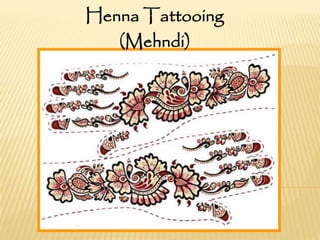
Henna Tattooing
(Mehndi)
WHAT'S IN THE NAME?
Henna tattooing is just the slang term for a
process called Mehndi. This art has become
increasingly popular with western culture and
is now commonly referred to with the slang
term.
WHAT IS HENNA?
Henna is a plant that grows in
the tropical and subtropical
regions of Australia, Southern
Asia (Including India), and
northern Africa. It requires a
good amount of rain and lots of
humidity. It is a green, leafy
plant that grows from about 6.5
ft to 20 ft at full maturity.
EGYPTIAN ORGINS
Henna Tattooing started in Egypt with
origins dating back almost 5,000
years! Egyptians used to decorate the
bodies of their deceased pharaohs
with henna.There were many tattoos they
used, and each had a different
meaning. Some tattoos gave
the pharaohs courage in the
afterlife while others gave
them guidance.
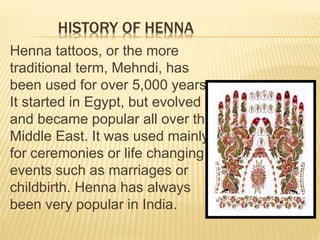
HISTORY OF HENNA
Henna tattoos, or the more
traditional term, Mehndi, has
been used for over 5,000 years.
It started in Egypt, but evolved
and became popular all over the
Middle East. It was used mainly
for ceremonies or life changing
events such as marriages or
childbirth. Henna has always
been very popular in India.
DIFFERENT PATTERNS
There are many, many different designs for
henna tattoos. They differ in many ways
including color, size, and difficulty. Here are
two examples of the ranging difficulty of the
tattoos.
HENNA TODAY
Henna tattoos have become very popular for
western culture. Beachgoers are surrounded
by booths for the tattoos. But the tattoos that
have become popular with today’s culture
have been downsized quite a bit and
simplified. Now, a simple butterfly might
adore a teenage girl’s ankle rather than the
very complex traditional Mehndi tattoos. But,
none the less, the ancient Mehndi designs
are still used in the Middle East.
APPLICATION OF HENNA
The application of henna is time consuming
and difficult. Here are the steps for the
Appling of a henna tattoo. Then we’ll show
you some pictures of us giving ourselves
henna tattoos.
1. You grind the henna leaf into a fine
powder.
2. You mix it with homemade materials or a
pre-made oil (we went with the pre-made oil
kit)
4. You store the henna paste in a refrigerator for
about a week.
5. You put the henna paste in a bottle of some kind
with a fine nozzle.
6. You squeeze the paste out of the bottle onto your
skin with a stencil or free hand.
7. You wrap the paste on your skin gently with a
paper towel.
8. When the paste is dry, peel it off your skin.
9. In a few hours, the tattoo will slowly appear on you
skin!
(CONTINUED)
OUR EXPERIENCE WITH HENNA
 Prob more than one slide
HENNA SAFETY TIPS
Black henna can be very dangerous. It can
infect and eat away at your skin. Henna is not
black! Black henna contains PPD, a dangerous
chemical that is illegal if used on the skin. If you
are interested in getting a henna tattoo, be
careful where you get your supplies. You want
to research the supplier throughly and make
sure they are reliable.
We hope that you enjoyed our
presentation! We’ll look forward to
seeing you here for some of our
future programs!
Bibliography
We’d like to thank:
www.wikipedia.com
www.hennapage.com
www.earthhenna.com
www.dictonary.com
www.everydayhenna.com
www.answers.com
www.google.com

Henna Slideshow

  • 1.
  • 2.
    WHAT'S IN THENAME? Henna tattooing is just the slang term for a process called Mehndi. This art has become increasingly popular with western culture and is now commonly referred to with the slang term.
  • 3.
    WHAT IS HENNA? Hennais a plant that grows in the tropical and subtropical regions of Australia, Southern Asia (Including India), and northern Africa. It requires a good amount of rain and lots of humidity. It is a green, leafy plant that grows from about 6.5 ft to 20 ft at full maturity.
  • 4.
    EGYPTIAN ORGINS Henna Tattooingstarted in Egypt with origins dating back almost 5,000 years! Egyptians used to decorate the bodies of their deceased pharaohs with henna.There were many tattoos they used, and each had a different meaning. Some tattoos gave the pharaohs courage in the afterlife while others gave them guidance.
  • 5.
    HISTORY OF HENNA Hennatattoos, or the more traditional term, Mehndi, has been used for over 5,000 years. It started in Egypt, but evolved and became popular all over the Middle East. It was used mainly for ceremonies or life changing events such as marriages or childbirth. Henna has always been very popular in India.
  • 6.
    DIFFERENT PATTERNS There aremany, many different designs for henna tattoos. They differ in many ways including color, size, and difficulty. Here are two examples of the ranging difficulty of the tattoos.
  • 7.
    HENNA TODAY Henna tattooshave become very popular for western culture. Beachgoers are surrounded by booths for the tattoos. But the tattoos that have become popular with today’s culture have been downsized quite a bit and simplified. Now, a simple butterfly might adore a teenage girl’s ankle rather than the very complex traditional Mehndi tattoos. But, none the less, the ancient Mehndi designs are still used in the Middle East.
  • 8.
    APPLICATION OF HENNA Theapplication of henna is time consuming and difficult. Here are the steps for the Appling of a henna tattoo. Then we’ll show you some pictures of us giving ourselves henna tattoos. 1. You grind the henna leaf into a fine powder. 2. You mix it with homemade materials or a pre-made oil (we went with the pre-made oil kit)
  • 9.
    4. You storethe henna paste in a refrigerator for about a week. 5. You put the henna paste in a bottle of some kind with a fine nozzle. 6. You squeeze the paste out of the bottle onto your skin with a stencil or free hand. 7. You wrap the paste on your skin gently with a paper towel. 8. When the paste is dry, peel it off your skin. 9. In a few hours, the tattoo will slowly appear on you skin! (CONTINUED)
  • 10.
    OUR EXPERIENCE WITHHENNA  Prob more than one slide
  • 11.
    HENNA SAFETY TIPS Blackhenna can be very dangerous. It can infect and eat away at your skin. Henna is not black! Black henna contains PPD, a dangerous chemical that is illegal if used on the skin. If you are interested in getting a henna tattoo, be careful where you get your supplies. You want to research the supplier throughly and make sure they are reliable.
  • 12.
    We hope thatyou enjoyed our presentation! We’ll look forward to seeing you here for some of our future programs!
  • 13.
    Bibliography We’d like tothank: www.wikipedia.com www.hennapage.com www.earthhenna.com www.dictonary.com www.everydayhenna.com www.answers.com www.google.com