1
PROTÉGÉ EDUCATION CENTER, LLC
Giving the Gift of Education
www.ProtegeEducation.com
Career Development Program
High school graduates & College students
SAT
PSAT
NJ ASK
Grades 3 to 12
Science Math
(Biology, Chemistry & Physics)
College
Biology, Biochemistry,
Microbiology, Immunology,
Chemistry
&
Physics
Biology Research Lab
Assistant
Certificate of Completion
Medical
Laboratory
Scientist
ASCP exam
Preparation
Presentation,
Public Speaking &
Leadership Skills
Certificate of Completion
Tutoring & Test Preparation
732-432-4900
Computer Science
Certificate of Completion
Medical Laboratory
Scientist
Hematology
Part 2 of 4 – White Blood Cells
Brief overview
2Protégé Education Center, LLC
All rights reserved
www.ProtegeEducation.com
Presented by
Nithianandan Selliah, PhD
Scientist
Founder and CEO
of Protégé Education Center, LLC
Protégé Education Center, LLC
All rights reserved
www.ProtegeEducation.com
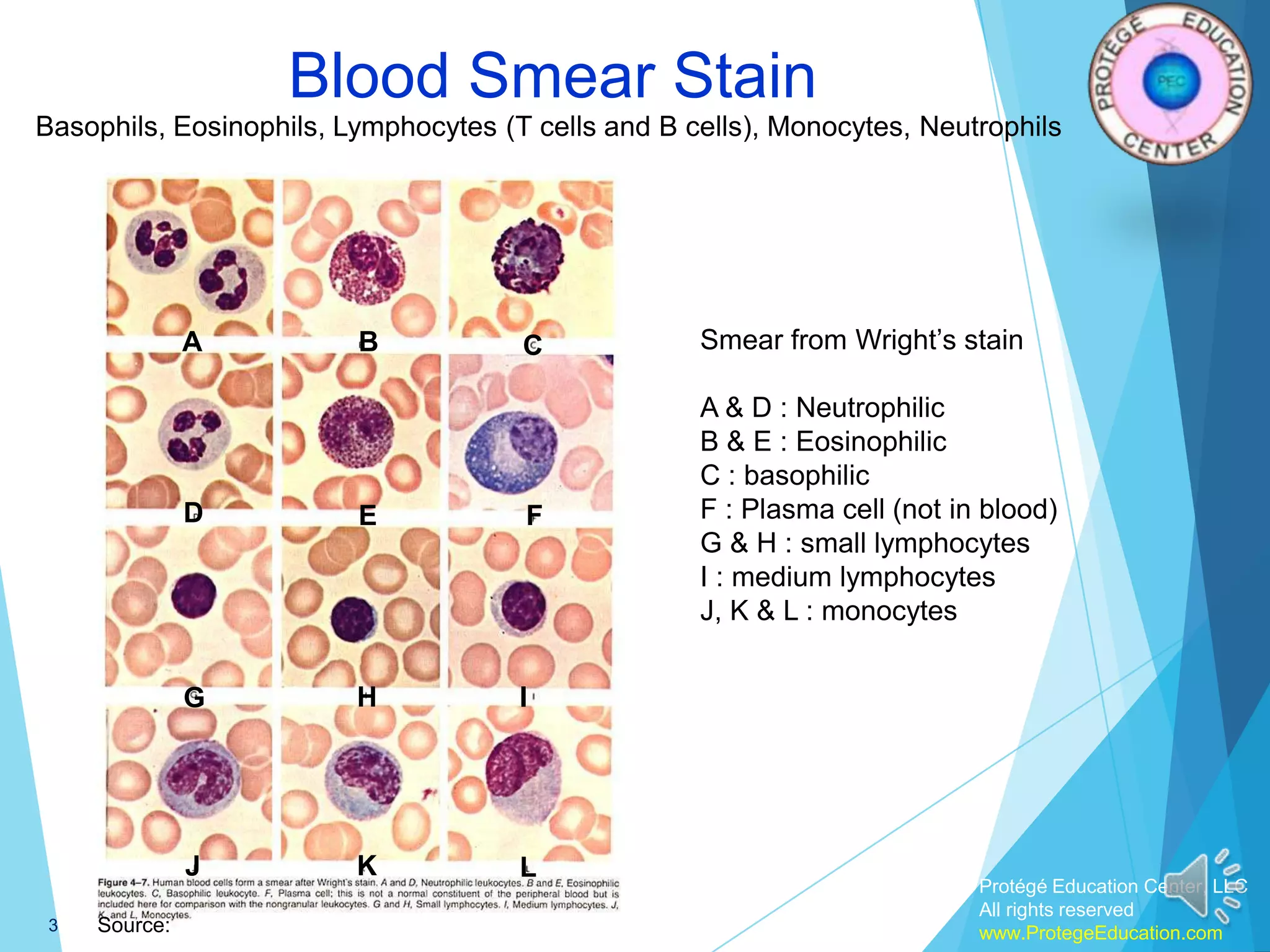
Blood Smear Stain
3
Smear from Wright’s stain
A & D : Neutrophilic
B & E : Eosinophilic
C : basophilic
F : Plasma cell (not in blood)
G & H : small lymphocytes
I : medium lymphocytes
J, K & L : monocytes
Source:
Basophils, Eosinophils, Lymphocytes (T cells and B cells), Monocytes, Neutrophils
A B C
D E F
G H I
J K L
Protégé Education Center, LLC
All rights reserved
www.ProtegeEducation.com
White Blood Cells (WBC) Count
 Five major types of white blood cells: Basophils, Eosinophils,
Lymphocytes (T cells and B cells), Monocytes, Neutrophils
Normal Results
 The normal number of WBCs in the blood is 4,500-10,000 white blood cells per
microliter (mcL).
Abnormal Results: Low count
 A low number of WBCs is called leukopenia.
 It may be due to:
 Bone marrow deficiency or failure (infection, tumor, or abnormal scarring)
 Cancer treating drugs, or other medicines
 Certain autoimmune disorders such as lupus
 Disease of the liver or spleen
 Radiation treatment for cancer
 Certain viral illnesses, such as Mono
 Cancers that damage the bone marrow
 Very severe bacterial infections
 HIV infection (low CD4 T-cell count)
4
Protégé Education Center, LLC
All rights reserved
www.ProtegeEducation.com
White Blood Cells (WBC) Count
It may be due to:
 Anemia
 Certain drugs or medications (see list
below
 Cigarette smoking
 Infections, most often those caused by
bacteria
 Inflammatory disease (such as
rheumatoid arthritis or allergy)
 Leukemia
 Severe mental or physical stress
 Tissue damage (for example, burns)
 There may also be other less common
reasons for this result. .
 Drugs that may lower your WBC count
include:
 Antibiotics
 Anticonvulsants
 Anti thyroid drugs
 Arsenicals
 Captopril
5
 Chemotherapy drugs
 Chlorpromazine
 Clozapine
 Diuretics
 Histamine-2 blockers
 Sulfonamides
 Quinidine
 Terbinafine
 Ticlopidine
 Drugs that may increase WBC
counts include:
 Beta adrenergic agonists (for
example albuterol)
 Corticosteroids
 Epinephrine
 Granulocyte colony
stimulating factor
 Heparin
 Lithium
Abnormal Results: High count
 A high number of WBCs is called leukocytosis.
Protégé Education Center, LLC
All rights reserved
www.ProtegeEducation.com
WBC – Cytochemical Stains
 Leukocyte alkaline phosphate (lap) : neutrophils, (alkaline phosphatase)

 Myeloperoxidase stain (mps) : primary granules of myeloid cells
(peroxidase).
 Periodic acid schiff reaction (pas): stains high molecular weight
carbohydrates normally present in most blood cell types except
pronormoblasts.
 Sudan black (sbb): stains phospholipids and lipoproteins present in
granules of monocytes and granulocytes.
 Acid phosphate : stains acid phosphatase present in the lysosomes of all
hematopoietic.
 Acid phosphate with tartrates resistance: acid phosphatase present in
all hematopoietic cells, located in lysosomes.
 Nonspecific esterase stain: stains esterases in monocytes and
macrophages.
 Specific esterases (naththol AS-D chloroacetate) stain (cae): stains
esterases present in mature and immature neutrophils in mast cells.
6
Protégé Education Center, LLC
All rights reserved
www.ProtegeEducation.com
Eosinophil, Basophil &
Platelets
7 Source:
Protégé Education Center, LLC
All rights reserved
www.ProtegeEducation.com
Lymphocyte & Monocyte
8 Source:
Protégé Education Center, LLC
All rights reserved
www.ProtegeEducation.com
Lymphocyte Morphology
9
Atypical lymphocytes (in infectious
mononucleosis).
Some are very large, some have
primitive nuclei with a diffuse chromatin
pattern and nucleoli, some nuclei are
lobulated, some cells have voluminous
basophilic cytoplasm.
B lymphocytes may differentiate into
plasma cells with an increased amount of
basophilic cytoplasm, a pale-staining area
near the nucleus (the Golgi zone) and an
eccentric nucleus with clumped
chromatin. There may also be
plasmacytoid lymphocytes with
characteristics intermediate between
those of lymphocytes and plasma cells.
http://www.bloodmed.com/home/ebook.asp?book=0865427178&id=3
Protégé Education Center, LLC
All rights reserved
www.ProtegeEducation.com
Neutrophil Morphology
10
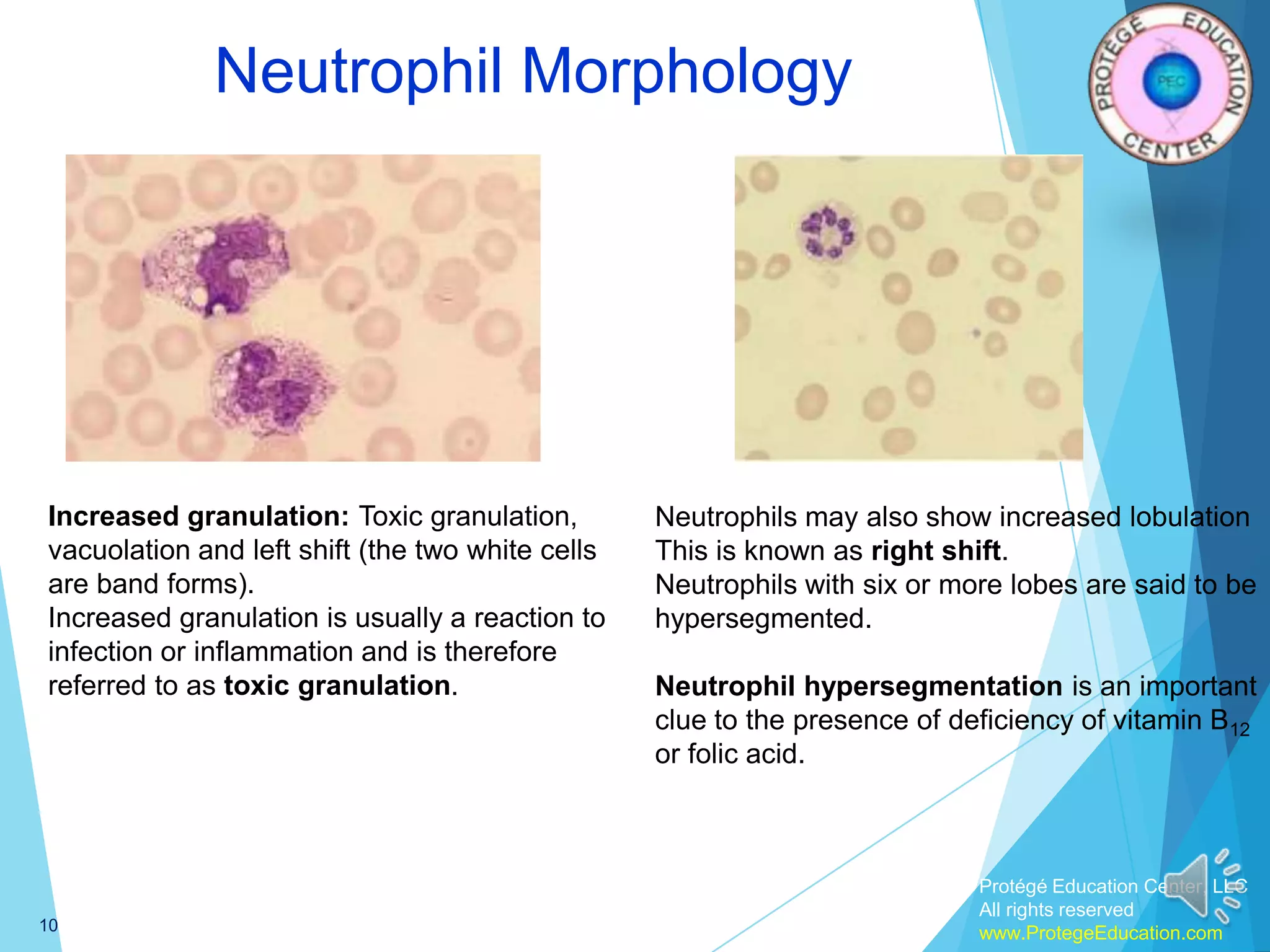
Neutrophils may also show increased lobulation
This is known as right shift.
Neutrophils with six or more lobes are said to be
hypersegmented.
Neutrophil hypersegmentation is an important
clue to the presence of deficiency of vitamin B12
or folic acid.
Increased granulation: Toxic granulation,
vacuolation and left shift (the two white cells
are band forms).
Increased granulation is usually a reaction to
infection or inflammation and is therefore
referred to as toxic granulation.
Protégé Education Center, LLC
All rights reserved
www.ProtegeEducation.com
Neutrophil Morphology
11
Decreased granulation:
A blood film of a patient showing a
myeloblast and a neutrophil. The
myeloblast has a high
nucleocytopasmic ratio, a diffuse
chromatin pattern and a single
nucleolus. The neutrophil is
hypogranular.
A neutrophil containing a Döhle body, a
small blue–grey cytoplasmic inclusion that
can be seen just below the nucleus.
Cytoplasmic inclusions may be present as
an inherited or acquired abnormality. The
commonest such abnormality is a
small, pale, blue–grey inclusion that occurs
both during pregnancy and in infection and
inflammation and is known as a Döhle
body
http://www.bloodmed.com/home/ebook.asp?book=0865427178&id=3
12
PROTÉGÉ EDUCATION CENTER, LLC
Giving the Gift of Education
www.ProtegeEducation.com
Career Development Program
Medical Laboratory Scientist
ASCP exam Preparation
Affordable rates
Online tutoring available for
out-of-state students
732-432-4900info@ProtegeEducation.com
13
PROTÉGÉ EDUCATION CENTER, LLC
Giving the Gift of Education
www.ProtegeEducation.com
Career Development Program
High school graduates & College students
SAT
PSAT
NJ ASK
Grades 3 to 12
Science Math
(Biology, Chemistry & Physics)
College
Biology, Biochemistry,
Microbiology, Immunology,
Chemistry
&
Physics
Biology Research Lab
Assistant
Certificate of Completion
Medical
Laboratory
Scientist
ASCP exam
Preparation
Presentation,
Public Speaking &
Leadership Skills
Certificate of Completion
Tutoring & Test Preparation
732-432-4900
Computer Science
Certificate of Completion
14
PROTÉGÉ EDUCATION CENTER, LLC
Giving the Gift of Education
www.ProtegeEducation.com
Thank You
 Tel: 732-432-4900
 Email: info@ProtegeEducation.com

Hematology Part 2 - White blood cells

  • 1.
    1 PROTÉGÉ EDUCATION CENTER,LLC Giving the Gift of Education www.ProtegeEducation.com Career Development Program High school graduates & College students SAT PSAT NJ ASK Grades 3 to 12 Science Math (Biology, Chemistry & Physics) College Biology, Biochemistry, Microbiology, Immunology, Chemistry & Physics Biology Research Lab Assistant Certificate of Completion Medical Laboratory Scientist ASCP exam Preparation Presentation, Public Speaking & Leadership Skills Certificate of Completion Tutoring & Test Preparation 732-432-4900 Computer Science Certificate of Completion
  • 2.
    Medical Laboratory Scientist Hematology Part 2of 4 – White Blood Cells Brief overview 2Protégé Education Center, LLC All rights reserved www.ProtegeEducation.com Presented by Nithianandan Selliah, PhD Scientist Founder and CEO of Protégé Education Center, LLC
  • 3.
    Protégé Education Center,LLC All rights reserved www.ProtegeEducation.com Blood Smear Stain 3 Smear from Wright’s stain A & D : Neutrophilic B & E : Eosinophilic C : basophilic F : Plasma cell (not in blood) G & H : small lymphocytes I : medium lymphocytes J, K & L : monocytes Source: Basophils, Eosinophils, Lymphocytes (T cells and B cells), Monocytes, Neutrophils A B C D E F G H I J K L
  • 4.
    Protégé Education Center,LLC All rights reserved www.ProtegeEducation.com White Blood Cells (WBC) Count  Five major types of white blood cells: Basophils, Eosinophils, Lymphocytes (T cells and B cells), Monocytes, Neutrophils Normal Results  The normal number of WBCs in the blood is 4,500-10,000 white blood cells per microliter (mcL). Abnormal Results: Low count  A low number of WBCs is called leukopenia.  It may be due to:  Bone marrow deficiency or failure (infection, tumor, or abnormal scarring)  Cancer treating drugs, or other medicines  Certain autoimmune disorders such as lupus  Disease of the liver or spleen  Radiation treatment for cancer  Certain viral illnesses, such as Mono  Cancers that damage the bone marrow  Very severe bacterial infections  HIV infection (low CD4 T-cell count) 4
  • 5.
    Protégé Education Center,LLC All rights reserved www.ProtegeEducation.com White Blood Cells (WBC) Count It may be due to:  Anemia  Certain drugs or medications (see list below  Cigarette smoking  Infections, most often those caused by bacteria  Inflammatory disease (such as rheumatoid arthritis or allergy)  Leukemia  Severe mental or physical stress  Tissue damage (for example, burns)  There may also be other less common reasons for this result. .  Drugs that may lower your WBC count include:  Antibiotics  Anticonvulsants  Anti thyroid drugs  Arsenicals  Captopril 5  Chemotherapy drugs  Chlorpromazine  Clozapine  Diuretics  Histamine-2 blockers  Sulfonamides  Quinidine  Terbinafine  Ticlopidine  Drugs that may increase WBC counts include:  Beta adrenergic agonists (for example albuterol)  Corticosteroids  Epinephrine  Granulocyte colony stimulating factor  Heparin  Lithium Abnormal Results: High count  A high number of WBCs is called leukocytosis.
  • 6.
    Protégé Education Center,LLC All rights reserved www.ProtegeEducation.com WBC – Cytochemical Stains  Leukocyte alkaline phosphate (lap) : neutrophils, (alkaline phosphatase)   Myeloperoxidase stain (mps) : primary granules of myeloid cells (peroxidase).  Periodic acid schiff reaction (pas): stains high molecular weight carbohydrates normally present in most blood cell types except pronormoblasts.  Sudan black (sbb): stains phospholipids and lipoproteins present in granules of monocytes and granulocytes.  Acid phosphate : stains acid phosphatase present in the lysosomes of all hematopoietic.  Acid phosphate with tartrates resistance: acid phosphatase present in all hematopoietic cells, located in lysosomes.  Nonspecific esterase stain: stains esterases in monocytes and macrophages.  Specific esterases (naththol AS-D chloroacetate) stain (cae): stains esterases present in mature and immature neutrophils in mast cells. 6
  • 7.
    Protégé Education Center,LLC All rights reserved www.ProtegeEducation.com Eosinophil, Basophil & Platelets 7 Source:
  • 8.
    Protégé Education Center,LLC All rights reserved www.ProtegeEducation.com Lymphocyte & Monocyte 8 Source:
  • 9.
    Protégé Education Center,LLC All rights reserved www.ProtegeEducation.com Lymphocyte Morphology 9 Atypical lymphocytes (in infectious mononucleosis). Some are very large, some have primitive nuclei with a diffuse chromatin pattern and nucleoli, some nuclei are lobulated, some cells have voluminous basophilic cytoplasm. B lymphocytes may differentiate into plasma cells with an increased amount of basophilic cytoplasm, a pale-staining area near the nucleus (the Golgi zone) and an eccentric nucleus with clumped chromatin. There may also be plasmacytoid lymphocytes with characteristics intermediate between those of lymphocytes and plasma cells. http://www.bloodmed.com/home/ebook.asp?book=0865427178&id=3
  • 10.
    Protégé Education Center,LLC All rights reserved www.ProtegeEducation.com Neutrophil Morphology 10 Neutrophils may also show increased lobulation This is known as right shift. Neutrophils with six or more lobes are said to be hypersegmented. Neutrophil hypersegmentation is an important clue to the presence of deficiency of vitamin B12 or folic acid. Increased granulation: Toxic granulation, vacuolation and left shift (the two white cells are band forms). Increased granulation is usually a reaction to infection or inflammation and is therefore referred to as toxic granulation.
  • 11.
    Protégé Education Center,LLC All rights reserved www.ProtegeEducation.com Neutrophil Morphology 11 Decreased granulation: A blood film of a patient showing a myeloblast and a neutrophil. The myeloblast has a high nucleocytopasmic ratio, a diffuse chromatin pattern and a single nucleolus. The neutrophil is hypogranular. A neutrophil containing a Döhle body, a small blue–grey cytoplasmic inclusion that can be seen just below the nucleus. Cytoplasmic inclusions may be present as an inherited or acquired abnormality. The commonest such abnormality is a small, pale, blue–grey inclusion that occurs both during pregnancy and in infection and inflammation and is known as a Döhle body http://www.bloodmed.com/home/ebook.asp?book=0865427178&id=3
  • 12.
    12 PROTÉGÉ EDUCATION CENTER,LLC Giving the Gift of Education www.ProtegeEducation.com Career Development Program Medical Laboratory Scientist ASCP exam Preparation Affordable rates Online tutoring available for out-of-state students 732-432-4900info@ProtegeEducation.com
  • 13.
    13 PROTÉGÉ EDUCATION CENTER,LLC Giving the Gift of Education www.ProtegeEducation.com Career Development Program High school graduates & College students SAT PSAT NJ ASK Grades 3 to 12 Science Math (Biology, Chemistry & Physics) College Biology, Biochemistry, Microbiology, Immunology, Chemistry & Physics Biology Research Lab Assistant Certificate of Completion Medical Laboratory Scientist ASCP exam Preparation Presentation, Public Speaking & Leadership Skills Certificate of Completion Tutoring & Test Preparation 732-432-4900 Computer Science Certificate of Completion
  • 14.
    14 PROTÉGÉ EDUCATION CENTER,LLC Giving the Gift of Education www.ProtegeEducation.com Thank You  Tel: 732-432-4900  Email: info@ProtegeEducation.com

Editor's Notes

  • #14 Embed code:<iframesrc="http://www.slideshare.net/slideshow/embed_code/33480742" width="476" height="400" frameborder="0" marginwidth="0" marginheight="0" scrolling="no"></iframe>