Hebb Net: Algorithm
andApplications
Exploring the fundamentals and uses of Hebb networks
Your
Logo
MM/DD/20XX
2.
Introduction
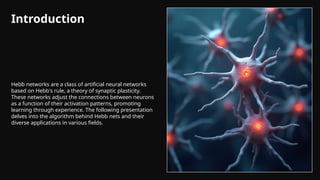
Hebb networks area class of artificial neural networks
based on Hebb's rule, a theory of synaptic plasticity.
These networks adjust the connections between neurons
as a function of their activation patterns, promoting
learning through experience. The following presentation
delves into the algorithm behind Hebb nets and their
diverse applications in various fields.
3.
Hebb Net Algorithm
TheHebb net algorithm is based on the
principle that synaptic connections between
neurons strengthen when they activate
simultaneously, enabling learning through
the enhancement of these connections. This
mechanism allows the network to adapt by
reinforcing patterns of correlated activity.
01
4.
Overview of Hebb'sRule
Hebb's rule posits that synaptic strength increases when a neuron persistently
activates another neuron. This principle facilitates the development of associative
learning in networks, allowing them to form patterns from input data, thereby
mimicking human learning behavior.
5.
Mechanism of Learning
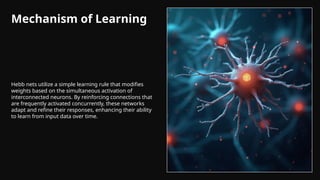
Hebbnets utilize a simple learning rule that modifies
weights based on the simultaneous activation of
interconnected neurons. By reinforcing connections that
are frequently activated concurrently, these networks
adapt and refine their responses, enhancing their ability
to learn from input data over time.
6.
Strengthening Connections
Hebb networkscontinuously adjust synaptic weights based on the correlation of
neuron activations. This reinforcement strengthens the connections between neurons
that are activated together, therefore adapting the network to better recognize
patterns. The result is enhanced learning capabilities as the network optimizes itself
for specific tasks or types of data.
Pattern Recognition
Hebb netsexcel in pattern recognition tasks, such as image and speech recognition.
They can effectively learn to identify and classify input patterns based on experience,
making them valuable in various applications, including computer vision and natural
language processing.
9.
Neural Network Models
Hebbnetworks serve as foundational models for more complex neural networks. Their
principles are used to develop models that simulate human cognitive processes,
inform machine learning techniques, and improve the understanding of neural
dynamics in biological systems.
10.
Adaptive Control
Systems
Hebb netsare utilized in adaptive control systems, where
they adjust their behavior based on changing
environments. Their ability to learn from experience
allows engineers to design more responsive systems in
robotics and automation, leading to improved
performance over time.
11.
Conclusions
Hebb nets arevital in understanding the basics of neural
learning. Their algorithm promotes collective neuron
activation, enabling powerful applications in pattern
recognition, neural models, and adaptive control systems.
As research advances, the insights garnered from Hebb
networks promise to foster future innovations in artificial
intelligence and machine learning.
12.
CREDITS: This presentation
templatewas created by
Slidesgo, and includes icons,
infographics & images by
Freepik
Thank you!
Do you have any questions?
+00 000 000 000









![SecurityBoat_Service_Pitch_Deck[24158].pdf](https://cdn.slidesharecdn.com/ss_thumbnails/securityboatservicepitchdeck24158-260121113056-452683e3-thumbnail.jpg?width=640&height=640&fit=bounds)


