Healthcare Analytics 101:
Proverbs to Prediction
Pamela Taylor
January 16, 2019
linkedin.com/in/pmtaylor
Contacted by Promotable
Promotable is a startup at 1871 that is helping to close the data
skills gap, by hosting experts from top companies for informal
talks about in-demand data driven topics that help everyone,
including "non-data people" cut through the hype and buzz
words to make better data driven decisions.
Today’s Plan
• What you’ll learn:
– The basics of the healthcare analytics space
– Managed care overview and what it means for you
– Highlights of use cases where the power of data is being utilized
to improve human health
• What you won’t learn:
– How to be a data scientist
– How to be a surgeon
– How to fix Obamacare or deal with Trump (no politics here!)
– Google’s unpublished plans to dominate healthcare in the future
“An apple a day keeps the doctor away.”
- Proverb, Coined 1857, 1913
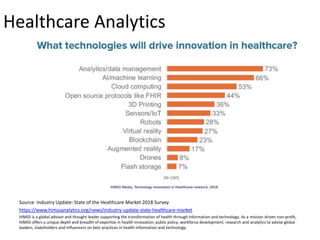
Healthcare Analytics
Source: Industry Update: State of the Healthcare Market 2018 Survey
https://www.himssanalytics.org/news/industry-update-state-healthcare-market
HIMSS is a global advisor and thought leader supporting the transformation of health through information and technology. As a mission driven non-profit,
HIMSS offers a unique depth and breadth of expertise in health innovation, public policy, workforce development, research and analytics to advise global
leaders, stakeholders and influencers on best practices in health information and technology.
Why is analytics so important?
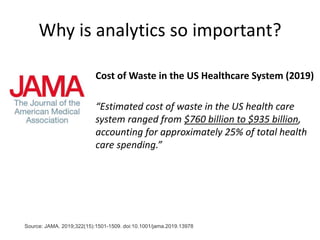
Cost of Waste in the US Healthcare System (2019)
“Estimated cost of waste in the US health care
system ranged from $760 billion to $935 billion,
accounting for approximately 25% of total health
care spending.”
Source: JAMA. 2019;322(15):1501-1509. doi:10.1001/jama.2019.13978
Managed Care + Analytics
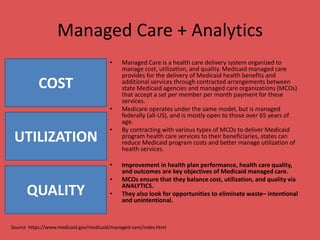
• Managed Care is a health care delivery system organized to
manage cost, utilization, and quality. Medicaid managed care
provides for the delivery of Medicaid health benefits and
additional services through contracted arrangements between
state Medicaid agencies and managed care organizations (MCOs)
that accept a set per member per month payment for these
services.
• Medicare operates under the same model, but is managed
federally (all-US), and is mostly open to those over 65 years of
age.
• By contracting with various types of MCOs to deliver Medicaid
program health care services to their beneficiaries, states can
reduce Medicaid program costs and better manage utilization of
health services.
• Improvement in health plan performance, health care quality,
and outcomes are key objectives of Medicaid managed care.
• MCOs ensure that they balance cost, utilization, and quality via
ANALYTICS.
• They also look for opportunities to eliminate waste– intentional
and unintentional.
Source https://www.medicaid.gov/medicaid/managed-care/index.html
COST
UTILIZATION
QUALITY
MCO Analytics Examples
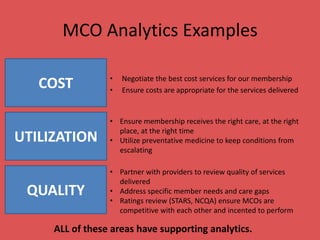
• Negotiate the best cost services for our membership
• Ensure costs are appropriate for the services delivered
COST
UTILIZATION
QUALITY
• Ensure membership receives the right care, at the right
place, at the right time
• Utilize preventative medicine to keep conditions from
escalating
• Partner with providers to review quality of services
delivered
• Address specific member needs and care gaps
• Ratings review (STARS, NCQA) ensure MCOs are
competitive with each other and incented to perform
ALL of these areas have supporting analytics.
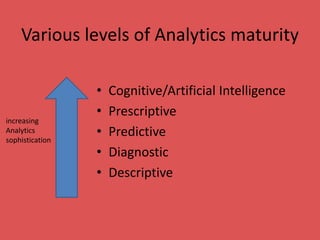
Various levels of Analytics maturity
• Cognitive/Artificial Intelligence
• Prescriptive
• Predictive
• Diagnostic
• Descriptive
increasing
Analytics
sophistication
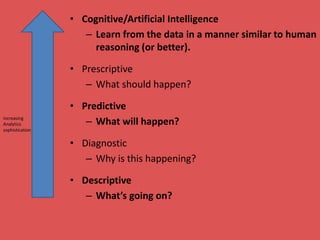
• Cognitive/Artificial Intelligence
– Learn from the data in a manner similar to human
reasoning (or better).
• Prescriptive
– What should happen?
• Predictive
– What will happen?
• Diagnostic
– Why is this happening?
• Descriptive
– What’s going on?
increasing
Analytics
sophistication
Descriptive
• Describe what’s going on in market, hospital,
subpopulation
– County performance
– Hospital/provider differences
• Illustrate key performance metrics, aligned with
strategic plan (like any business, even non-
profit)
– Cost of service
– Utilization of service
• Highlight treatments, outcomes, areas for
opportunity
– Admissions
– Length of Stay
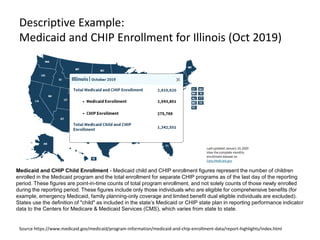
Descriptive Example:
Medicaid and CHIP Enrollment for Illinois (Oct 2019)
Source https://www.medicaid.gov/medicaid/program-information/medicaid-and-chip-enrollment-data/report-highlights/index.html
Medicaid and CHIP Child Enrollment - Medicaid child and CHIP enrollment figures represent the number of children
enrolled in the Medicaid program and the total enrollment for separate CHIP programs as of the last day of the reporting
period. These figures are point-in-time counts of total program enrollment, and not solely counts of those newly enrolled
during the reporting period. These figures include only those individuals who are eligible for comprehensive benefits (for
example, emergency Medicaid, family planning-only coverage and limited benefit dual eligible individuals are excluded).
States use the definition of "child" as included in the state’s Medicaid or CHIP state plan in reporting performance indicator
data to the Centers for Medicare & Medicaid Services (CMS), which varies from state to state.
Predictive
• How can I predict what will happen next? How
can we improve outcomes?
• How can we best manage care for those we
serve? Who needs care the most? Who’s
willing to accept care and/or change
behavior?
Predictive Example: Johns Hopkins ACG System
for Population Health Management (software)
The Johns Hopkins (Adjusted Clinical Group) ACG®
System is a statistically valid, case-mix methodology
that allows healthcare providers, healthcare
organizations, and public-sector agencies to describe or
predict a population’s past or future healthcare
utilization and costs.
Based on: duration, severity, diagnostic certainty, type
of etiology (cause), and expected need for specialty
care.
Source https://www.hopkinsacg.org/
Cognitive- Artificial Intelligence
• Not exactly…
What is AI?
Computer’s ability to mimic human
behavior (or better!)
Source “The Key Definitions Of Artificial Intelligence (AI) That Explain Its Importance,” Forbes Feb 2018.
https://www.forbes.com/sites/bernardmarr/2018/02/14/the-key-definitions-of-artificial-intelligence-ai-that-explain-its-
importance/#529ad9ae4f5d
• Amazon builds a lot of its business on machine-learning systems (as a subset of AI)
and defines AI as “the field of computer science dedicated to solving cognitive
problems commonly associated with human intelligence, such as learning, problem
solving, and pattern recognition.”
• Machine and deep learning are the priority for Google AI and its tools to “create
smarter, more useful technology and help as many people as possible” from
translations to healthcare to making our smartphones even smarter.
• IBM’s three areas of focus include AI Engineering, building scalable AI models and
tools; AI Tech where the core capabilities of AI such as natural language processing,
speech and image recognition and reasoning are explored and AI Science, where
expanding the frontiers of AI is the focus.
AI Example: Google AI application for breast
cancer detection (image recognition)
Source: https://www.nature.com/articles/s41586-019-1799-6
McKinney, S.M., Sieniek, M., Godbole, V. et al. International evaluation of an AI system for breast cancer screening. Nature 577,
89–94 (2020) doi:10.1038/s41586-019-1799-6
Wrapping it up
• Lots of info and opportunities exist in
healthcare analytics
• Managed care is one model utilizing
analytics to benefit the lives of members–
including those on Medicaid and Medicare
• There’s room for improvement via all levels
of Analytics– Descriptive through Cognitive
• No need to rely solely on proverbs
(anymore)

Healthcare analytics 101 - Proverbs to Prediction

  • 1.
    Healthcare Analytics 101: Proverbsto Prediction Pamela Taylor January 16, 2019 linkedin.com/in/pmtaylor
  • 2.
    Contacted by Promotable Promotableis a startup at 1871 that is helping to close the data skills gap, by hosting experts from top companies for informal talks about in-demand data driven topics that help everyone, including "non-data people" cut through the hype and buzz words to make better data driven decisions.
  • 3.
    Today’s Plan • Whatyou’ll learn: – The basics of the healthcare analytics space – Managed care overview and what it means for you – Highlights of use cases where the power of data is being utilized to improve human health • What you won’t learn: – How to be a data scientist – How to be a surgeon – How to fix Obamacare or deal with Trump (no politics here!) – Google’s unpublished plans to dominate healthcare in the future
  • 4.
    “An apple aday keeps the doctor away.” - Proverb, Coined 1857, 1913
  • 5.
    Healthcare Analytics Source: IndustryUpdate: State of the Healthcare Market 2018 Survey https://www.himssanalytics.org/news/industry-update-state-healthcare-market HIMSS is a global advisor and thought leader supporting the transformation of health through information and technology. As a mission driven non-profit, HIMSS offers a unique depth and breadth of expertise in health innovation, public policy, workforce development, research and analytics to advise global leaders, stakeholders and influencers on best practices in health information and technology.
  • 6.
    Why is analyticsso important? Cost of Waste in the US Healthcare System (2019) “Estimated cost of waste in the US health care system ranged from $760 billion to $935 billion, accounting for approximately 25% of total health care spending.” Source: JAMA. 2019;322(15):1501-1509. doi:10.1001/jama.2019.13978
  • 7.
    Managed Care +Analytics • Managed Care is a health care delivery system organized to manage cost, utilization, and quality. Medicaid managed care provides for the delivery of Medicaid health benefits and additional services through contracted arrangements between state Medicaid agencies and managed care organizations (MCOs) that accept a set per member per month payment for these services. • Medicare operates under the same model, but is managed federally (all-US), and is mostly open to those over 65 years of age. • By contracting with various types of MCOs to deliver Medicaid program health care services to their beneficiaries, states can reduce Medicaid program costs and better manage utilization of health services. • Improvement in health plan performance, health care quality, and outcomes are key objectives of Medicaid managed care. • MCOs ensure that they balance cost, utilization, and quality via ANALYTICS. • They also look for opportunities to eliminate waste– intentional and unintentional. Source https://www.medicaid.gov/medicaid/managed-care/index.html COST UTILIZATION QUALITY
  • 8.
    MCO Analytics Examples •Negotiate the best cost services for our membership • Ensure costs are appropriate for the services delivered COST UTILIZATION QUALITY • Ensure membership receives the right care, at the right place, at the right time • Utilize preventative medicine to keep conditions from escalating • Partner with providers to review quality of services delivered • Address specific member needs and care gaps • Ratings review (STARS, NCQA) ensure MCOs are competitive with each other and incented to perform ALL of these areas have supporting analytics.
  • 9.
    Various levels ofAnalytics maturity • Cognitive/Artificial Intelligence • Prescriptive • Predictive • Diagnostic • Descriptive increasing Analytics sophistication
  • 10.
    • Cognitive/Artificial Intelligence –Learn from the data in a manner similar to human reasoning (or better). • Prescriptive – What should happen? • Predictive – What will happen? • Diagnostic – Why is this happening? • Descriptive – What’s going on? increasing Analytics sophistication
  • 11.
    Descriptive • Describe what’sgoing on in market, hospital, subpopulation – County performance – Hospital/provider differences • Illustrate key performance metrics, aligned with strategic plan (like any business, even non- profit) – Cost of service – Utilization of service • Highlight treatments, outcomes, areas for opportunity – Admissions – Length of Stay
  • 12.
    Descriptive Example: Medicaid andCHIP Enrollment for Illinois (Oct 2019) Source https://www.medicaid.gov/medicaid/program-information/medicaid-and-chip-enrollment-data/report-highlights/index.html Medicaid and CHIP Child Enrollment - Medicaid child and CHIP enrollment figures represent the number of children enrolled in the Medicaid program and the total enrollment for separate CHIP programs as of the last day of the reporting period. These figures are point-in-time counts of total program enrollment, and not solely counts of those newly enrolled during the reporting period. These figures include only those individuals who are eligible for comprehensive benefits (for example, emergency Medicaid, family planning-only coverage and limited benefit dual eligible individuals are excluded). States use the definition of "child" as included in the state’s Medicaid or CHIP state plan in reporting performance indicator data to the Centers for Medicare & Medicaid Services (CMS), which varies from state to state.
  • 13.
    Predictive • How canI predict what will happen next? How can we improve outcomes? • How can we best manage care for those we serve? Who needs care the most? Who’s willing to accept care and/or change behavior?
  • 14.
    Predictive Example: JohnsHopkins ACG System for Population Health Management (software) The Johns Hopkins (Adjusted Clinical Group) ACG® System is a statistically valid, case-mix methodology that allows healthcare providers, healthcare organizations, and public-sector agencies to describe or predict a population’s past or future healthcare utilization and costs. Based on: duration, severity, diagnostic certainty, type of etiology (cause), and expected need for specialty care. Source https://www.hopkinsacg.org/
  • 15.
  • 16.
    What is AI? Computer’sability to mimic human behavior (or better!) Source “The Key Definitions Of Artificial Intelligence (AI) That Explain Its Importance,” Forbes Feb 2018. https://www.forbes.com/sites/bernardmarr/2018/02/14/the-key-definitions-of-artificial-intelligence-ai-that-explain-its- importance/#529ad9ae4f5d • Amazon builds a lot of its business on machine-learning systems (as a subset of AI) and defines AI as “the field of computer science dedicated to solving cognitive problems commonly associated with human intelligence, such as learning, problem solving, and pattern recognition.” • Machine and deep learning are the priority for Google AI and its tools to “create smarter, more useful technology and help as many people as possible” from translations to healthcare to making our smartphones even smarter. • IBM’s three areas of focus include AI Engineering, building scalable AI models and tools; AI Tech where the core capabilities of AI such as natural language processing, speech and image recognition and reasoning are explored and AI Science, where expanding the frontiers of AI is the focus.
  • 17.
    AI Example: GoogleAI application for breast cancer detection (image recognition) Source: https://www.nature.com/articles/s41586-019-1799-6 McKinney, S.M., Sieniek, M., Godbole, V. et al. International evaluation of an AI system for breast cancer screening. Nature 577, 89–94 (2020) doi:10.1038/s41586-019-1799-6
  • 18.
    Wrapping it up •Lots of info and opportunities exist in healthcare analytics • Managed care is one model utilizing analytics to benefit the lives of members– including those on Medicaid and Medicare • There’s room for improvement via all levels of Analytics– Descriptive through Cognitive • No need to rely solely on proverbs (anymore)