Health-Care Chat Bot
ABSTRACT:
With the increasing population of India and a rise in birth rates coupled with advancements in the medical field leading to
a decrease in death rates, there is a concerning shortage of doctors to adequately serve the growing population. This issue
becomes apparent when visiting government hospitals in cities, where the limited availability of doctors is a major cause
of inadequate treatment and, in some cases, even resulting in patient deaths. Furthermore, doctors, being human, are prone
to making mistakes in providing accurate treatments, which can also lead to patient fatalities. To address such situations,
the development of an intelligent and smart chatbot that can offer advice to both doctors and patients becomes crucial,
potentially saving the lives of hundreds of people. Virtual assistants, including chatbots, have the potential to assist
patients and healthcare providers with various medical-related tasks. Chatbots are computer programs designed to engage
in conversations with individuals, offering assistance through text messages, applications, or instant messaging. These bots
can identify symptoms and provide diagnoses based on specific symptoms, as well as recommend appropriate doctors for
prompt responses. While chatbots are already extensively employed in other industries such as retail to enhance processes,
their integration into healthcare services can prove invaluable.
Keywords: Intelligent chatbot, Virtual assistants, medical-related tasks, Diagnosis, health service.
INTRODUCTION:
Nowadays, chatbots are becoming increasingly prevalent in various industries, such as IRCTC, banks, and online travel
companies like Make My Trip. With the ongoing trend of digitalization, the demand for chatbots in the market continues
to grow. One of the main reasons behind the need for medical chatbots in the healthcare industry is the rising population in
India and the scarcity of doctors to cater to the needs of this growing population. Additionally, even doctors can make
mistakes when diagnosing patients, potentially endangering their lives. For instance, Mohammed Benaziza, a renowned
bodybuilder in the 1990s, tragically died due to Hypokalaemia (high potassium level) in his body. He experienced body
cramps as a result of this excess potassium, but doctors mistakenly concluded that he was potassium deficient and
administered additional potassium, leading to the cramps spreading to his heart and causing his death. There have been
other cases where doctors have made errors as well. To prevent such scenarios, medical chatbots are essential as they can
provide guidance to doctors in critical cases. Their application is not limited to doctors alone; they can also be used by the
general public in emergencies, where they can provide guidance on initial treatments. Furthermore, if an individual is
suffering from a particular disease, the chatbot can assess the type of disease by asking a few questions. Additionally, it
can provide information on precautions and remedies that should be taken.
S. No
Journal Type with
year
Authors Title Outcomes
1 1999
Mohammad Ausaf
Anwar, Durga prasad
Gangodkar
E-Health is defined in as the
practice of health-care
The term was apparently first used by
industry leaders and marketing people rather
than academics.
2 2016 Jun Lio
Emerging technologies are
revolutionizing the way of thinking
about healthcare.
The knowledge of Nurses as innovators will
further the impending need of ETs to serve
the Quadruple Aim.
3 2016
Yannick Perez and
Dominique Genoud.
health devices, and personalized and
proximity medicine
it maintains quality control and manages
sensitive items while they’re in transit it can
even lower costs by streamlining the overall
process.
4 2017 James L. Robertson Safety and healthcare devices
A developing number of hospitals, nursing
homes, and even private centres, presently
utilize online Chatbots for human services on
their sites.
LITERATURAL SURVEY
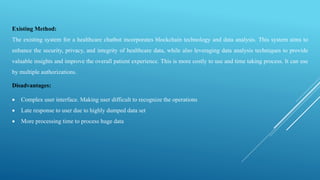
Existing Method:
The existing system for a healthcare chatbot incorporates blockchain technology and data analysis. This system aims to
enhance the security, privacy, and integrity of healthcare data, while also leveraging data analysis techniques to provide
valuable insights and improve the overall patient experience. This is more costly to use and time taking process. It can use
by multiple authorizations.
Disadvantages:
 Complex user interface. Making user difficult to recognize the operations
 Late response to user due to highly dumped data set
 More processing time to process huge data
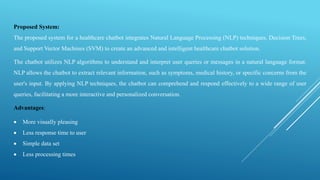
Proposed System:
The proposed system for a healthcare chatbot integrates Natural Language Processing (NLP) techniques, Decision Trees,
and Support Vector Machines (SVM) to create an advanced and intelligent healthcare chatbot solution.
The chatbot utilizes NLP algorithms to understand and interpret user queries or messages in a natural language format.
NLP allows the chatbot to extract relevant information, such as symptoms, medical history, or specific concerns from the
user's input. By applying NLP techniques, the chatbot can comprehend and respond effectively to a wide range of user
queries, facilitating a more interactive and personalized conversation.
Advantages:
 More visually pleasing
 Less response time to user
 Simple data set
 Less processing times
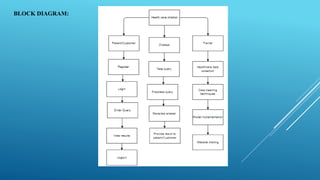
BLOCK DIAGRAM:
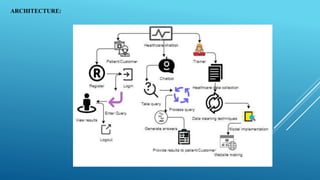
ARCHITECTURE:
SOFTWARE AND HARDWARE REQUIREMENTS:
HARDWARE CONFIGURATION:
 Processor - I3/Intel Processor
 RAM - 4GB (min)
 Hard Disk - 128 GB
SOFTWARE CONFIGURATION:
 Operating System : Windows 7+
 Server-side Script : Python 3.6+
 IDE : PyCharm
 Libraries Used : Pandas, NumPy, Sklearn, gensim, re.
 Framework : Flask
MODULES:
1. System
1.1 Take Data:
System will receive data from the user.
1.2 Pre-processing:
The system will undergo for pre-processing.
1.3 Training:
The System will get trained.
1.4 Model:
The system will work based on model.
1.5 Results:
The system will deliver the output to the user.
2. User
Testing
2.1 Send Query:
User will send Query to the system.
2.2 View Query Result:
User will view his query result.
ALGORITHMS:
NATURAL LANGUAGE PROCESSING:
Natural language processing (NLP) is a subfield of linguistics, computer science, and artificial intelligence concerned
with the interactions between computers and human language, in particular how to program computers to process and
analyse large amounts of natural language data. The result is a computer capable of "understanding" the contents of
documents, including the contextual nuances of the language within them. The technology can then accurately extract
information and insights contained in the documents as well as categorize and organize the documents themselves.
A chatbot is an NLP software that can simulate a conversation (or a chat) with a user in natural language through
messaging applications, websites, mobile apps or through the telephone.
Why are chatbots important? A chatbot is often described as one of the most advanced and promising expressions of
interaction between humans and machines. However, from a technological point of view, a chatbot only represents the
natural evolution of a Question Answering system leveraging Natural Language Processing (NLP). Formulating
responses to questions in natural language is one of the most typical Examples of Natural Language Processing applied
in various enterprises’ end-use applications.
UML DIAGRAMS
UML stands for Unified Modelling Language. UML is a standardized general-purpose modelling language in the field of
object-oriented software engineering. The standard is managed, and was created by, the Object Management Group.
The goal is for UML to become a common language for creating models of object-oriented computer software. In its
current form UML is comprised of two major components: a Meta-model and a notation. In the future, some form of method
or process may also be added to; or associated with, UML.
The Unified Modelling Language is a standard language for specifying, Visualization, Constructing and documenting the
artefacts of software system, as well as for business modelling and other non-software systems.
The UML represents a collection of best engineering practices that have proven successful in the modelling of large and
complex systems.
The UML is a very important part of developing objects-oriented software and the software development process. The
UML uses mostly graphical notations to express the design of software projects.
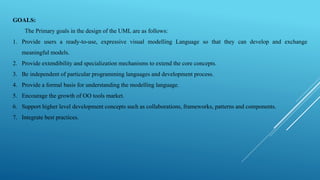
GOALS:
The Primary goals in the design of the UML are as follows:
1. Provide users a ready-to-use, expressive visual modelling Language so that they can develop and exchange
meaningful models.
2. Provide extendibility and specialization mechanisms to extend the core concepts.
3. Be independent of particular programming languages and development process.
4. Provide a formal basis for understanding the modelling language.
5. Encourage the growth of OO tools market.
6. Support higher level development concepts such as collaborations, frameworks, patterns and components.
7. Integrate best practices.
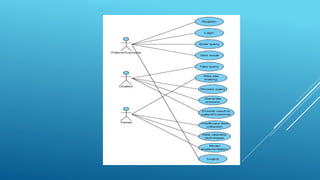
USE CASE DIAGRAM
 A use case diagram in the Unified Modeling Language (UML) is a type of behavioral diagram defined by and created
from a Use-case analysis.
 Its purpose is to present a graphical overview of the functionality provided by a system in terms of actors, their goals
(represented as use cases), and any dependencies between those use cases.
 The main purpose of a use case diagram is to show what system functions are performed for which actor. Roles of the
actors in the system can be depicted.
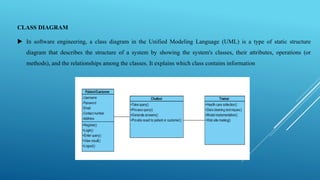
CLASS DIAGRAM
 In software engineering, a class diagram in the Unified Modeling Language (UML) is a type of static structure
diagram that describes the structure of a system by showing the system's classes, their attributes, operations (or
methods), and the relationships among the classes. It explains which class contains information
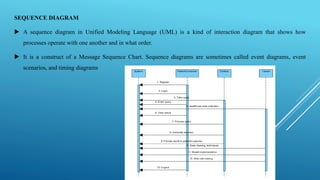
SEQUENCE DIAGRAM
 A sequence diagram in Unified Modeling Language (UML) is a kind of interaction diagram that shows how
processes operate with one another and in what order.
 It is a construct of a Message Sequence Chart. Sequence diagrams are sometimes called event diagrams, event
scenarios, and timing diagrams
COLLABORATION DIAGRAM:
 In collaboration diagram the method call sequence is indicated by some numbering technique as shown below. The
number indicates how the methods are called one after another. We have taken the same order management system to
describe the collaboration diagram. The method calls are similar to that of a sequence diagram. But the difference is that
the sequence diagram does not describe the object organization whereas the collaboration diagram shows the object
organization.
DEPLOYMENT DIAGRAM
 Deployment diagram represents the deployment view of a system. It is related to the component diagram. Because the
components are deployed using the deployment diagrams. A deployment diagram consists of nodes. Nodes are
nothing but physical hardware’s used to deploy the application.
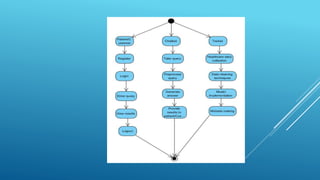
ACTIVITY DIAGRAM:
 Activity diagrams are graphical representations of workflows of stepwise activities and actions with support for
choice, iteration and concurrency. In the Unified Modelling Language, activity diagrams can be used to describe the
business and operational step-by-step workflows of components in a system. An activity diagram shows the overall
flow of control.
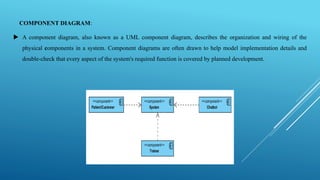
COMPONENT DIAGRAM:
 A component diagram, also known as a UML component diagram, describes the organization and wiring of the
physical components in a system. Component diagrams are often drawn to help model implementation details and
double-check that every aspect of the system's required function is covered by planned development.
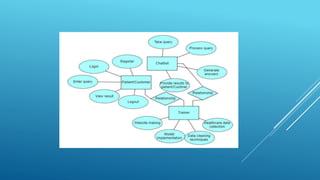
ER DIAGRAM:
 An Entity–relationship model (ER model) describes the structure of a database with the help of a diagram, which is
known as Entity Relationship Diagram (ER Diagram). An ER model is a design or blueprint of a database that can
later be implemented as a database. The main components of E-R model are: entity set and relationship set.
 An ER diagram shows the relationship among entity sets. An entity set is a group of similar entities and these entities
can have attributes. In terms of DBMS, an entity is a table or attribute of a table in database, so by showing
relationship among tables and their attributes, ER diagram shows the complete logical structure of a database. Let’s
have a look at a simple ER diagram to understand this concept.
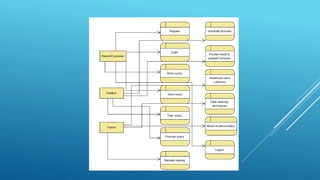
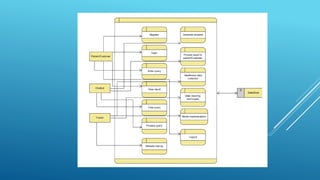
DFD Diagram:
A Data Flow Diagram (DFD) is a traditional way to visualize the information flows within a system. A neat and clear
DFD can depict a good amount of the system requirements graphically. It can be manual, automated, or a
combination of both. It shows how information enters and leaves the system, what changes the information and
where information is stored. The purpose of a DFD is to show the scope and boundaries of a system as a whole. It
may be used as a communications tool between a systems analyst and any person who plays a part in the system that
acts as the starting point for redesigning a system.
CONCLUSION:
Chatbots are an emerging technology that holds immense potential for the future. With their growing popularity among
companies, they are expected to have a lasting impact. It is truly exciting to witness the development of this new domain in
technology, as it surpasses previous limitations. We are developing this system in response to the increasing population of
our country. Although such systems are already available in other countries, they are not yet widely accessible in our own.
The shortage of doctors to meet the needs of patients is a well-known issue, particularly evident in the government
hospitals throughout the city. By introducing a medical chatbot, we aim to provide medical assistance to patients when
doctors are unavailable, ultimately enhancing the efficiency and performance of the medical industry and reducing the
mortality rate.
REFERENCES:
[1] A. Allen, ‘‘Morphing telemedicine-telecare-telehealth-e health,’’ Telemed Today, Special, no. 2000, 2000.
[2] S. L. Murphy, J. Xu, K. D. Kochanek, and E. Arias, ‘‘Mortality in the United States, 2017,’’ NCHS Data Brief, no.
328, pp. 1–8, Nov. 2018.
[3] K. Myers, P. Berry, J. Blythe, K. Conley, M. Gervasio, D. L. McGuinness, D. Morley, A. Pfeffer, M. Pollack, and M.
Tambe, ‘‘An intelligent personal assistant for task and time management,’’ AI Mag., vol. 28, no. 2, p. 47, 2007.
[4] Flora Amato, Stefano Marrone, “Chatbots meet eHealth: automat zing healthcare”, proceeding of diet, May-2018.
[5] Benilda Eleonor V. Comendador, “Pharmabot: A pediatric generic Medicine consultant Chatbot”, proceeding of the
JACE, April 2015.
[6] Divya, Indumathi, Ishwarya, Priyasankari, “A Self Diagnosis Medical Chatbot Using Artificial Intelligence”,
proceeding MAT Journal, October-2017.
[7] Tobias Kowatsch,” Text-based Healthcare Chatbots Supporting Patient and Health”, 01 October 2017.
[8] Chin-Yuan Huang, Ming-Chin Yang, Chin-Yu Huang, “A Chatbot-supported Smart Wireless Interactive Healthcare
System for Weight Control and Health Promotion”, proceeding of the IEEE, April-2018.
[9] Bouk richa, H., Wachsmuth, I.: Modeling Empathy for a Virtual Human: How, When and to What Extent. The 10th
International Conference on Autonomous Agents and Multiagent Systems-Volume 3. International Foundation for
Autonomous Agents and Multiagent Systems, 2011., pp. 1135–1136
[10] Agarwal, R., Gao, G., DesRoches, C., et al.: The Digital Transformation of Healthcare: Current Status and the Road
Ahead. Information Systems Research 21, 796-809 (2010).
[11] Aron, A., Aron, E.N., Smollan, D.: Inclusion of Other in the Self Scale and the structure of interpersonal closeness.
Journal of Personality and Social Psychology 63, 596-612 (1992).
[12] Bick more, T., Cassell, J.: Social Dialogue with Embodied Conversational Agents. In: Kuppevelt, J.C.J., Bernsen,
N.O., (eds.) Advances in Natural Multimodal Dialogue Systems, vol. 30, pp. 23–54. Springer, Dordrecht (2005).

health care chatbot using data science with python

  • 1.
  • 2.
    ABSTRACT: With the increasingpopulation of India and a rise in birth rates coupled with advancements in the medical field leading to a decrease in death rates, there is a concerning shortage of doctors to adequately serve the growing population. This issue becomes apparent when visiting government hospitals in cities, where the limited availability of doctors is a major cause of inadequate treatment and, in some cases, even resulting in patient deaths. Furthermore, doctors, being human, are prone to making mistakes in providing accurate treatments, which can also lead to patient fatalities. To address such situations, the development of an intelligent and smart chatbot that can offer advice to both doctors and patients becomes crucial, potentially saving the lives of hundreds of people. Virtual assistants, including chatbots, have the potential to assist patients and healthcare providers with various medical-related tasks. Chatbots are computer programs designed to engage in conversations with individuals, offering assistance through text messages, applications, or instant messaging. These bots can identify symptoms and provide diagnoses based on specific symptoms, as well as recommend appropriate doctors for prompt responses. While chatbots are already extensively employed in other industries such as retail to enhance processes, their integration into healthcare services can prove invaluable. Keywords: Intelligent chatbot, Virtual assistants, medical-related tasks, Diagnosis, health service.
  • 3.
    INTRODUCTION: Nowadays, chatbots arebecoming increasingly prevalent in various industries, such as IRCTC, banks, and online travel companies like Make My Trip. With the ongoing trend of digitalization, the demand for chatbots in the market continues to grow. One of the main reasons behind the need for medical chatbots in the healthcare industry is the rising population in India and the scarcity of doctors to cater to the needs of this growing population. Additionally, even doctors can make mistakes when diagnosing patients, potentially endangering their lives. For instance, Mohammed Benaziza, a renowned bodybuilder in the 1990s, tragically died due to Hypokalaemia (high potassium level) in his body. He experienced body cramps as a result of this excess potassium, but doctors mistakenly concluded that he was potassium deficient and administered additional potassium, leading to the cramps spreading to his heart and causing his death. There have been other cases where doctors have made errors as well. To prevent such scenarios, medical chatbots are essential as they can provide guidance to doctors in critical cases. Their application is not limited to doctors alone; they can also be used by the general public in emergencies, where they can provide guidance on initial treatments. Furthermore, if an individual is suffering from a particular disease, the chatbot can assess the type of disease by asking a few questions. Additionally, it can provide information on precautions and remedies that should be taken.
  • 4.
    S. No Journal Typewith year Authors Title Outcomes 1 1999 Mohammad Ausaf Anwar, Durga prasad Gangodkar E-Health is defined in as the practice of health-care The term was apparently first used by industry leaders and marketing people rather than academics. 2 2016 Jun Lio Emerging technologies are revolutionizing the way of thinking about healthcare. The knowledge of Nurses as innovators will further the impending need of ETs to serve the Quadruple Aim. 3 2016 Yannick Perez and Dominique Genoud. health devices, and personalized and proximity medicine it maintains quality control and manages sensitive items while they’re in transit it can even lower costs by streamlining the overall process. 4 2017 James L. Robertson Safety and healthcare devices A developing number of hospitals, nursing homes, and even private centres, presently utilize online Chatbots for human services on their sites. LITERATURAL SURVEY
  • 5.
    Existing Method: The existingsystem for a healthcare chatbot incorporates blockchain technology and data analysis. This system aims to enhance the security, privacy, and integrity of healthcare data, while also leveraging data analysis techniques to provide valuable insights and improve the overall patient experience. This is more costly to use and time taking process. It can use by multiple authorizations. Disadvantages:  Complex user interface. Making user difficult to recognize the operations  Late response to user due to highly dumped data set  More processing time to process huge data
  • 6.
    Proposed System: The proposedsystem for a healthcare chatbot integrates Natural Language Processing (NLP) techniques, Decision Trees, and Support Vector Machines (SVM) to create an advanced and intelligent healthcare chatbot solution. The chatbot utilizes NLP algorithms to understand and interpret user queries or messages in a natural language format. NLP allows the chatbot to extract relevant information, such as symptoms, medical history, or specific concerns from the user's input. By applying NLP techniques, the chatbot can comprehend and respond effectively to a wide range of user queries, facilitating a more interactive and personalized conversation. Advantages:  More visually pleasing  Less response time to user  Simple data set  Less processing times
  • 7.
  • 8.
  • 9.
    SOFTWARE AND HARDWAREREQUIREMENTS: HARDWARE CONFIGURATION:  Processor - I3/Intel Processor  RAM - 4GB (min)  Hard Disk - 128 GB SOFTWARE CONFIGURATION:  Operating System : Windows 7+  Server-side Script : Python 3.6+  IDE : PyCharm  Libraries Used : Pandas, NumPy, Sklearn, gensim, re.  Framework : Flask
  • 10.
    MODULES: 1. System 1.1 TakeData: System will receive data from the user. 1.2 Pre-processing: The system will undergo for pre-processing. 1.3 Training: The System will get trained.
  • 11.
    1.4 Model: The systemwill work based on model. 1.5 Results: The system will deliver the output to the user. 2. User Testing 2.1 Send Query: User will send Query to the system. 2.2 View Query Result: User will view his query result.
  • 12.
    ALGORITHMS: NATURAL LANGUAGE PROCESSING: Naturallanguage processing (NLP) is a subfield of linguistics, computer science, and artificial intelligence concerned with the interactions between computers and human language, in particular how to program computers to process and analyse large amounts of natural language data. The result is a computer capable of "understanding" the contents of documents, including the contextual nuances of the language within them. The technology can then accurately extract information and insights contained in the documents as well as categorize and organize the documents themselves. A chatbot is an NLP software that can simulate a conversation (or a chat) with a user in natural language through messaging applications, websites, mobile apps or through the telephone. Why are chatbots important? A chatbot is often described as one of the most advanced and promising expressions of interaction between humans and machines. However, from a technological point of view, a chatbot only represents the natural evolution of a Question Answering system leveraging Natural Language Processing (NLP). Formulating responses to questions in natural language is one of the most typical Examples of Natural Language Processing applied in various enterprises’ end-use applications.
  • 13.
    UML DIAGRAMS UML standsfor Unified Modelling Language. UML is a standardized general-purpose modelling language in the field of object-oriented software engineering. The standard is managed, and was created by, the Object Management Group. The goal is for UML to become a common language for creating models of object-oriented computer software. In its current form UML is comprised of two major components: a Meta-model and a notation. In the future, some form of method or process may also be added to; or associated with, UML. The Unified Modelling Language is a standard language for specifying, Visualization, Constructing and documenting the artefacts of software system, as well as for business modelling and other non-software systems. The UML represents a collection of best engineering practices that have proven successful in the modelling of large and complex systems. The UML is a very important part of developing objects-oriented software and the software development process. The UML uses mostly graphical notations to express the design of software projects.
  • 14.
    GOALS: The Primary goalsin the design of the UML are as follows: 1. Provide users a ready-to-use, expressive visual modelling Language so that they can develop and exchange meaningful models. 2. Provide extendibility and specialization mechanisms to extend the core concepts. 3. Be independent of particular programming languages and development process. 4. Provide a formal basis for understanding the modelling language. 5. Encourage the growth of OO tools market. 6. Support higher level development concepts such as collaborations, frameworks, patterns and components. 7. Integrate best practices.
  • 15.
    USE CASE DIAGRAM A use case diagram in the Unified Modeling Language (UML) is a type of behavioral diagram defined by and created from a Use-case analysis.  Its purpose is to present a graphical overview of the functionality provided by a system in terms of actors, their goals (represented as use cases), and any dependencies between those use cases.  The main purpose of a use case diagram is to show what system functions are performed for which actor. Roles of the actors in the system can be depicted.
  • 17.
    CLASS DIAGRAM  Insoftware engineering, a class diagram in the Unified Modeling Language (UML) is a type of static structure diagram that describes the structure of a system by showing the system's classes, their attributes, operations (or methods), and the relationships among the classes. It explains which class contains information
  • 18.
    SEQUENCE DIAGRAM  Asequence diagram in Unified Modeling Language (UML) is a kind of interaction diagram that shows how processes operate with one another and in what order.  It is a construct of a Message Sequence Chart. Sequence diagrams are sometimes called event diagrams, event scenarios, and timing diagrams
  • 19.
    COLLABORATION DIAGRAM:  Incollaboration diagram the method call sequence is indicated by some numbering technique as shown below. The number indicates how the methods are called one after another. We have taken the same order management system to describe the collaboration diagram. The method calls are similar to that of a sequence diagram. But the difference is that the sequence diagram does not describe the object organization whereas the collaboration diagram shows the object organization.
  • 20.
    DEPLOYMENT DIAGRAM  Deploymentdiagram represents the deployment view of a system. It is related to the component diagram. Because the components are deployed using the deployment diagrams. A deployment diagram consists of nodes. Nodes are nothing but physical hardware’s used to deploy the application.
  • 21.
    ACTIVITY DIAGRAM:  Activitydiagrams are graphical representations of workflows of stepwise activities and actions with support for choice, iteration and concurrency. In the Unified Modelling Language, activity diagrams can be used to describe the business and operational step-by-step workflows of components in a system. An activity diagram shows the overall flow of control.
  • 23.
    COMPONENT DIAGRAM:  Acomponent diagram, also known as a UML component diagram, describes the organization and wiring of the physical components in a system. Component diagrams are often drawn to help model implementation details and double-check that every aspect of the system's required function is covered by planned development.
  • 24.
    ER DIAGRAM:  AnEntity–relationship model (ER model) describes the structure of a database with the help of a diagram, which is known as Entity Relationship Diagram (ER Diagram). An ER model is a design or blueprint of a database that can later be implemented as a database. The main components of E-R model are: entity set and relationship set.  An ER diagram shows the relationship among entity sets. An entity set is a group of similar entities and these entities can have attributes. In terms of DBMS, an entity is a table or attribute of a table in database, so by showing relationship among tables and their attributes, ER diagram shows the complete logical structure of a database. Let’s have a look at a simple ER diagram to understand this concept.
  • 26.
    DFD Diagram: A DataFlow Diagram (DFD) is a traditional way to visualize the information flows within a system. A neat and clear DFD can depict a good amount of the system requirements graphically. It can be manual, automated, or a combination of both. It shows how information enters and leaves the system, what changes the information and where information is stored. The purpose of a DFD is to show the scope and boundaries of a system as a whole. It may be used as a communications tool between a systems analyst and any person who plays a part in the system that acts as the starting point for redesigning a system.
  • 29.
    CONCLUSION: Chatbots are anemerging technology that holds immense potential for the future. With their growing popularity among companies, they are expected to have a lasting impact. It is truly exciting to witness the development of this new domain in technology, as it surpasses previous limitations. We are developing this system in response to the increasing population of our country. Although such systems are already available in other countries, they are not yet widely accessible in our own. The shortage of doctors to meet the needs of patients is a well-known issue, particularly evident in the government hospitals throughout the city. By introducing a medical chatbot, we aim to provide medical assistance to patients when doctors are unavailable, ultimately enhancing the efficiency and performance of the medical industry and reducing the mortality rate.
  • 30.
    REFERENCES: [1] A. Allen,‘‘Morphing telemedicine-telecare-telehealth-e health,’’ Telemed Today, Special, no. 2000, 2000. [2] S. L. Murphy, J. Xu, K. D. Kochanek, and E. Arias, ‘‘Mortality in the United States, 2017,’’ NCHS Data Brief, no. 328, pp. 1–8, Nov. 2018. [3] K. Myers, P. Berry, J. Blythe, K. Conley, M. Gervasio, D. L. McGuinness, D. Morley, A. Pfeffer, M. Pollack, and M. Tambe, ‘‘An intelligent personal assistant for task and time management,’’ AI Mag., vol. 28, no. 2, p. 47, 2007. [4] Flora Amato, Stefano Marrone, “Chatbots meet eHealth: automat zing healthcare”, proceeding of diet, May-2018. [5] Benilda Eleonor V. Comendador, “Pharmabot: A pediatric generic Medicine consultant Chatbot”, proceeding of the JACE, April 2015. [6] Divya, Indumathi, Ishwarya, Priyasankari, “A Self Diagnosis Medical Chatbot Using Artificial Intelligence”, proceeding MAT Journal, October-2017.
  • 31.
    [7] Tobias Kowatsch,”Text-based Healthcare Chatbots Supporting Patient and Health”, 01 October 2017. [8] Chin-Yuan Huang, Ming-Chin Yang, Chin-Yu Huang, “A Chatbot-supported Smart Wireless Interactive Healthcare System for Weight Control and Health Promotion”, proceeding of the IEEE, April-2018. [9] Bouk richa, H., Wachsmuth, I.: Modeling Empathy for a Virtual Human: How, When and to What Extent. The 10th International Conference on Autonomous Agents and Multiagent Systems-Volume 3. International Foundation for Autonomous Agents and Multiagent Systems, 2011., pp. 1135–1136 [10] Agarwal, R., Gao, G., DesRoches, C., et al.: The Digital Transformation of Healthcare: Current Status and the Road Ahead. Information Systems Research 21, 796-809 (2010). [11] Aron, A., Aron, E.N., Smollan, D.: Inclusion of Other in the Self Scale and the structure of interpersonal closeness. Journal of Personality and Social Psychology 63, 596-612 (1992). [12] Bick more, T., Cassell, J.: Social Dialogue with Embodied Conversational Agents. In: Kuppevelt, J.C.J., Bernsen, N.O., (eds.) Advances in Natural Multimodal Dialogue Systems, vol. 30, pp. 23–54. Springer, Dordrecht (2005).