AI HEALTHCARE CHATBOT
ABHISHEK C B
KIRAN R
KIRAN T L
MAHAMAD BUDEN SAB K N
PRESENTED BY
Streamlining Healthcare with Artificial
Intelligence
GUIDE,
SANDEEP SIR
AGENDA
3 Abstract
4 Introduction
5 Problem statement
6 Litrature survey
7 architecture
8 How its works
9 Software requirments
10 Proposed and existing system
11 Nlp approach
12 Machine learning models
13 Challeneg and solution
Back to Agenda 03
ABSTRACT
A medical AI chatbot utilizes natural language processing (NLP) to diagnose diseases and provide essential information before consulting a
doctor. The chatbot employs human-computer interaction through natural language input, analyzing keywords to rank sentence similarity
using N-gram, TF-IDF, and cosine algorithms. Complex queries are redirected to expert systems for accurate and reliable answers.
Back to Agenda 03
Introduction
An AI-driven chatbot designed to assist patients by answering questions, checking symptoms, and providing healthcare information.
Objective: To improve access to healthcare services and thereby provide some guidance before the patients meet their
helath
healthcare provider
Key features :
 Symptom checking
 Basic medical advice
Scope of the study
This system is able to reduce the cost and time of health care for users, because it is not
possible to meet doctors or experts at that time when they are in need the most
Back to Agenda 04
PROBLEM STATEMENT & MOTIVATION
Back to Agenda 04
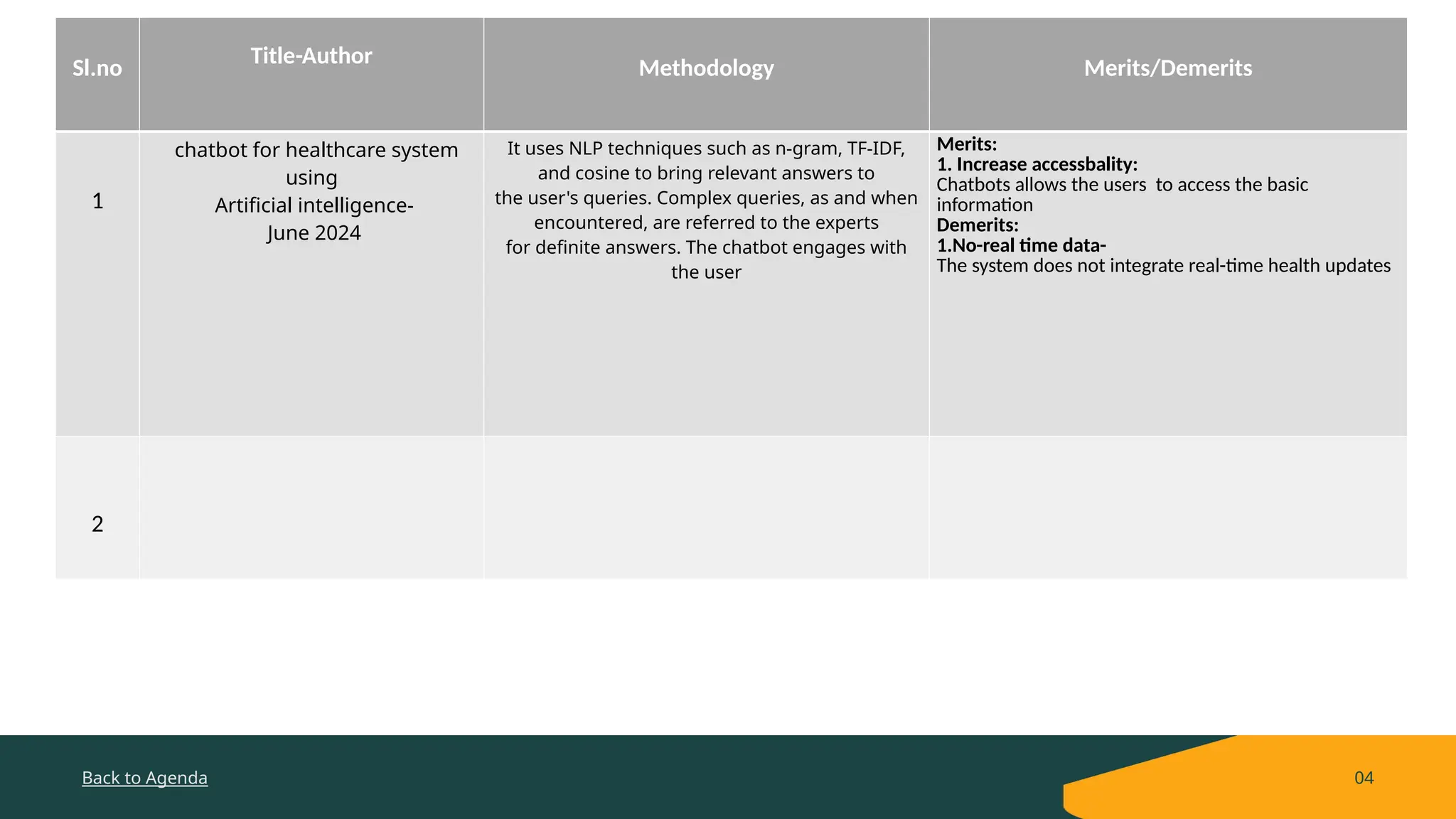
Sl.no
Title-Author
Methodology Merits/Demerits
1
chatbot for healthcare system
using
Artificial intelligence-
June 2024
It uses NLP techniques such as n-gram, TF-IDF,
and cosine to bring relevant answers to
the user's queries. Complex queries, as and when
encountered, are referred to the experts
for definite answers. The chatbot engages with
the user
Merits:
1. Increase accessbality:
Chatbots allows the users to access the basic
information
Demerits:
1.No-real time data-
The system does not integrate real-time health updates
2
ARCHITECTURE
Back to Agenda
HOW ITS WORKS:
05
 Interacting with the User: This involves a user asking a question or describing some symptoms: "I have got headache
and fever."
 Understanding the Question Asked: The chatbot makes use of NLP to determine keywords of the question asked.
 Providing Information Required: Depending upon symptoms described or question, provides generally health
information or may suggest an ailment.
 Giving Recommendations: The dialog system can give recommendations, for instance, a visit to the doctor would be
appropriate.
Back to Agenda
SOFTWARE REQUIRMENTS:
05
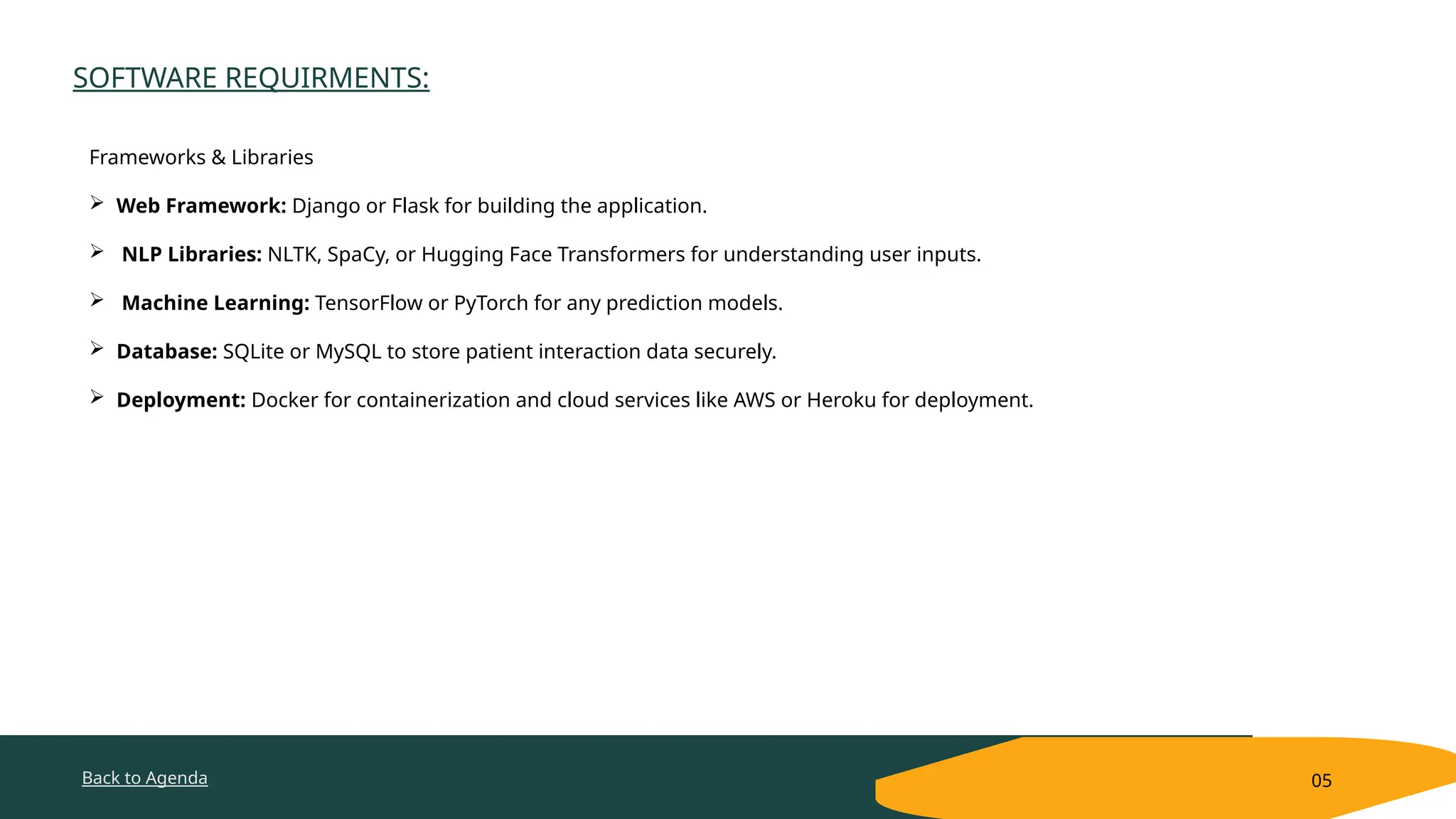
Frameworks & Libraries
 Web Framework: Django or Flask for building the application.
 NLP Libraries: NLTK, SpaCy, or Hugging Face Transformers for understanding user inputs.
 Machine Learning: TensorFlow or PyTorch for any prediction models.
 Database: SQLite or MySQL to store patient interaction data securely.
 Deployment: Docker for containerization and cloud services like AWS or Heroku for deployment.
Back to Agenda
PROPOSED & EXISTING SYTEM :
09
Existing system
 Availability of Information: Users rely on the doctors or online search which takes time and is too much to read.
 Not Available: Users in rural areas cannot get quick health advice.
 Overload of Health Care Professionals: The doctors receive many minor inquires, which increases the workload.
Proposed System (AI Health Chatbot)
 Accessibility Anytime: Provides instant health information and symptom checks anywhere, anytime.
 Rapid Analysis of Symptoms: Helps the user to understand the symptoms and what to do next.
 It reduces the workload of healthcare workers as it responds to general questions. The doctors can be concerned about major cases.
 More Relevant Advice: Since advice is targeted based on user input, therefore, it becomes more relevant.
Back to Agenda
Natural Language Processing (NLP) Approach
06
NLP: It processes the input received from the user and fetches out any medical keyword along with the intent.
NLP Tools Used:
Text Preprocessing: Use NLTK or SpaCy for cleaning and tokenizing the input text.
Intent Recognition: Use a pre-trained language model such as BERT or GPT to be able to recognize intent and respond accordingly.
Entity Recognition: Identifying entities related to health, like symptoms, medicines, and diseases.
Back to Agenda
MACHINE LEARNING AND MODELS
07
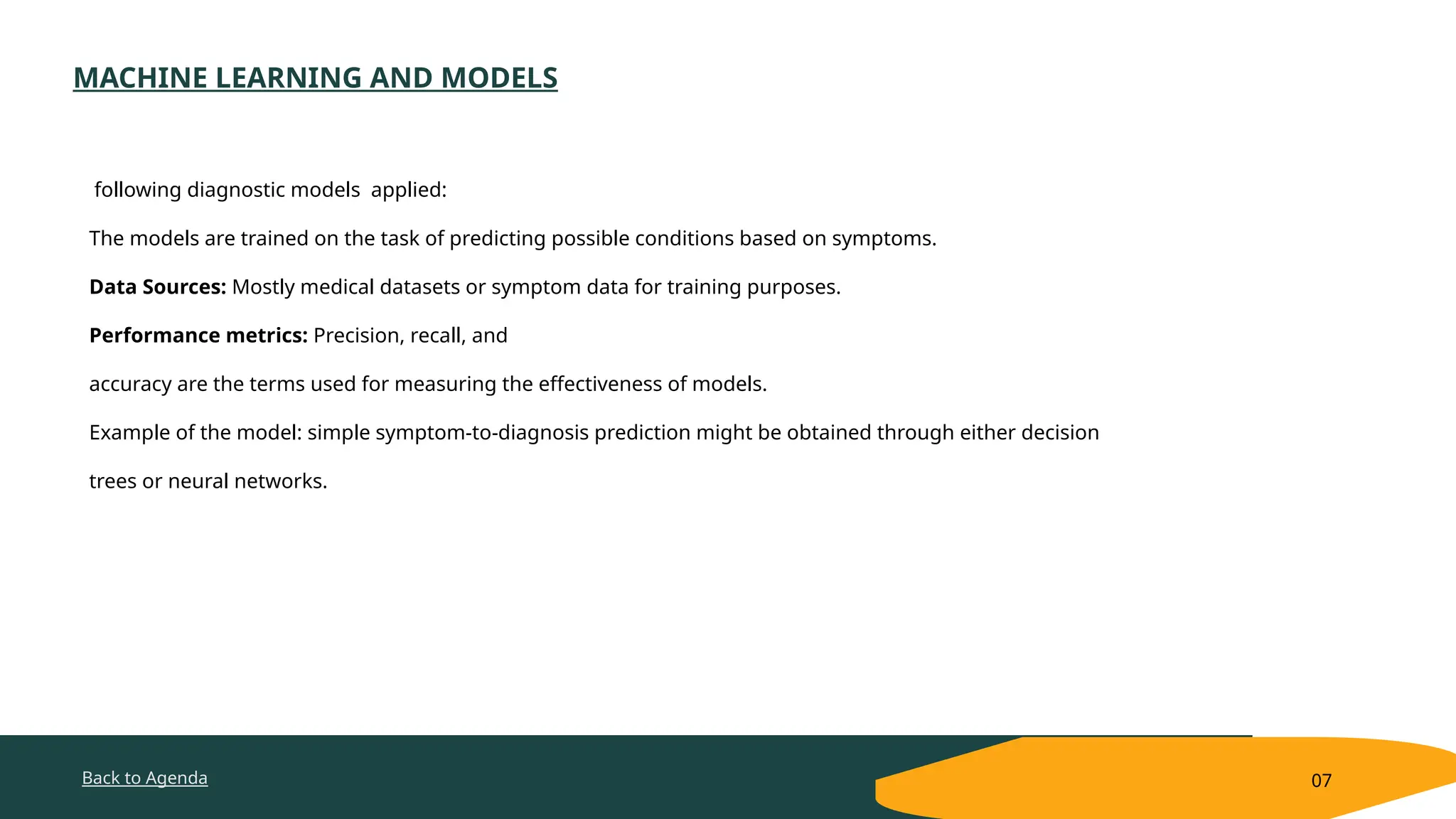
following diagnostic models applied:
The models are trained on the task of predicting possible conditions based on symptoms.
Data Sources: Mostly medical datasets or symptom data for training purposes.
Performance metrics: Precision, recall, and
accuracy are the terms used for measuring the effectiveness of models.
Example of the model: simple symptom-to-diagnosis prediction might be obtained through either decision
trees or neural networks.
Back to Agenda
USER INTRACTION AND EXPERIENCE
08
User Experience Goals: intuitional easy enough to not require medical knowledge.
Key features include: conversational interface; personalized responses; and simple navigation.
Visual Example: Screenshot of the chatbot interface, or description of interaction flow
User’s ask a Question
User can ask follow up questions
Back to Agenda
CHALLENGE & SOLUTION :
09
 Challenges:
 Privacy of Patient Data: Safety and healthcare regulation compliance, such as HIPAA.
 Accuracy: Incredibly well-trained chatbot - minimizing errors in advice given - very narrow scope.
 Trust & Transparency: The capacity and limitations of the bot must be communicated to the user.
 Solutions:
 Protection of Privacy: Encryption of data and safe servers.
 Rigorous Testing: Testing of the model on a grand scale with medical data.
 Transparency in Communication: Disclaimers and a pointer toward professionals for major issues.

aichat bot application for preesentation

  • 1.
    AI HEALTHCARE CHATBOT ABHISHEKC B KIRAN R KIRAN T L MAHAMAD BUDEN SAB K N PRESENTED BY Streamlining Healthcare with Artificial Intelligence GUIDE, SANDEEP SIR
  • 2.
    AGENDA 3 Abstract 4 Introduction 5Problem statement 6 Litrature survey 7 architecture 8 How its works 9 Software requirments 10 Proposed and existing system 11 Nlp approach 12 Machine learning models 13 Challeneg and solution
  • 3.
    Back to Agenda03 ABSTRACT A medical AI chatbot utilizes natural language processing (NLP) to diagnose diseases and provide essential information before consulting a doctor. The chatbot employs human-computer interaction through natural language input, analyzing keywords to rank sentence similarity using N-gram, TF-IDF, and cosine algorithms. Complex queries are redirected to expert systems for accurate and reliable answers.
  • 4.
    Back to Agenda03 Introduction An AI-driven chatbot designed to assist patients by answering questions, checking symptoms, and providing healthcare information. Objective: To improve access to healthcare services and thereby provide some guidance before the patients meet their helath healthcare provider Key features :  Symptom checking  Basic medical advice
  • 5.
    Scope of thestudy This system is able to reduce the cost and time of health care for users, because it is not possible to meet doctors or experts at that time when they are in need the most Back to Agenda 04 PROBLEM STATEMENT & MOTIVATION
  • 6.
    Back to Agenda04 Sl.no Title-Author Methodology Merits/Demerits 1 chatbot for healthcare system using Artificial intelligence- June 2024 It uses NLP techniques such as n-gram, TF-IDF, and cosine to bring relevant answers to the user's queries. Complex queries, as and when encountered, are referred to the experts for definite answers. The chatbot engages with the user Merits: 1. Increase accessbality: Chatbots allows the users to access the basic information Demerits: 1.No-real time data- The system does not integrate real-time health updates 2
  • 7.
  • 8.
    Back to Agenda HOWITS WORKS: 05  Interacting with the User: This involves a user asking a question or describing some symptoms: "I have got headache and fever."  Understanding the Question Asked: The chatbot makes use of NLP to determine keywords of the question asked.  Providing Information Required: Depending upon symptoms described or question, provides generally health information or may suggest an ailment.  Giving Recommendations: The dialog system can give recommendations, for instance, a visit to the doctor would be appropriate.
  • 9.
    Back to Agenda SOFTWAREREQUIRMENTS: 05 Frameworks & Libraries  Web Framework: Django or Flask for building the application.  NLP Libraries: NLTK, SpaCy, or Hugging Face Transformers for understanding user inputs.  Machine Learning: TensorFlow or PyTorch for any prediction models.  Database: SQLite or MySQL to store patient interaction data securely.  Deployment: Docker for containerization and cloud services like AWS or Heroku for deployment.
  • 10.
    Back to Agenda PROPOSED& EXISTING SYTEM : 09 Existing system  Availability of Information: Users rely on the doctors or online search which takes time and is too much to read.  Not Available: Users in rural areas cannot get quick health advice.  Overload of Health Care Professionals: The doctors receive many minor inquires, which increases the workload. Proposed System (AI Health Chatbot)  Accessibility Anytime: Provides instant health information and symptom checks anywhere, anytime.  Rapid Analysis of Symptoms: Helps the user to understand the symptoms and what to do next.  It reduces the workload of healthcare workers as it responds to general questions. The doctors can be concerned about major cases.  More Relevant Advice: Since advice is targeted based on user input, therefore, it becomes more relevant.
  • 11.
    Back to Agenda NaturalLanguage Processing (NLP) Approach 06 NLP: It processes the input received from the user and fetches out any medical keyword along with the intent. NLP Tools Used: Text Preprocessing: Use NLTK or SpaCy for cleaning and tokenizing the input text. Intent Recognition: Use a pre-trained language model such as BERT or GPT to be able to recognize intent and respond accordingly. Entity Recognition: Identifying entities related to health, like symptoms, medicines, and diseases.
  • 12.
    Back to Agenda MACHINELEARNING AND MODELS 07 following diagnostic models applied: The models are trained on the task of predicting possible conditions based on symptoms. Data Sources: Mostly medical datasets or symptom data for training purposes. Performance metrics: Precision, recall, and accuracy are the terms used for measuring the effectiveness of models. Example of the model: simple symptom-to-diagnosis prediction might be obtained through either decision trees or neural networks.
  • 13.
    Back to Agenda USERINTRACTION AND EXPERIENCE 08 User Experience Goals: intuitional easy enough to not require medical knowledge. Key features include: conversational interface; personalized responses; and simple navigation. Visual Example: Screenshot of the chatbot interface, or description of interaction flow User’s ask a Question User can ask follow up questions
  • 14.
    Back to Agenda CHALLENGE& SOLUTION : 09  Challenges:  Privacy of Patient Data: Safety and healthcare regulation compliance, such as HIPAA.  Accuracy: Incredibly well-trained chatbot - minimizing errors in advice given - very narrow scope.  Trust & Transparency: The capacity and limitations of the bot must be communicated to the user.  Solutions:  Protection of Privacy: Encryption of data and safe servers.  Rigorous Testing: Testing of the model on a grand scale with medical data.  Transparency in Communication: Disclaimers and a pointer toward professionals for major issues.