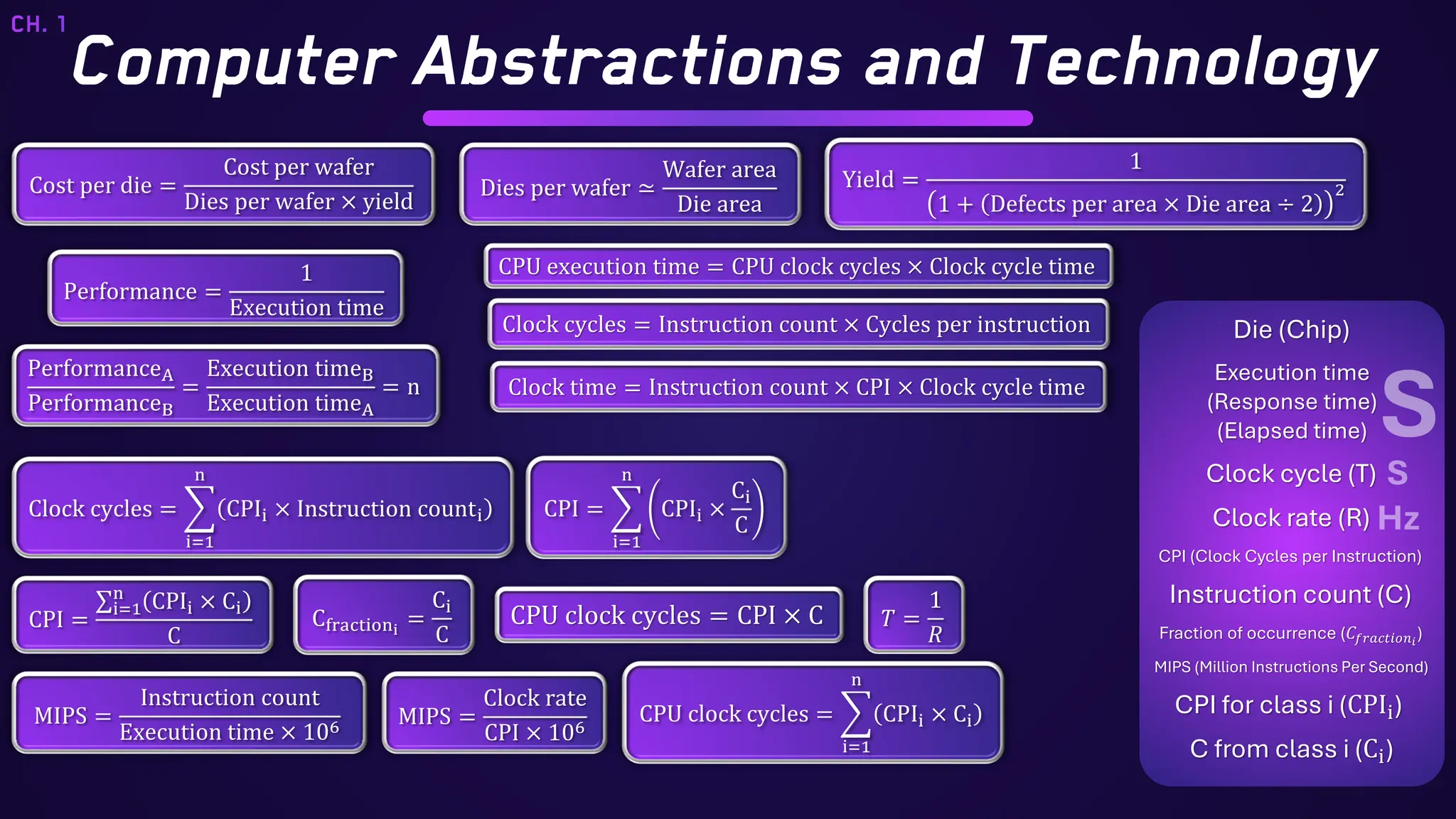
Computer Abstractions andTechnology
Cost per die =
Cost per wafer
Dies per wafer × yield
Dies per wafer ≃
Wafer area
Die area
Yield =
1
1 + Defects per area × Die area ÷ 2
2
Performance =
1
Execution time
PerformanceA
PerformanceB
=
Execution timeB
Execution timeA
= n
CPU execution time = CPU clock cycles × Clock cycle time
Clock cycles = Instruction count × Cycles per instruction
Clock time = Instruction count × CPI × Clock cycle time
Clock cycles =
i=1
n
CPIi × Instruction counti
CPU clock cycles =
i=1
n
CPIi × Ci
CPI =
i=1
n
CPIi ×
Ci
C
MIPS =
Instruction count
Execution time × 106 MIPS =
Clock rate
CPI × 106
𝑇 =
1
𝑅
CPI =
σi=1
n
CPIi × Ci
C
Cfractioni
=
Ci
C
CPU clock cycles = CPI × C
Die (Chip)
Execution time
(Response time)
(Elapsed time)
Clock cycle (T)
Clock rate (R)
CPI (Clock Cycles per Instruction)
Instruction count (C)
Fraction of occurrence (𝐶𝑓𝑟𝑎𝑐𝑡𝑖𝑜𝑛𝑖
)
MIPS (Million Instructions Per Second)
CPI for class i (CPIi)
C from class i (Ci)
CH. 1
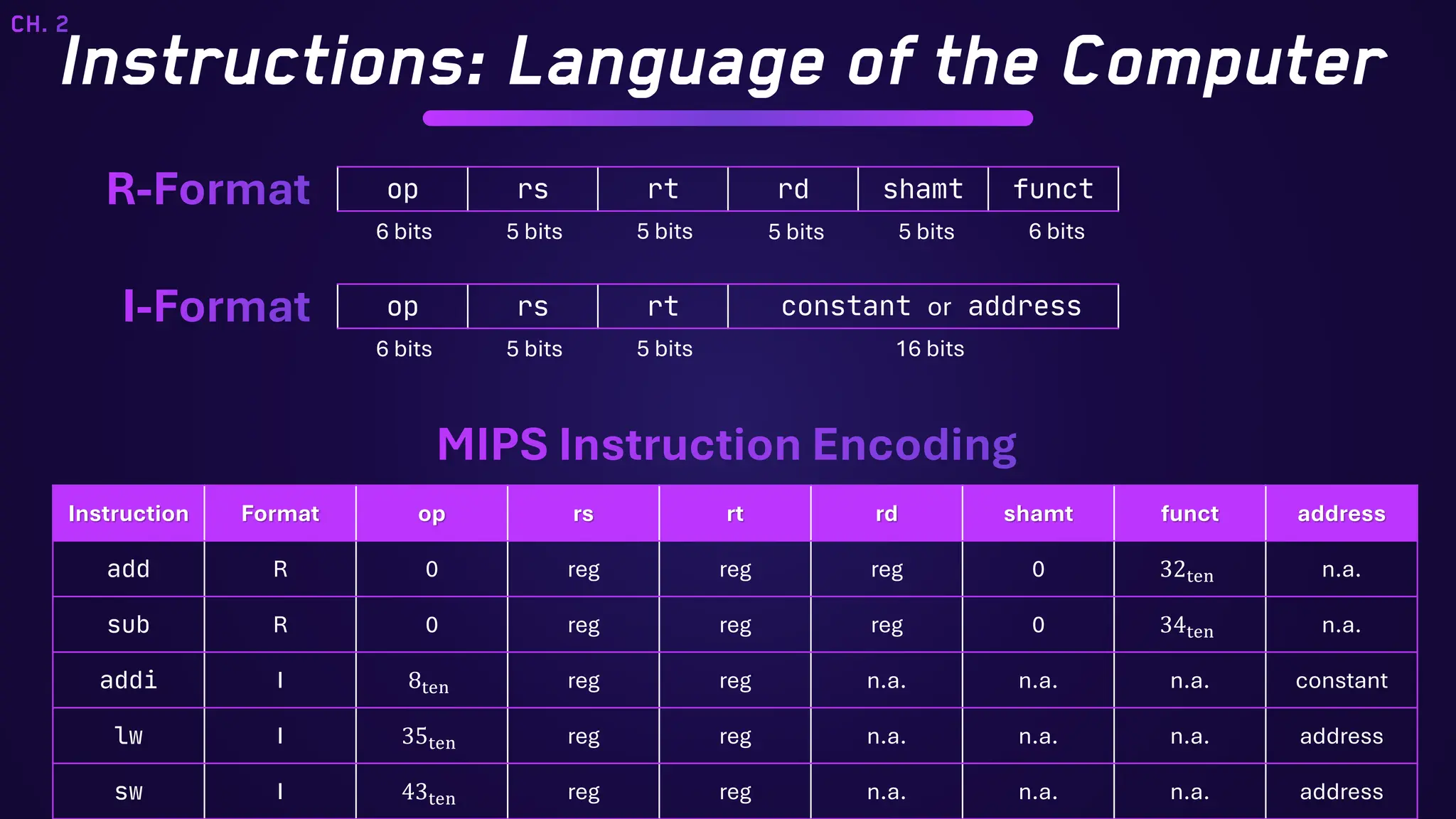
2.
op rs rtrd shamt funct
op rs rt constant or address
Instruction Format op rs rt rd shamt funct address
add R 0 reg reg reg 0 32ten n.a.
sub R 0 reg reg reg 0 34ten n.a.
addi I 8ten reg reg n.a. n.a. n.a. constant
lw I 35ten reg reg n.a. n.a. n.a. address
sw I 43ten reg reg n.a. n.a. n.a. address
MIPS Instruction Encoding
6 bits 5 bits 5 bits 5 bits 5 bits 6 bits
R-Format
6 bits 5 bits 5 bits 16 bits
I-Format
Instructions: Language of the Computer
CH. 2
3.
Category Instruction ExampleMeaning Comments
Arithmetic
add add $s1,$s2,$s3 $s1 = $s2 + $s3 Three register operands
subtract sub $s1,$s2,$s3 $s1 = $s2 – $s3 Three register operands
add immediate addi $s1,$s2,20 $s1=$s2 + 20 Used to add constants
Data transfer
load word lw $s1,20($s2) $s1 = Memory[$s2 + 20] Word from memory to register
store word sw $s1,20($s2) Memory[$s2 + 20] = $s1 Word from register to memory
load half lh $s1,20($s2) $s1 = Memory[$s2+ 20] Halfword memory to register
load half unsigned lhu $s1,20($s2) $s1 = Memory[$s2+ 20] Halfword memory to register
store half sh $s1,20($s2) Memory[$s2+ 20] = $s1 Halfword register to memory
load byte lb $s1,20($s2) $s1 = Memory[$s2+ 20] Byte from memory to register
load byte unsigned lbu $s1,20($s2) $s1 = Memory[$s2+ 20] Byte from memory to register
store byte sb $s1,20($s2) Memory[$s2+ 20] = $s1 Byte from register to memory
load linked word ll $s1,20($s2) $s1 = Memory[$s2+ 20] Load word as 1st half of atomic swap
store condition. word sc $s1,20($s2) Memory[$s2+20]=$s1;$s1=0 or 1 Store word as 2nd half of atomic swap
load upper immed. lui $s1,20 $s1 = 20 * 216
Loads constant in upper 16 bits
Logical
and and $s1,$s2,$s3 $s1 = $s2 & $s3 Three reg. operands;bit-by-bit AND
or or $s1,$s2,$s3 $s1 = $s2 | $s3 Three reg. operands;bit-by-bit OR
nor nor $s1,$s2,$s3 $s1 = ~ ($s2 | $s3) Three reg. operands;bit-by-bit NOR
and immediate andi $s1,$s2,20 $s1 = $s2 & 20 Bit-by-bit AND reg with constant
or immediate ori $s1,$s2,20 $s1 = $s2 | 20 Bit-by-bit OR reg with constant
shift left logical sll $s1,$s2,10 $s1 = $s2 << 10 Shift left by constant
shift right logical srl $s1,$s2,10 $s1 = $s2 >> 10 Shift right by constant
Conditional branch
branch on equal beq $s1,$s2,25 if ($s1 == $s2) go to PC + 4 + 100 Equal test; PC-relative branch
branch on not equal bne $s1,$s2,25 if ($s1!= $s2) go to PC + 4 + 100 Not equal test; PC-relative
set on less than slt $s1,$s2,$s3 if ($s2 < $s3) $s1= 1; else $s1 = 0 Compare less than; for beq, bne
set on less than unsigned sltu $s1,$s2,$s3 if ($s2 < $s3) $s1= 1; else $s1 = 0 Compare less than unsigned
set less than immediate slti $s1,$s2,20 if ($s2 < 20) $s1= 1; else $s1= 0 Compare less than constant
set less than immediate unsigned sltiu $s1,$s2,20 if ($s2 < 20) $s1= 1; else $s1= 0 Compare less than constant unsigned
Unconditional jump
jump j 2500 go to 10000 Jump to target address
jump register jr $ra go to $ra For switch, procedure return
jump and link jal 2500 $ra = PC + 4; go to 10000 For procedure call
MIPS
Assembly
Language
4.
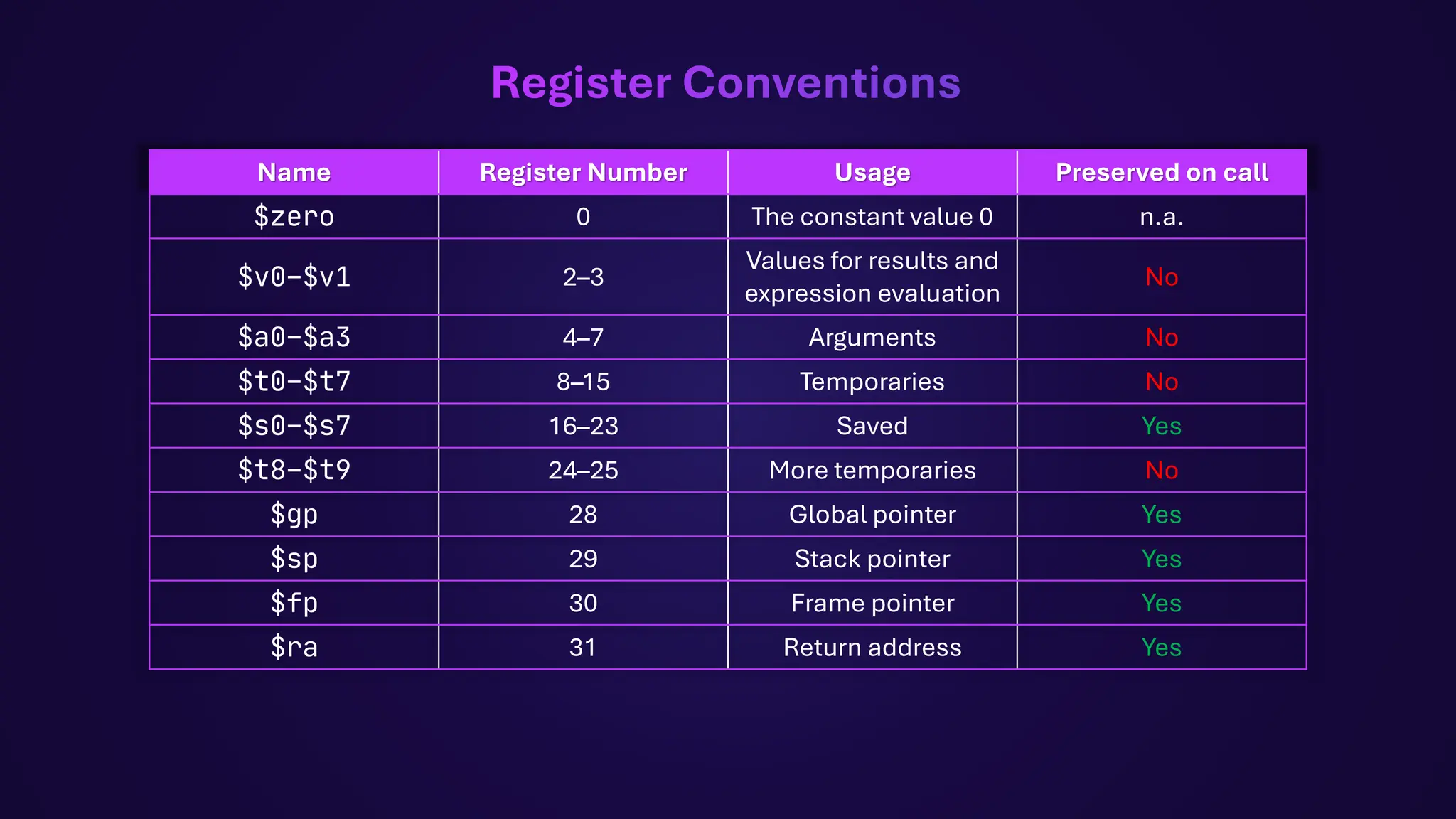
Name Register NumberUsage Preserved on call
$zero 0 The constant value 0 n.a.
$v0–$v1 2–3
Values for results and
expression evaluation
No
$a0–$a3 4–7 Arguments No
$t0–$t7 8–15 Temporaries No
$s0–$s7 16–23 Saved Yes
$t8–$t9 24–25 More temporaries No
$gp 28 Global pointer Yes
$sp 29 Stack pointer Yes
$fp 30 Frame pointer Yes
$ra 31 Return address Yes
Register Conventions
![Category Instruction Example Meaning Comments
Arithmetic
add add $s1,$s2,$s3 $s1 = $s2 + $s3 Three register operands
subtract sub $s1,$s2,$s3 $s1 = $s2 – $s3 Three register operands
add immediate addi $s1,$s2,20 $s1=$s2 + 20 Used to add constants
Data transfer
load word lw $s1,20($s2) $s1 = Memory[$s2 + 20] Word from memory to register
store word sw $s1,20($s2) Memory[$s2 + 20] = $s1 Word from register to memory
load half lh $s1,20($s2) $s1 = Memory[$s2+ 20] Halfword memory to register
load half unsigned lhu $s1,20($s2) $s1 = Memory[$s2+ 20] Halfword memory to register
store half sh $s1,20($s2) Memory[$s2+ 20] = $s1 Halfword register to memory
load byte lb $s1,20($s2) $s1 = Memory[$s2+ 20] Byte from memory to register
load byte unsigned lbu $s1,20($s2) $s1 = Memory[$s2+ 20] Byte from memory to register
store byte sb $s1,20($s2) Memory[$s2+ 20] = $s1 Byte from register to memory
load linked word ll $s1,20($s2) $s1 = Memory[$s2+ 20] Load word as 1st half of atomic swap
store condition. word sc $s1,20($s2) Memory[$s2+20]=$s1;$s1=0 or 1 Store word as 2nd half of atomic swap
load upper immed. lui $s1,20 $s1 = 20 * 216
Loads constant in upper 16 bits
Logical
and and $s1,$s2,$s3 $s1 = $s2 & $s3 Three reg. operands;bit-by-bit AND
or or $s1,$s2,$s3 $s1 = $s2 | $s3 Three reg. operands;bit-by-bit OR
nor nor $s1,$s2,$s3 $s1 = ~ ($s2 | $s3) Three reg. operands;bit-by-bit NOR
and immediate andi $s1,$s2,20 $s1 = $s2 & 20 Bit-by-bit AND reg with constant
or immediate ori $s1,$s2,20 $s1 = $s2 | 20 Bit-by-bit OR reg with constant
shift left logical sll $s1,$s2,10 $s1 = $s2 << 10 Shift left by constant
shift right logical srl $s1,$s2,10 $s1 = $s2 >> 10 Shift right by constant
Conditional branch
branch on equal beq $s1,$s2,25 if ($s1 == $s2) go to PC + 4 + 100 Equal test; PC-relative branch
branch on not equal bne $s1,$s2,25 if ($s1!= $s2) go to PC + 4 + 100 Not equal test; PC-relative
set on less than slt $s1,$s2,$s3 if ($s2 < $s3) $s1= 1; else $s1 = 0 Compare less than; for beq, bne
set on less than unsigned sltu $s1,$s2,$s3 if ($s2 < $s3) $s1= 1; else $s1 = 0 Compare less than unsigned
set less than immediate slti $s1,$s2,20 if ($s2 < 20) $s1= 1; else $s1= 0 Compare less than constant
set less than immediate unsigned sltiu $s1,$s2,20 if ($s2 < 20) $s1= 1; else $s1= 0 Compare less than constant unsigned
Unconditional jump
jump j 2500 go to 10000 Jump to target address
jump register jr $ra go to $ra For switch, procedure return
jump and link jal 2500 $ra = PC + 4; go to 10000 For procedure call
MIPS
Assembly
Language](https://image.slidesharecdn.com/archisummary-250819174950-0fe35eb1/75/Computer-Architecture-schools-Summary-pdf-3-2048.jpg)