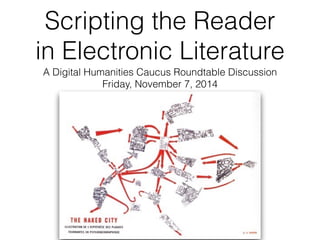
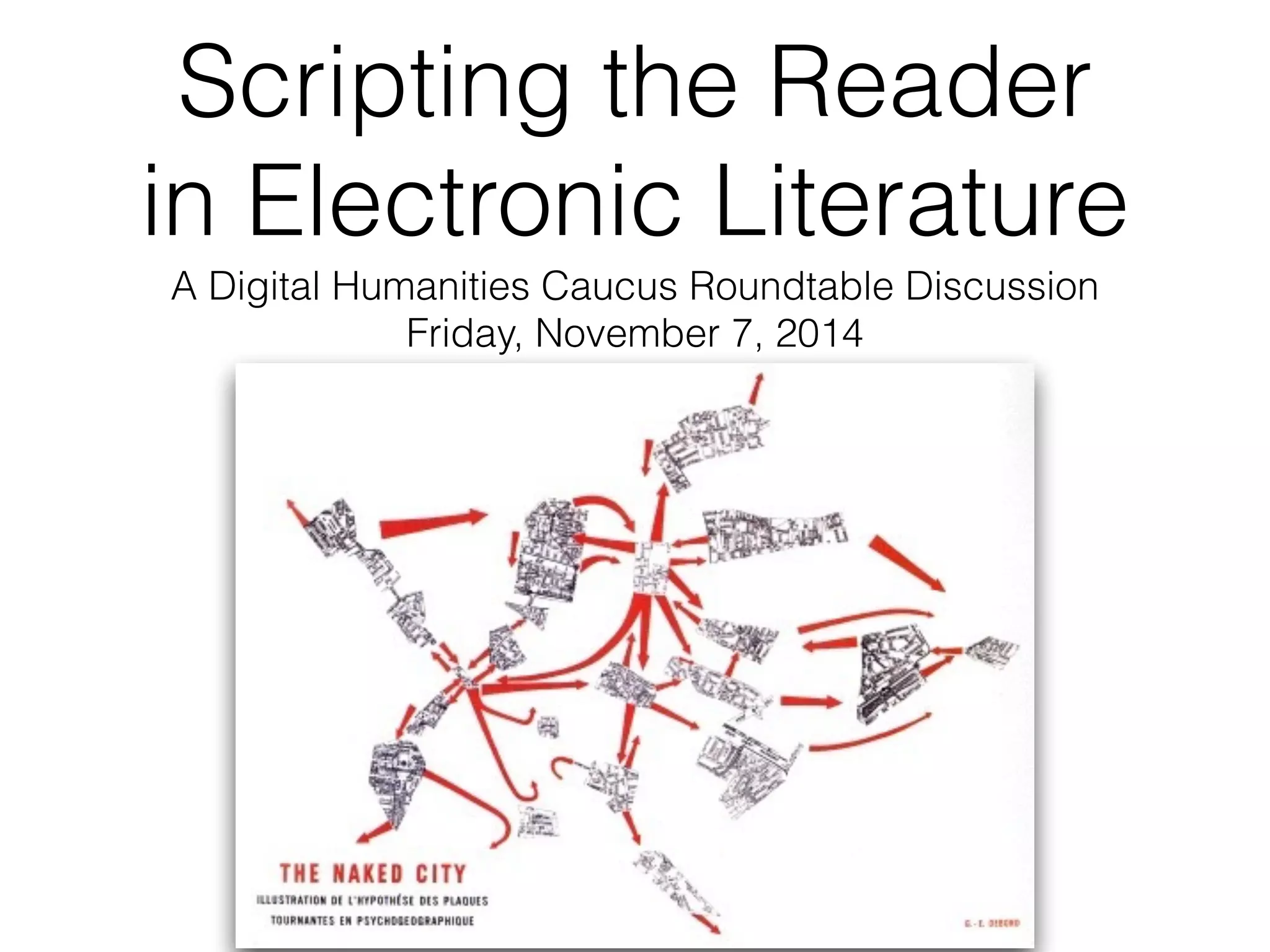
Scripting the Reader 
in Electronic Literature 
A Digital Humanities Caucus Roundtable Discussion 
Friday, November 7, 2014
Roundtable Overview 
1. Leonardo Flores - Introduction & Theoretical Framing 
2. Samantha Gorman - “rhythms of attention” 
3. A. J. Patrick Liszkiewicz - “lusory 
attitudes” (playfulness) 
4. Jeremy Hight - locative & AR works 
5. Mauro Carassai - e-lit “language games” 
6. Discussion
Key Questions 
• How do writers of electronic literature design, control, 
cast, or otherwise shape their readers’ experience 
and interaction? 
• Is fun used as a mechanism for control in a scripted 
interaction? 
• Do they reward certain choices and punish others? 
• How do they design virtual environments with a 
psychogeography that influences their readers' 
dérive?
What is Electronic 
Literature? 
• E-lit ≠ e-books. 
• E-books are industry-driven representations of the 
book in digital media. 
• E-lit is a set of grassroots experimental practices, 
that embrace the potential of digital media 
technologies to create innovative engagements 
with language.
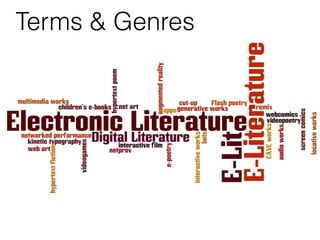
Terms & Genres
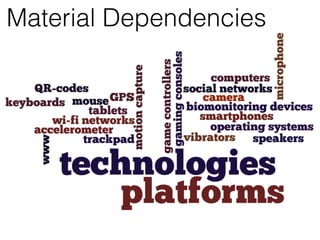
Material Dependencies
Scripting the Reader 
Espen Aarseth, Cybertext: Perspectives in Ergodic 
Literature. Johns Hopkins UP. 1997. 
• cybertext - a work with feedback loops that 
incorporates reader input in its functioning. 
• “A machine for the production of variety of 
expression.” 
• ergodic works - require “nontrivial effort” to 
traverse.
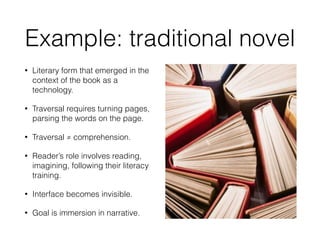
Example: traditional novel 
• Literary form that emerged in the 
context of the book as a 
technology. 
• Traversal requires turning pages, 
parsing the words on the page. 
• Traversal ≠ comprehension. 
• Reader’s role involves reading, 
imagining, following their literacy 
training. 
• Interface becomes invisible. 
• Goal is immersion in narrative.
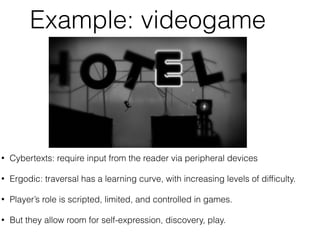
Example: videogame 
• Cybertexts: require input from the reader via peripheral devices 
• Ergodic: traversal has a learning curve, with increasing levels of difficulty. 
• Player’s role is scripted, limited, and controlled in games. 
• But they allow room for self-expression, discovery, play.
Example: E-Poetry 
• Aarseth, Cybertext (pgs. 91-92) 
• aporia - an impasse, frustration 
• epiphany - replaces aporia and satisfies closure. 
• Nick Montfort, “Taroko Gorge” (2009) 
• The desire for completion, closure, is frustrated (aporia) 
• The realization that the work is deliberately endless 
(epiphany)
Guy Debord 
“Theory of the Derive” (1958) 
• “technique of rapid passage through varied ambiences. Dérives involve 
playful-constructive behavior and awareness of psychogeographical effects, 
and are thus quite different from the classic notions of journey or stroll.” 
• In a dérive one or more persons during a certain period drop […] all their 
other usual motives for movement and action, and let themselves be drawn 
by the attractions of the terrain and the encounters they find there. 
• Chance is a less important factor in this activity than one might think: from a 
dérive point of view cities have psychogeographical contours, with constant 
currents, fixed points and vortexes that strongly discourage entry into or exit 
from certain zones. 
• But the dérive includes both this letting-go and its necessary contradiction: 
the domination of psychogeographical variations by the knowledge and 
calculation of their possibilities.
Up next 
1. Samantha Gorman - “rhythms of attention” 
2. A. J. Patrick Liszkiewicz - “lusory 
attitudes” (playfulness) 
3. Jeremy Hight - locative & AR works 
4. Mauro Carassai - e-lit “language games” 
5. Discussion

Slideshow for "Scripting the Reader in Electronic Literature"

  • 1.
    Scripting the Reader in Electronic Literature A Digital Humanities Caucus Roundtable Discussion Friday, November 7, 2014
  • 2.
    Roundtable Overview 1.Leonardo Flores - Introduction & Theoretical Framing 2. Samantha Gorman - “rhythms of attention” 3. A. J. Patrick Liszkiewicz - “lusory attitudes” (playfulness) 4. Jeremy Hight - locative & AR works 5. Mauro Carassai - e-lit “language games” 6. Discussion
  • 3.
    Key Questions •How do writers of electronic literature design, control, cast, or otherwise shape their readers’ experience and interaction? • Is fun used as a mechanism for control in a scripted interaction? • Do they reward certain choices and punish others? • How do they design virtual environments with a psychogeography that influences their readers' dérive?
  • 4.
    What is Electronic Literature? • E-lit ≠ e-books. • E-books are industry-driven representations of the book in digital media. • E-lit is a set of grassroots experimental practices, that embrace the potential of digital media technologies to create innovative engagements with language.
  • 5.
  • 6.
  • 7.
    Scripting the Reader Espen Aarseth, Cybertext: Perspectives in Ergodic Literature. Johns Hopkins UP. 1997. • cybertext - a work with feedback loops that incorporates reader input in its functioning. • “A machine for the production of variety of expression.” • ergodic works - require “nontrivial effort” to traverse.
  • 8.
    Example: traditional novel • Literary form that emerged in the context of the book as a technology. • Traversal requires turning pages, parsing the words on the page. • Traversal ≠ comprehension. • Reader’s role involves reading, imagining, following their literacy training. • Interface becomes invisible. • Goal is immersion in narrative.
  • 9.
    Example: videogame •Cybertexts: require input from the reader via peripheral devices • Ergodic: traversal has a learning curve, with increasing levels of difficulty. • Player’s role is scripted, limited, and controlled in games. • But they allow room for self-expression, discovery, play.
  • 10.
    Example: E-Poetry •Aarseth, Cybertext (pgs. 91-92) • aporia - an impasse, frustration • epiphany - replaces aporia and satisfies closure. • Nick Montfort, “Taroko Gorge” (2009) • The desire for completion, closure, is frustrated (aporia) • The realization that the work is deliberately endless (epiphany)
  • 11.
    Guy Debord “Theoryof the Derive” (1958) • “technique of rapid passage through varied ambiences. Dérives involve playful-constructive behavior and awareness of psychogeographical effects, and are thus quite different from the classic notions of journey or stroll.” • In a dérive one or more persons during a certain period drop […] all their other usual motives for movement and action, and let themselves be drawn by the attractions of the terrain and the encounters they find there. • Chance is a less important factor in this activity than one might think: from a dérive point of view cities have psychogeographical contours, with constant currents, fixed points and vortexes that strongly discourage entry into or exit from certain zones. • But the dérive includes both this letting-go and its necessary contradiction: the domination of psychogeographical variations by the knowledge and calculation of their possibilities.
  • 12.
    Up next 1.Samantha Gorman - “rhythms of attention” 2. A. J. Patrick Liszkiewicz - “lusory attitudes” (playfulness) 3. Jeremy Hight - locative & AR works 4. Mauro Carassai - e-lit “language games” 5. Discussion