Havana Cuba,
After the
Collapse:
Land Use change during the “Special
Period”
By Jason Nielsen
Objectives
• Discuss the History of Cuba’s Agriculture before and
after the collapse of the Soviet Union
• Discuss Hypothesis and Methods
• Display and Describe Results
• Conclusion and Recommendations
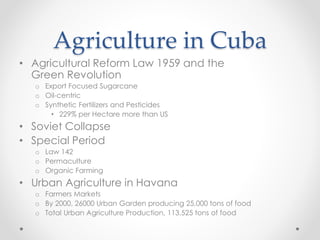
Agriculture in Cuba
• Agricultural Reform Law 1959 and the
Green Revolution
o Export Focused Sugarcane
o Oil-centric
o Synthetic Fertilizers and Pesticides
• 229% per Hectare more than US
• Soviet Collapse
• Special Period
o Law 142
o Permaculture
o Organic Farming
• Urban Agriculture in Havana
o Farmers Markets
o By 2000, 26000 Urban Garden producing 25,000 tons of food
o Total Urban Agriculture Production, 113,525 tons of food
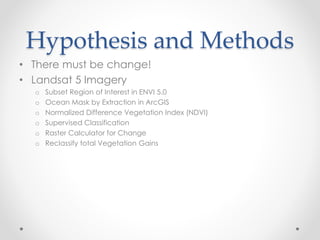
Hypothesis and Methods
• There must be change!
• Landsat 5 Imagery
o Subset Region of Interest in ENVI 5.0
o Ocean Mask by Extraction in ArcGIS
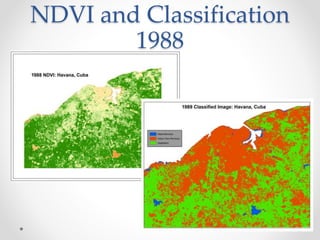
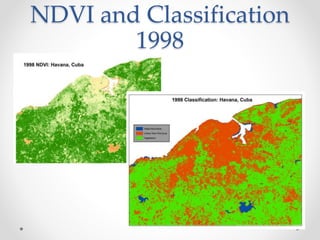
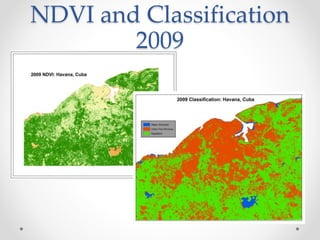
o Normalized Difference Vegetation Index (NDVI)
o Supervised Classification
o Raster Calculator for Change
o Reclassify total Vegetation Gains
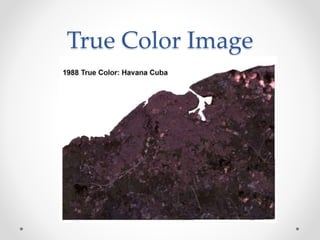
True Color Image
NDVI and Classification
1988
NDVI and Classification
1998
NDVI and Classification
2009
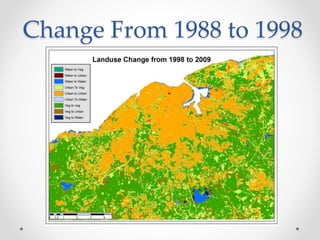
Change From 1988 to 1998
0
50000
100000
150000
200000
250000
300000
Water Pixel Numbers
Urban Pixel Numbers
Vegetation Pixel Numbers
Numberof30x30mPixels
Water Pixel Numbers Urban Pixel Numbers Vegetation Pixel Numbers
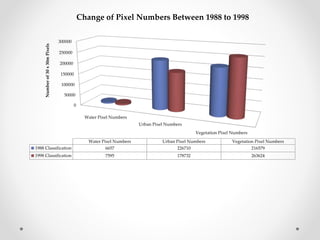
1988 Classification 6657 226710 216579
1998 Classification 7595 178732 263624
Change of Pixel Numbers Between 1988 to 1998
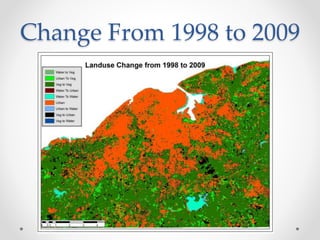
Change From 1998 to 2009
0
50000
100000
150000
200000
250000
300000
1 2 3
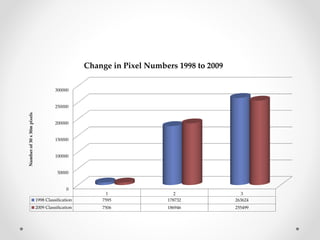
1998 Classification 7595 178732 263624
2009 Classification 7506 186946 255499
Numberof30x30mpixels
Change in Pixel Numbers 1998 to 2009
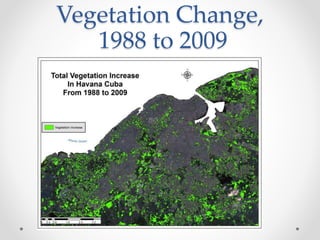
Vegetation Change,
1988 to 2009
-50000
0
50000
100000
150000
200000
250000
300000
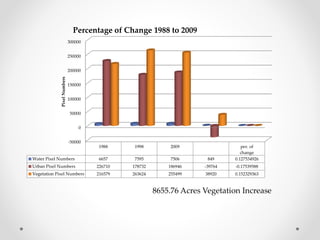
1988 1998 2009 per. of
change
Water Pixel Numbers 6657 7595 7506 849 0.127534926
Urban Pixel Numbers 226710 178732 186946 -39764 -0.17539588
Vegetation Pixel Numbers 216579 263624 255499 38920 0.152329363
PixelNumbers
Percentage of Change 1988 to 2009
8655.76 Acres Vegetation Increase
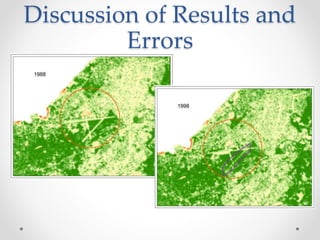
Discussion of Results and
Errors
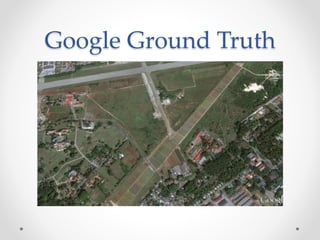
Google Ground Truth
Other Issues
• Clouds
• Reflectance
• Time of Day
• Angle of the Sun
• Error in Analysis
Conclusions…
Questions…
Work Cited
ArcGIS Help.
Internet publications Living Planet Report (2006). World Wildlife Fund in the USA and
Canada. http//:www. living_planet_report.pdf (Accessed March of 2015)
Google Earth
Journal article Febles-Gonzalez, J.M. et al (2010) Cuban Agricultural Policy in the last 25
years. From conventional to organic agriculture. Land Use Policy 28(2011) 723-735
Journal article Novo, Mario Gonzalez, and Catherine Murphy (2000). Urban agriculture
in the city of Havana: A popular response to a crisis. Growing cities, growing food.
Urban agriculture on the policy agenda. (ZEL) (2000): 329-346.
Journal article Maal-Bared, Rasha (2005) Comparing environmental issues in Cuba
before and after the Special Period: Balancing sustainable development and survival.
Environment International 32: 349-358

Havana Cuba, After the Collapse

  • 1.
    Havana Cuba, After the Collapse: LandUse change during the “Special Period” By Jason Nielsen
  • 2.
    Objectives • Discuss theHistory of Cuba’s Agriculture before and after the collapse of the Soviet Union • Discuss Hypothesis and Methods • Display and Describe Results • Conclusion and Recommendations
  • 3.
    Agriculture in Cuba •Agricultural Reform Law 1959 and the Green Revolution o Export Focused Sugarcane o Oil-centric o Synthetic Fertilizers and Pesticides • 229% per Hectare more than US • Soviet Collapse • Special Period o Law 142 o Permaculture o Organic Farming • Urban Agriculture in Havana o Farmers Markets o By 2000, 26000 Urban Garden producing 25,000 tons of food o Total Urban Agriculture Production, 113,525 tons of food
  • 4.
    Hypothesis and Methods •There must be change! • Landsat 5 Imagery o Subset Region of Interest in ENVI 5.0 o Ocean Mask by Extraction in ArcGIS o Normalized Difference Vegetation Index (NDVI) o Supervised Classification o Raster Calculator for Change o Reclassify total Vegetation Gains
  • 5.
  • 6.
  • 7.
  • 8.
  • 9.
  • 10.
    0 50000 100000 150000 200000 250000 300000 Water Pixel Numbers UrbanPixel Numbers Vegetation Pixel Numbers Numberof30x30mPixels Water Pixel Numbers Urban Pixel Numbers Vegetation Pixel Numbers 1988 Classification 6657 226710 216579 1998 Classification 7595 178732 263624 Change of Pixel Numbers Between 1988 to 1998
  • 11.
  • 12.
    0 50000 100000 150000 200000 250000 300000 1 2 3 1998Classification 7595 178732 263624 2009 Classification 7506 186946 255499 Numberof30x30mpixels Change in Pixel Numbers 1998 to 2009
  • 13.
  • 14.
    -50000 0 50000 100000 150000 200000 250000 300000 1988 1998 2009per. of change Water Pixel Numbers 6657 7595 7506 849 0.127534926 Urban Pixel Numbers 226710 178732 186946 -39764 -0.17539588 Vegetation Pixel Numbers 216579 263624 255499 38920 0.152329363 PixelNumbers Percentage of Change 1988 to 2009 8655.76 Acres Vegetation Increase
  • 15.
  • 16.
  • 17.
    Other Issues • Clouds •Reflectance • Time of Day • Angle of the Sun • Error in Analysis
  • 18.
  • 19.
  • 20.
    Work Cited ArcGIS Help. Internetpublications Living Planet Report (2006). World Wildlife Fund in the USA and Canada. http//:www. living_planet_report.pdf (Accessed March of 2015) Google Earth Journal article Febles-Gonzalez, J.M. et al (2010) Cuban Agricultural Policy in the last 25 years. From conventional to organic agriculture. Land Use Policy 28(2011) 723-735 Journal article Novo, Mario Gonzalez, and Catherine Murphy (2000). Urban agriculture in the city of Havana: A popular response to a crisis. Growing cities, growing food. Urban agriculture on the policy agenda. (ZEL) (2000): 329-346. Journal article Maal-Bared, Rasha (2005) Comparing environmental issues in Cuba before and after the Special Period: Balancing sustainable development and survival. Environment International 32: 349-358