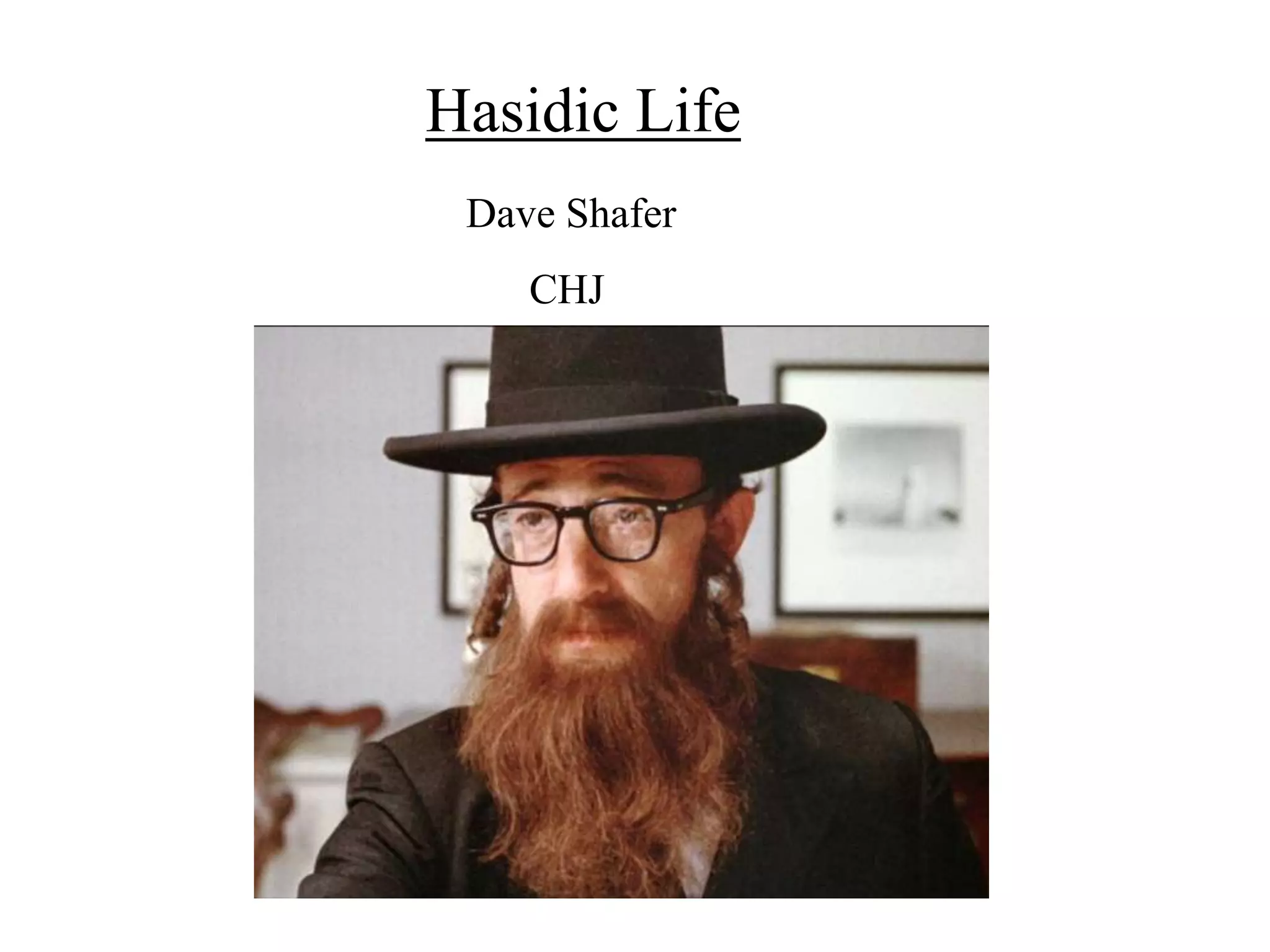










Hasidic Life
Dave Shafer
CHJ
The public face of Hasidism
Famous Jews with a Hasidic background
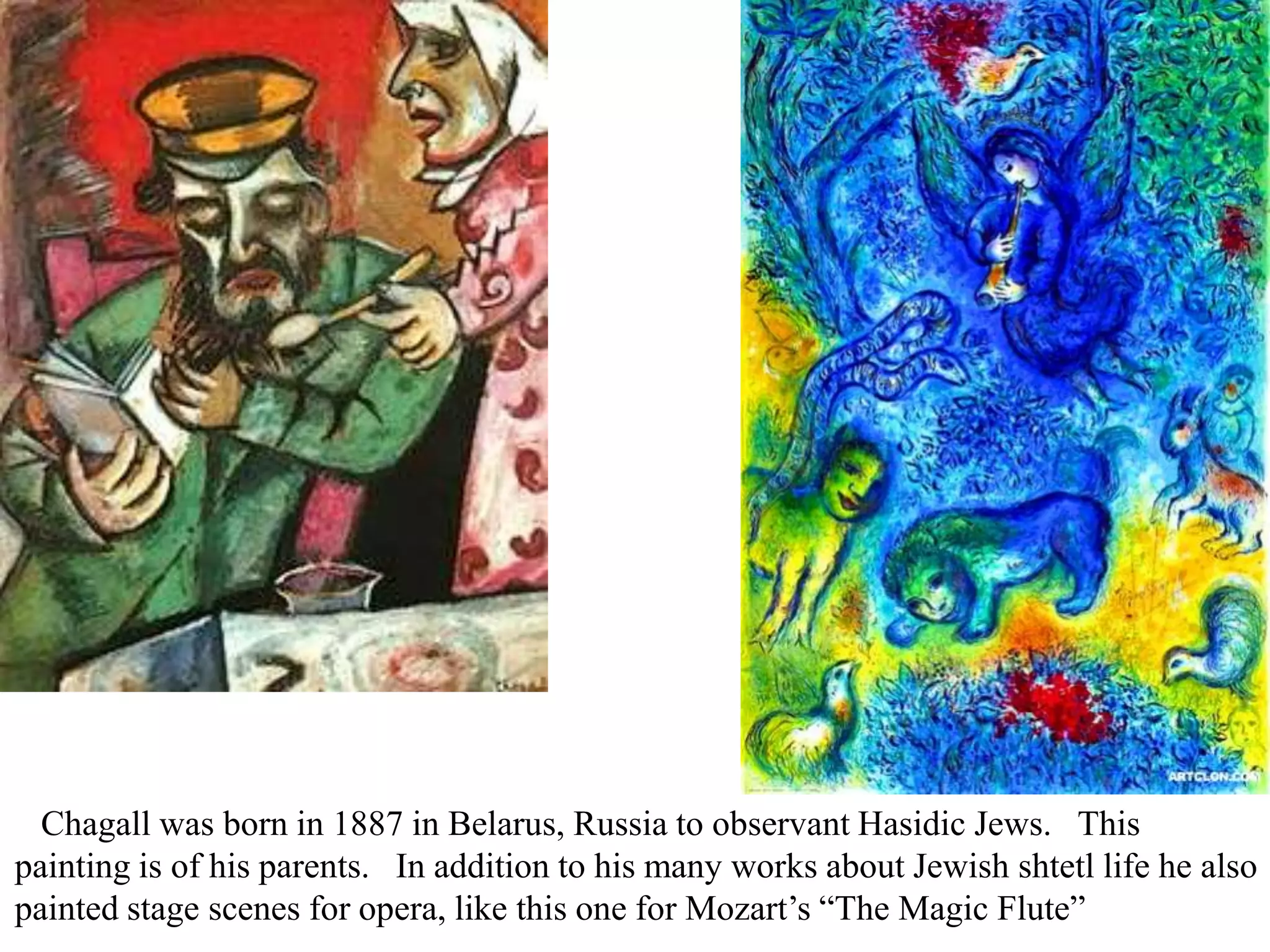
Probably the most famous
Hasidic Jew in history was Marc
Chagall, whose art is known and
loved around the world and is
instantly recognizable.
Chagall was born in 1887 in Belarus, Russia to observant Hasidic Jews. This
painting is of his parents. In addition to his many works about Jewish shtetl life he also
painted stage scenes for opera, like this one for Mozart’s “The Magic Flute”
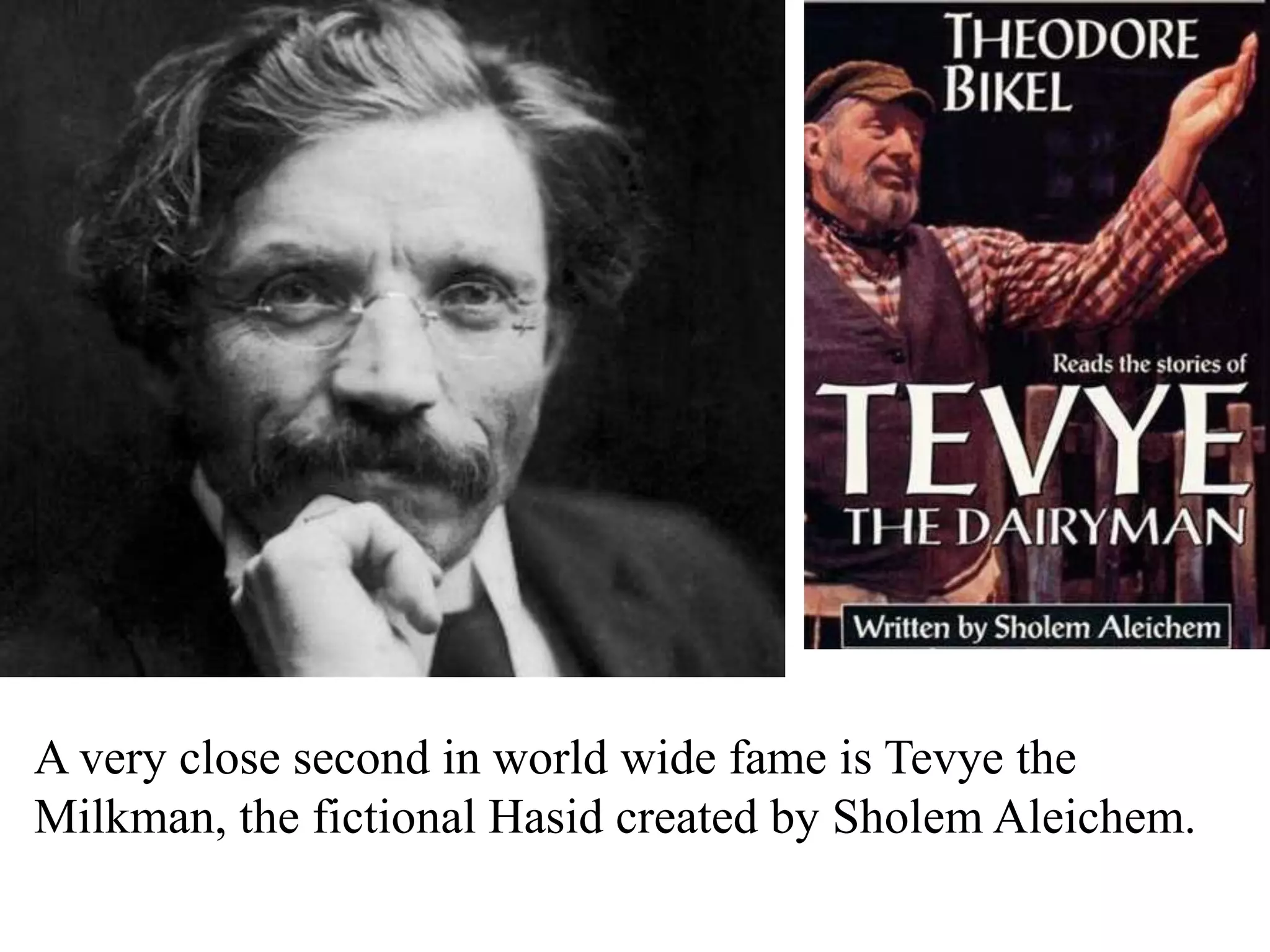
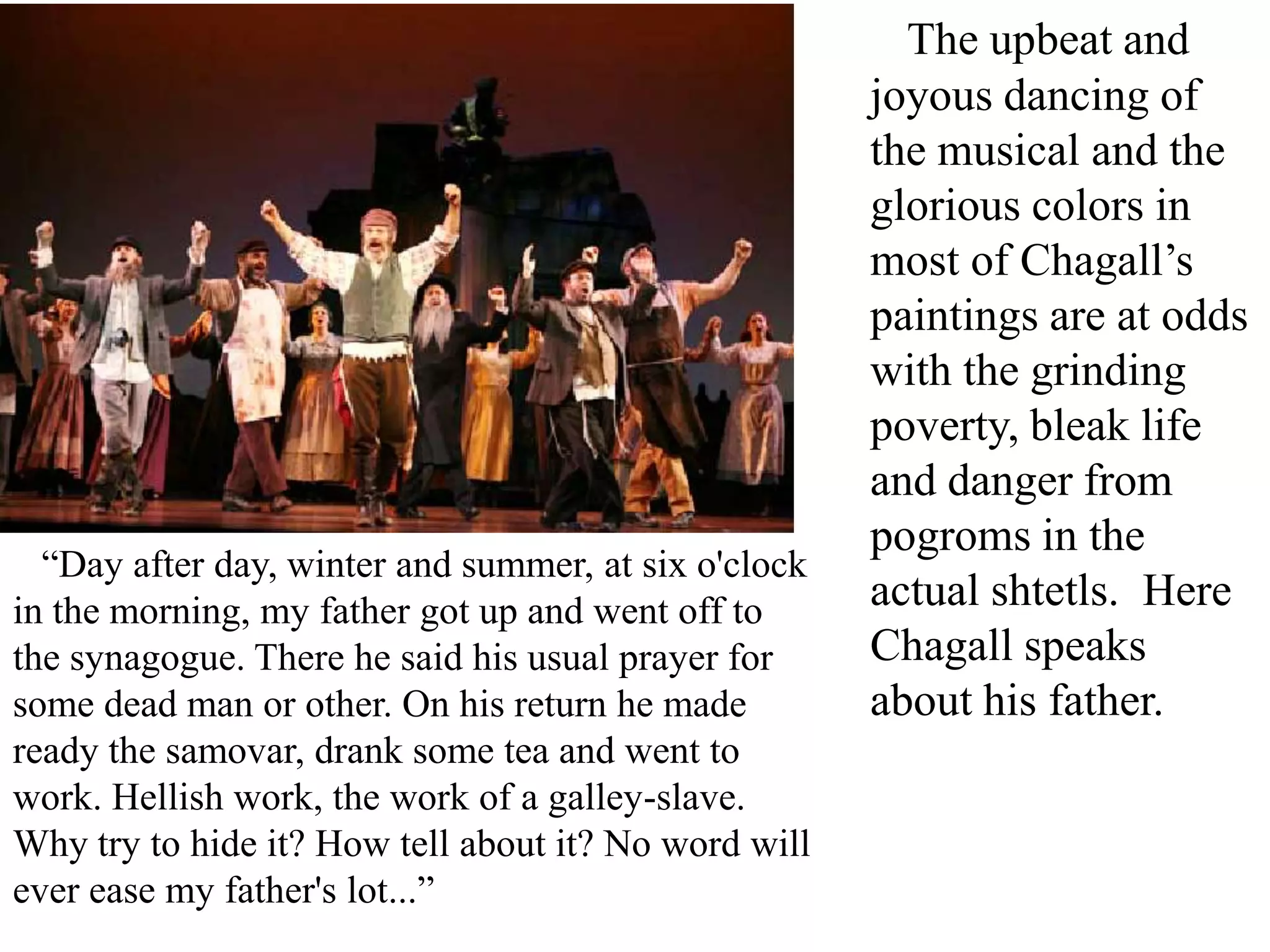
A very close second in world wide fame is Tevye the
Milkman, the fictional Hasid created by Sholem Aleichem.
The title of this Broadway musical
was taken from one of Chagall’s
many “Fiddler” paintings.
“Day after day, winter and summer, at six o'clock
in the morning, my father got up and went off to
the synagogue. There he said his usual prayer for
some dead man or other. On his return he made
ready the samovar, drank some tea and went to
work. Hellish work, the work of a galley-slave.
Why try to hide it? How tell about it? No word will
ever ease my father's lot...”

The upbeat and
joyous dancing of
the musical and the
glorious colors in
most of Chagall’s
paintings are at odds
with the grinding
poverty, bleak life
and danger from
pogroms in the
actual shtetls. Here
Chagall speaks
about his father.
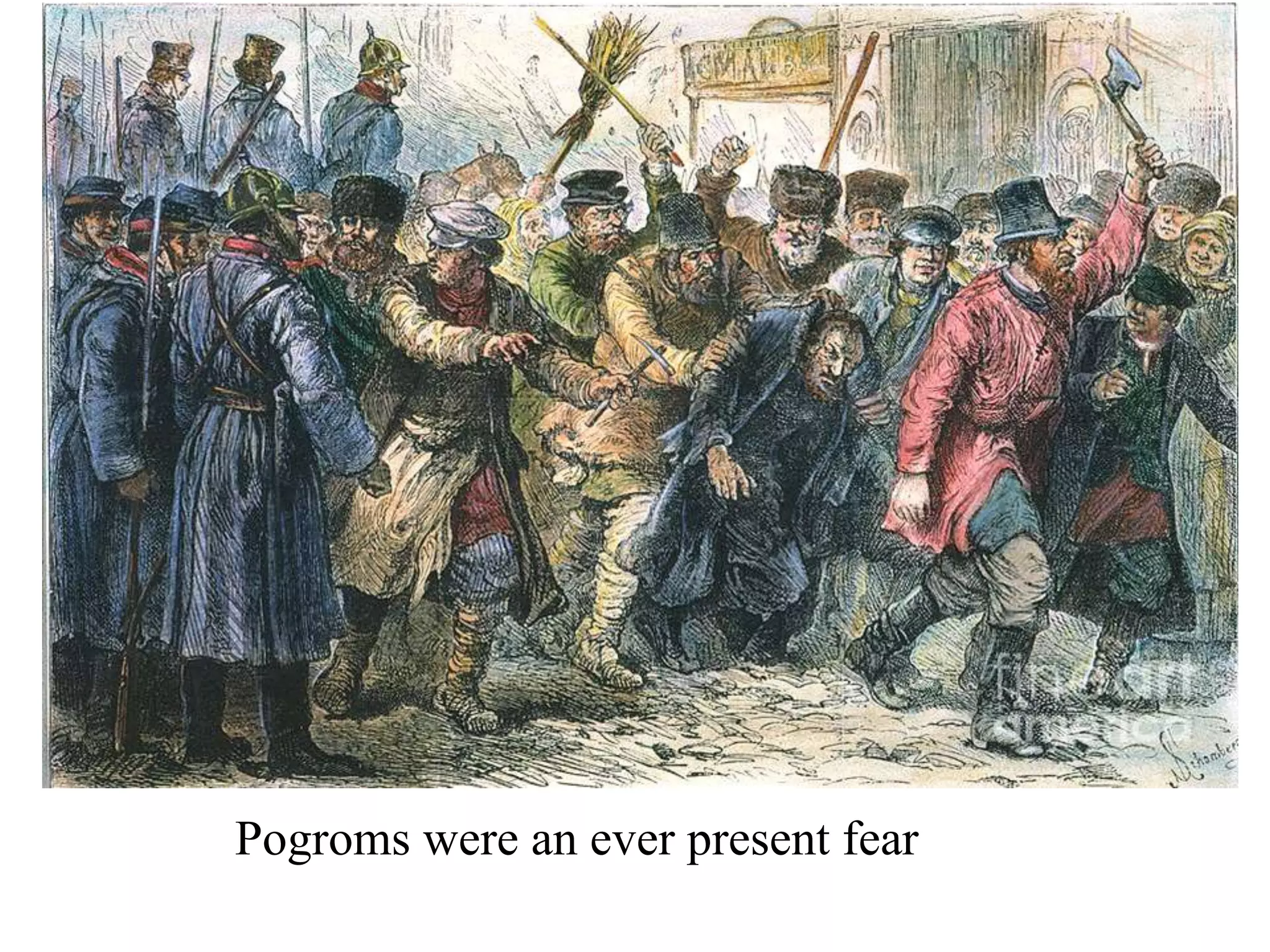
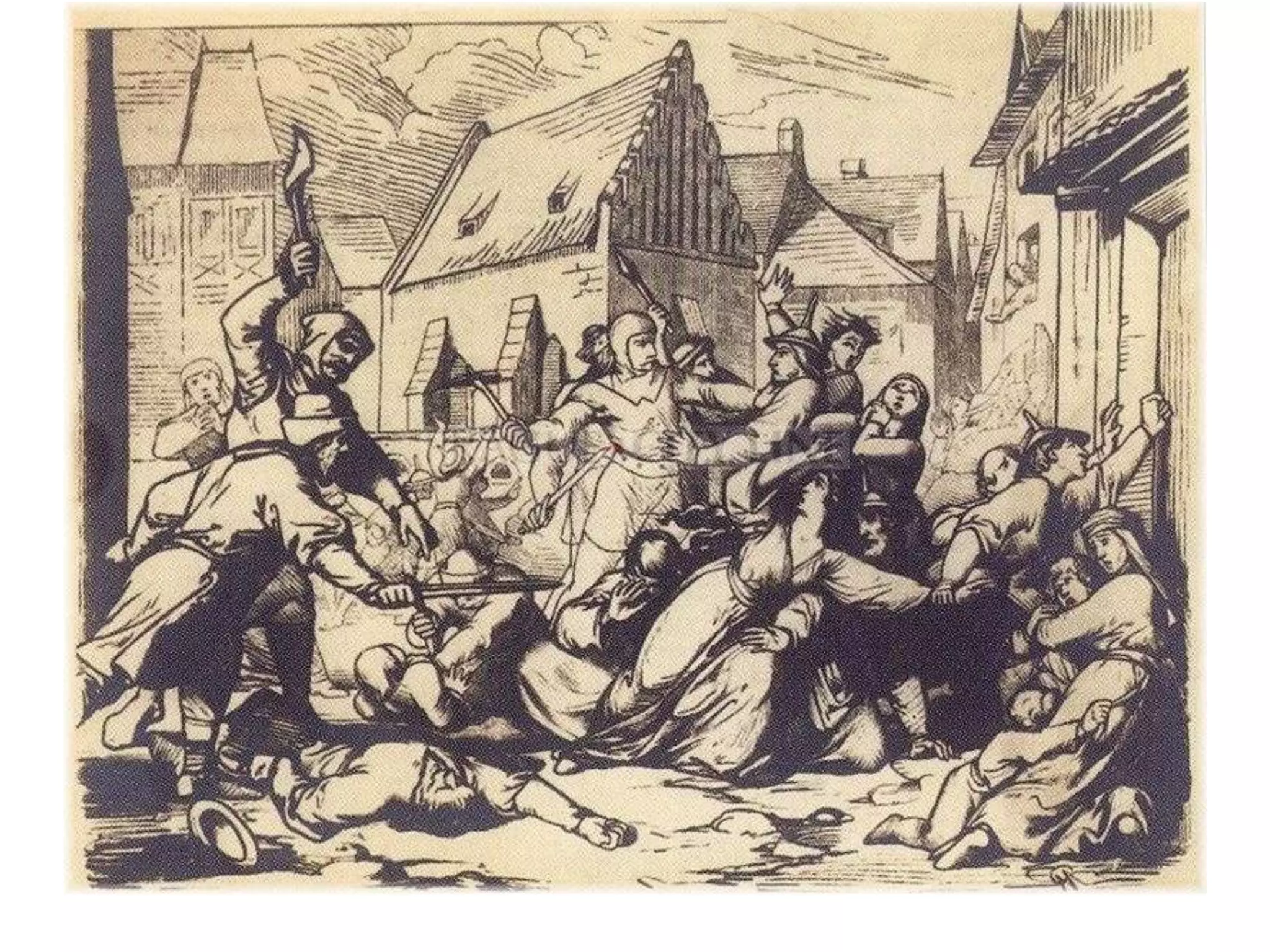
Pogroms were an ever present fear
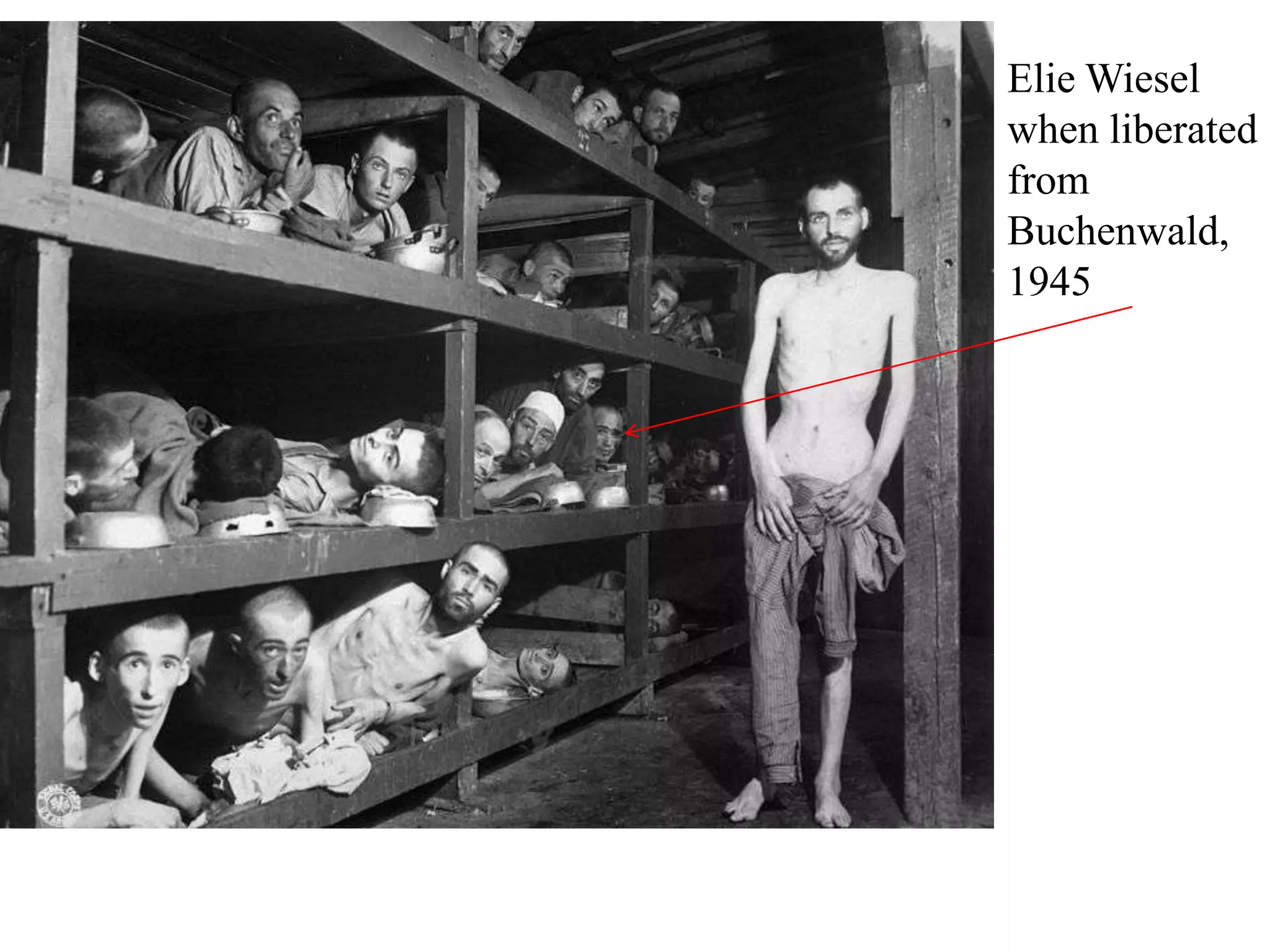
The most famous living person
from a Hasidic background is
probably Nobel Prize winner Elie
Wiesel, born in Romania.
Elie Wiesel
when liberated
from
Buchenwald,
1945
Isaac Singer, another Nobel Prize
winner and son of a Hasidic rabbi,
wrote some light-hearted pieces.
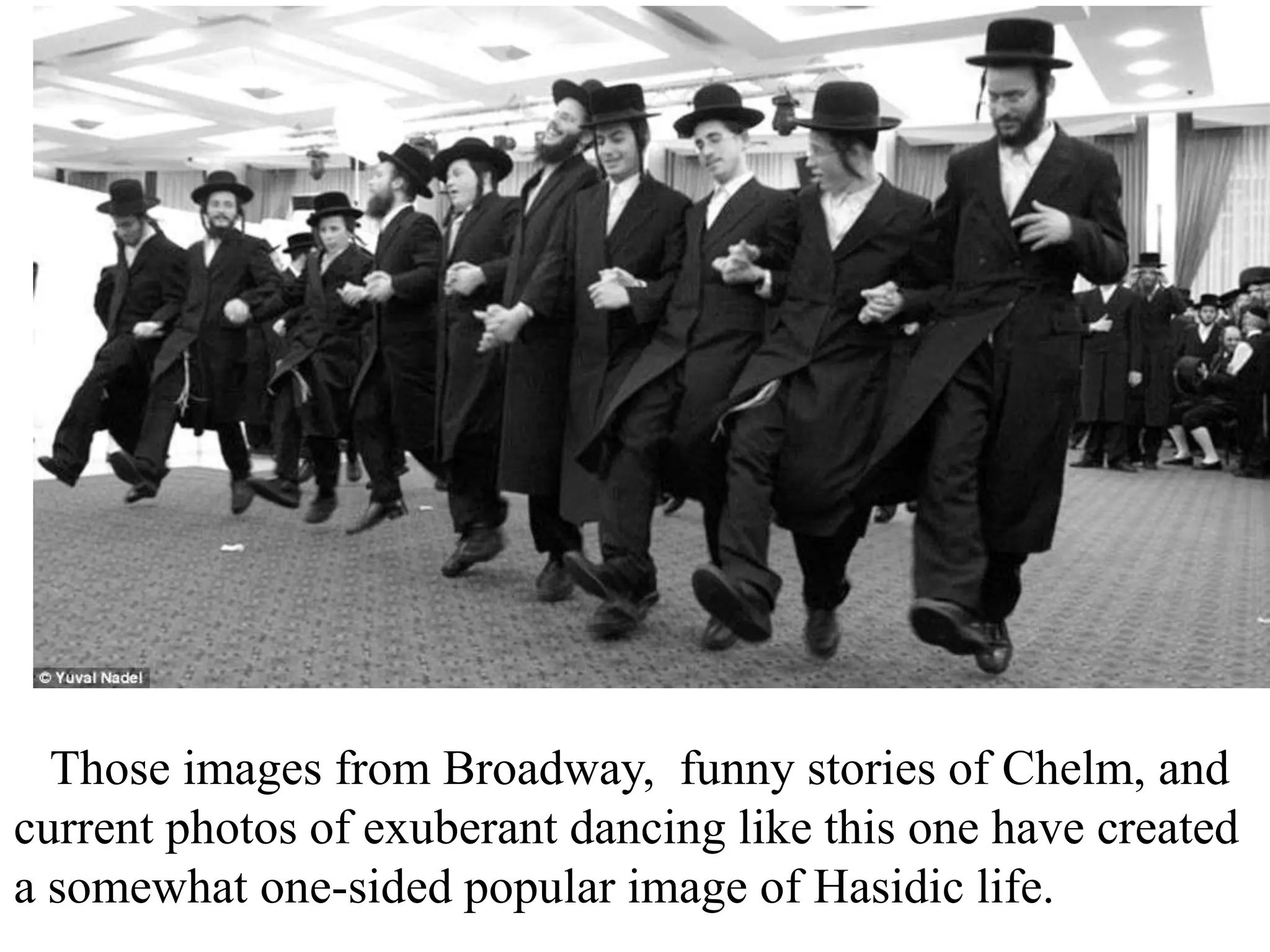
Those images from Broadway, funny stories of Chelm, and
current photos of exuberant dancing like this one have created
a somewhat one-sided popular image of Hasidic life.
It doesn’t take much to notice, however, that this is very much a man’s
world. There is another story to be told and other images to be shown.
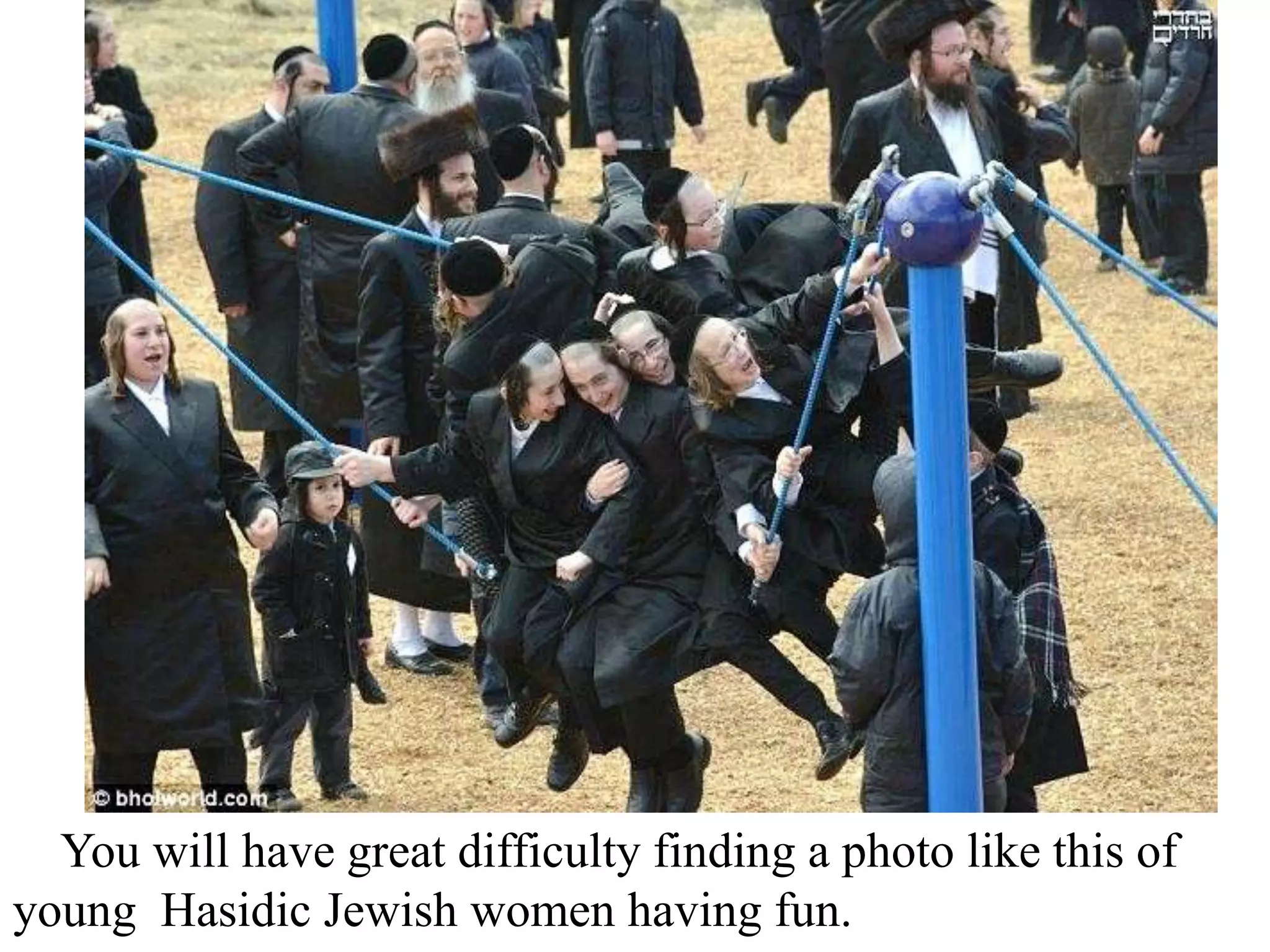
You will have great difficulty finding a photo like this of
young Hasidic Jewish women having fun.
We will try to show a balanced view of contemporary
Hasidic life and start with the lighter side
The Lighter Side of Hasidic life
(Tongue in cheek)
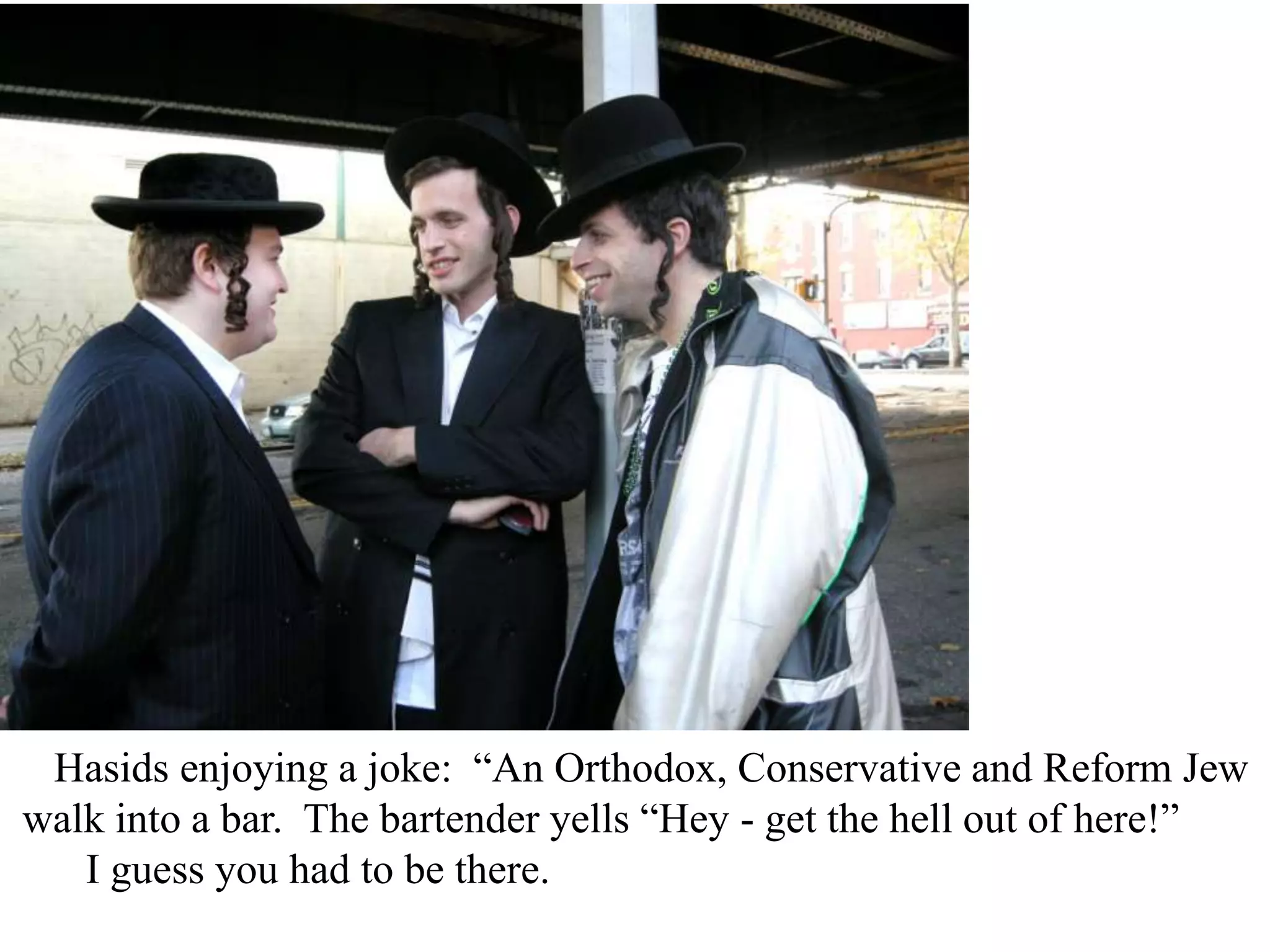
Hasids enjoying a joke: “An Orthodox, Conservative and Reform Jew
walk into a bar. The bartender yells “Hey - get the hell out of here!”
I guess you had to be there.
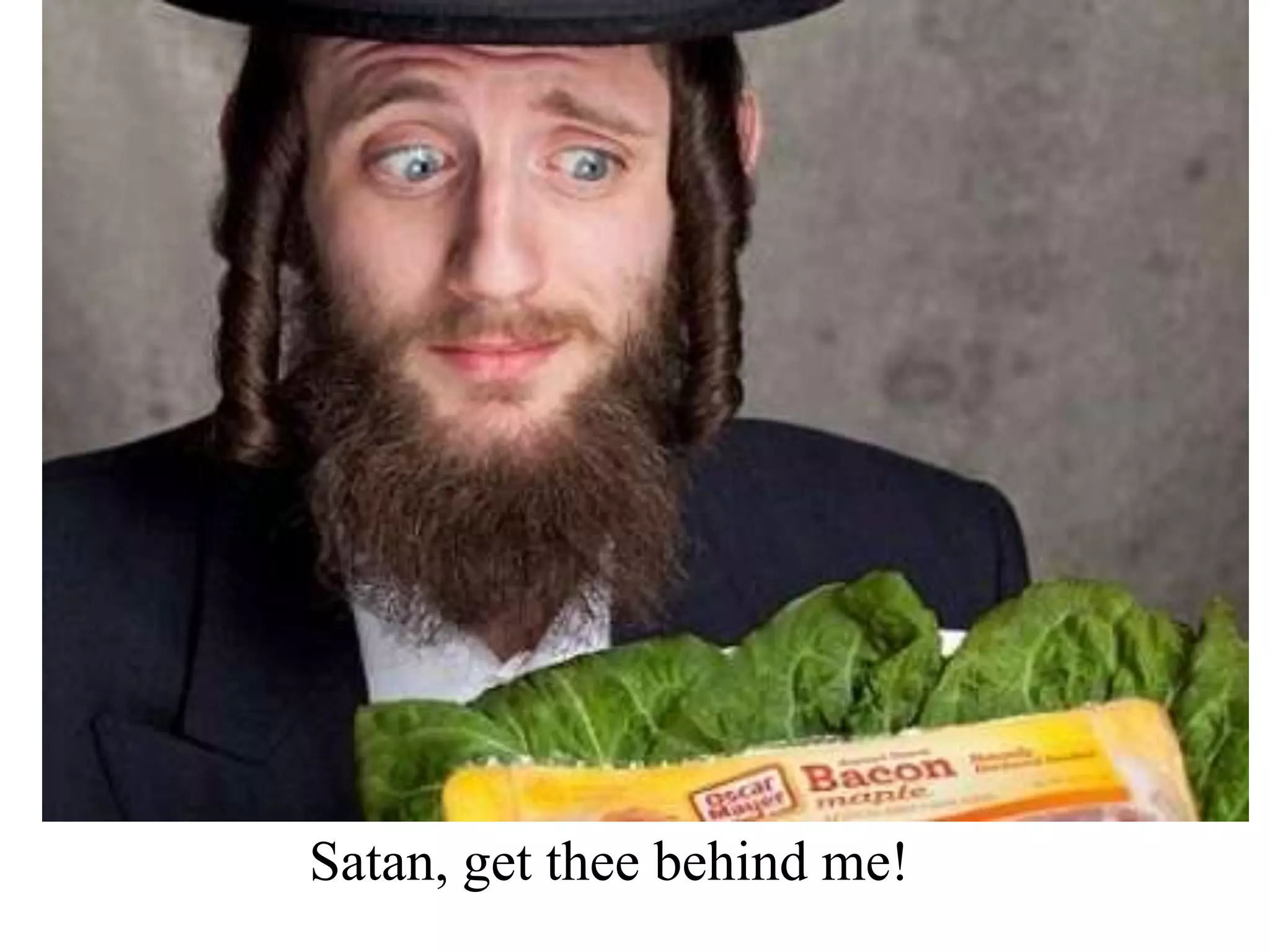
Satan, get thee behind me!
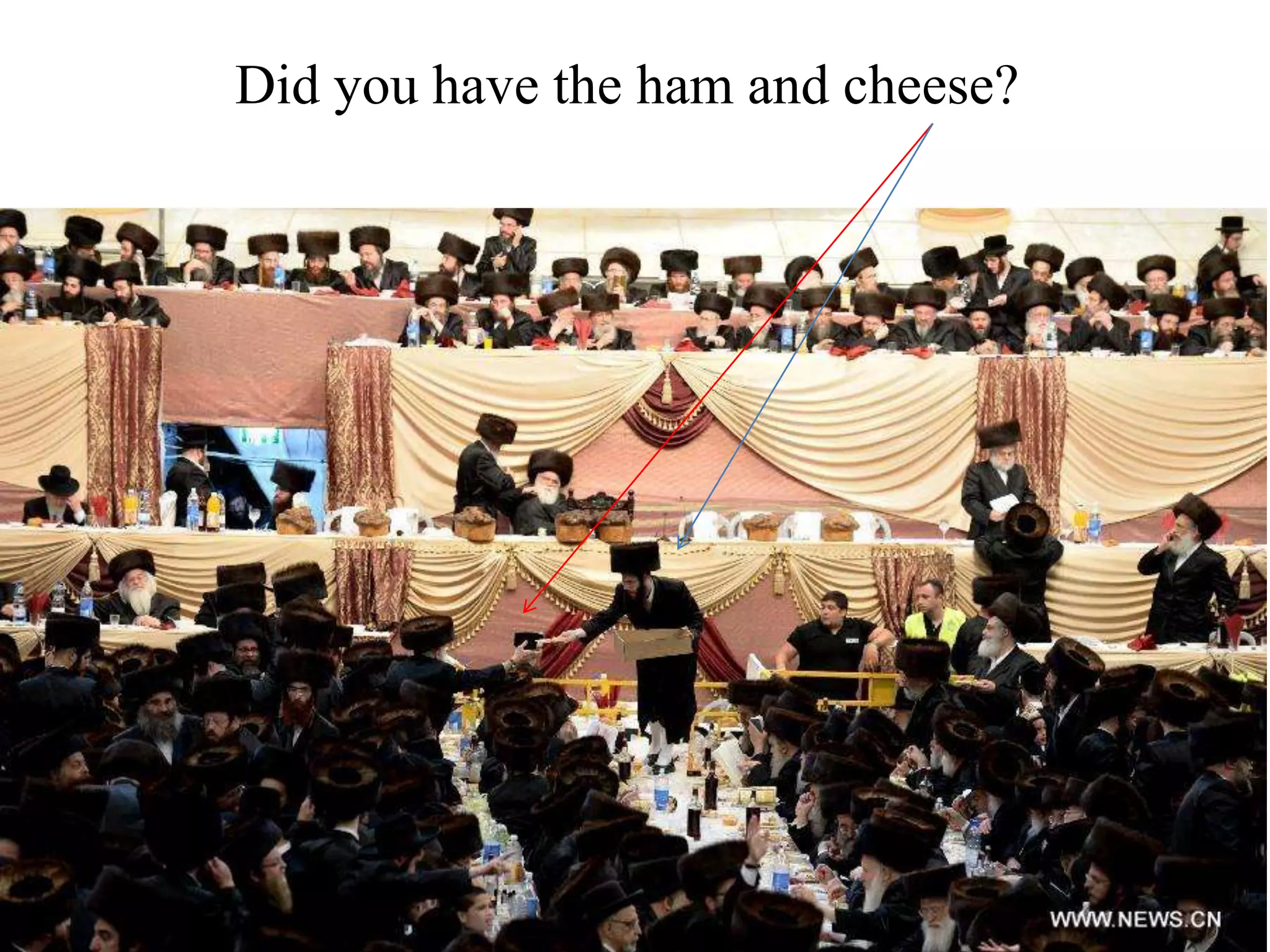
Did you have the ham and cheese?

Are those
toothpicks
kosher???
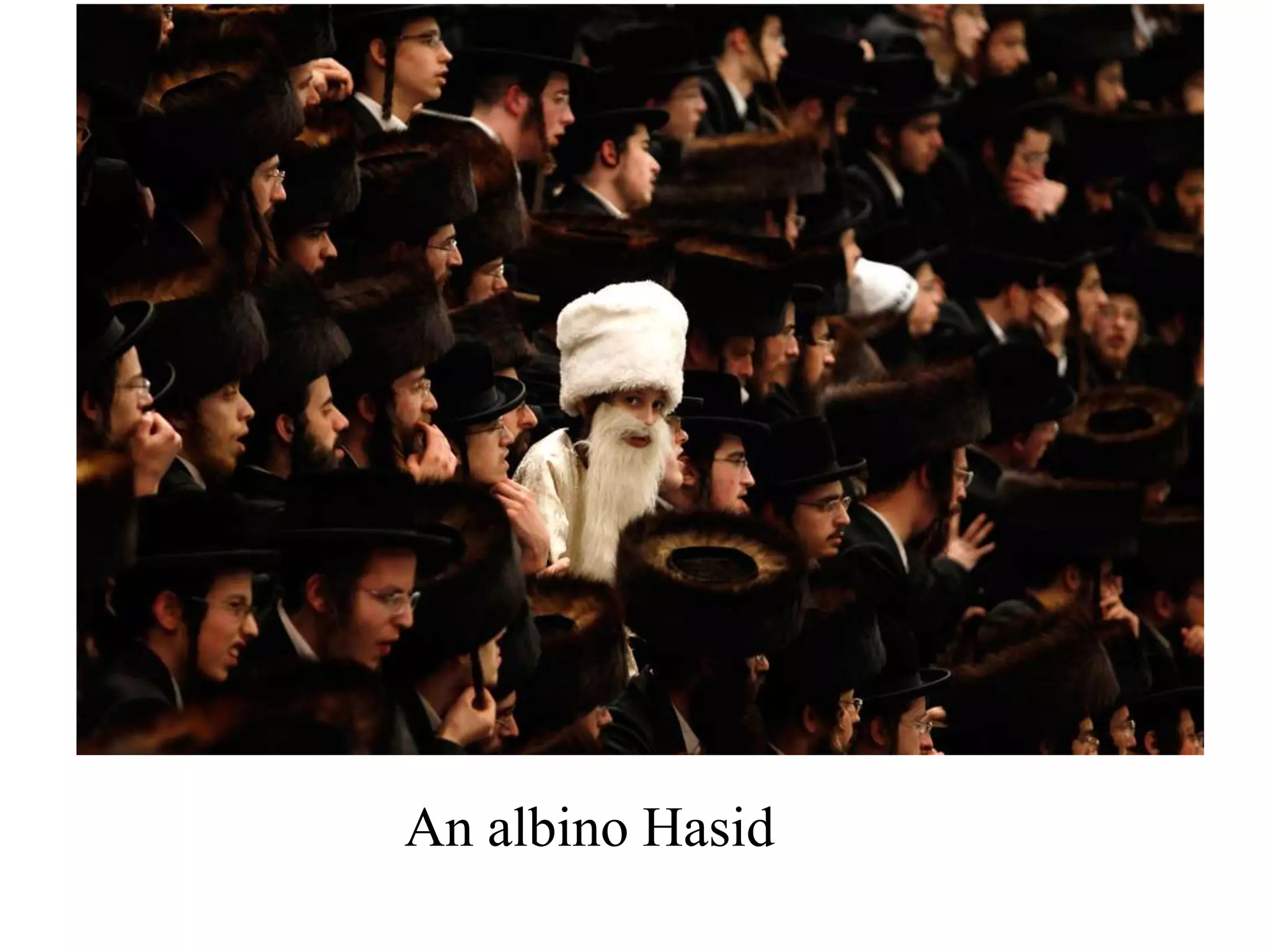
An albino Hasid
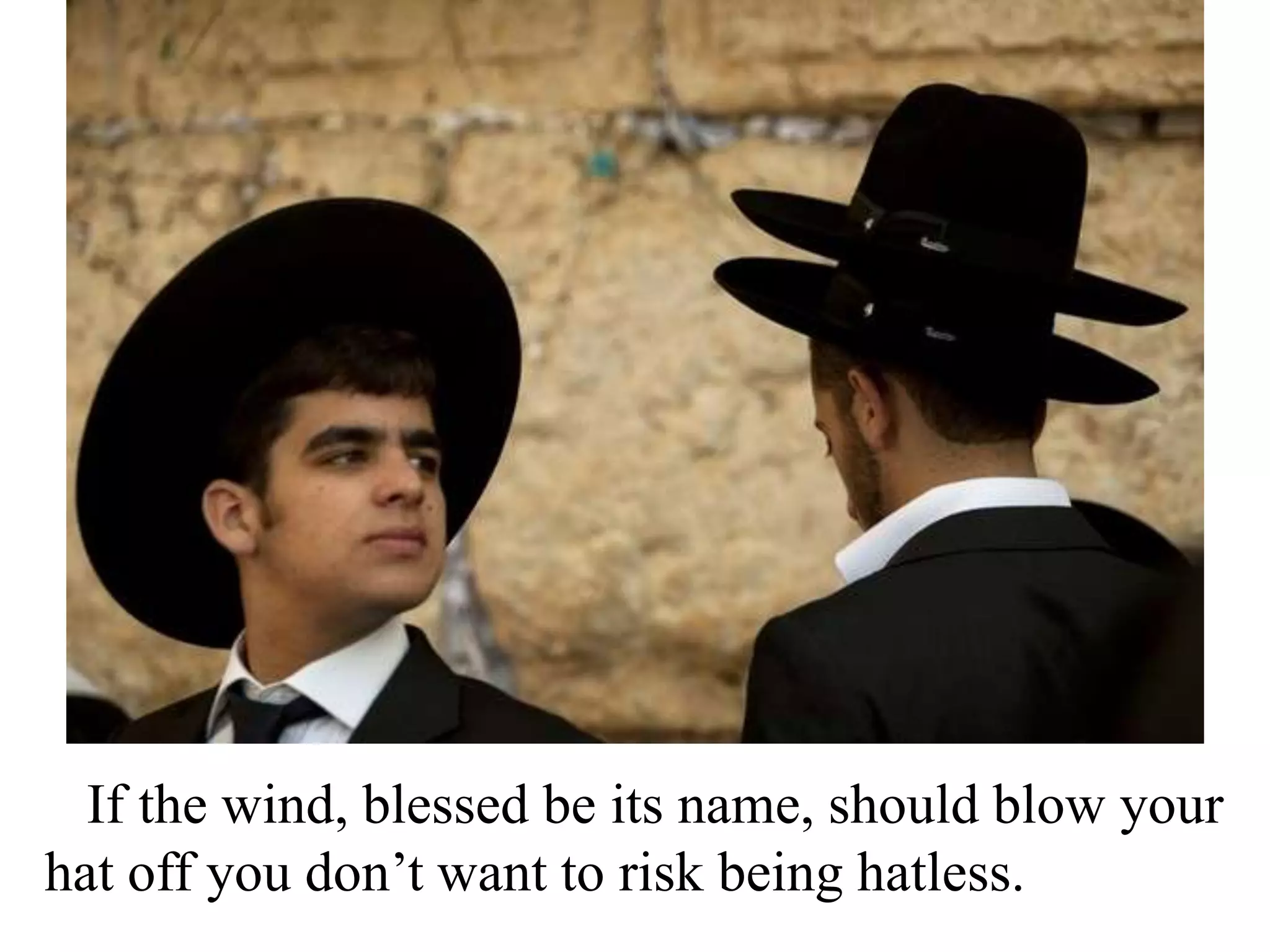
If the wind, blessed be its name, should blow your
hat off you don’t want to risk being hatless.
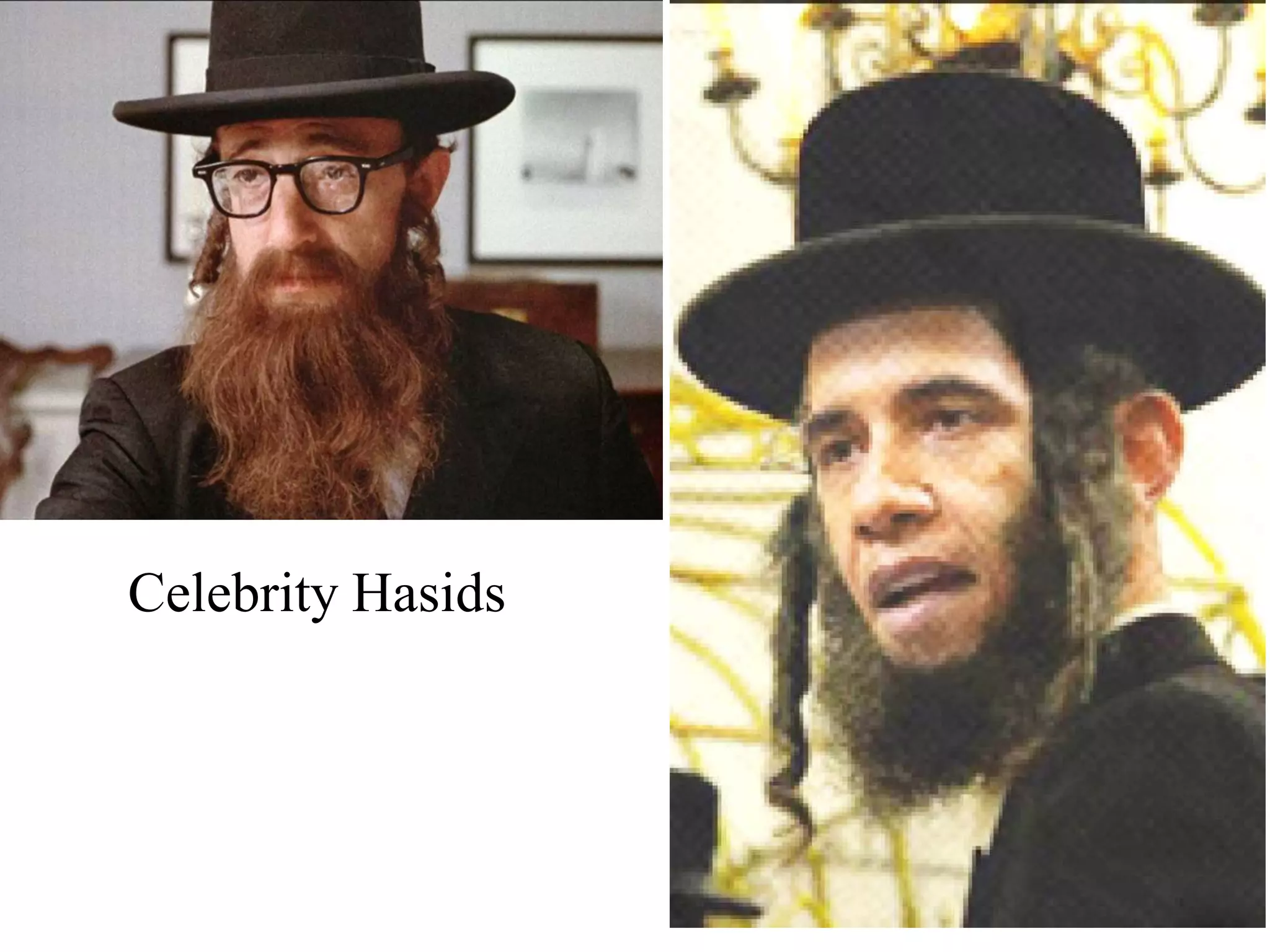
Celebrity Hasids
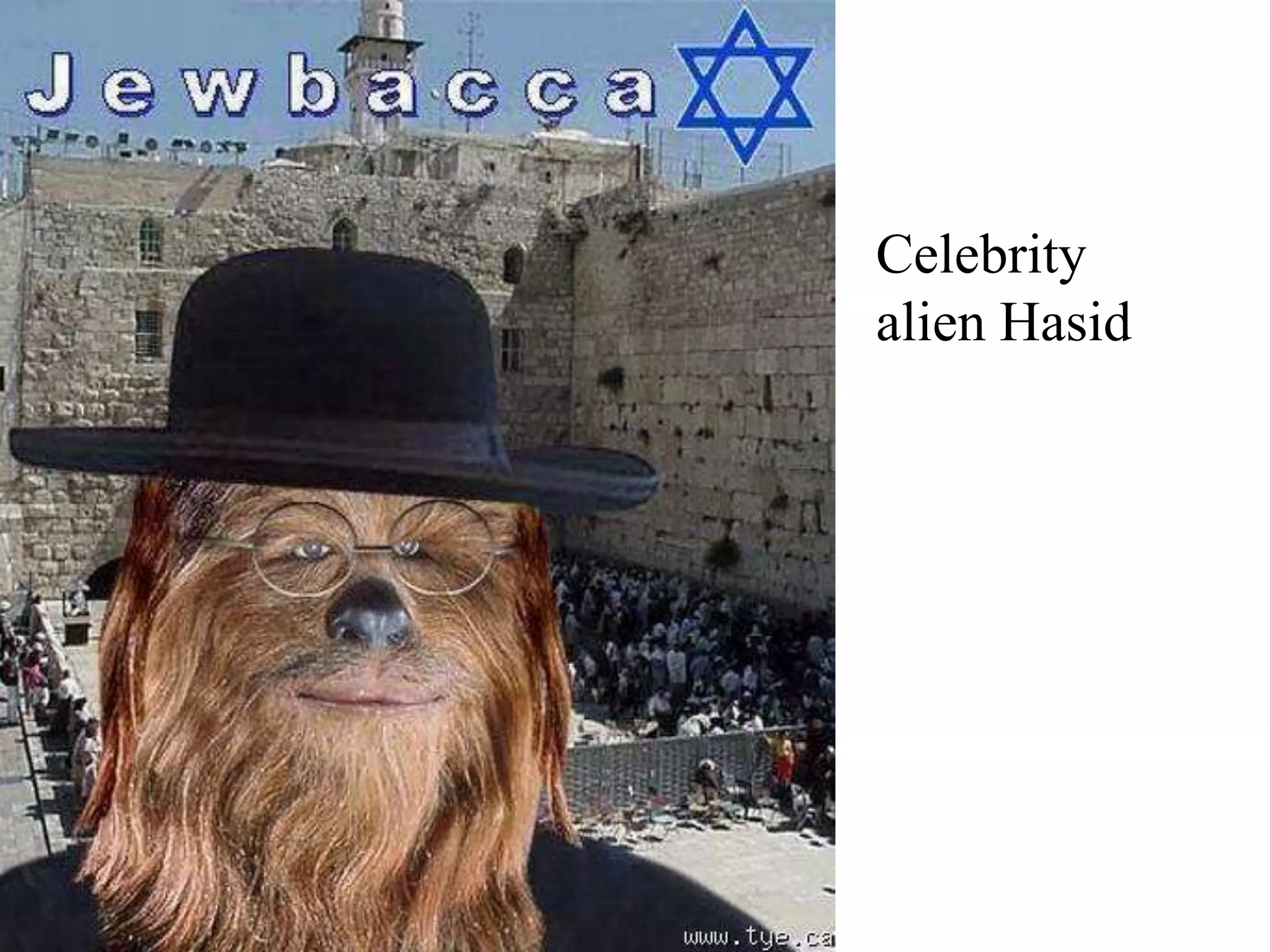
Celebrity
alien Hasid
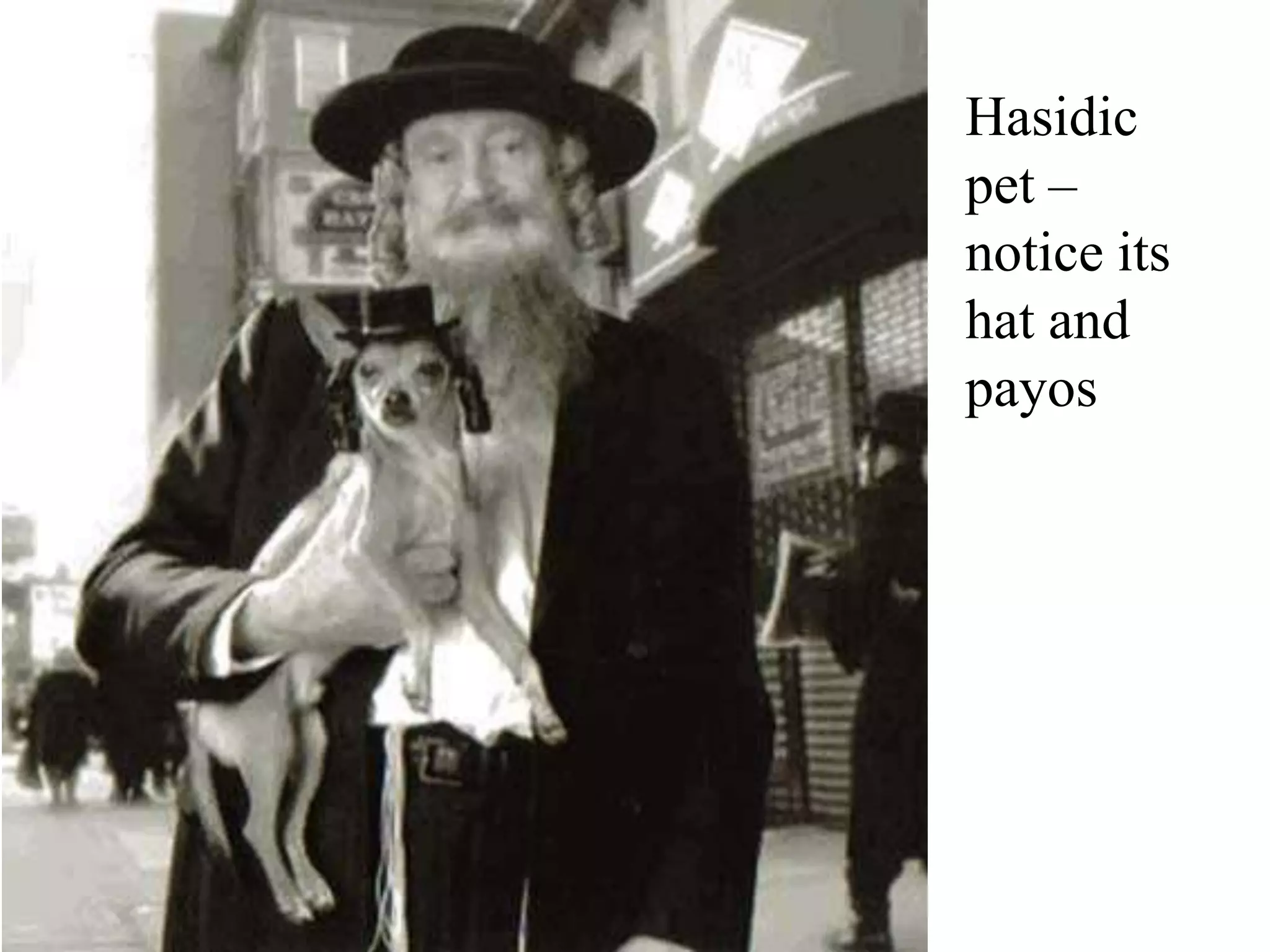
Hasidic
pet –
notice its
hat and
payos
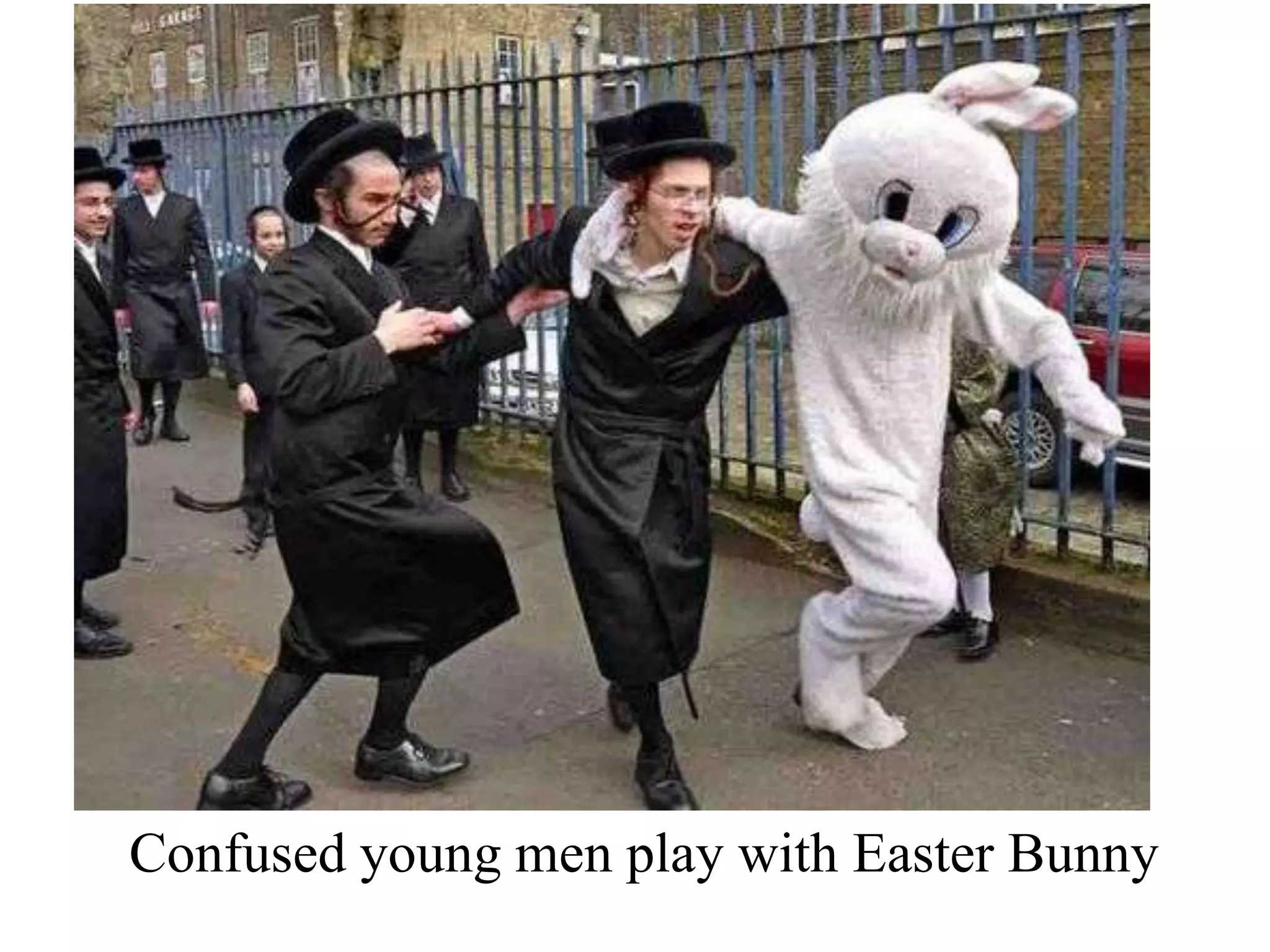
Confused young men play with Easter Bunny
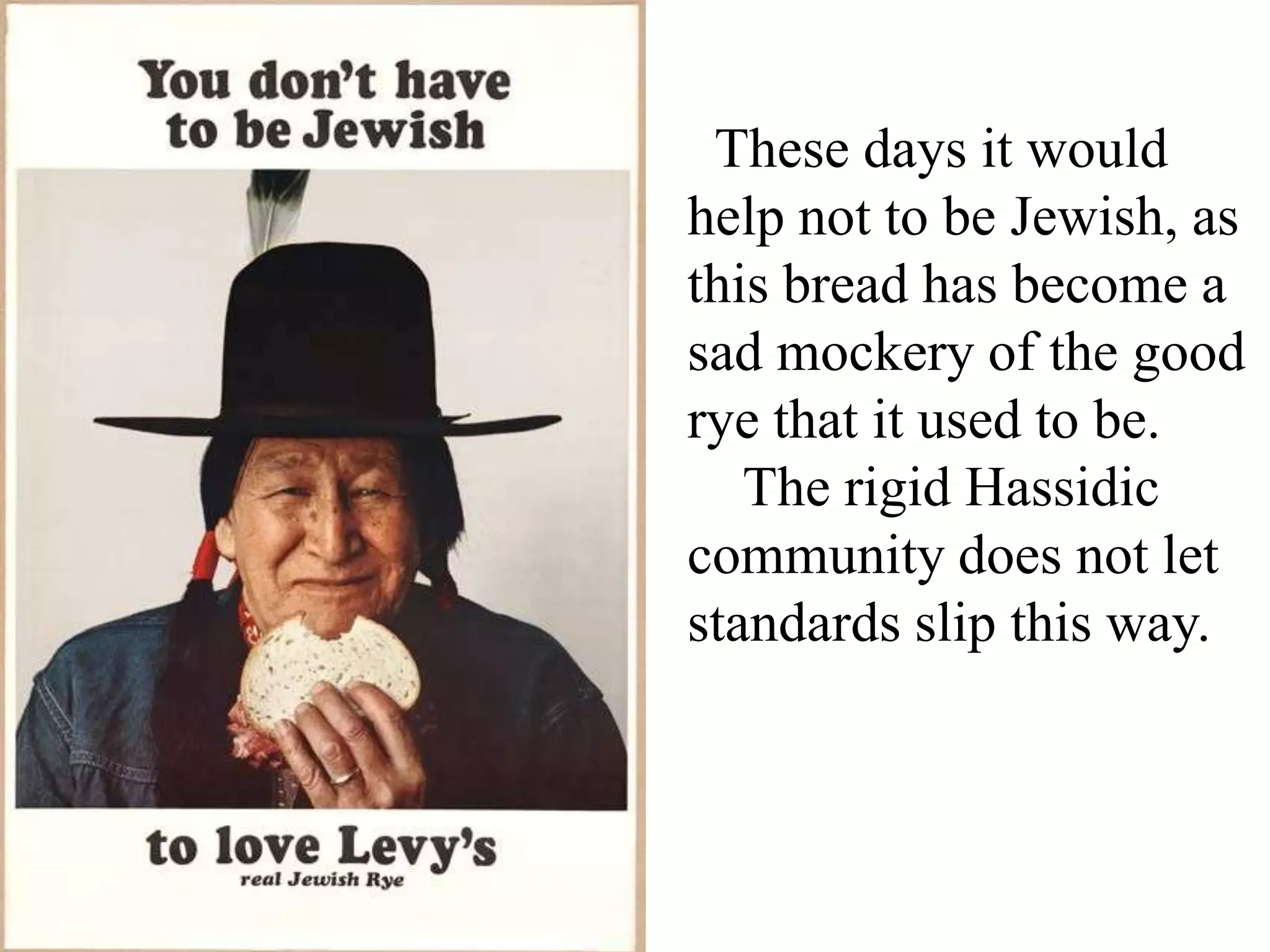
These days it would
help not to be Jewish, as
this bread has become a
sad mockery of the good
rye that it used to be.
The rigid Hassidic
community does not let
standards slip this way.
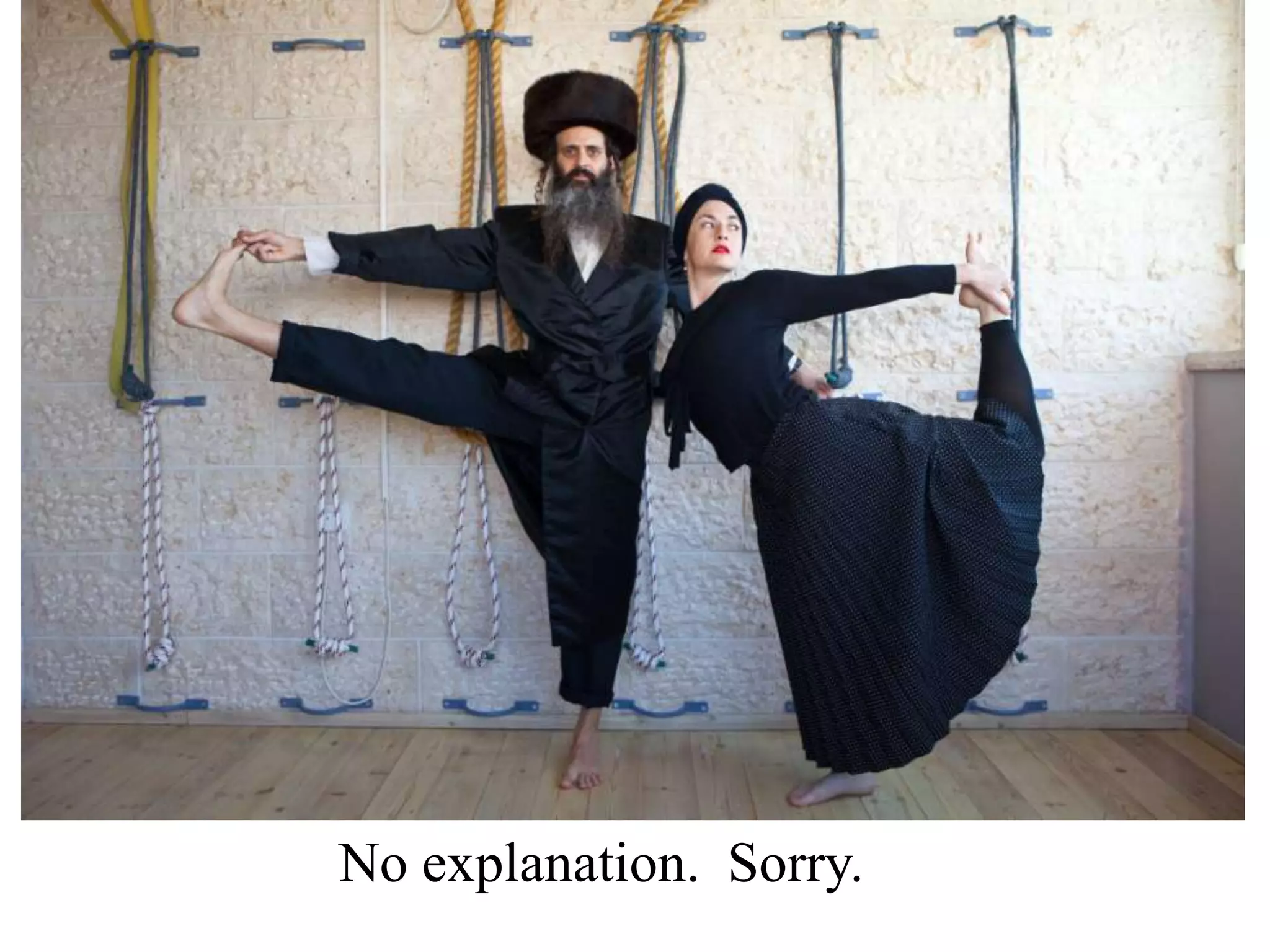
No explanation. Sorry.
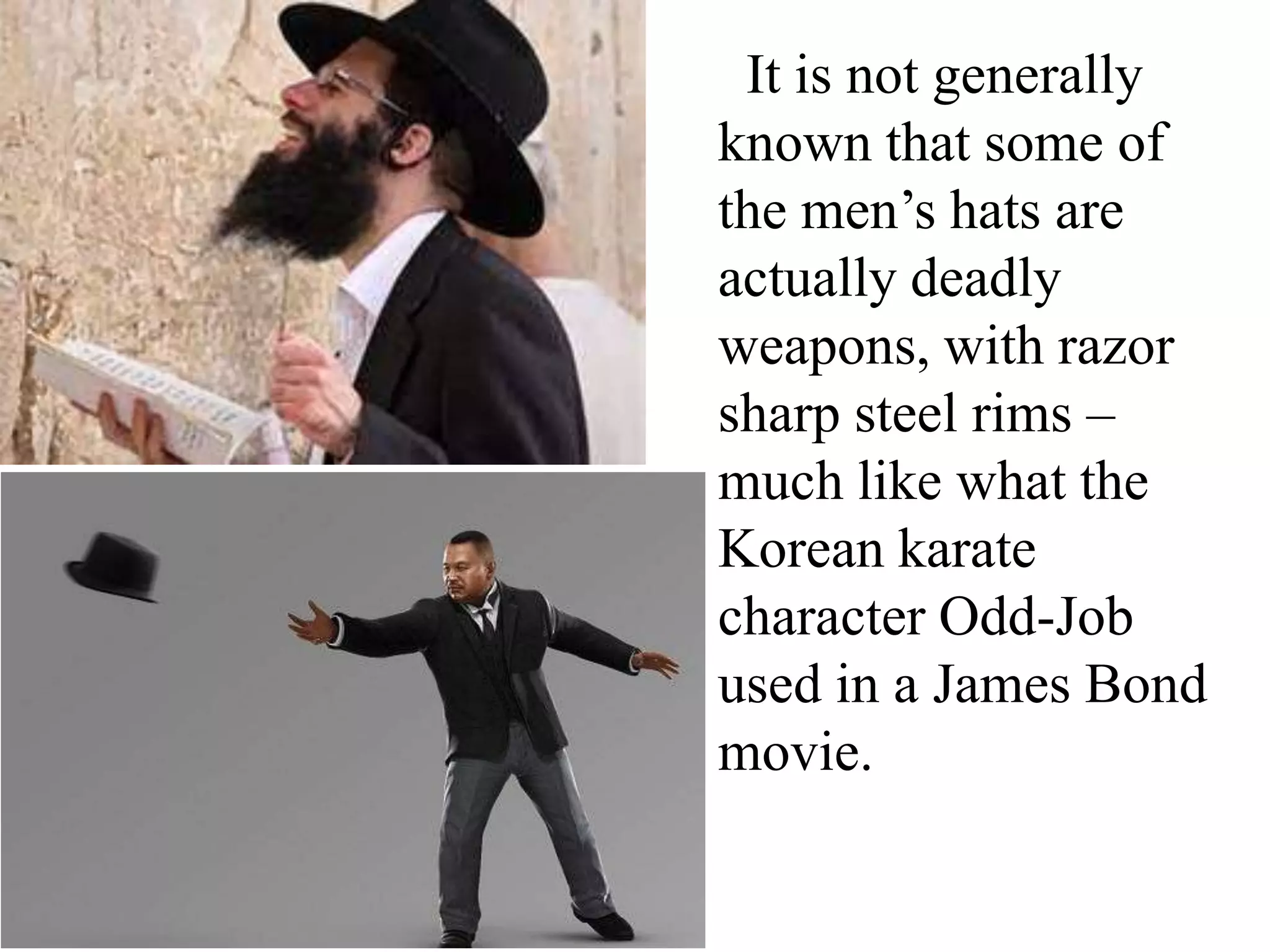
It is not generally
known that some of
the men’s hats are
actually deadly
weapons, with razor
sharp steel rims –
much like what the
Korean karate
character Odd-Job
used in a James Bond
movie.
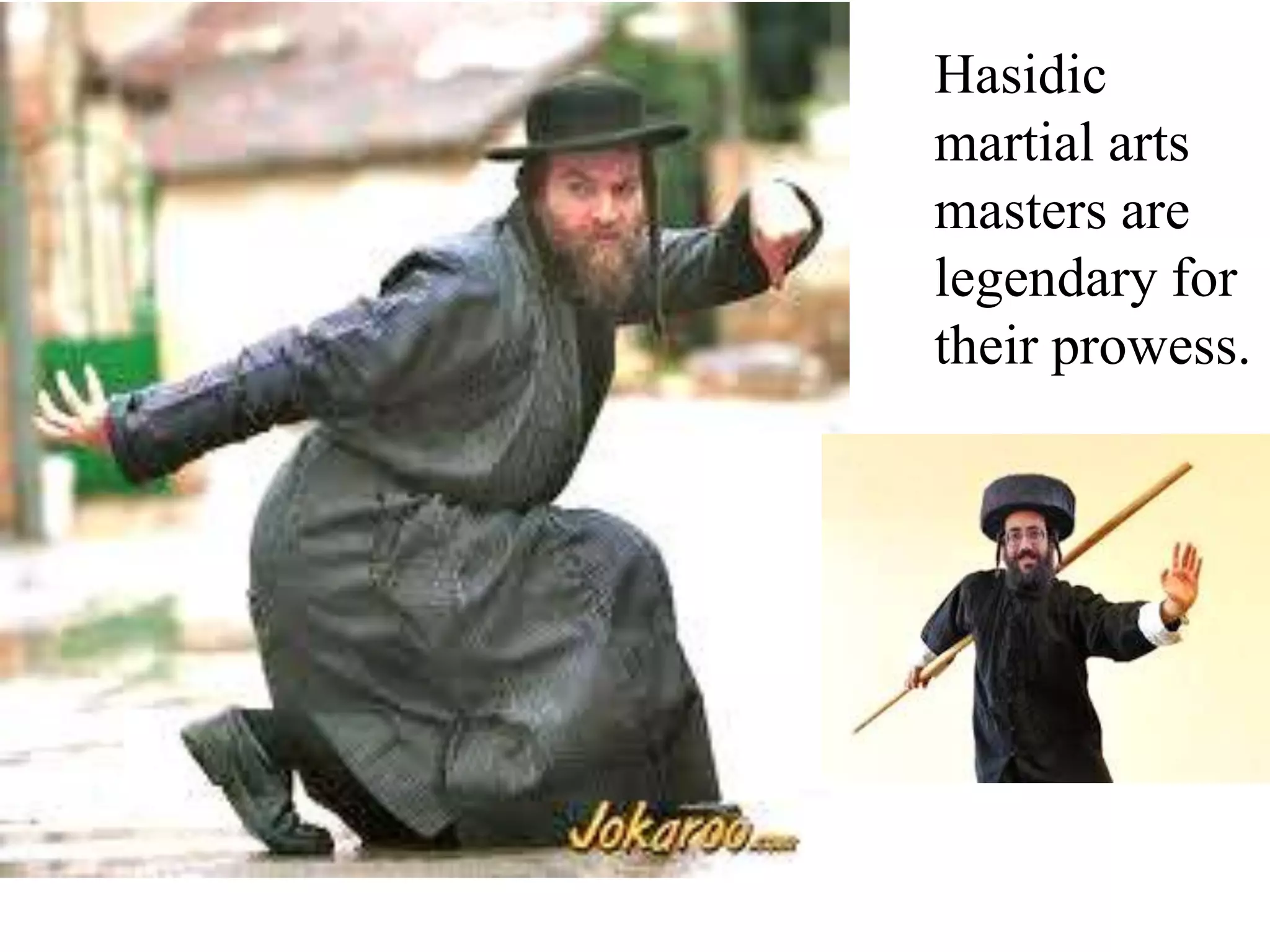
Hasidic
martial arts
masters are
legendary for
their prowess.
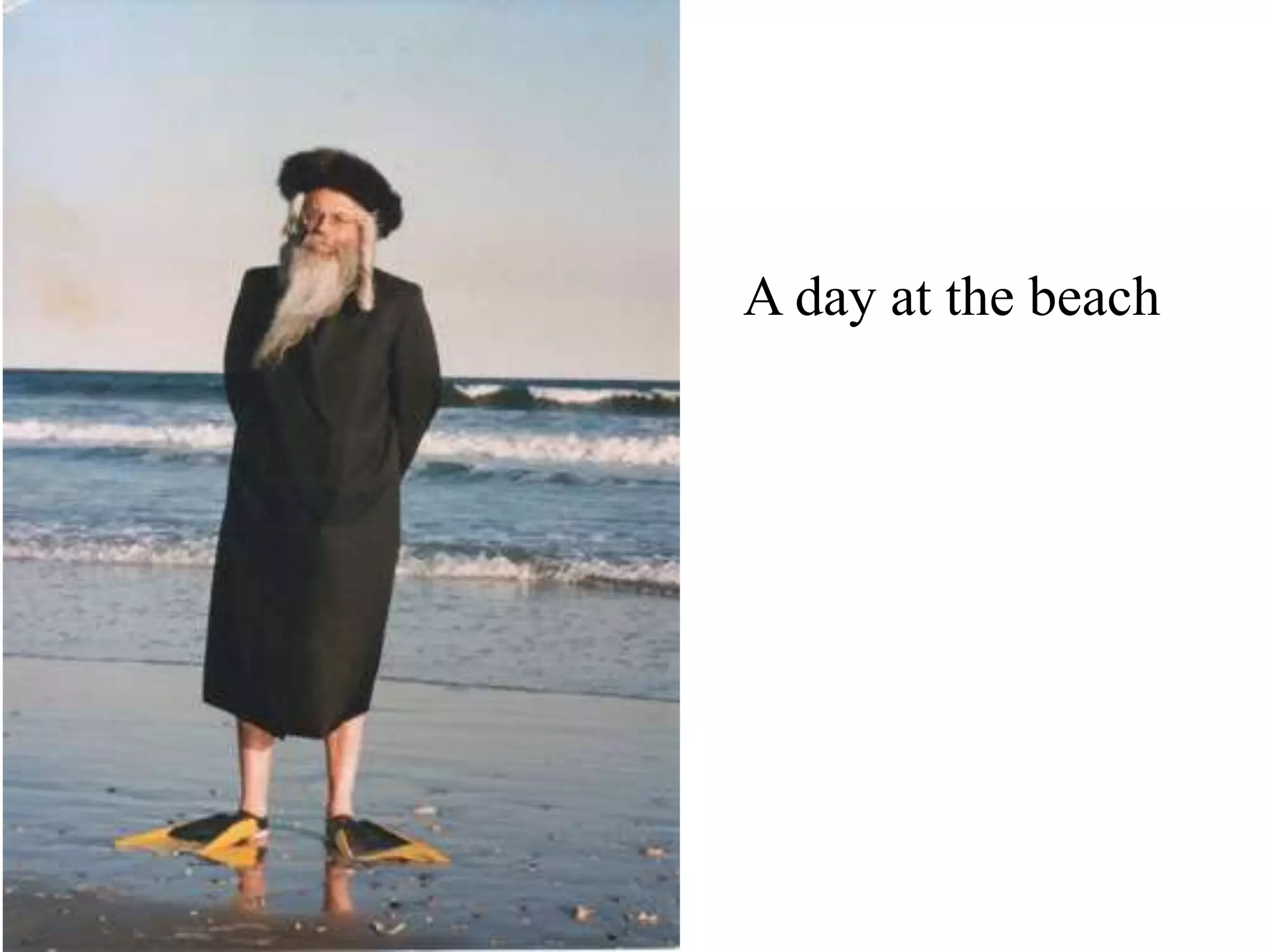
A day at the beach
And this is what you call a good pant’s seam?
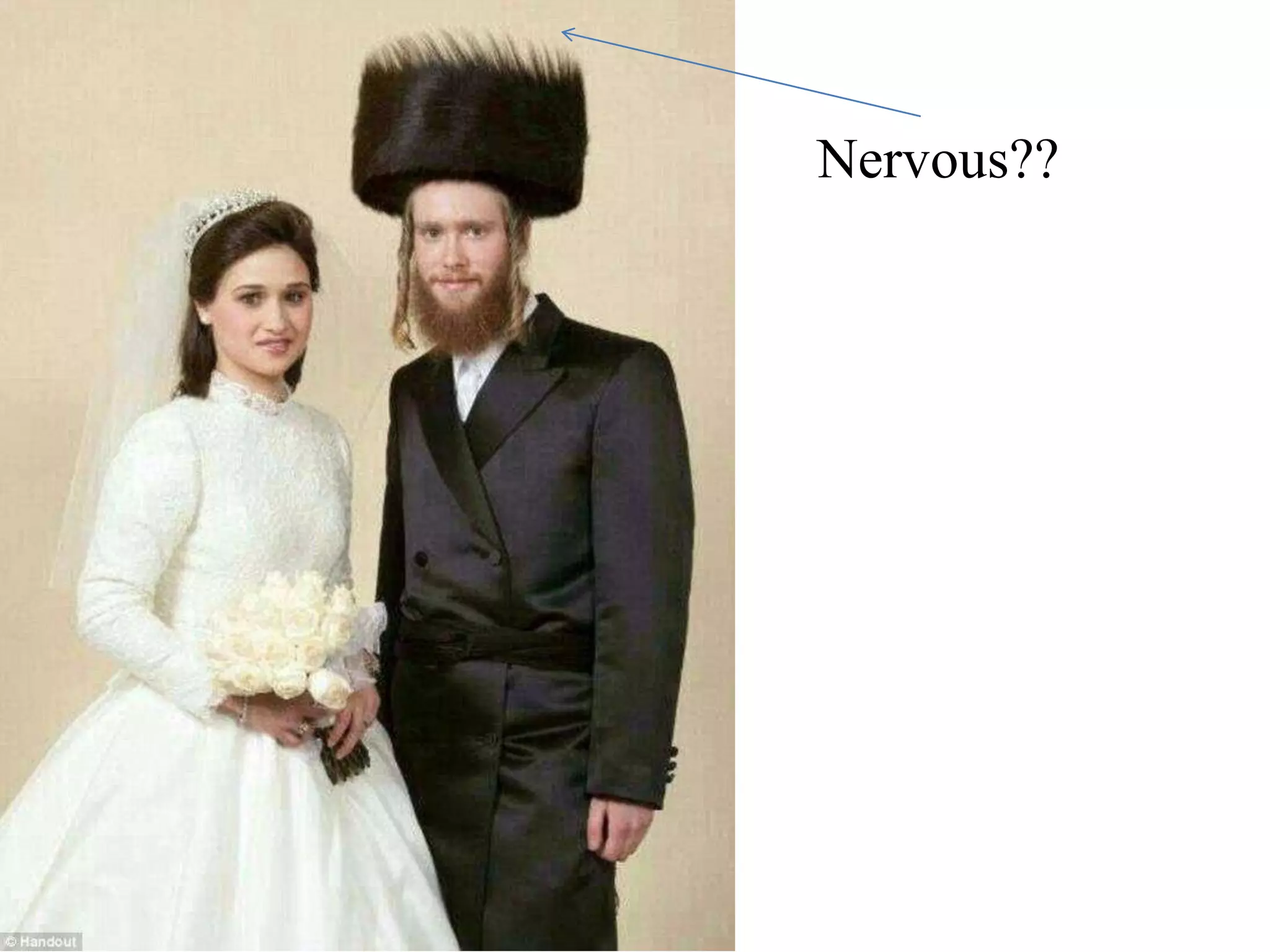
Nervous??
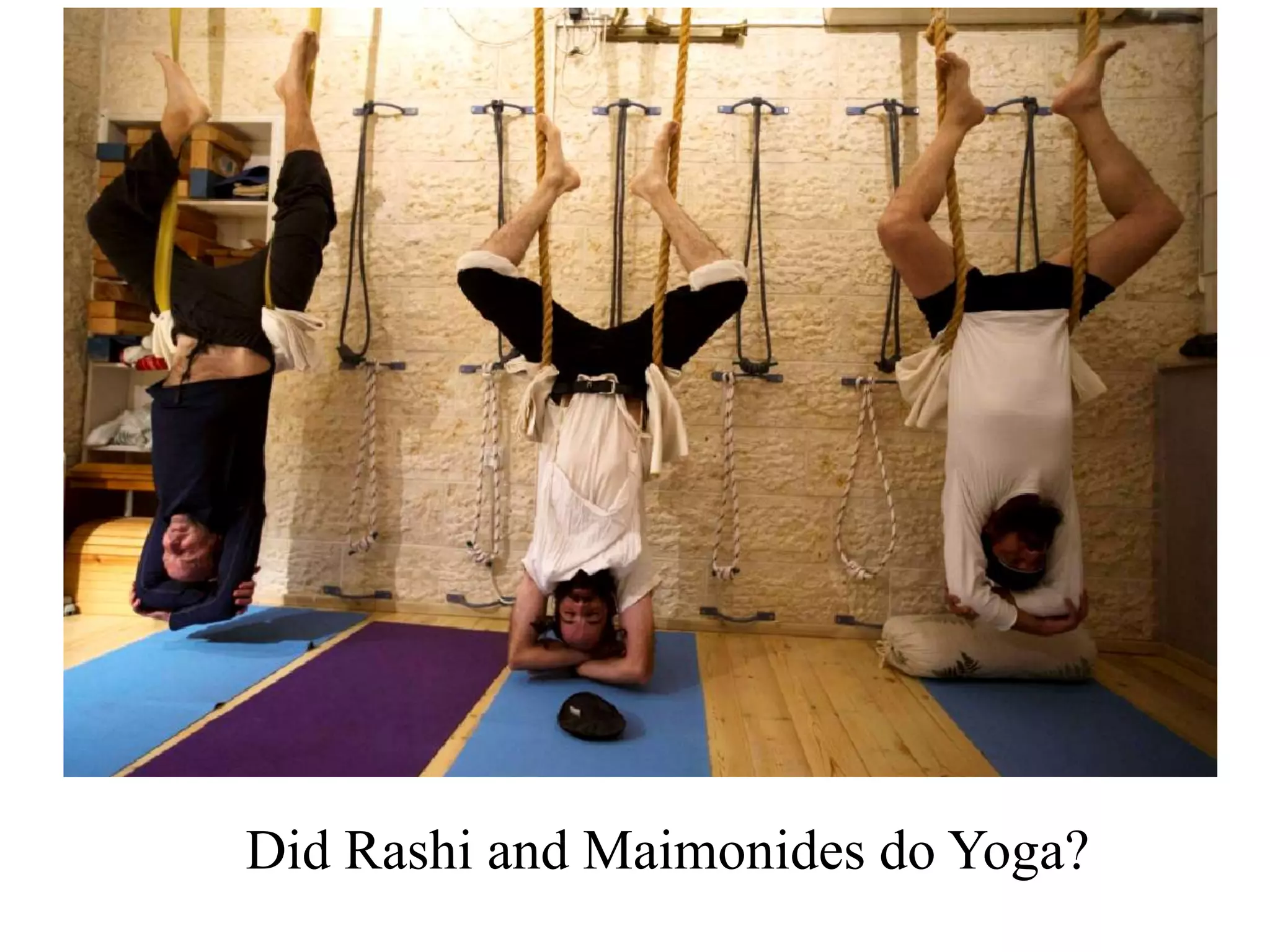
Did Rashi and Maimonides do Yoga?
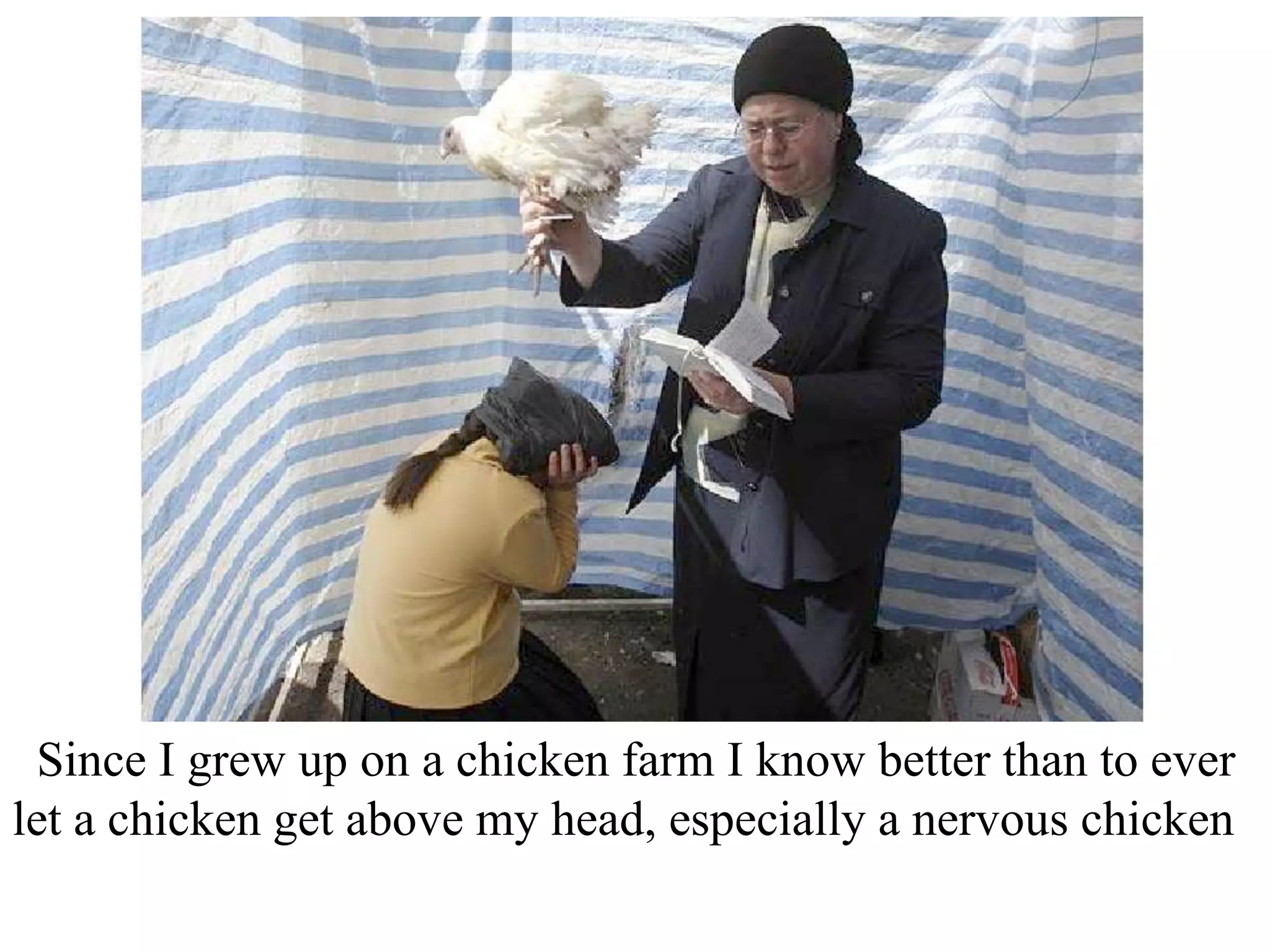
Since I grew up on a chicken farm I know better than to ever
let a chicken get above my head, especially a nervous chicken
The lighter (good) side of Hasidic life
(seriously)
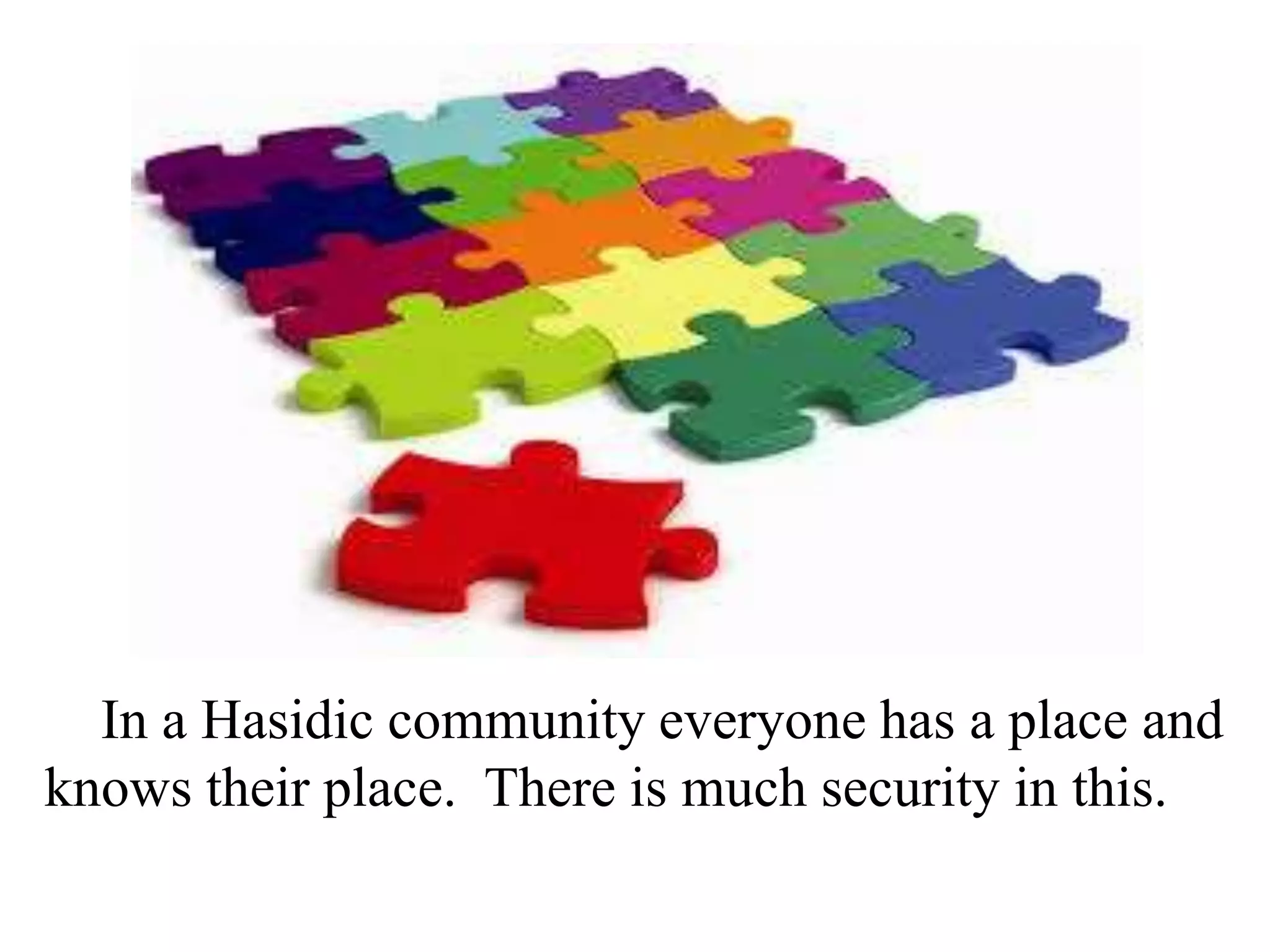
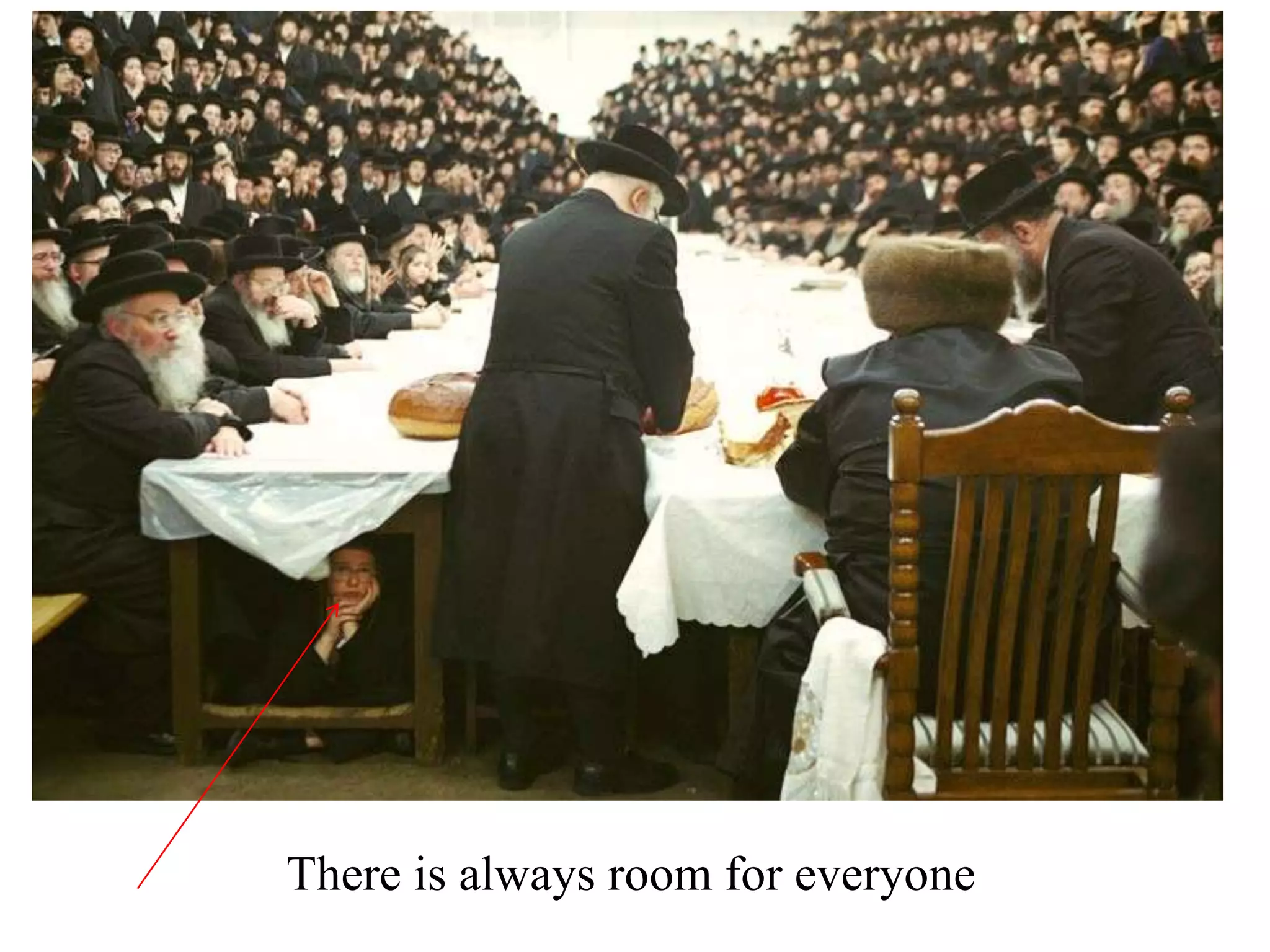
In a Hasidic community everyone has a place and
knows their place. There is much security in this.
There is always room for everyone
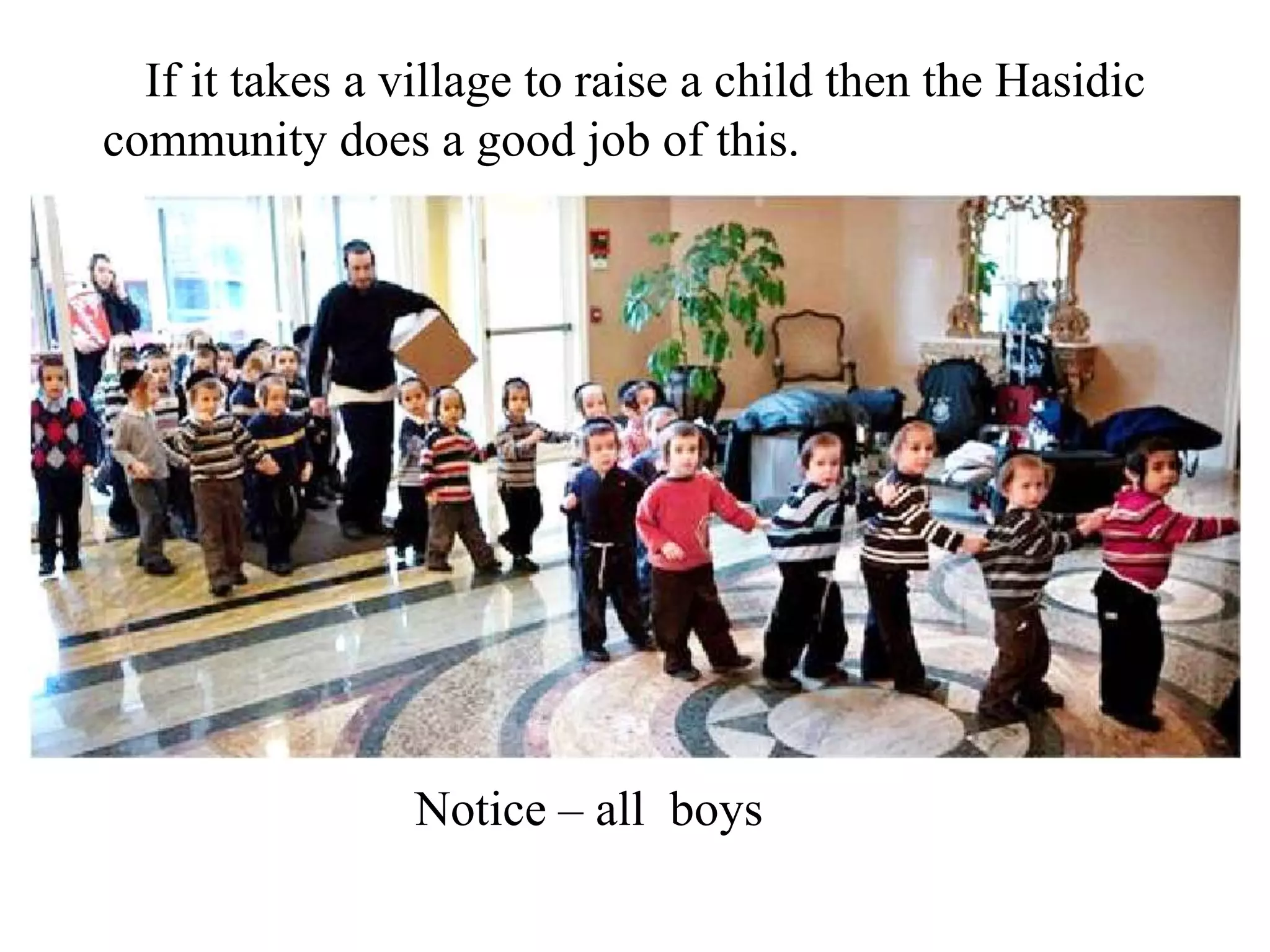
If it takes a village to raise a child then the Hasidic
community does a good job of this.

Notice – all boys
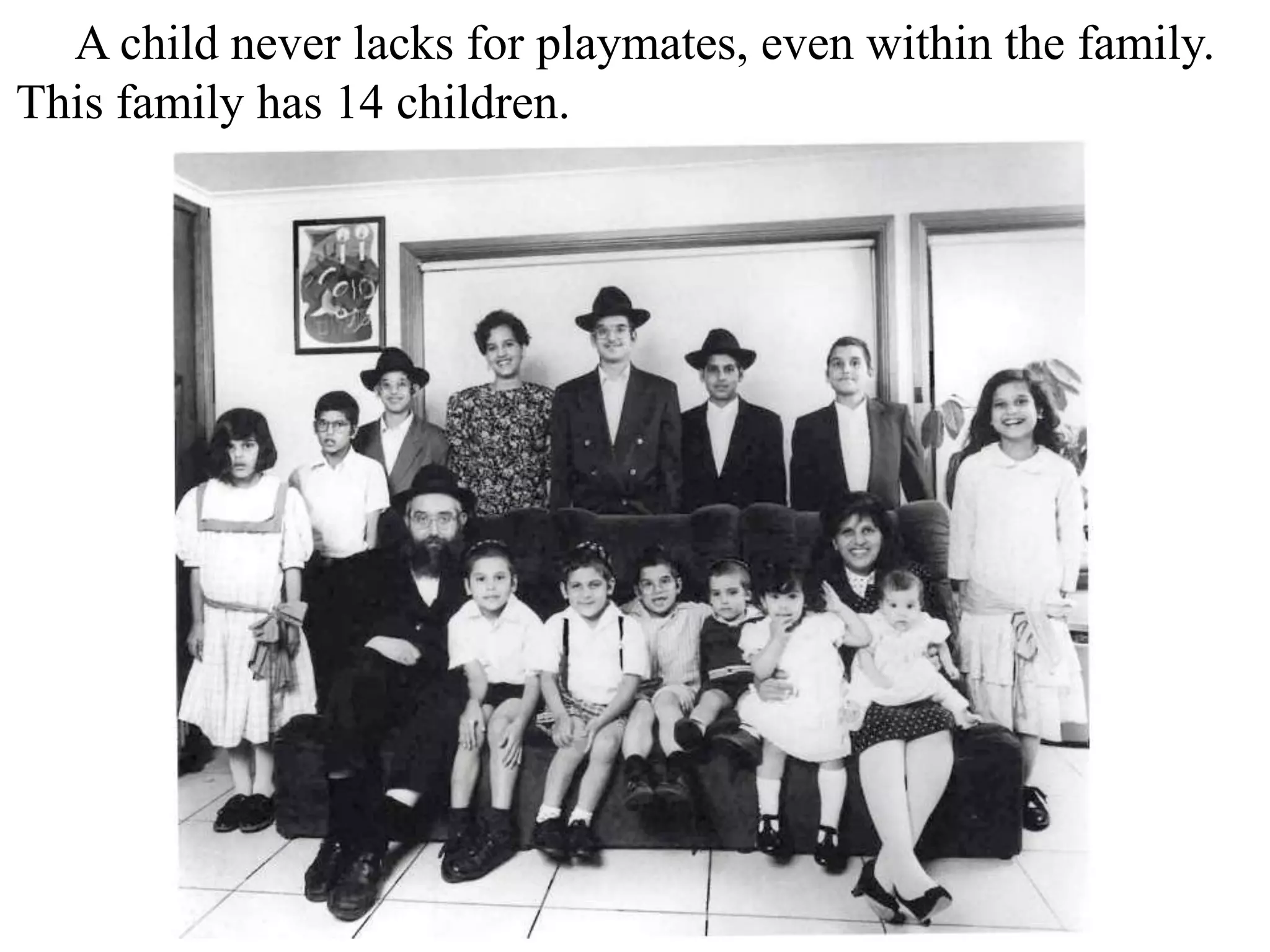
A child never lacks for playmates, even within the family.
This family has 14 children.
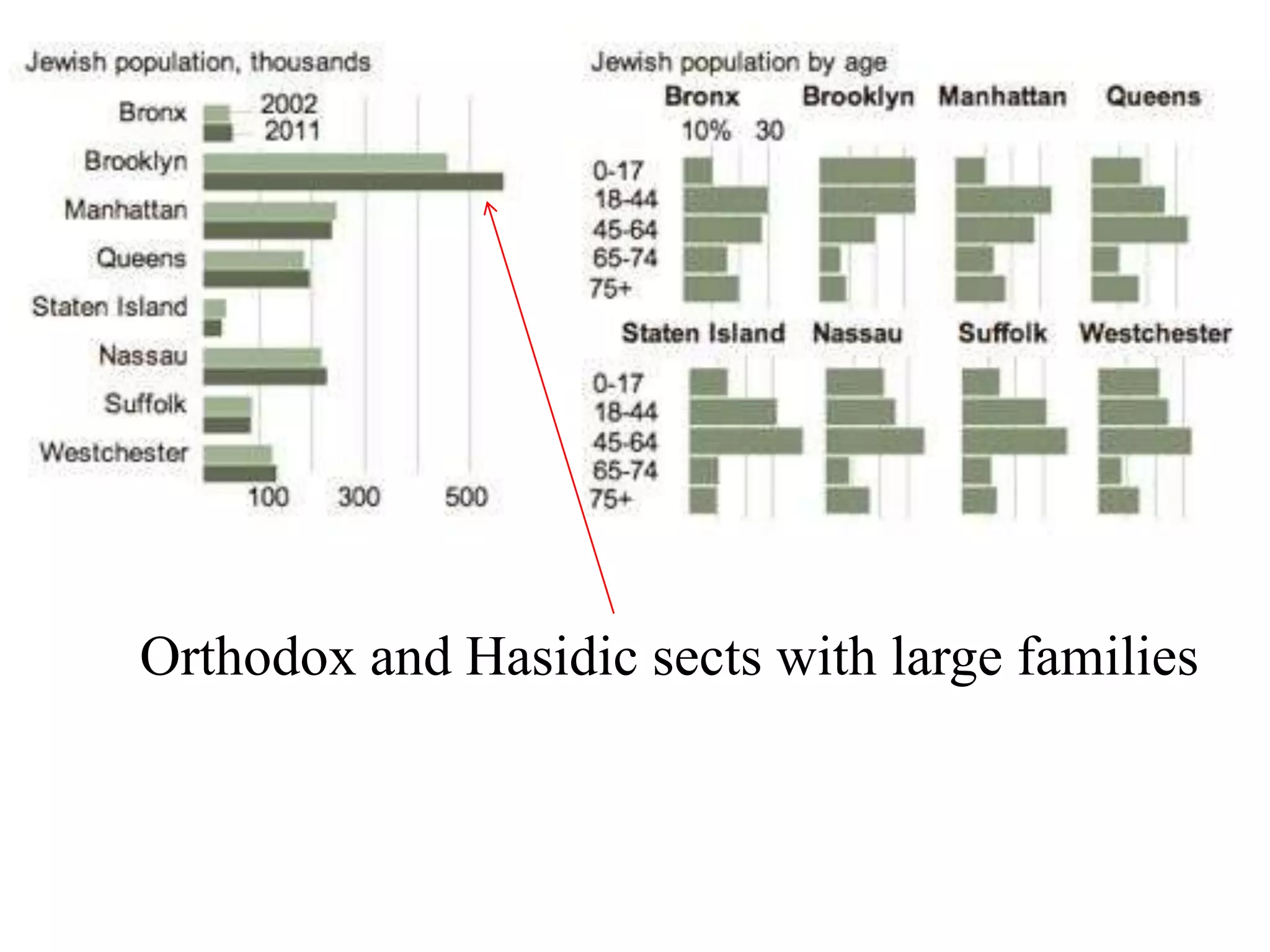
Orthodox and Hasidic sects with large families
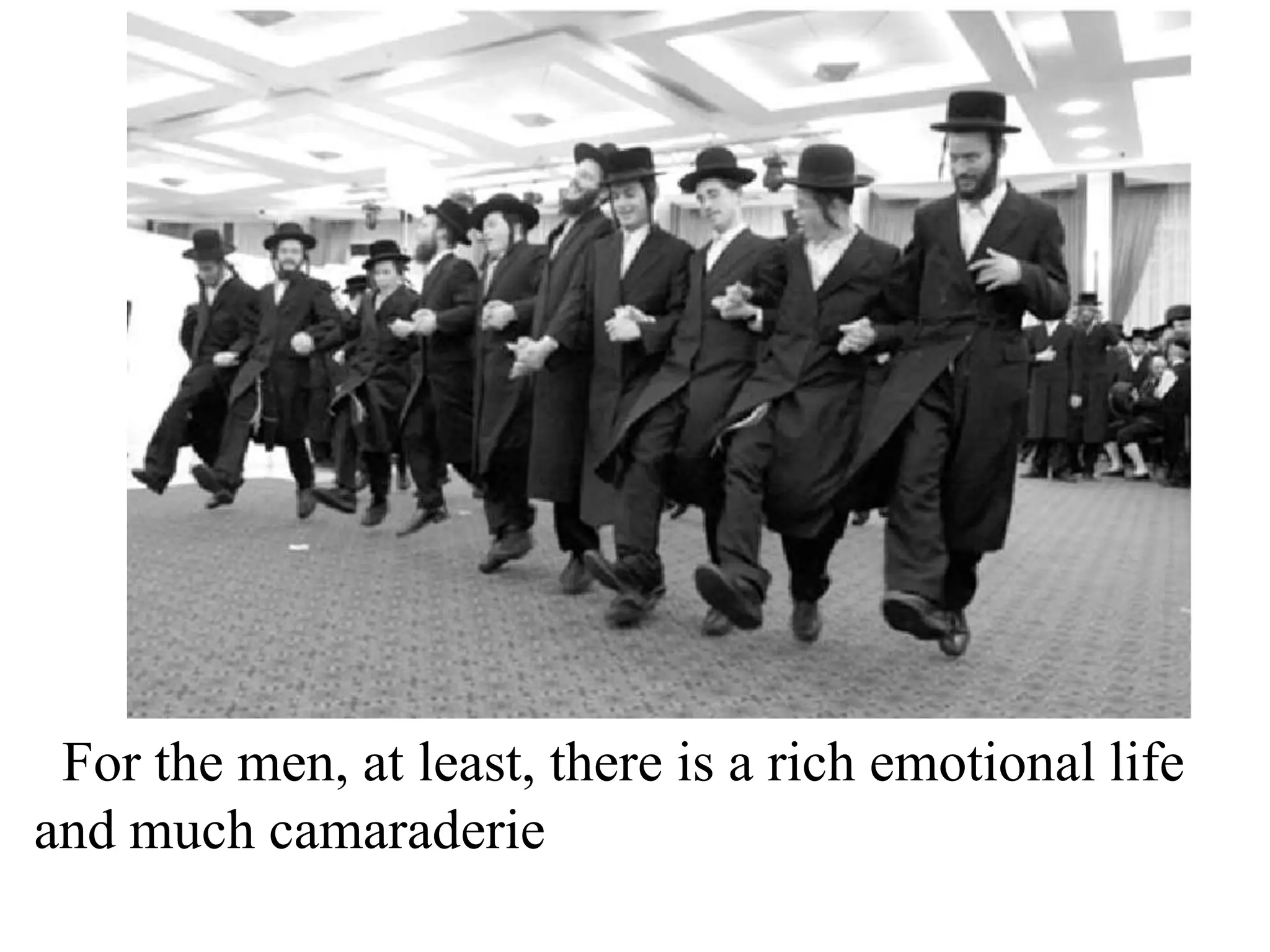
For the men, at least, there is a rich emotional life
and much camaraderie
show dancing video here
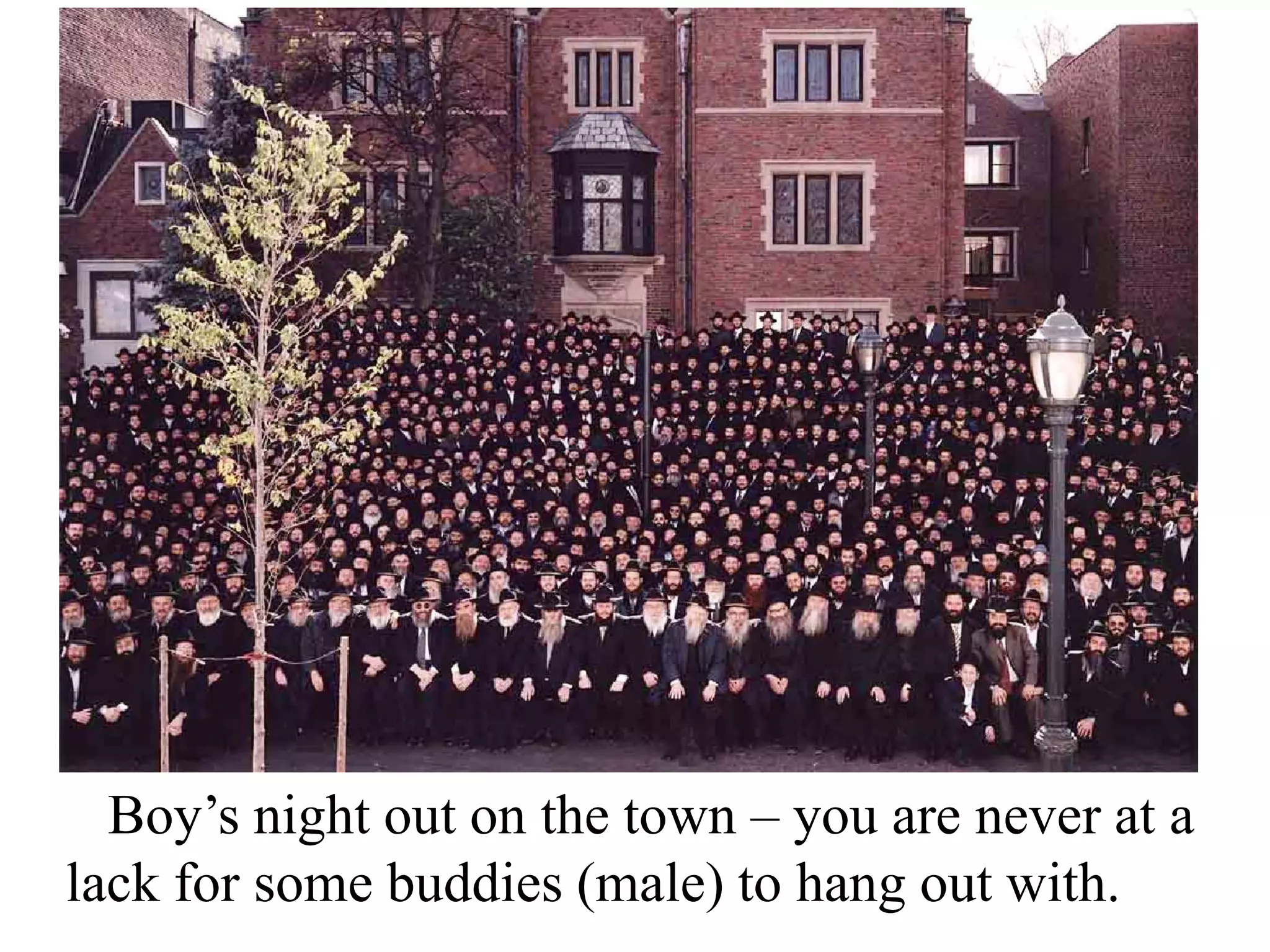
Boy’s night out on the town – you are never at a
lack for some buddies (male) to hang out with.
Spirituality for the
common man and woman you do not have to be highly
educated in the Torah to
worship and experience God
in one’s daily life.
Hasids emphasize a
joyous and emotional
attitude towards life, and
nature. It is more a life of
doing and feeling than one
of Torah study. There is a
mystical component to life.
At a time when less rigorous forms of Judaism are
in declining health, ultraorthodox and Hasidic sects
are in robust health and have a growing population.
Let’s stop for a moment here – who are these
people? What is the difference between the
Orthodox and the Hasidim?
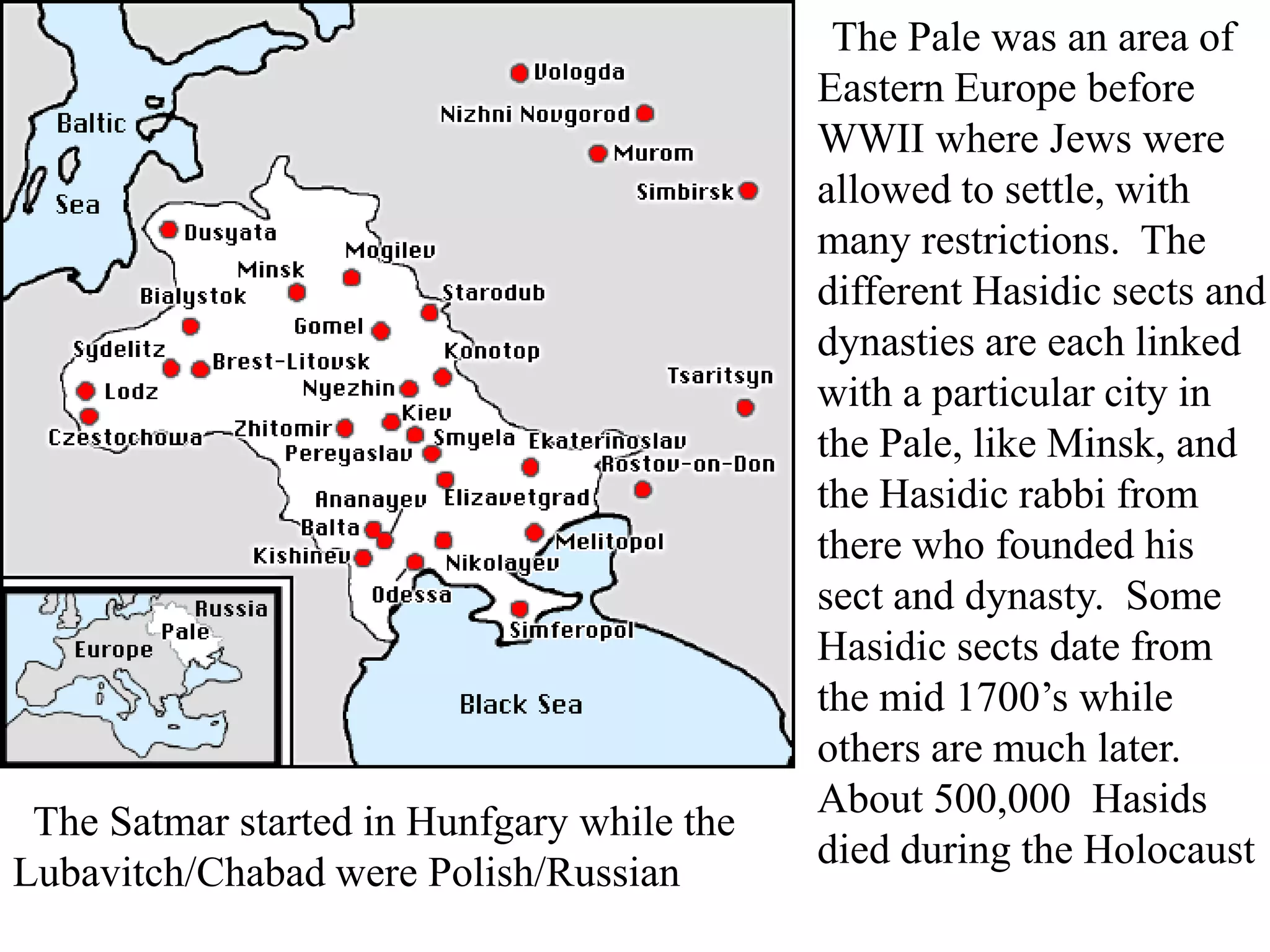
The Satmar started in Hunfgary while the
Lubavitch/Chabad were Polish/Russian

The Pale was an area of
Eastern Europe before
WWII where Jews were
allowed to settle, with
many restrictions. The
different Hasidic sects and
dynasties are each linked
with a particular city in
the Pale, like Minsk, and
the Hasidic rabbi from
there who founded his
sect and dynasty. Some
Hasidic sects date from
the mid 1700’s while
others are much later.
About 500,000 Hasids
died during the Holocaust
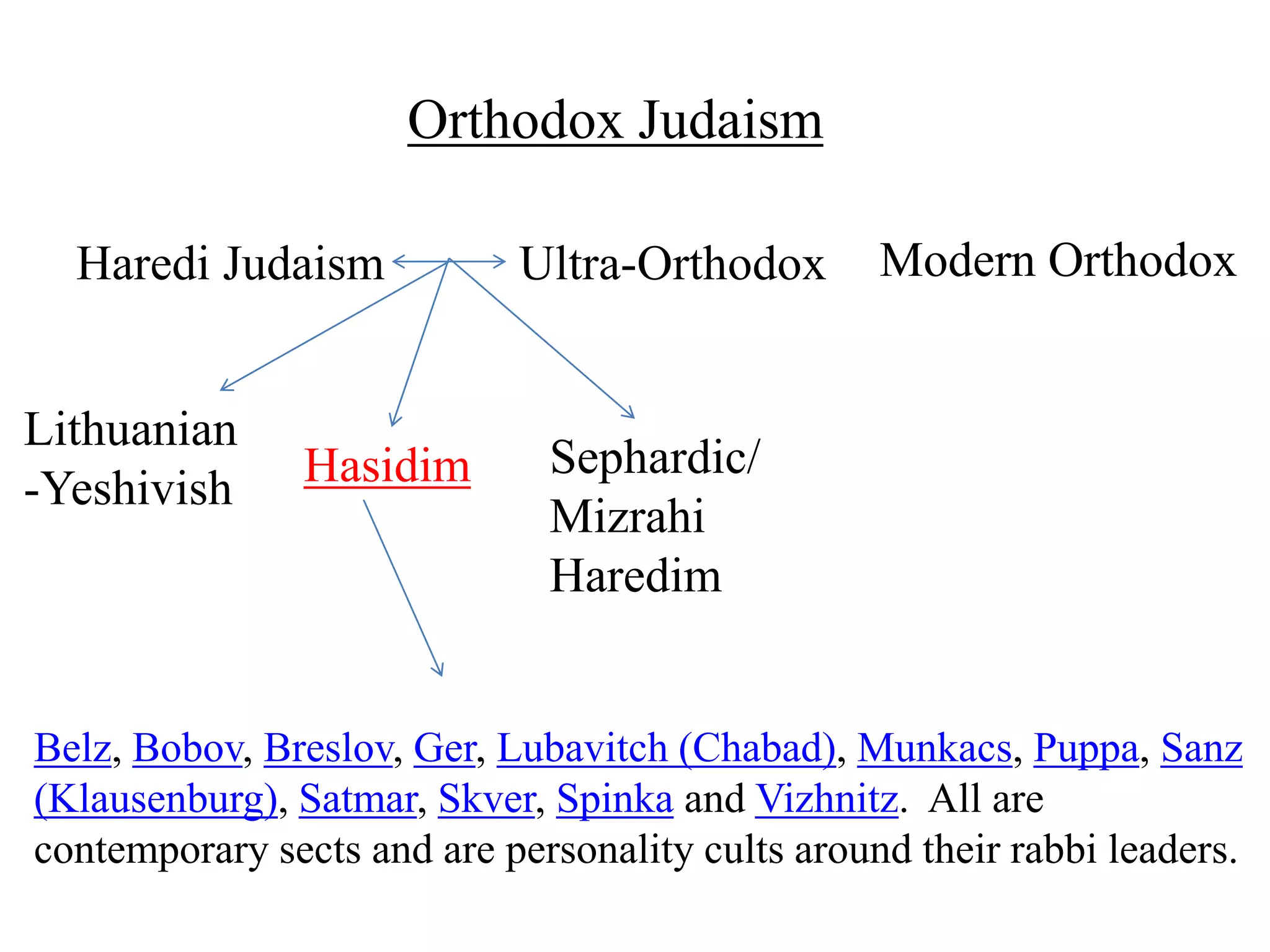
Orthodox Judaism
Haredi Judaism
Lithuanian
-Yeshivish

Hasidim

Ultra-Orthodox

Modern Orthodox

Sephardic/
Mizrahi
Haredim

Belz, Bobov, Breslov, Ger, Lubavitch (Chabad), Munkacs, Puppa, Sanz
(Klausenburg), Satmar, Skver, Spinka and Vizhnitz. All are
contemporary sects and are personality cults around their rabbi leaders.
There has been a lot of evolution in
the nature of the Hasidic movement
since its start in Eastern Europe about
250 years ago. It began as a reaction
against excessively dry Torah study
and featured a joyous and emotional
semi-mystical individual approach to
the worship of God. But then over
time it changed to be a cult centered on
the personality of the charismatic rabbi
leaders of each of the various sects.
Hereditary dynasties were set up. New
restrictions were placed on people’s
daily lives. Modern Hasidic life is a
corruption of the original movement.
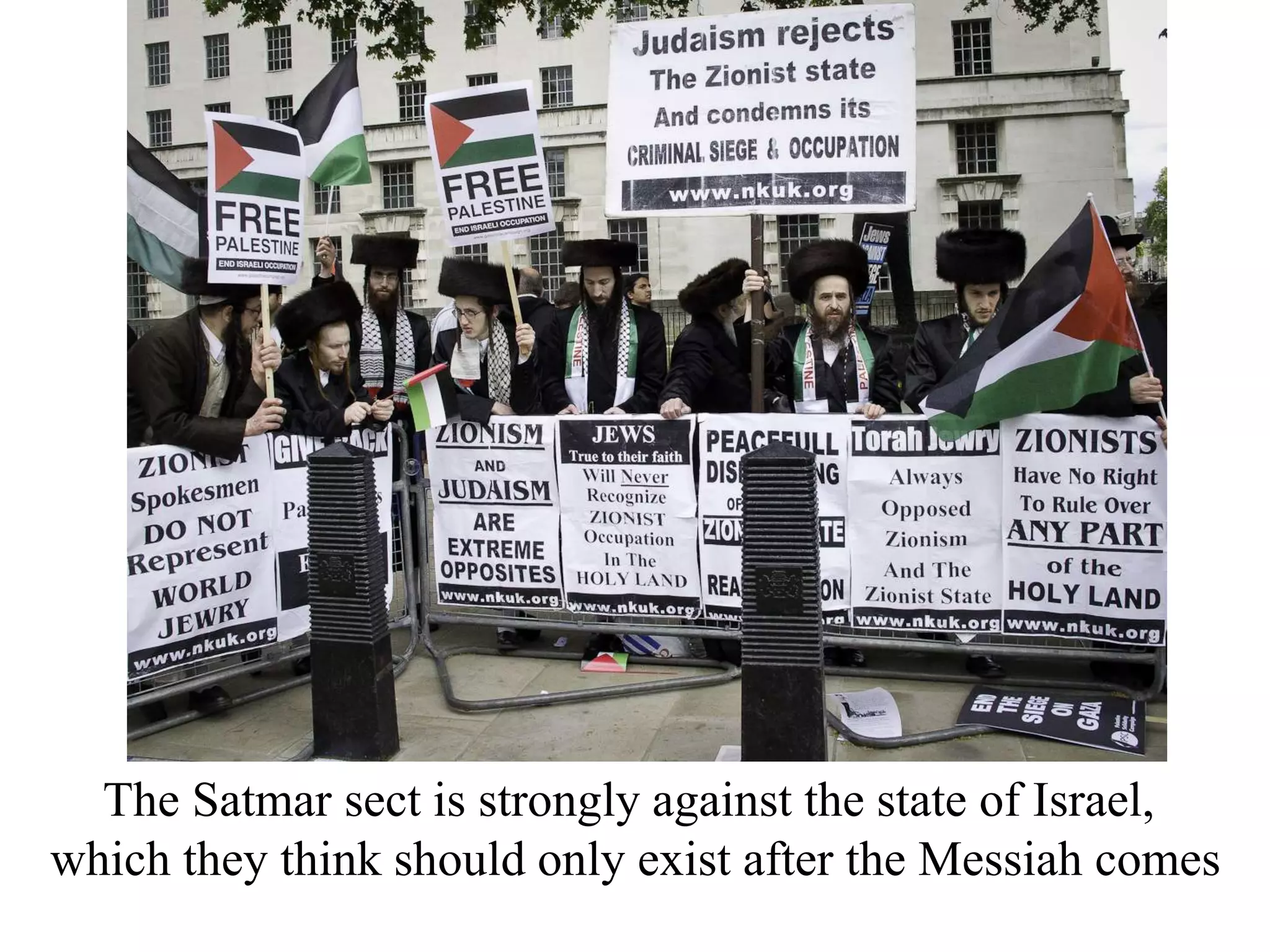
The Satmar sect is strongly against the state of Israel,
which they think should only exist after the Messiah comes
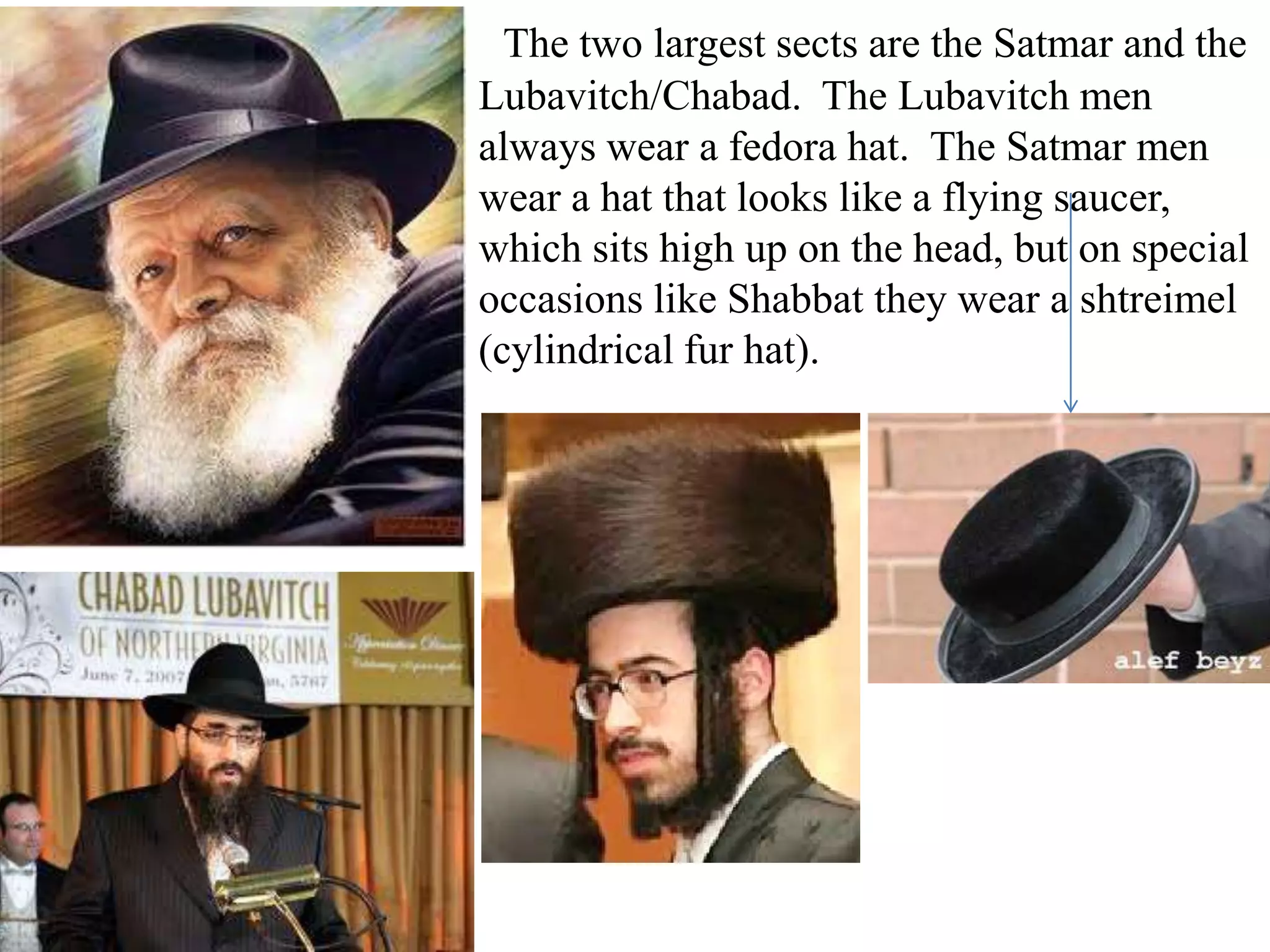
The two largest sects are the Satmar and the
Lubavitch/Chabad. The Lubavitch men
always wear a fedora hat. The Satmar men
wear a hat that looks like a flying saucer,
which sits high up on the head, but on special
occasions like Shabbat they wear a shtreimel
(cylindrical fur hat).
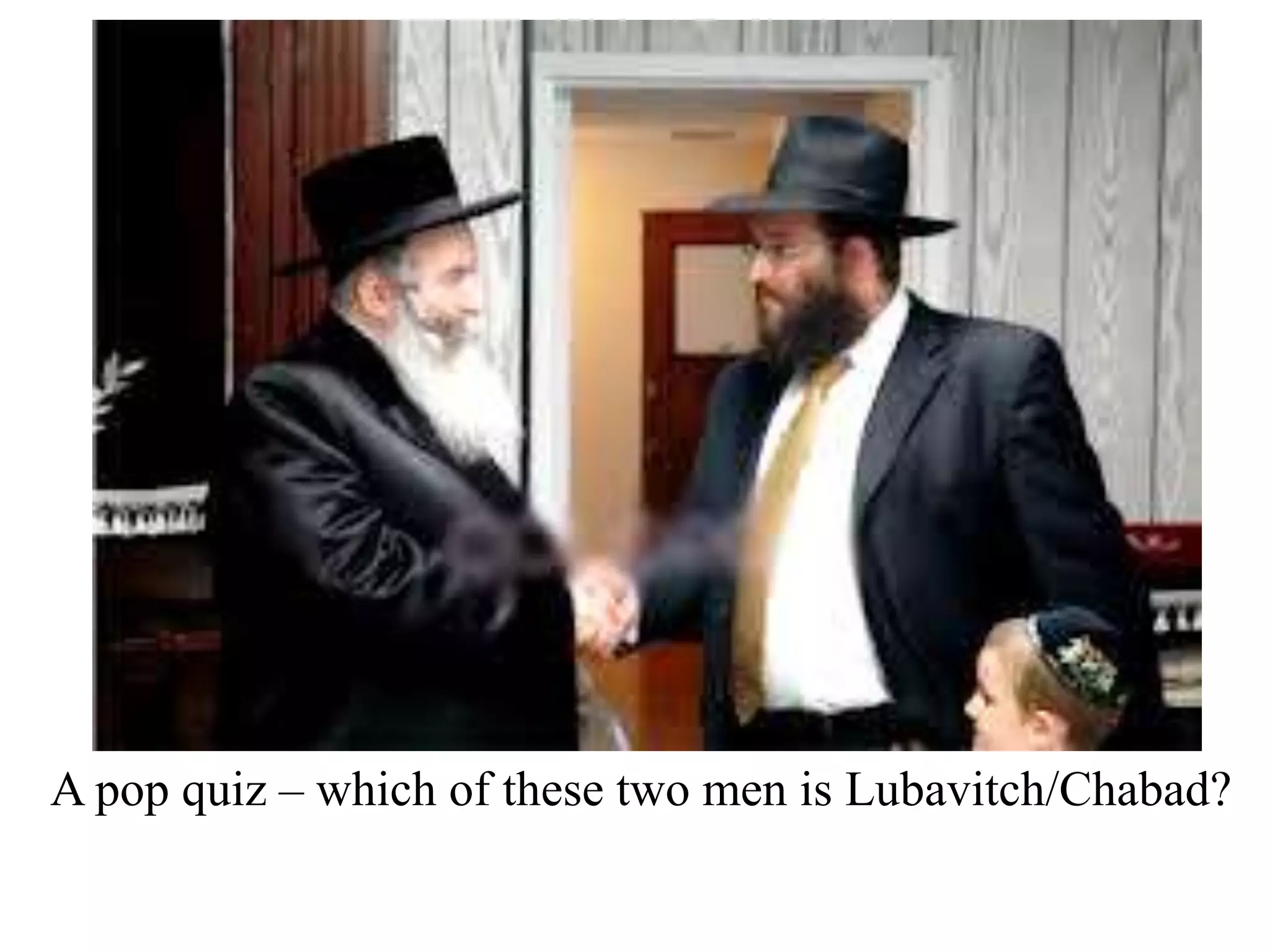
A pop quiz – which of these two men is Lubavitch/Chabad?
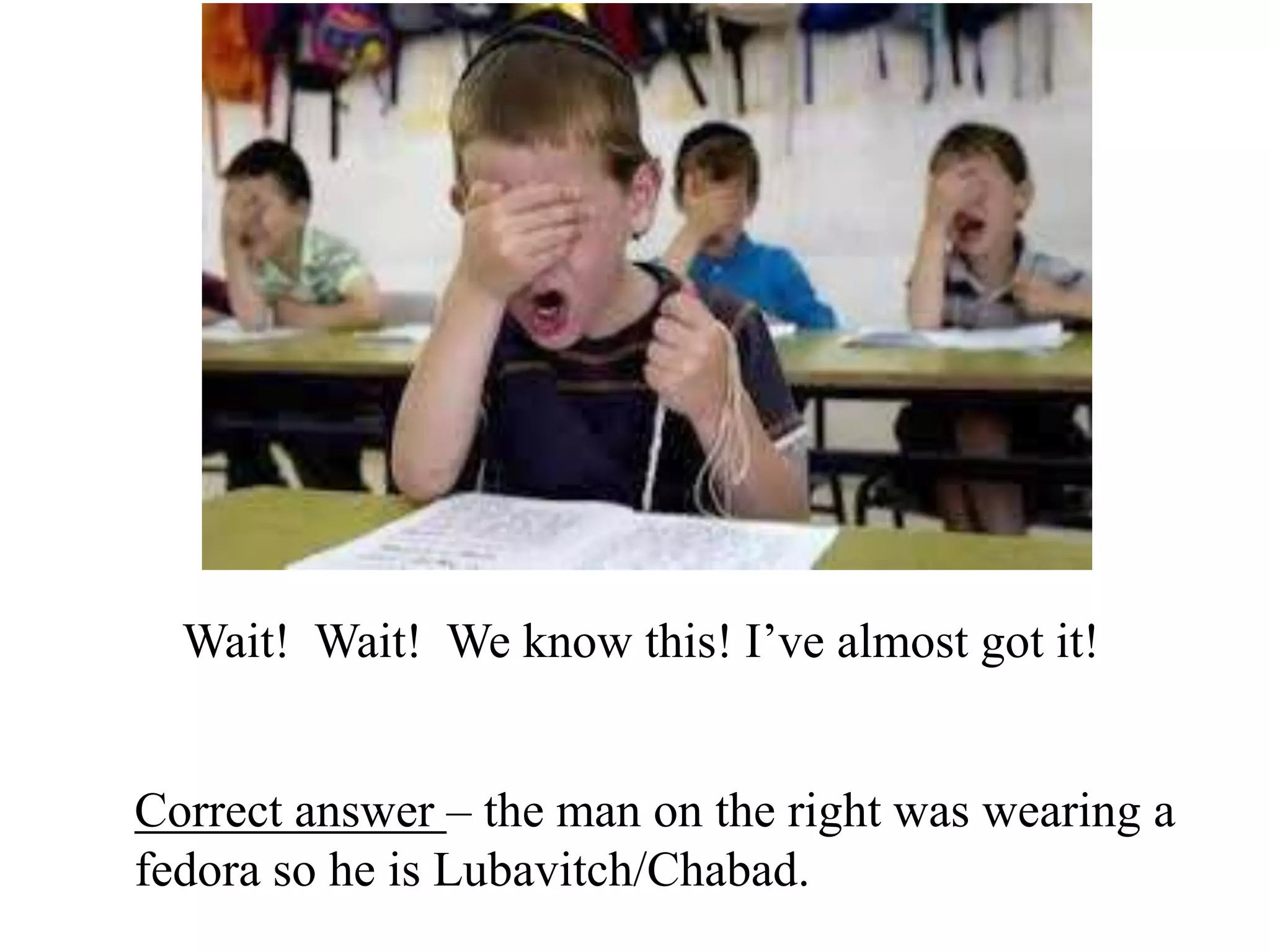
Wait! Wait! We know this! I’ve almost got it!
Correct answer – the man on the right was wearing a
fedora so he is Lubavitch/Chabad.
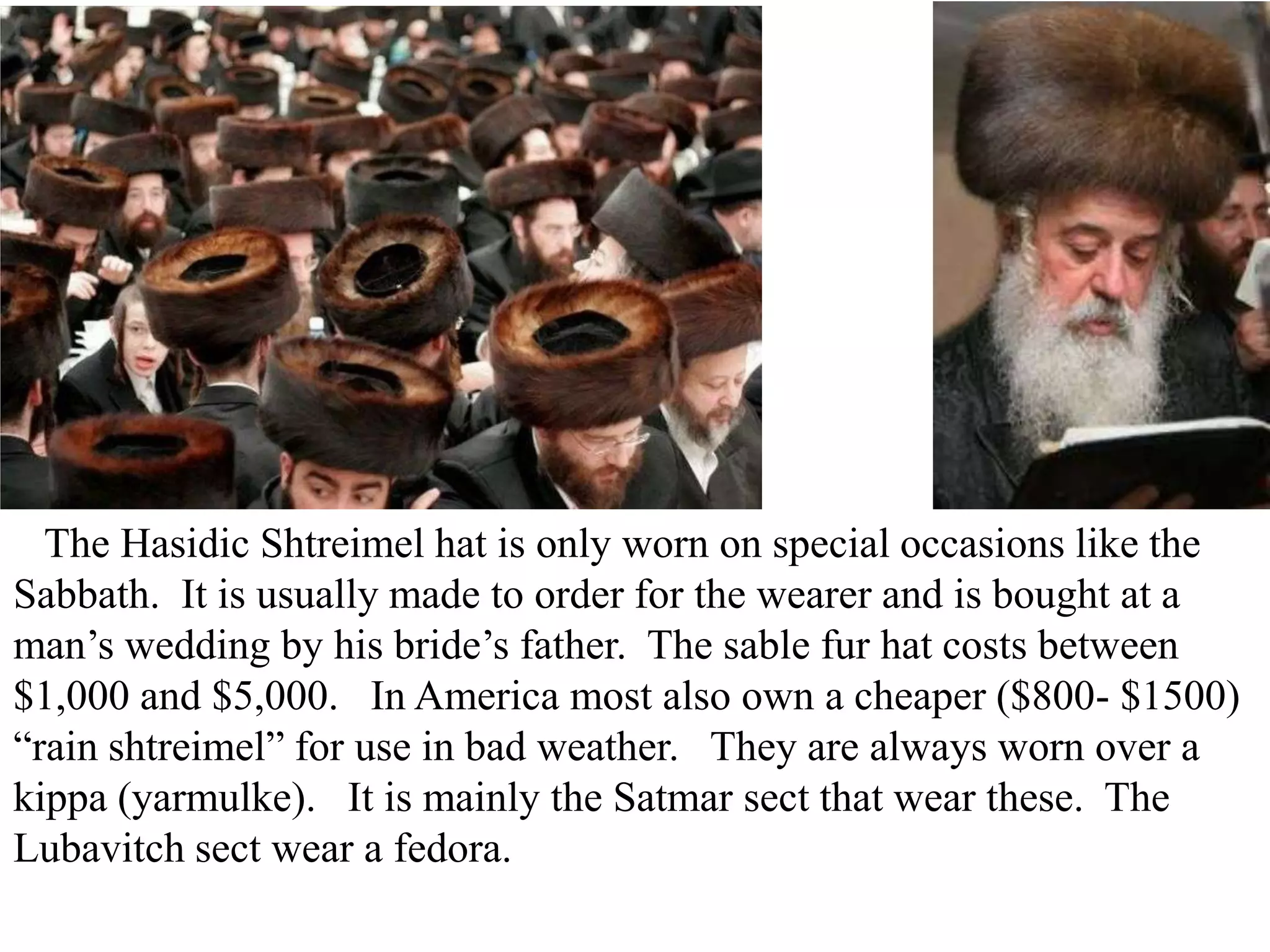
The Hasidic Shtreimel hat is only worn on special occasions like the
Sabbath. It is usually made to order for the wearer and is bought at a
man’s wedding by his bride’s father. The sable fur hat costs between
$1,000 and $5,000. In America most also own a cheaper ($800- $1500)
“rain shtreimel” for use in bad weather. They are always worn over a
kippa (yarmulke). It is mainly the Satmar sect that wear these. The
Lubavitch sect wear a fedora.
Cheaper options also exist.
In Israel the poverty of
many Hasidim has led
them to only own one
shtreimel, the cheaper rain
shtreimel type.
Women’s wigs are called
sheitels and can cost
$1500 or more.
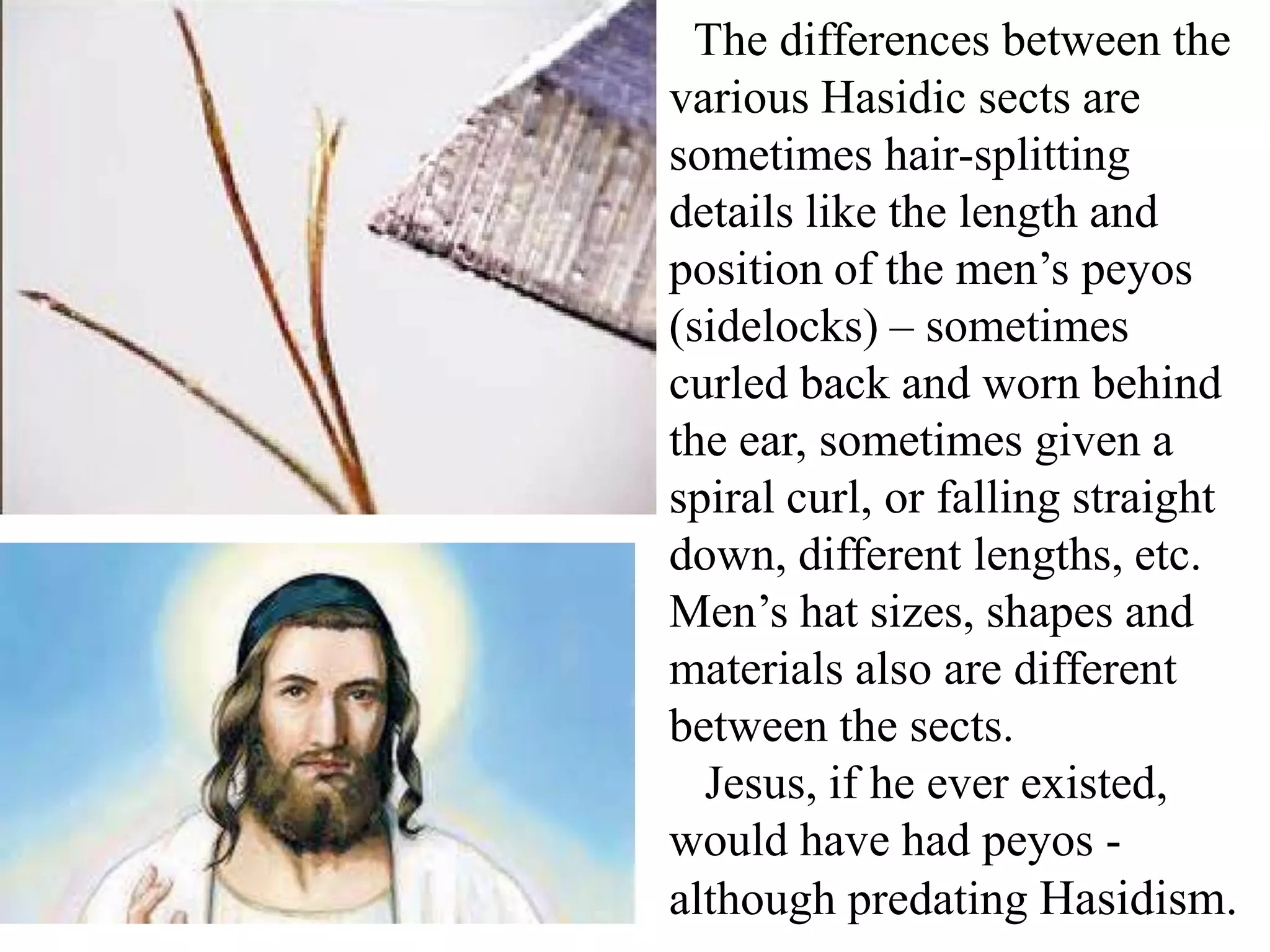
The differences between the
various Hasidic sects are
sometimes hair-splitting
details like the length and
position of the men’s peyos
(sidelocks) – sometimes
curled back and worn behind
the ear, sometimes given a
spiral curl, or falling straight
down, different lengths, etc.
Men’s hat sizes, shapes and
materials also are different
between the sects.
Jesus, if he ever existed,
would have had peyos although predating Hasidism.
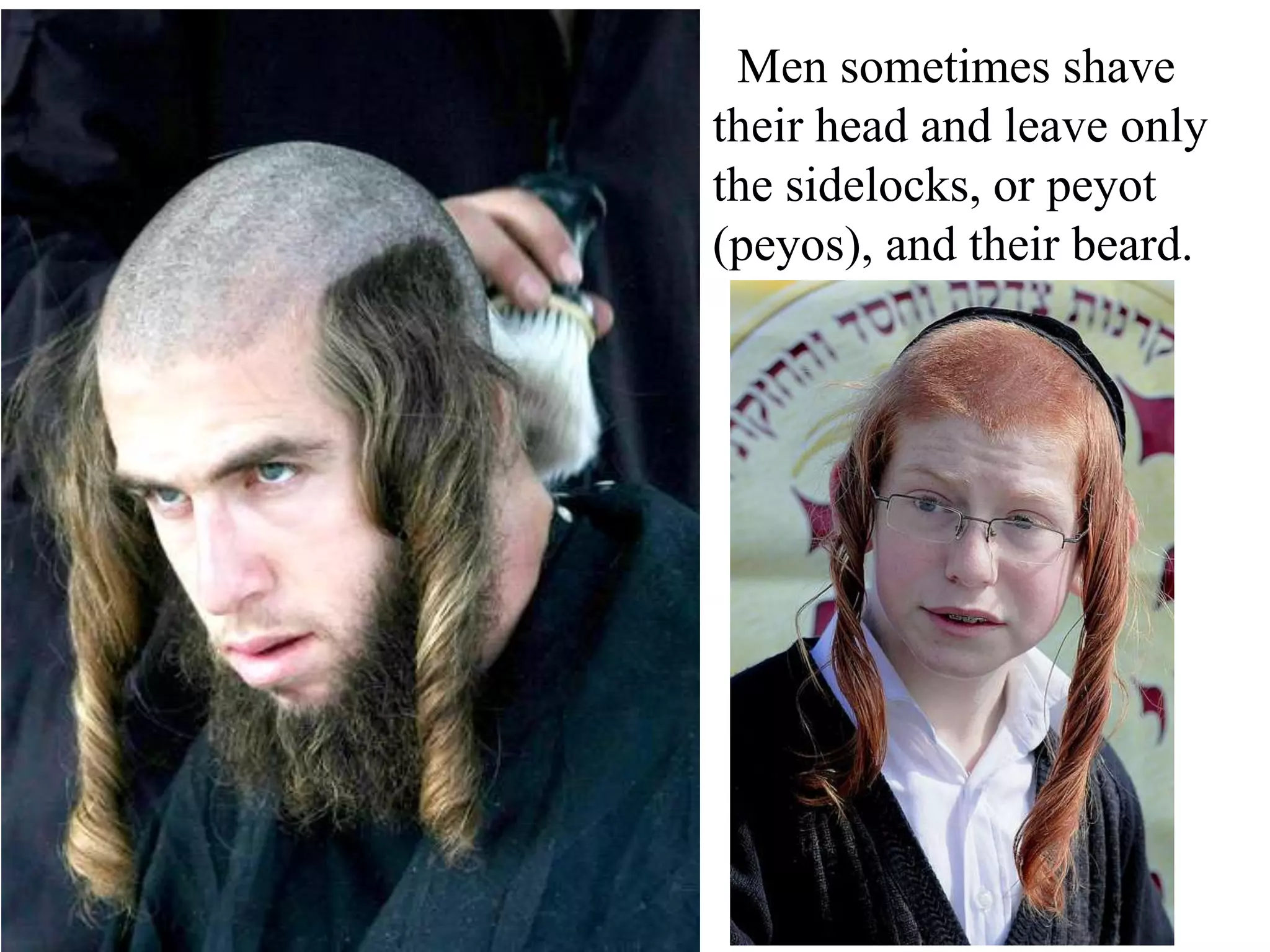
Men sometimes shave
their head and leave only
the sidelocks, or peyot
(peyos), and their beard.
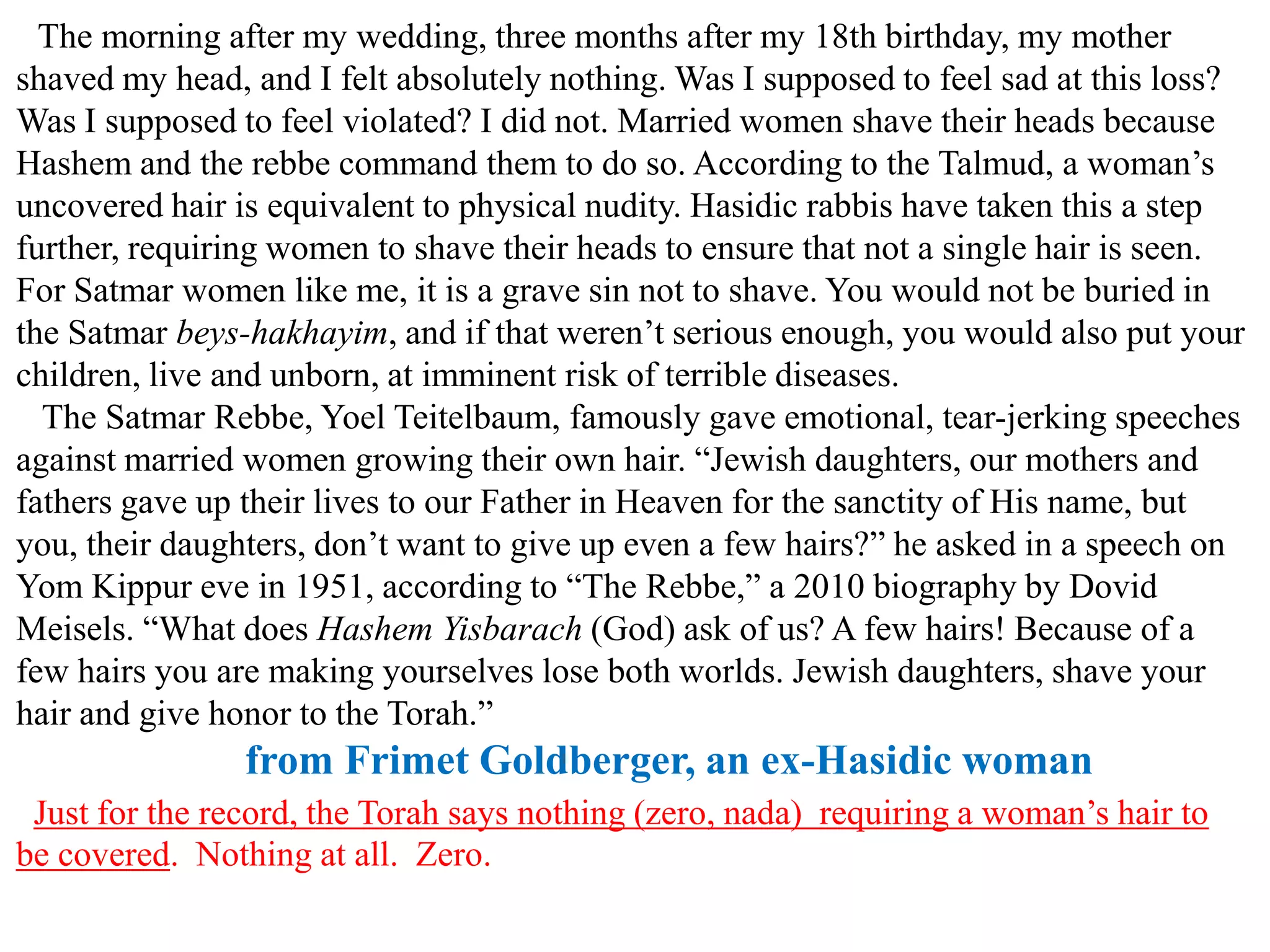
The morning after my wedding, three months after my 18th birthday, my mother
shaved my head, and I felt absolutely nothing. Was I supposed to feel sad at this loss?
Was I supposed to feel violated? I did not. Married women shave their heads because
Hashem and the rebbe command them to do so. According to the Talmud, a woman’s
uncovered hair is equivalent to physical nudity. Hasidic rabbis have taken this a step
further, requiring women to shave their heads to ensure that not a single hair is seen.
For Satmar women like me, it is a grave sin not to shave. You would not be buried in
the Satmar beys-hakhayim, and if that weren’t serious enough, you would also put your
children, live and unborn, at imminent risk of terrible diseases.
The Satmar Rebbe, Yoel Teitelbaum, famously gave emotional, tear-jerking speeches
against married women growing their own hair. “Jewish daughters, our mothers and
fathers gave up their lives to our Father in Heaven for the sanctity of His name, but
you, their daughters, don’t want to give up even a few hairs?” he asked in a speech on
Yom Kippur eve in 1951, according to “The Rebbe,” a 2010 biography by Dovid
Meisels. “What does Hashem Yisbarach (God) ask of us? A few hairs! Because of a
few hairs you are making yourselves lose both worlds. Jewish daughters, shave your
hair and give honor to the Torah.”

from Frimet Goldberger, an ex-Hasidic woman
Just for the record, the Torah says nothing (zero, nada) requiring a woman’s hair to
be covered. Nothing at all. Zero.
There is a single verse in the Torah – Numbers 5:18 – and a
single word in it which has been twisted around in the Talmud
by the rabbis, with some convoluted logic, to imply that an
uncovered woman’s head is sinful. But even then there is not
agreement if what is supposedly being forbidden is undone hair
(i.e. loose and not braided) or uncovered hair. Like much of
Hassidic practices to do with dress and hair, it is simply a
tradition and is not grounded in the Torah. The Torah does
prohibit men from cutting their sidelocks but again it says
nothing (zero, nada) about covering men’s heads. Again, this is
merely tradition.

Braided
versus
loose
Like most of the practices of the Catholic Church, there is no explicit
biblical basis for most of the Hasidic customs. They are just that –
customs, especially those for women – like these ones.
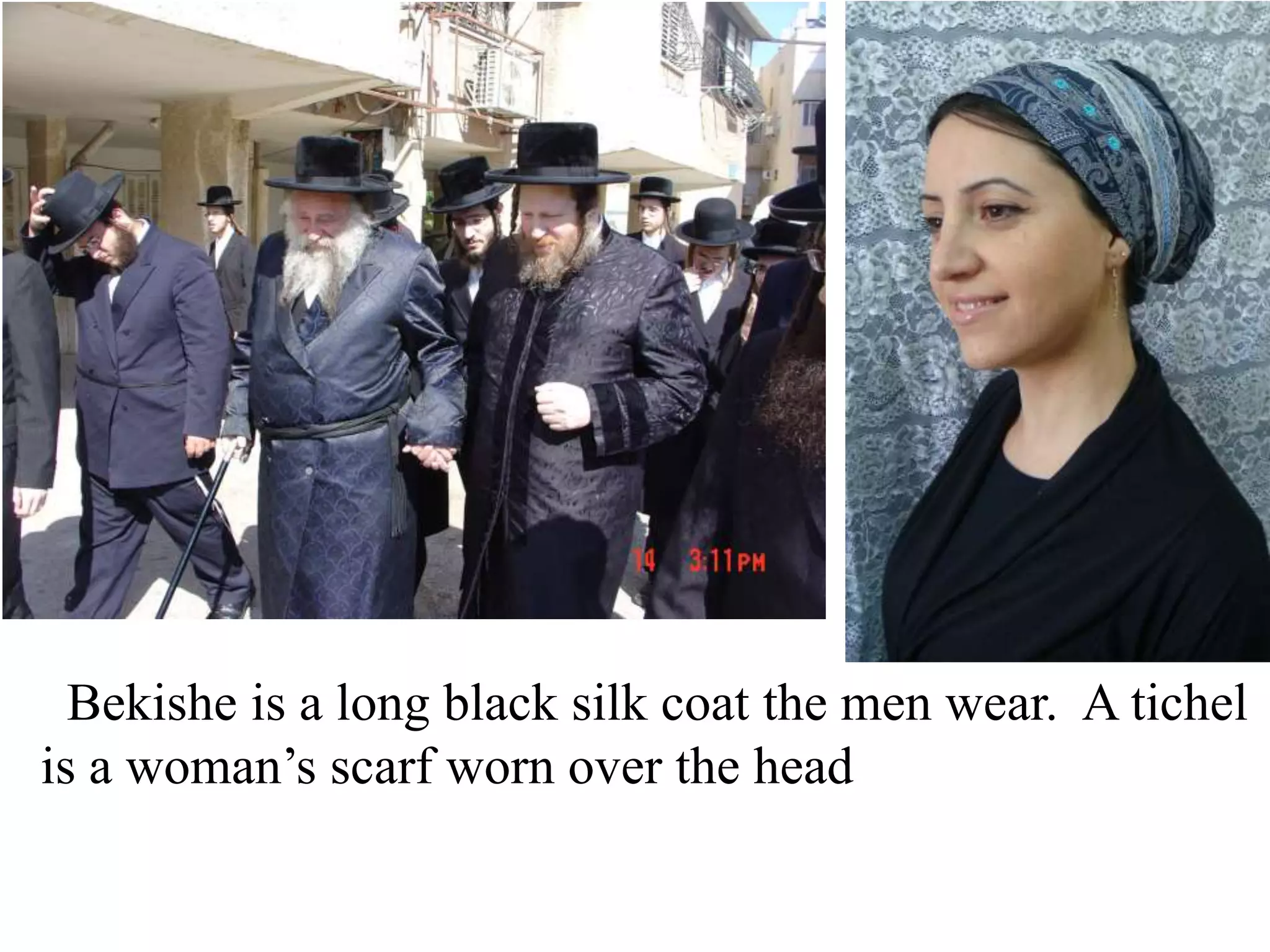
Bekishe is a long black silk coat the men wear. A tichel
is a woman’s scarf worn over the head
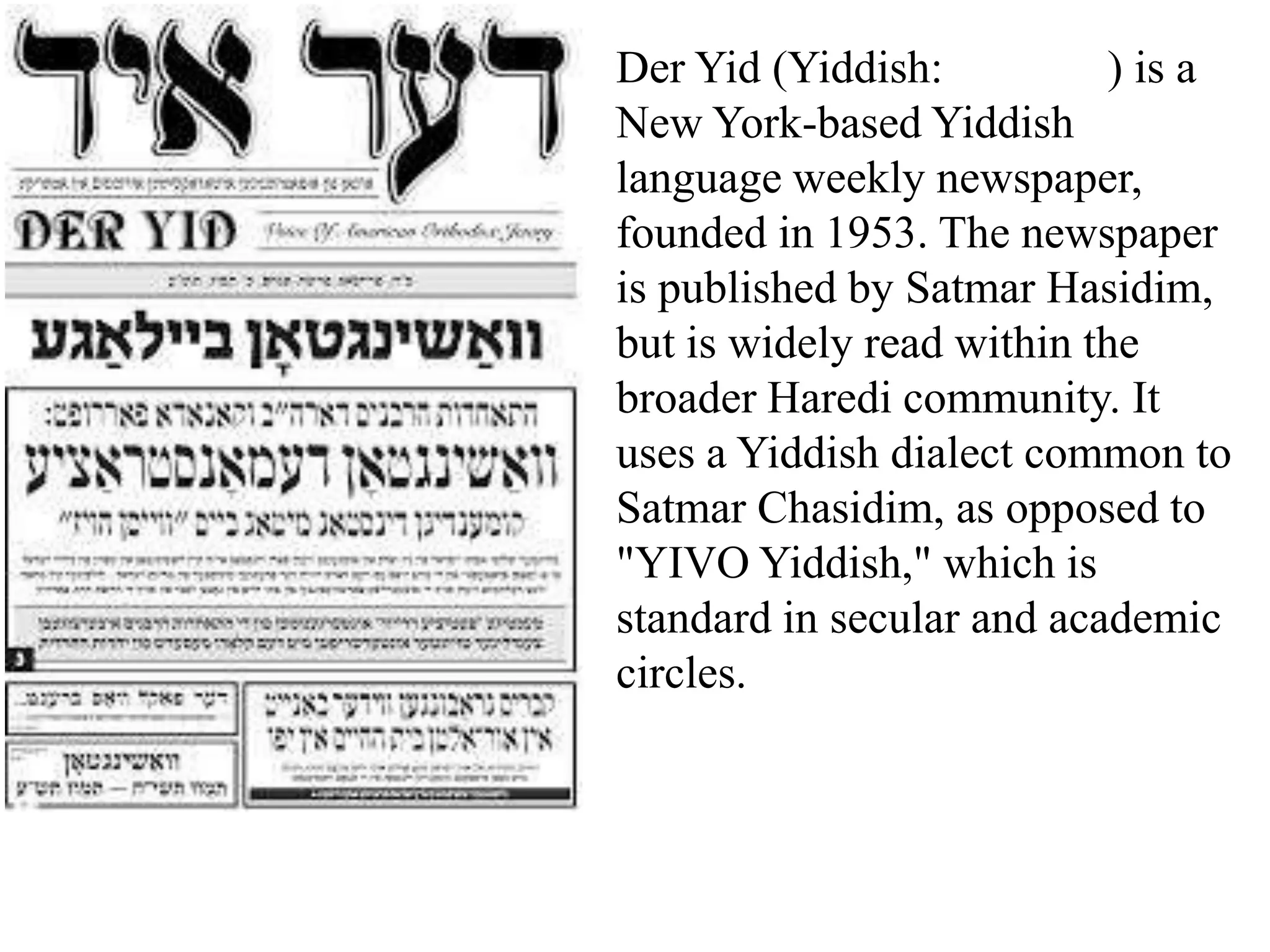
Der Yid (Yiddish:
) is a
New York-based Yiddish
language weekly newspaper,
founded in 1953. The newspaper
is published by Satmar Hasidim,
but is widely read within the
broader Haredi community. It
uses a Yiddish dialect common to
Satmar Chasidim, as opposed to
"YIVO Yiddish," which is
standard in secular and academic
circles.
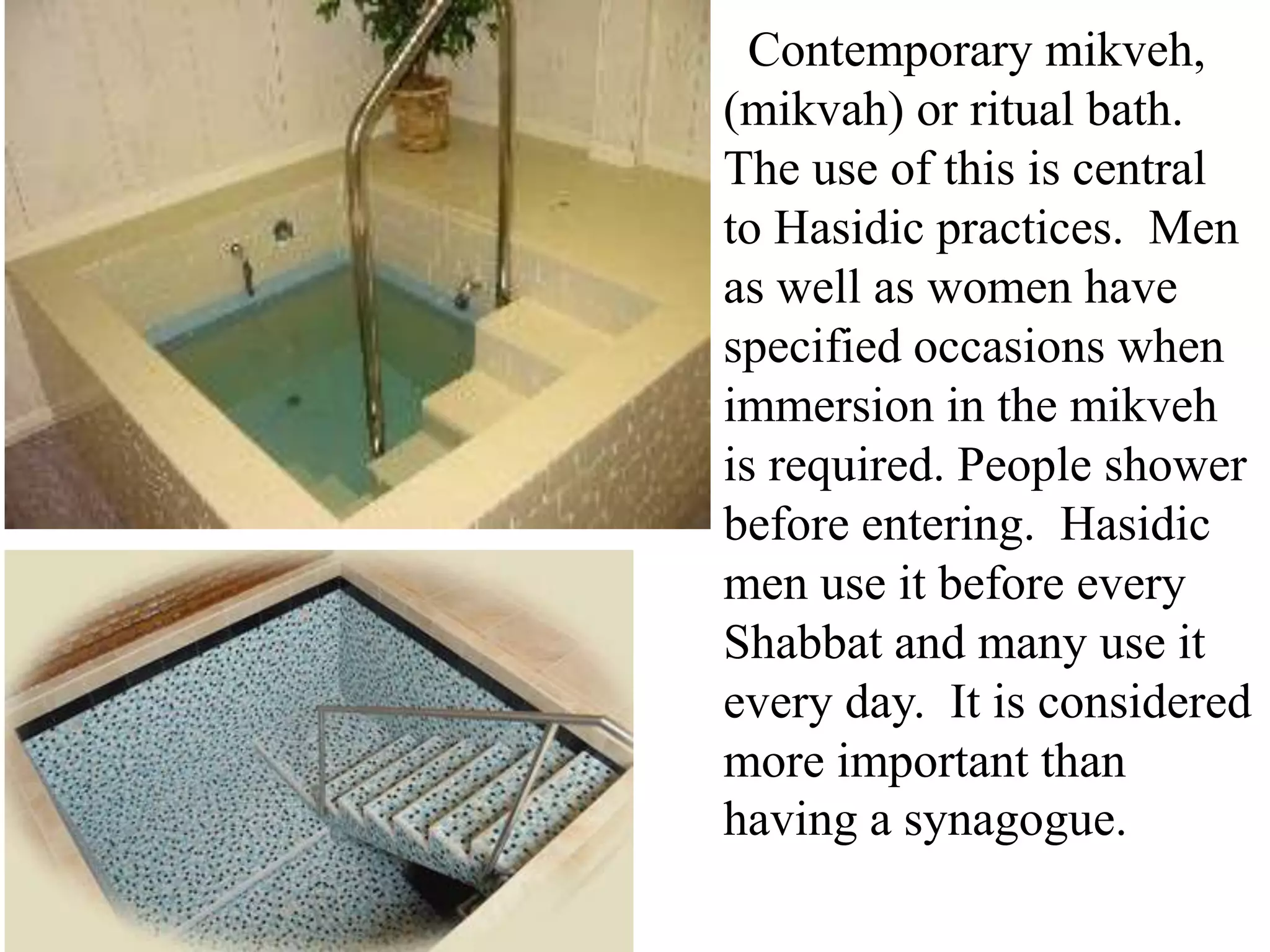
Contemporary mikveh,
(mikvah) or ritual bath.
The use of this is central
to Hasidic practices. Men
as well as women have
specified occasions when
immersion in the mikveh
is required. People shower
before entering. Hasidic
men use it before every
Shabbat and many use it
every day. It is considered
more important than
having a synagogue.
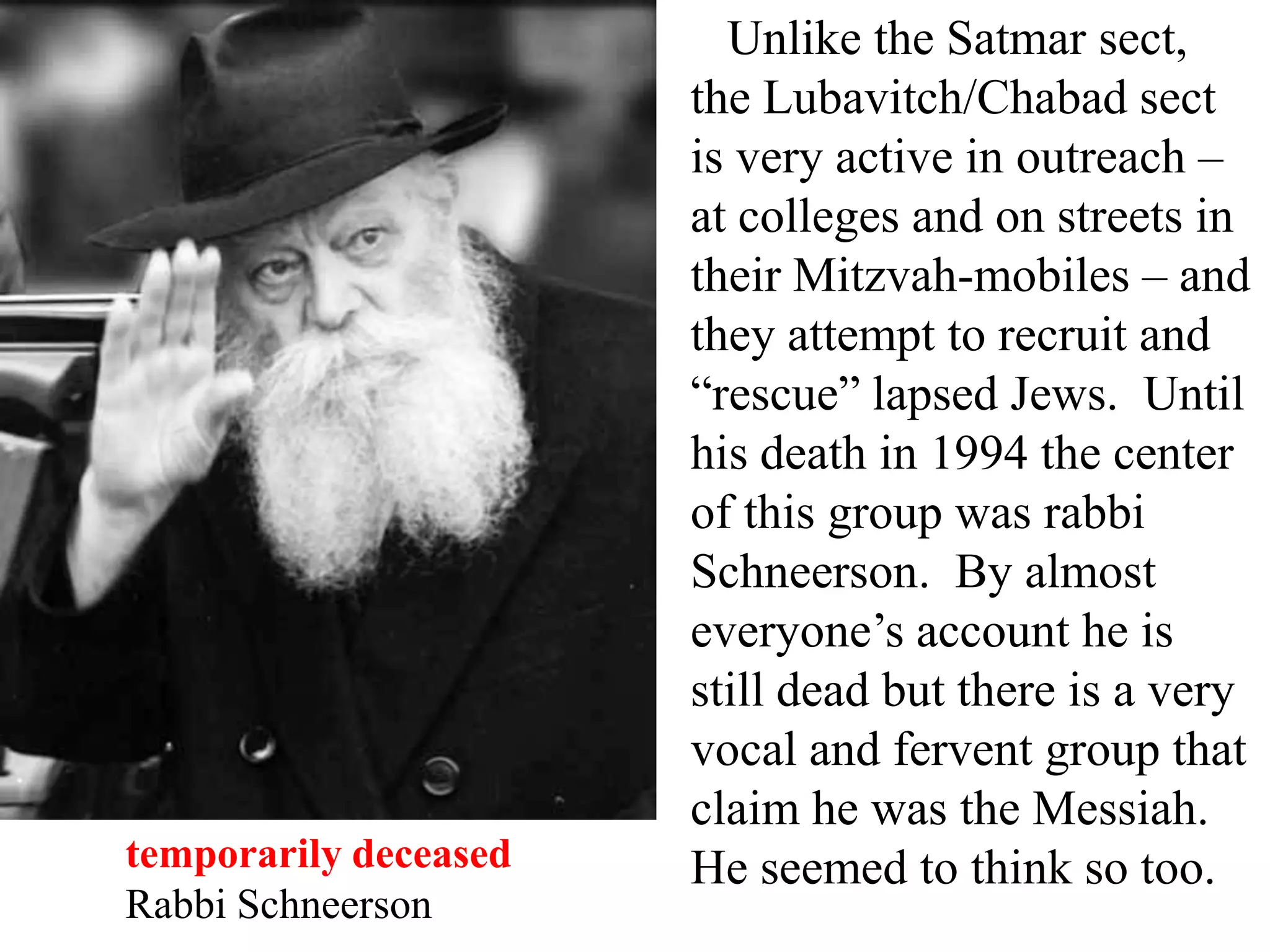
temporarily deceased
Rabbi Schneerson

Unlike the Satmar sect,
the Lubavitch/Chabad sect
is very active in outreach –
at colleges and on streets in
their Mitzvah-mobiles – and
they attempt to recruit and
“rescue” lapsed Jews. Until
his death in 1994 the center
of this group was rabbi
Schneerson. By almost
everyone’s account he is
still dead but there is a very
vocal and fervent group that
claim he was the Messiah.
He seemed to think so too.
.

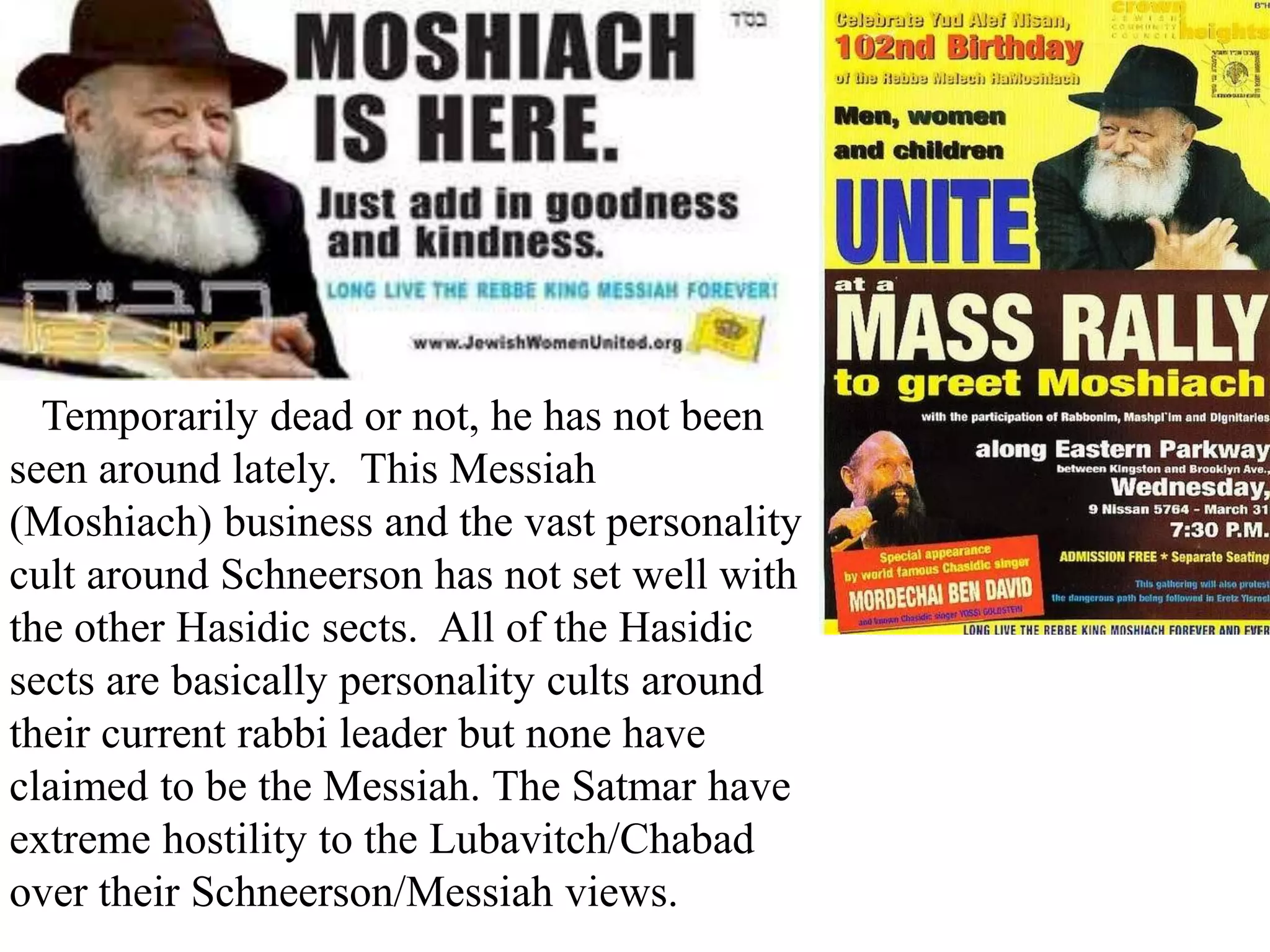
Temporarily dead or not, he has not been
seen around lately. This Messiah
(Moshiach) business and the vast personality
cult around Schneerson has not set well with
the other Hasidic sects. All of the Hasidic
sects are basically personality cults around
their current rabbi leader but none have
claimed to be the Messiah. The Satmar have
extreme hostility to the Lubavitch/Chabad
over their Schneerson/Messiah views.
.
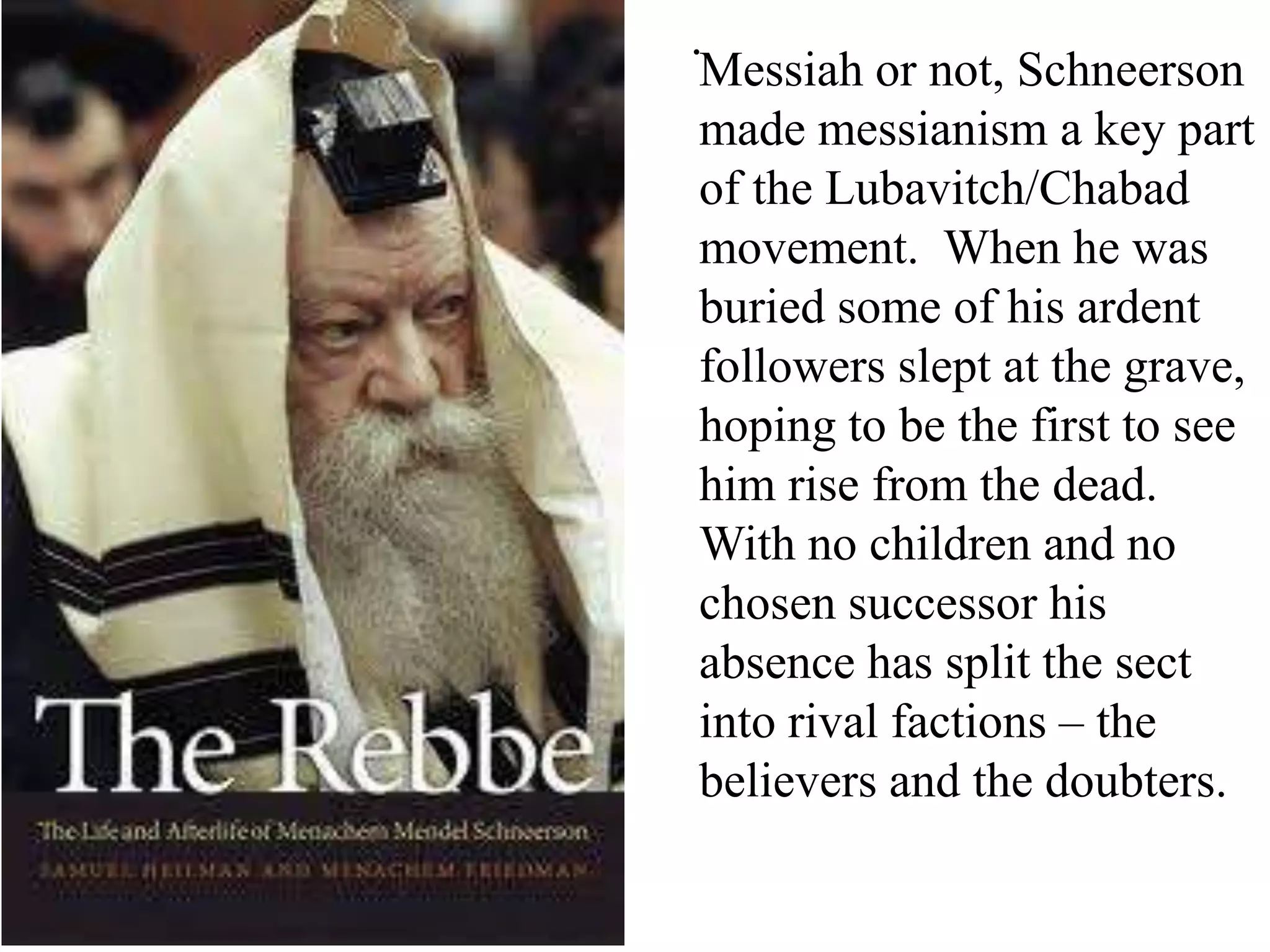
Messiah or not, Schneerson
made messianism a key part
of the Lubavitch/Chabad
movement. When he was
buried some of his ardent
followers slept at the grave,
hoping to be the first to see
him rise from the dead.
With no children and no
chosen successor his
absence has split the sect
into rival factions – the
believers and the doubters.
The Darker Side of Hasidic Life

There are a lot of ugly aspects of Hasidic life
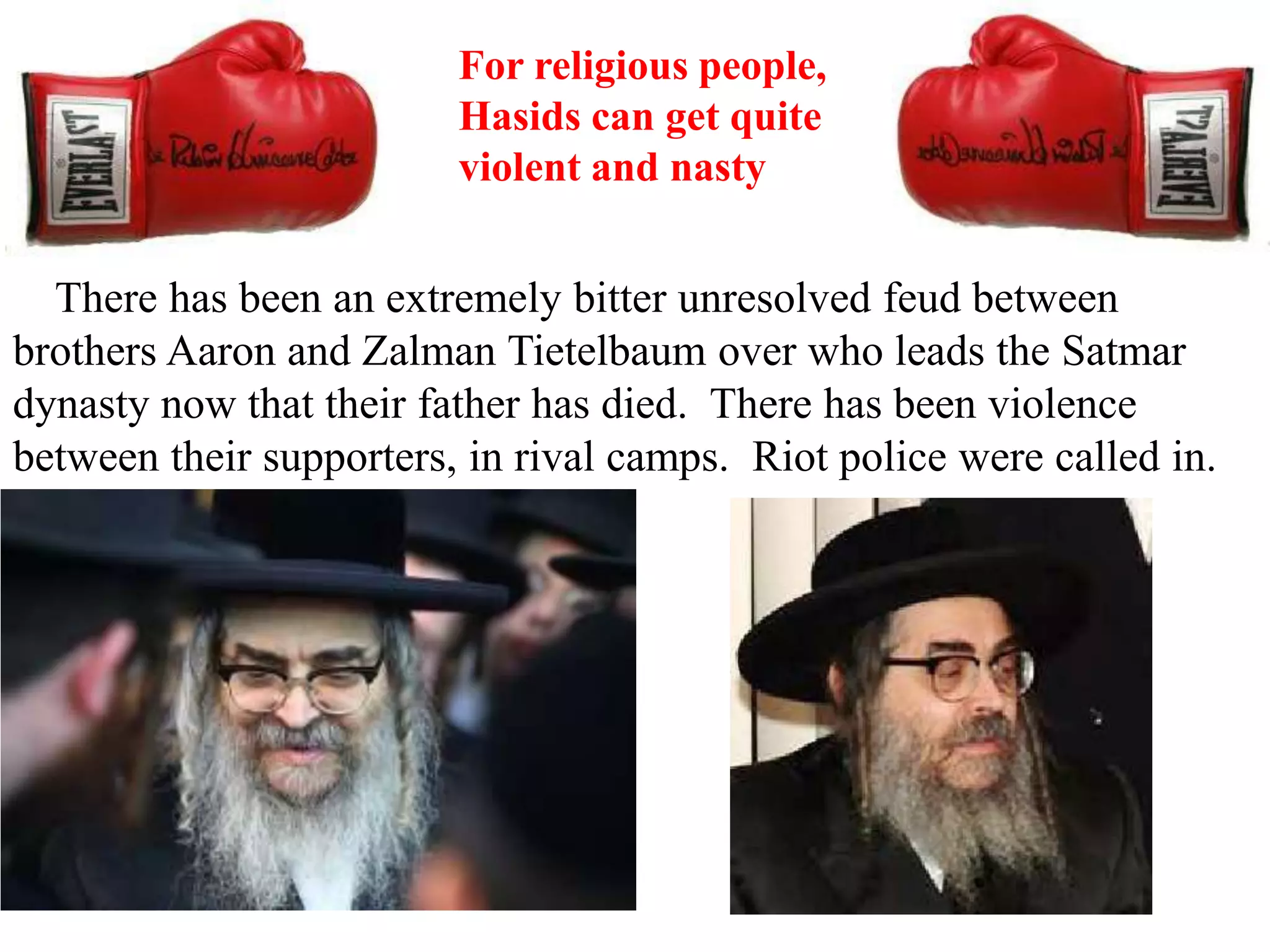
For religious people,
Hasids can get quite
violent and nasty

There has been an extremely bitter unresolved feud between
brothers Aaron and Zalman Tietelbaum over who leads the Satmar
dynasty now that their father has died. There has been violence
between their supporters, in rival camps. Riot police were called in.
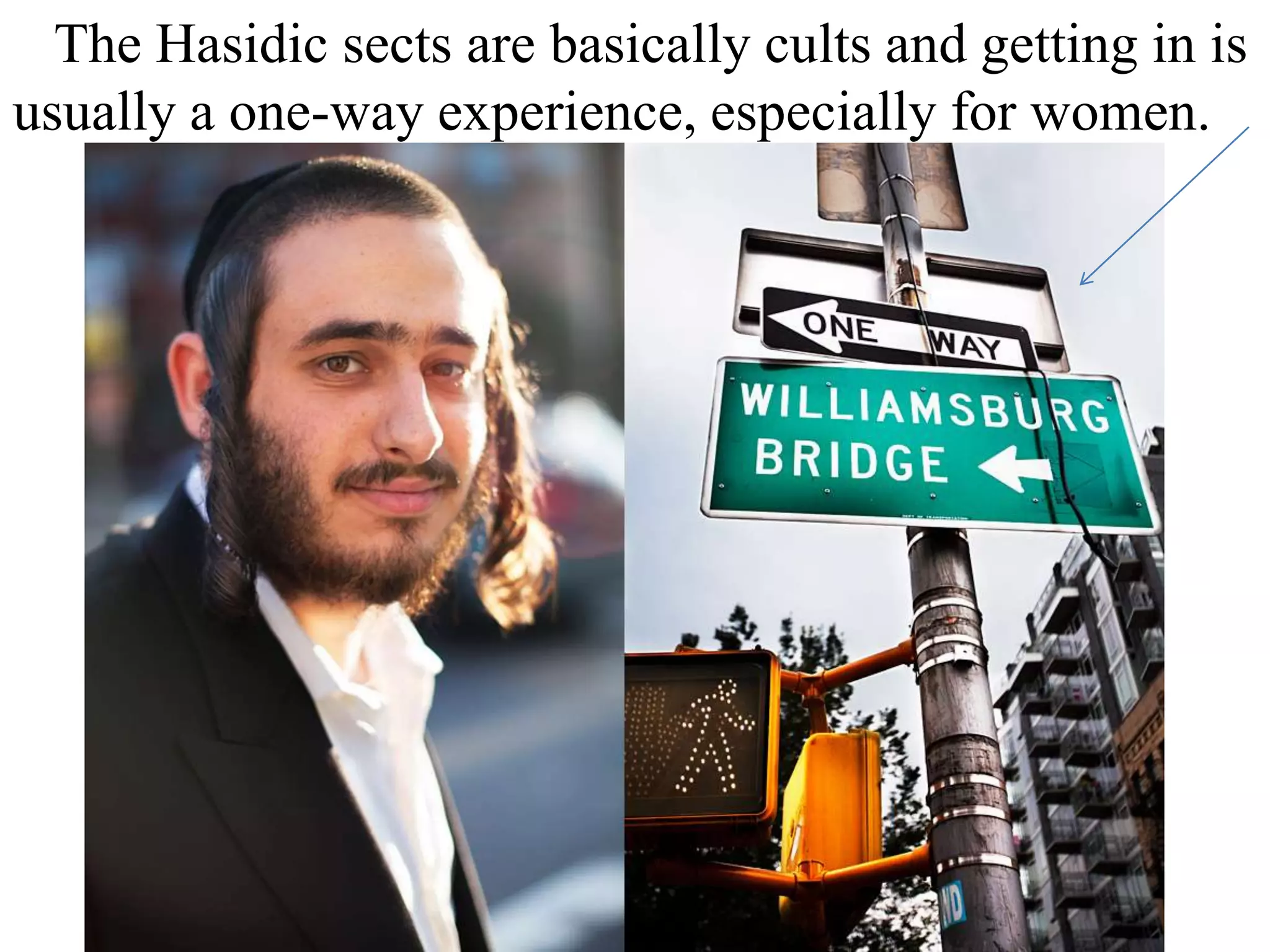
The Hasidic sects are basically cults and getting in is
usually a one-way experience, especially for women.
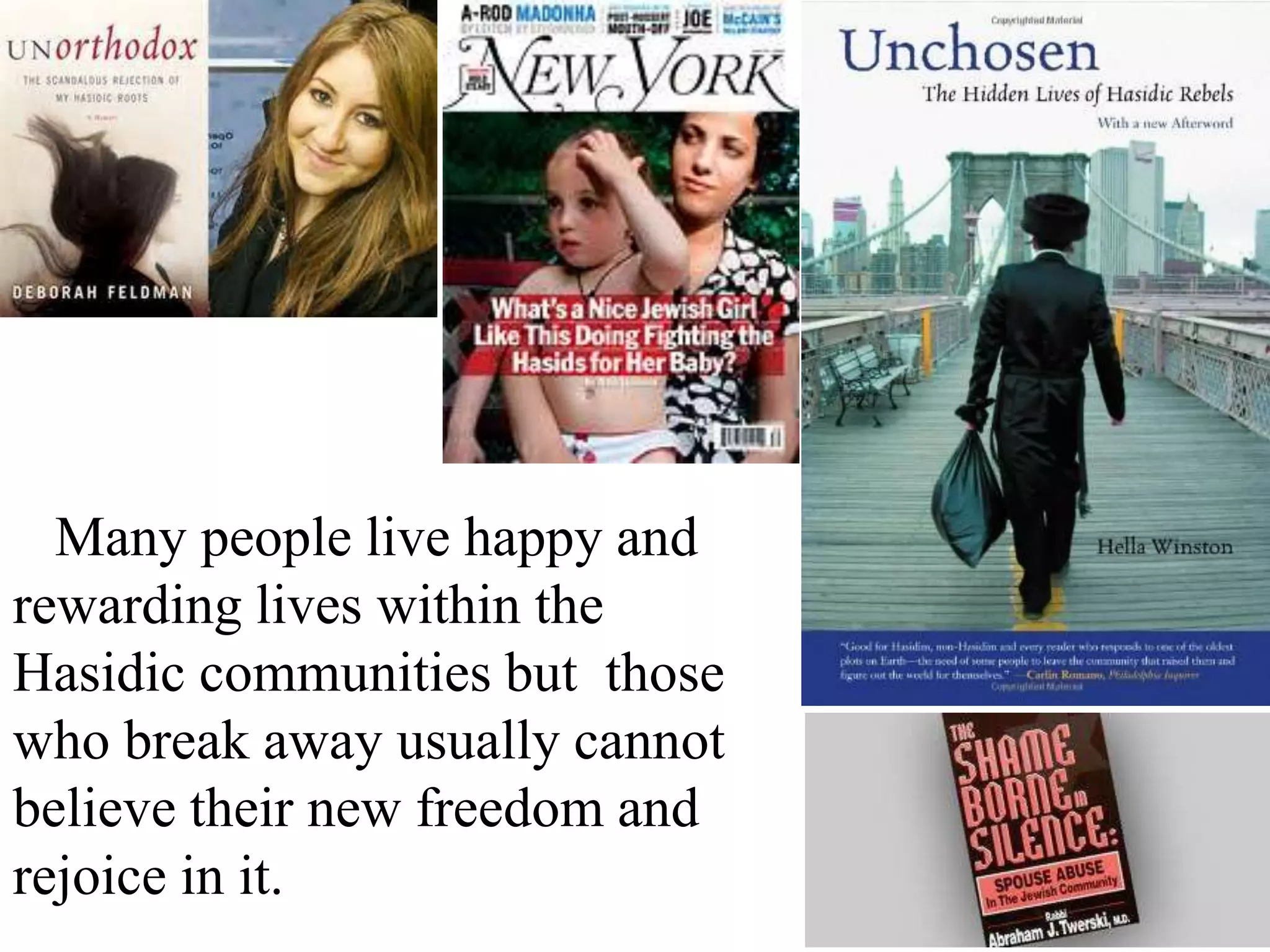
Some women have escaped this life and written
books about it.
Many people live happy and
rewarding lives within the
Hasidic communities but those
who break away usually cannot
believe their new freedom and
rejoice in it.
There is little secular education and this makes for few
employment opportunities if someone leaves the community.
The Hasidim
believe in the
literal truth of the
Torah. All of it.
Every word.
Noah’s Ark, the
Flood, everything.
Critical thought
is strongly
discouraged and
there is very little
secular education
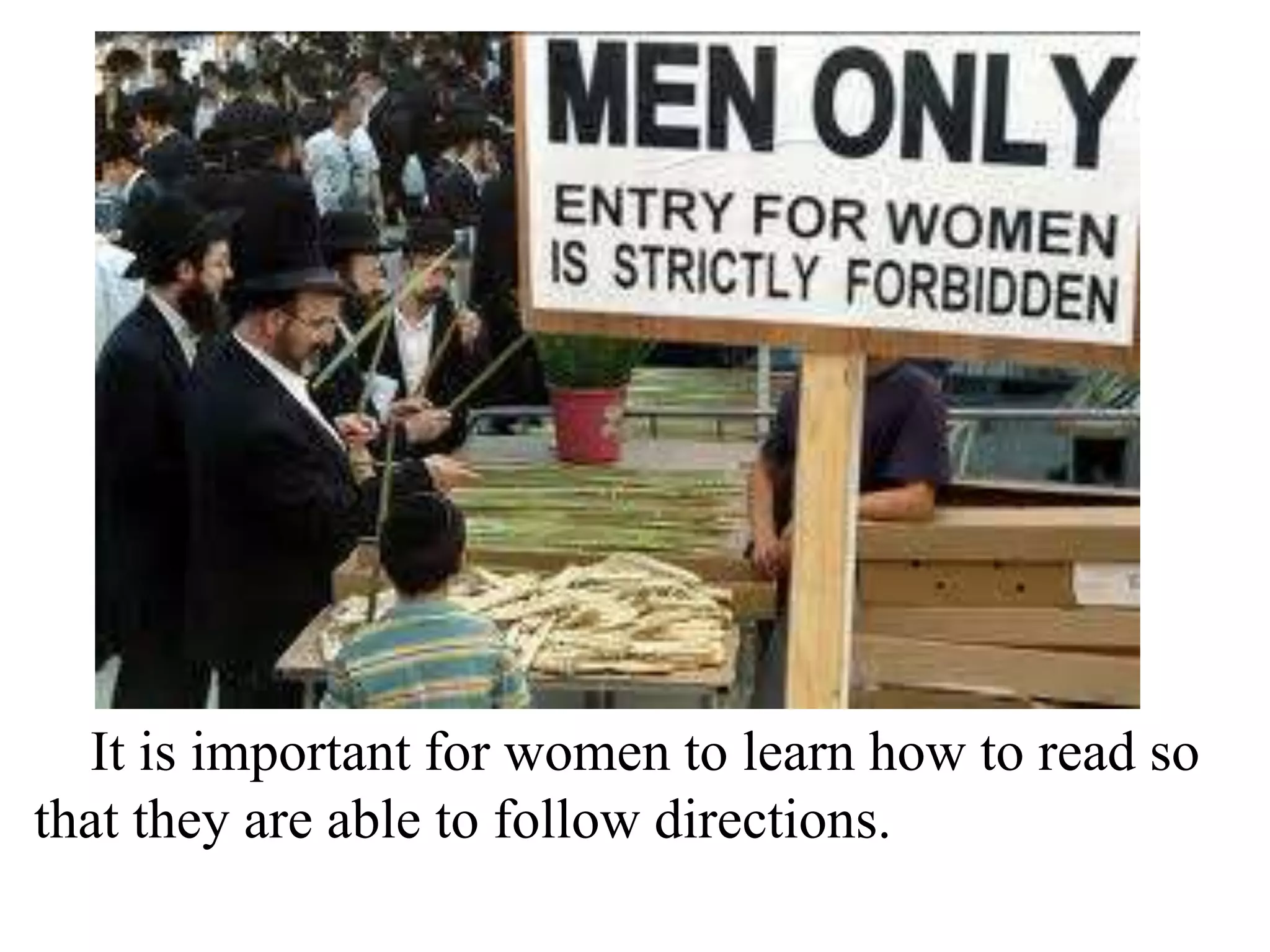
It is important for women to learn how to read so
that they are able to follow directions.
The universe would probably explode if someone accidentally
went in the wrong bathroom so the signs are very clear
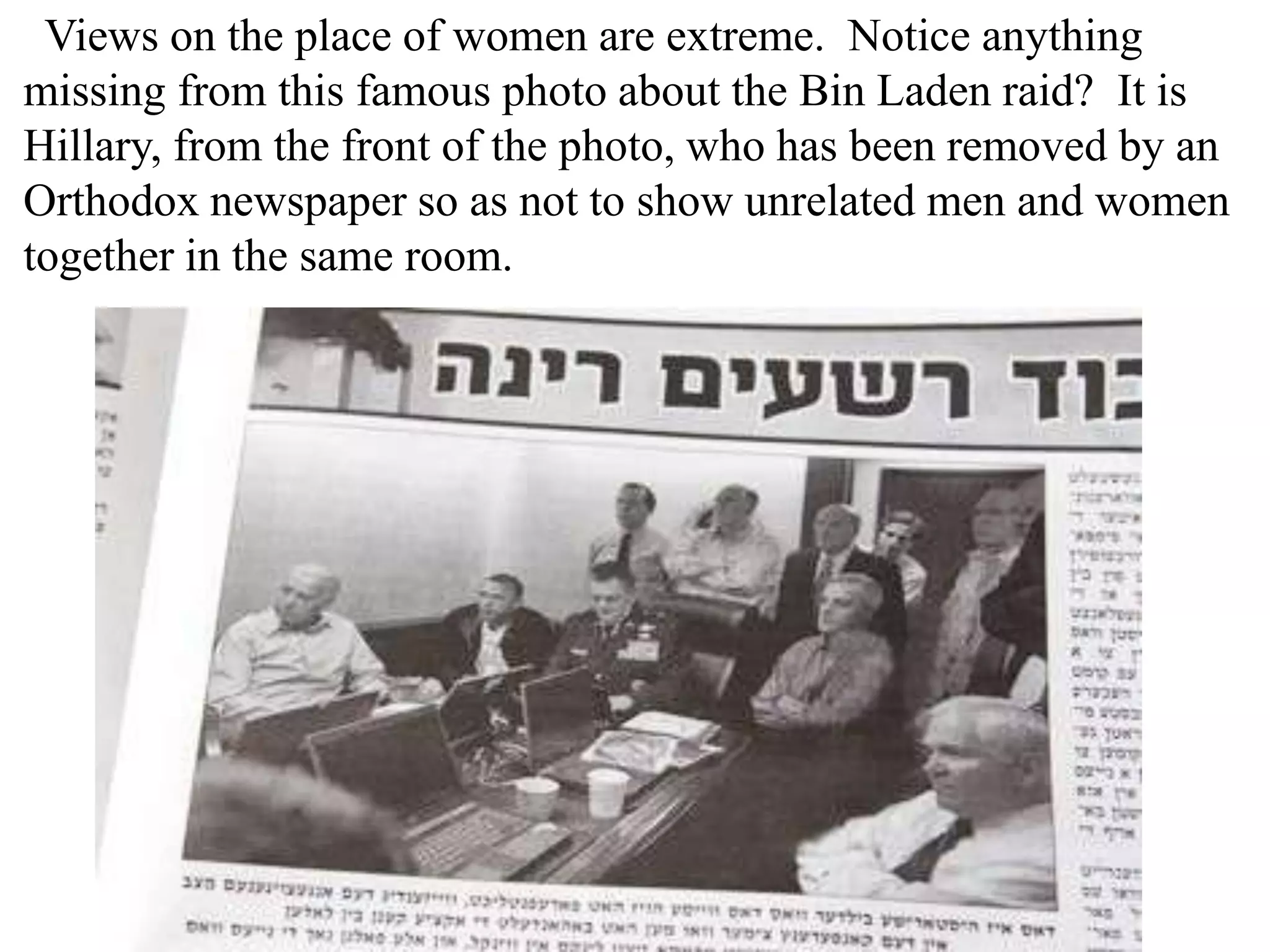
Views on the place of women are extreme. Notice anything
missing from this famous photo about the Bin Laden raid? It is
Hillary, from the front of the photo, who has been removed by an
Orthodox newspaper so as not to show unrelated men and women
together in the same room.
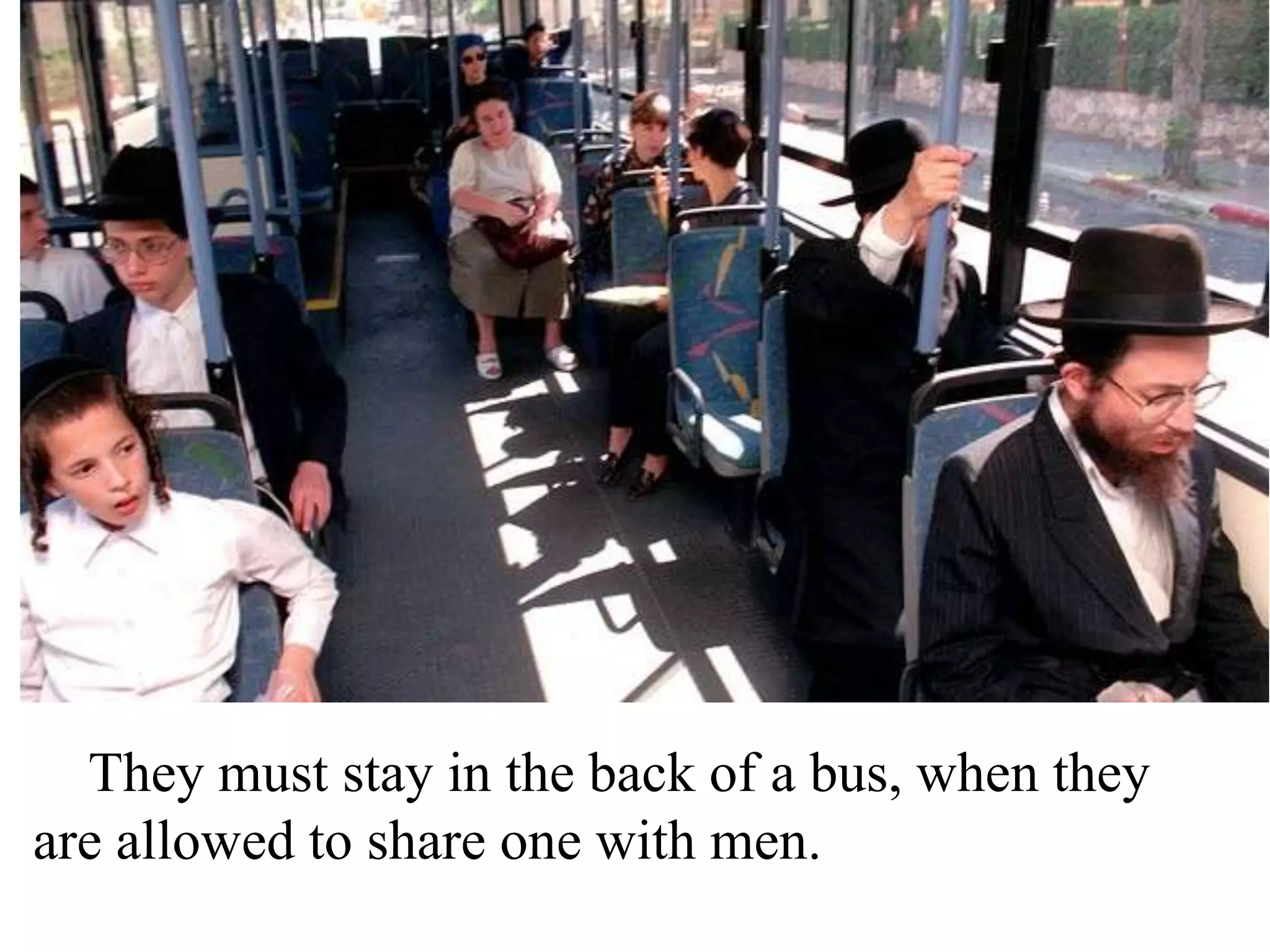
They must stay in the back of a bus, when they
are allowed to share one with men.
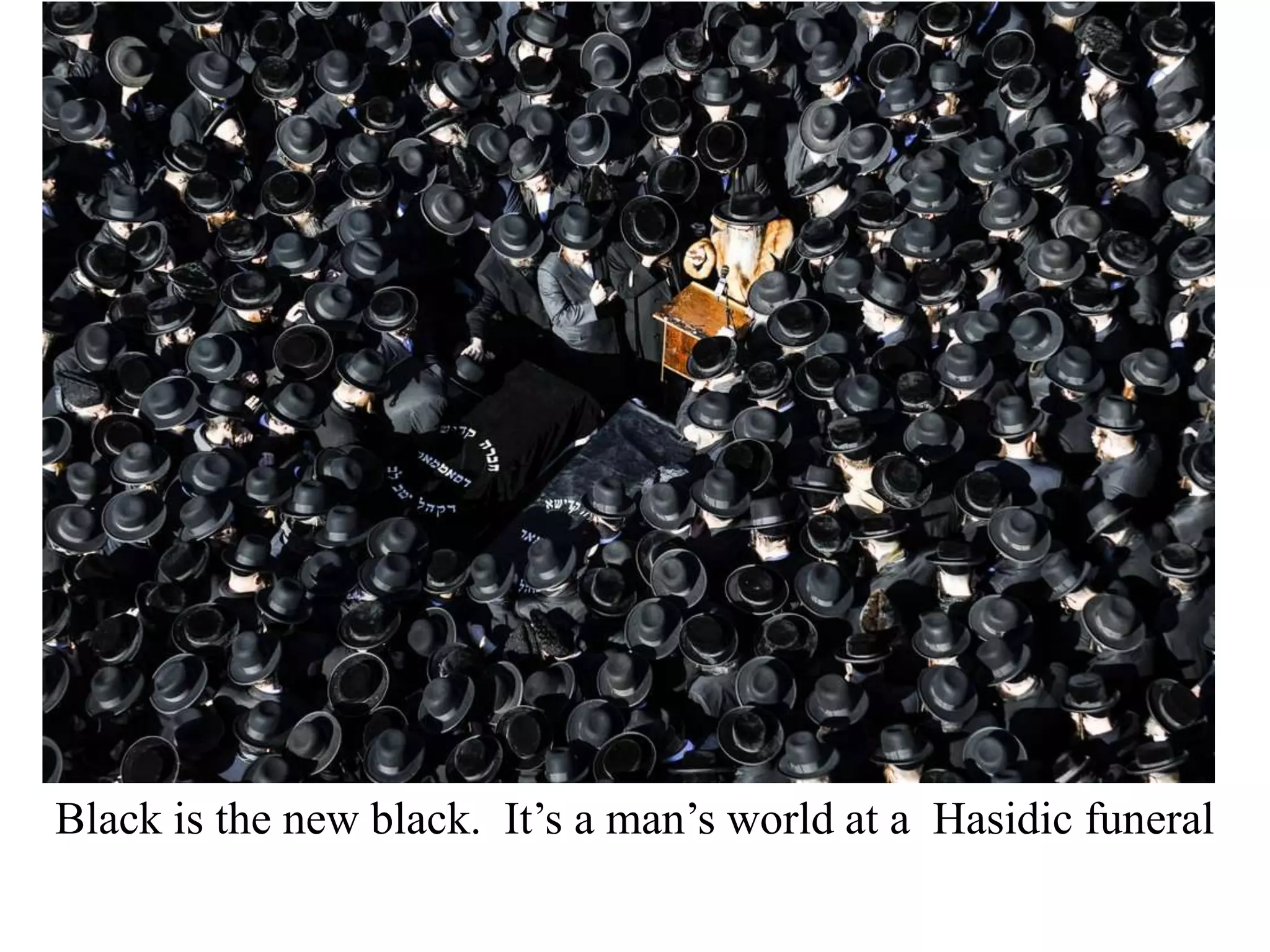
Black is the new black. It’s a man’s world at a Hasidic funeral
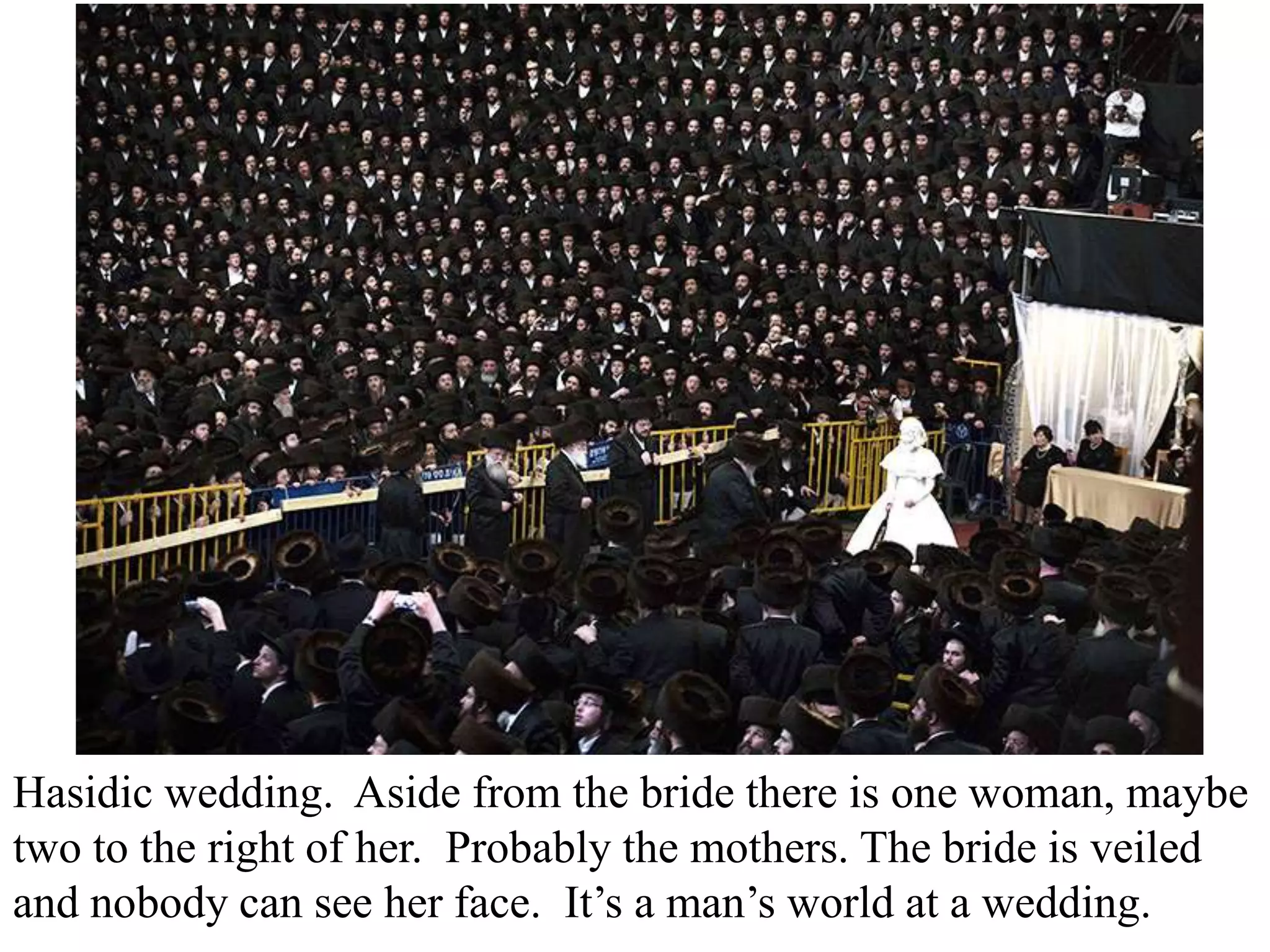
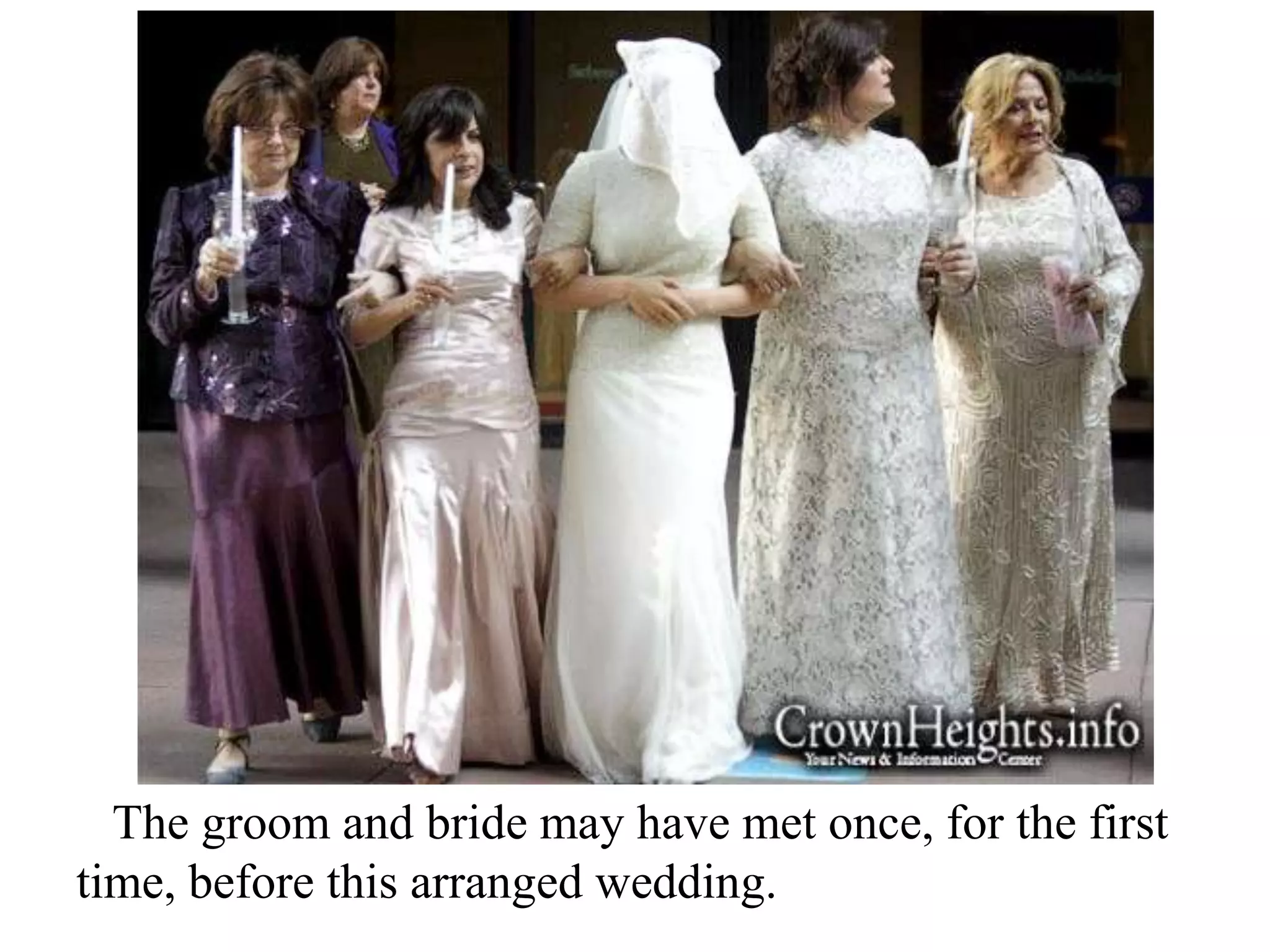
Hasidic wedding. Aside from the bride there is one woman, maybe
two to the right of her. Probably the mothers. The bride is veiled
and nobody can see her face. It’s a man’s world at a wedding.
The groom and bride may have met once, for the first
time, before this arranged wedding.
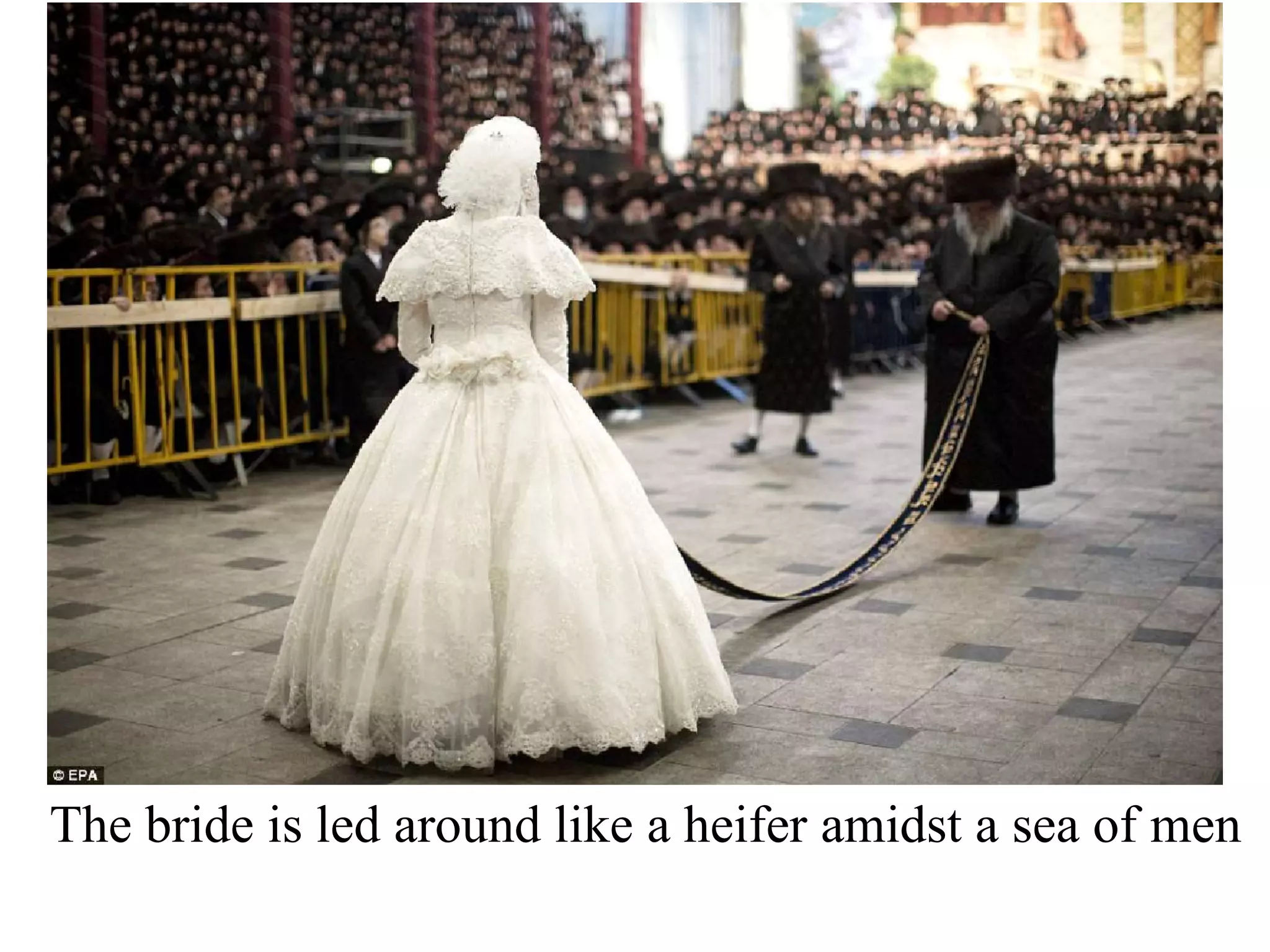
The bride is led around like a heifer amidst a sea of men
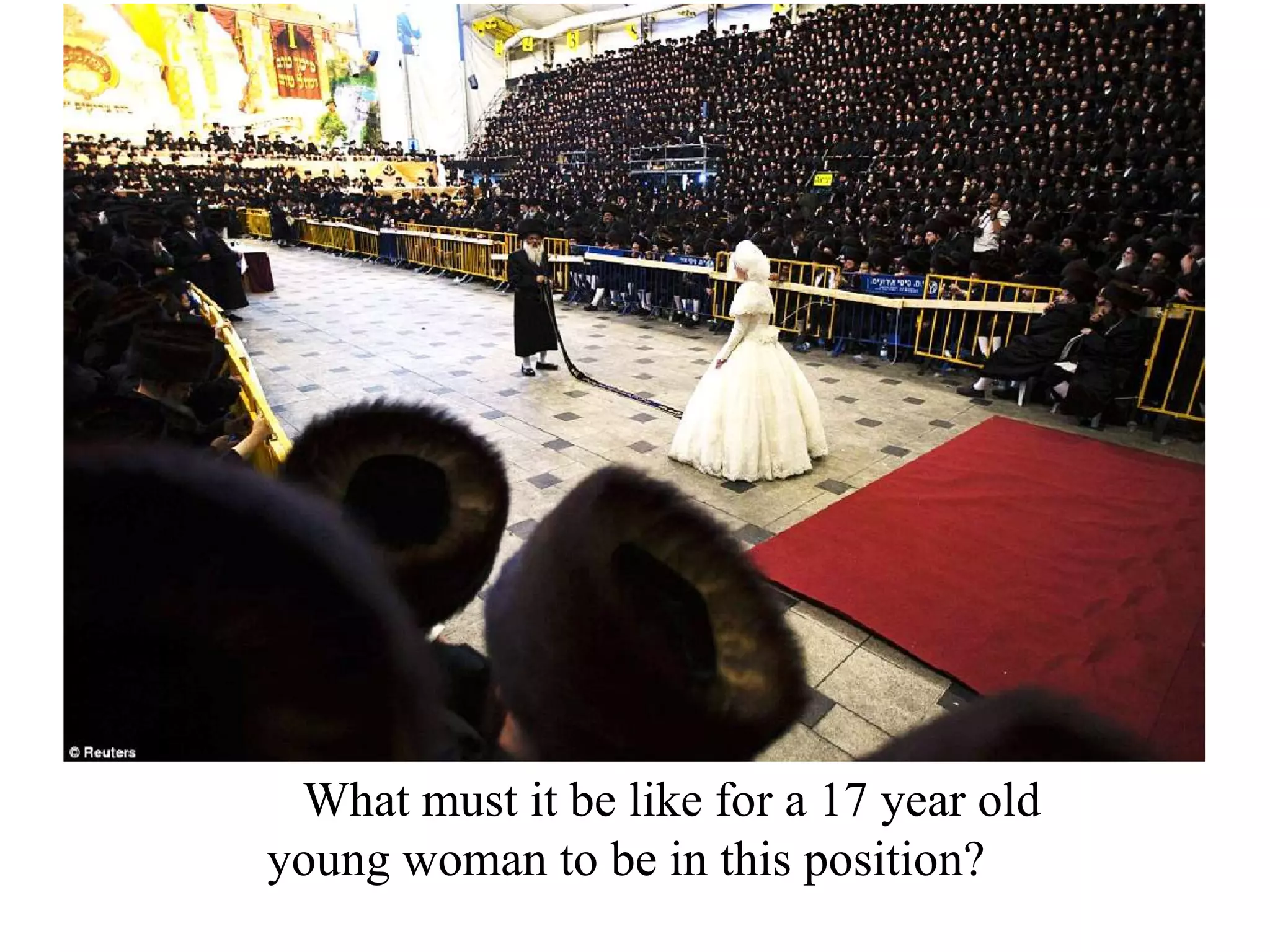
What must it be like for a 17 year old
young woman to be in this position?
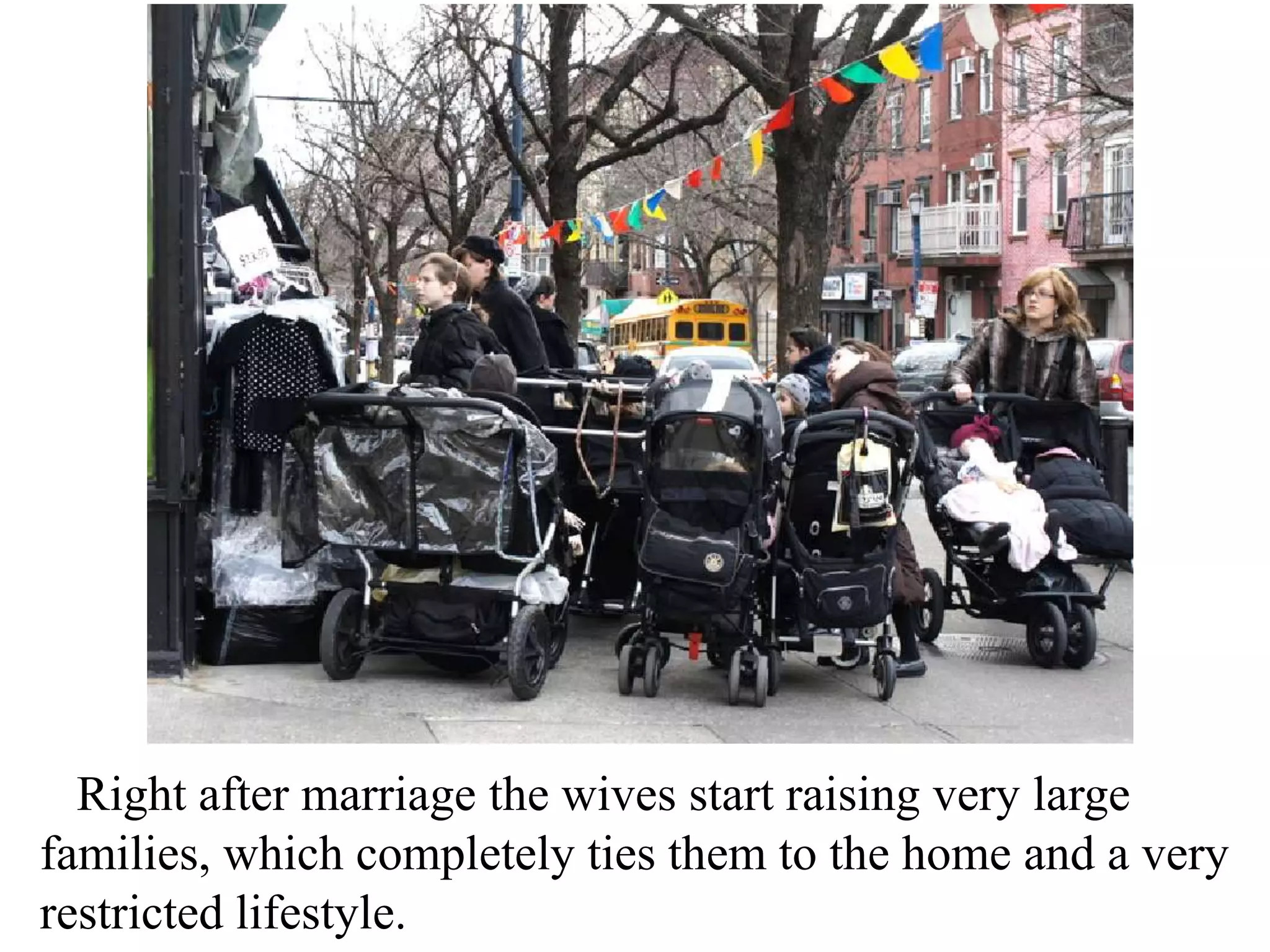
Right after marriage the wives start raising very large
families, which completely ties them to the home and a very
restricted lifestyle.
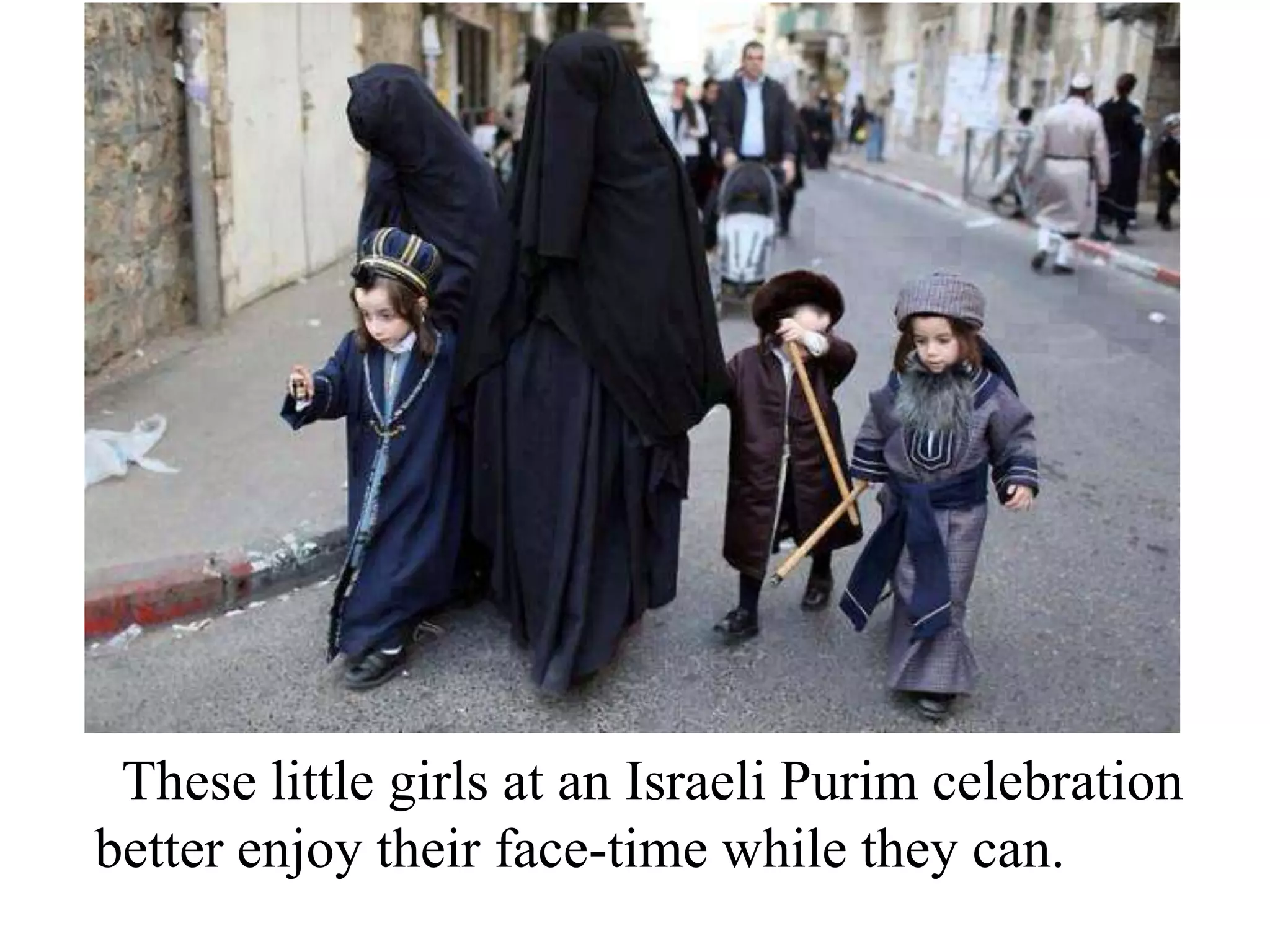
It is never possible to take modesty far enough
These little girls at an Israeli Purim celebration
better enjoy their face-time while they can.
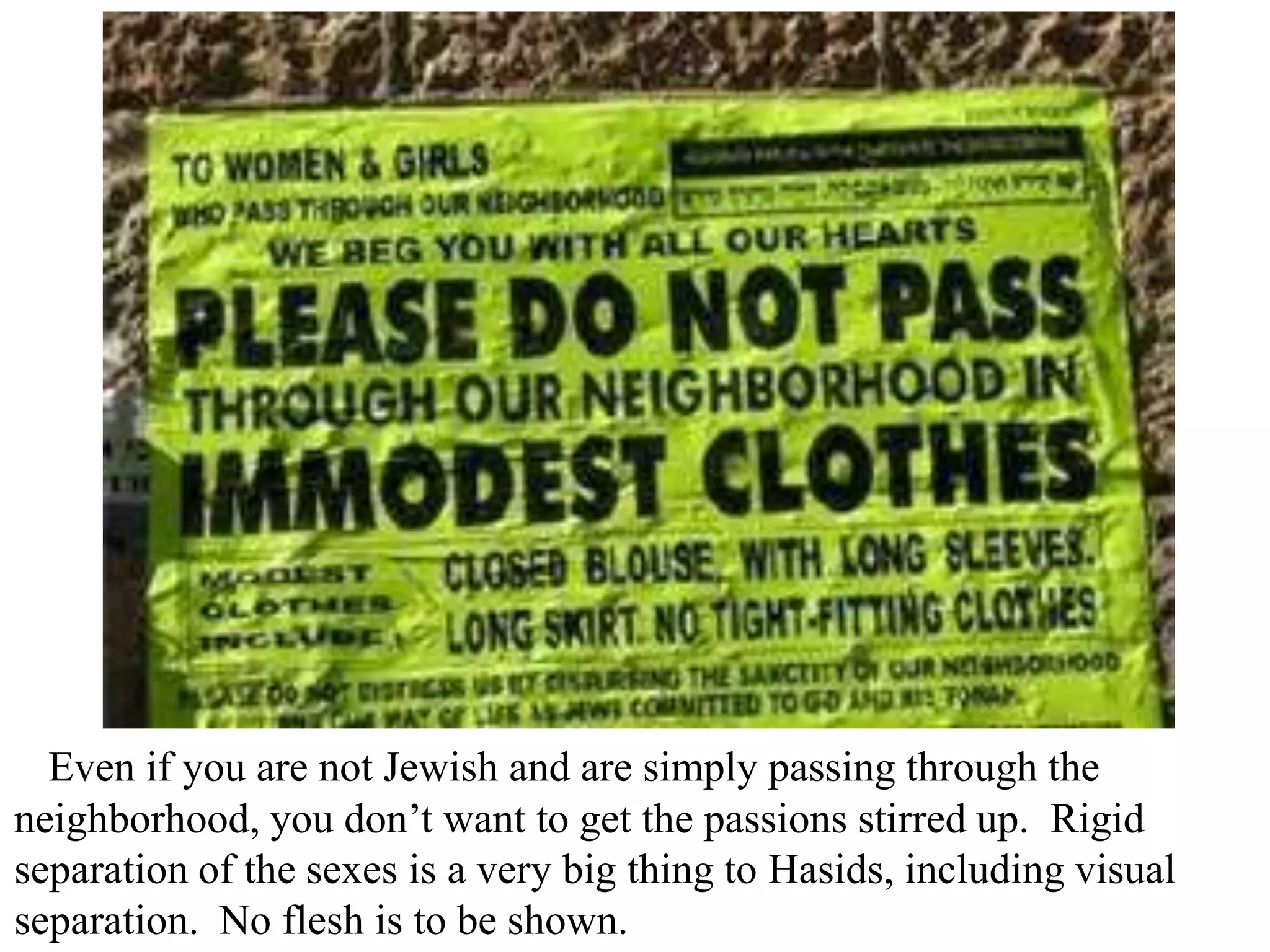
Even if you are not Jewish and are simply passing through the
neighborhood, you don’t want to get the passions stirred up. Rigid
separation of the sexes is a very big thing to Hasids, including visual
separation. No flesh is to be shown.
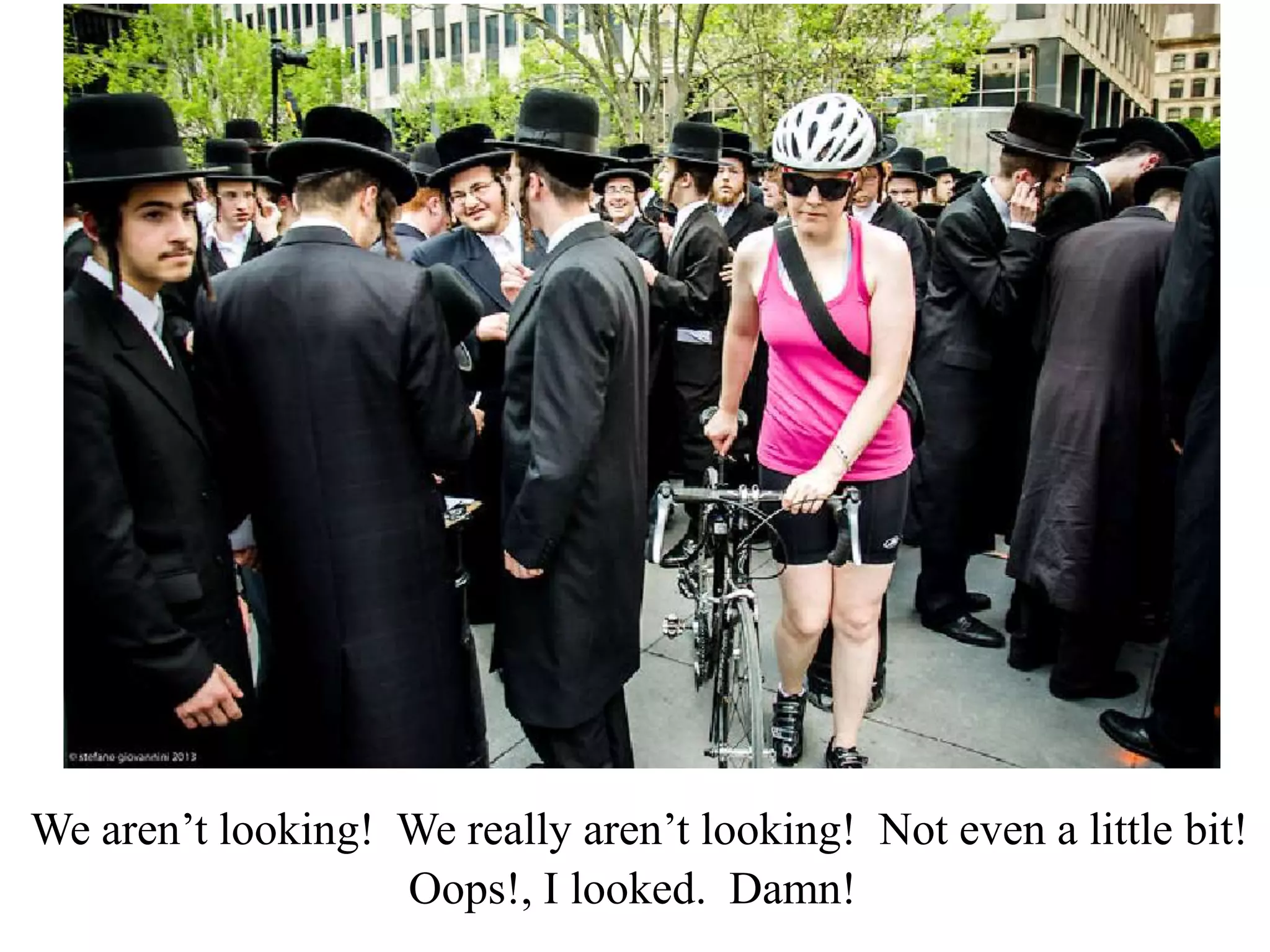
We aren’t looking! We really aren’t looking! Not even a little bit!
Oops!, I looked. Damn!
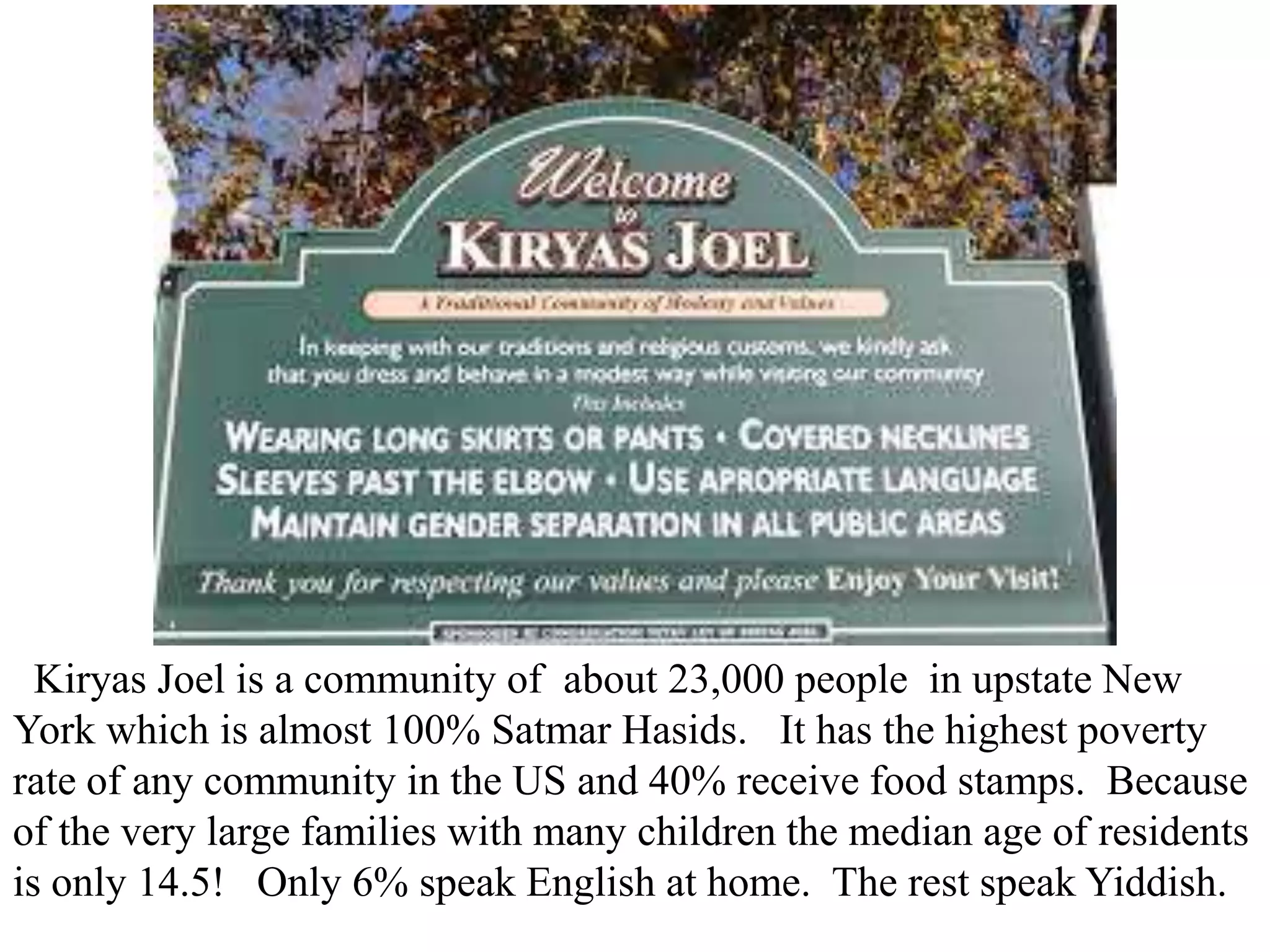
Kiryas Joel is a community of about 23,000 people in upstate New
York which is almost 100% Satmar Hasids. It has the highest poverty
rate of any community in the US and 40% receive food stamps. Because
of the very large families with many children the median age of residents
is only 14.5! Only 6% speak English at home. The rest speak Yiddish.
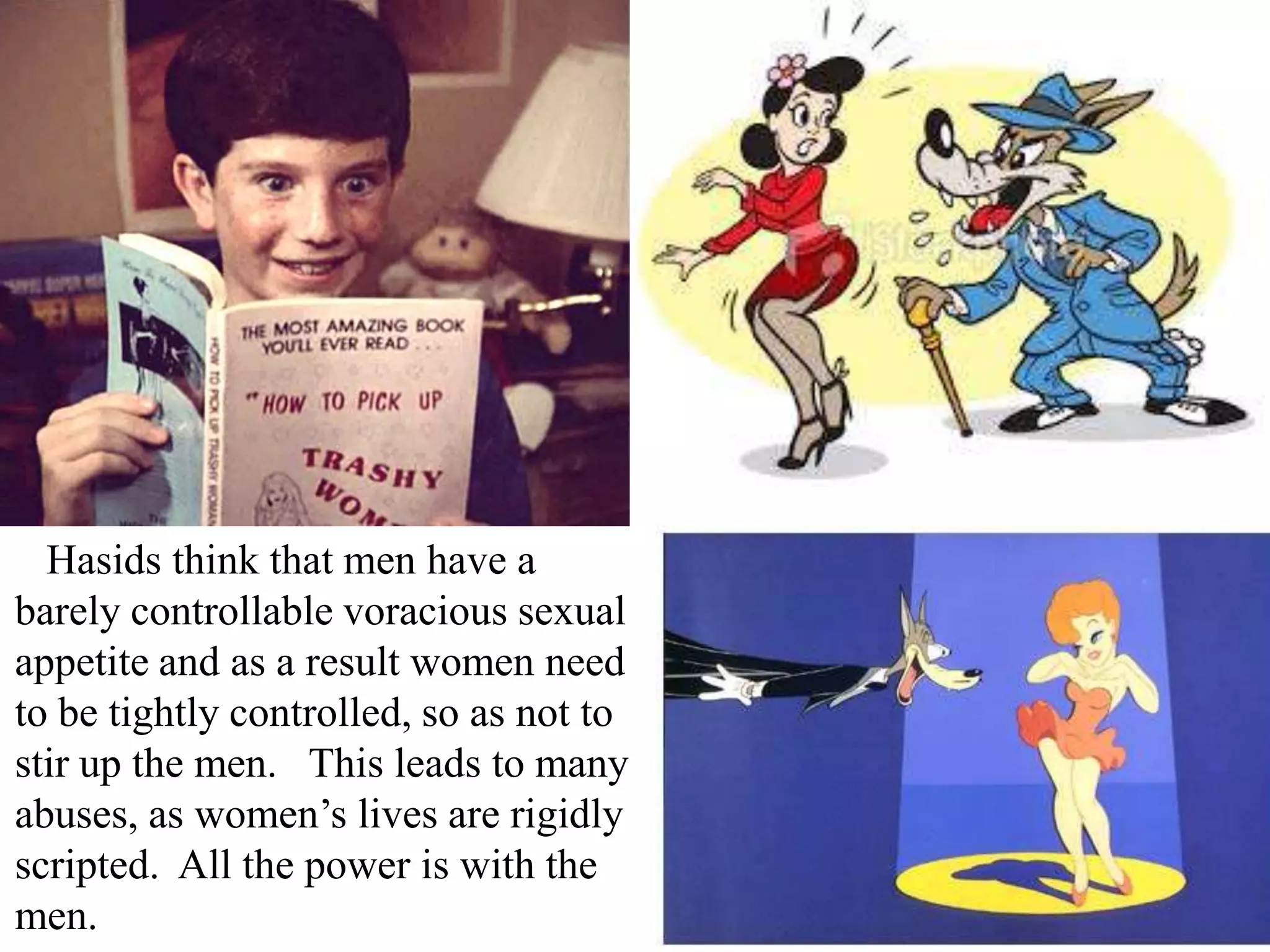
Hasids think that men have a
barely controllable voracious sexual
appetite and as a result women need
to be tightly controlled, so as not to
stir up the men. This leads to many
abuses, as women’s lives are rigidly
scripted. All the power is with the
men.
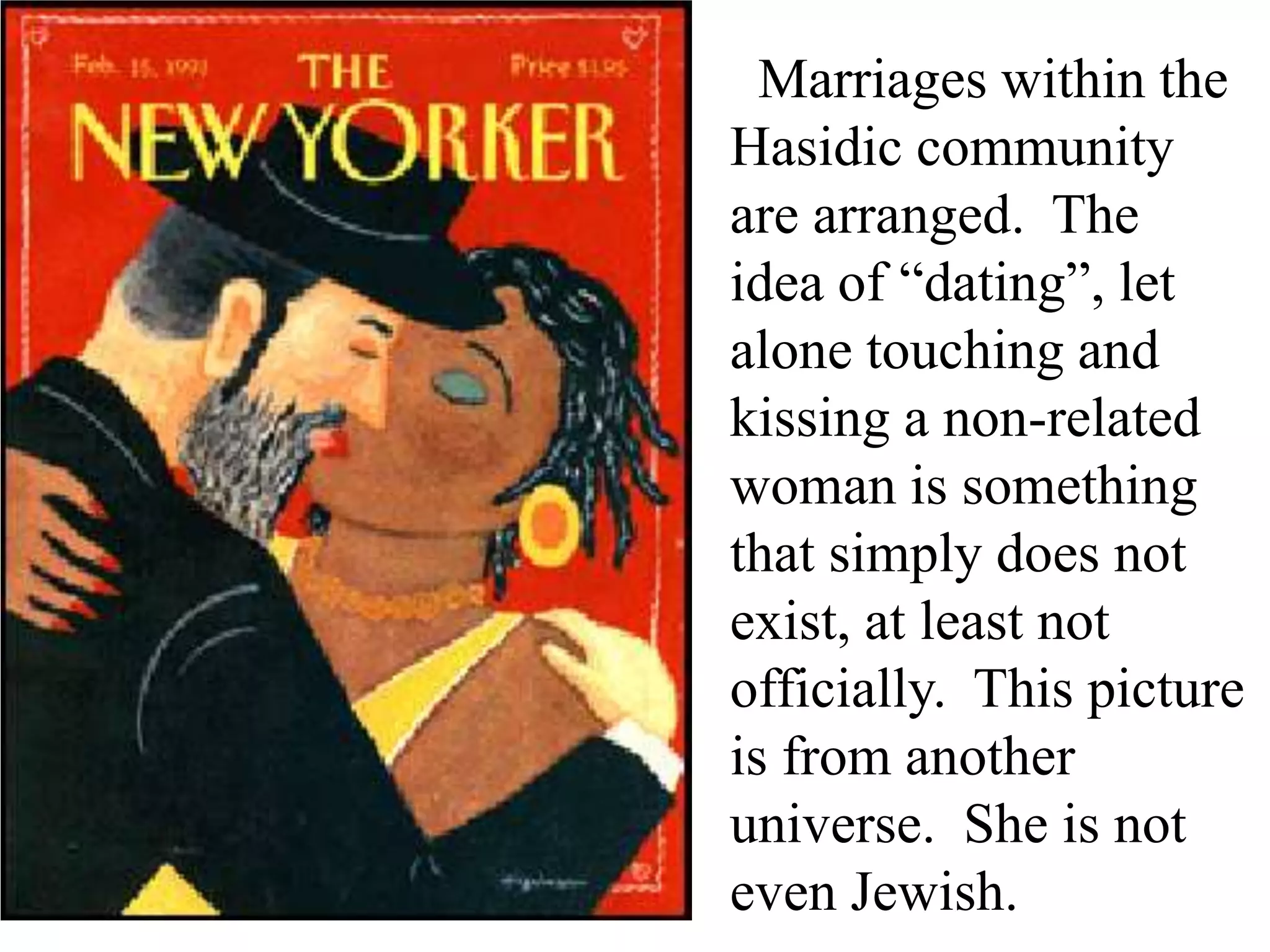
Marriages within the
Hasidic community
are arranged. The
idea of “dating”, let
alone touching and
kissing a non-related
woman is something
that simply does not
exist, at least not
officially. This picture
is from another
universe. She is not
even Jewish.
When Hasids get
married there is
almost complete
ignorance of sex,
which is done in the
dark. Ex-Satmar wife
Deborah Feldman
gives details in her
book “Unorthodox” It
makes the Shakers
look like hippy
swingers.
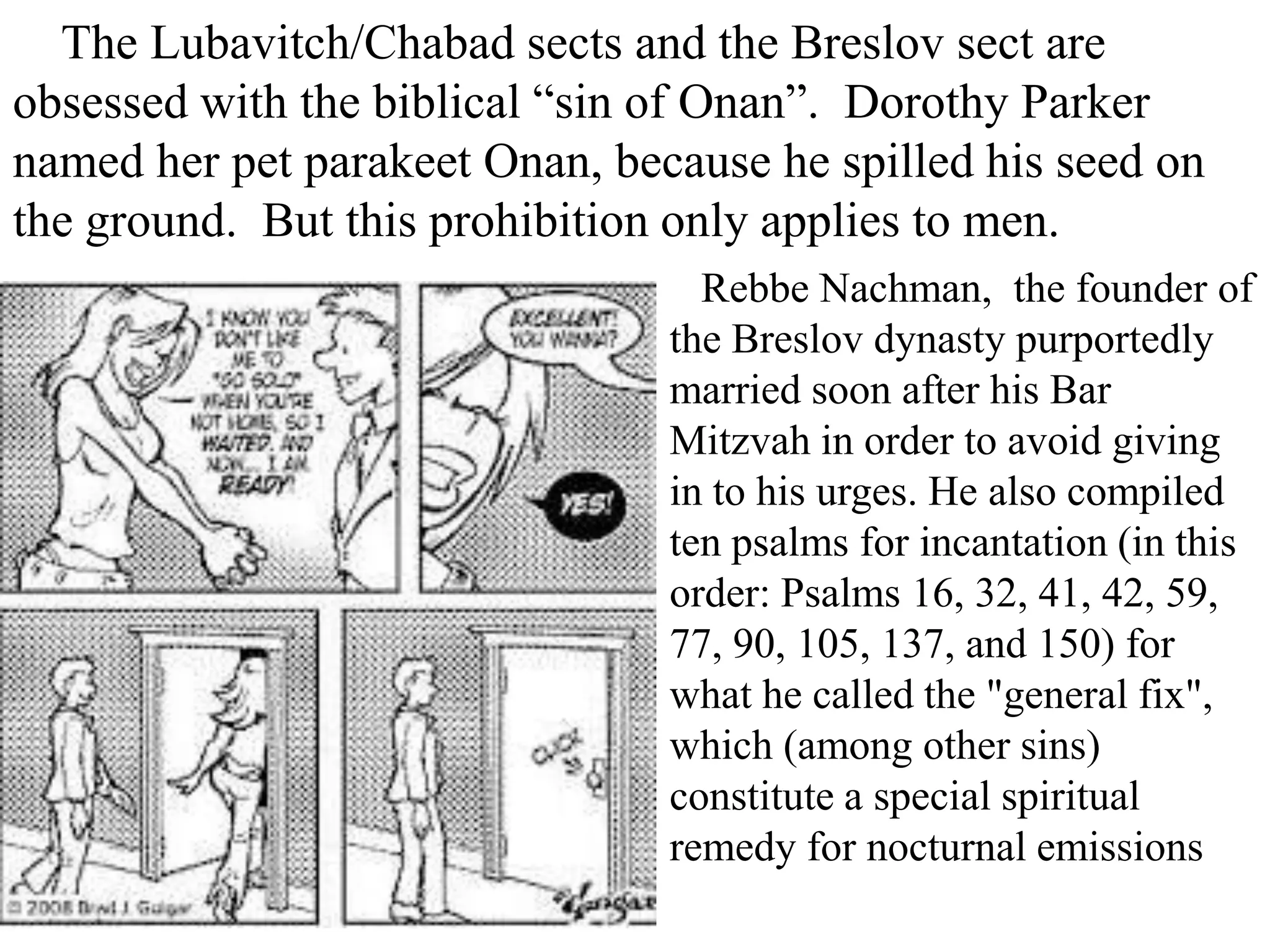
The Lubavitch/Chabad sects and the Breslov sect are
obsessed with the biblical “sin of Onan”. Dorothy Parker
named her pet parakeet Onan, because he spilled his seed on
the ground. But this prohibition only applies to men.
Rebbe Nachman, the founder of
the Breslov dynasty purportedly
married soon after his Bar
Mitzvah in order to avoid giving
in to his urges. He also compiled
ten psalms for incantation (in this
order: Psalms 16, 32, 41, 42, 59,
77, 90, 105, 137, and 150) for
what he called the "general fix",
which (among other sins)
constitute a special spiritual
remedy for nocturnal emissions
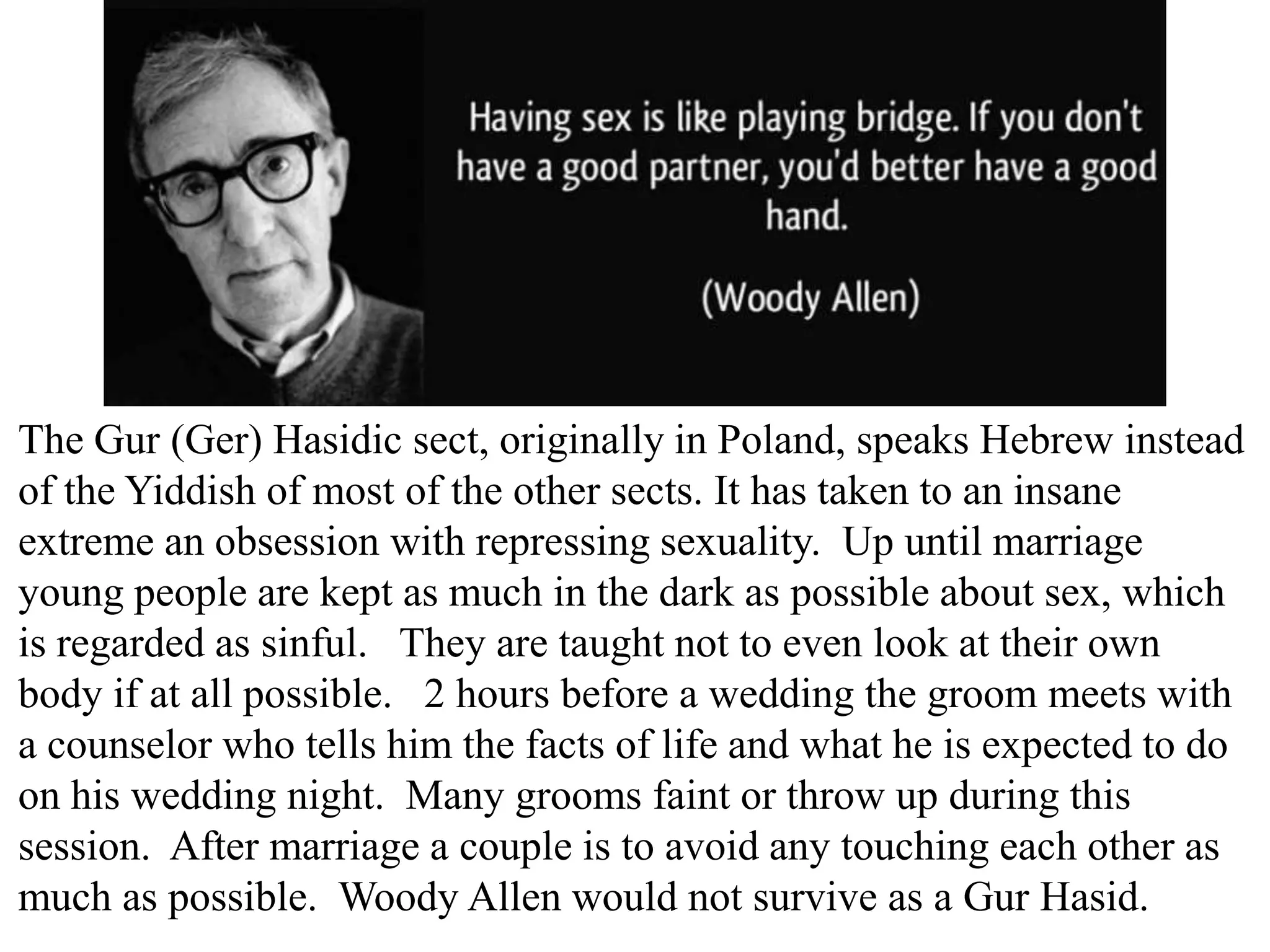
The Gur (Ger) Hasidic sect, originally in Poland, speaks Hebrew instead
of the Yiddish of most of the other sects. It has taken to an insane
extreme an obsession with repressing sexuality. Up until marriage
young people are kept as much in the dark as possible about sex, which
is regarded as sinful. They are taught not to even look at their own
body if at all possible. 2 hours before a wedding the groom meets with
a counselor who tells him the facts of life and what he is expected to do
on his wedding night. Many grooms faint or throw up during this
session. After marriage a couple is to avoid any touching each other as
much as possible. Woody Allen would not survive as a Gur Hasid.
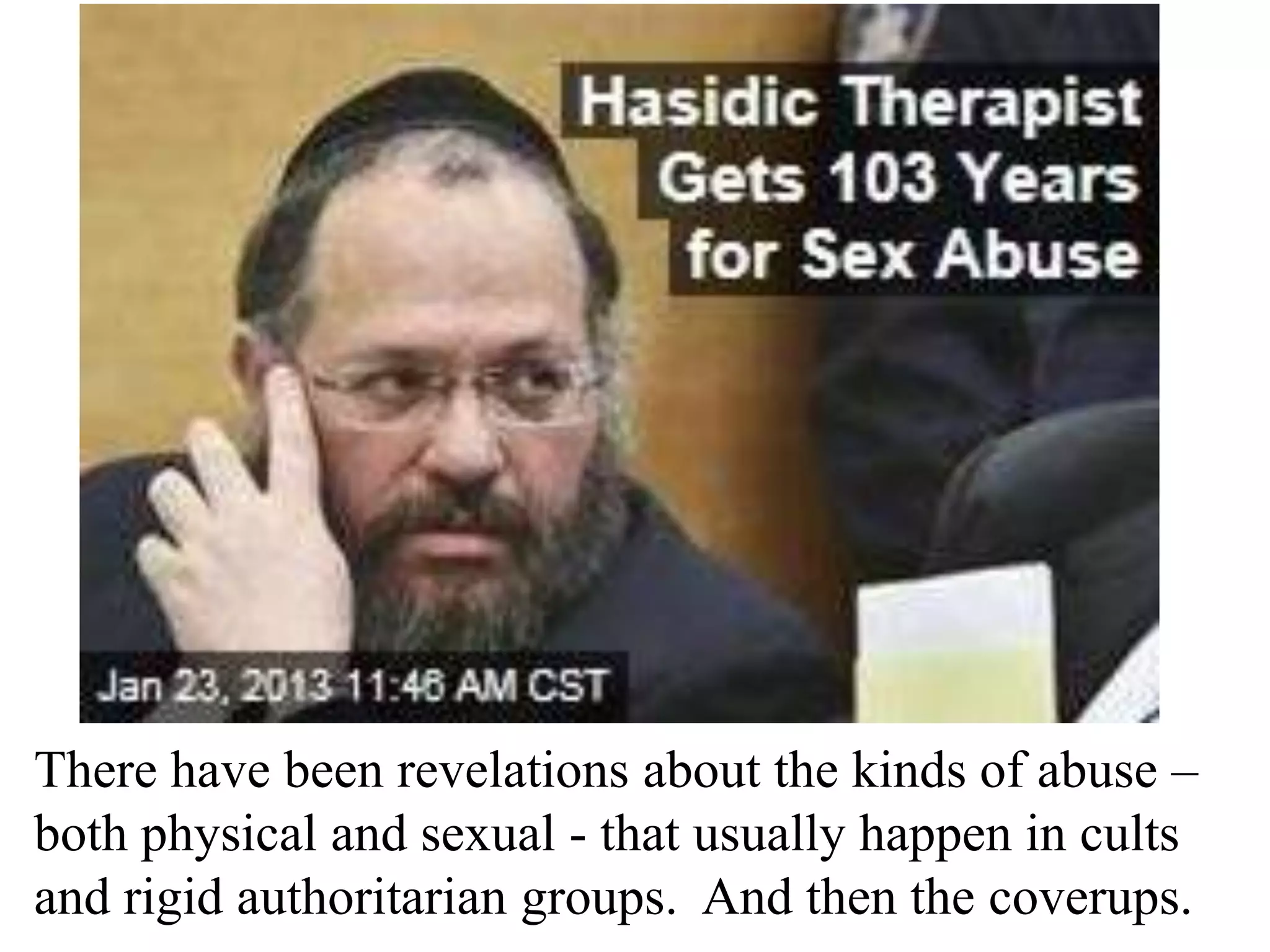
There have been revelations about the kinds of abuse –
both physical and sexual - that usually happen in cults
and rigid authoritarian groups. And then the coverups.
In addition to civil divorce an
Orthodox wife also needs a religious
divorce, or “get” as well before she
can remarry within the Orthodox
community. Spiteful husbands often
refuse to grant the religious divorce
and the wife is then chained
(“agunah”) to her marriage, while he
can remarry. This unequal rights
situation has led to many abuses.

Reporting physical or
sexual abuse to the
authorities is seen as a
crime by the Hasidic
community. So
therefore much of it
goes unreported,
when it would be
grounds for a civil
divorce.
Overall, it looks like the severe restriction of women’s
lives, the lack of any significant secular education, the
poverty, the fundamentalist beliefs, and the abuses that
come with any personality cult (around the rebbe) in an
authoritarian society weight very heavily against Hasidic
life as something to admire. But that is today the fastest
growing segment of Judaism in America. Oy veh!!!

Hasidic life, a Jewish anomaly

  • 1.
  • 2.
    The public faceof Hasidism Famous Jews with a Hasidic background
  • 3.
    Probably the mostfamous Hasidic Jew in history was Marc Chagall, whose art is known and loved around the world and is instantly recognizable.
  • 4.
    Chagall was bornin 1887 in Belarus, Russia to observant Hasidic Jews. This painting is of his parents. In addition to his many works about Jewish shtetl life he also painted stage scenes for opera, like this one for Mozart’s “The Magic Flute”
  • 5.
    A very closesecond in world wide fame is Tevye the Milkman, the fictional Hasid created by Sholem Aleichem.
  • 6.
    The title ofthis Broadway musical was taken from one of Chagall’s many “Fiddler” paintings.
  • 7.
    “Day after day,winter and summer, at six o'clock in the morning, my father got up and went off to the synagogue. There he said his usual prayer for some dead man or other. On his return he made ready the samovar, drank some tea and went to work. Hellish work, the work of a galley-slave. Why try to hide it? How tell about it? No word will ever ease my father's lot...” The upbeat and joyous dancing of the musical and the glorious colors in most of Chagall’s paintings are at odds with the grinding poverty, bleak life and danger from pogroms in the actual shtetls. Here Chagall speaks about his father.
  • 8.
    Pogroms were anever present fear
  • 10.
    The most famousliving person from a Hasidic background is probably Nobel Prize winner Elie Wiesel, born in Romania.
  • 11.
  • 12.
    Isaac Singer, anotherNobel Prize winner and son of a Hasidic rabbi, wrote some light-hearted pieces.
  • 13.
    Those images fromBroadway, funny stories of Chelm, and current photos of exuberant dancing like this one have created a somewhat one-sided popular image of Hasidic life.
  • 14.
    It doesn’t takemuch to notice, however, that this is very much a man’s world. There is another story to be told and other images to be shown.
  • 15.
    You will havegreat difficulty finding a photo like this of young Hasidic Jewish women having fun.
  • 16.
    We will tryto show a balanced view of contemporary Hasidic life and start with the lighter side
  • 17.
    The Lighter Sideof Hasidic life (Tongue in cheek)
  • 18.
    Hasids enjoying ajoke: “An Orthodox, Conservative and Reform Jew walk into a bar. The bartender yells “Hey - get the hell out of here!” I guess you had to be there.
  • 19.
    Satan, get theebehind me!
  • 20.
    Did you havethe ham and cheese? Are those toothpicks kosher???
  • 21.
  • 22.
    If the wind,blessed be its name, should blow your hat off you don’t want to risk being hatless.
  • 23.
  • 24.
  • 25.
  • 26.
    Confused young menplay with Easter Bunny
  • 27.
    These days itwould help not to be Jewish, as this bread has become a sad mockery of the good rye that it used to be. The rigid Hassidic community does not let standards slip this way.
  • 28.
  • 29.
    It is notgenerally known that some of the men’s hats are actually deadly weapons, with razor sharp steel rims – much like what the Korean karate character Odd-Job used in a James Bond movie.
  • 30.
  • 31.
    A day atthe beach
  • 32.
    And this iswhat you call a good pant’s seam?
  • 33.
  • 35.
    Did Rashi andMaimonides do Yoga?
  • 36.
    Since I grewup on a chicken farm I know better than to ever let a chicken get above my head, especially a nervous chicken
  • 37.
    The lighter (good)side of Hasidic life (seriously)
  • 38.
    In a Hasidiccommunity everyone has a place and knows their place. There is much security in this.
  • 39.
    There is alwaysroom for everyone
  • 40.
    If it takesa village to raise a child then the Hasidic community does a good job of this. Notice – all boys
  • 41.
    A child neverlacks for playmates, even within the family. This family has 14 children.
  • 42.
    Orthodox and Hasidicsects with large families
  • 43.
    For the men,at least, there is a rich emotional life and much camaraderie
  • 44.
  • 45.
    Boy’s night outon the town – you are never at a lack for some buddies (male) to hang out with.
  • 46.
    Spirituality for the commonman and woman you do not have to be highly educated in the Torah to worship and experience God in one’s daily life. Hasids emphasize a joyous and emotional attitude towards life, and nature. It is more a life of doing and feeling than one of Torah study. There is a mystical component to life.
  • 47.
    At a timewhen less rigorous forms of Judaism are in declining health, ultraorthodox and Hasidic sects are in robust health and have a growing population.
  • 48.
    Let’s stop fora moment here – who are these people? What is the difference between the Orthodox and the Hasidim?
  • 50.
    The Satmar startedin Hunfgary while the Lubavitch/Chabad were Polish/Russian The Pale was an area of Eastern Europe before WWII where Jews were allowed to settle, with many restrictions. The different Hasidic sects and dynasties are each linked with a particular city in the Pale, like Minsk, and the Hasidic rabbi from there who founded his sect and dynasty. Some Hasidic sects date from the mid 1700’s while others are much later. About 500,000 Hasids died during the Holocaust
  • 51.
    Orthodox Judaism Haredi Judaism Lithuanian -Yeshivish Hasidim Ultra-Orthodox ModernOrthodox Sephardic/ Mizrahi Haredim Belz, Bobov, Breslov, Ger, Lubavitch (Chabad), Munkacs, Puppa, Sanz (Klausenburg), Satmar, Skver, Spinka and Vizhnitz. All are contemporary sects and are personality cults around their rabbi leaders.
  • 52.
    There has beena lot of evolution in the nature of the Hasidic movement since its start in Eastern Europe about 250 years ago. It began as a reaction against excessively dry Torah study and featured a joyous and emotional semi-mystical individual approach to the worship of God. But then over time it changed to be a cult centered on the personality of the charismatic rabbi leaders of each of the various sects. Hereditary dynasties were set up. New restrictions were placed on people’s daily lives. Modern Hasidic life is a corruption of the original movement.
  • 53.
    The Satmar sectis strongly against the state of Israel, which they think should only exist after the Messiah comes
  • 54.
    The two largestsects are the Satmar and the Lubavitch/Chabad. The Lubavitch men always wear a fedora hat. The Satmar men wear a hat that looks like a flying saucer, which sits high up on the head, but on special occasions like Shabbat they wear a shtreimel (cylindrical fur hat).
  • 55.
    A pop quiz– which of these two men is Lubavitch/Chabad?
  • 56.
    Wait! Wait! Weknow this! I’ve almost got it! Correct answer – the man on the right was wearing a fedora so he is Lubavitch/Chabad.
  • 57.
    The Hasidic Shtreimelhat is only worn on special occasions like the Sabbath. It is usually made to order for the wearer and is bought at a man’s wedding by his bride’s father. The sable fur hat costs between $1,000 and $5,000. In America most also own a cheaper ($800- $1500) “rain shtreimel” for use in bad weather. They are always worn over a kippa (yarmulke). It is mainly the Satmar sect that wear these. The Lubavitch sect wear a fedora.
  • 58.
    Cheaper options alsoexist. In Israel the poverty of many Hasidim has led them to only own one shtreimel, the cheaper rain shtreimel type. Women’s wigs are called sheitels and can cost $1500 or more.
  • 59.
    The differences betweenthe various Hasidic sects are sometimes hair-splitting details like the length and position of the men’s peyos (sidelocks) – sometimes curled back and worn behind the ear, sometimes given a spiral curl, or falling straight down, different lengths, etc. Men’s hat sizes, shapes and materials also are different between the sects. Jesus, if he ever existed, would have had peyos although predating Hasidism.
  • 60.
    Men sometimes shave theirhead and leave only the sidelocks, or peyot (peyos), and their beard.
  • 61.
    The morning aftermy wedding, three months after my 18th birthday, my mother shaved my head, and I felt absolutely nothing. Was I supposed to feel sad at this loss? Was I supposed to feel violated? I did not. Married women shave their heads because Hashem and the rebbe command them to do so. According to the Talmud, a woman’s uncovered hair is equivalent to physical nudity. Hasidic rabbis have taken this a step further, requiring women to shave their heads to ensure that not a single hair is seen. For Satmar women like me, it is a grave sin not to shave. You would not be buried in the Satmar beys-hakhayim, and if that weren’t serious enough, you would also put your children, live and unborn, at imminent risk of terrible diseases. The Satmar Rebbe, Yoel Teitelbaum, famously gave emotional, tear-jerking speeches against married women growing their own hair. “Jewish daughters, our mothers and fathers gave up their lives to our Father in Heaven for the sanctity of His name, but you, their daughters, don’t want to give up even a few hairs?” he asked in a speech on Yom Kippur eve in 1951, according to “The Rebbe,” a 2010 biography by Dovid Meisels. “What does Hashem Yisbarach (God) ask of us? A few hairs! Because of a few hairs you are making yourselves lose both worlds. Jewish daughters, shave your hair and give honor to the Torah.” from Frimet Goldberger, an ex-Hasidic woman Just for the record, the Torah says nothing (zero, nada) requiring a woman’s hair to be covered. Nothing at all. Zero.
  • 62.
    There is asingle verse in the Torah – Numbers 5:18 – and a single word in it which has been twisted around in the Talmud by the rabbis, with some convoluted logic, to imply that an uncovered woman’s head is sinful. But even then there is not agreement if what is supposedly being forbidden is undone hair (i.e. loose and not braided) or uncovered hair. Like much of Hassidic practices to do with dress and hair, it is simply a tradition and is not grounded in the Torah. The Torah does prohibit men from cutting their sidelocks but again it says nothing (zero, nada) about covering men’s heads. Again, this is merely tradition. Braided versus loose
  • 63.
    Like most ofthe practices of the Catholic Church, there is no explicit biblical basis for most of the Hasidic customs. They are just that – customs, especially those for women – like these ones.
  • 64.
    Bekishe is along black silk coat the men wear. A tichel is a woman’s scarf worn over the head
  • 65.
    Der Yid (Yiddish: )is a New York-based Yiddish language weekly newspaper, founded in 1953. The newspaper is published by Satmar Hasidim, but is widely read within the broader Haredi community. It uses a Yiddish dialect common to Satmar Chasidim, as opposed to "YIVO Yiddish," which is standard in secular and academic circles.
  • 66.
    Contemporary mikveh, (mikvah) orritual bath. The use of this is central to Hasidic practices. Men as well as women have specified occasions when immersion in the mikveh is required. People shower before entering. Hasidic men use it before every Shabbat and many use it every day. It is considered more important than having a synagogue.
  • 67.
    temporarily deceased Rabbi Schneerson Unlikethe Satmar sect, the Lubavitch/Chabad sect is very active in outreach – at colleges and on streets in their Mitzvah-mobiles – and they attempt to recruit and “rescue” lapsed Jews. Until his death in 1994 the center of this group was rabbi Schneerson. By almost everyone’s account he is still dead but there is a very vocal and fervent group that claim he was the Messiah. He seemed to think so too.
  • 68.
    . Temporarily dead ornot, he has not been seen around lately. This Messiah (Moshiach) business and the vast personality cult around Schneerson has not set well with the other Hasidic sects. All of the Hasidic sects are basically personality cults around their current rabbi leader but none have claimed to be the Messiah. The Satmar have extreme hostility to the Lubavitch/Chabad over their Schneerson/Messiah views.
  • 69.
    . Messiah or not,Schneerson made messianism a key part of the Lubavitch/Chabad movement. When he was buried some of his ardent followers slept at the grave, hoping to be the first to see him rise from the dead. With no children and no chosen successor his absence has split the sect into rival factions – the believers and the doubters.
  • 70.
    The Darker Sideof Hasidic Life There are a lot of ugly aspects of Hasidic life
  • 71.
    For religious people, Hasidscan get quite violent and nasty There has been an extremely bitter unresolved feud between brothers Aaron and Zalman Tietelbaum over who leads the Satmar dynasty now that their father has died. There has been violence between their supporters, in rival camps. Riot police were called in.
  • 72.
    The Hasidic sectsare basically cults and getting in is usually a one-way experience, especially for women.
  • 73.
    Some women haveescaped this life and written books about it.
  • 74.
    Many people livehappy and rewarding lives within the Hasidic communities but those who break away usually cannot believe their new freedom and rejoice in it.
  • 75.
    There is littlesecular education and this makes for few employment opportunities if someone leaves the community.
  • 76.
    The Hasidim believe inthe literal truth of the Torah. All of it. Every word. Noah’s Ark, the Flood, everything. Critical thought is strongly discouraged and there is very little secular education
  • 77.
    It is importantfor women to learn how to read so that they are able to follow directions.
  • 78.
    The universe wouldprobably explode if someone accidentally went in the wrong bathroom so the signs are very clear
  • 79.
    Views on theplace of women are extreme. Notice anything missing from this famous photo about the Bin Laden raid? It is Hillary, from the front of the photo, who has been removed by an Orthodox newspaper so as not to show unrelated men and women together in the same room.
  • 80.
    They must stayin the back of a bus, when they are allowed to share one with men.
  • 81.
    Black is thenew black. It’s a man’s world at a Hasidic funeral
  • 82.
    Hasidic wedding. Asidefrom the bride there is one woman, maybe two to the right of her. Probably the mothers. The bride is veiled and nobody can see her face. It’s a man’s world at a wedding.
  • 83.
    The groom andbride may have met once, for the first time, before this arranged wedding.
  • 84.
    The bride isled around like a heifer amidst a sea of men
  • 85.
    What must itbe like for a 17 year old young woman to be in this position?
  • 86.
    Right after marriagethe wives start raising very large families, which completely ties them to the home and a very restricted lifestyle.
  • 87.
    It is neverpossible to take modesty far enough
  • 88.
    These little girlsat an Israeli Purim celebration better enjoy their face-time while they can.
  • 89.
    Even if youare not Jewish and are simply passing through the neighborhood, you don’t want to get the passions stirred up. Rigid separation of the sexes is a very big thing to Hasids, including visual separation. No flesh is to be shown.
  • 90.
    We aren’t looking!We really aren’t looking! Not even a little bit! Oops!, I looked. Damn!
  • 91.
    Kiryas Joel isa community of about 23,000 people in upstate New York which is almost 100% Satmar Hasids. It has the highest poverty rate of any community in the US and 40% receive food stamps. Because of the very large families with many children the median age of residents is only 14.5! Only 6% speak English at home. The rest speak Yiddish.
  • 92.
    Hasids think thatmen have a barely controllable voracious sexual appetite and as a result women need to be tightly controlled, so as not to stir up the men. This leads to many abuses, as women’s lives are rigidly scripted. All the power is with the men.
  • 93.
    Marriages within the Hasidiccommunity are arranged. The idea of “dating”, let alone touching and kissing a non-related woman is something that simply does not exist, at least not officially. This picture is from another universe. She is not even Jewish.
  • 94.
    When Hasids get marriedthere is almost complete ignorance of sex, which is done in the dark. Ex-Satmar wife Deborah Feldman gives details in her book “Unorthodox” It makes the Shakers look like hippy swingers.
  • 95.
    The Lubavitch/Chabad sectsand the Breslov sect are obsessed with the biblical “sin of Onan”. Dorothy Parker named her pet parakeet Onan, because he spilled his seed on the ground. But this prohibition only applies to men. Rebbe Nachman, the founder of the Breslov dynasty purportedly married soon after his Bar Mitzvah in order to avoid giving in to his urges. He also compiled ten psalms for incantation (in this order: Psalms 16, 32, 41, 42, 59, 77, 90, 105, 137, and 150) for what he called the "general fix", which (among other sins) constitute a special spiritual remedy for nocturnal emissions
  • 96.
    The Gur (Ger)Hasidic sect, originally in Poland, speaks Hebrew instead of the Yiddish of most of the other sects. It has taken to an insane extreme an obsession with repressing sexuality. Up until marriage young people are kept as much in the dark as possible about sex, which is regarded as sinful. They are taught not to even look at their own body if at all possible. 2 hours before a wedding the groom meets with a counselor who tells him the facts of life and what he is expected to do on his wedding night. Many grooms faint or throw up during this session. After marriage a couple is to avoid any touching each other as much as possible. Woody Allen would not survive as a Gur Hasid.
  • 97.
    There have beenrevelations about the kinds of abuse – both physical and sexual - that usually happen in cults and rigid authoritarian groups. And then the coverups.
  • 98.
    In addition tocivil divorce an Orthodox wife also needs a religious divorce, or “get” as well before she can remarry within the Orthodox community. Spiteful husbands often refuse to grant the religious divorce and the wife is then chained (“agunah”) to her marriage, while he can remarry. This unequal rights situation has led to many abuses. Reporting physical or sexual abuse to the authorities is seen as a crime by the Hasidic community. So therefore much of it goes unreported, when it would be grounds for a civil divorce.
  • 99.
    Overall, it lookslike the severe restriction of women’s lives, the lack of any significant secular education, the poverty, the fundamentalist beliefs, and the abuses that come with any personality cult (around the rebbe) in an authoritarian society weight very heavily against Hasidic life as something to admire. But that is today the fastest growing segment of Judaism in America. Oy veh!!!