Hashing
• The searchingtime of each searching technique depends on the comparison.
i.e., n comparisons required for an array A with n elements
• To increase the efficiency, i.e., to reduce the searching time. we need to avoid
unnecessary comparisons
• Hashing is a technique where we can compute the location of the desired
record in order to retrieve it in a single access (or comparison)
• Let there is a table of n employee records and each employee record is
defined by a unique employee code, which is a key to the record and
employee name
• If the key (or employee code) is used as the array index, then the record can
be accessed by the key directly
3.
Hashing
• If Lis the memory location where each record is related with the key
• If we can locate the memory address of a record from the key then the
desired record can be retrieved in a single access
• For notational and coding convenience, we assume that the keys in k and the
address in L are (decimal) integers
• So the location is selected by applying a function which is called hash
function or hashing function from the key k
• Unfortunately such a function H may not yield different values (or index); it is
possible that two different keys ki and k2 will yield the same hash address
• This situation is called Hash Collision, which is discussed later
4.
Hash Function
• Thebasic idea of hash function is the transformation of the key into the
corresponding location in the hash table
• A Hash function H can be defined as a function that takes key as input and
transforms it into a hash table index
5.
Properties of HashFunction
• A good hash function should:
• Minimize collisions
• Be easy and quick to compute
• Distribute key values evenly in the hash table
Division Method
• TABLEis an array of database file where the employee
details are stored
• Choose a number m, which is larger than the number of
keys k. i.e., m is greater than the total number of records in
the
• TABLE
• The number m is usually chosen to be prime number to
minimize the collision
• The hash function H is defined by
• H(k) = k mod m
• Where H(k) is the hash address and k mod m means the
remainder when k is divided by m
8.
Example
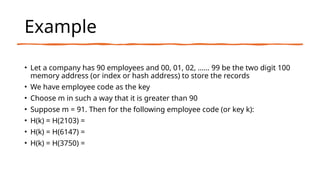
• Let acompany has 90 employees and 00, 01, 02, ...... 99 be the two digit 100
memory address (or index or hash address) to store the records
• We have employee code as the key
• Choose m in such a way that it is greater than 90
• Suppose m = 91. Then for the following employee code (or key k):
• H(k) = H(2103) =
• H(k) = H(6147) =
• H(k) = H(3750) =


![谷歌留痕技术教程[ 𝙩𝙤𝙥 𝟮𝟯𝟯. 𝙘 𝙤𝙢 ]](https://cdn.slidesharecdn.com/ss_thumbnails/top233-260130173900-2eb784f9-thumbnail.jpg?width=640&height=640&fit=bounds)


