Hash Functions , Digital Signature
Subject: Information Security
Presented by: Najam
Introduction to Hash Functions
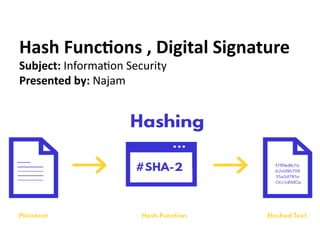
• Definition: A hash function is a mathematical
algorithm that converts an input (message)
into a fixed-size string of characters, which
appears random.
• Purpose: Ensures data integrity.
• Used in digital signatures and password
storage.
Properties of Hash Functions
• Deterministic: The same input always
produces the same hash.
• Fast Computation: Quick to generate hash
values.
• Pre-image Resistance: Difficult to reverse the
hash to the original input.
• Collision Resistance: Two different inputs
should not produce the same hash.
Popular Hash Functions
• MD5: Older, less secure. (not reversible)
• SHA-1: More secure but outdated.
• SHA-256: Widely used, secure.
• bcrypt: Slow, ideal for password hashing
Use this link to convert hash value
https://www.fileformat.info/
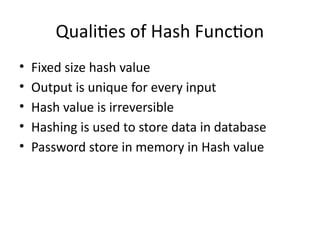
Qualities of Hash Function
• Fixed size hash value
• Output is unique for every input
• Hash value is irreversible
• Hashing is used to store data in database
• Password store in memory in Hash value
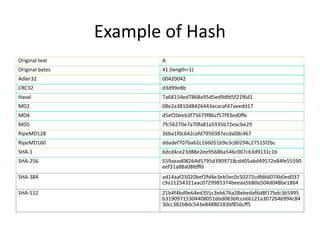
Example of Hash
Original text A
Original bytes 41 (length=1)
Adler32 00420042
CRC32 d3d99e8b
Haval 7a68154ed7868a95d5ed9dfd5f21f6d1
MD2 08e2a3810d8426443ecacaf47aeedd17
MD4 d5ef20eeb3f75679f86cf57f93ed0ffe
MD5 7fc56270e7a70fa81a5935b72eacbe29
RipeMD128 36ba1f0c642cafd7950387ecda08c467
RipeMD160 ddadef707ba62c166051b9e3cd0294c27515f2bc
SHA-1 6dcd4ce23d88e2ee9568ba546c007c63d9131c1b
SHA-256 559aead08264d5795d3909718cdd05abd49572e84fe55590
eef31a88a08fdffd
SHA-384 ad14aaf25020bef2fd4e3eb5ec0c50272cdfd66074b0ed037
c9a11254321aac0729985374beeaa5b80a504d048be1864
SHA-512 21b4f4bd9e64ed355c3eb676a28ebedaf6d8f17bdc365995
b319097153044080516bd083bfcce66121a3072646994c84
30cc382b8dc543e84880183bf856cff5
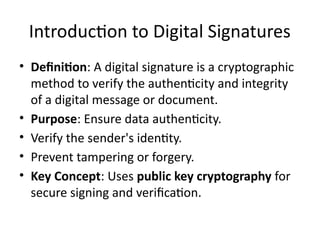
Introduction to Digital Signatures
• Definition: A digital signature is a cryptographic
method to verify the authenticity and integrity
of a digital message or document.
• Purpose: Ensure data authenticity.
• Verify the sender's identity.
• Prevent tampering or forgery.
• Key Concept: Uses public key cryptography for
secure signing and verification.
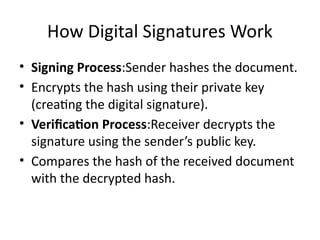
How Digital Signatures Work
• Signing Process:Sender hashes the document.
• Encrypts the hash using their private key
(creating the digital signature).
• Verification Process:Receiver decrypts the
signature using the sender’s public key.
• Compares the hash of the received document
with the decrypted hash.
Applications and Benefits
• Applications:
• Secure email communication.
• Legal document signing (e.g., contracts).
• Software distribution.
• Blockchain and cryptocurrency.
• Benefits:
• Prevents fraud and tampering.
• Ensures non-repudiation.
• Builds trust in digital transactions.

Hash Functions and many other function of the

  • 2.
    Hash Functions ,Digital Signature Subject: Information Security Presented by: Najam
  • 3.
    Introduction to HashFunctions • Definition: A hash function is a mathematical algorithm that converts an input (message) into a fixed-size string of characters, which appears random. • Purpose: Ensures data integrity. • Used in digital signatures and password storage.
  • 4.
    Properties of HashFunctions • Deterministic: The same input always produces the same hash. • Fast Computation: Quick to generate hash values. • Pre-image Resistance: Difficult to reverse the hash to the original input. • Collision Resistance: Two different inputs should not produce the same hash.
  • 5.
    Popular Hash Functions •MD5: Older, less secure. (not reversible) • SHA-1: More secure but outdated. • SHA-256: Widely used, secure. • bcrypt: Slow, ideal for password hashing Use this link to convert hash value https://www.fileformat.info/
  • 6.
    Qualities of HashFunction • Fixed size hash value • Output is unique for every input • Hash value is irreversible • Hashing is used to store data in database • Password store in memory in Hash value
  • 7.
    Example of Hash Originaltext A Original bytes 41 (length=1) Adler32 00420042 CRC32 d3d99e8b Haval 7a68154ed7868a95d5ed9dfd5f21f6d1 MD2 08e2a3810d8426443ecacaf47aeedd17 MD4 d5ef20eeb3f75679f86cf57f93ed0ffe MD5 7fc56270e7a70fa81a5935b72eacbe29 RipeMD128 36ba1f0c642cafd7950387ecda08c467 RipeMD160 ddadef707ba62c166051b9e3cd0294c27515f2bc SHA-1 6dcd4ce23d88e2ee9568ba546c007c63d9131c1b SHA-256 559aead08264d5795d3909718cdd05abd49572e84fe55590 eef31a88a08fdffd SHA-384 ad14aaf25020bef2fd4e3eb5ec0c50272cdfd66074b0ed037 c9a11254321aac0729985374beeaa5b80a504d048be1864 SHA-512 21b4f4bd9e64ed355c3eb676a28ebedaf6d8f17bdc365995 b319097153044080516bd083bfcce66121a3072646994c84 30cc382b8dc543e84880183bf856cff5
  • 8.
    Introduction to DigitalSignatures • Definition: A digital signature is a cryptographic method to verify the authenticity and integrity of a digital message or document. • Purpose: Ensure data authenticity. • Verify the sender's identity. • Prevent tampering or forgery. • Key Concept: Uses public key cryptography for secure signing and verification.
  • 10.
    How Digital SignaturesWork • Signing Process:Sender hashes the document. • Encrypts the hash using their private key (creating the digital signature). • Verification Process:Receiver decrypts the signature using the sender’s public key. • Compares the hash of the received document with the decrypted hash.
  • 11.
    Applications and Benefits •Applications: • Secure email communication. • Legal document signing (e.g., contracts). • Software distribution. • Blockchain and cryptocurrency. • Benefits: • Prevents fraud and tampering. • Ensures non-repudiation. • Builds trust in digital transactions.