HANDWRITING ANALSIS:
Principles and characteristics
Introduction:
▪ Writing is a combination of large numbers of habits, these
habits are the result of varied causes.
▪ Handwriting is an acquired skill and undoubtedly that is a
complex neuromuscular task.
▪ The writing becomes a pattern of subconscious, habitual
formations that are repeated from one writing to the next.
Characteristics of Handwriting
The characteristics of writing that occur in the handwriting
include the appearance of the writing and the methods of
construction.
a. Class characteristics
b. Individual characteristics
BASIC PRINCIPLES OF HANDWRITING
1. No two people write exactly alike.
2. All writing contains natural variation so that no two writing
samples by the same writer will be exactly the same.
3. Individual characteristics that are unique to a particular
writer exist in every person’s handwriting, distinguishing it
from every other handwriting.
4. The act of writing is a skill learned through repetition until it
becomes a habit.
5. A person’s normal form of writing is based on mental images
of learned letter designs.
6. Natural writing are subconscious act and therefore cannot
be changed by the writer.
7. A person’s handwriting can be change over a period of time.
1. Class characteristics are those features or qualities of
writing that situate a person within a group of writers, or
those features shared by a large number of peoples,
characteristics such as slope, spacing, height, proportions,
and letter designs that are shared with other systems.
2. Class characteristics assist in identifying a writer but are
not sufficient to identifying a writer.
Individual writing characteristics are those
discriminating elements that serve to differentiate
between members within any or all groups.
Handwriting Features
oArrangement
oAlignment
oAbbreviations
oConnections
oInitial Strokes
oPen Lifts
oPen Pressure
oPunctuation
oRhythm
oShading
oSize
oSlope
oTerminal Strokes
oTremor
Arrangement
The arrangement of writing on a sheet of paper may be as
individual as the writing itself.
Margins, spacing, address placement, crowding, insertions,
and alignment can all be personal habits of a writer.
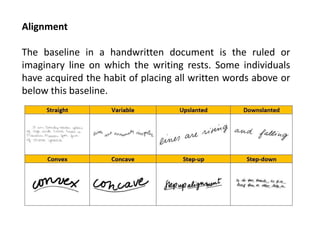
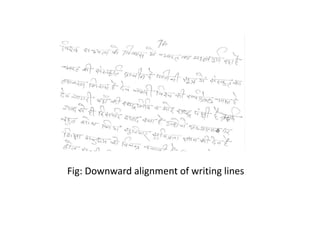
Alignment
The baseline in a handwritten document is the ruled or
imaginary line on which the writing rests. Some individuals
have acquired the habit of placing all written words above or
below this baseline.
Fig: Downward alignment of writing lines
Abbreviations
a. word contractions that eliminate letters
b. letter combinations that sacrifice form in favour of speed
“The styling of abbreviations — whether capitalized or
lowercased, closed up or spaced, punctuated or unpunctuated
— depends most often on the writer’s preference or the
organization’s policy.”
Days of the week (Sun., Mon., Tues)
Latin words and phrases (etc., i.e., e.g., viz., et al., pro
tem.)
Units of measure (cu. ft., sq. yd., km., Kilo., sec., min., hr.)
Words and word groups (c/o, w/o,
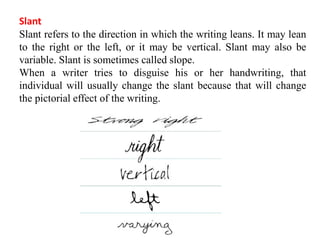
Slant
Slant refers to the direction in which the writing leans. It may lean
to the right or the left, or it may be vertical. Slant may also be
variable. Slant is sometimes called slope.
When a writer tries to disguise his or her handwriting, that
individual will usually change the slant because that will change
the pictorial effect of the writing.
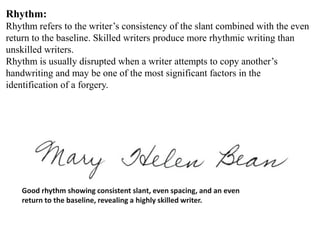
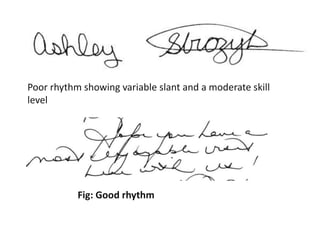
Rhythm:
Rhythm refers to the writer’s consistency of the slant combined with the even
return to the baseline. Skilled writers produce more rhythmic writing than
unskilled writers.
Rhythm is usually disrupted when a writer attempts to copy another’s
handwriting and may be one of the most significant factors in the
identification of a forgery.
Good rhythm showing consistent slant, even spacing, and an even
return to the baseline, revealing a highly skilled writer.
Poor rhythm showing variable slant and a moderate skill
level
Fig: Good rhythm
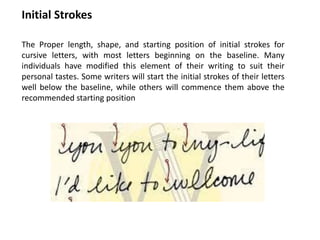
Initial Strokes
The Proper length, shape, and starting position of initial strokes for
cursive letters, with most letters beginning on the baseline. Many
individuals have modified this element of their writing to suit their
personal tastes. Some writers will start the initial strokes of their letters
well below the baseline, while others will commence them above the
recommended starting position
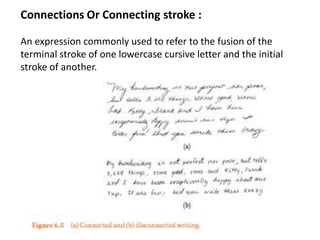
Connections Or Connecting stroke :
An expression commonly used to refer to the fusion of the
terminal stroke of one lowercase cursive letter and the initial
stroke of another.
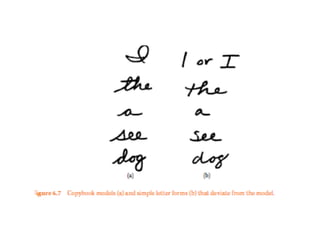
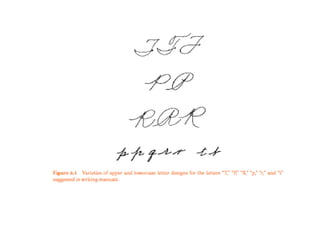
Design or construction of allographs (letters)
1. Correspondence to foreign/domestic or particular writing
systems
2. Number, nature, position, sequence, and direction of strokes in
allograph (letter) construction
3. Use of two or more designs for the same allograph
4. Capitalization—divergences from standard practices
5. Allograph (letter) combinations—wherein one allograph’s design
influences the structure or shape of its neighbor.
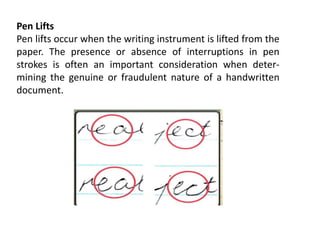
Pen Lifts
Pen lifts occur when the writing instrument is lifted from the
paper. The presence or absence of interruptions in pen
strokes is often an important consideration when deter-
mining the genuine or fraudulent nature of a handwritten
document.
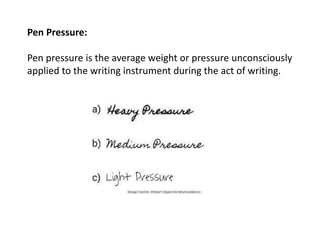
Pen Pressure:
Pen pressure is the average weight or pressure unconsciously
applied to the writing instrument during the act of writing.
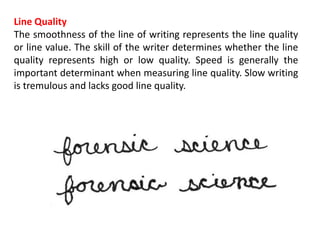
Line Quality
The smoothness of the line of writing represents the line quality
or line value. The skill of the writer determines whether the line
quality represents high or low quality. Speed is generally the
important determinant when measuring line quality. Slow writing
is tremulous and lacks good line quality.
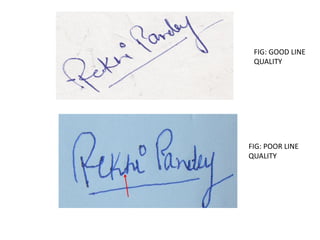
FIG: POOR LINE
QUALITY
FIG: GOOD LINE
QUALITY
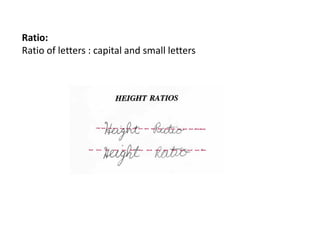
Ratio:
Ratio of letters : capital and small letters
WRITING MOVEMENT
Movement includes direction, slant, rhythm, pressure
patterns, line quality, and speed. The direction of writing is
dictated by rules of penmanship, but not everyone adheres
to the rules.
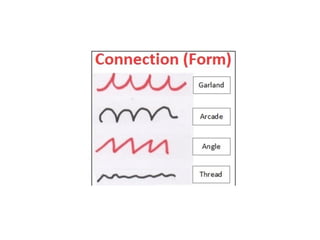
A. Garlanded — anticlockwise movements predominate
B. Arched — clockwise movements predominate
C. Angular — straight lines take precedence to curves
D. Indeterminable
Embellishments
Summary of writing attributes/
elements of handwriting
1. Style characteristics
a. Arrangement
i. Influenced by artistic ability, sense of proportion, and instruction received
ii. The product of a group of habits
b. Class of Allograph
The four styles of allographs
c. Connections
i. Interword
ii. Intraword
d. Designs of Allographs and Their Construction
i. Correspondence to foreign/domestic or particular writing systems
ii. Number, nature, position, sequence, and direction of strokes in letter
composition
iii. Use of two or more forms for the same letter
iv. Capitalization—divergences from standard practices
e. Dimensions
i. Proportions of elements of letters, that is, bowls to
staffs, bodies to loops, arches
to loops
ii. Absolute sizes
iii. Relative sizes of specific letters to specific letters or
according to position in
words
f. Slant or Slope
i. Of the writing in general
ii. Of letters or parts of letters in particular
g. Spacing
i. Interword
ii. Intraword
2. Elements of Execution
a. Abbreviations
i. Word contractions that eliminate letters
ii. Letter combinations that sacrifice form for speed
b. Alignment
The relation of successive letters of a signature, a word, or line
of writing to an actual
or imaginary baseline
c. Commencements and Terminations
i. Their length, direction, and path
ii. Their taper (the abruptness with which the instrument
approaches and leaves the paper)
d. Diacritics and Punctuation — Presence, Style, and Location.
e. Embellishments
Including flourishes, ornamentation, rubrics, and underscores
f. Legibility or Writing Quality
Ease of recognition of letters or adherence to copybook form
g. Line Continuity
The presence/absence of pen stops, pen lifts, or retracings
h. Line Quality
The degree of regularity (i.e., smoothness and/or gradation) to the
writing stroke as is judged from the consistency of its nature and of
its path in a prescribed direction.
It varies from smooth and controlled to tremulous and erratic.
i. Pen Control
i. Pen hold
ii. Pen position
iii. Point load (pen pressure)
A. To be considered if and when determinable
B. Evidenced by shading, greater deposition of ink or graphite
or by the depression of the paper; called rhythm, or fluency,
or a flowing hand when it materializes as a harmonious and
graduated recurrence
C. Absolute—occurring in all writing
D. Relative—greater or lesser in some strokes
j. Writing Movement
i. Variants in the predominating action of the writing instrument;
may be three-dimensional
ii. Observed in letter formation and interword connections that
may be:
A. Garlanded — anticlockwise movements predominate
B. Arched — clockwise movements predominate
C. Angular — straight lines take precedence to curves
D. Indeterminable
3. Attributes of All Writing Habits
a. Consistency or Natural Variation
The precision with which the habits are executed on repeated
occasions
b. Persistency
The frequency with which a given habit occurs when the
occasion permits
4. Combinations of Writing Habits
a. Lateral Expansion
i. Ranges from contracted to expanded
ii. The product of spacing and letter formation
b. Word Proportions
i. Vertical dimension versus horizontal dimension
ii. The product of size and spacing

Handwrting basics for the subject forensic science

  • 1.
  • 2.
    Introduction: ▪ Writing isa combination of large numbers of habits, these habits are the result of varied causes. ▪ Handwriting is an acquired skill and undoubtedly that is a complex neuromuscular task. ▪ The writing becomes a pattern of subconscious, habitual formations that are repeated from one writing to the next.
  • 3.
    Characteristics of Handwriting Thecharacteristics of writing that occur in the handwriting include the appearance of the writing and the methods of construction. a. Class characteristics b. Individual characteristics
  • 4.
    BASIC PRINCIPLES OFHANDWRITING 1. No two people write exactly alike. 2. All writing contains natural variation so that no two writing samples by the same writer will be exactly the same. 3. Individual characteristics that are unique to a particular writer exist in every person’s handwriting, distinguishing it from every other handwriting. 4. The act of writing is a skill learned through repetition until it becomes a habit. 5. A person’s normal form of writing is based on mental images of learned letter designs. 6. Natural writing are subconscious act and therefore cannot be changed by the writer. 7. A person’s handwriting can be change over a period of time.
  • 5.
    1. Class characteristicsare those features or qualities of writing that situate a person within a group of writers, or those features shared by a large number of peoples, characteristics such as slope, spacing, height, proportions, and letter designs that are shared with other systems. 2. Class characteristics assist in identifying a writer but are not sufficient to identifying a writer.
  • 6.
    Individual writing characteristicsare those discriminating elements that serve to differentiate between members within any or all groups.
  • 7.
    Handwriting Features oArrangement oAlignment oAbbreviations oConnections oInitial Strokes oPenLifts oPen Pressure oPunctuation oRhythm oShading oSize oSlope oTerminal Strokes oTremor
  • 8.
    Arrangement The arrangement ofwriting on a sheet of paper may be as individual as the writing itself. Margins, spacing, address placement, crowding, insertions, and alignment can all be personal habits of a writer.
  • 9.
    Alignment The baseline ina handwritten document is the ruled or imaginary line on which the writing rests. Some individuals have acquired the habit of placing all written words above or below this baseline.
  • 10.
    Fig: Downward alignmentof writing lines
  • 11.
    Abbreviations a. word contractionsthat eliminate letters b. letter combinations that sacrifice form in favour of speed “The styling of abbreviations — whether capitalized or lowercased, closed up or spaced, punctuated or unpunctuated — depends most often on the writer’s preference or the organization’s policy.” Days of the week (Sun., Mon., Tues) Latin words and phrases (etc., i.e., e.g., viz., et al., pro tem.) Units of measure (cu. ft., sq. yd., km., Kilo., sec., min., hr.) Words and word groups (c/o, w/o,
  • 12.
    Slant Slant refers tothe direction in which the writing leans. It may lean to the right or the left, or it may be vertical. Slant may also be variable. Slant is sometimes called slope. When a writer tries to disguise his or her handwriting, that individual will usually change the slant because that will change the pictorial effect of the writing.
  • 13.
    Rhythm: Rhythm refers tothe writer’s consistency of the slant combined with the even return to the baseline. Skilled writers produce more rhythmic writing than unskilled writers. Rhythm is usually disrupted when a writer attempts to copy another’s handwriting and may be one of the most significant factors in the identification of a forgery. Good rhythm showing consistent slant, even spacing, and an even return to the baseline, revealing a highly skilled writer.
  • 14.
    Poor rhythm showingvariable slant and a moderate skill level Fig: Good rhythm
  • 15.
    Initial Strokes The Properlength, shape, and starting position of initial strokes for cursive letters, with most letters beginning on the baseline. Many individuals have modified this element of their writing to suit their personal tastes. Some writers will start the initial strokes of their letters well below the baseline, while others will commence them above the recommended starting position
  • 16.
    Connections Or Connectingstroke : An expression commonly used to refer to the fusion of the terminal stroke of one lowercase cursive letter and the initial stroke of another.
  • 18.
    Design or constructionof allographs (letters) 1. Correspondence to foreign/domestic or particular writing systems 2. Number, nature, position, sequence, and direction of strokes in allograph (letter) construction 3. Use of two or more designs for the same allograph 4. Capitalization—divergences from standard practices 5. Allograph (letter) combinations—wherein one allograph’s design influences the structure or shape of its neighbor.
  • 21.
    Pen Lifts Pen liftsoccur when the writing instrument is lifted from the paper. The presence or absence of interruptions in pen strokes is often an important consideration when deter- mining the genuine or fraudulent nature of a handwritten document.
  • 22.
    Pen Pressure: Pen pressureis the average weight or pressure unconsciously applied to the writing instrument during the act of writing.
  • 23.
    Line Quality The smoothnessof the line of writing represents the line quality or line value. The skill of the writer determines whether the line quality represents high or low quality. Speed is generally the important determinant when measuring line quality. Slow writing is tremulous and lacks good line quality.
  • 24.
    FIG: POOR LINE QUALITY FIG:GOOD LINE QUALITY
  • 25.
    Ratio: Ratio of letters: capital and small letters
  • 26.
    WRITING MOVEMENT Movement includesdirection, slant, rhythm, pressure patterns, line quality, and speed. The direction of writing is dictated by rules of penmanship, but not everyone adheres to the rules. A. Garlanded — anticlockwise movements predominate B. Arched — clockwise movements predominate C. Angular — straight lines take precedence to curves D. Indeterminable
  • 27.
  • 29.
    Summary of writingattributes/ elements of handwriting
  • 30.
    1. Style characteristics a.Arrangement i. Influenced by artistic ability, sense of proportion, and instruction received ii. The product of a group of habits b. Class of Allograph The four styles of allographs c. Connections i. Interword ii. Intraword d. Designs of Allographs and Their Construction i. Correspondence to foreign/domestic or particular writing systems ii. Number, nature, position, sequence, and direction of strokes in letter composition iii. Use of two or more forms for the same letter iv. Capitalization—divergences from standard practices
  • 31.
    e. Dimensions i. Proportionsof elements of letters, that is, bowls to staffs, bodies to loops, arches to loops ii. Absolute sizes iii. Relative sizes of specific letters to specific letters or according to position in words f. Slant or Slope i. Of the writing in general ii. Of letters or parts of letters in particular g. Spacing i. Interword ii. Intraword
  • 32.
    2. Elements ofExecution a. Abbreviations i. Word contractions that eliminate letters ii. Letter combinations that sacrifice form for speed b. Alignment The relation of successive letters of a signature, a word, or line of writing to an actual or imaginary baseline c. Commencements and Terminations i. Their length, direction, and path ii. Their taper (the abruptness with which the instrument approaches and leaves the paper)
  • 33.
    d. Diacritics andPunctuation — Presence, Style, and Location. e. Embellishments Including flourishes, ornamentation, rubrics, and underscores f. Legibility or Writing Quality Ease of recognition of letters or adherence to copybook form g. Line Continuity The presence/absence of pen stops, pen lifts, or retracings h. Line Quality The degree of regularity (i.e., smoothness and/or gradation) to the writing stroke as is judged from the consistency of its nature and of its path in a prescribed direction. It varies from smooth and controlled to tremulous and erratic.
  • 34.
    i. Pen Control i.Pen hold ii. Pen position iii. Point load (pen pressure) A. To be considered if and when determinable B. Evidenced by shading, greater deposition of ink or graphite or by the depression of the paper; called rhythm, or fluency, or a flowing hand when it materializes as a harmonious and graduated recurrence C. Absolute—occurring in all writing D. Relative—greater or lesser in some strokes
  • 35.
    j. Writing Movement i.Variants in the predominating action of the writing instrument; may be three-dimensional ii. Observed in letter formation and interword connections that may be: A. Garlanded — anticlockwise movements predominate B. Arched — clockwise movements predominate C. Angular — straight lines take precedence to curves D. Indeterminable
  • 36.
    3. Attributes ofAll Writing Habits a. Consistency or Natural Variation The precision with which the habits are executed on repeated occasions b. Persistency The frequency with which a given habit occurs when the occasion permits 4. Combinations of Writing Habits a. Lateral Expansion i. Ranges from contracted to expanded ii. The product of spacing and letter formation b. Word Proportions i. Vertical dimension versus horizontal dimension ii. The product of size and spacing