STUDY OF CALLIGRAPHY
STROKES OF SCRIPTS
ENGLISH ART INTEGRATED PROJECT
Name :-ASHISH KUMAR
Class:-XIIth
CERTIFICATE
This is to certify that the art integrated
project of English is a record of genuine work
carried out by ASHISH KUMAR of Class XII during
the academic session 2022-23 under my
guidance have been completed successfully
Date:-26-01-2023
Place- MVM
I AM GLAD THAT I HAD THIS OPPORTUNITY TO TAKE UP
THIS PROJECT . IT HAS BEEN A GREAT LEARNING
EXPERIENCE. I HAVE ENJOYED DOING THIS PROJECT AND IT HAD
ALLOWED ME TO EXPLORE THE NEW ARENA OF KNOWLEDGE .I
WOULD LIKE TO TAKE THIS OPPORTUNITY TO EXPRESS MY
GRATITUDE TP ALL THOSE PEOPLE WHO HELPED ME IN
COMPLETING THIS PROJECT ,DIRECTLY OR INDIRECTLY .
I WOULD LIKE TO EXPRESS MY DEEP SENSE OF GRATITUDE TP OUR
MATHEMATICS TEACHER FOR PROVIDING CONSTANT SUPPORT,
REQUIRED GUIDANCE AND THE ASSISTANCE IN COMPLETING
THE PROJECT.
WHAT IS CALLIGRAPHY?
Calligraphy, the art of beautiful The term may derive from the Greek words for
“beauty” (kallos) and “to write” (graphein). It implies a sure knowledge of the correct
form of letters, the conventional signs by which can be communicated-and the skill
to make them with such ordering of the various parts and harmony of proportions
that the experienced, knowledgeable eye will recognize such as a work of art.
To do calligraphy, it involves learning about the following aspects:
• The tool used to draw the letterform (pens, brushes, bamboo sticks, etc.)
• The medium on which the letterform is drawn (paper, cloth, etc.)
WHAT IS CALLIGRAPHY STROKES ?
In calligraphy, we need to start with the very, very basics. These are
referred to a “strokes”. All of the letters are made up of strokes.
The most construction your stocks, the more consistency of letters!
The basic strokes are the foundations for the entire calligraphy
alphabet
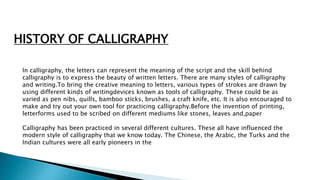
HISTORY OF CALLIGRAPHY
In calligraphy, the letters can represent the meaning of the script and the skill behind
calligraphy is to express the beauty of written letters. There are many styles of calligraphy
and writing.To bring the creative meaning to letters, various types of strokes are drawn by
using different kinds of writingdevices known as tools of calligraphy. These could be as
varied as pen nibs, quills, bamboo sticks, brushes, a craft knife, etc. It is also encouraged to
make and try out your own tool for practicing calligraphy.Before the invention of printing,
letterforms used to be scribed on different mediums like stones, leaves and,paper
Calligraphy has been practiced in several different cultures. These all have influenced the
modern style of calligraphy that we know today. The Chinese, the Arabic, the Turks and the
Indian cultures were all early pioneers in the
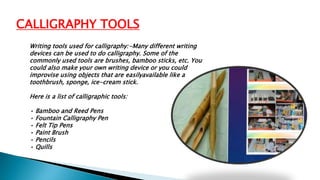
CALLIGRAPHY TOOLS
Writing tools used for calligraphy:-Many different writing
devices can be used to do calligraphy. Some of the
commonly used tools are brushes, bamboo sticks, etc. You
could also make your own writing device or you could
improvise using objects that are easilyavailable like a
toothbrush, sponge, ice-cream stick.
Here is a list of calligraphic tools:
• Bamboo and Reed Pens
• Fountain Calligraphy Pen
• Felt Tip Pens
• Paint Brush
• Pencils
• Quills
- Different mediums used for writing Calligraphy:
The letterforms are drawn on different types of papers, cloths, leaves, etc. The
texture of the surface as well as the absorption properties of the material makes a
difference to the calligraphic strokes.
Here is a list of different types of papers used for writing Calligraphy:
Parchment Paper
• Copier Paper
Onion skin Paper
• Rice Paper
• Pencils
CALLIGRAPHY
SURFACES
DEVNAGRI CALLIGRAPHY
Devanagari:-(/, deivǝ’na gǝri/ DAY-və-NAH-gǝr-ee; I, IAST: Devanagari,
Sanskrit pronunciation: [de ve ‘na geri:]), also called Nagari (Nāgari,, is a left-
to-right abugida (alphasyllabary), based on the ancient Brahmi script,used in
the Indian subcontinent. It was developed in ancient India from the 1st to the
4th century Ceand was in regular use by the 7th century CE. The Devanagari
script, composed of 47 primary characters including 14 vowels and 33
consonants, is the fourth most widely adopted writing system in the world,
being used for over 120 languages.
HISTORY OF DEVNAGRI
CALLIGRAPHY
Devanagari is part of the Brahmic family of scripts of India, Nepal, Tibet, and Southeast
Asia.It is a descendant of the 3rd century BCE Brahmi script, which evolved into the Nagari
script which in turn gave birth to Devanagari and Nandinagari. Both were used to write
Sanskrit, until the latter was merged into the former. The resulting script is widely adopted
across India to write Sanskrit, Marathi, Hindi and its dialects, and Konkani.
Some of the earliest epigraphical evidence attesting to the developing Sanskrit Nagari script
in ancient India is from the 1st to 4th century CE inscriptions discovered in Gujarat.Variants of
script called Nagari, recognisably close to Devanagari, are first attested from the 1st century
CE Rudradaman inscriptions in Sanskrit, while the modern standardised form of Devanagari
was in use by about 1000 CE. Medieval inscriptions suggest widespread diffusion of the
Nagari- related scripts, with biscripts presenting local script along with the adoption of
Nagari scripts. For example, the mid 8th-century Pattadakal pillar in Karnataka has text in
both Siddha Matri script, and an early Telugu-Kannada script; while, the Kangra Jawalamukhi
inscription SO in Hin hal Pradesh is written in both Sharada and Devanagari scripts.
Cursive forms, where letters are joined to one another by ligatures, were mainly
used in daily life, such as merchants writing accounts, shopping lists, birthday
notes and letters. The Old Roman Cursive (also called the majuscule cursive) is
thought to have been used widely from the 1st century BCE to the 3rd century CE
(although cursive forms seem to have been illegible even when Plautus, a 3rd
century BCE comedian was writing), and can be found in a few examples of
wooden or wax tablets, tabellae defixionum (curse tablets), graffiti, and
inscriptions on clay. The New Roman Cursive (also called the minuscule cursive)
seem to have been used from the 3rd-10th century, and influenced the
development of the uncial script (used widely from the 4th century onward).
One of the most defining features of the Old Roman Cursive is the 8 with the
round bow on the left, instead of the right, where we would expect it, and the Q
with a long tail slanted to the left. Even in neater handwriting, A, R, B, and D
look incredibly similar. Older examples of the Old Roman Cursive style seem to
have been more upright, like in an edict of Nero’s, but later examples are more
slanted and narrower.
ROMAN CALLIGRAPHY
In Western culture the plainer Greek- and Latin-derived alphabets and the spread of
literacy have tended to make handwriting in principle an art that anyone can practice.
Nonetheless, after the introduction of printing in Europe in the mid-15th century, a clear
distinction arose between handwriting and more elaborate forms of scripts and lettering.
In fact, new words meaning “calligraphy” entered most European languages about the end
of the 16th century, and in English the word calligraphy did not appear until 1613. Writing
books from the 16th century through the present day have continued to distinguish
between ordinary handwriting and the more decorative calligraphy.
In the absence of a printing press, everything was handwritten, but we can still identify
distinct scripts that were used for different purposes. It was square capitals (capitalis
quadrata) for inscriptions on public monuments since the early imperial age, old and new
Roman cursive for daily writing (shopping lists, inventories, birthday notes etc), and rustic
capitals for copying out literary works.
HISTORY OF ROMAN
CALLIGRAPHY
• Calligraphy Can Make You Money.
•
• Calligraphy Helps Your Brand to Stand Out.
•
• Calligraphy Makes People Feel Special.
•
• Calligraphy Helps You to Achieve Life Balance.
•
• You Can Save Money by DIYing Calligraphy Gifts.
•
• You Can Use Calligraphy to Pay the Bills.
Uses of Calligraphy
ASHISH_KUMAR ENGLISH.pptx

ASHISH_KUMAR ENGLISH.pptx

  • 1.
    STUDY OF CALLIGRAPHY STROKESOF SCRIPTS ENGLISH ART INTEGRATED PROJECT Name :-ASHISH KUMAR Class:-XIIth
  • 3.
    CERTIFICATE This is tocertify that the art integrated project of English is a record of genuine work carried out by ASHISH KUMAR of Class XII during the academic session 2022-23 under my guidance have been completed successfully Date:-26-01-2023 Place- MVM
  • 4.
    I AM GLADTHAT I HAD THIS OPPORTUNITY TO TAKE UP THIS PROJECT . IT HAS BEEN A GREAT LEARNING EXPERIENCE. I HAVE ENJOYED DOING THIS PROJECT AND IT HAD ALLOWED ME TO EXPLORE THE NEW ARENA OF KNOWLEDGE .I WOULD LIKE TO TAKE THIS OPPORTUNITY TO EXPRESS MY GRATITUDE TP ALL THOSE PEOPLE WHO HELPED ME IN COMPLETING THIS PROJECT ,DIRECTLY OR INDIRECTLY . I WOULD LIKE TO EXPRESS MY DEEP SENSE OF GRATITUDE TP OUR MATHEMATICS TEACHER FOR PROVIDING CONSTANT SUPPORT, REQUIRED GUIDANCE AND THE ASSISTANCE IN COMPLETING THE PROJECT.
  • 5.
    WHAT IS CALLIGRAPHY? Calligraphy,the art of beautiful The term may derive from the Greek words for “beauty” (kallos) and “to write” (graphein). It implies a sure knowledge of the correct form of letters, the conventional signs by which can be communicated-and the skill to make them with such ordering of the various parts and harmony of proportions that the experienced, knowledgeable eye will recognize such as a work of art. To do calligraphy, it involves learning about the following aspects: • The tool used to draw the letterform (pens, brushes, bamboo sticks, etc.) • The medium on which the letterform is drawn (paper, cloth, etc.)
  • 6.
    WHAT IS CALLIGRAPHYSTROKES ? In calligraphy, we need to start with the very, very basics. These are referred to a “strokes”. All of the letters are made up of strokes. The most construction your stocks, the more consistency of letters! The basic strokes are the foundations for the entire calligraphy alphabet
  • 7.
    HISTORY OF CALLIGRAPHY Incalligraphy, the letters can represent the meaning of the script and the skill behind calligraphy is to express the beauty of written letters. There are many styles of calligraphy and writing.To bring the creative meaning to letters, various types of strokes are drawn by using different kinds of writingdevices known as tools of calligraphy. These could be as varied as pen nibs, quills, bamboo sticks, brushes, a craft knife, etc. It is also encouraged to make and try out your own tool for practicing calligraphy.Before the invention of printing, letterforms used to be scribed on different mediums like stones, leaves and,paper Calligraphy has been practiced in several different cultures. These all have influenced the modern style of calligraphy that we know today. The Chinese, the Arabic, the Turks and the Indian cultures were all early pioneers in the
  • 8.
    CALLIGRAPHY TOOLS Writing toolsused for calligraphy:-Many different writing devices can be used to do calligraphy. Some of the commonly used tools are brushes, bamboo sticks, etc. You could also make your own writing device or you could improvise using objects that are easilyavailable like a toothbrush, sponge, ice-cream stick. Here is a list of calligraphic tools: • Bamboo and Reed Pens • Fountain Calligraphy Pen • Felt Tip Pens • Paint Brush • Pencils • Quills
  • 9.
    - Different mediumsused for writing Calligraphy: The letterforms are drawn on different types of papers, cloths, leaves, etc. The texture of the surface as well as the absorption properties of the material makes a difference to the calligraphic strokes. Here is a list of different types of papers used for writing Calligraphy: Parchment Paper • Copier Paper Onion skin Paper • Rice Paper • Pencils CALLIGRAPHY SURFACES
  • 10.
    DEVNAGRI CALLIGRAPHY Devanagari:-(/, deivǝ’nagǝri/ DAY-və-NAH-gǝr-ee; I, IAST: Devanagari, Sanskrit pronunciation: [de ve ‘na geri:]), also called Nagari (Nāgari,, is a left- to-right abugida (alphasyllabary), based on the ancient Brahmi script,used in the Indian subcontinent. It was developed in ancient India from the 1st to the 4th century Ceand was in regular use by the 7th century CE. The Devanagari script, composed of 47 primary characters including 14 vowels and 33 consonants, is the fourth most widely adopted writing system in the world, being used for over 120 languages.
  • 11.
    HISTORY OF DEVNAGRI CALLIGRAPHY Devanagariis part of the Brahmic family of scripts of India, Nepal, Tibet, and Southeast Asia.It is a descendant of the 3rd century BCE Brahmi script, which evolved into the Nagari script which in turn gave birth to Devanagari and Nandinagari. Both were used to write Sanskrit, until the latter was merged into the former. The resulting script is widely adopted across India to write Sanskrit, Marathi, Hindi and its dialects, and Konkani. Some of the earliest epigraphical evidence attesting to the developing Sanskrit Nagari script in ancient India is from the 1st to 4th century CE inscriptions discovered in Gujarat.Variants of script called Nagari, recognisably close to Devanagari, are first attested from the 1st century CE Rudradaman inscriptions in Sanskrit, while the modern standardised form of Devanagari was in use by about 1000 CE. Medieval inscriptions suggest widespread diffusion of the Nagari- related scripts, with biscripts presenting local script along with the adoption of Nagari scripts. For example, the mid 8th-century Pattadakal pillar in Karnataka has text in both Siddha Matri script, and an early Telugu-Kannada script; while, the Kangra Jawalamukhi inscription SO in Hin hal Pradesh is written in both Sharada and Devanagari scripts.
  • 12.
    Cursive forms, whereletters are joined to one another by ligatures, were mainly used in daily life, such as merchants writing accounts, shopping lists, birthday notes and letters. The Old Roman Cursive (also called the majuscule cursive) is thought to have been used widely from the 1st century BCE to the 3rd century CE (although cursive forms seem to have been illegible even when Plautus, a 3rd century BCE comedian was writing), and can be found in a few examples of wooden or wax tablets, tabellae defixionum (curse tablets), graffiti, and inscriptions on clay. The New Roman Cursive (also called the minuscule cursive) seem to have been used from the 3rd-10th century, and influenced the development of the uncial script (used widely from the 4th century onward). One of the most defining features of the Old Roman Cursive is the 8 with the round bow on the left, instead of the right, where we would expect it, and the Q with a long tail slanted to the left. Even in neater handwriting, A, R, B, and D look incredibly similar. Older examples of the Old Roman Cursive style seem to have been more upright, like in an edict of Nero’s, but later examples are more slanted and narrower. ROMAN CALLIGRAPHY
  • 13.
    In Western culturethe plainer Greek- and Latin-derived alphabets and the spread of literacy have tended to make handwriting in principle an art that anyone can practice. Nonetheless, after the introduction of printing in Europe in the mid-15th century, a clear distinction arose between handwriting and more elaborate forms of scripts and lettering. In fact, new words meaning “calligraphy” entered most European languages about the end of the 16th century, and in English the word calligraphy did not appear until 1613. Writing books from the 16th century through the present day have continued to distinguish between ordinary handwriting and the more decorative calligraphy. In the absence of a printing press, everything was handwritten, but we can still identify distinct scripts that were used for different purposes. It was square capitals (capitalis quadrata) for inscriptions on public monuments since the early imperial age, old and new Roman cursive for daily writing (shopping lists, inventories, birthday notes etc), and rustic capitals for copying out literary works. HISTORY OF ROMAN CALLIGRAPHY
  • 15.
    • Calligraphy CanMake You Money. • • Calligraphy Helps Your Brand to Stand Out. • • Calligraphy Makes People Feel Special. • • Calligraphy Helps You to Achieve Life Balance. • • You Can Save Money by DIYing Calligraphy Gifts. • • You Can Use Calligraphy to Pay the Bills. Uses of Calligraphy

Editor's Notes

  • #2 This template can be used as a starter file to give updates for project milestones. Sections Right-click on a slide to add sections. Sections can help to organize your slides or facilitate collaboration between multiple authors. Notes Use the Notes section for delivery notes or to provide additional details for the audience. View these notes in Presentation View during your presentation. Keep in mind the font size (important for accessibility, visibility, videotaping, and online production) Coordinated colors Pay particular attention to the graphs, charts, and text boxes. Consider that attendees will print in black and white or grayscale. Run a test print to make sure your colors work when printed in pure black and white and grayscale. Graphics, tables, and graphs Keep it simple: If possible, use consistent, non-distracting styles and colors. Label all graphs and tables.
  • #5 What is the project about? Define the goal of this project Is it similar to projects in the past or is it a new effort? Define the scope of this project Is it an independent project or is it related to other projects? * Note that this slide is not necessary for weekly status meetings
  • #7 * If any of these issues caused a schedule delay or need to be discussed further, include details in next slide.
  • #8 Duplicate this slide as necessary if there is more than one issue. This and related slides can be moved to the appendix or hidden if necessary.