cience of Graphology &
Grapho_Therapy
By
Prof Dr Muhammad Attique
Khan Shahid
Neuronic
Re
structuring
!!!!!
Brainstor
ming
The Key to
Successful Personality & Professional
Fitness Assessment through Adjustment of
Psychological Disorder Using Energy Balance
Technique
Adapted from http://www.unc.edu/depts/wcweb/handouts/brainstorming.html
I bet you didn’t know these…
 interpreting the features of the face
(physiognomy),
 Creases on the hand (palmistry),
 bumps on the head (phrenology),
 features of the belly button
(omphalomancy),
 patterns of forehead wrinkles
(metoposcopy),
 patterns on tea leaves (tasseography),
 directions of light rays reflected from
fingernails (onychomancy),
 the appearance of barley cakes
(critomancy)
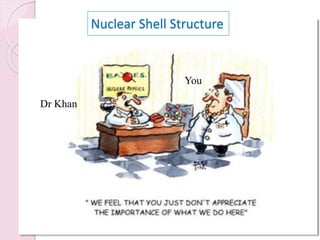
Nuclear Shell Structure
Dr Khan
You
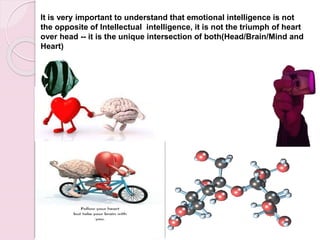
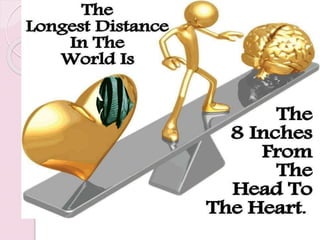
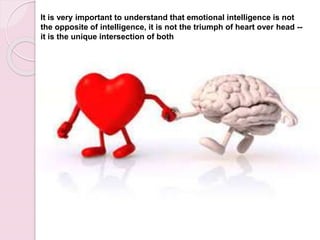
It is very important to understand that emotional intelligence is not
the opposite of Intellectual intelligence, it is not the triumph of heart
over head -- it is the unique intersection of both(Head/Brain/Mind and
Heart)
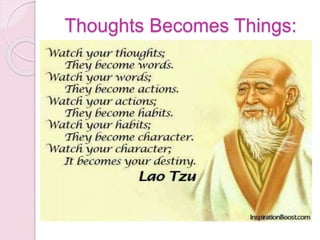
Thoughts Becomes Things:
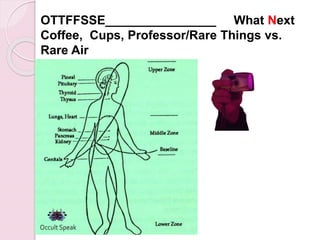
OTTFFSSE________________ What Next
Coffee, Cups, Professor/Rare Things vs.
Rare Air
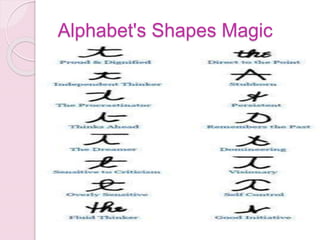
Alphabet's Shapes Magic
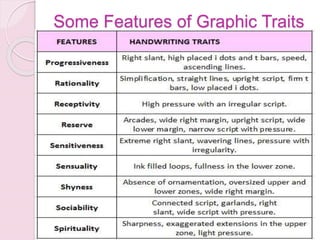
Some Features of Graphic Traits
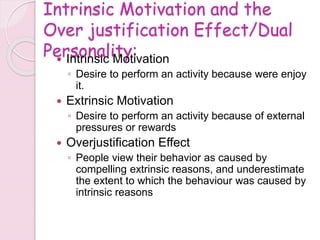
Intrinsic Motivation and the
Over justification Effect/Dual
Personality:
 Intrinsic Motivation
◦ Desire to perform an activity because were enjoy
it.
 Extrinsic Motivation
◦ Desire to perform an activity because of external
pressures or rewards
 Overjustification Effect
◦ People view their behavior as caused by
compelling extrinsic reasons, and underestimate
the extent to which the behaviour was caused by
intrinsic reasons
Graphology & Graphotherapy
Graphos = writing. Logos = science. Therapy=treatment
Forgery = the illegal act of reproducing someone’s
signature without his or her approval.
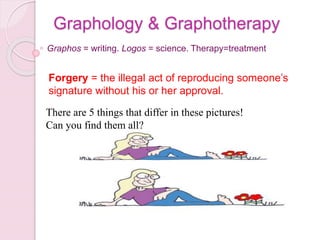
There are 5 things that differ in these pictures!
Can you find them all?
Graphology: The Science of knowing &
understanding the human Thoughts, Ideas,
Desires,
Dreams(Action/Habit/Character/Personality)
process through handwriting/ Signature using
Pen as a Tongue based on simple geometry.
Physics and human Anatomy
Grapho therapy: Using the Science of
Graphology to change thought process of a
person through specific handwriting techniques
like Pen Flick, Pen Stop /Pasto city ,technique so
as to bring about a positive change.
(Enhancement of Positive Traits and Rectification
of Negative Traits).
Need Of Training:
POLYGRAPH AND ITS
IMPORTANCE
 POLYGRAPH – is an instrument for the
recording of changes in Physiological
parameters like blood pressure; pulse rate,
respiration and skin resistance as indication
of emotional disturbances especially of
lying when questioned.
 The word was derived from the word POLY
means “many” and GRAPHS means
“writing chart”.
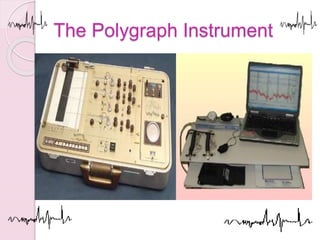
The Polygraph Instrument
Types Of Questions
IRRELEVANT
RELEVANT
CONTROL
There are three basic approaches
to the polygraph test:
The Control Question Test (CQT).
The Directed Lie Test (DLT).
The Guilty Knowledge Test (GKT).
The Control Question Test (CQT)
This test compares the physiological
response to relevant questions
about the crime with the response
to questions relating to possible
prior misdeeds. "This test is often
used to determine whether certain
criminal suspects should be
prosecuted or classified as
uninvolved in the crime" (American
Psychological Association).
The Directed Lie Test (DLT)
This test tries to detect lying by
comparing physiological
responses when the subject is
told to deliberately lie to
responses when they tell the
truth.
The Guilty Knowledge Test
(GKT)
This test compares physiological
responses to multiple-choice
type questions about the crime,
one choice of which contains
information only the crime
investigators and the criminal
would know about.
Limitations
 It is an invaluable investigation aid, but
never a substitute for investigation.
 It is a lie detector, it is not a scientific
diagnostic instrument.
 It does not determine facts, it records
responses to that which the subject
knows to be true.
 It is only as accurate as the examiner
is competent.
The underlying theory of the polygraph is
that when people lie they also get
measurably nervous about lying. The
heartbeat increases, blood pressure goes
up, breathing rhythms change,
perspiration increases, etc. A baseline for
these physiological characteristics is
established by asking the subject
questions whose answers the investigator
knows(The use of CQT Technique).
Deviation from the baseline for
truthfulness is taken as sign of lying
 Graphology or Handwriting Analysis is a
science of interpreting a person's character
from his/her personal handwriting.
 Handwriting analyzing can tell a lot about
personality
 Large companies use graphology
(handwriting analyzing) to check job
applications.
 The police still use handwriting experts to
determine who wrote what.
Graphology
 Coupled with psychology and knowledge of
human behavior, it can be used for
recruitment, marriage compatibility, career
guidance, and child development, etc.
 Signature is easy to collect, but not the best
way to analyze character from handwriting ,
for several reasons.
◦ Firstly, the Signature is sometimes illegible and
different from the normal handwriting.
◦ Secondly, the lone signature does not give enough
words and letters to help the graphologist in his/her
judgment.
Graphology
 Graphology can analyze a person's personality
without the person’s knowledge that he/she is being
analyzed.
 Distortion of the result may be cause by the
subject's knowledge that he/she is being analyzed.
This is common in most Question-&-Answer type of
personality analysis tools.
 This behavior analysis is more accurate than
putting the subject under unnatural stress of a long
questionnaire.
 A single personality questionnaire may reveal a
single dimension of personality. But two handwriting
samples of the same person at different occasion
may reveals different behavior characteristics.
Graphology
What is Graphoanalysis?
 Graphoanalysis is a scientific system of
identifying and assessing the character and
personality of an individual through a study of
handwriting. The techniques used are based
on a well-defined, standardized method of:
◦ 1: Identifying strokes,
◦ 2: Relating these strokes to specific personality
traits, and
◦ 3: Evaluating the relative strength/weakness of the
interrelated traits and if neede provide guidance to
improve them.
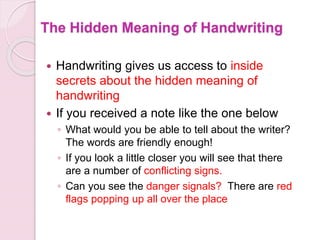
The Hidden Meaning of Handwriting
 Handwriting gives us access to inside
secrets about the hidden meaning of
handwriting
 If you received a note like the one below
◦ What would you be able to tell about the writer?
The words are friendly enough!
◦ If you look a little closer you will see that there
are a number of conflicting signs.
◦ Can you see the danger signals? There are red
flags popping up all over the place
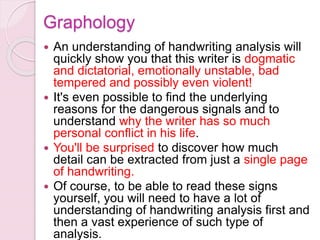
 An understanding of handwriting analysis will
quickly show you that this writer is dogmatic
and dictatorial, emotionally unstable, bad
tempered and possibly even violent!
 It's even possible to find the underlying
reasons for the dangerous signals and to
understand why the writer has so much
personal conflict in his life.
 You'll be surprised to discover how much
detail can be extracted from just a single page
of handwriting.
 Of course, to be able to read these signs
yourself, you will need to have a lot of
understanding of handwriting analysis first and
then a vast experience of such type of
analysis.
Graphology
Handwriting Guidelines
 Get a sheet of paper, sign your name, and
start to analyze with these guidelines:
◦ Writing that leans to the right shows good
communication skills.
◦ Straight, vertical writing shows independence
and stability.
◦ Writing that leans to the left may mean you find it
difficult to communicate.
◦ Small writing can be a sign of modesty.
◦ Large writing indicates enthusiasm and
generosity.
Exercise ( 15 minutes)
 Get a paper and write the following
sentences:
◦ Go west young man and grow up with the
country
◦ It is Valentino’s day today, so I will give
her …
 Give it to your group member to
analyze it – based on the guidelines.
Your Own Writing Sample
Write a letter to yourself of at least two
paragraphs. The verbal content of your
message is unimportant, so just relax
and write in usual style (CURSIVE
form). Let it be evaluated by an Expert
Graphologist to find true picture of your
hidden potential
Graphology
 Has been called a pseudo science There
are many individuals who, in evaluating the
legitimacy of graphology, place it on the
same level as astrology.
 There are, indeed, a great number of
individuals who fervently believe in the
worth of graphology as a reliable method to
learn valuable information about the
personality of an individual through his or
her writing.
Graphology
 Not a modern invention
 Roman Emperor Nero is said to have
judged the abilities of his associates
by a study of their handwriting
 Italian scholar Camillo Baldi is said to
have authored the first treatise on
graphology in 1625, under the loosely
translated title of "How to know the
nature and qualities of a person by
looking at a letter he has written."
Graphology
 Abbe Michon, a French monk, wrote
about the relationship between
handwriting and personality in a book
wherein he referred to the study as
"graphologie."
Graphology
 International Graphoanalysis Society
(IGAS).
 learn the principles of graphology, and
become "graphoanalysts" through home
study.
 Because no two persons have identical
handwriting(As promised by God in the
Holy Quran)
 By adulthood, it is exclusive to an
individual
(we all learned the same techniques to
begin writing in schools Even then
uniqueness remains)
 Even disguised handwriting will exhibit
some of the person’s individual
characteristics/Personality Traits
WHY GRAPHOLOGY:
53
53
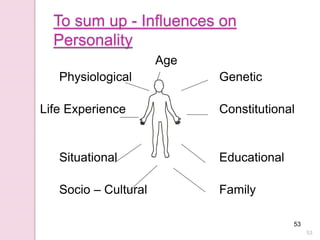
To sum up - Influences on
Personality
Age
Physiological Genetic
Life Experience Constitutional
Situational Educational
Socio – Cultural Family
54
54
What is Competency
“An underlying characteristic of a person
which enables him to deliver superior
performance in a given job, role or
situation”
The “attribute bundle” including the
intellectual, motivational, social & emotional
capability aspects
A combination of IQ & EQ& RQ Recently
known as I & I= RQ+IQ+EQ
55
55
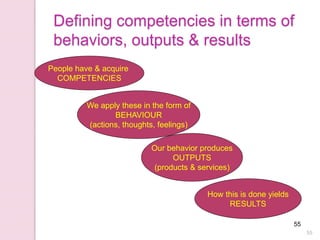
Defining competencies in terms of
behaviors, outputs & results
People have & acquire
COMPETENCIES
We apply these in the form of
BEHAVIOUR
(actions, thoughts, feelings)
Our behavior produces
OUTPUTS
(products & services)
How this is done yields
RESULTS
“Handwriting is as
individual as a
fingerprint, and in many
subtle ways is unique to
the writer.”
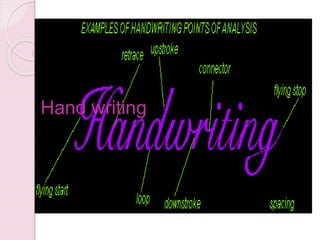
Hand writing
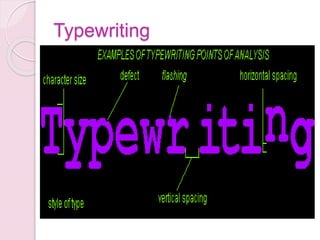
Typewriting
What handwriting CAN’T tell:
 Gender
◦ Can only infer the degree of
masculinity/femininity
 Age
◦ Chronological age cannot be determined,
but emotional age can
 Writing hand
 Race, religion or the future….
What handwriting CAN tell:
 Social style
 Thinking style
 Ego strength
 Use of energy
 Fears and inhibitions
 Locus of control
Keep in your mind…
 Handwriting is symbolic of behavior
and attitudes.
 You can learn a lot from handwriting,
but it doesn’t reveal everything about
you.
 Handwriting cannot reveal the future,
but it tells a lot about the past.
 Handwriting tells a lot about how the
writer thinks, feels and behaves.
Handwriting Analysis=
Graphology
 The foundation for graphology is that a
graphic structure defines a particular
personality behavior or trait.
 Document experts continually testify
that no two individuals write exactly
the same.
 Many individuals can have very similar
handwritings styles but not factors are
the same.
What can you tell from
handwriting?
 Graphology= study of handwriting
 Graphotherapy= study of changing
your handwriting to change your life
pattern.
 Handwriting= Brain writing
 Neuro-muscular movement which
tells personality traits. Personality
can be told by a neurological brain
pattern unconsciously make tiny
movements in handwriting.
HAND WRITING IS BRAIN WRITING
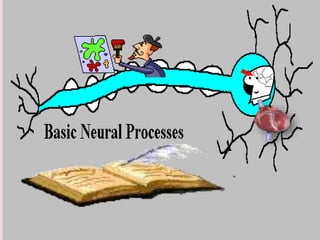
Handwriting originates in the brain
when a mental picture of letters and
words is formed. The signal to try to
duplicate the mental picture is sent to
the arm and hand through the muscles
and nervous system. The actual
output is almost never an exact match
of the original mental picture.
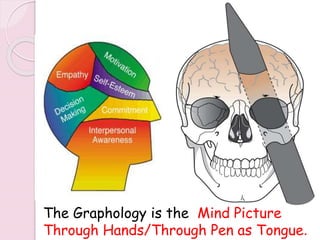
The Graphology is the Mind Picture
Through Hands/Through Pen as Tongue.
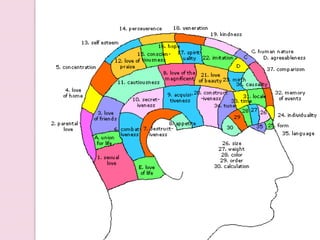
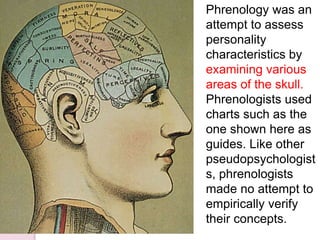
Phrenology was an
attempt to assess
personality
characteristics by
examining various
areas of the skull.
Phrenologists used
charts such as the
one shown here as
guides. Like other
pseudopsychologist
s, phrenologists
made no attempt to
empirically verify
their concepts.
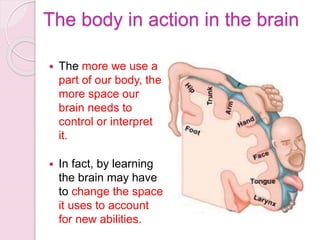
 The more we use a
part of our body, the
more space our
brain needs to
control or interpret
it.
 In fact, by learning
the brain may have
to change the space
it uses to account
for new abilities.
The body in action in the brain
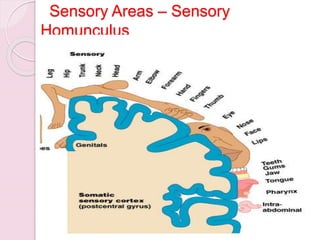
Sensory Areas – Sensory
Homunculus
Figure 13.10
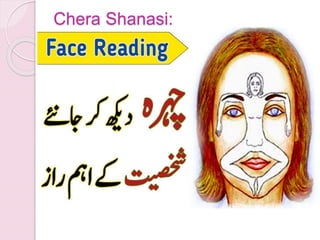
Chera Shanasi:
PSYCHO MOTOR DOMAIN,S UNDERSTANDING IS MUST
Handwriting is distal, meaning that it
occurs at the extremities and involves
fine motor activity as opposed to a skill
like walking which is proximal - a
large, or gross motor skill. One reason
individuals find it difficult to simulate
the handwriting of others is that to do
so successfully requires
understanding the essence of the
writer's motor control program and
executing that same program.
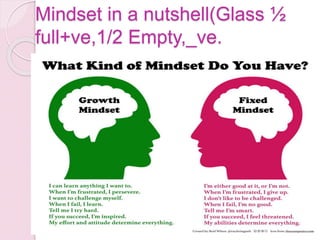
Mindset in a nutshell(Glass ½
full+ve,1/2 Empty,_ve.
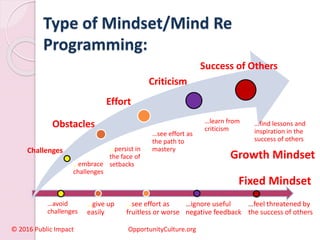
Type of Mindset/Mind Re
Programming:
…avoid
challenges
…give up
easily
…see effort as
fruitless or worse
…ignore useful
negative feedback
…feel threatened by
the success of others
Challenges
Obstacles
Effort
Criticism
Fixed Mindset
Success of Others
Growth Mindset
…find lessons and
inspiration in the
success of others
…learn from
criticism
…see effort as
the path to
mastery
…persist in
the face of
setbacks
…embrace
challenges
© 2016 Public Impact OpportunityCulture.org
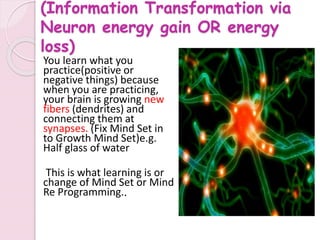
(Information Transformation via
Neuron energy gain OR energy
loss)
You learn what you
practice(positive or
negative things) because
when you are practicing,
your brain is growing new
fibers (dendrites) and
connecting them at
synapses. (Fix Mind Set in
to Growth Mind Set)e.g.
Half glass of water
This is what learning is or
change of Mind Set or Mind
Re Programming..
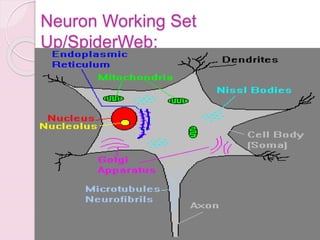
Neuron Working Set
Up/SpiderWeb:
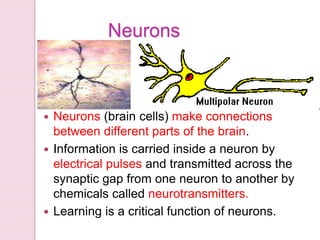
Neurons
 Neurons (brain cells) make connections
between different parts of the brain.
 Information is carried inside a neuron by
electrical pulses and transmitted across the
synaptic gap from one neuron to another by
chemicals called neurotransmitters.
 Learning is a critical function of neurons.
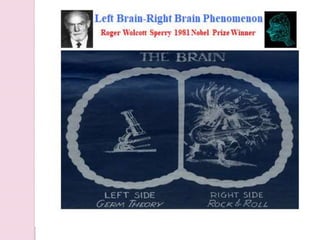
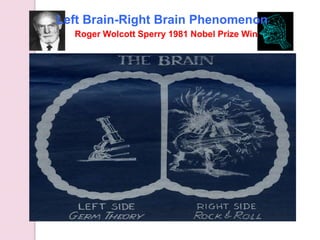
Roger Wolcott Sperry 1981 Nobel Prize Winner
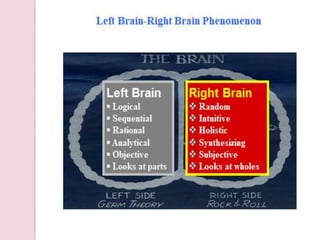
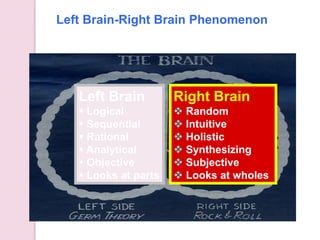
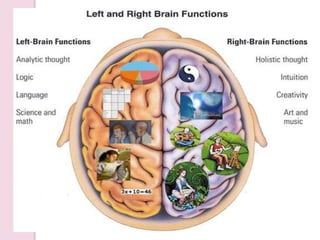
Left Brain-Right Brain Phenomenon
Left Brain
 Logical
 Sequential
 Rational
 Analytical
 Objective
 Looks at parts
Right Brain
 Random
 Intuitive
 Holistic
 Synthesizing
 Subjective
 Looks at wholes
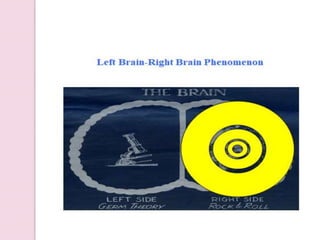
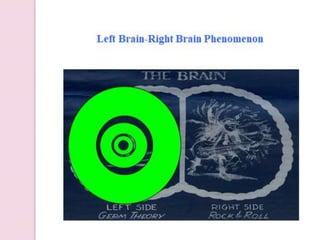
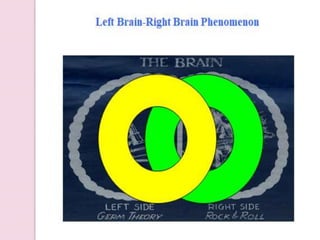
Left Brain-Right Brain Phenomenon
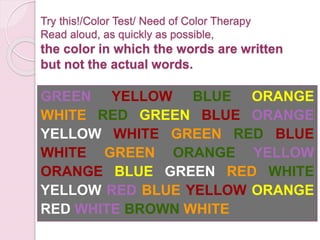
Try this!/Color Test/ Need of Color Therapy
Read aloud, as quickly as possible,
the color in which the words are written
but not the actual words.
GREEN YELLOW BLUE ORANGE
WHITE RED GREEN BLUE ORANGE
YELLOW WHITE GREEN RED BLUE
WHITE GREEN ORANGE YELLOW
ORANGE BLUE GREEN RED WHITE
YELLOW RED BLUE YELLOW ORANGE
RED WHITE BROWN WHITE
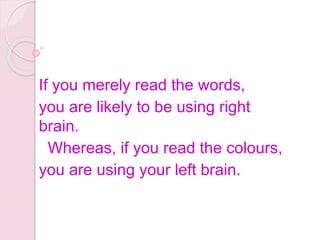
If you merely read the words,
you are likely to be using right
brain.
Whereas, if you read the colours,
you are using your left brain.
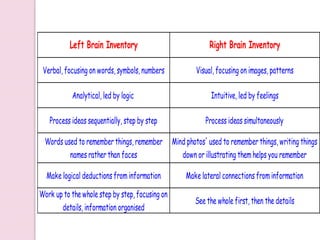
Left Brain Inventory Right Brain Inventory
Verbal, focusing on words, symbols, numbers Visual, focusing on images, patterns
Analytical, led by logic Intuitive, led by feelings
Process ideas sequentially, step by step Process ideas simultaneously
Words used to remember things, remember
names rather than faces
Mind photos' used to remember things, writing things
down or illustrating themhelps you remember
Make logical deductions frominformation Make lateral connections frominformation
Work up to the whole step by step, focusing on
details, information organised
See the whole first, then the details
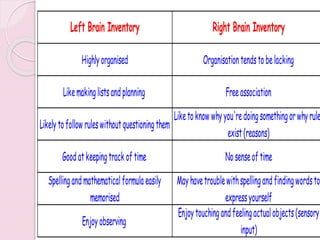
Left Brain Inventory Right Brain Inventory
Highlyorganised Organisationtendstobelacking
Likemakinglistsandplanning Freeassociation
Likelytofollow ruleswithoutquestioningthem
Liketoknow whyyou'redoingsomethingorwhyrule
exist(reasons)
Goodatkeepingtrack of time Nosenseof time
Spellingandmathematicalformula easily
memorised
Mayhavetroublewithspellingandfindingwordsto
expressyourself
Enjoyobserving
Enjoytouchingandfeelingactualobjects(sensory
input)
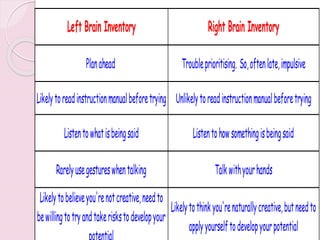
Left Brain Inventory Right Brain Inventory
Planahead Troubleprioritising. So,oftenlate,impulsive
Likelytoreadinstructionmanualbeforetrying Unlikelytoreadinstructionmanualbeforetrying
Listentowhatisbeingsaid Listentohowsomethingisbeingsaid
Rarelyusegestureswhentalking Talkwithyourhands
Likelytobelieveyou'renotcreative,needto
bewillingtotryandtakeriskstodevelopyour
Likelytothinkyou'renaturallycreative,butneedto
applyyourselftodevelopyourpotential
Mnemonics(Memory/Assistance +
Electronics/Relating)
 Did you know that you can use memory
tricks or mnemonic devices to help you
remember information?
Definition of Mnemonics:
 1. Assisting or Intended to Assist memory;
 2. of or Relating to memory
Origin of MNEMONIC:
 Greek mnēmonikos, from mnēmōn mindful,
 from mimnēskesthai to remember
Handwriting Experts
are 85%-95% accurate in their analysis
~~~~~~~~~~~~~~~~~~~~~~~~~~~~~
~~~
Handwriting is a clinical science that
falls under Psychology.
Spain, France, Holland, and Israel all
use handwriting analysis when
interviewing potential employees
(80%)
USA this on the rise but still under 10%
Does your handwriting change
on a daily basis?
 IF YES, you are moody!
 EMOTIONAL
 Fix your handwriting, fix your mood
and cut down on sugary snacks.
 Basic strokes stay the same/Cosmetic
are Changed.
 Even if you write differently all the
time, some traits do not change.
YOUR SIGNATURE
Please check Your signature are different
from your handwriting or same because
they have different meanings.
Illegible signature means you write it
100x a day (Ex: Doctor) OR you are a
private person who would like to be
seen but not known.
Your signature reveals your true
EGO/SUPER EGO & Id.
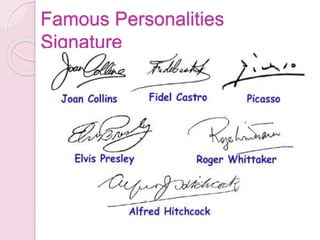
Famous Personalities
Signature
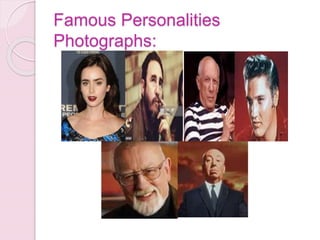
Famous Personalities
Photographs:
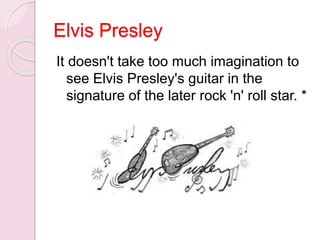
Elvis Presley
It doesn't take too much imagination to
see Elvis Presley's guitar in the
signature of the later rock 'n' roll star. *
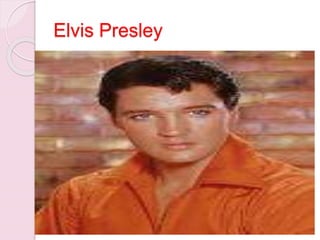
Elvis Presley
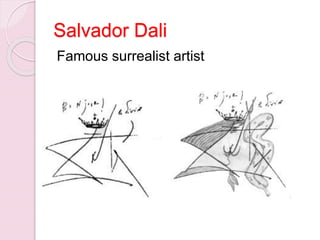
Salvador Dali
Famous surrealist artist
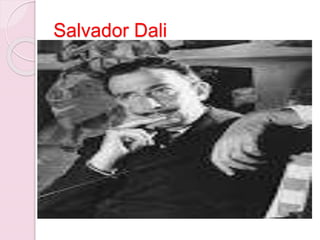
Salvador Dali
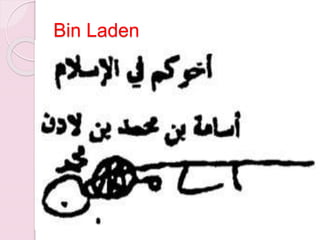
Bin Laden
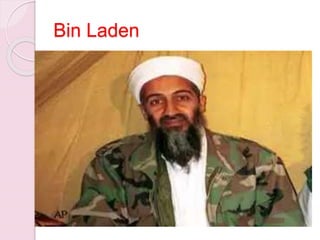
Bin Laden
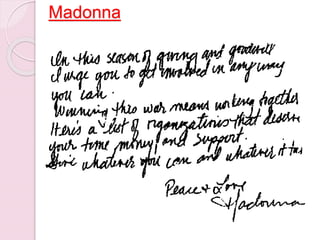
Madonna
Madonna
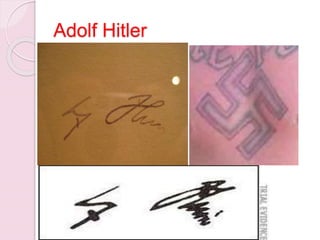
Adolf Hitler
Adolf Hitler
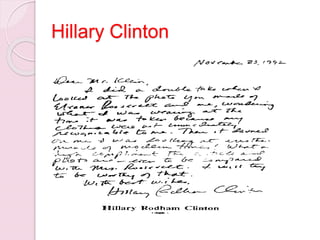
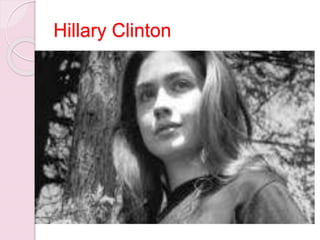
Hillary Clinton
Hillary Clinton
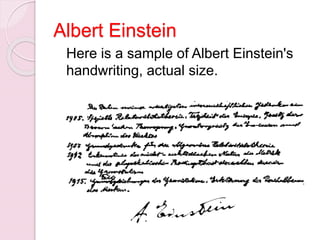
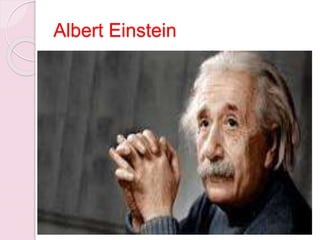
Albert Einstein
Here is a sample of Albert Einstein's
handwriting, actual size.
Albert Einstein
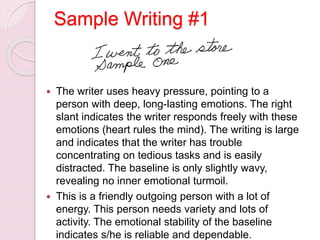
Sample Writing #1
 The writer uses heavy pressure, pointing to a
person with deep, long-lasting emotions. The right
slant indicates the writer responds freely with these
emotions (heart rules the mind). The writing is large
and indicates that the writer has trouble
concentrating on tedious tasks and is easily
distracted. The baseline is only slightly wavy,
revealing no inner emotional turmoil.
 This is a friendly outgoing person with a lot of
energy. This person needs variety and lots of
activity. The emotional stability of the baseline
indicates s/he is reliable and dependable.
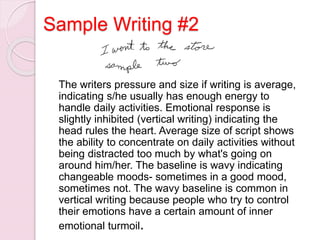
Sample Writing #2
The writers pressure and size if writing is average,
indicating s/he usually has enough energy to
handle daily activities. Emotional response is
slightly inhibited (vertical writing) indicating the
head rules the heart. Average size of script shows
the ability to concentrate on daily activities without
being distracted too much by what's going on
around him/her. The baseline is wavy indicating
changeable moods- sometimes in a good mood,
sometimes not. The wavy baseline is common in
vertical writing because people who try to control
their emotions have a certain amount of inner
emotional turmoil.
The TRUTH
Appearances can be
deceiving but Handwriting
Never LIES/You can not
deceive your Brain how hard
you can Try..
- Michelle Dresbold (2006)
Handwriting Analysis
 Like Fingerprints/DNA Coding , every
person’s handwriting is unique and
personalized
 Handwriting is difficult to disguise or
forge
◦ Good tool for including or excluding
persons when determining a match with
an exemplar
 Questioned documents are compared
to exemplars to determine matches
◦ Exemplars- prewritten handwriting
samples from a suspect(s)
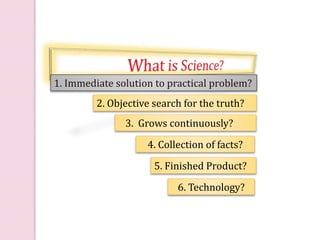
4. Collection of facts?
6. Technology?
5. Finished Product?
2. Objective search for the truth?
1. Immediate solution to practical problem?
3. Grows continuously?
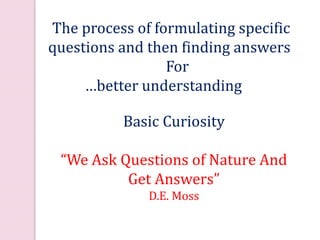
Science: a process of inquiry
Basic Curiosity
“We Ask Questions of Nature And
Get Answers”
D.E. Moss
The process of formulating specific
questions and then finding answers
For
…better understanding …
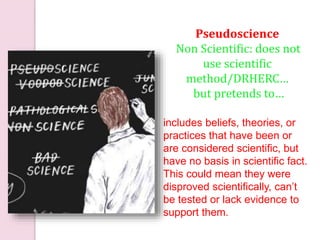
includes beliefs, theories, or
practices that have been or
are considered scientific, but
have no basis in scientific fact.
This could mean they were
disproved scientifically, can’t
be tested or lack evidence to
support them.
Pseudoscience
Non Scientific: does not
use scientific
method/DRHERC…
but pretends to…
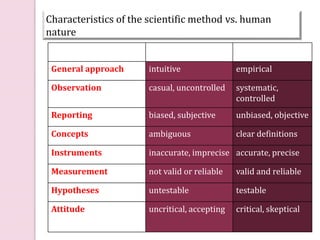
Everyday Scientific
General approach intuitive empirical
Observation casual, uncontrolled systematic,
controlled
Reporting biased, subjective unbiased, objective
Concepts ambiguous clear definitions
Instruments inaccurate, imprecise accurate, precise
Measurement not valid or reliable valid and reliable
Hypotheses untestable testable
Attitude uncritical, accepting critical, skeptical
Characteristics of the scientific method vs. human
nature
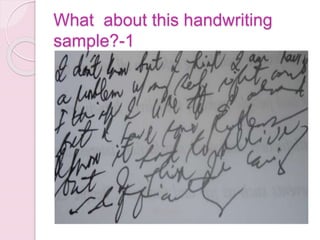
What about this handwriting
sample?-1
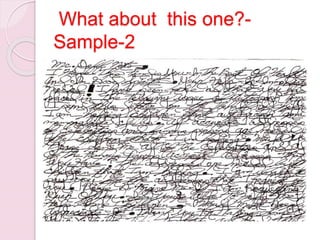
What about this one?-
Sample-2
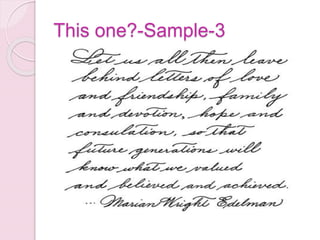
This one?-Sample-3
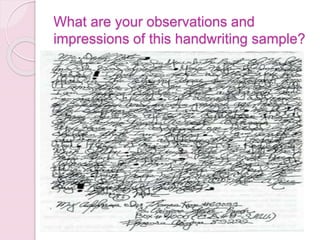
What are your observations and
impressions of this handwriting sample?
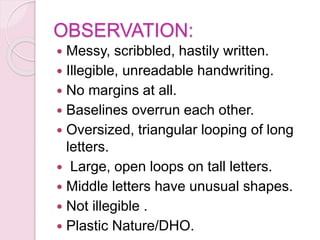
OBSERVATION:
 Messy, scribbled, hastily written.
 Illegible, unreadable handwriting.
 No margins at all.
 Baselines overrun each other.
 Oversized, triangular looping of long
letters.
 Large, open loops on tall letters.
 Middle letters have unusual shapes.
 Not illegible .
 Plastic Nature/DHO.
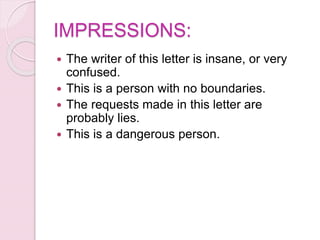
IMPRESSIONS:
 The writer of this letter is insane, or very
confused.
 This is a person with no boundaries.
 The requests made in this letter are
probably lies.
 This is a dangerous person.
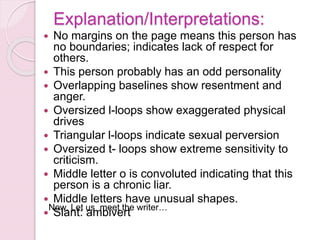
Explanation/Interpretations:
 No margins on the page means this person has
no boundaries; indicates lack of respect for
others.
 This person probably has an odd personality
 Overlapping baselines show resentment and
anger.
 Oversized l-loops show exaggerated physical
drives
 Triangular l-loops indicate sexual perversion
 Oversized t- loops show extreme sensitivity to
criticism.
 Middle letter o is convoluted indicating that this
person is a chronic liar.
 Middle letters have unusual shapes.
 Slant: ambivert
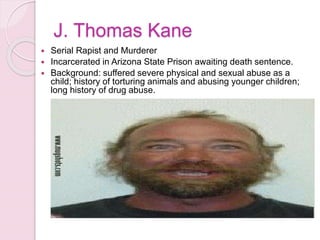
Now, Let us meet the writer…
J. Thomas Kane
 Serial Rapist and Murderer
 Incarcerated in Arizona State Prison awaiting death sentence.
 Background: suffered severe physical and sexual abuse as a
child; history of torturing animals and abusing younger children;
long history of drug abuse.
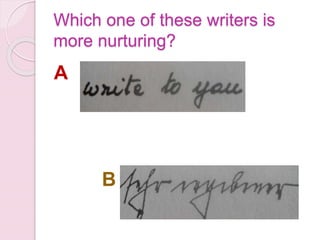
Which one of these writers is
more nurturing?
A
B
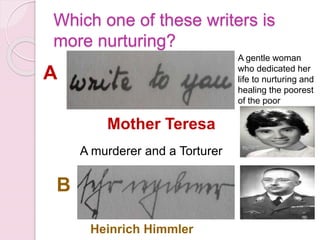
Which one of these writers is
more nurturing?
A
B
A gentle woman
who dedicated her
life to nurturing and
healing the poorest
of the poor
Mother Teresa
A murderer and a Torturer
Heinrich Himmler
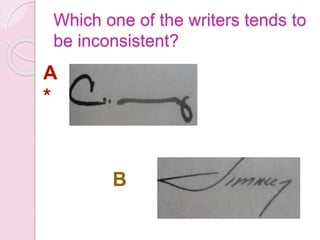
Which one of the writers tends to
be inconsistent?
A
*
B
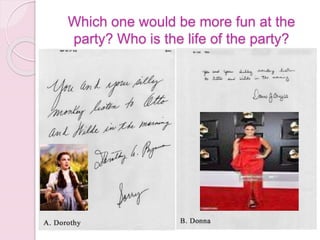
Which one would be more fun at the
party? Who is the life of the party?
The BEGINNING
* Edgar Allan Poe – a great
American Poet, employed the term
Autographery
Brief Background
*2nd century
- China (Calligraphers)
*99 A.D.
- Rome (Suetonius Tranquilius)
Brief Background
• 1662 – Camillo Baldi
• First book on the subject
was written.
• 1871 – Abbe Jean
Hippolyte Michon
• Published two more books
and coined the term
“GRAPHOLOGY”
Brief Background
1979 – most graphology books
were placed in psychological
selection categories in the
Dewey Decimal Classification
at the Library of Congress, USA
Brief Background
1989 – the US Dept. of labor
changed category of
Graphology from
Entertainment to
Miscellaneous
professional
Kendall/Hunt Publishing
Company 155
Handwriting
Handwriting analysis involves two
phases:
 The hardware—ink, paper, pens, pencils,
typewriter, printers
 Visual examination of the writing
Kendall/Hunt Publishing
Company 156
Handwriting Characteristics
 12 pts. to compare between known and questioned samples
1. Line Quality—smooth or shaky
2. Word and Letter Spacing–-check distance
between letters and words
3. Letter Comparison—check height, width and
size of letters.
4. Pen Lifts and Separation —check where
does the writer lift his pen
5. Connecting strokes —check how capital letters connect
to others; how strokes connect between letters and words
6. Beginning and ending strokes —check how words
begin and end; straight, curled, long, short, etc.
7. Unusual Letter Formation—check for backwards letters,
letters with tails, or unusual capital letters
8. Shading or pen pressure—check for amount of pressure
used on downward and upward strokes
9. Slant—check for left, right, or no slant
10. Baseline Habits—check if it follows a straight line across
the page or moves up or down
11. Flourishes or embellishments —check for fancy letters,
little curls, loops, hearts, etc.
12. Diacritic Placement—check how the t’s are crossed or i’s
are dotted
Kendall/Hunt Publishing
Company 157
Line spacing (between lines)
Indicates self-control
 Clear line spacing
◦ mental clarity, sense of order, reasons well,
objective when dealing with problems
 Narrow line spacing
◦ Impulsive, rushes ahead too quickly,
possibly “cheap” spender
 Crowded line spacing
◦ Driven by impulse, lack of abstract thinking
and objectivity, lives in the moment,
imaginative
 Tangled lines
◦ Loss of perspective, acts on instincts and
emotions, doesn’t plan far ahead
 Moderately wide line spacing
◦ logical, orderly mind; preference for
keeping things clear; not impulsive, love of
beauty, spend money freely
 Extremely wide line spacing
◦ Anxious, feels isolated from world,
concerned with maintaining own space,
lost capacity to act spontaneously
 Irregular line spacing
◦ Reactions depend on circumstances and
how they feel at the moment, lacks good
self-discipline and unsure of themselves
 Extremely regular line spacing
◦ Inflexible, obsessive, follows strict routine,
needs counseling?
Handwriting Size
 Writing size tells how much space you feel
you deserve.
 Middle-zone height reveals how much your
ego needs; width shows how willing you are
to get your ego needs met.
 Upper-zone height symbolizes aspirations,
principles, and standards; width shows how
open-minded you are.
 Lower-zone length and width tells how active
and productive you are.
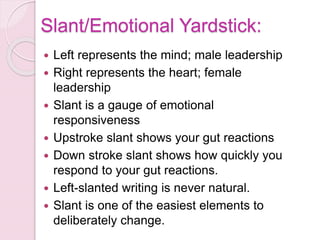
Slant/Emotional Yardstick:
 Left represents the mind; male leadership
 Right represents the heart; female
leadership
 Slant is a gauge of emotional
responsiveness
 Upstroke slant shows your gut reactions
 Down stroke slant shows how quickly you
respond to your gut reactions.
 Left-slanted writing is never natural.
 Slant is one of the easiest elements to
deliberately change.
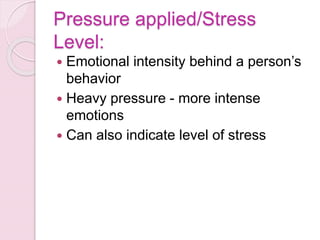
Pressure applied/Stress
Level:
 Emotional intensity behind a person’s
behavior
 Heavy pressure - more intense
emotions
 Can also indicate level of stress
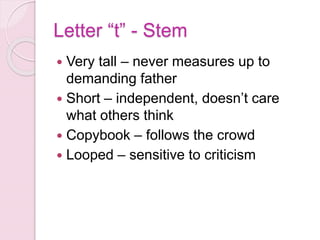
Letter “t” - Stem
 Very tall – never measures up to
demanding father
 Short – independent, doesn’t care
what others think
 Copybook – follows the crowd
 Looped – sensitive to criticism
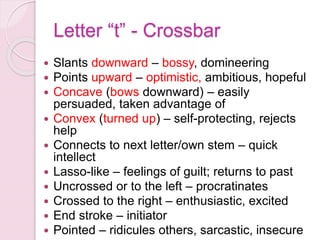
Letter “t” - Crossbar
 Slants downward – bossy, domineering
 Points upward – optimistic, ambitious, hopeful
 Concave (bows downward) – easily
persuaded, taken advantage of
 Convex (turned up) – self-protecting, rejects
help
 Connects to next letter/own stem – quick
intellect
 Lasso-like – feelings of guilt; returns to past
 Uncrossed or to the left – procratinates
 Crossed to the right – enthusiastic, excited
 End stroke – initiator
 Pointed – ridicules others, sarcastic, insecure
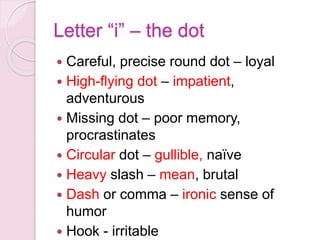
Letter “i” – the dot
 Careful, precise round dot – loyal
 High-flying dot – impatient,
adventurous
 Missing dot – poor memory,
procrastinates
 Circular dot – gullible, naïve
 Heavy slash – mean, brutal
 Dash or comma – ironic sense of
humor
 Hook - irritable
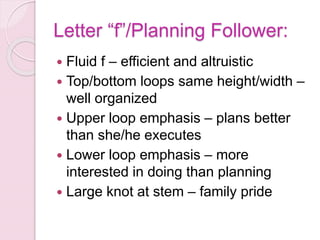
Letter “f”/Planning Follower:
 Fluid f – efficient and altruistic
 Top/bottom loops same height/width –
well organized
 Upper loop emphasis – plans better
than she/he executes
 Lower loop emphasis – more
interested in doing than planning
 Large knot at stem – family pride
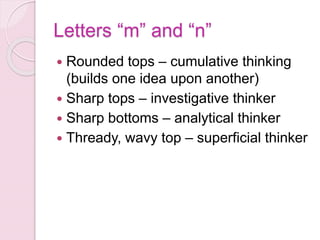
Letters “m” and “n”
 Rounded tops – cumulative thinking
(builds one idea upon another)
 Sharp tops – investigative thinker
 Sharp bottoms – analytical thinker
 Thready, wavy top – superficial thinker
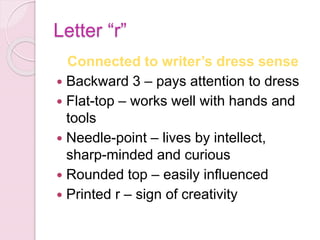
Letter “r”
Connected to writer’s dress sense
 Backward 3 – pays attention to dress
 Flat-top – works well with hands and
tools
 Needle-point – lives by intellect,
sharp-minded and curious
 Rounded top – easily influenced
 Printed r – sign of creativity
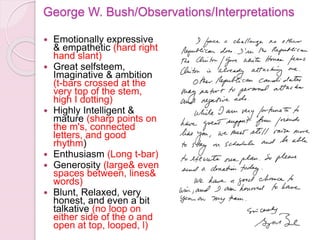
George W. Bush/Observations/Interpretations
 Emotionally expressive
& empathetic (hard right
hand slant)
 Great selfsteem,
Imaginative & ambition
(t-bars crossed at the
very top of the stem,
high I dotting)
 Highly Intelligent &
mature (sharp points on
the m's, connected
letters, and good
rhythm)
 Enthusiasm (Long t-bar)
 Generosity (large& even
spaces between, lines&
words)
 Blunt, Relaxed, very
honest, and even a bit
talkative (no loop on
either side of the o and
open at top, looped, l)
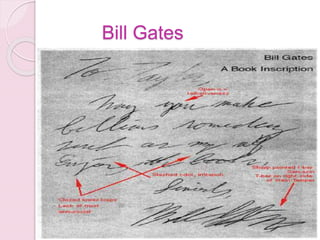
Bill Gates
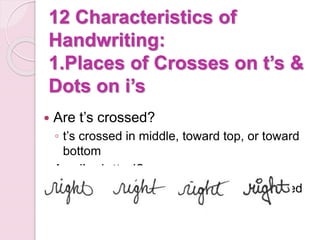
12 Characteristics of
Handwriting:
1.Places of Crosses on t’s &
Dots on i’s
 Are t’s crossed?
◦ t’s crossed in middle, toward top, or toward
bottom
 Are i’s dotted?
◦ Dotted toward left, toward right, or centered
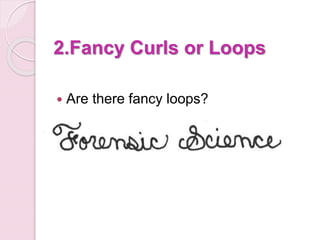
2.Fancy Curls or Loops
 Are there fancy loops?
 Any other distinguishing features?
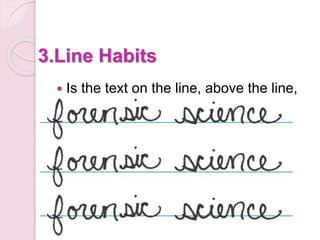
3.Line Habits
 Is the text on the line, above the line,
or below the line?
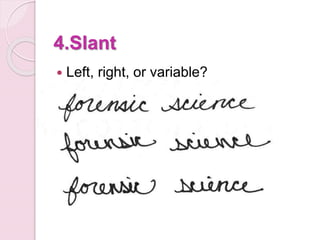
4.Slant
 Left, right, or variable?
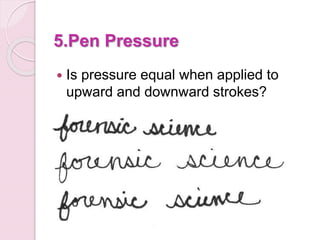
5.Pen Pressure
 Is pressure equal when applied to
upward and downward strokes?
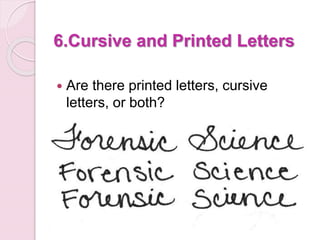
6.Cursive and Printed Letters
 Are there printed letters, cursive
letters, or both?
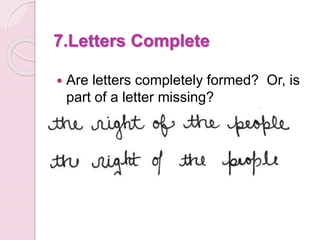
7.Letters Complete
 Are letters completely formed? Or, is
part of a letter missing?
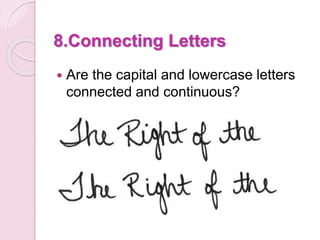
8.Connecting Letters
 Are the capital and lowercase letters
connected and continuous?
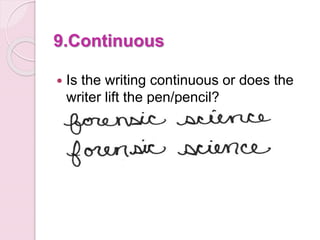
9.Continuous
 Is the writing continuous or does the
writer lift the pen/pencil?
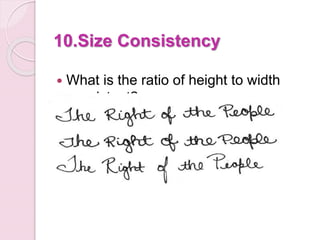
10.Size Consistency
 What is the ratio of height to width
consistent?
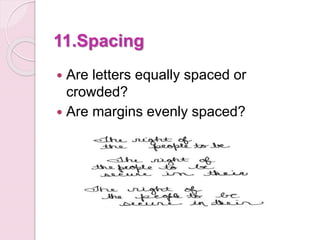
11.Spacing
 Are letters equally spaced or
crowded?
 Are margins evenly spaced?
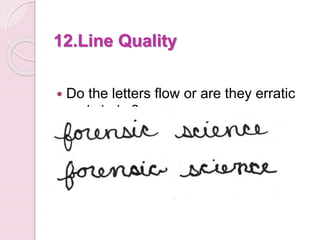
12.Line Quality
 Do the letters flow or are they erratic
and shaky?
Forensic Science:
Fundamentals &
Investigations, Chapter 10 184
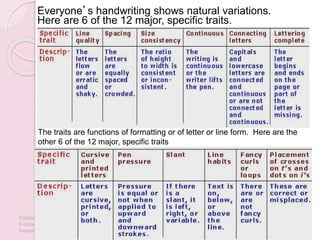
Everyone’s handwriting shows natural variations.
Here are 6 of the 12 major, specific traits.
The traits are functions of formatting or of letter or line form. Here are the
other 6 of the 12 major, specific traits
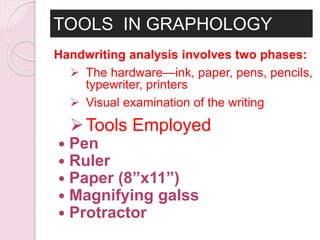
TOOLS IN GRAPHOLOGY
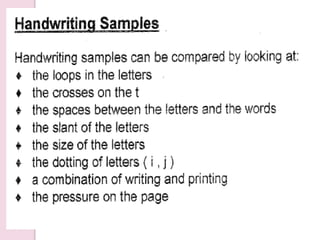
Handwriting analysis involves two phases:
 The hardware—ink, paper, pens, pencils,
typewriter, printers
 Visual examination of the writing
Tools Employed
 Pen
 Ruler
 Paper (8”x11”)
 Magnifying galss
 Protractor
HOW TO PREPARE A
HANDWRITING SPECIMEN
Use the prescribed tools
Take note:
 sex of the writer
handedness
frequency of writing
number of signatures used
mood of the writer
Preparing a Specimen
Put the signature (normally
used) below
At the back of the sheet or in
another sheet, write other
signatures used
Content should be not less than
3 paragraphs
Points to ponder…
In schools/Colleges/
Universities/Organizations , it is
recommended that teachers/HR
Managers practice their
students/Employees to write a
balance in the three zones to
avoid possible production of
individuals who are braggarts,
immature, greedy and have
little control over temptations.
Points to ponder…
Guidance Counselors who
noticed a student for having an
imbalanced writing in the three
zones, and confirmed significant
concerns in the latter’s behavior
might take into consideration to
make use of grapho-therapy
together with their preferred
counseling philosophy.
Points to ponder…
In a company, HR experts may
take into consideration to clearly
check and evaluate the balance
in the three zones, and together
with the other personality tests,
HR experts may be able to hire
competent employees
depending on the company’s
needs.
Points to ponder
 If the company needs someone
who has a head over heart
emotional attitude, and is open
to experiences but cautious and
controlled, then the HR expert
might want to hire a vertical-
slanted writer.
Points to ponder
 However, if the company needs
someone who still manages to
be charming in social situations
while remaining emotionally
aloof, then the HR expert might
want to hire a slightly left-
slanted writer.
Things to ponder
In school, College,&
universities it is
recommended that teachers
check their students’ writing
spaces (line, words and
letters). Helping their students
maintain average spaces may
assist them to achieve more
peaceful classroom
environment.
Importance graphology In Press
Media.:
Originally, graphology applied only to the
appearance of a person's handwriting
,how ever you can use it to any
aspect of the form and
appearance of a text that
modifies meaning in any
way.
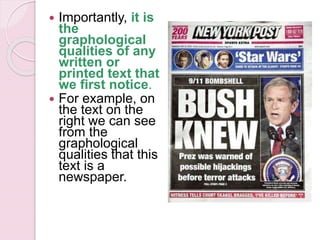
 Importantly, it is
the
graphological
qualities of any
written or
printed text that
we first notice.
 For example, on
the text on the
right we can see
from the
graphological
qualities that this
text is a
newspaper.
 Because these features are what you
first notice you would do well to apply
the graphology framework first in
your stylistic analyses
 Although the graphological framework
is not considered as important as
others it is often overlooked.
 You should not focus too much on this
framework, but properly applied
graphological analysis can be very
useful and subtle and add marks
to your analysis.
 When you are analysing a text using the
graphological framework, you will need to consider
the following points:
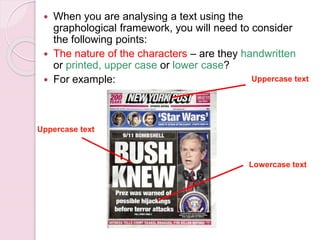
 The nature of the characters – are they handwritten
or printed, upper case or lower case?
 For example:
Uppercase text
Lowercase text
Uppercase text
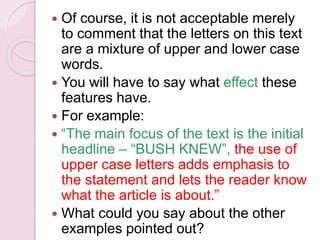
 Of course, it is not acceptable merely
to comment that the letters on this text
are a mixture of upper and lower case
words.
 You will have to say what effect these
features have.
 For example:
 “The main focus of the text is the initial
headline – “BUSH KNEW”, the use of
upper case letters adds emphasis to
the statement and lets the reader know
what the article is about.”
 What could you say about the other
examples pointed out?
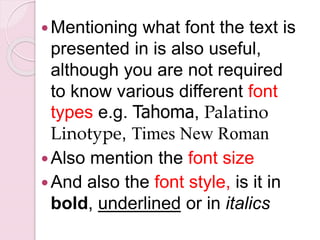
Mentioning what font the text is
presented in is also useful,
although you are not required
to know various different font
types e.g. Tahoma, Palatino
Linotype, Times New Roman
Also mention the font size
And also the font style, is it in
bold, underlined or in italics
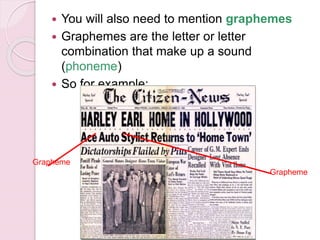
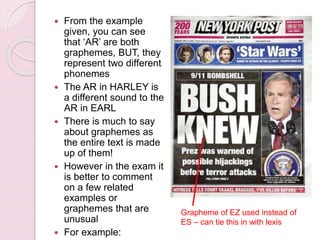
 You will also need to mention graphemes
 Graphemes are the letter or letter
combination that make up a sound
(phoneme)
 So for example:
Grapheme
Grapheme
 From the example
given, you can see
that ‘AR’ are both
graphemes, BUT, they
represent two different
phonemes
 The AR in HARLEY is
a different sound to the
AR in EARL
 There is much to say
about graphemes as
the entire text is made
up of them!
 However in the exam it
is better to comment
on a few related
examples or
graphemes that are
unusual
 For example:
Grapheme of EZ used instead of
ES – can tie this in with lexis
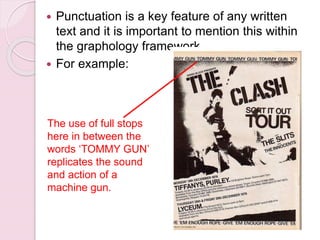
 Punctuation is a key feature of any written
text and it is important to mention this within
the graphology framework
 For example:
The use of full stops
here in between the
words ‘TOMMY GUN’
replicates the sound
and action of a
machine gun.
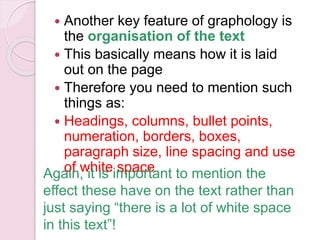
 Another key feature of graphology is
the organisation of the text
 This basically means how it is laid
out on the page
 Therefore you need to mention such
things as:
 Headings, columns, bullet points,
numeration, borders, boxes,
paragraph size, line spacing and use
of white space
Again, it is important to mention the
effect these have on the text rather than
just saying “there is a lot of white space
in this text”!
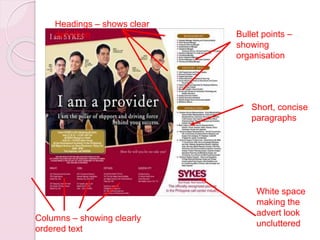
Headings – shows clear
definition Bullet points –
showing
organisation
Columns – showing clearly
ordered text
Short, concise
paragraphs
White space
making the
advert look
uncluttered
 Finally the last things you need to
mention regarding the graphology
framework are:
 Use of colour
 Logos
 Drawings
 Photographs
 Captions
 Diagrams
 Charts
As stated before, you need to state what
effect these features have on the text as a
whole and if they are effective in achieving
their aims.
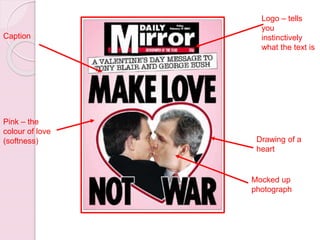
Logo – tells
you
instinctively
what the text is
Pink – the
colour of love
(softness) Drawing of a
heart
Mocked up
photograph
Caption
What are the
characteristics of
students with
handwriting problems?
Why we need Grapho
therapy ?
Handwriting Problems
 Dysgraphia( Greek. Dys/ Impaired ,graphia/
Making letter forms by hand” An Impairment
in written Expression” is a written-language
disorder that involves mechanical (psymotor
domain effect)l writing skill
 It manifests itself in poor writing performance
 It is seen in students of at least average
intelligence who do not have a neurological
disability and/or perceptual-motor
handicap(Non perceptuality effect)
 It can occur alone or in the presence of other
disabilities
All Rights Reserved Kevin T. Blake, Ph.D., P.L.C. 210
AD/HD and Learning Disorders and
Dysgraphia
Barkley stated:
 15% to 30% of AD/HD have Reading Disorder
 26% have Spelling Problems
 10% to 60% have Mathematics Disorder
 Developmental Coordination Disorder-Dysgraphia
60%(CAVD Test Recommended)
Barkley, R.A. (2002). ADHD and Oppositional Defiant Children. Seminar Presented February
19-20, Phoenix, AZ, The Institute for Continuing Education,Fairhope, AL, from handout, pp.
9.
Barkley, R.A. (2002) Mental and Medical Outcomes of AD/HD. Pre-Conference Institute, #
TPA1, Thursday October 17, 2002, 14th Annual CHADD International Conference, Miami
Beach, FL.
All Rights Reserved Kevin T. Blake, Ph.D., P.L.C. 211
AD/HD and Learning
Disorders and
Dysgraphia
Hynd indicated those with Inattentive AD/HD:
 21% have Reading Disorder
 33% have Mathematics Disorder
 4% have Spelling/Disorder
of Written Expression
Hynd, G. (2002). ADHD and Its Association with Dyslexia:
Diagnostic and Treatment Challenges. Paper presented
at the 53rd Annual International Dyslexia Association
Conference, Atlanta, GE, November 16.
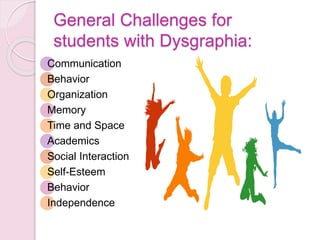
General Challenges for
students with Dysgraphia:
Communication
Behavior
Organization
Memory
Time and Space
Academics
Social Interaction
Self-Esteem
Behavior
Independence
Symptoms of Dysgraphia:(Violation of all
hand writing characteristics)
 Poor formation
 Too large, too small, or inconsistent
 Incorrect use of capital and lowercase letters
 Crowded or cramped
 Inconsistent spacing
 Incorrect alignment
 Incorrect or inconsistent slant
 Lack of fluency
 Slow pace even when asked to write quickly
Copyright © Pearson Allyn &
Bacon 2009
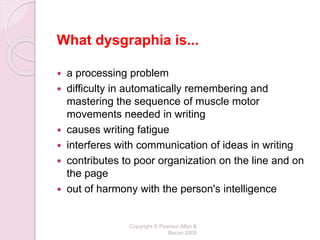
What dysgraphia is...
 a processing problem
 difficulty in automatically remembering and
mastering the sequence of muscle motor
movements needed in writing
 causes writing fatigue
 interferes with communication of ideas in writing
 contributes to poor organization on the line and on
the page
 out of harmony with the person's intelligence
Copyright © Pearson Allyn &
Bacon 2009
What dysgraphia is not ..(Misconceptions)
◦ laziness
◦ not trying
◦ not caring
◦ sloppy writing
◦ general sloppiness
◦ careless writing
◦ visual-motor delay
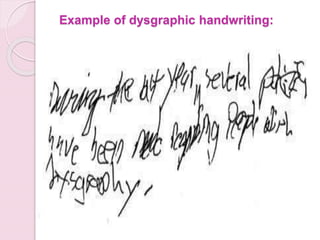
Example of dysgraphic handwriting:
Strategies for Teaching Students with
Learning and Behavior Problems
Eighth Edition
How is Dysgraphia Treated? Or Grapho therapy:
First, an evaluation by an occupational therapist is
often warranted, to determine if there are specific
exercises and strategies a child can do in order to
strengthen fine motor skills necessary for writing.
Second, parents should work closely with their child's
school to determine appropriate accommodations.
The goal of accommodations is to ensure that the
process of writing does not interfere with a child's
ability to learn, or to show what he/she has
learned.
Copyright © Pearson Allyn &
Bacon 2009
Breakin
g the
ice!
219
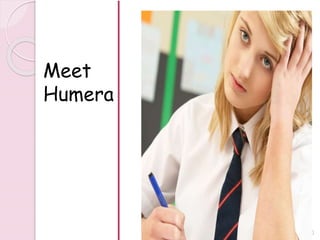
Meet
Humera
220
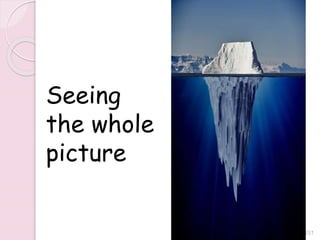
Seeing
the whole
picture
221
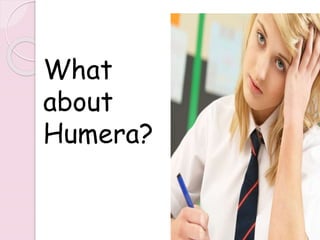
What
about
Humera?
222
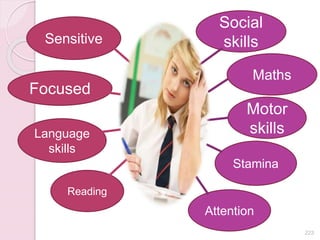
223
Sensitive
Focused
Motor
skills
Stamina
Maths
Attention
Reading
Social
skills
Language
skills
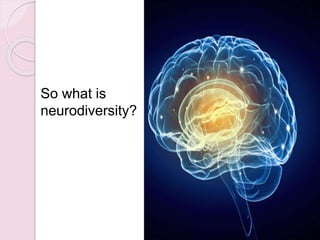
So what is
neurodiversity?
224
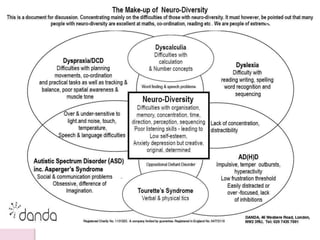
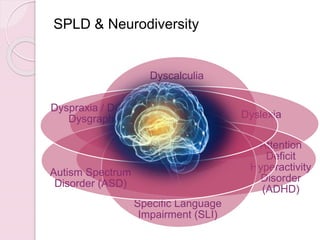
SPLD & Neurodiversity
Dyscalculia
Dyslexia
Attention
Deficit
Hyperactivity
Disorder
(ADHD)
Specific Language
Impairment (SLI)
Autism Spectrum
Disorder (ASD)
Dyspraxia / DCD &
Dysgraphia
Some examples of common accommodations
include:
Limiting the copying aspect of work (i.e., no copying sentences or math
problems from the chalkboard or from a book).
Allowing students to be tested orally (i.e., simply say their answer to the
teacher, rather than writing it out).
Not grading for spelling errors, accept on spelling tests and assignments
specifically assigned for spelling.
Allowing students to dictate book reports into a tape recorder, or to their
parents for typing.
Teaching students to type as early as possible, so that they can type
papers instead of writing them by hand.
If assignments must be written, allowing students to use abbreviations or
to respond in a shortened manner (i.e., making lists versus
writing out complete sentences).
Finally, older students may need extra assistance in learning how to
organize their thoughts for papers and essays. This may
include brainstorming ideas, learning to group similar ideas,
identifying appropriate sequencing of ideas, and mastering skills of
proofing and correcting their written work.
Teaching for Neurodiversity Classroom
support strategies
Working
together to
empower
Students to
cater for
Special 228
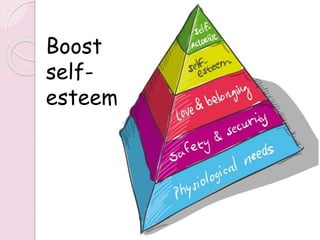
Boost
self-
esteem
229
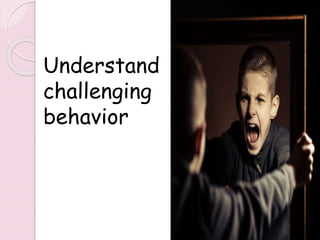
Understand
challenging
behavior
230
Motivat
e
231
Teach
metacognitio
n
232
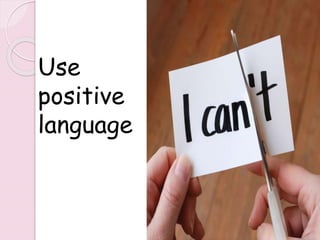
Use
positive
language
233
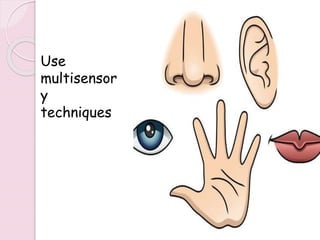
Use
multisensor
y
techniques
234
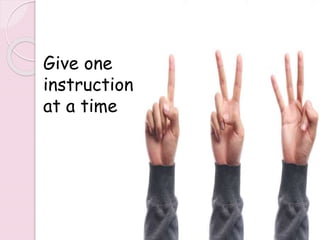
Give one
instruction
at a time
235
Allow
‘think
time’
236
Reduce
memory
load
237
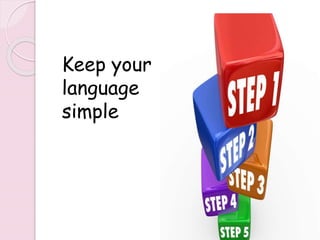
Keep your
language
simple
238
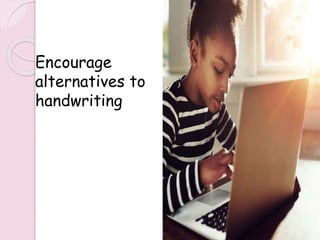
Encourage
alternatives to
handwriting
239
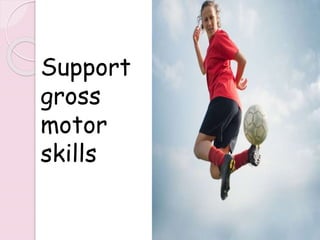
Support
gross
motor
skills
240
Support
academic
language
development
241
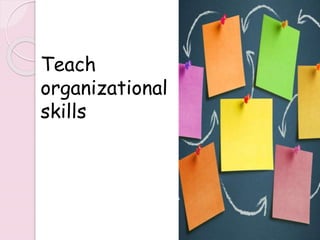
Teach
organizational
skills
242
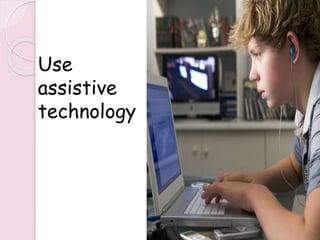
Use
assistive
technology
243
Teach
reading
and proof
reading
techniques
244
Teach study
skills and
exam
techniques
245
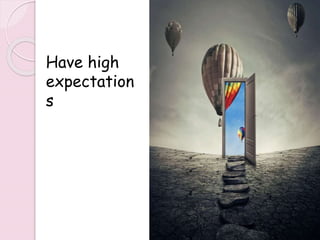
Have high
expectation
s
246
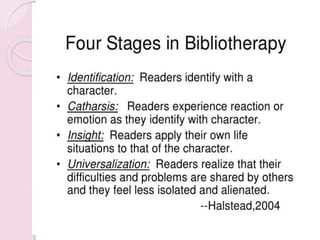
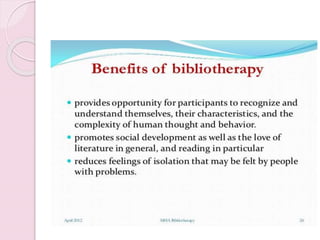
Bibliotherapy
“Bibliotherapy is an attempt to help
young people understand themselves
and cope with problems by providing
literature relevant to their personal
situations and developmental needs
at appropriate times. Teachers using this
approach believe that reading can influence a
student's thinking and behavior. Moreover,
through guided discussions, selected
readings can focus on specific needs of gifted
247
 “Huma is a nine-year-old and passionate about
her love of horses. She can discuss almost
any aspect of her passion in great detail
including: characteristics and history of various
breeds, history of the domestication, and
training and riding methods. She is a talented
artist and has a wonderful portfolio of her horse
drawings, paintings, and sketches.
 “She contributes to many class discussions and
frequently relies on her visual memory,
advanced vocabulary, and unique sense of
humor. Teachers comment on Huma’s ability to
remember so much detail.”
Case Study: Huma
253
 “Huma struggles with reading and writing. Her oral
reading is not fluent, characterized by word-by-word
reading with many decoding errors. She relies on sight
words, contextual cues, and her advanced abilities in
reasoning skills to comprehend and predict text. She is
very self-conscious about her oral reading hates when
she is called on to read in class.
 “Huma’s writing is characterized by many wonderful and
creative ideas that are very loosely organized. Her
writing has many spelling and grammatical errors.
 “Huma has always struggled with the weekly spelling
tests. She works hard daily and practices each night, but
still only manages to average B- or C on the weekly
tests.”
Case Study: Huma
254
 “Ali is an 8th-grader who has been described as
insightful, smart, interesting, and charming. His
teachers also find him to be polite and respectful.
He has demonstrated advanced knowledge in
science, particularly in the geology. He can
describe different rock formations with the correct
vocabulary and concepts. He and his science
teacher enjoy conversations about their shared
passion.
 “Ali is also a talented music student. He plays 3
instruments and is first chair of his school band.
He participates in family musical group that
entertains at local senior citizen and community
centers on a monthly basis.”
Case Study: Ali
255
 “Although Ali is a hard worker and wants to be
successful in school, he is very frustrated with how hard
school has become for him. He thinks that the teachers
give him too much work and he is overwhelmed. He
has difficulty with organization which is evident with his
messy binder and locker, his inability to locate
assignments and to keep track of due dates. Long term
assignments are rarely turned in on time. He struggles
to understand directions and needs more time to
organize his thoughts when trying to explain a concept,
even when he knows the information well.
 “He has good and creative ideas but his writing is ‘bare-
bones’ with little detail or richness. Given his advanced
vocabulary, his teachers are surprised by his frequent
spelling mistakes.”
Case Study: Ali
256
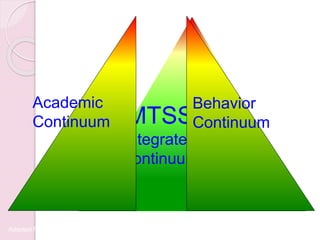
MTSS
Integrated
Continuum
Academic
Continuum
Behavior
Continuum
Adapted from the OSEP TA Center for PBIS
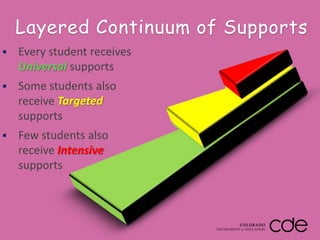
 Every student receives
Universal supports
 Some students also
receive Targeted
supports
 Few students also
receive Intensive
supports
Layered Continuum of Supports
Definition 2
A written language disorder
◦ In serial production of strokes
◦ To form a handwritten letter
◦ Involves not only motor skills but also
language skills
 Finding, retrieving, and producing letters
 This is a subword level language skills
◦ The impaired handwriting may interfere with
spelling and/or composing
259
260
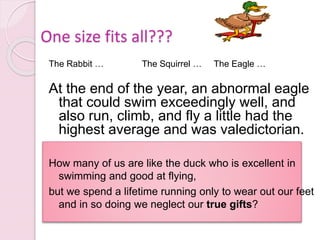
One size fits all???
Once upon a time the animals decided
they must do something heroic to meet
the problems of a "new world,"
so they organized a school.
They adopted an activity curriculum
consisting of running, climbing,
swimming, and flying,
and to make it easier to administer, all the
animals took all the subjects.
261
One size fits all???
The duck was excellent in swimming,
better in fact than his instructor, and
made passing grades in flying, but he
was very poor in running.
Since he was so slow in running, he
had to stay after school and also drop
swimming to practice running.
This was kept up until his web feet
were badly worn and he was only
average in swimming.
But average was acceptable in school,
so nobody worried about that except
the duck.
262
One size fits all???
The Rabbit … The Squirrel … The Eagle …
At the end of the year, an abnormal eagle
that could swim exceedingly well, and
also run, climb, and fly a little had the
highest average and was valedictorian.
How many of us are like the duck who is excellent in
swimming and good at flying,
but we spend a lifetime running only to wear out our feet
and in so doing we neglect our true gifts?
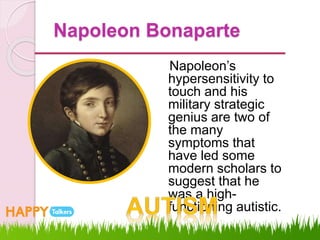
Napoleon Bonaparte
Napoleon’s
hypersensitivity to
touch and his
military strategic
genius are two of
the many
symptoms that
have led some
modern scholars to
suggest that he
was a high-
functioning autistic.
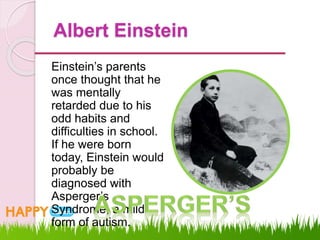
Albert Einstein
Einstein’s parents
once thought that he
was mentally
retarded due to his
odd habits and
difficulties in school.
If he were born
today, Einstein would
probably be
diagnosed with
Asperger’s
Syndrome, a mild
form of autism.
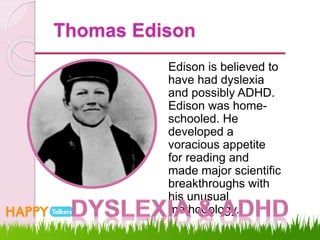
Thomas Edison
Edison is believed to
have had dyslexia
and possibly ADHD.
Edison was home-
schooled. He
developed a
voracious appetite
for reading and
made major scientific
breakthroughs with
his unusual
methodology.
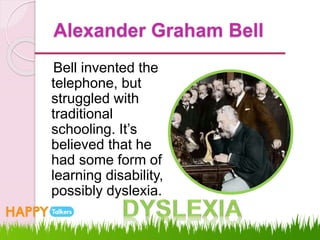
Alexander Graham Bell
Bell invented the
telephone, but
struggled with
traditional
schooling. It’s
believed that he
had some form of
learning disability,
possibly dyslexia.
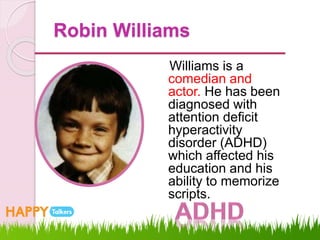
Robin Williams
Williams is a
comedian and
actor. He has been
diagnosed with
attention deficit
hyperactivity
disorder (ADHD)
which affected his
education and his
ability to memorize
scripts.
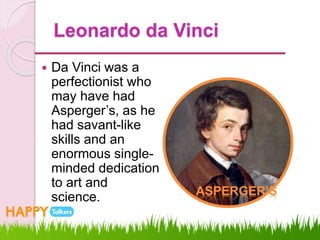
Leonardo da Vinci
 Da Vinci was a
perfectionist who
may have had
Asperger’s, as he
had savant-like
skills and an
enormous single-
minded dedication
to art and
science. ASPERGER’S
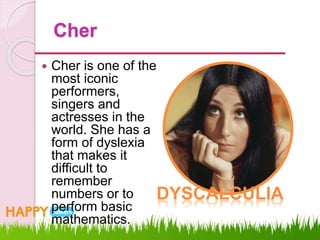
Cher
 Cher is one of the
most iconic
performers,
singers and
actresses in the
world. She has a
form of dyslexia
that makes it
difficult to
remember
numbers or to
perform basic
mathematics.
DYSCALCULIA
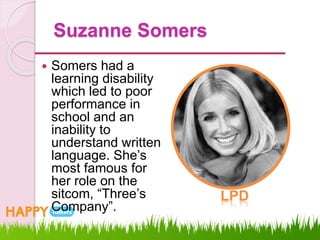
Suzanne Somers
 Somers had a
learning disability
which led to poor
performance in
school and an
inability to
understand written
language. She’s
most famous for
her role on the
sitcom, “Three’s
Company”.
LPD
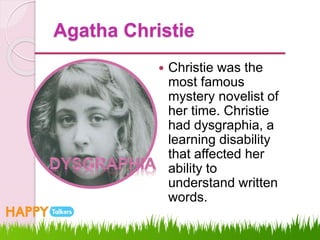
Agatha Christie
 Christie was the
most famous
mystery novelist of
her time. Christie
had dysgraphia, a
learning disability
that affected her
ability to
understand written
words.
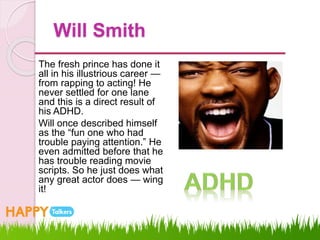
Will Smith
The fresh prince has done it
all in his illustrious career —
from rapping to acting! He
never settled for one lane
and this is a direct result of
his ADHD.
Will once described himself
as the “fun one who had
trouble paying attention.” He
even admitted before that he
has trouble reading movie
scripts. So he just does what
any great actor does — wing
it!
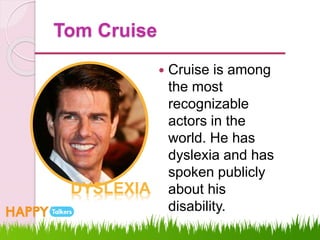
Tom Cruise
 Cruise is among
the most
recognizable
actors in the
world. He has
dyslexia and has
spoken publicly
about his
disability.
DYSLEXIA
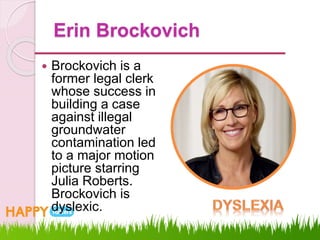
Erin Brockovich
 Brockovich is a
former legal clerk
whose success in
building a case
against illegal
groundwater
contamination led
to a major motion
picture starring
Julia Roberts.
Brockovich is
dyslexic.
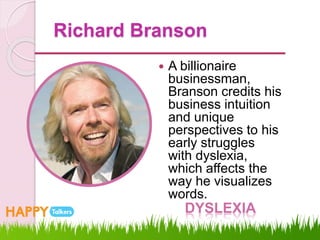
Richard Branson
 A billionaire
businessman,
Branson credits his
business intuition
and unique
perspectives to his
early struggles
with dyslexia,
which affects the
way he visualizes
words.
DYSLEXIA
And many, more!
 Walt Disney, The Founder Of
Disneyland
 Michael Phelps, The Most Decorated
Olympian Of All Time
 Justin Timberlake,
Singer/Actor/Producer/Businessman
 Michael Jordan, The Greatest Of All
Time
 Jim Carrey, Actor/Comedian/Poducer
 David Neeleman, Aviation
Entrepreneur
 John F. Kennedy, The 35th President
My conclusion after this
presentation is that…
Graphology needs to be present in
academia as a tool of assessment…
to develop personality traits …
and to be accepted as a legitimate tool for
selection procedure with other already
accepted tools, Because no
psychological test is 100%,While
Graphology is al almost 95%,So it
should be taught as Subject up to
University level.
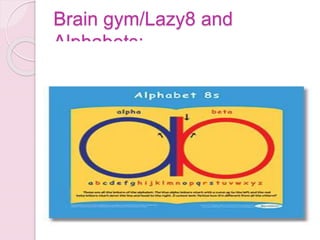
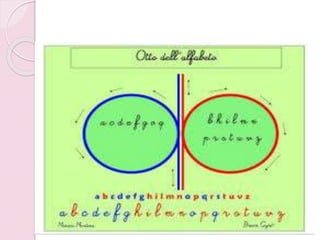
Some Magical Techniques/Brain gym
Exercises For Grapho therapy:
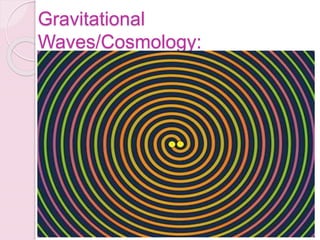
Golden Spiral,
Brain Gym/Lazy8& Alphabets.
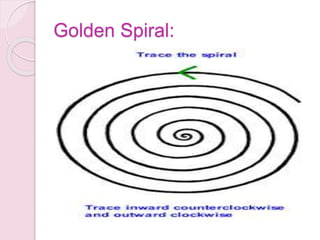
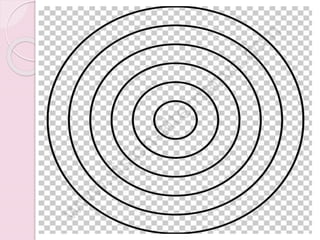
Golden Spiral:
Gravitational
Waves/Cosmology:
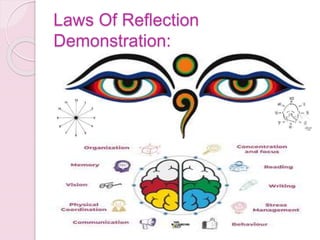
Laws Of Reflection
Demonstration:
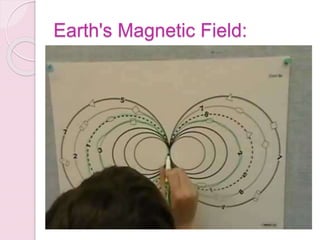
Earth's Magnetic Field:
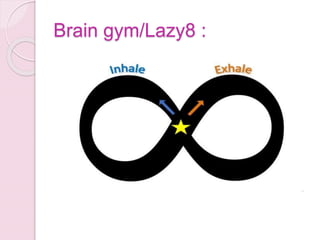
Brain gym/Lazy8 :
Brain gym/Lazy8 and
Alphabets:
SEE YOU NEXT TIME! TILL THEN ALLAH
HAFIZ!/HAVE A GOOD DAY AHEAD& BE
HAPPY!
References
 APA Guidelines For Educational and
Psychological Testing
American Psychological Association
APA: 1974.
 Barrow, N K and Scott, R H
Validation of a personnel Selection
System to meet EEOC Guidelines.
Journal Of Handwriting Psychology
1984, 1 (1), 15 - 17
References
 Sassoon, R. - Children's Handwriting
As An Indicator of Stress;
International Journal of Psychology;
V0027 N3-4, p 440, Jun-Aug 1992.

Schmitt, J, Neal, J & Klimoski, R:
Research Method's in Human
Resources Management.
South Western Publications,
Cincinnati, OH: 1991.
References
 Amend, K. & Ruiz, M. (1980)
 Baggett, B. (2004)
 Baggett, B. (2007)
 Bradley, N. (2005)
 Dresbold, M. (2006)
 Kurdsen, N. (1971)
 Lowe, S. (2007)
 Handwriting University International (HUI)
 Handwriting Analyst International (HAI)
 Ocampa Handwriting Analysis (OHA)
References
 Berninger, V. & Abbott, R. (2013). Differences
between children with dyslexia who are and are
not gifted in verbal reasoning. Gifted Child
Quarterly, 57,223-233.
 Eide, B. & Eide, F. (2012). The Dyslexic
Advantage: Unlocking the Hidden Potential of
the Dyslexic Brain. New York, Hay House.
 Foley Nicpon, M., Allmon, A. , Sieck, R., &
Stinson, R.D. (2011). Empirical investigation of
twice-exceptionality: Where have we been and
where are we are going? Gifted Child Quarterly,
55, 3-17.
297
 McCallum, S.R., Bell, S.M., Coles, J.T., Miller,
K.C. , Hopkins, M.B., & Hilton-Prillhart, A.
(2013). Screening of twice-exceptional
students (gifted with learning disabilities) within
a Response to Intervention (RtI) model. Gifted
Child Quarterly, 57, 209-222.
 Shaywitz, S. (2003). Overcoming Dyslexia: A
New and Complete Science-Based Program
for Reading Problems at Any Level. New York:
Vintage Books.
References
298
 Spiers Neumeister, K., Yssel, N., & Burney,
V.H. (2013). The influence of primary
caregivers in fostering success in twice-
exceptional children. Gifted Child Quarterly,
57, 263-274
 Willard-Holt, C., Weber, J., Morrison, K. L., &
Horgan, J. (2013). Twice-exceptional learners’
perspectives on effective learning strategies.
Gifted Child Quarterly, 57, 247-262.
References
299
References
 Dyslexia, Dysgraphia, OWL LD, and
Dyscalculia: Lessons from Science &
Teaching. Virginia W. Berninger & Beverly
Wolf
 Helping Students with Dyslexia &
Dysgraphia Make Connections. Virginia
W. Berninger & Beverly Wolf
 The Dyslexia Empowerment Plan: A
Blueprint for Renewing Your Child’s
Confidence and Love of Learning. Benn
Foss
300
References
 Eli: The Boy Who Hated to Write. Regina G.
Richards & Eli I. Richards
 The Writing Road: Reinvigorate Your
Students’ Enthusiasm for Writing. Regina G.
Richards, www.LDonliine.org
 The Source for Dyslexia & Dysgraphia.
Regina G. Richards
 The Source for Learning & Memory
Strategies. Regina G. Richards
 When Writing’s a Problem: Understanding
Dysgraphia & Helpful Hints for Reluctant
Writers. Regina G. Richards (Kindle edition)
301
BACKUP SLIDES:
Thematic Apperception Test/Projective
Method
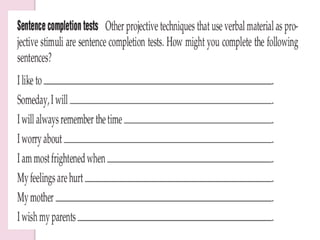
Sentence Completion Test
302
Thematic Apperception
Test/Projective Method:
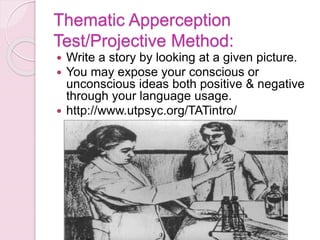
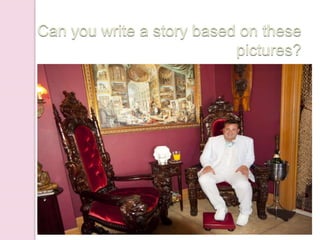
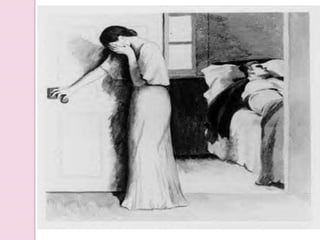
 Write a story by looking at a given picture.
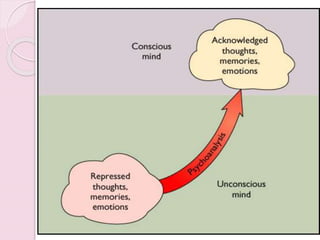
 You may expose your conscious or
unconscious ideas both positive & negative
through your language usage.
 http://www.utpsyc.org/TATintro/
My story
 The woman in the picture is a female
scientist. She is brilliant, working on
his project but under the supervision
of a male scientist. The man is not as
good as the woman, but he is the
boss. He will take the findings of her
project as his own and claim the credit
of the project completion. Which is
unfair. Such type of practice must be
condemned.
Can you write a story based on these
pictures?
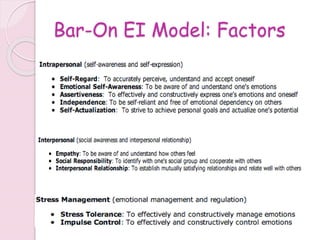
Bar-On EI Model: Factors
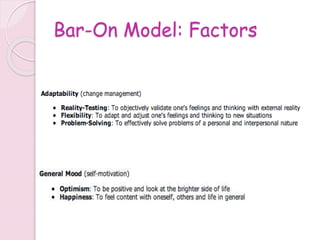
Bar-On Model: Factors
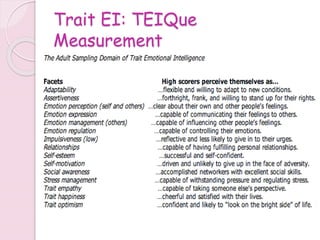
Trait EI: TEIQue
Measurement
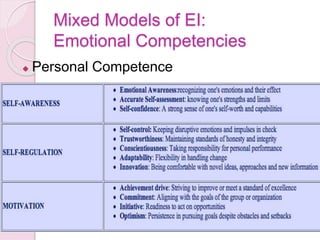
Mixed Models of EI:
Emotional Competencies
 Personal Competence
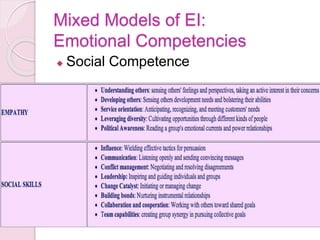
Mixed Models of EI:
Emotional Competencies
 Social Competence
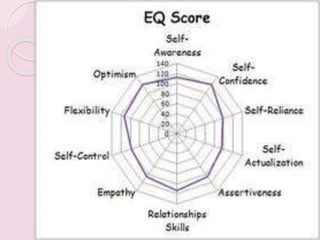
It is very important to understand that emotional intelligence is not
the opposite of intelligence, it is not the triumph of heart over head --
it is the unique intersection of both
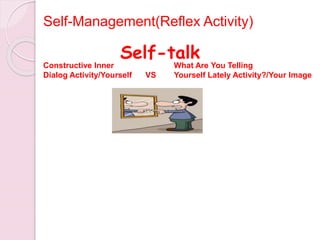
Self-Management(Reflex Activity)
Self-talk
Constructive Inner
Dialog Activity/Yourself VS
What Are You Telling
Yourself Lately Activity?/Your Image
We are all unique. The secret to feel good comes how and what we think
about ourselves. What matters most is how you see yourself“
Always think POSITIVE!

Grapho Therapy 2022N.pptx

  • 1.
    cience of Graphology& Grapho_Therapy By Prof Dr Muhammad Attique Khan Shahid
  • 3.
  • 4.
    Brainstor ming The Key to SuccessfulPersonality & Professional Fitness Assessment through Adjustment of Psychological Disorder Using Energy Balance Technique Adapted from http://www.unc.edu/depts/wcweb/handouts/brainstorming.html
  • 5.
    I bet youdidn’t know these…  interpreting the features of the face (physiognomy),  Creases on the hand (palmistry),  bumps on the head (phrenology),  features of the belly button (omphalomancy),  patterns of forehead wrinkles (metoposcopy),  patterns on tea leaves (tasseography),  directions of light rays reflected from fingernails (onychomancy),  the appearance of barley cakes (critomancy)
  • 8.
  • 9.
    It is veryimportant to understand that emotional intelligence is not the opposite of Intellectual intelligence, it is not the triumph of heart over head -- it is the unique intersection of both(Head/Brain/Mind and Heart)
  • 12.
  • 13.
    OTTFFSSE________________ What Next Coffee,Cups, Professor/Rare Things vs. Rare Air
  • 15.
  • 19.
    Some Features ofGraphic Traits
  • 21.
    Intrinsic Motivation andthe Over justification Effect/Dual Personality:  Intrinsic Motivation ◦ Desire to perform an activity because were enjoy it.  Extrinsic Motivation ◦ Desire to perform an activity because of external pressures or rewards  Overjustification Effect ◦ People view their behavior as caused by compelling extrinsic reasons, and underestimate the extent to which the behaviour was caused by intrinsic reasons
  • 22.
    Graphology & Graphotherapy Graphos= writing. Logos = science. Therapy=treatment Forgery = the illegal act of reproducing someone’s signature without his or her approval. There are 5 things that differ in these pictures! Can you find them all?
  • 23.
    Graphology: The Scienceof knowing & understanding the human Thoughts, Ideas, Desires, Dreams(Action/Habit/Character/Personality) process through handwriting/ Signature using Pen as a Tongue based on simple geometry. Physics and human Anatomy Grapho therapy: Using the Science of Graphology to change thought process of a person through specific handwriting techniques like Pen Flick, Pen Stop /Pasto city ,technique so as to bring about a positive change. (Enhancement of Positive Traits and Rectification of Negative Traits).
  • 28.
  • 29.
    POLYGRAPH AND ITS IMPORTANCE POLYGRAPH – is an instrument for the recording of changes in Physiological parameters like blood pressure; pulse rate, respiration and skin resistance as indication of emotional disturbances especially of lying when questioned.  The word was derived from the word POLY means “many” and GRAPHS means “writing chart”.
  • 30.
  • 31.
  • 32.
    There are threebasic approaches to the polygraph test: The Control Question Test (CQT). The Directed Lie Test (DLT). The Guilty Knowledge Test (GKT).
  • 33.
    The Control QuestionTest (CQT) This test compares the physiological response to relevant questions about the crime with the response to questions relating to possible prior misdeeds. "This test is often used to determine whether certain criminal suspects should be prosecuted or classified as uninvolved in the crime" (American Psychological Association).
  • 34.
    The Directed LieTest (DLT) This test tries to detect lying by comparing physiological responses when the subject is told to deliberately lie to responses when they tell the truth.
  • 35.
    The Guilty KnowledgeTest (GKT) This test compares physiological responses to multiple-choice type questions about the crime, one choice of which contains information only the crime investigators and the criminal would know about.
  • 37.
    Limitations  It isan invaluable investigation aid, but never a substitute for investigation.  It is a lie detector, it is not a scientific diagnostic instrument.  It does not determine facts, it records responses to that which the subject knows to be true.  It is only as accurate as the examiner is competent.
  • 38.
    The underlying theoryof the polygraph is that when people lie they also get measurably nervous about lying. The heartbeat increases, blood pressure goes up, breathing rhythms change, perspiration increases, etc. A baseline for these physiological characteristics is established by asking the subject questions whose answers the investigator knows(The use of CQT Technique). Deviation from the baseline for truthfulness is taken as sign of lying
  • 39.
     Graphology orHandwriting Analysis is a science of interpreting a person's character from his/her personal handwriting.  Handwriting analyzing can tell a lot about personality  Large companies use graphology (handwriting analyzing) to check job applications.  The police still use handwriting experts to determine who wrote what. Graphology
  • 40.
     Coupled withpsychology and knowledge of human behavior, it can be used for recruitment, marriage compatibility, career guidance, and child development, etc.  Signature is easy to collect, but not the best way to analyze character from handwriting , for several reasons. ◦ Firstly, the Signature is sometimes illegible and different from the normal handwriting. ◦ Secondly, the lone signature does not give enough words and letters to help the graphologist in his/her judgment. Graphology
  • 41.
     Graphology cananalyze a person's personality without the person’s knowledge that he/she is being analyzed.  Distortion of the result may be cause by the subject's knowledge that he/she is being analyzed. This is common in most Question-&-Answer type of personality analysis tools.  This behavior analysis is more accurate than putting the subject under unnatural stress of a long questionnaire.  A single personality questionnaire may reveal a single dimension of personality. But two handwriting samples of the same person at different occasion may reveals different behavior characteristics. Graphology
  • 42.
    What is Graphoanalysis? Graphoanalysis is a scientific system of identifying and assessing the character and personality of an individual through a study of handwriting. The techniques used are based on a well-defined, standardized method of: ◦ 1: Identifying strokes, ◦ 2: Relating these strokes to specific personality traits, and ◦ 3: Evaluating the relative strength/weakness of the interrelated traits and if neede provide guidance to improve them.
  • 43.
    The Hidden Meaningof Handwriting  Handwriting gives us access to inside secrets about the hidden meaning of handwriting  If you received a note like the one below ◦ What would you be able to tell about the writer? The words are friendly enough! ◦ If you look a little closer you will see that there are a number of conflicting signs. ◦ Can you see the danger signals? There are red flags popping up all over the place
  • 44.
     An understandingof handwriting analysis will quickly show you that this writer is dogmatic and dictatorial, emotionally unstable, bad tempered and possibly even violent!  It's even possible to find the underlying reasons for the dangerous signals and to understand why the writer has so much personal conflict in his life.  You'll be surprised to discover how much detail can be extracted from just a single page of handwriting.  Of course, to be able to read these signs yourself, you will need to have a lot of understanding of handwriting analysis first and then a vast experience of such type of analysis. Graphology
  • 45.
    Handwriting Guidelines  Geta sheet of paper, sign your name, and start to analyze with these guidelines: ◦ Writing that leans to the right shows good communication skills. ◦ Straight, vertical writing shows independence and stability. ◦ Writing that leans to the left may mean you find it difficult to communicate. ◦ Small writing can be a sign of modesty. ◦ Large writing indicates enthusiasm and generosity.
  • 46.
    Exercise ( 15minutes)  Get a paper and write the following sentences: ◦ Go west young man and grow up with the country ◦ It is Valentino’s day today, so I will give her …  Give it to your group member to analyze it – based on the guidelines.
  • 47.
    Your Own WritingSample Write a letter to yourself of at least two paragraphs. The verbal content of your message is unimportant, so just relax and write in usual style (CURSIVE form). Let it be evaluated by an Expert Graphologist to find true picture of your hidden potential
  • 48.
    Graphology  Has beencalled a pseudo science There are many individuals who, in evaluating the legitimacy of graphology, place it on the same level as astrology.  There are, indeed, a great number of individuals who fervently believe in the worth of graphology as a reliable method to learn valuable information about the personality of an individual through his or her writing.
  • 49.
    Graphology  Not amodern invention  Roman Emperor Nero is said to have judged the abilities of his associates by a study of their handwriting  Italian scholar Camillo Baldi is said to have authored the first treatise on graphology in 1625, under the loosely translated title of "How to know the nature and qualities of a person by looking at a letter he has written."
  • 50.
    Graphology  Abbe Michon,a French monk, wrote about the relationship between handwriting and personality in a book wherein he referred to the study as "graphologie."
  • 51.
    Graphology  International GraphoanalysisSociety (IGAS).  learn the principles of graphology, and become "graphoanalysts" through home study.
  • 52.
     Because notwo persons have identical handwriting(As promised by God in the Holy Quran)  By adulthood, it is exclusive to an individual (we all learned the same techniques to begin writing in schools Even then uniqueness remains)  Even disguised handwriting will exhibit some of the person’s individual characteristics/Personality Traits WHY GRAPHOLOGY:
  • 53.
    53 53 To sum up- Influences on Personality Age Physiological Genetic Life Experience Constitutional Situational Educational Socio – Cultural Family
  • 54.
    54 54 What is Competency “Anunderlying characteristic of a person which enables him to deliver superior performance in a given job, role or situation” The “attribute bundle” including the intellectual, motivational, social & emotional capability aspects A combination of IQ & EQ& RQ Recently known as I & I= RQ+IQ+EQ
  • 55.
    55 55 Defining competencies interms of behaviors, outputs & results People have & acquire COMPETENCIES We apply these in the form of BEHAVIOUR (actions, thoughts, feelings) Our behavior produces OUTPUTS (products & services) How this is done yields RESULTS
  • 56.
    “Handwriting is as individualas a fingerprint, and in many subtle ways is unique to the writer.”
  • 57.
  • 58.
  • 59.
    What handwriting CAN’Ttell:  Gender ◦ Can only infer the degree of masculinity/femininity  Age ◦ Chronological age cannot be determined, but emotional age can  Writing hand  Race, religion or the future….
  • 60.
    What handwriting CANtell:  Social style  Thinking style  Ego strength  Use of energy  Fears and inhibitions  Locus of control
  • 61.
    Keep in yourmind…  Handwriting is symbolic of behavior and attitudes.  You can learn a lot from handwriting, but it doesn’t reveal everything about you.  Handwriting cannot reveal the future, but it tells a lot about the past.  Handwriting tells a lot about how the writer thinks, feels and behaves.
  • 62.
    Handwriting Analysis= Graphology  Thefoundation for graphology is that a graphic structure defines a particular personality behavior or trait.  Document experts continually testify that no two individuals write exactly the same.  Many individuals can have very similar handwritings styles but not factors are the same.
  • 63.
    What can youtell from handwriting?  Graphology= study of handwriting  Graphotherapy= study of changing your handwriting to change your life pattern.  Handwriting= Brain writing  Neuro-muscular movement which tells personality traits. Personality can be told by a neurological brain pattern unconsciously make tiny movements in handwriting.
  • 64.
    HAND WRITING ISBRAIN WRITING Handwriting originates in the brain when a mental picture of letters and words is formed. The signal to try to duplicate the mental picture is sent to the arm and hand through the muscles and nervous system. The actual output is almost never an exact match of the original mental picture.
  • 66.
    The Graphology isthe Mind Picture Through Hands/Through Pen as Tongue.
  • 68.
    Phrenology was an attemptto assess personality characteristics by examining various areas of the skull. Phrenologists used charts such as the one shown here as guides. Like other pseudopsychologist s, phrenologists made no attempt to empirically verify their concepts.
  • 70.
     The morewe use a part of our body, the more space our brain needs to control or interpret it.  In fact, by learning the brain may have to change the space it uses to account for new abilities. The body in action in the brain
  • 71.
    Sensory Areas –Sensory Homunculus Figure 13.10
  • 72.
  • 76.
    PSYCHO MOTOR DOMAIN,SUNDERSTANDING IS MUST Handwriting is distal, meaning that it occurs at the extremities and involves fine motor activity as opposed to a skill like walking which is proximal - a large, or gross motor skill. One reason individuals find it difficult to simulate the handwriting of others is that to do so successfully requires understanding the essence of the writer's motor control program and executing that same program.
  • 77.
    Mindset in anutshell(Glass ½ full+ve,1/2 Empty,_ve.
  • 78.
    Type of Mindset/MindRe Programming: …avoid challenges …give up easily …see effort as fruitless or worse …ignore useful negative feedback …feel threatened by the success of others Challenges Obstacles Effort Criticism Fixed Mindset Success of Others Growth Mindset …find lessons and inspiration in the success of others …learn from criticism …see effort as the path to mastery …persist in the face of setbacks …embrace challenges © 2016 Public Impact OpportunityCulture.org
  • 79.
    (Information Transformation via Neuronenergy gain OR energy loss) You learn what you practice(positive or negative things) because when you are practicing, your brain is growing new fibers (dendrites) and connecting them at synapses. (Fix Mind Set in to Growth Mind Set)e.g. Half glass of water This is what learning is or change of Mind Set or Mind Re Programming..
  • 80.
  • 81.
    Neurons  Neurons (braincells) make connections between different parts of the brain.  Information is carried inside a neuron by electrical pulses and transmitted across the synaptic gap from one neuron to another by chemicals called neurotransmitters.  Learning is a critical function of neurons.
  • 85.
    Roger Wolcott Sperry1981 Nobel Prize Winner Left Brain-Right Brain Phenomenon
  • 86.
    Left Brain  Logical Sequential  Rational  Analytical  Objective  Looks at parts Right Brain  Random  Intuitive  Holistic  Synthesizing  Subjective  Looks at wholes Left Brain-Right Brain Phenomenon
  • 91.
    Try this!/Color Test/Need of Color Therapy Read aloud, as quickly as possible, the color in which the words are written but not the actual words. GREEN YELLOW BLUE ORANGE WHITE RED GREEN BLUE ORANGE YELLOW WHITE GREEN RED BLUE WHITE GREEN ORANGE YELLOW ORANGE BLUE GREEN RED WHITE YELLOW RED BLUE YELLOW ORANGE RED WHITE BROWN WHITE
  • 106.
    If you merelyread the words, you are likely to be using right brain. Whereas, if you read the colours, you are using your left brain.
  • 107.
    Left Brain InventoryRight Brain Inventory Verbal, focusing on words, symbols, numbers Visual, focusing on images, patterns Analytical, led by logic Intuitive, led by feelings Process ideas sequentially, step by step Process ideas simultaneously Words used to remember things, remember names rather than faces Mind photos' used to remember things, writing things down or illustrating themhelps you remember Make logical deductions frominformation Make lateral connections frominformation Work up to the whole step by step, focusing on details, information organised See the whole first, then the details
  • 108.
    Left Brain InventoryRight Brain Inventory Highlyorganised Organisationtendstobelacking Likemakinglistsandplanning Freeassociation Likelytofollow ruleswithoutquestioningthem Liketoknow whyyou'redoingsomethingorwhyrule exist(reasons) Goodatkeepingtrack of time Nosenseof time Spellingandmathematicalformula easily memorised Mayhavetroublewithspellingandfindingwordsto expressyourself Enjoyobserving Enjoytouchingandfeelingactualobjects(sensory input)
  • 109.
    Left Brain InventoryRight Brain Inventory Planahead Troubleprioritising. So,oftenlate,impulsive Likelytoreadinstructionmanualbeforetrying Unlikelytoreadinstructionmanualbeforetrying Listentowhatisbeingsaid Listentohowsomethingisbeingsaid Rarelyusegestureswhentalking Talkwithyourhands Likelytobelieveyou'renotcreative,needto bewillingtotryandtakeriskstodevelopyour Likelytothinkyou'renaturallycreative,butneedto applyyourselftodevelopyourpotential
  • 110.
    Mnemonics(Memory/Assistance + Electronics/Relating)  Didyou know that you can use memory tricks or mnemonic devices to help you remember information? Definition of Mnemonics:  1. Assisting or Intended to Assist memory;  2. of or Relating to memory Origin of MNEMONIC:  Greek mnēmonikos, from mnēmōn mindful,  from mimnēskesthai to remember
  • 111.
    Handwriting Experts are 85%-95%accurate in their analysis ~~~~~~~~~~~~~~~~~~~~~~~~~~~~~ ~~~ Handwriting is a clinical science that falls under Psychology. Spain, France, Holland, and Israel all use handwriting analysis when interviewing potential employees (80%) USA this on the rise but still under 10%
  • 112.
    Does your handwritingchange on a daily basis?  IF YES, you are moody!  EMOTIONAL  Fix your handwriting, fix your mood and cut down on sugary snacks.  Basic strokes stay the same/Cosmetic are Changed.  Even if you write differently all the time, some traits do not change.
  • 113.
    YOUR SIGNATURE Please checkYour signature are different from your handwriting or same because they have different meanings. Illegible signature means you write it 100x a day (Ex: Doctor) OR you are a private person who would like to be seen but not known. Your signature reveals your true EGO/SUPER EGO & Id.
  • 114.
  • 115.
  • 116.
    Elvis Presley It doesn'ttake too much imagination to see Elvis Presley's guitar in the signature of the later rock 'n' roll star. *
  • 117.
  • 118.
  • 119.
  • 120.
  • 121.
  • 122.
  • 123.
  • 124.
  • 125.
  • 126.
  • 127.
  • 128.
    Albert Einstein Here isa sample of Albert Einstein's handwriting, actual size.
  • 129.
  • 130.
    Sample Writing #1 The writer uses heavy pressure, pointing to a person with deep, long-lasting emotions. The right slant indicates the writer responds freely with these emotions (heart rules the mind). The writing is large and indicates that the writer has trouble concentrating on tedious tasks and is easily distracted. The baseline is only slightly wavy, revealing no inner emotional turmoil.  This is a friendly outgoing person with a lot of energy. This person needs variety and lots of activity. The emotional stability of the baseline indicates s/he is reliable and dependable.
  • 131.
    Sample Writing #2 Thewriters pressure and size if writing is average, indicating s/he usually has enough energy to handle daily activities. Emotional response is slightly inhibited (vertical writing) indicating the head rules the heart. Average size of script shows the ability to concentrate on daily activities without being distracted too much by what's going on around him/her. The baseline is wavy indicating changeable moods- sometimes in a good mood, sometimes not. The wavy baseline is common in vertical writing because people who try to control their emotions have a certain amount of inner emotional turmoil.
  • 132.
    The TRUTH Appearances canbe deceiving but Handwriting Never LIES/You can not deceive your Brain how hard you can Try.. - Michelle Dresbold (2006)
  • 133.
    Handwriting Analysis  LikeFingerprints/DNA Coding , every person’s handwriting is unique and personalized  Handwriting is difficult to disguise or forge ◦ Good tool for including or excluding persons when determining a match with an exemplar  Questioned documents are compared to exemplars to determine matches ◦ Exemplars- prewritten handwriting samples from a suspect(s)
  • 134.
    4. Collection offacts? 6. Technology? 5. Finished Product? 2. Objective search for the truth? 1. Immediate solution to practical problem? 3. Grows continuously?
  • 135.
    Science: a processof inquiry Basic Curiosity “We Ask Questions of Nature And Get Answers” D.E. Moss The process of formulating specific questions and then finding answers For …better understanding …
  • 136.
    includes beliefs, theories,or practices that have been or are considered scientific, but have no basis in scientific fact. This could mean they were disproved scientifically, can’t be tested or lack evidence to support them. Pseudoscience Non Scientific: does not use scientific method/DRHERC… but pretends to…
  • 137.
    Everyday Scientific General approachintuitive empirical Observation casual, uncontrolled systematic, controlled Reporting biased, subjective unbiased, objective Concepts ambiguous clear definitions Instruments inaccurate, imprecise accurate, precise Measurement not valid or reliable valid and reliable Hypotheses untestable testable Attitude uncritical, accepting critical, skeptical Characteristics of the scientific method vs. human nature
  • 138.
    What about thishandwriting sample?-1
  • 139.
    What about thisone?- Sample-2
  • 140.
  • 141.
    What are yourobservations and impressions of this handwriting sample?
  • 142.
    OBSERVATION:  Messy, scribbled,hastily written.  Illegible, unreadable handwriting.  No margins at all.  Baselines overrun each other.  Oversized, triangular looping of long letters.  Large, open loops on tall letters.  Middle letters have unusual shapes.  Not illegible .  Plastic Nature/DHO.
  • 143.
    IMPRESSIONS:  The writerof this letter is insane, or very confused.  This is a person with no boundaries.  The requests made in this letter are probably lies.  This is a dangerous person.
  • 144.
    Explanation/Interpretations:  No marginson the page means this person has no boundaries; indicates lack of respect for others.  This person probably has an odd personality  Overlapping baselines show resentment and anger.  Oversized l-loops show exaggerated physical drives  Triangular l-loops indicate sexual perversion  Oversized t- loops show extreme sensitivity to criticism.  Middle letter o is convoluted indicating that this person is a chronic liar.  Middle letters have unusual shapes.  Slant: ambivert Now, Let us meet the writer…
  • 145.
    J. Thomas Kane Serial Rapist and Murderer  Incarcerated in Arizona State Prison awaiting death sentence.  Background: suffered severe physical and sexual abuse as a child; history of torturing animals and abusing younger children; long history of drug abuse.
  • 146.
    Which one ofthese writers is more nurturing? A B
  • 147.
    Which one ofthese writers is more nurturing? A B A gentle woman who dedicated her life to nurturing and healing the poorest of the poor Mother Teresa A murderer and a Torturer Heinrich Himmler
  • 148.
    Which one ofthe writers tends to be inconsistent? A * B
  • 149.
    Which one wouldbe more fun at the party? Who is the life of the party?
  • 150.
    The BEGINNING * EdgarAllan Poe – a great American Poet, employed the term Autographery
  • 151.
    Brief Background *2nd century -China (Calligraphers) *99 A.D. - Rome (Suetonius Tranquilius)
  • 152.
    Brief Background • 1662– Camillo Baldi • First book on the subject was written. • 1871 – Abbe Jean Hippolyte Michon • Published two more books and coined the term “GRAPHOLOGY”
  • 153.
    Brief Background 1979 –most graphology books were placed in psychological selection categories in the Dewey Decimal Classification at the Library of Congress, USA
  • 154.
    Brief Background 1989 –the US Dept. of labor changed category of Graphology from Entertainment to Miscellaneous professional
  • 155.
    Kendall/Hunt Publishing Company 155 Handwriting Handwritinganalysis involves two phases:  The hardware—ink, paper, pens, pencils, typewriter, printers  Visual examination of the writing
  • 156.
    Kendall/Hunt Publishing Company 156 HandwritingCharacteristics  12 pts. to compare between known and questioned samples 1. Line Quality—smooth or shaky 2. Word and Letter Spacing–-check distance between letters and words 3. Letter Comparison—check height, width and size of letters. 4. Pen Lifts and Separation —check where does the writer lift his pen 5. Connecting strokes —check how capital letters connect to others; how strokes connect between letters and words 6. Beginning and ending strokes —check how words begin and end; straight, curled, long, short, etc.
  • 157.
    7. Unusual LetterFormation—check for backwards letters, letters with tails, or unusual capital letters 8. Shading or pen pressure—check for amount of pressure used on downward and upward strokes 9. Slant—check for left, right, or no slant 10. Baseline Habits—check if it follows a straight line across the page or moves up or down 11. Flourishes or embellishments —check for fancy letters, little curls, loops, hearts, etc. 12. Diacritic Placement—check how the t’s are crossed or i’s are dotted Kendall/Hunt Publishing Company 157
  • 158.
    Line spacing (betweenlines) Indicates self-control  Clear line spacing ◦ mental clarity, sense of order, reasons well, objective when dealing with problems  Narrow line spacing ◦ Impulsive, rushes ahead too quickly, possibly “cheap” spender  Crowded line spacing ◦ Driven by impulse, lack of abstract thinking and objectivity, lives in the moment, imaginative
  • 159.
     Tangled lines ◦Loss of perspective, acts on instincts and emotions, doesn’t plan far ahead  Moderately wide line spacing ◦ logical, orderly mind; preference for keeping things clear; not impulsive, love of beauty, spend money freely  Extremely wide line spacing ◦ Anxious, feels isolated from world, concerned with maintaining own space, lost capacity to act spontaneously
  • 160.
     Irregular linespacing ◦ Reactions depend on circumstances and how they feel at the moment, lacks good self-discipline and unsure of themselves  Extremely regular line spacing ◦ Inflexible, obsessive, follows strict routine, needs counseling?
  • 161.
    Handwriting Size  Writingsize tells how much space you feel you deserve.  Middle-zone height reveals how much your ego needs; width shows how willing you are to get your ego needs met.  Upper-zone height symbolizes aspirations, principles, and standards; width shows how open-minded you are.  Lower-zone length and width tells how active and productive you are.
  • 162.
    Slant/Emotional Yardstick:  Leftrepresents the mind; male leadership  Right represents the heart; female leadership  Slant is a gauge of emotional responsiveness  Upstroke slant shows your gut reactions  Down stroke slant shows how quickly you respond to your gut reactions.  Left-slanted writing is never natural.  Slant is one of the easiest elements to deliberately change.
  • 163.
    Pressure applied/Stress Level:  Emotionalintensity behind a person’s behavior  Heavy pressure - more intense emotions  Can also indicate level of stress
  • 164.
    Letter “t” -Stem  Very tall – never measures up to demanding father  Short – independent, doesn’t care what others think  Copybook – follows the crowd  Looped – sensitive to criticism
  • 165.
    Letter “t” -Crossbar  Slants downward – bossy, domineering  Points upward – optimistic, ambitious, hopeful  Concave (bows downward) – easily persuaded, taken advantage of  Convex (turned up) – self-protecting, rejects help  Connects to next letter/own stem – quick intellect  Lasso-like – feelings of guilt; returns to past  Uncrossed or to the left – procratinates  Crossed to the right – enthusiastic, excited  End stroke – initiator  Pointed – ridicules others, sarcastic, insecure
  • 166.
    Letter “i” –the dot  Careful, precise round dot – loyal  High-flying dot – impatient, adventurous  Missing dot – poor memory, procrastinates  Circular dot – gullible, naïve  Heavy slash – mean, brutal  Dash or comma – ironic sense of humor  Hook - irritable
  • 167.
    Letter “f”/Planning Follower: Fluid f – efficient and altruistic  Top/bottom loops same height/width – well organized  Upper loop emphasis – plans better than she/he executes  Lower loop emphasis – more interested in doing than planning  Large knot at stem – family pride
  • 168.
    Letters “m” and“n”  Rounded tops – cumulative thinking (builds one idea upon another)  Sharp tops – investigative thinker  Sharp bottoms – analytical thinker  Thready, wavy top – superficial thinker
  • 169.
    Letter “r” Connected towriter’s dress sense  Backward 3 – pays attention to dress  Flat-top – works well with hands and tools  Needle-point – lives by intellect, sharp-minded and curious  Rounded top – easily influenced  Printed r – sign of creativity
  • 170.
    George W. Bush/Observations/Interpretations Emotionally expressive & empathetic (hard right hand slant)  Great selfsteem, Imaginative & ambition (t-bars crossed at the very top of the stem, high I dotting)  Highly Intelligent & mature (sharp points on the m's, connected letters, and good rhythm)  Enthusiasm (Long t-bar)  Generosity (large& even spaces between, lines& words)  Blunt, Relaxed, very honest, and even a bit talkative (no loop on either side of the o and open at top, looped, l)
  • 171.
  • 172.
    12 Characteristics of Handwriting: 1.Placesof Crosses on t’s & Dots on i’s  Are t’s crossed? ◦ t’s crossed in middle, toward top, or toward bottom  Are i’s dotted? ◦ Dotted toward left, toward right, or centered
  • 173.
    2.Fancy Curls orLoops  Are there fancy loops?  Any other distinguishing features?
  • 174.
    3.Line Habits  Isthe text on the line, above the line, or below the line?
  • 175.
  • 176.
    5.Pen Pressure  Ispressure equal when applied to upward and downward strokes?
  • 177.
    6.Cursive and PrintedLetters  Are there printed letters, cursive letters, or both?
  • 178.
    7.Letters Complete  Areletters completely formed? Or, is part of a letter missing?
  • 179.
    8.Connecting Letters  Arethe capital and lowercase letters connected and continuous?
  • 180.
    9.Continuous  Is thewriting continuous or does the writer lift the pen/pencil?
  • 181.
    10.Size Consistency  Whatis the ratio of height to width consistent?
  • 182.
    11.Spacing  Are lettersequally spaced or crowded?  Are margins evenly spaced?
  • 183.
    12.Line Quality  Dothe letters flow or are they erratic and shaky?
  • 184.
    Forensic Science: Fundamentals & Investigations,Chapter 10 184 Everyone’s handwriting shows natural variations. Here are 6 of the 12 major, specific traits. The traits are functions of formatting or of letter or line form. Here are the other 6 of the 12 major, specific traits
  • 186.
    TOOLS IN GRAPHOLOGY Handwritinganalysis involves two phases:  The hardware—ink, paper, pens, pencils, typewriter, printers  Visual examination of the writing Tools Employed  Pen  Ruler  Paper (8”x11”)  Magnifying galss  Protractor
  • 187.
    HOW TO PREPAREA HANDWRITING SPECIMEN Use the prescribed tools Take note:  sex of the writer handedness frequency of writing number of signatures used mood of the writer
  • 188.
    Preparing a Specimen Putthe signature (normally used) below At the back of the sheet or in another sheet, write other signatures used Content should be not less than 3 paragraphs
  • 189.
    Points to ponder… Inschools/Colleges/ Universities/Organizations , it is recommended that teachers/HR Managers practice their students/Employees to write a balance in the three zones to avoid possible production of individuals who are braggarts, immature, greedy and have little control over temptations.
  • 190.
    Points to ponder… GuidanceCounselors who noticed a student for having an imbalanced writing in the three zones, and confirmed significant concerns in the latter’s behavior might take into consideration to make use of grapho-therapy together with their preferred counseling philosophy.
  • 191.
    Points to ponder… Ina company, HR experts may take into consideration to clearly check and evaluate the balance in the three zones, and together with the other personality tests, HR experts may be able to hire competent employees depending on the company’s needs.
  • 192.
    Points to ponder If the company needs someone who has a head over heart emotional attitude, and is open to experiences but cautious and controlled, then the HR expert might want to hire a vertical- slanted writer.
  • 193.
    Points to ponder However, if the company needs someone who still manages to be charming in social situations while remaining emotionally aloof, then the HR expert might want to hire a slightly left- slanted writer.
  • 194.
    Things to ponder Inschool, College,& universities it is recommended that teachers check their students’ writing spaces (line, words and letters). Helping their students maintain average spaces may assist them to achieve more peaceful classroom environment.
  • 195.
    Importance graphology InPress Media.: Originally, graphology applied only to the appearance of a person's handwriting ,how ever you can use it to any aspect of the form and appearance of a text that modifies meaning in any way.
  • 196.
     Importantly, itis the graphological qualities of any written or printed text that we first notice.  For example, on the text on the right we can see from the graphological qualities that this text is a newspaper.
  • 197.
     Because thesefeatures are what you first notice you would do well to apply the graphology framework first in your stylistic analyses  Although the graphological framework is not considered as important as others it is often overlooked.  You should not focus too much on this framework, but properly applied graphological analysis can be very useful and subtle and add marks to your analysis.
  • 198.
     When youare analysing a text using the graphological framework, you will need to consider the following points:  The nature of the characters – are they handwritten or printed, upper case or lower case?  For example: Uppercase text Lowercase text Uppercase text
  • 199.
     Of course,it is not acceptable merely to comment that the letters on this text are a mixture of upper and lower case words.  You will have to say what effect these features have.  For example:  “The main focus of the text is the initial headline – “BUSH KNEW”, the use of upper case letters adds emphasis to the statement and lets the reader know what the article is about.”  What could you say about the other examples pointed out?
  • 200.
    Mentioning what fontthe text is presented in is also useful, although you are not required to know various different font types e.g. Tahoma, Palatino Linotype, Times New Roman Also mention the font size And also the font style, is it in bold, underlined or in italics
  • 201.
     You willalso need to mention graphemes  Graphemes are the letter or letter combination that make up a sound (phoneme)  So for example: Grapheme Grapheme
  • 202.
     From theexample given, you can see that ‘AR’ are both graphemes, BUT, they represent two different phonemes  The AR in HARLEY is a different sound to the AR in EARL  There is much to say about graphemes as the entire text is made up of them!  However in the exam it is better to comment on a few related examples or graphemes that are unusual  For example: Grapheme of EZ used instead of ES – can tie this in with lexis
  • 203.
     Punctuation isa key feature of any written text and it is important to mention this within the graphology framework  For example: The use of full stops here in between the words ‘TOMMY GUN’ replicates the sound and action of a machine gun.
  • 204.
     Another keyfeature of graphology is the organisation of the text  This basically means how it is laid out on the page  Therefore you need to mention such things as:  Headings, columns, bullet points, numeration, borders, boxes, paragraph size, line spacing and use of white space Again, it is important to mention the effect these have on the text rather than just saying “there is a lot of white space in this text”!
  • 205.
    Headings – showsclear definition Bullet points – showing organisation Columns – showing clearly ordered text Short, concise paragraphs White space making the advert look uncluttered
  • 206.
     Finally thelast things you need to mention regarding the graphology framework are:  Use of colour  Logos  Drawings  Photographs  Captions  Diagrams  Charts As stated before, you need to state what effect these features have on the text as a whole and if they are effective in achieving their aims.
  • 207.
    Logo – tells you instinctively whatthe text is Pink – the colour of love (softness) Drawing of a heart Mocked up photograph Caption
  • 208.
    What are the characteristicsof students with handwriting problems? Why we need Grapho therapy ?
  • 209.
    Handwriting Problems  Dysgraphia(Greek. Dys/ Impaired ,graphia/ Making letter forms by hand” An Impairment in written Expression” is a written-language disorder that involves mechanical (psymotor domain effect)l writing skill  It manifests itself in poor writing performance  It is seen in students of at least average intelligence who do not have a neurological disability and/or perceptual-motor handicap(Non perceptuality effect)  It can occur alone or in the presence of other disabilities
  • 210.
    All Rights ReservedKevin T. Blake, Ph.D., P.L.C. 210 AD/HD and Learning Disorders and Dysgraphia Barkley stated:  15% to 30% of AD/HD have Reading Disorder  26% have Spelling Problems  10% to 60% have Mathematics Disorder  Developmental Coordination Disorder-Dysgraphia 60%(CAVD Test Recommended) Barkley, R.A. (2002). ADHD and Oppositional Defiant Children. Seminar Presented February 19-20, Phoenix, AZ, The Institute for Continuing Education,Fairhope, AL, from handout, pp. 9. Barkley, R.A. (2002) Mental and Medical Outcomes of AD/HD. Pre-Conference Institute, # TPA1, Thursday October 17, 2002, 14th Annual CHADD International Conference, Miami Beach, FL.
  • 211.
    All Rights ReservedKevin T. Blake, Ph.D., P.L.C. 211 AD/HD and Learning Disorders and Dysgraphia Hynd indicated those with Inattentive AD/HD:  21% have Reading Disorder  33% have Mathematics Disorder  4% have Spelling/Disorder of Written Expression Hynd, G. (2002). ADHD and Its Association with Dyslexia: Diagnostic and Treatment Challenges. Paper presented at the 53rd Annual International Dyslexia Association Conference, Atlanta, GE, November 16.
  • 212.
    General Challenges for studentswith Dysgraphia: Communication Behavior Organization Memory Time and Space Academics Social Interaction Self-Esteem Behavior Independence
  • 213.
    Symptoms of Dysgraphia:(Violationof all hand writing characteristics)  Poor formation  Too large, too small, or inconsistent  Incorrect use of capital and lowercase letters  Crowded or cramped  Inconsistent spacing  Incorrect alignment  Incorrect or inconsistent slant  Lack of fluency  Slow pace even when asked to write quickly Copyright © Pearson Allyn & Bacon 2009
  • 214.
    What dysgraphia is... a processing problem  difficulty in automatically remembering and mastering the sequence of muscle motor movements needed in writing  causes writing fatigue  interferes with communication of ideas in writing  contributes to poor organization on the line and on the page  out of harmony with the person's intelligence Copyright © Pearson Allyn & Bacon 2009
  • 215.
    What dysgraphia isnot ..(Misconceptions) ◦ laziness ◦ not trying ◦ not caring ◦ sloppy writing ◦ general sloppiness ◦ careless writing ◦ visual-motor delay
  • 216.
  • 217.
    Strategies for TeachingStudents with Learning and Behavior Problems Eighth Edition
  • 218.
    How is DysgraphiaTreated? Or Grapho therapy: First, an evaluation by an occupational therapist is often warranted, to determine if there are specific exercises and strategies a child can do in order to strengthen fine motor skills necessary for writing. Second, parents should work closely with their child's school to determine appropriate accommodations. The goal of accommodations is to ensure that the process of writing does not interfere with a child's ability to learn, or to show what he/she has learned. Copyright © Pearson Allyn & Bacon 2009
  • 219.
  • 220.
  • 221.
  • 222.
  • 223.
  • 224.
  • 226.
    SPLD & Neurodiversity Dyscalculia Dyslexia Attention Deficit Hyperactivity Disorder (ADHD) SpecificLanguage Impairment (SLI) Autism Spectrum Disorder (ASD) Dyspraxia / DCD & Dysgraphia
  • 227.
    Some examples ofcommon accommodations include: Limiting the copying aspect of work (i.e., no copying sentences or math problems from the chalkboard or from a book). Allowing students to be tested orally (i.e., simply say their answer to the teacher, rather than writing it out). Not grading for spelling errors, accept on spelling tests and assignments specifically assigned for spelling. Allowing students to dictate book reports into a tape recorder, or to their parents for typing. Teaching students to type as early as possible, so that they can type papers instead of writing them by hand. If assignments must be written, allowing students to use abbreviations or to respond in a shortened manner (i.e., making lists versus writing out complete sentences). Finally, older students may need extra assistance in learning how to organize their thoughts for papers and essays. This may include brainstorming ideas, learning to group similar ideas, identifying appropriate sequencing of ideas, and mastering skills of proofing and correcting their written work.
  • 228.
    Teaching for NeurodiversityClassroom support strategies Working together to empower Students to cater for Special 228
  • 229.
  • 230.
  • 231.
  • 232.
  • 233.
  • 234.
  • 235.
  • 236.
  • 237.
  • 238.
  • 239.
  • 240.
  • 241.
  • 242.
  • 243.
  • 244.
  • 245.
  • 246.
  • 247.
    Bibliotherapy “Bibliotherapy is anattempt to help young people understand themselves and cope with problems by providing literature relevant to their personal situations and developmental needs at appropriate times. Teachers using this approach believe that reading can influence a student's thinking and behavior. Moreover, through guided discussions, selected readings can focus on specific needs of gifted 247
  • 253.
     “Huma isa nine-year-old and passionate about her love of horses. She can discuss almost any aspect of her passion in great detail including: characteristics and history of various breeds, history of the domestication, and training and riding methods. She is a talented artist and has a wonderful portfolio of her horse drawings, paintings, and sketches.  “She contributes to many class discussions and frequently relies on her visual memory, advanced vocabulary, and unique sense of humor. Teachers comment on Huma’s ability to remember so much detail.” Case Study: Huma 253
  • 254.
     “Huma struggleswith reading and writing. Her oral reading is not fluent, characterized by word-by-word reading with many decoding errors. She relies on sight words, contextual cues, and her advanced abilities in reasoning skills to comprehend and predict text. She is very self-conscious about her oral reading hates when she is called on to read in class.  “Huma’s writing is characterized by many wonderful and creative ideas that are very loosely organized. Her writing has many spelling and grammatical errors.  “Huma has always struggled with the weekly spelling tests. She works hard daily and practices each night, but still only manages to average B- or C on the weekly tests.” Case Study: Huma 254
  • 255.
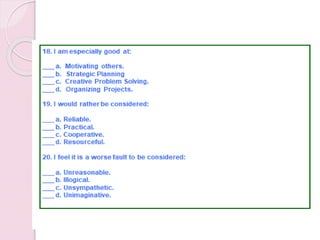
     “Ali isan 8th-grader who has been described as insightful, smart, interesting, and charming. His teachers also find him to be polite and respectful. He has demonstrated advanced knowledge in science, particularly in the geology. He can describe different rock formations with the correct vocabulary and concepts. He and his science teacher enjoy conversations about their shared passion.  “Ali is also a talented music student. He plays 3 instruments and is first chair of his school band. He participates in family musical group that entertains at local senior citizen and community centers on a monthly basis.” Case Study: Ali 255
  • 256.
     “Although Aliis a hard worker and wants to be successful in school, he is very frustrated with how hard school has become for him. He thinks that the teachers give him too much work and he is overwhelmed. He has difficulty with organization which is evident with his messy binder and locker, his inability to locate assignments and to keep track of due dates. Long term assignments are rarely turned in on time. He struggles to understand directions and needs more time to organize his thoughts when trying to explain a concept, even when he knows the information well.  “He has good and creative ideas but his writing is ‘bare- bones’ with little detail or richness. Given his advanced vocabulary, his teachers are surprised by his frequent spelling mistakes.” Case Study: Ali 256
  • 257.
  • 258.
     Every studentreceives Universal supports  Some students also receive Targeted supports  Few students also receive Intensive supports Layered Continuum of Supports
  • 259.
    Definition 2 A writtenlanguage disorder ◦ In serial production of strokes ◦ To form a handwritten letter ◦ Involves not only motor skills but also language skills  Finding, retrieving, and producing letters  This is a subword level language skills ◦ The impaired handwriting may interfere with spelling and/or composing 259
  • 260.
    260 One size fitsall??? Once upon a time the animals decided they must do something heroic to meet the problems of a "new world," so they organized a school. They adopted an activity curriculum consisting of running, climbing, swimming, and flying, and to make it easier to administer, all the animals took all the subjects.
  • 261.
    261 One size fitsall??? The duck was excellent in swimming, better in fact than his instructor, and made passing grades in flying, but he was very poor in running. Since he was so slow in running, he had to stay after school and also drop swimming to practice running. This was kept up until his web feet were badly worn and he was only average in swimming. But average was acceptable in school, so nobody worried about that except the duck.
  • 262.
    262 One size fitsall??? The Rabbit … The Squirrel … The Eagle … At the end of the year, an abnormal eagle that could swim exceedingly well, and also run, climb, and fly a little had the highest average and was valedictorian. How many of us are like the duck who is excellent in swimming and good at flying, but we spend a lifetime running only to wear out our feet and in so doing we neglect our true gifts?
  • 263.
    Napoleon Bonaparte Napoleon’s hypersensitivity to touchand his military strategic genius are two of the many symptoms that have led some modern scholars to suggest that he was a high- functioning autistic.
  • 264.
    Albert Einstein Einstein’s parents oncethought that he was mentally retarded due to his odd habits and difficulties in school. If he were born today, Einstein would probably be diagnosed with Asperger’s Syndrome, a mild form of autism.
  • 266.
    Thomas Edison Edison isbelieved to have had dyslexia and possibly ADHD. Edison was home- schooled. He developed a voracious appetite for reading and made major scientific breakthroughs with his unusual methodology.
  • 267.
    Alexander Graham Bell Bellinvented the telephone, but struggled with traditional schooling. It’s believed that he had some form of learning disability, possibly dyslexia.
  • 268.
    Robin Williams Williams isa comedian and actor. He has been diagnosed with attention deficit hyperactivity disorder (ADHD) which affected his education and his ability to memorize scripts.
  • 269.
    Leonardo da Vinci Da Vinci was a perfectionist who may have had Asperger’s, as he had savant-like skills and an enormous single- minded dedication to art and science. ASPERGER’S
  • 270.
    Cher  Cher isone of the most iconic performers, singers and actresses in the world. She has a form of dyslexia that makes it difficult to remember numbers or to perform basic mathematics. DYSCALCULIA
  • 271.
    Suzanne Somers  Somershad a learning disability which led to poor performance in school and an inability to understand written language. She’s most famous for her role on the sitcom, “Three’s Company”. LPD
  • 272.
    Agatha Christie  Christiewas the most famous mystery novelist of her time. Christie had dysgraphia, a learning disability that affected her ability to understand written words.
  • 273.
    Will Smith The freshprince has done it all in his illustrious career — from rapping to acting! He never settled for one lane and this is a direct result of his ADHD. Will once described himself as the “fun one who had trouble paying attention.” He even admitted before that he has trouble reading movie scripts. So he just does what any great actor does — wing it!
  • 274.
    Tom Cruise  Cruiseis among the most recognizable actors in the world. He has dyslexia and has spoken publicly about his disability. DYSLEXIA
  • 275.
    Erin Brockovich  Brockovichis a former legal clerk whose success in building a case against illegal groundwater contamination led to a major motion picture starring Julia Roberts. Brockovich is dyslexic.
  • 276.
    Richard Branson  Abillionaire businessman, Branson credits his business intuition and unique perspectives to his early struggles with dyslexia, which affects the way he visualizes words. DYSLEXIA
  • 277.
    And many, more! Walt Disney, The Founder Of Disneyland  Michael Phelps, The Most Decorated Olympian Of All Time  Justin Timberlake, Singer/Actor/Producer/Businessman  Michael Jordan, The Greatest Of All Time  Jim Carrey, Actor/Comedian/Poducer  David Neeleman, Aviation Entrepreneur  John F. Kennedy, The 35th President
  • 278.
    My conclusion afterthis presentation is that… Graphology needs to be present in academia as a tool of assessment… to develop personality traits … and to be accepted as a legitimate tool for selection procedure with other already accepted tools, Because no psychological test is 100%,While Graphology is al almost 95%,So it should be taught as Subject up to University level.
  • 279.
    Some Magical Techniques/Braingym Exercises For Grapho therapy: Golden Spiral, Brain Gym/Lazy8& Alphabets.
  • 280.
  • 282.
  • 283.
  • 284.
  • 285.
  • 287.
  • 293.
    SEE YOU NEXTTIME! TILL THEN ALLAH HAFIZ!/HAVE A GOOD DAY AHEAD& BE HAPPY!
  • 294.
    References  APA GuidelinesFor Educational and Psychological Testing American Psychological Association APA: 1974.  Barrow, N K and Scott, R H Validation of a personnel Selection System to meet EEOC Guidelines. Journal Of Handwriting Psychology 1984, 1 (1), 15 - 17
  • 295.
    References  Sassoon, R.- Children's Handwriting As An Indicator of Stress; International Journal of Psychology; V0027 N3-4, p 440, Jun-Aug 1992.  Schmitt, J, Neal, J & Klimoski, R: Research Method's in Human Resources Management. South Western Publications, Cincinnati, OH: 1991.
  • 296.
    References  Amend, K.& Ruiz, M. (1980)  Baggett, B. (2004)  Baggett, B. (2007)  Bradley, N. (2005)  Dresbold, M. (2006)  Kurdsen, N. (1971)  Lowe, S. (2007)  Handwriting University International (HUI)  Handwriting Analyst International (HAI)  Ocampa Handwriting Analysis (OHA)
  • 297.
    References  Berninger, V.& Abbott, R. (2013). Differences between children with dyslexia who are and are not gifted in verbal reasoning. Gifted Child Quarterly, 57,223-233.  Eide, B. & Eide, F. (2012). The Dyslexic Advantage: Unlocking the Hidden Potential of the Dyslexic Brain. New York, Hay House.  Foley Nicpon, M., Allmon, A. , Sieck, R., & Stinson, R.D. (2011). Empirical investigation of twice-exceptionality: Where have we been and where are we are going? Gifted Child Quarterly, 55, 3-17. 297
  • 298.
     McCallum, S.R.,Bell, S.M., Coles, J.T., Miller, K.C. , Hopkins, M.B., & Hilton-Prillhart, A. (2013). Screening of twice-exceptional students (gifted with learning disabilities) within a Response to Intervention (RtI) model. Gifted Child Quarterly, 57, 209-222.  Shaywitz, S. (2003). Overcoming Dyslexia: A New and Complete Science-Based Program for Reading Problems at Any Level. New York: Vintage Books. References 298
  • 299.
     Spiers Neumeister,K., Yssel, N., & Burney, V.H. (2013). The influence of primary caregivers in fostering success in twice- exceptional children. Gifted Child Quarterly, 57, 263-274  Willard-Holt, C., Weber, J., Morrison, K. L., & Horgan, J. (2013). Twice-exceptional learners’ perspectives on effective learning strategies. Gifted Child Quarterly, 57, 247-262. References 299
  • 300.
    References  Dyslexia, Dysgraphia,OWL LD, and Dyscalculia: Lessons from Science & Teaching. Virginia W. Berninger & Beverly Wolf  Helping Students with Dyslexia & Dysgraphia Make Connections. Virginia W. Berninger & Beverly Wolf  The Dyslexia Empowerment Plan: A Blueprint for Renewing Your Child’s Confidence and Love of Learning. Benn Foss 300
  • 301.
    References  Eli: TheBoy Who Hated to Write. Regina G. Richards & Eli I. Richards  The Writing Road: Reinvigorate Your Students’ Enthusiasm for Writing. Regina G. Richards, www.LDonliine.org  The Source for Dyslexia & Dysgraphia. Regina G. Richards  The Source for Learning & Memory Strategies. Regina G. Richards  When Writing’s a Problem: Understanding Dysgraphia & Helpful Hints for Reluctant Writers. Regina G. Richards (Kindle edition) 301
  • 302.
    BACKUP SLIDES: Thematic ApperceptionTest/Projective Method Sentence Completion Test 302
  • 303.
    Thematic Apperception Test/Projective Method: Write a story by looking at a given picture.  You may expose your conscious or unconscious ideas both positive & negative through your language usage.  http://www.utpsyc.org/TATintro/
  • 304.
    My story  Thewoman in the picture is a female scientist. She is brilliant, working on his project but under the supervision of a male scientist. The man is not as good as the woman, but he is the boss. He will take the findings of her project as his own and claim the credit of the project completion. Which is unfair. Such type of practice must be condemned.
  • 308.
    Can you writea story based on these pictures?
  • 324.
  • 325.
  • 326.
  • 327.
    Mixed Models ofEI: Emotional Competencies  Personal Competence
  • 328.
    Mixed Models ofEI: Emotional Competencies  Social Competence
  • 333.
    It is veryimportant to understand that emotional intelligence is not the opposite of intelligence, it is not the triumph of heart over head -- it is the unique intersection of both
  • 334.
    Self-Management(Reflex Activity) Self-talk Constructive Inner DialogActivity/Yourself VS What Are You Telling Yourself Lately Activity?/Your Image
  • 335.
    We are allunique. The secret to feel good comes how and what we think about ourselves. What matters most is how you see yourself“ Always think POSITIVE!