Twitter Heron
KARTHIK RAMASAMY
@KARTHIKZ
#TwitterHeron
BEGIN
END
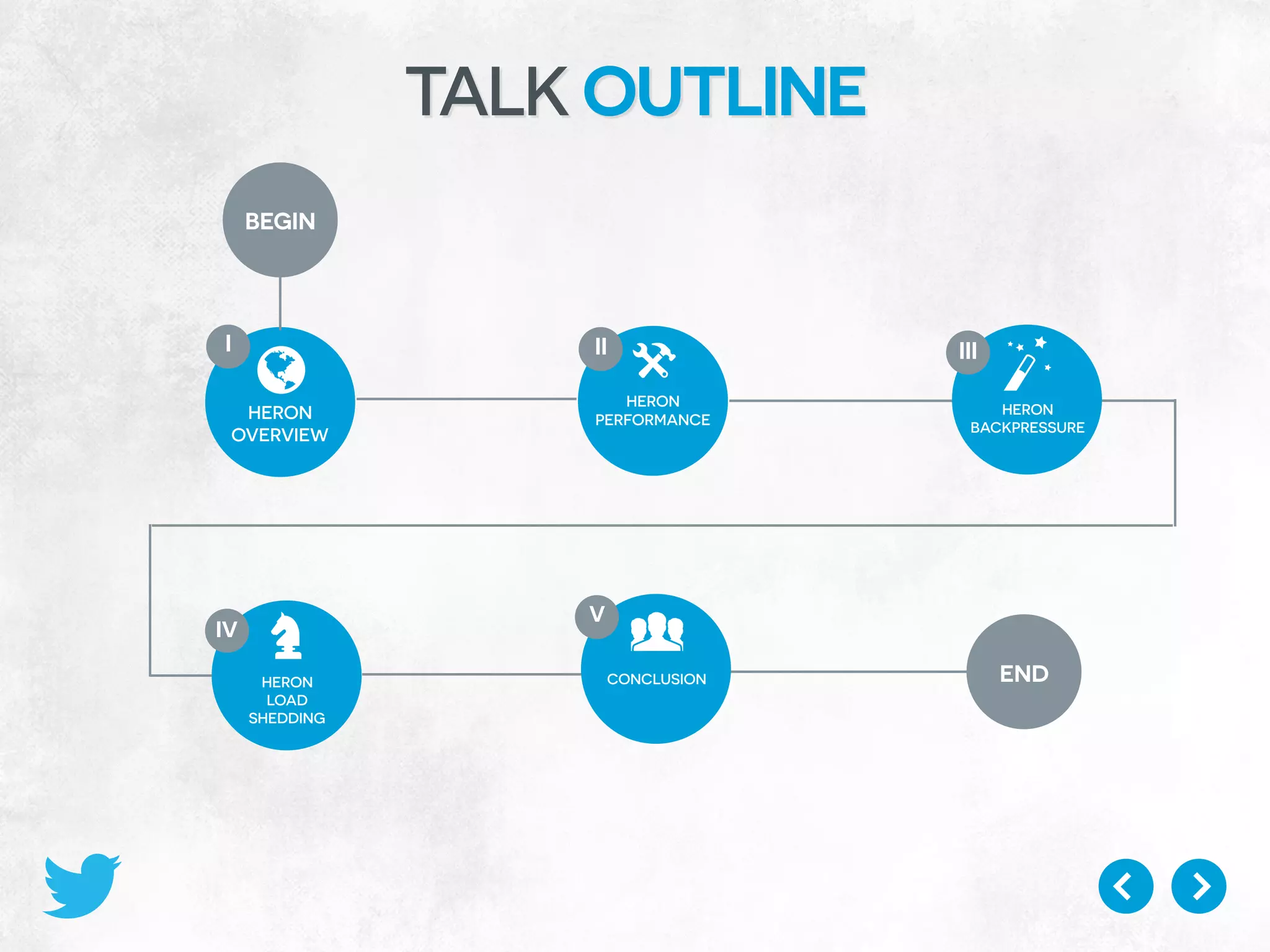
HERON
OVERVIEW
!
I
HERON
PERFORMANCE
(II
CONCLUSION
K
V
HERON
LOAD
SHEDDING
ZIV
TALK OUTLINE
HERON
BACKPRESSURE
bIII
HERON
OVERVIEW
b
STORM/HERON TERMINOLOGY
TOPOLOGY
Directed acyclic graph
Vertices=computation, and edges=streams of data tuples
SPOUTS
Sources of data tuples for the topology
Examples - Kafka/Kestrel/MySQL/Postgres
BOLTS
Process incoming tuples and emit outgoing tuples
Examples - filtering/aggregation/join/arbitrary function
,
%
STORM/HERON TOPOLOGY
%
%
%
%
%
SPOUT 1
SPOUT 2
BOLT 1
BOLT 2
BOLT 3
BOLT 4
BOLT 5
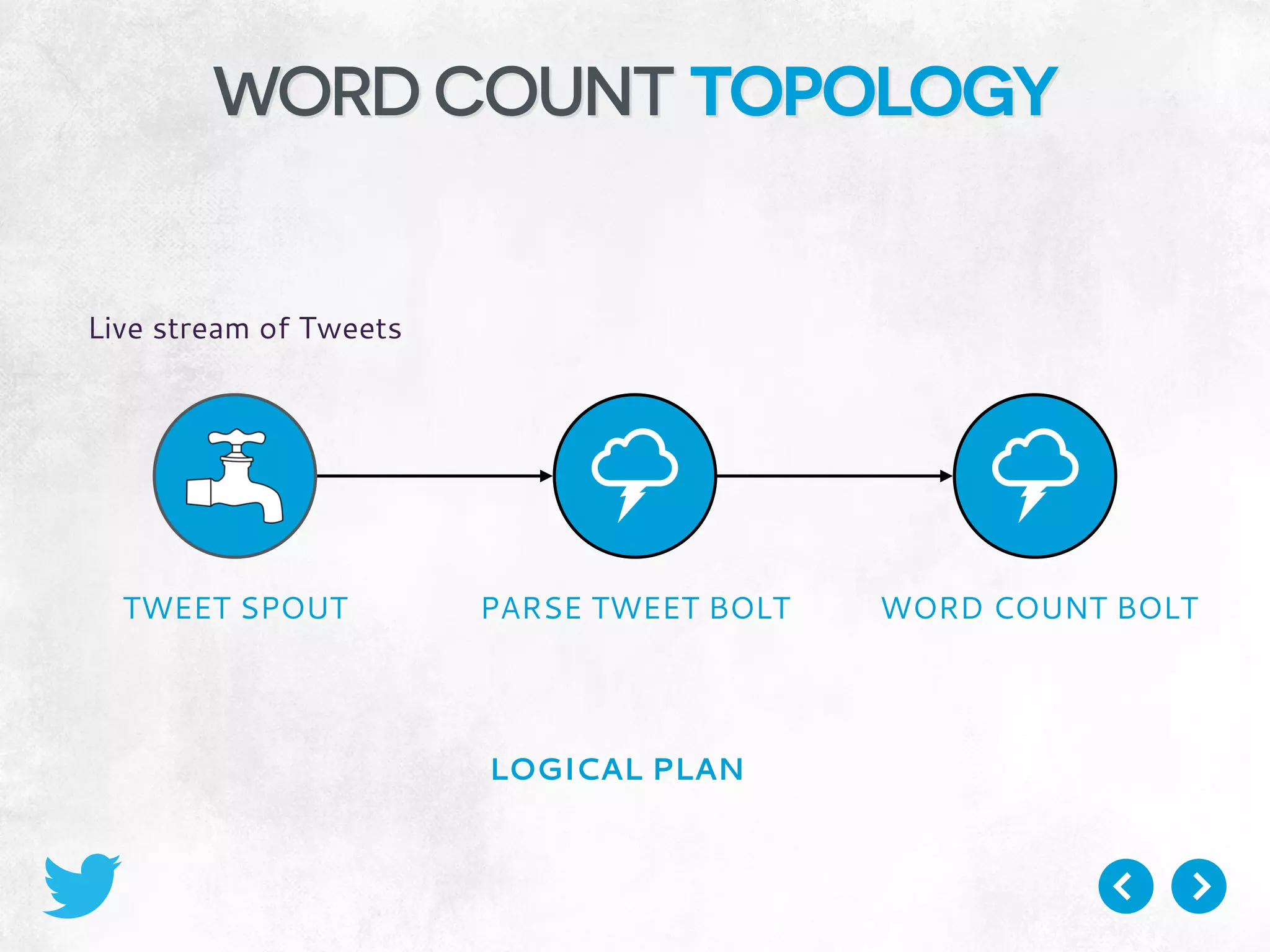
WORD COUNT TOPOLOGY
% %
TWEET SPOUT PARSE TWEET BOLT WORD COUNT BOLT
Live stream of Tweets
LOGICAL PLAN
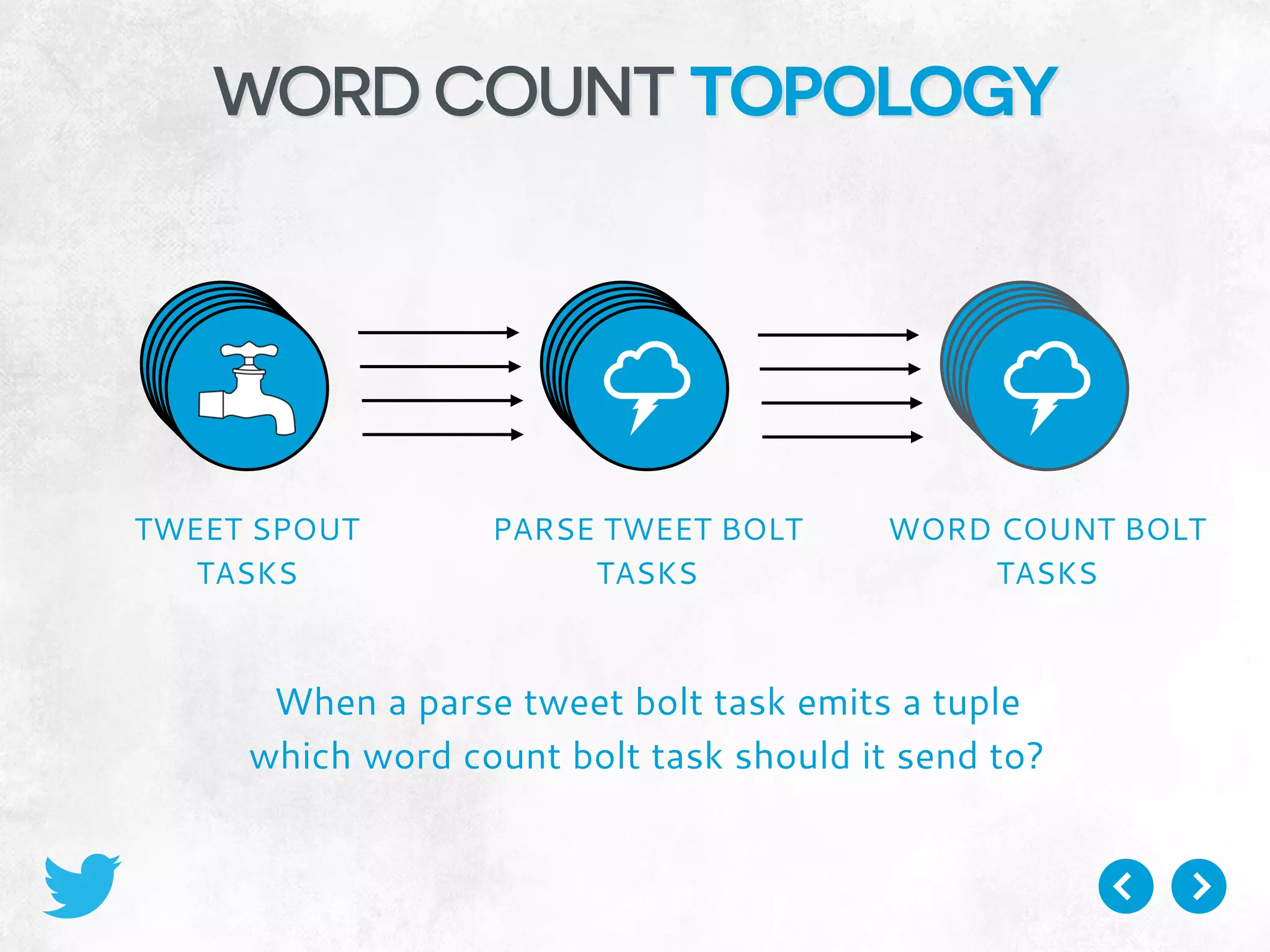
WORD COUNT TOPOLOGY
% %
TWEET SPOUT
TASKS
PARSE TWEET BOLT
TASKS
WORD COUNT BOLT
TASKS
%%%% %%%%
When a parse tweet bolt task emits a tuple
which word count bolt task should it send to?
STREAM GROUPINGS
Random distribution
of tuples
Group tuples by a
field or multiple
fields
Replicates tuples to
all tasks
SHUFFLE GROUPING FIELDS GROUPING ALL GROUPING
Sends the entire
stream to one task
GLOBAL GROUPING
/ - ,.
WORD COUNT TOPOLOGY
% %
TWEET SPOUT
TASKS
PARSE TWEET BOLT
TASKS
WORD COUNT BOLT
TASKS
%%%% %%%%
SHUFFLE GROUPING FIELDS GROUPING
WHY HERON?
PERFORMANCE PREDICTABILITY
EASE OF MANAGEABILITY
!
d
" IMPROVE DEVELOPER PRODUCTIVITY
HERON DESIGN DECISIONS
FULLY API COMPATIBLE WITH STORM
Directed acyclic graph
Topologies, spouts and bolts
USE OF MAIN STREAM LANGUAGES
C++/JAVA/Python
!
d
"
TASK ISOLATION
Ease of debug ability/resource isolation/profiling
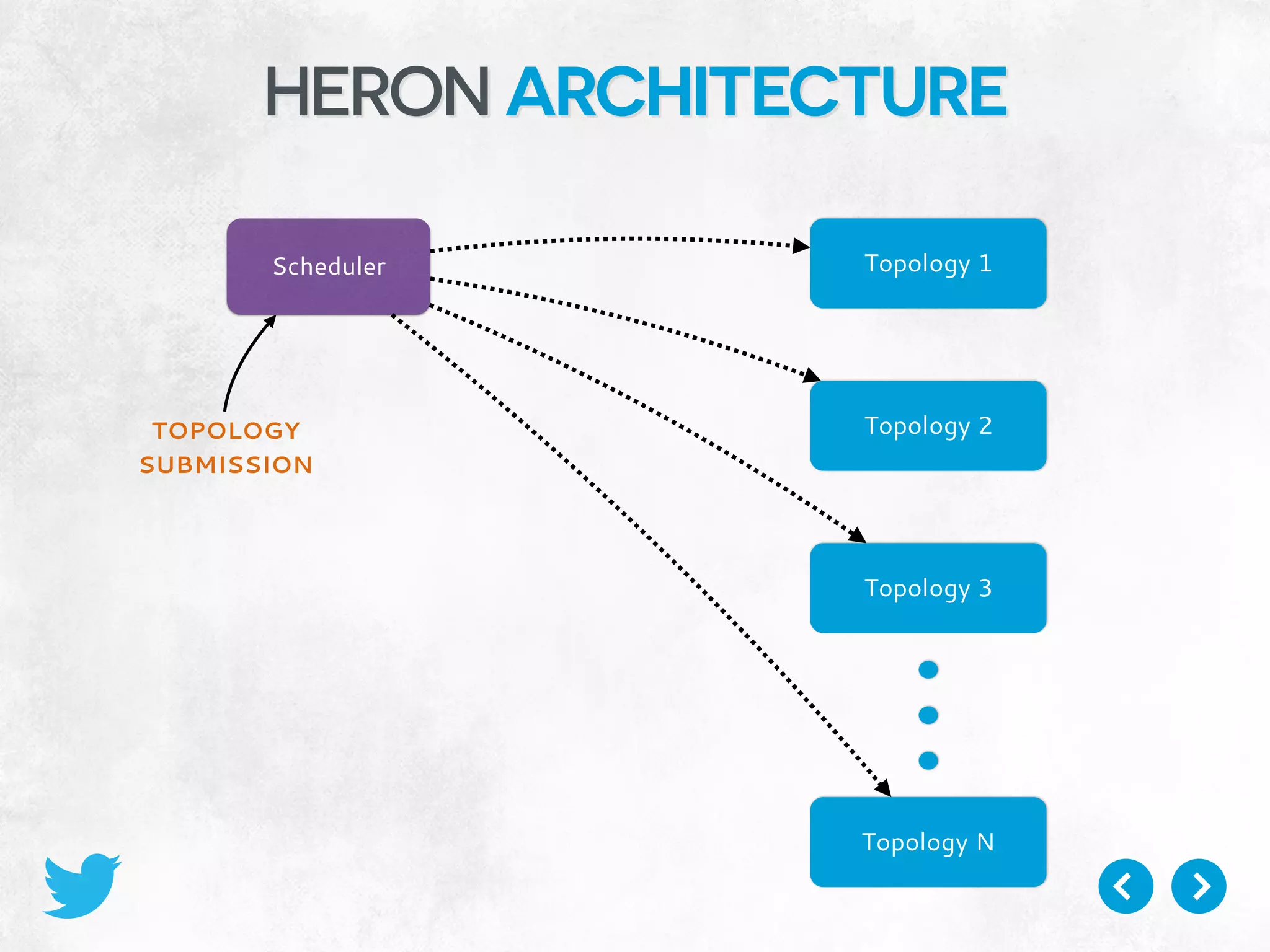
HERON ARCHITECTURE
Topology 1
TOPOLOGY
SUBMISSION
Scheduler
Topology 2
Topology 3
Topology N
TOPOLOGY ARCHITECTURE
Topology
Master
ZK
CLUSTER
Stream
Manager
I1 I2 I3 I4
Stream
Manager
I1 I2 I3 I4
Logical Plan,
Physical Plan and
Execution State
Sync Physical Plan
CONTAINER CONTAINER
Metrics
Manager
Metrics
Manager
HERON SAMPLE TOPOLOGIES
Large amount of data
produced every day
Large cluster Several hundred
topologies deployed
Several billion
messages every day
HERON @TWITTER
1 stage 10 stages
3x reduction in cores and memory
Heron has been in production for 2 years
HERON USE CASES
REALTIME
ETL
REAL TIME
BI
SPAM
DETECTION
REAL TIME
TRENDS
REALTIME
ML
REAL TIME
MEDIA
REAL TIME
OPS
COMPONENTIZING
HERON
x
9
HETEROGENOUS ECOSYSTEM
Unmanaged Schedulers
Managed Schedulers State Managers
Job Uploaders
LOOKING BACK- MICROKERNELS
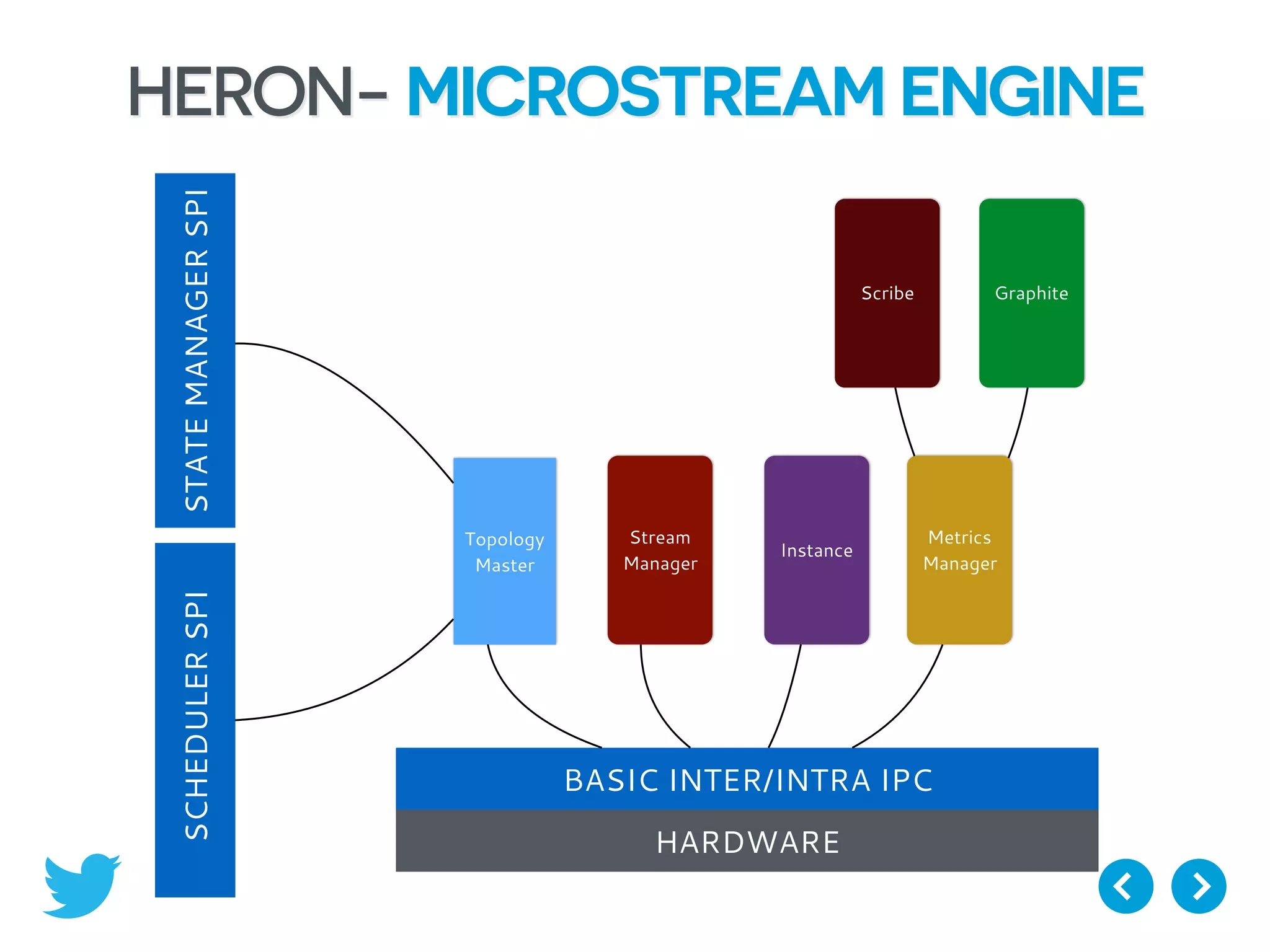
HERON- MICROSTREAM ENGINE
HARDWARE
BASIC INTER/INTRA IPC
Topology
Master
Stream
Manager
Instance
Metrics
Manager
Scribe Graphite
SCHEDULERSPISTATEMANAGERSPI
HERON - MICROSTREAM ENGINE
PLUG AND PLAY COMPONENTS
As environment changes, core does not change
MULTI LANGUAGE INSTANCES
Support multiple language API with native instances
MULTIPLE PROCESSING SEMANTICS
Efficient stream managers for each semantics
EASE OF DEVELOPMENT
Faster development of components with little dependency
!
!
!
!
HERON ENVIRONMENT
Local Scheduler
Local State Manager
Local Uploader
Aurora/Scheduler
Zookeeper State Manager
Packer Uploader
Mesos/Aurora Scheduler
Zookeeper State Manager
HDFS Uploader
Laptop/Server Cluster/ProductionCluster/Testing
HERON
RESOURCE
USAGE
x
9
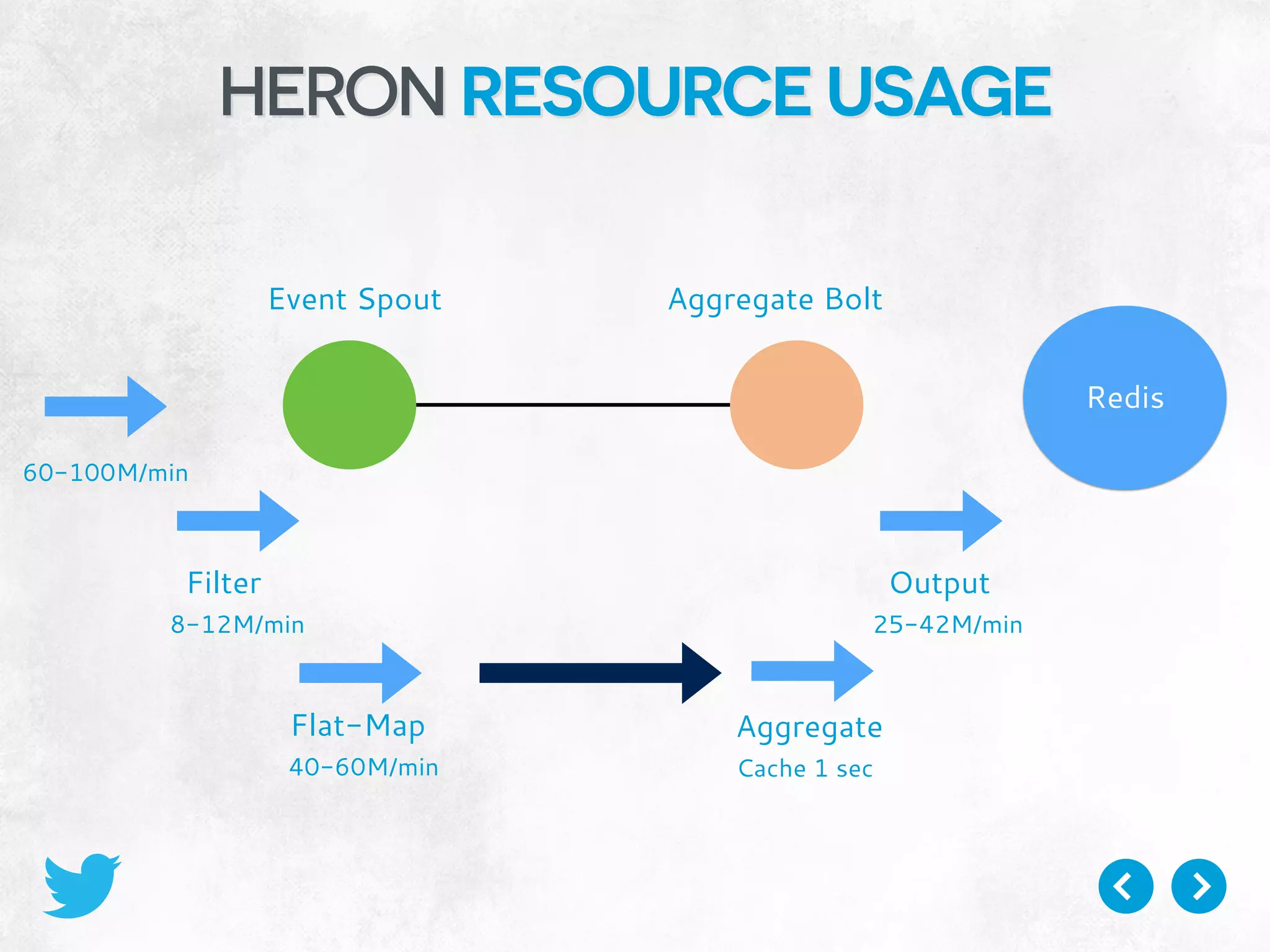
HERON RESOURCE USAGE
Event Spout Aggregate Bolt
60-100M/min
Filter
8-12M/min
Flat-Map
40-60M/min
Aggregate
Cache 1 sec
Output
25-42M/min
Redis
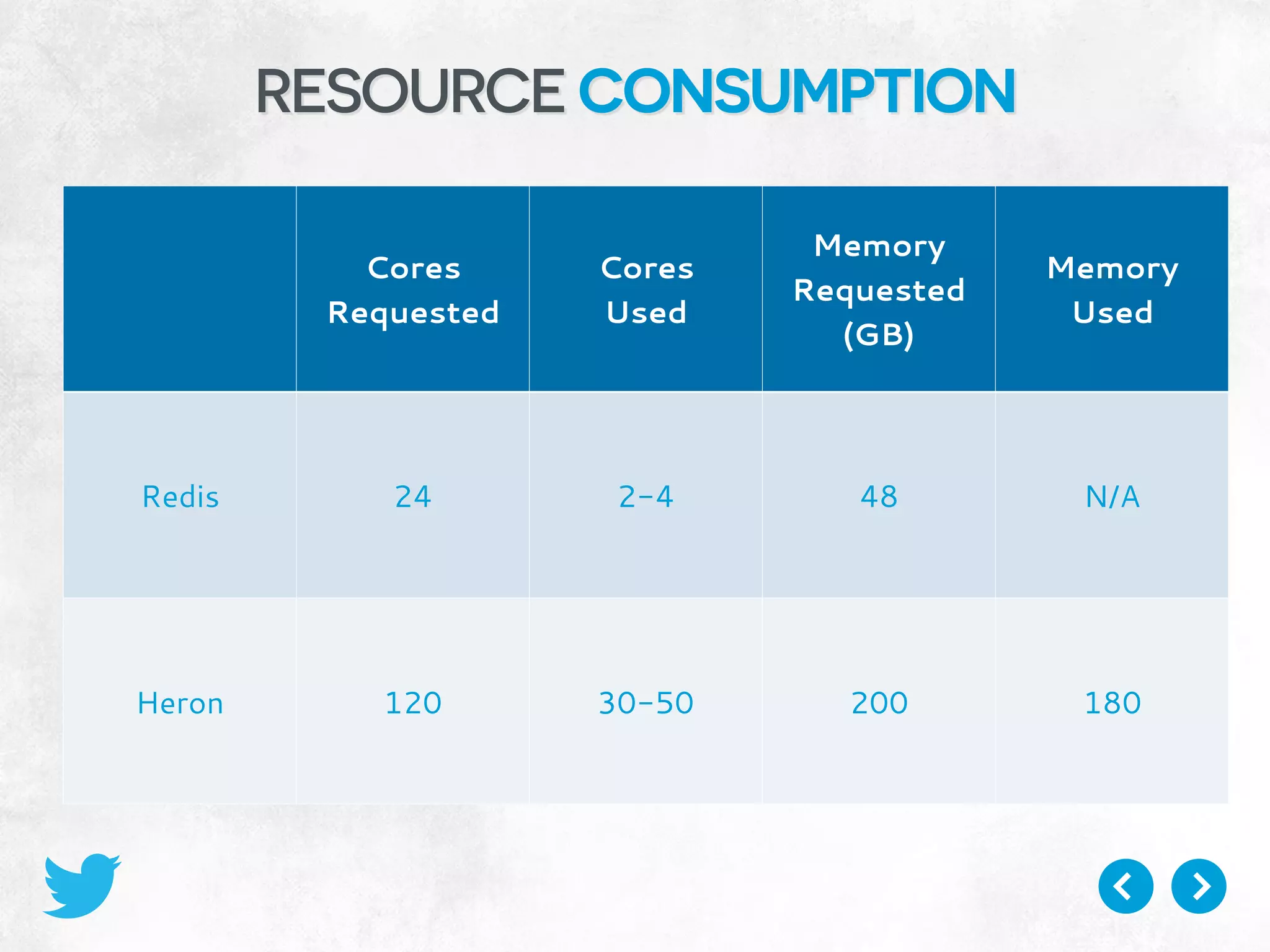
RESOURCE CONSUMPTION
Cores
Requested
Cores
Used
Memory
Requested
(GB)
Memory
Used
Redis 24 2-4 48 N/A
Heron 120 30-50 200 180
RESOURCE CONSUMPTION
7%
9%
84%
Spout Instances Bolt Instances Heron Overhead
PROFILING SPOUTS
2%7%
16%
6%
6%
63%
Deserialize Parse/Filter Mapping Kafka Iterator Kafka Fetch Rest
PROFILING BOLTS
2%4%
5%
2%
19%
68%
Write Data Serialize Deserialize Aggregation Data Transport Rest
RESOURCE CONSUMPTION - BREAKDOWN
8%
11%
21%
61%
Fetching Data User Logic Heron Usage Writing Data
HERON BACK
PRESSURE
x
9
STRAGGLERS
BAD HOST EXECUTION
SKEW
INADEQUATE
PROVISIONING
b  Ñ
Stragglers are the norm in a multi-tenant distributed systems
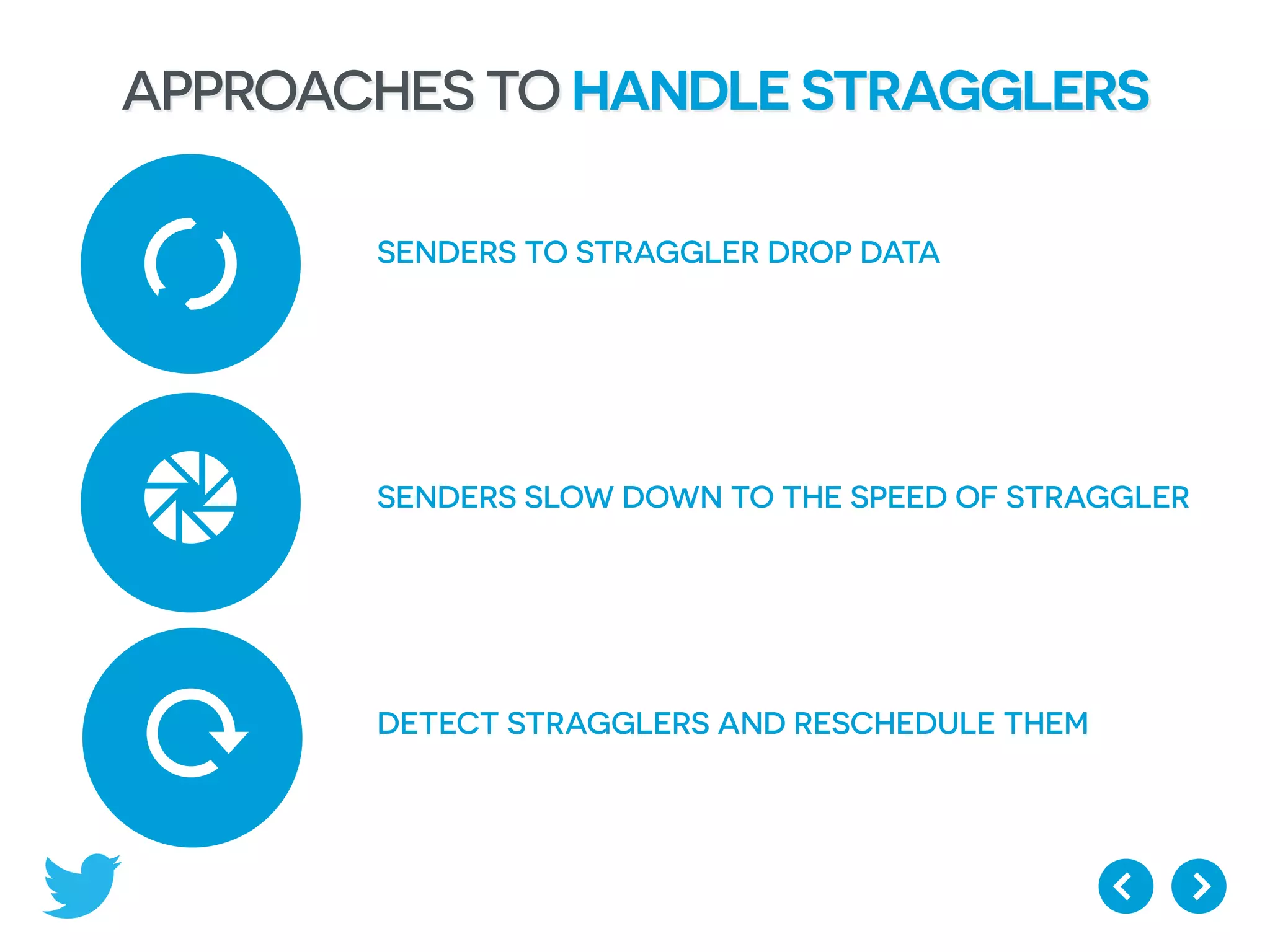
APPROACHES TO HANDLE STRAGGLERS
SENDERS TO STRAGGLER DROP DATA
DETECT STRAGGLERS AND RESCHEDULE THEM
!
d
" SENDERS SLOW DOWN TO THE SPEED OF STRAGGLER
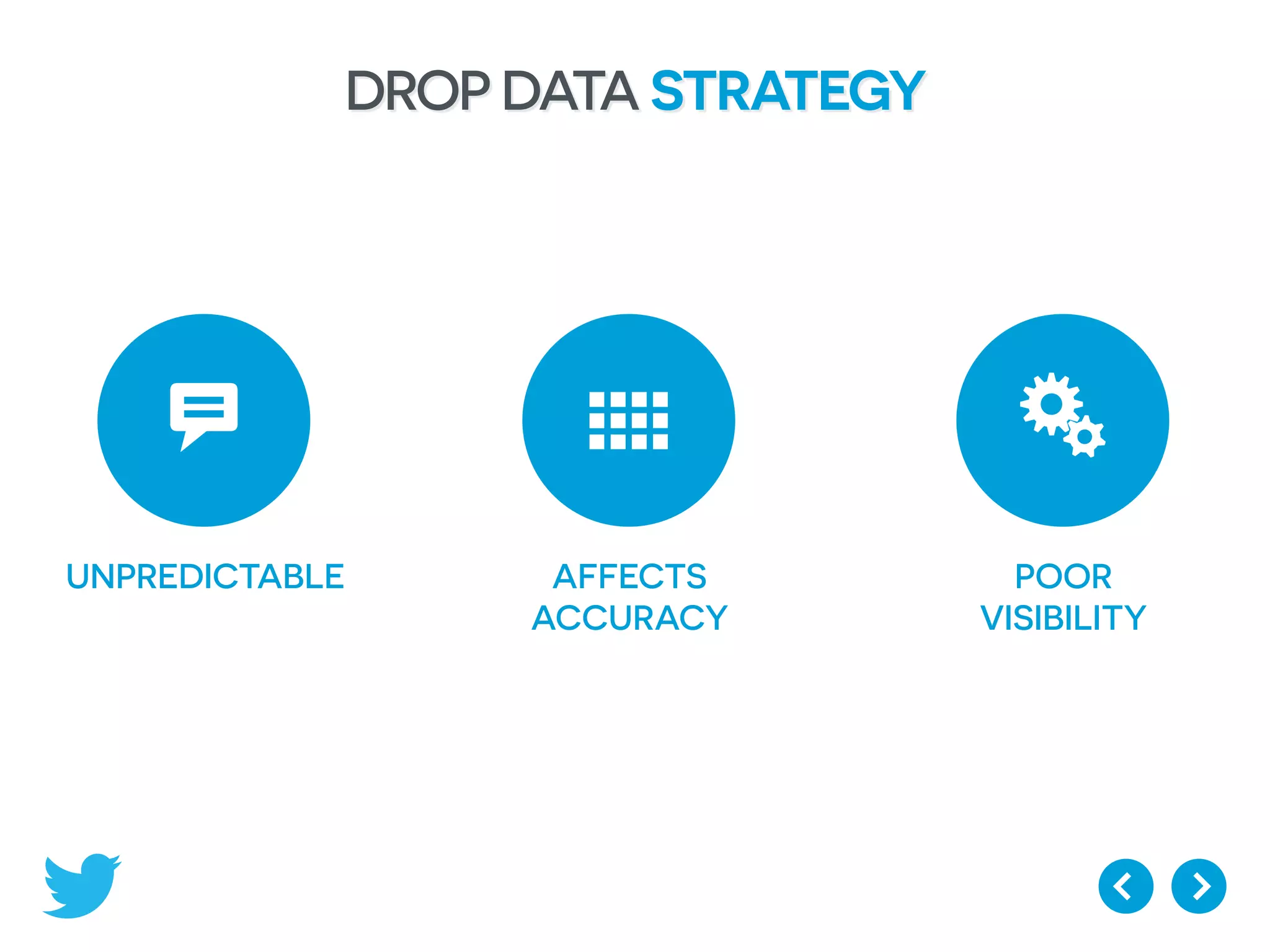
DROP DATA STRATEGY
UNPREDICTABLE AFFECTS
ACCURACY
POOR
VISIBILITY
b  Ñ
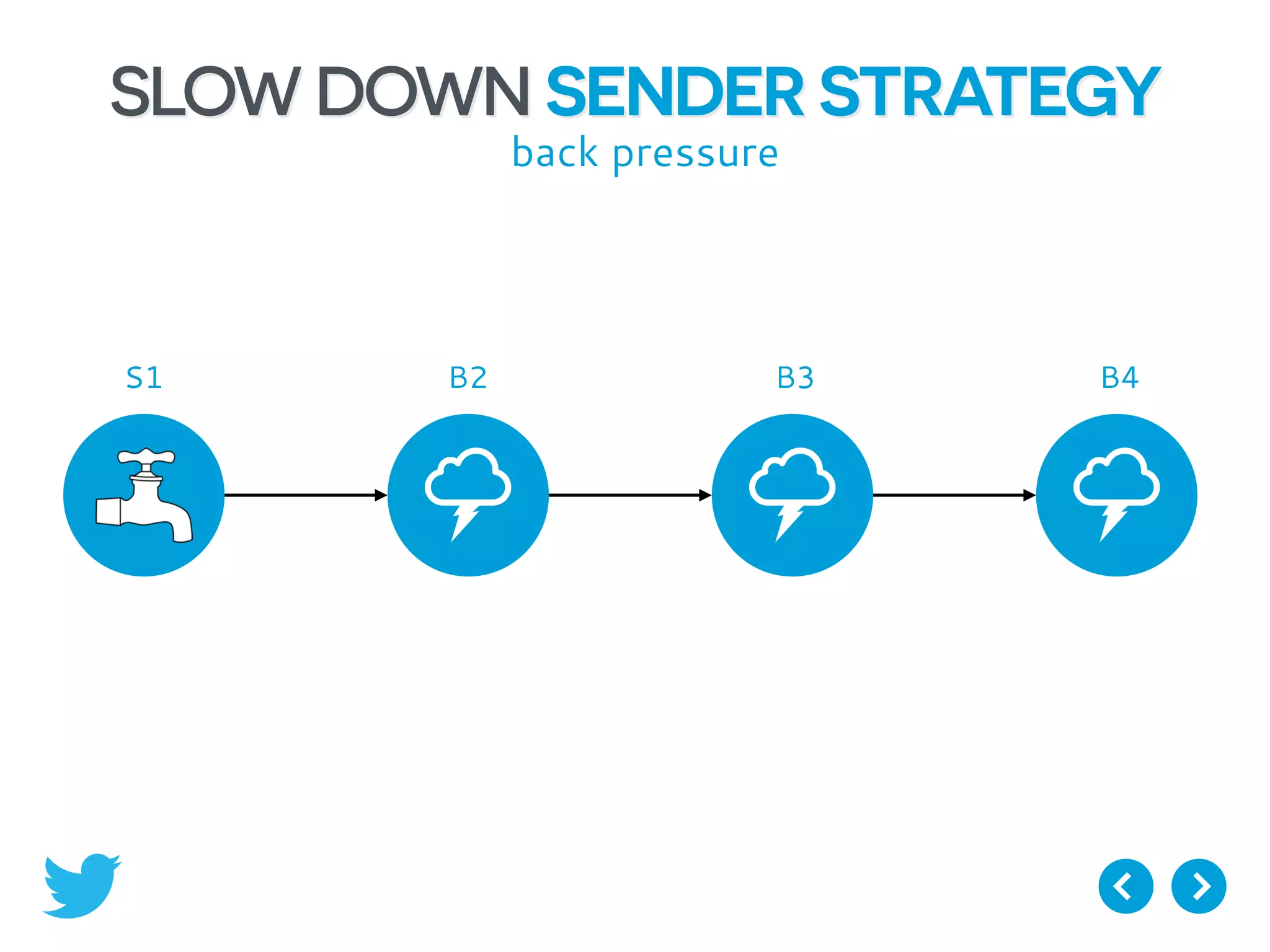
SLOW DOWN SENDER STRATEGY
PROVIDES
PREDICTABILITY
PROCESSES
DATA AT
MAXIMUM
RATE
REDUCE
RECOVERY
TIMES
HANDLES
TEMPORARY
SPIKES
/b  Ñ
back pressure
SLOW DOWN SENDER STRATEGY
% %
S1 B2 B3
%
B4
back pressure
S1 B2
B3
SLOW DOWN SENDERS STRATEGY
Stream
Manager
Stream
Manager
Stream
Manager
Stream
Manager
S1 B2
B3 B4
S1 B2
B3
S1 B2
B3 B4
B4
S1 S1
S1S1
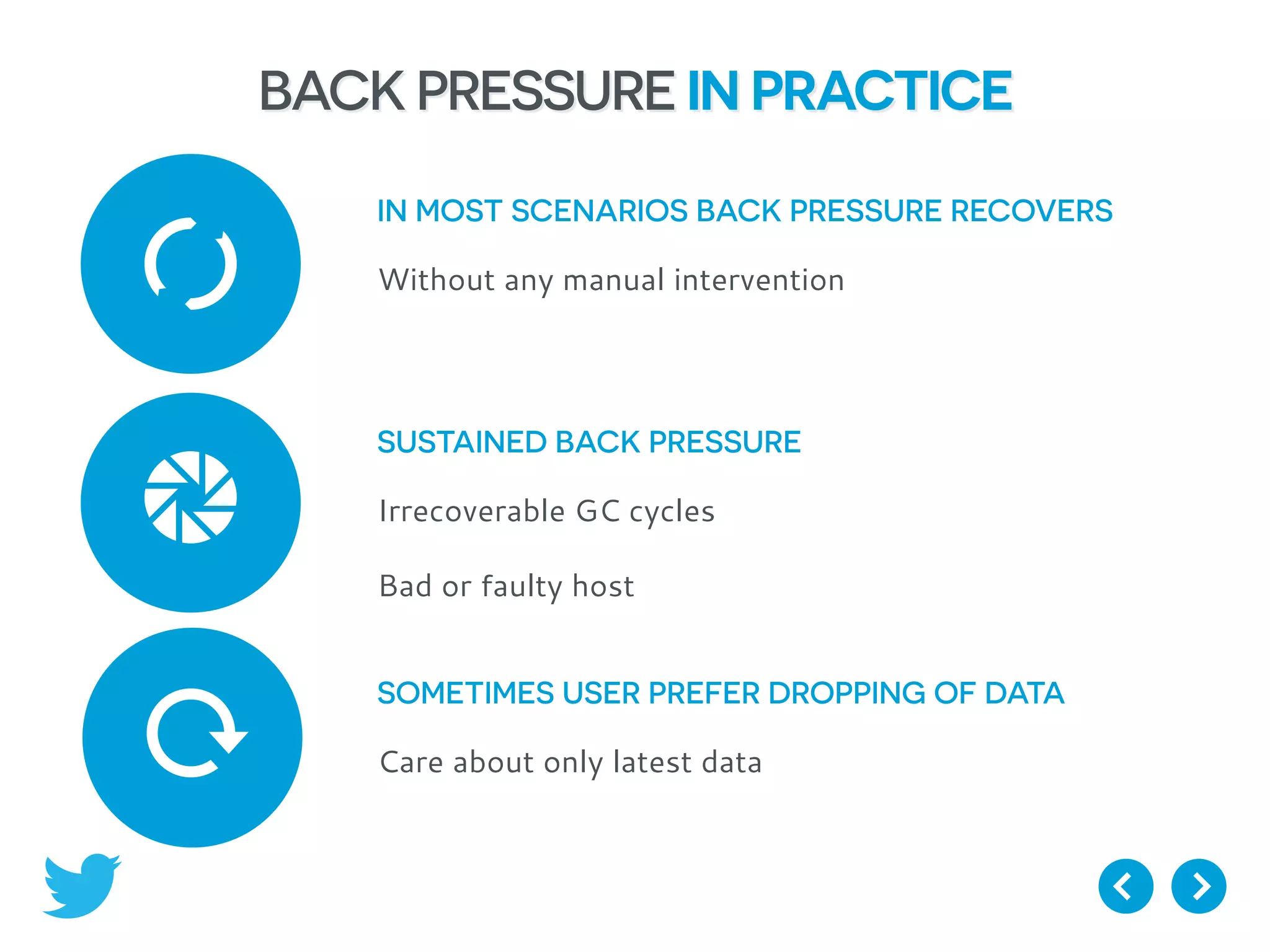
BACK PRESSURE IN PRACTICE
Read pointer Write pointer
Manually restart the container
BACK PRESSURE IN PRACTICE
IN MOST SCENARIOS BACK PRESSURE RECOVERS
Without any manual intervention
SOMETIMES USER PREFER DROPPING OF DATA
Care about only latest data
!
d
"
SUSTAINED BACK PRESSURE
Irrecoverable GC cycles
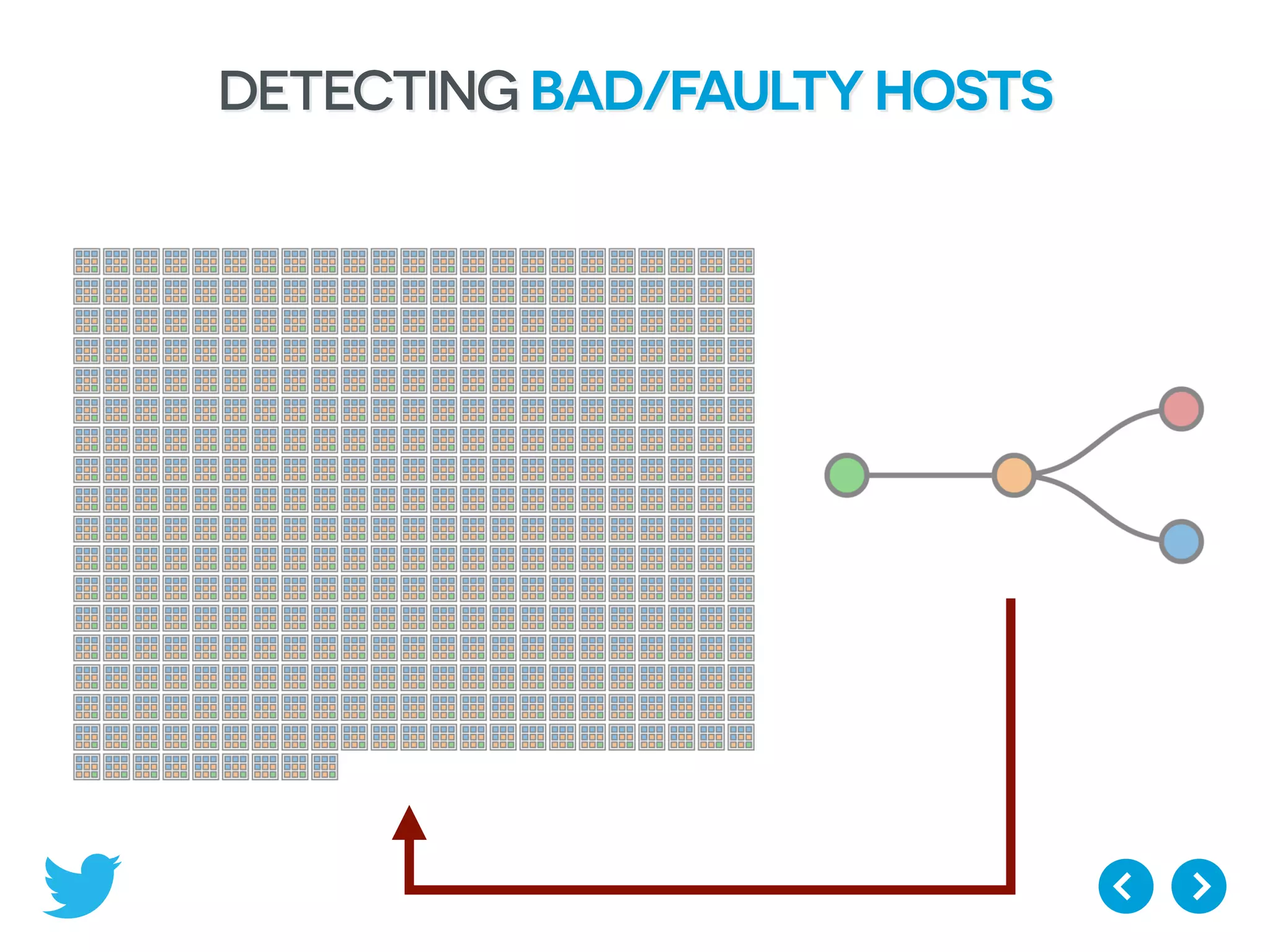
Bad or faulty host
DETECTING BAD/FAULTY HOSTS
HERON LOAD
SHEDDING
x
9
LOAD SHEDDING
SAMPLING BASED APPROACHES
Down sample the incoming stream and scale up the results
Easy to reason if the sampling is uniform
Hard to achieve uniformity across distributed spouts
!
"
DROP BASED APPROACHES
Simply drop older data
Spouts takes a lag threshold and a lag adjustment value
Works well in practice
CURIOUS TO LEARN MORE…
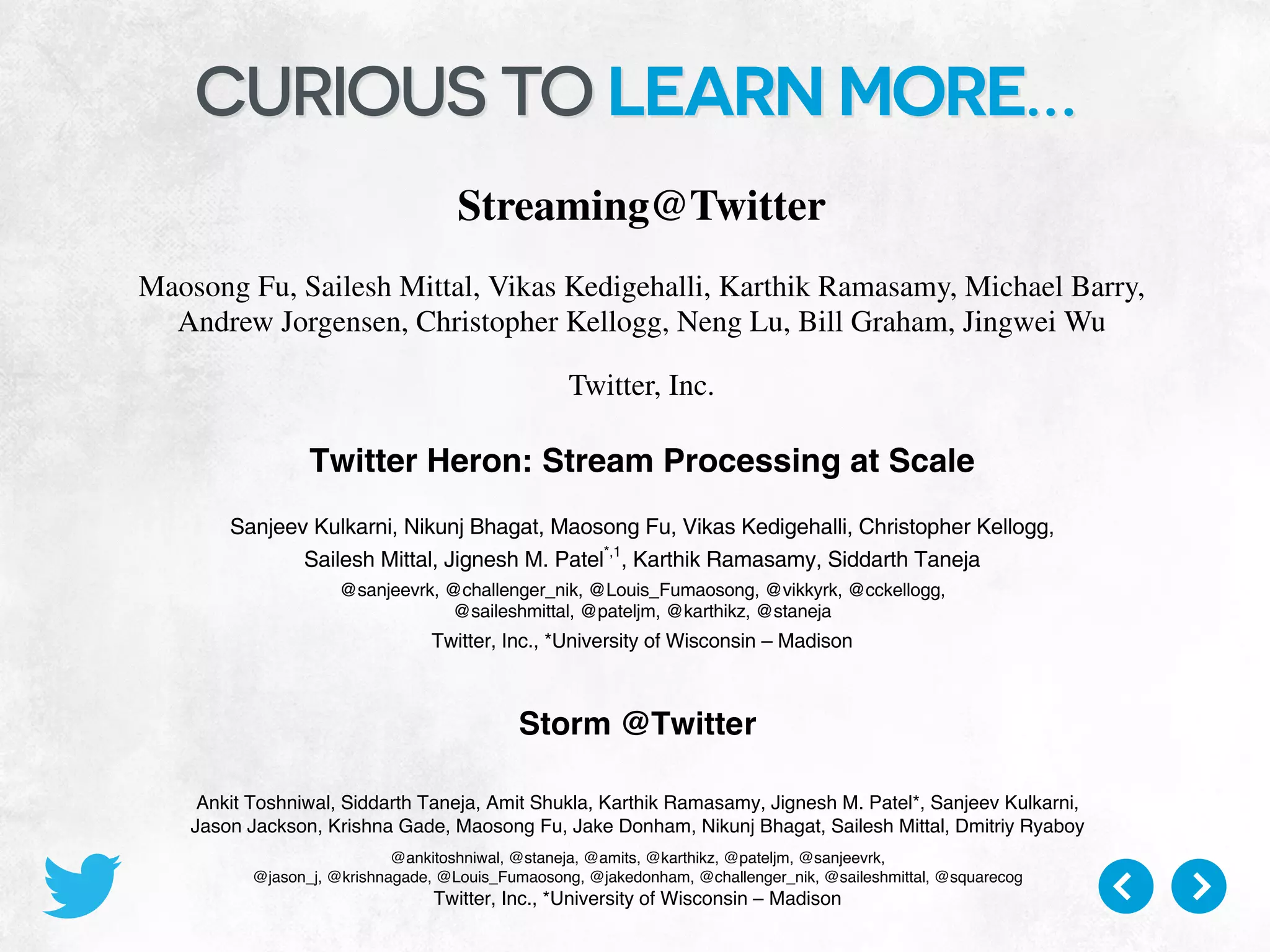
Twitter Heron: Stream Processing at Scale
Sanjeev Kulkarni, Nikunj Bhagat, Maosong Fu, Vikas Kedigehalli, Christopher Kellogg,
Sailesh Mittal, Jignesh M. Patel*,1
, Karthik Ramasamy, Siddarth Taneja
@sanjeevrk, @challenger_nik, @Louis_Fumaosong, @vikkyrk, @cckellogg,
@saileshmittal, @pateljm, @karthikz, @staneja
Twitter, Inc., *University of Wisconsin – Madison
ABSTRACT
Storm has long served as the main platform for real-time analytics
at Twitter. However, as the scale of data being processed in real-
time at Twitter has increased, along with an increase in the
diversity and the number of use cases, many limitations of Storm
have become apparent. We need a system that scales better, has
better debug-ability, has better performance, and is easier to
manage – all while working in a shared cluster infrastructure. We
considered various alternatives to meet these needs, and in the end
concluded that we needed to build a new real-time stream data
processing system. This paper presents the design and
implementation of this new system, called Heron. Heron is now
system process, which makes debugging very challenging. Thus, we
needed a cleaner mapping from the logical units of computation to
each physical process. The importance of such clean mapping for
debug-ability is really crucial when responding to pager alerts for a
failing topology, especially if it is a topology that is critical to the
underlying business model.
In addition, Storm needs dedicated cluster resources, which requires
special hardware allocation to run Storm topologies. This approach
leads to inefficiencies in using precious cluster resources, and also
limits the ability to scale on demand. We needed the ability to work
in a more flexible way with popular cluster scheduling software that
allows sharing the cluster resources across different types of data
Storm @Twitter
Ankit Toshniwal, Siddarth Taneja, Amit Shukla, Karthik Ramasamy, Jignesh M. Patel*, Sanjeev Kulkarni,
Jason Jackson, Krishna Gade, Maosong Fu, Jake Donham, Nikunj Bhagat, Sailesh Mittal, Dmitriy Ryaboy
@ankitoshniwal, @staneja, @amits, @karthikz, @pateljm, @sanjeevrk,
@jason_j, @krishnagade, @Louis_Fumaosong, @jakedonham, @challenger_nik, @saileshmittal, @squarecog
Twitter, Inc., *University of Wisconsin – Madison
Streaming@Twitter
Maosong Fu, Sailesh Mittal, Vikas Kedigehalli, Karthik Ramasamy, Michael Barry,
Andrew Jorgensen, Christopher Kellogg, Neng Lu, Bill Graham, Jingwei Wu
Twitter, Inc.
Abstract
Twitter generates tens of billions of events per hour when users interact with it. Analyzing these
events to surface relevant content and to derive insights in real time is a challenge. To address this, we
developed Heron, a new real time distributed streaming engine. In this paper, we first describe the design
goals of Heron and show how the Heron architecture achieves task isolation and resource reservation
to ease debugging, troubleshooting, and seamless use of shared cluster infrastructure with other critical
Twitter services. We subsequently explore how a topology self adjusts using back pressure so that the
pace of the topology goes as its slowest component. Finally, we outline how Heron implements at most
once and at least once semantics and we describe a few operational stories based on running Heron in
production.
1 Introduction
INTERESTED IN HERON?
CONTRIBUTIONS ARE WELCOME!
https://github.com/twitter/heron
http://heronstreaming.io
HERON IS OPEN SOURCED
FOLLOW US @HERONSTREAMING
"
#ThankYou
FOR LISTENING
QUESTIONS
and
ANSWERS
R
# Go ahead. Ask away.
Heron Hands On
NENG LU, PANKAJ GUPTA
MARK LI, ZUYU ZHANG
TAISHI NOJIMA
#TwitterHeron
BEGIN
END
INSTALL
HERON
!
I
LAUNCH
TOPOLOGIES
(II
CONCLUSI
ON
K
V
HERON
STARTER
ZIV
AGENDA OUTLINE
EXPLORE UI
bIII
INSTALL
HERON
x
9
HERON PREREQS
JAVA 7 OR ABOVE
PYTHON 2.7
LINUX PLATFORMS: INSTALL LIBUNWIND
INSTALL HERON CLIENT
STEP 1: DOWNLOAD CLIENT BINARIES
https://github.com/twitter/heron/releases/tag/0.14.1
heron-client-install-0.14.1-<platform>.sh
STEP 2: INSTALL CLIENT BINARIES
chmod +x heron-client-install-0.14.1-<platform>.sh
./heron-client-install-0.14.1-<platform>.sh —user
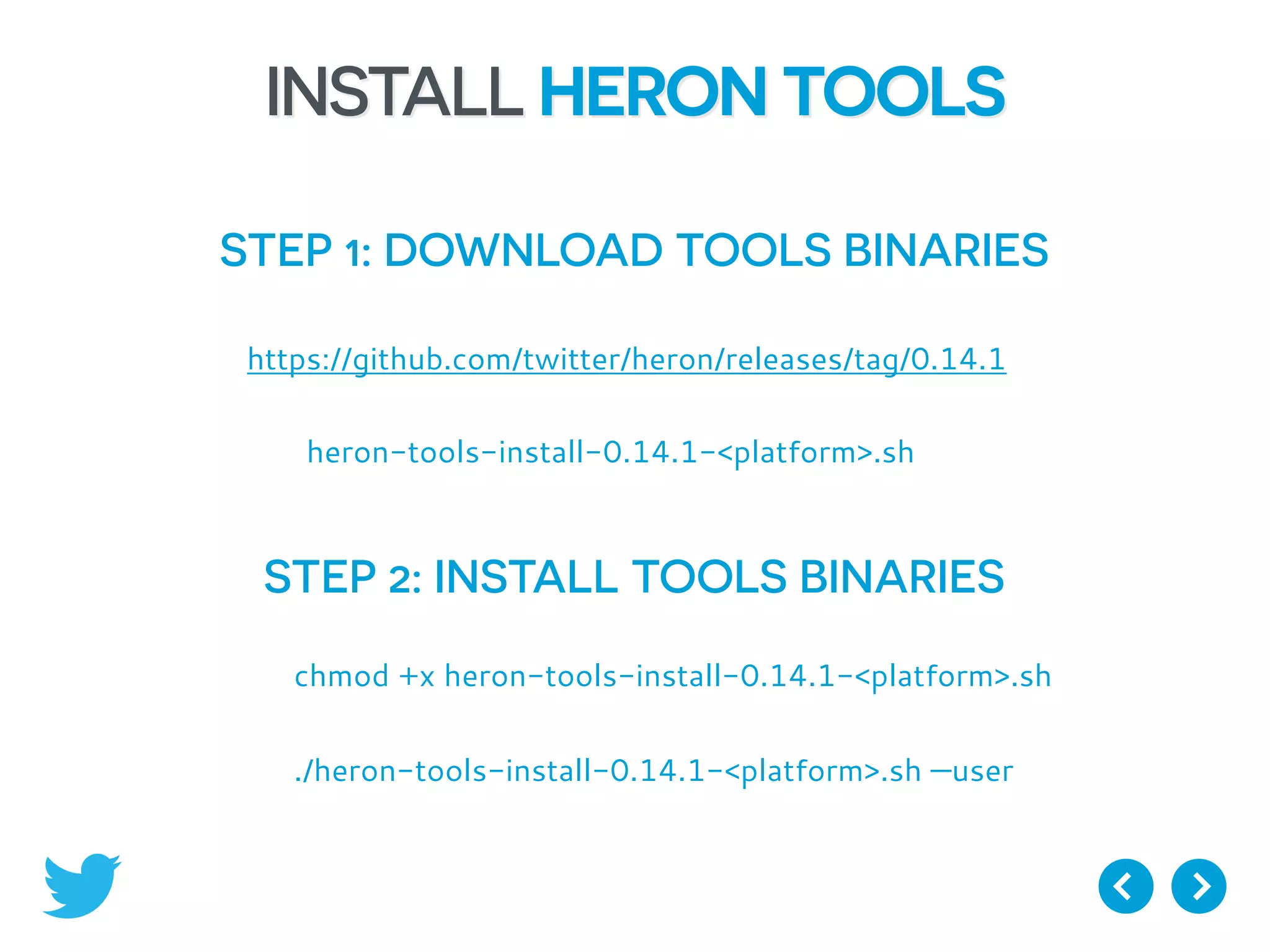
INSTALL HERON TOOLS
STEP 1: DOWNLOAD TOOLS BINARIES
https://github.com/twitter/heron/releases/tag/0.14.1
heron-tools-install-0.14.1-<platform>.sh
STEP 2: INSTALL TOOLS BINARIES
chmod +x heron-tools-install-0.14.1-<platform>.sh
./heron-tools-install-0.14.1-<platform>.sh —user
LAUNCH HERON TOOLS
STEP 1: LAUNCH HERON TRACKER
heron-tracker
STEP 2: LAUNCH HERON UI
heron-ui
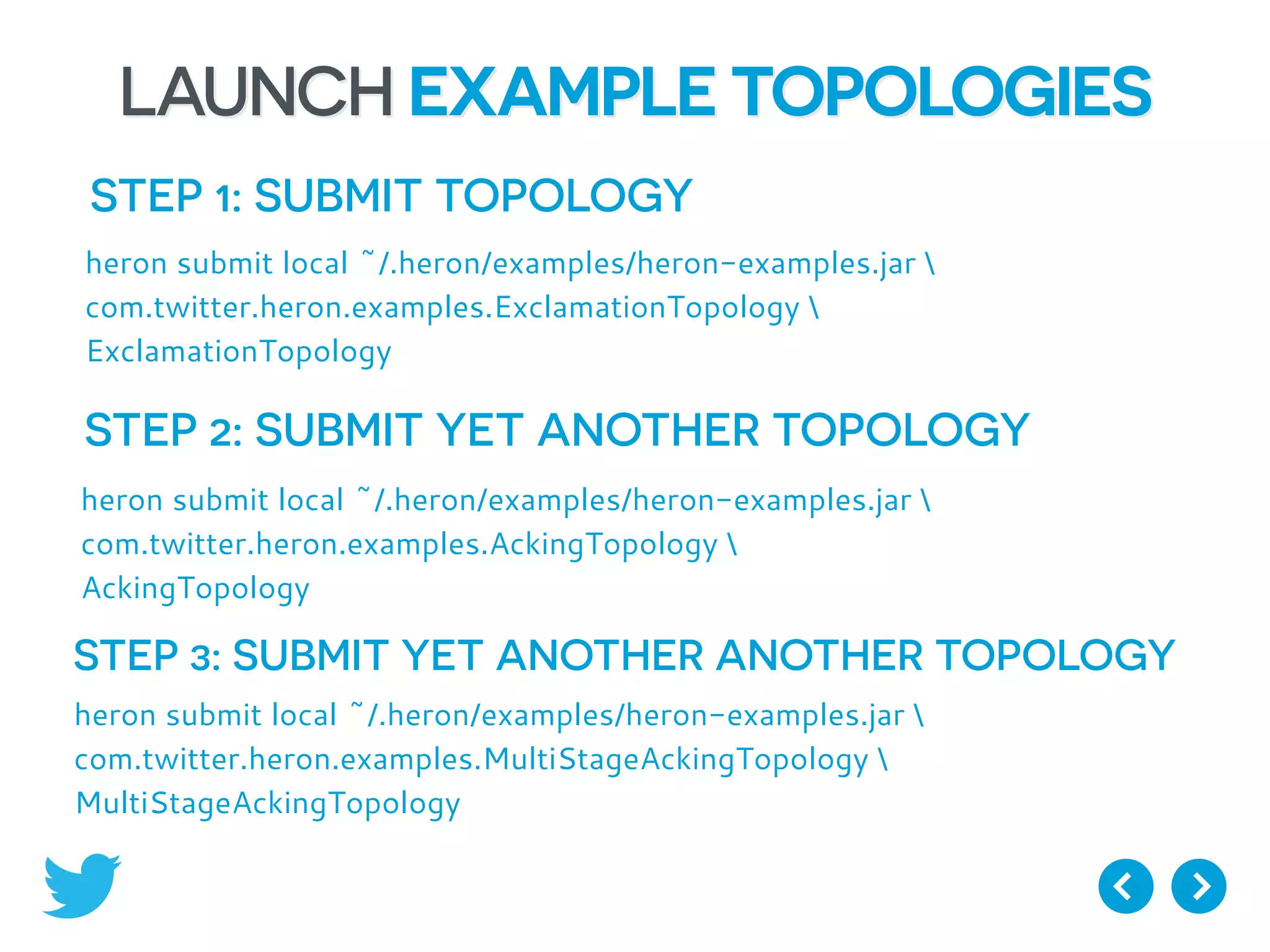
LAUNCH EXAMPLE TOPOLOGIES
STEP 1: SUBMIT TOPOLOGY
heron submit local ~/.heron/examples/heron-examples.jar 
com.twitter.heron.examples.ExclamationTopology 
ExclamationTopology
STEP 2: SUBMIT YET ANOTHER TOPOLOGY
heron submit local ~/.heron/examples/heron-examples.jar 
com.twitter.heron.examples.AckingTopology 
AckingTopology
STEP 3: SUBMIT YET ANOTHER ANOTHER TOPOLOGY
heron submit local ~/.heron/examples/heron-examples.jar 
com.twitter.heron.examples.MultiStageAckingTopology 
MultiStageAckingTopology
EXPLORE UI
STEP 1: LOGICAL PLAN AND PHYSICAL PLAN
STEP 2: EXPLORE DASHBOARD
STEP 3: VIEW METRICS
EXPLORE UI
STEP 4: VIEW PROCESS LOGS
STEP 5: VIEW EXCEPTIONS
STEP 6: EXPLORE OTHER FEATURES
HERON STARTER
SEVERAL STARTER EXAMPLES
https://github.com/kramasamy/heron-starter
INTERESTING EXERCISES
Trending Twitter Words
Trending Twitter Hashtags
Find top retweeters for given hash tag
QUESTIONS IN HERON?
ANY QUESTIONS/CLARIFICATIONS?
https://groups.google.com/forum/#!forum/heron-users
http://heronstreaming.io
FOR UPDATES FOLLOW
@HERONSTREAMING
"
#ThankYou
FOR TRYING

Handson with Twitter Heron

  • 1.
  • 2.
  • 3.
  • 4.
    STORM/HERON TERMINOLOGY TOPOLOGY Directed acyclicgraph Vertices=computation, and edges=streams of data tuples SPOUTS Sources of data tuples for the topology Examples - Kafka/Kestrel/MySQL/Postgres BOLTS Process incoming tuples and emit outgoing tuples Examples - filtering/aggregation/join/arbitrary function , %
  • 5.
    STORM/HERON TOPOLOGY % % % % % SPOUT 1 SPOUT2 BOLT 1 BOLT 2 BOLT 3 BOLT 4 BOLT 5
  • 6.
    WORD COUNT TOPOLOGY %% TWEET SPOUT PARSE TWEET BOLT WORD COUNT BOLT Live stream of Tweets LOGICAL PLAN
  • 7.
    WORD COUNT TOPOLOGY %% TWEET SPOUT TASKS PARSE TWEET BOLT TASKS WORD COUNT BOLT TASKS %%%% %%%% When a parse tweet bolt task emits a tuple which word count bolt task should it send to?
  • 8.
    STREAM GROUPINGS Random distribution oftuples Group tuples by a field or multiple fields Replicates tuples to all tasks SHUFFLE GROUPING FIELDS GROUPING ALL GROUPING Sends the entire stream to one task GLOBAL GROUPING / - ,.
  • 9.
    WORD COUNT TOPOLOGY %% TWEET SPOUT TASKS PARSE TWEET BOLT TASKS WORD COUNT BOLT TASKS %%%% %%%% SHUFFLE GROUPING FIELDS GROUPING
  • 10.
    WHY HERON? PERFORMANCE PREDICTABILITY EASEOF MANAGEABILITY ! d " IMPROVE DEVELOPER PRODUCTIVITY
  • 11.
    HERON DESIGN DECISIONS FULLYAPI COMPATIBLE WITH STORM Directed acyclic graph Topologies, spouts and bolts USE OF MAIN STREAM LANGUAGES C++/JAVA/Python ! d " TASK ISOLATION Ease of debug ability/resource isolation/profiling
  • 12.
  • 13.
    TOPOLOGY ARCHITECTURE Topology Master ZK CLUSTER Stream Manager I1 I2I3 I4 Stream Manager I1 I2 I3 I4 Logical Plan, Physical Plan and Execution State Sync Physical Plan CONTAINER CONTAINER Metrics Manager Metrics Manager
  • 14.
  • 15.
    Large amount ofdata produced every day Large cluster Several hundred topologies deployed Several billion messages every day HERON @TWITTER 1 stage 10 stages 3x reduction in cores and memory Heron has been in production for 2 years
  • 16.
    HERON USE CASES REALTIME ETL REALTIME BI SPAM DETECTION REAL TIME TRENDS REALTIME ML REAL TIME MEDIA REAL TIME OPS
  • 17.
  • 18.
    HETEROGENOUS ECOSYSTEM Unmanaged Schedulers ManagedSchedulers State Managers Job Uploaders
  • 19.
  • 20.
    HERON- MICROSTREAM ENGINE HARDWARE BASICINTER/INTRA IPC Topology Master Stream Manager Instance Metrics Manager Scribe Graphite SCHEDULERSPISTATEMANAGERSPI
  • 21.
    HERON - MICROSTREAMENGINE PLUG AND PLAY COMPONENTS As environment changes, core does not change MULTI LANGUAGE INSTANCES Support multiple language API with native instances MULTIPLE PROCESSING SEMANTICS Efficient stream managers for each semantics EASE OF DEVELOPMENT Faster development of components with little dependency ! ! ! !
  • 22.
    HERON ENVIRONMENT Local Scheduler LocalState Manager Local Uploader Aurora/Scheduler Zookeeper State Manager Packer Uploader Mesos/Aurora Scheduler Zookeeper State Manager HDFS Uploader Laptop/Server Cluster/ProductionCluster/Testing
  • 23.
  • 24.
    HERON RESOURCE USAGE EventSpout Aggregate Bolt 60-100M/min Filter 8-12M/min Flat-Map 40-60M/min Aggregate Cache 1 sec Output 25-42M/min Redis
  • 25.
  • 26.
  • 27.
    PROFILING SPOUTS 2%7% 16% 6% 6% 63% Deserialize Parse/FilterMapping Kafka Iterator Kafka Fetch Rest
  • 28.
    PROFILING BOLTS 2%4% 5% 2% 19% 68% Write DataSerialize Deserialize Aggregation Data Transport Rest
  • 29.
    RESOURCE CONSUMPTION -BREAKDOWN 8% 11% 21% 61% Fetching Data User Logic Heron Usage Writing Data
  • 30.
  • 31.
    STRAGGLERS BAD HOST EXECUTION SKEW INADEQUATE PROVISIONING b Ñ Stragglers are the norm in a multi-tenant distributed systems
  • 32.
    APPROACHES TO HANDLESTRAGGLERS SENDERS TO STRAGGLER DROP DATA DETECT STRAGGLERS AND RESCHEDULE THEM ! d " SENDERS SLOW DOWN TO THE SPEED OF STRAGGLER
  • 33.
    DROP DATA STRATEGY UNPREDICTABLEAFFECTS ACCURACY POOR VISIBILITY b Ñ
  • 34.
    SLOW DOWN SENDERSTRATEGY PROVIDES PREDICTABILITY PROCESSES DATA AT MAXIMUM RATE REDUCE RECOVERY TIMES HANDLES TEMPORARY SPIKES /b Ñ back pressure
  • 35.
    SLOW DOWN SENDERSTRATEGY % % S1 B2 B3 % B4 back pressure
  • 36.
    S1 B2 B3 SLOW DOWNSENDERS STRATEGY Stream Manager Stream Manager Stream Manager Stream Manager S1 B2 B3 B4 S1 B2 B3 S1 B2 B3 B4 B4 S1 S1 S1S1
  • 37.
    BACK PRESSURE INPRACTICE Read pointer Write pointer Manually restart the container
  • 38.
    BACK PRESSURE INPRACTICE IN MOST SCENARIOS BACK PRESSURE RECOVERS Without any manual intervention SOMETIMES USER PREFER DROPPING OF DATA Care about only latest data ! d " SUSTAINED BACK PRESSURE Irrecoverable GC cycles Bad or faulty host
  • 39.
  • 40.
  • 41.
    LOAD SHEDDING SAMPLING BASEDAPPROACHES Down sample the incoming stream and scale up the results Easy to reason if the sampling is uniform Hard to achieve uniformity across distributed spouts ! " DROP BASED APPROACHES Simply drop older data Spouts takes a lag threshold and a lag adjustment value Works well in practice
  • 42.
    CURIOUS TO LEARNMORE… Twitter Heron: Stream Processing at Scale Sanjeev Kulkarni, Nikunj Bhagat, Maosong Fu, Vikas Kedigehalli, Christopher Kellogg, Sailesh Mittal, Jignesh M. Patel*,1 , Karthik Ramasamy, Siddarth Taneja @sanjeevrk, @challenger_nik, @Louis_Fumaosong, @vikkyrk, @cckellogg, @saileshmittal, @pateljm, @karthikz, @staneja Twitter, Inc., *University of Wisconsin – Madison ABSTRACT Storm has long served as the main platform for real-time analytics at Twitter. However, as the scale of data being processed in real- time at Twitter has increased, along with an increase in the diversity and the number of use cases, many limitations of Storm have become apparent. We need a system that scales better, has better debug-ability, has better performance, and is easier to manage – all while working in a shared cluster infrastructure. We considered various alternatives to meet these needs, and in the end concluded that we needed to build a new real-time stream data processing system. This paper presents the design and implementation of this new system, called Heron. Heron is now system process, which makes debugging very challenging. Thus, we needed a cleaner mapping from the logical units of computation to each physical process. The importance of such clean mapping for debug-ability is really crucial when responding to pager alerts for a failing topology, especially if it is a topology that is critical to the underlying business model. In addition, Storm needs dedicated cluster resources, which requires special hardware allocation to run Storm topologies. This approach leads to inefficiencies in using precious cluster resources, and also limits the ability to scale on demand. We needed the ability to work in a more flexible way with popular cluster scheduling software that allows sharing the cluster resources across different types of data Storm @Twitter Ankit Toshniwal, Siddarth Taneja, Amit Shukla, Karthik Ramasamy, Jignesh M. Patel*, Sanjeev Kulkarni, Jason Jackson, Krishna Gade, Maosong Fu, Jake Donham, Nikunj Bhagat, Sailesh Mittal, Dmitriy Ryaboy @ankitoshniwal, @staneja, @amits, @karthikz, @pateljm, @sanjeevrk, @jason_j, @krishnagade, @Louis_Fumaosong, @jakedonham, @challenger_nik, @saileshmittal, @squarecog Twitter, Inc., *University of Wisconsin – Madison Streaming@Twitter Maosong Fu, Sailesh Mittal, Vikas Kedigehalli, Karthik Ramasamy, Michael Barry, Andrew Jorgensen, Christopher Kellogg, Neng Lu, Bill Graham, Jingwei Wu Twitter, Inc. Abstract Twitter generates tens of billions of events per hour when users interact with it. Analyzing these events to surface relevant content and to derive insights in real time is a challenge. To address this, we developed Heron, a new real time distributed streaming engine. In this paper, we first describe the design goals of Heron and show how the Heron architecture achieves task isolation and resource reservation to ease debugging, troubleshooting, and seamless use of shared cluster infrastructure with other critical Twitter services. We subsequently explore how a topology self adjusts using back pressure so that the pace of the topology goes as its slowest component. Finally, we outline how Heron implements at most once and at least once semantics and we describe a few operational stories based on running Heron in production. 1 Introduction
  • 43.
    INTERESTED IN HERON? CONTRIBUTIONSARE WELCOME! https://github.com/twitter/heron http://heronstreaming.io HERON IS OPEN SOURCED FOLLOW US @HERONSTREAMING
  • 44.
  • 45.
  • 46.
    Heron Hands On NENGLU, PANKAJ GUPTA MARK LI, ZUYU ZHANG TAISHI NOJIMA #TwitterHeron
  • 47.
  • 48.
  • 49.
    HERON PREREQS JAVA 7OR ABOVE PYTHON 2.7 LINUX PLATFORMS: INSTALL LIBUNWIND
  • 50.
    INSTALL HERON CLIENT STEP1: DOWNLOAD CLIENT BINARIES https://github.com/twitter/heron/releases/tag/0.14.1 heron-client-install-0.14.1-<platform>.sh STEP 2: INSTALL CLIENT BINARIES chmod +x heron-client-install-0.14.1-<platform>.sh ./heron-client-install-0.14.1-<platform>.sh —user
  • 51.
    INSTALL HERON TOOLS STEP1: DOWNLOAD TOOLS BINARIES https://github.com/twitter/heron/releases/tag/0.14.1 heron-tools-install-0.14.1-<platform>.sh STEP 2: INSTALL TOOLS BINARIES chmod +x heron-tools-install-0.14.1-<platform>.sh ./heron-tools-install-0.14.1-<platform>.sh —user
  • 52.
    LAUNCH HERON TOOLS STEP1: LAUNCH HERON TRACKER heron-tracker STEP 2: LAUNCH HERON UI heron-ui
  • 53.
    LAUNCH EXAMPLE TOPOLOGIES STEP1: SUBMIT TOPOLOGY heron submit local ~/.heron/examples/heron-examples.jar com.twitter.heron.examples.ExclamationTopology ExclamationTopology STEP 2: SUBMIT YET ANOTHER TOPOLOGY heron submit local ~/.heron/examples/heron-examples.jar com.twitter.heron.examples.AckingTopology AckingTopology STEP 3: SUBMIT YET ANOTHER ANOTHER TOPOLOGY heron submit local ~/.heron/examples/heron-examples.jar com.twitter.heron.examples.MultiStageAckingTopology MultiStageAckingTopology
  • 54.
    EXPLORE UI STEP 1:LOGICAL PLAN AND PHYSICAL PLAN STEP 2: EXPLORE DASHBOARD STEP 3: VIEW METRICS
  • 55.
    EXPLORE UI STEP 4:VIEW PROCESS LOGS STEP 5: VIEW EXCEPTIONS STEP 6: EXPLORE OTHER FEATURES
  • 56.
    HERON STARTER SEVERAL STARTEREXAMPLES https://github.com/kramasamy/heron-starter INTERESTING EXERCISES Trending Twitter Words Trending Twitter Hashtags Find top retweeters for given hash tag
  • 57.
    QUESTIONS IN HERON? ANYQUESTIONS/CLARIFICATIONS? https://groups.google.com/forum/#!forum/heron-users http://heronstreaming.io FOR UPDATES FOLLOW @HERONSTREAMING
  • 58.