The Agility Assessment
Framework
An Open Source Toolset for Agile Practitioners
Workshop #1 v0.9
© Stefan Wolpers • Berlin, February 3rd, 2018
Twitter: #XAAF
stefan@age-of-product.com
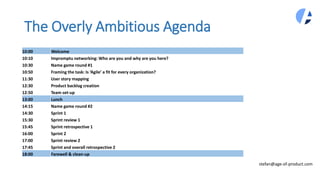
The Overly Ambitious Agenda
stefan@age-of-product.com
10:00 Welcome
10:10 Impromptu networking: Who are you and why are you here?
10:30 Name game round #1
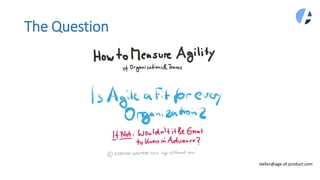
10:50 Framing the task: Is ‘Agile’ a fit for every organization?
11:30 User story mapping
12:30 Product backlog creation
12:50 Team set-up
13:00 Lunch
14:15 Name game round #2
14:30 Sprint 1
15:30 Sprint review 1
15:45 Sprint retrospective 1
16:00 Sprint 2
17:00 Sprint review 2
17:45 Sprint and overall retrospective 2
18:00 Farewell & clean-up
The Question
stefan@age-of-product.com
Can an organization make an informed
decision on becoming agile in advance?
The Question (2): In Other Words
stefan@age-of-product.com
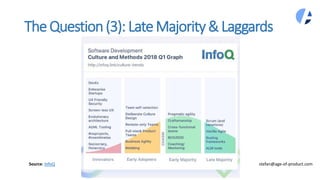
TheQuestion(3): LateMajority&Laggards
stefan@age-of-product.comSource: InfoQ
The Situation: Parachuting In
Source: Nellis Air Force Base
Create a toolset that:
• Comprises of surveys and questionnaires and
• Enables a knowledgeable agile practitioner to
• Answer ‘the question’
• In reasonable timeframe.
The Task
stefan@age-of-product.com
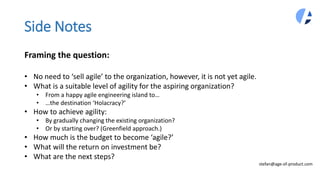
Side Notes
stefan@age-of-product.com
Framing the question:
• No need to ‘sell agile’ to the organization, however, it is not yet agile.
• What is a suitable level of agility for the aspiring organization?
• From a happy agile engineering island to…
• …the destination ‘Holacracy?’
• How to achieve agility:
• By gradually changing the existing organization?
• Or by starting over? (Greenfield approach.)
• How much is the budget to become ‘agile?’
• What will the return on investment be?
• What are the next steps?
A toolset to assess agility at team level.
Out of Scope for Today
stefan@age-of-product.comMore: 70-plus self-assessment tools curated by Ben Linders
Out of Scope for Today (2)
stefan@age-of-product.com
Out of Scope for Today (3)
stefan@age-of-product.com
Out of Scope for Today (4)
stefan@age-of-product.com
A toolset to assess the progress
of an organization during a transition.
stefan@age-of-product.com
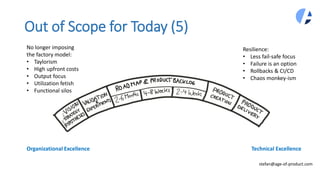
Out of Scope for Today (5)
No longer imposing
the factory model:
• Taylorism
• High upfront costs
• Output focus
• Utilization fetish
• Functional silos
Resilience:
• Less fail-safe focus
• Failure is an option
• Rollbacks & CI/CD
• Chaos monkey-ism
Organizational Excellence Technical Excellence
The Taxonomy of Agility Indicators
stefan@age-of-product.com
The Taxonomy of Agility Indicators:
The Survey (2)
Four Survey Questions:
1. What factors contribute to a team’s growing maturity in agile
practices?
2. What maturity levels do you see at a team level?
3. What factors contribute to becoming an ‘agile’ or a learning
organization?
4. What maturity levels do you see at an organizational level?
Responses: 86
The Taxonomy of Agility Indicators (3)
Agility Indicators:
1. People: Autonomy, Mastery, Purpose
2. Organizational Excellence
3. Technical Excellence
4. Communication & Collaboration
The Taxonomy of Agility Indicators (4):
Organizational Excellence
Culture:
• Embrace and celebrate failure (Validate hypotheses by running
experiments)
• Curiosity as a norm
• Undogmatic attitude, live Shu-Ha-Ri
• Transparency:
• Share information and data at all levels,
• No more gated information or information brokers
The Taxonomy of Agility Indicators (5):
Organizational Excellence
Leadership:
• Focus on innovation, quality and business value (No more HIPPOism.)
• Supports of ‘agile’s way of working’ fully
• Enforces ‘agile’ as the core of the company culture
• Respect for roles, principles, and processes (The ‘real’ PO.)
The Taxonomy of Agility Indicators (6):
Organizational Excellence
Management:
• Managers to servant leaders
• Trust in people and teams
• Provides tools and facilities necessary to become agile
• Gemba and Kaizen become standard practices
The Taxonomy of Agility Indicators (7):
Organizational Excellence
Organizational design:
• Abandon functional silos for cross-functional teams
• Remove redundant middle management layers (Flatten the hierarchy)
• No more command & control, compliance driven management
• HR aligns with requirements of self-organizing teams
• The organizations morphs into a team of teams
The Taxonomy of Agility Indicators (8):
Organizational Excellence
Clear objectives:
• Shared vision among all actors
• Clear strategy
• Clear priorities
The Taxonomy of Agility Indicators (9):
Organizational Excellence
Business value focus:
• Customer centricity mindset
• Delivering business results
• Shifting the IT focus business needs
• From project budgets to product teams
The Taxonomy of Agility Indicators (10):
Technical Excellence
Engineering practices:
• Built-in quality:
• Code reviews
• Test automation
• Pair and mob programming
• Practicing Scrum, Kanban, XP
• Open sourcing code
The Taxonomy of Agility Indicators (11):
Technical Excellence
Release practices:
• DevOps: CI, CD (Deployment at will)
• Regular cadence of releases
The Taxonomy of Agility Indicators (12):
Communication & Collaboration
Trust & respect:
• Benefit of the doubt for colleagues
• Safety to disagree
• Honesty
• Candid peer feedback
The Taxonomy of Agility Indicators (13):
Communication & Collaboration
Conflict resolution:
• Constructive disagreement:
• Disgree but commit approach
• No tyranny of compromise*
• Non-violent communication
Peter Drucker: “With strategy, one always makes compromises on implementation,” he wrote. “But one does not compromise on goals, does
not pussy-foot around them, does not try to serve two masters.”
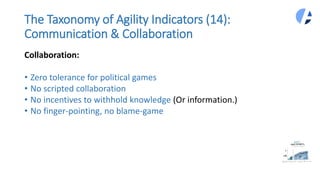
The Taxonomy of Agility Indicators (14):
Communication & Collaboration
Collaboration:
• Zero tolerance for political games
• No scripted collaboration
• No incentives to withhold knowledge (Or information.)
• No finger-pointing, no blame-game
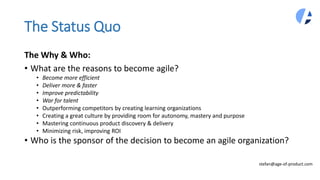
The Status Quo
The Why & Who:
• What are the reasons to become agile?
• Become more efficient
• Deliver more & faster
• Improve predictability
• War for talent
• Outperforming competitors by creating learning organizations
• Creating a great culture by providing room for autonomy, mastery and purpose
• Mastering continuous product discovery & delivery
• Minimizing risk, improving ROI
• Who is the sponsor of the decision to become an agile organization?
stefan@age-of-product.com
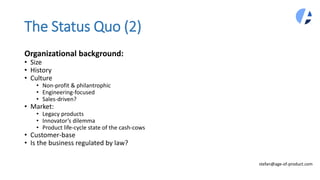
The Status Quo (2)
Organizational background:
• Size
• History
• Culture
• Non-profit & philantrophic
• Engineering-focused
• Sales-driven?
• Market:
• Legacy products
• Innovator’s dilemma
• Product life-cycle state of the cash-cows
• Customer-base
• Is the business regulated by law?
stefan@age-of-product.com
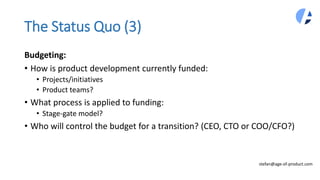
The Status Quo (3)
Budgeting:
• How is product development currently funded:
• Projects/initiatives
• Product teams?
• What process is applied to funding:
• Stage-gate model?
• Who will control the budget for a transition? (CEO, CTO or COO/CFO?)
stefan@age-of-product.com
The Status Quo (4)
Collaboration with product teams—How does it work now?
• W/ business stakeholders
• Among teams
• W/ customers
• W/ the management
• W/ the leadership
stefan@age-of-product.com
The Status Quo (5)
Nature of teams:
• What is the outsourcing level; are there internal teams?
• Team longevity:
• Are teams funded or projects/initiatives?
• Are team members assigned to teams randomly?
• Are people simultaneously working on several project?
• Are teams functional silos or cross-functional team?
• Are teams co-located?
• If not: are team members meeting regularly in person?
stefan@age-of-product.com
The Status Quo (6)
Team building & hiring:
• Hiring:
• Are teams diverse? (Gender, age, religion, race etc.)
• Peer recruiting of team members?
• Are the teams selecting themselves?
• Is HR is pursuing old-school career development?
• Titles, certificates etc.
• What about ‘autonomy, mastery, purpose?’
• What is the fluctuation rate:
• Among teams?
• Within the organization?
• Freelancer vs. Employees relationship:
• Are freelancers regarded as equals?
• What is the ratio of freelancers to employees?
stefan@age-of-product.com
The Status Quo (7)
Team management:
• People management/team management:
• Are people or teams micromanaged?
• Detailed instruction what and how to do?
• No trust in the capability of a team?
• Management of teams by OKRs?
• Do people have conflicting incentives with their teams’ objective?
• How is failure handled?
• Is a change of the incentive schemes planned?
• WIIFM syndrome?
• Is pursuing personal agendas or local optima lucrative?
stefan@age-of-product.com
The Status Quo (8)
Workspace:
• Can all work spaces be provided?
• Large, flexible space(s) for training, public ceremonies
• Defined team spaces to create a sense of togetherness
• Ad hoc collaboration space for 2-5 people
• Silent workspace to for deep, focused work
• Are exclusive spaces available?
• Whiteboards in abundance?
• Offsite work spaces to leave the comfort zone of the office?
stefan@age-of-product.com
The Status Quo (9)
Tools and technology:
• On-premise vs cloud—what is the status?
• Bring your own tech?
• Choose your own tools/software?
• Is open source acceptable?
stefan@age-of-product.com
Contact Information
Stefan Wolpers
Email: stefan@age-of-product.com
Blog: Age-of-Product.com
Newsletter: https://age-of-product.com/subscribe (Join 14,150 peers)
Slack: https://hands-onagile.slack.com/ (Join 2,400 peers)
Twitter 1: @StefanW
Twitter 2: @AgeOfProduct

Hands-on Agile: The Agility Assessment Framework Workshop

  • 1.
    The Agility Assessment Framework AnOpen Source Toolset for Agile Practitioners Workshop #1 v0.9 © Stefan Wolpers • Berlin, February 3rd, 2018
  • 2.
  • 3.
    The Overly AmbitiousAgenda stefan@age-of-product.com 10:00 Welcome 10:10 Impromptu networking: Who are you and why are you here? 10:30 Name game round #1 10:50 Framing the task: Is ‘Agile’ a fit for every organization? 11:30 User story mapping 12:30 Product backlog creation 12:50 Team set-up 13:00 Lunch 14:15 Name game round #2 14:30 Sprint 1 15:30 Sprint review 1 15:45 Sprint retrospective 1 16:00 Sprint 2 17:00 Sprint review 2 17:45 Sprint and overall retrospective 2 18:00 Farewell & clean-up
  • 4.
  • 5.
    Can an organizationmake an informed decision on becoming agile in advance? The Question (2): In Other Words stefan@age-of-product.com
  • 6.
  • 7.
    The Situation: ParachutingIn Source: Nellis Air Force Base
  • 8.
    Create a toolsetthat: • Comprises of surveys and questionnaires and • Enables a knowledgeable agile practitioner to • Answer ‘the question’ • In reasonable timeframe. The Task stefan@age-of-product.com
  • 9.
    Side Notes stefan@age-of-product.com Framing thequestion: • No need to ‘sell agile’ to the organization, however, it is not yet agile. • What is a suitable level of agility for the aspiring organization? • From a happy agile engineering island to… • …the destination ‘Holacracy?’ • How to achieve agility: • By gradually changing the existing organization? • Or by starting over? (Greenfield approach.) • How much is the budget to become ‘agile?’ • What will the return on investment be? • What are the next steps?
  • 10.
    A toolset toassess agility at team level. Out of Scope for Today stefan@age-of-product.comMore: 70-plus self-assessment tools curated by Ben Linders
  • 11.
    Out of Scopefor Today (2) stefan@age-of-product.com
  • 12.
    Out of Scopefor Today (3) stefan@age-of-product.com
  • 13.
    Out of Scopefor Today (4) stefan@age-of-product.com A toolset to assess the progress of an organization during a transition.
  • 14.
    stefan@age-of-product.com Out of Scopefor Today (5) No longer imposing the factory model: • Taylorism • High upfront costs • Output focus • Utilization fetish • Functional silos Resilience: • Less fail-safe focus • Failure is an option • Rollbacks & CI/CD • Chaos monkey-ism Organizational Excellence Technical Excellence
  • 15.
    The Taxonomy ofAgility Indicators stefan@age-of-product.com
  • 16.
    The Taxonomy ofAgility Indicators: The Survey (2) Four Survey Questions: 1. What factors contribute to a team’s growing maturity in agile practices? 2. What maturity levels do you see at a team level? 3. What factors contribute to becoming an ‘agile’ or a learning organization? 4. What maturity levels do you see at an organizational level? Responses: 86
  • 17.
    The Taxonomy ofAgility Indicators (3) Agility Indicators: 1. People: Autonomy, Mastery, Purpose 2. Organizational Excellence 3. Technical Excellence 4. Communication & Collaboration
  • 18.
    The Taxonomy ofAgility Indicators (4): Organizational Excellence Culture: • Embrace and celebrate failure (Validate hypotheses by running experiments) • Curiosity as a norm • Undogmatic attitude, live Shu-Ha-Ri • Transparency: • Share information and data at all levels, • No more gated information or information brokers
  • 19.
    The Taxonomy ofAgility Indicators (5): Organizational Excellence Leadership: • Focus on innovation, quality and business value (No more HIPPOism.) • Supports of ‘agile’s way of working’ fully • Enforces ‘agile’ as the core of the company culture • Respect for roles, principles, and processes (The ‘real’ PO.)
  • 20.
    The Taxonomy ofAgility Indicators (6): Organizational Excellence Management: • Managers to servant leaders • Trust in people and teams • Provides tools and facilities necessary to become agile • Gemba and Kaizen become standard practices
  • 21.
    The Taxonomy ofAgility Indicators (7): Organizational Excellence Organizational design: • Abandon functional silos for cross-functional teams • Remove redundant middle management layers (Flatten the hierarchy) • No more command & control, compliance driven management • HR aligns with requirements of self-organizing teams • The organizations morphs into a team of teams
  • 22.
    The Taxonomy ofAgility Indicators (8): Organizational Excellence Clear objectives: • Shared vision among all actors • Clear strategy • Clear priorities
  • 23.
    The Taxonomy ofAgility Indicators (9): Organizational Excellence Business value focus: • Customer centricity mindset • Delivering business results • Shifting the IT focus business needs • From project budgets to product teams
  • 24.
    The Taxonomy ofAgility Indicators (10): Technical Excellence Engineering practices: • Built-in quality: • Code reviews • Test automation • Pair and mob programming • Practicing Scrum, Kanban, XP • Open sourcing code
  • 25.
    The Taxonomy ofAgility Indicators (11): Technical Excellence Release practices: • DevOps: CI, CD (Deployment at will) • Regular cadence of releases
  • 26.
    The Taxonomy ofAgility Indicators (12): Communication & Collaboration Trust & respect: • Benefit of the doubt for colleagues • Safety to disagree • Honesty • Candid peer feedback
  • 27.
    The Taxonomy ofAgility Indicators (13): Communication & Collaboration Conflict resolution: • Constructive disagreement: • Disgree but commit approach • No tyranny of compromise* • Non-violent communication Peter Drucker: “With strategy, one always makes compromises on implementation,” he wrote. “But one does not compromise on goals, does not pussy-foot around them, does not try to serve two masters.”
  • 28.
    The Taxonomy ofAgility Indicators (14): Communication & Collaboration Collaboration: • Zero tolerance for political games • No scripted collaboration • No incentives to withhold knowledge (Or information.) • No finger-pointing, no blame-game
  • 29.
    The Status Quo TheWhy & Who: • What are the reasons to become agile? • Become more efficient • Deliver more & faster • Improve predictability • War for talent • Outperforming competitors by creating learning organizations • Creating a great culture by providing room for autonomy, mastery and purpose • Mastering continuous product discovery & delivery • Minimizing risk, improving ROI • Who is the sponsor of the decision to become an agile organization? stefan@age-of-product.com
  • 30.
    The Status Quo(2) Organizational background: • Size • History • Culture • Non-profit & philantrophic • Engineering-focused • Sales-driven? • Market: • Legacy products • Innovator’s dilemma • Product life-cycle state of the cash-cows • Customer-base • Is the business regulated by law? stefan@age-of-product.com
  • 31.
    The Status Quo(3) Budgeting: • How is product development currently funded: • Projects/initiatives • Product teams? • What process is applied to funding: • Stage-gate model? • Who will control the budget for a transition? (CEO, CTO or COO/CFO?) stefan@age-of-product.com
  • 32.
    The Status Quo(4) Collaboration with product teams—How does it work now? • W/ business stakeholders • Among teams • W/ customers • W/ the management • W/ the leadership stefan@age-of-product.com
  • 33.
    The Status Quo(5) Nature of teams: • What is the outsourcing level; are there internal teams? • Team longevity: • Are teams funded or projects/initiatives? • Are team members assigned to teams randomly? • Are people simultaneously working on several project? • Are teams functional silos or cross-functional team? • Are teams co-located? • If not: are team members meeting regularly in person? stefan@age-of-product.com
  • 34.
    The Status Quo(6) Team building & hiring: • Hiring: • Are teams diverse? (Gender, age, religion, race etc.) • Peer recruiting of team members? • Are the teams selecting themselves? • Is HR is pursuing old-school career development? • Titles, certificates etc. • What about ‘autonomy, mastery, purpose?’ • What is the fluctuation rate: • Among teams? • Within the organization? • Freelancer vs. Employees relationship: • Are freelancers regarded as equals? • What is the ratio of freelancers to employees? stefan@age-of-product.com
  • 35.
    The Status Quo(7) Team management: • People management/team management: • Are people or teams micromanaged? • Detailed instruction what and how to do? • No trust in the capability of a team? • Management of teams by OKRs? • Do people have conflicting incentives with their teams’ objective? • How is failure handled? • Is a change of the incentive schemes planned? • WIIFM syndrome? • Is pursuing personal agendas or local optima lucrative? stefan@age-of-product.com
  • 36.
    The Status Quo(8) Workspace: • Can all work spaces be provided? • Large, flexible space(s) for training, public ceremonies • Defined team spaces to create a sense of togetherness • Ad hoc collaboration space for 2-5 people • Silent workspace to for deep, focused work • Are exclusive spaces available? • Whiteboards in abundance? • Offsite work spaces to leave the comfort zone of the office? stefan@age-of-product.com
  • 37.
    The Status Quo(9) Tools and technology: • On-premise vs cloud—what is the status? • Bring your own tech? • Choose your own tools/software? • Is open source acceptable? stefan@age-of-product.com
  • 38.
    Contact Information Stefan Wolpers Email:stefan@age-of-product.com Blog: Age-of-Product.com Newsletter: https://age-of-product.com/subscribe (Join 14,150 peers) Slack: https://hands-onagile.slack.com/ (Join 2,400 peers) Twitter 1: @StefanW Twitter 2: @AgeOfProduct