Introduction to
Hand Tool Safety
This material was produced under Susan Harwood grant number SH-31214-SH7 Occupational Safety
and Health Administration, U.S. Department of Labor. The contents in this presentation do not
necessarily reflect the views or policies of the U.S. Department of Labor, nor does the mention of
trade names, commercial products, or organizations imply endorsement by the U.S. Government.
Introduction: What
are hand tools?
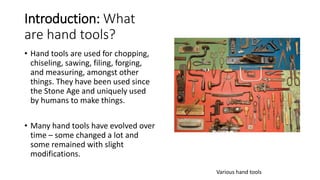
• Hand tools are used for chopping,
chiseling, sawing, filing, forging,
and measuring, amongst other
things. They have been used since
the Stone Age and uniquely used
by humans to make things.
• Many hand tools have evolved over
time – some changed a lot and
some remained with slight
modifications.
Various hand tools
Safety: Who is OSHA?
With the Occupational Safety and
Health Act of 1970, Congress
created the Occupational Safety
and Health Administration
(OSHA) to assure safe and
healthful working conditions for
working men and women by
setting and enforcing standards
and by providing training,
outreach, education and
assistance.
OSHA is part of the United States
Department of Labor. The
administrator for OSHA is
the Assistant Secretary of Labor
for Occupational Safety and
Health. OSHA's administrator
answers to the Secretary of Labor,
who is a member of the cabinet of
the President of the United States.
Safety: Know your rights
Under federal law, you are entitled
to a safe workplace.
• Your employer must provide a
workplace free of known health
and safety hazards.
• If you have concerns, you have
the right to speak up about
them without fear of retaliation.
You also have the right to:
• Be trained in a language you understand
• Work on machines that are safe
• Be provided required safety gear, such as gloves or a
harness and lifeline for falls
• Be protected from toxic chemicals
• Request an OSHA inspection, and speak to the inspector
• Report an injury or illness, and get copies of your medical
records
• See copies of the workplace injury and illness log
• Review records of work-related injuries and illnesses
• Get copies of test results done to find hazards in the
workplace
Hazards: Machine-
related injuries
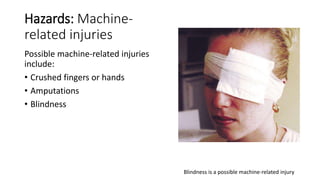
Possible machine-related injuries
include:
• Crushed fingers or hands
• Amputations
• Blindness
Blindness is a possible machine-related injury
Hazards: Point of
operation
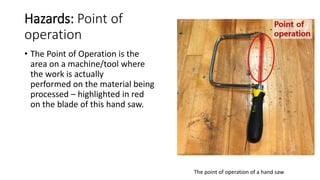
• The Point of Operation is the
area on a machine/tool where
the work is actually
performed on the material being
processed – highlighted in red
on the blade of this hand saw.
The point of operation of a hand saw
Hazards: Nip points
and rotating parts
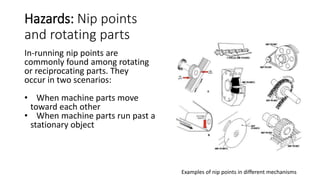
In-running nip points are
commonly found among rotating
or reciprocating parts. They
occur in two scenarios:
• When machine parts move
toward each other
• When machine parts run past a
stationary object
Examples of nip points in different mechanisms
Hazards: Power hand
tools
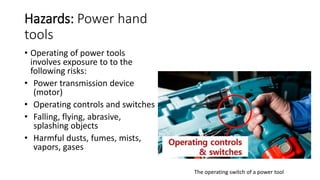
• Operating of power tools
involves exposure to to the
following risks:
• Power transmission device
(motor)
• Operating controls and switches
• Falling, flying, abrasive,
splashing objects
• Harmful dusts, fumes, mists,
vapors, gases
The operating switch of a power tool
Hazards: Hand tool
misuse
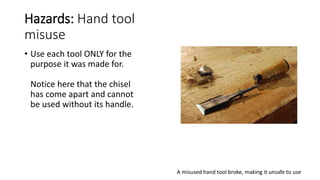
• Use each tool ONLY for the
purpose it was made for.
Notice here that the chisel
has come apart and cannot
be used without its handle.
A misused hand tool broke, making it unsafe to use
Hazards: Power tool
misuse
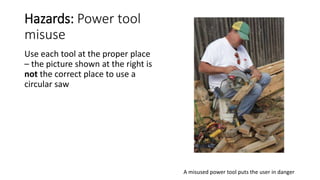
Use each tool at the proper place
– the picture shown at the right is
not the correct place to use a
circular saw
A misused power tool puts the user in danger
Hazards: Best practices
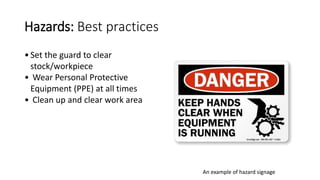
An example of hazard signage
•Set the guard to clear
stock/workpiece
• Wear Personal Protective
Equipment (PPE) at all times
• Clean up and clear work area
Safe Operation: Before
use
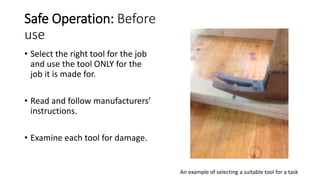
• Select the right tool for the job
and use the tool ONLY for the
job it is made for.
• Read and follow manufacturers’
instructions.
• Examine each tool for damage.
An example of selecting a suitable tool for a task
Safe Operation: In use
• Use the right Personal Protective
Equipment (PPE) at all times.
• Do NOT wear loose clothing or
jewelry.
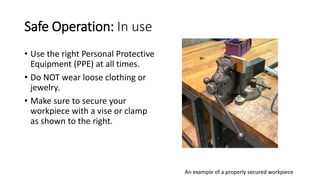
• Make sure to secure your
workpiece with a vise or clamp
as shown to the right.
An example of a properly secured workpiece
Safe Operation: In use
(continued)
• Hold the tool ONLY by the
handle and maintain good
posture.
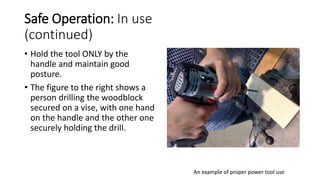
• The figure to the right shows a
person drilling the woodblock
secured on a vise, with one hand
on the handle and the other one
securely holding the drill.
An example of proper power tool use
Safe Operation: Working
environment
• Keep workplace floors clean and
dry.
• Keep cords away in designated
space.
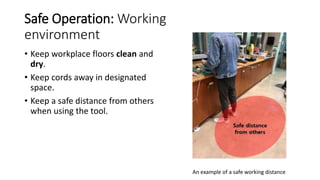
• Keep a safe distance from others
when using the tool.
An example of a safe working distance
Safe Operation: After use
• Unplug and disengage tool from
power source – do NOT yank the
cord.
• Disconnect whenever not in use.
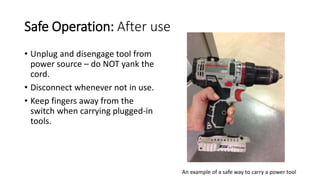
• Keep fingers away from the
switch when carrying plugged-in
tools.
An example of a safe way to carry a power tool

Hand Tools.pptx

  • 1.
    Introduction to Hand ToolSafety This material was produced under Susan Harwood grant number SH-31214-SH7 Occupational Safety and Health Administration, U.S. Department of Labor. The contents in this presentation do not necessarily reflect the views or policies of the U.S. Department of Labor, nor does the mention of trade names, commercial products, or organizations imply endorsement by the U.S. Government.
  • 2.
    Introduction: What are handtools? • Hand tools are used for chopping, chiseling, sawing, filing, forging, and measuring, amongst other things. They have been used since the Stone Age and uniquely used by humans to make things. • Many hand tools have evolved over time – some changed a lot and some remained with slight modifications. Various hand tools
  • 3.
    Safety: Who isOSHA? With the Occupational Safety and Health Act of 1970, Congress created the Occupational Safety and Health Administration (OSHA) to assure safe and healthful working conditions for working men and women by setting and enforcing standards and by providing training, outreach, education and assistance. OSHA is part of the United States Department of Labor. The administrator for OSHA is the Assistant Secretary of Labor for Occupational Safety and Health. OSHA's administrator answers to the Secretary of Labor, who is a member of the cabinet of the President of the United States.
  • 4.
    Safety: Know yourrights Under federal law, you are entitled to a safe workplace. • Your employer must provide a workplace free of known health and safety hazards. • If you have concerns, you have the right to speak up about them without fear of retaliation. You also have the right to: • Be trained in a language you understand • Work on machines that are safe • Be provided required safety gear, such as gloves or a harness and lifeline for falls • Be protected from toxic chemicals • Request an OSHA inspection, and speak to the inspector • Report an injury or illness, and get copies of your medical records • See copies of the workplace injury and illness log • Review records of work-related injuries and illnesses • Get copies of test results done to find hazards in the workplace
  • 5.
    Hazards: Machine- related injuries Possiblemachine-related injuries include: • Crushed fingers or hands • Amputations • Blindness Blindness is a possible machine-related injury
  • 6.
    Hazards: Point of operation •The Point of Operation is the area on a machine/tool where the work is actually performed on the material being processed – highlighted in red on the blade of this hand saw. The point of operation of a hand saw
  • 7.
    Hazards: Nip points androtating parts In-running nip points are commonly found among rotating or reciprocating parts. They occur in two scenarios: • When machine parts move toward each other • When machine parts run past a stationary object Examples of nip points in different mechanisms
  • 8.
    Hazards: Power hand tools •Operating of power tools involves exposure to to the following risks: • Power transmission device (motor) • Operating controls and switches • Falling, flying, abrasive, splashing objects • Harmful dusts, fumes, mists, vapors, gases The operating switch of a power tool
  • 9.
    Hazards: Hand tool misuse •Use each tool ONLY for the purpose it was made for. Notice here that the chisel has come apart and cannot be used without its handle. A misused hand tool broke, making it unsafe to use
  • 10.
    Hazards: Power tool misuse Useeach tool at the proper place – the picture shown at the right is not the correct place to use a circular saw A misused power tool puts the user in danger
  • 11.
    Hazards: Best practices Anexample of hazard signage •Set the guard to clear stock/workpiece • Wear Personal Protective Equipment (PPE) at all times • Clean up and clear work area
  • 12.
    Safe Operation: Before use •Select the right tool for the job and use the tool ONLY for the job it is made for. • Read and follow manufacturers’ instructions. • Examine each tool for damage. An example of selecting a suitable tool for a task
  • 13.
    Safe Operation: Inuse • Use the right Personal Protective Equipment (PPE) at all times. • Do NOT wear loose clothing or jewelry. • Make sure to secure your workpiece with a vise or clamp as shown to the right. An example of a properly secured workpiece
  • 14.
    Safe Operation: Inuse (continued) • Hold the tool ONLY by the handle and maintain good posture. • The figure to the right shows a person drilling the woodblock secured on a vise, with one hand on the handle and the other one securely holding the drill. An example of proper power tool use
  • 15.
    Safe Operation: Working environment •Keep workplace floors clean and dry. • Keep cords away in designated space. • Keep a safe distance from others when using the tool. An example of a safe working distance
  • 16.
    Safe Operation: Afteruse • Unplug and disengage tool from power source – do NOT yank the cord. • Disconnect whenever not in use. • Keep fingers away from the switch when carrying plugged-in tools. An example of a safe way to carry a power tool

Editor's Notes

  • #4 OSHA was started to protect workers in the work place. Before OSHA there was no organization that tracked work place injuries. There were also no safety standards for employers.   OSHA has 2 branches, the Enforcement Branch and the Collaboration Branch.   The Enforcement Branch investigates complaints and serious accidents. The Collaboration Branch works on education, such as the Susan Harwood Grant.    
  • #5 Every worker has the right to a safe workplace and OSHA was created to enforce that. Read the rights to the trainees and point them to the posters available around the workplace where they can refer to for more information. Extra resources can be found at https://www.osha.gov/workers/index.html
  • #6 The machines may look imposing and may be loud, but you shouldn’t be afraid of them. When used correctly they are safe and can be used to create a lot of interesting things.   Do not take the machines for granted. Accidents can happen very quickly. Machine users need to keep their fingers and hands away from the Point of Operation. Wear safety glasses to protect their eyes and closed toe sturdy shoes to protect their feet. Machine users need to put long hair up in a ponytail or bun and not wear loose clothing or dangling jewelry to protect themselves from getting caught up in rotational hazards. Many accidents result from persons working on, or around, moving machinery. These accidents could have been prevented by the installation and proper maintenance of guarding. The goal of this training is to make the guarding of all equipment as easily understood as possible and re-inforce the safe working procedures that must always be in place around dangerous equipment.   This list of accidents is as long as it is horrifying.   Safeguards are essential for protecting workers from needless and preventable injuries. Where the operation of a machine can injure the operator or other workers, the hazard must be controlled or eliminated.   National Emphasis Program on Amputations*. CPL 03-00-019, (August 13, 2015). Describes policies and procedures for implementing a National Emphasis Program (NEP) to identify and to reduce workplace machinery and equipment hazards which are causing or likely to cause amputations. Resource: 
https://www.osha.gov/dte/outreach/construction_generalindustry/gi_outreach_tp.html https://safetyresourcesblog.com/2014/08/16/osha-quickcards-download-here-all-free-englishspanishother/      
  • #7 Explain that the Point of Operation is where the work is being done on the machine. You always want to make sure that your fingers are away from the Point of Operation since this is where the work is being done with the tool. Don’t take the simplicity of a hand tool for granted. It can still cause injury.
  • #8 Nip Points and Rotating Parts are areas where fingers, hair, loose clothing, or jewelry can get caught up in. Keep long hair up in a ponytail or bun and do not wear loose clothing or jewelry. Keep in mind that Nip Points and Rotating Parts can pull your fingers into the machine and you need to be aware to keep your fingers, hair, loose clothing, or jewelry away from them.
  • #9 An easy way to keep these in mind is that the Point of Operation is where the work actually happens.     The Power Transmission device is usually the motor that drives the machine.   Other moving parts are anything else on the hand tool that moves. The operating controls are the buttons and switches that allow you to turn the tool on and off and have it do other functions. “All machines consist of three fundamental areas: the point of operation, the power transmission device, and the operating controls. Despite all machines having the same basic components, their safeguarding needs widely differ due to varying physical characteristics and operator involvement” (OSHA 2007).   OSHA Machine Guarding eTool - https://www.osha.gov/SLTC/etools/machineguarding/intro.html  
  • #10 Knowing the potential hazards of the tool will hopefully help you understand why if the tool has guards that they must be kept in place and why we need to wear Personal Protective Equipment (PPE) when using them.
  • #11 Knowing the potential hazards of the tool will hopefully help you understand why if the tool has guards that they must be kept in place and why we need to wear Personal Protective Equipment (PPE) when using them.
  • #12 Tool users always need to check to make sure that all of the guards are in place if the tool has guards. Hand Tools seems to be easy enough to operate, but users still need to be trained on their use. The work piece needs to be placed on the Table for safety and stability. Operators always need to be aware where their fingers are in relation to the Point of Operation and the work piece. Any tool malfunction needs to be reported to the shop staff. Do not attempt to repair the tool on your own.
  • #14 Make sure that the Guards are intact and work. No tool should be used with the guards removed.   Hand tools should not be used if they are in dis-repair.
  • #16 The work area needs to be clear of obstructions and of others working near it. Always make sure that the floor around the work area is clear of obstructions as well so that there are no trip hazards.
  • #17 Use a vacuum to suck up the dust and debris that was created in and around the work area   Sweep up or vacuum up any debris that is on the floor.   It is important to chips, debris, and dust off the floor since it is a slip hazard and can cause injury.