Need for HACCP Certification for
        Food industry &
       The Way Forward


     QSS - Quality Management Services
General Awareness


• Food borne & Water borne Illness
• Great human sufferings globally
• Cost to a country’s economy
• Outbreaks across the years


                    QSS - Quality Management Services
3
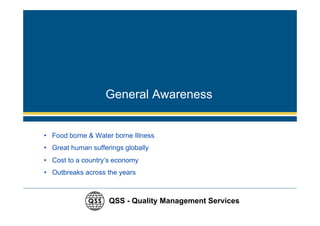
                 German E coli Outbreak June 2011
    Starting May 2011, 3785 cases -                    Source traced to fenugreek seeds
     852 patients with acute Kidney                               from Egypt
        Failure and 48 Deaths in
             Germany alone


Cost $284 million in human losses (such as sick leave),
regardless of material losses (such as dumped cucumbers)


                               QSS – Quality Management Services
4
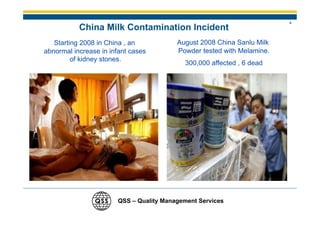
           China Milk Contamination Incident
   Starting 2008 in China , an           August 2008 China Sanlu Milk
abnormal increase in infant cases        Powder tested with Melamine.
         of kidney stones.
                                           300,000 affected , 6 dead


                       QSS – Quality Management Services
5

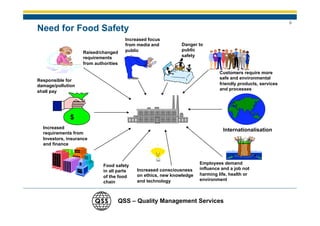
Need for Food Safety
                                       Increased focus
                                       from media and          Danger to
                                       public                  public
                    Raised/changed
                    requirements                               safety
                    from authorities

                                                                                Customers require more
                                                                                safe and environmental
Responsible for
damage/pollution                                                                friendly products, services
                                                                                and processes
shall pay


              $
  Increased
                                                                                 Internationalisation
  requirements from
  Investors, insurance
  and finance


                                                                       Employees demand
                             Food safety
                                            Increased consciousness    influence and a job not
                             in all parts
                                            on ethics, new knowledge   harming life, health or
                             of the food
                                            and technology             environment
                             chain


                                   QSS – Quality Management Services
6

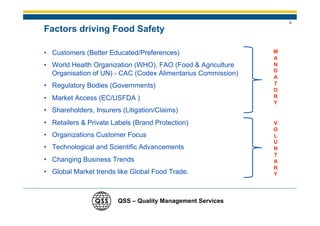
Factors driving Food Safety

• Customers (Better Educated/Preferences)                     M
                                                              A
• World Health Organization (WHO), FAO (Food & Agriculture    N
                                                              D
  Organisation of UN) - CAC (Codex Alimentarius Commission)
                                                              A
• Regulatory Bodies (Governments)                             T
                                                              O
• Market Access (EC/USFDA )                                   R
                                                              Y
• Shareholders, Insurers (Litigation/Claims)
• Retailers & Private Labels (Brand Protection)               V
                                                              O
• Organizations Customer Focus                                L
                                                              U
• Technological and Scientific Advancements                   N
                                                              T
• Changing Business Trends                                    A
                                                              R
• Global Market trends like Global Food Trade.                Y


                        QSS – Quality Management Services
Mandatory - Global & Indian Legislation


WTO SPS & TBT
• SPS- Sanitary and Phytosanitary measures
    •   stresses on health and safety
• TBT- Technical barrier to Trade agreements
    • stresses on quality aspects


                          QSS – Quality Management Services
8
Codex Alimentarius Commission (CAC)

• CAC is responsible for the execution of the joint FAO/WHO food
  standards programme
• Established in 1963
• Developed food standards, guidelines and related texts to protect
  consumer health and ensure Fair Trade Practices
• Members include both International Government and Non
  Governmental organizations
• Recommended as voluntary application by members, Codex
  standards serve in many cases as a basis for national legislation
• Documentation available in form of
       Standards
       Codes of practice
       Guidelines
       Other guidelines


                           QSS – Quality Management Services
9
India and CODEX


  • India is represented on CODEX by the Ministry of Health and
    Family Welfare (MOHFW)
  • CODEX India co-ordinates and promotes Codex activities in
    India in association with the National Codex Committee and
    facilitates India's input to the work of Codex through an
    established consultation process
  • Various CODEX Committees are formed which includes
    various trade, government, consumer and academia
    representatives


                      QSS – Quality Management Services
10
Indian Food Regulations

• Food Safety and Standards Act (FSS), 2006
       In effect since 5th August 2011
       FSS repeals the following Acts:
         •   The Prevention of Food Adulteration Act, 1954
         •   The Fruit Products Order, 1955
         •   The Meat Food Products Order, 1973
         •   The Vegetable Oil Products (Control) Order, 1947
         •   The Edible Oils Packaging (Regulation) Order, 1998
         •   The Solvent Extracted Oil, De oiled Meal, and Edible Flour (Control)
             Order, 1967
         •   The Milk and Milk Products Order, 1992
         •   Essential Commodities Act, 1955 relating to food
• Voluntary Standardization and Certification
       BSI (ISI Mark) & DMI (Agmark Standards)


                            QSS – Quality Management Services
11
FSS Act Regulations


   • Following regulations have been issued
         FSS - Licensing and Registration of Food Business
         Regulations
         FSS - Packaging and Labeling Regulations
         FSS – Food Product Standards and Food Additives
         Regulations
         FSS - Prohibition and Restriction on Sales Regulations
         FSS - Contaminants, Toxins and Residues Regulations
         FSS - Laboratory and Sampling Analysis Regulations


                      QSS – Quality Management Services
12
Important aspects of the FSS Act


 • Scope- applicable to all kinds of food/substances whether processed,
   partially processed or unprocessed, intended for human consumption
   and includes primary food except those produced by farmers/
   fishermen, genetically modified foods or foods with genetic
   ingredients, infant foods, packaged drinking water, alcoholic drink
   and water used in manufacture of food.
 • Definitions- important definitions are given in the regulations.
 • Establishment of the authority- powers granted and the structure of
   the body
 • Misleading advertisements and unfair trade practices - No false
   claims, unfair trade practices,
 • Imports- All imports of articles of food are subject to the Act.


                          QSS – Quality Management Services
13
Important aspects of the FSS Act contd….

 • Special responsibility of FBO-
         Not hire sick workers, infected individuals
        Sell product to other food vendors, provide guarantee in writing of the
        safety/quality of food article
        If food of a batch is found contaminated it will be presumed that the
        whole batch is unsafe.
 • Liability of manufacturer, packer, wholesaler, distributor and sellers-
   manufacturer liable to meet all requirements of FSA,
 • Wholesaler/ seller liable for sale after expiry, storage, traceability etc.
 • Food recall procedures
 • Offences and penalties
 • QUID – Quantitative Ingredient Declaration
 • Clear indication of Restriction of Sale of certain admixtures


                            QSS – Quality Management Services
14
FSS Act – Points to Note


 • For the first time, the Act compels the establishment of food recall
   procedures in conjunction with global standards.
 • The complete traceability of the food product at all levels needs to be
   established.
 • All FBO’s have to intimate the authority well in advance of their plan
   on any addition, extension/modification within the business
   establishment including change in product category, layout, closure
   or any other info, based on which a license is granted.


                          QSS – Quality Management Services
Food Safety Management Systems


Key Terminology:
• HACCP
• ISO 22000
• Other Standards in use globally


                       QSS – Quality Management Services
16
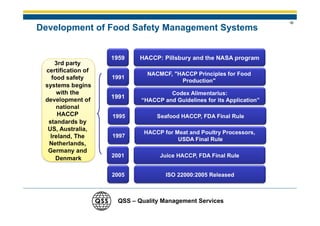
Development of Food Safety Management Systems


                    1959   HACCP: Pillsbury and the NASA program
     3rd party
 certification of
                              NACMCF, "HACCP Principles for Food
    food safety     1991
                                        Production"
 systems begins
      with the                       Codex Alimentarius:
 development of     1991
                            “HACCP and Guidelines for its Application”
      national
      HACCP         1995         Seafood HACCP, FDA Final Rule
  standards by
  US, Australia,
                             HACCP for Meat and Poultry Processors,
   Ireland, The     1997
                                        USDA Final Rule
  Netherlands,
  Germany and
      Denmark       2001          Juice HACCP, FDA Final Rule


                    2005            ISO 22000:2005 Released


                     QSS – Quality Management Services
17


HACCP

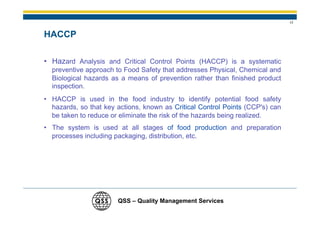
• Hazard Analysis and Critical Control Points (HACCP) is a systematic
  preventive approach to Food Safety that addresses Physical, Chemical and
  Biological hazards as a means of prevention rather than finished product
  inspection.
• HACCP is used in the food industry to identify potential food safety
  hazards, so that key actions, known as Critical Control Points (CCP's) can
  be taken to reduce or eliminate the risk of the hazards being realized.
• The system is used at all stages of food production and preparation
  processes including packaging, distribution, etc.


                       QSS – Quality Management Services
18
ISO 22000 – Food Safety Management System
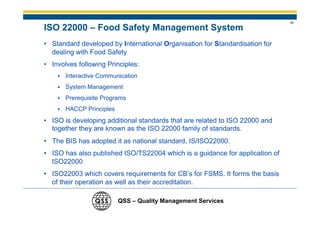
• Standard developed by International Organisation for Standardisation for
  dealing with Food Safety
• Involves following Principles:
       Interactive Communication
       System Management
       Prerequisite Programs
       HACCP Principles
• ISO is developing additional standards that are related to ISO 22000 and
  together they are known as the ISO 22000 family of standards.
• The BIS has adopted it as national standard, IS/ISO22000.
• ISO has also published ISO/TS22004 which is a guidance for application of
  ISO22000
• ISO22003 which covers requirements for CB’s for FSMS. It forms the basis
  of their operation as well as their accreditation.

                          QSS – Quality Management Services
19

What is Food Safety Management System to an
organization?

• It acts as a tool for developing a system which ensures safe food.
• Raise product or service quality
• Builds customer confidence
• Lower overhead and Stimulates creativity
• Reduce waste and rework and Stimulates teamwork
• Open new markets and customers.
• Systematic not anarchy
• A platform to improve communication by dismantling cross functional barriers.
• A vehicle to improve productivity and profitability by vesting ownership in
  everyone.
• A motivator to make training and learning the foundation for continuous
  improvement.


                         QSS – Quality Management Services
Implementing food hygiene practices


          QSS – Quality Management Services
21
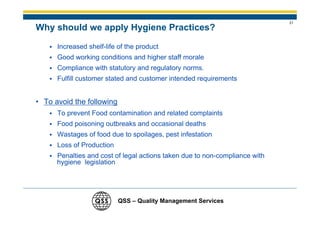
Why should we apply Hygiene Practices?

      Increased shelf-life of the product
      Good working conditions and higher staff morale
      Compliance with statutory and regulatory norms.
      Fulfill customer stated and customer intended requirements


• To avoid the following
      To prevent Food contamination and related complaints
      Food poisoning outbreaks and occasional deaths
      Wastages of food due to spoilages, pest infestation
      Loss of Production
      Penalties and cost of legal actions taken due to non-compliance with
      hygiene legislation


                           QSS – Quality Management Services
22


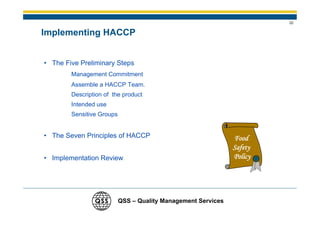
Implementing HACCP


• The Five Preliminary Steps
        Management Commitment
        Assemble a HACCP Team.
        Description of the product
        Intended use
        Sensitive Groups


• The Seven Principles of HACCP                                Food
                                                               Safety
• Implementation Review                                        Policy


                           QSS – Quality Management Services
23


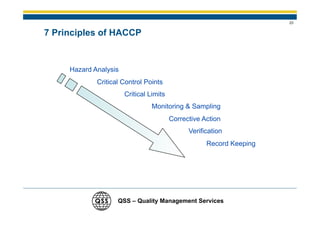
7 Principles of HACCP


     Hazard Analysis
             Critical Control Points
                       Critical Limits
                                 Monitoring & Sampling
                                         Corrective Action
                                               Verification
                                                     Record Keeping


                    QSS – Quality Management Services
Thank you


QSS – Quality Management Services

HACCP Certification for Food Industry_2012

  • 1.
    Need for HACCPCertification for Food industry & The Way Forward QSS - Quality Management Services
  • 2.
    General Awareness • Foodborne & Water borne Illness • Great human sufferings globally • Cost to a country’s economy • Outbreaks across the years QSS - Quality Management Services
  • 3.
    3 German E coli Outbreak June 2011 Starting May 2011, 3785 cases - Source traced to fenugreek seeds 852 patients with acute Kidney from Egypt Failure and 48 Deaths in Germany alone Cost $284 million in human losses (such as sick leave), regardless of material losses (such as dumped cucumbers) QSS – Quality Management Services
  • 4.
    4 China Milk Contamination Incident Starting 2008 in China , an August 2008 China Sanlu Milk abnormal increase in infant cases Powder tested with Melamine. of kidney stones. 300,000 affected , 6 dead QSS – Quality Management Services
  • 5.
    5 Need for FoodSafety Increased focus from media and Danger to public public Raised/changed requirements safety from authorities Customers require more safe and environmental Responsible for damage/pollution friendly products, services and processes shall pay $ Increased Internationalisation requirements from Investors, insurance and finance Employees demand Food safety Increased consciousness influence and a job not in all parts on ethics, new knowledge harming life, health or of the food and technology environment chain QSS – Quality Management Services
  • 6.
    6 Factors driving FoodSafety • Customers (Better Educated/Preferences) M A • World Health Organization (WHO), FAO (Food & Agriculture N D Organisation of UN) - CAC (Codex Alimentarius Commission) A • Regulatory Bodies (Governments) T O • Market Access (EC/USFDA ) R Y • Shareholders, Insurers (Litigation/Claims) • Retailers & Private Labels (Brand Protection) V O • Organizations Customer Focus L U • Technological and Scientific Advancements N T • Changing Business Trends A R • Global Market trends like Global Food Trade. Y QSS – Quality Management Services
  • 7.
    Mandatory - Global& Indian Legislation WTO SPS & TBT • SPS- Sanitary and Phytosanitary measures • stresses on health and safety • TBT- Technical barrier to Trade agreements • stresses on quality aspects QSS – Quality Management Services
  • 8.
    8 Codex Alimentarius Commission(CAC) • CAC is responsible for the execution of the joint FAO/WHO food standards programme • Established in 1963 • Developed food standards, guidelines and related texts to protect consumer health and ensure Fair Trade Practices • Members include both International Government and Non Governmental organizations • Recommended as voluntary application by members, Codex standards serve in many cases as a basis for national legislation • Documentation available in form of Standards Codes of practice Guidelines Other guidelines QSS – Quality Management Services
  • 9.
    9 India and CODEX • India is represented on CODEX by the Ministry of Health and Family Welfare (MOHFW) • CODEX India co-ordinates and promotes Codex activities in India in association with the National Codex Committee and facilitates India's input to the work of Codex through an established consultation process • Various CODEX Committees are formed which includes various trade, government, consumer and academia representatives QSS – Quality Management Services
  • 10.
    10 Indian Food Regulations •Food Safety and Standards Act (FSS), 2006 In effect since 5th August 2011 FSS repeals the following Acts: • The Prevention of Food Adulteration Act, 1954 • The Fruit Products Order, 1955 • The Meat Food Products Order, 1973 • The Vegetable Oil Products (Control) Order, 1947 • The Edible Oils Packaging (Regulation) Order, 1998 • The Solvent Extracted Oil, De oiled Meal, and Edible Flour (Control) Order, 1967 • The Milk and Milk Products Order, 1992 • Essential Commodities Act, 1955 relating to food • Voluntary Standardization and Certification BSI (ISI Mark) & DMI (Agmark Standards) QSS – Quality Management Services
  • 11.
    11 FSS Act Regulations • Following regulations have been issued FSS - Licensing and Registration of Food Business Regulations FSS - Packaging and Labeling Regulations FSS – Food Product Standards and Food Additives Regulations FSS - Prohibition and Restriction on Sales Regulations FSS - Contaminants, Toxins and Residues Regulations FSS - Laboratory and Sampling Analysis Regulations QSS – Quality Management Services
  • 12.
    12 Important aspects ofthe FSS Act • Scope- applicable to all kinds of food/substances whether processed, partially processed or unprocessed, intended for human consumption and includes primary food except those produced by farmers/ fishermen, genetically modified foods or foods with genetic ingredients, infant foods, packaged drinking water, alcoholic drink and water used in manufacture of food. • Definitions- important definitions are given in the regulations. • Establishment of the authority- powers granted and the structure of the body • Misleading advertisements and unfair trade practices - No false claims, unfair trade practices, • Imports- All imports of articles of food are subject to the Act. QSS – Quality Management Services
  • 13.
    13 Important aspects ofthe FSS Act contd…. • Special responsibility of FBO- Not hire sick workers, infected individuals Sell product to other food vendors, provide guarantee in writing of the safety/quality of food article If food of a batch is found contaminated it will be presumed that the whole batch is unsafe. • Liability of manufacturer, packer, wholesaler, distributor and sellers- manufacturer liable to meet all requirements of FSA, • Wholesaler/ seller liable for sale after expiry, storage, traceability etc. • Food recall procedures • Offences and penalties • QUID – Quantitative Ingredient Declaration • Clear indication of Restriction of Sale of certain admixtures QSS – Quality Management Services
  • 14.
    14 FSS Act –Points to Note • For the first time, the Act compels the establishment of food recall procedures in conjunction with global standards. • The complete traceability of the food product at all levels needs to be established. • All FBO’s have to intimate the authority well in advance of their plan on any addition, extension/modification within the business establishment including change in product category, layout, closure or any other info, based on which a license is granted. QSS – Quality Management Services
  • 15.
    Food Safety ManagementSystems Key Terminology: • HACCP • ISO 22000 • Other Standards in use globally QSS – Quality Management Services
  • 16.
    16 Development of FoodSafety Management Systems 1959 HACCP: Pillsbury and the NASA program 3rd party certification of NACMCF, "HACCP Principles for Food food safety 1991 Production" systems begins with the Codex Alimentarius: development of 1991 “HACCP and Guidelines for its Application” national HACCP 1995 Seafood HACCP, FDA Final Rule standards by US, Australia, HACCP for Meat and Poultry Processors, Ireland, The 1997 USDA Final Rule Netherlands, Germany and Denmark 2001 Juice HACCP, FDA Final Rule 2005 ISO 22000:2005 Released QSS – Quality Management Services
  • 17.
    17 HACCP • Hazard Analysisand Critical Control Points (HACCP) is a systematic preventive approach to Food Safety that addresses Physical, Chemical and Biological hazards as a means of prevention rather than finished product inspection. • HACCP is used in the food industry to identify potential food safety hazards, so that key actions, known as Critical Control Points (CCP's) can be taken to reduce or eliminate the risk of the hazards being realized. • The system is used at all stages of food production and preparation processes including packaging, distribution, etc. QSS – Quality Management Services
  • 18.
    18 ISO 22000 –Food Safety Management System • Standard developed by International Organisation for Standardisation for dealing with Food Safety • Involves following Principles: Interactive Communication System Management Prerequisite Programs HACCP Principles • ISO is developing additional standards that are related to ISO 22000 and together they are known as the ISO 22000 family of standards. • The BIS has adopted it as national standard, IS/ISO22000. • ISO has also published ISO/TS22004 which is a guidance for application of ISO22000 • ISO22003 which covers requirements for CB’s for FSMS. It forms the basis of their operation as well as their accreditation. QSS – Quality Management Services
  • 19.
    19 What is FoodSafety Management System to an organization? • It acts as a tool for developing a system which ensures safe food. • Raise product or service quality • Builds customer confidence • Lower overhead and Stimulates creativity • Reduce waste and rework and Stimulates teamwork • Open new markets and customers. • Systematic not anarchy • A platform to improve communication by dismantling cross functional barriers. • A vehicle to improve productivity and profitability by vesting ownership in everyone. • A motivator to make training and learning the foundation for continuous improvement. QSS – Quality Management Services
  • 20.
    Implementing food hygienepractices QSS – Quality Management Services
  • 21.
    21 Why should weapply Hygiene Practices? Increased shelf-life of the product Good working conditions and higher staff morale Compliance with statutory and regulatory norms. Fulfill customer stated and customer intended requirements • To avoid the following To prevent Food contamination and related complaints Food poisoning outbreaks and occasional deaths Wastages of food due to spoilages, pest infestation Loss of Production Penalties and cost of legal actions taken due to non-compliance with hygiene legislation QSS – Quality Management Services
  • 22.
    22 Implementing HACCP • TheFive Preliminary Steps Management Commitment Assemble a HACCP Team. Description of the product Intended use Sensitive Groups • The Seven Principles of HACCP Food Safety • Implementation Review Policy QSS – Quality Management Services
  • 23.
    23 7 Principles ofHACCP Hazard Analysis Critical Control Points Critical Limits Monitoring & Sampling Corrective Action Verification Record Keeping QSS – Quality Management Services
  • 24.
    Thank you QSS –Quality Management Services