
Energy Efficiency and  Carbon Responsibility
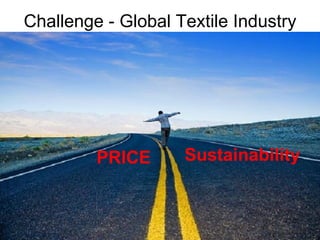
Challenge - Global Textile Industry PRICE Sustainability
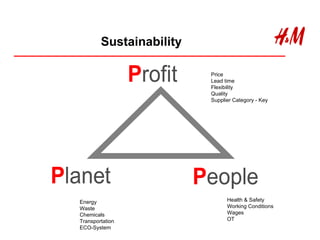
Price  Lead time  Flexibility  Quality  Supplier Category - Key Energy  Waste  Chemicals  Transportation  ECO-System  Health & Safety Working Conditions  Wages OT Sustainability
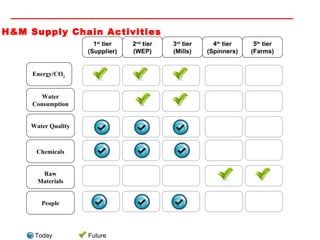
H&M Supply Chain Activities 1 st  tier (Supplier) 2 nd  tier (WEP) 3 rd  tier (Mills) 4 th  tier (Spinners) 5 th  tier (Farms) Energy/CO 2  Water Consumption Water Quality Chemicals Raw Materials People Today Future
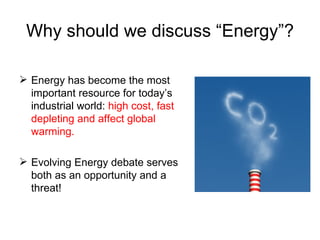
Why should we discuss “Energy”? Energy has become the most important resource for today’s industrial world:  high cost, fast depleting and affect global warming. Evolving Energy debate serves both as an opportunity and a  threat!
Opportunity Reap benefits by reducing costs Compete in the Global market
Threat Customers want to buy a “Carbon Neutral” garment. Keen to know if the garment comes from an “environmental and socially responsible manufacturer” If India does not change   LOOSE TO OTHER COUNTRIES
Some Facts –  ARRPEEC   ( Asian Regional Research Program in Energy Environment and Climate ) Average energy use in Indian textile industry One kg of yarn - 3 to 3.5 kWh of electricity Weave one meter fabric - 2.9 to 3.1 kWh Knit one kg of fabric 0.09 to 0.2 kWh Dye one kg of fabric 0.04 to 0.15 kWh  Steam consumption in a fabric dyeing unit may vary from 4 to 9 kg of steam per kg of fabric SMEs in Indian textile industry have a potential to save  15 to 20% of their energy consumption !!!
Factors for Energy Conservation High capacity utilization Fine tuning of equipment Technology up gradation
How To Do So? SAVE ENERGY!!!

H & M- Energy Efficiency Workshop - Bangalore

  • 1.
    Energy Efficiency and Carbon Responsibility
  • 2.
    Challenge - GlobalTextile Industry PRICE Sustainability
  • 3.
    Price Leadtime Flexibility Quality Supplier Category - Key Energy Waste Chemicals Transportation ECO-System Health & Safety Working Conditions Wages OT Sustainability
  • 4.
    H&M Supply ChainActivities 1 st tier (Supplier) 2 nd tier (WEP) 3 rd tier (Mills) 4 th tier (Spinners) 5 th tier (Farms) Energy/CO 2 Water Consumption Water Quality Chemicals Raw Materials People Today Future
  • 5.
    Why should wediscuss “Energy”? Energy has become the most important resource for today’s industrial world: high cost, fast depleting and affect global warming. Evolving Energy debate serves both as an opportunity and a threat!
  • 6.
    Opportunity Reap benefitsby reducing costs Compete in the Global market
  • 7.
    Threat Customers wantto buy a “Carbon Neutral” garment. Keen to know if the garment comes from an “environmental and socially responsible manufacturer” If India does not change LOOSE TO OTHER COUNTRIES
  • 8.
    Some Facts – ARRPEEC ( Asian Regional Research Program in Energy Environment and Climate ) Average energy use in Indian textile industry One kg of yarn - 3 to 3.5 kWh of electricity Weave one meter fabric - 2.9 to 3.1 kWh Knit one kg of fabric 0.09 to 0.2 kWh Dye one kg of fabric 0.04 to 0.15 kWh Steam consumption in a fabric dyeing unit may vary from 4 to 9 kg of steam per kg of fabric SMEs in Indian textile industry have a potential to save 15 to 20% of their energy consumption !!!
  • 9.
    Factors for EnergyConservation High capacity utilization Fine tuning of equipment Technology up gradation
  • 10.
    How To DoSo? SAVE ENERGY!!!

Editor's Notes

  • #3 Textile industry is facing the challenge to withstand the price competitiveness and the growing the demands of CSR. We expect a fine balance between these two factors, Price and CSR. To have a better price CSR should not be compromised.
  • #7 Low-cost - a low carbon foot print means lower consumption of energy & more efficient use of energy giving scope for cutting costs by reducing waste of raw materials and energy. Firms are looking for long term horizon they need to embark on green paradigm. Being ahead of regulatory curse reduces the risk of supply chain disruptions at a future date Consumer increasingly demanding environmental stewardship by the manufacturers and suppliers of goods and services by taking into account life cycle approach.
  • #10 1. Both man and machine Reducing Energy Consumption & Installing Energy Management Systems Opting of renewable energy solutions to meet energy requirements Reducing inputs, rejections etc. 2. Increase the machine efficiency. 3. Look for ROI, an investment – if we have the right mindset, today’s expenditure is an investment for tommorrow.