Downloaded 15 times



![Figure 2
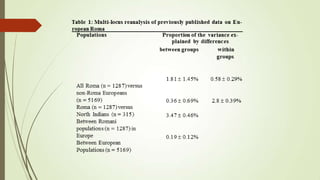
Multilocus comparison between Romani populations from different European countries, autochthonous Euro- pean
populations and populations from north India The polymorphic systems included in the analysis comprised
A1A2BO, MN, haptoglobin and Rh (CDE), with a total of 11 independent alleles. Information on these markers was available
for the Roma in Slovakia (n = 350) [26], Hungary (n = 507) [11], England (n = 109) [23], Slovenia (n = 350) [27], Sweden (n
=
115) [24] and Wales (n = 84) [22], for non-Roma Europeans (n = 5169) and for two north Indian populations, Rajput (n = 175)
[34,35] and Punjabi (n = 140) [35,36]. Genetic distances between pairs of populations were computed by means of Reynold's
coancenstry coefficient [84] and displayed as a neighbour-joining tree [85]. The robustness of the branches in the tree
was
assessed with a bootstrap approach [86]. The analysis was conducted using the PHYLIP 3.57c package [87].](https://image.slidesharecdn.com/gypsies-130913115333-phpapp01/85/Gypsies-10-320.jpg)
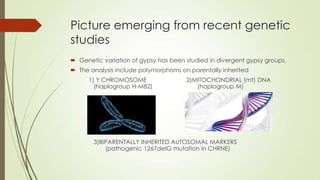
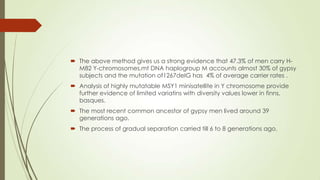
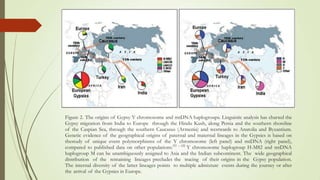
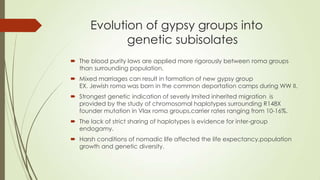
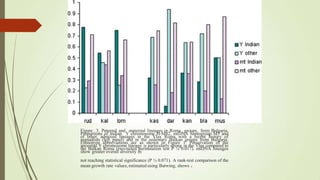
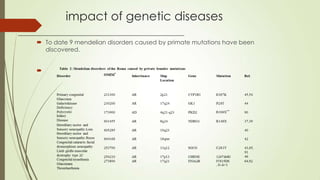
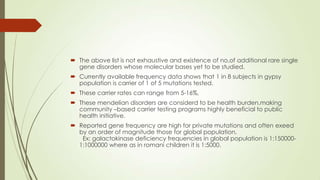
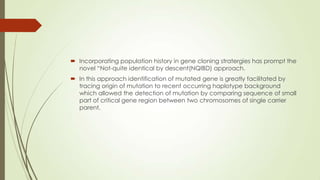



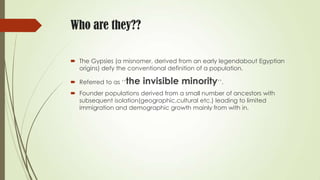
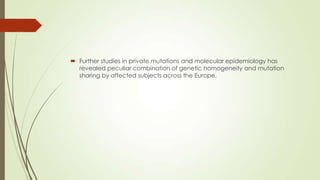
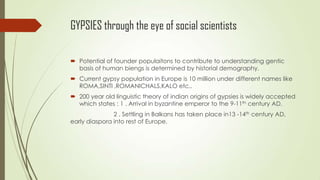
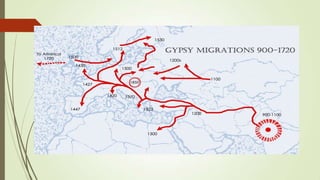
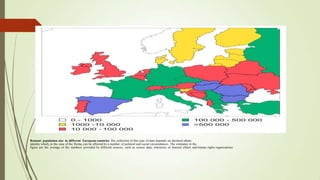
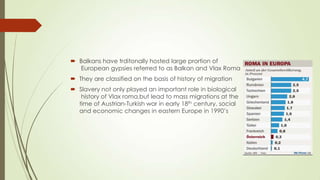
Genetic studies of Romani populations (Gypsies) in Europe have provided insights into their origins and population history. Y-chromosome and mitochondrial DNA analyses indicate Romani paternal and maternal lineages originated in South Asia, likely arriving in Europe between the 9th-15th centuries AD. Subsequent isolation and endogamy led to reduced genetic diversity and increased frequencies of disease-causing mutations inherited from a small number of founding ancestors. At least 9 Mendelian disorders have been identified through private mutations shared across European Romani communities. Future studies incorporating Romani culture and history can improve understanding of their population genetics and help design public health programs.


![Senior Project Presentation[1]](https://cdn.slidesharecdn.com/ss_thumbnails/seniorprojectpresentation1-1277311111436-phpapp02-thumbnail.jpg?width=640&height=640&fit=bounds)


![5G Explained! A High Level Overview [Introduction]](https://cdn.slidesharecdn.com/ss_thumbnails/5gexplainedahighleveloverview-260119165306-cc137a3e-thumbnail.jpg?width=640&height=640&fit=bounds)


