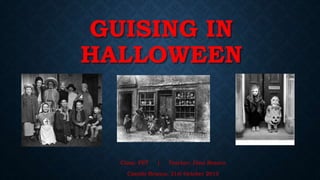
GUISING IN
HALLOWEEN
Class: PET | Teacher: Dina Branco
Castelo Branco, 31st October 2015
guising
1. (Theatre) (in Scotland and Northern England)
the practice or custom of disguising oneself in
fancy dress, often with a mask, and visiting
people's houses, especially at Halloween.
http://www.collinsdictionary.com/dictionary/english/guising
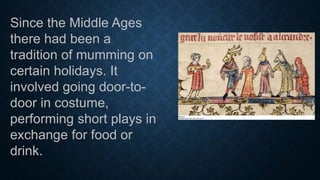
Since the Middle Ages
there had been a
tradition of mumming on
certain holidays. It
involved going door-to-
door in costume,
performing short plays in
exchange for food or
drink.
The custom of trick-or-treating at Halloween may
come from the belief that supernatural beings, or
the souls of the dead, roamed the earth at this
time and needed to be appeased.
The wearing of costumes, or "guising", at
Hallowmas (All Saints), had been recorded in
Scotland in the 16th century and was later
recorded in other parts of Britain and Ireland.
There are many references to mumming,
guising or souling at Halloween in Britain and
Ireland during the late 18th century and the
19th century.
In parts of southern Ireland, a man
dressed as a Láir Bhán (white mare) led
youths house-to-house reciting verses—
some of which had pagan overtones—in
exchange for food. If the household
donated food it could expect good
fortune from the 'Muck Olla'; not doing so
would bring misfortune.
According to one 19th century English writer
"parties of children, dressed up in fantastic
costume […] went round to the farm houses and
cottages, signing a song
song, and begging for
cakes (spoken of as
"soal-cakes"), apples,
money, or anything
that the goodwives
would give them".
Guising at Halloween in Scotland is recorded in
1895, where masqueraders in disguise carrying
lanterns made out of scooped out turnips, visit
homes to be rewarded with cakes, fruit and money.
The practice of Guising at Halloween in North
America is first recorded in 1911, where a
newspaper in Kingston, Ontario reported children
going "guising" around the neighborhood
http://www.collinsdictionary.com/dictionary/english/guising
http://www.todayifoundout.com/index.php/2012/10/how-the-tradition-of-trick-or-treating-got-started/
https://en.wikipedia.org/wiki/Trick-or-treating
http://www.history.com/topics/halloween/history-of-trick-or-treating

Guising in Halloween

  • 1.
    GUISING IN HALLOWEEN Class: PET| Teacher: Dina Branco Castelo Branco, 31st October 2015
  • 2.
    guising 1. (Theatre) (inScotland and Northern England) the practice or custom of disguising oneself in fancy dress, often with a mask, and visiting people's houses, especially at Halloween. http://www.collinsdictionary.com/dictionary/english/guising
  • 3.
    Since the MiddleAges there had been a tradition of mumming on certain holidays. It involved going door-to- door in costume, performing short plays in exchange for food or drink.
  • 4.
    The custom oftrick-or-treating at Halloween may come from the belief that supernatural beings, or the souls of the dead, roamed the earth at this time and needed to be appeased.
  • 5.
    The wearing ofcostumes, or "guising", at Hallowmas (All Saints), had been recorded in Scotland in the 16th century and was later recorded in other parts of Britain and Ireland. There are many references to mumming, guising or souling at Halloween in Britain and Ireland during the late 18th century and the 19th century.
  • 6.
    In parts ofsouthern Ireland, a man dressed as a Láir Bhán (white mare) led youths house-to-house reciting verses— some of which had pagan overtones—in exchange for food. If the household donated food it could expect good fortune from the 'Muck Olla'; not doing so would bring misfortune.
  • 8.
    According to one19th century English writer "parties of children, dressed up in fantastic costume […] went round to the farm houses and cottages, signing a song song, and begging for cakes (spoken of as "soal-cakes"), apples, money, or anything that the goodwives would give them".
  • 9.
    Guising at Halloweenin Scotland is recorded in 1895, where masqueraders in disguise carrying lanterns made out of scooped out turnips, visit homes to be rewarded with cakes, fruit and money. The practice of Guising at Halloween in North America is first recorded in 1911, where a newspaper in Kingston, Ontario reported children going "guising" around the neighborhood
  • 11.