Hamburg3
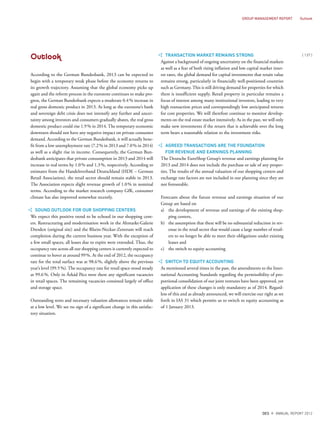
feelestate.de
ANNUAL REPORT
12
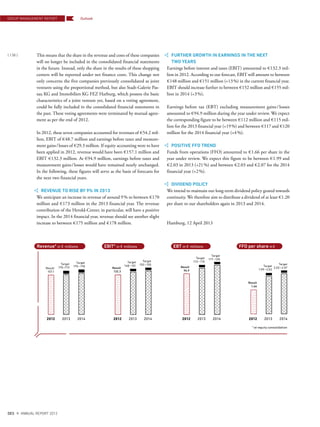
*at-equity consolidation
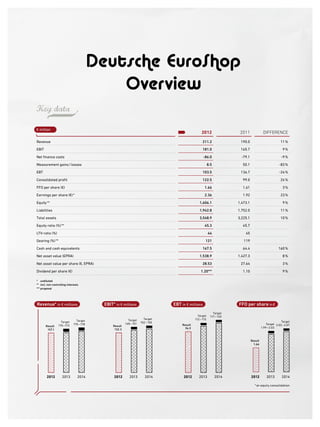
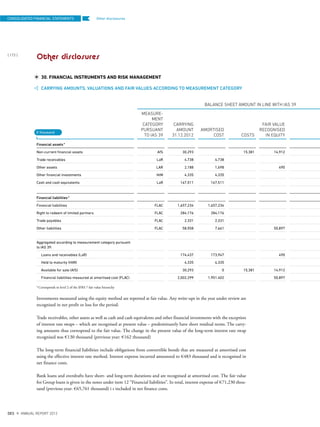
Revenue* in € millions
2012 2013 2014
Result
157.1
Target
170–173
Target
175–178
EBIT* in € millions
2012 2013 2014
Result
132.3
Target
148–151
Target
152–155
EBT in € millions FFO per share in€
2012 2013 2014
Result
1.66
Target
1.99–2.03
Target
2.03–2.07
Key data
2012 2013 2014
Result
94.9
Target
112–115
Target
117–120
Deutsche EuroShop
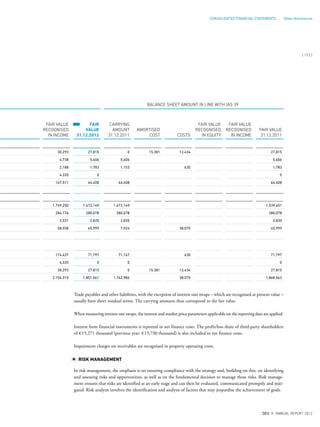
Overview
2012 2011 DIFFERENCE
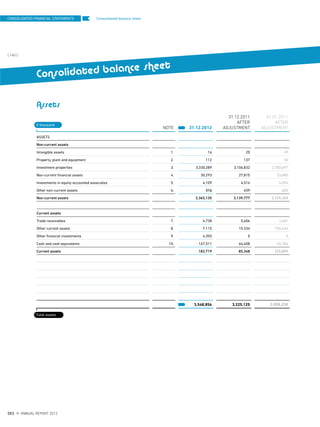
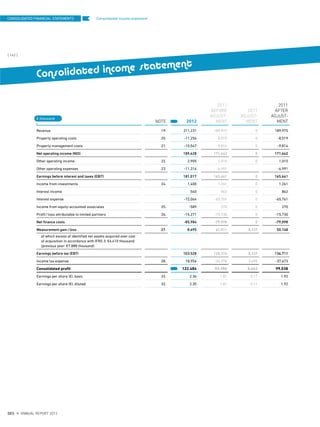
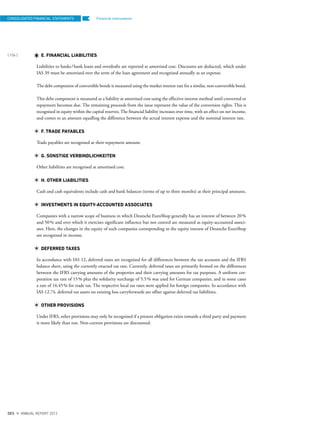
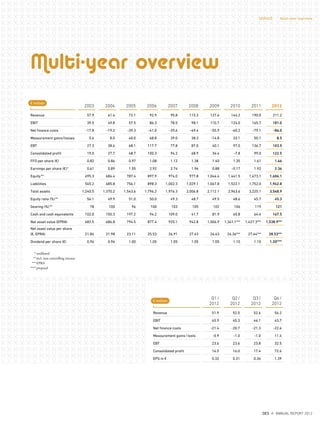
Revenue 211.2 190.0 11%
EBIT 181.0 165.7 9%
Net finance costs -86.0 -79.1 -9%
Measurement gains/losses 8.5 50.1 -83%
EBT 103.5 136.7 -24%
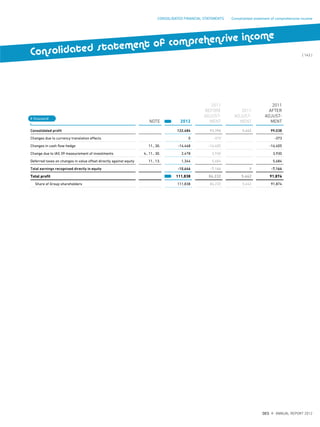
Consolidated profit 122.5 99.0 24%
FFO per share (€) 1.66 1.61 3%
Earnings per share (€)* 2.36 1.92 23%
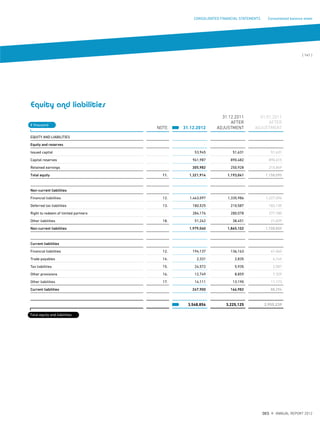
Equity** 1,606.1 1,473.1 9%
Liabilities 1,942.8 1,752.0 11%
Total assets 3,548.9 3,225.1 10%
Equity ratio (%)** 45.3 45.7
LTV-ratio (%) 44 45
Gearing (%)** 121 119
Cash and cash equivalents 167.5 64.4 160%
Net asset value (EPRA) 1,538.9 1,427.3 8%
Net asset value per share (€, EPRA) 28.53 27.64 3%
Dividend per share (€) 1.20*** 1.10 9%
€ million
* undiluted
** incl. non controlling interests
*** proposal
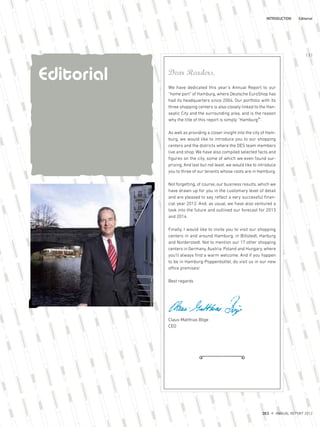
Dear Readers,
We have dedicated this year’s Annual Report to our
“home port” of Hamburg, where Deutsche EuroShop has
had its headquarters since 2004. Our portfolio with its
three shopping centers is also closely linked to the Han-
seatic City and the surrounding area, and is the reason
why the title of this report is simply “Hamburg³”.
As well as providing a closer insight into the city of Ham-
burg, we would like to introduce you to our shopping
centers and the districts where the DES team members
live and shop. We have also compiled selected facts and
figures on the city, some of which we even found sur-
prising. And last but not least, we would like to introduce
you to three of our tenants whose roots are in Hamburg.
Not forgetting, of course, our business results, which we
have drawn up for you in the customary level of detail
and are pleased to say reflect a very successful finan-
cial year 2012. And, as usual, we have also ventured a
look into the future and outlined our forecast for 2013
and 2014.
Finally, I would like to invite you to visit our shopping
centers in and around Hamburg, in Billstedt, Harburg
and Norderstedt. Not to mention our 17 other shopping
centers in Germany, Austria, Poland and Hungary, where
you’ll always find a warm welcome. And if you happen
to be in Hamburg-Poppenbüttel, do visit us in our new
office premises!
Best regards
Claus-Matthias Böge
CEO
INTRODUCTION Editorial
Editorial
DES ANNUAL REPORT 2012
{ 3 }
Deutsche EuroShop
2012
The
Hamburg
Edition
DES ANNUAL REPORT 2012
{ 4 }
THE CENTERS 48
Our Portfolio 48
Activities in the centers 56
Tenant profiles 58
Sustainable? We always have been! 60
Electric car charging station
in Billstedt 64
Hamburg as european green capital 66
Portfolio 70
Our shopping centers in and around
Hamburg 73
The centers 74
INVESTOR RELATIONS 98
The shopping center share 98
Interesting facts about shareholders of
Deutsche EuroShop 106
Conferences and roadshows 108
10 reasons to invest in the share 109
Marketing 110
Annual general meeting 112
Corporate governance 114
GROUP MANAGEMENT REPORT 119
CONSOLIDATED
FINANCIAL STATEMENTS 139
SERVICE 184
Glossary 184
Financial calendar 186
Index 187
Imprint 188
Multi-year overview 189
INTRODUCTION 2
Key data 2
Editorial 3
Our values, our goals 6
Highlights 2012 6
Interview with the Executive Board 8
Report of the Supervisory Board 14
SHOPPING 20
Consumption 2013 20
Hamburg in figures 26
Hamburg’s famous markets 28
Hamburg – novels and films 30
What the customer really wants 32
”Future labs“ 34
Hamburg facts 36
My Hamburg – Members of the DES
team present the districts they live in 38
What I bought in 2012 46
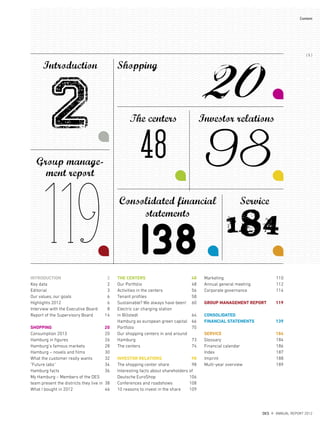
Introduction
Group manage-
ment report
Shopping
Service
2
119
48
The centers Investor relations
20
98Consolidated financial
statements
184138
DES ANNUAL REPORT 2012
{ 5 }
Content
Our values
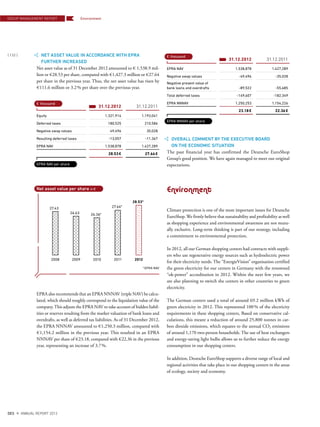
We are the only public company in Germany that invests solely
in shopping centers in prime locations. We invest only in care-
fully chosen properties. High quality standards and a high degree
of flexibility are just as important to us as sustained earnings
growth from index- and turnover-linked rental contracts. In addi-
tion, we boast a higher than average occupancy rate of around
99% and professional center management – these are the
pillars of our success.
Our goals
Deutsche EuroShop does not seek short-term success, but rather
the stable increase in the value of our portfolio. Our objective is to
generate a sustainably high surplus liquidity from the longterm
leasing of our shopping centers to distribute an attractive divi-
dend to our shareholders every year. In order to achieve this, we
shall acquire further prime properties and hence establish our-
selves as one of the largest companies in Europe focusing on
retail properties.
June
Annual General Meeting
Distribution of a dividend of €1.10 per share
September
40th anniversary of Rhein-Neckar-Zentrum,
Viernheim
10th anniversary of City-Point, Kassel
October
5th anniversary of Galeria Baltycka, Gdansk
10th anniversary of Altmarkt-Galerie, Dresden
November
Placement of 2,314,136 new shares from an
increase in the share capital with institutional
investors
Convertible bonds with a maturity of five years
and a total principal amount of €100 million
were placed with qualified investors
Acquisition of Herold-Center, Norderstedt
35th anniversary of Billstedt-Center, Hamburg
Highlights 2012
DES ANNUAL REPORT 2012
{ 6 }
Our values, our goals/Highlights 2012
Schon wieder
geblitzt worden.
„Don't put the rod down just because
you haven't had a bite yet.”
“
Interview with the Executive Board
{ 8 }
Interview with the Executive Board
Deutsche EuroShop just finished restructuring.
What happened?
CLAUS-MATTHIAS BÖGE: We reacted to a surprising ruling
from the German Federal Fiscal Court (Bundesfinanzhof) and
restructured the Deutsche EuroShop Group in such a way that,
in future, we will be able to take advantage of the “extended trade
tax deduction” for at least a portion of our shopping center port-
folio in Germany.
We’re working on sustainably optimising this situation; however,
that’s an undertaking that will take several years. It was and
remains highly complex – unfortunately something German tax
law is known for.
OLAF BORKERS: One positive effect of this restructuring was
that we were able to release €49.3 million in deferred trade tax
provisions created during the previous years.
While we’re on the positive aspects, were you also able
to secure growth?
CLAUS-MATTHIAS BÖGE: Yes, we acquired the Herold-
Center in Norderstedt just before the end of the year. The invest-
ment volume is around €187 million, the initial rate of return
about 6.1% – certainly an attractive return on a popular shop-
ping center market.
?
?
ONE KEY QUALITY OF SUCCESS-
FUL RETAILERS IS THEIR WILL-
INGNESS TO CHANGE. EVERY
TRADER KNOWS THE RETAIL
TRADE NEVER STANDS STILL. IN
2012, VERSATILITY WAS CALLED
FOR FROM DEUTSCHE EUROSHOP,
TOO. NOT FROM AN OPERA-
TIONAL PERSPECTIVE, BUT A TAX
ONE. DESPITE THE FACT THAT
THE GROUP’S RESTRUCTURING
PUT A HEAVY STRAIN ON CAPACI-
TIES, THE TWO MEMBERS OF
THE EXECUTIVE BOARD, CLAUS-
MATTHIAS BÖGE AND OLAF
BORKERS, WERE ABLE TO CON-
TINUE DRIVING THE COMPANY’S
GROWTH FORWARD. READ ABOUT
HOW THE INDIVIDUAL ISSUES
WERE HANDLED IN THE INTER-
VIEW WITH THE EXECUTIVE
BOARD.
3
DES ANNUAL REPORT 2012
{ 9 }
Interview with the Executive Board
OLAF BORKERS: Our portfolio now comprises 20 shopping
centers with a market value of €3.8 billion. Built on two lev-
els, with a retail space of around 26,000 m2
, the Herold-Center
houses some 130 specialist outlets, all of which are let. The
center was opened in 1971 and most recently expanded in 2003.
Did you explore new avenues with regard to external
financing this time?
OLAF BORKERS: Yes we did. We issued a our very first con-
vertible bond. In doing so we secured financing in the amount of
€100 million for a five-year period at an interest rate of 1.75%.
That’s a good rate for us, yet at the same time attractive for bond
investors who expect DES share prices to rise.
CLAUS-MATTHIAS BÖGE: A small capital increase also
brought €67.7 million in equity.
Why were private shareholders excluded from partici-
pating in the capital increase?
CLAUS-MATTHIAS BÖGE: I’ve said many times in the past
that we prefer to carry out capital increases with subscrip-
tion rights for our many loyal private shareholders, as we most
recently did twice in 2010.
However, there’s been a change in the Wertpapierprospektgesetz
(German Securities Prospectus Act). A general securities pro-
spectus requirement has been in effect since July 2012, also
for the type of rights issue we liked to work with. Since it takes
several weeks to draw up a prospectus, the delay that entails
as well as the uncertain outcome in a changing capital market
environment could become a deal breaker during the purchase
process. That’s something we’d like to avoid. Plus drawing up a
prospectus is extremely expensive.
We only issued around 2.3 million shares in November and chose
the quick accelerated book building process to do this. Unfortu-
nately when using this process, one which places new shares
close to the stock market price, only “qualified investors” can be
approached, generally institutional investors, and subscription
rights must be excluded for shareholders.
Ultimately, though, we were very pleased that both measures
were well received on the capital market despite the fact that we
were still an unknown quantity for the bond market. The good
track record we’ve now been able to establish here, too, should
prove beneficial if we ever decide to repeat the move.
?
?
But you’ll also continue to rely on classical forms of
external financing?
OLAF BORKERS: Absolutely! We took advantage of favour-
able financing terms for Deutsche EuroShop and were able to
reduce the average interest rate of our liabilities from 4.59% to
4.1%, or in other words by 43 basis points.
?
DES ANNUAL REPORT 2012
{ 10 }
Interview with the Executive Board
That all sounds great. How were operations?
CLAUS-MATTHIAS BÖGE: Good, as always, according to plan.
To be more precise: We projected between €207 million and
€211 million in revenue and in the end generated €211.2 million.
We were especially pleased with revenue trends at the Main-Tau-
nus-Zentrum, the Altmarkt-Galerie Dresden and the A10 Center,
where extensions had been opened up during the previous year.
Earnings before interest and taxes (EBIT) were projected at
between €177 million and €181 million. A 9% increase to €181.0
million put us at the upper end of that range.
We always plan earnings before taxes (EBT) without measure-
ment gains/losses and were expecting a figure of between
€90 million and €93 million. Over the course of the year we
raised our forecast from €94 to 97 million and, with a result of
€95.9 million, our corridor was extremely accurate.
Originally we predicted that funds from operations, FFO for short,
would fall within the €1.64 to €1.68 range per share. As the year
progressed we adjusted our forecast here, too, and raised this
range to €1.70 to €1.74 per share. In the end we came in at €1.66,
right in the middle of the original forecast.
OLAF BORKERS: I’m sure you’d like to hear more on the
background to that. One-off fees in the form of prepayment
compensation and tax payments were incurred in connection
? with both the refinancing of the Main-Taunus-Zentrum and the
restructuring of the Group, which reduced the FFO by €0.16 per
share. Adjusted for these effects, the FFO would have been €1.82
per share and, in that case, we would have significantly exceeded
our forecasts.
Some people regard the measurement gain as surpris-
ingly low. What were the reasons behind that?
OLAF BORKERS: There was a measurement gain of €8.5 mil-
lion. Our Hungarian shopping center in Pécs, which represents
around 1% of our investment properties, was depreciated by
about 16% as a precautionary measure. The value of the Main-
Taunus-Zentrum, on the other hand, was increased by 8% after
the expansion was well received by customers. Those were the
anomalies. Changes in the market values of the other properties
remained within a very narrow corridor of between -1.9 to +3.4%.
CLAUS-MATTHIAS BÖGE: Internally we had expected the
measurement gain/loss to zero out. In fact it’s impossible to
predict the myriad of effects which include interest rate move-
ments, real estate market and tenant risk as well as some
150 other factors, something we stress over and over again.
Anyway, the only thing that counts for us is the cash we influ-
ence through our business decisions and can distribute as a divi-
dend. Since we aren’t planning to sell our portfolio of shopping
centers, the annual measurement gain or loss isn’t very mean-
ingful for us.
?
“GOOD, AS
ALWAYS,
ACCORDING TO
PLAN.”
3
Interview with the Executive Board
DES ANNUAL REPORT 2012
{ 11 }
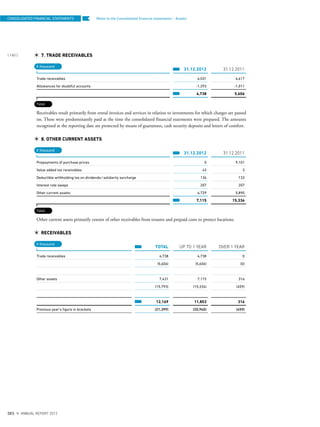
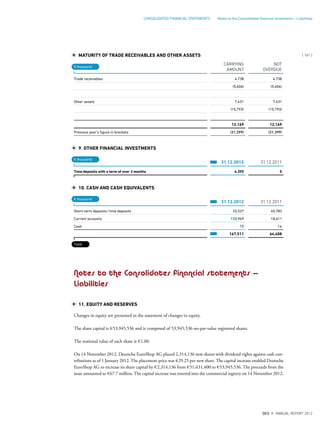
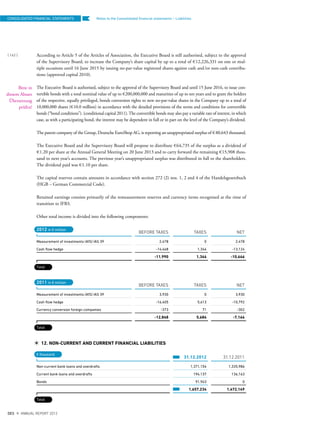
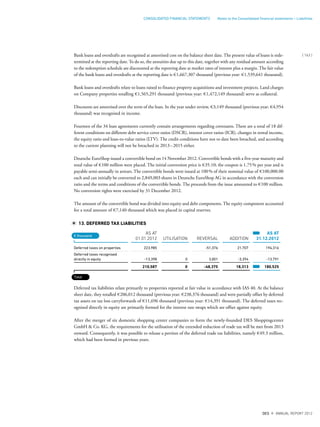
However if you expect a measurement gain based on the most
recently conducted center transactions, you’re failing to consider
the fact that our experts don’t use a mark-to-market but a dis-
counted cash flow method. Since shopping centers are hard to
compare, I also consider that the better approach.
How will shareholders participate in the Group’s
renewed set of good results?
CLAUS-MATTHIAS BÖGE: With a dividend that’s been
increased to €1.20 per share. At least that’s going to be our pro-
posal at the Annual General Meeting. We’ve always promised
our shareholders that the most recently paid dividend will be the
minimum amount for future distributions. So far, these distribu-
tions – at least for our long-standing shareholders – have been
entirely tax free. That’s changing now: For the first time, €0.31
per share of the 2012 dividend is subject to capital gains with-
holding tax. That means that 31 cents of the dividend are sub-
ject to taxes totalling 26.37% (25% flat-rate withholding tax plus
5.5% solidarity surcharge) or, in other words, a little over 8 cents.
A 10-cent raise in the dividend more than evens out this effect
so that, in the end, our shareholders are not receiving any less.
Could you briefly explain why the 2013 forecast shows a
dip in revenue and EBIT?
CLAUS-MATTHIAS BÖGE: That’s due to the changes to IFRS
accounting standards announced last year, which prohibit the use
ofproportionalconsolidationinthefuture.Whilethischangemeans
decreased transparency in the presentation of results, it doesn’t
actually change results. We’re not the only ones affected by this
change; all companies that used to include subsidiaries on a pro-
portional basis in consolidated financial statements are affected.
Yet ultimately it doesn’t change a thing because, in the income
statement, the results of the investees are accounted for in the
net finance costs as income from investments. That means that
these IFRS amendments only visually impact the revenue and
EBIT in our forecast, while both the EBT and FFO remain practi-
cally unchanged.
?
?
Can you tell us a bit about your forecasts for 2013 and
2014?
OLAF BORKERS: Things continue to improve. During the cur-
rent financial year we anticipate our rental income, recognised
as revenue, to rise 9% from €170 million to €173 million. Next
year this figure could be between €175 million and €178 million.
Our outlook for 2013 predicts that EBIT of between €148 million
and €151 million, which corresponds to an increase of 13%, and
another 3% increase to between €152 million and €155 million
in 2014. We anticipate that our earnings before taxes exclud-
ing measurement gains/losses will rise by 19% to between
€112 million and €115 million with another 4% increase to
between €117 million and €120 million expected next year.
After the one-off effects recognised in 2012, the jump in funds
from operations (FFO) is particularly impressive. For 2013 we
anticipate an increase of 21% to between €1.99 and €2.03 per
share. That will return to normal in 2014, when we predict a two-
percent increase to between €2.03 and €2.07.
In light of all of these predictions, we anticipate stable business
without any surprises and, as always, we have not planned in
any acquisitions.
No acquisitions?
CLAUS-MATTHIAS BÖGE: We’re still ready to seize attrac-
tive opportunities as they arise. But patience is a virtue – just like
when you’re fishing. I had more opportunities to go fishing as a
child than I do now but that experience also helps me in my pro-
fessional life. Incidentally, in Low German we have a saying which
roughly translates to: “Don’t put the rod down just because you
haven’t had a bite. Because eventually, you will.”
Thank you for talking to us.
?
?
“OUR PORTFOLIO NOW COM-
PRISES 20 SHOPPING CENTERS
WITH A MARKET VALUE OF
€3.8 BILLION.”
DES ANNUAL REPORT 2012
{ 12 }
Interview with the Executive Board
..
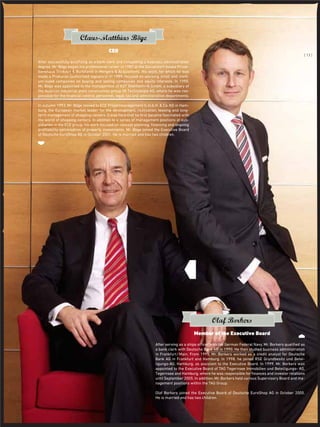
After serving as a ships officer with the German Federal Navy, Mr. Borkers qualified as
a bank clerk with Deutsche Bank AG in 1990. He then studied business administration
in Frankfurt/Main. From 1995, Mr. Borkers worked as a credit analyst for Deutsche
Bank AG in Frankfurt and Hamburg. In 1998, he joined RSE Grundbesitz und Betei-
ligungs-AG, Hamburg, as assistant to the Executive Board. In 1999, Mr. Borkers was
appointed to the Executive Board of TAG Tegernsee Immobilien und Beteiligungs- AG,
Tegernsee and Hamburg, where he was responsible for finances and investor relations
until September 2005. In addition, Mr. Borkers held various Supervisory Board and ma-
nagement positions within the TAG Group.
Olaf Borkers joined the Executive Board of Deutsche EuroShop AG in October 2005.
He is married and has two children.
Olaf Borkers
Member of the Executive Board
After successfully qualifying as a bank clerk and completing a business administration
degree, Mr. Böge began his professional career in 1987 at the Düsseldorf-based Privat-
bankhaus Trinkaus & Burkhardt in Mergers & Acquisitions. His work, for which he was
made a Prokurist (authorised signatory) in 1989, focused on advising small and medi-
um-sized companies on buying and selling companies and equity interests. In 1990,
Mr. Böge was appointed to the management of KST Stahltechnik GmbH, a subsidiary of
the Austrian industrial plant construction group VA Technologie AG, where he was res-
ponsible for the financial control, personnel, legal, tax and administration departments.
In autumn 1993, Mr. Böge moved to ECE Projektmanagement G.m.b.H. & Co. KG in Ham-
burg, the European market leader for the development, realisation, leasing and long-
term management of shopping centers. It was here that he first became fascinated with
the world of shopping centers. In addition to a series of management positions at sub-
sidiaries in the ECE group, his work focused on concept planning, financing and ongoing
profitability optimisation of property investments. Mr. Böge joined the Executive Board
of Deutsche EuroShop AG in October 2001. He is married and has two children.
Claus-Matthias Böge
CEO
..
{ 13 }
Report of the
Supervisory Board
Federal Fiscal Court (Bundesfinanzhof) regarding the extended
trade tax deduction, were the subject of particularly intense dis-
cussions during the financial year.
Regular discussions were conducted with the Executive Board
regarding trends on the capital, credit, real estate and retail mar-
kets and the effects of these on the Company’s strategy. The
Executive Board and Supervisory Board also examined various
investment options. We received regular reports detailing the
turnover trends and payment patterns of our tenants and the
credit policies of the banks.
The Chairman of the Supervisory Board and the Executive Com-
mittee of the Supervisory Board also discussed other topical
issues with the Executive Board as required. Transactions requir-
ing the approval of the Supervisory Board were discussed and
resolved upon at the scheduled meetings. In addition, for trans-
actions of the Executive Board requiring approval, circular res-
olutions were passed in writing by the Supervisory Board. All
resolutions in the reporting period were passed unanimously.
MEETINGS
Five scheduled Supervisory Board meetings took place during
financial year 2012. The only absences were recorded at the con-
stituent meeting on 21 June 2012; in this case, three members
of the Supervisory Board were excused from attending. They
granted voting proxies prior to the meeting.
Dear Shareholders,
During financial year 2012, the Supervisory Board performed the
duties incumbent on it according to the law and the Articles of
Association and closely followed the performance of Deutsche
EuroShop AG. The strategic orientation of the Company was coor-
dinated with the Supervisory Board, and the status of the strategy
implementation was discussed at regular intervals. The Super-
visory Board monitored and advised the Executive Board on its
management of the business, and the Executive Board informed
us regularly, promptly and in detail of business developments.
FOCUS OF ADVISORY ACTIVITIES
We examined the Company’s net assets, financial position and
results of operations, as well as its risk management, regularly
and in detail. In this context, we checked that the formal con-
ditions for implementing an efficient system of monitoring our
Company were met and that the means of supervision at our
disposal were effective.
We were informed on an ongoing basis of all significant factors
affecting the business.
We considered the development of the portfolio properties, spe-
cifically their turnover trends, the accounts receivable and occu-
pancy rates as well as the Company’s liquidity position. The Exec-
utive Board’s plans to restructure the Group, which, according
to an assessment by the Executive Board and the Supervisory
Board, became necessary following the ruling by the German
DES ANNUAL REPORT 2012
{ 14 }
Report of the Supervisory Board
At the first scheduled meeting, on 26 April 2012, the Super-
visory Board’s annual review of efficiency was completed and
the agenda for the Annual General Meeting was approved. We
selected the auditor, who was proposed to the shareholders for
election. In relation to the audit of the annual financial state-
ments, we once again attached great importance to the explana-
tions of the Executive Board and those of the auditor on the real
estate appraisals. In addition, the Executive Board explained the
possibilities opened up by corporate restructuring and the tax
impact on the Group. The Executive Board also reported on the
conclusion of the expansion of Main-Taunus-Zentrum, the acqui-
sition of the remaining shares in the Rathaus-Center in Dessau
and various refinancing negotiations. Explanations regarding the
occupancy situation focused on the office space in the expanded
Altmarkt-Galerie in Dresden. The Executive Board also presented
the option of purchasing a shopping center in Poland.
At the meeting held on 21 June 2012 prior to the Annual
General Meeting, the Executive Board reported on refinancing
agreements implemented as well as the occupancy situation at
the shopping center in Pécs, Hungary, in particular. The Execu-
tive Board informed us of the latest insights regarding Group
restructuring, given that the concept will soon be ready to sub-
mit for a decision, and presented the possibility of acquiring the
Herold-Center in Norderstedt.
One focus of this meeting was also the planned enlargement of
our Supervisory Board in light of changes to the requirements
of the Corporate Governance Code. We discussed the planned
enlargement and composition of the Supervisory Board as well
as the various functions in the committees.
At the constituent meeting on 21 June 2012 following the
Annual General Meeting, we elected members by open ballot to
various functions on the Supervisory Board and its committees.
The election was suspended pending the legally valid amend-
ment to the Articles of Association to enlarge the Supervisory
Board. It was then held on 13 July 2012.
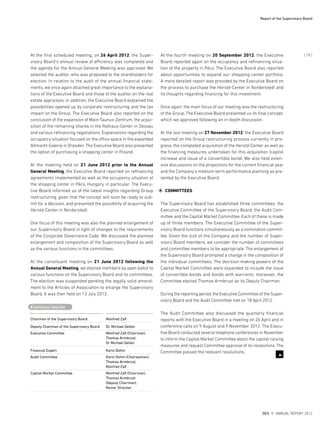
Chairman of the Supervisory Board Manfred Zaß
Deputy Chairman of the Supervisory Board Dr. Michael Gellen
Executive Committee Manfred Zaß (Chairman),
Thomas Armbrust,
Dr Michael Gellen
Financial Expert Karin Dohm
Audit Committee Karin Dohm (Chairwoman),
Thomas Armbrust,
Manfred Zaß
Capital Market Committee Manfred Zaß (Chairman),
Thomas Armbrust
(Deputy Chairman),
Reiner Strecker
Elections results
At the fourth meeting on 20 September 2012, the Executive
Board reported again on the occupancy and refinancing situa-
tion of the property in Pécs. The Executive Board also reported
about opportunities to expand our shopping center portfolio.
A more detailed report was provided by the Executive Board on
the process to purchase the Herold-Center in Norderstedt and
its thoughts regarding financing for this investment.
Once again, the main focus of our meeting was the restructuring
of the Group. The Executive Board presented us its final concept,
which we approved following an in-depth discussion.
At the last meeting on 27 November 2012, the Executive Board
reported on the Group restructuring process currently in pro-
gress, the completed acquisition of the Herold-Center as well as
the financing measures undertaken for this acquisition (capital
increase and issue of a convertible bond). We also held exten-
sive discussions on the projections for the current financial year
and the Company’s medium-term performance planning as pre-
sented by the Executive Board.
COMMITTEES
The Supervisory Board has established three committees: the
Executive Committee of the Supervisory Board, the Audit Com-
mittee and the Capital Market Committee. Each of these is made
up of three members. The Executive Committee of the Super-
visory Board functions simultaneously as a nomination commit-
tee. Given the size of the Company and the number of Super-
visory Board members, we consider the number of committees
and committee members to be appropriate. The enlargement of
the Supervisory Board prompted a change in the composition of
the individual committees. The decision-making powers of the
Capital Market Committee were expanded to include the issue
of convertible bonds and bonds with warrants; moreover, the
Committee elected Thomas Armbrust as its Deputy Chairman.
During the reporting period, the Executive Committee of the Super-
visory Board and the Audit Committee met on 18 April 2012.
The Audit Committee also discussed the quarterly financial
reports with the Executive Board in a meeting on 26 April and in
conference calls on 9 August and 9 November 2012. The Execu-
tive Board conducted several telephone conferences in November
to inform the Capital Market Committee about the capital-raising
measures and request Committee approval of its resolutions. The
Committee passed the relevant resolutions.
3
Report of the Supervisory Board
DES ANNUAL REPORT 2012
{ 15 }
CORPORATE GOVERNANCE
In November 2012, together with the Executive Board, we issued
an updated declaration of conformity in relation to the recom-
mendations of the government commission pursuant to sec-
tion 161 of the Aktiengesetz (German Public Companies Act –
AktG) and made this permanently available on the Deutsche
EuroShop AG website. A separate report on the implementation
of the German Corporate Governance Code is included in this
Annual Report. The members of the Supervisory Board and the
Executive Board declared in writing at the beginning of 2013 that
no conflicts of interest had arisen.
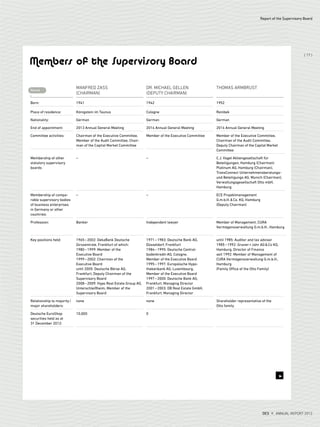
FINANCIAL STATEMENTS OF DEUTSCHE EUROSHOP AG
AND THE GROUP FOR THE PERIOD ENDING
31 DECEMBER 2012
At the Audit Committee meeting on 12 April 2013 and the Super-
visory Board meeting on 23 April 2013, the Audit Committee and
the Supervisory Board respectively examined in detail the annual
financial statements of Deutsche EuroShop AG in accordance
with German commercial law, and the consolidated financial
statements in accordance with International Financial Reporting
Standards (IFRS), each as at 31 December 2012, as well as the
management report and group management report for financial
year 2012.
The documents relating to the financial statements, the auditor’s
reports and the Executive Board’s proposal for the appropriation
of the unappropriated surplus were presented to us in good time.
The auditor appointed by the Annual General Meeting on 21 June
2012 – BDO AG Wirtschaftsprüfungsgesellschaft, Hamburg – had
already audited the financial statements and issued an unquali-
fied audit opinion in each case. The auditor also confirmed that
the accounting policies, measurement methods and methods of
consolidation in the consolidated financial statements complied
with the relevant accounting provisions. In addition, the audi-
tor determined in the course of its assessment of the risk man-
agement system that the Executive Board had undertaken all
required measures pursuant to section 91 (2) AktG to promptly
identify risks that could jeopardise the continued existence of
the Company.
The auditor’s representatives took part in the discussion of the
annual financial statements and the consolidated financial state-
ments on the occasions of the Audit Committee meeting on 12
April 2013 and the Supervisory Board meeting on 23 April 2013
and explained the main findings.
Following its own examination of the annual financial statements
of Deutsche EuroShop AG, the consolidated financial statements
and the corresponding management reports, the Supervisory
Board did not raise any objections. It agreed with the findings
of the auditor’s examination and approved the annual financial
statements of Deutsche EuroShop AG and the consolidated finan-
cial statements. The annual financial statements have thus been
adopted. The Supervisory Board endorses the Executive Board’s
proposal for the appropriation of the unappropriated surplus and
distribution of a dividend of €1.20 per share.
The Company’s success in financial year 2012 was the result of
its sustainable, long-term strategy and the dedication shown by
the Executive Board and our employees, for which the Super-
visory Board would like to express its particular gratitude.
Hamburg, 23 April 2013
MANFRED ZASS, CHAIRMAN
DES ANNUAL REPORT 2012
{ 16 }
Report of the Supervisory Board
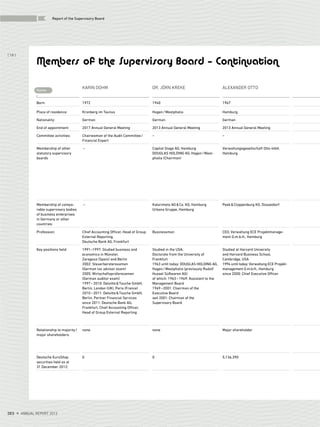
MANFRED ZASS
(CHAIRMAN)
DR. MICHAEL GELLEN
(DEPUTY CHAIRMAN)
THOMAS ARMBRUST
Born: 1941 1942 1952
Place of residence: Königstein im Taunus Cologne Reinbek
Nationality: German German German
End of appointment: 2013 Annual General Meeting 2014 Annual General Meeting 2014 Annual General Meeting
Committee activities: Chairman of the Executive Committee,
Member of the Audit Committee, Chair-
man of the Capital Market Committee
Member of the Executive Committee Member of the Executive Committee,
Chairman of the Audit Committee,
Deputy Chairman of the Capital Market
Committee
Membership of other
statutory supervisory
boards
– – C.J. Vogel Aktiengesellschaft für
Beteiligungen, Hamburg (Chairman)
Platinum AG, Hamburg (Chairman),
TransConnect Unternehmensberatungs-
und Beteiligungs AG, Munich (Chairman),
Verwaltungsgesellschaft Otto mbH,
Hamburg
Membership of compa-
rable supervisory bodies
of business enterprises
in Germany or other
countries:
– – ECE Projektmanagement
G.m.b.H.&Co. KG, Hamburg
(Deputy Chairman)
Profession: Banker Independent lawyer Member of Management, CURA
Vermögensverwaltung G.m.b.H., Hamburg
Key positions held: 1965–2002: DekaBank Deutsche
Girozentrale, Frankfurt of which:
1980–1999: Member of the
Executive Board
1999–2002: Chairman of the
Executive Board
until 2005: Deutsche Börse AG,
Frankfurt, Deputy Chairman of the
Supervisory Board
2008–2009: Hypo Real Estate Group AG,
Unterschleißheim, Member of the
Supervisory Board
1971–1983: Deutsche Bank AG,
Düsseldorf, Frankfurt
1984–1995: Deutsche Central-
bodenkredit-AG, Cologne,
Member of the Executive Board
1995–1997: Europäische Hypo-
thekenbank AG, Luxembourg,
Member of the Executive Board
1997–2000: Deutsche Bank AG,
Frankfurt, Managing Director
2001–2003: DB Real Estate GmbH,
Frankfurt, Managing Director
until 1985: Auditor and tax advisor
1985–1992: Gruner+Jahr AG&Co KG,
Hamburg, Director of Finance
seit 1992: Member of Management of
CURA Vermögensverwaltung G.m.b.H.,
Hamburg
(Family Office of the Otto Family)
Relationship to majority/
major shareholders:
none none Shareholder representative of the
Otto family
Deutsche EuroShop
securities held as at
31 December 2012:
10,000 0
Name
Members of the Supervisory Board
3
Report of the Supervisory Board
DES ANNUAL REPORT 2012
{ 17 }
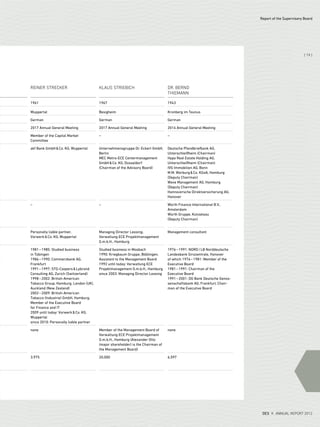
KARIN DOHM DR. JÖRN KREKE ALEXANDER OTTO
Born: 1972 1940 1967
Place of residence: Kronberg im Taunus Hagen/Westphalia Hamburg
Nationality: German German German
End of appointment: 2017 Annual General Meeting 2013 Annual General Meeting 2013 Annual General Meeting
Committee activities: Chairwoman of the Audit Committee/
Financial Expert
– –
Membership of other
statutory supervisory
boards
– Capital Stage AG, Hamburg
DOUGLAS HOLDING AG, Hagen/West-
phalia (Chairman)
Verwaltungsgesellschaft Otto mbH,
Hamburg
Membership of compa-
rable supervisory bodies
of business enterprises
in Germany or other
countries:
– Kalorimeta AG&Co. KG, Hamburg
Urbana Gruppe, Hamburg
Peek&Cloppenburg KG, Düsseldorf
Profession: Chief Accounting Officer, Head of Group
External Reporting,
Deutsche Bank AG, Frankfurt
Businessman CEO, Verwaltung ECE Projektmanage-
ment G.m.b.H., Hamburg
Key positions held: 1991–1997: Studied business and
economics in Münster,
Zaragoza (Spain) and Berlin
2002: Steuerberaterexamen
(German tax advisor exam)
2005: Wirtschaftsprüferexamen
(German auditor exam)
1997–2010: Deloitte&Touche GmbH,
Berlin, London (UK), Paris (France)
2010–2011: Deloitte&Touche GmbH,
Berlin, Partner Financial Services
since 2011: Deutsche Bank AG,
Frankfurt, Chief Accounting Officer,
Head of Group External Reporting
Studied in the USA,
Doctorate from the University of
Frankfurt
1963 until today: DOUGLAS HOLDING AG,
Hagen/Westphalia (previously Rudolf
Hussel Süßwaren AG)
of which: 1963–1969: Assistant to the
Management Board
1969–2001: Chairman of the
Executive Board
seit 2001: Chairman of the
Supervisory Board
Studied at Harvard University
and Harvard Business School,
Cambridge, USA
1994 until today: Verwaltung ECE Projekt-
management G.m.b.H., Hamburg
since 2000: Chief Executive Officer
Relationship to majority/
major shareholders:
none none Major shareholder
Deutsche EuroShop
securities held as at
31 December 2012:
0 0 5,136,390
Name
Members of the Supervisory Board – Continuation
DES ANNUAL REPORT 2012
{ 18 }
Report of the Supervisory Board
REINER STRECKER KLAUS STRIEBICH DR. BERND
THIEMANN
1961 1967 1943
Wuppertal Besigheim Kronberg im Taunus
German German German
2017 Annual General Meeting 2017 Annual General Meeting 2014 Annual General Meeting
Member of the Capital Market
Committee
– –
akf Bank GmbH&Co. KG, Wuppertal Unternehmensgruppe Dr. Eckert GmbH,
Berlin
MEC Metro-ECE Centermanagement
GmbH&Co. KG, Düsseldorf
(Chairman of the Advisory Board)
Deutsche Pfandbriefbank AG,
Unterschleißheim (Chairman)
Hypo Real Estate Holding AG,
Unterschleißheim (Chairman)
IVG Immobilien AG, Bonn
M.M. Warburg&Co. KGaA, Hamburg
(Deputy Chairman)
Wave Management AG, Hamburg
(Deputy Chairman)
Hannoversche Direktversicherung AG,
Hanover
– – Würth Finance International B.V.,
Amsterdam
Würth Gruppe, Künzelsau
(Deputy Chairman)
Personally liable partner,
Vorwerk&Co. KG, Wuppertal
Managing Director Leasing,
Verwaltung ECE Projektmanagement
G.m.b.H., Hamburg
Management consultant
1981–1985: Studied business
in Tübingen
1986–1990: Commerzbank AG,
Frankfurt
1991–1997: STG-Coopers&Lybrand
Consulting AG, Zurich (Switzerland)
1998–2002: British-American
Tobacco Group, Hamburg, London (UK),
Auckland (New Zealand)
2002–2009: British-American
Tobacco (Industrie) GmbH, Hamburg,
Member of the Executive Board
for Finance and IT
2009 until today: Vorwerk&Co. KG,
Wuppertal
since 2010: Personally liable partner
Studied business in Mosbach
1990: Kriegbaum Gruppe, Böblingen,
Assistant to the Management Board
1992 until today: Verwaltung ECE
Projektmanagement G.m.b.H., Hamburg
since 2003: Managing Director Leasing
1976–1991: NORD/LB Norddeutsche
Landesbank Girozentrale, Hanover
of which 1976–1981: Member of the
Executive Board
1981–1991: Chairman of the
Executive Board
1991–2001: DG Bank Deutsche Genos-
senschaftsbank AG, Frankfurt, Chair-
man of the Executive Board
none Member of the Management Board of
Verwaltung ECE Projektmanagement
G.m.b.H., Hamburg (Alexander Otto
(major shareholder) is the Chairman of
the Management Board)
none
3,975 20,000 6,597
Report of the Supervisory Board
DES ANNUAL REPORT 2012
{ 19 }
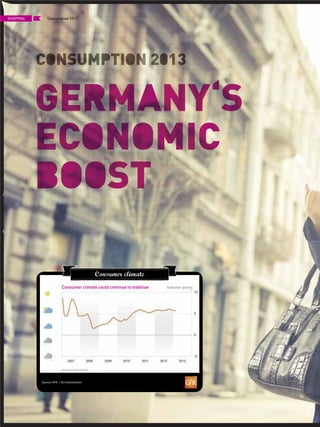
Consumer climate
Source: GFK I EU-Commission
Consumer climate could continue to stabilise IndikatorpunkteIndicator points
Consumer climate
Consumption 2013SHOPPING
{ 20 }
OUTLOOK FOR PRIVATE
CONSUMPTION
BY ROLF BÜRKL, GFK CONSUMPTION EXPERT
{ 21 }
ACCORDING TO FORECASTS BY THE
GERMAN SOCIETY FOR CONSUMER
RESEARCH GFK (GESELLSCHAFT
FÜR KONSUMFORSCHUNG ), PRIVATE
HOUSEHOLD SPENDING IN GER-
MANY IS SET TO INCREASE BY 1.0%
IN REAL TERMS IN 2013. PRIVATE
CONSUMPTION IS THUS PROVIDING
A SUBSTANTIAL CONTRIBUTION TO
THE STABILITY OF THE GERMAN
DOMESTIC ECONOMY.
n light of low interest rates and
concern about the future of the
euro, consumers are tending toward
making high value purchases. Moderate
growth is forecast for retailers.
According to the GfK Consumer Climate,
German consumers started 2013 in posi-
tive spirits with all indicators showing
an upward trend at the beginning of the
year. Despite economic development noti-
ceably slowing down in the winter months
of 2012, it seems as though, from a con-
sumer perspective, a turning point has
been reached. Economic prospects are
currently improving. This sentiment is
also shared by business, as demonst-
rated by the Ifo Business Climate Index,
which increased for the third consecutive
time in January.
Buoyed by the positive situation on the
labour market, German consumers are
expecting their income to increase in the
near future. Perceived job security is also
giving consumers the necessary planning
security for major purchases. At the same
time, savings and loan interest rates are
at a record low. This is particularly good
news for real estate, which is seen by
consumers as a safe alternative for their
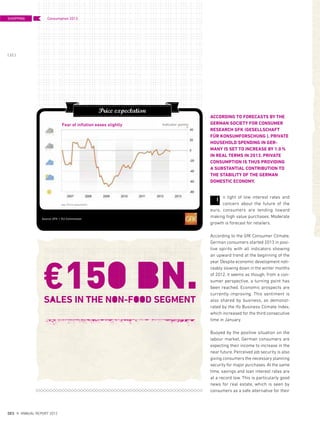
Price expectation
Source: GFK I EU-Commission
Fear of inflation eases slightly
I
Indicator points
Price expectation
SHOPPING
{ 22 }
DES ANNUAL REPORT 2012
Consumption 2013
3
savings. This trend is further driven by concerns about the future
of the euro. Previously labelled ‚panic savers‘, many Germans
have now turned into ‚panic consumers’.
MODERATE RETAIL GROWTH
While real estate is booming, the performance of the German
retail market is somewhat mixed. According to GfK calculations,
food retailers and drugstores only saw nominal sales growth
of 2.2% to approximately €160 billion, while full-service gro-
cery stores showed the best performance with sales up 4.7%
in 2012. Discount stores registered stable growth with a sales
plus of 2.4%. Overall growth was achieved by setting prices hig-
her, as the volume sales of food retailers continued to decline.
For 2013, GfK is forecasting a nominal sales increase of 1.5%
for food retailers and drugstores, while volumes are expected
to continue to fall.
In the non-food retail segment, which includes textiles, electro-
nic devices, furniture and home improvement products, sales
improved by 1.0% in 2012 and rose to around €150 billion. Sales
of electronic devices rose by 2.8%, while textiles decreased by
1.6%. Once again, online retail showed the best performance by
far, with sales in the non-food segment increasing by 14.0% to
almost €24 billion. For 2013, the GfK is expecting the growth rate
for non-food retailers to slow down slightly to 0.7%. For food and
non-food retail combined, the GfK is forecasting an overall sales
increase of 1.1%.
{ 23 }
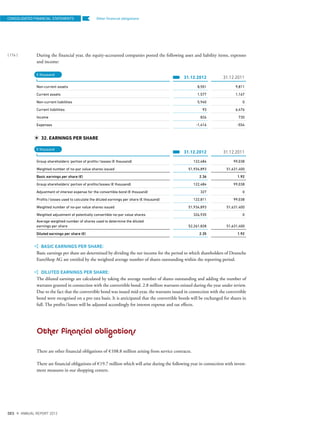
DES ANNUAL REPORT 2012
7
GERMAN JOB MIRACLE
The most important aspect of positive
consumer climate is the the labour mar-
ket. According to the Federal Employ-
ment Agency, an average 2.9 million peo-
ple were registered as unemployed in
Germany in 2012. This is the lowest level
since 1991. A comparison with the job
market situation in other European coun-
tries shows just how impressive the Ger-
man job miracle is. Germany is the only
country in which the number of people
out of work has dropped since the pre-
crisis level of 2007. While unemployment
has fallen by a third in Germany, average
unemployment figures across Europe
have risen by almost 50%. In Spain and
Ireland, the number of people without a
job has increased by more than 200%,
while Greece is battling an increase of
nearly 170%.
CONSUMPTION 2013 – ECONOMIC
BOOST FOR GERMANY
The outlook for the global economy
remains cautious. While it registered
a decline of 0.3% for 2012, the Federal
Statistical Office is expecting growth for
the EU‘s gross domestic product (GDP)
of 0.4% in 2013. This could indicate that
the danger of a prolonged recession has
been averted and that German exports
within Europe are unlikely to decline any
further. Following the 0.7% growth achie-
ved in 2012, Germany’s GDP is expected
to rise 0.8% this year.
In light of the subdued global economy,
domestic demand will become ever more
important. For the most part, real (i.e.
adjusted for price) spending of private
households registered major increases
in the years leading up to the turn of the
millennium. The decade since, however,
was marked by stagnation. Between 2000
and 2010, consumer spending increased
by an average of only 0.3% in real terms.
In 2011, an increase of 1.5% in real pri-
vate consumption seems to have put a
stop to this negative development. Preli-
minary data from the Federal Statistical
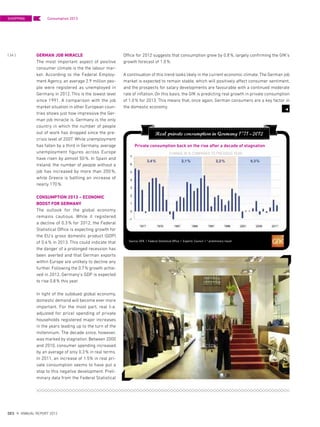
Office for 2012 suggests that consumption grew by 0.8%, largely confirming the GfK’s
growth forecast of 1.0%.
A continuation of this trend looks likely in the current economic climate. The German job
market is expected to remain stable, which will positively affect consumer sentiment,
and the prospects for salary developments are favourable with a continued moderate
rate of inflation. On this basis, the GfK is predicting real growth in private consumption
of 1.0% for 2013. This means that, once again, German consumers are a key factor in
the domestic economy.
Real private consumption in Germany 1971--2012
Source: GFK I Federal Statistical Office I Experts‘ Council I * preliminary result
Private consumption back on the rise after a decade of stagnation
CHANGE IN % COMPARED TO PREVIOUS YEAR
SHOPPING
{ 24 }
DES ANNUAL REPORT 2012
Consumption 2013
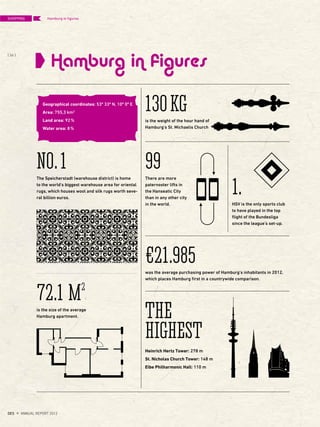
Hamburg in figures
130KG
€21.985
THE
HIGHEST
NO.1 99
1.
72.1 M2
is the weight of the hour hand of
Hamburg's St. Michaelis Church
was the average purchasing power of Hamburg's inhabitants in 2012,
which places Hamburg first in a countrywide comparison.
The Speicherstadt (warehouse district) is home
to the world's biggest warehouse area for oriental
rugs, which houses wool and silk rugs worth seve-
ral billion euros.
There are more
paternoster lifts in
the Hanseatic City
than in any other city
in the world. HSV is the only sports club
to have played in the top
flight of the Bundesliga
since the league's set-up.
Geographical coordinates: 53º 33º N, 10º 0º E
Area: 755,3 km2
Land area: 92%
Water area: 8%
Heinrich Hertz Tower: 278 m
St. Nicholas Church Tower: 148 m
Elbe Philharmonic Hall: 110 m
is the size of the average
Hamburg apartment.
SHOPPING
{ 26 }
DES ANNUAL REPORT 2012
Hamburg in figures
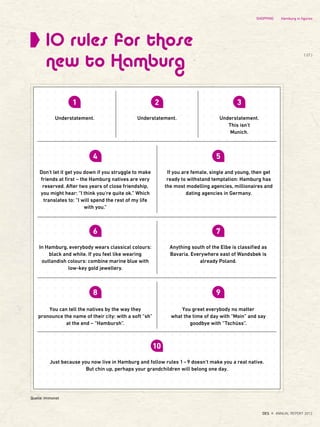
10 rules for those
new to Hamburg
1 2
4
6
5
7
Understatement.
Don‘t let it get you down if you struggle to make
friends at first – the Hamburg natives are very
reserved. After two years of close friendship,
you might hear: “I think you‘re quite ok.” Which
translates to: “I will spend the rest of my life
with you.”
In Hamburg, everybody wears classical colours:
black and white. If you feel like wearing
outlandish colours: combine marine blue with
low-key gold jewellery.
You can tell the natives by the way they
pronounce the name of their city: with a soft “sh”
at the end – “Hambursh”.
Anything south of the Elbe is classified as
Bavaria. Everywhere east of Wandsbek is
already Poland.
You greet everybody no matter
what the time of day with “Moin” and say
goodbye with “Tschüss”.
Just because you now live in Hamburg and follow rules 1–9 doesn‘t make you a real native.
But chin up, perhaps your grandchildren will belong one day.
If you are female, single and young, then get
ready to withstand temptation: Hamburg has
the most modelling agencies, millionaires and
dating agencies in Germany.
Understatement. Understatement.
This isn‘t
Munich.
8 9
10
Quelle: Immonet
3
{ 27 }
DES ANNUAL REPORT 2012
SHOPPING Hamburg in figures
Hamburg’s famous markets
SHOPPING
{ 28 }
DES ANNUAL REPORT 2012
Hamburg‘s famous markets
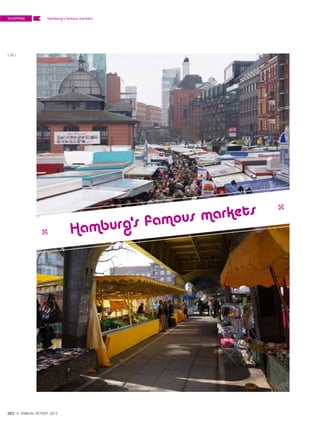
n the early hours of every Sunday morning, several
thousand visitors and locals flock to the fish market in
Hamburg‘s borough of Altona on the banks of the Elbe. Fresh
fish is not the only thing on offer here, as the visitors can browse
through a colourful jumble of mobile phone accessories, bas-
kets of pasta, tropical plants and even live chickens and car-
rier pigeons.
The market is set up on the open space right next to the inner
harbour, and at its many stalls and wagons haggling is more
than commonplace: baskets are crammed with more and more
goods and advertised by market criers at the top of their voices
until someone agrees to buy them. This loud and verbose spec-
tacle alone makes the market worth a visit. Rumour has it that
you can hear the market criers all the way to the Reeperbahn
(a street famous for its nightlife) several hundred metres away.
But the fish market is not only a colourful and bizarre shop-
ping opportunity: for many it is also the last stop before bed
after a long night out in the famous Kiez (the district where the
Reeperbahn is located). Tucking into a hearty breakfast of a fish
sandwich or Currywurst while enjoying the view over Hamburg‘s
harbour is an experience with its very own charm. Filled with
fresh energy, some might even venture into the nearby former
fish auction hall – now an attractive dance venue with live music.
While the fish market is presently usually marketed as a tou-
rist attraction and is copied by a travelling fair that stops in mar-
ket squares throughout Germany, it boasts a proud history and
tradition: Sunday trading has been allowed in Altona since 1703
so that freshly caught fish can be sold to churchgoers early in
the morning before they go to church.
Informations
Opening times: Every Tuesday and Friday from
8.30 a.m. to 2 p.m.)
Address: Isestraße between Eppendorfer Baum and
Hoheluftchaussee
Public transport: U3 stop Eppendorfer Baum and Ho-
heluft
Isemarkt
I ith around 100 weekly farmers‘ markets, Hamburg is one
of the cities with the most markets in Europe. And of those,
the Isemarkt is probably one of the most worth seeing. It has
the longest history of all the markets in Hamburg: for over 100
years it has been held beneath the viaduct of Hamburg‘s first
underground line between Eppendorfer Baum and Hoheluft, only
a stone‘s throw from the former offices of Deutsche EuroShop
on Oderfelder Straße. It also holds a European record: with a
length of 1 km it is longer than any other open air market on
the continent.
Nearly 300 traders offer an impressive assortment of goods
here, especially groceries that would make any amateur chef‘s
mouth water: a multitude of regional products and specialities
from around the world such as fruit, vegetables, herbs and spi-
ces, nuts, honey, pralines, cheese, fish and meat, often from fair-
trade or organic production. Flowers, gifts of all kinds and even
clothing are also on offer.
With a bit of luck you might even spot one of Hamburg‘s
famous faces amongst all the amateur chefs, such as TV chefs
Tim Mälzer and Cornelia Poletto, or one of the many other cele-
brities who live in the magnificent Jugenstil buildings in the area.
However, it is rarely hectic amidst this jostle of pushchairs,
bikes, tourists, customers and market traders. Everywhere you
look people are jovially discussing the latest news and goods.
So you should make sure you take your time to visit this place.
And where else would you find such a multitude of snack, coffee
and espresso stands?
Informations
Opening times: Every Sunday from 5 a.m. to
9.30 a.m. (from 7 a.m. in winter)
Address: Große Elbstraße 1
Public transport: S1 and S3 stop Reeperbahn,
U3 stop Landungsbrücken
Altona
fish market
W
SHOPPING Hamburg‘s famous markets
{ 29 }
DES ANNUAL REPORT 2012
Paperback: 187 pages
Publisher: Dtv
(1 November 2000)
Language: German
ISBN-13: 978-3423128391
THE DISCOVERY
OF THE CURRYWURST
by Uwe Timm
Reminiscing about his childhood, the narrator sets off in his
search for the former owner of a snackbar in the Hamburger
Großneumarkt. He tracks down the extremely elderly Lena Brü-
cker to an old people's home and listens to her tell her story
of the "most wonderful years of her life" and of how she dis-
covered the currywurst. Her story starts way back in the last
days of April in 1945.
Bound: 784 pages
Publisher: Fischer
Taschenbuch Verlag
Edition: 22 (10 June 2008)
Language: German
ISBN-13: 978-3596259618
Taschenbuch: 416 pages
Publisher: Diogenes
(August 2004)
Language: German
ISBN-13: 978-3257234169
DIE BERTINIS
by Ralph Giordano
A large-scale family saga that spans generations, an exemp-
lary contemporary novel. Ralph Giordano creates an epic out
of a story that had hitherto attracted little attention: he tells the
story of the fate of "Jewish crossbreeds" during the period of
National Socialism. The prehistory starts at the end of the last
century, with the main story starting prior to 1933 and continu-
ing into the first post-war years. Its location: Hamburg – from
the Elbe suburbs to its Central Park, from Barmbek in the north
to the port in the south, with unforgettable figures, scenes and
situations woven into the dramatic story.
RIPLEY'S GAME OR
THE AMERICAN FRIEND
by Patricia Highsmith
The Mafia's attempts to gain a foothold in Hamburg must
be prevented. The search starts for a man who will kill two
wpeople in exchange for a lot of money. Tom Ripley has just the
person in mind…
Hamburg as a location for novels and films
Books
SHOPPING
{ 30 }
DES ANNUAL REPORT 2012
JAMES BOND 007 –
TOMORROW NEVER DIES
Power-hungry media baron Elliot Carver has a macabre hobby:
He prefabricates news, which he himself publishes in his
newspaper "Tomorrow". He is now willing to go to all lengths to
capture the profitable Chinese market. The insane Carver then
tries to provoke a devastating World War III by means of a sub-
marine that cannot be picked up by radar. British super agent
James Bond tries to stop the scrupulous media baron and gains
entrance to Carver's newspaper headquarters in Hamburg.
Cast:
Adam Bousdoukos,
Moritz Bleibtreu,
Birol Ünel,
Pheline Roggan,
Lucas
Gregorowicz
Director: Fatih Akin
Date of release:
25 August 2010
Year of production: 2009
SOUL KITCHEN
Bar owner Zinos is plagued by bad luck: first his girlfriend
Nadine takes a new job in Shanghai, then he suffers a slip-
ped disk. When he takes on the eccentric top chef Shayn in
desperation, even his few regulars stop coming to his bar.
And to top it all off, his petty criminal brother Illias turns up
and asks him for help. While Zinos considers how he can get
rid of his bar so he can follow Nadine to China, his music
and an outlandish menu start to draw an increasing number
of trendy figures. The "Soul Kitchen" rocks and booms like
never before. But then things start to happen thick and fast.
Cast: Pierce Brosnan, Jonathan Pryce,
Michelle Yeoh
Director: Roger Spottiswoode
Studio: MGM Home Entertainment GmbH (German)
Year of production: 1998
Current cast:
Jan Fedder
Dirk Matthies
Maria Ketikidou
Saskia Fischer
Year(s) of production:
since 1986
Production company:
Studio Hamburg
First showing:
16December 1986 on Das Erste
GROSSSTADTREVIER
The German television series Großstadtrevier has achieved cult
status. 26 series have been produced since its first showing on
16 December 1986. The story revolves around the police officers
of the 14th precinct and their fictitious working day in Hamburg's
red-light area. Großstadtrevier won a Golden Camera award
in 2005.
Films & Series
SHOPPING Hamburg as a location for novels and films
{ 31 }
DES ANNUAL REPORT 2012
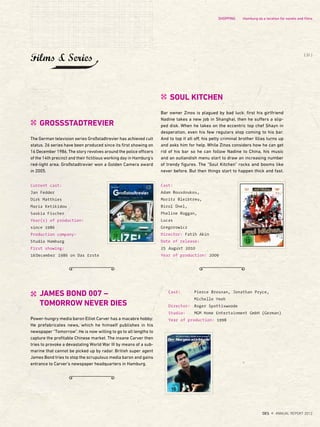
what the Customer
really wants
“In the future, customers will only do their shopping on the Internet, making the high
street shops a thing of the past: offline shopping will die out, online shopping will
thrive!” Future visions such as these are now dominating reports in the media. But are
these predictions really correct? Will online retailing really displace classic retailing?
And how do customers find their way around the online and offline world of shopping?
HENRIE W. KÖTTER, MANAGING DIRECTOR CENTER MANAGEMENT,
ECE PROJEKTMANAGEMENT
What the customer really wants
Study of buying behaviour in the online and offline world
SHOPPING
{ 32 }
DES ANNUAL REPORT 2012
purchase products straight away. In a multi-channel shopping
world, it is therefore crucial for in-store retailers to identify
the buying motives of customers that are more important than
price, rather than trying to compete on price with the cheapest
online supplier.
In-store retailing is also a long way off from serving solely as a
showroom for online merchandisers. On the contrary, purchases
that customers decide upon online but make in a bricks-and-
mortar store generate eleven times more revenue than the other
way round. “Showrooming” does not therefore pose a threat to
in-store shopping, but represents an opportunity for retailers to
stay one step ahead of the competition. Take the example of high-
tech companies like Apple which rely fully on the Internet but are
now opening large flagship stores in key centers.
Another surprising finding: even among the young “digital native”
generation, which has grown up with the Internet, there is a large
group of consumers who do all their shopping in traditional
shops, even though this customer group spends several hours a
day on the Internet. For them it is the emotional experience when
shopping that they value most and, above all, being able to share
the experience with friends.
To sum up the results of the study: in-store retailing in Germany
can meet those customer needs which online retailing is not yet
able to meet or will never be able to meet. However, retailers
need to gain a better understanding of the desires and buying
needs of their customers so they can adapt their offerings accor-
dingly. A useful approach is to adopt a multichannel strategy,
where the online and offline worlds are sensibly combined. To tap
the potential of the Internet, it is not always necessary to open an
online shop. For many customers, the ability to check online to see
if an item is available in the offline store can be a strong incentive
to visit the shop. The future thus lies in intelligently combining
digital channels with bricks-and-mortar retailing.
o get to the bottom of these ques-
tions, Roland Berger Strategy Con-
sultants and the ECE conducted a com-
prehensive study, in which they polled
around 42,000 consumers throughout
Germany about their shopping habits. In
addition, nearly 2,000 study participants
kept a personal diary of their shopping
activities over a period of a month, detai-
ling on how much they spent, when each
purchase was made, the product category
that the item belonged to and the sales
channel used.
The analysis of all the data revealed
some surprising findings. For example,
the share of online retailing is much hig-
her than had previously been assumed,
with seven per cent of online purchases
generating 16 per cent of total retail sales
– and trending upwards. But for bricks-
and-mortar stores there is absolutely no
reason why they should have to throw
in the towel in the face of online com-
petition; for the simple reason that two
thirds of consumers regularly shop in off-
line stores, shopping every two weeks and
mostly in high street shops or shopping
centers. By contrast, only 13 per cent of
consumers regularly shop online. These
figures are testimony to the continu-
ing importance to consumers of in-store
shopping. They also show that besides
shopping frequency the share of impulse
purchases is significantly higher than is
the case with online shopping. This a key
competitive advantage in a world where
the needs of customers for the large part
have to be awakened before they can be
satisfied.
Another notable finding is that price is
not the key determinant where choice
of retail channel is concerned. Tradi-
tional retailing scores higher when it
comes to providing on-the-spot per-
sonalised advice and information and
enabling customers to view, try out and
7
Further information
The study “What the customer really wants”
can be downloaded free of charge at:
www.ece.de/multichannelstudie
T
SHOPPING What the customer really wants
{ 33 }
DES ANNUAL REPORT 2012
he idea behind these “Future Labs” is that they will be used
for testing new interactive services, from virtual store
guide systems to a wide range of social media links to interac-
tive play areas, and serve as experimental sites for trying out new
technical trends and ideas. Developments that are well received
by customers will continue to be pursued and implemented in
other shopping centers; those that meet with a less positive res-
ponse will be stopped and replaced by new ones.
The key question to be asked in the test labs is: what can we
learn from online retailers? Here we can be sure about one thing:
timing is crucial. Tailoring information to potential customers and
getting it to them at the right time is vital. With this aim in mind,
we developed, among other things, a free smartphone app for
the purpose of informing customers about offerings, events and
news. This offering is complemented by a points collection and
voucher scheme.
ALEXANDER CRÜSEMANN,
PROJECT MANAGER FUTURE LABS, ECE PROJEKTMANAGEMENT
Inspired by the findings of the multichannel study
(www.ece.de/multichannelstudie), ECE went on to
launch so-called „Future Labs“ in the Alstertal-
Einkaufszentrum in Hamburg and in the Limbecker
Platz shopping center in Essen in March 2013.
Another novelty of the “Future Labs” is the „Mall Wall“: a high-
resolution mega display measuring 4 x 4 metres, which visitors
can access using a specially developed touchscreen, allowing
them, for example, to click on fashion tips, social media, blogs,
games, or so-called augmented reality animations, where they
can experience extended reality in the form of virtual simula-
tions. A special attraction for children is the interactive play
area “Journey of the Giants”. On a touchscreen mounted on
the ground, players try to catch cars or coins whizzing across
the screen.
The “Your Way2go” system offers visitors a novel way of
searching for and finding the quickest way to shops by down-
loading a 3D animation to their mobile phone using a QR code or
by displaying the information there and then on the screen. Also
new is “Gloria”: a virtual mall avatar. Users communicate inter-
actively with the virtual shopping center manager using a touch-
screen and display. “Gloria” is fully acquainted with the shop-
ping center, offers useful tips and sends video messages. “Info
Gate” is another new attraction: Info Gate service staff respond
via live videostream to queries from visitors about shops in the
center or about departure times of buses and trains. But along-
side these interactive information sources, the customer infor-
mation desk still has its place, allowing customers can talk to
advisors in person.
An additional feature of the “Future Labs” is the “Multi Media
Lounge”: a place where shoppers can learn about the latest
technologies in a relaxed atmosphere, try out tablet devices or
browse the Internet. They can also check out the biggest 3D tele-
vision on display to date in Germany (featuring a 70" screen)
from United Entertain, which doesn‘t require viewers to wear
3D glasses.
T
Experimental sites for new technical
trends and ideas
“Future Labs“
Future labsSHOPPING
{ 34 }
DES ANNUAL REPORT 2012
Summary
The results of the multichannel study and initial expe-
riences with the “Future Labs” demonstrate one thing
very clearly: that shopping centers provide the best con-
ditions for the beneficial aspects of the online world to
be transferred to a unique and special offline world. By
intelligently linking the opportunities that present them-
selves, customers can enjoy an inspirational shopping
experience in the real world of the shopping center,
which they won‘t find in the Internet.
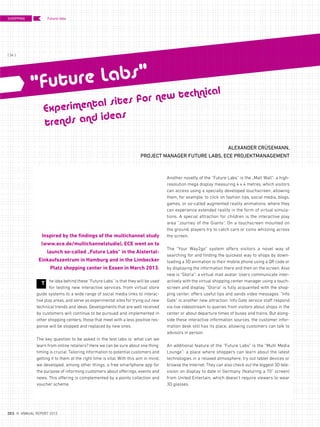
Shoppers wishing to share their location with their social net-
work can log into Facebook at the “Social Check-in” terminal.
They can also use “Photobuzzer” to shoot a portrait photo and
post it on the shopping center‘s Facebook page or the “Mall Wal”.
The test center also offers WLAN access: users register and
receive an access code via SMS. And if after all these activities
the batteries of shoppers‘ smartphones or tablets start to run
low, they can simply recharge them up at the charging station.
Besides working on all these technical innovations, the ECE
remains active in the “real world”, continually enhancing its ser-
vice portfolio. For example, so-called XXL parking spaces have
been set up in both test centers to accommodate car drivers
who need more room to park and load or unload their vehicles.
7
SHOPPING Future labs
{ 35 }
DES ANNUAL REPORT 2012
Hamburg: Germany's
happiest city
Hamburg is home to Germany's happiest people:
the inhabitants of Hamburg live in above-average contentment
in all areas, in particular work, income and health.
AVERAGE RATING GIVEN BY THE PEOPLE SURVEYED
(on a scale of 1 to 10)
Life in general
Work
Income
Health
Hamburg
7,4
6,8
6,3
6,7
Germany
6,4
6,1
6,7
6,8
SHOPPING
{ 36 }
DES ANNUAL REPORT 2012
Hamburg facts
The high-society lady
The lady of easy virtue
The fish seller
The St. Pauli fan
Facts about four original
Hamburg institutions
would love to be the quintessen-
tial English lady and is an exclu-
sive member of numerous clubs
has a very flexible neck:
she is able to kiss left and
right without her obligatory
hat getting in the way
stresses understatement, but always looks in Monday's Abendblatt
to see if she was photographed at the cocktail reception
always comes back with a cheeky retort
is the only person who still pronounces “Sprotte” (sprat)
and “Filet-Stück” (piece of fillet) correctly
has a virtually superhuman capacity for suffering
has a voice that
carries further
than a foghorn
tends to vote red-
green despite wearing
a brown football strip
can't be passed
without having
a girlfriend for
protection in town
himself finds it hard to believe
how many strips of smoked
dogfish and trout fillet can be
stuffed into a bag for €15
wears a mini skirt
with moonboots
wears an overall,
wellingtons and an apron
is naturally always
to be seen carrying a
“gentlemen's handbag”
– a six-pack of Astra
is a chain-smoker
her husband is
one of the city's
859 millionaires
lays his head down
each night on a skull
and crossbones
pillow
{ 37 }
DES ANNUAL REPORT 2012
SHOPPING Hamburg facts
Members of the DES team present
the districts they live in
My
Hamburg
SHOPPING
{ 38 }
DES ANNUAL REPORT 2012
My Hamburg
{ 39 }
Alsterdorf
Claus-Matthias Böge,
CEO
T
The most famous
building here is
the “Altes Krema-
torium”, a former
crematorium that
has come to stand
for versatility
Altersdorf, a district with around 14,000 inhabitants, is situ-
ated on the upper part of the river Alster, from which it deri-
ves its name. The river runs through it from northeast to sou-
thwest. Altersdorf lies in the north of Hamburg and borders
the districts of Ohlsdorf, Winterhude and Eppendorf.
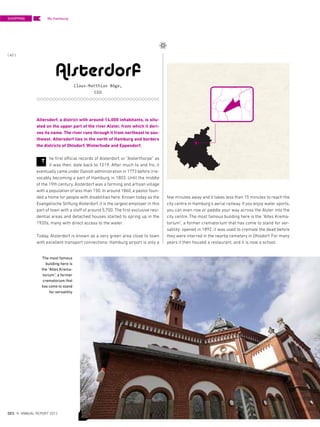
he first official records of Alsterdorf, or “Alsterthorpe” as
it was then, date back to 1219. After much to and fro, it
eventually came under Danish administration in 1773 before irre-
vocably becoming a part of Hamburg in 1803. Until the middle
of the 19th century, Alsterdorf was a farming and artisan village
with a population of less than 150. In around 1860, a pastor foun-
ded a home for people with disabilities here. Known today as the
Evangelische Stiftung Alsterdorf, it is the largest employer in this
part of town with a staff of around 5,700. The first exclusive resi-
dential areas and detached houses started to spring up in the
1920s, many with direct access to the water.
Today, Alsterdorf is known as a very green area close to town
with excellent transport connections: Hamburg airport is only a
few minutes away and it takes less than 15 minutes to reach the
city centre in Hamburg‘s aerial railway. If you enjoy water sports,
you can even row or paddle your way across the Alster into the
city centre. The most famous building here is the “Altes Krema-
torium”, a former crematorium that has come to stand for ver-
satility: opened in 1892, it was used to cremate the dead before
they were interred in the nearby cemetery in Ohlsdorf. For many
years it then housed a restaurant, and it is now a school.
SHOPPING
{ 40 }
DES ANNUAL REPORT 2012
My Hamburg
V
The nearby
museum village,
Hamburg‘s only
open-air museum,
is well worth a visit
Volksdorf
Olaf Borkers,
Member of the Executive Board
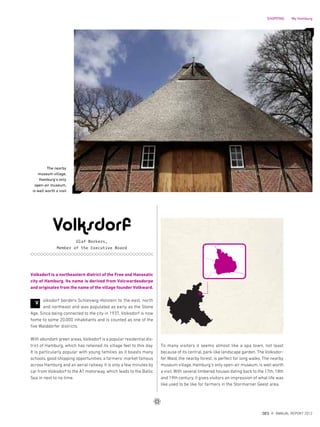
To many visitors it seems almost like a spa town, not least
because of its central, park-like landscape garden. The Volksdor-
fer Wald, the nearby forest, is perfect for long walks. The nearby
museum village, Hamburg‘s only open-air museum, is well worth
a visit. With several timbered houses dating back to the 17th, 18th
and 19th century, it gives visitors an impression of what life was
like used to be like for farmers in the Stormarner Geest area.
Volksdorf is a northeastern district of the Free and Hanseatic
city of Hamburg. Its name is derived from Volcwardesdorpe
and originates from the name of the village founder Volkward.
olksdorf borders Schleswig-Holstein to the east, north
and northeast and was populated as early as the Stone
Age. Since being connected to the city in 1937, Volksdorf is now
home to some 20,000 inhabitants and is counted as one of the
five Walddörfer districts.
With abundant green areas, Volksdorf is a popular residential dis-
trict of Hamburg, which has retained its village feel to this day.
It is particularly popular with young families as it boasts many
schools, good shopping opportunities, a farmers‘ market famous
across Hamburg and an aerial railway. It is only a few minutes by
car from Volksdorf to the A1 motorway, which leads to the Baltic
Sea in next to no time.
{ 41 }
DES ANNUAL REPORT 2012
SHOPPING My Hamburg
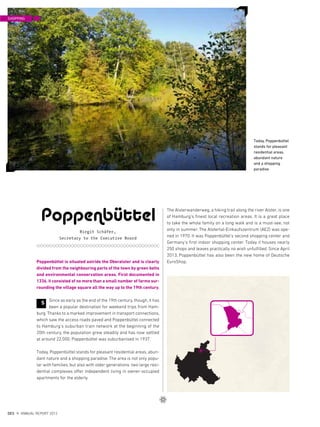
The Alsterwanderweg, a hiking trail along the river Alster, is one
of Hamburg‘s finest local recreation areas. It is a great place
to take the whole family on a long walk and is a must-see, not
only in summer. The Alstertal-Einkaufszentrum (AEZ) was ope-
ned in 1970. It was Poppenbüttel‘s second shopping center and
Germany‘s first indoor shopping center. Today it houses nearly
250 shops and leaves practically no wish unfulfilled. Since April
2013, Poppenbüttel has also been the new home of Deutsche
EuroShop.Poppenbüttel is situated astride the Oberalster and is clearly
divided from the neighbouring parts of the town by green belts
and environmental conservation areas. First documented in
1336, it consisted of no more than a small number of farms sur-
rounding the village square all the way up to the 19th century.
Since as early as the end of the 19th century, though, it has
been a popular destination for weekend trips from Ham-
burg. Thanks to a marked improvement in transport connections,
which saw the access roads paved and Poppenbüttel connected
to Hamburg‘s suburban train network at the beginning of the
20th century, the population grew steadily and has now settled
at around 22,000. Poppenbüttel was suburbanised in 1937.
Today, Poppenbüttel stands for pleasant residential areas, abun-
dant nature and a shopping paradise. The area is not only popu-
lar with families, but also with older generations: two large resi-
dential complexes offer independent living in owner-occupied
apartments for the elderly.
Poppenbüttel
Birgit Schäfer,
Secretary to the Executive Board
S
Today, Poppenbüttel
stands for pleasant
residential areas,
abundant nature
and a shopping
paradise
SHOPPING
{ 42 }
DES ANNUAL REPORT 2012
In a way, you could say that, several times a day, most Germans
have a little bit of Loksted in their living rooms: news program-
mes are recorded and produced here in the studios of the Nord-
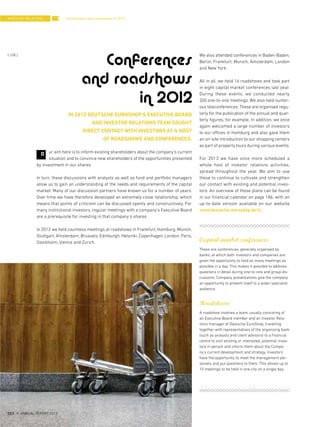
deutscher Rundfunk.
Lokstedt is one of nine districts in Hamburg‘s borough of
Eimsbüttel and has a population of more than 25,000. It first
appears in records as early as 1110. A farming village with a
small number of artisans, it soon became a residential area for
some of the wealthier citizens of nearby Hamburg.
n the middle of the 19th century, the pubs and inns of
Loksted were so popular that the Danish court introduced
bans to limit the excessive celebrations. The Danish rule over
Lokstedt only ended in 1866. In 1891, Lokstedt was the first Ger-
man village to have electric street lighting. In 1937 it was incor-
porated into Hamburg.
Lokstedt remains a relatively autonomous place to this day: the
inhabitants of this part of town are all served by the local large
electric power station (since 1905), water works (since 1910)
and gas works (since 1911), which are all extremely efficient and
can easily supply the neighbouring Niendorf and Schnelsen, too.
Built in 1911, the
neogothic water
tower is one of ele-
ven such towers still
remaining in Ham-
burg. It is the high-
est building in that
part of the city and
has been used for
residential purposes
since 1984
Lokstedt
Kirsten Kaiser,
Head of Accounting
I
{ 43 }
DES ANNUAL REPORT 2012
SHOPPING My Hamburg
There are many clichés surrounding Blankenese, but tradition is
held very dear here and continues to be upheld in many forms,
including the four Blankenese Easter Fires and the Kreekfah-
ren, a type of sledging on a wide, flat wooden sledge that is only
used on the Schinkels Meadow in Blankenese. The best time of
the year to visit, though, is the summer: with all the water and
stunning views over the hills, this part of Hamburg really has a
maritime southern flair.
Blankenese is a suburban district in the borough of Altona in
the western part of Hamburg and is home to around 13,000
people. It lies on the northern geest (sandy moor) on the lower
part of the river Elbe, which has formed a high bank in its centre.
he first official records of Blankenese date back to 1301.
Over the centuries, it has developed from a fishing village
to a retirement location for ships‘ captains and pilots and is now
a residential area lined with grand villas. In 1938, it became part
of Hamburg at the same time as the borough of Altona.
In the Treppenviertel (“stairway district”) around the Süllberg
you can still see many of the historical fishermen‘s houses from
the 18th and 19th century. Most of them are small, sober brick
buildings. But if you explore the narrow and steep lanes that are
only accessible on foot, you will also find some much more ornate
half-timbered houses with thatched roofs. And the stunning view
will make up for having to climb the many steps.
Blankenese
Patrick Kiss,
Head of Investor & Public Relations
T
In the Treppen-
viertel (“stairway
district”) around
the Süllberg you
can still see many
of the historical
fishermen‘s houses
from the 18th and
19th century
SHOPPING
{ 44 }
DES ANNUAL REPORT 2012
My Hamburg
where they will find many owner-managed specialised shops,
such as the Kaffeerösterei Burg, which has been in business
since 1923, as well as charming cafés and restaurants.
Eppendorf is Hamburg‘s oldest village and was first menti-
oned as Eppenthorp in 1140. For several centuries of the last
millennium, this village was owned by a Protestant foundation
before it was transferred to Hamburg‘s administration in 1832.
hile in the hands of the foundation, Eppendorf was a sta-
ging ground for several military conflicts and was repea-
tedly seized by Swedish and Danish troops before being occu-
pied by Napoleon‘s troops and freed by the Russians in 1814.
In the 19th century, Eppendorf gained popularity among the aff-
luent citizens of Hamburg who came here to build their country
houses. In 1879, when the hospitals in Hamburg could no longer
take in all the sick, many of which were suffering from epidemics
like cholera, a new, modern hospital was built on the unoccupied
land outside Eppendorf. Today, this is the Hamburg-Eppendorf
university hospital. New knowledge of how to avoid the sprea-
ding of diseases led to patients being put into separate pavili-
ons rather than the large rooms common in earlier hospitals.
Today, it houses more than 80 clinics, polyclinics and institutes
and employs around 2,250 doctors, making it one of Germany‘s
biggest hospitals.
Eppendorf is one of the most desirable parts of Hamburg and
especially popular with families. But the high demand for apart-
ments in its Jugendstil houses has pushed up prices and so it is
not a coincidence that Eppendorf is the home of choice for many
celebrities. Famous faces such as Olli Dittrich, Harry Rowohlt,
Sylvie van der Vaart and Ulrich Wickert can go to the supermar-
ket or the bakery here without attracting too much attention. Avid
shoppers can enjoy a browse through the area between Eppen-
dorfer Baum, Eppendorfer Landstraße and Eppendorfer Weg,
Eppendorf is one
of the most desira-
ble parts of Ham-
burg and especially
popular with fami-
lies. But the high
demand for apart-
ments in its Jugend-
stil houses has
pushed up prices
Eppendorf
Nicolas Lissner,
Manager Investor & Public Relations
W
Recommended book:
Das große Hamburg Buch (in German only)
Hardback edition, 1199 pages, 49,95
Publisher: Hamburger Abendblatt
ISBN-10: 3863701100
DES ANNUAL REPORT 2012
1. Kirsten Kaiser
Head of Accounting,
Deutsche EuroShop
“We needed a new couch. And it goes
without saying that the one we
bought is so comfortable that I
have no problems spending a very
long night on it watching tennis
on the television. With matching
cushions of course!”
2. Rolf Burkl
Senior Research Consultant,
Technology, Consumer Experiences,
GfK Marktforschung
“I bought myself a digital single
lens reflex camera as my old digi-
tal compact camera was long past
its best. I hope it will give me
more motivation to take photos
than in the past. And the quality
of the photos is much better, of
course.”
3. Patrick Kiss
Head of Investor & Public Relations,
Deutsche EuroShop
“In 2012, I invested in human capi-
tal: my own body. Not through
cosmetic surgery but by running. I
went to a sports shop, which used
a video analysis to show me which
running shoes would suit me best:
Brooks Trance. You can‘t do some-
thing like this online. I now feel
a lot fitter – and lighter.”
4. Claus-Matthias Boge
CEO,
Deutsche EuroShop
“My purchase of the year was
undoubtedly my iPad. I use it
nearly every day. Not for online
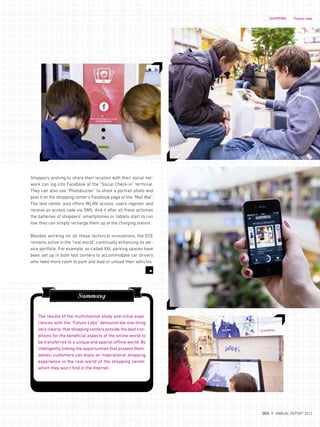
shopping, but to read the morn-
ing‘s newspaper in the evening, to
quickly look something up on the
Internet or to answer my e-mails.
And when I‘m on the go and take
pictures with my iPhone, they‘re
all automatically uploaded to my
iPad. Simply ingenious.”
5. Henrie W. Kotter
Managing Director Center Management,
ECE Projektmanagement
“I bought a small, remote-controlled
helicopter at a stand in the
Alstertal Shopping Center – hours
of fun for less than 20 Euro.”
What I bought in 2012
..
..
..
1
3
44
2
SHOPPING
{ 46 }
DES ANNUAL REPORT 2012
What I bought in 2012
6. Nicolas Lissner
Manager Investor & Public Relations,
Deutsche EuroShop
“New swimming goggles: since June
2012, I use them to go swimming
twice a week for at least 1 km.
And because it is a bit colder
when swimming outdoors in winter,
I bought a swimming cap to go
with them.”
7. Alexander Crusemann
Project Manager Future Labs,
ECE Projektmanagement
“I treated myself to a Strandkorb
for the terrace. As long as you
can‘t download actual sunshine
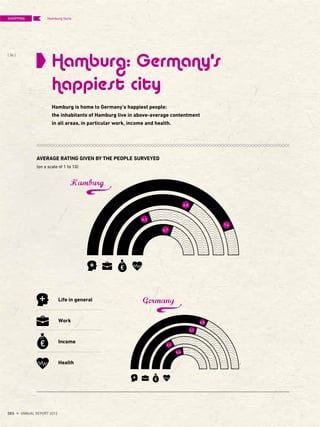
with an app, the Strandkorb beats
any form of virtual reality, no
matter how well it‘s made, even in
our norther climate.”
8. Birgit Schafer
Secretary to the Executive Board,
Deutsche EuroShop
“I‘m happy with my purchase of a
mini-trampoline for some holistic
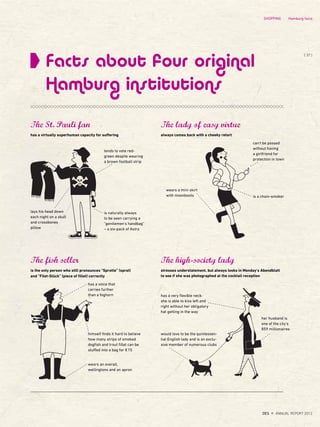
exercise that puts me in a good
mood. The exercise is particularly
kind to my joints and is supposed
to have an anti-aging effect. And
best of all: it‘s so much fun!”
9. Olaf Borkers
Member of the Executive Board,
Deutsche EuroShop
“I bought myself a new bike this
year, because mine had always been
the oldest in the garage at home.
As I mainly use it to go and buy
bread rolls at the weekend, I de-
cided against a „lightweight life-
style bike“ and opted for a „solid
cross touring bike with a balanced
character“. And I did actually put
the bike through its paces during
my holiday by the Baltic Sea.”
10. Jens-Ulrich Maier
Managing Director Construction,
ECE Projektmanagement
“I actually fulfilled myself a wish:
I bought a new watch – a UNION
Glashütte automatic with a date
and power reserve display – in the
Stern Center Potsdam last summer.
I really like wearing it!”
..
..
5
6
9
8
7
10
SHOPPING What I bought in 2012
{ 47 }
DES ANNUAL REPORT 2012
PortfolioTHE CENTERS
{ 48 }
THE CENTERS Portfolio
t 90 %, the focus of
our investment activ-
ity clearly lies in Germany.
As in previous years, we are
particularly proud of our con-
sistently high occupancy rate
of 99% on average, which is
testament to the quality of our
portfolio.
INDIVIDUAL MASTERPIECES
In real estate, and particularly
in retail, location has always
played a pivotal role. Our ten-
ants want to be wherever
their customers are. Each of
our 20  shopping centers is
in its own prime location: the
majority of our properties are
in city centres, in places where
people have been coming
together for centuries to ply their trades. Often our centers are
immediately adjacent to local pedestrian zones. Our portfolio also
includes shopping centers in established out-of-town locations.
These are properties that for many years now have represented
a welcome change for customers from shopping in the city and
they each have inter-regional significance.
Right from the very beginning, our focus is on the transport links
for each property: in city centres, we seek out locations close
to local public transport hubs. These might be central bus sta-
tions, which in Hameln and Passau, for example, are situated
right alongside our properties. Our new center in Norderstedt,
for instance, is built directly above an underground train station.
What is more, all our centers have their own parking facilities
that offer visitors convenient and affordable parking, even in city
centres, thereby ensuring good accessibility by car. Our out-of-
town properties offer a large number of free parking spaces.
These particular locations are alongside motorways, making
them very easy to reach. Parking spaces reserved for women
and the disabled are offered as part of the service at all our
shopping centers.
3
A
ONCE AGAIN IN 2012, OUR PORTFOLIO POSTED
STRONG GROWTH: IN NOVEMBER WE ACQUIRED
THE HEROLD-CENTER IN NORDERSTEDT. THAT
EXPANDED OUR PORTFOLIO TO 20 CENTERS:
16 IN GERMANY, TWO
IN POLAND AND ONE
IN BOTH AUSTRIA
AND HUNGARY.
THESE OFFER A
TOTAL OF 2,453
SHOPS COVERING AN
AREA OF 960.400 M².
DOMESTIC
INTER-
NATIONAL Total
No. of centers 16 4 20
Leasable space in m² 806,700 153,700 960,400
No. of shops 1,910 543 2,453
Occupancy rate* 99% 98% 99%
Inhabitants in catchment area
in millions 13.4 3.5 16.9
*including office space
{ 49 }
DES ANNUAL REPORT 2012
When we are designing our locations, one factor that always
receives special attention is the architecture: specific plot
requirements are just as important as the functional needs of
our tenants. We also have a responsibility to the city that we are
keen to fulfil. The shopping centers should blend in with their
surroundings as much as possible, while also having an exterior
that meets the requirements of modern architecture. We work
on this very closely with the relevant local authorities. The out-
come is often an architectural gem, where even historical build-
ings can be carefully integrated into the center if possible, as is
the case, for example, with the listed Kreishaus building, which
is now part of the Stadt-Galerie in Hameln.
Our shopping centers also need to be impressive inside so that
visitors and customers enjoy shopping there, first and foremost,
and find them a pleasant place to be. To achieve this, we adopt
a simple and timeless architecture that makes use of premium
materials. Quiet rest areas and fountains invite people to take a
moment to relax, innovative lighting concepts create the right
atmosphere in the mall to suit the time of day, and state-of-the-art
The tenant structure at each of our
20 properties is the result of a long and
intensive process that is about specifi-
cally complementing the offering of the
city centre in question. Our goal remains
always to work with traders in the neigh-
bourhood to make the entire location
more attractive so that everyone can ben-
efit from the increased appeal of the city
centre as a whole. Our centers often play
an active role in marketing and manag-
ing the city concerned, both financially
and from the perspective of creative and
personnel input. We are always keen to
work with others in a spirit of fairness and
partnership.
THE CENTERS
{ 50 }
DES ANNUAL REPORT 2012
Portfolio
climate control technology guarantees a pleasant temperature all
year round. Everything is designed to make each visitor feel good
and want to keep coming back. An ongoing modernisation and
optimisation programme also ensures that our centers remain
competitive and retain their value.
It goes without saying that we design our properties to suit all
generations and that every visitor should feel they are in good
hands, no matter what their age. Thanks to wide malls, escala-
tors and lifts, it is possible to explore every corner of the center
without too much effort, even with a pushchair or wheelchair.
There are play areas for our smallest visitors, where shoppers
can enjoy some time out. Massage chairs are available for cus-
tomers to use in the mall for a small fee, providing necessary
relaxation as a break from shopping.
SUSTAINABLE ENERGY SUPPLY
We are particularly proud of the fact that all our German centers
have been operating on green electricity since 2011. We are plan-
ning to switch our foreign properties to energy from renewable
sources over the next few years. It is also our goal to continu-
ously reduce the overall energy consumption of our properties
and in so doing to cut CO2 emissions. To achieve this aim, we are
using ultramodern technologies, such as heat exchangers and
environmentally friendly lighting systems. We are also working
with our tenants to try to keep reducing energy consumption in
the individual shops as well.
FORWARD-LOOKING FLEXIBILITY
Retail involves constant change. Particularly in recent years, it
has been evident that many retailers are considerably expanding
their premises, enabling them to convert the shop from purely a
retail area into an experience arena. For instance, retailers are
increasingly allowing customers to take the time to try out and
experience the product at length before buying. A further trend
is the tendency toward more in-depth consultations. The role
these factors play is growing steadily, particularly in an age of
increasing online shopping.
We are able to provide customised solutions to meet the demand
for ever more varied spaces: in our centers we can provide all
tenants with the exact floor plan they need to realise their con-
cepts. And we can even be flexible in the long term. It is possible
to adapt virtually any retail space, making it bigger or smaller,
without major effort or expense by shifting the internal walls.
Reducing a larger retail space, for example, creates an opportu-
nity to integrate a new concept into the shopping center.
This is one of the main distinctions between our concept and the
traditional shopping street with its rigid floor plans that have to
be put up with the way they are. It is often the case that certain
retailers wait until they have been offered space in a shopping
center before entering the market in a city because of a lack of
suitable spaces for them beforehand in the city centre. The whole
of the retail sector in the city centre ultimately benefits from the
resulting addition to the offering.
190 MILLION VISITORS IN ONE YEAR
The catchment areas around our centers are home to nearly
17 million people, over 13 million of whom in Germany. This
gives us access in theory to 16% of the German population.
RETAIL INVOLVES CONSTANT
CHANGE. PARTICULARLY IN RECENT
YEARS, IT HAS BEEN EVIDENT THAT
MANY RETAILERS ARE CONSIDERABLY
EXPANDING THEIR PREMISES.
3
{ 51 }
DES ANNUAL REPORT 2012
THE CENTERS Portfolio
LONG-TERM RENTAL CONTRACTS
The rental contracts that we sign with our tenants tend to have a standard
term of ten years. As at 31 December 2012 the weighted residual term of
the rental contracts in our portfolio was seven years, with 63% of our rental
contracts being secured until at least 2018.
A location's catchment area is a major factor for us
when it comes to selecting an investment: this is
ascertained on an annual basis according to stand-
ardised rules for all shopping centers and represents
the number of potential customers for the location
in question. In 2012 we welcomed a total of around
190 million visitors to our 20 properties.
OUR TOP 10 TENANTS
With a share of 5.7%, the Metro Group is our biggest
tenant. It is one of the most important international
retailers and is represented in a large number of our
centers by its retail brands Media Markt and Saturn
(consumer electronics), Real-SB-Warenhaus and
Galeria Kaufhof Warenhaus. Behind this in second
place is the Douglas Group, one of Europe's leading
retailers, which, with its divisions Douglas perfumer-
ies, Thalia bookshops, Christ jewellery shops, Appel-
rathCüpper fashion stores and Hussel confectioners,
is a tenant of our centers and has a share of 4.6% in
our overall rental volume.
Our rental contract portfolio is highly diversified: our
top 10 tenants are responsible for a quarter of our
rental income, which shows that there is no depend-
ency on individual tenants.
The ten largest tenants share of rental income in %
74.1 Other tenants 5.7 Metro Group
4.6 Douglas Group
2.9 H&M
2.2 New Yorker
2.1 Peek & Cloppenburg
1.9 Deichmann
1.8 C&A
1.7 REWE
1.5 Esprit
1.5 Inditex
25.9 Total of
top ten tenants
As at: 31 December 2012
Long-term rental contracts term of contracts, share in %
63 2018
et sqq.
2 2013
7 2014
8 2015
9 2016
11 2017
As at: 31 December 2012
THE CENTERS
{ 52 }
DES ANNUAL REPORT 2012
Portfolio
EXTERNAL CENTER MANAGEMENT
Management of our 20 shopping centers has been outsourced to
our partner ECE Projektmanagement.
ECE has been developing, planning, implementing, renting out
and managing shopping centers since 1965. With 185 facilities
currently under its management, the company is Europe’s leader
in the area of shopping malls.
Deutsche EuroShop benefits from this experience both within
Germany and abroad. Thanks to our streamlined structure, we
are therefore able to focus on our core business and competence,
portfolio management.
www.ece.com
RENT OPTIMISATION RATHER THAN MAXIMISATION
This mix of tenants and sectors is tailored perfectly to the location
in each case and is constantly refined. It is the result of a precise
analysis of the local retail sector.
Center management is also about identifying the wishes and
needs of customers. We always create space in our centers for
retailers from sectors that, on account of current rental costs in
prime locations, can scarcely be found in city centres anymore,
such as toy and porcelain shops. This also enables us to give new
businesses and niche concepts an opportunity.
There is one key area in which we set ourselves apart from the
majority of building owners in the pedestrian zone: as long-term
investors, it is our goal to achieve permanent rent optimisation
rather than short-term maximisation. We want to offer our cus-
tomers and visitors an attractive mix. Rather than focus on each
shop space in isolation, we look at the property as a whole. The
rent in each case is calculated primarily on the basis of the sales
potential of the sector to which the tenant belongs as well as of
its location within the shopping center.
ONE OF THE CORE TASKS OF CENTER
MANAGEMENT IS PUTTING TOGETHER
THE RIGHT COMBINATION OF SHOPS
TO SUIT THE PROPERTY AND THE
LOCAL AREA.
3
{ 53 }
DES ANNUAL REPORT 2012
THE CENTERS Portfolio
SHOPPING EXPERIENCE
At our centers, visitors can always rely on standard opening hours, unlike
in the traditional city centre where each individual retailer decides for itself
how long it will be open. Whether it is an optician or a travel agency, every
tenant will be open to visitors for the center's full opening hours. This too
is a strategic advantage that is appreciated particularly by customers who
have to come a long way.
In the center itself, the focus is always on service. There are Service Points
manned by friendly staff who can answer any questions about the center.
Gift vouchers can be purchased here, and in many of our centers there is
also the opportunity to hire pushchairs. Customers can feel safe at all times
All sides benefit from this system: as the landlord,
we are able to build a relationship of trust with our
tenants for the long term; our tenants benefit from
high visitor numbers achieved due to the varied mix;
and our customers appreciate the very wide choice of
shops. These range from different fashion concepts
to accessories and health and beauty retailers, right
through to professional services such as bank and
post office branches. There are also various food and
drink options for visitors, with cafés, fast-food res-
taurants and ice-cream parlours offering satisfying
snacks and refreshments to enjoy while shopping.
DIVERSITY AMONG TENANTS
The fashion industry dominates our retail mix at 50%.
The fashion expertise of our centers is confirmed
time and again in customer surveys. It is one rea-
son why customers are willing to travel sometimes
long distances from the surrounding area to enjoy the
wide selection and the quality of the service.
The individual tenant mix provides each of our cent-
ers with a character all of its own. In our shopping
centers, we always make sure that there is a healthy
blend of regional and local traders as well as national
and international chain stores. This contrasts starkly
with the main shopping streets, where, according to
studies in Germany, chain stores occupy over 90% of
the retail space in some cases. The small-scale struc-
ture of our centers offers visitors something different
each time and the opportunity to satisfy a vast range
of consumer needs.
FAMOUS TENANTS
Our tenants are a key factor in our success. They
include Aldi, Apple, Bench, Bijou Brigitte, Breun-
inger, Burger King, C&A, Christ, dm-drogerie markt,
Deutsche Post, Deutsche Telekom, Douglas, Esprit,
Fielmann, Gerry Weber, Görtz, H&M, Hollister,
Jack&Jones, Media Markt, Marc O’Polo, New Yorker,
Nordsee, Peek & Cloppenburg, REWE, Saturn, s.Oliver,
Subway, Thalia, Timberland, TK Maxx, Tom Tailor,
Tommy Hilfiger, Vero Moda, Vodafone, WMF and Zara.
Retail mix in % of space
50 Clothing 1 Service providers
4 Catering
6 Health products
sector
7 Groceries
11 Department stores
21 Hardware/
electronics
As at: 31. December 2012
Regional tenant mix in % of space
47 (Inter)national
chains
29 Individual
merchants
24 Regional chains
As at: 31. December 2012
THE FASHION EXPERTISE
OF OUR CENTERS IS CONFIRMED
TIME AND AGAIN IN CUSTOMER
SURVEYS.
THE CENTERS
{ 54 }
DES ANNUAL REPORT 2012
Portfolio
thanks to the deployment of discreet
security personnel. Baby changing rooms,
customer toilets and cash machines com-
plete the offering. It goes without saying
that the centers are always clean.
Every one of our tenants is automatically
also a member of the marketing associa-
tion of the center in question. This means
that each tenant pays a share of the cent-
er's marketing costs and can play an
active role in the marketing strategy com-
mittee. The marketing association plans
events together with the center manage-
ment making the shopping center into a
lively marketplace: fashion shows, art
exhibitions, country-themed weeks and
information events dealing with a whole
range of topics offer visitors new and
fresh experiences time and again. Local
associations and municipal authorities
are also involved in the plans and are
given the opportunity to represent them-
selves in the center. The lavish center
decorations for the Easter and Christmas
periods are among the projects handled
by the marketing associations.
Another important area of the work is
coordinating coherent advertising activ-
ity for the center as a whole as well as
editing a center newspaper, which is dis-
tributed as an insert in regional daily
newspapers in the catchment area and
provides readers with regular and pro-
fessional updates on events and news
relating to the center. Radio ads, adverts
on and inside local public transport and
illuminated advertising posters ensure
that the advertising campaigns reach a
large audience.
Investment
guidelines
DEUTSCHE EUROSHOP’S KEY INVESTMENT GUIDELINES
CAN BE SUMMARISED AS FOLLOWS:
Deutsche EuroShop invests exclusively in shopping centers.
The minimum property size is 15,000 m² of which no more than
15% may be office space or other non-commercial usage.
The locations must feature a catchment area of at least 300,000
inhabitants.
Shopping center projects are only purchased when an executable
construction authorization can be produced and 40% of the leasa-
ble space is secured by long-term legally binding lease contracts.
Project developments without the right to build or that cannot
facilitate pre-letting can be taken over as a joint venture. Project
development costs may not exceed 5% in individual cases or 10%
in total of the Deutsche EuroShop equity.
The main country of investment is Germany. In the long-term,
investments in the rest of Europe may not exceed 25% of the total
investment volume.
7
{ 55 }
DES ANNUAL REPORT 2012
THE CENTERS Portfolio
n December 2012, an
ice skating rink was set
up outside the Allee-Center in
cooperation with the Magde-
burg Christmas market. Cov-
ering an area of 450 m², the
rink offered abundant space
for young and old to glide
around to their heart's con-
tent. Skates and skating
aids were available to hire.
Off the ice, visitors could also enjoy some delicious
food and drink. Cosy pavilions offered tasty Italian
treats, as well as Glühsecco, Aperol Hot, homemade
mulled wine and a different choice of barbecued spe-
cialities every day. Thursday evenings were particu-
larly popular as people came to have a good time both
on and off the ice at the weekly after-work party. The
ice rink was also host to the first ever Magdeburg
company ice stock championships, a charity event
organised in cooperation with the local Lions Club.
Ice skating fun in
Magdeburg
I
Activities in the centers 2012
Activities in the centersTHE CENTERS
{ 56 }
DES ANNUAL REPORT 2012
Birthday celebrations
in Gdansk
he Hessentag is the
oldest and largest state
festival in Germany. The event
combines the culture, tradition
and modern life of the hosting
region and the state of Hesse.
In 2012, the 52nd Hessentag
took place in Wetzlar between
1 and 10 June, attracting
around 1.25 million visitors to
more than 1,000 separate events. Throughout the fes-
tival, the Forum Wetzlar offered its visitors a range
of shows on its special event stage, including dance,
song, comedy and much more. The “Knack den Hes-
sentags-Code” prize draw gave visitors a chance of
winning an incredible 50,000 euro. The 110 shops in
the Forum also had plenty on offer, including special
discounts and one-time offers.
Hessentag in Wetzlar
T
he Galeria Baltycka in Gdańsk saw
the inauguration on 4 October 2007.
The autumn of 2012 therefore provided
the opportunity to mark the center's fifth
anniversary with a big celebration. The
programme included a prize draw, vari-
ous performances in the mall and the
city centre of Gdańsk, as well as a big
Facebook campaign. The fashion shows
for children and adults presented by
Polish top model Karolina
Malinowska amongst others
proved particularly popular
with visitors. No birthday cel-
ebration would be complete
without a birthday cake, and
for a shopping center of nearly
50,000 m² leasable space and
almost 200 shops the cake
was never going to be small.
T
F ollowing two very suc-
cessful years in 2010
and 2011, when tickets sold
out very quickly, the Herold-
Center Norderstedt hosted
the third Ü-30 Exklusiv Night,
a popular party night for over
30s. The event was held on
6  October  2012 and once
again transformed the Her-
old-Center Norderstedt into
the biggest nightclub in Schleswig-Holstein with a
breathtaking atmosphere and top class live entertain-
ment. And with a musical mix of party classics from
the 70s, 80s and 90s, as well as house, charts, rock &
pop, R'n'B, discofox and German Schlager music,
there was something on offer for everyone. With
plenty of different bars the more than 2,500 guests
were sure to never find themselves without refresh-
ments. The highlight and star guest of the night was
live act Harpo, who performed his 70s hit “Moviestar”.
Party time in Norderstedt
{ 57 }
DES ANNUAL REPORT 2012
THE CENTERS Activities in the centers
THIS YEAR, WE WANT TO PUT THE SPOTLIGHT ON THREE TENANTS WHO HAVE THEIR ORIGINS AND
PLACE OF BUSINESS IN HAMBURG AND WHOM YOU CAN FIND IN OUR CENTERS IN THAT REGION.
Görtz has its own design team, which is constantly
travelling between the fashion capitals of the world
to ensure that Görtz can meet its customers' expec-
tations in terms of fashion expertise. The team devel-
ops and selects the upcoming collections to suit next
season's trends.
Since 2006, Görtz has invested in a new design for its
branches with a view to further developing its posi-
tion as a premium supplier of shoes and accesso-
ries. Spacious interiors with exclusive high fashion
brand shop-in-shops have already been introduced
to a selected number of branches. Here, a wide range
of bags, hats, scarves and leather belts are presented
for men, women and children.
Ludwig Görtz, located in and around Hamburg at the
Phoenix-Center and the Herold-Center
early 140 years after opening its first shop in Ham-
burg, covering just 14 m², the Ludwig Görtz GmbH
has become one of Germany's largest shoe retailers with
around 240 branches and 3,000 employees. With the
launch of www.goertz.de it has also positioned itself as a
multi-channel retailer.Since it has opened shops in Austria
and Switzerland, it now has an international presence too.
The “Görtz” brand features collections for women, men and children. These
include own brands Görtz Shoes und Ludwig Görtz as well as designer
brands such as Hugo Boss, Tommy Hilfiger and Belmondo. The Belmondo
label was founded as a subsidiary of Görtz in 1980 and has since become
an independent brand focused on Italian design and is sold in more than
20 different countries.
“Görtz 17” offers fascinating and avant-garde shoes and accessories in a
modish ambience with trendy brands for young teens and the fashion-con-
scious.
The “Hess” shops offer branded shoes and accessories for the whole
family in a self-service setup.
NLudwig
Görtz
..
THE CENTERS
DES ANNUAL REPORT 2012
he Bijou Brigitte Group from Ham-
burg specialises in fashion jewel-
lery and accessories. 2013 will see it cele-
brate its 50th corporate anniversary. With
more than 1,160 branches in 22 countries
it employs over 3,000 people. The foun-
dations for this success story were laid
by Friedrich-W. Werner in 1963, when he
founded a trading company in his name.
In 1971, he changed the name to “Bijou
Brigitte”. Six years later, he introduced
the branch system, which he expanded
abroad in 1989, two years after the com-
pany was listed on the stock exchange. In
2009, a new generation took over as the
company was passed to the founder's son
Roland Werner.
A key part of the company's success is
the unique product range of more than
9,000 articles, which gives the fashionis-
tas of this world the choice of both classic
basics and trendy must-haves. The com-
T
Schacht&
Westerich
or more than 180 years, Schacht
& Westerich has been synony-
mous with high-quality paper and writ-
ing utensils in Hamburg. Behind every
good tradition there is also a good story.
And in this case, it starts in 1826.
Conrad Schacht saved his employer's
stock from a big flood and was rewarded
by his grateful employer with a lottery
ticket. This lottery ticket won him the
substantial sum of 3,000 Courantmark.
He used his winnings to found his own
paper business under the name “Conrad
Schacht” in a small shop on the Brod-
schangen street in Hamburg's old town.
Following his death, the shop was taken over by Adolph Wes-
terich, who rebuilt it after it was damaged in the big fire of 1842
and changed its name to “Schacht & Westerich”.
To this day, the name Schacht & Westerich stands for exquisite
paper and stationery. Goods range from elegant leather accesso-
ries, photo albums and selected gift items to beautiful wrapping
material as well as the classical selection of stationery, office
supplies and desk accessories. It has long been one of the top
addresses in Hamburg for exclusive stationery, not least because
Schacht & Westerich puts particular emphasis on service. Its
competent, helpful, reliable and skilled staff are always happy to
provide customers with advice. This tradition may come with a
certain responsibility but it also moves with the times: in addition
to its 6 branches in Hamburg, Bremen and Hanover, Schacht &
Westerich is also available to customers throughout Germany
24 hours a day via its online shop.
Schacht & Westerich, located in and around Hamburg at the
Phoenix-Center
pany's offering is rounded off by a large collection
of fashion accessories, including scarves, bags and
sunglasses, as well as a line of selected real silver
products. The decision on what goes into the product
range is based on the following key factors: devel-
opments in the world of fashion, client demand and
the company's aim to be a market leader in terms
of quality.
Throughout 2013, fashion-conscious Bijou Brigitte
customers can expect several anniversary collec-
tions, special promotions in the branches and the
odd surprise.
Bijou Brigitte, located in and around Hamburg at the
Phoenix-Center, the Herold-Center and the Billstedt-
Center
Bijou Brigitte
F
{ 59 }
DES ANNUAL REPORT 2012
Compact locations that have pre-
viously been developed reduce the
amount of natural land is lost. At the
same time, shopping centers also
make better use of space than normal
business premises since they offer
considerable synergies with regard to
many functional aspects (staff rooms,
toilets, lifts).
Additionally, most locations are not
greenfield, but rather brownfield
sites. Phoenix factory buildings used
to stand in Harburg. This means that
no new natural land was lost. Com-
prehensive construction and ground-
water surveys ensure that no water
table reduction problems arise. They
also show how land that has fre-
quently been contaminated in the
past is cleaned up at considerable
cost, where necessary. As a result,
contamination in our city centres is
removed sustainably.
DES SHOPPING CENTERS HAVE BEEN GEARED TOWARDS SUSTAINABILITY FOR MANY YEARS NOW – ON
THE BASIS OF OUR CONVICTIONS, PRACTICALITY AND ULTIMATELY THE FINANCIAL ADVANTAGES IT
BRINGS. THE DETAILS BELOW ON THE PHOENIX-CENTER IN HAMBURG-HARBURG ILLUSTRATE THIS
COMPREHENSIVE SUSTAINABILITY APPROACH.
Choice of location
3 2
Inner-city locations reduce transport distances, meaning that more and more
customers come by public transportation, on foot or by bike. Across from the
Phoenix-Center is the bus and S-Bahn station.
City locations also fit into existing structures and strengthen them. The Harburg
pedestrian zone provides direct access to the Phoenix-Center.
Sustainable? We always
2
3
1
1
Sustainable? We always have been!THE CENTERS
{ 60 }
DES ANNUAL REPORT 2012
The centers are ventilated exclusively by means
of energy-efficient drives with SFP (specific fan
power). The large heat exchangers with a recov-
ery rate of 70% reduce heating and cooling needs.
The areas for low-loss cast resin transformers
are generally on the exterior walls, thus dispens-
ing with the need for a separate mechanical cool-
ing system.
The insulating material used for thermal insula-
tion on roofs that are accessible by vehicle must
meet the highest requirements. Foam glass, also
known as cellular glass, is used. This material
is predominantly made from recycled glass,
which is ground, heated, mixed with carbon and
expanded.
The use of durable German materials (Jura mar-
ble, regional sandstone, domestic wood) reduces
transport volumes. We can also be sure that the
quarries will be recultivated, which is not the
case with materials from China, South America
or Egypt.
Of particular importance is the ability to adapt
shopping centers to the ever-changing needs of
customers and retail trends without major con-
struction measures:
Due to the fact that systems with a static design
(no prestressed structures or continuous beams)
and a sufficient load reserve are used, retail
space can be divided up and redeployed with a
high degree of flexibility.
For this same reason, reserves have been
planned in the building's technical systems for
future changes of use. As part of this planning,
power rails with a variable connected load are
used as an energy supply system.
Shopping centers are only heated for a few days a year. Unlike other real
estate properties, the energy savings do not come from optimised heat
insulation but rather from minimised heat transfer:
Solar control glass reduces the need for air-conditioning and the
intensity of light required in the shops.
An article by
Jens-Ulrich Maier,
Managing Director Construction, ECE Projektmanagement
Architecture
3
1
have been!
2
3
1
DIE CENTER Sustainable? We always have been!
2
{ 61 }
DES ANNUAL REPORT 2012
1
2
Detailed floor plans and logistics concepts are developed for each construction site to ensure
that they operate as smoothly as possible. Where possible, sites receive supplies and dispose
of their waste by rail or waterway. We also check whether it is worthwhile using a static con-
crete mixing plant, with the aim of reducing traffic.
Special rubble collection points ensure that waste is separated right from the construction
phase.
Resources are conserved by means of reusable system formworks.
Enclosed construction equipment is used to cut noise and protect residents and workers
on the site during the construction period.
2
1
Sustainable? We always have been!
Implementation
THE CENTERS
{ 62 }
DES ANNUAL REPORT 2012
THE CENTERS Sustainable? We always have been!
Excessively high consumption levels are iden-
tified and remedied by comparing the manage-
ment costs of all ECE-managed centers.
District heating supply and green electricity
reduce CO2 emissions.
Rubbish collected in the centers is separated.
The use of environmentally-friendly cleaning prod-
ucts is even specified in the cleaning agreements.
The performance and consumption of the heating, ventilation and
cooling systems are continuously checked and adjusted dynamically
to current requirements by means of modern, computer-assisted con-
trol systems (DDC systems: direct digital control).
Energy-saving lights, motion detectors and light intensities that
change throughout the day all help to save electricity.
Thirty minutes prior to closing, the center's cooling system is switched
off in order to reduce its energy requirements.
A frequency-based escalator control system saves energy.
Operations
1
2
2
1
3
3
{ 63 }
DES ANNUAL REPORT 2012
convinced of the advantages of e-mobility. Aside from support-
ing the further development of the necessary technology, a cen-
tral step towards promoting e-mobility is to integrate electric
vehicles and charging stations into the cityscape so as to ensure
nationwide coverage of charging facilities for electric cars.
Developments have so far not been able to meet government
and industry expectations due to the vehicles being expensive
and the lack of a comprehensive charging station infrastructure.
One major problem in this regard is the improbability of the more
than 1,300 mostly regional energy suppliers in Germany build-
ing their own network of charging stations. Such insular solu-
tions would also make a cross-regional use of electric vehicles
impossible. In particular, the large-cap energy suppliers would
fight for inner-city locations and then only allow their own cus-
tomers to use the facilities.
Non-discriminating charging stations and the use of private land
in the form of multi-storey car parks in highly-frequented real
estate present a solution that eases the burden on cityscapes
and thus enables wider acceptance of this new kind of mobility
and its infrastructure.
In practical terms, a non-discriminating charging station offers
all customers the possibility of charging their vehicle and the
energy consumed in the process is paid at the end of each month
he German government
wants to see a million
electric vehicles on German
roads by 2020. The objective
is to become a leader in the
area of electric mobility and
to make a significant contribu-
tion to protecting the climate.
This can only be achieved,
however, if consumers are
T
Electric car charging station in Billstedt
Electric car charging station in
the Billstedt–Center Hamburg
Sustainability
In September 2012, the Billstedt-Center
Hamburg became the first center in our
portfolio to have an electric car charging
station. Multiple electric vehicles can be
charged easily and at the same time while
the drivers go shopping or run errands.
Together with our partners ECE and mk-
group, we will evaluate our experience from
this project and if it proves successful
extend it to other Deutsche EuroShop
locations.
THE CENTERS
{ 64 }
DES ANNUAL REPORT 2012
7
THE CENTERS Electric car charging station in Billstedt
via their energy bill from their respective supplier. All customers
are billed at their existing residential electricity rate. Charging a
vehicle at a non-discriminating charging station therefore does
not cost more than charging it at home.
Aside from the charging station concept, cooperation with
related infrastructure in urban areas is a key requirement for
providing comprehensive coverage for electric vehicles. The
DeutscheEuroshop centers are a key focus of urban life, which
bring together people from the surrounding area and thus gener-
ate a high level of customer traffic. Creating prominent and well
designed charging facilities in the centers' car parks in the man-
ner outlined above could not only further the integration of electric
mobility into the lives of its users, but also into that of the public
in general.
The operation of public parking spaces is an important source of
revenue for towns and communities. Taking away attractive and
frequently-used parking spaces to provide for electric mobility
is difficult for many local authorities. With the time it takes to
charge an electric vehicle often exceeding the usual maximum
parking limits in most larger cities, it could also cause problems
in the monitoring of stationary traffic. The use of private, easily
accessible areas such as shopping center car parks for the pur-
pose of charging electric vehicles thus eases the burden on local
authorities in more than one way.
However, those benefitting the most from the nationwide devel-
opment of charging facilities in multi-storey car parks will be the
owners of electric vehicles. By using non-discriminating charging
facilities, they will no longer face unpleasant surprises caused
by varying rates as they can charge their cars at their residen-
tial energy rate while doing their shopping. This innovative billing
method also reduces the need for settling payment transactions
in small change. Moreover, a large number of charging stations in
highly-frequented locations increases the range of electric vehi-
cles as they can be charged regularly. This makes them more
suitable for daily use.
Larger communities in particular will only be able to find a
long-term solution to the problems caused by pollution and
the exceeding of regulatory emission limits by radically chang-
ing their transport policies. Electric mobility can be part of the
solution to these social and ecological problems. This project
places non-discriminating charging stations at attractive loca-
tions such as the Billstedt-Center Hamburg and possibly other
DeutscheEuroshop centers in the future and will thus make a
valuable contribution to promoting electric mobility as an attrac-
tive solution without the need for subsidies or public money.
ELECTRICCAR CHARGING STATION
{ 65 }
Hamburg as European
Green Capital*
*
2011
THE CENTERS
{ 66 }
DES ANNUAL REPORT 2012
The results achieved so far verify just how
successful Hamburg's climate protection
concept is: As part of the Companies for
Resource Protection project, 810 compa-
nies in Hamburg, for instance, cut their
carbon dioxide emissions by around
219,000 tonnes per year through energy
efficiency measures promoted by the
city. Compared to the base year of 1990,
energy used for heating was reduced by
40% and the resultant CO2 emissions
were cut by 45%.
The number of green electricity custom-
ers in Hamburg grew considerably dur-
ing the year-long initiative – the municipal
provider alone, Hamburg Energie, doubled
its customer base and the StadtRAD bike
rental system is now used by more than
180,000 customers on a regular basis.
Moreover, the waterfront project Hafen-
City Hamburg is regarded internation-
ally as the epitome of sustainable urban
development.
The city's successes also include
UNESCO's declaration of the Hamburg
Wadden Sea National Park as a World
Natural Heritage Site. The widespread
commitment of Hamburg's citizens for
greater environmental protection can
also be seen in its cityscape: A growing
number of new trees are lining Hamburg's
streets. And new trees are being planted
all the time as part of the “My Tree – My
City” campaign – more than 3.000 since
the campaign started!
or one year, in 2011, Hamburg was able to
demonstrate which measures a city can use
to cut CO2 emissions. At some 2,000 events, residents
and representatives from politics and public admin-
istration, as well as businesspeople and associations
discussed how cities can be prepared for the future.
Households, families and children were also encour-
aged to act in a more environmentally-conscious way.
On its tour through 18 European cities, the “Train of
Ideas” got over 70,000 EU citizens involved in this
process. As a role model and ambassador for urban
environmental and climate protection, Hamburg has
set new standards.
One of the reasons why the city was awarded the title
of European Green Capital by the European Commis-
sion was for its ambitious climate protection goals:
As a growing industrial and commercial metropo-
lis with Europe's second-largest container port, by
2007 Hamburg had succeeded in reducing its CO2
emissions within the city by 15% compared to 1990.
Hamburg will play its part in Germany meeting its
climate protection targets: By 2020 those emissions
are to be cut by 40% compared to the base year of
1990 – through sustainable management and con-
struction, environmentally-friendly transport, envi-
ronmental protection, sustainable consumption and
educational programs.
HAMBURG, GERMANY, IS NOT ONLY A CITY
OF MILLIONAIRES AND BRIDGES
BUT HAS ALSO BEEN NAMED EUROPEAN
GREEN CAPITAL.
F
7
For more information go to
http://ec.europa.eu/environment/europeangreencapital
www.meinbaum-meinestadt.de
THE CENTERS Hamburg as European Green Capital 2011
{ 67 }
DES ANNUAL REPORT 2012
Ballindamm / Glockengießerwall: This major traf-
fic junction clearly illustrates the challenges of urban
environmental protection. While favourable winds
mean that Hamburg is rarely plagued by poor air quality, emis-
sion levels still need to be reduced, for example through the use
of electric cars or by building a corridor over the A7 motorway to
the west of the city. Hamburg already has around 300 green taxis
criss-crossing through the city, and each one saves three tons of
CO2 emissions per year.
Ballindamm/Reesendammbrücke: In the past, strong
rains frequently flooded the Alster Lake with waste
water. Today, transport sluices and retention basins
prevent this pollution of the waters and the water is now clean
enough for swimming. This is also great for the lake's eel, carp
and pike population: more than 30 types of fish are once again
splashing about in the Alster Lake.
Kleine Alster / Rathausmarkt: There are choices
aplenty for anybody standing at Rathausmarkt: every
underground line stops here, soon including the new
U4 line. Add to that multiple S-Bahn and bus lines. A good con-
nection is not exceptional: there is hardly a resident in Hamburg
that has to walk more than 300 metres to the next stop - no doubt
one reason why passenger numbers have been rising for years.
Mönckebergstraße/St.-Petri-Kirche: Mönckeberg-
straße is Hamburg's largest shopping street. Ham-
burg is not only the Green Capital, but also encour-
ages conscious consumption. By supporting the “From the region,
for the region” initiative, it is helping to increase demand for local
products. When it comes to waste, however, there is still room
for improvement, which is why Hamburg launched a recycling
scheme in 2011.
Expedition
to the green capital
2
3
4
Expedition to the green capital
1
HOW DID HAMBURG WIN THIS EUROPEAN TITLE?
FOR JUST EIGHT OF THE REASONS, TAKE A LOOK AT THE
„HAMBURG FOR GREEN EXPLORERS” MAP.
THE CENTERS
{ 68 }
DES ANNUAL REPORT 2012
Domplatz: Hamburg is known as the green metropo-
lis on the waterfront – and the Domplatz in the heart
of the city centre shows why. Not only do parks and
other green space cover some 40% of the city, but around a quar-
ter of a million trees also line the streets. With all this greenery,
even Hamburg's city centre offers attractive residential areas with
short commutes to work.
Brandstwiete/Kornhausbrücke: The flood protection
line is located at this crossing. Because it sits right on
the river Elbe, Hamburg has to protect itself against
storm surges and is working on an adaptation strategy. Ham-
burg is considered one of the world's leading centres of climate
research thanks to its interdisciplinary network of researchers. In
an effort to protect the climate, the city has set itself an ambitious
goal: reduce CO2 emissions by 40% by 2020, and by 80% by 2050.
Magdeburger Hafen: HafenCity was a contributing fac-
tor to Hamburg winning the title of Green Capital: this
revitalised port area now provides housing for some
12,000 people as well as 45,000 jobs. A gold HafenCity environ-
mental label is awarded for particularly sustainable buildings.
Curious visitors can stop by the Sustainability Pavilion for more
information.
Strandkai: The port is both a landmark and an economic
driving force: numerous container and cruise ships
dock here and the port provides jobs for more than
150,000 people. At the same time, the city is supporting conserva-
tion measures aimed at protecting the natural environment along
the Elbe. And as part of the International Building Exhibition, a
climate-neutral district is currently being built on the other bank
of the river.
5
5
1
6
6
2
7
7
3
8
8
4
Source:FreieundHansestadtHamburg,BehördefürStadtentwicklungundUmwelt
{ 69 }
DES ANNUAL REPORT 2012
Phoenix-Center,
Hamburg
City-Point,
Kassel
Forum,
Wetzlar
Billstedt-Center,
Hamburg
Herold-Center,
Norderstedt
Main-Taunus-Zentrum,
Sulzbach/Frankfurt
City-Galerie,
Wolfsburg
A10 Center,
Wildau/Berlin
Rhein-Neckar-Zentrum,
Viernheim
Stadt-Galerie,
Hameln
Allee-Center,
Magdeburg
Rathaus-Center,
Dessau
Altmarkt-Galerie,
Dresden
Allee-Center,
Hamm
City-Arkaden,
Wuppertal
Stadt-Galerie,
Passau
1
12
1
2
13
3
14
4 5
15
6 7
8 9
10 11
16
3
4
5
6
7
8
9
10
11 12
13
14
15
16
19
2
THE CENTERS
{ 70 }
Portfolio
The centers
4 countries
20 locations
Galeria Bałtycka,
Gdansk, Poland
Galeria Dominikanska,
Wroclaw, Poland
Árkád,
Pécs, Hungary
City Arkaden,
Klagenfurt, Austria
17 18
2019
17
18
20
{ 71 }
IN AND AROUND HAMBURG:
Phoenix-Center
Billstedt-Center
Herold-Center
A10 Center, Wildau/Berlin
Main-Taunus-Zentrum, Sulzbach/Frankfurt
Altmarkt-Galerie, Dresden
Rhein-Neckar-Zentrum, Viernheim
Allee-Center, Magdeburg
Forum, Wetzlar
Allee-Center, Hamm
City-Galerie, Wolfsburg
Rathaus-Center, Dessau
City-Arkaden, Wuppertal
City-Point, Kassel
Stadt-Galerie, Passau
Stadt-Galerie, Hameln
THE CENTERS
{ 72 }
The German centers
THE CENTERS Our shopping centers in and abroud Hamburg
Deutsche EuroShop has three shopping centers in the Hamburg
metropolitan area. Why not plan a visit on your next trip to Hamburg?
The centers offer a total of more than 350 shops and are easy to get to by
car or public transport. All three are modern, lively and friendly market-
places with a choice of shops and services that is perfectly tailored to meet
their customers' desires and needs. Let yourself be tempted – come in for
a browse, shop and experience, and see for yourself just how much charm
and flair our centers in and around Hamburg have to offer.
We look forward to your visit!
Our shopping centers
in and around Hamburg
{ 73 }
THE CENTERS Qur shopping centers in and around Hamburg
Our center in the
South of Hamburg
Phoenix-Center
Deutsche EuroShop has had an investment in the Phoenix-
Center since early 2004. The center's outstanding success and
high demand by tenants has prompted thoughts of expanding
the center at the basement level.
ith its glass façade and exclusive architectonic design,
the Phoenix-Center quickly made a name for itself as the
number one shopping magnet in southern Hamburg. Prominently
situated in the city centre, the shopping center is located right
between the Harburg train, S-Bahn and bus station on one side
and the pedestrian zone on the other.
With its attractive retail mix of around 110 specialist shops on
three levels, the Phoenix-Center is a “shopping city” where noth-
ing is ever very far away. The center's anchor tenants are C&A,
H&M, Karstadt Sports, Media Markt, New Yorker, SinnLeffers and
REWE. The Center is also home to five doctors' surgeries.
Centrally located in the middle of a dynamically growing district
with great potential for development, with excellent accessibility
by car, some 1,600 covered parking spaces and the train station
right outside its doors, the center can be reached quickly and
easily from any direction.
W
THE CENTERS
{ 74 }
DES ANNUAL REPORT 2012
Our shopping centers in and around Hamburg
www.phoenix-center-harburg.de
Floor plan
Investments: 50%
Leasable space: approx. 39.200 m²
Of which retail space: 26.500 m2
Parking: 1.600
No. of shops: 110
No. of Occupancy rate: 100%
Catchment area: 0,6
Purchased by DES: August 2003
Grand opening: 2004
Anchor tenants: C&A, H&M, Karstadt Sports,
Media Markt, New Yorker,
REWE, SinnLeffers
Visitors in 20
12
in million
10,08
Phoenix-Center
Hannoversche Str. 86, 21079 Hamburg
Opening hours:
Monday – Saturday, 9.30 a.m. to 8 p.m.
Sunday shopping in 2013:
24 March, 16 June, 29 September, 3 November
Public transport:
S3 and S31, stop Bahnhof Harburg
{ 75 }
DES ANNUAL REPORT 2012
THE CENTERS Our shopping centers in and around Hamburg
Our center in the
East of Hamburg
Billstedt-Center
Visitors in 20
12
in million
10,53
THE CENTERS
{ 76 }
DES ANNUAL REPORT 2012
Our shopping centers in and around Hamburg
www.billstedt-center.de
Floor plan
Investments: 100%
Leasable space: approx. 42.800 m²
Of which retail space: 40.000 m2
Parking: 1.500
No. of shops: 110
No. of Occupancy rate: 100%
Catchment area: 0,7
Purchased by DES: January 2011
Grand opening: 1969/1977
Restructuring: 1996
Anchor tenants: C&A, H&M, Media Markt,
TK Maxx, Toom
ttracting around 40,000 visitors a day, the Billstedt-Center is quite a
crowd-puller. First opened in 1969 and then restructured from the bot-
tom up in 1977 and 1996, it is ideally and strategically located between the
Billstedt stop (U2 underground line as well as numerous buses) and Billst-
edt's pedestrian zone. The addition of the U4 underground line will provide yet
another link from the Billstedt stop to both Hamburg's city centre and Hafen
City. For those coming by car, there are approximately 1,500 parking spaces
and access via the nearby A1 motorway and Bundestrasse B5 is excellent.
The center's key tenants include Toom, Media Markt and three fashion
shops (C&A, TK Maxx and H&M). Shoppers have the choice between a total
of 110 shops, many of which have been completely redecorated in the past
two years. A Karstadt department store, which is owned by third parties, is
also integrated into the center. In addition, the center has some 3,500 m² of
residential and office space currently used by doctors' surgeries, a law firm
and a tutoring service.
This long-established shopping center has been part of the portfolio of
Deutsche EuroShop since early 2011. Around 740,000 people live in its
catchment area which extends over Reinbek and Bergdorf all the way to
Lauenburg.
A
Billstedt-Center
Möllner Landstr. 3, 22111 Hamburg
Opening hours:
Monday – Saturday, 9.30 a.m. to 8 p.m.
Sunday shopping in 2013:
24 March, 16 June, 29 September, 3 November
Public transport:
U2 and U4, stop Billstedt
{ 77 }
DES ANNUAL REPORT 2012
THE CENTERS Our shopping centers in and around Hamburg
Our center in the
North of Hamburg
Herold-Center
Visitors in 20
12
in million
11,40
THE CENTERS
{ 78 }
DES ANNUAL REPORT 2012
Our shopping centers in and around Hamburg
Floor plan
Investments: 100%
Leasable space: rd. 55.500 m²
Of which retail space: 26.000 m2
Parking: 850
No. of shops: 140
No. of Occupancy rate: 98%
Catchment area: 0,5
Purchased by DES: Januar 2013
Grand opening: 1971
Restructuring/Expansion: 1995
Anchor tenants: C&A, H&M,
Peek&Cloppenburg, Rewe
Herold-Center
Berliner Allee 40
22850 Norderstedt
Opening hours:
Monday – Saturday, 9.30 a.m. to 8 p.m.
Sunday shopping in 2013:
1 September, 10 November
Public transport:
U1, stop Garstedt
www.herold-center.de
he Herold-Center in Norderstedt was taken over by
Deutsche EuroShop at the beginning of 2013 and is the
latest addition to the family of currently 20 shopping centers. The
investment volume was approximately €187 million.
The center was opened in 1971 and expanded in 1995. This
expansion saw the addition of an office building and medical
practice as well as a separate multi-storey car park to the exist-
ing old building which had previously consisted of a two-storey
shopping mall and four high-rise residential buildings. The new
annex on the side facing the central bus station built in 2003 gave
the Herold-Center its current appearance.
T
The Herold-Center houses some 140 specialist shops on a retail
space of around 26,000 m² over two levels. The center's key ten-
ants are three fashion shops (P&C, C&A and H&M) and REWE.
A Karstadt department store, which is not owned by Deutsche
EuroShop, is also connected to the center.
Some 480,000 people live in the shopping center's catchment
area, the north portion of which extends far into Schleswig-
Holstein. On peak days, the Herold-Center is visited by up to
40,000 customers. The U1 underground line stops directly
beneath the center.
{ 79 }
DES ANNUAL REPORT 2012
THE CENTERS Our shopping centers in and around Hamburg
Visitors 2012 (million)
6.62
www.a10center.de
Floor plan
Wildau/Berlin
Chausseestr. 1, 15745 Wildau
Investments:
100%
Leasable space:
rd. 118.500 m²
Of which retail space:
66.000 m2
Parking:
4.000
No. of shops:
200
No. of Occupancy rate:
100%
Catchment area:
1,2
Purchased by DES:
Januar 2010
Grand opening:
1996
Restructuring/Modernisation: 2010–2011
Anchor tenants: Bauhaus, C&A, H&M,
Karstadt
Sports, Peek & Cloppenburg, real
Interior view
THE CENTERS
{ 80 }
DES ANNUAL REPORT 2012
Overview Germany
Königsteiner Straße, 65843 Sulzbach (Taunus)
Sulzbach/Frankfurt
Main–Taunus–
Zentrum
www.main-taunus-zentrum.de
Interior view
Floor plan
Visitors 2012 (million)
12.60
Investments:
52%
Leasable space:
rd. 117.900 m²
Of which retail space:
91.000 m2
Parking:
4.500
No. of shops:
170
No. of Occupancy rate:
100%
Catchment area:
2,2
Purchased by DES: September 2000
Grand opening:
1964
Restructuring/Modernisierung 2004
Expansion:
2011
Anchor tenants: Apple, Breuninger, GaleriaKaufhof, H&M, Hollister, Karstadt,Media Markt, REWE
THE CENTERS Overview Germany
{ 81 }
DES ANNUAL REPORT 2012
Webergasse 1, 01067 Dresden
Investments:
67%
Leasable space:
rd. 77.000 m²
Of which retail space:
44.000 m2
Parking:
500
No. of shops:
200
No. of Occupancy rate:
93%
Catchment area:
1,0
Purchased by DES:
September 2000
Grand opening:
2002
Expansion:
2011
Anchor tenants:
Apple, Hollister, Saturn,
SinnLeffers, SportScheck, Zara
Dresden
Altmarkt–Galerie
Visitors 2012 (million)
16.03
www.altmarkt-galerie.de
Interiorview
Floor plan
THE CENTERS
{ 82 }
DES ANNUAL REPORT 2012
Overview Germany
Visitors2012(million)
7.30
Floorplan
Robert-Schumann-Str. 8, 68519 Viernheim
Viernheim
Rhein–Neckar–Zentrum
Investments:
100%
Leasable space:
rd. 64.400 m²
Of which retail space:
60.000 m2
Parking:
3.800
No. of shops:
110
No. of Occupancy rate:
100%
Catchment area:
1,2
Purchased by DES:
September 2000
Grand opening:
1972
Restructuring/Expansion:
2002
Anchor tenants:
Engelhorn Active Town,
Peek & Cloppenburg, H&M,TK Maxx, Zara
www.rhein-neckar-zentrum-viernheim.de
THE CENTERS Overview Germany
{ 83 }
DES ANNUAL REPORT 2012
Magdeburg
Allee–Center
Visitors2012(million)
10.50
Floorplan
Interiorview
Ernst-Reuter-Allee 11, 39104 Magdeburg
Investments:
50%
Leasable space:
rd. 51.300 m²
Of which retail space:
35.000 m2
Parking:
1.300
No. of shops:
150
No. of Occupancy rate:
98%
Catchment area:
0,7
Purchased by DES:
Oktober 2011
Grand opening:
1998
Expansion:
2006
Anchor tenants: H&M, Saturn, SportScheck,
REWE
www.allee-center-magdeburg.de
Overview GermanyTHE CENTERS
{ 84 }
DES ANNUAL REPORT 2012
Wetzlar
Forum
Visitors 2012 (million)
6.78
www.forum-wetzlar.de
Floor plan
Interior view
Am Forum 1, 35576 Wetzlar
Investments:
65%
Leasable space:
rd. 34.400 m²
Of which retail space:
23.500 m2
Parking:
1.700
No. of shops:
110
No. of Occupancy rate:
100%
Catchment area:
0,5
Purchased by DES:
Oktober 2003
Grand opening:
2005
Anchor tenants: Kaufland, Media Markt,
Thalia
THE CENTERS Overview Germany
{ 85 }
DES ANNUAL REPORT 2012
Richard-Matthaei-Platz 1, 59065 Hamm
Hamm
Allee–Center
Visitors 2012 (million)
6.98www.allee-center-hamm.de
Interiorview
Floor plan
Investments:
100%Leasable space:
rd. 33.900 m²Of which retail space:
21.000 m2Parking:
1.250No. of shops:
90No. of Occupancy rate:
100%Catchment area:
1,0Purchased by DES:
April 2002Grand opening:
1992Renovation/Restructuring: 2003, 2009Anchor tenants: C&A, H&M, Peek &Cloppenburg,
REWE, Saturn
Overview GermanyTHE CENTERS
{ 86 }
DES ANNUAL REPORT 2012
Investments:
100%Leasable space:
rd. 30.800 m²Of which retail space:
20.000 m2Parking:
800No. of shops:
100No. of Occupancy rate:
100%Catchment area:
0,5Purchased by DES: September 2000Grand opening:
2001Restructuring:
2011Anchor tenants: Hempel, New Yorker, REWE,
Saturn
Porschestr. 45, 38440 Wolfsburg
Wolfsburg
City–Galerie
Visitors2012(million)
7.285
www.city-galerie-wolfsburg.de
Floorplan
Interiorview
THE CENTERS Overview Germany
{ 87 }
Kavalierstraße 49, 06844 Dessau-Roßlau
Dessau
Rathaus–
Center
Visitors2012(million)
5.98
www.rathaus-center-dessau.de
Floor plan
Interiorview
Investments:
100%
Leasable space:
rd. 30.400 m²
Of which retail space:
20.000 m2
Parking:
850
No. of shops:
90
No. of Occupancy rate:
98%
Catchment area:
0,6
Purchased by DES:
November 2005
Grand opening:
1995
Anchor tenants: H&M, Modehaus Fischer,
Thalia, TK Maxx
Overview GermanyTHE CENTERS
{ 88 }
DES ANNUAL REPORT 2012
Investments:
100%
Leasable space:
rd. 28.700 m²
Of which retail space:
20.000 m2
Parking:
650
No. of shops:
80
No. of Occupancy rate:
100%
Catchment area:
0,8
Purchased by DES:
September 2000
Grand opening:
2001
Restructuring:
2011
Anchor tenants: Akzenta, H&M, MediMax,
Thalia, Zara
Visitors 2012 (million)
Alte Freiheit 9, 42103 Wuppertal
Wuppertal
City–Arkaden
10.38
Floor plan
Interiorview
www.city-arkaden-wuppertal.de
THE CENTERS Overview Germany
{ 89 }
DES ANNUAL REPORT 2012
Königsplatz 61, 34117 Kassel
Kassel
City–Point
Visitors2012(million)
10.42
www.city-point-kassel.de
Interior view
Floorplan
Investments:
100%
Leasable space:
rd. 28.300 m²
Of which retail space:
20.000 m2
Parking:
220
No. of shops:
60
No. of Occupancy rate:
100%
Catchment area:
0,8
Purchased by DES:
September 2000
Grand opening:
2002
Restructuring:
2009
Anchor tenants: H&M, New Yorker, Saturn,Sport Voswinkel
Overview GermanyTHE CENTERS
{ 90 }
DES ANNUAL REPORT 2012
Investments:
75%
Leasable space:
rd. 27.600 m²
Of which retail space:
21.000 m2
Parking:
500
No. of shops:
90
No. of Occupancy rate:
100%
Catchment area:
0,7
Purchased by DES:
Dezember 2006
Grand opening:
2008
Anchor tenants: C&A, Esprit, Saturn, Thalia
Bahnhofstr. 1, 94032 Passau
Passau
Stadt–Galerie
Visitors 2012 (million)
7.25
www.stadtgalerie-passau.de
Interior view
Floor plan
THE CENTERS Overview Germany
{ 91 }
DES ANNUAL REPORT 2012
Hameln
Visitors 2012 (million)
5.77
www.stadt-galerie-hameln.de
Pferdemarkt 1, 31785 Hameln
Stadt–Galerie
Interior view
Floor plan
Investments:
100%
Leasable space:
rd. 26.000 m²
Of which retail space:
19.000 m2
Parking:
500
No. of shops:
100
No. of Occupancy rate:
100%
Catchment area:
0,4
Purchased by DES:
November 2005
Grand opening:
2002
Restructuring:
2008
Anchor tenants:
Müller Drogerie, New
Yorker, real, Thalia
Overview GermanyTHE CENTERS
{ 92 }
DES ANNUAL REPORT 2012
Galeria Bałtycka, Gdansk, Poland
City Arkaden, Klagenfurt, Austria
Árkád, Pécs, Hungary
Galeria Dominikanska, Wroclaw, Poland
{ 93 }
DES ANNUAL REPORT 2012
al. Grunwaldzka 141, 80-264 Gdansk, Poland
Gdansk/Poland
Galeria
Baltycka
Visitors 2012 (million)
10,03
www.galeriabaltycka.pl
Floor plan
Interior view
Investments:
74%
Leasable space:
rd. 48.600 m²
Of which retail space:
39.500 m2
Parking:
1.050
No. of shops:
193
No. of Occupancy rate:
100%
Catchment area:
1,1
Purchased by DES:
August 2006
Grand opening:
2007
Anchor tenants:
Carrefour, H&M,
Peek&Cloppenburg, Saturn, Zara
THE CENTERS
{ 94 }
DES ANNUAL REPORT 2012
Overview abroad
Interior view
Heuplatz 5, 9020 Klagenfurt, Austria
City–Arkaden
Visitors 2012 (million)
6.20
Investments:
50%
Leasable space:
rd. 36.900 m²
Of which retail space:
30.000 m2
Parking:
880
No. of shops:
120
No. of Occupancy rate:
100%
Catchment area:
0,4
Purchased by DES:
August 2004
Grand opening:
2006
Anchor tenants: C&A, Peek & Cloppenburg,
Saturn, Zara, H&M
www.city-arkaden.at
Floorplan
Klagenfurt/Austria
{ 95 }
DES ANNUAL REPORT 2012
THE CENTERS Overview abroud
Visitors2012(million)
13.19Investments:
50%
Leasable space:
rd. 35.300 m²
Of which retail space:
35.000 m2
Parking:
850
No. of shops:
130
No. of Occupancy rate:
93%
Catchment area:
1,0
Purchased by DES:
November 2002
Grand opening:
2004
Anchor tenants: C&A, H&M, Media Markt,
Spar
www.arkadpecs.hu
Bajcsy Zs. U. 11/1, 7622 Pécs, Hungary
Pécs/Hungary
Árkád
Interiorview
Floor plan
THE CENTERS
{ 96 }
DES ANNUAL REPORT 2012
Overview abroad
Plac Dominikanski 3, 50159 Wroclaw, Poland
Wroclaw/Poland
Galeria
Dominikanska
Visitors 2012 (million)
11.56
www.galeria-dominikanska.pl
Floor plan
Interiorview
Investments:
33,3%
Leasable space:
rd. 32.900 m²
Of which retail space:
26.000 m2
Parking:
900
No. of shops:
100
No. of Occupancy rate:
99%
Catchment area:
1,0
Purchased by DES:
Dezember 2003
Grand opening:
2001
Restructuring:
2011
Anchor tenants:
C&A, Carrefour,Media Markt, van Graaf, Zara
{ 97 }
DES ANNUAL REPORT 2012
THE CENTERS Overview abroud
Die Shoppingcenter-AktieThe shopping center share
Investor Relations
The shopping center
share
SHARE PRICE: ON AN UPWARD TREND
After closing 2011 at €24.80, a slight downward trend caused
Deutsche EuroShop shares to hit €23.72 on 6 January 2012, their
lowest level for the period. In a positive environment, the price
stabilised within a corridor of €26 to €27 between late Janu-
ary and mid-April, before surging upward at the start of May.
Our share peaked at €32.03 on 1 November 2012 (Xetra clos-
ing price).
Shortly before Christmas, on 20 December, the share price hit
a new all-time intraday high of €32.45. The price at the end of
the year was €31.64. Deutsche EuroShop’s market capitalisa-
tion rose nearly €427 million (33%) in 2012, from €1,280 million
to €1,707 million.
GOOD RESULT COMPARED WITH BENCHMARKS AND
PEER GROUP
Deutsche EuroShop shares increased 27.6% in price. Taking
into account the dividend paid of €1.10 per share, the perfor-
mance of Deutsche EuroShop shares amounted to +32.7% year-
on-year (2011: -11.1%). As such, our share price performance
was above that of the European benchmark for listed real estate
companies, the EPRA index, in 2012 (+29.2%; 2011: -9.2%) and
was ranked among the leaders within the European peer group1
.
The benchmark index for medium-sized enterprises, the MDAX,
gained 33.9% during the year under review.
3
1
Corio, Eurocommercial Properties, Klepierre, Mercialys and Unibail-Rodamco
INVESTOR RELATIONS
{ 98 }
DES ANNUAL REPORT 2012
2012 2011
DES share 32.7% -11.1%
DAX 29.1% -14.7%
MDAX 33.9% -12.1%
TecDAX 20.9% -19.5%
EURO STOXX 50 (Europe) 13.7% -17.1%
Dow Jones (USA) 7.2% 5.6%
Nikkei (Japan) 22.9% -17.3%
2012 2013
Jan Feb Mar Apr May June July Aug Sep Oct Nov Dec Jan Feb Mar Apr
Trend of share
Stock market
performance
Number of shares in thousand
800
600
400
200
0
in €
32
30
28
26
24
{ 99 }
DES ANNUAL REPORT 2012
The shopping center share
German open-ended property funds achieved
an average performance of -0.7 % in 2012
(2011: 1.5%) and attracted cash inflows of
around €2.9 billion (2011: €1.2 billion).
ATTENDANCE UP AT ANNUAL GENERAL MEETING
The Annual General Meeting was held in Hamburg on 21 June 2012. The 260 or
so shareholders present represented 63.2% (previous year: 55.6%) of capital and
approved all the items on the agenda.
Trend of share (indexed) -- 5 year overview
in %
200
150
100
50
0
in %
160
140
120
100
80
Dec
06
Mar
07
June
07
Sep
07
Dec
07
Mar
08
June
08
Sep
08
Dec
08
Mar
08
June
09
Sep
09
Dec
09
Mar
09
June
10
Sep
10
Dec
10
Mar
11
Mar
11
June
11
June
11
Sep
11
Sep
11
Dec
11
Dec
11
Jan
12
Feb
12
Mar
12
Apr
12
May
12
June
12
July
12
Aug
12
Sep
12
Oct
12
Nov
12
Dec
12
Jan
13
Feb
13
Mar
13
Trend of share (indexed)
MDAX EPRA
MDAX DAX EPRADeutsche EuroShop
Deutsche EuroShop
INVESTOR RELATIONS
{ 100 }
DES ANNUAL REPORT 2012
Deutsche EuroShop
Shares--Key figures
WKN/ISIN 748 020/DE 000 748 020 4
Ticker-Symbol DEQ
Share capital in € 53,945,536.00
Number of share
(non-par value
registeres shares)
53,945,536
Indices MDAX, EPRA, GPR 250, MSCI Small Cap,
EPIX 30, HASPAX, HDAX, DAX Internation-
al Mid 100, MSCI Small Cap, F.A.Z.-Index,
DivMSDAX, EURO STOXX, STOXX Europe
600
Official market Prime Standard
Frankfurter Wertpapierbörse and Xetra
OTC markets Berlin-Bremen, Dusseldorf, Hamburg,
Hanover, Munich and Stuttgart
in %
100
75
50
25
0
Q205
Q105
Q304
Q404
Q204
Q206
Q207
Q208
Q209
Q210
Q211
Q212
Q305
Q306
Q307
Q308
Q309
Q310
Q311
Q312
Q405
Q406
Q407
Q408
Q409
Q410
Q411
Q412
Q113
Q106
Q107
Q108
Q109
Q110
Q111
Q112
Diversity of analyst's opinion
Neutral NegativePositive
BROAD COVERAGE OF THE SHARE
Our shares are now regularly followed by 24 analysts (as at
15 March 2013) from renowned German and international finan-
cial institutions2
, and their recommendations introduce us to
new groups of investors. This makes Deutsche EuroShop one
of the property companies in Europe with the best coverage,
and it also stands up to comparison with the MDAX (average of
21 analysts). Information on the recommendations can be found
at www.deutsche-euroshop.com/research.
Analysts are neutral to positive on the prospects for the DES
share (as at 15 March 2013).
3
2
ABN Amro, Baader Bank, Bankhaus Lampe, Bank of America Merrill Lynch, Berenberg Bank, Close Brothers Seydler, Commerzbank, Deutsche Bank, DZ Bank, equinet,
Green Street Advisors, Hamburger Sparkasse, HSBC, Independent Research, Kempen, Kepler Capital Markets, LFG Kronos, Metzler, M.M. Warburg, Natixis, Oddo, Petercam
Bank, Societe Generale, UBS
{ 101 }
DES ANNUAL REPORT 2012
The shopping center share
ANOTHER AWARD FOR INVESTOR
RELATIONS
Deutsche EuroShop took first place in the MDAX
category of “BIRD 2012” (Beste Investor Rela-
tions Deutschland – Germany’s Best Investor
Relations), after having come second in both
2010 and 2011. For the tenth time, the investor
magazine Börse Online honoured those com-
panies whose capital market communication is
considered particularly open, honest and fair by
private investors. In the overall assessment of
160 companies from the DAX, MDAX, SDAX and
TecDAX, our investor relations activities earned
us second place.
In addition, the international specialist maga-
zine Institutional Investor awarded Deutsche
EuroShop’s IR managers second place for
“Best European Investor Relations”. Addition-
ally, in the pan-European “Extel Survey”, we
are pleased to announce that our capital market
team was consistently placed among the sec-
tor’s top 10 in the relevant categories.
GOLD AWARD FOR ANNUAL REPORT
In the “LACP 2012 Vision Awards Annual Com-
petition” of the LACP (League of American Com-
munications Professionals), our 2011 annual
report was awarded gold in the “Real Estate”
category, with 98 out of a possible 100 points.
Further awards for our capital market commu-
nication can be found on our website at www.
deutsche-euroshop.com/ircommunication.
SLIGHT CHANGE IN SHAREHOLDER
STRUCTURE
The number of investors declined significantly
in 2012; Deutsche EuroShop now has around
9,050 shareholders (as at 15 March 2013, pre-
vious year: 10,150, -11%). The structural break-
down is almost unchanged: institutional inves-
tors hold around 55.3% (previous year: 50.1%)
of the shares, and private investors around
28.8% (previous year: 28.9%). The Otto fami-
ly’s stake is 15.9%. The charitable Hertie Foun-
dation, BlackRock and the Ministry of Treasury
of the Kingdom of Belgium (SFPI/FPIM) each
report that they currently hold just over 3% of
the shares, thus making them the largest insti-
tutional investors.
3.0 BlackRock
3.0 Hertie-Stiftung
5.44 France
3.47 Belgium
2.61 Norway
1.24 Switzerland
1.94 Other
24,4 Private investors
7.55 USA
7.28 Netherlands
5.97 United Kingdom
15.9 Otto family
53.7 Institutional
investors
64.5 Germany
Shareholder’s structure in %
Shareholder’s structure regional in %
3
The introduction of a shareholder ID has given us a better overview of the interna-
tional distribution of our shares. While German investors still hold a clear major-
ity (61%) of Deutsche EuroShop, its overall shareholder structure is dominated by
Europeans with British and French investors topping the list. US investors hold
5% of DES shares.
INVESTOR RELATIONS
{ 102 }
DES ANNUAL REPORT 2012
INVESTOR RELATIONS The shopping center share
2,000
1,500
1,000
500
0
Market capitalisation
in Mio. €
477 484 527
602
816
965
808 835
895
1,496
1,280
1,707
Annual performance including dividendsAnnual performance excluding dividends
2002 2003 2004 2005 2006 2007 2008 2009 2010 2011 20122001
Share performance
in %
-20,6
2.7
15.6
19.6
28.7
22.8
-13.1
7.9
2.1
28.1
-11.1
32.735
30
25
20
15
10
5
0
-5
-10
-15
-20
-25
Share performance and
market capitalisation
since the IPO
{ 103 }
DES ANNUAL REPORT 2012
The shopping center share
DIVIDEND INCREASE
The Executive and Supervisory Boards will submit to the Annual
General Meeting to be held in Hamburg on 20 June 2013 a pro-
posal to raise the dividend by €0.10 to €1.20 per share for finan-
cial year 2012. With our long-term strategy of a dividend policy
based on continuity and a yield of 3.8% (based on the 2012 year-
end closing price of €31.64), we hope to cement the confidence
of our existing shareholders even further and attract new inves-
tors. For the future, too, we intend to distribute a dividend of at
least €1.20 per share.
Dividend 2013*
Dividends paid to shareholders domiciled in Germany
are subject to income or corporation tax. From 2009
onward, the uniform flat-rate withholding tax of 25%
plus a solidarity surcharge applies to private investors.
Under certain conditions, exceptions apply to dividend
payments that are regarded as equity repayments from
a tax perspective (dividend from EK04 or, since 2001,
from a contribution account for tax purposes). The
Deutsche EuroShop dividend meets these conditions in
part. Pursuant to Section 20 (1) no. 1 sentence 5 of the
Einkommensteuergesetz (German Income Tax Act), the
dividend payment represents non-taxable income (i.e.
not subject to tax) in part.
However in accordance with revised legislation in place
since 2009, dividend payments are tax relevant since
gains from the sale of shares purchased after 31 Decem-
ber 2008 are subject to tax. In this case, the payments
reduce the cost of the investment in Deutsche EuroShop
and thus lead to higher capital gains at the time of sale.
Dividend
in €
1.20
0.80
0.40
0
Year-end closing price *proposal **as of March 2013Dividend (paid for the previous year)
2002 2003 2004 2005 2006 2007 2008 2009 2010 2011 2012 2013
15.50
16.88
19.26
23.73
28.08
23.50
24.30
23.67
28.98
24.80
31.64
0.96 0.96 0.96 0.96
1.00
1.05 1.05 1.05 1.05
1.10 1.10
1.20*
31.56**
Share price
in €
35
30
25
20
15
Dividend
1.20
Tax situation regarding the dividend
INVESTOR RELATIONS
{ 104 }
DES ANNUAL REPORT 2012
Patrick Kiss (right) and
Nicolas Lissner
INVESTOR RELATIONS The shopping center share
Would you like
additional information?
..
Then visit us online or call us:
Patrick Kiss and Nicolas Lissner
Tel.: +49 (0)40 - 41 35 79 20/-22
Fax: +49 (0)40 - 41 35 79 29
E-Mail: ir@deutsche-euroshop.com
Internet: www.deutsche-euroshop.com/ir
2012 2011 2010 2009 2008 2007 2006 2005 2004 2003
Market capitalisation
(basis: year-end
closing price) (€ m) 1,707 1,280 1,496 895 835 808 965 816 602 527
Number of shares
(year-end) 53,945,536 51,631,400 51,631,400 37,812,496 34,374,998 34,374,998 34,374,998 34,374,998 31,250,000 31,250,000
Weighted average
number of shares 51,934,893 51,631,400 45,544,976 36,799,402 34,374,998 34,374,998 34,374,998 31,575,340 31,250,000 31,250,000
High(€)
32.03
(01.11.12)
29.06
(01.06.11)
28.98
(30.12.10)
26.00
(06.01.09)
28.40
(13.05.08)
30.09
(23.04.07)
29.12
(31.03.06)
25.25
(27.07.05)
19.44
(29.12.04)
17.35
(18.11.03)
Low €
23.72
(06.01.12)
22.94
(23.11.11)
21.72
(01.07.10)
18.66
(06.03.09)
18.50
(20.11.08)
23.22
(20.08.07)
23.89
(02.01.06)
19.12
(05.01.05)
16.45
(12.08.04)
14.85
(03.03.03)
Year-end closing price
(31 Dec) (€) 31.64 24.80 28.98 23.67 24.30 23.50 28.08 23.73 19.26 16.88
Dividend per share (€) 1.201
1.10 1.10 1.05 1.05 1.05 1.05 1.00 0.96 0.96
Dividend yield
(31 Dec) (%) 3.8 4.4 3.8 4.4 4.3 4.5 3.7 4.2 5.0 5.7
Annual performance
excl./incl. dividend
27.6%/
32.7%
-14.4%/
-11.1%
22.4%/
28.1%
-2,6%/
2,1%
3.4%/
7.9%
-16.3%/
-13.1%
18.4%/
22.8%
23.2%/
28.7%
14.1%/
19.6%
8.9%/
15.6%
Average daily trading
volume (shares)
129.000
(incl.
multilateral
trading
facilities
>174.000)
125.400
(incl.
multilateral
trading
facilities
>210,000) 116,084 113,008 143,297 144,361 93,744 76,786 36,698 12,438
EPS (€) (undiluted) 2.36 1.92 -0.17 0.93 2.00 2.74 2.92 1.55 0.89 0.61
All information onwards relates to Xetra
1
proposal
{ 105 }
DES ANNUAL REPORT 2012
Interesting facts about shareholders of Deutsche EuroShop
Interesting facts
about shareholders of Deutsche EuroShop
by age and
average amount of shares
Breakdown of
men and women
Age
01–10
Age
11-20
Age
21–30
Age
31–40
Age
41–50
Age
51–60
Age
61–70
Age
71–80
Age
81–90
Age
>90
67 58
76 60
131 99
361 146
876 311
885 350
869 420
907 532
321 269
52 55
Total
125
136
230
507
1,187
1,235
1,289
1,439
590
107
Men Women Total Men Women
01 to 10 67 58 125 1016 1,126
11 to 20 76 60 136 459 325
21 to 30 131 99 230 439 3338
31 to 40 361 146 507 351 984
41 to 50 876 311 1,187 1,715 1,921
51 to 60 885 350 1,235 1,001 958
61 to 70 869 420 1,289 1,886 919
71 to 80 907 532 1,439 1,797 1,627
81 to 90 321 269 590 1,903 1,662
> 90 52 55 107 1,679 5,640
Average
age/average
shareholdings 58 60 59 1,461 1,522
Age group
Average
amount of shares
INVESTOR RELATIONS
{ 106 }
DES ANNUAL REPORT 2012
257 143
499 312
47 18
422 169
918 531
178 90
41 16
552 239
736 346
16 11
23 20
76 19
156 92
14 11
45 13
178 90
INVESTOR RELATIONS Interesting facts about shareholders of Deutsche EuroShop
Men
Wo-
men Joint
Legal
entity Total
Baden-
Wurttemberg
552 239 200 36 1027
Bavaria 736 346 261 38 1381
Berlin 156 92 39 11 298
Brandenburg 54 13 16 0 83
Bremen 47 18 15 4 84
Hamburg 499 312 147 59 1017
Hesse 544 263 205 113 1125
Mecklenburg-
Western
Pomerania 14 11 15 1 41
Lower Saxony 422 169 127 16 734
North Rhine-
Westphalia 918 531 343 76 1868
Rhineland-
Palatinate 178 90 65 10 343
Saarland 41 16 18 0 75
Saxony 76 19 29 3 127
Saxony-Anhalt 16 11 16 2 45
Schleswig-
Holstein 257 143 100 8 508
Thüringen 23 20 17 0 60
State
01
02
03
04
06
07
08
09
10
11
12
13
14
15
16
17
18
19
20
21
22
23
24
25
26
27
28
29
30
31
32
33
34
35
36
37
38
39
40
41
42
44
45
46
47
48
49
50
51
52
53
54
55
56
57
58
59
60
61
63
64
65
66
67
68
69
70
71
72
73
74
75
76
77
78
79
80
81
82
83
84
85
86
87
88
89
90
91
92
93
94
95
96
97
98
99
Breakdown
by state and postcode
Postcode
Number of shareholders
by state
{ 107 }
DES ANNUAL REPORT 2012
Conferences and roadshows in 2012
Conferences
and roadshows
in 2012
IN 2012 DEUTSCHE EUROSHOP’S EXECUTIVE BOARD
AND INVESTOR RELATIONS TEAM SOUGHT
DIRECT CONTACT WITH INVESTORS AT A HOST
OF ROADSHOWS AND CONFERENCES.
We also attended conferences in Baden-Baden,
Berlin, Frankfurt, Munich, Amsterdam, London
and New York.
All in all, we held 16 roadshows and took part
in eight capital market conferences last year.
During these events, we conducted nearly
300 one-to-one meetings. We also held numer-
ous teleconferences. These are organised regu-
larly for the publication of the annual and quar-
terly figures, for example. In addition, we once
again welcomed a large number of investors
to our offices in Hamburg and also gave them
an on-site introduction to our shopping centers
as part of property tours during various events.
For 2013 we have once more scheduled a
whole host of investor relations activities,
spread throughout the year. We aim to use
these to continue to cultivate and strengthen
our contact with existing and potential inves-
tors. An overview of these plans can be found
in our financial calendar on page 186, with an
up-to-date version available on our website
www.deutsche-euroshop.de/ir.
O ur aim here is to inform existing shareholders about the company’s current
situation and to convince new shareholders of the opportunities presented
by investment in our shares.
In turn, these discussions with analysts as well as fund and portfolio managers
allow us to gain an understanding of the needs and requirements of the capital
market. Many of our discussion partners have known us for a number of years.
Over time we have therefore developed an extremely close relationship, which
means that points of criticism can be discussed openly and constructively. For
many institutional investors, regular meetings with a company’s Executive Board
are a prerequisite for investing in that company’s shares.
In 2012 we held countless meetings at roadshows in Frankfurt, Hamburg, Munich,
Stuttgart, Amsterdam, Brussels, Edinburgh, Helsinki, Copenhagen, London, Paris,
Stockholm, Vienna and Zurich. Capital market conferences
These are conferences, generally organised by
banks, at which both investors and companies are
given the opportunity to hold as many meetings as
possible in a day. This makes it possible to address
questions in detail during one-to-one and group dis-
cussions. Company presentations give the company
an opportunity to present itself to a wider specialist
audience.
Roadshows
A roadshow involves a team, usually consisting of
an Executive Board member and an Investor Rela-
tions manager of Deutsche EuroShop, travelling
together with representatives of the organising bank
(such as analysts and client advisors) to a financial
centre to visit existing or interested, potential inves-
tors in person and inform them about the Compa-
ny’s current development and strategy. Investors
have the opportunity to meet the management per-
sonally and put questions to them. This allows up to
10 meetings to be held in one city on a single day.
INVESTOR RELATIONS
{ 108 }
DES ANNUAL REPORT 2012
INVESTOR RELATIONS 10 reasons to invest in Deutsche Euroshop shares
01
09
The only public company
in Germany to invest
solely in shopping centers
Inflation-protected
rental agreements
02
Prime locations
03Proven,
conservative
strategy
04Stable cash flow with
long term visibility
Shareholderfriendly
dividend policy
05
08Centers almost
100% let
Excellent
track record
10Solidity combined with growth potential
Experienced
management
team
reasons
to invest in Deutsche EuroShop shares
10
0706
{ 109 }
DES ANNUAL REPORT 2012
Marketing
In the retail industry, the success of any investment property
is very much determined by the combination of the classic fac-
tors “location, location, location”. We have incorporated this well-
known rule into our adverts by humorously making reference to
the premium locations of our shopping centers. We have also
made slight changes to our corporate design by freshening up
and modernising its colours. To increase the recognition value of
our new corporate design, we placed highly target group-specific
adverts emphasizing the new colour scheme in professional pub-
lications which were perfectly timed to coincide with the publica-
tion of our current financial figures.
LOCATION, LOCATION,
LOCATION
MEDIA ATTENTION DECLINING SLIGHTLY
NORMALERWEISE HEISST ES
LAGE, LAGE, LAGE.
BEI UNS HEISST ES
LAGE, LAGE, LAGE, LAGE, LAGE, LAGE, LAGE,
LAGE, LAGE, LAGE, LAGE, LAGE.
Trend in media presence
€ millions
35
30
25
20
15
10
5
Q1 Q3Q2 Q4
2004 2005 2006 2007 2008 2009 2010 2011 2012
21.8
31.5 30.4 31.0
27.6
28.9
31.5
22.1 21.6
Circulation in millions of newspapers and magazines containing reports
Deutsche EuroShop still enjoys a strong media presence. Business and financial journalists in
particular regularly wrote about our Company. In addition, a number of television channels, radio
stations and online publications all devoted reports and interviews to Deutsche EuroShop. The
print circulation of these media dropped by around 2%, from 22.1 million in the previous year to
21.6 million in 2012.
INVESTOR RELATIONS
{ 110 }
DES ANNUAL REPORT 2012
INVESTOR RELATIONS Marketing
While the number of visitors to the website has declined in recent years, there is a clear trend for users to access more pages on
average during each visit. Our website can be found at www.deutsche-euroshop.com.
STABLE HIT FIGURES FOR WEBSITE
SOCIAL MEDIA ON AN UPWARD TREND
Social media is continually increasing in popularity, now also among capital market participants.
For many years we have shown ourselves to be open to technical innovations and use these actively
to supply our investors and interested parties with news and supplementary information about
Deutsche EuroShop. Perhaps we can establish contact with you through one or more of these plat-
forms too – we would be happy to see you there:
TWITTER Follow us on Twitter: www.twitter.com/DES_AG
FACEBOOK Become a fan on Facebook
www.facebook.com/euroshop
GOOGLE+ Add us to your circle on Google+:
plus.google.com/102911789106628036776
IR MALL Read and follow our Investor Relations blog:
www.ir-mall.com
FLICKR View our photos on the online platform Flickr:
www.flickr.com/desag
SLIDESHARE See our presentations and reports on SlideShare:
www.slideshare.net/desag
YOUTUBE Watch our videos on YouTube:
www.youtube.com/DeutscheEuroShop
In addition to share marketing, we also con-
centrate on further developing and main-
taining the Deutsche EuroShop brand. Our
goal is to boost awareness and recognition
of the brand. The intention of Deutsche Euro-
Shop is to establish itself as the brand for
investments in shopping centers.
thousand
120
80
40
0
VisitsPages
2003 2004 2005 2006 2007 2008 2009 2010 2011 2012 thousand
20
15
10
5
0
Visitors and page hits per month
The brand
{ 111 }
DES ANNUAL REPORT 2012
Annual general meeting
at the Handwerkskammer
Hamburg
THE ANNUAL GENERAL MEETING OF
DEUTSCHE EUROSHOP WAS HELD ON
21 JUNE 2012 IN THE HISTORIC ROOMS OF
THE HANDWERKSKAMMER HAMBURG.
n his speech, Claus-Matthias Böge, Chief Executive Officer,
gave the 260 or so shareholders present a detailed report
on the results of the past financial year, as well as covering cur-
rent events such as the investments in the Billstedt-Center
Hamburg and the Allee-Center Magdeburg.
A recording of the speech was available as a videocast shortly
after the event at the website address given below. Here, inter-
ested parties will also find an extensive archive containing pres-
entations, speeches and information relating to our most recent
Annual General Meetings.
Items on the agenda included an amendment to the Articles
of Association to enlarge the Supervisory Board as well as the
election of three new Supervisory Board members: Karin Dohm,
Reiner Strecker and Klaus Striebich were elected for a five-
year term of office. The attendance rate at the time of the vote
was 63.2%.
As is customary at our Annual General Meetings, the Executive
Board and employees were available before and after the event
for a face-to-face discussion.
The Annual General Meeting for the 2012 financial year will be
held on 20 June 2013, again at Handwerkskammer Hamburg. Our
shareholders will receive a timely invitation by mail.
www.deutsche-euroshop.com/agm
I
INVESTOR RELATIONS
{ 112 }
DES ANNUAL REPORT 2012
Viele Frauen wussten es schon immer, manche Männer auch: Gerade in schlechten
Zeiten ist Shopping eine gute Investition. Ob vor Ort bei einem unserer 17.500
Einzelhandels-Mieter oder durch eine direkte oder indirekte Beteiligung an einem
unserer 185 Shopping-Center, zum Beispiel mit Aktien der Deutsche Euro hop.
Millionen Frauen
wussten es schon immer:
Shopping ist eine
sinnvolle Investition.
Shopping | Office | Traffic | Industries
ECE Projektmanagement G.m.b.H. & Co. KG
Heegbarg 30, 22391 Hamburg, Germany
Telefon: (040) 606 06-0, Fax: (040) 606 06-6230
www.ece.de, info@ece.de
DES ANNUAL REPORT 2012
Corporate governance
WORKING METHODS OF THE EXECUTIVE AND
SUPERVISORY BOARDS
The Supervisory and Executive Boards performed their
statutory duties in financial year 2012 in accordance with the
applicable laws and the Articles of Association. The strategic ori-
entation of the Company was coordinated between the Executive
Board and the Supervisory Board, and the progress of strategy
implementation was discussed at regular intervals. The Execu-
tive Board informed the Supervisory Board regularly, promptly
and in detail of business developments and the risk situation.
Detailed information on the main areas of focus of the Super-
visory Board’s activities in the 2012 financial year can be found
in its report on pages 14 to 19.
In financial year 2012, there were no advisory or other contracts
for work or services in existence between members of the Super-
visory Board and the Company.
T he Government Commission on the Ger-
man Corporate Governance Code pub-
lished the German Corporate Governance Code
on 26 February 2002 and approved amend-
ments and additions to individual recommenda-
tions and suggestions, most recently on 15 May
2012. Going forward, the Government Commis-
sion will continue to monitor the development
of corporate governance in legislation and in
practice, and will adapt the Code as needed.
Deutsche EuroShop welcomes the German Cor-
porate Governance Code produced by the Gov-
ernment Commission. The Code not only creates
a transparent legal framework for corporate
management and control in Germany, but also
documents generally accepted standards for
good and responsible corporate leadership.
INVESTOR RELATIONS
{ 114 }
DES ANNUAL REPORT 2012
3
COMPOSITION AND DIVERSITY
The Supervisory Board has formulated specific goals for its com-
position and geared itself toward the needs of a listed company
with a small staff base which makes long-term investments with
high capital requirements. In view of this, the Supervisory Board
should primarily be composed of independent members of both
genders who have special knowledge and experience of the retail
trade, the letting of retail space, the management of shopping
centers, the equity and debt financing of listed real estate com-
panies, and accounting principles in accordance with German
and international regulations. The Supervisory Board continues
to believe that professional qualifications and skills should rep-
resent the key criteria for members of the Supervisory Board.
In keeping with this stance, there is no stipulated age limit, but
members should not be much older than 70.
To implement these goals, the Supervisory Board was expanded
to nine members at the Annual General Meeting on 21 June 2012
with effect on 13 July 2012 (date on which the amendment to the
Articles of Association was entered into the commercial register)
by means of a resolution to amend the Articles of Association and
corresponding Supervisory Board elections. The new members
possess the professional qualifications and skills defined in the
objective. Ms Karin Dohm was appointed Financial Expert of the
Supervisory Board. These objectives are to be pursued further
as the mandate periods of several members of the Supervisory
Board expire in 2013 and 2014.
EXECUTIVE BOARD
The Executive Board of Deutsche EuroShop manages the Com-
pany in accordance with the provisions of German company law
and with its rules of procedure. The Executive Board’s duties,
responsibilities and business procedures are laid down in its
rules of procedure and in its schedule of responsibilities. The
chief management duties of the Executive Board are the deter-
mination of the Group’s strategic orientation and management
of the Group, planning, and the establishment and implementa-
tion of risk management.
The Executive Board of Deutsche EuroShop currently comprises
two members.
Claus-Matthias Böge
Born 13 February 1959
First appointment: 2001
Appointment ends: 2015
Claus-Matthias Böge joined Deutsche EuroShop in 2001, as a
member of the Executive Board. He assumed his current posi-
tion as CEO in 2003. He is also a Managing Director and Director
at various different companies in the Deutsche EuroShop Group.
Olaf Borkers
Born 10 December 1964
First appointment: 2005
Appointment ends: 2016
Olaf Borkers joined Deutsche EuroShop in 2005, as a member of
the Executive Board. He is also a Managing Director and Director
at various different companies in the Deutsche EuroShop Group.
SUPERVISORY BOARD
The Supervisory Board supervises and advises the Executive
Board in its management activities in accordance with the pro-
visions of German company law and its rules of procedure.
It appoints members of the Executive Board, and significant busi-
ness transacted by the Executive Board is subject to its approval.
The Supervisory Board is composed of nine members, who are
elected by the Annual General Meeting.
The Supervisory Board has established the notification and
reporting duties to be met by the Executive Board and has formed
an Executive Committee, an Audit Committee and a Capital Market
Committee, each comprising three people.
The members of the Supervisory Board are:
Manfred Zaß, Chairman
Dr. Michael Gellen, Deputy Chairman
Thomas Armbrust
Karin Dohm
Dr. Jörn Kreke
Reiner Strecker
Klaus Striebich
Alexander Otto
Dr. Bernd Thiemann
The members of the Executive Committee are Mr Zaß, Dr Gel-
len and Mr Armbrust. The Executive Committee is chaired by the
Chairman of the Supervisory Board. The Committee discusses
urgent business matters and passes relevant resolutions. It is
also responsible for preparing human resources issues con-
cerning the Executive Board and for reviewing the Company’s
corporate governance principles. The Executive Committee of
the Supervisory Board also fulfils the function of a nomination
committee.
The Audit Committee consists of Ms Dohm as Financial Expert
and Chairwoman as well as Mr Zaß and Mr Armbrust. It is
responsible for issues relating to financial reporting, auditing and
the preparation of the annual and consolidated financial state-
ments. Former members of the Company’s Executive Board and
the Chairman of the Supervisory Board generally do not chair the
Audit Committee, to avoid conflicts of interest.
INVESTOR RELATIONS Corporate governance
{ 115 }
DES ANNUAL REPORT 2012
Corporate governance
The members of the Capital Market Committee are Mr Zaß,
Mr Armbrust and Mr Strecker. The Capital Market Committee is
chaired by Mr Zaß and his deputy is Mr Armbrust. The Super-
visory Board’s powers relating to the utilisation of approved capi-
tal and conditional capital were transferred to the Committee for
decision-making and processing.
SHAREHOLDINGS
Executive Board
As at 31 December 2012,the Executive Board held a total of 19,000
shares, less than 1% of Deutsche EuroShop’s share capital.
Supervisory Board
As at 31 December 2012, the Supervisory Board held a total of
5,197,187 shares, more than 1% of Deutsche EuroShop’s share
capital.
In addition to the general statutory provisions requiring public
disclosure, the rules of procedure of the Executive Board and
of the Supervisory Board govern the reporting duties of Execu-
tive and Supervisory Board members in the event of dealings
involving shares in the Company or related rights of purchase
or sale, as well as rights directly dependent on the Company’s
share price.
DIRECTORS’ DEALINGS
The following securities transactions by members of the Execu-
tive Board and of the Supervisory Board or by certain persons
related to members of the executive bodies were notified to
Deutsche EuroShop during financial year 2012 in accordance
with section 15a of the Wertpapierhandelsgesetz (WpHG – Ger-
man Securities Trading Act):
RELATIONSHIPS WITH SHAREHOLDERS
Shareholders exercise their rights in matters concerning the
Company at the Annual General Meeting. The Annual General
Meeting elects the members of the Supervisory Board and
passes resolutions approving the actions of the Executive and
Supervisory Boards. It decides on the appropriation of the unap-
propriated surplus and amendments to the Company’s Articles
of Association. The Annual General Meeting, at which the Execu-
tive and Supervisory Boards give an account of the past finan-
cial year, takes place once a year. When resolutions are adopted
at the Annual General Meeting, each share confers entitlement
to one vote in line with the principle of “one share, one vote”. All
shareholders are entitled to attend the Annual General Meeting
and to speak and submit questions about items on the agenda.
Deutsche EuroShop reports to its shareholders and to the public
on the Company’s business performance, financial position and
results of operations four times a year in line with a financial
calendar. Press releases also inform the public and the media of
Company activities. Information that may materially influence the
Company’s share price is published in the form of ad hoc disclo-
sures in accordance with the statutory requirements.
The Executive Board gives regular presentations to analysts and
at investor events as part of the Company’s investor relations
activities. Analyst conferences on the release of the annual and
quarterly financial statements are broadcast over the internet,
where they are available to anyone interested in the Company.
In addition, Deutsche EuroShop provides financial information
and other information about the Deutsche EuroShop Group on
its website.
ACCOUNTING AND AUDITS
The Deutsche EuroShop Group prepares its financial statements
according to International Financial Reporting Standards (IFRSs)
on the basis of section 292a of the Handelsgesetzbuch (HGB –
German Commercial Code). The annual financial statements of
Deutsche EuroShop AG will continue to be prepared in line with
the accounting provisions of the HGB. The Executive Board is
responsible for the preparation of the financial statements. The
Chairman of the Audit Committee commissions the auditor of the
annual financial statements, as elected by the Annual General
Meeting. The stricter requirements for auditor independence are
met in this process.
OUTLOOK
Further intensive discussions are being held on the diversity of
management. Deutsche EuroShop has adapted accordingly and
enlarged its Supervisory Board from six to nine members. After
the Supervisory Board elections in 2013 and 2014, Deutsche
EuroShop will continue to comply with the requirements of the
Corporate Governance Code and the corresponding, diverse com-
position of the Supervisory Board or meet the objectives of these.
DATE
SHARE
PRICE
IN €
SALES
(NO. OF
SHARES)
Claus-Matthias Böge Sale 21.05.2012 28.80 6,061
Olaf Borkers Sale 21.05.2012 28.85 1,000
Manfred Zaß Sale 19.07.2012 30.96 1,500
Manfred Zaß Sale 23.07.2012 30.38 1,000
Directors’ Dealings
INVESTOR RELATIONS
{ 116 }
DES ANNUAL REPORT 2012
7
DECLARATION OF CONFORMITY
In November 2012, the Executive and Supervisory Boards of the
Company jointly submitted their updated declaration of conform-
ity with the recommendations of the Government Commission
on the German Corporate Governance Code for financial year
2012 in accordance with section 161 of the Aktiengesetz (AktG –
German Public Companies Act). The declaration was made per-
manently available to the public on the Company’s website at
www.deutsche-euroshop.de.
Joint declaration by the Executive and Supervisory Boards of Deutsche EuroShop AG relating to the recommendations
of the Government Commission on the German Corporate Governance Code in accordance with section 161 AktG
The Executive Board and the Supervisory Board of Deutsche EuroShop AG declare that the Company has complied with, and
will continue to comply with,the recommendations of the Government Commission on the German Corporate Governance Code
(as published by the German Federal Ministry of Justice in the official section of the electronic German Federal Gazette (Bun-
desanzeiger) on 4 July 2003, and as amended on 15 May 2012), subject to a limited number of exceptions as indicated below:
¤ The existing D&O insurance policy taken out for the Supervisory Board does not provide for any deductible
(Section 3.8).
The Executive and Supervisory Boards of Deutsche EuroShop AG have acted in a responsible manner, managing and super-
vising the Company in line with the principles of creating enterprise value ever since the Company was established, preced-
ing the official introduction of corporate governance guidelines. The Company therefore takes the view that the agreement
of a deductible is not necessary, in particular as this has no effect on the level of the insurance premium.
¤ There is no stipulated age limit for members of the Executive Board (Section 5.1.2).
The Supervisory Board believes that professional qualifications and skills represent the key criteria for members of the
Executive Board. An age limit could force the retirement of a suitably qualified and successful Executive Board member.
¤ There is no stipulated age limit for members of the Supervisory Board (Section 5.4.1).
The Supervisory Board believes that professional qualifications and skills represent the key criteria for members of the
Supervisory Board. An age limit could force the retirement of a suitably qualified and successful Supervisory Board member.
¤ The remuneration of the Supervisory Board does not include any performance-based elements (Section 5.4.6).
The Company believes that fixed remuneration for members of the Supervisory Board best reflects the Company’s busi-
ness model. The selection of shopping centers to be acquired and held and the quality of long-term leases represent the
key factors determining the Company’s long-term success.
¤ The consolidated financial statements are published within 120 days of the end of the financial year (Section 7.1.2).
It is important to the Company to publish audited financial statements that have been approved by the Supervisory Board.
An earlier publication date is not feasible due to the schedules for the preparation, auditing and adoption of the financial
statements. Unaudited data of relevance to the capital market is published in advance.
Hamburg, 29 November 2012
The Executive Board and the Supervisory Board
Deutsche EuroShop AG
INVESTOR RELATIONS Corporate governance
{ 117 }
DES ANNUAL REPORT 2012
Business and Economic Conditions 120
Remuneration report 121
Overview of the course of business 122
Results of operations, financial position and net assets 124
Environment 132
Reports not included 133
Risks and opportunities management, internal control system 133
Outlook 137
2012
Forward-looking statements
This Management Report contains forward-looking statements based on estimates of future developments
by the Executive Board. The statements and forecasts represent estimates based on all of the informa-
tion available at the current time. If the assumptions on which these statements and forecasts are based
do not materialise, the actual results may differ from those currently being forecast.
Rounding and rates of change
Percentages and figures stated in this report may be subject to rounding differences. The signs attrib-
uted to rates of change are based on economic considerations: improvements are denoted with a plus
(+) and debasements with a minus (-).
Business and Economic Conditions
OPERATING ACTIVITIES
Deutsche EuroShop AG is the only public company in Germany to
invest solely in shopping centers in prime locations. On 31 Decem-
ber 2012, it had investments in 20 shopping centers in Germany, Aus-
tria, Poland and Hungary. The Group generates its reported revenue
from rental income on the space which it lets in the shopping centers.
GROUP’S LEGAL STRUCTURE
Due to its lean personnel structure, the Deutsche EuroShop Group
is centrally organised. The parent company, Deutsche EuroShop AG,
is responsible for corporate strategy, portfolio and risk management,
financing and communication.
The Company’s registered office is in Hamburg. Deutsche Euro-
Shop is an Aktiengesellschaft (stock corporation) under German law.
The individual shopping centers are managed as separate companies
and, depending on the share of nominal capital owned, are either
fully or proportionally consolidated or accounted for using the equity
method. More information on indirect or direct investment is detailed
in the notes to the consolidated financial statements.
Deutsche EuroShop shares are traded on the Frankfurt Stock
Exchange and other exchanges. As of 31 December 2012, 9.57% of
shares were owned by Alexander Otto (2011: 10,0%).
The share capital amounts to €53,945,536.00 and is composed of
53,945,536 no-par value registered shares. The notional value of each
share is € 1.00.
According to section 5 of the Articles of Association, the Executive
Board is authorised, with the approval of the Supervisory Board, to
increase the share capital by up to a total of € 12,226,331.00 on one
or several occasions until 16 June 2015 by issuing up to 12,226,331
(no-par value) registered shares against cash or non-cash contributions
(“Authorised capital 2010”, as of 31 December 2012).
The Executive Board is authorised, with the Supervisory Board’s
approval, to issue, until 15 June 2016, convertible bonds with a total
nominal value of up to € 200,000,000 and a maximum term of ten
years and to grant the holders of the respective, equally privileged,
bonds conversion rights to new no-par value shares in the Com-
pany up to a total of 10,000,000 shares (€ 10.0 million), as detailed
in the terms and conditions for convertible bonds (“Bond condi-
tions”; “Conditional capital 2011”). The convertible bonds may also
pay a variable rate of interest, in which case, as with a participating
bond, the interest may be dependent in full or in part on the level of
the Company’s dividend. In November 2012, Deutsche EuroShop
issued a convertible bond with a five-year term and a nominal value
of € 100,000,000, for which some 2.8 million no-par shares are cur-
rently reserved in conditional capital.
GOVERNANCE AND SUPERVISION
The Executive Board of Deutsche EuroShop manages the Company
in accordance with the provisions of German company law and with
its rules of procedure. The Executive Board’s duties, responsibilities
and business procedures are laid down in its rules of procedure and
in its schedule of responsibilities.
The Supervisory Board supervises and advises the Executive Board in
its management activities in accordance with the provisions of Ger-
man company law and the rules of procedure. It appoints the mem-
bers of the Executive Board and significant business transacted by the
Executive Board is subject to its approval. The Supervisory Board is
composed of nine members, all of whom are elected by the Annual
General Meeting.
Members of the Executive Board are appointed and dismissed on the
basis of sections 84 and 85 of the Aktiengesetz (AktG – German Public
Companies Act). Changes to the Articles of Association are made in
accordance with sections 179 and 133 of the AktG; the Supervisory
Board is also authorised to amend the Articles of Association in line
with new legal provisions that become binding on the Company as
well as to resolve changes to the Articles of Association that only relate
to the wording without a resolution of the Annual General Meeting.
More information about the Executive Board and the Supervisory
Board can be found in the declaration on corporate governance.
DECLARATION ON CORPORATE GOVERNANCE
The declaration on corporate governance, in conformity with section
3.10 of the Deutscher Corporate Governance Kodex (German Corpo-
rate Governance Code) as well as section 289a (1) of the Handelsge-
setzbuch (HGB – German Commercial Code), has been published on
the Deutsche EuroShop website at www.deutsche-euroshop.de/ezu.
GROUP MANAGEMENT REPORT
{ 120 }
DES ANNUAL REPORT 2012
Business and Economic Conditions
Remuneration report
Das Vergütungsmodell der Deutsche EuroShop AG wurde 2010 vom
Aufsichtsrat überprüft und an das Gesetz zur Angemessenheit der
Vorstandsvergütungen (VorstAG) und den Corporate Governance
Kodex angepasst.
REMUNERATION REPORT
Remuneration for the Executive Board is set by the Supervisory
Board. The remuneration system provides for a non-performance-
related basic annual remuneration component based on the individual
Executive Board member’s duties, a performance-related remunera-
tion component and non-cash benefits in the form of a company car
and contributions to a pension scheme.
As a performance-related remuneration component, the bonus is
dependent on the long-term performance of the company. It is based
on the weighted average over the financial year and the two previous
financial years. Group EBT (excluding measurement gains/losses)
for the financial year is taken into account at a weighting of 60% in
the basis of calculation, that of the previous financial year at 30%
and that of the financial year before that at 10%. Mr Böge receives
0.5% of the calculation basis as a bonus and Mr Borkers receives
0.2% with the amount of the bonus limited to 150% of the basic
annual remuneration.
The non-performance-related basic annual remuneration is € 300,000
for Mr Böge and € 168,000 for Mr Borkers. In addition, Mr Böge
is expected to receive a bonus of € 450,000 and Mr Borkers of
€ 180,000. The final amount of the bonus will only be available
after approval of the consolidated financial statements by the Super-
visory Board; the bonus will be paid following approval.
Should the results of operations and net assets of the Company dete-
riorate during the term of the respective employment contracts to
such an extent that further payment of this remuneration becomes
unreasonable, the rules of section 87 (2) of the AktG shall apply. In
such a case, the Supervisory Board decides at its own discretion on
the extent to which remuneration shall be reduced.
In the event that the employment contract is terminated prematurely
by the Company without any good cause, the members of the Exec-
utive Board shall be entitled to a settlement in the amount of the
annual remuneration outstanding up to the end of the agreed con-
tractual term, but limited to an amount equivalent to a maximum of
two annual remunerations (basic annual remuneration plus bonus).
The annual remuneration amount is determined on the basis of the
average annual remuneration for the previous financial year and the
probable annual remuneration for the current financial.
A long-term incentive (LTI) remuneration component was agreed for
the first time in 2010. The amount of the LTI is based on the changes
in the market capitalisation of Deutsche EuroShop AG between
1 July 2010 and 30 July 2015. Market capitalisation is calculated by
multiplying the share price by the number of Company shares issued.
On 1 July 2010, according to information provided by the German
stock exchange, market capitalisation stood at € 983.5 million.
If, over the above five-year period, there is a positive change in market
capitalisation of up to €500 million, Mr Böge will receive 0.2% and
Mr Borkers 0.025% of the change. For any change over and above
this amount, Mr Böge will receive 0.1% and Mr Borkers 0.0125%.
The LTI will be paid out to Mr Borkers in December 2015, and to
Mr Böge in five equal annual instalments, the first being paid on
1 January 2016. In the event that the employment contract is termi-
nated prematurely by the Company, any entitlements arising from
the LTI until that date will be paid out prematurely.
Between 1 July 2010 and 31 December 2012, the market capitalisa-
tion of the Company rose to €1,706.8 million (31 December 2011:
€1,280.5 million), an increase of € 723.3 million (31 December
2011: €297.0 million) since 1 July 2010. The present value of the
potential entitlement to the long-term incentive arising therefrom was
€1,272 thousand at year-end (31 December 2011: €609 thousand).
An allocation to the provision of €305 thousand (2011: €96 thou-
sand) was included for this purpose during the financial year.
REMUNERATION OF THE EXECUTIVE BOARD IN 2012
The remuneration of the Executive Board totalled €1,193 thousand,
which breaks down as follows:
NON-
PERFORMANCE-
RELATED
REMUNERATION
PERFORMANCE-
RELATED
REMUNERATION
ANCILLARY
BENEFITS TOTAL
TOTAL
PREVIOUS YEAR
Claus-Matthias Böge 300 464 65 829 739
Olaf Borkers 168 186 10 364 327
468 650 75 1,193 1,066
€ thousand
Total
{ 121 }
DES ANNUAL REPORT 2012
GROUP MANAGEMENT REPORT Remuneration report
In addition to the prospective bonuses for the financial year, the perfor-
mance-related remuneration also includes the difference between the
prospective and final bonuses for the previous year (€20 thousand).
The ancillary benefits for each include the provision of a car for busi-
ness and private use as well as contributions to a pension scheme.
No advances or loans were granted to members of the Executive
Board. The Company has not entered into any commitments or con-
tingent liabilities in favour of these persons.
REMUNERATION SYSTEM FOR THE SUPERVISORY BOARD
The remuneration of the Supervisory Board is based on section 8 (4)
of the Articles of Association of Deutsche EuroShop AG. In accord-
ance with the Articles of Association, the remuneration amounts to
€50,000 for the chairman, €37,500 for the deputy chairman and
€25,000 for each of the other members of the Supervisory Board.
Committee membership is not additionally taken into account when
determining the remuneration of the Supervisory Board. Moreover,
the remuneration does not contain any performance-related elements.
The remuneration is determined on the basis of the business model
and size of the Company as well as the responsibility associated with
the role. The Company’s business and financial position is also taken
into consideration. If a member of the Supervisory Board should leave
the Supervisory Board during the financial year, they shall receive
their remuneration pro rata. In accordance with section 8 (5) of the
Articles of Association, expenses are also reimbursed.
REMUNERATION OF THE SUPERVISORY BOARD IN 2012
The remuneration of the members of the Supervisory Board totalled
€265 thousand in the period under review, which breaks down as
follows:
TOTAL
2012
TOTAL
2011
Manfred Zaß 59.50 59.50
Dr. Michael Gellen 44.62 44.62
Thomas Armbrust 29.75 29.75
Karin Dohm 13.98 0.00
Dr. Jörn Kreke 29.75 29.75
Alexander Otto 29.75 29.75
Reiner Strecker 13.98 0.00
Klaus Striebich 13.98 0.00
Dr. Bernd Thiemann 29.75 29.75
265.06 223.12
No advances or loans were granted to the members of the Super-
visory Board.
€ thousand
Including 19% value added tax
MISCELLANEOUS
No agreements have been concluded with members of the Executive
Board that provide for a severance payment on expiry of their current
employment contract.
No pensions are paid to former members of the Executive or Super-
visory Boards or to their dependents.
COMPENSATION AGREEMENTS CONCLUDED BY
DEUTSCHE EUROSHOP AG WITH EXECUTIVE BOARD
MEMBERS OR EMPLOYEES OF THE COMPANY FOR
THE EVENT OF A CHANGE OF CONTROL
A change-of-control arrangement has been agreed with two employ-
ees. Under this arrangement, if and insofar as the Company informs
them that they will no longer be employed in their current positions,
these employees will have a special right of termination with a notice
period of one month up to the end of the quarter, which will be valid
for twelve months from the date the change of control takes effect.
A change of control arises if Deutsche EuroShop AG merges with
another company, if a public takeover bid has been made under the
Deutsches Wertpapiererwerbs- und Übernahmegesetz (WpÜG –
German Securities Acquisition and Takeover Act) and accepted by
a majority of shareholders, if the Company is integrated into a new
group of companies or if the Company goes private and is delisted.
In the event of such termination of the employment relationship,
these employees will receive a one-time payment amounting to three
months’ gross salary multiplied by the number of years that they have
worked for the Company, but limited to a maximum of 24 months’
gross salary.
The Deutsche EuroShop Group does not currently have any other
compensation agreements with members of the Executive Board or
other employees for the event of a change of control.
Overview of the course
of business
MACROECONOMIC CONDITIONS
2012 saw the German economy grow at a slower pace than during the
two very dynamic previous years. It did prove its resilience in light of
Europe’s recessionary environment, but lost momentum towards the
end of the year. Real (price-adjusted) gross domestic product (GDP)
rose by 0.7% in 2012 (previous year +3.0%). Adjusted for the dif-
fering number of working days (calendar-adjusted), real GDP grew
by 0.9% (previous year 3.1%).
GROUP MANAGEMENT REPORT
{ 122 }
DES ANNUAL REPORT 2012
Overview of the course of business
Once again, exports proved to be the key factor driving growth in
the German economy. While private and government consump-
tion expenditure also contributed to GDP growth, investments have
dropped. In the construction industry (particularly in commercial
and residential developments), for instance, investments were down
by 1.1%.
The German labour market weathered the economic slowdown in
2012 quite well, hitting a new record high for the sixth year in a row
with 41.6 million people in employment. According to the Ger-
man Federal Employment Agency, the number of people registered
as unemployed in 2012 averaged 2,897 million, some 79,000 or
2.6% less than in the previous year. The unemployment rate fell on
an annual average from 7.1% to 6.8%. Using the internationally
comparable ILO (International Labour Organisation) methodology,
the unemployment rate in Germany fell by 0.2% to 5.3% between
December 2011 and December 2012.
In 2012, gross pay per employee rose by 2.6% according to the Ger-
man Federal Statistical Office. In an environment marked by high
employment and low interest rates, the propensity to consume con-
tinued to rise and the savings rate fell to 10.3% of disposable income
in 2012 (2011: 10.4%). Private consumer spending, which accounted
for 57.6% of GDP, rose by a nominal 2.4% in 2012 (real: +0.8%).
Measured against the consumer price index, living costs in Germany
have risen by 2.0%. This represents a further increase on the previous
year (+2.3%), although not as pronounced. Inflation was precisely
at the price stability target of 2% p.a. set by the European Central
Bank (ECB). The price increase was mainly driven by energy, with
the price of household energy (including electricity and gas) rising by
5.6%. Stripped of these effects, inflation was only 1.6%. Other main
drivers of inflation were the prices for food as well as clothing and
shoes, which rose by 3.2% and 2.7%, respectively. Residential rent
prices, on the other hand, only rose moderately (+1.2%). The down-
ward trend in prices for communication (-1.3%) continued in 2012.
Economic trends varied tremendously within Europe in 2012. On the
one hand, countries affected by the sovereign debt crisis continued
to suffer from recession. On the other, it was particularly the major
economy of Germany, along with a few smaller member states, that
underpinned economic development in Europe. Economic output
contracted both in the EU (-0.3%) and in the eurozone (-0.4%). The
upward trend in prices has slowed down in Europe, with the infla-
tion rate falling on an annual average from 3.1% to 2.6% for the EU
and from 2.7% to 2.5% for the eurozone. As a consequence of the
problems in countries hit by the euro crisis, the seasonally-adjusted
number of unemployed increased by 1,796 million within a year to
18,715 million in December 2012, while the unemployment rate
(according to ILO) rose from 10.7% to 11.7%.
ECONOMIC CONDITIONS IN THE INDUSTRY
RETAIL SECTOR
According to figures from the German Federal Statistical Office, retail
sales in Germany rose by a nominal 1.9% in 2012 (excluding vehicle
sales). In real terms, i.e. adjusted for price differences, they declined by
0.3%. Almost all branches and sales channels recorded drops in sales.
While “other retail (such as books and jewellery)” saw real sales grow
by 0.6% and formed one of the exceptions, “textiles, clothing, foot-
wear and leather goods” recorded a more significant price-adjusted
reduction of -2.2%. Looking at the sales channels, the trend away
from “other retail involving goods of various types” (such as depart-
ment stores) continued with a real fall in revenue of 2.3%. Sales in
“online and mail-order business”, on the other hand, increased by
1.4% in real terms in 2012; taken alone, online business succeeded
in boosting its sales by 13%.
According the Handelsverband Deutschland (HDE – German Retail
Association), the retail sector has continued to recover and is a stabi-
lising factor in the German economy. The positive development in
the labour market, higher incomes and low interest rates increased the
propensity to consume, thus giving the retail trade a boost in 2012.
With around 400,000 companies and 3.0 million employees in the
reporting year, the retail trade in a narrow sense (excluding vehicles,
petrol stations, pharmacies) saw an increase in revenues of 1.5% to
€427.9 billion (previous year: €421.5 billion), representing 16.2%
of GDP according to information provided by HDE.
Based on calculations from Jones Lang LaSalle, rental turnover on
retail spaces let in Germany in 2012 decreased by 13% to 590,000
m2. Two developments were visible here. On the one hand, the share
of international concepts declined from 60% to 55%. On the other,
there is a continued trend both toward large cities (>100,000 inhab-
itants) outside the “Big 10”1
and toward small- and medium-sized
cities. The average space let decreased by 14% to 600 m2
, while rental
space in excess of 1,000 m2
accounted for 33% of lease agreements.
Demand for smaller retail premises of under 350 m2
remained high,
accounting for 38% of all leases.
With 28% of rented floor space, textile retailers were the most sig-
nificant demand group. “General clothing” and “Women’s clothing”
were the dominating segments within this group. In second place
behind textiles retailers were food retailers, accounting for 18%, fol-
lowed by catering in third place with 12%.
1
Berlin, Dusseldorf, Frankfurt, Hamburg, Hanover, Cologne, Leipzig, Munich,
Nuremberg and Stuttgart
{ 123 }
DES ANNUAL REPORT 2012
GROUP MANAGEMENT REPORT Overview of the course of business
REAL ESTATE MARKET
With an 11% growth in transaction volume to €25.2 billion, the
commercial property investment market in Germany continued its
expansion course in 2012, according to CBRE. The market was again
dominated by individual transactions, with portfolio transactions rep-
resenting around a quarter of the volume (26% compared to 20%
in 2011).
Retail properties accounted for just under 36%, with investments in
this asset class declining by 13% to €9.15 billion in 2012. CBRE
sees the combination of a focus on core products by investors and
low supply in this segment as one of the main reasons for the decline.
According to information provided by Jones Lang LaSalle, foreign
investors were responsible for 50% of the retail investment volume.
With half the sum of investments from outside Germany coming
from French investors, US investors were relegated to second place
(8% following 39% during the previous year). Asset and fund man-
agers continued to be the most important investor groups in 2012,
representing 41%, along with real estate companies and REITs, who
accounted for 29% of investments in retail properties.
Shopping centers continued to dominate the retail property segment,
with a 34% share of transactions, followed by inner-city business
premises in prime shopping locations (31%). The transaction vol-
ume in shopping centers dropped by 34% to €3.1 billion in 2012
compared with the strong previous year.
Given the ongoing defensive investment strategy pursued by real
estate investors, top returns in 2012 lingered at a record high. High-
equity funds, such as international sovereign and pension funds and
various German open-ended property funds, are often prepared
to accept lower returns in return for being able to invest financial
resources promptly. According to Cushman & Wakefield, top returns
for shopping center investments in Germany remained at the previous
year’s level of 4.8% at the end of 2012. As a result, the current level is
still at the lower threshold of the ten-year range of 4.8% to 5.75%.
SHARE PRICE PERFORMANCE
Deutsche EuroShop shares began 2012 with a price of €24.80. Dur-
ing the first few trading days of the year, the price dropped to €23.72
on 6 January. From then on, share prices were on an upward trend,
reaching their highest price of the year at €32.03 (Xetra closing price)
on 1 November 2012. The price hovered around this level until the
end of the year and was at €31.64 on the last day of trading in 2012.
The shares closed the year with a performance of +32.7% (incl. divi-
dends; 2011: -11.1%).
EVALUATION OF THE FINANCIAL YEAR
The Executive Board of Deutsche EuroShop is satisfied with the past
financial year. The Allee-Center Magdeburg and the expansion of the
Main-Taunus-Zentrum, the Altmarkt-Galerie and the A10 Center,
which were included in our full-year results for the first time, made
a significant contribution in this regard.
Revenue was planned at between €207 million and €211 million and
totalled €211.2 million (2011: €190.0 million) as of the reporting
date, corresponding to an increase of 11%. Earnings before interest
and taxes (EBIT) of between €177 million and €181 million were
planned; the year ended with EBIT at €181.0 million which was at
the upper end of the forecast range and 9% over the previous year
(2011: €165.7 million). We expected earnings before taxes (EBT)
excluding measurement gains/losses of between €90 million and
€93 million. The actual EBT of €95.9 million exceeded this range
and represented an 11% increase year on year (2011: €86.5 million).
Deutsche EuroShop has thus proven once again that it has an out-
standing shopping center portfolio and is well positioned.
Results of operations, financial
position and net assets
CORRECTION OF AN ERROR IN ACCORDANCE WITH IAS 8
The Bundesanstalt für Finanzdienstleistungsaufsicht (BaFin – Ger-
man Federal Financial Supervisory Authority) notified us that an
audit of the financial statements for the financial year 2011 revealed
two mistakes:
The item “Measurement gains/losses” indicated in the consolidated
income statement was €8.3 million too low because merger-related
expenses connected to the acquisition of the Billstedt-Center Ham-
burg, which should have been recognised in financial year 2010, were
erroneously recognised in financial year 2011.
In the 2011 consolidated financial statements, cash inflows in the
amount of €155.2 million were recognised in “Cash flow from oper-
ating activities” and cash outflows in the same amount in “Cash flow
from investment activities”, both in connection with the acquisition
of the Billstedt-Center Hamburg. However, no cash inflows or out-
flows in this amount actually took place during the period.
GROUP MANAGEMENT REPORT
{ 124 }
DES ANNUAL REPORT 2012
Results of operations, financial position and net assets
The corresponding corrections, taking into account any deferred
taxes, are recognised in the consolidated financial statements in
accordance with sections 8.41 et seq.
Where comparisons are made to the previous year in the additional
explanatory notes to the results of operations, financial position and
net assets, the figures referred to are the 2011 annual results restated
in accordance with IAS 8.
RESULTS OF OPERATIONS, FINANCIAL POSITION AND
NET ASSETS
Deutsche EuroShop can look back on another successful financial
year. Revenue and profit were significantly up on the previous year
and, on the investment side, our purchase of the Herold-Center ena-
bled us to expand our portfolio by year’s end. By acquiring the inter-
ests held by third parties in three other properties in our portfolio
(Rhein-Neckar-Zentrum, Allee-Center Hamm and Rathaus-Center
Dessau), we were able to lay the foundations for the restructuring
of the Group. Consequently, we could release part of the tax provi-
sions created during the previous years, which led to one-off income
of €49.3 million.
Our financial structure remains solid. Several favourable refinancing
arrangements have made a positive contribution to earnings and the
issue of a convertible bond in November allowed us to make full use
of an additional option for financing our company for the first time.
Revenue rose by 11% to €211.2 million and consolidated profit
ended the year at €122.5 million compared to €99.0 million in the
previous year. This resulted in earnings per share of €2.36, compared
with €1.92 per share in 2011, while operating profit per share rose
14% from €1.19 to €1.35.
Measurement gains/losses declined considerably in 2012 to €8.5 mil-
lion compared with the previous year (€50.1 million). If stripped of
the loss stemming from the initial valuation of the Herold-Center
at €4.8 million, earnings would have amounted to €13.3 million.
Earnings before taxes rose by around 10%, from €86.5 million in
the previous year to €95.0 million.
The EPRA net asset value per share rose by 3.2%, from €27.64 to
€28.53.
RESULTS OF OPERATIONS
Revenues in the German retail trade (excluding the vehicle trade) rose
by a nominal 1.9% over the reporting year, while the revenues of the
tenants in our German shopping centers rose by 5.2%. This perfor-
mance is particularly attributable to the good turnover trends in the
Main-Taunus-Zentrum, the Altmarkt-Galerie Dresden and the A10
Center, where expansions were completed in 2011. In the other shop-
ping centers, we registered a slight increase in revenues at 0.4% in
Germany, a slightly higher increase of 2.4% in our foreign properties.
CONSOLIDATED REVENUE UP 11%
Consolidated revenue was up 11%, from €190.0 million to €211.2
million, in the financial year. The Main-Taunus-Zentrum, the Allee-
Center Magdeburg (acquired during the previous year), the Altmarkt-
Galerie Dresden and the A10 Center contributed significantly to this
revenue growth.
At twelve properties, the rise in revenue was largely due to index-
related rental increases, while revenue dropped slightly at City-Point
Kassel and Árkád Pécs. Overall, total revenue rose by a satisfactory
2.6% (2.7% in Germany, 1.8% abroad) on a like-for-like basis over
the reporting year.
Revenue in € millions
2012
2011
2010
2009
2008
211.2
190.0
144.2
127.6
115.3
187.7
166.8
121.3
23.6
23.1
22.9
105.0 22.6
93.6 21.7
Deviations in total amounts could arise
as a result of rounding differences
Domestic Foreign
{ 125 }
DES ANNUAL REPORT 2012
GROUP MANAGEMENT REPORT Results of operations, financial position and net assets
31.12.2012 31.12.2011 DIFF. DIFF. %
Main-Taunus-Zentrum, Sulzbach 33,184 24,671 8,513 34.5
A10 Center, Wildau 20,646 18,347 2,300 12.5
Rhein-Neckar-Zentrum, Viernheim 17,654 17,400 254 1.5
Altmarkt-Galerie, Dresden 16,096 13,781 2,315 16.8
Phoenix-Center, Hamburg 12,002 11,810 191 1.6
Billstedt-Center, Hamburg 11,040 10,822 218 2.0
Allee-Center, Hamm 9,975 9,925 50 0.5
Stadtgalerie, Passau 9,101 9,017 83 0.9
City-Arkaden, Wuppertal 8,929 8,865 64 0.7
Forum, Wetzlar 8,992 8,727 266 3.0
City-Galerie, Wolfsburg 9,290 8,671 619 7.1
City-Point, Kassel 7,934 8,110 -175 -2.2
Rathaus-Center, Dessau 8,166 8,015 151 1.9
Stadt-Galerie, Hameln 6,889 6,679 210 3.1
Allee-Center, Magdeburg 7,762 1,993 5,770 289.6
Total Germany 187,661 166,833 20,828 12.5
Galeria Baltycka, Gdansk 14,017 13,728 288 2.1
City-Arkaden, Klagenfurt 5,635 5,478 157 2.9
Árkád, Pécs 3,577 3,603 -26 -0.7
Caspia 341 333 8 2.4
Total abroad 23,570 23,142 427 1.8
211,231 189,975 21,255 11.2
VACANCY RATE REMAINS STABLE AT UNDER 1%
As in previous years, the vacancy rate of retail spaces remained stable
at under 1%. At €0.8 million (2011: €0.4 million) or 0.4% (2011:
0.2%), the need for write-downs for rent losses remained at a very
low level.
INCREASE IN PROPERTY OPERATING AND
ADMINISTRATIVE COSTS
Property operating costs were €2.8 million higher than the previous
year at €11.3 million (2011: €8.5 million) and property administra-
tive costs were up by €0.7 million to €10.5 million (2011: €9.8 mil-
lion). The increases are mainly the result of expansions (€3.0 million)
as well as the acquisition of the Allee-Center Magdeburg (€0.6 mil-
lion). However, we were able to keep these costs on a par with the
previous year in the other centers. Overall, the cost ratio came in at
10.3% of revenue (2011: 9.7%). One key factor behind this was
increased maintenance expenses compared to the previous year.
Revenue in € millions
Overall total
OTHER OPERATING INCOME AND EXPENSES
Other operating income of €2.9 million exceeded the previous year’s
level (€1.0 million), while other operating expenses rose significantly
by €4.3 million to €11.3 (2011: €7.0 million). This increase resulted
from significantly higher one-off real estate transfer tax of €2.9 mil-
lion incurred in connection with the restructuring of the Group.
NET FINANCE COSTS RISE IN LINE WITH EXPECTATIONS
Net finance costs increased €6.9 million to €86.0 million (2011:
€79.1 million), a development which can largely be attributed to one-
off prepayment compensation for the refinancing of the Main-Tau-
nus-Zentrum as well as increased interest expense due to expansions
and the acquisition of the Allee-Center Magdeburg (€-8.7 million).
However, we achieved interest savings of €2.4 million by refinancing
and repaying existing loans.
Profit from equity-accounted shareholdings was down €0.9 million,
while income from investments and interest income also fell €0.2
million short of the previous year. The profit share of third-party
shareholders declined by €0.5 million.
GROUP MANAGEMENT REPORT
{ 126 }
DES ANNUAL REPORT 2012
Results of operations, financial position and net assets
MEASUREMENT GAINS/LOSSES DOWN ON
PREVIOUS YEAR
Measurement gains/losses fell to €8.5 million, €41.6 million less
than the previous year (€50.1 million). Unlike in past years, there
were vast differences in the measurement gains and losses. Our Hun-
garian shopping center, in particular, was devalued by about 16%.
This devaluation was undertaken as a precautionary measure in light
of upcoming lease renewals at the end of the 10-year lease term next
year. The value of the Main-Taunus-Zentrum, on the other hand,
increased by 8% after the center’s expansion was well received by
customers.
The market value of the remaining properties was between 0% and
+3.4% higher than in the previous year, with four exceptions where
real estate values were decreased by between -0.1% and -1.9%. On
average, the portfolio properties increased 1.4% in value.
Measurement of the portfolio properties led to measurement gains of
€31.1 million. The initial valuation of the Herold-Center Norder-
stedt generated measurement gains of €3.5 million, while ancillary
acquisition costs for the Herold-Center amounted to €9.2 million.
After taking deferred taxes into account, the result is a measurement
loss of €4.8 million.
In addition, the acquisition of additional shareholdings in the Allee-
Center Hamm KG, the Rhein-Neckar-Zentrum KG and the Rathaus-
Center Dessau KG led to a measurement gain of €0.9 million. The
purchase price of the shareholdings at the time of transfer fell short
of the recognised redemption entitlements of the former limited part-
ners.
The share of measurement gains attributable to third-party sharehold-
ers amounted to €18.7 million in the reporting year (2011: €11.9
million).
ANOTHER SIGNIFICANT CHANGE IN TAX POSITION
A portion of the trade tax provisions created during the previous years
could be released following Group restructuring. This release led to
gains of €49.3 million. Meanwhile, allocations for deferred income
taxes generated expenditures of €21.7 million during the year under
review. Tax expense for income tax payments amounted to €8.6 mil-
lion (domestic: €7.7 million, foreign: €0.9 million). Overall, tax
income in the amount of €19.0 is recognised in 2012, compared to
tax expense of €37.7 million in the previous year.
SIGNIFICANT INCREASE IN CONSOLIDATED PROFIT
Earnings before interest and taxes (EBIT) climbed 9%, from €165.7
million to €181.0 million in the year under review. At €103.5 mil-
lion, earnings before taxes (EBT) was 24% lower than in the previous
year (€136.7 million) for the aforementioned reasons. Consolidated
profit amounted to €122.5 million and was thus 24% higher than
the previous year (€99.0 million).
OPERATIONS AND TAX INCOME DRIVING EARNINGS
PER SHARE
Earnings per share (consolidated net profit per share) amounted to
€2.36 in the reporting year, compared with €1.92 in the previous year
(+23%). Of this amount, €1.35 was attributable to operations (2011:
€1.19) and €0.06 to measurement gains/losses (2011: €0.73). More-
over, the earnings per share for the financial year 2012 was positively
impacted by one-off tax income in the amount of €0.95 per share.
2012 2011
Consolidated net profit 2.36 1.92
Valuation in accordance with
IAS 40/IFRS 3 -0.16 -0.97
Deferred taxes 0.10 0.24
Tax income from past years -0.95 0.00
EPRA* earnings 1.35 1.19
Weighted no. of shares
in thousands 51,935 51,631
* European Public Real Estate Association
EBIT in € millions
2012
2011
2010
2009
2008
181.0
165.7
124.0
110.7
98.1
in € per share
{ 127 }
DES ANNUAL REPORT 2012
GROUP MANAGEMENT REPORT Results of operations, financial position and net assets
FUNDS FROM OPERATIONS (FFO) UP 5%
Funds from operations (FFO) are used to finance our ongoing invest-
ments in portfolio properties, scheduled repayments on our long-
term bank loans and the distribution of dividends. During the year
under review, FFO of €86.4 million was generated, representing a
rise of +4% (2011: €83.1 million). The FFO per share rose by 3%
from €1.61 to €1.66.
This low increase in FFO is mainly due to one-off costs of €0.16
per share in connection with the refinancing of the Main-Taunus-
Zentrum as well as tax payments incurred as the result of Group
restructuring. Stripped of these effects, the FFO amounted to €1.82
per share (+13%).
2012 2011
Consolidated profit 122,484 99,038
Measurement gains/losses
- Equity-accounted
companies -2 -94
- IAS 40/IFRS 3 -8,495 -50,148
Deferred taxes -27,545 34,301
FFO 86,442 83,097
FFO per share 1.66€ 1.61€
Weighted no. of shares
in thousands 51,935 51,631
2012
2011
2010
2009
2008
2.36
1.92
-0.17
0.88
2.00
1.35 0.06
1.19
0.98
0.95
0.73
0.54
-0.30
1.13 0.87
Operating
profit
Extraordinary
tax effect
Measurement
gains/losses
Earnings per share in€, basic
1.18
-1.70
in € per share
DIVIDEND PROPOSAL: €1.20 PER SHARE
Based on a successful financial year, we are able to maintain our divi-
dend policy, which is geared towards the long term and continuity.
The Executive Board and Supervisory Board will therefore propose to
the shareholders at the Annual General Meeting in Hamburg on 20
June 2013 that a dividend of €1.20 per share, 9% or €0.10 higher
than the previous year, be distributed for the financial year 2012. For
the first time, an amount of €0.31 per share of the dividend will be
subject to the deduction of capital gains tax.
FINANCIAL POSITION
PRINCIPLES AND OBJECTIVES OF FINANCIAL
MANAGEMENT
For the purposes of financing its investments, Deutsche EuroShop
uses the stock exchange to raise equity, as well as the credit and capi-
tal markets to borrow funds. Within the Group, both the individ-
ual property companies and Deutsche EuroShop AG borrow from
banks and serve as bond issuers. Deutsche EuroShop’s credit stand-
ing has been shown to be advantageous when negotiating loan terms.
The Group can also arrange its financing independently and flexibly.
Loans and bonds are taken out in euros for all Group companies. In
general, the use of equity and loans for investments should be equally
weighted and the equity ratio in the Group (including third-party
interests) should not fall significantly below 45%.
We finance our real estate projects on a long-term basis and also use
derivative financial instruments to hedge against rising capital mar-
ket rates. An available credit line enables Deutsche EuroShop to react
quickly to investment opportunities. Any cash not needed is invested
in time deposits for the short term until it is used for investments, to
finance ongoing costs or to pay dividends.
GROUP MANAGEMENT REPORT
{ 128 }
DES ANNUAL REPORT 2012
Results of operations, financial position and net assets
FINANCING ANALYSIS: IMPROVED INTEREST RATE
CONDITIONS
As of 31 December 2012, the Deutsche EuroShop Group reported
the following key financial data:
2012 2011 CHANGE
Total assets 3,548.9 3,225.1 +323.8
Equity
(incl. third-party interests) 1,606.1 1,473.1 +133.0
Equity ratio (%) 45.3 45.7 -0.4
Net financial liabilities 1,489.7 1,407.7 +82.0
Loan to value ratio (%) 44 45 -1
At €1,606.1 million, the Group’s economic equity capital, which
comprises the equity of the Group shareholders (€1,321.9 million)
and the equity of the third-party shareholders (€284.2 million), was
€133.0 million higher than in the previous year. Nevertheless, the
equity ratio declined slightly by 0.4 percentage points to 45.3%, but
continues to be above our minimum target of 45%.
2012 2011
Convertible bond 91,943 0
Non-current bank loans
and overdrafts 1,371,154 1,335,986
Current bank loans
and overdrafts 194,137 136,163
Total 1,657,234 1,472,149
Cash and cash equivalents -167,511 -64,408
Net financial liabilities 1,489,723 1,407,741
in € per share
€ thousand
Current and non-current financial liabilities rose from €1,472.1 mil-
lion to €1,657.2 million in the year under review, an increase of
€185.1 million. At the same time, cash and cash equivalents rose
by €103.1 million, leading net financial liabilities to increase by
€82.0 million, from €1,407.7 million to €1,489.7 million. Of
this, €126.7 million were used to finance the Herold-Center and
€100.0 million to increase cash and cash equivalents. Meanwhile,
loans amounting to €38.5 million were repaid.
Two existing loans with a residual volume of €104.3 were prematurely
extended or replaced by new loans in the year under review. While
the loans’ average residual maturity at the time of their replacement
was 2.0 years with an average rate of interest of 5.83%, the new loans
were taken out for 10.0 years at an average rate of interest of 3.02%.
As a result, we have again significantly improved the maturity and
interest rate structure of our loan portfolio.
The net financial liabilities existing at the end of the year are used
exclusively to finance non-current assets. As a result, 44% of non-
current assets were financed by loans in the year under review.
The Group has access to a credit line in the sum of €150 million
until 2014. Of this, €126.7 million had been drawn down as at the
balance sheet date.
Overall, the debt finance terms (including the convertible bond) as of
31 December 2012 remained fixed at 4.16% p.a. (2011: 4.59% p.a.)
for an average period of 6.3 years (previous year: 6.6 years). Deutsche
EuroShop maintains credit facilities with 23 banks which – with the
exception of one in Austria – are all German banks.
*average residual maturity
IN % OF LOANS IN € MILLIONS
DURATION
(YEARS) IN %
AVERAGE
INTEREST RATE
Up to
1 year
342.5 1.0 2.93%
1 to
5 years
428.7 3.7 4.74%
5 to
10 years
785.0 8.3 4.32%
More than
10 years
93.0 14.6 5.05%
1,649.3 6.3 4.16%
Loan structure as of 31 December 2012
Total
21
26
48
6
100
{ 129 }
DES ANNUAL REPORT 2012
GROUP MANAGEMENT REPORT Results of operations, financial position and net assets
Of 34 loans across the Group, credit covenants were agreed with
the financing banks on fourteen of these. This includes a total of
18 different covenants on debt service cover ratios (DSCRs), inter-
est cover ratios (ICRs), changes in rental income and the loan-to-
value ratio (LTV). All conditions were met. Based on the budgeted
figures, compliance with the covenants may also be assumed in the
current financial year.
At the end of February 2013, 13 loans taken out in the past to
finance the Main-Taunus-Zentrum were replaced by a new loan in
the amount of €220.0 million. Moreover, scheduled repayments
amounting to €18.6 million will be made from current cash flow
during the 2013 financial year. Over the period from 2014 to 2017,
average repayments will be around €18.1 million per year.
No loans are due to expire in the next two financial years. In 2015,
one loan in the amount of €61.9 million will be due for renewal, and
a further three loans amounting to €173.0 million in 2016. The con-
vertible bond must be repaid in 2017 if the bond holders have not
made use of their conversion rights by then.
Short- and long-term financial liabilities totalling €1,657.2 million
were recognised in the balance sheet as of the reporting date. The dif-
ference between the total sum and the amounts stated here is €7.9
million and relates to deferred interest and repayment obligations that
were settled at the beginning of 2013.
INVESTMENT ANALYSIS:
INVESTMENTS ABOVE PREVIOUS YEAR’S LEVEL
Investments made during the 2012 financial year amounted to
€198.2 million, compared to €197.0 million in the previous year.
The acquisition of the Herold-Center, which was acquired on
31 December 2012 for a total of €185.4 million, accounted for the
majority of these investments. In addition, residual work on expan-
sions required investments totalling €7.0 million. Ongoing invest-
ments in portfolio properties amounted to €5.6 million.
LIQUIDITY ANALYSIS:
HIGHER LIQUIDITY DUE TO FINANCING
The Group’s operating cash flow of €102.8 million (2011: €100.2 mil-
lion) comprises the amount generated by the Group for shareholders
through the leasing of shopping center floor space after deduction
of all costs. It primarily serves to finance the dividends of Deutsche
EuroShop AG and payments to third-party shareholders.
Cash flow from operating activities amounted to €121.4 million
(2011: €103.4 million) and, in addition to operating cash flow, con-
tains changes in receivables and other assets as well as other liabilities
and provisions. This increase was largely due to the need to create
merger-related real estate transfer tax provisions and income tax pro-
visions on current earnings.
Cash flow from financing activities rose from €92.8 million to
€180.0 million. Cash inflows from financial liabilities, amounting
to €191.7 million, resulted from the greater utilisation of a credit line
and the convertible bond issued during the year under review. Fur-
thermore, the capital increase against cash contribution in November
led to net issue proceeds in the amount of €66.2 million. Dividends
paid to shareholders totalled €56.8 million. Payments to third-party
shareholders comprise the purchase price of the shareholdings in the
Rathaus-Center Dessau acquired at the beginning of the year and
distributions paid out during the year under review.
Cash and cash equivalents rose by €103.1 million in the year under
review to €167.5 million (2011: €64.4 million).
NET ASSETS
BALANCE SHEET ANALYSIS
The Group’s total assets increased by €323.8 million, from €3,225.1
million to €3,548.9 million.
2012 2011 CHANGE
Current assets 183,719 85,348 98,371
Non-current assets 3,365,135 3,139,777 225,358
Current liabilities 247,900 166,982 80,918
Non-current liabilities 1,979,040 1,865,102 113,938
Equity 1,321,914 1,193,041 128,873
3,548,854 3,225,125 323,729
€ thousand
Total assets
GROUP MANAGEMENT REPORT
{ 130 }
DES ANNUAL REPORT 2012
Results of operations, financial position and net assets
CURRENT ASSETS INCREASED AS AT
BALANCE SHEET DATE
As at the end of the year, current assets amounted to €183.7 million,
an increase of €98.4 million compared to the previous year (2011:
€85.3 million). This was exclusively the result of the higher level of
cash and cash equivalents at the reporting date. Trade receivables of
€4.7 million, on the other hand, fell €0.9 million short of the previ-
ous year (€5.6 million). Other assets also declined by €8.2 million,
from €15.3 million to €7.1 million.
Cash and cash equivalents amounted to €167.5 million on the report-
ing date, €103.1 higher than at the end of the previous year (€ 64.4
million). There was also a time deposit as at the balance sheet date,
which was recognised as other financial investment.
Balance sheet structure in € millions
2008
2009
2010
2011
2012
2,006.9
2,112.1
2,963.6
3,225.1
3,548.9
1,954.0
2,020.2
2,729.3
52.9
91.9
234.2
3,139.8 85.3
3,365.1 183.7
Deviations in total amounts could arise
as a result of rounding differences
Non-current
assets
Current
assets
ASSETS
2012
2011
2010
2009
2008
3,548.9
3,225.1
2,963.6
2,112.1
2,006.9
1,321.9
1,193.0
1,163.7
247.9
167.0
88.3
921.3 41.2
860.5 52.7
Equity
Non-current
liabilities
LIABILITIES
Current
liabilities
1,979,0
1,865.1
1,711.5
1,149.6
1,093.7
NON-CURRENT ASSETS INCREASED AS A RESULT
OF INVESTMENT
Non-current assets rose by €225.3 million, from €3,139.8 million
to €3,365.1 million in the year under review, while investment prop-
erties increased by €223.5 million, €179.8 million of which was
attributable to the first-time full consolidation of the Herold-Center.
Residual work on expansion measures at our centers in Dresden,
Sulzbach and Wildau also led to investments totalling €7.0 mil-
lion. Costs of investments in portfolio properties amounted to €5.6
million. The revaluation of our property portfolio resulted in value
increases amounting to €48.2 million and value decreases totalling
€17.1 million.
Compared with the previous year, other non-current assets increased
by a net €1.9 million as a result of remeasurements, due in particu-
lar to the higher valuation of the stake in the Galeria Dominikan-
ska in Wroclaw.
TEMPORARY INCREASE IN CURRENT LIABILITIES
Current liabilities rose by €80.9 million, from €167.0 million to
€247.9 million, due in particular to the increase in short-term bank
loans and liabilities (+ €58.0 million) as well as tax liabilities (+ €18.6
million).
Other current liabilities rose in net terms by €4.3 million, primarily
due to an increase in other provisions.
NON-CURRENT LIABILITIES UP DUE TO FINANCING
Non-current liabilities rose by €113.9 million, from €1,865.1 mil-
lion to €1,979.0 million. This is primarily attributable to the issue of
the convertible bond (€91.9 million) Other non-current bank loans
and overdrafts climbed €35.2 million to €1.371.2 million. Non-
current deferred tax liabilities, on the other hand, fell by €30.1 mil-
lion to €180.5 million. At €284.2 million, third-party interests in
the equity of the property companies exceeded that of the previous
year by €4.1 million. Other liabilities increased by €12.8 million to
€51.2 million (2011: €38.5 million), largely due to the valuation of
interest rate swaps.
EQUITY
At €1,321.9 million, Group equity was up €128.9 million on the
previous year (€1,193.0 million).
The changes that arose during the year under review were attribut-
able to, among other things, the capital increase that led to net issue
proceeds in the amount of €66.7 million. In addition, the conver-
sion rights of the convertible bond issued in November were valued
at €7.1 million and recognised directly in equity. The earnings recog-
nised directly in equity resulted in a reduction in equity of €10.6 mil-
lion. Other changes led to an increase in equity of €65.7 million.
This was in particular related to the difference between the consoli-
dated profit of €122.5 million and the dividend in the amount of
€56.8 million paid out in June 2012.
{ 131 }
DES ANNUAL REPORT 2012
GROUP MANAGEMENT REPORT Results of operations, financial position and net assets
NET ASSET VALUE IN ACCORDANCE WITH EPRA
FURTHER INCREASED
Net asset value as of 31 December 2012 amounted to € 1,538.9 mil-
lion or €28.53 per share, compared with €1,427.3 million or €27.64
per share in the previous year. Thus, the net asset value has risen by
€111.6 million or 3.2% per share over the previous year.
31.12.2012 31.12.2011
Equity 1,321,914 1,193,041
Deferred taxes 180,525 210,586
Negative swap values 49,496 35,028
Resulting deferred taxes -13,057 -11,367
EPRA NAV 1,538,878 1,427,289
28.53€ 27.64€
EPRA also recommends that an EPRA NNNAV (triple NAV) be calcu-
lated, which should roughly correspond to the liquidation value of the
company.This adjusts the EPRA NAV to take account of hidden liabil-
ities or reserves resulting from the market valuation of bank loans and
overdrafts, as well as deferred tax liabilities. As of 31 December 2012,
the EPRA NNNAV amounted to €1,250.3 million, compared with
€1,154.2 million in the previous year. This resulted in an EPRA
NNNAV per share of €23.18, compared with €22.36 in the previous
year, representing an increase of 3.7%.
€ thousand
EPRA NAV per share
Net asset value per share in€
2008 2009 2010 2011 2012
28.53*
27.64*
26.36*26.63
27.43
*EPRA NAV
31.12.2012 31.12.2011
EPRA NAV 1,538,878 1,427,289
Negative swap values -49,496 -35,028
Negative present value of
bank loans and overdrafts -89,522 -55,685
Total deferred taxes -149,607 -182,349
EPRA NNNAV 1,250,253 1,154,226
23.18€ 22.36€
OVERALL COMMENT BY THE EXECUTIVE BOARD
ON THE ECONOMIC SITUATION
The past financial year has confirmed the Deutsche EuroShop
Group’s good position. We have again managed to meet our original
expectations.
Environment
Climate protection is one of the most important issues for Deutsche
EuroShop. We firmly believe that sustainability and profitability as well
as shopping experience and environmental awareness are not mutu-
ally exclusive. Long-term thinking is part of our strategy, including
a commitment to environmental protection.
In 2012, all our German shopping centers had contracts with suppli-
ers who use regenerative energy sources such as hydroelectric power
for their electricity needs. The “EnergieVision” organisation certified
the green electricity for our centers in Germany with the renowned
“ok-power” accreditation in 2012. Within the next few years, we
are also planning to switch the centers in other countries to green
electricity.
The German centers used a total of around 69.2 million kWh of
green electricity in 2012. This represented 100% of the electricity
requirements in these shopping centers, Based on conservative cal-
culations, this meant a reduction of around 25,800 tonnes in car-
bon dioxide emissions, which equates to the annual CO2 emissions
of around 1,170 two-person households. The use of heat exchangers
and energy-saving light bulbs allows us to further reduce the energy
consumption in our shopping centers.
In addition, Deutsche EuroShop supports a diverse range of local and
regional activities that take place in our shopping centers in the areas
of ecology, society and economy.
€ thousand
EPRA NNNAV per share
GROUP MANAGEMENT REPORT
{ 132 }
DES ANNUAL REPORT 2012
Environment
Reports not included
A research and development (R&D) report is not required as part
of the Management Report because Deutsche EuroShop does not
need or pursue any research and development in line with its pri-
mary business purpose.
The Company’s business purpose, which is to manage assets, does
not require procurement in the traditional sense. For this reason, this
topic is not covered by a separate section of the Management Report.
At the reporting date, Deutsche EuroShop AG employed only four peo-
ple and therefore did not prepare a separate human resources report.
Report on events after the
balance sheet date
No further significant events occurred between the balance sheet date
and the date of preparation of the consolidated financial statements.
Risks and opportunities manage–
ment, internal control system
PRINCIPLES
Deutsche EuroShop’s strategy is geared towards maintaining and sus-
tainably increasing shareholders’ assets as well as generating sustain-
ably high surplus liquidity from leasing real estate, thereby ensuring
that the shareholders can share in the success of the company over
the long term through the distribution of a reasonable dividend. The
focus of the risk management system is therefore on monitoring com-
pliance with this strategy and, building on this, the identification and
assessment of risks and opportunities as well as the fundamental deci-
sion on how to manage these risks. Risk management ensures that
risks are identified at an early stage and can then be evaluated, com-
municated promptly and mitigated. Monitoring and management
of the risks identified are the focus of the internal control system,
which at Group level is essentially the responsibility of the Execu-
tive Board. The internal control system is an integral part of the risk
management system.
Within the framework of their legal mandate for auditing the annual
financial statements, the auditor checks whether the early warning
system for risks is suitable for detecting at an early stage any risks or
developments that might endanger the Company.
Risk analysis involves the identification and analysis of factors that
may jeopardise the achievement of objectives. The risk analysis pro-
cess answers the question of how to deal with risks given ongoing
changes in the environment, the legal framework and working con-
ditions. The resulting control activities are to be embedded into pro-
cesses that are essential to the realisation of business targets.
KEY FEATURES
Under existing service contracts, the Executive Board of Deutsche
EuroShop AG is continuously briefed about the business performance
of individual property companies. Financial statements and financial
control reports are submitted on a quarterly basis for each shopping
center, with medium-term corporate plans submitted annually. The
Executive Board regularly reviews and analyses these reports, using
the following information in particular to assess the level of risk:
1. Existing properties
¤ Trends in accounts receivable
¤ Trends in occupancy rates
¤ Retail sales trends in the shopping centers
¤ Variance against projected income from the properties
2. Centers under construction
¤ Pre-letting levels
¤ Construction status
¤ Budget status
Risks are identified by observing issues and changes that deviate from
the original plans and budgets. The systematic analysis of economic
data such as consumer confidence and retail sales trends is also incor-
porated into risk management. The activities of competitors are also
monitored continually.
{ 133 }
DES ANNUAL REPORT 2012
GROUP MANAGEMENT REPORT Reports not included
FINANCIAL STATEMENT PREPARATION PROCESS
Preparation of the financial statement is a further important part of
the internal control system and is monitored and controlled at the
level of the Group holding company. Internal regulations and guide-
lines ensure the conformity of the annual financial statements and
the consolidated financial statements.
The decentralised preparation of Group-relevant reports by the ser-
vice provider is followed by the aggregation and consolidation of
the individual annual financial statements and the preparation of
the information for reporting in the notes and Management Report
in the accounting department of the holding company with the aid
of the consolidation software Conmezzo. This is accompanied by
manual process controls such as the principle of dual control by the
employees charged with ensuring the regularity of financial report-
ing and by the Executive Board. In addition, within the scope of his
auditing activities, the auditor of the consolidated financial state-
ments performs process-independent auditing work, also with respect
to financial reporting.
ADVICE ON LIMITATIONS
By virtue of the organisational, control and monitoring measures laid
down in the Group, the internal control and risk management system
enables the full recording, processing and evaluation of Company-
related facts as well as their proper presentation in Group financial
reporting.
Decisions based on personal judgment, flawed controls, criminal acts
or other circumstances cannot be entirely ruled out, however, and
may limit the effectiveness and reliability of the internal control and
risk management system that is in use such that the application of
the systems used cannot guarantee absolute certainty in respect of
the correct, complete and timely recording of facts in Group finan-
cial reporting.
The statements made relate solely to those subsidiaries included in the
consolidated financial statements of Deutsche EuroShop for which
Deutsche EuroShop is in a position, directly or indirectly, to dictate
their financial and operating policies.
PRESENTATION OF MATERIAL INDIVIDUAL RISKS
CYCLICAL AND MACROECONOMIC RISKS
The German economy suffered a setback at the end of 2012: The
price-, seasonally- and calendar-adjusted gross domestic product
(GDP) declined by 0.6% compared to the previous quarter, which
was primarily attributable to a weakening of foreign trade. Private
consumer spending, on the other hand, was a driving force both in
comparison with the third quarter (+0.1%) as well as the same quar-
ter of the previous year. Measured in terms of GDP, the German
economy saw growth of 0.7% for the whole of 2012 (after price,
seasonal and calendar adjustments: +0.9%). This is a considerable
slowdown compared to the previous year, when GDP had climbed
to 3.0% (adjusted: +3.1%). The German Bundesbank expects Ger-
many’s GDP to rise by around 0.4% in 2013 (0.5% after calendar
adjustments).
The European Central Bank (ECB) reports that real GDP at Euro-
pean level experienced a downward trend in the eurozone in 2012
and that economic activities got off to a weak start at the beginning
of 2013. According to the ECB, this development is attributable to
low consumer and investor confidence. Brightening sentiment on
financial markets, a stabilisation of business and consumer confidence
as well as an upturn in exports due to a global increase in demand
mean that gradual recovery should kick in during 2013. The ECB
expects real GDP to grow by an average of -0.9% to 0.3% over the
course of the year.
The prices of all goods and services for private consumption were
on average 2.0% higher in 2012 than in the previous year (2011:
+2.3%). The German Bundesbank expects 2013 to bring another
decrease in inflation to 1.5%. Consumer prices in the eurozone rose
2.2% in 2012. The ECB predicts an increase of 1.1% to 2.1% in
the harmonised consumer price index in 2013.
Deutsche EuroShop AG is not as strongly affected by short-term
economic developments as other sectors are in terms of its business
model – long-term, inflation-proofed letting of retail space – and
the associated risks. Past experience has demonstrated that by locat-
ing our shopping centers in prime locations and by ensuring broad
sector diversification within the centers, we can achieve commercial
success even during periods of stagnation.
GROUP MANAGEMENT REPORT
{ 134 }
DES ANNUAL REPORT 2012
Risks and opportunities management, internal control system
MARKET AND SECTOR RISKS
There has been a structural change in the retail trade in recent years,
caused by shifts in demand patterns and new product formats. The
greatest success has been enjoyed by large-scale retail operations that
are able to offer customers a wide range of goods. Thanks to its busi-
ness model, Deutsche EuroShop benefits from this development,
especially as the experience aspect of shopping has gained in impor-
tance and a trend towards shopping as a recreational and lifestyle
activity has become apparent.
We regard this development as more of an opportunity than a risk,
as a decline in consumer spending at the macroeconomic level would
not necessarily have a negative impact on retailers’ revenue in our
shopping centers.
Particular attention should, however, be given to the online retail
sector. Revenue generated by online business rose 13% to €29.5 bil-
lion in 2012. The Handelsverband Deutschland (HDE – German
Retail Association) expects revenue to grow by another 12% in 2013.
Along with these changes in distribution channels, tenants are also
expected to increasingly switch to so-called multi-channel concepts
that allow the integration of online and offline channels (Internet
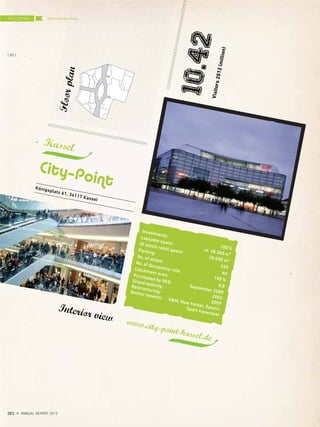
and stationary retailing).
Revenue in the retail sector saw nominal growth of 1.9% in 2012
(-0.3% in real terms) and thus fell short of the previous year (+2.7%
in nominal terms, +1.1% in real terms) The HDE expects revenue
to grow by 1.0% to €432.1 billion. We also believe that domestic
demand will remain strong.
We minimise market and sector risks by closely monitoring the mar-
ket and by concluding long-term contracts with tenants with strong
credit ratings in all retail segments.
RISK OF RENT LOSS
It is possible that tenants may be unable to meet their obligations
under existing leases or that the previous rents may no longer be
obtained in the case of new and follow-on rentals. As a result, income
would turn out to be less than budgeted, and distributions to share-
holders might have to be reduced. If the rental income for a property
company is no longer sufficient to meet its interest and repayment
obligations, this could lead to the loss of the entire property. Ten-
ants’ revenue trends and the accounts receivable trends are regularly
analysed in this respect, and measures to find new tenants are initi-
ated at an early stage if there are signs of any negative developments.
The tenants furnish corresponding security deposits against the risk
of default. In addition, write-downs are recognised in the accounts
in individual cases.
COST RISK
Expenditure on current maintenance or investment projects can turn
out higher than budgeted on the basis of experience. We minimise
risks from cost overruns in current investment projects by costing in
all identifiable risks in the planning stage as a precautionary meas-
ure. In addition, construction contracts are only awarded on a fixed-
price basis to general contractors with strong credit ratings. During
the building phase, professional project management is assured by
the companies we commission. However, it is impossible to com-
pletely avoid cost overruns in ongoing construction projects in indi-
vidual cases.
VALUATION RISK
The value of a property is essentially determined by its capitalised
earnings value, which in turn depends on factors such as the level of
annual rental income, the underlying location risk, the evolution of
long-term capital market rates and the general condition of the prop-
erty. A reduction in rental income or a deterioration of the location
risk necessarily involves a lower capitalised earnings value. The appre-
ciation of the properties is therefore also significantly influenced by a
variety of macroeconomic or regional factors as well as developments
specific to the property that can neither be foreseen nor influenced
by the Company. The factors described are taken into account in the
annual market valuations of our portfolio properties by independ-
ent appraisers. Changes in value are recognised in the income state-
ment of the consolidated financial statements in accordance with
the requirements of IAS 40 and may thus increase the volatility of
the consolidated profit. However, this generally has no effect on the
Group’s solvency.
CURRENCY RISK
Deutsche EuroShop AG’s activities are limited exclusively to the Euro-
pean economic area. Manageable currency risks arise in the case of
the Eastern European investees. These risks are not hedged because
this is purely an issue of translation at the reporting date and is there-
fore not associated with any cash flow risks. The currency risk from
operations is largely hedged by linking rents and loan liabilities to
the euro. A risk could arise if the Hungarian forint or the Polish zloty
were to plummet against the euro such that tenants were no longer
able to pay what would then be considerably higher rents denomi-
nated in foreign currency.
{ 135 }
DES ANNUAL REPORT 2012
GROUP MANAGEMENT REPORT Risks and opportunities management, internal control system
FINANCING AND INTEREST RATE RISKS
We minimise the interest rate risk for new property financing as far as
possible by entering into long-term loans with fixed-interest periods
of up to 20 years. It cannot be ruled out that refinancing may only
be possible at higher interest rates than before. The interest rate level
is materially determined by the underlying macroeconomic condi-
tions and therefore cannot be predicted by us.
The possibility cannot be completely excluded that, owing for exam-
ple to a deterioration in the Company’s results of operations, banks
may not be prepared to provide refinancing or to extend credit lines.
We monitor the interest rate environment closely so as to be able to
react appropriately to interest rate changes with alternative financ-
ing concepts or hedging if necessary. At an average interest rate of
4.23% (2011: 4.59%), this does not currently present a significant
risk within the Group, particularly as the most recent refinancing was
concluded at lower interest rates than the original financing and the
present average interest rate.
Deutsche EuroShop AG uses derivatives that qualify for hedge
accounting to hedge interest rate risks. These interest rate swap
transactions transform variable interest rates into fixed interest rates.
An interest rate swap is an effective hedge if the principal amounts,
maturities, repricing or repayment dates, dates for interest payments
and principal repayments, and basis of calculation used to determine
the interest rates for the hedge are identical to those of the under-
lying transaction and the party to the contract fulfils the contract.
Financial instruments are not subject to liquidity or other risks. The
Group counters the risk of default by stringently examining its con-
tract partners. A test of effectiveness for the hedges described is imple-
mented regularly.
RISK OF DAMAGE
The property companies bear the risk of total or partial destruction
of the properties. The insurance payouts due in such a case might be
insufficient to compensate fully for the damage. It is conceivable that
insurance cover is not sufficient for all theoretically possible losses or
that the insurers may refuse to provide compensation.
IT RISK
Deutsche EuroShop’s information system is based on a centrally man-
aged network solution. Corrective and preventive maintenance of the
system is carried out by an external service provider. A virus protec-
tion concept and permanent monitoring of data traffic with respect to
hidden and dangerous content are designed to protect against external
attacks. All data relevant to operations is backed up on a daily basis.
In the event of a hardware or software failure in our system, all data
can be reproduced at short notice.
PERSONNEL RISK
Given the small number of employees of Deutsche EuroShop AG,
the Company is dependent on individual persons in key positions.
The departure of these key staff would lead to a loss of expertise, and
the recruitment and induction of new replacement personnel could
temporarily impair ongoing day-to-day business.
LEGAL RISK
The concept for our business model is based on the current legal situ-
ation, administrative opinion and court decisions, all of which may,
however, change at any time.
EVALUATION OF THE OVERALL RISK POSITION
On the basis of the monitoring system described, Deutsche EuroShop
has taken appropriate steps to identify developments jeopardising its
continued existence at an early stage and to counteract them. The
Executive Board is not aware of any risks that could jeopardise the
continued existence of the Company.
GROUP MANAGEMENT REPORT
{ 136 }
DES ANNUAL REPORT 2012
Risks and opportunities management, internal control system
Outlook
According to the German Bundesbank, 2013 can be expected to
begin with a temporary weak phase before the economy returns to
its growth trajectory. Assuming that the global economy picks up
again and the reform process in the eurozone continues to make pro-
gress, the German Bundesbank expects a moderate 0.4% increase in
real gross domestic product in 2013. As long as the eurozone’s bank
and sovereign debt crisis does not intensify any further and uncer-
tainty among investors and consumers gradually abates, the real gross
domestic product could rise 1.9% in 2014. The temporary economic
downturn should not have any negative impact on private consumer
demand. According to the German Bundesbank, it will actually bene-
fit from a low unemployment rate (7.2% in 2013 and 7.0% in 2014)
as well as a slight rise in income. Consequently, the German Bun-
desbank anticipates that private consumption in 2013 and 2014 will
increase in real terms by 1.0% and 1.3%, respectively. According to
estimates from the Handelsverband Deutschland (HDE – German
Retail Association), the retail sector should remain stable in 2013.
The Association expects slight revenue growth of 1.0% in nominal
terms. According to the market research company GfK, consumer
climate has also improved somewhat recently.
SOUND OUTLOOK FOR OUR SHOPPING CENTERS
We expect this positive trend to be echoed in our shopping cent-
ers. Restructuring and modernisation work in the Altmarkt-Galerie
Dresden (original site) and the Rhein-Neckar-Zentrum will reach
completion during the current business year. With the exception of
a few small spaces, all leases due to expire were extended. Thus, the
occupancy rate across all our shopping centers is currently expected to
continue to hover at around 99%. At the end of 2012, the occupancy
rate for the total surface was at 98.6%, slightly above the previous
year’s level (99.5%). The occupancy rate for retail space stood steady
at 99.6%. Only in Árkád Pécs were there any significant vacancies
in retail spaces. The remaining vacancies consisted largely of office
and storage space.
Outstanding rents and necessary valuation allowances remain stable
at a low level. We see no sign of a significant change in this satisfac-
tory situation.
TRANSACTION MARKET REMAINS STRONG
Against a background of ongoing uncertainty on the financial markets
as well as a fear of both rising inflation and low capital market inter-
est rates, the global demand for capital investments that retain value
remains strong, particularly in financially well-positioned countries
such as Germany. This is still driving demand for properties for which
there is insufficient supply. Retail property in particular remains a
focus of interest among many institutional investors, leading to very
high transaction prices and correspondingly low anticipated returns
for core properties. We will therefore continue to monitor develop-
ments on the real estate market intensively. As in the past, we will only
make new investments if the return that is achievable over the long
term bears a reasonable relation to the investment risks.
AGREED TRANSACTIONS ARE THE FOUNDATION
FOR REVENUE AND EARNINGS PLANNING
The Deutsche EuroShop Group’s revenue and earnings planning for
2013 and 2014 does not include the purchase or sale of any proper-
ties. The results of the annual valuation of our shopping centers and
exchange rate factors are not included in our planning since they are
not foreseeable.
Forecasts about the future revenue and earnings situation of our
Group are based on
a) the development of revenue and earnings of the existing shop-
ping centers,
b) the assumption that there will be no substantial reduction in rev-
enue in the retail sector that would cause a large number of retail-
ers to no longer be able to meet their obligations under existing
leases and
c) the switch to equity accounting
SWITCH TO EQUITY ACCOUNTING
As mentioned several times in the past, the amendments to the Inter-
national Accounting Standards regarding the permissibility of pro-
portional consolidation of our joint ventures have been approved, yet
application of these changes is only mandatory as of 2014. Regard-
less of this and as already announced, we will exercise our right as set
forth in IAS 31 which permits us to switch to equity accounting as
of 1 January 2013.
{ 137 }
DES ANNUAL REPORT 2012
GROUP MANAGEMENT REPORT Outlook
This means that the share in the revenue and costs of these companies
will no longer be included in the consolidated financial statements
in the future. Instead, only the share in the results of these shopping
centers will be reported under net finance costs. This change not
only concerns the five companies previously consolidated as joint
ventures using the proportional method, but also Stadt-Galerie Pas-
sau KG and Immobilien KG FEZ Harburg, which possess the basic
characteristics of a joint venture yet, based on a voting agreement,
could be fully included in the consolidated financial statements in
the past. These voting agreements were terminated by mutual agree-
ment as per the end of 2012.
In 2012, these seven companies accounted for revenues of €54.2 mil-
lion, EBIT of €48.7 million and earnings before taxes and measure-
ment gains/losses of €29.3 million. If equity accounting were to have
been applied in 2012, revenue would have been €157.1 million and
EBIT €132.3 million. At €94.9 million, earnings before taxes and
measurement gains/losses would have remained nearly unchanged.
In the following, these figures will serve as the basis of forecasts for
the next two financial years.
REVENUE TO RISE BY 9% IN 2013
We anticipate an increase in revenue of around 9% to between €170
million and €173 million in the 2013 financial year. The revenue
contribution of the Herold-Center, in particular, will have a positive
impact. In the 2014 financial year, revenue should see another slight
increase to between €175 million and €178 million.
FURTHER GROWTH IN EARNINGS IN THE NEXT
TWO YEARS
Earnings before interest and taxes (EBIT) amounted to €132.3 mil-
lion in 2012. According to our forecast, EBIT will amount to between
€148 million and €151 million (+13%) in the current financial year.
EBIT should increase further to between €152 million and €155 mil-
lion in 2014 (+3%).
Earnings before tax (EBT) excluding measurement gains/losses
amounted to €94.9 million during the year under review. We expect
the corresponding figure to be between €112 million and €115 mil-
lion for the 2013 financial year (+19%) and between €117 and €120
million for the 2014 financial year (+4%).
POSITIVE FFO TREND
Funds from operations (FFO) amounted to €1.66 per share in the
year under review. We expect this figure to be between €1.99 and
€2.03 in 2013 (+21%) and between €2.03 and €2.07 for the 2014
financial year (+2%).
DIVIDEND POLICY
We intend to maintain our long-term dividend policy geared towards
continuity. We therefore aim to distribute a dividend of at least €1.20
per share to our shareholders again in 2013 and 2014.
Hamburg, 12 April 2013
*at-equity consolidation
Revenue* in € millions
2012 2013 2014
Result
157.1
Target
170–173
Target
175–178
EBIT* in € millions
2012 2013 2014
Result
132.3
Target
148–151
Target
152–155
EBT in € millions
2012 2013 2014
Result
94.9
Target
112–115
Target
117–120
FFO per share in€
2012 2013 2014
Result
1.66
Target
1.99–2.03
Target
2.03–2.07
GROUP MANAGEMENT REPORT
{ 138 }
DES ANNUAL REPORT 2012
Outlook
Consolidated balance sheet 140
Consolidated income statement 142
Consolidated statement of comprehensive income 143
Consolidated cash flow statement 144
Statement of changes in equity 145
Notes to the Consolidated financial statements 146
Auditor’s report 182
2012
Consolidated balance sheetCONSOLIDATED FINANCIAL STATEMENTS
{ 140 }
DES ANNUAL REPORT 2012
Assets
NOTE 31.12.2012
31.12.2011
AFTER
ADJUSTMENT
01.01.2011
AFTER
ADJUSTMENT
ASSETS
Non-current assets
Intangible assets 1. 16 20 29
Property, plant and equipment 2. 112 137 30
Investment properties 3. 3,330,289 3,106,832 2,700,697
Non-current financial assets 4. 30,293 27,815 23,885
Investments in equity-accounted associates 5. 4,109 4,514 4,094
Other non-current assets 6. 316 459 605
Non-current assets 3,365,135 3,139,777 2,729,340
Current assets
Trade receivables 7. 4,738 5,606 3,481
Other current assets 8. 7,115 15,334 156,634
Other financial investments 9. 4,355 0 0
Cash and cash equivalents 10. 167,511 64,408 65,784
Current assets 183,719 85,348 225,899
3,548,854 3,225,125 2,955,239
€ thousand
Total assets
Consolidated balance sheet
{ 141 }
DES ANNUAL REPORT 2012
CONSOLIDATED FINANCIAL STATEMENTS Consolidated balance sheet
Equity and liabilities
NOTE 31.12.2012
31.12.2011
AFTER
ADJUSTMENT
01.01.2011
AFTER
ADJUSTMENT
EQUITY AND LIABILITIES
Equity and reserves
Issued capital 53,945 51,631 51,631
Capital reserves 961,987 890,482 890,615
Retained earnings 305,982 250,928 215,849
Total equity 11. 1,321,914 1,193,041 1,158,095
Non-current liabilities
Financial liabilities 12. 1,463,097 1,335,986 1,227,096
Deferred tax liabilities 13. 180,525 210,587 182,135
Right to redeem of limited partners 284,176 280,078 277,780
Other liabilities 18. 51,242 38,451 21,839
Non-current liabilities 1,979,040 1,865,102 1,708,850
Current liabilities
Financial liabilities 12. 194,137 136,163 61,060
Trade payables 14. 2,331 2,835 6,145
Tax liabilities 15. 24,572 5,935 2,587
Other provisions 16. 12,749 8,859 7,329
Other liabilities 17. 14,111 13,190 11,173
Current liabilities 247,900 166,982 88,294
3,548,854 3,225,125 2,955,239
€ thousand
Total equity and liabilities
Consolidated income statement
NOTE 2012
2011
BEFORE
ADJUST-
MENT
2011
ADJUST-
MENT
2011
AFTER
ADJUST-
MENT
Revenue 19. 211,231 189,975 0 189,975
Property operating costs 20. -11,256 -8,519 0 -8,519
Property management costs 21. -10,547 -9,814 0 -9,814
Net operating income (NOI) 189,428 171,642 0 171,642
Other operating income 22. 2,905 1,010 0 1,010
Other operating expenses 23. -11,316 -6,991 -6,991
Earnings before interest and taxes (EBIT) 181,017 165,661 0 165,661
Income from investments 24. 1,400 1,261 0 1,261
Interest income 540 862 0 862
Interest expense -72,064 -65,761 0 -65,761
Income from equity-accounted associates 25. -589 270 0 270
Profit/loss attributable to limited partners 26. -15,271 -15,730 0 -15,730
Net finance costs -85,984 -79,098 0 -79,098
Measurement gain/loss 27. 8,495 41,811 8,337 50,148
of which excess of identified net assets acquired over cost
of acquisition in accordance with IFRS 3: €4,410 thousand
(previous year: €7,888 thousand)
Earnings before tax (EBT) 103,528 128,374 8,337 136,711
Income tax expense 28. 18,956 -34,978 -2,695 -37,673
Consolidated profit 122,484 93,396 5,642 99,038
Earnings per share (€), basic 32. 2.36 1.81 0.11 1.92
Earnings per share (€), diluted 32. 2.35 1.81 0.11 1.92
€ thousand
CONSOLIDATED FINANCIAL STATEMENTS
{ 142 }
DES ANNUAL REPORT 2012
Consolidated income statement
NOTE 2012
2011
BEFORE
ADJUST-
MENT
2011
ADJUST-
MENT
2011
AFTER
ADJUST-
MENT
Consolidated profit 122,484 93,396 5,642 99,038
Changes due to currency translation effects 0 -373 -373
Changes in cash flow hedge 11., 30. -14,468 -16,405 -16,405
Change due to IAS 39 measurement of investments 4., 11., 30. 2,478 3,930 3,930
Deferred taxes on changes in value offset directly against equity 11., 13. 1,344 5,684 5,684
Total earnings recognised directly in equity -10,646 -7,164 0 -7,164
Total profit 111,838 86,232 5,642 91,874
Share of Group shareholders 111,838 86,232 5,642 91,874
€ thousand
{ 143 }
DES ANNUAL REPORT 2012
CONSOLIDATED FINANCIAL STATEMENTS Consolidated statement of comprehensive income
Consolidated statement of comprehensive income
Consolidated cash flow statement
NOTE
01.01.–
31.12.2012
01.01.–
31.12.2011
BEFORE
ADJUST-
MENT
01.01.-
31.12.2011
ADJUST-
MENT
01.01.–
31.12.2011
AFTER
ADJUST-
MENT
Profit after tax 122,484 93,396 5,642 99,038
Expenses/income from the application of IFRS 3 27. -5,289 -7,888 -7,888
Profit/loss attributable to limited partners 26., 27. 33,946 27,596 27,596
Depreciation of intangible assets and property, plant
and equipment 1., 2. 40 36 36
Unrealised changes in fair value of investment property 27. -31,079 -54,302 -54,302
Profit/loss for the period of equity-accounted companies 25. 589 -270 -270
Other non-cash income/expenses 484 0 0
Expenses from investment activities to be allocated to
the cash flow 27. 9,198 8,512 -8,337 175
Deferred taxes 28. -27,545 31,606 2,695 34,301
Operating cash flow 102,828 98,686 0 98,686
Changes in receivables 6., 7., 8., 30. -12 147,660 -147,611 49
Change in other financial investments -4,355 0 0
Changes in current provisions 16. 22,528 1,482 1,482
Changes in liabilities
14., 15., 17.,
18., 30. 390 1,593 1,593
Cash flow from operating activities 121,379 249,421 -147,611 101,810
Payments to acquire property, plant and equipment/
investment properties 2., 3. -12,628 -77,201 -77,201
Expenses from investment activities to be allocated to
the cash flow -9,198 -8,512 8,337 -175
Payments to acquire shareholdings in consolidated companies
and business units -176,250 -266,323 148,375 -117,948
Inflows/outflows to/from the financial assets -184 -150 -150
Cash flow from investing activities -198,260 -352,186 156,712 -195,474
Inflows from financial liabilities 12. 191,742 183,993 183,993
Contributions of Group shareholders 11., 29. 66,198 0 0
Payments to Group shareholders 11., 29. -56,795 -56,795 -56,795
Payments to limited partners 29. -21,161 -25,319 -9,101 -34,420
Cash flow from financing activities 179,984 101,879 -9,101 92,778
Net change in cash and cash equivalents 103,103 -886 0 -886
Cash and cash equivalents at beginning of period 64,408 65,784 65,784
Currency-related changes 0 -487 -487
Other changes 0 -3 -3
Cash and cash equivalents at end of period 10. 167,511 64,408 0 64,408
€ thousand
CONSOLIDATED FINANCIAL STATEMENTS
{ 144 }
DES ANNUAL REPORT 2012
Consolidated cash flow statement
NOTE
NUMBER
OF SHARES
OUT-
STANDING
SHARE
CAPITAL
CAPITAL
RESERVES
OTHER
RETAINED
EARNINGS
STATUTORY
RESERVE TOTAL
01.01.2011 51,631,400 51,631 890,615 219,491 2,000 1,163,737
Adjustment in acc. with IAS 8 -5,642 -5,642
Adjusted on 1 January 2011 51,631,400 51,631 890,615 213,849 2,000 1,158,095
Earnings recognised
directly in equity 0 0 -7,164 0 -7,164
Consolidated profit (including
adjustment acc. to IAS 8.41f.) 99,038 99,038
Total profit 91,874 91,874
Change in deferred taxes -133 -133
Dividend payments 11. -56,795 -56,795
Other changes 0
Capital increase 0 0
31.12.2011 51,631,400 51,631 890,482 248,928 0 1,193,041
01.01.12 51,631,400 51,631 890,482 248,928 2,000 1,193,041
Earnings recognised
directly in equity 0 0 -10,646 0 -10,646
Consolidated profit 122,484 122,484
Total profit 0 111,838 111,838
Dividend payments 11. -56,795 -56,795
Bond conversion right 12. 7,140 7,140
Capital increase 11. 2,314,136 2,314 64,365 66,679
Other changes 11 11
31.12.2012 53,945,536 53,945 961,987 303,982 2,000 1,321,914
€ thousand
{ 145 }
DES ANNUAL REPORT 2012
CONSOLIDATED FINANCIAL STATEMENTS Statement of changes in equity
Statement of changes in equity
General disclosuresCONSOLIDATED FINANCIAL STATEMENTS
{ 146 }
DES ANNUAL REPORT 2012
General disclosures
The Group parent company is Deutsche EuroShop AG, Hamburg, Germany. The Company’s registered office is
Wandsbeker Straße 3–7, 22179 Hamburg, Germany, and it is entered in the Hamburg commercial register under
HRB 91799.
Deutsche EuroShop AG focuses on acquiring, managing, using and selling investments of all kinds, and in particular
investments in retail properties.
The consolidated financial statements of Deutsche EuroShop AG have been prepared in accordance with the Inter-
national Financial Reporting Standards (IFRSs) issued by the International Accounting Standards Board (IASB),
including the interpretations of the International Financial Reporting Interpretations Committee (IFRIC) and the
supplementary provisions of German commercial law required to be applied under section 315a (1) of the Handelsge-
setzbuch (HGB – German Commercial Code). They are based on the premise of a going concern. All IFRSs and
IFRIC interpretations endorsed by the European Commission and required to be applied as of 31 December 2012
have been applied.
In addition to the consolidated balance sheet, consolidated income statement and the consolidated statement of com-
prehensive income, the consolidated financial statements comprise the consolidated statement of changes in equity,
the cash flow statement and the notes to the consolidated financial statements.
Amounts are mainly presented in thousands of €.
Notes
to the Consolidated financial statements
2012
{ 147 }
DES ANNUAL REPORT 2012
CONSOLIDATED FINANCIAL STATEMENTS Basis of consolidation and consolidation methods
The preparation of the consolidated financial statements necessitates the use of estimates and assumptions. These affect
the reported amounts of assets, liabilities and contingent liabilities at the balance sheet date, as well as the recognition
of income and expenses during the reporting period. The actual amounts can differ from these estimates. Expected
cash flows and the discount factor in particular are critical parameters for the measurement of investment properties.
The consolidated financial statements as at 31 December 2012 are approved by the Audit Committee of the Super-
visory Board on 12 April 2013 and are expected to be approved at the Supervisory Board’s financial statements review
meeting on 23 April 2013. Until the consolidated financial statements are adopted there is still a possibility that they
may be amended.
A detailed list of the companies included in the consolidated financial statements forms part of the notes.
The annual financial statements of the consolidated companies were prepared as at 31 December 2012, the reporting
date of the consolidated financial statements.
Basis of consolidation and consolidation methods
BASIS OF CONSOLIDATION
SUBSIDIARIES
The consolidated financial statements include all subsidiaries in which Deutsche EuroShop AG directly or indirectly
holds a majority of voting rights, plus those companies which are joint ventures.
As at 31 December 2012, the basis of consolidation comprised, in addition to the parent company, 12 (previous
year: 19) fully consolidated domestic and foreign subsidiaries and five (previous year: five) proportionately consoli-
dated domestic and foreign joint ventures.
With effect from 1 January 2012, Deutsche EuroShop AG acquired 5.1% of the Rathaus-Center Dessau KG, thus
taking its shareholding to 100%. The purchase price of €5.9 million was paid in early 2012. In addition, with effect
from 1 January 2012, around 11% of the Allee-Center Hamm KG (purchase price €8.9 million) and 0.1% of the
Rhein-Neckar-Zentrum KG (purchase price €0.2 million) were acquired, thus increasing the shareholding in each to
100%. The purchase prices were paid at the end of 2011. These acquisitions resulted in an excess of identified net assets
acquired over cost of acquisition in the amount of €0.8 million, which was recognised under measurement gains/losses.
DES Shoppingcenter GmbH & Co. KG was founded on 23 August 2012 with an investment of €10 thousand. The
company’s purpose is to acquire and manage property as well as all transactions associated with this property. Within
the scope of the merger agreements of 27 December 2012 and with effect from 31 December 2012, Billstedt-Center
Hamburg GmbH & Co. KG, Allee-Center Hamm GmbH & Co. KG, City-Arkaden Wuppertal GmbH & Co. KG,
City-Galerie Wolfsburg GmbH & Co. KG, Rathaus-Center Dessau GmbH & Co. KG and Rhein-Neckar-Zentrum
GmbH & Co. KG transferred their assets in full to DES Shoppingcenter GmbH & Co. KG including all rights and
obligations by dissolution without liquidation as part of a merger by absorption pursuant to sections 2 (1), (4) et seq.
and sections 39 et seq. of the Umwandlungsgesetz (UmwG – German Reorganization Act) and were thus merged
into the latter. DES Shoppingcenter GmbH & Co. KG thus became the owner of the shopping centers Allee-Center
Hamm, Billstedt-Center Hamburg, City-Galerie Wolfsburg, City-Arkaden Wuppertal, Rathaus-Center Dessau and
Rhein-Neckar-Zentrum Viernheim.
Basis of consolidation and consolidation methods
The company also acquired ownership of the Herold-Center Norderstedt with the property purchase agreement dated
16 November 2012. The transfer of benefits and encumbrances took place on 31 December 2012. The fair value of
the acquired property was €179.80 million, which resulted in an excess of identified net assets acquired over the pur-
chase price allocation. This stood at €4.4 million and was recognised under measurement gains/losses. This is off-
set by ancillary acquisition costs in connection with the acquisition of the property totalling €9.2 million, which are
recognised under measurement gains/losses. Information regarding the revenue and profit generated by the acquired
property for the financial year 2012 were not available.
CARRYING
AMOUNTS FAIR VALUE
Acquired property assets 179,760 179,760
Purchase price -176,250 -176,250
Deferred taxes 900 900
Excess of identified net assets acquired over cost of acquisition 4,410 4,410
JOINT VENTURES
Joint ventures in which Deutsche EuroShop AG has a majority of the voting rights together with third parties are
proportionately included as joint ventures in the consolidated financial statements.
Five companies fall into this category as at the balance sheet date.
ASSOCIATES
In accordance with IAS 28, where Deutsche EuroShop AG can exercise a significant influence but not control over
companies these are measured using the equity method, irrespective of the interest held in these companies. Six com-
panies fall into this category as at the balance sheet date.
INVESTEES
Investments over which Deutsche EuroShop AG has neither significant influence nor control are measured at fair
value, in line with the provisions of IAS 39. This includes the investment in Ilwro Joint Venture Sp. z o.o., Warsaw.
CONSOLIDATION METHODS
For purchase accounting, the cost is eliminated against the parent company’s interest in the re-valued equity of the
subsidiaries at the date of acquisition or initial consolidation. Any remaining excess of identified net assets acquired
over cost of acquisition is recognised as goodwill in intangible assets. Any excess of identified net assets acquired over
cost of acquisition is recognised in income following a further reassessment.
Joint ventures are included proportionately in the consolidated financial statements in accordance with IAS 31.
Alternatively, the equity method is also permissible. The assets and liabilities and the income and expenses of jointly
controlled companies are included in the consolidated financial statements according to the interest held in these
companies. Proportionate consolidation and accounting for goodwill follows the same principles applied to the con-
solidation of subsidiaries.
For associates measured in the consolidated financial statements using the equity method, the cost of the investment is
recognised in income at an amount increased or reduced by the changes in equity corresponding to the equity interest
of Deutsche EuroShop AG.
Intragroup transactions are eliminated as part of the consolidation of intercompany balances and of income and
expenses.
2012 in € million
Total
CONSOLIDATED FINANCIAL STATEMENTS
{ 148 }
DES ANNUAL REPORT 2012
Currency translation
The Group currency is the euro (€).
The companies located outside the eurozone that are included in the consolidated financial statements are treated as
legally independent, but economically dependent, integrated companies. The reporting currencies of these compa-
nies (Polish zloty and Hungarian forint) therefore deviate from the functional currency (euro). Under IAS 21, annual
financial statements prepared in foreign currencies are translated using the functional currency method, with the result
that the balance sheet is to be translated as if the transactions had arisen for the Group itself, as the local currency of
the integrated companies is deemed to be a foreign currency for these companies themselves.
Monetary values are therefore translated at the closing rate and non-monetary items at the rate that applied at the
time of initial recognition. Non-monetary items to be reported at fair value are translated at the closing rate. Items in
the consolidated income statement are translated at average rates for the year or, in the event of strong fluctuations,
using the rate that applied on the date of the transaction. Any translation differences that may arise if the translation
rates of the balance sheet and consolidated income statement differ are recognised in profit or loss.
A closing rate of HUF 291.29 (previous year: HUF 311.13) and an average rate of HUF 289.42 (previous year:
HUF 279.28) were used in the translation of the separate Hungarian financial statements for Einkaufs-Center Arkaden
Pécs KG, Hamburg, from forint to euros. A closing rate of PLN 4.0822 (previous year: PLN 4.4168 ) and an average
rate of PLN 4.185 (previous year: PLN 4.1189) were taken as a basis for translating the separate financial statements
of the Polish property company.
Changes in accounting policies
ADJUSTMENT OF PREVIOUS YEAR’S VALUES IN ACCORDANCE WITH IAS 8
(CORRECTION OF AN ERROR)
The Bundesanstalt für Finanzdienstleistungsaufsicht (BaFin – German Federal Financial Supervisory Authority) has
notified us that an audit of the financial statements for the financial year 2011 revealed two mistakes:
The item “Measurement gains/losses” indicated in the consolidated income statement was €8.3 million too low
because merger-related expenses connected to the acquisition of the Billstedt-Center Hamburg which should have
been recognised in financial year 2010 were erroneously recognised in financial year 2011.
In the 2011 consolidated financial statements, cash inflows in the amount of €155.2 million are recognised in “Cash
flow from operating activities” and cash outflows in the same amount are recognised in “Cash flow from investment
activities”, both in connection with the acquisition of the Billstedt-Center Hamburg, yet no cash inflows or outflows
in this amount actually took place during the period.
Additionally, within the scope of corrections made to the cash flow statement, a correction was made to the way pur-
chase price prepayments in connection with the increased shareholdings in the Allee-Center Hamm and the Rhein-
Neckar-Zentrum in 2011 were depicted.
{ 149 }
DES ANNUAL REPORT 2012
CONSOLIDATED FINANCIAL STATEMENTS Currency translation
Changes in accounting policies
The resulting corrected values, taking into account any deferred taxes, have been recognised in the other parts of the
consolidated financial statements and are summarised below:
CONSOLIDATED INCOME STATEMENT
2011 BEFORE
ADJUSTMENT
IAS 8
ADJUSTMENT
2011 AFTER
ADJUSTMENT
Measurement gains/losses 41,811 8,337 50,148
Income tax expense -34.978 -2.695 -37.673
CONSOLIDATED PROFIT PER SHARE
2011 BEFORE
ADJUSTMENT
IAS 8
ADJUSTMENT
2011 AFTER
ADJUSTMENT
basic 1.81 0.11 1.92
diluted 1,81 0,11 1,92
GROUP EQUITY
2011 BEFORE
ADJUSTMENT
IAS 8
ADJUSTMENT
2011 AFTER
ADJUSTMENT
Retained earnings at 1 January 221,491 -5,642 215,849
Consolidated profit 93,396 5,642 99,038
Other changes in retained earnings -63.959 0 -63.959
Retained earnings at 31 December 250,928 0 250,928
CONSOLIDATED BALANCE SHEET
01.01.2011
BEFORE
ADJUSTMENT
IAS 8
ADJUSTMENT
01.01.2011
AFTER
ADJUSTMENT
Other current assets 164,971 -8,337 156,634
Retained earnings 221,491 -5,642 215,849
Deferred tax liabilities -184,830 -2,695 -182,135
€ thousand
in €
€ thousand
€ thousand
CONSOLIDATED FINANCIAL STATEMENTS
{ 150 }
DES ANNUAL REPORT 2012
CASH FLOW STATEMENT
2011 BEFORE
ADJUSTMENT
IAS 8
ADJUSTMENT
2011 NACH
ADJUSTMENT
Profit after tax 93.396 5.642 99.038
Expenses from investment activities to be allocated
to the cash flow 8.512 -8.337 175
Deferred taxes 31.606 2.695 34.301
Operating cash flow 98.686 0 98.686
Changes in receivables 147.660 -147.611 49
Cash flow from operating activities 249.421 -147.611 101.810
Expenses from investment activities to be allocated
to the cash flow -8.512 8.337 -175
Payments to acquire shareholdings in consolidated
companies and business units -266.323 148.375 -117.948
Cash flow from investing activities -352.186 156.712 -195.474
Payments to limited partners -25.319 -9.101 -34.420
Cash flow from financing activities 101.879 -9.101 92.778
Net change in cash and cash equivalents -886 0 -886
Reporting principles
The following standards and interpretations or amendments to these were applicable for the first time in financial
year 2012:
¤ IFRS 7 Financial Instruments: Disclosures – Transfers of Financial Assets (amendment) (since 1 July 2011)
The amendments or new announcements had no or no material effects on the presentation of the net assets, financial
position and results of operations of the Group.
€ thousand
{ 151 }
DES ANNUAL REPORT 2012
CONSOLIDATED FINANCIAL STATEMENTS Reporting principles
Reporting principles
In 2012, the IASB issued standards and interpretations of and amendments to existing standards which it was not yet
compulsory to apply in the consolidated financial statements for this period.
¤ IAS 1 Presentation of Financial Statements: changes to Presentation of Items of Other Comprehensive
Income (since 1 July 2012)
¤ IAS 19 Employee Benefits: accounting treatment of defined benefit plans and post-employment benefits
(as of 1 January 2013)
¤ IFRS 10 Consolidated Financial Statements (as of 1 January 2014)
¤ IFRS 11 Joint Arrangements (as of 1 January 2014)
¤ IFRS 12 Disclosures of Interests in Other Entities (as of 1 January 2014)
¤ IFRS 13 Fair Value Measurement (as of 1 January 2013)
¤ IAS 27 Separate Financial Statements (as of 1 January 2014)
¤ IAS 28 Investments in Associates and Joint Ventures (as of 1 January 2014)
¤ IAS 12 Deferred Tax: Recovery of Underlying Assets
(start of the first financial year on or following the ordinance’s entry into effect)
¤ Amendments to IFRS 1 Severe Hyperinflation and Removal of Fixed Dates for First-time Adopters
(start of the first financial year on or following the ordinance’s entry into effect)
¤ Amendments to IFRS 7 Financial Instruments: Disclosures – Offsetting Financial Assets and
Financial Liabilities (amendment) (as of 1 January 2013)
¤ Amendments to IAS 32 Financial Instruments: Presentation – Offsetting Financial Assets and
Financial Liabilities (as of 1 January 2014)
¤ IFRIC 20 Stripping Costs in the Production Phase of a Surface Mine (as of 1 January 2013)
The official announcements that did not yet have to be applied in 2012 will be implemented in the year in which
their application becomes compulsory for the first time. The effects of these individual amendments are being
examined by the Group.
The following standards as well as interpretations of and amendments to existing standards were issued by IASB.
However, their application was not yet compulsory for the preparation of the consolidated financial statements
dated 31 December 2012. Application requires that they are endorsed by the EU within the scope of the IFRAS
endorsement process.
¤ IFRS 9 Financial Instruments (as of 1 January 2015)
¤ Amendments to IFRS 1 First-time Adoption of the International Financial Reporting Standards –
Government Assistance
¤ Annual Improvements to IFRS – 2009–2011 Cycle (as of 1 January 2013)
¤ Amendments to IFRS 10, IFRS 11, IFRS 12: Transitional guidelines (as of 1 January 2013)
¤ Amendments to IFRS 10, IFRS 12 and IAS 27: Investment companies (as of 1 January 2014)
The official announcements that did not yet have to be applied in 2012 will be implemented in the year in which their
application becomes compulsory for the first time. The effects of these individual amendments are being examined by
the Group.
CONSOLIDATED FINANCIAL STATEMENTS
{ 152 }
DES ANNUAL REPORT 2012
Significant accounting policies
REVENUE AND EXPENSE RECOGNITION
Revenue and other operating income are recognised once the relevant service has been rendered or once the risk has
passed to the customer. Operating expenses are recognised once the service has been utilised or at the time when they
are booked through profit and loss. Interest income and expense are accrued.
INTANGIBLE ASSETS
Intangible assets relate exclusively to software purchased by Deutsche EuroShop AG. Additions are measured at cost.
These are amortised using the straight-line method over the expected useful life of five years. The method of depre-
ciation and the depreciation period are reviewed annually at the end of each financial year.
PROPERTY, PLANT AND EQUIPMENT
Property, plant and equipment is reported at cost, less scheduled depreciation and, where applicable, unscheduled
write-downs (impairment charges).
Operating and office equipment comprises company cars, office equipment, fittings and technical equipment belong-
ing to Deutsche EuroShop AG, and is depreciated using the straight-line method over three to 13 years. The method
of depreciation and the depreciation period are reviewed annually at the end of each financial year.
INVESTMENT PROPERTIES
Under IAS 40, investment property must initially be measured at cost at the date of acquisition. Property that is
under construction and that is intended to be used as investment property following its completion also falls under
the scope of IAS 40. Property held as a financial investment can either be recognised at amortised cost (cost model)
or using the fair-value model.
Subsequently, all properties must be measured at their fair value and the annual net changes recognised in income
under measurement gains/losses. Investment property is property held for the long term to earn rental income or capi-
tal gains. Under IAS 40, investment property measured using the fair value model is no longer depreciated.
As in previous years, the fair values of the properties in the period under review were determined by the Feri EuroRating
Services AG and GfK GeoMarketing GmbH appraisal team using the discounted cash flow (DCF) method. In accord-
ance with the DCF method, future cash flows from the property in question are discounted back to the measure-
ment date. In addition, the net income from the property is determined over a detailed planning period of ten years.
A resale value is forecast for the end of the ten-year detailed planning phase. The net income is then capitalised over
the remaining life. In a second step, the resale value is discounted back to the measurement date.
Averaged across all properties, 11.0% (2011: 11.8%) of rental income is deducted for management and adminis-
trative costs, with the result that net income equates to 89.0% (2011: 88.2%) of rental income. Actual manage-
ment and administrative costs amounted to 10.3% of rental income in the year under review (2011: 9.7%).
{ 153 }
DES ANNUAL REPORT 2012
CONSOLIDATED FINANCIAL STATEMENTS Significant accounting policies
Financial instruments
The capitalisation rate applied comprises a forecast yield on a ten-year German federal government bond and a pre-
mium that takes account of the individual risk profile of the property. Around 150 individual indicators are used to
determine the risk profile. These include a forecast of population trends over the long term, the rate of employment
and the resulting effects on retail demand, trends in the competitive environment and construction activity.
The discount rate averaged 6.67%, compared with 6.65% in the previous year. It is composed of an average yield
of 4.30% on a ten-year German federal government bond (2011: 4.34%) and an average risk premium of 2.37%
(2011: 2.34%).
On the basis of the expert appraisals, the property portfolio has a net initial yield of 5.98% for financial year 2013,
compared with 5.92% in the previous year.
There is no differentiation between the domestic and international operations, as the differences are not material.
Borrowing and initial rental costs that are directly attributable to the acquisition, construction or production of a qual-
ifying asset are included in the cost of that asset until the time at which the asset is largely ready for its intended use.
Income realised from the temporary investment of specifically borrowed funds up to the point when these are used
to obtain qualifying assets is deducted from the capitalisable costs of these assets.
All other borrowing costs are recognised in income in the period in which they occur. Maintenance measures relating
to property, plant and equipment are recognised as an expense in the financial year in which they occur.
No appraisal report was produced for the properties owned by CASPIA Investments Sp. z o.o., Warsaw, due to their
lesser importance. The properties were also recognised at market value in accordance with IAS 40.
LEASE AGREEMENTS
In line with IAS 17, the tenancy agreements in the Deutsche EuroShop Group are classified as operating leases. The
operating lease agreements relate to investment property owned by the Group with long-term leases. Rental income
from operating leases is recognised in income on a straight-line basis over the term of the corresponding lease. The
lessee has no opportunity to acquire the property at the end of the term.
Financial instruments
Financial assets and liabilities are recognised in the consolidated balance sheet when the Group becomes a party to
the contractual provisions governing the financial instrument.
Financial instruments are generally recognised at fair value. When determining fair value, three assessment categories
are differentiated between:
Level 1: At the first level of the “fair value hierarchy”, fair values are determined using publicly quoted market prices,
as the best-possible objective indication of the fair value of a financial asset or liability can be observed on
an active market.
CONSOLIDATED FINANCIAL STATEMENTS
{ 154 }
DES ANNUAL REPORT 2012
Level 2: If there is no active market for an instrument, a company determines the fair value using measurement
models. These models include use of the most recent arm’s-length transactions between knowledgeable and
willing parties, comparison with the current fair value of another, essentially identical financial instrument,
use of the discounted cash flow method and option pricing models. The fair value is estimated on the basis
of the results of a method of measurement that uses data from the market to the greatest possible extent and
is based as little as possible on company-specific data.
Level 3: The measurement models used for this level are also based on parameters that are not observable on the market.
A. DERIVATIVE FINANCIAL INSTRUMENTS
Derivatives that qualify for hedge accounting in accordance with IAS 39 are used to hedge interest rate risks. These
are fixed-rate swaps to limit the interest rate risk of variable interest rate loans, which have terms extending to 2026.
The interest rate hedges are recognised at fair value under “Other assets” or “Other liabilities”. Changes are recognised
directly in equity, provided that the conditions of the underlying and hedge transaction are identical. Hedge effec-
tiveness tests are regularly conducted. Present value is calculated based on discounted cash flows using current market
interest rates. The final maturities of the interest rate hedges and loan agreements are identical.
B. NON-CURRENT FINANCIAL ASSETS
Non-current financial assets are classified as available for sale and include an investment in a Polish corporation that
is a joint venture controlled by Deutsche EuroShop jointly with partner companies. As Deutsche EuroShop, under
the provisions of the shareholders’ agreement, exercises neither significant influence nor control over this company,
the investment is measured at fair value in line with the provisions of IAS 39. Measurement gains and losses are rec-
ognised directly in equity. Fair values of financial instruments for which there are no quoted market prices are esti-
mated on the basis of the market values of the properties determined by appraisals, less net debt. The determination
of fair value assumes the existence of a going concern.
C. RECEIVABLES AND OTHER CURRENT ASSETS
Receivables and other current assets are recognised at amortised cost less write-downs. Allowances are established for
trade receivables if it is no longer certain that payment will be received. This is reviewed on a case-by-case basis at the
balance sheet date. They are written off if the receivable becomes uncollectible.
D. RIGHT TO REDEEM OF LIMITED PARTNERS
The distinction between equity and liabilities is set out in IAS 32 Financial Instruments: Disclosure and Presenta-
tion. In accordance with this standard, the equity interests of third-party shareholders in commercial partnerships
are reclassified as liabilities due to the shareholders’ potential right of redemption. According to sections 131 et seq.
HGB, shareholders in commercial partnerships have an ordinary legal right of termination of six months with effect
from the end of the financial year, which the shareholders’ agreement can define in greater detail, but not exclude.
As a result of this stipulation, a liability rather than equity is recognised in the balance sheet. This liability must be
measured at fair value.
{ 155 }
DES ANNUAL REPORT 2012
CONSOLIDATED FINANCIAL STATEMENTS Financial instruments
Financial instruments
E. FINANCIAL LIABILITIES
Liabilities to banks/bank loans and overdrafts are reported at amortised cost. Discounts are deducted, which under
IAS 39 must be amortised over the term of the loan agreement and recognised annually as an expense.
The debt component of convertible bonds is measured using the market interest rate for a similar, non-convertible bond.
This debt component is measured as a liability at amortised cost using the effective interest method until converted or
repayment becomes due. The remaining proceeds from the issue represent the value of the conversion rights. This is
recognised in equity within the capital reserves. The financial liability increases over time, with an effect on net income,
and comes to an amount equalling the difference between the actual interest expense and the nominal interest rate.
F. TRADE PAYABLES
Trade payables are recognised at their repayment amount.
G. SONSTIGE VERBINDLICHKEITEN
Other liabilities are recognised at amortised cost.
H. OTHER LIABILITIES
Cash and cash equivalents include cash and bank balances (terms of up to three months) at their principal amounts.
INVESTMENTS IN EQUITY-ACCOUNTED ASSOCIATES
Companies with a narrow scope of business in which Deutsche EuroShop generally has an interest of between 20%
and 50% and over which it exercises significant influence but not control are measured as equity-accounted associ-
ates. Here, the changes in the equity of such companies corresponding to the equity interest of Deutsche EuroShop
are recognised in income.
DEFERRED TAXES
In accordance with IAS 12, deferred taxes are recognised for all differences between the tax accounts and the IFRS
balance sheet, using the currently enacted tax rate. Currently, deferred taxes are primarily formed on the differences
between the IFRS carrying amounts of the properties and their carrying amounts for tax purposes. A uniform cor-
poration tax rate of 15% plus the solidarity surcharge of 5.5% was used for German companies, and in some cases
a rate of 16.45% for trade tax. The respective local tax rates were applied for foreign companies. In accordance with
IAS 12.74, deferred tax assets on existing loss carryforwards are offset against deferred tax liabilities.
OTHER PROVISIONS
Under IFRS, other provisions may only be recognised if a present obligation exists towards a third party and payment
is more likely than not. Non-current provisions are discounted.
CONSOLIDATED FINANCIAL STATEMENTS
{ 156 }
DES ANNUAL REPORT 2012
Notes to the Consolidated financial statements — Assets
1. INTANGIBLE ASSETS
CONCESSIONS, INDUSTRIAL AND SIMILAR RIGHTS AND
LICENCES IN SUCH RIGHTS AND ASSETS
2012 2011
Costs as at 1 January 64 62
Additions 9 2
Disposals -9 0
as at 31 December 64 64
Depreciation as at 1 January -44 -33
Additions -12 -11
Disposals 8 0
as at 31 December -48 -44
Carrying amount at 1 January 20 29
Carrying amount at 31 December 16 20
This item consists mainly of software licences.
2. PROPERTY, PLANT AND EQUIPMENT
OTHER EQUIPMENT, OPERATING AND OFFICE EQUIPMENT
2012 2011
Costs as at 1 January 204 77
Additions 2 132
Disposals -1 -5
as at 31 December 205 204
Depreciation as at 1 January -67 -47
Additions -28 -24
Disposals 2 4
as at 31 December -93 -67
Carrying amount at 1 January 137 30
Carrying amount at 31 December 112 137
This includes the office equipment of Deutsche EuroShop AG and two company vehicles.
€ thousand
€ thousand
{ 157 }
DES ANNUAL REPORT 2012
CONSOLIDATED FINANCIAL STATEMENTS Notes to the Consolidated financial statements – Assets
Notes to the Consolidated financial statements – Assets
PROPERTY, ADVANCE PAYMENTS AND ASSETS UNDER CONSTRUCTION
2012 2011
Costs as at 1 January 230 230
Additions 0 0
Disposals -230 0
as at 31 December 0 230
Depreciation as at 1 January -230 -230
Additions 0 0
Disposals 230 0
as at 31 December 0 -230
Carrying amount at 1 January 0 0
Carrying amount at 31 December 0 0
3. INVESTMENT PROPERTIES
2012 2011
Carrying amount at 1 January 3,106,832 2,700,697
Additions 12,618 77,067
Additions to basis of consolidation 179,760 274,767
Unrealised changes in fair value 31,079 54,301
Carrying amount at 31 December 3,330,289 3,106,832
The properties are secured by mortgages. There are land charges in the amount of €1,565,291 thousand (previous year:
€1,472,149 thousand). The rental income of the properties valued in accordance with IAS 40 was €211,231 thou-
sand (previous year: €189,975 thousand). Directly associated operating expenses were €21,803 thousand (previous
year: €18,333 thousand).
The additions include construction costs incurred for our expansion measures in Dresden, Wildau and Sulzbach as
well as ongoing investments in portfolio properties.
The Herold-Center Norderstedt was acquired on 31 December 2012. The fair value at the balance sheet date was
included in the basis of consolidation.
Unrealised changes in market value relate to appreciation and depreciation in accordance with IAS 40 on shopping
center properties.
€ thousand
€ thousand
CONSOLIDATED FINANCIAL STATEMENTS
{ 158 }
DES ANNUAL REPORT 2012
4. NON-CURRENT FINANCIAL ASSETS
2012 2011
Costs as at 1 January 15,381 15,381
as at 31 December 15,381 15,381
Amortisation/impairment losses and reversals as at 1 January 12,434 8,504
Reversals of impairment losses 2,478 3,930
as at 31 December 14,912 12,434
Carrying amount at 1 January 27,815 23,885
Carrying amount at 31 December 30,293 27,815
During the reporting year, a reversal of impairment losses, recognised directly in equity, on the stake in Ilwro Joint
Venture Sp. z o.o., Warsaw, was made in the amount of €2,478 thousand, taking the carrying amount of the partici-
pation to €30,293 thousand on the reporting date.
5. INVESTMENTS IN EQUITY-ACCOUNTED ASSOCIATES
2012 2011
Carrying amount at 1 January 4,514 4,094
Deposits/withdrawals 184 150
Share of profit/loss -590 177
Value increases 1 93
Carrying amount at 31 December 4,109 4,514
The changes in the fair value of equity-accounted associates are due to deposits made and shares in the profits/losses
of smaller property companies that are not of material significance from a Group perspective.
6. OTHER NON-CURRENT ASSETS
31.12.2012 31.12.2011
Other non-current assets 316 459
316 459
This item consists mainly of the present value of a non-current receivable of €282 thousand (previous year: €422
thousand) for our Polish property company. The company will have annual cash inflows of €207 thousand until 2016.
€ thousand
€ thousand
€ thousand
Total
{ 159 }
DES ANNUAL REPORT 2012
CONSOLIDATED FINANCIAL STATEMENTS Notes to the Consolidated financial statements – Assets
Notes to the Consolidated financial statements – Assets
7. TRADE RECEIVABLES
31.12.2012 31.12.2011
Trade receivables 6,031 6,617
Allowances for doubtful accounts -1,293 -1,011
4,738 5,606
Receivables result primarily from rental invoices and services in relation to investments for which charges are passed
on. These were predominantly paid at the time the consolidated financial statements were prepared. The amounts
recognised at the reporting date are protected by means of guarantees, cash security deposits and letters of comfort.
8. OTHER CURRENT ASSETS
31.12.2012 31.12.2011
Prepayments of purchase prices 0 9,101
Value added tax receivables 43 3
Deductible withholding tax on dividends/solidarity surcharge 136 133
Interest rate swaps 207 207
Other current assets: 6,729 5,890
7,115 15,334
Other current assets primarily consist of other receivables from tenants and prepaid costs to protect locations.
RECEIVABLES
TOTAL UP TO 1 YEAR OVER 1 YEAR
Trade receivables 4,738 4,738 0
(5,606) (5,606) (0)
Other assets 7,431 7,115 316
(15,793) (15,334) (459)
12,169 11,853 316
Previous year’s figure in brackets (21,399) (20,940) (459)
€ thousand
Total
€ thousand
Total
€ thousand
CONSOLIDATED FINANCIAL STATEMENTS
{ 160 }
DES ANNUAL REPORT 2012
MATURITY OF TRADE RECEIVABLES AND OTHER ASSETS
CARRYING
AMOUNT
NOT
OVERDUE
Trade receivables 4,738 4,738
(5,606) (5,606)
Other assets 7,431 7,431
(15,793) (15,793)
12,169 12,169
Previous year’s figure in brackets (21,399) (21,399)
9. OTHER FINANCIAL INVESTMENTS
31.12.2012 31.12.2011
Time deposits with a term of over 3 months 4,355 0
10. CASH AND CASH EQUIVALENTS
31.12.2012 31.12.2011
Short-term deposits/time deposits 33,527 45,783
Current accounts 133,969 18,611
Cash 15 14
167,511 64,408
Notes to the Consolidates financial statements —
Liabilities
11. EQUITY AND RESERVES
Changes in equity are presented in the statement of changes in equity.
The share capital is €53,945,536 and is composed of 53,945,536 no-par-value registered shares.
The notional value of each share is €1.00.
On 14 November 2012, Deutsche EuroShop AG placed 2,314,136 new shares with dividend rights against cash con-
tributions as of 1 January 2012. The placement price was €29.25 per new share. The capital increase enabled Deutsche
EuroShop AG to increase its share capital by €2,314,136 from €51,631,400 to €53,945,536. The proceeds from the
issue amounted to €67.7 million. The capital increase was entered into the commercial registry on 14 November 2012.
€ thousand
€ thousand
€ thousand
Total
{ 161 }
DES ANNUAL REPORT 2012
CONSOLIDATED FINANCIAL STATEMENTS Notes to the Consolidated financial statements – Liabilities
Notes to the Consolidated financial statements – Liabilities
According to Article 5 of the Articles of Association, the Executive Board is still authorised, subject to the approval
of the Supervisory Board, to increase the Company’s share capital by up to a total of €12,226,331 on one or mul-
tiple occasions until 16 June 2015 by issuing no-par-value registered shares against cash and/or non-cash contribu-
tions (approved capital 2010).
The Executive Board is authorised, subject to the approval of the Supervisory Board and until 15 June 2016, to issue con-
vertible bonds with a total nominal value of up to €200,000,000 and maturities of up to ten years and to grant the holders
of the respective, equally privileged, bonds conversion rights to new no-par-value shares in the Company up to a total of
10,000,000 shares (€10.0 million) in accordance with the detailed provisions of the terms and conditions for convertible
bonds (“bond conditions”). (conditional capital 2011).The convertible bonds may also pay a variable rate of interest, in which
case, as with a participating bond, the interest may be dependent in full or in part on the level of the Company’s dividend.
The parent company of the Group, Deutsche EuroShop AG, is reporting an unappropriated surplus of € 80,643 thousand.
The Executive Board and the Supervisory Board will propose to distribute €64,735 of the surplus as a dividend of
€1.20 per share at the Annual General Meeting on 20 June 2013 and to carry forward the remaining €15,908 thou-
sand to next year’s accounts. The previous year’s unappropriated surplus was distributed in full to the shareholders.
The dividend paid was €1.10 per share.
The capital reserves contain amounts in accordance with section 272 (2) nos. 1, 2 and 4 of the Handelsgesetzbuch
(HGB – German Commercial Code).
Retained earnings consists primarily of the remeasurement reserves and currency items recognised at the time of
transition to IFRS.
Other total income is divided into the following components:
BEFORE TAXES TAXES NET
Measurement of investments (AfS) IAS 39 2,478 0 2,478
Cash flow hedge -14,468 1,344 -13,124
-11,990 1,344 -10,646
BEFORE TAXES TAXES NET
Measurement of investments (AfS) IAS 39 3,930 0 3,930
Cash flow hedge -16,405 5,613 -10,792
Currency conversion foreign companies -373 71 -302
-12,848 5,684 -7,164
12. NON-CURRENT AND CURRENT FINANCIAL LIABILITIES
31.12.2012 31.12.2011
Non-current bank loans and overdrafts 1,371,154 1,335,986
Current bank loans and overdrafts 194,137 136,163
Bonds 91,943 0
1,657,234 1,472,149
2012 in € million
Total
2011 in € million
Total
€ thousand
Total
Bitte in
diesem Absatz
Übersetzung
prüfen!
CONSOLIDATED FINANCIAL STATEMENTS
{ 162 }
DES ANNUAL REPORT 2012
Bank loans and overdrafts are recognised at amortised cost on the balance sheet date. The present value of loans is rede-
termined at the reporting date. To do so, the annuities due up to this date, together with any residual amount according
to the redemption schedule are discounted at the reporting date at market rates of interest plus a margin. The fair value
of the bank loans and overdrafts at the reporting date is €1,667,307 thousand (previous year: €1,539,641 thousand).
Bank loans and overdrafts relate to loans raised to finance property acquisitions and investment projects. Land charges
on Company properties totalling €1,565,291 thousand (previous year: €1,472,149 thousand) serve as collateral.
Discounts are amortised over the term of the loan. In the year under review, €3,149 thousand (previous year: €4,954
thousand) was recognised in income.
Fourteen of the 34 loan agreements currently contain arrangements regarding covenants. There are a total of 18 dif-
ferent conditions on different debt service cover ratios (DSCR), interest cover ratios (ICR), changes in rental income,
the equity ratio and loan-to-value ratios (LTV). The credit conditions have not to date been breached, and according
to the current planning will not be breached in 2013–2015 either.
Deutsche EuroShop issued a convertible bond on 14 November 2012. Convertible bonds with a five-year maturity and
total value of €100 million were placed. The initial conversion price is €35.10; the coupon is 1.75% per year and is
payable semi-annually in arrears. The convertible bonds were issued at 100% of their nominal value of €100,000.00
each and can initially be converted to 2,849,003 shares in Deutsche EuroShop AG in accordance with the conversion
ratio and the terms and conditions of the convertible bonds. The proceeds from the issue amounted to €100 million.
No conversion rights were exercised by 31 December 2012.
The amount of the convertible bond was divided into equity and debt components. The equity component accounted
for a total amount of €7,140 thousand which was placed in capital reserves.
13. DEFERRED TAX LIABILITIES
AS AT
01.01.2012 UTILISATION REVERSAL ADDITION
AS AT
31.12.2012
Deferred taxes on properties 223,985 -51,376 21,707 194,316
Deferred taxes recognised
directly in equity -13,398 0 3,001 -3,394 -13,791
210,587 0 -48,375 18,313 180,525
Deferred tax liabilities relate primarily to properties reported at fair value in accordance with IAS 40. At the balance
sheet date, they totalled €206,012 thousand (previous year: €238,376 thousand) and were partially offset by deferred
tax assets on tax loss carryforwards of €11,696 thousand (previous year: €14,391 thousand). The deferred taxes rec-
ognised directly in equity are primarily formed for the interest rate swaps which are offset against equity.
After the merger of six domestic shopping center companies to form the newly-founded DES Shoppingcenter
GmbH & Co. KG, the requirements for the utilisation of the extended reduction of trade tax will be met from 2013
onward. Consequently, it was possible to release a portion of the deferred trade tax liabilities, namely €49.3 million,
which had been formed in previous years.
€ thousand
Total
{ 163 }
DES ANNUAL REPORT 2012
CONSOLIDATED FINANCIAL STATEMENTS Notes to the Consolidated financial statements – Liabilities
Notes to the Consolidated financial statements – Liabilities
AS AT
01.01.2012 UTILISATION REVERSAL ADDITION
AS AT
31.12.2012
Deferred taxes on
domestic companies 182,223 -46,322 17,526 153,427
Deferred taxes on
foreign companies 28,364 0 -2,053 787 27,098
210,587 0 -48,375 18,313 180,525
14. TRADE PAYABLES
31.12.2012 31.12.2011
Construction services 451 1,027
Other 1,880 1,808
2,331 2,835
15. TAX LIABILITIES
AS AT
01.01.2012 UTILISATION REVERSAL ADDITION
AS AT
31.12.2012
Income taxes 5,263 69 75 7,612 12,731
Real estate transfer tax 635 635 11,753 11,753
Real property tax 37 22 73 88
5,935 69 732 19,438 24,572
Income taxes consist of corporation taxes and a solidarity surcharge totalling €2,272 thousand and trade taxes of
€10,459 thousand. Real estate transfer tax relates mainly to the acquisition of the Herold-Center.
16. OTHER PROVISIONS
AS AT
01.01.2012 UTILISATION REVERSAL ADDITION
AS AT
31.12.2012
Maintenance and construction
services already performed but
not yet invoiced 5,399 4,781 434 3,081 3,265
Fees 86 83 3 151 151
Other 3,373 2,607 325 8,892 9,333
8,858 7,471 762 12,124 12,749
Other provisions include the early repayment penalty for the early repayment of a loan in the amount of €5.8 mil-
lion. This item also includes the present value (€650 thousand) of a long-term incentive plan which was contractu-
ally agreed between the Executive Board and employees of Deutsche EuroShop AG with effect from 1 July 2010. The
term is five years, and the plan is based on the performance of the Company’s market capitalisation within this period.
Please also refer to the details in the remuneration report, which is part of the management report.
All other provisions have a term of up to one year.
€ thousand
Total
€ thousand
Total
€ thousand
Total
€ thousand
Total
CONSOLIDATED FINANCIAL STATEMENTS
{ 164 }
DES ANNUAL REPORT 2012
17. OTHER CURRENT LIABILITIES
31.12.2012 31.12.2011
Value added tax 4,447 3,472
Rental deposits 896 829
Service contract liabilities 431 819
Debtors with credit balances 269 636
Other 8,068 7,434
14,111 13,190
Other mainly comprises liabilities for heating and ancillary costs together with prepaid rent for the following year.
18. OTHER NON-CURRENT LIABILITIES
31.12.2012 31.12.2011
Zinsswaps 50,897 38,075
Übrige 345 376
51,242 38,451
In connection with borrowing, interest rate hedges were concluded to hedge against higher capital market interest
rates (interest rate swaps). Their present value totalled €50,897 thousand as at the reporting date.
LIABILITIES
TOTAL CURRENT NON-CURRENT
Financial liabilities 1,657,234 194,137 1,463,097
(1,472,149) (136,163) (1,335,986)
Trade payables 2,331 2,331 0
(2,835) (2,835) (0)
Other liabilities 65,353 14,111 51,242
(51,641) (13,190) (38,451)
of which taxes 4,561 4,561 0
(3,502) (3,502) (0)
1,724,918 210,579 1,514,339
Previous year’s figure in brackets (1,526,625) (152,188) (1,374,437)
€ thousand
Total
€ thousand
Total
€ thousand
{ 165 }
DES ANNUAL REPORT 2012
CONSOLIDATED FINANCIAL STATEMENTS Notes to the Consolidated financial statements – Liabilities
Notes to the Consolidated income statement
19. REVENUE
2012 2011
Minimum rental income 206,914 185,405
Turnover rental income 2,906 3,313
Other 1,411 1,257
211,231 189,975
of which directly attributable operating expenditure
in accordance with IAS 40 Investment Properties 211,231 189,975
Other revenue relates primarily to compensation for use, residential leases and settlement payments made by former
tenants.
The amounts reported here as operating leases relate to rental income from investment property with long-term rental
periods. The future minimum leasing payments from non-terminable rental agreements have the following maturities:
2012 2011
Maturity within 1 year 219,463 202,950
Maturity from 1 to 5 years 744,107 712,207
Maturity after 5 years 433,325 479,696
1,396,895 1,394,853
20. PROPERTY OPERATING COSTS
2012 2011
Center marketing -3,010 -2,860
Maintenance and repairs -4,169 -1,619
Real property tax -754 -979
Insurance -354 -406
Write-downs of rent receivables -797 -441
Other -2,172 -2,214
-11,256 -8,519
of which directly attributable operating expenditure
in accordance with IAS 40 Investment Properties -11,256 -8,519
€ thousand
€ thousand
Total
€ thousand
CONSOLIDATED FINANCIAL STATEMENTS
{ 166 }
DES ANNUAL REPORT 2012
21. PROPERTY MANAGEMENT COSTS
2012 2011
Center management/agency agreement costs -10,547 -9,814
of which directly attributable operating expenditure
in accordance with IAS 40 Investment Properties -10,547 -9,814
22. OTHER OPERATING INCOME
2012 2011
Income from the reversal of provisions 762 202
Exchange rate gains 995 83
Other 1,148 725
2,905 1,010
23. OTHER OPERATING EXPENSES
2012 2011
Real estate transfer tax -2,937 0
Personnel expenses -2,135 -1,733
Legal, consulting and audit expenses -1,888 -1,521
Ancillary financing costs -1,567 -1,285
Exchange rate losses -473 -323
Marketing costs -399 -442
Appraisal costs -330 -287
Supervisory Board compensation -265 -223
Write-downs -40 -35
Other -1,282 -1,142
-11,316 -6,991
Legal and consulting costs, tax consultant fees and audit expenses include €344 thousand in fees for the audit of Group
companies.
24. INCOME FROM INVESTMENTS
2012 2011
Income from investments 1,400 1,261
In the year under review, this item included the dividends paid by Ilwro Joint Venture Sp. z.o.o. and City-Point
Beteiligungs GmbH.
€ thousand
€ thousand
Total
€ thousand
Total
€ thousand
{ 167 }
DES ANNUAL REPORT 2012
CONSOLIDATED FINANCIAL STATEMENTS Notes to the Consolidated income statement
Notes to the Consolidated income statement
25. INCOME FROM EQUITY-ACCOUNTED ASSOCIATES
2012 2011
Profit/loss from equity-accounted associates -589 270
This includes the share in the profits/losses of smaller property companies that are included in the consolidated finan-
cial statements in accordance with the equity method.
26. PROFIT/LOSS ATTRIBUTABLE TO LIMITED PARTNERS
2012 2011
Profit/loss attributable to limited partners -15,271 -15,730
27. MEASUREMENT GAIN/LOSS
2012 2011
Unrealised changes in fair value 31,079 54,302
Profit/loss attributable to limited partners -18,675 -11,866
Ancillary acquisitions costs -9,198 -176
Excess of identified net assets acquired over cost of acquisition in accordance
with IFRS 3 and increased shareholdings 5,289 7,888
8,495 50,148
Ancillary acquisition costs relate to the acquisition of the Herold-Center Norderstedt.
The excess of net assets acquired over cost of acquisition in accordance with IFRS 3 primarily results from the approach
used for the Herold-Center which was recognised at market value in accordance with IAS 40 and the increase in the
shareholding in our properties in Dessau, Hamm and Viernheim.
28. INCOME TAX EXPENSE
2012 2011
Current tax expense -8,589 -3,372
Deferred tax liabilities – domestic companies 28,791 -33,329
Deferred tax liabilities – foreign companies -1,246 -972
18,956 -37,673
In measuring deferred taxes, the tax rates applicable in accordance with IAS 12 are those valid under current legislation
at the date at which the temporary differences will probably reverse.
In 2012, a corporate tax rate of 15% was used for the companies in Germany. In addition, a solidarity surcharge of
5.5% on the calculated corporation tax and, in part, 16.45% in trade tax were recognised.
The respective local tax rates were applied for foreign companies.
Taxes on income and earnings include the reversal of latent trade tax liabilities in the amount of €49.3 million in
deferred trade tax liabilities which had been formed in previous years.
€ thousand
€ thousand
€ thousand
Total
€ thousand
Total
CONSOLIDATED FINANCIAL STATEMENTS
{ 168 }
DES ANNUAL REPORT 2012
NAX RECONCILIATION
Income taxes in the amount of €18,956 thousand in the year under review are derived as follows from an expected
income tax expense that would have resulted from the application of the parent company’s statutory income tax rate
to the profit before tax. This was calculated using a corporation tax rate of 15% plus the 5.5% solidarity surcharge
and a trade tax rate of 16.45%.
2012 2011
Consolidated profit before income tax 103,528 136,711
Theoretical income tax 32.28% -33,414 -44,123
Tax rate differences for foreign Group companies 2,190 2,161
Tax rate differences for domestic Group companies 2,057 967
Tax-free income/non-deductible expenses 460 3,126
Aperiodic tax income 49,357 -107
Other -1,694 303
Current income tax 18,956 -37,673
After the merger of six domestic shopping center companies to form the newly-founded DES Shoppingcenter
GmbH & Co. KG, the requirements for the utilisation of the extended reduction of trade tax will be met from 2013
onward. Consequently, it was possible to release a portion of the deferred trade tax liabilities, namely €49,323 thou-
sand, which had been formed in previous years and is contained in aperiodic tax income. This items also includes
€34 thousand in trade tax back payments for previous years.
In financial year 2012, the effective income tax rate was 28.5%. This figure does not include aperiodic tax income in
the amount of €49.3 million (release of trade tax).
29. Notes to the consolidated cash flow statement
NOTES TO THE CONSOLIDATED CASH FLOW STATEMENT
The cash flow statement has been prepared in accordance with IAS 7 and is broken down into operating cash flow
and cash flow from operating activities, cash flow from investing activities, and cash flow from financing activities.
Cash and cash equivalents consists of cash bank balances and short-term deposits.
COMPOSITION OF CASH AND CASH EQUIVALENTS
31.12.2012 31.12.2011
Cash and cash equivalents 167,511 64,408
€ thousand
€ thousand
{ 169 }
DES ANNUAL REPORT 2012
CONSOLIDATED FINANCIAL STATEMENTS Notes to the consolidated cash flow statement
Notes to the consolidated cash flow statement
OPERATING CASH FLOW
After adjustment of the annual profit for non-cash income and expenses, operating cash flow was €102,828 thousand.
All changes to cash flows from net finance costs are allocated to operating activities.
CASH FLOW FROM OPERATING ACTIVITIES
Changes in receivables, provisions and liabilities are allocated to cash flow from operating activities.
Cash outflows from operating activities includes, among others:
¤ interest income of €0.5 million (previous year: €0.9 million)
¤ interest expense of €67.7 million (previous year: €60.8 million)
¤ income taxes paid of €1.1 million (previous year: €3.3 million)
¤ net allocations to provisions of €11.4 million (previous year: €8.2 million)
CASH FLOW FROM INVESTING ACTIVITIES
Cash additions/disposals of non-current assets during the year are recognised.
During the year under review, expansion investments and investments in portfolio properties totalling €12.6 million
were made.
The purchase price for the Herold-Center Norderstedt of €185.4 million (including ancillary acquisition costs) was
paid at the end of December 2012.
CASH FLOW FROM FINANCING ACTIVITIES
Inflows from financial liabilities include inflows from the issue of a convertible bond in the amount of €100 million
less transaction costs in the amount of €1.4 million. Moreover, loans taken out resulted in a cash inflow in the amount
of €93.1 million.
A capital increase against cash contribution was carried out during the year under review. It raised €67.7 million for
Deutsche Euroshop AG less transaction costs in the amount of €1.5 million.
In financial year 2012, a dividend of €56.8 million was paid to the shareholders.
Payments to third-party shareholders include the distributions paid of €15.3 million and the purchase price payments
for the increased shareholding in the Rathaus-Center Dessau KG totalling € 5.9 million.
CONSOLIDATED FINANCIAL STATEMENTS
{ 170 }
DES ANNUAL REPORT 2012
Segment reporting
As a holding company, Deutsche EuroShop AG holds equity interests in shopping centers in the European Union. The
investees are pure shelf companies without staff of their own. Operational management is contracted out to external
service providers under agency agreements, meaning that the companies’ activities are exclusively restricted to asset
management. The companies are operated individually.
Due to the Company’s uniform business activities within a relatively homogeneous region (the European Union),
and in accordance with IFRS 8.12, separate segment reporting is presented in the form of a breakdown by domestic
and international results.
As the Group’s main decision-making body, the Deutsche EuroShop AG Executive Board largely assesses the per-
formance of the segments based on the EBIT of the individual property companies. The valuation principles for the
segment reporting correspond to those of the Group. Intra-Group activities between the segments are eliminated in
the reconciliation statement.
In view of the geographical segmentation, no further information pursuant to IFRS 8.33 is given.
DOMESTIC
INTER-
NATIONAL
RECON-
CILIATION TOTAL
Revenue 187,661 23,570 0 211,231
(previous year’s figures) (166,832) (23,143) (0) (189,975)
DOMESTIC
INTER-
NATIONAL
RECON-
CILIATION TOTAL
EBIT 163,221 21,781 -3,985 181,017
(previous year’s figures) (148,652) (20,698) -(3,689) (165,661)
DOMESTIC
INTER-
NATIONAL
RECON-
CILIATION TOTAL
Net interest income -62,086 -7,679 -1,759 -71,524
(previous year’s figures) -(55,972) -(7,516) -(1,411) -(64,899)
DOMESTIC
INTER-
NATIONAL
RECON-
CILIATION TOTAL
Earnings before tax (EBT) 106,318 5,561 -8,351 103,528
(previous year’s figures) (127,734) (17,754) -(8,777) (136,711)
DOMESTIC
INTER-
NATIONAL TOTAL
Segment assets 3,203,587 345,267 3,548,854
(previous year’s figures) (2,874,224) (350,901) (3,225,125)
of which investment properties 2,991,616 338,673 3,330,289
(previous year’s figures) (2,763,626) (343,206) (3,106,832)
€ thousand
€ thousand
€ thousand
€ thousand
€ thousand
{ 171 }
DES ANNUAL REPORT 2012
CONSOLIDATED FINANCIAL STATEMENTS Segment reporting
Other disclosures
Other disclosures
30. FINANCIAL INSTRUMENTS AND RISK MANAGEMENT
CARRYING AMOUNTS, VALUATIONS AND FAIR VALUES ACCORDING TO MEASUREMENT CATEGORY
BALANCE SHEET AMOUNT IN LINE WITH IAS 39
MEASURE-
MENT
CATEGORY
PURSUANT
TO IAS 39
CARRYING
AMOUNT
31.12.2012
AMORTISED
COST COSTS
FAIR VALUE
RECOGNISED
IN EQUITY
Financial assets*
Non-current financial assets AfS 30,293 15,381 14,912
Trade receivables LaR 4,738 4,738
Other assets LAR 2,188 1,698 490
Other financial investments HtM 4,335 4,335
Cash and cash equivalents LaR 167,511 167,511
Financial liabilities*
Financial liabilities FLAC 1,657,234 1,657,234
Right to redeem of limited partners FLAC 284,176 284,176
Trade payables FLAC 2,331 2,331
Other liabilities FLAC 58,558 7,661 50,897
Aggregated according to measurement category pursuant
to IAS 39:
Loans and receivables (LaR) 174,437 173,947 490
Held to maturity (HtM) 4,335 4,335
Available for sale (AfS) 30,293 0 15,381 14,912
Financial liabilities measured at amortised cost (FLAC) 2,002,299 1,951,402 50,897
*Corresponds to level 2 of the IFRS 7 fair value hierarchy
Investments measured using the equity method are reported at fair value. Any write-ups in the year under review are
recognised in net profit or loss for the period.
Trade receivables, other assets as well as cash and cash equivalents and other financial investments with the exception
of interest rate swaps – which are recognised at present value – predominantly have short residual terms. The carry-
ing amounts thus correspond to the fair value. The change in the present value of the long-term interest rate swap
recognised was €130 thousand (previous year: €162 thousand)
The long-term financial liabilities include obligations from convertible bonds that are measured at amortised cost
using the effective interest rate method. Interest expense incurred amounted to €483 thousand and is recognised in
net finance costs.
Bank loans and overdrafts have short- and long-term durations and are recognised at amortised cost. The fair value
for Group loans is given in the notes under item 12 “Financial liabilities”. In total, interest expense of €71,230 thou-
sand (previous year: €65,761 thousand) i s included in net finance costs.
€ thousand
CONSOLIDATED FINANCIAL STATEMENTS
{ 172 }
DES ANNUAL REPORT 2012
BALANCE SHEET AMOUNT IN LINE WITH IAS 39
FAIR VALUE
RECOGNISED
IN INCOME
FAIR
VALUE
31.12.2012
CARRYING
AMOUNT
31.12.2011
AMORTISED
COST COSTS
FAIR VALUE
RECOGNISED
IN EQUITY
FAIR VALUE
RECOGNISED
IN INCOME
FAIR VALUE
31.12.2011
30,293 27,815 0 15,381 12,434 27,815
4,738 5,606 5,606 5,606
2,188 1,783 1,153 630 1,783
4,335 0 0
167,511 64,408 64,408 64,408
1,759,250 1,472,149 1,472,149 1,539,651
284,176 280,078 280,078 280,078
2,331 2,835 2,835 2,835
58,558 45,999 7,924 38,075 45,999
174,437 71,797 71,167 630 71,797
4,335 0 0 0
30,293 27,815 0 15,381 12,434 27,815
2,104,315 1,801,061 1,762,986 38,075 1,868,563
Trade payables and other liabilities, with the exception of interest rate swaps – which are recognised at present value –
usually have short residual terms. The carrying amounts thus correspond to the fair value.
When measuring interest rate swaps, the interest and market price parameters applicable on the reporting date are applied.
Interest from financial instruments is reported in net finance costs. The profit/loss share of third-party shareholders
of €15,271 thousand (previous year: €15,730 thousand) is also included in net finance costs.
Impairment charges on receivables are recognised in property operating costs.
RISK MANAGEMENT
In risk management, the emphasis is on ensuring compliance with the strategy and, building on this, on identifying
and assessing risks and opportunities, as well as on the fundamental decision to manage these risks. Risk manage-
ment ensures that risks are identified at an early stage and can then be evaluated, communicated promptly and miti-
gated. Risk analysis involves the identification and analysis of factors that may jeopardise the achievement of goals.
{ 173 }
DES ANNUAL REPORT 2012
CONSOLIDATED FINANCIAL STATEMENTS Other disclosures
Other disclosures
MARKET RISKS
LIQUIDITY RISK
The liquidity of Deutsche EuroShop Group is continuously monitored and planned. The subsidiaries regularly have
sufficient cash to be able to pay for their current commitments. Furthermore, credit lines and bank overdrafts can
be utilised at short notice.
The contractually agreed future interest and principle repayments of the original financial liabilities and derivative
financial instruments are as follows as at 31 December 2012:
CARRYING
AMOUNT
31.12.2012
CASH FLOWS
2013
CASH FLOWS
2014 TO 2017
CASH FLOWS
FROM 2018
Convertible bonds 91,943 1,750 106,803 0
Bank loans and overdrafts 1,565,291 404,269 541,433 1,016,316
The amounts relate to all contractual commitments existing on the balance sheet date. The majority of the trade
payables and other financial liabilities reported at the end of the financial year will fall due in 2013.
CREDIT AND DEFAULT RISK
There are no significant credit risks in the Group. The trade receivables reported on the reporting date were pre-
dominantly paid up to the date of preparation of the financial statements. During the reporting year, write-downs of
rent receivables of €797 thousand (previous year: €441 thousand) were recognised under property operating costs.
The maximum default risk in relation to trade receivables and other assets totalled €12,169 thousand (previous year:
€12,298 thousand) as at the reporting date.
CURRENCY AND MEASUREMENT RISK
The Group companies operate exclusively in the European Economic Area and conduct the greater part of their business
in euro. This does not entail currency risks.
A 25 bp change in a material parameter of real estate appraisals would have the following pre-tax impact on
measurement gains/losses:
BASIS -0,25% +0,25%
Rate of rent increases 1,70% -110,2 +113
Discount rate 6,67% +101,9 -97
Cost ratio 11,00% +9,5 -9,5
INTEREST RATE RISK
A sensitivity analysis was implemented to determine the effect of potential interest rate changes. Based on the finan-
cial assets and liabilities subject to interest rate risk on the balance sheet date, this shows the effect of a change on the
Group‘s equity. Interest rate risks arose on the balance sheet date only for credit borrowed and the associated interest
rate hedges, which are recognised in equity as cash flow hedges at present value. An increase in the market interest
rate of 100 basis points would lead to an increase in equity of €19,112 thousand (previous year: €18,320 thousand).
The majority of the loan liabilities have fixed interest terms. On the reporting date, loans totalling €194,651 thou-
sand (previous year: €198,651 thousand) were hedged using derivative financial instruments.
€ thousand
€ thousand
CONSOLIDATED FINANCIAL STATEMENTS
{ 174 }
DES ANNUAL REPORT 2012
CAPITAL MANAGEMENT
The Group’s capital management is designed to maintain a strong equity base with the aim of ensuring that its ability
to repay its debts and financial well-being are maintained in the future. The Group’s financial policies are also based
on the annual payment of a dividend.
31.12.2012 31.12.2011
Equity 1,606,090 1,473,119
Equity ratio (%) 45.3 45.7
Net financial debt 1,489,723 1,407,741
Equity is reported here including the share of the third-party shareholders.
Net financial debt is determined from the financial liabilities on the balance sheet date less cash and cash equivalents.
31. JOINT VENTURES AND EQUITY-ACCOUNTED ASSOCIATES
JOINT VENTURES
Joint ventures in which Deutsche EuroShop AG together with third parties has a majority of the voting rights are
proportionately included as joint ventures in the consolidated financial statements. For the purposes of proportion-
ate consolidation, the share of the assets which are jointly controlled and the share of liabilities for which Deutsche
EuroShop AG is jointly responsible are recognised in the consolidated balance sheet. The income statement includes
the share of income and expenses of the jointly controlled companies.
During the financial year, assets and liability items and income of the subsidiaries defined as joint ventures in line
with IAS 31.56 were recognised in the consolidated financial statements as follows:
31.12.2012 31.12.2011
Non-current assets 506,584 510,701
Current assets 12,565 9,065
Non-current liabilities 195,353 149,874
Current liabilities 5,942 46,479
Income 35,529 30,024
Expenses -20,588 -16,315
EQUITY-ACCOUNTED ASSOCIATES
Small property companies in which Deutsche EuroShop indirectly or directly has an interest are part of the Group.
Deutsche EuroShop exercises a controlling influence over these companies together with other shareholders. Overall,
these companies are not important to the Group.
The share in these companies’ equity is compared to the net carrying amount and any differences are recognised in
income. The share in the profits/losses of these companies is assigned to the domestic segment.
€ thousand
€ thousand
{ 175 }
DES ANNUAL REPORT 2012
CONSOLIDATED FINANCIAL STATEMENTS Other disclosures
Other financial obligations
During the financial year, the equity-accounted companies posted the following asset and liability items, expenses
and income:
31.12.2012 31.12.2011
Non-current assets 8,551 9,811
Current assets 1,577 1,167
Non-current liabilities 5,940 0
Current liabilities 93 6,476
Income 826 730
Expenses -1,416 -554
32. EARNINGS PER SHARE
31.12.2012 31.12.2011
Group shareholders' portion of profits/losses (€ thousand) 122,484 99,038
Weighted number of no-par value shares issued 51,934,893 51,631,400
Basic earnings per share (€) 2.36 1.92
Group shareholders' portion of profits/losses (€ thousand) 122,484 99,038
Adjustment of interest expense for the convertible bond (€ thousand) 327 0
Profits/losses used to calculate the diluted earnings per share (€ thousand) 122,811 99,038
Weighted number of no-par value shares issued 51,934,893 51,631,400
Weighted adjustment of potentially convertible no-par value shares 326,935 0
Average weighted number of shares used to determine the diluted
earnings per share 52,261,828 51,631,400
Diluted earnings per share (€) 2.35 1.92
BASIC EARNINGS PER SHARE:
Basic earnings per share are determined by dividing the net income for the period to which shareholders of Deutsche
EuroShop AG are entitled by the weighted average number of shares outstanding within the reporting period.
DILUTED EARNINGS PER SHARE:
The diluted earnings are calculated by taking the average number of shares outstanding and adding the number of
warrants granted in connection with the convertible bond. 2.8 million warrants existed during the year under review.
Due to the fact that the convertible bond was issued mid-year, the warrants issued in connection with the convertible
bond were recognised on a pro rata basis. It is anticipated that the convertible bonds will be exchanged for shares in
full. The profits/losses will be adjusted accordingly for interest expense and tax effects.
Other financial obligations
There are other financial obligations of €108.8 million arising from service contracts.
There are financial obligations of €19.7 million which will arise during the following year in connection with invest-
ment measures in our shopping centers.
€ thousand
€ thousand
CONSOLIDATED FINANCIAL STATEMENTS
{ 176 }
DES ANNUAL REPORT 2012
Other disclosures
An average of four (previous year: five) staff members were employed in the Group during the financial year.
Events after the Balance sheet date
Nofurthersignificanteventsoccurredbetweenthebalancesheetdateandthedateofpreparationofthefinancialstatements.
The Supervisory Board and Executive Board
SUPERVISORY BOARD
a) Membership of other statutory supervisory boards
b) Membership of comparable supervisory bodies of business enterprises in Germany or other countries
Manfred Zaß, Königstein im Taunus, Chairman
Banker
Dr. Michael Gellen, Köln, Deputy Chairman
Independent lawyer
Thomas Armbrust, Reinbek
Member of Management of KG CURA Vermögensverwaltung G.m.b.H. & Co., Hamburg
a) C.J. Vogel Aktiengesellschaft für Beteiligungen, Hamburg (Chairman)
Platinum AG, Hamburg (Chairman)
TransConnect Unternehmensberatungs- und Beteiligungs AG, Munich (Chairman)
Verwaltungsgesellschaft Otto mbH, Hamburg
b) ECE Projektmanagement G.m.b.H. & Co. KG, Hamburg (Deputy Chairman)
Karin Dohm, Kronberg im Taunus (since 13 July 2012)
Head of Group External Reporting der Deutsche Bank AG, Frankfurt am Main
Dr. Jörn Kreke, Hagen
Businessman
a) Capital Stage AG, Hamburg
Douglas Holding AG, Hagen/Westphalia (Chairman)
b) Kalorimeta AG & Co. KG, Hamburg
Urbana AG & Co. KG, Hamburg
Reiner Strecker, Wuppertal (since 13 July 2012)
Geschäftsführender Gesellschafter der Vorwerk & Co. KG, Wuppertal
b) akf Bank GmbH & Co. KG, Wuppertal
Klaus Striebich, Besigheim (since 13 July 2012)
Managing Director Leasing der ECE Projektmanagement G.m.b.H. & Co. KG, Hamburg
a) Unternehmensgruppe Dr. Eckert GmbH, Berlin
MEC Metro-ECE Centermanagement GmbH & Co. KG, Düsseldorf (Chairman since 7 August 2012)
{ 177 }
DES ANNUAL REPORT 2012
CONSOLIDATED FINANCIAL STATEMENTS Other disclosures
The Supervisory Board and Executive Board
Alexander Otto, Hamburg
CEO of ECE Projektmanagement G.m.b.H. & Co. KG, Hamburg
a) Verwaltungsgesellschaft Otto mbH, Hamburg
b) Peek & Cloppenburg KG, Düsseldorf
Dr. Bernd Thiemann, Kronberg im Taunus
Management consultant
a) Deutsche Pfandbriefbank AG, Unterschleißheim (Chairman)
EQC AG, Osnabrück (Deputy Chairman)
Hypo Real Estate Holding AG, Unterschleißheim (Chairman)
VHV Vereinigte Hannoversche Versicherung a.G., Hanover
Wave Management AG, Hamburg (Deputy Chairman)
IVG Immobilien AG, Bonn
M.M. Warburg & Co. KG aA, Hamburg (Deputy Chairman)
Hannover Direkt Versicherung AG, Hanover
b) Würth Gruppe, Künzelsau (Deputy Chairman)
Würth Finance International B.V., Amsterdam
The remuneration of the members of the Supervisory Board totalled €265 thousand in the period under review
(previous year: €223 thousand).
VORSTAND
Claus-Matthias Böge, Hamburg, Executive Board Spokesman
a) Douglas Holding AG, Hagen
Olaf Borkers, Hamburg
The remuneration of the Executive Board totalled €1,193 thousand (previous year: €1,066 thousand), which includes
performance-related compensation in the amount of €650 thousand (previous year: €523 thousand).
€305 thousand (previous year: €96 thousand) was allocated to the provision for the Executive Board’s long-term
incentive plan (LTI). Accrued interest was €10 thousand.
For further details, please see the supplementary disclosures on remuneration in the management report.
CORPORATE GOVERNANCE
The Declaration of Conformity with the German Corporate Governance Code required by section 161 of the
Aktiengesetz (AktG – German Public Companies Act) has been issued jointly by the Supervisory Board and the Exec-
utive Board, and was made available to shareholders via publication on the Internet in November 2012.
Related parties for the purposes of IAS 24
Deutsche EuroShop AG’s subsidiaries, joint ventures and associates as well as the members of its Executive Board and
Supervisory Board are regarded as related parties for the purposes of IAS 24. The remuneration of the Supervisory
Board and the Executive Board is described in the “Supervisory Board and Executive Board” section and also in the
remuneration report part of the group management report.
CONSOLIDATED FINANCIAL STATEMENTS
{ 178 }
DES ANNUAL REPORT 2012
Fees for service contracts with the ECE Group totalled €19,566 thousand (previous year: €23,454 thousand). This
amount was partially offset by income from lease agreements with the ECE Group in the amount of €6,835 thousand
(previous year: €5,983 thousand). Receivables from ECE were €4,305 thousand, while liabilities were €1,255 thousand.
Transactions with related parties involving the provision of goods and services were at standard market rates.
Hamburg, 12 April 2013
Deutsche EuroShop AG
The Executive Board
Claus-Matthias Böge Olaf Borkers
Other disclosures
In line with section 160 (1) no. 8 AktG, we give notice that the following investments and changes to voting rights
have been registered to our Company in conformity with the duty of disclosure in accordance with section 21 of the
Wertpapierhandelsgesetz (WpHG – German Securities Trading Act):
SHAREHOLDER
SHARE-
HOLDING
REPORT
AS AT
EVENT
(SHARE THRESHOLD
IN %)
NEW
VOTING
RIGHTS
SHARE
IN%
OF WHICH
OWN
HOLDINGS
IN%
OF WHICH
INDIRECTLY
ATTRIBUT-
ABLE IN%
Benjamin Otto, Hamburg 02.04.2002 Exceeds threshold (5) 7.74 0.00 7.74
„Bravo-Alpha“ Beteiligungs
G.m.b.H., Hamburg 02.04.2002 Exceeds threshold (5) 7.74 3.71 4.03
Gemeinnützige Hertie-Stifung,
Frankurt 15.08.2011 Exceeds threshold (3) 3.02 3.02 0.00
BlackRock Inc., New York, U.S.A. 23.01.2012 Falls below threshold (3) 2.97 0.00 2.97
BlackRock Holdco 2, Inc.,
Wilmington, Delaware, U.S.A. 23.01.2012 Falls below threshold (3) 2.97 0.00 2.97
BlackRock Financial Management,
Inc., New York, U.S.A. 23.01.2012 Falls below threshold (3) 2.97 0.00 2.97
BlackRock Inc., New York, U.S.A. 22.03.2012 Exceeds threshold (3) 3.02 0.00 3.02
BlackRock Holdco 2, Inc.,
Wilmington, Delaware, U.S.A. 22.03.2012 Exceeds threshold (3) 3.02 0.00 3.02
BlackRock Financial Management,
Inc., New York, U.S.A. 22.03.2012 Exceeds threshold (3) 3.02 0.00 3.02
Alexander Otto, Hamburg 14.11.2012 Falls below threshold (10) 9.57 0.65 8.92
The total fees for the consolidated financial statements for the 2012 financial year amounted to €344 thousand
(previous year: €321 thousand). The Group auditor performed no other services.
{ 179 }
DES ANNUAL REPORT 2012
CONSOLIDATED FINANCIAL STATEMENTS Other disclosures
Shareholdings
Shareholdings
LIST OF SHAREHOLDINGS IN ACCORDANCE WITH SECTION 313 (2) NOS. 1 AND 4 OF THE
HANDELSGESETZBUCH (HGB – GERMAN COMMERCIAL CODE) AS AT 31 DECEMBER 2012:
COMPANY NAME AND DOMICILE
INTEREST IN
EQUITY
OF WHICH
INDIRECT
OF WHICH
DIRECT
EQUITY
AS AT
31.12. 2012
HGB
PROFIT/
LOSS 2012
Fully consolidated companies: in € in €
DES Verwaltung GmbH, Hamburg
(vormals Deutsche EuroShop Verwaltungs GmbH) 100.00% - 100.00% 30,940,407.30 1,127,568.93
DES Management GmbH, Hamburg
(vormals Deutsche EuroShop Management GmbH) 100.00% - 100.00% 67,614.67 42,614.67
DES Shoppingcenter GmbH & Co. KG 100.00% - 100.00% 437,109,917.63 -331,300.41
A10 Center Wildau GmbH 100.00% 100.00% 91,167,005.25 3,796,874.73
Objekt City-Point Kassel GmbH & Co. KG, Pullach 100.00% 100.00% - -22,747,883.73 732,343.73
Stadt-Galerie Hameln KG, Hamburg 100.00% - 100.00% 62,364,731.43 3,992,284.74
Stadt-Galerie Passau KG, Hamburg 75.00% - 75.00% 116,569,429.89 4,646,620.32
Einkaufs-Center Galeria Baltycka G.m.b.H. & Co.KG, Hamburg 74.00% - 74.00% 40,517,713.82 6,729,707.68
Forum Wetzlar KG, Hamburg 65.00% - 65.00% 11,162,819.04 2,588,474.27
Main-Taunus-Zentrum KG, Hamburg 97.43% 91.69% 5.74% -89,415,949.97 10,127,259.44
DB Immobilienfonds 12 Main-Taunus-Zentrum KG, Hamburg 50.47% - 50.47% 86,009,968.21 7,705,184.30
Immobilien Kommanditgesellschaft FEZ Harburg, Hamburg 50.00% - 50.00% 18,007,523.19 2,223,635.07
in PLN in PLN
Einkaufs-Center Galeria Baltycka G.m.b.H. & Co. KG, Sp. kom.,
Warsaw, Poland 99.99% 99.99% - 539,519,874.61 -797,892.59
CASPIA Investments Sp. z o.o., Warsaw, Poland 100.00% 100.00% - 15,593,388.85 524,531.42
Proportionately consolidated companies: in € in €
Altmarkt-Galerie Dresden KG, Hamburg 67.00% - 67.00% 50,799,394.45 7,064,440.98
Allee-Center Magdeburg KG, Hamburg 50.00% - 50.00% 76,102,744.07 9,940,106.00
CAK City Arkaden Klagenfurt KG, Hamburg 50.00% - 50.00% 8,971,918.42 914,762.72
EKZ Eins Errichtungs- und Betriebs Ges.m.b.H. & Co OG,
Vienna 50.00% 50.00% - -440,801.23 951,235.49
Einkaufs-Center Arkaden Pécs KG, Hamburg 50.00% - 50.00% 22,725,689.10 1,541,590.13
CONSOLIDATED FINANCIAL STATEMENTS
{ 180 }
DES ANNUAL REPORT 2012
COMPANY NAME AND DOMICILE
INTEREST IN
EQUITY
OF WHICH
INDIRECT
OF WHICH
DIRECT
EQUITY
AS AT
31.12. 2012
HGB
PROFIT/
LOSS 2012
Equity-accounted companies/associates: in € in €
Kommanditgesellschaft Sechzehnte ALBA
Grundstücksgesellschaft mbH & Co., Hamburg 50.00% 50.00% 1,884,780.55 -37,621.57
EKZ Vier Errichtungs- und Betriebs Ges.m.b.H., Vienna 50.00% 50.00% 804,080.10 30,673.29
Kommanditgesellschaft PANTA Fünfundsiebzigste
Grundstücksgesellschaft m.b.H. & Co., Hamburg 50.00% 50.00% 2,186,295.91 -1,445,846.38
Kommanditgesellschaft PANTA Dreiunddreißigste
Grundstücksgesellschaft m.b.H. & Co., Hamburg 50.00% 50.00% 2,443,931.31 270,561.95
Kommanditgesellschaft PANTA Achtundvierzigste
Grundstücks gesellschaft m.b.H. & Co., Hamburg 50.00% 50.00% 886,501.50 29,008.76
City-Point Beteiligungs GmbH, Pullach 40.00% - 40.00% 27,642.15 2,077.55
Investees: in PLN in PLN
Ilwro Joint Venture Sp. z o.o., Warsaw, Poland 33.33% - 33.33% 371,531,496.72 21,157,631.99
{ 181 }
DES ANNUAL REPORT 2012
CONSOLIDATED FINANCIAL STATEMENTS Shareholdings
Auditor’s report
Auditor’s report
We have audited the consolidated financial statements, comprising the balance sheet, statement of compre-
hensive income, income statement, statement of changes in equity, cash flow statement and the notes, as
well as the group management report prepared by Deutsche EuroShop AG, Hamburg, for the financial year
from 1 January 2012 to 31 December 2012. The preparation of the consolidated financial statements and the
group management report in accordance with IFRS as adopted by the EU and the supplementary provisions of
German commercial law required to be applied under section 315a (1) of the Handelsgesetzbuch (HGB – Ger-
man Commercial Code) is the responsibility of the Company’s management. Our responsibility is to express
an opinion on the consolidated financial statements and the group management report based on our audit.
We conducted our audit of the consolidated financial statements in accordance with section 317 of the HGB
and German generally accepted standards for the auditing of financial statements promulgated by the Insti-
tut der Wirtschaftsprüfer (IDW). Those standards require that we plan and perform the audit such that mis-
statements materially affecting the presentation of the net assets, financial position and results of operations
in the consolidated financial statements in accordance with the applicable financial reporting standards and
in the group management report are detected with reasonable assurance. Knowledge of the business activi-
ties and the economic and legal environment of the Group and expectations as to possible misstatements
are taken into account in the determination of audit procedures. The effectiveness of the accounting-related
internal control system and the evidence supporting the disclosures in the consolidated financial statements
and the group management report are examined primarily on the basis of spot checks within the framework
of the audit. The audit includes assessing the accounting information of the areas of the company included in
the consolidated financial statements, the determination of the companies to be included in the consolidated
financial statements, the accounting and consolidation principles used, and significant estimates made by
management, as well as evaluating the overall presentation of the consolidated financial statements and the
group management report. We believe that our audit provides a reasonable basis for our opinion.
Our audit has not led to any reservations.
In our opinion, based on the findings of our audit, the consolidated financial statements comply with IFRS as
adopted by the EU and the supplementary provisions of German commercial law required to be applied under
section 315a (1) of the HGB and give a true and fair view of the net assets, financial position and results of
operations of the Group in accordance with these requirements. The group management report is consistent
with the consolidated financial statements, provides a true overall view of the Group’s position and suitably
presents the opportunities and risks of future development.
Hamburg, 12 April 2013
BDO AG
Wirtschaftsprüfungsgesellschaft
signed Dyckerhoff signed Dr. Probst
Auditor Auditor
CONSOLIDATED FINANCIAL STATEMENTS
{ 182 }
DES ANNUAL REPORT 2012
Responsibility statement by the Executive board
We declare that to the best of our knowledge, in line with the accounting policies to be applied, the consoli-
dated financial statements present a true and fair view of the net assets, financial position and results of
operations of the Group and the Group Management Report presents the situation of the Group and the course
of business including business performance which is a fair and accurate view, and describes the essential
opportunities and risks of the likely development of the Group.
Hamburg, 12 April 2013
Claus-Matthias Böge Olaf Borkers
{ 183 }
DES ANNUAL REPORT 2012
CONSOLIDATED FINANCIAL STATEMENTS Responsibility statement by the Executive board
dverstising value equivalence ¤
Index number for the assessment
of the monetary value of an editorial arti-
cle. It is based on the advertising rate of
the medium.
Annual financial statements ¤ Under
German (HGB) accounting principles,
the annual financial statements con-
sist of a company’s balance sheet,
profit and loss account, the notes to the
financial statements and the manage-
ment report. The annual financial
statements of a public company
are prepared by its executive board,
audited by a certified public accoun-
tant (in Germany: Wirtschaftsprüfer)
and adopted by the supervisory board.
Benchmark ¤ A standard of com-
parison, e.g. an index which serves
as a guideline.
ashflow per Share (CFPS) ¤ The
cash flow per share is calculated
by dividing the cash flow by the number
of shares issued by a company. The cash
flow per share is taken as the basis for
calculating the price/cash flow ratio.
Class of assets ¤ Division of the capi-
tal and real estate market into different
classes of assets or asset segments.
Consumer price index ¤ Also called the
cost-of-living index, this is calculated in
Germany by the Federal Statistical Office
on a monthly basis. The CPI is the most
important statistical indicator of a change
in prices; the price of a basket of goods
during a given period is compared with
the price of the same basket during the
base year. This change is also known as
the inflation rate.
Core ¤ Designation of a real estate invest-
ment and/or individual properties as well
as the name of an investment style. The
term refers to the relationship between
risk and return. Core designates mature,
transparent, sufficiently large markets
or high-quality, well-situated properties
that are fully let on a long-term basis to
tenants with strong credit ratings. Other
return/risk categories are value-added
and opportunistic.
Corporate governance ¤ The rules for
good, value-driven corporate manage-
ment. The objective is to control the com-
pany’s management and to create mecha-
nisms to oblige executives to act in the
interests of their shareholders.
Covenants ¤ A clause in a loan agree-
ment which pertains to and contractu-
ally defines the binding warranties to be
adhered to by the borrower during the
term of a loan.
Coverage ¤ Information provided on a
listed public company by banks and finan-
cial analysts in the form of studies and
research reports.
AX ¤ Germany’s premier equity
index. The composition of the DAX
is established by Deutsche Börse AG
on the basis of the share prices of the
30 largest German companies listed in
the Prime Standard in terms of market
capitalisation and market turnover.
Discounted cash flow model (DCF) ¤
Method for the assessment of companies
which is used to determine the future pay-
ments surplusses and discount them to
the valuation date.
Dividend ¤ The share of the distributed
net profit of a company to which a share-
holder is entitled in line with the number
of shares he or she holds.
BIT ¤ Earnings before interest and
taxes.
EBT ¤ Earnings before taxes.
E-Commerce ¤ Direct commercial rela-
tionship between supplier and buyer via
the internet including the provision of
services.
EPRA ¤ European Public Real Estate
Association. Based in Amsterdam, the
EPRA is an organisation that represents
the interests of the major European
property management companies and
supports the development and market
presence of European public property
companies. The wellknown international
index named after it, the EPRA index,
tracks the performance of the largest
European and North American listed
property companies.
Eps ¤ Earnings per Share
air Value ¤ According to IFRS, a
potential market price under ideal
market conditions for which an asset
value may be traded or an obligation
between competent and independent
business partners, willing to make a con-
tract, may be settled.
FERI-Rating ¤ Short for FERI real estate
rating. A science-based system for the
determination of an achievable sustained
market value (criteria: predicted net earn-
ings, taking into account the location’s and
property’s attractiveness) and property
rating (risk/return ratio).
Food Court ¤ Catering area of a shopping
center, in which different vendors sell food
at stations about a common seating area.
A
B
C
D
E
F
GlossarySERVICE
{ 184 }
DES ANNUAL REPORT 2012
Free cash flow ¤ The surplus cash gen-
erated from operating activities recog-
nised in the profit and loss account. This
expresses a company’s internal financing
power, which can be used for investments,
the repayment of debt, dividend payments
and to meet funding requirements.
Funds from Operations (FFO) ¤ Cash
flows from operating activities. DES-
calculation: net income for the period
adjusted for measurement gains/losses
and deferred income tax expense.
earing ¤ Ratio which shows the
relationship between liabilities and
equity.
edge accounting ¤ Financial map-
ping of two or more financial instru-
ments that hedge one another.
fo Business Climate Index ¤ The
ifo Business Climate Index is an
important forward indicator for economic
development in Germany. In order to cal-
culate the index, the ifo Institute asks
approximately 7.000 companies every
month for their assessment of the eco-
nomic situation and their short-term cor-
porate planning.
Interest rate swap ¤ Exchange of fixed
and variable interest pay able on two
nominal amounts of capital for a fixed
period. By means of an interest rate swap,
interest rate risks may be controlled
actively.
International Financial Reporting Stan-
dards (IFRSs) ¤ International Financial
Reporting Standards are based on Inter-
national Accounting Standards (IASs).
Since 1 January 2005, listed companies
have been required to apply IFRSs. IASs/
IFRSs focus on the decision-usefulness
of accounts. The key requirement with
regard to the annual financial statements
is fair presentation that is not qualified by
aspects of prudence or risk provision.
Loan to value ¤ Ratio that ex-
presses the amount of a mortgage
as a percentage of the market value of
real property.
all ¤ Row of shops in a shopping
center.
Market capitalisation ¤ The current
quoted price for a share multiplied by the
number of shares listed on the stock.
MDAX ¤ German mid-cap index com-
prising the 50 most important securities
after the DAX members. exchange. Market
capitalisation is calculated for individual
companies, sectors, and entire stock mar-
kets, thus enabling comparisons between
them.
Multi Channelling ¤ Using a combination
of online and offline communication tools
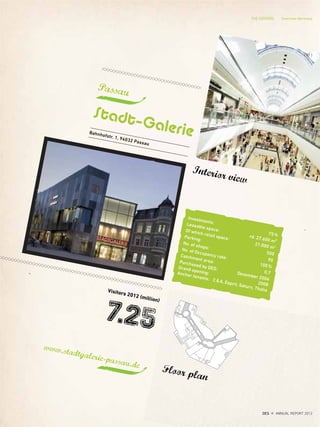
in marketing.
et Asset Value (NAV) ¤ The value
of an asset after deduction of lia-
bilities. With regard to shares, the NAV
constitutes their intrinsic value. The net
net asset value (NNAV) is calculated by
deducting deferred taxes from the NAV.
eer-Group ¤ A share price per-
formance benchmark consisting
of companies from similar sectors, put
together on the basis of individual criteria.
Performance ¤ The term performance
describes the percentage appreciation
of an investment or a securities portfolio
during a given period.
EIT ¤ REIT stands for “Real Estate
Investment Trust”. REITs are listed
real estate corporations that are exempt
from tax at the company level. To qualify,
a minimum of 75% of their income must
come from real estate rental, leasing and
sales and 90% of profits must be distrib-
uted to shareholders as dividends.
Retail space ¤ Space in a building and/or
an open area that is used for sales by a
retail operation and that is accessible to
customers. Service areas required for
operational and legal purposes are not
taken into account, nor are stairways or
shop windows. The retail space is part of
the leasable space of a business.
Roadshow ¤ Corporate presentations to
institutional in vestors.
avings ratio ¤ Share of savings of
the income available in households.
Subprime ¤ Mortgage loan to borrower
with a low degree of creditworthiness.
ecDAX ¤ The successor to the
NEMAX 50, comprising the 30 larg-
est German listed technology securities in
terms of market capitalisation and market
turnover.
olatility ¤ Statistical measure for
price fluctuations. The greater the
fluctuations in the price of a security, the
higher its volatility.
etra ¤ An electronic stock ex-
change trading system that, in
contrast to floor trading, uses and open
order book, thus increasing market trans-
parency. The trading hours are currently
9,00 a.m. to 5,30 p.m.
H
I
L
M
N
P
R
S
T
V
X
G
{ 185 }
DES ANNUAL REPORT 2012
SERVICE Glossary
10.–11.01. Oddo Midcap Forum, Lyon
04.02. Roadshow Munich, LFG KRONOS
05.02. Close Brothers Seydler Small & Mid Cap
Conference, Frankfurt
21.03. Preliminary Results FY 2012
27.03. Roadshow London, Bankhaus Metzler
27.03. Roadshow Geneva, Berenberg Bank
12.04. Audit Commitee meeting, Hamburg
12.04. Bankhaus Lampe Deutschland-Konferenz,
Baden-Baden
23.04. Supervisory Board meeting, Hamburg
26.04. Publication of the Annual Report 2012
29.04. Roadshow Frankfurt, Deutsche Bank
15.05. Interim report Q1 2013
29.05. Kempen & Co. European Property Seminar,
Amsterdam
04.06. Roadshow Paris, Bankhaus Metzler
06.06. Roadshow Milan, Société Générale
06.–07.06. M.M. Warburg Highlights Conference,
Hamburg
20.06. Annual General Meeting, Hamburg
20.06. Supervisory Board meeting, Hamburg
14.08. Interim report H1 2013
11.–12.09. Bank of America Merrill Lynch Global Real
Estate Conference, New York
16.09. UBS Best of Germany Conference, New York
23.09. Berenberg Bank and Goldman Sachs German
Corporate Conference, Munich
25.09. Supervisory Board meeting, Hamburg
26.09. Baader Investment Conference, Munich
24.10. Roadshow Amsterdam, ABN AMRO
13.11. Nine-month report 2013
14.11. Roadshow London, Bank of America Merrill
Lynch
26.11. Aufsichtsratssitzung, Hamburg
27.–28.11. Bankhaus Lampe Hamburg Investment
Conference, Hamburg
OUR FINANCIAL CALENDAR IS UPDATED CONTINUOUSLY.
PLEASE CHECK OUR WEBSITE FOR THE LATEST EVENTS
Financial
calendar 2013
Financial calendar
www.deutsche–euroshop.com/ir
SERVICE
{ 186 }
DES ANNUAL REPORT 2012
Index
A
Accounting 116, 149, 153,
Auditor’s report 182
Assets 124 et seq., 130 et seq., 140,
153, 155, 157 et seq.
B
Balance sheet 130 et seq., 140, 150,
Benchmark 98
C
Carrying amount 172
Cash flow 130, 144, 151, 169 et seq.
Cash flow statement 144, 151, 169
Center management 53 et seq.
Committees 15
Consolidated income statement 142,
150, 166
Corporate governance 16, 114 et seq.,
120, 178
Currency translation 149
D
Declaration of conformity 117, 178,
Deferred taxes 156, 163,
Dividend 6, 12, 98, 104, 128, 138, 170
Dividend proposal 128
E
Employees 136,
Equity 10, 129, 131, 137, 141, 145,
150, 161
Equity ratio 128,
Executive Board 9, 114 et seq.,
120 et seq., 124, 132, 178
F
Fair value 148, 172
FFO 11, 128, 138
Financial instruments 154 et seq., 172
Financial position 124 et seq., 128
Financing 10, 129 et seq., 136, 170
G
Gross domestic product (GDP) 24, 122
I
Income from investments 167
Investments 78 et seq., 130, 156,
159, 161, 167
Investment properties 153, 158
Investor relations 98 et seq.
K
Key data U2
L
Liabilities 129 et seq., 141, 156,
161 et seq.,
Liquidity 130, 174
M
Macroeconomic conditions 122
Marketing 110
N
Net asset value 132
Non-current assets 131, 159
Notes 146
P
Portfolio 10, 48 et seq.
Provisions 156, 164
R
Real estate market 124
Receivables 155, 160 et seq.
Remuneration 121 et seq., 178
Reserves 161 et seq.
Results of operation 124 et seq.
Retail mix 54, 74
Retail sector 123
Revenue 12, 125 et seq., 137 et seq.,
153, 166
Right to redeem 155
Risks 133 et seq., 174
S
Segment reporting 171
Share 98 et seq., 120, 124, 161
Shareholder structure 102
Shareholdings 106, 116, 180
Shopping centers 6, 10 et seq.,
48 et sec., 73 et seq., 137
Strategy 104, 133
Sustainability 60 et seq.
T
Tenants 49 et seqq.
U
Unappropriated surplus 162
W
Website 102, 108, 111, 117, 120
{ 187 }
DES ANNUAL REPORT 2012
SERVICE Index
ImprintImprintmp n
Published by
Deutsche EuroShop AG
Heegbarg 36
22391 Hamburg
Germany
Tel.: +49 (0)40 - 41 35 79 0
Fax: +49 (0)40 - 41 35 79 29
www.deutsche-euroshop.com
ir@deutsche-euroshop.com
Editor in Chief
Patrick Kiss
Editorial Management
Nicolas Lissner
Guest Editors
Rolf Bürkl, Alexander Crüsemann,
Henrie W. Kötter, Jens-Ulrich Maier,
Immonet, Whitepark GmbH&Co.
Concept
Deutsche EuroShop AG
Art Direction
Whitepark GmbH&Co.
Layout
Whitepark GmbH&Co.
Advertising
Nicolas Lissner
Pictures
Behörde für Stadtentwicklung und Umwelt,
Birgit Bossbach, Deutsche EuroShop AG,
Marc Huppert, Patrick Kiss, Andreas Wittenburg
iStockphoto, Shutterstock, Photocase
Digital Prepress
Albert Bauer Companies, Hamburg
Responsible for the editorial content
Deutsche EuroShop AG, Hamburg
English translation
CLS Communication AG
Disclaimer
Authored articles
Bylined texts do not necessarily represent the views of Deutsche EuroShop AG. The respective
authors are responsible for the content of their own texts.
Advertisements
Deutsche EuroShop AG assumes no responsibility for the content of the advertisement.
Trademarks
All trademarks and product names referred to in this Annual Report are the property of their
respective owners. This applies in particular to DAX, MDAX, SDAX, TecDAX and Xetra, which are
registered trademarks and the property of Deutsche Börse AG.
Rounding and rates of change
Percentages and figures stated in this report may be subject to rounding differences. The rates
of change are based on economic considerations: improvements are indicated by a plus (+),
deterioration by a minus (-).
Forward-looking statements
This Annual Report contains forward-looking statements based on estimates of future develop-
ments by the Executive Board. The statements and forecasts represent estimates made on the
basis of all available information at the present time. If the assumptions on which the statements
and forecasts are based do not materialise, actual results may differ from those currently
expected.
Publications for our Shareholders
¤ Annual Report (German and English)
¤ Interim Reports Q1, H1 and 9M (German and English)
Online Annual Report
Deutsche EuroShop’s Annual Report is available online at www.deutsche-euroshop.com in PDF
format and as an interactive online version.
This annual report is also available in German. In the event of conflicts the German-language
version shall prevail.
ImprintSERVICE
{ 188 }
DES ANNUAL REPORT 2012
Reader’s service
Join the Deutsche EuroShop mailing list
D
eutsche EuroShop
Annual report
2012
The biggest festival in Northern Germany, the “Ham-
burger Dom” takes place on the Heiligengeistfeld in
Hamburg and is organised three times a year.
Spring Dom
(Spring Festival, March 22 until April 21, 2013)
Summer Dom
(Hummel Festival, July 19 until August 18, 2013)
Winter Dom
(Dom Market, November 8 to December 8, 2013)
Hamburger Dom
CUT OUT AND SEND IN OR FAX IT TO +49 40 - 41 35 79 29
BUSINESS REPLY
Deutsche EuroShop AG
Investor & Public Relations
Heegbarg 36
22391 Hamburg/Germany
Franking
optional
READER’S SERVICE: Subscribe to Deutsche EuroShop!
I would like to get information on Deutsche EuroShop AG regularly*:
Shareholder Reference Number (SRN) (if known): – – – – – – – – – –
*We will send the annual report to our shareholders or interested parties only if desired. The quarterly reports will be
available for download on our website on www.deutsche-euroshop.com/ir.
Newsletter by e-mail printed version of annual report (annually)
I am
a DES shareholder just interested
Something I have always wanted to tell you (positive and negative feedback, etc.):
Name:
Street:
Postcode and city:
E-mail:
Reader’s service
Join the Deutsche EuroShop mailing list
D
eutsche EuroShop
Annual report
2012
2003 2004 2005 2006 2007 2008 2009 2010 2011 2012
Revenue 57.9 61.4 72.1 92.9 95.8 115.3 127.6 144.2 190.0 211.2
EBIT 39.5 49.8 57.5 86.3 78.5 98.1 110.7 124.0 165.7 181.0
Net finance costs -17.8 -19.2 -39.3 -41.0 -39.6 -49.4 -55.9 -60.2 -79.1 -86.0
Measurement gains/losses 5.6 8.0 40.0 68.8 39.0 38.3 -14.8 33.1 50.1 8.5
EBT 27.3 38.6 68.1 117.7 77.8 87.0 40.1 97.0 136.7 103.5
Consolidated profit 19.0 27.7 48.7 100.3 94.2 68.9 34.4 -7.8 99.0 122.5
FFO per share (€) 0.82 0.86 0.97 1.08 1.12 1.38 1.40 1.35 1.61 1.66
Earnings per share (€)* 0.61 0.89 1.55 2.92 2.74 1.96 0.88 -0.17 1.92 2.36
Equity** 695.3 684.4 787.4 897.9 974.0 977.8 1,044.4 1,441.5 1,473.1 1,606.1
Liabilities 545.2 685.8 756.1 898.3 1,002.3 1,029.1 1,067.8 1,522.1 1,752.0 1,942.8
Total assets 1,240.5 1,370.2 1,543.6 1,796.2 1,976.3 2,006.8 2,112.1 2,963.6 3,225.1 3,548.9
Equity ratio (%)** 56.1 49.9 51.0 50.0 49.3 48.7 49.5 48.6 45.7 45.3
Gearing (%)** 78 100 96 100 103 105 102 106 119 121
Cash and cash equivalents 102.0 150.3 197.2 94.2 109.0 41.7 81.9 65.8 64.4 167.5
Net asset value (EPRA) 682.5 686.8 794.5 877.4 925.1 942.8 1,006.9 1,361.1*** 1,427.3*** 1,538.9***
Net asset value per share
(€, EPRA) 21.84 21.98 23.11 25.53 26.91 27.43 26.63 26.36*** 27.64*** 28.53***
Dividend per share (€) 0.96 0.96 1.00 1.05 1.05 1.05 1.05 1.10 1.10 1.20****
* undiluted
** incl. non controlling interest
*** EPRA
****proposal
€ million
Q1/
2012
Q2/
2012
Q3/
2012
Q4/
2012
Revenue 51.9 52.5 52.6 54.2
EBIT 45.9 45.3 46.1 43.7
Net finance costs -21.4 -20.7 -21.3 -22.6
Measurement gains/losts -0.9 -1.0 -1.0 11.4
EBT 23.6 23.6 23.8 32.5
Consolidated profit 16.5 16.0 17.4 72.6
EPS in € 0.32 0.31 0.34 1.39
€ million
Multi-year overviewMulti-year overviewMulti-year overview
DES ANNUAL REPORT 2012
SERVICE Multi-year overview
www.shoppingcenter.ag

Deutsche EuroShop | Annual Report 2012

  • 1.
  • 2.
    *at-equity consolidation Revenue* in€ millions 2012 2013 2014 Result 157.1 Target 170–173 Target 175–178 EBIT* in € millions 2012 2013 2014 Result 132.3 Target 148–151 Target 152–155 EBT in € millions FFO per share in€ 2012 2013 2014 Result 1.66 Target 1.99–2.03 Target 2.03–2.07 Key data 2012 2013 2014 Result 94.9 Target 112–115 Target 117–120 Deutsche EuroShop Overview 2012 2011 DIFFERENCE Revenue 211.2 190.0 11% EBIT 181.0 165.7 9% Net finance costs -86.0 -79.1 -9% Measurement gains/losses 8.5 50.1 -83% EBT 103.5 136.7 -24% Consolidated profit 122.5 99.0 24% FFO per share (€) 1.66 1.61 3% Earnings per share (€)* 2.36 1.92 23% Equity** 1,606.1 1,473.1 9% Liabilities 1,942.8 1,752.0 11% Total assets 3,548.9 3,225.1 10% Equity ratio (%)** 45.3 45.7 LTV-ratio (%) 44 45 Gearing (%)** 121 119 Cash and cash equivalents 167.5 64.4 160% Net asset value (EPRA) 1,538.9 1,427.3 8% Net asset value per share (€, EPRA) 28.53 27.64 3% Dividend per share (€) 1.20*** 1.10 9% € million * undiluted ** incl. non controlling interests *** proposal
  • 3.
    Dear Readers, We havededicated this year’s Annual Report to our “home port” of Hamburg, where Deutsche EuroShop has had its headquarters since 2004. Our portfolio with its three shopping centers is also closely linked to the Han- seatic City and the surrounding area, and is the reason why the title of this report is simply “Hamburg³”. As well as providing a closer insight into the city of Ham- burg, we would like to introduce you to our shopping centers and the districts where the DES team members live and shop. We have also compiled selected facts and figures on the city, some of which we even found sur- prising. And last but not least, we would like to introduce you to three of our tenants whose roots are in Hamburg. Not forgetting, of course, our business results, which we have drawn up for you in the customary level of detail and are pleased to say reflect a very successful finan- cial year 2012. And, as usual, we have also ventured a look into the future and outlined our forecast for 2013 and 2014. Finally, I would like to invite you to visit our shopping centers in and around Hamburg, in Billstedt, Harburg and Norderstedt. Not to mention our 17 other shopping centers in Germany, Austria, Poland and Hungary, where you’ll always find a warm welcome. And if you happen to be in Hamburg-Poppenbüttel, do visit us in our new office premises! Best regards Claus-Matthias Böge CEO INTRODUCTION Editorial Editorial DES ANNUAL REPORT 2012 { 3 }
  • 4.
  • 5.
    THE CENTERS 48 OurPortfolio 48 Activities in the centers 56 Tenant profiles 58 Sustainable? We always have been! 60 Electric car charging station in Billstedt 64 Hamburg as european green capital 66 Portfolio 70 Our shopping centers in and around Hamburg 73 The centers 74 INVESTOR RELATIONS 98 The shopping center share 98 Interesting facts about shareholders of Deutsche EuroShop 106 Conferences and roadshows 108 10 reasons to invest in the share 109 Marketing 110 Annual general meeting 112 Corporate governance 114 GROUP MANAGEMENT REPORT 119 CONSOLIDATED FINANCIAL STATEMENTS 139 SERVICE 184 Glossary 184 Financial calendar 186 Index 187 Imprint 188 Multi-year overview 189 INTRODUCTION 2 Key data 2 Editorial 3 Our values, our goals 6 Highlights 2012 6 Interview with the Executive Board 8 Report of the Supervisory Board 14 SHOPPING 20 Consumption 2013 20 Hamburg in figures 26 Hamburg’s famous markets 28 Hamburg – novels and films 30 What the customer really wants 32 ”Future labs“ 34 Hamburg facts 36 My Hamburg – Members of the DES team present the districts they live in 38 What I bought in 2012 46 Introduction Group manage- ment report Shopping Service 2 119 48 The centers Investor relations 20 98Consolidated financial statements 184138 DES ANNUAL REPORT 2012 { 5 } Content
  • 6.
    Our values We arethe only public company in Germany that invests solely in shopping centers in prime locations. We invest only in care- fully chosen properties. High quality standards and a high degree of flexibility are just as important to us as sustained earnings growth from index- and turnover-linked rental contracts. In addi- tion, we boast a higher than average occupancy rate of around 99% and professional center management – these are the pillars of our success. Our goals Deutsche EuroShop does not seek short-term success, but rather the stable increase in the value of our portfolio. Our objective is to generate a sustainably high surplus liquidity from the longterm leasing of our shopping centers to distribute an attractive divi- dend to our shareholders every year. In order to achieve this, we shall acquire further prime properties and hence establish our- selves as one of the largest companies in Europe focusing on retail properties. June Annual General Meeting Distribution of a dividend of €1.10 per share September 40th anniversary of Rhein-Neckar-Zentrum, Viernheim 10th anniversary of City-Point, Kassel October 5th anniversary of Galeria Baltycka, Gdansk 10th anniversary of Altmarkt-Galerie, Dresden November Placement of 2,314,136 new shares from an increase in the share capital with institutional investors Convertible bonds with a maturity of five years and a total principal amount of €100 million were placed with qualified investors Acquisition of Herold-Center, Norderstedt 35th anniversary of Billstedt-Center, Hamburg Highlights 2012 DES ANNUAL REPORT 2012 { 6 } Our values, our goals/Highlights 2012
  • 7.
  • 8.
    „Don't put therod down just because you haven't had a bite yet.” “ Interview with the Executive Board { 8 } Interview with the Executive Board
  • 9.
    Deutsche EuroShop justfinished restructuring. What happened? CLAUS-MATTHIAS BÖGE: We reacted to a surprising ruling from the German Federal Fiscal Court (Bundesfinanzhof) and restructured the Deutsche EuroShop Group in such a way that, in future, we will be able to take advantage of the “extended trade tax deduction” for at least a portion of our shopping center port- folio in Germany. We’re working on sustainably optimising this situation; however, that’s an undertaking that will take several years. It was and remains highly complex – unfortunately something German tax law is known for. OLAF BORKERS: One positive effect of this restructuring was that we were able to release €49.3 million in deferred trade tax provisions created during the previous years. While we’re on the positive aspects, were you also able to secure growth? CLAUS-MATTHIAS BÖGE: Yes, we acquired the Herold- Center in Norderstedt just before the end of the year. The invest- ment volume is around €187 million, the initial rate of return about 6.1% – certainly an attractive return on a popular shop- ping center market. ? ? ONE KEY QUALITY OF SUCCESS- FUL RETAILERS IS THEIR WILL- INGNESS TO CHANGE. EVERY TRADER KNOWS THE RETAIL TRADE NEVER STANDS STILL. IN 2012, VERSATILITY WAS CALLED FOR FROM DEUTSCHE EUROSHOP, TOO. NOT FROM AN OPERA- TIONAL PERSPECTIVE, BUT A TAX ONE. DESPITE THE FACT THAT THE GROUP’S RESTRUCTURING PUT A HEAVY STRAIN ON CAPACI- TIES, THE TWO MEMBERS OF THE EXECUTIVE BOARD, CLAUS- MATTHIAS BÖGE AND OLAF BORKERS, WERE ABLE TO CON- TINUE DRIVING THE COMPANY’S GROWTH FORWARD. READ ABOUT HOW THE INDIVIDUAL ISSUES WERE HANDLED IN THE INTER- VIEW WITH THE EXECUTIVE BOARD. 3 DES ANNUAL REPORT 2012 { 9 } Interview with the Executive Board
  • 10.
    OLAF BORKERS: Ourportfolio now comprises 20 shopping centers with a market value of €3.8 billion. Built on two lev- els, with a retail space of around 26,000 m2 , the Herold-Center houses some 130 specialist outlets, all of which are let. The center was opened in 1971 and most recently expanded in 2003. Did you explore new avenues with regard to external financing this time? OLAF BORKERS: Yes we did. We issued a our very first con- vertible bond. In doing so we secured financing in the amount of €100 million for a five-year period at an interest rate of 1.75%. That’s a good rate for us, yet at the same time attractive for bond investors who expect DES share prices to rise. CLAUS-MATTHIAS BÖGE: A small capital increase also brought €67.7 million in equity. Why were private shareholders excluded from partici- pating in the capital increase? CLAUS-MATTHIAS BÖGE: I’ve said many times in the past that we prefer to carry out capital increases with subscrip- tion rights for our many loyal private shareholders, as we most recently did twice in 2010. However, there’s been a change in the Wertpapierprospektgesetz (German Securities Prospectus Act). A general securities pro- spectus requirement has been in effect since July 2012, also for the type of rights issue we liked to work with. Since it takes several weeks to draw up a prospectus, the delay that entails as well as the uncertain outcome in a changing capital market environment could become a deal breaker during the purchase process. That’s something we’d like to avoid. Plus drawing up a prospectus is extremely expensive. We only issued around 2.3 million shares in November and chose the quick accelerated book building process to do this. Unfortu- nately when using this process, one which places new shares close to the stock market price, only “qualified investors” can be approached, generally institutional investors, and subscription rights must be excluded for shareholders. Ultimately, though, we were very pleased that both measures were well received on the capital market despite the fact that we were still an unknown quantity for the bond market. The good track record we’ve now been able to establish here, too, should prove beneficial if we ever decide to repeat the move. ? ? But you’ll also continue to rely on classical forms of external financing? OLAF BORKERS: Absolutely! We took advantage of favour- able financing terms for Deutsche EuroShop and were able to reduce the average interest rate of our liabilities from 4.59% to 4.1%, or in other words by 43 basis points. ? DES ANNUAL REPORT 2012 { 10 } Interview with the Executive Board
  • 11.
    That all soundsgreat. How were operations? CLAUS-MATTHIAS BÖGE: Good, as always, according to plan. To be more precise: We projected between €207 million and €211 million in revenue and in the end generated €211.2 million. We were especially pleased with revenue trends at the Main-Tau- nus-Zentrum, the Altmarkt-Galerie Dresden and the A10 Center, where extensions had been opened up during the previous year. Earnings before interest and taxes (EBIT) were projected at between €177 million and €181 million. A 9% increase to €181.0 million put us at the upper end of that range. We always plan earnings before taxes (EBT) without measure- ment gains/losses and were expecting a figure of between €90 million and €93 million. Over the course of the year we raised our forecast from €94 to 97 million and, with a result of €95.9 million, our corridor was extremely accurate. Originally we predicted that funds from operations, FFO for short, would fall within the €1.64 to €1.68 range per share. As the year progressed we adjusted our forecast here, too, and raised this range to €1.70 to €1.74 per share. In the end we came in at €1.66, right in the middle of the original forecast. OLAF BORKERS: I’m sure you’d like to hear more on the background to that. One-off fees in the form of prepayment compensation and tax payments were incurred in connection ? with both the refinancing of the Main-Taunus-Zentrum and the restructuring of the Group, which reduced the FFO by €0.16 per share. Adjusted for these effects, the FFO would have been €1.82 per share and, in that case, we would have significantly exceeded our forecasts. Some people regard the measurement gain as surpris- ingly low. What were the reasons behind that? OLAF BORKERS: There was a measurement gain of €8.5 mil- lion. Our Hungarian shopping center in Pécs, which represents around 1% of our investment properties, was depreciated by about 16% as a precautionary measure. The value of the Main- Taunus-Zentrum, on the other hand, was increased by 8% after the expansion was well received by customers. Those were the anomalies. Changes in the market values of the other properties remained within a very narrow corridor of between -1.9 to +3.4%. CLAUS-MATTHIAS BÖGE: Internally we had expected the measurement gain/loss to zero out. In fact it’s impossible to predict the myriad of effects which include interest rate move- ments, real estate market and tenant risk as well as some 150 other factors, something we stress over and over again. Anyway, the only thing that counts for us is the cash we influ- ence through our business decisions and can distribute as a divi- dend. Since we aren’t planning to sell our portfolio of shopping centers, the annual measurement gain or loss isn’t very mean- ingful for us. ? “GOOD, AS ALWAYS, ACCORDING TO PLAN.” 3 Interview with the Executive Board DES ANNUAL REPORT 2012 { 11 }
  • 12.
    However if youexpect a measurement gain based on the most recently conducted center transactions, you’re failing to consider the fact that our experts don’t use a mark-to-market but a dis- counted cash flow method. Since shopping centers are hard to compare, I also consider that the better approach. How will shareholders participate in the Group’s renewed set of good results? CLAUS-MATTHIAS BÖGE: With a dividend that’s been increased to €1.20 per share. At least that’s going to be our pro- posal at the Annual General Meeting. We’ve always promised our shareholders that the most recently paid dividend will be the minimum amount for future distributions. So far, these distribu- tions – at least for our long-standing shareholders – have been entirely tax free. That’s changing now: For the first time, €0.31 per share of the 2012 dividend is subject to capital gains with- holding tax. That means that 31 cents of the dividend are sub- ject to taxes totalling 26.37% (25% flat-rate withholding tax plus 5.5% solidarity surcharge) or, in other words, a little over 8 cents. A 10-cent raise in the dividend more than evens out this effect so that, in the end, our shareholders are not receiving any less. Could you briefly explain why the 2013 forecast shows a dip in revenue and EBIT? CLAUS-MATTHIAS BÖGE: That’s due to the changes to IFRS accounting standards announced last year, which prohibit the use ofproportionalconsolidationinthefuture.Whilethischangemeans decreased transparency in the presentation of results, it doesn’t actually change results. We’re not the only ones affected by this change; all companies that used to include subsidiaries on a pro- portional basis in consolidated financial statements are affected. Yet ultimately it doesn’t change a thing because, in the income statement, the results of the investees are accounted for in the net finance costs as income from investments. That means that these IFRS amendments only visually impact the revenue and EBIT in our forecast, while both the EBT and FFO remain practi- cally unchanged. ? ? Can you tell us a bit about your forecasts for 2013 and 2014? OLAF BORKERS: Things continue to improve. During the cur- rent financial year we anticipate our rental income, recognised as revenue, to rise 9% from €170 million to €173 million. Next year this figure could be between €175 million and €178 million. Our outlook for 2013 predicts that EBIT of between €148 million and €151 million, which corresponds to an increase of 13%, and another 3% increase to between €152 million and €155 million in 2014. We anticipate that our earnings before taxes exclud- ing measurement gains/losses will rise by 19% to between €112 million and €115 million with another 4% increase to between €117 million and €120 million expected next year. After the one-off effects recognised in 2012, the jump in funds from operations (FFO) is particularly impressive. For 2013 we anticipate an increase of 21% to between €1.99 and €2.03 per share. That will return to normal in 2014, when we predict a two- percent increase to between €2.03 and €2.07. In light of all of these predictions, we anticipate stable business without any surprises and, as always, we have not planned in any acquisitions. No acquisitions? CLAUS-MATTHIAS BÖGE: We’re still ready to seize attrac- tive opportunities as they arise. But patience is a virtue – just like when you’re fishing. I had more opportunities to go fishing as a child than I do now but that experience also helps me in my pro- fessional life. Incidentally, in Low German we have a saying which roughly translates to: “Don’t put the rod down just because you haven’t had a bite. Because eventually, you will.” Thank you for talking to us. ? ? “OUR PORTFOLIO NOW COM- PRISES 20 SHOPPING CENTERS WITH A MARKET VALUE OF €3.8 BILLION.” DES ANNUAL REPORT 2012 { 12 } Interview with the Executive Board
  • 13.
    .. After serving asa ships officer with the German Federal Navy, Mr. Borkers qualified as a bank clerk with Deutsche Bank AG in 1990. He then studied business administration in Frankfurt/Main. From 1995, Mr. Borkers worked as a credit analyst for Deutsche Bank AG in Frankfurt and Hamburg. In 1998, he joined RSE Grundbesitz und Betei- ligungs-AG, Hamburg, as assistant to the Executive Board. In 1999, Mr. Borkers was appointed to the Executive Board of TAG Tegernsee Immobilien und Beteiligungs- AG, Tegernsee and Hamburg, where he was responsible for finances and investor relations until September 2005. In addition, Mr. Borkers held various Supervisory Board and ma- nagement positions within the TAG Group. Olaf Borkers joined the Executive Board of Deutsche EuroShop AG in October 2005. He is married and has two children. Olaf Borkers Member of the Executive Board After successfully qualifying as a bank clerk and completing a business administration degree, Mr. Böge began his professional career in 1987 at the Düsseldorf-based Privat- bankhaus Trinkaus & Burkhardt in Mergers & Acquisitions. His work, for which he was made a Prokurist (authorised signatory) in 1989, focused on advising small and medi- um-sized companies on buying and selling companies and equity interests. In 1990, Mr. Böge was appointed to the management of KST Stahltechnik GmbH, a subsidiary of the Austrian industrial plant construction group VA Technologie AG, where he was res- ponsible for the financial control, personnel, legal, tax and administration departments. In autumn 1993, Mr. Böge moved to ECE Projektmanagement G.m.b.H. & Co. KG in Ham- burg, the European market leader for the development, realisation, leasing and long- term management of shopping centers. It was here that he first became fascinated with the world of shopping centers. In addition to a series of management positions at sub- sidiaries in the ECE group, his work focused on concept planning, financing and ongoing profitability optimisation of property investments. Mr. Böge joined the Executive Board of Deutsche EuroShop AG in October 2001. He is married and has two children. Claus-Matthias Böge CEO .. { 13 }
  • 14.
    Report of the SupervisoryBoard Federal Fiscal Court (Bundesfinanzhof) regarding the extended trade tax deduction, were the subject of particularly intense dis- cussions during the financial year. Regular discussions were conducted with the Executive Board regarding trends on the capital, credit, real estate and retail mar- kets and the effects of these on the Company’s strategy. The Executive Board and Supervisory Board also examined various investment options. We received regular reports detailing the turnover trends and payment patterns of our tenants and the credit policies of the banks. The Chairman of the Supervisory Board and the Executive Com- mittee of the Supervisory Board also discussed other topical issues with the Executive Board as required. Transactions requir- ing the approval of the Supervisory Board were discussed and resolved upon at the scheduled meetings. In addition, for trans- actions of the Executive Board requiring approval, circular res- olutions were passed in writing by the Supervisory Board. All resolutions in the reporting period were passed unanimously. MEETINGS Five scheduled Supervisory Board meetings took place during financial year 2012. The only absences were recorded at the con- stituent meeting on 21 June 2012; in this case, three members of the Supervisory Board were excused from attending. They granted voting proxies prior to the meeting. Dear Shareholders, During financial year 2012, the Supervisory Board performed the duties incumbent on it according to the law and the Articles of Association and closely followed the performance of Deutsche EuroShop AG. The strategic orientation of the Company was coor- dinated with the Supervisory Board, and the status of the strategy implementation was discussed at regular intervals. The Super- visory Board monitored and advised the Executive Board on its management of the business, and the Executive Board informed us regularly, promptly and in detail of business developments. FOCUS OF ADVISORY ACTIVITIES We examined the Company’s net assets, financial position and results of operations, as well as its risk management, regularly and in detail. In this context, we checked that the formal con- ditions for implementing an efficient system of monitoring our Company were met and that the means of supervision at our disposal were effective. We were informed on an ongoing basis of all significant factors affecting the business. We considered the development of the portfolio properties, spe- cifically their turnover trends, the accounts receivable and occu- pancy rates as well as the Company’s liquidity position. The Exec- utive Board’s plans to restructure the Group, which, according to an assessment by the Executive Board and the Supervisory Board, became necessary following the ruling by the German DES ANNUAL REPORT 2012 { 14 } Report of the Supervisory Board
  • 15.
    At the firstscheduled meeting, on 26 April 2012, the Super- visory Board’s annual review of efficiency was completed and the agenda for the Annual General Meeting was approved. We selected the auditor, who was proposed to the shareholders for election. In relation to the audit of the annual financial state- ments, we once again attached great importance to the explana- tions of the Executive Board and those of the auditor on the real estate appraisals. In addition, the Executive Board explained the possibilities opened up by corporate restructuring and the tax impact on the Group. The Executive Board also reported on the conclusion of the expansion of Main-Taunus-Zentrum, the acqui- sition of the remaining shares in the Rathaus-Center in Dessau and various refinancing negotiations. Explanations regarding the occupancy situation focused on the office space in the expanded Altmarkt-Galerie in Dresden. The Executive Board also presented the option of purchasing a shopping center in Poland. At the meeting held on 21 June 2012 prior to the Annual General Meeting, the Executive Board reported on refinancing agreements implemented as well as the occupancy situation at the shopping center in Pécs, Hungary, in particular. The Execu- tive Board informed us of the latest insights regarding Group restructuring, given that the concept will soon be ready to sub- mit for a decision, and presented the possibility of acquiring the Herold-Center in Norderstedt. One focus of this meeting was also the planned enlargement of our Supervisory Board in light of changes to the requirements of the Corporate Governance Code. We discussed the planned enlargement and composition of the Supervisory Board as well as the various functions in the committees. At the constituent meeting on 21 June 2012 following the Annual General Meeting, we elected members by open ballot to various functions on the Supervisory Board and its committees. The election was suspended pending the legally valid amend- ment to the Articles of Association to enlarge the Supervisory Board. It was then held on 13 July 2012. Chairman of the Supervisory Board Manfred Zaß Deputy Chairman of the Supervisory Board Dr. Michael Gellen Executive Committee Manfred Zaß (Chairman), Thomas Armbrust, Dr Michael Gellen Financial Expert Karin Dohm Audit Committee Karin Dohm (Chairwoman), Thomas Armbrust, Manfred Zaß Capital Market Committee Manfred Zaß (Chairman), Thomas Armbrust (Deputy Chairman), Reiner Strecker Elections results At the fourth meeting on 20 September 2012, the Executive Board reported again on the occupancy and refinancing situa- tion of the property in Pécs. The Executive Board also reported about opportunities to expand our shopping center portfolio. A more detailed report was provided by the Executive Board on the process to purchase the Herold-Center in Norderstedt and its thoughts regarding financing for this investment. Once again, the main focus of our meeting was the restructuring of the Group. The Executive Board presented us its final concept, which we approved following an in-depth discussion. At the last meeting on 27 November 2012, the Executive Board reported on the Group restructuring process currently in pro- gress, the completed acquisition of the Herold-Center as well as the financing measures undertaken for this acquisition (capital increase and issue of a convertible bond). We also held exten- sive discussions on the projections for the current financial year and the Company’s medium-term performance planning as pre- sented by the Executive Board. COMMITTEES The Supervisory Board has established three committees: the Executive Committee of the Supervisory Board, the Audit Com- mittee and the Capital Market Committee. Each of these is made up of three members. The Executive Committee of the Super- visory Board functions simultaneously as a nomination commit- tee. Given the size of the Company and the number of Super- visory Board members, we consider the number of committees and committee members to be appropriate. The enlargement of the Supervisory Board prompted a change in the composition of the individual committees. The decision-making powers of the Capital Market Committee were expanded to include the issue of convertible bonds and bonds with warrants; moreover, the Committee elected Thomas Armbrust as its Deputy Chairman. During the reporting period, the Executive Committee of the Super- visory Board and the Audit Committee met on 18 April 2012. The Audit Committee also discussed the quarterly financial reports with the Executive Board in a meeting on 26 April and in conference calls on 9 August and 9 November 2012. The Execu- tive Board conducted several telephone conferences in November to inform the Capital Market Committee about the capital-raising measures and request Committee approval of its resolutions. The Committee passed the relevant resolutions. 3 Report of the Supervisory Board DES ANNUAL REPORT 2012 { 15 }
  • 16.
    CORPORATE GOVERNANCE In November2012, together with the Executive Board, we issued an updated declaration of conformity in relation to the recom- mendations of the government commission pursuant to sec- tion 161 of the Aktiengesetz (German Public Companies Act – AktG) and made this permanently available on the Deutsche EuroShop AG website. A separate report on the implementation of the German Corporate Governance Code is included in this Annual Report. The members of the Supervisory Board and the Executive Board declared in writing at the beginning of 2013 that no conflicts of interest had arisen. FINANCIAL STATEMENTS OF DEUTSCHE EUROSHOP AG AND THE GROUP FOR THE PERIOD ENDING 31 DECEMBER 2012 At the Audit Committee meeting on 12 April 2013 and the Super- visory Board meeting on 23 April 2013, the Audit Committee and the Supervisory Board respectively examined in detail the annual financial statements of Deutsche EuroShop AG in accordance with German commercial law, and the consolidated financial statements in accordance with International Financial Reporting Standards (IFRS), each as at 31 December 2012, as well as the management report and group management report for financial year 2012. The documents relating to the financial statements, the auditor’s reports and the Executive Board’s proposal for the appropriation of the unappropriated surplus were presented to us in good time. The auditor appointed by the Annual General Meeting on 21 June 2012 – BDO AG Wirtschaftsprüfungsgesellschaft, Hamburg – had already audited the financial statements and issued an unquali- fied audit opinion in each case. The auditor also confirmed that the accounting policies, measurement methods and methods of consolidation in the consolidated financial statements complied with the relevant accounting provisions. In addition, the audi- tor determined in the course of its assessment of the risk man- agement system that the Executive Board had undertaken all required measures pursuant to section 91 (2) AktG to promptly identify risks that could jeopardise the continued existence of the Company. The auditor’s representatives took part in the discussion of the annual financial statements and the consolidated financial state- ments on the occasions of the Audit Committee meeting on 12 April 2013 and the Supervisory Board meeting on 23 April 2013 and explained the main findings. Following its own examination of the annual financial statements of Deutsche EuroShop AG, the consolidated financial statements and the corresponding management reports, the Supervisory Board did not raise any objections. It agreed with the findings of the auditor’s examination and approved the annual financial statements of Deutsche EuroShop AG and the consolidated finan- cial statements. The annual financial statements have thus been adopted. The Supervisory Board endorses the Executive Board’s proposal for the appropriation of the unappropriated surplus and distribution of a dividend of €1.20 per share. The Company’s success in financial year 2012 was the result of its sustainable, long-term strategy and the dedication shown by the Executive Board and our employees, for which the Super- visory Board would like to express its particular gratitude. Hamburg, 23 April 2013 MANFRED ZASS, CHAIRMAN DES ANNUAL REPORT 2012 { 16 } Report of the Supervisory Board
  • 17.
    MANFRED ZASS (CHAIRMAN) DR. MICHAELGELLEN (DEPUTY CHAIRMAN) THOMAS ARMBRUST Born: 1941 1942 1952 Place of residence: Königstein im Taunus Cologne Reinbek Nationality: German German German End of appointment: 2013 Annual General Meeting 2014 Annual General Meeting 2014 Annual General Meeting Committee activities: Chairman of the Executive Committee, Member of the Audit Committee, Chair- man of the Capital Market Committee Member of the Executive Committee Member of the Executive Committee, Chairman of the Audit Committee, Deputy Chairman of the Capital Market Committee Membership of other statutory supervisory boards – – C.J. Vogel Aktiengesellschaft für Beteiligungen, Hamburg (Chairman) Platinum AG, Hamburg (Chairman), TransConnect Unternehmensberatungs- und Beteiligungs AG, Munich (Chairman), Verwaltungsgesellschaft Otto mbH, Hamburg Membership of compa- rable supervisory bodies of business enterprises in Germany or other countries: – – ECE Projektmanagement G.m.b.H.&Co. KG, Hamburg (Deputy Chairman) Profession: Banker Independent lawyer Member of Management, CURA Vermögensverwaltung G.m.b.H., Hamburg Key positions held: 1965–2002: DekaBank Deutsche Girozentrale, Frankfurt of which: 1980–1999: Member of the Executive Board 1999–2002: Chairman of the Executive Board until 2005: Deutsche Börse AG, Frankfurt, Deputy Chairman of the Supervisory Board 2008–2009: Hypo Real Estate Group AG, Unterschleißheim, Member of the Supervisory Board 1971–1983: Deutsche Bank AG, Düsseldorf, Frankfurt 1984–1995: Deutsche Central- bodenkredit-AG, Cologne, Member of the Executive Board 1995–1997: Europäische Hypo- thekenbank AG, Luxembourg, Member of the Executive Board 1997–2000: Deutsche Bank AG, Frankfurt, Managing Director 2001–2003: DB Real Estate GmbH, Frankfurt, Managing Director until 1985: Auditor and tax advisor 1985–1992: Gruner+Jahr AG&Co KG, Hamburg, Director of Finance seit 1992: Member of Management of CURA Vermögensverwaltung G.m.b.H., Hamburg (Family Office of the Otto Family) Relationship to majority/ major shareholders: none none Shareholder representative of the Otto family Deutsche EuroShop securities held as at 31 December 2012: 10,000 0 Name Members of the Supervisory Board 3 Report of the Supervisory Board DES ANNUAL REPORT 2012 { 17 }
  • 18.
    KARIN DOHM DR.JÖRN KREKE ALEXANDER OTTO Born: 1972 1940 1967 Place of residence: Kronberg im Taunus Hagen/Westphalia Hamburg Nationality: German German German End of appointment: 2017 Annual General Meeting 2013 Annual General Meeting 2013 Annual General Meeting Committee activities: Chairwoman of the Audit Committee/ Financial Expert – – Membership of other statutory supervisory boards – Capital Stage AG, Hamburg DOUGLAS HOLDING AG, Hagen/West- phalia (Chairman) Verwaltungsgesellschaft Otto mbH, Hamburg Membership of compa- rable supervisory bodies of business enterprises in Germany or other countries: – Kalorimeta AG&Co. KG, Hamburg Urbana Gruppe, Hamburg Peek&Cloppenburg KG, Düsseldorf Profession: Chief Accounting Officer, Head of Group External Reporting, Deutsche Bank AG, Frankfurt Businessman CEO, Verwaltung ECE Projektmanage- ment G.m.b.H., Hamburg Key positions held: 1991–1997: Studied business and economics in Münster, Zaragoza (Spain) and Berlin 2002: Steuerberaterexamen (German tax advisor exam) 2005: Wirtschaftsprüferexamen (German auditor exam) 1997–2010: Deloitte&Touche GmbH, Berlin, London (UK), Paris (France) 2010–2011: Deloitte&Touche GmbH, Berlin, Partner Financial Services since 2011: Deutsche Bank AG, Frankfurt, Chief Accounting Officer, Head of Group External Reporting Studied in the USA, Doctorate from the University of Frankfurt 1963 until today: DOUGLAS HOLDING AG, Hagen/Westphalia (previously Rudolf Hussel Süßwaren AG) of which: 1963–1969: Assistant to the Management Board 1969–2001: Chairman of the Executive Board seit 2001: Chairman of the Supervisory Board Studied at Harvard University and Harvard Business School, Cambridge, USA 1994 until today: Verwaltung ECE Projekt- management G.m.b.H., Hamburg since 2000: Chief Executive Officer Relationship to majority/ major shareholders: none none Major shareholder Deutsche EuroShop securities held as at 31 December 2012: 0 0 5,136,390 Name Members of the Supervisory Board – Continuation DES ANNUAL REPORT 2012 { 18 } Report of the Supervisory Board
  • 19.
    REINER STRECKER KLAUSSTRIEBICH DR. BERND THIEMANN 1961 1967 1943 Wuppertal Besigheim Kronberg im Taunus German German German 2017 Annual General Meeting 2017 Annual General Meeting 2014 Annual General Meeting Member of the Capital Market Committee – – akf Bank GmbH&Co. KG, Wuppertal Unternehmensgruppe Dr. Eckert GmbH, Berlin MEC Metro-ECE Centermanagement GmbH&Co. KG, Düsseldorf (Chairman of the Advisory Board) Deutsche Pfandbriefbank AG, Unterschleißheim (Chairman) Hypo Real Estate Holding AG, Unterschleißheim (Chairman) IVG Immobilien AG, Bonn M.M. Warburg&Co. KGaA, Hamburg (Deputy Chairman) Wave Management AG, Hamburg (Deputy Chairman) Hannoversche Direktversicherung AG, Hanover – – Würth Finance International B.V., Amsterdam Würth Gruppe, Künzelsau (Deputy Chairman) Personally liable partner, Vorwerk&Co. KG, Wuppertal Managing Director Leasing, Verwaltung ECE Projektmanagement G.m.b.H., Hamburg Management consultant 1981–1985: Studied business in Tübingen 1986–1990: Commerzbank AG, Frankfurt 1991–1997: STG-Coopers&Lybrand Consulting AG, Zurich (Switzerland) 1998–2002: British-American Tobacco Group, Hamburg, London (UK), Auckland (New Zealand) 2002–2009: British-American Tobacco (Industrie) GmbH, Hamburg, Member of the Executive Board for Finance and IT 2009 until today: Vorwerk&Co. KG, Wuppertal since 2010: Personally liable partner Studied business in Mosbach 1990: Kriegbaum Gruppe, Böblingen, Assistant to the Management Board 1992 until today: Verwaltung ECE Projektmanagement G.m.b.H., Hamburg since 2003: Managing Director Leasing 1976–1991: NORD/LB Norddeutsche Landesbank Girozentrale, Hanover of which 1976–1981: Member of the Executive Board 1981–1991: Chairman of the Executive Board 1991–2001: DG Bank Deutsche Genos- senschaftsbank AG, Frankfurt, Chair- man of the Executive Board none Member of the Management Board of Verwaltung ECE Projektmanagement G.m.b.H., Hamburg (Alexander Otto (major shareholder) is the Chairman of the Management Board) none 3,975 20,000 6,597 Report of the Supervisory Board DES ANNUAL REPORT 2012 { 19 }
  • 20.
    Consumer climate Source: GFKI EU-Commission Consumer climate could continue to stabilise IndikatorpunkteIndicator points Consumer climate Consumption 2013SHOPPING { 20 }
  • 21.
    OUTLOOK FOR PRIVATE CONSUMPTION BYROLF BÜRKL, GFK CONSUMPTION EXPERT { 21 }
  • 22.
    ACCORDING TO FORECASTSBY THE GERMAN SOCIETY FOR CONSUMER RESEARCH GFK (GESELLSCHAFT FÜR KONSUMFORSCHUNG ), PRIVATE HOUSEHOLD SPENDING IN GER- MANY IS SET TO INCREASE BY 1.0% IN REAL TERMS IN 2013. PRIVATE CONSUMPTION IS THUS PROVIDING A SUBSTANTIAL CONTRIBUTION TO THE STABILITY OF THE GERMAN DOMESTIC ECONOMY. n light of low interest rates and concern about the future of the euro, consumers are tending toward making high value purchases. Moderate growth is forecast for retailers. According to the GfK Consumer Climate, German consumers started 2013 in posi- tive spirits with all indicators showing an upward trend at the beginning of the year. Despite economic development noti- ceably slowing down in the winter months of 2012, it seems as though, from a con- sumer perspective, a turning point has been reached. Economic prospects are currently improving. This sentiment is also shared by business, as demonst- rated by the Ifo Business Climate Index, which increased for the third consecutive time in January. Buoyed by the positive situation on the labour market, German consumers are expecting their income to increase in the near future. Perceived job security is also giving consumers the necessary planning security for major purchases. At the same time, savings and loan interest rates are at a record low. This is particularly good news for real estate, which is seen by consumers as a safe alternative for their Price expectation Source: GFK I EU-Commission Fear of inflation eases slightly I Indicator points Price expectation SHOPPING { 22 } DES ANNUAL REPORT 2012 Consumption 2013
  • 23.
    3 savings. This trendis further driven by concerns about the future of the euro. Previously labelled ‚panic savers‘, many Germans have now turned into ‚panic consumers’. MODERATE RETAIL GROWTH While real estate is booming, the performance of the German retail market is somewhat mixed. According to GfK calculations, food retailers and drugstores only saw nominal sales growth of 2.2% to approximately €160 billion, while full-service gro- cery stores showed the best performance with sales up 4.7% in 2012. Discount stores registered stable growth with a sales plus of 2.4%. Overall growth was achieved by setting prices hig- her, as the volume sales of food retailers continued to decline. For 2013, GfK is forecasting a nominal sales increase of 1.5% for food retailers and drugstores, while volumes are expected to continue to fall. In the non-food retail segment, which includes textiles, electro- nic devices, furniture and home improvement products, sales improved by 1.0% in 2012 and rose to around €150 billion. Sales of electronic devices rose by 2.8%, while textiles decreased by 1.6%. Once again, online retail showed the best performance by far, with sales in the non-food segment increasing by 14.0% to almost €24 billion. For 2013, the GfK is expecting the growth rate for non-food retailers to slow down slightly to 0.7%. For food and non-food retail combined, the GfK is forecasting an overall sales increase of 1.1%. { 23 } DES ANNUAL REPORT 2012
  • 24.
    7 GERMAN JOB MIRACLE Themost important aspect of positive consumer climate is the the labour mar- ket. According to the Federal Employ- ment Agency, an average 2.9 million peo- ple were registered as unemployed in Germany in 2012. This is the lowest level since 1991. A comparison with the job market situation in other European coun- tries shows just how impressive the Ger- man job miracle is. Germany is the only country in which the number of people out of work has dropped since the pre- crisis level of 2007. While unemployment has fallen by a third in Germany, average unemployment figures across Europe have risen by almost 50%. In Spain and Ireland, the number of people without a job has increased by more than 200%, while Greece is battling an increase of nearly 170%. CONSUMPTION 2013 – ECONOMIC BOOST FOR GERMANY The outlook for the global economy remains cautious. While it registered a decline of 0.3% for 2012, the Federal Statistical Office is expecting growth for the EU‘s gross domestic product (GDP) of 0.4% in 2013. This could indicate that the danger of a prolonged recession has been averted and that German exports within Europe are unlikely to decline any further. Following the 0.7% growth achie- ved in 2012, Germany’s GDP is expected to rise 0.8% this year. In light of the subdued global economy, domestic demand will become ever more important. For the most part, real (i.e. adjusted for price) spending of private households registered major increases in the years leading up to the turn of the millennium. The decade since, however, was marked by stagnation. Between 2000 and 2010, consumer spending increased by an average of only 0.3% in real terms. In 2011, an increase of 1.5% in real pri- vate consumption seems to have put a stop to this negative development. Preli- minary data from the Federal Statistical Office for 2012 suggests that consumption grew by 0.8%, largely confirming the GfK’s growth forecast of 1.0%. A continuation of this trend looks likely in the current economic climate. The German job market is expected to remain stable, which will positively affect consumer sentiment, and the prospects for salary developments are favourable with a continued moderate rate of inflation. On this basis, the GfK is predicting real growth in private consumption of 1.0% for 2013. This means that, once again, German consumers are a key factor in the domestic economy. Real private consumption in Germany 1971--2012 Source: GFK I Federal Statistical Office I Experts‘ Council I * preliminary result Private consumption back on the rise after a decade of stagnation CHANGE IN % COMPARED TO PREVIOUS YEAR SHOPPING { 24 } DES ANNUAL REPORT 2012 Consumption 2013
  • 26.
    Hamburg in figures 130KG €21.985 THE HIGHEST NO.199 1. 72.1 M2 is the weight of the hour hand of Hamburg's St. Michaelis Church was the average purchasing power of Hamburg's inhabitants in 2012, which places Hamburg first in a countrywide comparison. The Speicherstadt (warehouse district) is home to the world's biggest warehouse area for oriental rugs, which houses wool and silk rugs worth seve- ral billion euros. There are more paternoster lifts in the Hanseatic City than in any other city in the world. HSV is the only sports club to have played in the top flight of the Bundesliga since the league's set-up. Geographical coordinates: 53º 33º N, 10º 0º E Area: 755,3 km2 Land area: 92% Water area: 8% Heinrich Hertz Tower: 278 m St. Nicholas Church Tower: 148 m Elbe Philharmonic Hall: 110 m is the size of the average Hamburg apartment. SHOPPING { 26 } DES ANNUAL REPORT 2012 Hamburg in figures
  • 27.
    10 rules forthose new to Hamburg 1 2 4 6 5 7 Understatement. Don‘t let it get you down if you struggle to make friends at first – the Hamburg natives are very reserved. After two years of close friendship, you might hear: “I think you‘re quite ok.” Which translates to: “I will spend the rest of my life with you.” In Hamburg, everybody wears classical colours: black and white. If you feel like wearing outlandish colours: combine marine blue with low-key gold jewellery. You can tell the natives by the way they pronounce the name of their city: with a soft “sh” at the end – “Hambursh”. Anything south of the Elbe is classified as Bavaria. Everywhere east of Wandsbek is already Poland. You greet everybody no matter what the time of day with “Moin” and say goodbye with “Tschüss”. Just because you now live in Hamburg and follow rules 1–9 doesn‘t make you a real native. But chin up, perhaps your grandchildren will belong one day. If you are female, single and young, then get ready to withstand temptation: Hamburg has the most modelling agencies, millionaires and dating agencies in Germany. Understatement. Understatement. This isn‘t Munich. 8 9 10 Quelle: Immonet 3 { 27 } DES ANNUAL REPORT 2012 SHOPPING Hamburg in figures
  • 28.
    Hamburg’s famous markets SHOPPING {28 } DES ANNUAL REPORT 2012 Hamburg‘s famous markets
  • 29.
    n the earlyhours of every Sunday morning, several thousand visitors and locals flock to the fish market in Hamburg‘s borough of Altona on the banks of the Elbe. Fresh fish is not the only thing on offer here, as the visitors can browse through a colourful jumble of mobile phone accessories, bas- kets of pasta, tropical plants and even live chickens and car- rier pigeons. The market is set up on the open space right next to the inner harbour, and at its many stalls and wagons haggling is more than commonplace: baskets are crammed with more and more goods and advertised by market criers at the top of their voices until someone agrees to buy them. This loud and verbose spec- tacle alone makes the market worth a visit. Rumour has it that you can hear the market criers all the way to the Reeperbahn (a street famous for its nightlife) several hundred metres away. But the fish market is not only a colourful and bizarre shop- ping opportunity: for many it is also the last stop before bed after a long night out in the famous Kiez (the district where the Reeperbahn is located). Tucking into a hearty breakfast of a fish sandwich or Currywurst while enjoying the view over Hamburg‘s harbour is an experience with its very own charm. Filled with fresh energy, some might even venture into the nearby former fish auction hall – now an attractive dance venue with live music. While the fish market is presently usually marketed as a tou- rist attraction and is copied by a travelling fair that stops in mar- ket squares throughout Germany, it boasts a proud history and tradition: Sunday trading has been allowed in Altona since 1703 so that freshly caught fish can be sold to churchgoers early in the morning before they go to church. Informations Opening times: Every Tuesday and Friday from 8.30 a.m. to 2 p.m.) Address: Isestraße between Eppendorfer Baum and Hoheluftchaussee Public transport: U3 stop Eppendorfer Baum and Ho- heluft Isemarkt I ith around 100 weekly farmers‘ markets, Hamburg is one of the cities with the most markets in Europe. And of those, the Isemarkt is probably one of the most worth seeing. It has the longest history of all the markets in Hamburg: for over 100 years it has been held beneath the viaduct of Hamburg‘s first underground line between Eppendorfer Baum and Hoheluft, only a stone‘s throw from the former offices of Deutsche EuroShop on Oderfelder Straße. It also holds a European record: with a length of 1 km it is longer than any other open air market on the continent. Nearly 300 traders offer an impressive assortment of goods here, especially groceries that would make any amateur chef‘s mouth water: a multitude of regional products and specialities from around the world such as fruit, vegetables, herbs and spi- ces, nuts, honey, pralines, cheese, fish and meat, often from fair- trade or organic production. Flowers, gifts of all kinds and even clothing are also on offer. With a bit of luck you might even spot one of Hamburg‘s famous faces amongst all the amateur chefs, such as TV chefs Tim Mälzer and Cornelia Poletto, or one of the many other cele- brities who live in the magnificent Jugenstil buildings in the area. However, it is rarely hectic amidst this jostle of pushchairs, bikes, tourists, customers and market traders. Everywhere you look people are jovially discussing the latest news and goods. So you should make sure you take your time to visit this place. And where else would you find such a multitude of snack, coffee and espresso stands? Informations Opening times: Every Sunday from 5 a.m. to 9.30 a.m. (from 7 a.m. in winter) Address: Große Elbstraße 1 Public transport: S1 and S3 stop Reeperbahn, U3 stop Landungsbrücken Altona fish market W SHOPPING Hamburg‘s famous markets { 29 } DES ANNUAL REPORT 2012
  • 30.
    Paperback: 187 pages Publisher:Dtv (1 November 2000) Language: German ISBN-13: 978-3423128391 THE DISCOVERY OF THE CURRYWURST by Uwe Timm Reminiscing about his childhood, the narrator sets off in his search for the former owner of a snackbar in the Hamburger Großneumarkt. He tracks down the extremely elderly Lena Brü- cker to an old people's home and listens to her tell her story of the "most wonderful years of her life" and of how she dis- covered the currywurst. Her story starts way back in the last days of April in 1945. Bound: 784 pages Publisher: Fischer Taschenbuch Verlag Edition: 22 (10 June 2008) Language: German ISBN-13: 978-3596259618 Taschenbuch: 416 pages Publisher: Diogenes (August 2004) Language: German ISBN-13: 978-3257234169 DIE BERTINIS by Ralph Giordano A large-scale family saga that spans generations, an exemp- lary contemporary novel. Ralph Giordano creates an epic out of a story that had hitherto attracted little attention: he tells the story of the fate of "Jewish crossbreeds" during the period of National Socialism. The prehistory starts at the end of the last century, with the main story starting prior to 1933 and continu- ing into the first post-war years. Its location: Hamburg – from the Elbe suburbs to its Central Park, from Barmbek in the north to the port in the south, with unforgettable figures, scenes and situations woven into the dramatic story. RIPLEY'S GAME OR THE AMERICAN FRIEND by Patricia Highsmith The Mafia's attempts to gain a foothold in Hamburg must be prevented. The search starts for a man who will kill two wpeople in exchange for a lot of money. Tom Ripley has just the person in mind… Hamburg as a location for novels and films Books SHOPPING { 30 } DES ANNUAL REPORT 2012
  • 31.
    JAMES BOND 007– TOMORROW NEVER DIES Power-hungry media baron Elliot Carver has a macabre hobby: He prefabricates news, which he himself publishes in his newspaper "Tomorrow". He is now willing to go to all lengths to capture the profitable Chinese market. The insane Carver then tries to provoke a devastating World War III by means of a sub- marine that cannot be picked up by radar. British super agent James Bond tries to stop the scrupulous media baron and gains entrance to Carver's newspaper headquarters in Hamburg. Cast: Adam Bousdoukos, Moritz Bleibtreu, Birol Ünel, Pheline Roggan, Lucas Gregorowicz Director: Fatih Akin Date of release: 25 August 2010 Year of production: 2009 SOUL KITCHEN Bar owner Zinos is plagued by bad luck: first his girlfriend Nadine takes a new job in Shanghai, then he suffers a slip- ped disk. When he takes on the eccentric top chef Shayn in desperation, even his few regulars stop coming to his bar. And to top it all off, his petty criminal brother Illias turns up and asks him for help. While Zinos considers how he can get rid of his bar so he can follow Nadine to China, his music and an outlandish menu start to draw an increasing number of trendy figures. The "Soul Kitchen" rocks and booms like never before. But then things start to happen thick and fast. Cast: Pierce Brosnan, Jonathan Pryce, Michelle Yeoh Director: Roger Spottiswoode Studio: MGM Home Entertainment GmbH (German) Year of production: 1998 Current cast: Jan Fedder Dirk Matthies Maria Ketikidou Saskia Fischer Year(s) of production: since 1986 Production company: Studio Hamburg First showing: 16December 1986 on Das Erste GROSSSTADTREVIER The German television series Großstadtrevier has achieved cult status. 26 series have been produced since its first showing on 16 December 1986. The story revolves around the police officers of the 14th precinct and their fictitious working day in Hamburg's red-light area. Großstadtrevier won a Golden Camera award in 2005. Films & Series SHOPPING Hamburg as a location for novels and films { 31 } DES ANNUAL REPORT 2012
  • 32.
    what the Customer reallywants “In the future, customers will only do their shopping on the Internet, making the high street shops a thing of the past: offline shopping will die out, online shopping will thrive!” Future visions such as these are now dominating reports in the media. But are these predictions really correct? Will online retailing really displace classic retailing? And how do customers find their way around the online and offline world of shopping? HENRIE W. KÖTTER, MANAGING DIRECTOR CENTER MANAGEMENT, ECE PROJEKTMANAGEMENT What the customer really wants Study of buying behaviour in the online and offline world SHOPPING { 32 } DES ANNUAL REPORT 2012
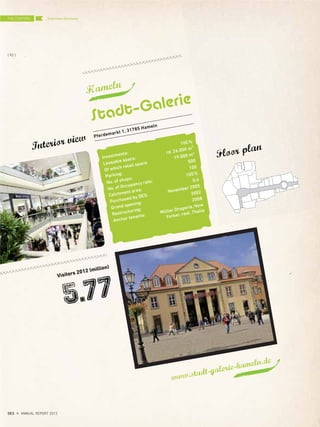
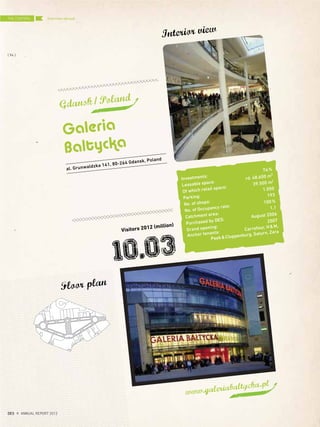
  • 33.
    purchase products straightaway. In a multi-channel shopping world, it is therefore crucial for in-store retailers to identify the buying motives of customers that are more important than price, rather than trying to compete on price with the cheapest online supplier. In-store retailing is also a long way off from serving solely as a showroom for online merchandisers. On the contrary, purchases that customers decide upon online but make in a bricks-and- mortar store generate eleven times more revenue than the other way round. “Showrooming” does not therefore pose a threat to in-store shopping, but represents an opportunity for retailers to stay one step ahead of the competition. Take the example of high- tech companies like Apple which rely fully on the Internet but are now opening large flagship stores in key centers. Another surprising finding: even among the young “digital native” generation, which has grown up with the Internet, there is a large group of consumers who do all their shopping in traditional shops, even though this customer group spends several hours a day on the Internet. For them it is the emotional experience when shopping that they value most and, above all, being able to share the experience with friends. To sum up the results of the study: in-store retailing in Germany can meet those customer needs which online retailing is not yet able to meet or will never be able to meet. However, retailers need to gain a better understanding of the desires and buying needs of their customers so they can adapt their offerings accor- dingly. A useful approach is to adopt a multichannel strategy, where the online and offline worlds are sensibly combined. To tap the potential of the Internet, it is not always necessary to open an online shop. For many customers, the ability to check online to see if an item is available in the offline store can be a strong incentive to visit the shop. The future thus lies in intelligently combining digital channels with bricks-and-mortar retailing. o get to the bottom of these ques- tions, Roland Berger Strategy Con- sultants and the ECE conducted a com- prehensive study, in which they polled around 42,000 consumers throughout Germany about their shopping habits. In addition, nearly 2,000 study participants kept a personal diary of their shopping activities over a period of a month, detai- ling on how much they spent, when each purchase was made, the product category that the item belonged to and the sales channel used. The analysis of all the data revealed some surprising findings. For example, the share of online retailing is much hig- her than had previously been assumed, with seven per cent of online purchases generating 16 per cent of total retail sales – and trending upwards. But for bricks- and-mortar stores there is absolutely no reason why they should have to throw in the towel in the face of online com- petition; for the simple reason that two thirds of consumers regularly shop in off- line stores, shopping every two weeks and mostly in high street shops or shopping centers. By contrast, only 13 per cent of consumers regularly shop online. These figures are testimony to the continu- ing importance to consumers of in-store shopping. They also show that besides shopping frequency the share of impulse purchases is significantly higher than is the case with online shopping. This a key competitive advantage in a world where the needs of customers for the large part have to be awakened before they can be satisfied. Another notable finding is that price is not the key determinant where choice of retail channel is concerned. Tradi- tional retailing scores higher when it comes to providing on-the-spot per- sonalised advice and information and enabling customers to view, try out and 7 Further information The study “What the customer really wants” can be downloaded free of charge at: www.ece.de/multichannelstudie T SHOPPING What the customer really wants { 33 } DES ANNUAL REPORT 2012
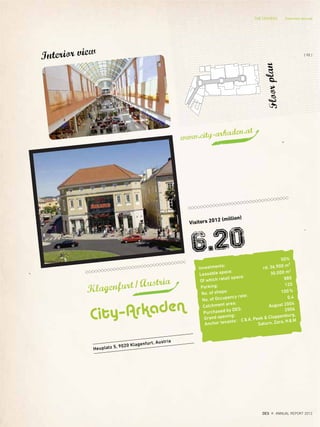
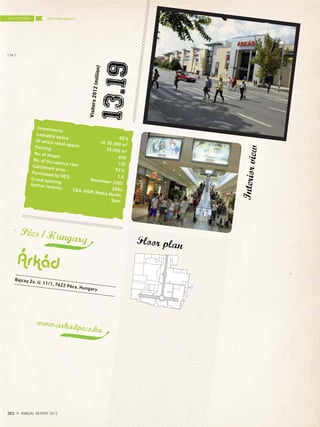
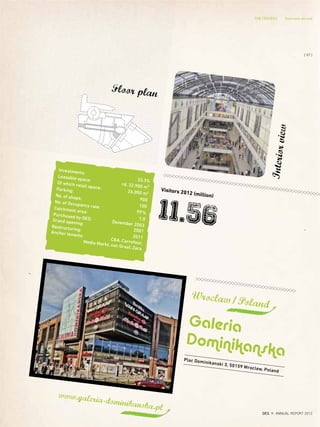
  • 34.
    he idea behindthese “Future Labs” is that they will be used for testing new interactive services, from virtual store guide systems to a wide range of social media links to interac- tive play areas, and serve as experimental sites for trying out new technical trends and ideas. Developments that are well received by customers will continue to be pursued and implemented in other shopping centers; those that meet with a less positive res- ponse will be stopped and replaced by new ones. The key question to be asked in the test labs is: what can we learn from online retailers? Here we can be sure about one thing: timing is crucial. Tailoring information to potential customers and getting it to them at the right time is vital. With this aim in mind, we developed, among other things, a free smartphone app for the purpose of informing customers about offerings, events and news. This offering is complemented by a points collection and voucher scheme. ALEXANDER CRÜSEMANN, PROJECT MANAGER FUTURE LABS, ECE PROJEKTMANAGEMENT Inspired by the findings of the multichannel study (www.ece.de/multichannelstudie), ECE went on to launch so-called „Future Labs“ in the Alstertal- Einkaufszentrum in Hamburg and in the Limbecker Platz shopping center in Essen in March 2013. Another novelty of the “Future Labs” is the „Mall Wall“: a high- resolution mega display measuring 4 x 4 metres, which visitors can access using a specially developed touchscreen, allowing them, for example, to click on fashion tips, social media, blogs, games, or so-called augmented reality animations, where they can experience extended reality in the form of virtual simula- tions. A special attraction for children is the interactive play area “Journey of the Giants”. On a touchscreen mounted on the ground, players try to catch cars or coins whizzing across the screen. The “Your Way2go” system offers visitors a novel way of searching for and finding the quickest way to shops by down- loading a 3D animation to their mobile phone using a QR code or by displaying the information there and then on the screen. Also new is “Gloria”: a virtual mall avatar. Users communicate inter- actively with the virtual shopping center manager using a touch- screen and display. “Gloria” is fully acquainted with the shop- ping center, offers useful tips and sends video messages. “Info Gate” is another new attraction: Info Gate service staff respond via live videostream to queries from visitors about shops in the center or about departure times of buses and trains. But along- side these interactive information sources, the customer infor- mation desk still has its place, allowing customers can talk to advisors in person. An additional feature of the “Future Labs” is the “Multi Media Lounge”: a place where shoppers can learn about the latest technologies in a relaxed atmosphere, try out tablet devices or browse the Internet. They can also check out the biggest 3D tele- vision on display to date in Germany (featuring a 70" screen) from United Entertain, which doesn‘t require viewers to wear 3D glasses. T Experimental sites for new technical trends and ideas “Future Labs“ Future labsSHOPPING { 34 } DES ANNUAL REPORT 2012
  • 35.
    Summary The results ofthe multichannel study and initial expe- riences with the “Future Labs” demonstrate one thing very clearly: that shopping centers provide the best con- ditions for the beneficial aspects of the online world to be transferred to a unique and special offline world. By intelligently linking the opportunities that present them- selves, customers can enjoy an inspirational shopping experience in the real world of the shopping center, which they won‘t find in the Internet. Shoppers wishing to share their location with their social net- work can log into Facebook at the “Social Check-in” terminal. They can also use “Photobuzzer” to shoot a portrait photo and post it on the shopping center‘s Facebook page or the “Mall Wal”. The test center also offers WLAN access: users register and receive an access code via SMS. And if after all these activities the batteries of shoppers‘ smartphones or tablets start to run low, they can simply recharge them up at the charging station. Besides working on all these technical innovations, the ECE remains active in the “real world”, continually enhancing its ser- vice portfolio. For example, so-called XXL parking spaces have been set up in both test centers to accommodate car drivers who need more room to park and load or unload their vehicles. 7 SHOPPING Future labs { 35 } DES ANNUAL REPORT 2012
  • 36.
    Hamburg: Germany's happiest city Hamburgis home to Germany's happiest people: the inhabitants of Hamburg live in above-average contentment in all areas, in particular work, income and health. AVERAGE RATING GIVEN BY THE PEOPLE SURVEYED (on a scale of 1 to 10) Life in general Work Income Health Hamburg 7,4 6,8 6,3 6,7 Germany 6,4 6,1 6,7 6,8 SHOPPING { 36 } DES ANNUAL REPORT 2012 Hamburg facts
  • 37.
    The high-society lady Thelady of easy virtue The fish seller The St. Pauli fan Facts about four original Hamburg institutions would love to be the quintessen- tial English lady and is an exclu- sive member of numerous clubs has a very flexible neck: she is able to kiss left and right without her obligatory hat getting in the way stresses understatement, but always looks in Monday's Abendblatt to see if she was photographed at the cocktail reception always comes back with a cheeky retort is the only person who still pronounces “Sprotte” (sprat) and “Filet-Stück” (piece of fillet) correctly has a virtually superhuman capacity for suffering has a voice that carries further than a foghorn tends to vote red- green despite wearing a brown football strip can't be passed without having a girlfriend for protection in town himself finds it hard to believe how many strips of smoked dogfish and trout fillet can be stuffed into a bag for €15 wears a mini skirt with moonboots wears an overall, wellingtons and an apron is naturally always to be seen carrying a “gentlemen's handbag” – a six-pack of Astra is a chain-smoker her husband is one of the city's 859 millionaires lays his head down each night on a skull and crossbones pillow { 37 } DES ANNUAL REPORT 2012 SHOPPING Hamburg facts
  • 38.
    Members of theDES team present the districts they live in My Hamburg SHOPPING { 38 } DES ANNUAL REPORT 2012 My Hamburg
  • 39.
  • 40.
    Alsterdorf Claus-Matthias Böge, CEO T The mostfamous building here is the “Altes Krema- torium”, a former crematorium that has come to stand for versatility Altersdorf, a district with around 14,000 inhabitants, is situ- ated on the upper part of the river Alster, from which it deri- ves its name. The river runs through it from northeast to sou- thwest. Altersdorf lies in the north of Hamburg and borders the districts of Ohlsdorf, Winterhude and Eppendorf. he first official records of Alsterdorf, or “Alsterthorpe” as it was then, date back to 1219. After much to and fro, it eventually came under Danish administration in 1773 before irre- vocably becoming a part of Hamburg in 1803. Until the middle of the 19th century, Alsterdorf was a farming and artisan village with a population of less than 150. In around 1860, a pastor foun- ded a home for people with disabilities here. Known today as the Evangelische Stiftung Alsterdorf, it is the largest employer in this part of town with a staff of around 5,700. The first exclusive resi- dential areas and detached houses started to spring up in the 1920s, many with direct access to the water. Today, Alsterdorf is known as a very green area close to town with excellent transport connections: Hamburg airport is only a few minutes away and it takes less than 15 minutes to reach the city centre in Hamburg‘s aerial railway. If you enjoy water sports, you can even row or paddle your way across the Alster into the city centre. The most famous building here is the “Altes Krema- torium”, a former crematorium that has come to stand for ver- satility: opened in 1892, it was used to cremate the dead before they were interred in the nearby cemetery in Ohlsdorf. For many years it then housed a restaurant, and it is now a school. SHOPPING { 40 } DES ANNUAL REPORT 2012 My Hamburg
  • 41.
    V The nearby museum village, Hamburg‘sonly open-air museum, is well worth a visit Volksdorf Olaf Borkers, Member of the Executive Board To many visitors it seems almost like a spa town, not least because of its central, park-like landscape garden. The Volksdor- fer Wald, the nearby forest, is perfect for long walks. The nearby museum village, Hamburg‘s only open-air museum, is well worth a visit. With several timbered houses dating back to the 17th, 18th and 19th century, it gives visitors an impression of what life was like used to be like for farmers in the Stormarner Geest area. Volksdorf is a northeastern district of the Free and Hanseatic city of Hamburg. Its name is derived from Volcwardesdorpe and originates from the name of the village founder Volkward. olksdorf borders Schleswig-Holstein to the east, north and northeast and was populated as early as the Stone Age. Since being connected to the city in 1937, Volksdorf is now home to some 20,000 inhabitants and is counted as one of the five Walddörfer districts. With abundant green areas, Volksdorf is a popular residential dis- trict of Hamburg, which has retained its village feel to this day. It is particularly popular with young families as it boasts many schools, good shopping opportunities, a farmers‘ market famous across Hamburg and an aerial railway. It is only a few minutes by car from Volksdorf to the A1 motorway, which leads to the Baltic Sea in next to no time. { 41 } DES ANNUAL REPORT 2012 SHOPPING My Hamburg
  • 42.
    The Alsterwanderweg, ahiking trail along the river Alster, is one of Hamburg‘s finest local recreation areas. It is a great place to take the whole family on a long walk and is a must-see, not only in summer. The Alstertal-Einkaufszentrum (AEZ) was ope- ned in 1970. It was Poppenbüttel‘s second shopping center and Germany‘s first indoor shopping center. Today it houses nearly 250 shops and leaves practically no wish unfulfilled. Since April 2013, Poppenbüttel has also been the new home of Deutsche EuroShop.Poppenbüttel is situated astride the Oberalster and is clearly divided from the neighbouring parts of the town by green belts and environmental conservation areas. First documented in 1336, it consisted of no more than a small number of farms sur- rounding the village square all the way up to the 19th century. Since as early as the end of the 19th century, though, it has been a popular destination for weekend trips from Ham- burg. Thanks to a marked improvement in transport connections, which saw the access roads paved and Poppenbüttel connected to Hamburg‘s suburban train network at the beginning of the 20th century, the population grew steadily and has now settled at around 22,000. Poppenbüttel was suburbanised in 1937. Today, Poppenbüttel stands for pleasant residential areas, abun- dant nature and a shopping paradise. The area is not only popu- lar with families, but also with older generations: two large resi- dential complexes offer independent living in owner-occupied apartments for the elderly. Poppenbüttel Birgit Schäfer, Secretary to the Executive Board S Today, Poppenbüttel stands for pleasant residential areas, abundant nature and a shopping paradise SHOPPING { 42 } DES ANNUAL REPORT 2012
  • 43.
    In a way,you could say that, several times a day, most Germans have a little bit of Loksted in their living rooms: news program- mes are recorded and produced here in the studios of the Nord- deutscher Rundfunk. Lokstedt is one of nine districts in Hamburg‘s borough of Eimsbüttel and has a population of more than 25,000. It first appears in records as early as 1110. A farming village with a small number of artisans, it soon became a residential area for some of the wealthier citizens of nearby Hamburg. n the middle of the 19th century, the pubs and inns of Loksted were so popular that the Danish court introduced bans to limit the excessive celebrations. The Danish rule over Lokstedt only ended in 1866. In 1891, Lokstedt was the first Ger- man village to have electric street lighting. In 1937 it was incor- porated into Hamburg. Lokstedt remains a relatively autonomous place to this day: the inhabitants of this part of town are all served by the local large electric power station (since 1905), water works (since 1910) and gas works (since 1911), which are all extremely efficient and can easily supply the neighbouring Niendorf and Schnelsen, too. Built in 1911, the neogothic water tower is one of ele- ven such towers still remaining in Ham- burg. It is the high- est building in that part of the city and has been used for residential purposes since 1984 Lokstedt Kirsten Kaiser, Head of Accounting I { 43 } DES ANNUAL REPORT 2012 SHOPPING My Hamburg
  • 44.
    There are manyclichés surrounding Blankenese, but tradition is held very dear here and continues to be upheld in many forms, including the four Blankenese Easter Fires and the Kreekfah- ren, a type of sledging on a wide, flat wooden sledge that is only used on the Schinkels Meadow in Blankenese. The best time of the year to visit, though, is the summer: with all the water and stunning views over the hills, this part of Hamburg really has a maritime southern flair. Blankenese is a suburban district in the borough of Altona in the western part of Hamburg and is home to around 13,000 people. It lies on the northern geest (sandy moor) on the lower part of the river Elbe, which has formed a high bank in its centre. he first official records of Blankenese date back to 1301. Over the centuries, it has developed from a fishing village to a retirement location for ships‘ captains and pilots and is now a residential area lined with grand villas. In 1938, it became part of Hamburg at the same time as the borough of Altona. In the Treppenviertel (“stairway district”) around the Süllberg you can still see many of the historical fishermen‘s houses from the 18th and 19th century. Most of them are small, sober brick buildings. But if you explore the narrow and steep lanes that are only accessible on foot, you will also find some much more ornate half-timbered houses with thatched roofs. And the stunning view will make up for having to climb the many steps. Blankenese Patrick Kiss, Head of Investor & Public Relations T In the Treppen- viertel (“stairway district”) around the Süllberg you can still see many of the historical fishermen‘s houses from the 18th and 19th century SHOPPING { 44 } DES ANNUAL REPORT 2012 My Hamburg
  • 45.
    where they willfind many owner-managed specialised shops, such as the Kaffeerösterei Burg, which has been in business since 1923, as well as charming cafés and restaurants. Eppendorf is Hamburg‘s oldest village and was first menti- oned as Eppenthorp in 1140. For several centuries of the last millennium, this village was owned by a Protestant foundation before it was transferred to Hamburg‘s administration in 1832. hile in the hands of the foundation, Eppendorf was a sta- ging ground for several military conflicts and was repea- tedly seized by Swedish and Danish troops before being occu- pied by Napoleon‘s troops and freed by the Russians in 1814. In the 19th century, Eppendorf gained popularity among the aff- luent citizens of Hamburg who came here to build their country houses. In 1879, when the hospitals in Hamburg could no longer take in all the sick, many of which were suffering from epidemics like cholera, a new, modern hospital was built on the unoccupied land outside Eppendorf. Today, this is the Hamburg-Eppendorf university hospital. New knowledge of how to avoid the sprea- ding of diseases led to patients being put into separate pavili- ons rather than the large rooms common in earlier hospitals. Today, it houses more than 80 clinics, polyclinics and institutes and employs around 2,250 doctors, making it one of Germany‘s biggest hospitals. Eppendorf is one of the most desirable parts of Hamburg and especially popular with families. But the high demand for apart- ments in its Jugendstil houses has pushed up prices and so it is not a coincidence that Eppendorf is the home of choice for many celebrities. Famous faces such as Olli Dittrich, Harry Rowohlt, Sylvie van der Vaart and Ulrich Wickert can go to the supermar- ket or the bakery here without attracting too much attention. Avid shoppers can enjoy a browse through the area between Eppen- dorfer Baum, Eppendorfer Landstraße and Eppendorfer Weg, Eppendorf is one of the most desira- ble parts of Ham- burg and especially popular with fami- lies. But the high demand for apart- ments in its Jugend- stil houses has pushed up prices Eppendorf Nicolas Lissner, Manager Investor & Public Relations W Recommended book: Das große Hamburg Buch (in German only) Hardback edition, 1199 pages, 49,95 Publisher: Hamburger Abendblatt ISBN-10: 3863701100 DES ANNUAL REPORT 2012
  • 46.
    1. Kirsten Kaiser Headof Accounting, Deutsche EuroShop “We needed a new couch. And it goes without saying that the one we bought is so comfortable that I have no problems spending a very long night on it watching tennis on the television. With matching cushions of course!” 2. Rolf Burkl Senior Research Consultant, Technology, Consumer Experiences, GfK Marktforschung “I bought myself a digital single lens reflex camera as my old digi- tal compact camera was long past its best. I hope it will give me more motivation to take photos than in the past. And the quality of the photos is much better, of course.” 3. Patrick Kiss Head of Investor & Public Relations, Deutsche EuroShop “In 2012, I invested in human capi- tal: my own body. Not through cosmetic surgery but by running. I went to a sports shop, which used a video analysis to show me which running shoes would suit me best: Brooks Trance. You can‘t do some- thing like this online. I now feel a lot fitter – and lighter.” 4. Claus-Matthias Boge CEO, Deutsche EuroShop “My purchase of the year was undoubtedly my iPad. I use it nearly every day. Not for online shopping, but to read the morn- ing‘s newspaper in the evening, to quickly look something up on the Internet or to answer my e-mails. And when I‘m on the go and take pictures with my iPhone, they‘re all automatically uploaded to my iPad. Simply ingenious.” 5. Henrie W. Kotter Managing Director Center Management, ECE Projektmanagement “I bought a small, remote-controlled helicopter at a stand in the Alstertal Shopping Center – hours of fun for less than 20 Euro.” What I bought in 2012 .. .. .. 1 3 44 2 SHOPPING { 46 } DES ANNUAL REPORT 2012 What I bought in 2012
  • 47.
    6. Nicolas Lissner ManagerInvestor & Public Relations, Deutsche EuroShop “New swimming goggles: since June 2012, I use them to go swimming twice a week for at least 1 km. And because it is a bit colder when swimming outdoors in winter, I bought a swimming cap to go with them.” 7. Alexander Crusemann Project Manager Future Labs, ECE Projektmanagement “I treated myself to a Strandkorb for the terrace. As long as you can‘t download actual sunshine with an app, the Strandkorb beats any form of virtual reality, no matter how well it‘s made, even in our norther climate.” 8. Birgit Schafer Secretary to the Executive Board, Deutsche EuroShop “I‘m happy with my purchase of a mini-trampoline for some holistic exercise that puts me in a good mood. The exercise is particularly kind to my joints and is supposed to have an anti-aging effect. And best of all: it‘s so much fun!” 9. Olaf Borkers Member of the Executive Board, Deutsche EuroShop “I bought myself a new bike this year, because mine had always been the oldest in the garage at home. As I mainly use it to go and buy bread rolls at the weekend, I de- cided against a „lightweight life- style bike“ and opted for a „solid cross touring bike with a balanced character“. And I did actually put the bike through its paces during my holiday by the Baltic Sea.” 10. Jens-Ulrich Maier Managing Director Construction, ECE Projektmanagement “I actually fulfilled myself a wish: I bought a new watch – a UNION Glashütte automatic with a date and power reserve display – in the Stern Center Potsdam last summer. I really like wearing it!” .. .. 5 6 9 8 7 10 SHOPPING What I bought in 2012 { 47 } DES ANNUAL REPORT 2012
  • 48.
  • 49.
    THE CENTERS Portfolio t90 %, the focus of our investment activ- ity clearly lies in Germany. As in previous years, we are particularly proud of our con- sistently high occupancy rate of 99% on average, which is testament to the quality of our portfolio. INDIVIDUAL MASTERPIECES In real estate, and particularly in retail, location has always played a pivotal role. Our ten- ants want to be wherever their customers are. Each of our 20  shopping centers is in its own prime location: the majority of our properties are in city centres, in places where people have been coming together for centuries to ply their trades. Often our centers are immediately adjacent to local pedestrian zones. Our portfolio also includes shopping centers in established out-of-town locations. These are properties that for many years now have represented a welcome change for customers from shopping in the city and they each have inter-regional significance. Right from the very beginning, our focus is on the transport links for each property: in city centres, we seek out locations close to local public transport hubs. These might be central bus sta- tions, which in Hameln and Passau, for example, are situated right alongside our properties. Our new center in Norderstedt, for instance, is built directly above an underground train station. What is more, all our centers have their own parking facilities that offer visitors convenient and affordable parking, even in city centres, thereby ensuring good accessibility by car. Our out-of- town properties offer a large number of free parking spaces. These particular locations are alongside motorways, making them very easy to reach. Parking spaces reserved for women and the disabled are offered as part of the service at all our shopping centers. 3 A ONCE AGAIN IN 2012, OUR PORTFOLIO POSTED STRONG GROWTH: IN NOVEMBER WE ACQUIRED THE HEROLD-CENTER IN NORDERSTEDT. THAT EXPANDED OUR PORTFOLIO TO 20 CENTERS: 16 IN GERMANY, TWO IN POLAND AND ONE IN BOTH AUSTRIA AND HUNGARY. THESE OFFER A TOTAL OF 2,453 SHOPS COVERING AN AREA OF 960.400 M². DOMESTIC INTER- NATIONAL Total No. of centers 16 4 20 Leasable space in m² 806,700 153,700 960,400 No. of shops 1,910 543 2,453 Occupancy rate* 99% 98% 99% Inhabitants in catchment area in millions 13.4 3.5 16.9 *including office space { 49 } DES ANNUAL REPORT 2012
  • 50.
    When we aredesigning our locations, one factor that always receives special attention is the architecture: specific plot requirements are just as important as the functional needs of our tenants. We also have a responsibility to the city that we are keen to fulfil. The shopping centers should blend in with their surroundings as much as possible, while also having an exterior that meets the requirements of modern architecture. We work on this very closely with the relevant local authorities. The out- come is often an architectural gem, where even historical build- ings can be carefully integrated into the center if possible, as is the case, for example, with the listed Kreishaus building, which is now part of the Stadt-Galerie in Hameln. Our shopping centers also need to be impressive inside so that visitors and customers enjoy shopping there, first and foremost, and find them a pleasant place to be. To achieve this, we adopt a simple and timeless architecture that makes use of premium materials. Quiet rest areas and fountains invite people to take a moment to relax, innovative lighting concepts create the right atmosphere in the mall to suit the time of day, and state-of-the-art The tenant structure at each of our 20 properties is the result of a long and intensive process that is about specifi- cally complementing the offering of the city centre in question. Our goal remains always to work with traders in the neigh- bourhood to make the entire location more attractive so that everyone can ben- efit from the increased appeal of the city centre as a whole. Our centers often play an active role in marketing and manag- ing the city concerned, both financially and from the perspective of creative and personnel input. We are always keen to work with others in a spirit of fairness and partnership. THE CENTERS { 50 } DES ANNUAL REPORT 2012 Portfolio
  • 51.
    climate control technologyguarantees a pleasant temperature all year round. Everything is designed to make each visitor feel good and want to keep coming back. An ongoing modernisation and optimisation programme also ensures that our centers remain competitive and retain their value. It goes without saying that we design our properties to suit all generations and that every visitor should feel they are in good hands, no matter what their age. Thanks to wide malls, escala- tors and lifts, it is possible to explore every corner of the center without too much effort, even with a pushchair or wheelchair. There are play areas for our smallest visitors, where shoppers can enjoy some time out. Massage chairs are available for cus- tomers to use in the mall for a small fee, providing necessary relaxation as a break from shopping. SUSTAINABLE ENERGY SUPPLY We are particularly proud of the fact that all our German centers have been operating on green electricity since 2011. We are plan- ning to switch our foreign properties to energy from renewable sources over the next few years. It is also our goal to continu- ously reduce the overall energy consumption of our properties and in so doing to cut CO2 emissions. To achieve this aim, we are using ultramodern technologies, such as heat exchangers and environmentally friendly lighting systems. We are also working with our tenants to try to keep reducing energy consumption in the individual shops as well. FORWARD-LOOKING FLEXIBILITY Retail involves constant change. Particularly in recent years, it has been evident that many retailers are considerably expanding their premises, enabling them to convert the shop from purely a retail area into an experience arena. For instance, retailers are increasingly allowing customers to take the time to try out and experience the product at length before buying. A further trend is the tendency toward more in-depth consultations. The role these factors play is growing steadily, particularly in an age of increasing online shopping. We are able to provide customised solutions to meet the demand for ever more varied spaces: in our centers we can provide all tenants with the exact floor plan they need to realise their con- cepts. And we can even be flexible in the long term. It is possible to adapt virtually any retail space, making it bigger or smaller, without major effort or expense by shifting the internal walls. Reducing a larger retail space, for example, creates an opportu- nity to integrate a new concept into the shopping center. This is one of the main distinctions between our concept and the traditional shopping street with its rigid floor plans that have to be put up with the way they are. It is often the case that certain retailers wait until they have been offered space in a shopping center before entering the market in a city because of a lack of suitable spaces for them beforehand in the city centre. The whole of the retail sector in the city centre ultimately benefits from the resulting addition to the offering. 190 MILLION VISITORS IN ONE YEAR The catchment areas around our centers are home to nearly 17 million people, over 13 million of whom in Germany. This gives us access in theory to 16% of the German population. RETAIL INVOLVES CONSTANT CHANGE. PARTICULARLY IN RECENT YEARS, IT HAS BEEN EVIDENT THAT MANY RETAILERS ARE CONSIDERABLY EXPANDING THEIR PREMISES. 3 { 51 } DES ANNUAL REPORT 2012 THE CENTERS Portfolio
  • 52.
    LONG-TERM RENTAL CONTRACTS Therental contracts that we sign with our tenants tend to have a standard term of ten years. As at 31 December 2012 the weighted residual term of the rental contracts in our portfolio was seven years, with 63% of our rental contracts being secured until at least 2018. A location's catchment area is a major factor for us when it comes to selecting an investment: this is ascertained on an annual basis according to stand- ardised rules for all shopping centers and represents the number of potential customers for the location in question. In 2012 we welcomed a total of around 190 million visitors to our 20 properties. OUR TOP 10 TENANTS With a share of 5.7%, the Metro Group is our biggest tenant. It is one of the most important international retailers and is represented in a large number of our centers by its retail brands Media Markt and Saturn (consumer electronics), Real-SB-Warenhaus and Galeria Kaufhof Warenhaus. Behind this in second place is the Douglas Group, one of Europe's leading retailers, which, with its divisions Douglas perfumer- ies, Thalia bookshops, Christ jewellery shops, Appel- rathCüpper fashion stores and Hussel confectioners, is a tenant of our centers and has a share of 4.6% in our overall rental volume. Our rental contract portfolio is highly diversified: our top 10 tenants are responsible for a quarter of our rental income, which shows that there is no depend- ency on individual tenants. The ten largest tenants share of rental income in % 74.1 Other tenants 5.7 Metro Group 4.6 Douglas Group 2.9 H&M 2.2 New Yorker 2.1 Peek & Cloppenburg 1.9 Deichmann 1.8 C&A 1.7 REWE 1.5 Esprit 1.5 Inditex 25.9 Total of top ten tenants As at: 31 December 2012 Long-term rental contracts term of contracts, share in % 63 2018 et sqq. 2 2013 7 2014 8 2015 9 2016 11 2017 As at: 31 December 2012 THE CENTERS { 52 } DES ANNUAL REPORT 2012 Portfolio
  • 53.
    EXTERNAL CENTER MANAGEMENT Managementof our 20 shopping centers has been outsourced to our partner ECE Projektmanagement. ECE has been developing, planning, implementing, renting out and managing shopping centers since 1965. With 185 facilities currently under its management, the company is Europe’s leader in the area of shopping malls. Deutsche EuroShop benefits from this experience both within Germany and abroad. Thanks to our streamlined structure, we are therefore able to focus on our core business and competence, portfolio management. www.ece.com RENT OPTIMISATION RATHER THAN MAXIMISATION This mix of tenants and sectors is tailored perfectly to the location in each case and is constantly refined. It is the result of a precise analysis of the local retail sector. Center management is also about identifying the wishes and needs of customers. We always create space in our centers for retailers from sectors that, on account of current rental costs in prime locations, can scarcely be found in city centres anymore, such as toy and porcelain shops. This also enables us to give new businesses and niche concepts an opportunity. There is one key area in which we set ourselves apart from the majority of building owners in the pedestrian zone: as long-term investors, it is our goal to achieve permanent rent optimisation rather than short-term maximisation. We want to offer our cus- tomers and visitors an attractive mix. Rather than focus on each shop space in isolation, we look at the property as a whole. The rent in each case is calculated primarily on the basis of the sales potential of the sector to which the tenant belongs as well as of its location within the shopping center. ONE OF THE CORE TASKS OF CENTER MANAGEMENT IS PUTTING TOGETHER THE RIGHT COMBINATION OF SHOPS TO SUIT THE PROPERTY AND THE LOCAL AREA. 3 { 53 } DES ANNUAL REPORT 2012 THE CENTERS Portfolio
  • 54.
    SHOPPING EXPERIENCE At ourcenters, visitors can always rely on standard opening hours, unlike in the traditional city centre where each individual retailer decides for itself how long it will be open. Whether it is an optician or a travel agency, every tenant will be open to visitors for the center's full opening hours. This too is a strategic advantage that is appreciated particularly by customers who have to come a long way. In the center itself, the focus is always on service. There are Service Points manned by friendly staff who can answer any questions about the center. Gift vouchers can be purchased here, and in many of our centers there is also the opportunity to hire pushchairs. Customers can feel safe at all times All sides benefit from this system: as the landlord, we are able to build a relationship of trust with our tenants for the long term; our tenants benefit from high visitor numbers achieved due to the varied mix; and our customers appreciate the very wide choice of shops. These range from different fashion concepts to accessories and health and beauty retailers, right through to professional services such as bank and post office branches. There are also various food and drink options for visitors, with cafés, fast-food res- taurants and ice-cream parlours offering satisfying snacks and refreshments to enjoy while shopping. DIVERSITY AMONG TENANTS The fashion industry dominates our retail mix at 50%. The fashion expertise of our centers is confirmed time and again in customer surveys. It is one rea- son why customers are willing to travel sometimes long distances from the surrounding area to enjoy the wide selection and the quality of the service. The individual tenant mix provides each of our cent- ers with a character all of its own. In our shopping centers, we always make sure that there is a healthy blend of regional and local traders as well as national and international chain stores. This contrasts starkly with the main shopping streets, where, according to studies in Germany, chain stores occupy over 90% of the retail space in some cases. The small-scale struc- ture of our centers offers visitors something different each time and the opportunity to satisfy a vast range of consumer needs. FAMOUS TENANTS Our tenants are a key factor in our success. They include Aldi, Apple, Bench, Bijou Brigitte, Breun- inger, Burger King, C&A, Christ, dm-drogerie markt, Deutsche Post, Deutsche Telekom, Douglas, Esprit, Fielmann, Gerry Weber, Görtz, H&M, Hollister, Jack&Jones, Media Markt, Marc O’Polo, New Yorker, Nordsee, Peek & Cloppenburg, REWE, Saturn, s.Oliver, Subway, Thalia, Timberland, TK Maxx, Tom Tailor, Tommy Hilfiger, Vero Moda, Vodafone, WMF and Zara. Retail mix in % of space 50 Clothing 1 Service providers 4 Catering 6 Health products sector 7 Groceries 11 Department stores 21 Hardware/ electronics As at: 31. December 2012 Regional tenant mix in % of space 47 (Inter)national chains 29 Individual merchants 24 Regional chains As at: 31. December 2012 THE FASHION EXPERTISE OF OUR CENTERS IS CONFIRMED TIME AND AGAIN IN CUSTOMER SURVEYS. THE CENTERS { 54 } DES ANNUAL REPORT 2012 Portfolio
  • 55.
    thanks to thedeployment of discreet security personnel. Baby changing rooms, customer toilets and cash machines com- plete the offering. It goes without saying that the centers are always clean. Every one of our tenants is automatically also a member of the marketing associa- tion of the center in question. This means that each tenant pays a share of the cent- er's marketing costs and can play an active role in the marketing strategy com- mittee. The marketing association plans events together with the center manage- ment making the shopping center into a lively marketplace: fashion shows, art exhibitions, country-themed weeks and information events dealing with a whole range of topics offer visitors new and fresh experiences time and again. Local associations and municipal authorities are also involved in the plans and are given the opportunity to represent them- selves in the center. The lavish center decorations for the Easter and Christmas periods are among the projects handled by the marketing associations. Another important area of the work is coordinating coherent advertising activ- ity for the center as a whole as well as editing a center newspaper, which is dis- tributed as an insert in regional daily newspapers in the catchment area and provides readers with regular and pro- fessional updates on events and news relating to the center. Radio ads, adverts on and inside local public transport and illuminated advertising posters ensure that the advertising campaigns reach a large audience. Investment guidelines DEUTSCHE EUROSHOP’S KEY INVESTMENT GUIDELINES CAN BE SUMMARISED AS FOLLOWS: Deutsche EuroShop invests exclusively in shopping centers. The minimum property size is 15,000 m² of which no more than 15% may be office space or other non-commercial usage. The locations must feature a catchment area of at least 300,000 inhabitants. Shopping center projects are only purchased when an executable construction authorization can be produced and 40% of the leasa- ble space is secured by long-term legally binding lease contracts. Project developments without the right to build or that cannot facilitate pre-letting can be taken over as a joint venture. Project development costs may not exceed 5% in individual cases or 10% in total of the Deutsche EuroShop equity. The main country of investment is Germany. In the long-term, investments in the rest of Europe may not exceed 25% of the total investment volume. 7 { 55 } DES ANNUAL REPORT 2012 THE CENTERS Portfolio
  • 56.
    n December 2012,an ice skating rink was set up outside the Allee-Center in cooperation with the Magde- burg Christmas market. Cov- ering an area of 450 m², the rink offered abundant space for young and old to glide around to their heart's con- tent. Skates and skating aids were available to hire. Off the ice, visitors could also enjoy some delicious food and drink. Cosy pavilions offered tasty Italian treats, as well as Glühsecco, Aperol Hot, homemade mulled wine and a different choice of barbecued spe- cialities every day. Thursday evenings were particu- larly popular as people came to have a good time both on and off the ice at the weekly after-work party. The ice rink was also host to the first ever Magdeburg company ice stock championships, a charity event organised in cooperation with the local Lions Club. Ice skating fun in Magdeburg I Activities in the centers 2012 Activities in the centersTHE CENTERS { 56 } DES ANNUAL REPORT 2012
  • 57.
    Birthday celebrations in Gdansk heHessentag is the oldest and largest state festival in Germany. The event combines the culture, tradition and modern life of the hosting region and the state of Hesse. In 2012, the 52nd Hessentag took place in Wetzlar between 1 and 10 June, attracting around 1.25 million visitors to more than 1,000 separate events. Throughout the fes- tival, the Forum Wetzlar offered its visitors a range of shows on its special event stage, including dance, song, comedy and much more. The “Knack den Hes- sentags-Code” prize draw gave visitors a chance of winning an incredible 50,000 euro. The 110 shops in the Forum also had plenty on offer, including special discounts and one-time offers. Hessentag in Wetzlar T he Galeria Baltycka in Gdańsk saw the inauguration on 4 October 2007. The autumn of 2012 therefore provided the opportunity to mark the center's fifth anniversary with a big celebration. The programme included a prize draw, vari- ous performances in the mall and the city centre of Gdańsk, as well as a big Facebook campaign. The fashion shows for children and adults presented by Polish top model Karolina Malinowska amongst others proved particularly popular with visitors. No birthday cel- ebration would be complete without a birthday cake, and for a shopping center of nearly 50,000 m² leasable space and almost 200 shops the cake was never going to be small. T F ollowing two very suc- cessful years in 2010 and 2011, when tickets sold out very quickly, the Herold- Center Norderstedt hosted the third Ü-30 Exklusiv Night, a popular party night for over 30s. The event was held on 6  October  2012 and once again transformed the Her- old-Center Norderstedt into the biggest nightclub in Schleswig-Holstein with a breathtaking atmosphere and top class live entertain- ment. And with a musical mix of party classics from the 70s, 80s and 90s, as well as house, charts, rock & pop, R'n'B, discofox and German Schlager music, there was something on offer for everyone. With plenty of different bars the more than 2,500 guests were sure to never find themselves without refresh- ments. The highlight and star guest of the night was live act Harpo, who performed his 70s hit “Moviestar”. Party time in Norderstedt { 57 } DES ANNUAL REPORT 2012 THE CENTERS Activities in the centers
  • 58.
    THIS YEAR, WEWANT TO PUT THE SPOTLIGHT ON THREE TENANTS WHO HAVE THEIR ORIGINS AND PLACE OF BUSINESS IN HAMBURG AND WHOM YOU CAN FIND IN OUR CENTERS IN THAT REGION. Görtz has its own design team, which is constantly travelling between the fashion capitals of the world to ensure that Görtz can meet its customers' expec- tations in terms of fashion expertise. The team devel- ops and selects the upcoming collections to suit next season's trends. Since 2006, Görtz has invested in a new design for its branches with a view to further developing its posi- tion as a premium supplier of shoes and accesso- ries. Spacious interiors with exclusive high fashion brand shop-in-shops have already been introduced to a selected number of branches. Here, a wide range of bags, hats, scarves and leather belts are presented for men, women and children. Ludwig Görtz, located in and around Hamburg at the Phoenix-Center and the Herold-Center early 140 years after opening its first shop in Ham- burg, covering just 14 m², the Ludwig Görtz GmbH has become one of Germany's largest shoe retailers with around 240 branches and 3,000 employees. With the launch of www.goertz.de it has also positioned itself as a multi-channel retailer.Since it has opened shops in Austria and Switzerland, it now has an international presence too. The “Görtz” brand features collections for women, men and children. These include own brands Görtz Shoes und Ludwig Görtz as well as designer brands such as Hugo Boss, Tommy Hilfiger and Belmondo. The Belmondo label was founded as a subsidiary of Görtz in 1980 and has since become an independent brand focused on Italian design and is sold in more than 20 different countries. “Görtz 17” offers fascinating and avant-garde shoes and accessories in a modish ambience with trendy brands for young teens and the fashion-con- scious. The “Hess” shops offer branded shoes and accessories for the whole family in a self-service setup. NLudwig Görtz .. THE CENTERS DES ANNUAL REPORT 2012
  • 59.
    he Bijou BrigitteGroup from Ham- burg specialises in fashion jewel- lery and accessories. 2013 will see it cele- brate its 50th corporate anniversary. With more than 1,160 branches in 22 countries it employs over 3,000 people. The foun- dations for this success story were laid by Friedrich-W. Werner in 1963, when he founded a trading company in his name. In 1971, he changed the name to “Bijou Brigitte”. Six years later, he introduced the branch system, which he expanded abroad in 1989, two years after the com- pany was listed on the stock exchange. In 2009, a new generation took over as the company was passed to the founder's son Roland Werner. A key part of the company's success is the unique product range of more than 9,000 articles, which gives the fashionis- tas of this world the choice of both classic basics and trendy must-haves. The com- T Schacht& Westerich or more than 180 years, Schacht & Westerich has been synony- mous with high-quality paper and writ- ing utensils in Hamburg. Behind every good tradition there is also a good story. And in this case, it starts in 1826. Conrad Schacht saved his employer's stock from a big flood and was rewarded by his grateful employer with a lottery ticket. This lottery ticket won him the substantial sum of 3,000 Courantmark. He used his winnings to found his own paper business under the name “Conrad Schacht” in a small shop on the Brod- schangen street in Hamburg's old town. Following his death, the shop was taken over by Adolph Wes- terich, who rebuilt it after it was damaged in the big fire of 1842 and changed its name to “Schacht & Westerich”. To this day, the name Schacht & Westerich stands for exquisite paper and stationery. Goods range from elegant leather accesso- ries, photo albums and selected gift items to beautiful wrapping material as well as the classical selection of stationery, office supplies and desk accessories. It has long been one of the top addresses in Hamburg for exclusive stationery, not least because Schacht & Westerich puts particular emphasis on service. Its competent, helpful, reliable and skilled staff are always happy to provide customers with advice. This tradition may come with a certain responsibility but it also moves with the times: in addition to its 6 branches in Hamburg, Bremen and Hanover, Schacht & Westerich is also available to customers throughout Germany 24 hours a day via its online shop. Schacht & Westerich, located in and around Hamburg at the Phoenix-Center pany's offering is rounded off by a large collection of fashion accessories, including scarves, bags and sunglasses, as well as a line of selected real silver products. The decision on what goes into the product range is based on the following key factors: devel- opments in the world of fashion, client demand and the company's aim to be a market leader in terms of quality. Throughout 2013, fashion-conscious Bijou Brigitte customers can expect several anniversary collec- tions, special promotions in the branches and the odd surprise. Bijou Brigitte, located in and around Hamburg at the Phoenix-Center, the Herold-Center and the Billstedt- Center Bijou Brigitte F { 59 } DES ANNUAL REPORT 2012
  • 60.
    Compact locations thathave pre- viously been developed reduce the amount of natural land is lost. At the same time, shopping centers also make better use of space than normal business premises since they offer considerable synergies with regard to many functional aspects (staff rooms, toilets, lifts). Additionally, most locations are not greenfield, but rather brownfield sites. Phoenix factory buildings used to stand in Harburg. This means that no new natural land was lost. Com- prehensive construction and ground- water surveys ensure that no water table reduction problems arise. They also show how land that has fre- quently been contaminated in the past is cleaned up at considerable cost, where necessary. As a result, contamination in our city centres is removed sustainably. DES SHOPPING CENTERS HAVE BEEN GEARED TOWARDS SUSTAINABILITY FOR MANY YEARS NOW – ON THE BASIS OF OUR CONVICTIONS, PRACTICALITY AND ULTIMATELY THE FINANCIAL ADVANTAGES IT BRINGS. THE DETAILS BELOW ON THE PHOENIX-CENTER IN HAMBURG-HARBURG ILLUSTRATE THIS COMPREHENSIVE SUSTAINABILITY APPROACH. Choice of location 3 2 Inner-city locations reduce transport distances, meaning that more and more customers come by public transportation, on foot or by bike. Across from the Phoenix-Center is the bus and S-Bahn station. City locations also fit into existing structures and strengthen them. The Harburg pedestrian zone provides direct access to the Phoenix-Center. Sustainable? We always 2 3 1 1 Sustainable? We always have been!THE CENTERS { 60 } DES ANNUAL REPORT 2012
  • 61.
    The centers areventilated exclusively by means of energy-efficient drives with SFP (specific fan power). The large heat exchangers with a recov- ery rate of 70% reduce heating and cooling needs. The areas for low-loss cast resin transformers are generally on the exterior walls, thus dispens- ing with the need for a separate mechanical cool- ing system. The insulating material used for thermal insula- tion on roofs that are accessible by vehicle must meet the highest requirements. Foam glass, also known as cellular glass, is used. This material is predominantly made from recycled glass, which is ground, heated, mixed with carbon and expanded. The use of durable German materials (Jura mar- ble, regional sandstone, domestic wood) reduces transport volumes. We can also be sure that the quarries will be recultivated, which is not the case with materials from China, South America or Egypt. Of particular importance is the ability to adapt shopping centers to the ever-changing needs of customers and retail trends without major con- struction measures: Due to the fact that systems with a static design (no prestressed structures or continuous beams) and a sufficient load reserve are used, retail space can be divided up and redeployed with a high degree of flexibility. For this same reason, reserves have been planned in the building's technical systems for future changes of use. As part of this planning, power rails with a variable connected load are used as an energy supply system. Shopping centers are only heated for a few days a year. Unlike other real estate properties, the energy savings do not come from optimised heat insulation but rather from minimised heat transfer: Solar control glass reduces the need for air-conditioning and the intensity of light required in the shops. An article by Jens-Ulrich Maier, Managing Director Construction, ECE Projektmanagement Architecture 3 1 have been! 2 3 1 DIE CENTER Sustainable? We always have been! 2 { 61 } DES ANNUAL REPORT 2012
  • 62.
    1 2 Detailed floor plansand logistics concepts are developed for each construction site to ensure that they operate as smoothly as possible. Where possible, sites receive supplies and dispose of their waste by rail or waterway. We also check whether it is worthwhile using a static con- crete mixing plant, with the aim of reducing traffic. Special rubble collection points ensure that waste is separated right from the construction phase. Resources are conserved by means of reusable system formworks. Enclosed construction equipment is used to cut noise and protect residents and workers on the site during the construction period. 2 1 Sustainable? We always have been! Implementation THE CENTERS { 62 } DES ANNUAL REPORT 2012
  • 63.
    THE CENTERS Sustainable?We always have been! Excessively high consumption levels are iden- tified and remedied by comparing the manage- ment costs of all ECE-managed centers. District heating supply and green electricity reduce CO2 emissions. Rubbish collected in the centers is separated. The use of environmentally-friendly cleaning prod- ucts is even specified in the cleaning agreements. The performance and consumption of the heating, ventilation and cooling systems are continuously checked and adjusted dynamically to current requirements by means of modern, computer-assisted con- trol systems (DDC systems: direct digital control). Energy-saving lights, motion detectors and light intensities that change throughout the day all help to save electricity. Thirty minutes prior to closing, the center's cooling system is switched off in order to reduce its energy requirements. A frequency-based escalator control system saves energy. Operations 1 2 2 1 3 3 { 63 } DES ANNUAL REPORT 2012
  • 64.
    convinced of theadvantages of e-mobility. Aside from support- ing the further development of the necessary technology, a cen- tral step towards promoting e-mobility is to integrate electric vehicles and charging stations into the cityscape so as to ensure nationwide coverage of charging facilities for electric cars. Developments have so far not been able to meet government and industry expectations due to the vehicles being expensive and the lack of a comprehensive charging station infrastructure. One major problem in this regard is the improbability of the more than 1,300 mostly regional energy suppliers in Germany build- ing their own network of charging stations. Such insular solu- tions would also make a cross-regional use of electric vehicles impossible. In particular, the large-cap energy suppliers would fight for inner-city locations and then only allow their own cus- tomers to use the facilities. Non-discriminating charging stations and the use of private land in the form of multi-storey car parks in highly-frequented real estate present a solution that eases the burden on cityscapes and thus enables wider acceptance of this new kind of mobility and its infrastructure. In practical terms, a non-discriminating charging station offers all customers the possibility of charging their vehicle and the energy consumed in the process is paid at the end of each month he German government wants to see a million electric vehicles on German roads by 2020. The objective is to become a leader in the area of electric mobility and to make a significant contribu- tion to protecting the climate. This can only be achieved, however, if consumers are T Electric car charging station in Billstedt Electric car charging station in the Billstedt–Center Hamburg Sustainability In September 2012, the Billstedt-Center Hamburg became the first center in our portfolio to have an electric car charging station. Multiple electric vehicles can be charged easily and at the same time while the drivers go shopping or run errands. Together with our partners ECE and mk- group, we will evaluate our experience from this project and if it proves successful extend it to other Deutsche EuroShop locations. THE CENTERS { 64 } DES ANNUAL REPORT 2012
  • 65.
    7 THE CENTERS Electriccar charging station in Billstedt via their energy bill from their respective supplier. All customers are billed at their existing residential electricity rate. Charging a vehicle at a non-discriminating charging station therefore does not cost more than charging it at home. Aside from the charging station concept, cooperation with related infrastructure in urban areas is a key requirement for providing comprehensive coverage for electric vehicles. The DeutscheEuroshop centers are a key focus of urban life, which bring together people from the surrounding area and thus gener- ate a high level of customer traffic. Creating prominent and well designed charging facilities in the centers' car parks in the man- ner outlined above could not only further the integration of electric mobility into the lives of its users, but also into that of the public in general. The operation of public parking spaces is an important source of revenue for towns and communities. Taking away attractive and frequently-used parking spaces to provide for electric mobility is difficult for many local authorities. With the time it takes to charge an electric vehicle often exceeding the usual maximum parking limits in most larger cities, it could also cause problems in the monitoring of stationary traffic. The use of private, easily accessible areas such as shopping center car parks for the pur- pose of charging electric vehicles thus eases the burden on local authorities in more than one way. However, those benefitting the most from the nationwide devel- opment of charging facilities in multi-storey car parks will be the owners of electric vehicles. By using non-discriminating charging facilities, they will no longer face unpleasant surprises caused by varying rates as they can charge their cars at their residen- tial energy rate while doing their shopping. This innovative billing method also reduces the need for settling payment transactions in small change. Moreover, a large number of charging stations in highly-frequented locations increases the range of electric vehi- cles as they can be charged regularly. This makes them more suitable for daily use. Larger communities in particular will only be able to find a long-term solution to the problems caused by pollution and the exceeding of regulatory emission limits by radically chang- ing their transport policies. Electric mobility can be part of the solution to these social and ecological problems. This project places non-discriminating charging stations at attractive loca- tions such as the Billstedt-Center Hamburg and possibly other DeutscheEuroshop centers in the future and will thus make a valuable contribution to promoting electric mobility as an attrac- tive solution without the need for subsidies or public money. ELECTRICCAR CHARGING STATION { 65 }
  • 66.
    Hamburg as European GreenCapital* * 2011 THE CENTERS { 66 } DES ANNUAL REPORT 2012
  • 67.
    The results achievedso far verify just how successful Hamburg's climate protection concept is: As part of the Companies for Resource Protection project, 810 compa- nies in Hamburg, for instance, cut their carbon dioxide emissions by around 219,000 tonnes per year through energy efficiency measures promoted by the city. Compared to the base year of 1990, energy used for heating was reduced by 40% and the resultant CO2 emissions were cut by 45%. The number of green electricity custom- ers in Hamburg grew considerably dur- ing the year-long initiative – the municipal provider alone, Hamburg Energie, doubled its customer base and the StadtRAD bike rental system is now used by more than 180,000 customers on a regular basis. Moreover, the waterfront project Hafen- City Hamburg is regarded internation- ally as the epitome of sustainable urban development. The city's successes also include UNESCO's declaration of the Hamburg Wadden Sea National Park as a World Natural Heritage Site. The widespread commitment of Hamburg's citizens for greater environmental protection can also be seen in its cityscape: A growing number of new trees are lining Hamburg's streets. And new trees are being planted all the time as part of the “My Tree – My City” campaign – more than 3.000 since the campaign started! or one year, in 2011, Hamburg was able to demonstrate which measures a city can use to cut CO2 emissions. At some 2,000 events, residents and representatives from politics and public admin- istration, as well as businesspeople and associations discussed how cities can be prepared for the future. Households, families and children were also encour- aged to act in a more environmentally-conscious way. On its tour through 18 European cities, the “Train of Ideas” got over 70,000 EU citizens involved in this process. As a role model and ambassador for urban environmental and climate protection, Hamburg has set new standards. One of the reasons why the city was awarded the title of European Green Capital by the European Commis- sion was for its ambitious climate protection goals: As a growing industrial and commercial metropo- lis with Europe's second-largest container port, by 2007 Hamburg had succeeded in reducing its CO2 emissions within the city by 15% compared to 1990. Hamburg will play its part in Germany meeting its climate protection targets: By 2020 those emissions are to be cut by 40% compared to the base year of 1990 – through sustainable management and con- struction, environmentally-friendly transport, envi- ronmental protection, sustainable consumption and educational programs. HAMBURG, GERMANY, IS NOT ONLY A CITY OF MILLIONAIRES AND BRIDGES BUT HAS ALSO BEEN NAMED EUROPEAN GREEN CAPITAL. F 7 For more information go to http://ec.europa.eu/environment/europeangreencapital www.meinbaum-meinestadt.de THE CENTERS Hamburg as European Green Capital 2011 { 67 } DES ANNUAL REPORT 2012
  • 68.
    Ballindamm / Glockengießerwall:This major traf- fic junction clearly illustrates the challenges of urban environmental protection. While favourable winds mean that Hamburg is rarely plagued by poor air quality, emis- sion levels still need to be reduced, for example through the use of electric cars or by building a corridor over the A7 motorway to the west of the city. Hamburg already has around 300 green taxis criss-crossing through the city, and each one saves three tons of CO2 emissions per year. Ballindamm/Reesendammbrücke: In the past, strong rains frequently flooded the Alster Lake with waste water. Today, transport sluices and retention basins prevent this pollution of the waters and the water is now clean enough for swimming. This is also great for the lake's eel, carp and pike population: more than 30 types of fish are once again splashing about in the Alster Lake. Kleine Alster / Rathausmarkt: There are choices aplenty for anybody standing at Rathausmarkt: every underground line stops here, soon including the new U4 line. Add to that multiple S-Bahn and bus lines. A good con- nection is not exceptional: there is hardly a resident in Hamburg that has to walk more than 300 metres to the next stop - no doubt one reason why passenger numbers have been rising for years. Mönckebergstraße/St.-Petri-Kirche: Mönckeberg- straße is Hamburg's largest shopping street. Ham- burg is not only the Green Capital, but also encour- ages conscious consumption. By supporting the “From the region, for the region” initiative, it is helping to increase demand for local products. When it comes to waste, however, there is still room for improvement, which is why Hamburg launched a recycling scheme in 2011. Expedition to the green capital 2 3 4 Expedition to the green capital 1 HOW DID HAMBURG WIN THIS EUROPEAN TITLE? FOR JUST EIGHT OF THE REASONS, TAKE A LOOK AT THE „HAMBURG FOR GREEN EXPLORERS” MAP. THE CENTERS { 68 } DES ANNUAL REPORT 2012
  • 69.
    Domplatz: Hamburg isknown as the green metropo- lis on the waterfront – and the Domplatz in the heart of the city centre shows why. Not only do parks and other green space cover some 40% of the city, but around a quar- ter of a million trees also line the streets. With all this greenery, even Hamburg's city centre offers attractive residential areas with short commutes to work. Brandstwiete/Kornhausbrücke: The flood protection line is located at this crossing. Because it sits right on the river Elbe, Hamburg has to protect itself against storm surges and is working on an adaptation strategy. Ham- burg is considered one of the world's leading centres of climate research thanks to its interdisciplinary network of researchers. In an effort to protect the climate, the city has set itself an ambitious goal: reduce CO2 emissions by 40% by 2020, and by 80% by 2050. Magdeburger Hafen: HafenCity was a contributing fac- tor to Hamburg winning the title of Green Capital: this revitalised port area now provides housing for some 12,000 people as well as 45,000 jobs. A gold HafenCity environ- mental label is awarded for particularly sustainable buildings. Curious visitors can stop by the Sustainability Pavilion for more information. Strandkai: The port is both a landmark and an economic driving force: numerous container and cruise ships dock here and the port provides jobs for more than 150,000 people. At the same time, the city is supporting conserva- tion measures aimed at protecting the natural environment along the Elbe. And as part of the International Building Exhibition, a climate-neutral district is currently being built on the other bank of the river. 5 5 1 6 6 2 7 7 3 8 8 4 Source:FreieundHansestadtHamburg,BehördefürStadtentwicklungundUmwelt { 69 } DES ANNUAL REPORT 2012
  • 70.
  • 71.
    The centers 4 countries 20locations Galeria Bałtycka, Gdansk, Poland Galeria Dominikanska, Wroclaw, Poland Árkád, Pécs, Hungary City Arkaden, Klagenfurt, Austria 17 18 2019 17 18 20 { 71 }
  • 72.
    IN AND AROUNDHAMBURG: Phoenix-Center Billstedt-Center Herold-Center A10 Center, Wildau/Berlin Main-Taunus-Zentrum, Sulzbach/Frankfurt Altmarkt-Galerie, Dresden Rhein-Neckar-Zentrum, Viernheim Allee-Center, Magdeburg Forum, Wetzlar Allee-Center, Hamm City-Galerie, Wolfsburg Rathaus-Center, Dessau City-Arkaden, Wuppertal City-Point, Kassel Stadt-Galerie, Passau Stadt-Galerie, Hameln THE CENTERS { 72 } The German centers
  • 73.
    THE CENTERS Ourshopping centers in and abroud Hamburg Deutsche EuroShop has three shopping centers in the Hamburg metropolitan area. Why not plan a visit on your next trip to Hamburg? The centers offer a total of more than 350 shops and are easy to get to by car or public transport. All three are modern, lively and friendly market- places with a choice of shops and services that is perfectly tailored to meet their customers' desires and needs. Let yourself be tempted – come in for a browse, shop and experience, and see for yourself just how much charm and flair our centers in and around Hamburg have to offer. We look forward to your visit! Our shopping centers in and around Hamburg { 73 } THE CENTERS Qur shopping centers in and around Hamburg
  • 74.
    Our center inthe South of Hamburg Phoenix-Center Deutsche EuroShop has had an investment in the Phoenix- Center since early 2004. The center's outstanding success and high demand by tenants has prompted thoughts of expanding the center at the basement level. ith its glass façade and exclusive architectonic design, the Phoenix-Center quickly made a name for itself as the number one shopping magnet in southern Hamburg. Prominently situated in the city centre, the shopping center is located right between the Harburg train, S-Bahn and bus station on one side and the pedestrian zone on the other. With its attractive retail mix of around 110 specialist shops on three levels, the Phoenix-Center is a “shopping city” where noth- ing is ever very far away. The center's anchor tenants are C&A, H&M, Karstadt Sports, Media Markt, New Yorker, SinnLeffers and REWE. The Center is also home to five doctors' surgeries. Centrally located in the middle of a dynamically growing district with great potential for development, with excellent accessibility by car, some 1,600 covered parking spaces and the train station right outside its doors, the center can be reached quickly and easily from any direction. W THE CENTERS { 74 } DES ANNUAL REPORT 2012 Our shopping centers in and around Hamburg
  • 75.
    www.phoenix-center-harburg.de Floor plan Investments: 50% Leasablespace: approx. 39.200 m² Of which retail space: 26.500 m2 Parking: 1.600 No. of shops: 110 No. of Occupancy rate: 100% Catchment area: 0,6 Purchased by DES: August 2003 Grand opening: 2004 Anchor tenants: C&A, H&M, Karstadt Sports, Media Markt, New Yorker, REWE, SinnLeffers Visitors in 20 12 in million 10,08 Phoenix-Center Hannoversche Str. 86, 21079 Hamburg Opening hours: Monday – Saturday, 9.30 a.m. to 8 p.m. Sunday shopping in 2013: 24 March, 16 June, 29 September, 3 November Public transport: S3 and S31, stop Bahnhof Harburg { 75 } DES ANNUAL REPORT 2012 THE CENTERS Our shopping centers in and around Hamburg
  • 76.
    Our center inthe East of Hamburg Billstedt-Center Visitors in 20 12 in million 10,53 THE CENTERS { 76 } DES ANNUAL REPORT 2012 Our shopping centers in and around Hamburg
  • 77.
    www.billstedt-center.de Floor plan Investments: 100% Leasablespace: approx. 42.800 m² Of which retail space: 40.000 m2 Parking: 1.500 No. of shops: 110 No. of Occupancy rate: 100% Catchment area: 0,7 Purchased by DES: January 2011 Grand opening: 1969/1977 Restructuring: 1996 Anchor tenants: C&A, H&M, Media Markt, TK Maxx, Toom ttracting around 40,000 visitors a day, the Billstedt-Center is quite a crowd-puller. First opened in 1969 and then restructured from the bot- tom up in 1977 and 1996, it is ideally and strategically located between the Billstedt stop (U2 underground line as well as numerous buses) and Billst- edt's pedestrian zone. The addition of the U4 underground line will provide yet another link from the Billstedt stop to both Hamburg's city centre and Hafen City. For those coming by car, there are approximately 1,500 parking spaces and access via the nearby A1 motorway and Bundestrasse B5 is excellent. The center's key tenants include Toom, Media Markt and three fashion shops (C&A, TK Maxx and H&M). Shoppers have the choice between a total of 110 shops, many of which have been completely redecorated in the past two years. A Karstadt department store, which is owned by third parties, is also integrated into the center. In addition, the center has some 3,500 m² of residential and office space currently used by doctors' surgeries, a law firm and a tutoring service. This long-established shopping center has been part of the portfolio of Deutsche EuroShop since early 2011. Around 740,000 people live in its catchment area which extends over Reinbek and Bergdorf all the way to Lauenburg. A Billstedt-Center Möllner Landstr. 3, 22111 Hamburg Opening hours: Monday – Saturday, 9.30 a.m. to 8 p.m. Sunday shopping in 2013: 24 March, 16 June, 29 September, 3 November Public transport: U2 and U4, stop Billstedt { 77 } DES ANNUAL REPORT 2012 THE CENTERS Our shopping centers in and around Hamburg
  • 78.
    Our center inthe North of Hamburg Herold-Center Visitors in 20 12 in million 11,40 THE CENTERS { 78 } DES ANNUAL REPORT 2012 Our shopping centers in and around Hamburg
  • 79.
    Floor plan Investments: 100% Leasablespace: rd. 55.500 m² Of which retail space: 26.000 m2 Parking: 850 No. of shops: 140 No. of Occupancy rate: 98% Catchment area: 0,5 Purchased by DES: Januar 2013 Grand opening: 1971 Restructuring/Expansion: 1995 Anchor tenants: C&A, H&M, Peek&Cloppenburg, Rewe Herold-Center Berliner Allee 40 22850 Norderstedt Opening hours: Monday – Saturday, 9.30 a.m. to 8 p.m. Sunday shopping in 2013: 1 September, 10 November Public transport: U1, stop Garstedt www.herold-center.de he Herold-Center in Norderstedt was taken over by Deutsche EuroShop at the beginning of 2013 and is the latest addition to the family of currently 20 shopping centers. The investment volume was approximately €187 million. The center was opened in 1971 and expanded in 1995. This expansion saw the addition of an office building and medical practice as well as a separate multi-storey car park to the exist- ing old building which had previously consisted of a two-storey shopping mall and four high-rise residential buildings. The new annex on the side facing the central bus station built in 2003 gave the Herold-Center its current appearance. T The Herold-Center houses some 140 specialist shops on a retail space of around 26,000 m² over two levels. The center's key ten- ants are three fashion shops (P&C, C&A and H&M) and REWE. A Karstadt department store, which is not owned by Deutsche EuroShop, is also connected to the center. Some 480,000 people live in the shopping center's catchment area, the north portion of which extends far into Schleswig- Holstein. On peak days, the Herold-Center is visited by up to 40,000 customers. The U1 underground line stops directly beneath the center. { 79 } DES ANNUAL REPORT 2012 THE CENTERS Our shopping centers in and around Hamburg
  • 80.
    Visitors 2012 (million) 6.62 www.a10center.de Floorplan Wildau/Berlin Chausseestr. 1, 15745 Wildau Investments: 100% Leasable space: rd. 118.500 m² Of which retail space: 66.000 m2 Parking: 4.000 No. of shops: 200 No. of Occupancy rate: 100% Catchment area: 1,2 Purchased by DES: Januar 2010 Grand opening: 1996 Restructuring/Modernisation: 2010–2011 Anchor tenants: Bauhaus, C&A, H&M, Karstadt Sports, Peek & Cloppenburg, real Interior view THE CENTERS { 80 } DES ANNUAL REPORT 2012 Overview Germany
  • 81.
    Königsteiner Straße, 65843Sulzbach (Taunus) Sulzbach/Frankfurt Main–Taunus– Zentrum www.main-taunus-zentrum.de Interior view Floor plan Visitors 2012 (million) 12.60 Investments: 52% Leasable space: rd. 117.900 m² Of which retail space: 91.000 m2 Parking: 4.500 No. of shops: 170 No. of Occupancy rate: 100% Catchment area: 2,2 Purchased by DES: September 2000 Grand opening: 1964 Restructuring/Modernisierung 2004 Expansion: 2011 Anchor tenants: Apple, Breuninger, GaleriaKaufhof, H&M, Hollister, Karstadt,Media Markt, REWE THE CENTERS Overview Germany { 81 } DES ANNUAL REPORT 2012
  • 82.
    Webergasse 1, 01067Dresden Investments: 67% Leasable space: rd. 77.000 m² Of which retail space: 44.000 m2 Parking: 500 No. of shops: 200 No. of Occupancy rate: 93% Catchment area: 1,0 Purchased by DES: September 2000 Grand opening: 2002 Expansion: 2011 Anchor tenants: Apple, Hollister, Saturn, SinnLeffers, SportScheck, Zara Dresden Altmarkt–Galerie Visitors 2012 (million) 16.03 www.altmarkt-galerie.de Interiorview Floor plan THE CENTERS { 82 } DES ANNUAL REPORT 2012 Overview Germany
  • 83.
    Visitors2012(million) 7.30 Floorplan Robert-Schumann-Str. 8, 68519Viernheim Viernheim Rhein–Neckar–Zentrum Investments: 100% Leasable space: rd. 64.400 m² Of which retail space: 60.000 m2 Parking: 3.800 No. of shops: 110 No. of Occupancy rate: 100% Catchment area: 1,2 Purchased by DES: September 2000 Grand opening: 1972 Restructuring/Expansion: 2002 Anchor tenants: Engelhorn Active Town, Peek & Cloppenburg, H&M,TK Maxx, Zara www.rhein-neckar-zentrum-viernheim.de THE CENTERS Overview Germany { 83 } DES ANNUAL REPORT 2012
  • 84.
    Magdeburg Allee–Center Visitors2012(million) 10.50 Floorplan Interiorview Ernst-Reuter-Allee 11, 39104Magdeburg Investments: 50% Leasable space: rd. 51.300 m² Of which retail space: 35.000 m2 Parking: 1.300 No. of shops: 150 No. of Occupancy rate: 98% Catchment area: 0,7 Purchased by DES: Oktober 2011 Grand opening: 1998 Expansion: 2006 Anchor tenants: H&M, Saturn, SportScheck, REWE www.allee-center-magdeburg.de Overview GermanyTHE CENTERS { 84 } DES ANNUAL REPORT 2012
  • 85.
    Wetzlar Forum Visitors 2012 (million) 6.78 www.forum-wetzlar.de Floorplan Interior view Am Forum 1, 35576 Wetzlar Investments: 65% Leasable space: rd. 34.400 m² Of which retail space: 23.500 m2 Parking: 1.700 No. of shops: 110 No. of Occupancy rate: 100% Catchment area: 0,5 Purchased by DES: Oktober 2003 Grand opening: 2005 Anchor tenants: Kaufland, Media Markt, Thalia THE CENTERS Overview Germany { 85 } DES ANNUAL REPORT 2012
  • 86.
    Richard-Matthaei-Platz 1, 59065Hamm Hamm Allee–Center Visitors 2012 (million) 6.98www.allee-center-hamm.de Interiorview Floor plan Investments: 100%Leasable space: rd. 33.900 m²Of which retail space: 21.000 m2Parking: 1.250No. of shops: 90No. of Occupancy rate: 100%Catchment area: 1,0Purchased by DES: April 2002Grand opening: 1992Renovation/Restructuring: 2003, 2009Anchor tenants: C&A, H&M, Peek &Cloppenburg, REWE, Saturn Overview GermanyTHE CENTERS { 86 } DES ANNUAL REPORT 2012
  • 87.
    Investments: 100%Leasable space: rd. 30.800m²Of which retail space: 20.000 m2Parking: 800No. of shops: 100No. of Occupancy rate: 100%Catchment area: 0,5Purchased by DES: September 2000Grand opening: 2001Restructuring: 2011Anchor tenants: Hempel, New Yorker, REWE, Saturn Porschestr. 45, 38440 Wolfsburg Wolfsburg City–Galerie Visitors2012(million) 7.285 www.city-galerie-wolfsburg.de Floorplan Interiorview THE CENTERS Overview Germany { 87 }
  • 88.
    Kavalierstraße 49, 06844Dessau-Roßlau Dessau Rathaus– Center Visitors2012(million) 5.98 www.rathaus-center-dessau.de Floor plan Interiorview Investments: 100% Leasable space: rd. 30.400 m² Of which retail space: 20.000 m2 Parking: 850 No. of shops: 90 No. of Occupancy rate: 98% Catchment area: 0,6 Purchased by DES: November 2005 Grand opening: 1995 Anchor tenants: H&M, Modehaus Fischer, Thalia, TK Maxx Overview GermanyTHE CENTERS { 88 } DES ANNUAL REPORT 2012
  • 89.
    Investments: 100% Leasable space: rd. 28.700m² Of which retail space: 20.000 m2 Parking: 650 No. of shops: 80 No. of Occupancy rate: 100% Catchment area: 0,8 Purchased by DES: September 2000 Grand opening: 2001 Restructuring: 2011 Anchor tenants: Akzenta, H&M, MediMax, Thalia, Zara Visitors 2012 (million) Alte Freiheit 9, 42103 Wuppertal Wuppertal City–Arkaden 10.38 Floor plan Interiorview www.city-arkaden-wuppertal.de THE CENTERS Overview Germany { 89 } DES ANNUAL REPORT 2012
  • 90.
    Königsplatz 61, 34117Kassel Kassel City–Point Visitors2012(million) 10.42 www.city-point-kassel.de Interior view Floorplan Investments: 100% Leasable space: rd. 28.300 m² Of which retail space: 20.000 m2 Parking: 220 No. of shops: 60 No. of Occupancy rate: 100% Catchment area: 0,8 Purchased by DES: September 2000 Grand opening: 2002 Restructuring: 2009 Anchor tenants: H&M, New Yorker, Saturn,Sport Voswinkel Overview GermanyTHE CENTERS { 90 } DES ANNUAL REPORT 2012
  • 91.
    Investments: 75% Leasable space: rd. 27.600m² Of which retail space: 21.000 m2 Parking: 500 No. of shops: 90 No. of Occupancy rate: 100% Catchment area: 0,7 Purchased by DES: Dezember 2006 Grand opening: 2008 Anchor tenants: C&A, Esprit, Saturn, Thalia Bahnhofstr. 1, 94032 Passau Passau Stadt–Galerie Visitors 2012 (million) 7.25 www.stadtgalerie-passau.de Interior view Floor plan THE CENTERS Overview Germany { 91 } DES ANNUAL REPORT 2012
  • 92.
    Hameln Visitors 2012 (million) 5.77 www.stadt-galerie-hameln.de Pferdemarkt1, 31785 Hameln Stadt–Galerie Interior view Floor plan Investments: 100% Leasable space: rd. 26.000 m² Of which retail space: 19.000 m2 Parking: 500 No. of shops: 100 No. of Occupancy rate: 100% Catchment area: 0,4 Purchased by DES: November 2005 Grand opening: 2002 Restructuring: 2008 Anchor tenants: Müller Drogerie, New Yorker, real, Thalia Overview GermanyTHE CENTERS { 92 } DES ANNUAL REPORT 2012
  • 93.
    Galeria Bałtycka, Gdansk,Poland City Arkaden, Klagenfurt, Austria Árkád, Pécs, Hungary Galeria Dominikanska, Wroclaw, Poland { 93 } DES ANNUAL REPORT 2012
  • 94.
    al. Grunwaldzka 141,80-264 Gdansk, Poland Gdansk/Poland Galeria Baltycka Visitors 2012 (million) 10,03 www.galeriabaltycka.pl Floor plan Interior view Investments: 74% Leasable space: rd. 48.600 m² Of which retail space: 39.500 m2 Parking: 1.050 No. of shops: 193 No. of Occupancy rate: 100% Catchment area: 1,1 Purchased by DES: August 2006 Grand opening: 2007 Anchor tenants: Carrefour, H&M, Peek&Cloppenburg, Saturn, Zara THE CENTERS { 94 } DES ANNUAL REPORT 2012 Overview abroad
  • 95.
    Interior view Heuplatz 5,9020 Klagenfurt, Austria City–Arkaden Visitors 2012 (million) 6.20 Investments: 50% Leasable space: rd. 36.900 m² Of which retail space: 30.000 m2 Parking: 880 No. of shops: 120 No. of Occupancy rate: 100% Catchment area: 0,4 Purchased by DES: August 2004 Grand opening: 2006 Anchor tenants: C&A, Peek & Cloppenburg, Saturn, Zara, H&M www.city-arkaden.at Floorplan Klagenfurt/Austria { 95 } DES ANNUAL REPORT 2012 THE CENTERS Overview abroud
  • 96.
    Visitors2012(million) 13.19Investments: 50% Leasable space: rd. 35.300m² Of which retail space: 35.000 m2 Parking: 850 No. of shops: 130 No. of Occupancy rate: 93% Catchment area: 1,0 Purchased by DES: November 2002 Grand opening: 2004 Anchor tenants: C&A, H&M, Media Markt, Spar www.arkadpecs.hu Bajcsy Zs. U. 11/1, 7622 Pécs, Hungary Pécs/Hungary Árkád Interiorview Floor plan THE CENTERS { 96 } DES ANNUAL REPORT 2012 Overview abroad
  • 97.
    Plac Dominikanski 3,50159 Wroclaw, Poland Wroclaw/Poland Galeria Dominikanska Visitors 2012 (million) 11.56 www.galeria-dominikanska.pl Floor plan Interiorview Investments: 33,3% Leasable space: rd. 32.900 m² Of which retail space: 26.000 m2 Parking: 900 No. of shops: 100 No. of Occupancy rate: 99% Catchment area: 1,0 Purchased by DES: Dezember 2003 Grand opening: 2001 Restructuring: 2011 Anchor tenants: C&A, Carrefour,Media Markt, van Graaf, Zara { 97 } DES ANNUAL REPORT 2012 THE CENTERS Overview abroud
  • 98.
    Die Shoppingcenter-AktieThe shoppingcenter share Investor Relations The shopping center share SHARE PRICE: ON AN UPWARD TREND After closing 2011 at €24.80, a slight downward trend caused Deutsche EuroShop shares to hit €23.72 on 6 January 2012, their lowest level for the period. In a positive environment, the price stabilised within a corridor of €26 to €27 between late Janu- ary and mid-April, before surging upward at the start of May. Our share peaked at €32.03 on 1 November 2012 (Xetra clos- ing price). Shortly before Christmas, on 20 December, the share price hit a new all-time intraday high of €32.45. The price at the end of the year was €31.64. Deutsche EuroShop’s market capitalisa- tion rose nearly €427 million (33%) in 2012, from €1,280 million to €1,707 million. GOOD RESULT COMPARED WITH BENCHMARKS AND PEER GROUP Deutsche EuroShop shares increased 27.6% in price. Taking into account the dividend paid of €1.10 per share, the perfor- mance of Deutsche EuroShop shares amounted to +32.7% year- on-year (2011: -11.1%). As such, our share price performance was above that of the European benchmark for listed real estate companies, the EPRA index, in 2012 (+29.2%; 2011: -9.2%) and was ranked among the leaders within the European peer group1 . The benchmark index for medium-sized enterprises, the MDAX, gained 33.9% during the year under review. 3 1 Corio, Eurocommercial Properties, Klepierre, Mercialys and Unibail-Rodamco INVESTOR RELATIONS { 98 } DES ANNUAL REPORT 2012
  • 99.
    2012 2011 DES share32.7% -11.1% DAX 29.1% -14.7% MDAX 33.9% -12.1% TecDAX 20.9% -19.5% EURO STOXX 50 (Europe) 13.7% -17.1% Dow Jones (USA) 7.2% 5.6% Nikkei (Japan) 22.9% -17.3% 2012 2013 Jan Feb Mar Apr May June July Aug Sep Oct Nov Dec Jan Feb Mar Apr Trend of share Stock market performance Number of shares in thousand 800 600 400 200 0 in € 32 30 28 26 24 { 99 } DES ANNUAL REPORT 2012
  • 100.
    The shopping centershare German open-ended property funds achieved an average performance of -0.7 % in 2012 (2011: 1.5%) and attracted cash inflows of around €2.9 billion (2011: €1.2 billion). ATTENDANCE UP AT ANNUAL GENERAL MEETING The Annual General Meeting was held in Hamburg on 21 June 2012. The 260 or so shareholders present represented 63.2% (previous year: 55.6%) of capital and approved all the items on the agenda. Trend of share (indexed) -- 5 year overview in % 200 150 100 50 0 in % 160 140 120 100 80 Dec 06 Mar 07 June 07 Sep 07 Dec 07 Mar 08 June 08 Sep 08 Dec 08 Mar 08 June 09 Sep 09 Dec 09 Mar 09 June 10 Sep 10 Dec 10 Mar 11 Mar 11 June 11 June 11 Sep 11 Sep 11 Dec 11 Dec 11 Jan 12 Feb 12 Mar 12 Apr 12 May 12 June 12 July 12 Aug 12 Sep 12 Oct 12 Nov 12 Dec 12 Jan 13 Feb 13 Mar 13 Trend of share (indexed) MDAX EPRA MDAX DAX EPRADeutsche EuroShop Deutsche EuroShop INVESTOR RELATIONS { 100 } DES ANNUAL REPORT 2012
  • 101.
    Deutsche EuroShop Shares--Key figures WKN/ISIN748 020/DE 000 748 020 4 Ticker-Symbol DEQ Share capital in € 53,945,536.00 Number of share (non-par value registeres shares) 53,945,536 Indices MDAX, EPRA, GPR 250, MSCI Small Cap, EPIX 30, HASPAX, HDAX, DAX Internation- al Mid 100, MSCI Small Cap, F.A.Z.-Index, DivMSDAX, EURO STOXX, STOXX Europe 600 Official market Prime Standard Frankfurter Wertpapierbörse and Xetra OTC markets Berlin-Bremen, Dusseldorf, Hamburg, Hanover, Munich and Stuttgart in % 100 75 50 25 0 Q205 Q105 Q304 Q404 Q204 Q206 Q207 Q208 Q209 Q210 Q211 Q212 Q305 Q306 Q307 Q308 Q309 Q310 Q311 Q312 Q405 Q406 Q407 Q408 Q409 Q410 Q411 Q412 Q113 Q106 Q107 Q108 Q109 Q110 Q111 Q112 Diversity of analyst's opinion Neutral NegativePositive BROAD COVERAGE OF THE SHARE Our shares are now regularly followed by 24 analysts (as at 15 March 2013) from renowned German and international finan- cial institutions2 , and their recommendations introduce us to new groups of investors. This makes Deutsche EuroShop one of the property companies in Europe with the best coverage, and it also stands up to comparison with the MDAX (average of 21 analysts). Information on the recommendations can be found at www.deutsche-euroshop.com/research. Analysts are neutral to positive on the prospects for the DES share (as at 15 March 2013). 3 2 ABN Amro, Baader Bank, Bankhaus Lampe, Bank of America Merrill Lynch, Berenberg Bank, Close Brothers Seydler, Commerzbank, Deutsche Bank, DZ Bank, equinet, Green Street Advisors, Hamburger Sparkasse, HSBC, Independent Research, Kempen, Kepler Capital Markets, LFG Kronos, Metzler, M.M. Warburg, Natixis, Oddo, Petercam Bank, Societe Generale, UBS { 101 } DES ANNUAL REPORT 2012
  • 102.
    The shopping centershare ANOTHER AWARD FOR INVESTOR RELATIONS Deutsche EuroShop took first place in the MDAX category of “BIRD 2012” (Beste Investor Rela- tions Deutschland – Germany’s Best Investor Relations), after having come second in both 2010 and 2011. For the tenth time, the investor magazine Börse Online honoured those com- panies whose capital market communication is considered particularly open, honest and fair by private investors. In the overall assessment of 160 companies from the DAX, MDAX, SDAX and TecDAX, our investor relations activities earned us second place. In addition, the international specialist maga- zine Institutional Investor awarded Deutsche EuroShop’s IR managers second place for “Best European Investor Relations”. Addition- ally, in the pan-European “Extel Survey”, we are pleased to announce that our capital market team was consistently placed among the sec- tor’s top 10 in the relevant categories. GOLD AWARD FOR ANNUAL REPORT In the “LACP 2012 Vision Awards Annual Com- petition” of the LACP (League of American Com- munications Professionals), our 2011 annual report was awarded gold in the “Real Estate” category, with 98 out of a possible 100 points. Further awards for our capital market commu- nication can be found on our website at www. deutsche-euroshop.com/ircommunication. SLIGHT CHANGE IN SHAREHOLDER STRUCTURE The number of investors declined significantly in 2012; Deutsche EuroShop now has around 9,050 shareholders (as at 15 March 2013, pre- vious year: 10,150, -11%). The structural break- down is almost unchanged: institutional inves- tors hold around 55.3% (previous year: 50.1%) of the shares, and private investors around 28.8% (previous year: 28.9%). The Otto fami- ly’s stake is 15.9%. The charitable Hertie Foun- dation, BlackRock and the Ministry of Treasury of the Kingdom of Belgium (SFPI/FPIM) each report that they currently hold just over 3% of the shares, thus making them the largest insti- tutional investors. 3.0 BlackRock 3.0 Hertie-Stiftung 5.44 France 3.47 Belgium 2.61 Norway 1.24 Switzerland 1.94 Other 24,4 Private investors 7.55 USA 7.28 Netherlands 5.97 United Kingdom 15.9 Otto family 53.7 Institutional investors 64.5 Germany Shareholder’s structure in % Shareholder’s structure regional in % 3 The introduction of a shareholder ID has given us a better overview of the interna- tional distribution of our shares. While German investors still hold a clear major- ity (61%) of Deutsche EuroShop, its overall shareholder structure is dominated by Europeans with British and French investors topping the list. US investors hold 5% of DES shares. INVESTOR RELATIONS { 102 } DES ANNUAL REPORT 2012
  • 103.
    INVESTOR RELATIONS Theshopping center share 2,000 1,500 1,000 500 0 Market capitalisation in Mio. € 477 484 527 602 816 965 808 835 895 1,496 1,280 1,707 Annual performance including dividendsAnnual performance excluding dividends 2002 2003 2004 2005 2006 2007 2008 2009 2010 2011 20122001 Share performance in % -20,6 2.7 15.6 19.6 28.7 22.8 -13.1 7.9 2.1 28.1 -11.1 32.735 30 25 20 15 10 5 0 -5 -10 -15 -20 -25 Share performance and market capitalisation since the IPO { 103 } DES ANNUAL REPORT 2012
  • 104.
    The shopping centershare DIVIDEND INCREASE The Executive and Supervisory Boards will submit to the Annual General Meeting to be held in Hamburg on 20 June 2013 a pro- posal to raise the dividend by €0.10 to €1.20 per share for finan- cial year 2012. With our long-term strategy of a dividend policy based on continuity and a yield of 3.8% (based on the 2012 year- end closing price of €31.64), we hope to cement the confidence of our existing shareholders even further and attract new inves- tors. For the future, too, we intend to distribute a dividend of at least €1.20 per share. Dividend 2013* Dividends paid to shareholders domiciled in Germany are subject to income or corporation tax. From 2009 onward, the uniform flat-rate withholding tax of 25% plus a solidarity surcharge applies to private investors. Under certain conditions, exceptions apply to dividend payments that are regarded as equity repayments from a tax perspective (dividend from EK04 or, since 2001, from a contribution account for tax purposes). The Deutsche EuroShop dividend meets these conditions in part. Pursuant to Section 20 (1) no. 1 sentence 5 of the Einkommensteuergesetz (German Income Tax Act), the dividend payment represents non-taxable income (i.e. not subject to tax) in part. However in accordance with revised legislation in place since 2009, dividend payments are tax relevant since gains from the sale of shares purchased after 31 Decem- ber 2008 are subject to tax. In this case, the payments reduce the cost of the investment in Deutsche EuroShop and thus lead to higher capital gains at the time of sale. Dividend in € 1.20 0.80 0.40 0 Year-end closing price *proposal **as of March 2013Dividend (paid for the previous year) 2002 2003 2004 2005 2006 2007 2008 2009 2010 2011 2012 2013 15.50 16.88 19.26 23.73 28.08 23.50 24.30 23.67 28.98 24.80 31.64 0.96 0.96 0.96 0.96 1.00 1.05 1.05 1.05 1.05 1.10 1.10 1.20* 31.56** Share price in € 35 30 25 20 15 Dividend 1.20 Tax situation regarding the dividend INVESTOR RELATIONS { 104 } DES ANNUAL REPORT 2012
  • 105.
    Patrick Kiss (right)and Nicolas Lissner INVESTOR RELATIONS The shopping center share Would you like additional information? .. Then visit us online or call us: Patrick Kiss and Nicolas Lissner Tel.: +49 (0)40 - 41 35 79 20/-22 Fax: +49 (0)40 - 41 35 79 29 E-Mail: ir@deutsche-euroshop.com Internet: www.deutsche-euroshop.com/ir 2012 2011 2010 2009 2008 2007 2006 2005 2004 2003 Market capitalisation (basis: year-end closing price) (€ m) 1,707 1,280 1,496 895 835 808 965 816 602 527 Number of shares (year-end) 53,945,536 51,631,400 51,631,400 37,812,496 34,374,998 34,374,998 34,374,998 34,374,998 31,250,000 31,250,000 Weighted average number of shares 51,934,893 51,631,400 45,544,976 36,799,402 34,374,998 34,374,998 34,374,998 31,575,340 31,250,000 31,250,000 High(€) 32.03 (01.11.12) 29.06 (01.06.11) 28.98 (30.12.10) 26.00 (06.01.09) 28.40 (13.05.08) 30.09 (23.04.07) 29.12 (31.03.06) 25.25 (27.07.05) 19.44 (29.12.04) 17.35 (18.11.03) Low € 23.72 (06.01.12) 22.94 (23.11.11) 21.72 (01.07.10) 18.66 (06.03.09) 18.50 (20.11.08) 23.22 (20.08.07) 23.89 (02.01.06) 19.12 (05.01.05) 16.45 (12.08.04) 14.85 (03.03.03) Year-end closing price (31 Dec) (€) 31.64 24.80 28.98 23.67 24.30 23.50 28.08 23.73 19.26 16.88 Dividend per share (€) 1.201 1.10 1.10 1.05 1.05 1.05 1.05 1.00 0.96 0.96 Dividend yield (31 Dec) (%) 3.8 4.4 3.8 4.4 4.3 4.5 3.7 4.2 5.0 5.7 Annual performance excl./incl. dividend 27.6%/ 32.7% -14.4%/ -11.1% 22.4%/ 28.1% -2,6%/ 2,1% 3.4%/ 7.9% -16.3%/ -13.1% 18.4%/ 22.8% 23.2%/ 28.7% 14.1%/ 19.6% 8.9%/ 15.6% Average daily trading volume (shares) 129.000 (incl. multilateral trading facilities >174.000) 125.400 (incl. multilateral trading facilities >210,000) 116,084 113,008 143,297 144,361 93,744 76,786 36,698 12,438 EPS (€) (undiluted) 2.36 1.92 -0.17 0.93 2.00 2.74 2.92 1.55 0.89 0.61 All information onwards relates to Xetra 1 proposal { 105 } DES ANNUAL REPORT 2012
  • 106.
    Interesting facts aboutshareholders of Deutsche EuroShop Interesting facts about shareholders of Deutsche EuroShop by age and average amount of shares Breakdown of men and women Age 01–10 Age 11-20 Age 21–30 Age 31–40 Age 41–50 Age 51–60 Age 61–70 Age 71–80 Age 81–90 Age >90 67 58 76 60 131 99 361 146 876 311 885 350 869 420 907 532 321 269 52 55 Total 125 136 230 507 1,187 1,235 1,289 1,439 590 107 Men Women Total Men Women 01 to 10 67 58 125 1016 1,126 11 to 20 76 60 136 459 325 21 to 30 131 99 230 439 3338 31 to 40 361 146 507 351 984 41 to 50 876 311 1,187 1,715 1,921 51 to 60 885 350 1,235 1,001 958 61 to 70 869 420 1,289 1,886 919 71 to 80 907 532 1,439 1,797 1,627 81 to 90 321 269 590 1,903 1,662 > 90 52 55 107 1,679 5,640 Average age/average shareholdings 58 60 59 1,461 1,522 Age group Average amount of shares INVESTOR RELATIONS { 106 } DES ANNUAL REPORT 2012
  • 107.
    257 143 499 312 4718 422 169 918 531 178 90 41 16 552 239 736 346 16 11 23 20 76 19 156 92 14 11 45 13 178 90 INVESTOR RELATIONS Interesting facts about shareholders of Deutsche EuroShop Men Wo- men Joint Legal entity Total Baden- Wurttemberg 552 239 200 36 1027 Bavaria 736 346 261 38 1381 Berlin 156 92 39 11 298 Brandenburg 54 13 16 0 83 Bremen 47 18 15 4 84 Hamburg 499 312 147 59 1017 Hesse 544 263 205 113 1125 Mecklenburg- Western Pomerania 14 11 15 1 41 Lower Saxony 422 169 127 16 734 North Rhine- Westphalia 918 531 343 76 1868 Rhineland- Palatinate 178 90 65 10 343 Saarland 41 16 18 0 75 Saxony 76 19 29 3 127 Saxony-Anhalt 16 11 16 2 45 Schleswig- Holstein 257 143 100 8 508 Thüringen 23 20 17 0 60 State 01 02 03 04 06 07 08 09 10 11 12 13 14 15 16 17 18 19 20 21 22 23 24 25 26 27 28 29 30 31 32 33 34 35 36 37 38 39 40 41 42 44 45 46 47 48 49 50 51 52 53 54 55 56 57 58 59 60 61 63 64 65 66 67 68 69 70 71 72 73 74 75 76 77 78 79 80 81 82 83 84 85 86 87 88 89 90 91 92 93 94 95 96 97 98 99 Breakdown by state and postcode Postcode Number of shareholders by state { 107 } DES ANNUAL REPORT 2012
  • 108.
    Conferences and roadshowsin 2012 Conferences and roadshows in 2012 IN 2012 DEUTSCHE EUROSHOP’S EXECUTIVE BOARD AND INVESTOR RELATIONS TEAM SOUGHT DIRECT CONTACT WITH INVESTORS AT A HOST OF ROADSHOWS AND CONFERENCES. We also attended conferences in Baden-Baden, Berlin, Frankfurt, Munich, Amsterdam, London and New York. All in all, we held 16 roadshows and took part in eight capital market conferences last year. During these events, we conducted nearly 300 one-to-one meetings. We also held numer- ous teleconferences. These are organised regu- larly for the publication of the annual and quar- terly figures, for example. In addition, we once again welcomed a large number of investors to our offices in Hamburg and also gave them an on-site introduction to our shopping centers as part of property tours during various events. For 2013 we have once more scheduled a whole host of investor relations activities, spread throughout the year. We aim to use these to continue to cultivate and strengthen our contact with existing and potential inves- tors. An overview of these plans can be found in our financial calendar on page 186, with an up-to-date version available on our website www.deutsche-euroshop.de/ir. O ur aim here is to inform existing shareholders about the company’s current situation and to convince new shareholders of the opportunities presented by investment in our shares. In turn, these discussions with analysts as well as fund and portfolio managers allow us to gain an understanding of the needs and requirements of the capital market. Many of our discussion partners have known us for a number of years. Over time we have therefore developed an extremely close relationship, which means that points of criticism can be discussed openly and constructively. For many institutional investors, regular meetings with a company’s Executive Board are a prerequisite for investing in that company’s shares. In 2012 we held countless meetings at roadshows in Frankfurt, Hamburg, Munich, Stuttgart, Amsterdam, Brussels, Edinburgh, Helsinki, Copenhagen, London, Paris, Stockholm, Vienna and Zurich. Capital market conferences These are conferences, generally organised by banks, at which both investors and companies are given the opportunity to hold as many meetings as possible in a day. This makes it possible to address questions in detail during one-to-one and group dis- cussions. Company presentations give the company an opportunity to present itself to a wider specialist audience. Roadshows A roadshow involves a team, usually consisting of an Executive Board member and an Investor Rela- tions manager of Deutsche EuroShop, travelling together with representatives of the organising bank (such as analysts and client advisors) to a financial centre to visit existing or interested, potential inves- tors in person and inform them about the Compa- ny’s current development and strategy. Investors have the opportunity to meet the management per- sonally and put questions to them. This allows up to 10 meetings to be held in one city on a single day. INVESTOR RELATIONS { 108 } DES ANNUAL REPORT 2012
  • 109.
    INVESTOR RELATIONS 10reasons to invest in Deutsche Euroshop shares 01 09 The only public company in Germany to invest solely in shopping centers Inflation-protected rental agreements 02 Prime locations 03Proven, conservative strategy 04Stable cash flow with long term visibility Shareholderfriendly dividend policy 05 08Centers almost 100% let Excellent track record 10Solidity combined with growth potential Experienced management team reasons to invest in Deutsche EuroShop shares 10 0706 { 109 } DES ANNUAL REPORT 2012
  • 110.
    Marketing In the retailindustry, the success of any investment property is very much determined by the combination of the classic fac- tors “location, location, location”. We have incorporated this well- known rule into our adverts by humorously making reference to the premium locations of our shopping centers. We have also made slight changes to our corporate design by freshening up and modernising its colours. To increase the recognition value of our new corporate design, we placed highly target group-specific adverts emphasizing the new colour scheme in professional pub- lications which were perfectly timed to coincide with the publica- tion of our current financial figures. LOCATION, LOCATION, LOCATION MEDIA ATTENTION DECLINING SLIGHTLY NORMALERWEISE HEISST ES LAGE, LAGE, LAGE. BEI UNS HEISST ES LAGE, LAGE, LAGE, LAGE, LAGE, LAGE, LAGE, LAGE, LAGE, LAGE, LAGE, LAGE, LAGE, LAGE, LAGE, LAGE, LAGE, LAGE, LAGE. Trend in media presence € millions 35 30 25 20 15 10 5 Q1 Q3Q2 Q4 2004 2005 2006 2007 2008 2009 2010 2011 2012 21.8 31.5 30.4 31.0 27.6 28.9 31.5 22.1 21.6 Circulation in millions of newspapers and magazines containing reports Deutsche EuroShop still enjoys a strong media presence. Business and financial journalists in particular regularly wrote about our Company. In addition, a number of television channels, radio stations and online publications all devoted reports and interviews to Deutsche EuroShop. The print circulation of these media dropped by around 2%, from 22.1 million in the previous year to 21.6 million in 2012. INVESTOR RELATIONS { 110 } DES ANNUAL REPORT 2012
  • 111.
    INVESTOR RELATIONS Marketing Whilethe number of visitors to the website has declined in recent years, there is a clear trend for users to access more pages on average during each visit. Our website can be found at www.deutsche-euroshop.com. STABLE HIT FIGURES FOR WEBSITE SOCIAL MEDIA ON AN UPWARD TREND Social media is continually increasing in popularity, now also among capital market participants. For many years we have shown ourselves to be open to technical innovations and use these actively to supply our investors and interested parties with news and supplementary information about Deutsche EuroShop. Perhaps we can establish contact with you through one or more of these plat- forms too – we would be happy to see you there: TWITTER Follow us on Twitter: www.twitter.com/DES_AG FACEBOOK Become a fan on Facebook www.facebook.com/euroshop GOOGLE+ Add us to your circle on Google+: plus.google.com/102911789106628036776 IR MALL Read and follow our Investor Relations blog: www.ir-mall.com FLICKR View our photos on the online platform Flickr: www.flickr.com/desag SLIDESHARE See our presentations and reports on SlideShare: www.slideshare.net/desag YOUTUBE Watch our videos on YouTube: www.youtube.com/DeutscheEuroShop In addition to share marketing, we also con- centrate on further developing and main- taining the Deutsche EuroShop brand. Our goal is to boost awareness and recognition of the brand. The intention of Deutsche Euro- Shop is to establish itself as the brand for investments in shopping centers. thousand 120 80 40 0 VisitsPages 2003 2004 2005 2006 2007 2008 2009 2010 2011 2012 thousand 20 15 10 5 0 Visitors and page hits per month The brand { 111 } DES ANNUAL REPORT 2012
  • 112.
    Annual general meeting Annualgeneral meeting at the Handwerkskammer Hamburg THE ANNUAL GENERAL MEETING OF DEUTSCHE EUROSHOP WAS HELD ON 21 JUNE 2012 IN THE HISTORIC ROOMS OF THE HANDWERKSKAMMER HAMBURG. n his speech, Claus-Matthias Böge, Chief Executive Officer, gave the 260 or so shareholders present a detailed report on the results of the past financial year, as well as covering cur- rent events such as the investments in the Billstedt-Center Hamburg and the Allee-Center Magdeburg. A recording of the speech was available as a videocast shortly after the event at the website address given below. Here, inter- ested parties will also find an extensive archive containing pres- entations, speeches and information relating to our most recent Annual General Meetings. Items on the agenda included an amendment to the Articles of Association to enlarge the Supervisory Board as well as the election of three new Supervisory Board members: Karin Dohm, Reiner Strecker and Klaus Striebich were elected for a five- year term of office. The attendance rate at the time of the vote was 63.2%. As is customary at our Annual General Meetings, the Executive Board and employees were available before and after the event for a face-to-face discussion. The Annual General Meeting for the 2012 financial year will be held on 20 June 2013, again at Handwerkskammer Hamburg. Our shareholders will receive a timely invitation by mail. www.deutsche-euroshop.com/agm I INVESTOR RELATIONS { 112 } DES ANNUAL REPORT 2012
  • 113.
    Viele Frauen wusstenes schon immer, manche Männer auch: Gerade in schlechten Zeiten ist Shopping eine gute Investition. Ob vor Ort bei einem unserer 17.500 Einzelhandels-Mieter oder durch eine direkte oder indirekte Beteiligung an einem unserer 185 Shopping-Center, zum Beispiel mit Aktien der Deutsche Euro hop. Millionen Frauen wussten es schon immer: Shopping ist eine sinnvolle Investition. Shopping | Office | Traffic | Industries ECE Projektmanagement G.m.b.H. & Co. KG Heegbarg 30, 22391 Hamburg, Germany Telefon: (040) 606 06-0, Fax: (040) 606 06-6230 www.ece.de, info@ece.de DES ANNUAL REPORT 2012
  • 114.
    Corporate governance WORKING METHODSOF THE EXECUTIVE AND SUPERVISORY BOARDS The Supervisory and Executive Boards performed their statutory duties in financial year 2012 in accordance with the applicable laws and the Articles of Association. The strategic ori- entation of the Company was coordinated between the Executive Board and the Supervisory Board, and the progress of strategy implementation was discussed at regular intervals. The Execu- tive Board informed the Supervisory Board regularly, promptly and in detail of business developments and the risk situation. Detailed information on the main areas of focus of the Super- visory Board’s activities in the 2012 financial year can be found in its report on pages 14 to 19. In financial year 2012, there were no advisory or other contracts for work or services in existence between members of the Super- visory Board and the Company. T he Government Commission on the Ger- man Corporate Governance Code pub- lished the German Corporate Governance Code on 26 February 2002 and approved amend- ments and additions to individual recommenda- tions and suggestions, most recently on 15 May 2012. Going forward, the Government Commis- sion will continue to monitor the development of corporate governance in legislation and in practice, and will adapt the Code as needed. Deutsche EuroShop welcomes the German Cor- porate Governance Code produced by the Gov- ernment Commission. The Code not only creates a transparent legal framework for corporate management and control in Germany, but also documents generally accepted standards for good and responsible corporate leadership. INVESTOR RELATIONS { 114 } DES ANNUAL REPORT 2012
  • 115.
    3 COMPOSITION AND DIVERSITY TheSupervisory Board has formulated specific goals for its com- position and geared itself toward the needs of a listed company with a small staff base which makes long-term investments with high capital requirements. In view of this, the Supervisory Board should primarily be composed of independent members of both genders who have special knowledge and experience of the retail trade, the letting of retail space, the management of shopping centers, the equity and debt financing of listed real estate com- panies, and accounting principles in accordance with German and international regulations. The Supervisory Board continues to believe that professional qualifications and skills should rep- resent the key criteria for members of the Supervisory Board. In keeping with this stance, there is no stipulated age limit, but members should not be much older than 70. To implement these goals, the Supervisory Board was expanded to nine members at the Annual General Meeting on 21 June 2012 with effect on 13 July 2012 (date on which the amendment to the Articles of Association was entered into the commercial register) by means of a resolution to amend the Articles of Association and corresponding Supervisory Board elections. The new members possess the professional qualifications and skills defined in the objective. Ms Karin Dohm was appointed Financial Expert of the Supervisory Board. These objectives are to be pursued further as the mandate periods of several members of the Supervisory Board expire in 2013 and 2014. EXECUTIVE BOARD The Executive Board of Deutsche EuroShop manages the Com- pany in accordance with the provisions of German company law and with its rules of procedure. The Executive Board’s duties, responsibilities and business procedures are laid down in its rules of procedure and in its schedule of responsibilities. The chief management duties of the Executive Board are the deter- mination of the Group’s strategic orientation and management of the Group, planning, and the establishment and implementa- tion of risk management. The Executive Board of Deutsche EuroShop currently comprises two members. Claus-Matthias Böge Born 13 February 1959 First appointment: 2001 Appointment ends: 2015 Claus-Matthias Böge joined Deutsche EuroShop in 2001, as a member of the Executive Board. He assumed his current posi- tion as CEO in 2003. He is also a Managing Director and Director at various different companies in the Deutsche EuroShop Group. Olaf Borkers Born 10 December 1964 First appointment: 2005 Appointment ends: 2016 Olaf Borkers joined Deutsche EuroShop in 2005, as a member of the Executive Board. He is also a Managing Director and Director at various different companies in the Deutsche EuroShop Group. SUPERVISORY BOARD The Supervisory Board supervises and advises the Executive Board in its management activities in accordance with the pro- visions of German company law and its rules of procedure. It appoints members of the Executive Board, and significant busi- ness transacted by the Executive Board is subject to its approval. The Supervisory Board is composed of nine members, who are elected by the Annual General Meeting. The Supervisory Board has established the notification and reporting duties to be met by the Executive Board and has formed an Executive Committee, an Audit Committee and a Capital Market Committee, each comprising three people. The members of the Supervisory Board are: Manfred Zaß, Chairman Dr. Michael Gellen, Deputy Chairman Thomas Armbrust Karin Dohm Dr. Jörn Kreke Reiner Strecker Klaus Striebich Alexander Otto Dr. Bernd Thiemann The members of the Executive Committee are Mr Zaß, Dr Gel- len and Mr Armbrust. The Executive Committee is chaired by the Chairman of the Supervisory Board. The Committee discusses urgent business matters and passes relevant resolutions. It is also responsible for preparing human resources issues con- cerning the Executive Board and for reviewing the Company’s corporate governance principles. The Executive Committee of the Supervisory Board also fulfils the function of a nomination committee. The Audit Committee consists of Ms Dohm as Financial Expert and Chairwoman as well as Mr Zaß and Mr Armbrust. It is responsible for issues relating to financial reporting, auditing and the preparation of the annual and consolidated financial state- ments. Former members of the Company’s Executive Board and the Chairman of the Supervisory Board generally do not chair the Audit Committee, to avoid conflicts of interest. INVESTOR RELATIONS Corporate governance { 115 } DES ANNUAL REPORT 2012
  • 116.
    Corporate governance The membersof the Capital Market Committee are Mr Zaß, Mr Armbrust and Mr Strecker. The Capital Market Committee is chaired by Mr Zaß and his deputy is Mr Armbrust. The Super- visory Board’s powers relating to the utilisation of approved capi- tal and conditional capital were transferred to the Committee for decision-making and processing. SHAREHOLDINGS Executive Board As at 31 December 2012,the Executive Board held a total of 19,000 shares, less than 1% of Deutsche EuroShop’s share capital. Supervisory Board As at 31 December 2012, the Supervisory Board held a total of 5,197,187 shares, more than 1% of Deutsche EuroShop’s share capital. In addition to the general statutory provisions requiring public disclosure, the rules of procedure of the Executive Board and of the Supervisory Board govern the reporting duties of Execu- tive and Supervisory Board members in the event of dealings involving shares in the Company or related rights of purchase or sale, as well as rights directly dependent on the Company’s share price. DIRECTORS’ DEALINGS The following securities transactions by members of the Execu- tive Board and of the Supervisory Board or by certain persons related to members of the executive bodies were notified to Deutsche EuroShop during financial year 2012 in accordance with section 15a of the Wertpapierhandelsgesetz (WpHG – Ger- man Securities Trading Act): RELATIONSHIPS WITH SHAREHOLDERS Shareholders exercise their rights in matters concerning the Company at the Annual General Meeting. The Annual General Meeting elects the members of the Supervisory Board and passes resolutions approving the actions of the Executive and Supervisory Boards. It decides on the appropriation of the unap- propriated surplus and amendments to the Company’s Articles of Association. The Annual General Meeting, at which the Execu- tive and Supervisory Boards give an account of the past finan- cial year, takes place once a year. When resolutions are adopted at the Annual General Meeting, each share confers entitlement to one vote in line with the principle of “one share, one vote”. All shareholders are entitled to attend the Annual General Meeting and to speak and submit questions about items on the agenda. Deutsche EuroShop reports to its shareholders and to the public on the Company’s business performance, financial position and results of operations four times a year in line with a financial calendar. Press releases also inform the public and the media of Company activities. Information that may materially influence the Company’s share price is published in the form of ad hoc disclo- sures in accordance with the statutory requirements. The Executive Board gives regular presentations to analysts and at investor events as part of the Company’s investor relations activities. Analyst conferences on the release of the annual and quarterly financial statements are broadcast over the internet, where they are available to anyone interested in the Company. In addition, Deutsche EuroShop provides financial information and other information about the Deutsche EuroShop Group on its website. ACCOUNTING AND AUDITS The Deutsche EuroShop Group prepares its financial statements according to International Financial Reporting Standards (IFRSs) on the basis of section 292a of the Handelsgesetzbuch (HGB – German Commercial Code). The annual financial statements of Deutsche EuroShop AG will continue to be prepared in line with the accounting provisions of the HGB. The Executive Board is responsible for the preparation of the financial statements. The Chairman of the Audit Committee commissions the auditor of the annual financial statements, as elected by the Annual General Meeting. The stricter requirements for auditor independence are met in this process. OUTLOOK Further intensive discussions are being held on the diversity of management. Deutsche EuroShop has adapted accordingly and enlarged its Supervisory Board from six to nine members. After the Supervisory Board elections in 2013 and 2014, Deutsche EuroShop will continue to comply with the requirements of the Corporate Governance Code and the corresponding, diverse com- position of the Supervisory Board or meet the objectives of these. DATE SHARE PRICE IN € SALES (NO. OF SHARES) Claus-Matthias Böge Sale 21.05.2012 28.80 6,061 Olaf Borkers Sale 21.05.2012 28.85 1,000 Manfred Zaß Sale 19.07.2012 30.96 1,500 Manfred Zaß Sale 23.07.2012 30.38 1,000 Directors’ Dealings INVESTOR RELATIONS { 116 } DES ANNUAL REPORT 2012
  • 117.
    7 DECLARATION OF CONFORMITY InNovember 2012, the Executive and Supervisory Boards of the Company jointly submitted their updated declaration of conform- ity with the recommendations of the Government Commission on the German Corporate Governance Code for financial year 2012 in accordance with section 161 of the Aktiengesetz (AktG – German Public Companies Act). The declaration was made per- manently available to the public on the Company’s website at www.deutsche-euroshop.de. Joint declaration by the Executive and Supervisory Boards of Deutsche EuroShop AG relating to the recommendations of the Government Commission on the German Corporate Governance Code in accordance with section 161 AktG The Executive Board and the Supervisory Board of Deutsche EuroShop AG declare that the Company has complied with, and will continue to comply with,the recommendations of the Government Commission on the German Corporate Governance Code (as published by the German Federal Ministry of Justice in the official section of the electronic German Federal Gazette (Bun- desanzeiger) on 4 July 2003, and as amended on 15 May 2012), subject to a limited number of exceptions as indicated below: ¤ The existing D&O insurance policy taken out for the Supervisory Board does not provide for any deductible (Section 3.8). The Executive and Supervisory Boards of Deutsche EuroShop AG have acted in a responsible manner, managing and super- vising the Company in line with the principles of creating enterprise value ever since the Company was established, preced- ing the official introduction of corporate governance guidelines. The Company therefore takes the view that the agreement of a deductible is not necessary, in particular as this has no effect on the level of the insurance premium. ¤ There is no stipulated age limit for members of the Executive Board (Section 5.1.2). The Supervisory Board believes that professional qualifications and skills represent the key criteria for members of the Executive Board. An age limit could force the retirement of a suitably qualified and successful Executive Board member. ¤ There is no stipulated age limit for members of the Supervisory Board (Section 5.4.1). The Supervisory Board believes that professional qualifications and skills represent the key criteria for members of the Supervisory Board. An age limit could force the retirement of a suitably qualified and successful Supervisory Board member. ¤ The remuneration of the Supervisory Board does not include any performance-based elements (Section 5.4.6). The Company believes that fixed remuneration for members of the Supervisory Board best reflects the Company’s busi- ness model. The selection of shopping centers to be acquired and held and the quality of long-term leases represent the key factors determining the Company’s long-term success. ¤ The consolidated financial statements are published within 120 days of the end of the financial year (Section 7.1.2). It is important to the Company to publish audited financial statements that have been approved by the Supervisory Board. An earlier publication date is not feasible due to the schedules for the preparation, auditing and adoption of the financial statements. Unaudited data of relevance to the capital market is published in advance. Hamburg, 29 November 2012 The Executive Board and the Supervisory Board Deutsche EuroShop AG INVESTOR RELATIONS Corporate governance { 117 } DES ANNUAL REPORT 2012
  • 119.
    Business and EconomicConditions 120 Remuneration report 121 Overview of the course of business 122 Results of operations, financial position and net assets 124 Environment 132 Reports not included 133 Risks and opportunities management, internal control system 133 Outlook 137 2012 Forward-looking statements This Management Report contains forward-looking statements based on estimates of future developments by the Executive Board. The statements and forecasts represent estimates based on all of the informa- tion available at the current time. If the assumptions on which these statements and forecasts are based do not materialise, the actual results may differ from those currently being forecast. Rounding and rates of change Percentages and figures stated in this report may be subject to rounding differences. The signs attrib- uted to rates of change are based on economic considerations: improvements are denoted with a plus (+) and debasements with a minus (-).
  • 120.
    Business and EconomicConditions OPERATING ACTIVITIES Deutsche EuroShop AG is the only public company in Germany to invest solely in shopping centers in prime locations. On 31 Decem- ber 2012, it had investments in 20 shopping centers in Germany, Aus- tria, Poland and Hungary. The Group generates its reported revenue from rental income on the space which it lets in the shopping centers. GROUP’S LEGAL STRUCTURE Due to its lean personnel structure, the Deutsche EuroShop Group is centrally organised. The parent company, Deutsche EuroShop AG, is responsible for corporate strategy, portfolio and risk management, financing and communication. The Company’s registered office is in Hamburg. Deutsche Euro- Shop is an Aktiengesellschaft (stock corporation) under German law. The individual shopping centers are managed as separate companies and, depending on the share of nominal capital owned, are either fully or proportionally consolidated or accounted for using the equity method. More information on indirect or direct investment is detailed in the notes to the consolidated financial statements. Deutsche EuroShop shares are traded on the Frankfurt Stock Exchange and other exchanges. As of 31 December 2012, 9.57% of shares were owned by Alexander Otto (2011: 10,0%). The share capital amounts to €53,945,536.00 and is composed of 53,945,536 no-par value registered shares. The notional value of each share is € 1.00. According to section 5 of the Articles of Association, the Executive Board is authorised, with the approval of the Supervisory Board, to increase the share capital by up to a total of € 12,226,331.00 on one or several occasions until 16 June 2015 by issuing up to 12,226,331 (no-par value) registered shares against cash or non-cash contributions (“Authorised capital 2010”, as of 31 December 2012). The Executive Board is authorised, with the Supervisory Board’s approval, to issue, until 15 June 2016, convertible bonds with a total nominal value of up to € 200,000,000 and a maximum term of ten years and to grant the holders of the respective, equally privileged, bonds conversion rights to new no-par value shares in the Com- pany up to a total of 10,000,000 shares (€ 10.0 million), as detailed in the terms and conditions for convertible bonds (“Bond condi- tions”; “Conditional capital 2011”). The convertible bonds may also pay a variable rate of interest, in which case, as with a participating bond, the interest may be dependent in full or in part on the level of the Company’s dividend. In November 2012, Deutsche EuroShop issued a convertible bond with a five-year term and a nominal value of € 100,000,000, for which some 2.8 million no-par shares are cur- rently reserved in conditional capital. GOVERNANCE AND SUPERVISION The Executive Board of Deutsche EuroShop manages the Company in accordance with the provisions of German company law and with its rules of procedure. The Executive Board’s duties, responsibilities and business procedures are laid down in its rules of procedure and in its schedule of responsibilities. The Supervisory Board supervises and advises the Executive Board in its management activities in accordance with the provisions of Ger- man company law and the rules of procedure. It appoints the mem- bers of the Executive Board and significant business transacted by the Executive Board is subject to its approval. The Supervisory Board is composed of nine members, all of whom are elected by the Annual General Meeting. Members of the Executive Board are appointed and dismissed on the basis of sections 84 and 85 of the Aktiengesetz (AktG – German Public Companies Act). Changes to the Articles of Association are made in accordance with sections 179 and 133 of the AktG; the Supervisory Board is also authorised to amend the Articles of Association in line with new legal provisions that become binding on the Company as well as to resolve changes to the Articles of Association that only relate to the wording without a resolution of the Annual General Meeting. More information about the Executive Board and the Supervisory Board can be found in the declaration on corporate governance. DECLARATION ON CORPORATE GOVERNANCE The declaration on corporate governance, in conformity with section 3.10 of the Deutscher Corporate Governance Kodex (German Corpo- rate Governance Code) as well as section 289a (1) of the Handelsge- setzbuch (HGB – German Commercial Code), has been published on the Deutsche EuroShop website at www.deutsche-euroshop.de/ezu. GROUP MANAGEMENT REPORT { 120 } DES ANNUAL REPORT 2012 Business and Economic Conditions
  • 121.
    Remuneration report Das Vergütungsmodellder Deutsche EuroShop AG wurde 2010 vom Aufsichtsrat überprüft und an das Gesetz zur Angemessenheit der Vorstandsvergütungen (VorstAG) und den Corporate Governance Kodex angepasst. REMUNERATION REPORT Remuneration for the Executive Board is set by the Supervisory Board. The remuneration system provides for a non-performance- related basic annual remuneration component based on the individual Executive Board member’s duties, a performance-related remunera- tion component and non-cash benefits in the form of a company car and contributions to a pension scheme. As a performance-related remuneration component, the bonus is dependent on the long-term performance of the company. It is based on the weighted average over the financial year and the two previous financial years. Group EBT (excluding measurement gains/losses) for the financial year is taken into account at a weighting of 60% in the basis of calculation, that of the previous financial year at 30% and that of the financial year before that at 10%. Mr Böge receives 0.5% of the calculation basis as a bonus and Mr Borkers receives 0.2% with the amount of the bonus limited to 150% of the basic annual remuneration. The non-performance-related basic annual remuneration is € 300,000 for Mr Böge and € 168,000 for Mr Borkers. In addition, Mr Böge is expected to receive a bonus of € 450,000 and Mr Borkers of € 180,000. The final amount of the bonus will only be available after approval of the consolidated financial statements by the Super- visory Board; the bonus will be paid following approval. Should the results of operations and net assets of the Company dete- riorate during the term of the respective employment contracts to such an extent that further payment of this remuneration becomes unreasonable, the rules of section 87 (2) of the AktG shall apply. In such a case, the Supervisory Board decides at its own discretion on the extent to which remuneration shall be reduced. In the event that the employment contract is terminated prematurely by the Company without any good cause, the members of the Exec- utive Board shall be entitled to a settlement in the amount of the annual remuneration outstanding up to the end of the agreed con- tractual term, but limited to an amount equivalent to a maximum of two annual remunerations (basic annual remuneration plus bonus). The annual remuneration amount is determined on the basis of the average annual remuneration for the previous financial year and the probable annual remuneration for the current financial. A long-term incentive (LTI) remuneration component was agreed for the first time in 2010. The amount of the LTI is based on the changes in the market capitalisation of Deutsche EuroShop AG between 1 July 2010 and 30 July 2015. Market capitalisation is calculated by multiplying the share price by the number of Company shares issued. On 1 July 2010, according to information provided by the German stock exchange, market capitalisation stood at € 983.5 million. If, over the above five-year period, there is a positive change in market capitalisation of up to €500 million, Mr Böge will receive 0.2% and Mr Borkers 0.025% of the change. For any change over and above this amount, Mr Böge will receive 0.1% and Mr Borkers 0.0125%. The LTI will be paid out to Mr Borkers in December 2015, and to Mr Böge in five equal annual instalments, the first being paid on 1 January 2016. In the event that the employment contract is termi- nated prematurely by the Company, any entitlements arising from the LTI until that date will be paid out prematurely. Between 1 July 2010 and 31 December 2012, the market capitalisa- tion of the Company rose to €1,706.8 million (31 December 2011: €1,280.5 million), an increase of € 723.3 million (31 December 2011: €297.0 million) since 1 July 2010. The present value of the potential entitlement to the long-term incentive arising therefrom was €1,272 thousand at year-end (31 December 2011: €609 thousand). An allocation to the provision of €305 thousand (2011: €96 thou- sand) was included for this purpose during the financial year. REMUNERATION OF THE EXECUTIVE BOARD IN 2012 The remuneration of the Executive Board totalled €1,193 thousand, which breaks down as follows: NON- PERFORMANCE- RELATED REMUNERATION PERFORMANCE- RELATED REMUNERATION ANCILLARY BENEFITS TOTAL TOTAL PREVIOUS YEAR Claus-Matthias Böge 300 464 65 829 739 Olaf Borkers 168 186 10 364 327 468 650 75 1,193 1,066 € thousand Total { 121 } DES ANNUAL REPORT 2012 GROUP MANAGEMENT REPORT Remuneration report
  • 122.
    In addition tothe prospective bonuses for the financial year, the perfor- mance-related remuneration also includes the difference between the prospective and final bonuses for the previous year (€20 thousand). The ancillary benefits for each include the provision of a car for busi- ness and private use as well as contributions to a pension scheme. No advances or loans were granted to members of the Executive Board. The Company has not entered into any commitments or con- tingent liabilities in favour of these persons. REMUNERATION SYSTEM FOR THE SUPERVISORY BOARD The remuneration of the Supervisory Board is based on section 8 (4) of the Articles of Association of Deutsche EuroShop AG. In accord- ance with the Articles of Association, the remuneration amounts to €50,000 for the chairman, €37,500 for the deputy chairman and €25,000 for each of the other members of the Supervisory Board. Committee membership is not additionally taken into account when determining the remuneration of the Supervisory Board. Moreover, the remuneration does not contain any performance-related elements. The remuneration is determined on the basis of the business model and size of the Company as well as the responsibility associated with the role. The Company’s business and financial position is also taken into consideration. If a member of the Supervisory Board should leave the Supervisory Board during the financial year, they shall receive their remuneration pro rata. In accordance with section 8 (5) of the Articles of Association, expenses are also reimbursed. REMUNERATION OF THE SUPERVISORY BOARD IN 2012 The remuneration of the members of the Supervisory Board totalled €265 thousand in the period under review, which breaks down as follows: TOTAL 2012 TOTAL 2011 Manfred Zaß 59.50 59.50 Dr. Michael Gellen 44.62 44.62 Thomas Armbrust 29.75 29.75 Karin Dohm 13.98 0.00 Dr. Jörn Kreke 29.75 29.75 Alexander Otto 29.75 29.75 Reiner Strecker 13.98 0.00 Klaus Striebich 13.98 0.00 Dr. Bernd Thiemann 29.75 29.75 265.06 223.12 No advances or loans were granted to the members of the Super- visory Board. € thousand Including 19% value added tax MISCELLANEOUS No agreements have been concluded with members of the Executive Board that provide for a severance payment on expiry of their current employment contract. No pensions are paid to former members of the Executive or Super- visory Boards or to their dependents. COMPENSATION AGREEMENTS CONCLUDED BY DEUTSCHE EUROSHOP AG WITH EXECUTIVE BOARD MEMBERS OR EMPLOYEES OF THE COMPANY FOR THE EVENT OF A CHANGE OF CONTROL A change-of-control arrangement has been agreed with two employ- ees. Under this arrangement, if and insofar as the Company informs them that they will no longer be employed in their current positions, these employees will have a special right of termination with a notice period of one month up to the end of the quarter, which will be valid for twelve months from the date the change of control takes effect. A change of control arises if Deutsche EuroShop AG merges with another company, if a public takeover bid has been made under the Deutsches Wertpapiererwerbs- und Übernahmegesetz (WpÜG – German Securities Acquisition and Takeover Act) and accepted by a majority of shareholders, if the Company is integrated into a new group of companies or if the Company goes private and is delisted. In the event of such termination of the employment relationship, these employees will receive a one-time payment amounting to three months’ gross salary multiplied by the number of years that they have worked for the Company, but limited to a maximum of 24 months’ gross salary. The Deutsche EuroShop Group does not currently have any other compensation agreements with members of the Executive Board or other employees for the event of a change of control. Overview of the course of business MACROECONOMIC CONDITIONS 2012 saw the German economy grow at a slower pace than during the two very dynamic previous years. It did prove its resilience in light of Europe’s recessionary environment, but lost momentum towards the end of the year. Real (price-adjusted) gross domestic product (GDP) rose by 0.7% in 2012 (previous year +3.0%). Adjusted for the dif- fering number of working days (calendar-adjusted), real GDP grew by 0.9% (previous year 3.1%). GROUP MANAGEMENT REPORT { 122 } DES ANNUAL REPORT 2012 Overview of the course of business
  • 123.
    Once again, exportsproved to be the key factor driving growth in the German economy. While private and government consump- tion expenditure also contributed to GDP growth, investments have dropped. In the construction industry (particularly in commercial and residential developments), for instance, investments were down by 1.1%. The German labour market weathered the economic slowdown in 2012 quite well, hitting a new record high for the sixth year in a row with 41.6 million people in employment. According to the Ger- man Federal Employment Agency, the number of people registered as unemployed in 2012 averaged 2,897 million, some 79,000 or 2.6% less than in the previous year. The unemployment rate fell on an annual average from 7.1% to 6.8%. Using the internationally comparable ILO (International Labour Organisation) methodology, the unemployment rate in Germany fell by 0.2% to 5.3% between December 2011 and December 2012. In 2012, gross pay per employee rose by 2.6% according to the Ger- man Federal Statistical Office. In an environment marked by high employment and low interest rates, the propensity to consume con- tinued to rise and the savings rate fell to 10.3% of disposable income in 2012 (2011: 10.4%). Private consumer spending, which accounted for 57.6% of GDP, rose by a nominal 2.4% in 2012 (real: +0.8%). Measured against the consumer price index, living costs in Germany have risen by 2.0%. This represents a further increase on the previous year (+2.3%), although not as pronounced. Inflation was precisely at the price stability target of 2% p.a. set by the European Central Bank (ECB). The price increase was mainly driven by energy, with the price of household energy (including electricity and gas) rising by 5.6%. Stripped of these effects, inflation was only 1.6%. Other main drivers of inflation were the prices for food as well as clothing and shoes, which rose by 3.2% and 2.7%, respectively. Residential rent prices, on the other hand, only rose moderately (+1.2%). The down- ward trend in prices for communication (-1.3%) continued in 2012. Economic trends varied tremendously within Europe in 2012. On the one hand, countries affected by the sovereign debt crisis continued to suffer from recession. On the other, it was particularly the major economy of Germany, along with a few smaller member states, that underpinned economic development in Europe. Economic output contracted both in the EU (-0.3%) and in the eurozone (-0.4%). The upward trend in prices has slowed down in Europe, with the infla- tion rate falling on an annual average from 3.1% to 2.6% for the EU and from 2.7% to 2.5% for the eurozone. As a consequence of the problems in countries hit by the euro crisis, the seasonally-adjusted number of unemployed increased by 1,796 million within a year to 18,715 million in December 2012, while the unemployment rate (according to ILO) rose from 10.7% to 11.7%. ECONOMIC CONDITIONS IN THE INDUSTRY RETAIL SECTOR According to figures from the German Federal Statistical Office, retail sales in Germany rose by a nominal 1.9% in 2012 (excluding vehicle sales). In real terms, i.e. adjusted for price differences, they declined by 0.3%. Almost all branches and sales channels recorded drops in sales. While “other retail (such as books and jewellery)” saw real sales grow by 0.6% and formed one of the exceptions, “textiles, clothing, foot- wear and leather goods” recorded a more significant price-adjusted reduction of -2.2%. Looking at the sales channels, the trend away from “other retail involving goods of various types” (such as depart- ment stores) continued with a real fall in revenue of 2.3%. Sales in “online and mail-order business”, on the other hand, increased by 1.4% in real terms in 2012; taken alone, online business succeeded in boosting its sales by 13%. According the Handelsverband Deutschland (HDE – German Retail Association), the retail sector has continued to recover and is a stabi- lising factor in the German economy. The positive development in the labour market, higher incomes and low interest rates increased the propensity to consume, thus giving the retail trade a boost in 2012. With around 400,000 companies and 3.0 million employees in the reporting year, the retail trade in a narrow sense (excluding vehicles, petrol stations, pharmacies) saw an increase in revenues of 1.5% to €427.9 billion (previous year: €421.5 billion), representing 16.2% of GDP according to information provided by HDE. Based on calculations from Jones Lang LaSalle, rental turnover on retail spaces let in Germany in 2012 decreased by 13% to 590,000 m2. Two developments were visible here. On the one hand, the share of international concepts declined from 60% to 55%. On the other, there is a continued trend both toward large cities (>100,000 inhab- itants) outside the “Big 10”1 and toward small- and medium-sized cities. The average space let decreased by 14% to 600 m2 , while rental space in excess of 1,000 m2 accounted for 33% of lease agreements. Demand for smaller retail premises of under 350 m2 remained high, accounting for 38% of all leases. With 28% of rented floor space, textile retailers were the most sig- nificant demand group. “General clothing” and “Women’s clothing” were the dominating segments within this group. In second place behind textiles retailers were food retailers, accounting for 18%, fol- lowed by catering in third place with 12%. 1 Berlin, Dusseldorf, Frankfurt, Hamburg, Hanover, Cologne, Leipzig, Munich, Nuremberg and Stuttgart { 123 } DES ANNUAL REPORT 2012 GROUP MANAGEMENT REPORT Overview of the course of business
  • 124.
    REAL ESTATE MARKET Withan 11% growth in transaction volume to €25.2 billion, the commercial property investment market in Germany continued its expansion course in 2012, according to CBRE. The market was again dominated by individual transactions, with portfolio transactions rep- resenting around a quarter of the volume (26% compared to 20% in 2011). Retail properties accounted for just under 36%, with investments in this asset class declining by 13% to €9.15 billion in 2012. CBRE sees the combination of a focus on core products by investors and low supply in this segment as one of the main reasons for the decline. According to information provided by Jones Lang LaSalle, foreign investors were responsible for 50% of the retail investment volume. With half the sum of investments from outside Germany coming from French investors, US investors were relegated to second place (8% following 39% during the previous year). Asset and fund man- agers continued to be the most important investor groups in 2012, representing 41%, along with real estate companies and REITs, who accounted for 29% of investments in retail properties. Shopping centers continued to dominate the retail property segment, with a 34% share of transactions, followed by inner-city business premises in prime shopping locations (31%). The transaction vol- ume in shopping centers dropped by 34% to €3.1 billion in 2012 compared with the strong previous year. Given the ongoing defensive investment strategy pursued by real estate investors, top returns in 2012 lingered at a record high. High- equity funds, such as international sovereign and pension funds and various German open-ended property funds, are often prepared to accept lower returns in return for being able to invest financial resources promptly. According to Cushman & Wakefield, top returns for shopping center investments in Germany remained at the previous year’s level of 4.8% at the end of 2012. As a result, the current level is still at the lower threshold of the ten-year range of 4.8% to 5.75%. SHARE PRICE PERFORMANCE Deutsche EuroShop shares began 2012 with a price of €24.80. Dur- ing the first few trading days of the year, the price dropped to €23.72 on 6 January. From then on, share prices were on an upward trend, reaching their highest price of the year at €32.03 (Xetra closing price) on 1 November 2012. The price hovered around this level until the end of the year and was at €31.64 on the last day of trading in 2012. The shares closed the year with a performance of +32.7% (incl. divi- dends; 2011: -11.1%). EVALUATION OF THE FINANCIAL YEAR The Executive Board of Deutsche EuroShop is satisfied with the past financial year. The Allee-Center Magdeburg and the expansion of the Main-Taunus-Zentrum, the Altmarkt-Galerie and the A10 Center, which were included in our full-year results for the first time, made a significant contribution in this regard. Revenue was planned at between €207 million and €211 million and totalled €211.2 million (2011: €190.0 million) as of the reporting date, corresponding to an increase of 11%. Earnings before interest and taxes (EBIT) of between €177 million and €181 million were planned; the year ended with EBIT at €181.0 million which was at the upper end of the forecast range and 9% over the previous year (2011: €165.7 million). We expected earnings before taxes (EBT) excluding measurement gains/losses of between €90 million and €93 million. The actual EBT of €95.9 million exceeded this range and represented an 11% increase year on year (2011: €86.5 million). Deutsche EuroShop has thus proven once again that it has an out- standing shopping center portfolio and is well positioned. Results of operations, financial position and net assets CORRECTION OF AN ERROR IN ACCORDANCE WITH IAS 8 The Bundesanstalt für Finanzdienstleistungsaufsicht (BaFin – Ger- man Federal Financial Supervisory Authority) notified us that an audit of the financial statements for the financial year 2011 revealed two mistakes: The item “Measurement gains/losses” indicated in the consolidated income statement was €8.3 million too low because merger-related expenses connected to the acquisition of the Billstedt-Center Ham- burg, which should have been recognised in financial year 2010, were erroneously recognised in financial year 2011. In the 2011 consolidated financial statements, cash inflows in the amount of €155.2 million were recognised in “Cash flow from oper- ating activities” and cash outflows in the same amount in “Cash flow from investment activities”, both in connection with the acquisition of the Billstedt-Center Hamburg. However, no cash inflows or out- flows in this amount actually took place during the period. GROUP MANAGEMENT REPORT { 124 } DES ANNUAL REPORT 2012 Results of operations, financial position and net assets
  • 125.
    The corresponding corrections,taking into account any deferred taxes, are recognised in the consolidated financial statements in accordance with sections 8.41 et seq. Where comparisons are made to the previous year in the additional explanatory notes to the results of operations, financial position and net assets, the figures referred to are the 2011 annual results restated in accordance with IAS 8. RESULTS OF OPERATIONS, FINANCIAL POSITION AND NET ASSETS Deutsche EuroShop can look back on another successful financial year. Revenue and profit were significantly up on the previous year and, on the investment side, our purchase of the Herold-Center ena- bled us to expand our portfolio by year’s end. By acquiring the inter- ests held by third parties in three other properties in our portfolio (Rhein-Neckar-Zentrum, Allee-Center Hamm and Rathaus-Center Dessau), we were able to lay the foundations for the restructuring of the Group. Consequently, we could release part of the tax provi- sions created during the previous years, which led to one-off income of €49.3 million. Our financial structure remains solid. Several favourable refinancing arrangements have made a positive contribution to earnings and the issue of a convertible bond in November allowed us to make full use of an additional option for financing our company for the first time. Revenue rose by 11% to €211.2 million and consolidated profit ended the year at €122.5 million compared to €99.0 million in the previous year. This resulted in earnings per share of €2.36, compared with €1.92 per share in 2011, while operating profit per share rose 14% from €1.19 to €1.35. Measurement gains/losses declined considerably in 2012 to €8.5 mil- lion compared with the previous year (€50.1 million). If stripped of the loss stemming from the initial valuation of the Herold-Center at €4.8 million, earnings would have amounted to €13.3 million. Earnings before taxes rose by around 10%, from €86.5 million in the previous year to €95.0 million. The EPRA net asset value per share rose by 3.2%, from €27.64 to €28.53. RESULTS OF OPERATIONS Revenues in the German retail trade (excluding the vehicle trade) rose by a nominal 1.9% over the reporting year, while the revenues of the tenants in our German shopping centers rose by 5.2%. This perfor- mance is particularly attributable to the good turnover trends in the Main-Taunus-Zentrum, the Altmarkt-Galerie Dresden and the A10 Center, where expansions were completed in 2011. In the other shop- ping centers, we registered a slight increase in revenues at 0.4% in Germany, a slightly higher increase of 2.4% in our foreign properties. CONSOLIDATED REVENUE UP 11% Consolidated revenue was up 11%, from €190.0 million to €211.2 million, in the financial year. The Main-Taunus-Zentrum, the Allee- Center Magdeburg (acquired during the previous year), the Altmarkt- Galerie Dresden and the A10 Center contributed significantly to this revenue growth. At twelve properties, the rise in revenue was largely due to index- related rental increases, while revenue dropped slightly at City-Point Kassel and Árkád Pécs. Overall, total revenue rose by a satisfactory 2.6% (2.7% in Germany, 1.8% abroad) on a like-for-like basis over the reporting year. Revenue in € millions 2012 2011 2010 2009 2008 211.2 190.0 144.2 127.6 115.3 187.7 166.8 121.3 23.6 23.1 22.9 105.0 22.6 93.6 21.7 Deviations in total amounts could arise as a result of rounding differences Domestic Foreign { 125 } DES ANNUAL REPORT 2012 GROUP MANAGEMENT REPORT Results of operations, financial position and net assets
  • 126.
    31.12.2012 31.12.2011 DIFF.DIFF. % Main-Taunus-Zentrum, Sulzbach 33,184 24,671 8,513 34.5 A10 Center, Wildau 20,646 18,347 2,300 12.5 Rhein-Neckar-Zentrum, Viernheim 17,654 17,400 254 1.5 Altmarkt-Galerie, Dresden 16,096 13,781 2,315 16.8 Phoenix-Center, Hamburg 12,002 11,810 191 1.6 Billstedt-Center, Hamburg 11,040 10,822 218 2.0 Allee-Center, Hamm 9,975 9,925 50 0.5 Stadtgalerie, Passau 9,101 9,017 83 0.9 City-Arkaden, Wuppertal 8,929 8,865 64 0.7 Forum, Wetzlar 8,992 8,727 266 3.0 City-Galerie, Wolfsburg 9,290 8,671 619 7.1 City-Point, Kassel 7,934 8,110 -175 -2.2 Rathaus-Center, Dessau 8,166 8,015 151 1.9 Stadt-Galerie, Hameln 6,889 6,679 210 3.1 Allee-Center, Magdeburg 7,762 1,993 5,770 289.6 Total Germany 187,661 166,833 20,828 12.5 Galeria Baltycka, Gdansk 14,017 13,728 288 2.1 City-Arkaden, Klagenfurt 5,635 5,478 157 2.9 Árkád, Pécs 3,577 3,603 -26 -0.7 Caspia 341 333 8 2.4 Total abroad 23,570 23,142 427 1.8 211,231 189,975 21,255 11.2 VACANCY RATE REMAINS STABLE AT UNDER 1% As in previous years, the vacancy rate of retail spaces remained stable at under 1%. At €0.8 million (2011: €0.4 million) or 0.4% (2011: 0.2%), the need for write-downs for rent losses remained at a very low level. INCREASE IN PROPERTY OPERATING AND ADMINISTRATIVE COSTS Property operating costs were €2.8 million higher than the previous year at €11.3 million (2011: €8.5 million) and property administra- tive costs were up by €0.7 million to €10.5 million (2011: €9.8 mil- lion). The increases are mainly the result of expansions (€3.0 million) as well as the acquisition of the Allee-Center Magdeburg (€0.6 mil- lion). However, we were able to keep these costs on a par with the previous year in the other centers. Overall, the cost ratio came in at 10.3% of revenue (2011: 9.7%). One key factor behind this was increased maintenance expenses compared to the previous year. Revenue in € millions Overall total OTHER OPERATING INCOME AND EXPENSES Other operating income of €2.9 million exceeded the previous year’s level (€1.0 million), while other operating expenses rose significantly by €4.3 million to €11.3 (2011: €7.0 million). This increase resulted from significantly higher one-off real estate transfer tax of €2.9 mil- lion incurred in connection with the restructuring of the Group. NET FINANCE COSTS RISE IN LINE WITH EXPECTATIONS Net finance costs increased €6.9 million to €86.0 million (2011: €79.1 million), a development which can largely be attributed to one- off prepayment compensation for the refinancing of the Main-Tau- nus-Zentrum as well as increased interest expense due to expansions and the acquisition of the Allee-Center Magdeburg (€-8.7 million). However, we achieved interest savings of €2.4 million by refinancing and repaying existing loans. Profit from equity-accounted shareholdings was down €0.9 million, while income from investments and interest income also fell €0.2 million short of the previous year. The profit share of third-party shareholders declined by €0.5 million. GROUP MANAGEMENT REPORT { 126 } DES ANNUAL REPORT 2012 Results of operations, financial position and net assets
  • 127.
    MEASUREMENT GAINS/LOSSES DOWNON PREVIOUS YEAR Measurement gains/losses fell to €8.5 million, €41.6 million less than the previous year (€50.1 million). Unlike in past years, there were vast differences in the measurement gains and losses. Our Hun- garian shopping center, in particular, was devalued by about 16%. This devaluation was undertaken as a precautionary measure in light of upcoming lease renewals at the end of the 10-year lease term next year. The value of the Main-Taunus-Zentrum, on the other hand, increased by 8% after the center’s expansion was well received by customers. The market value of the remaining properties was between 0% and +3.4% higher than in the previous year, with four exceptions where real estate values were decreased by between -0.1% and -1.9%. On average, the portfolio properties increased 1.4% in value. Measurement of the portfolio properties led to measurement gains of €31.1 million. The initial valuation of the Herold-Center Norder- stedt generated measurement gains of €3.5 million, while ancillary acquisition costs for the Herold-Center amounted to €9.2 million. After taking deferred taxes into account, the result is a measurement loss of €4.8 million. In addition, the acquisition of additional shareholdings in the Allee- Center Hamm KG, the Rhein-Neckar-Zentrum KG and the Rathaus- Center Dessau KG led to a measurement gain of €0.9 million. The purchase price of the shareholdings at the time of transfer fell short of the recognised redemption entitlements of the former limited part- ners. The share of measurement gains attributable to third-party sharehold- ers amounted to €18.7 million in the reporting year (2011: €11.9 million). ANOTHER SIGNIFICANT CHANGE IN TAX POSITION A portion of the trade tax provisions created during the previous years could be released following Group restructuring. This release led to gains of €49.3 million. Meanwhile, allocations for deferred income taxes generated expenditures of €21.7 million during the year under review. Tax expense for income tax payments amounted to €8.6 mil- lion (domestic: €7.7 million, foreign: €0.9 million). Overall, tax income in the amount of €19.0 is recognised in 2012, compared to tax expense of €37.7 million in the previous year. SIGNIFICANT INCREASE IN CONSOLIDATED PROFIT Earnings before interest and taxes (EBIT) climbed 9%, from €165.7 million to €181.0 million in the year under review. At €103.5 mil- lion, earnings before taxes (EBT) was 24% lower than in the previous year (€136.7 million) for the aforementioned reasons. Consolidated profit amounted to €122.5 million and was thus 24% higher than the previous year (€99.0 million). OPERATIONS AND TAX INCOME DRIVING EARNINGS PER SHARE Earnings per share (consolidated net profit per share) amounted to €2.36 in the reporting year, compared with €1.92 in the previous year (+23%). Of this amount, €1.35 was attributable to operations (2011: €1.19) and €0.06 to measurement gains/losses (2011: €0.73). More- over, the earnings per share for the financial year 2012 was positively impacted by one-off tax income in the amount of €0.95 per share. 2012 2011 Consolidated net profit 2.36 1.92 Valuation in accordance with IAS 40/IFRS 3 -0.16 -0.97 Deferred taxes 0.10 0.24 Tax income from past years -0.95 0.00 EPRA* earnings 1.35 1.19 Weighted no. of shares in thousands 51,935 51,631 * European Public Real Estate Association EBIT in € millions 2012 2011 2010 2009 2008 181.0 165.7 124.0 110.7 98.1 in € per share { 127 } DES ANNUAL REPORT 2012 GROUP MANAGEMENT REPORT Results of operations, financial position and net assets
  • 128.
    FUNDS FROM OPERATIONS(FFO) UP 5% Funds from operations (FFO) are used to finance our ongoing invest- ments in portfolio properties, scheduled repayments on our long- term bank loans and the distribution of dividends. During the year under review, FFO of €86.4 million was generated, representing a rise of +4% (2011: €83.1 million). The FFO per share rose by 3% from €1.61 to €1.66. This low increase in FFO is mainly due to one-off costs of €0.16 per share in connection with the refinancing of the Main-Taunus- Zentrum as well as tax payments incurred as the result of Group restructuring. Stripped of these effects, the FFO amounted to €1.82 per share (+13%). 2012 2011 Consolidated profit 122,484 99,038 Measurement gains/losses - Equity-accounted companies -2 -94 - IAS 40/IFRS 3 -8,495 -50,148 Deferred taxes -27,545 34,301 FFO 86,442 83,097 FFO per share 1.66€ 1.61€ Weighted no. of shares in thousands 51,935 51,631 2012 2011 2010 2009 2008 2.36 1.92 -0.17 0.88 2.00 1.35 0.06 1.19 0.98 0.95 0.73 0.54 -0.30 1.13 0.87 Operating profit Extraordinary tax effect Measurement gains/losses Earnings per share in€, basic 1.18 -1.70 in € per share DIVIDEND PROPOSAL: €1.20 PER SHARE Based on a successful financial year, we are able to maintain our divi- dend policy, which is geared towards the long term and continuity. The Executive Board and Supervisory Board will therefore propose to the shareholders at the Annual General Meeting in Hamburg on 20 June 2013 that a dividend of €1.20 per share, 9% or €0.10 higher than the previous year, be distributed for the financial year 2012. For the first time, an amount of €0.31 per share of the dividend will be subject to the deduction of capital gains tax. FINANCIAL POSITION PRINCIPLES AND OBJECTIVES OF FINANCIAL MANAGEMENT For the purposes of financing its investments, Deutsche EuroShop uses the stock exchange to raise equity, as well as the credit and capi- tal markets to borrow funds. Within the Group, both the individ- ual property companies and Deutsche EuroShop AG borrow from banks and serve as bond issuers. Deutsche EuroShop’s credit stand- ing has been shown to be advantageous when negotiating loan terms. The Group can also arrange its financing independently and flexibly. Loans and bonds are taken out in euros for all Group companies. In general, the use of equity and loans for investments should be equally weighted and the equity ratio in the Group (including third-party interests) should not fall significantly below 45%. We finance our real estate projects on a long-term basis and also use derivative financial instruments to hedge against rising capital mar- ket rates. An available credit line enables Deutsche EuroShop to react quickly to investment opportunities. Any cash not needed is invested in time deposits for the short term until it is used for investments, to finance ongoing costs or to pay dividends. GROUP MANAGEMENT REPORT { 128 } DES ANNUAL REPORT 2012 Results of operations, financial position and net assets
  • 129.
    FINANCING ANALYSIS: IMPROVEDINTEREST RATE CONDITIONS As of 31 December 2012, the Deutsche EuroShop Group reported the following key financial data: 2012 2011 CHANGE Total assets 3,548.9 3,225.1 +323.8 Equity (incl. third-party interests) 1,606.1 1,473.1 +133.0 Equity ratio (%) 45.3 45.7 -0.4 Net financial liabilities 1,489.7 1,407.7 +82.0 Loan to value ratio (%) 44 45 -1 At €1,606.1 million, the Group’s economic equity capital, which comprises the equity of the Group shareholders (€1,321.9 million) and the equity of the third-party shareholders (€284.2 million), was €133.0 million higher than in the previous year. Nevertheless, the equity ratio declined slightly by 0.4 percentage points to 45.3%, but continues to be above our minimum target of 45%. 2012 2011 Convertible bond 91,943 0 Non-current bank loans and overdrafts 1,371,154 1,335,986 Current bank loans and overdrafts 194,137 136,163 Total 1,657,234 1,472,149 Cash and cash equivalents -167,511 -64,408 Net financial liabilities 1,489,723 1,407,741 in € per share € thousand Current and non-current financial liabilities rose from €1,472.1 mil- lion to €1,657.2 million in the year under review, an increase of €185.1 million. At the same time, cash and cash equivalents rose by €103.1 million, leading net financial liabilities to increase by €82.0 million, from €1,407.7 million to €1,489.7 million. Of this, €126.7 million were used to finance the Herold-Center and €100.0 million to increase cash and cash equivalents. Meanwhile, loans amounting to €38.5 million were repaid. Two existing loans with a residual volume of €104.3 were prematurely extended or replaced by new loans in the year under review. While the loans’ average residual maturity at the time of their replacement was 2.0 years with an average rate of interest of 5.83%, the new loans were taken out for 10.0 years at an average rate of interest of 3.02%. As a result, we have again significantly improved the maturity and interest rate structure of our loan portfolio. The net financial liabilities existing at the end of the year are used exclusively to finance non-current assets. As a result, 44% of non- current assets were financed by loans in the year under review. The Group has access to a credit line in the sum of €150 million until 2014. Of this, €126.7 million had been drawn down as at the balance sheet date. Overall, the debt finance terms (including the convertible bond) as of 31 December 2012 remained fixed at 4.16% p.a. (2011: 4.59% p.a.) for an average period of 6.3 years (previous year: 6.6 years). Deutsche EuroShop maintains credit facilities with 23 banks which – with the exception of one in Austria – are all German banks. *average residual maturity IN % OF LOANS IN € MILLIONS DURATION (YEARS) IN % AVERAGE INTEREST RATE Up to 1 year 342.5 1.0 2.93% 1 to 5 years 428.7 3.7 4.74% 5 to 10 years 785.0 8.3 4.32% More than 10 years 93.0 14.6 5.05% 1,649.3 6.3 4.16% Loan structure as of 31 December 2012 Total 21 26 48 6 100 { 129 } DES ANNUAL REPORT 2012 GROUP MANAGEMENT REPORT Results of operations, financial position and net assets
  • 130.
    Of 34 loansacross the Group, credit covenants were agreed with the financing banks on fourteen of these. This includes a total of 18 different covenants on debt service cover ratios (DSCRs), inter- est cover ratios (ICRs), changes in rental income and the loan-to- value ratio (LTV). All conditions were met. Based on the budgeted figures, compliance with the covenants may also be assumed in the current financial year. At the end of February 2013, 13 loans taken out in the past to finance the Main-Taunus-Zentrum were replaced by a new loan in the amount of €220.0 million. Moreover, scheduled repayments amounting to €18.6 million will be made from current cash flow during the 2013 financial year. Over the period from 2014 to 2017, average repayments will be around €18.1 million per year. No loans are due to expire in the next two financial years. In 2015, one loan in the amount of €61.9 million will be due for renewal, and a further three loans amounting to €173.0 million in 2016. The con- vertible bond must be repaid in 2017 if the bond holders have not made use of their conversion rights by then. Short- and long-term financial liabilities totalling €1,657.2 million were recognised in the balance sheet as of the reporting date. The dif- ference between the total sum and the amounts stated here is €7.9 million and relates to deferred interest and repayment obligations that were settled at the beginning of 2013. INVESTMENT ANALYSIS: INVESTMENTS ABOVE PREVIOUS YEAR’S LEVEL Investments made during the 2012 financial year amounted to €198.2 million, compared to €197.0 million in the previous year. The acquisition of the Herold-Center, which was acquired on 31 December 2012 for a total of €185.4 million, accounted for the majority of these investments. In addition, residual work on expan- sions required investments totalling €7.0 million. Ongoing invest- ments in portfolio properties amounted to €5.6 million. LIQUIDITY ANALYSIS: HIGHER LIQUIDITY DUE TO FINANCING The Group’s operating cash flow of €102.8 million (2011: €100.2 mil- lion) comprises the amount generated by the Group for shareholders through the leasing of shopping center floor space after deduction of all costs. It primarily serves to finance the dividends of Deutsche EuroShop AG and payments to third-party shareholders. Cash flow from operating activities amounted to €121.4 million (2011: €103.4 million) and, in addition to operating cash flow, con- tains changes in receivables and other assets as well as other liabilities and provisions. This increase was largely due to the need to create merger-related real estate transfer tax provisions and income tax pro- visions on current earnings. Cash flow from financing activities rose from €92.8 million to €180.0 million. Cash inflows from financial liabilities, amounting to €191.7 million, resulted from the greater utilisation of a credit line and the convertible bond issued during the year under review. Fur- thermore, the capital increase against cash contribution in November led to net issue proceeds in the amount of €66.2 million. Dividends paid to shareholders totalled €56.8 million. Payments to third-party shareholders comprise the purchase price of the shareholdings in the Rathaus-Center Dessau acquired at the beginning of the year and distributions paid out during the year under review. Cash and cash equivalents rose by €103.1 million in the year under review to €167.5 million (2011: €64.4 million). NET ASSETS BALANCE SHEET ANALYSIS The Group’s total assets increased by €323.8 million, from €3,225.1 million to €3,548.9 million. 2012 2011 CHANGE Current assets 183,719 85,348 98,371 Non-current assets 3,365,135 3,139,777 225,358 Current liabilities 247,900 166,982 80,918 Non-current liabilities 1,979,040 1,865,102 113,938 Equity 1,321,914 1,193,041 128,873 3,548,854 3,225,125 323,729 € thousand Total assets GROUP MANAGEMENT REPORT { 130 } DES ANNUAL REPORT 2012 Results of operations, financial position and net assets
  • 131.
    CURRENT ASSETS INCREASEDAS AT BALANCE SHEET DATE As at the end of the year, current assets amounted to €183.7 million, an increase of €98.4 million compared to the previous year (2011: €85.3 million). This was exclusively the result of the higher level of cash and cash equivalents at the reporting date. Trade receivables of €4.7 million, on the other hand, fell €0.9 million short of the previ- ous year (€5.6 million). Other assets also declined by €8.2 million, from €15.3 million to €7.1 million. Cash and cash equivalents amounted to €167.5 million on the report- ing date, €103.1 higher than at the end of the previous year (€ 64.4 million). There was also a time deposit as at the balance sheet date, which was recognised as other financial investment. Balance sheet structure in € millions 2008 2009 2010 2011 2012 2,006.9 2,112.1 2,963.6 3,225.1 3,548.9 1,954.0 2,020.2 2,729.3 52.9 91.9 234.2 3,139.8 85.3 3,365.1 183.7 Deviations in total amounts could arise as a result of rounding differences Non-current assets Current assets ASSETS 2012 2011 2010 2009 2008 3,548.9 3,225.1 2,963.6 2,112.1 2,006.9 1,321.9 1,193.0 1,163.7 247.9 167.0 88.3 921.3 41.2 860.5 52.7 Equity Non-current liabilities LIABILITIES Current liabilities 1,979,0 1,865.1 1,711.5 1,149.6 1,093.7 NON-CURRENT ASSETS INCREASED AS A RESULT OF INVESTMENT Non-current assets rose by €225.3 million, from €3,139.8 million to €3,365.1 million in the year under review, while investment prop- erties increased by €223.5 million, €179.8 million of which was attributable to the first-time full consolidation of the Herold-Center. Residual work on expansion measures at our centers in Dresden, Sulzbach and Wildau also led to investments totalling €7.0 mil- lion. Costs of investments in portfolio properties amounted to €5.6 million. The revaluation of our property portfolio resulted in value increases amounting to €48.2 million and value decreases totalling €17.1 million. Compared with the previous year, other non-current assets increased by a net €1.9 million as a result of remeasurements, due in particu- lar to the higher valuation of the stake in the Galeria Dominikan- ska in Wroclaw. TEMPORARY INCREASE IN CURRENT LIABILITIES Current liabilities rose by €80.9 million, from €167.0 million to €247.9 million, due in particular to the increase in short-term bank loans and liabilities (+ €58.0 million) as well as tax liabilities (+ €18.6 million). Other current liabilities rose in net terms by €4.3 million, primarily due to an increase in other provisions. NON-CURRENT LIABILITIES UP DUE TO FINANCING Non-current liabilities rose by €113.9 million, from €1,865.1 mil- lion to €1,979.0 million. This is primarily attributable to the issue of the convertible bond (€91.9 million) Other non-current bank loans and overdrafts climbed €35.2 million to €1.371.2 million. Non- current deferred tax liabilities, on the other hand, fell by €30.1 mil- lion to €180.5 million. At €284.2 million, third-party interests in the equity of the property companies exceeded that of the previous year by €4.1 million. Other liabilities increased by €12.8 million to €51.2 million (2011: €38.5 million), largely due to the valuation of interest rate swaps. EQUITY At €1,321.9 million, Group equity was up €128.9 million on the previous year (€1,193.0 million). The changes that arose during the year under review were attribut- able to, among other things, the capital increase that led to net issue proceeds in the amount of €66.7 million. In addition, the conver- sion rights of the convertible bond issued in November were valued at €7.1 million and recognised directly in equity. The earnings recog- nised directly in equity resulted in a reduction in equity of €10.6 mil- lion. Other changes led to an increase in equity of €65.7 million. This was in particular related to the difference between the consoli- dated profit of €122.5 million and the dividend in the amount of €56.8 million paid out in June 2012. { 131 } DES ANNUAL REPORT 2012 GROUP MANAGEMENT REPORT Results of operations, financial position and net assets
  • 132.
    NET ASSET VALUEIN ACCORDANCE WITH EPRA FURTHER INCREASED Net asset value as of 31 December 2012 amounted to € 1,538.9 mil- lion or €28.53 per share, compared with €1,427.3 million or €27.64 per share in the previous year. Thus, the net asset value has risen by €111.6 million or 3.2% per share over the previous year. 31.12.2012 31.12.2011 Equity 1,321,914 1,193,041 Deferred taxes 180,525 210,586 Negative swap values 49,496 35,028 Resulting deferred taxes -13,057 -11,367 EPRA NAV 1,538,878 1,427,289 28.53€ 27.64€ EPRA also recommends that an EPRA NNNAV (triple NAV) be calcu- lated, which should roughly correspond to the liquidation value of the company.This adjusts the EPRA NAV to take account of hidden liabil- ities or reserves resulting from the market valuation of bank loans and overdrafts, as well as deferred tax liabilities. As of 31 December 2012, the EPRA NNNAV amounted to €1,250.3 million, compared with €1,154.2 million in the previous year. This resulted in an EPRA NNNAV per share of €23.18, compared with €22.36 in the previous year, representing an increase of 3.7%. € thousand EPRA NAV per share Net asset value per share in€ 2008 2009 2010 2011 2012 28.53* 27.64* 26.36*26.63 27.43 *EPRA NAV 31.12.2012 31.12.2011 EPRA NAV 1,538,878 1,427,289 Negative swap values -49,496 -35,028 Negative present value of bank loans and overdrafts -89,522 -55,685 Total deferred taxes -149,607 -182,349 EPRA NNNAV 1,250,253 1,154,226 23.18€ 22.36€ OVERALL COMMENT BY THE EXECUTIVE BOARD ON THE ECONOMIC SITUATION The past financial year has confirmed the Deutsche EuroShop Group’s good position. We have again managed to meet our original expectations. Environment Climate protection is one of the most important issues for Deutsche EuroShop. We firmly believe that sustainability and profitability as well as shopping experience and environmental awareness are not mutu- ally exclusive. Long-term thinking is part of our strategy, including a commitment to environmental protection. In 2012, all our German shopping centers had contracts with suppli- ers who use regenerative energy sources such as hydroelectric power for their electricity needs. The “EnergieVision” organisation certified the green electricity for our centers in Germany with the renowned “ok-power” accreditation in 2012. Within the next few years, we are also planning to switch the centers in other countries to green electricity. The German centers used a total of around 69.2 million kWh of green electricity in 2012. This represented 100% of the electricity requirements in these shopping centers, Based on conservative cal- culations, this meant a reduction of around 25,800 tonnes in car- bon dioxide emissions, which equates to the annual CO2 emissions of around 1,170 two-person households. The use of heat exchangers and energy-saving light bulbs allows us to further reduce the energy consumption in our shopping centers. In addition, Deutsche EuroShop supports a diverse range of local and regional activities that take place in our shopping centers in the areas of ecology, society and economy. € thousand EPRA NNNAV per share GROUP MANAGEMENT REPORT { 132 } DES ANNUAL REPORT 2012 Environment
  • 133.
    Reports not included Aresearch and development (R&D) report is not required as part of the Management Report because Deutsche EuroShop does not need or pursue any research and development in line with its pri- mary business purpose. The Company’s business purpose, which is to manage assets, does not require procurement in the traditional sense. For this reason, this topic is not covered by a separate section of the Management Report. At the reporting date, Deutsche EuroShop AG employed only four peo- ple and therefore did not prepare a separate human resources report. Report on events after the balance sheet date No further significant events occurred between the balance sheet date and the date of preparation of the consolidated financial statements. Risks and opportunities manage– ment, internal control system PRINCIPLES Deutsche EuroShop’s strategy is geared towards maintaining and sus- tainably increasing shareholders’ assets as well as generating sustain- ably high surplus liquidity from leasing real estate, thereby ensuring that the shareholders can share in the success of the company over the long term through the distribution of a reasonable dividend. The focus of the risk management system is therefore on monitoring com- pliance with this strategy and, building on this, the identification and assessment of risks and opportunities as well as the fundamental deci- sion on how to manage these risks. Risk management ensures that risks are identified at an early stage and can then be evaluated, com- municated promptly and mitigated. Monitoring and management of the risks identified are the focus of the internal control system, which at Group level is essentially the responsibility of the Execu- tive Board. The internal control system is an integral part of the risk management system. Within the framework of their legal mandate for auditing the annual financial statements, the auditor checks whether the early warning system for risks is suitable for detecting at an early stage any risks or developments that might endanger the Company. Risk analysis involves the identification and analysis of factors that may jeopardise the achievement of objectives. The risk analysis pro- cess answers the question of how to deal with risks given ongoing changes in the environment, the legal framework and working con- ditions. The resulting control activities are to be embedded into pro- cesses that are essential to the realisation of business targets. KEY FEATURES Under existing service contracts, the Executive Board of Deutsche EuroShop AG is continuously briefed about the business performance of individual property companies. Financial statements and financial control reports are submitted on a quarterly basis for each shopping center, with medium-term corporate plans submitted annually. The Executive Board regularly reviews and analyses these reports, using the following information in particular to assess the level of risk: 1. Existing properties ¤ Trends in accounts receivable ¤ Trends in occupancy rates ¤ Retail sales trends in the shopping centers ¤ Variance against projected income from the properties 2. Centers under construction ¤ Pre-letting levels ¤ Construction status ¤ Budget status Risks are identified by observing issues and changes that deviate from the original plans and budgets. The systematic analysis of economic data such as consumer confidence and retail sales trends is also incor- porated into risk management. The activities of competitors are also monitored continually. { 133 } DES ANNUAL REPORT 2012 GROUP MANAGEMENT REPORT Reports not included
  • 134.
    FINANCIAL STATEMENT PREPARATIONPROCESS Preparation of the financial statement is a further important part of the internal control system and is monitored and controlled at the level of the Group holding company. Internal regulations and guide- lines ensure the conformity of the annual financial statements and the consolidated financial statements. The decentralised preparation of Group-relevant reports by the ser- vice provider is followed by the aggregation and consolidation of the individual annual financial statements and the preparation of the information for reporting in the notes and Management Report in the accounting department of the holding company with the aid of the consolidation software Conmezzo. This is accompanied by manual process controls such as the principle of dual control by the employees charged with ensuring the regularity of financial report- ing and by the Executive Board. In addition, within the scope of his auditing activities, the auditor of the consolidated financial state- ments performs process-independent auditing work, also with respect to financial reporting. ADVICE ON LIMITATIONS By virtue of the organisational, control and monitoring measures laid down in the Group, the internal control and risk management system enables the full recording, processing and evaluation of Company- related facts as well as their proper presentation in Group financial reporting. Decisions based on personal judgment, flawed controls, criminal acts or other circumstances cannot be entirely ruled out, however, and may limit the effectiveness and reliability of the internal control and risk management system that is in use such that the application of the systems used cannot guarantee absolute certainty in respect of the correct, complete and timely recording of facts in Group finan- cial reporting. The statements made relate solely to those subsidiaries included in the consolidated financial statements of Deutsche EuroShop for which Deutsche EuroShop is in a position, directly or indirectly, to dictate their financial and operating policies. PRESENTATION OF MATERIAL INDIVIDUAL RISKS CYCLICAL AND MACROECONOMIC RISKS The German economy suffered a setback at the end of 2012: The price-, seasonally- and calendar-adjusted gross domestic product (GDP) declined by 0.6% compared to the previous quarter, which was primarily attributable to a weakening of foreign trade. Private consumer spending, on the other hand, was a driving force both in comparison with the third quarter (+0.1%) as well as the same quar- ter of the previous year. Measured in terms of GDP, the German economy saw growth of 0.7% for the whole of 2012 (after price, seasonal and calendar adjustments: +0.9%). This is a considerable slowdown compared to the previous year, when GDP had climbed to 3.0% (adjusted: +3.1%). The German Bundesbank expects Ger- many’s GDP to rise by around 0.4% in 2013 (0.5% after calendar adjustments). The European Central Bank (ECB) reports that real GDP at Euro- pean level experienced a downward trend in the eurozone in 2012 and that economic activities got off to a weak start at the beginning of 2013. According to the ECB, this development is attributable to low consumer and investor confidence. Brightening sentiment on financial markets, a stabilisation of business and consumer confidence as well as an upturn in exports due to a global increase in demand mean that gradual recovery should kick in during 2013. The ECB expects real GDP to grow by an average of -0.9% to 0.3% over the course of the year. The prices of all goods and services for private consumption were on average 2.0% higher in 2012 than in the previous year (2011: +2.3%). The German Bundesbank expects 2013 to bring another decrease in inflation to 1.5%. Consumer prices in the eurozone rose 2.2% in 2012. The ECB predicts an increase of 1.1% to 2.1% in the harmonised consumer price index in 2013. Deutsche EuroShop AG is not as strongly affected by short-term economic developments as other sectors are in terms of its business model – long-term, inflation-proofed letting of retail space – and the associated risks. Past experience has demonstrated that by locat- ing our shopping centers in prime locations and by ensuring broad sector diversification within the centers, we can achieve commercial success even during periods of stagnation. GROUP MANAGEMENT REPORT { 134 } DES ANNUAL REPORT 2012 Risks and opportunities management, internal control system
  • 135.
    MARKET AND SECTORRISKS There has been a structural change in the retail trade in recent years, caused by shifts in demand patterns and new product formats. The greatest success has been enjoyed by large-scale retail operations that are able to offer customers a wide range of goods. Thanks to its busi- ness model, Deutsche EuroShop benefits from this development, especially as the experience aspect of shopping has gained in impor- tance and a trend towards shopping as a recreational and lifestyle activity has become apparent. We regard this development as more of an opportunity than a risk, as a decline in consumer spending at the macroeconomic level would not necessarily have a negative impact on retailers’ revenue in our shopping centers. Particular attention should, however, be given to the online retail sector. Revenue generated by online business rose 13% to €29.5 bil- lion in 2012. The Handelsverband Deutschland (HDE – German Retail Association) expects revenue to grow by another 12% in 2013. Along with these changes in distribution channels, tenants are also expected to increasingly switch to so-called multi-channel concepts that allow the integration of online and offline channels (Internet and stationary retailing). Revenue in the retail sector saw nominal growth of 1.9% in 2012 (-0.3% in real terms) and thus fell short of the previous year (+2.7% in nominal terms, +1.1% in real terms) The HDE expects revenue to grow by 1.0% to €432.1 billion. We also believe that domestic demand will remain strong. We minimise market and sector risks by closely monitoring the mar- ket and by concluding long-term contracts with tenants with strong credit ratings in all retail segments. RISK OF RENT LOSS It is possible that tenants may be unable to meet their obligations under existing leases or that the previous rents may no longer be obtained in the case of new and follow-on rentals. As a result, income would turn out to be less than budgeted, and distributions to share- holders might have to be reduced. If the rental income for a property company is no longer sufficient to meet its interest and repayment obligations, this could lead to the loss of the entire property. Ten- ants’ revenue trends and the accounts receivable trends are regularly analysed in this respect, and measures to find new tenants are initi- ated at an early stage if there are signs of any negative developments. The tenants furnish corresponding security deposits against the risk of default. In addition, write-downs are recognised in the accounts in individual cases. COST RISK Expenditure on current maintenance or investment projects can turn out higher than budgeted on the basis of experience. We minimise risks from cost overruns in current investment projects by costing in all identifiable risks in the planning stage as a precautionary meas- ure. In addition, construction contracts are only awarded on a fixed- price basis to general contractors with strong credit ratings. During the building phase, professional project management is assured by the companies we commission. However, it is impossible to com- pletely avoid cost overruns in ongoing construction projects in indi- vidual cases. VALUATION RISK The value of a property is essentially determined by its capitalised earnings value, which in turn depends on factors such as the level of annual rental income, the underlying location risk, the evolution of long-term capital market rates and the general condition of the prop- erty. A reduction in rental income or a deterioration of the location risk necessarily involves a lower capitalised earnings value. The appre- ciation of the properties is therefore also significantly influenced by a variety of macroeconomic or regional factors as well as developments specific to the property that can neither be foreseen nor influenced by the Company. The factors described are taken into account in the annual market valuations of our portfolio properties by independ- ent appraisers. Changes in value are recognised in the income state- ment of the consolidated financial statements in accordance with the requirements of IAS 40 and may thus increase the volatility of the consolidated profit. However, this generally has no effect on the Group’s solvency. CURRENCY RISK Deutsche EuroShop AG’s activities are limited exclusively to the Euro- pean economic area. Manageable currency risks arise in the case of the Eastern European investees. These risks are not hedged because this is purely an issue of translation at the reporting date and is there- fore not associated with any cash flow risks. The currency risk from operations is largely hedged by linking rents and loan liabilities to the euro. A risk could arise if the Hungarian forint or the Polish zloty were to plummet against the euro such that tenants were no longer able to pay what would then be considerably higher rents denomi- nated in foreign currency. { 135 } DES ANNUAL REPORT 2012 GROUP MANAGEMENT REPORT Risks and opportunities management, internal control system
  • 136.
    FINANCING AND INTERESTRATE RISKS We minimise the interest rate risk for new property financing as far as possible by entering into long-term loans with fixed-interest periods of up to 20 years. It cannot be ruled out that refinancing may only be possible at higher interest rates than before. The interest rate level is materially determined by the underlying macroeconomic condi- tions and therefore cannot be predicted by us. The possibility cannot be completely excluded that, owing for exam- ple to a deterioration in the Company’s results of operations, banks may not be prepared to provide refinancing or to extend credit lines. We monitor the interest rate environment closely so as to be able to react appropriately to interest rate changes with alternative financ- ing concepts or hedging if necessary. At an average interest rate of 4.23% (2011: 4.59%), this does not currently present a significant risk within the Group, particularly as the most recent refinancing was concluded at lower interest rates than the original financing and the present average interest rate. Deutsche EuroShop AG uses derivatives that qualify for hedge accounting to hedge interest rate risks. These interest rate swap transactions transform variable interest rates into fixed interest rates. An interest rate swap is an effective hedge if the principal amounts, maturities, repricing or repayment dates, dates for interest payments and principal repayments, and basis of calculation used to determine the interest rates for the hedge are identical to those of the under- lying transaction and the party to the contract fulfils the contract. Financial instruments are not subject to liquidity or other risks. The Group counters the risk of default by stringently examining its con- tract partners. A test of effectiveness for the hedges described is imple- mented regularly. RISK OF DAMAGE The property companies bear the risk of total or partial destruction of the properties. The insurance payouts due in such a case might be insufficient to compensate fully for the damage. It is conceivable that insurance cover is not sufficient for all theoretically possible losses or that the insurers may refuse to provide compensation. IT RISK Deutsche EuroShop’s information system is based on a centrally man- aged network solution. Corrective and preventive maintenance of the system is carried out by an external service provider. A virus protec- tion concept and permanent monitoring of data traffic with respect to hidden and dangerous content are designed to protect against external attacks. All data relevant to operations is backed up on a daily basis. In the event of a hardware or software failure in our system, all data can be reproduced at short notice. PERSONNEL RISK Given the small number of employees of Deutsche EuroShop AG, the Company is dependent on individual persons in key positions. The departure of these key staff would lead to a loss of expertise, and the recruitment and induction of new replacement personnel could temporarily impair ongoing day-to-day business. LEGAL RISK The concept for our business model is based on the current legal situ- ation, administrative opinion and court decisions, all of which may, however, change at any time. EVALUATION OF THE OVERALL RISK POSITION On the basis of the monitoring system described, Deutsche EuroShop has taken appropriate steps to identify developments jeopardising its continued existence at an early stage and to counteract them. The Executive Board is not aware of any risks that could jeopardise the continued existence of the Company. GROUP MANAGEMENT REPORT { 136 } DES ANNUAL REPORT 2012 Risks and opportunities management, internal control system
  • 137.
    Outlook According to theGerman Bundesbank, 2013 can be expected to begin with a temporary weak phase before the economy returns to its growth trajectory. Assuming that the global economy picks up again and the reform process in the eurozone continues to make pro- gress, the German Bundesbank expects a moderate 0.4% increase in real gross domestic product in 2013. As long as the eurozone’s bank and sovereign debt crisis does not intensify any further and uncer- tainty among investors and consumers gradually abates, the real gross domestic product could rise 1.9% in 2014. The temporary economic downturn should not have any negative impact on private consumer demand. According to the German Bundesbank, it will actually bene- fit from a low unemployment rate (7.2% in 2013 and 7.0% in 2014) as well as a slight rise in income. Consequently, the German Bun- desbank anticipates that private consumption in 2013 and 2014 will increase in real terms by 1.0% and 1.3%, respectively. According to estimates from the Handelsverband Deutschland (HDE – German Retail Association), the retail sector should remain stable in 2013. The Association expects slight revenue growth of 1.0% in nominal terms. According to the market research company GfK, consumer climate has also improved somewhat recently. SOUND OUTLOOK FOR OUR SHOPPING CENTERS We expect this positive trend to be echoed in our shopping cent- ers. Restructuring and modernisation work in the Altmarkt-Galerie Dresden (original site) and the Rhein-Neckar-Zentrum will reach completion during the current business year. With the exception of a few small spaces, all leases due to expire were extended. Thus, the occupancy rate across all our shopping centers is currently expected to continue to hover at around 99%. At the end of 2012, the occupancy rate for the total surface was at 98.6%, slightly above the previous year’s level (99.5%). The occupancy rate for retail space stood steady at 99.6%. Only in Árkád Pécs were there any significant vacancies in retail spaces. The remaining vacancies consisted largely of office and storage space. Outstanding rents and necessary valuation allowances remain stable at a low level. We see no sign of a significant change in this satisfac- tory situation. TRANSACTION MARKET REMAINS STRONG Against a background of ongoing uncertainty on the financial markets as well as a fear of both rising inflation and low capital market inter- est rates, the global demand for capital investments that retain value remains strong, particularly in financially well-positioned countries such as Germany. This is still driving demand for properties for which there is insufficient supply. Retail property in particular remains a focus of interest among many institutional investors, leading to very high transaction prices and correspondingly low anticipated returns for core properties. We will therefore continue to monitor develop- ments on the real estate market intensively. As in the past, we will only make new investments if the return that is achievable over the long term bears a reasonable relation to the investment risks. AGREED TRANSACTIONS ARE THE FOUNDATION FOR REVENUE AND EARNINGS PLANNING The Deutsche EuroShop Group’s revenue and earnings planning for 2013 and 2014 does not include the purchase or sale of any proper- ties. The results of the annual valuation of our shopping centers and exchange rate factors are not included in our planning since they are not foreseeable. Forecasts about the future revenue and earnings situation of our Group are based on a) the development of revenue and earnings of the existing shop- ping centers, b) the assumption that there will be no substantial reduction in rev- enue in the retail sector that would cause a large number of retail- ers to no longer be able to meet their obligations under existing leases and c) the switch to equity accounting SWITCH TO EQUITY ACCOUNTING As mentioned several times in the past, the amendments to the Inter- national Accounting Standards regarding the permissibility of pro- portional consolidation of our joint ventures have been approved, yet application of these changes is only mandatory as of 2014. Regard- less of this and as already announced, we will exercise our right as set forth in IAS 31 which permits us to switch to equity accounting as of 1 January 2013. { 137 } DES ANNUAL REPORT 2012 GROUP MANAGEMENT REPORT Outlook
  • 138.
    This means thatthe share in the revenue and costs of these companies will no longer be included in the consolidated financial statements in the future. Instead, only the share in the results of these shopping centers will be reported under net finance costs. This change not only concerns the five companies previously consolidated as joint ventures using the proportional method, but also Stadt-Galerie Pas- sau KG and Immobilien KG FEZ Harburg, which possess the basic characteristics of a joint venture yet, based on a voting agreement, could be fully included in the consolidated financial statements in the past. These voting agreements were terminated by mutual agree- ment as per the end of 2012. In 2012, these seven companies accounted for revenues of €54.2 mil- lion, EBIT of €48.7 million and earnings before taxes and measure- ment gains/losses of €29.3 million. If equity accounting were to have been applied in 2012, revenue would have been €157.1 million and EBIT €132.3 million. At €94.9 million, earnings before taxes and measurement gains/losses would have remained nearly unchanged. In the following, these figures will serve as the basis of forecasts for the next two financial years. REVENUE TO RISE BY 9% IN 2013 We anticipate an increase in revenue of around 9% to between €170 million and €173 million in the 2013 financial year. The revenue contribution of the Herold-Center, in particular, will have a positive impact. In the 2014 financial year, revenue should see another slight increase to between €175 million and €178 million. FURTHER GROWTH IN EARNINGS IN THE NEXT TWO YEARS Earnings before interest and taxes (EBIT) amounted to €132.3 mil- lion in 2012. According to our forecast, EBIT will amount to between €148 million and €151 million (+13%) in the current financial year. EBIT should increase further to between €152 million and €155 mil- lion in 2014 (+3%). Earnings before tax (EBT) excluding measurement gains/losses amounted to €94.9 million during the year under review. We expect the corresponding figure to be between €112 million and €115 mil- lion for the 2013 financial year (+19%) and between €117 and €120 million for the 2014 financial year (+4%). POSITIVE FFO TREND Funds from operations (FFO) amounted to €1.66 per share in the year under review. We expect this figure to be between €1.99 and €2.03 in 2013 (+21%) and between €2.03 and €2.07 for the 2014 financial year (+2%). DIVIDEND POLICY We intend to maintain our long-term dividend policy geared towards continuity. We therefore aim to distribute a dividend of at least €1.20 per share to our shareholders again in 2013 and 2014. Hamburg, 12 April 2013 *at-equity consolidation Revenue* in € millions 2012 2013 2014 Result 157.1 Target 170–173 Target 175–178 EBIT* in € millions 2012 2013 2014 Result 132.3 Target 148–151 Target 152–155 EBT in € millions 2012 2013 2014 Result 94.9 Target 112–115 Target 117–120 FFO per share in€ 2012 2013 2014 Result 1.66 Target 1.99–2.03 Target 2.03–2.07 GROUP MANAGEMENT REPORT { 138 } DES ANNUAL REPORT 2012 Outlook
  • 139.
    Consolidated balance sheet140 Consolidated income statement 142 Consolidated statement of comprehensive income 143 Consolidated cash flow statement 144 Statement of changes in equity 145 Notes to the Consolidated financial statements 146 Auditor’s report 182 2012
  • 140.
    Consolidated balance sheetCONSOLIDATEDFINANCIAL STATEMENTS { 140 } DES ANNUAL REPORT 2012 Assets NOTE 31.12.2012 31.12.2011 AFTER ADJUSTMENT 01.01.2011 AFTER ADJUSTMENT ASSETS Non-current assets Intangible assets 1. 16 20 29 Property, plant and equipment 2. 112 137 30 Investment properties 3. 3,330,289 3,106,832 2,700,697 Non-current financial assets 4. 30,293 27,815 23,885 Investments in equity-accounted associates 5. 4,109 4,514 4,094 Other non-current assets 6. 316 459 605 Non-current assets 3,365,135 3,139,777 2,729,340 Current assets Trade receivables 7. 4,738 5,606 3,481 Other current assets 8. 7,115 15,334 156,634 Other financial investments 9. 4,355 0 0 Cash and cash equivalents 10. 167,511 64,408 65,784 Current assets 183,719 85,348 225,899 3,548,854 3,225,125 2,955,239 € thousand Total assets Consolidated balance sheet
  • 141.
    { 141 } DESANNUAL REPORT 2012 CONSOLIDATED FINANCIAL STATEMENTS Consolidated balance sheet Equity and liabilities NOTE 31.12.2012 31.12.2011 AFTER ADJUSTMENT 01.01.2011 AFTER ADJUSTMENT EQUITY AND LIABILITIES Equity and reserves Issued capital 53,945 51,631 51,631 Capital reserves 961,987 890,482 890,615 Retained earnings 305,982 250,928 215,849 Total equity 11. 1,321,914 1,193,041 1,158,095 Non-current liabilities Financial liabilities 12. 1,463,097 1,335,986 1,227,096 Deferred tax liabilities 13. 180,525 210,587 182,135 Right to redeem of limited partners 284,176 280,078 277,780 Other liabilities 18. 51,242 38,451 21,839 Non-current liabilities 1,979,040 1,865,102 1,708,850 Current liabilities Financial liabilities 12. 194,137 136,163 61,060 Trade payables 14. 2,331 2,835 6,145 Tax liabilities 15. 24,572 5,935 2,587 Other provisions 16. 12,749 8,859 7,329 Other liabilities 17. 14,111 13,190 11,173 Current liabilities 247,900 166,982 88,294 3,548,854 3,225,125 2,955,239 € thousand Total equity and liabilities
  • 142.
    Consolidated income statement NOTE2012 2011 BEFORE ADJUST- MENT 2011 ADJUST- MENT 2011 AFTER ADJUST- MENT Revenue 19. 211,231 189,975 0 189,975 Property operating costs 20. -11,256 -8,519 0 -8,519 Property management costs 21. -10,547 -9,814 0 -9,814 Net operating income (NOI) 189,428 171,642 0 171,642 Other operating income 22. 2,905 1,010 0 1,010 Other operating expenses 23. -11,316 -6,991 -6,991 Earnings before interest and taxes (EBIT) 181,017 165,661 0 165,661 Income from investments 24. 1,400 1,261 0 1,261 Interest income 540 862 0 862 Interest expense -72,064 -65,761 0 -65,761 Income from equity-accounted associates 25. -589 270 0 270 Profit/loss attributable to limited partners 26. -15,271 -15,730 0 -15,730 Net finance costs -85,984 -79,098 0 -79,098 Measurement gain/loss 27. 8,495 41,811 8,337 50,148 of which excess of identified net assets acquired over cost of acquisition in accordance with IFRS 3: €4,410 thousand (previous year: €7,888 thousand) Earnings before tax (EBT) 103,528 128,374 8,337 136,711 Income tax expense 28. 18,956 -34,978 -2,695 -37,673 Consolidated profit 122,484 93,396 5,642 99,038 Earnings per share (€), basic 32. 2.36 1.81 0.11 1.92 Earnings per share (€), diluted 32. 2.35 1.81 0.11 1.92 € thousand CONSOLIDATED FINANCIAL STATEMENTS { 142 } DES ANNUAL REPORT 2012 Consolidated income statement
  • 143.
    NOTE 2012 2011 BEFORE ADJUST- MENT 2011 ADJUST- MENT 2011 AFTER ADJUST- MENT Consolidated profit122,484 93,396 5,642 99,038 Changes due to currency translation effects 0 -373 -373 Changes in cash flow hedge 11., 30. -14,468 -16,405 -16,405 Change due to IAS 39 measurement of investments 4., 11., 30. 2,478 3,930 3,930 Deferred taxes on changes in value offset directly against equity 11., 13. 1,344 5,684 5,684 Total earnings recognised directly in equity -10,646 -7,164 0 -7,164 Total profit 111,838 86,232 5,642 91,874 Share of Group shareholders 111,838 86,232 5,642 91,874 € thousand { 143 } DES ANNUAL REPORT 2012 CONSOLIDATED FINANCIAL STATEMENTS Consolidated statement of comprehensive income Consolidated statement of comprehensive income
  • 144.
    Consolidated cash flowstatement NOTE 01.01.– 31.12.2012 01.01.– 31.12.2011 BEFORE ADJUST- MENT 01.01.- 31.12.2011 ADJUST- MENT 01.01.– 31.12.2011 AFTER ADJUST- MENT Profit after tax 122,484 93,396 5,642 99,038 Expenses/income from the application of IFRS 3 27. -5,289 -7,888 -7,888 Profit/loss attributable to limited partners 26., 27. 33,946 27,596 27,596 Depreciation of intangible assets and property, plant and equipment 1., 2. 40 36 36 Unrealised changes in fair value of investment property 27. -31,079 -54,302 -54,302 Profit/loss for the period of equity-accounted companies 25. 589 -270 -270 Other non-cash income/expenses 484 0 0 Expenses from investment activities to be allocated to the cash flow 27. 9,198 8,512 -8,337 175 Deferred taxes 28. -27,545 31,606 2,695 34,301 Operating cash flow 102,828 98,686 0 98,686 Changes in receivables 6., 7., 8., 30. -12 147,660 -147,611 49 Change in other financial investments -4,355 0 0 Changes in current provisions 16. 22,528 1,482 1,482 Changes in liabilities 14., 15., 17., 18., 30. 390 1,593 1,593 Cash flow from operating activities 121,379 249,421 -147,611 101,810 Payments to acquire property, plant and equipment/ investment properties 2., 3. -12,628 -77,201 -77,201 Expenses from investment activities to be allocated to the cash flow -9,198 -8,512 8,337 -175 Payments to acquire shareholdings in consolidated companies and business units -176,250 -266,323 148,375 -117,948 Inflows/outflows to/from the financial assets -184 -150 -150 Cash flow from investing activities -198,260 -352,186 156,712 -195,474 Inflows from financial liabilities 12. 191,742 183,993 183,993 Contributions of Group shareholders 11., 29. 66,198 0 0 Payments to Group shareholders 11., 29. -56,795 -56,795 -56,795 Payments to limited partners 29. -21,161 -25,319 -9,101 -34,420 Cash flow from financing activities 179,984 101,879 -9,101 92,778 Net change in cash and cash equivalents 103,103 -886 0 -886 Cash and cash equivalents at beginning of period 64,408 65,784 65,784 Currency-related changes 0 -487 -487 Other changes 0 -3 -3 Cash and cash equivalents at end of period 10. 167,511 64,408 0 64,408 € thousand CONSOLIDATED FINANCIAL STATEMENTS { 144 } DES ANNUAL REPORT 2012 Consolidated cash flow statement
  • 145.
    NOTE NUMBER OF SHARES OUT- STANDING SHARE CAPITAL CAPITAL RESERVES OTHER RETAINED EARNINGS STATUTORY RESERVE TOTAL 01.01.201151,631,400 51,631 890,615 219,491 2,000 1,163,737 Adjustment in acc. with IAS 8 -5,642 -5,642 Adjusted on 1 January 2011 51,631,400 51,631 890,615 213,849 2,000 1,158,095 Earnings recognised directly in equity 0 0 -7,164 0 -7,164 Consolidated profit (including adjustment acc. to IAS 8.41f.) 99,038 99,038 Total profit 91,874 91,874 Change in deferred taxes -133 -133 Dividend payments 11. -56,795 -56,795 Other changes 0 Capital increase 0 0 31.12.2011 51,631,400 51,631 890,482 248,928 0 1,193,041 01.01.12 51,631,400 51,631 890,482 248,928 2,000 1,193,041 Earnings recognised directly in equity 0 0 -10,646 0 -10,646 Consolidated profit 122,484 122,484 Total profit 0 111,838 111,838 Dividend payments 11. -56,795 -56,795 Bond conversion right 12. 7,140 7,140 Capital increase 11. 2,314,136 2,314 64,365 66,679 Other changes 11 11 31.12.2012 53,945,536 53,945 961,987 303,982 2,000 1,321,914 € thousand { 145 } DES ANNUAL REPORT 2012 CONSOLIDATED FINANCIAL STATEMENTS Statement of changes in equity Statement of changes in equity
  • 146.
    General disclosuresCONSOLIDATED FINANCIALSTATEMENTS { 146 } DES ANNUAL REPORT 2012 General disclosures The Group parent company is Deutsche EuroShop AG, Hamburg, Germany. The Company’s registered office is Wandsbeker Straße 3–7, 22179 Hamburg, Germany, and it is entered in the Hamburg commercial register under HRB 91799. Deutsche EuroShop AG focuses on acquiring, managing, using and selling investments of all kinds, and in particular investments in retail properties. The consolidated financial statements of Deutsche EuroShop AG have been prepared in accordance with the Inter- national Financial Reporting Standards (IFRSs) issued by the International Accounting Standards Board (IASB), including the interpretations of the International Financial Reporting Interpretations Committee (IFRIC) and the supplementary provisions of German commercial law required to be applied under section 315a (1) of the Handelsge- setzbuch (HGB – German Commercial Code). They are based on the premise of a going concern. All IFRSs and IFRIC interpretations endorsed by the European Commission and required to be applied as of 31 December 2012 have been applied. In addition to the consolidated balance sheet, consolidated income statement and the consolidated statement of com- prehensive income, the consolidated financial statements comprise the consolidated statement of changes in equity, the cash flow statement and the notes to the consolidated financial statements. Amounts are mainly presented in thousands of €. Notes to the Consolidated financial statements 2012
  • 147.
    { 147 } DESANNUAL REPORT 2012 CONSOLIDATED FINANCIAL STATEMENTS Basis of consolidation and consolidation methods The preparation of the consolidated financial statements necessitates the use of estimates and assumptions. These affect the reported amounts of assets, liabilities and contingent liabilities at the balance sheet date, as well as the recognition of income and expenses during the reporting period. The actual amounts can differ from these estimates. Expected cash flows and the discount factor in particular are critical parameters for the measurement of investment properties. The consolidated financial statements as at 31 December 2012 are approved by the Audit Committee of the Super- visory Board on 12 April 2013 and are expected to be approved at the Supervisory Board’s financial statements review meeting on 23 April 2013. Until the consolidated financial statements are adopted there is still a possibility that they may be amended. A detailed list of the companies included in the consolidated financial statements forms part of the notes. The annual financial statements of the consolidated companies were prepared as at 31 December 2012, the reporting date of the consolidated financial statements. Basis of consolidation and consolidation methods BASIS OF CONSOLIDATION SUBSIDIARIES The consolidated financial statements include all subsidiaries in which Deutsche EuroShop AG directly or indirectly holds a majority of voting rights, plus those companies which are joint ventures. As at 31 December 2012, the basis of consolidation comprised, in addition to the parent company, 12 (previous year: 19) fully consolidated domestic and foreign subsidiaries and five (previous year: five) proportionately consoli- dated domestic and foreign joint ventures. With effect from 1 January 2012, Deutsche EuroShop AG acquired 5.1% of the Rathaus-Center Dessau KG, thus taking its shareholding to 100%. The purchase price of €5.9 million was paid in early 2012. In addition, with effect from 1 January 2012, around 11% of the Allee-Center Hamm KG (purchase price €8.9 million) and 0.1% of the Rhein-Neckar-Zentrum KG (purchase price €0.2 million) were acquired, thus increasing the shareholding in each to 100%. The purchase prices were paid at the end of 2011. These acquisitions resulted in an excess of identified net assets acquired over cost of acquisition in the amount of €0.8 million, which was recognised under measurement gains/losses. DES Shoppingcenter GmbH & Co. KG was founded on 23 August 2012 with an investment of €10 thousand. The company’s purpose is to acquire and manage property as well as all transactions associated with this property. Within the scope of the merger agreements of 27 December 2012 and with effect from 31 December 2012, Billstedt-Center Hamburg GmbH & Co. KG, Allee-Center Hamm GmbH & Co. KG, City-Arkaden Wuppertal GmbH & Co. KG, City-Galerie Wolfsburg GmbH & Co. KG, Rathaus-Center Dessau GmbH & Co. KG and Rhein-Neckar-Zentrum GmbH & Co. KG transferred their assets in full to DES Shoppingcenter GmbH & Co. KG including all rights and obligations by dissolution without liquidation as part of a merger by absorption pursuant to sections 2 (1), (4) et seq. and sections 39 et seq. of the Umwandlungsgesetz (UmwG – German Reorganization Act) and were thus merged into the latter. DES Shoppingcenter GmbH & Co. KG thus became the owner of the shopping centers Allee-Center Hamm, Billstedt-Center Hamburg, City-Galerie Wolfsburg, City-Arkaden Wuppertal, Rathaus-Center Dessau and Rhein-Neckar-Zentrum Viernheim.
  • 148.
    Basis of consolidationand consolidation methods The company also acquired ownership of the Herold-Center Norderstedt with the property purchase agreement dated 16 November 2012. The transfer of benefits and encumbrances took place on 31 December 2012. The fair value of the acquired property was €179.80 million, which resulted in an excess of identified net assets acquired over the pur- chase price allocation. This stood at €4.4 million and was recognised under measurement gains/losses. This is off- set by ancillary acquisition costs in connection with the acquisition of the property totalling €9.2 million, which are recognised under measurement gains/losses. Information regarding the revenue and profit generated by the acquired property for the financial year 2012 were not available. CARRYING AMOUNTS FAIR VALUE Acquired property assets 179,760 179,760 Purchase price -176,250 -176,250 Deferred taxes 900 900 Excess of identified net assets acquired over cost of acquisition 4,410 4,410 JOINT VENTURES Joint ventures in which Deutsche EuroShop AG has a majority of the voting rights together with third parties are proportionately included as joint ventures in the consolidated financial statements. Five companies fall into this category as at the balance sheet date. ASSOCIATES In accordance with IAS 28, where Deutsche EuroShop AG can exercise a significant influence but not control over companies these are measured using the equity method, irrespective of the interest held in these companies. Six com- panies fall into this category as at the balance sheet date. INVESTEES Investments over which Deutsche EuroShop AG has neither significant influence nor control are measured at fair value, in line with the provisions of IAS 39. This includes the investment in Ilwro Joint Venture Sp. z o.o., Warsaw. CONSOLIDATION METHODS For purchase accounting, the cost is eliminated against the parent company’s interest in the re-valued equity of the subsidiaries at the date of acquisition or initial consolidation. Any remaining excess of identified net assets acquired over cost of acquisition is recognised as goodwill in intangible assets. Any excess of identified net assets acquired over cost of acquisition is recognised in income following a further reassessment. Joint ventures are included proportionately in the consolidated financial statements in accordance with IAS 31. Alternatively, the equity method is also permissible. The assets and liabilities and the income and expenses of jointly controlled companies are included in the consolidated financial statements according to the interest held in these companies. Proportionate consolidation and accounting for goodwill follows the same principles applied to the con- solidation of subsidiaries. For associates measured in the consolidated financial statements using the equity method, the cost of the investment is recognised in income at an amount increased or reduced by the changes in equity corresponding to the equity interest of Deutsche EuroShop AG. Intragroup transactions are eliminated as part of the consolidation of intercompany balances and of income and expenses. 2012 in € million Total CONSOLIDATED FINANCIAL STATEMENTS { 148 } DES ANNUAL REPORT 2012
  • 149.
    Currency translation The Groupcurrency is the euro (€). The companies located outside the eurozone that are included in the consolidated financial statements are treated as legally independent, but economically dependent, integrated companies. The reporting currencies of these compa- nies (Polish zloty and Hungarian forint) therefore deviate from the functional currency (euro). Under IAS 21, annual financial statements prepared in foreign currencies are translated using the functional currency method, with the result that the balance sheet is to be translated as if the transactions had arisen for the Group itself, as the local currency of the integrated companies is deemed to be a foreign currency for these companies themselves. Monetary values are therefore translated at the closing rate and non-monetary items at the rate that applied at the time of initial recognition. Non-monetary items to be reported at fair value are translated at the closing rate. Items in the consolidated income statement are translated at average rates for the year or, in the event of strong fluctuations, using the rate that applied on the date of the transaction. Any translation differences that may arise if the translation rates of the balance sheet and consolidated income statement differ are recognised in profit or loss. A closing rate of HUF 291.29 (previous year: HUF 311.13) and an average rate of HUF 289.42 (previous year: HUF 279.28) were used in the translation of the separate Hungarian financial statements for Einkaufs-Center Arkaden Pécs KG, Hamburg, from forint to euros. A closing rate of PLN 4.0822 (previous year: PLN 4.4168 ) and an average rate of PLN 4.185 (previous year: PLN 4.1189) were taken as a basis for translating the separate financial statements of the Polish property company. Changes in accounting policies ADJUSTMENT OF PREVIOUS YEAR’S VALUES IN ACCORDANCE WITH IAS 8 (CORRECTION OF AN ERROR) The Bundesanstalt für Finanzdienstleistungsaufsicht (BaFin – German Federal Financial Supervisory Authority) has notified us that an audit of the financial statements for the financial year 2011 revealed two mistakes: The item “Measurement gains/losses” indicated in the consolidated income statement was €8.3 million too low because merger-related expenses connected to the acquisition of the Billstedt-Center Hamburg which should have been recognised in financial year 2010 were erroneously recognised in financial year 2011. In the 2011 consolidated financial statements, cash inflows in the amount of €155.2 million are recognised in “Cash flow from operating activities” and cash outflows in the same amount are recognised in “Cash flow from investment activities”, both in connection with the acquisition of the Billstedt-Center Hamburg, yet no cash inflows or outflows in this amount actually took place during the period. Additionally, within the scope of corrections made to the cash flow statement, a correction was made to the way pur- chase price prepayments in connection with the increased shareholdings in the Allee-Center Hamm and the Rhein- Neckar-Zentrum in 2011 were depicted. { 149 } DES ANNUAL REPORT 2012 CONSOLIDATED FINANCIAL STATEMENTS Currency translation
  • 150.
    Changes in accountingpolicies The resulting corrected values, taking into account any deferred taxes, have been recognised in the other parts of the consolidated financial statements and are summarised below: CONSOLIDATED INCOME STATEMENT 2011 BEFORE ADJUSTMENT IAS 8 ADJUSTMENT 2011 AFTER ADJUSTMENT Measurement gains/losses 41,811 8,337 50,148 Income tax expense -34.978 -2.695 -37.673 CONSOLIDATED PROFIT PER SHARE 2011 BEFORE ADJUSTMENT IAS 8 ADJUSTMENT 2011 AFTER ADJUSTMENT basic 1.81 0.11 1.92 diluted 1,81 0,11 1,92 GROUP EQUITY 2011 BEFORE ADJUSTMENT IAS 8 ADJUSTMENT 2011 AFTER ADJUSTMENT Retained earnings at 1 January 221,491 -5,642 215,849 Consolidated profit 93,396 5,642 99,038 Other changes in retained earnings -63.959 0 -63.959 Retained earnings at 31 December 250,928 0 250,928 CONSOLIDATED BALANCE SHEET 01.01.2011 BEFORE ADJUSTMENT IAS 8 ADJUSTMENT 01.01.2011 AFTER ADJUSTMENT Other current assets 164,971 -8,337 156,634 Retained earnings 221,491 -5,642 215,849 Deferred tax liabilities -184,830 -2,695 -182,135 € thousand in € € thousand € thousand CONSOLIDATED FINANCIAL STATEMENTS { 150 } DES ANNUAL REPORT 2012
  • 151.
    CASH FLOW STATEMENT 2011BEFORE ADJUSTMENT IAS 8 ADJUSTMENT 2011 NACH ADJUSTMENT Profit after tax 93.396 5.642 99.038 Expenses from investment activities to be allocated to the cash flow 8.512 -8.337 175 Deferred taxes 31.606 2.695 34.301 Operating cash flow 98.686 0 98.686 Changes in receivables 147.660 -147.611 49 Cash flow from operating activities 249.421 -147.611 101.810 Expenses from investment activities to be allocated to the cash flow -8.512 8.337 -175 Payments to acquire shareholdings in consolidated companies and business units -266.323 148.375 -117.948 Cash flow from investing activities -352.186 156.712 -195.474 Payments to limited partners -25.319 -9.101 -34.420 Cash flow from financing activities 101.879 -9.101 92.778 Net change in cash and cash equivalents -886 0 -886 Reporting principles The following standards and interpretations or amendments to these were applicable for the first time in financial year 2012: ¤ IFRS 7 Financial Instruments: Disclosures – Transfers of Financial Assets (amendment) (since 1 July 2011) The amendments or new announcements had no or no material effects on the presentation of the net assets, financial position and results of operations of the Group. € thousand { 151 } DES ANNUAL REPORT 2012 CONSOLIDATED FINANCIAL STATEMENTS Reporting principles
  • 152.
    Reporting principles In 2012,the IASB issued standards and interpretations of and amendments to existing standards which it was not yet compulsory to apply in the consolidated financial statements for this period. ¤ IAS 1 Presentation of Financial Statements: changes to Presentation of Items of Other Comprehensive Income (since 1 July 2012) ¤ IAS 19 Employee Benefits: accounting treatment of defined benefit plans and post-employment benefits (as of 1 January 2013) ¤ IFRS 10 Consolidated Financial Statements (as of 1 January 2014) ¤ IFRS 11 Joint Arrangements (as of 1 January 2014) ¤ IFRS 12 Disclosures of Interests in Other Entities (as of 1 January 2014) ¤ IFRS 13 Fair Value Measurement (as of 1 January 2013) ¤ IAS 27 Separate Financial Statements (as of 1 January 2014) ¤ IAS 28 Investments in Associates and Joint Ventures (as of 1 January 2014) ¤ IAS 12 Deferred Tax: Recovery of Underlying Assets (start of the first financial year on or following the ordinance’s entry into effect) ¤ Amendments to IFRS 1 Severe Hyperinflation and Removal of Fixed Dates for First-time Adopters (start of the first financial year on or following the ordinance’s entry into effect) ¤ Amendments to IFRS 7 Financial Instruments: Disclosures – Offsetting Financial Assets and Financial Liabilities (amendment) (as of 1 January 2013) ¤ Amendments to IAS 32 Financial Instruments: Presentation – Offsetting Financial Assets and Financial Liabilities (as of 1 January 2014) ¤ IFRIC 20 Stripping Costs in the Production Phase of a Surface Mine (as of 1 January 2013) The official announcements that did not yet have to be applied in 2012 will be implemented in the year in which their application becomes compulsory for the first time. The effects of these individual amendments are being examined by the Group. The following standards as well as interpretations of and amendments to existing standards were issued by IASB. However, their application was not yet compulsory for the preparation of the consolidated financial statements dated 31 December 2012. Application requires that they are endorsed by the EU within the scope of the IFRAS endorsement process. ¤ IFRS 9 Financial Instruments (as of 1 January 2015) ¤ Amendments to IFRS 1 First-time Adoption of the International Financial Reporting Standards – Government Assistance ¤ Annual Improvements to IFRS – 2009–2011 Cycle (as of 1 January 2013) ¤ Amendments to IFRS 10, IFRS 11, IFRS 12: Transitional guidelines (as of 1 January 2013) ¤ Amendments to IFRS 10, IFRS 12 and IAS 27: Investment companies (as of 1 January 2014) The official announcements that did not yet have to be applied in 2012 will be implemented in the year in which their application becomes compulsory for the first time. The effects of these individual amendments are being examined by the Group. CONSOLIDATED FINANCIAL STATEMENTS { 152 } DES ANNUAL REPORT 2012
  • 153.
    Significant accounting policies REVENUEAND EXPENSE RECOGNITION Revenue and other operating income are recognised once the relevant service has been rendered or once the risk has passed to the customer. Operating expenses are recognised once the service has been utilised or at the time when they are booked through profit and loss. Interest income and expense are accrued. INTANGIBLE ASSETS Intangible assets relate exclusively to software purchased by Deutsche EuroShop AG. Additions are measured at cost. These are amortised using the straight-line method over the expected useful life of five years. The method of depre- ciation and the depreciation period are reviewed annually at the end of each financial year. PROPERTY, PLANT AND EQUIPMENT Property, plant and equipment is reported at cost, less scheduled depreciation and, where applicable, unscheduled write-downs (impairment charges). Operating and office equipment comprises company cars, office equipment, fittings and technical equipment belong- ing to Deutsche EuroShop AG, and is depreciated using the straight-line method over three to 13 years. The method of depreciation and the depreciation period are reviewed annually at the end of each financial year. INVESTMENT PROPERTIES Under IAS 40, investment property must initially be measured at cost at the date of acquisition. Property that is under construction and that is intended to be used as investment property following its completion also falls under the scope of IAS 40. Property held as a financial investment can either be recognised at amortised cost (cost model) or using the fair-value model. Subsequently, all properties must be measured at their fair value and the annual net changes recognised in income under measurement gains/losses. Investment property is property held for the long term to earn rental income or capi- tal gains. Under IAS 40, investment property measured using the fair value model is no longer depreciated. As in previous years, the fair values of the properties in the period under review were determined by the Feri EuroRating Services AG and GfK GeoMarketing GmbH appraisal team using the discounted cash flow (DCF) method. In accord- ance with the DCF method, future cash flows from the property in question are discounted back to the measure- ment date. In addition, the net income from the property is determined over a detailed planning period of ten years. A resale value is forecast for the end of the ten-year detailed planning phase. The net income is then capitalised over the remaining life. In a second step, the resale value is discounted back to the measurement date. Averaged across all properties, 11.0% (2011: 11.8%) of rental income is deducted for management and adminis- trative costs, with the result that net income equates to 89.0% (2011: 88.2%) of rental income. Actual manage- ment and administrative costs amounted to 10.3% of rental income in the year under review (2011: 9.7%). { 153 } DES ANNUAL REPORT 2012 CONSOLIDATED FINANCIAL STATEMENTS Significant accounting policies
  • 154.
    Financial instruments The capitalisationrate applied comprises a forecast yield on a ten-year German federal government bond and a pre- mium that takes account of the individual risk profile of the property. Around 150 individual indicators are used to determine the risk profile. These include a forecast of population trends over the long term, the rate of employment and the resulting effects on retail demand, trends in the competitive environment and construction activity. The discount rate averaged 6.67%, compared with 6.65% in the previous year. It is composed of an average yield of 4.30% on a ten-year German federal government bond (2011: 4.34%) and an average risk premium of 2.37% (2011: 2.34%). On the basis of the expert appraisals, the property portfolio has a net initial yield of 5.98% for financial year 2013, compared with 5.92% in the previous year. There is no differentiation between the domestic and international operations, as the differences are not material. Borrowing and initial rental costs that are directly attributable to the acquisition, construction or production of a qual- ifying asset are included in the cost of that asset until the time at which the asset is largely ready for its intended use. Income realised from the temporary investment of specifically borrowed funds up to the point when these are used to obtain qualifying assets is deducted from the capitalisable costs of these assets. All other borrowing costs are recognised in income in the period in which they occur. Maintenance measures relating to property, plant and equipment are recognised as an expense in the financial year in which they occur. No appraisal report was produced for the properties owned by CASPIA Investments Sp. z o.o., Warsaw, due to their lesser importance. The properties were also recognised at market value in accordance with IAS 40. LEASE AGREEMENTS In line with IAS 17, the tenancy agreements in the Deutsche EuroShop Group are classified as operating leases. The operating lease agreements relate to investment property owned by the Group with long-term leases. Rental income from operating leases is recognised in income on a straight-line basis over the term of the corresponding lease. The lessee has no opportunity to acquire the property at the end of the term. Financial instruments Financial assets and liabilities are recognised in the consolidated balance sheet when the Group becomes a party to the contractual provisions governing the financial instrument. Financial instruments are generally recognised at fair value. When determining fair value, three assessment categories are differentiated between: Level 1: At the first level of the “fair value hierarchy”, fair values are determined using publicly quoted market prices, as the best-possible objective indication of the fair value of a financial asset or liability can be observed on an active market. CONSOLIDATED FINANCIAL STATEMENTS { 154 } DES ANNUAL REPORT 2012
  • 155.
    Level 2: Ifthere is no active market for an instrument, a company determines the fair value using measurement models. These models include use of the most recent arm’s-length transactions between knowledgeable and willing parties, comparison with the current fair value of another, essentially identical financial instrument, use of the discounted cash flow method and option pricing models. The fair value is estimated on the basis of the results of a method of measurement that uses data from the market to the greatest possible extent and is based as little as possible on company-specific data. Level 3: The measurement models used for this level are also based on parameters that are not observable on the market. A. DERIVATIVE FINANCIAL INSTRUMENTS Derivatives that qualify for hedge accounting in accordance with IAS 39 are used to hedge interest rate risks. These are fixed-rate swaps to limit the interest rate risk of variable interest rate loans, which have terms extending to 2026. The interest rate hedges are recognised at fair value under “Other assets” or “Other liabilities”. Changes are recognised directly in equity, provided that the conditions of the underlying and hedge transaction are identical. Hedge effec- tiveness tests are regularly conducted. Present value is calculated based on discounted cash flows using current market interest rates. The final maturities of the interest rate hedges and loan agreements are identical. B. NON-CURRENT FINANCIAL ASSETS Non-current financial assets are classified as available for sale and include an investment in a Polish corporation that is a joint venture controlled by Deutsche EuroShop jointly with partner companies. As Deutsche EuroShop, under the provisions of the shareholders’ agreement, exercises neither significant influence nor control over this company, the investment is measured at fair value in line with the provisions of IAS 39. Measurement gains and losses are rec- ognised directly in equity. Fair values of financial instruments for which there are no quoted market prices are esti- mated on the basis of the market values of the properties determined by appraisals, less net debt. The determination of fair value assumes the existence of a going concern. C. RECEIVABLES AND OTHER CURRENT ASSETS Receivables and other current assets are recognised at amortised cost less write-downs. Allowances are established for trade receivables if it is no longer certain that payment will be received. This is reviewed on a case-by-case basis at the balance sheet date. They are written off if the receivable becomes uncollectible. D. RIGHT TO REDEEM OF LIMITED PARTNERS The distinction between equity and liabilities is set out in IAS 32 Financial Instruments: Disclosure and Presenta- tion. In accordance with this standard, the equity interests of third-party shareholders in commercial partnerships are reclassified as liabilities due to the shareholders’ potential right of redemption. According to sections 131 et seq. HGB, shareholders in commercial partnerships have an ordinary legal right of termination of six months with effect from the end of the financial year, which the shareholders’ agreement can define in greater detail, but not exclude. As a result of this stipulation, a liability rather than equity is recognised in the balance sheet. This liability must be measured at fair value. { 155 } DES ANNUAL REPORT 2012 CONSOLIDATED FINANCIAL STATEMENTS Financial instruments
  • 156.
    Financial instruments E. FINANCIALLIABILITIES Liabilities to banks/bank loans and overdrafts are reported at amortised cost. Discounts are deducted, which under IAS 39 must be amortised over the term of the loan agreement and recognised annually as an expense. The debt component of convertible bonds is measured using the market interest rate for a similar, non-convertible bond. This debt component is measured as a liability at amortised cost using the effective interest method until converted or repayment becomes due. The remaining proceeds from the issue represent the value of the conversion rights. This is recognised in equity within the capital reserves. The financial liability increases over time, with an effect on net income, and comes to an amount equalling the difference between the actual interest expense and the nominal interest rate. F. TRADE PAYABLES Trade payables are recognised at their repayment amount. G. SONSTIGE VERBINDLICHKEITEN Other liabilities are recognised at amortised cost. H. OTHER LIABILITIES Cash and cash equivalents include cash and bank balances (terms of up to three months) at their principal amounts. INVESTMENTS IN EQUITY-ACCOUNTED ASSOCIATES Companies with a narrow scope of business in which Deutsche EuroShop generally has an interest of between 20% and 50% and over which it exercises significant influence but not control are measured as equity-accounted associ- ates. Here, the changes in the equity of such companies corresponding to the equity interest of Deutsche EuroShop are recognised in income. DEFERRED TAXES In accordance with IAS 12, deferred taxes are recognised for all differences between the tax accounts and the IFRS balance sheet, using the currently enacted tax rate. Currently, deferred taxes are primarily formed on the differences between the IFRS carrying amounts of the properties and their carrying amounts for tax purposes. A uniform cor- poration tax rate of 15% plus the solidarity surcharge of 5.5% was used for German companies, and in some cases a rate of 16.45% for trade tax. The respective local tax rates were applied for foreign companies. In accordance with IAS 12.74, deferred tax assets on existing loss carryforwards are offset against deferred tax liabilities. OTHER PROVISIONS Under IFRS, other provisions may only be recognised if a present obligation exists towards a third party and payment is more likely than not. Non-current provisions are discounted. CONSOLIDATED FINANCIAL STATEMENTS { 156 } DES ANNUAL REPORT 2012
  • 157.
    Notes to theConsolidated financial statements — Assets 1. INTANGIBLE ASSETS CONCESSIONS, INDUSTRIAL AND SIMILAR RIGHTS AND LICENCES IN SUCH RIGHTS AND ASSETS 2012 2011 Costs as at 1 January 64 62 Additions 9 2 Disposals -9 0 as at 31 December 64 64 Depreciation as at 1 January -44 -33 Additions -12 -11 Disposals 8 0 as at 31 December -48 -44 Carrying amount at 1 January 20 29 Carrying amount at 31 December 16 20 This item consists mainly of software licences. 2. PROPERTY, PLANT AND EQUIPMENT OTHER EQUIPMENT, OPERATING AND OFFICE EQUIPMENT 2012 2011 Costs as at 1 January 204 77 Additions 2 132 Disposals -1 -5 as at 31 December 205 204 Depreciation as at 1 January -67 -47 Additions -28 -24 Disposals 2 4 as at 31 December -93 -67 Carrying amount at 1 January 137 30 Carrying amount at 31 December 112 137 This includes the office equipment of Deutsche EuroShop AG and two company vehicles. € thousand € thousand { 157 } DES ANNUAL REPORT 2012 CONSOLIDATED FINANCIAL STATEMENTS Notes to the Consolidated financial statements – Assets
  • 158.
    Notes to theConsolidated financial statements – Assets PROPERTY, ADVANCE PAYMENTS AND ASSETS UNDER CONSTRUCTION 2012 2011 Costs as at 1 January 230 230 Additions 0 0 Disposals -230 0 as at 31 December 0 230 Depreciation as at 1 January -230 -230 Additions 0 0 Disposals 230 0 as at 31 December 0 -230 Carrying amount at 1 January 0 0 Carrying amount at 31 December 0 0 3. INVESTMENT PROPERTIES 2012 2011 Carrying amount at 1 January 3,106,832 2,700,697 Additions 12,618 77,067 Additions to basis of consolidation 179,760 274,767 Unrealised changes in fair value 31,079 54,301 Carrying amount at 31 December 3,330,289 3,106,832 The properties are secured by mortgages. There are land charges in the amount of €1,565,291 thousand (previous year: €1,472,149 thousand). The rental income of the properties valued in accordance with IAS 40 was €211,231 thou- sand (previous year: €189,975 thousand). Directly associated operating expenses were €21,803 thousand (previous year: €18,333 thousand). The additions include construction costs incurred for our expansion measures in Dresden, Wildau and Sulzbach as well as ongoing investments in portfolio properties. The Herold-Center Norderstedt was acquired on 31 December 2012. The fair value at the balance sheet date was included in the basis of consolidation. Unrealised changes in market value relate to appreciation and depreciation in accordance with IAS 40 on shopping center properties. € thousand € thousand CONSOLIDATED FINANCIAL STATEMENTS { 158 } DES ANNUAL REPORT 2012
  • 159.
    4. NON-CURRENT FINANCIALASSETS 2012 2011 Costs as at 1 January 15,381 15,381 as at 31 December 15,381 15,381 Amortisation/impairment losses and reversals as at 1 January 12,434 8,504 Reversals of impairment losses 2,478 3,930 as at 31 December 14,912 12,434 Carrying amount at 1 January 27,815 23,885 Carrying amount at 31 December 30,293 27,815 During the reporting year, a reversal of impairment losses, recognised directly in equity, on the stake in Ilwro Joint Venture Sp. z o.o., Warsaw, was made in the amount of €2,478 thousand, taking the carrying amount of the partici- pation to €30,293 thousand on the reporting date. 5. INVESTMENTS IN EQUITY-ACCOUNTED ASSOCIATES 2012 2011 Carrying amount at 1 January 4,514 4,094 Deposits/withdrawals 184 150 Share of profit/loss -590 177 Value increases 1 93 Carrying amount at 31 December 4,109 4,514 The changes in the fair value of equity-accounted associates are due to deposits made and shares in the profits/losses of smaller property companies that are not of material significance from a Group perspective. 6. OTHER NON-CURRENT ASSETS 31.12.2012 31.12.2011 Other non-current assets 316 459 316 459 This item consists mainly of the present value of a non-current receivable of €282 thousand (previous year: €422 thousand) for our Polish property company. The company will have annual cash inflows of €207 thousand until 2016. € thousand € thousand € thousand Total { 159 } DES ANNUAL REPORT 2012 CONSOLIDATED FINANCIAL STATEMENTS Notes to the Consolidated financial statements – Assets
  • 160.
    Notes to theConsolidated financial statements – Assets 7. TRADE RECEIVABLES 31.12.2012 31.12.2011 Trade receivables 6,031 6,617 Allowances for doubtful accounts -1,293 -1,011 4,738 5,606 Receivables result primarily from rental invoices and services in relation to investments for which charges are passed on. These were predominantly paid at the time the consolidated financial statements were prepared. The amounts recognised at the reporting date are protected by means of guarantees, cash security deposits and letters of comfort. 8. OTHER CURRENT ASSETS 31.12.2012 31.12.2011 Prepayments of purchase prices 0 9,101 Value added tax receivables 43 3 Deductible withholding tax on dividends/solidarity surcharge 136 133 Interest rate swaps 207 207 Other current assets: 6,729 5,890 7,115 15,334 Other current assets primarily consist of other receivables from tenants and prepaid costs to protect locations. RECEIVABLES TOTAL UP TO 1 YEAR OVER 1 YEAR Trade receivables 4,738 4,738 0 (5,606) (5,606) (0) Other assets 7,431 7,115 316 (15,793) (15,334) (459) 12,169 11,853 316 Previous year’s figure in brackets (21,399) (20,940) (459) € thousand Total € thousand Total € thousand CONSOLIDATED FINANCIAL STATEMENTS { 160 } DES ANNUAL REPORT 2012
  • 161.
    MATURITY OF TRADERECEIVABLES AND OTHER ASSETS CARRYING AMOUNT NOT OVERDUE Trade receivables 4,738 4,738 (5,606) (5,606) Other assets 7,431 7,431 (15,793) (15,793) 12,169 12,169 Previous year’s figure in brackets (21,399) (21,399) 9. OTHER FINANCIAL INVESTMENTS 31.12.2012 31.12.2011 Time deposits with a term of over 3 months 4,355 0 10. CASH AND CASH EQUIVALENTS 31.12.2012 31.12.2011 Short-term deposits/time deposits 33,527 45,783 Current accounts 133,969 18,611 Cash 15 14 167,511 64,408 Notes to the Consolidates financial statements — Liabilities 11. EQUITY AND RESERVES Changes in equity are presented in the statement of changes in equity. The share capital is €53,945,536 and is composed of 53,945,536 no-par-value registered shares. The notional value of each share is €1.00. On 14 November 2012, Deutsche EuroShop AG placed 2,314,136 new shares with dividend rights against cash con- tributions as of 1 January 2012. The placement price was €29.25 per new share. The capital increase enabled Deutsche EuroShop AG to increase its share capital by €2,314,136 from €51,631,400 to €53,945,536. The proceeds from the issue amounted to €67.7 million. The capital increase was entered into the commercial registry on 14 November 2012. € thousand € thousand € thousand Total { 161 } DES ANNUAL REPORT 2012 CONSOLIDATED FINANCIAL STATEMENTS Notes to the Consolidated financial statements – Liabilities
  • 162.
    Notes to theConsolidated financial statements – Liabilities According to Article 5 of the Articles of Association, the Executive Board is still authorised, subject to the approval of the Supervisory Board, to increase the Company’s share capital by up to a total of €12,226,331 on one or mul- tiple occasions until 16 June 2015 by issuing no-par-value registered shares against cash and/or non-cash contribu- tions (approved capital 2010). The Executive Board is authorised, subject to the approval of the Supervisory Board and until 15 June 2016, to issue con- vertible bonds with a total nominal value of up to €200,000,000 and maturities of up to ten years and to grant the holders of the respective, equally privileged, bonds conversion rights to new no-par-value shares in the Company up to a total of 10,000,000 shares (€10.0 million) in accordance with the detailed provisions of the terms and conditions for convertible bonds (“bond conditions”). (conditional capital 2011).The convertible bonds may also pay a variable rate of interest, in which case, as with a participating bond, the interest may be dependent in full or in part on the level of the Company’s dividend. The parent company of the Group, Deutsche EuroShop AG, is reporting an unappropriated surplus of € 80,643 thousand. The Executive Board and the Supervisory Board will propose to distribute €64,735 of the surplus as a dividend of €1.20 per share at the Annual General Meeting on 20 June 2013 and to carry forward the remaining €15,908 thou- sand to next year’s accounts. The previous year’s unappropriated surplus was distributed in full to the shareholders. The dividend paid was €1.10 per share. The capital reserves contain amounts in accordance with section 272 (2) nos. 1, 2 and 4 of the Handelsgesetzbuch (HGB – German Commercial Code). Retained earnings consists primarily of the remeasurement reserves and currency items recognised at the time of transition to IFRS. Other total income is divided into the following components: BEFORE TAXES TAXES NET Measurement of investments (AfS) IAS 39 2,478 0 2,478 Cash flow hedge -14,468 1,344 -13,124 -11,990 1,344 -10,646 BEFORE TAXES TAXES NET Measurement of investments (AfS) IAS 39 3,930 0 3,930 Cash flow hedge -16,405 5,613 -10,792 Currency conversion foreign companies -373 71 -302 -12,848 5,684 -7,164 12. NON-CURRENT AND CURRENT FINANCIAL LIABILITIES 31.12.2012 31.12.2011 Non-current bank loans and overdrafts 1,371,154 1,335,986 Current bank loans and overdrafts 194,137 136,163 Bonds 91,943 0 1,657,234 1,472,149 2012 in € million Total 2011 in € million Total € thousand Total Bitte in diesem Absatz Übersetzung prüfen! CONSOLIDATED FINANCIAL STATEMENTS { 162 } DES ANNUAL REPORT 2012
  • 163.
    Bank loans andoverdrafts are recognised at amortised cost on the balance sheet date. The present value of loans is rede- termined at the reporting date. To do so, the annuities due up to this date, together with any residual amount according to the redemption schedule are discounted at the reporting date at market rates of interest plus a margin. The fair value of the bank loans and overdrafts at the reporting date is €1,667,307 thousand (previous year: €1,539,641 thousand). Bank loans and overdrafts relate to loans raised to finance property acquisitions and investment projects. Land charges on Company properties totalling €1,565,291 thousand (previous year: €1,472,149 thousand) serve as collateral. Discounts are amortised over the term of the loan. In the year under review, €3,149 thousand (previous year: €4,954 thousand) was recognised in income. Fourteen of the 34 loan agreements currently contain arrangements regarding covenants. There are a total of 18 dif- ferent conditions on different debt service cover ratios (DSCR), interest cover ratios (ICR), changes in rental income, the equity ratio and loan-to-value ratios (LTV). The credit conditions have not to date been breached, and according to the current planning will not be breached in 2013–2015 either. Deutsche EuroShop issued a convertible bond on 14 November 2012. Convertible bonds with a five-year maturity and total value of €100 million were placed. The initial conversion price is €35.10; the coupon is 1.75% per year and is payable semi-annually in arrears. The convertible bonds were issued at 100% of their nominal value of €100,000.00 each and can initially be converted to 2,849,003 shares in Deutsche EuroShop AG in accordance with the conversion ratio and the terms and conditions of the convertible bonds. The proceeds from the issue amounted to €100 million. No conversion rights were exercised by 31 December 2012. The amount of the convertible bond was divided into equity and debt components. The equity component accounted for a total amount of €7,140 thousand which was placed in capital reserves. 13. DEFERRED TAX LIABILITIES AS AT 01.01.2012 UTILISATION REVERSAL ADDITION AS AT 31.12.2012 Deferred taxes on properties 223,985 -51,376 21,707 194,316 Deferred taxes recognised directly in equity -13,398 0 3,001 -3,394 -13,791 210,587 0 -48,375 18,313 180,525 Deferred tax liabilities relate primarily to properties reported at fair value in accordance with IAS 40. At the balance sheet date, they totalled €206,012 thousand (previous year: €238,376 thousand) and were partially offset by deferred tax assets on tax loss carryforwards of €11,696 thousand (previous year: €14,391 thousand). The deferred taxes rec- ognised directly in equity are primarily formed for the interest rate swaps which are offset against equity. After the merger of six domestic shopping center companies to form the newly-founded DES Shoppingcenter GmbH & Co. KG, the requirements for the utilisation of the extended reduction of trade tax will be met from 2013 onward. Consequently, it was possible to release a portion of the deferred trade tax liabilities, namely €49.3 million, which had been formed in previous years. € thousand Total { 163 } DES ANNUAL REPORT 2012 CONSOLIDATED FINANCIAL STATEMENTS Notes to the Consolidated financial statements – Liabilities
  • 164.
    Notes to theConsolidated financial statements – Liabilities AS AT 01.01.2012 UTILISATION REVERSAL ADDITION AS AT 31.12.2012 Deferred taxes on domestic companies 182,223 -46,322 17,526 153,427 Deferred taxes on foreign companies 28,364 0 -2,053 787 27,098 210,587 0 -48,375 18,313 180,525 14. TRADE PAYABLES 31.12.2012 31.12.2011 Construction services 451 1,027 Other 1,880 1,808 2,331 2,835 15. TAX LIABILITIES AS AT 01.01.2012 UTILISATION REVERSAL ADDITION AS AT 31.12.2012 Income taxes 5,263 69 75 7,612 12,731 Real estate transfer tax 635 635 11,753 11,753 Real property tax 37 22 73 88 5,935 69 732 19,438 24,572 Income taxes consist of corporation taxes and a solidarity surcharge totalling €2,272 thousand and trade taxes of €10,459 thousand. Real estate transfer tax relates mainly to the acquisition of the Herold-Center. 16. OTHER PROVISIONS AS AT 01.01.2012 UTILISATION REVERSAL ADDITION AS AT 31.12.2012 Maintenance and construction services already performed but not yet invoiced 5,399 4,781 434 3,081 3,265 Fees 86 83 3 151 151 Other 3,373 2,607 325 8,892 9,333 8,858 7,471 762 12,124 12,749 Other provisions include the early repayment penalty for the early repayment of a loan in the amount of €5.8 mil- lion. This item also includes the present value (€650 thousand) of a long-term incentive plan which was contractu- ally agreed between the Executive Board and employees of Deutsche EuroShop AG with effect from 1 July 2010. The term is five years, and the plan is based on the performance of the Company’s market capitalisation within this period. Please also refer to the details in the remuneration report, which is part of the management report. All other provisions have a term of up to one year. € thousand Total € thousand Total € thousand Total € thousand Total CONSOLIDATED FINANCIAL STATEMENTS { 164 } DES ANNUAL REPORT 2012
  • 165.
    17. OTHER CURRENTLIABILITIES 31.12.2012 31.12.2011 Value added tax 4,447 3,472 Rental deposits 896 829 Service contract liabilities 431 819 Debtors with credit balances 269 636 Other 8,068 7,434 14,111 13,190 Other mainly comprises liabilities for heating and ancillary costs together with prepaid rent for the following year. 18. OTHER NON-CURRENT LIABILITIES 31.12.2012 31.12.2011 Zinsswaps 50,897 38,075 Übrige 345 376 51,242 38,451 In connection with borrowing, interest rate hedges were concluded to hedge against higher capital market interest rates (interest rate swaps). Their present value totalled €50,897 thousand as at the reporting date. LIABILITIES TOTAL CURRENT NON-CURRENT Financial liabilities 1,657,234 194,137 1,463,097 (1,472,149) (136,163) (1,335,986) Trade payables 2,331 2,331 0 (2,835) (2,835) (0) Other liabilities 65,353 14,111 51,242 (51,641) (13,190) (38,451) of which taxes 4,561 4,561 0 (3,502) (3,502) (0) 1,724,918 210,579 1,514,339 Previous year’s figure in brackets (1,526,625) (152,188) (1,374,437) € thousand Total € thousand Total € thousand { 165 } DES ANNUAL REPORT 2012 CONSOLIDATED FINANCIAL STATEMENTS Notes to the Consolidated financial statements – Liabilities
  • 166.
    Notes to theConsolidated income statement Notes to the Consolidated income statement 19. REVENUE 2012 2011 Minimum rental income 206,914 185,405 Turnover rental income 2,906 3,313 Other 1,411 1,257 211,231 189,975 of which directly attributable operating expenditure in accordance with IAS 40 Investment Properties 211,231 189,975 Other revenue relates primarily to compensation for use, residential leases and settlement payments made by former tenants. The amounts reported here as operating leases relate to rental income from investment property with long-term rental periods. The future minimum leasing payments from non-terminable rental agreements have the following maturities: 2012 2011 Maturity within 1 year 219,463 202,950 Maturity from 1 to 5 years 744,107 712,207 Maturity after 5 years 433,325 479,696 1,396,895 1,394,853 20. PROPERTY OPERATING COSTS 2012 2011 Center marketing -3,010 -2,860 Maintenance and repairs -4,169 -1,619 Real property tax -754 -979 Insurance -354 -406 Write-downs of rent receivables -797 -441 Other -2,172 -2,214 -11,256 -8,519 of which directly attributable operating expenditure in accordance with IAS 40 Investment Properties -11,256 -8,519 € thousand € thousand Total € thousand CONSOLIDATED FINANCIAL STATEMENTS { 166 } DES ANNUAL REPORT 2012
  • 167.
    21. PROPERTY MANAGEMENTCOSTS 2012 2011 Center management/agency agreement costs -10,547 -9,814 of which directly attributable operating expenditure in accordance with IAS 40 Investment Properties -10,547 -9,814 22. OTHER OPERATING INCOME 2012 2011 Income from the reversal of provisions 762 202 Exchange rate gains 995 83 Other 1,148 725 2,905 1,010 23. OTHER OPERATING EXPENSES 2012 2011 Real estate transfer tax -2,937 0 Personnel expenses -2,135 -1,733 Legal, consulting and audit expenses -1,888 -1,521 Ancillary financing costs -1,567 -1,285 Exchange rate losses -473 -323 Marketing costs -399 -442 Appraisal costs -330 -287 Supervisory Board compensation -265 -223 Write-downs -40 -35 Other -1,282 -1,142 -11,316 -6,991 Legal and consulting costs, tax consultant fees and audit expenses include €344 thousand in fees for the audit of Group companies. 24. INCOME FROM INVESTMENTS 2012 2011 Income from investments 1,400 1,261 In the year under review, this item included the dividends paid by Ilwro Joint Venture Sp. z.o.o. and City-Point Beteiligungs GmbH. € thousand € thousand Total € thousand Total € thousand { 167 } DES ANNUAL REPORT 2012 CONSOLIDATED FINANCIAL STATEMENTS Notes to the Consolidated income statement
  • 168.
    Notes to theConsolidated income statement 25. INCOME FROM EQUITY-ACCOUNTED ASSOCIATES 2012 2011 Profit/loss from equity-accounted associates -589 270 This includes the share in the profits/losses of smaller property companies that are included in the consolidated finan- cial statements in accordance with the equity method. 26. PROFIT/LOSS ATTRIBUTABLE TO LIMITED PARTNERS 2012 2011 Profit/loss attributable to limited partners -15,271 -15,730 27. MEASUREMENT GAIN/LOSS 2012 2011 Unrealised changes in fair value 31,079 54,302 Profit/loss attributable to limited partners -18,675 -11,866 Ancillary acquisitions costs -9,198 -176 Excess of identified net assets acquired over cost of acquisition in accordance with IFRS 3 and increased shareholdings 5,289 7,888 8,495 50,148 Ancillary acquisition costs relate to the acquisition of the Herold-Center Norderstedt. The excess of net assets acquired over cost of acquisition in accordance with IFRS 3 primarily results from the approach used for the Herold-Center which was recognised at market value in accordance with IAS 40 and the increase in the shareholding in our properties in Dessau, Hamm and Viernheim. 28. INCOME TAX EXPENSE 2012 2011 Current tax expense -8,589 -3,372 Deferred tax liabilities – domestic companies 28,791 -33,329 Deferred tax liabilities – foreign companies -1,246 -972 18,956 -37,673 In measuring deferred taxes, the tax rates applicable in accordance with IAS 12 are those valid under current legislation at the date at which the temporary differences will probably reverse. In 2012, a corporate tax rate of 15% was used for the companies in Germany. In addition, a solidarity surcharge of 5.5% on the calculated corporation tax and, in part, 16.45% in trade tax were recognised. The respective local tax rates were applied for foreign companies. Taxes on income and earnings include the reversal of latent trade tax liabilities in the amount of €49.3 million in deferred trade tax liabilities which had been formed in previous years. € thousand € thousand € thousand Total € thousand Total CONSOLIDATED FINANCIAL STATEMENTS { 168 } DES ANNUAL REPORT 2012
  • 169.
    NAX RECONCILIATION Income taxesin the amount of €18,956 thousand in the year under review are derived as follows from an expected income tax expense that would have resulted from the application of the parent company’s statutory income tax rate to the profit before tax. This was calculated using a corporation tax rate of 15% plus the 5.5% solidarity surcharge and a trade tax rate of 16.45%. 2012 2011 Consolidated profit before income tax 103,528 136,711 Theoretical income tax 32.28% -33,414 -44,123 Tax rate differences for foreign Group companies 2,190 2,161 Tax rate differences for domestic Group companies 2,057 967 Tax-free income/non-deductible expenses 460 3,126 Aperiodic tax income 49,357 -107 Other -1,694 303 Current income tax 18,956 -37,673 After the merger of six domestic shopping center companies to form the newly-founded DES Shoppingcenter GmbH & Co. KG, the requirements for the utilisation of the extended reduction of trade tax will be met from 2013 onward. Consequently, it was possible to release a portion of the deferred trade tax liabilities, namely €49,323 thou- sand, which had been formed in previous years and is contained in aperiodic tax income. This items also includes €34 thousand in trade tax back payments for previous years. In financial year 2012, the effective income tax rate was 28.5%. This figure does not include aperiodic tax income in the amount of €49.3 million (release of trade tax). 29. Notes to the consolidated cash flow statement NOTES TO THE CONSOLIDATED CASH FLOW STATEMENT The cash flow statement has been prepared in accordance with IAS 7 and is broken down into operating cash flow and cash flow from operating activities, cash flow from investing activities, and cash flow from financing activities. Cash and cash equivalents consists of cash bank balances and short-term deposits. COMPOSITION OF CASH AND CASH EQUIVALENTS 31.12.2012 31.12.2011 Cash and cash equivalents 167,511 64,408 € thousand € thousand { 169 } DES ANNUAL REPORT 2012 CONSOLIDATED FINANCIAL STATEMENTS Notes to the consolidated cash flow statement
  • 170.
    Notes to theconsolidated cash flow statement OPERATING CASH FLOW After adjustment of the annual profit for non-cash income and expenses, operating cash flow was €102,828 thousand. All changes to cash flows from net finance costs are allocated to operating activities. CASH FLOW FROM OPERATING ACTIVITIES Changes in receivables, provisions and liabilities are allocated to cash flow from operating activities. Cash outflows from operating activities includes, among others: ¤ interest income of €0.5 million (previous year: €0.9 million) ¤ interest expense of €67.7 million (previous year: €60.8 million) ¤ income taxes paid of €1.1 million (previous year: €3.3 million) ¤ net allocations to provisions of €11.4 million (previous year: €8.2 million) CASH FLOW FROM INVESTING ACTIVITIES Cash additions/disposals of non-current assets during the year are recognised. During the year under review, expansion investments and investments in portfolio properties totalling €12.6 million were made. The purchase price for the Herold-Center Norderstedt of €185.4 million (including ancillary acquisition costs) was paid at the end of December 2012. CASH FLOW FROM FINANCING ACTIVITIES Inflows from financial liabilities include inflows from the issue of a convertible bond in the amount of €100 million less transaction costs in the amount of €1.4 million. Moreover, loans taken out resulted in a cash inflow in the amount of €93.1 million. A capital increase against cash contribution was carried out during the year under review. It raised €67.7 million for Deutsche Euroshop AG less transaction costs in the amount of €1.5 million. In financial year 2012, a dividend of €56.8 million was paid to the shareholders. Payments to third-party shareholders include the distributions paid of €15.3 million and the purchase price payments for the increased shareholding in the Rathaus-Center Dessau KG totalling € 5.9 million. CONSOLIDATED FINANCIAL STATEMENTS { 170 } DES ANNUAL REPORT 2012
  • 171.
    Segment reporting As aholding company, Deutsche EuroShop AG holds equity interests in shopping centers in the European Union. The investees are pure shelf companies without staff of their own. Operational management is contracted out to external service providers under agency agreements, meaning that the companies’ activities are exclusively restricted to asset management. The companies are operated individually. Due to the Company’s uniform business activities within a relatively homogeneous region (the European Union), and in accordance with IFRS 8.12, separate segment reporting is presented in the form of a breakdown by domestic and international results. As the Group’s main decision-making body, the Deutsche EuroShop AG Executive Board largely assesses the per- formance of the segments based on the EBIT of the individual property companies. The valuation principles for the segment reporting correspond to those of the Group. Intra-Group activities between the segments are eliminated in the reconciliation statement. In view of the geographical segmentation, no further information pursuant to IFRS 8.33 is given. DOMESTIC INTER- NATIONAL RECON- CILIATION TOTAL Revenue 187,661 23,570 0 211,231 (previous year’s figures) (166,832) (23,143) (0) (189,975) DOMESTIC INTER- NATIONAL RECON- CILIATION TOTAL EBIT 163,221 21,781 -3,985 181,017 (previous year’s figures) (148,652) (20,698) -(3,689) (165,661) DOMESTIC INTER- NATIONAL RECON- CILIATION TOTAL Net interest income -62,086 -7,679 -1,759 -71,524 (previous year’s figures) -(55,972) -(7,516) -(1,411) -(64,899) DOMESTIC INTER- NATIONAL RECON- CILIATION TOTAL Earnings before tax (EBT) 106,318 5,561 -8,351 103,528 (previous year’s figures) (127,734) (17,754) -(8,777) (136,711) DOMESTIC INTER- NATIONAL TOTAL Segment assets 3,203,587 345,267 3,548,854 (previous year’s figures) (2,874,224) (350,901) (3,225,125) of which investment properties 2,991,616 338,673 3,330,289 (previous year’s figures) (2,763,626) (343,206) (3,106,832) € thousand € thousand € thousand € thousand € thousand { 171 } DES ANNUAL REPORT 2012 CONSOLIDATED FINANCIAL STATEMENTS Segment reporting
  • 172.
    Other disclosures Other disclosures 30.FINANCIAL INSTRUMENTS AND RISK MANAGEMENT CARRYING AMOUNTS, VALUATIONS AND FAIR VALUES ACCORDING TO MEASUREMENT CATEGORY BALANCE SHEET AMOUNT IN LINE WITH IAS 39 MEASURE- MENT CATEGORY PURSUANT TO IAS 39 CARRYING AMOUNT 31.12.2012 AMORTISED COST COSTS FAIR VALUE RECOGNISED IN EQUITY Financial assets* Non-current financial assets AfS 30,293 15,381 14,912 Trade receivables LaR 4,738 4,738 Other assets LAR 2,188 1,698 490 Other financial investments HtM 4,335 4,335 Cash and cash equivalents LaR 167,511 167,511 Financial liabilities* Financial liabilities FLAC 1,657,234 1,657,234 Right to redeem of limited partners FLAC 284,176 284,176 Trade payables FLAC 2,331 2,331 Other liabilities FLAC 58,558 7,661 50,897 Aggregated according to measurement category pursuant to IAS 39: Loans and receivables (LaR) 174,437 173,947 490 Held to maturity (HtM) 4,335 4,335 Available for sale (AfS) 30,293 0 15,381 14,912 Financial liabilities measured at amortised cost (FLAC) 2,002,299 1,951,402 50,897 *Corresponds to level 2 of the IFRS 7 fair value hierarchy Investments measured using the equity method are reported at fair value. Any write-ups in the year under review are recognised in net profit or loss for the period. Trade receivables, other assets as well as cash and cash equivalents and other financial investments with the exception of interest rate swaps – which are recognised at present value – predominantly have short residual terms. The carry- ing amounts thus correspond to the fair value. The change in the present value of the long-term interest rate swap recognised was €130 thousand (previous year: €162 thousand) The long-term financial liabilities include obligations from convertible bonds that are measured at amortised cost using the effective interest rate method. Interest expense incurred amounted to €483 thousand and is recognised in net finance costs. Bank loans and overdrafts have short- and long-term durations and are recognised at amortised cost. The fair value for Group loans is given in the notes under item 12 “Financial liabilities”. In total, interest expense of €71,230 thou- sand (previous year: €65,761 thousand) i s included in net finance costs. € thousand CONSOLIDATED FINANCIAL STATEMENTS { 172 } DES ANNUAL REPORT 2012
  • 173.
    BALANCE SHEET AMOUNTIN LINE WITH IAS 39 FAIR VALUE RECOGNISED IN INCOME FAIR VALUE 31.12.2012 CARRYING AMOUNT 31.12.2011 AMORTISED COST COSTS FAIR VALUE RECOGNISED IN EQUITY FAIR VALUE RECOGNISED IN INCOME FAIR VALUE 31.12.2011 30,293 27,815 0 15,381 12,434 27,815 4,738 5,606 5,606 5,606 2,188 1,783 1,153 630 1,783 4,335 0 0 167,511 64,408 64,408 64,408 1,759,250 1,472,149 1,472,149 1,539,651 284,176 280,078 280,078 280,078 2,331 2,835 2,835 2,835 58,558 45,999 7,924 38,075 45,999 174,437 71,797 71,167 630 71,797 4,335 0 0 0 30,293 27,815 0 15,381 12,434 27,815 2,104,315 1,801,061 1,762,986 38,075 1,868,563 Trade payables and other liabilities, with the exception of interest rate swaps – which are recognised at present value – usually have short residual terms. The carrying amounts thus correspond to the fair value. When measuring interest rate swaps, the interest and market price parameters applicable on the reporting date are applied. Interest from financial instruments is reported in net finance costs. The profit/loss share of third-party shareholders of €15,271 thousand (previous year: €15,730 thousand) is also included in net finance costs. Impairment charges on receivables are recognised in property operating costs. RISK MANAGEMENT In risk management, the emphasis is on ensuring compliance with the strategy and, building on this, on identifying and assessing risks and opportunities, as well as on the fundamental decision to manage these risks. Risk manage- ment ensures that risks are identified at an early stage and can then be evaluated, communicated promptly and miti- gated. Risk analysis involves the identification and analysis of factors that may jeopardise the achievement of goals. { 173 } DES ANNUAL REPORT 2012 CONSOLIDATED FINANCIAL STATEMENTS Other disclosures
  • 174.
    Other disclosures MARKET RISKS LIQUIDITYRISK The liquidity of Deutsche EuroShop Group is continuously monitored and planned. The subsidiaries regularly have sufficient cash to be able to pay for their current commitments. Furthermore, credit lines and bank overdrafts can be utilised at short notice. The contractually agreed future interest and principle repayments of the original financial liabilities and derivative financial instruments are as follows as at 31 December 2012: CARRYING AMOUNT 31.12.2012 CASH FLOWS 2013 CASH FLOWS 2014 TO 2017 CASH FLOWS FROM 2018 Convertible bonds 91,943 1,750 106,803 0 Bank loans and overdrafts 1,565,291 404,269 541,433 1,016,316 The amounts relate to all contractual commitments existing on the balance sheet date. The majority of the trade payables and other financial liabilities reported at the end of the financial year will fall due in 2013. CREDIT AND DEFAULT RISK There are no significant credit risks in the Group. The trade receivables reported on the reporting date were pre- dominantly paid up to the date of preparation of the financial statements. During the reporting year, write-downs of rent receivables of €797 thousand (previous year: €441 thousand) were recognised under property operating costs. The maximum default risk in relation to trade receivables and other assets totalled €12,169 thousand (previous year: €12,298 thousand) as at the reporting date. CURRENCY AND MEASUREMENT RISK The Group companies operate exclusively in the European Economic Area and conduct the greater part of their business in euro. This does not entail currency risks. A 25 bp change in a material parameter of real estate appraisals would have the following pre-tax impact on measurement gains/losses: BASIS -0,25% +0,25% Rate of rent increases 1,70% -110,2 +113 Discount rate 6,67% +101,9 -97 Cost ratio 11,00% +9,5 -9,5 INTEREST RATE RISK A sensitivity analysis was implemented to determine the effect of potential interest rate changes. Based on the finan- cial assets and liabilities subject to interest rate risk on the balance sheet date, this shows the effect of a change on the Group‘s equity. Interest rate risks arose on the balance sheet date only for credit borrowed and the associated interest rate hedges, which are recognised in equity as cash flow hedges at present value. An increase in the market interest rate of 100 basis points would lead to an increase in equity of €19,112 thousand (previous year: €18,320 thousand). The majority of the loan liabilities have fixed interest terms. On the reporting date, loans totalling €194,651 thou- sand (previous year: €198,651 thousand) were hedged using derivative financial instruments. € thousand € thousand CONSOLIDATED FINANCIAL STATEMENTS { 174 } DES ANNUAL REPORT 2012
  • 175.
    CAPITAL MANAGEMENT The Group’scapital management is designed to maintain a strong equity base with the aim of ensuring that its ability to repay its debts and financial well-being are maintained in the future. The Group’s financial policies are also based on the annual payment of a dividend. 31.12.2012 31.12.2011 Equity 1,606,090 1,473,119 Equity ratio (%) 45.3 45.7 Net financial debt 1,489,723 1,407,741 Equity is reported here including the share of the third-party shareholders. Net financial debt is determined from the financial liabilities on the balance sheet date less cash and cash equivalents. 31. JOINT VENTURES AND EQUITY-ACCOUNTED ASSOCIATES JOINT VENTURES Joint ventures in which Deutsche EuroShop AG together with third parties has a majority of the voting rights are proportionately included as joint ventures in the consolidated financial statements. For the purposes of proportion- ate consolidation, the share of the assets which are jointly controlled and the share of liabilities for which Deutsche EuroShop AG is jointly responsible are recognised in the consolidated balance sheet. The income statement includes the share of income and expenses of the jointly controlled companies. During the financial year, assets and liability items and income of the subsidiaries defined as joint ventures in line with IAS 31.56 were recognised in the consolidated financial statements as follows: 31.12.2012 31.12.2011 Non-current assets 506,584 510,701 Current assets 12,565 9,065 Non-current liabilities 195,353 149,874 Current liabilities 5,942 46,479 Income 35,529 30,024 Expenses -20,588 -16,315 EQUITY-ACCOUNTED ASSOCIATES Small property companies in which Deutsche EuroShop indirectly or directly has an interest are part of the Group. Deutsche EuroShop exercises a controlling influence over these companies together with other shareholders. Overall, these companies are not important to the Group. The share in these companies’ equity is compared to the net carrying amount and any differences are recognised in income. The share in the profits/losses of these companies is assigned to the domestic segment. € thousand € thousand { 175 } DES ANNUAL REPORT 2012 CONSOLIDATED FINANCIAL STATEMENTS Other disclosures
  • 176.
    Other financial obligations Duringthe financial year, the equity-accounted companies posted the following asset and liability items, expenses and income: 31.12.2012 31.12.2011 Non-current assets 8,551 9,811 Current assets 1,577 1,167 Non-current liabilities 5,940 0 Current liabilities 93 6,476 Income 826 730 Expenses -1,416 -554 32. EARNINGS PER SHARE 31.12.2012 31.12.2011 Group shareholders' portion of profits/losses (€ thousand) 122,484 99,038 Weighted number of no-par value shares issued 51,934,893 51,631,400 Basic earnings per share (€) 2.36 1.92 Group shareholders' portion of profits/losses (€ thousand) 122,484 99,038 Adjustment of interest expense for the convertible bond (€ thousand) 327 0 Profits/losses used to calculate the diluted earnings per share (€ thousand) 122,811 99,038 Weighted number of no-par value shares issued 51,934,893 51,631,400 Weighted adjustment of potentially convertible no-par value shares 326,935 0 Average weighted number of shares used to determine the diluted earnings per share 52,261,828 51,631,400 Diluted earnings per share (€) 2.35 1.92 BASIC EARNINGS PER SHARE: Basic earnings per share are determined by dividing the net income for the period to which shareholders of Deutsche EuroShop AG are entitled by the weighted average number of shares outstanding within the reporting period. DILUTED EARNINGS PER SHARE: The diluted earnings are calculated by taking the average number of shares outstanding and adding the number of warrants granted in connection with the convertible bond. 2.8 million warrants existed during the year under review. Due to the fact that the convertible bond was issued mid-year, the warrants issued in connection with the convertible bond were recognised on a pro rata basis. It is anticipated that the convertible bonds will be exchanged for shares in full. The profits/losses will be adjusted accordingly for interest expense and tax effects. Other financial obligations There are other financial obligations of €108.8 million arising from service contracts. There are financial obligations of €19.7 million which will arise during the following year in connection with invest- ment measures in our shopping centers. € thousand € thousand CONSOLIDATED FINANCIAL STATEMENTS { 176 } DES ANNUAL REPORT 2012
  • 177.
    Other disclosures An averageof four (previous year: five) staff members were employed in the Group during the financial year. Events after the Balance sheet date Nofurthersignificanteventsoccurredbetweenthebalancesheetdateandthedateofpreparationofthefinancialstatements. The Supervisory Board and Executive Board SUPERVISORY BOARD a) Membership of other statutory supervisory boards b) Membership of comparable supervisory bodies of business enterprises in Germany or other countries Manfred Zaß, Königstein im Taunus, Chairman Banker Dr. Michael Gellen, Köln, Deputy Chairman Independent lawyer Thomas Armbrust, Reinbek Member of Management of KG CURA Vermögensverwaltung G.m.b.H. & Co., Hamburg a) C.J. Vogel Aktiengesellschaft für Beteiligungen, Hamburg (Chairman) Platinum AG, Hamburg (Chairman) TransConnect Unternehmensberatungs- und Beteiligungs AG, Munich (Chairman) Verwaltungsgesellschaft Otto mbH, Hamburg b) ECE Projektmanagement G.m.b.H. & Co. KG, Hamburg (Deputy Chairman) Karin Dohm, Kronberg im Taunus (since 13 July 2012) Head of Group External Reporting der Deutsche Bank AG, Frankfurt am Main Dr. Jörn Kreke, Hagen Businessman a) Capital Stage AG, Hamburg Douglas Holding AG, Hagen/Westphalia (Chairman) b) Kalorimeta AG & Co. KG, Hamburg Urbana AG & Co. KG, Hamburg Reiner Strecker, Wuppertal (since 13 July 2012) Geschäftsführender Gesellschafter der Vorwerk & Co. KG, Wuppertal b) akf Bank GmbH & Co. KG, Wuppertal Klaus Striebich, Besigheim (since 13 July 2012) Managing Director Leasing der ECE Projektmanagement G.m.b.H. & Co. KG, Hamburg a) Unternehmensgruppe Dr. Eckert GmbH, Berlin MEC Metro-ECE Centermanagement GmbH & Co. KG, Düsseldorf (Chairman since 7 August 2012) { 177 } DES ANNUAL REPORT 2012 CONSOLIDATED FINANCIAL STATEMENTS Other disclosures
  • 178.
    The Supervisory Boardand Executive Board Alexander Otto, Hamburg CEO of ECE Projektmanagement G.m.b.H. & Co. KG, Hamburg a) Verwaltungsgesellschaft Otto mbH, Hamburg b) Peek & Cloppenburg KG, Düsseldorf Dr. Bernd Thiemann, Kronberg im Taunus Management consultant a) Deutsche Pfandbriefbank AG, Unterschleißheim (Chairman) EQC AG, Osnabrück (Deputy Chairman) Hypo Real Estate Holding AG, Unterschleißheim (Chairman) VHV Vereinigte Hannoversche Versicherung a.G., Hanover Wave Management AG, Hamburg (Deputy Chairman) IVG Immobilien AG, Bonn M.M. Warburg & Co. KG aA, Hamburg (Deputy Chairman) Hannover Direkt Versicherung AG, Hanover b) Würth Gruppe, Künzelsau (Deputy Chairman) Würth Finance International B.V., Amsterdam The remuneration of the members of the Supervisory Board totalled €265 thousand in the period under review (previous year: €223 thousand). VORSTAND Claus-Matthias Böge, Hamburg, Executive Board Spokesman a) Douglas Holding AG, Hagen Olaf Borkers, Hamburg The remuneration of the Executive Board totalled €1,193 thousand (previous year: €1,066 thousand), which includes performance-related compensation in the amount of €650 thousand (previous year: €523 thousand). €305 thousand (previous year: €96 thousand) was allocated to the provision for the Executive Board’s long-term incentive plan (LTI). Accrued interest was €10 thousand. For further details, please see the supplementary disclosures on remuneration in the management report. CORPORATE GOVERNANCE The Declaration of Conformity with the German Corporate Governance Code required by section 161 of the Aktiengesetz (AktG – German Public Companies Act) has been issued jointly by the Supervisory Board and the Exec- utive Board, and was made available to shareholders via publication on the Internet in November 2012. Related parties for the purposes of IAS 24 Deutsche EuroShop AG’s subsidiaries, joint ventures and associates as well as the members of its Executive Board and Supervisory Board are regarded as related parties for the purposes of IAS 24. The remuneration of the Supervisory Board and the Executive Board is described in the “Supervisory Board and Executive Board” section and also in the remuneration report part of the group management report. CONSOLIDATED FINANCIAL STATEMENTS { 178 } DES ANNUAL REPORT 2012
  • 179.
    Fees for servicecontracts with the ECE Group totalled €19,566 thousand (previous year: €23,454 thousand). This amount was partially offset by income from lease agreements with the ECE Group in the amount of €6,835 thousand (previous year: €5,983 thousand). Receivables from ECE were €4,305 thousand, while liabilities were €1,255 thousand. Transactions with related parties involving the provision of goods and services were at standard market rates. Hamburg, 12 April 2013 Deutsche EuroShop AG The Executive Board Claus-Matthias Böge Olaf Borkers Other disclosures In line with section 160 (1) no. 8 AktG, we give notice that the following investments and changes to voting rights have been registered to our Company in conformity with the duty of disclosure in accordance with section 21 of the Wertpapierhandelsgesetz (WpHG – German Securities Trading Act): SHAREHOLDER SHARE- HOLDING REPORT AS AT EVENT (SHARE THRESHOLD IN %) NEW VOTING RIGHTS SHARE IN% OF WHICH OWN HOLDINGS IN% OF WHICH INDIRECTLY ATTRIBUT- ABLE IN% Benjamin Otto, Hamburg 02.04.2002 Exceeds threshold (5) 7.74 0.00 7.74 „Bravo-Alpha“ Beteiligungs G.m.b.H., Hamburg 02.04.2002 Exceeds threshold (5) 7.74 3.71 4.03 Gemeinnützige Hertie-Stifung, Frankurt 15.08.2011 Exceeds threshold (3) 3.02 3.02 0.00 BlackRock Inc., New York, U.S.A. 23.01.2012 Falls below threshold (3) 2.97 0.00 2.97 BlackRock Holdco 2, Inc., Wilmington, Delaware, U.S.A. 23.01.2012 Falls below threshold (3) 2.97 0.00 2.97 BlackRock Financial Management, Inc., New York, U.S.A. 23.01.2012 Falls below threshold (3) 2.97 0.00 2.97 BlackRock Inc., New York, U.S.A. 22.03.2012 Exceeds threshold (3) 3.02 0.00 3.02 BlackRock Holdco 2, Inc., Wilmington, Delaware, U.S.A. 22.03.2012 Exceeds threshold (3) 3.02 0.00 3.02 BlackRock Financial Management, Inc., New York, U.S.A. 22.03.2012 Exceeds threshold (3) 3.02 0.00 3.02 Alexander Otto, Hamburg 14.11.2012 Falls below threshold (10) 9.57 0.65 8.92 The total fees for the consolidated financial statements for the 2012 financial year amounted to €344 thousand (previous year: €321 thousand). The Group auditor performed no other services. { 179 } DES ANNUAL REPORT 2012 CONSOLIDATED FINANCIAL STATEMENTS Other disclosures
  • 180.
    Shareholdings Shareholdings LIST OF SHAREHOLDINGSIN ACCORDANCE WITH SECTION 313 (2) NOS. 1 AND 4 OF THE HANDELSGESETZBUCH (HGB – GERMAN COMMERCIAL CODE) AS AT 31 DECEMBER 2012: COMPANY NAME AND DOMICILE INTEREST IN EQUITY OF WHICH INDIRECT OF WHICH DIRECT EQUITY AS AT 31.12. 2012 HGB PROFIT/ LOSS 2012 Fully consolidated companies: in € in € DES Verwaltung GmbH, Hamburg (vormals Deutsche EuroShop Verwaltungs GmbH) 100.00% - 100.00% 30,940,407.30 1,127,568.93 DES Management GmbH, Hamburg (vormals Deutsche EuroShop Management GmbH) 100.00% - 100.00% 67,614.67 42,614.67 DES Shoppingcenter GmbH & Co. KG 100.00% - 100.00% 437,109,917.63 -331,300.41 A10 Center Wildau GmbH 100.00% 100.00% 91,167,005.25 3,796,874.73 Objekt City-Point Kassel GmbH & Co. KG, Pullach 100.00% 100.00% - -22,747,883.73 732,343.73 Stadt-Galerie Hameln KG, Hamburg 100.00% - 100.00% 62,364,731.43 3,992,284.74 Stadt-Galerie Passau KG, Hamburg 75.00% - 75.00% 116,569,429.89 4,646,620.32 Einkaufs-Center Galeria Baltycka G.m.b.H. & Co.KG, Hamburg 74.00% - 74.00% 40,517,713.82 6,729,707.68 Forum Wetzlar KG, Hamburg 65.00% - 65.00% 11,162,819.04 2,588,474.27 Main-Taunus-Zentrum KG, Hamburg 97.43% 91.69% 5.74% -89,415,949.97 10,127,259.44 DB Immobilienfonds 12 Main-Taunus-Zentrum KG, Hamburg 50.47% - 50.47% 86,009,968.21 7,705,184.30 Immobilien Kommanditgesellschaft FEZ Harburg, Hamburg 50.00% - 50.00% 18,007,523.19 2,223,635.07 in PLN in PLN Einkaufs-Center Galeria Baltycka G.m.b.H. & Co. KG, Sp. kom., Warsaw, Poland 99.99% 99.99% - 539,519,874.61 -797,892.59 CASPIA Investments Sp. z o.o., Warsaw, Poland 100.00% 100.00% - 15,593,388.85 524,531.42 Proportionately consolidated companies: in € in € Altmarkt-Galerie Dresden KG, Hamburg 67.00% - 67.00% 50,799,394.45 7,064,440.98 Allee-Center Magdeburg KG, Hamburg 50.00% - 50.00% 76,102,744.07 9,940,106.00 CAK City Arkaden Klagenfurt KG, Hamburg 50.00% - 50.00% 8,971,918.42 914,762.72 EKZ Eins Errichtungs- und Betriebs Ges.m.b.H. & Co OG, Vienna 50.00% 50.00% - -440,801.23 951,235.49 Einkaufs-Center Arkaden Pécs KG, Hamburg 50.00% - 50.00% 22,725,689.10 1,541,590.13 CONSOLIDATED FINANCIAL STATEMENTS { 180 } DES ANNUAL REPORT 2012
  • 181.
    COMPANY NAME ANDDOMICILE INTEREST IN EQUITY OF WHICH INDIRECT OF WHICH DIRECT EQUITY AS AT 31.12. 2012 HGB PROFIT/ LOSS 2012 Equity-accounted companies/associates: in € in € Kommanditgesellschaft Sechzehnte ALBA Grundstücksgesellschaft mbH & Co., Hamburg 50.00% 50.00% 1,884,780.55 -37,621.57 EKZ Vier Errichtungs- und Betriebs Ges.m.b.H., Vienna 50.00% 50.00% 804,080.10 30,673.29 Kommanditgesellschaft PANTA Fünfundsiebzigste Grundstücksgesellschaft m.b.H. & Co., Hamburg 50.00% 50.00% 2,186,295.91 -1,445,846.38 Kommanditgesellschaft PANTA Dreiunddreißigste Grundstücksgesellschaft m.b.H. & Co., Hamburg 50.00% 50.00% 2,443,931.31 270,561.95 Kommanditgesellschaft PANTA Achtundvierzigste Grundstücks gesellschaft m.b.H. & Co., Hamburg 50.00% 50.00% 886,501.50 29,008.76 City-Point Beteiligungs GmbH, Pullach 40.00% - 40.00% 27,642.15 2,077.55 Investees: in PLN in PLN Ilwro Joint Venture Sp. z o.o., Warsaw, Poland 33.33% - 33.33% 371,531,496.72 21,157,631.99 { 181 } DES ANNUAL REPORT 2012 CONSOLIDATED FINANCIAL STATEMENTS Shareholdings
  • 182.
    Auditor’s report Auditor’s report Wehave audited the consolidated financial statements, comprising the balance sheet, statement of compre- hensive income, income statement, statement of changes in equity, cash flow statement and the notes, as well as the group management report prepared by Deutsche EuroShop AG, Hamburg, for the financial year from 1 January 2012 to 31 December 2012. The preparation of the consolidated financial statements and the group management report in accordance with IFRS as adopted by the EU and the supplementary provisions of German commercial law required to be applied under section 315a (1) of the Handelsgesetzbuch (HGB – Ger- man Commercial Code) is the responsibility of the Company’s management. Our responsibility is to express an opinion on the consolidated financial statements and the group management report based on our audit. We conducted our audit of the consolidated financial statements in accordance with section 317 of the HGB and German generally accepted standards for the auditing of financial statements promulgated by the Insti- tut der Wirtschaftsprüfer (IDW). Those standards require that we plan and perform the audit such that mis- statements materially affecting the presentation of the net assets, financial position and results of operations in the consolidated financial statements in accordance with the applicable financial reporting standards and in the group management report are detected with reasonable assurance. Knowledge of the business activi- ties and the economic and legal environment of the Group and expectations as to possible misstatements are taken into account in the determination of audit procedures. The effectiveness of the accounting-related internal control system and the evidence supporting the disclosures in the consolidated financial statements and the group management report are examined primarily on the basis of spot checks within the framework of the audit. The audit includes assessing the accounting information of the areas of the company included in the consolidated financial statements, the determination of the companies to be included in the consolidated financial statements, the accounting and consolidation principles used, and significant estimates made by management, as well as evaluating the overall presentation of the consolidated financial statements and the group management report. We believe that our audit provides a reasonable basis for our opinion. Our audit has not led to any reservations. In our opinion, based on the findings of our audit, the consolidated financial statements comply with IFRS as adopted by the EU and the supplementary provisions of German commercial law required to be applied under section 315a (1) of the HGB and give a true and fair view of the net assets, financial position and results of operations of the Group in accordance with these requirements. The group management report is consistent with the consolidated financial statements, provides a true overall view of the Group’s position and suitably presents the opportunities and risks of future development. Hamburg, 12 April 2013 BDO AG Wirtschaftsprüfungsgesellschaft signed Dyckerhoff signed Dr. Probst Auditor Auditor CONSOLIDATED FINANCIAL STATEMENTS { 182 } DES ANNUAL REPORT 2012
  • 183.
    Responsibility statement bythe Executive board We declare that to the best of our knowledge, in line with the accounting policies to be applied, the consoli- dated financial statements present a true and fair view of the net assets, financial position and results of operations of the Group and the Group Management Report presents the situation of the Group and the course of business including business performance which is a fair and accurate view, and describes the essential opportunities and risks of the likely development of the Group. Hamburg, 12 April 2013 Claus-Matthias Böge Olaf Borkers { 183 } DES ANNUAL REPORT 2012 CONSOLIDATED FINANCIAL STATEMENTS Responsibility statement by the Executive board
  • 184.
    dverstising value equivalence¤ Index number for the assessment of the monetary value of an editorial arti- cle. It is based on the advertising rate of the medium. Annual financial statements ¤ Under German (HGB) accounting principles, the annual financial statements con- sist of a company’s balance sheet, profit and loss account, the notes to the financial statements and the manage- ment report. The annual financial statements of a public company are prepared by its executive board, audited by a certified public accoun- tant (in Germany: Wirtschaftsprüfer) and adopted by the supervisory board. Benchmark ¤ A standard of com- parison, e.g. an index which serves as a guideline. ashflow per Share (CFPS) ¤ The cash flow per share is calculated by dividing the cash flow by the number of shares issued by a company. The cash flow per share is taken as the basis for calculating the price/cash flow ratio. Class of assets ¤ Division of the capi- tal and real estate market into different classes of assets or asset segments. Consumer price index ¤ Also called the cost-of-living index, this is calculated in Germany by the Federal Statistical Office on a monthly basis. The CPI is the most important statistical indicator of a change in prices; the price of a basket of goods during a given period is compared with the price of the same basket during the base year. This change is also known as the inflation rate. Core ¤ Designation of a real estate invest- ment and/or individual properties as well as the name of an investment style. The term refers to the relationship between risk and return. Core designates mature, transparent, sufficiently large markets or high-quality, well-situated properties that are fully let on a long-term basis to tenants with strong credit ratings. Other return/risk categories are value-added and opportunistic. Corporate governance ¤ The rules for good, value-driven corporate manage- ment. The objective is to control the com- pany’s management and to create mecha- nisms to oblige executives to act in the interests of their shareholders. Covenants ¤ A clause in a loan agree- ment which pertains to and contractu- ally defines the binding warranties to be adhered to by the borrower during the term of a loan. Coverage ¤ Information provided on a listed public company by banks and finan- cial analysts in the form of studies and research reports. AX ¤ Germany’s premier equity index. The composition of the DAX is established by Deutsche Börse AG on the basis of the share prices of the 30 largest German companies listed in the Prime Standard in terms of market capitalisation and market turnover. Discounted cash flow model (DCF) ¤ Method for the assessment of companies which is used to determine the future pay- ments surplusses and discount them to the valuation date. Dividend ¤ The share of the distributed net profit of a company to which a share- holder is entitled in line with the number of shares he or she holds. BIT ¤ Earnings before interest and taxes. EBT ¤ Earnings before taxes. E-Commerce ¤ Direct commercial rela- tionship between supplier and buyer via the internet including the provision of services. EPRA ¤ European Public Real Estate Association. Based in Amsterdam, the EPRA is an organisation that represents the interests of the major European property management companies and supports the development and market presence of European public property companies. The wellknown international index named after it, the EPRA index, tracks the performance of the largest European and North American listed property companies. Eps ¤ Earnings per Share air Value ¤ According to IFRS, a potential market price under ideal market conditions for which an asset value may be traded or an obligation between competent and independent business partners, willing to make a con- tract, may be settled. FERI-Rating ¤ Short for FERI real estate rating. A science-based system for the determination of an achievable sustained market value (criteria: predicted net earn- ings, taking into account the location’s and property’s attractiveness) and property rating (risk/return ratio). Food Court ¤ Catering area of a shopping center, in which different vendors sell food at stations about a common seating area. A B C D E F GlossarySERVICE { 184 } DES ANNUAL REPORT 2012
  • 185.
    Free cash flow¤ The surplus cash gen- erated from operating activities recog- nised in the profit and loss account. This expresses a company’s internal financing power, which can be used for investments, the repayment of debt, dividend payments and to meet funding requirements. Funds from Operations (FFO) ¤ Cash flows from operating activities. DES- calculation: net income for the period adjusted for measurement gains/losses and deferred income tax expense. earing ¤ Ratio which shows the relationship between liabilities and equity. edge accounting ¤ Financial map- ping of two or more financial instru- ments that hedge one another. fo Business Climate Index ¤ The ifo Business Climate Index is an important forward indicator for economic development in Germany. In order to cal- culate the index, the ifo Institute asks approximately 7.000 companies every month for their assessment of the eco- nomic situation and their short-term cor- porate planning. Interest rate swap ¤ Exchange of fixed and variable interest pay able on two nominal amounts of capital for a fixed period. By means of an interest rate swap, interest rate risks may be controlled actively. International Financial Reporting Stan- dards (IFRSs) ¤ International Financial Reporting Standards are based on Inter- national Accounting Standards (IASs). Since 1 January 2005, listed companies have been required to apply IFRSs. IASs/ IFRSs focus on the decision-usefulness of accounts. The key requirement with regard to the annual financial statements is fair presentation that is not qualified by aspects of prudence or risk provision. Loan to value ¤ Ratio that ex- presses the amount of a mortgage as a percentage of the market value of real property. all ¤ Row of shops in a shopping center. Market capitalisation ¤ The current quoted price for a share multiplied by the number of shares listed on the stock. MDAX ¤ German mid-cap index com- prising the 50 most important securities after the DAX members. exchange. Market capitalisation is calculated for individual companies, sectors, and entire stock mar- kets, thus enabling comparisons between them. Multi Channelling ¤ Using a combination of online and offline communication tools in marketing. et Asset Value (NAV) ¤ The value of an asset after deduction of lia- bilities. With regard to shares, the NAV constitutes their intrinsic value. The net net asset value (NNAV) is calculated by deducting deferred taxes from the NAV. eer-Group ¤ A share price per- formance benchmark consisting of companies from similar sectors, put together on the basis of individual criteria. Performance ¤ The term performance describes the percentage appreciation of an investment or a securities portfolio during a given period. EIT ¤ REIT stands for “Real Estate Investment Trust”. REITs are listed real estate corporations that are exempt from tax at the company level. To qualify, a minimum of 75% of their income must come from real estate rental, leasing and sales and 90% of profits must be distrib- uted to shareholders as dividends. Retail space ¤ Space in a building and/or an open area that is used for sales by a retail operation and that is accessible to customers. Service areas required for operational and legal purposes are not taken into account, nor are stairways or shop windows. The retail space is part of the leasable space of a business. Roadshow ¤ Corporate presentations to institutional in vestors. avings ratio ¤ Share of savings of the income available in households. Subprime ¤ Mortgage loan to borrower with a low degree of creditworthiness. ecDAX ¤ The successor to the NEMAX 50, comprising the 30 larg- est German listed technology securities in terms of market capitalisation and market turnover. olatility ¤ Statistical measure for price fluctuations. The greater the fluctuations in the price of a security, the higher its volatility. etra ¤ An electronic stock ex- change trading system that, in contrast to floor trading, uses and open order book, thus increasing market trans- parency. The trading hours are currently 9,00 a.m. to 5,30 p.m. H I L M N P R S T V X G { 185 } DES ANNUAL REPORT 2012 SERVICE Glossary
  • 186.
    10.–11.01. Oddo MidcapForum, Lyon 04.02. Roadshow Munich, LFG KRONOS 05.02. Close Brothers Seydler Small & Mid Cap Conference, Frankfurt 21.03. Preliminary Results FY 2012 27.03. Roadshow London, Bankhaus Metzler 27.03. Roadshow Geneva, Berenberg Bank 12.04. Audit Commitee meeting, Hamburg 12.04. Bankhaus Lampe Deutschland-Konferenz, Baden-Baden 23.04. Supervisory Board meeting, Hamburg 26.04. Publication of the Annual Report 2012 29.04. Roadshow Frankfurt, Deutsche Bank 15.05. Interim report Q1 2013 29.05. Kempen & Co. European Property Seminar, Amsterdam 04.06. Roadshow Paris, Bankhaus Metzler 06.06. Roadshow Milan, Société Générale 06.–07.06. M.M. Warburg Highlights Conference, Hamburg 20.06. Annual General Meeting, Hamburg 20.06. Supervisory Board meeting, Hamburg 14.08. Interim report H1 2013 11.–12.09. Bank of America Merrill Lynch Global Real Estate Conference, New York 16.09. UBS Best of Germany Conference, New York 23.09. Berenberg Bank and Goldman Sachs German Corporate Conference, Munich 25.09. Supervisory Board meeting, Hamburg 26.09. Baader Investment Conference, Munich 24.10. Roadshow Amsterdam, ABN AMRO 13.11. Nine-month report 2013 14.11. Roadshow London, Bank of America Merrill Lynch 26.11. Aufsichtsratssitzung, Hamburg 27.–28.11. Bankhaus Lampe Hamburg Investment Conference, Hamburg OUR FINANCIAL CALENDAR IS UPDATED CONTINUOUSLY. PLEASE CHECK OUR WEBSITE FOR THE LATEST EVENTS Financial calendar 2013 Financial calendar www.deutsche–euroshop.com/ir SERVICE { 186 } DES ANNUAL REPORT 2012
  • 187.
    Index A Accounting 116, 149,153, Auditor’s report 182 Assets 124 et seq., 130 et seq., 140, 153, 155, 157 et seq. B Balance sheet 130 et seq., 140, 150, Benchmark 98 C Carrying amount 172 Cash flow 130, 144, 151, 169 et seq. Cash flow statement 144, 151, 169 Center management 53 et seq. Committees 15 Consolidated income statement 142, 150, 166 Corporate governance 16, 114 et seq., 120, 178 Currency translation 149 D Declaration of conformity 117, 178, Deferred taxes 156, 163, Dividend 6, 12, 98, 104, 128, 138, 170 Dividend proposal 128 E Employees 136, Equity 10, 129, 131, 137, 141, 145, 150, 161 Equity ratio 128, Executive Board 9, 114 et seq., 120 et seq., 124, 132, 178 F Fair value 148, 172 FFO 11, 128, 138 Financial instruments 154 et seq., 172 Financial position 124 et seq., 128 Financing 10, 129 et seq., 136, 170 G Gross domestic product (GDP) 24, 122 I Income from investments 167 Investments 78 et seq., 130, 156, 159, 161, 167 Investment properties 153, 158 Investor relations 98 et seq. K Key data U2 L Liabilities 129 et seq., 141, 156, 161 et seq., Liquidity 130, 174 M Macroeconomic conditions 122 Marketing 110 N Net asset value 132 Non-current assets 131, 159 Notes 146 P Portfolio 10, 48 et seq. Provisions 156, 164 R Real estate market 124 Receivables 155, 160 et seq. Remuneration 121 et seq., 178 Reserves 161 et seq. Results of operation 124 et seq. Retail mix 54, 74 Retail sector 123 Revenue 12, 125 et seq., 137 et seq., 153, 166 Right to redeem 155 Risks 133 et seq., 174 S Segment reporting 171 Share 98 et seq., 120, 124, 161 Shareholder structure 102 Shareholdings 106, 116, 180 Shopping centers 6, 10 et seq., 48 et sec., 73 et seq., 137 Strategy 104, 133 Sustainability 60 et seq. T Tenants 49 et seqq. U Unappropriated surplus 162 W Website 102, 108, 111, 117, 120 { 187 } DES ANNUAL REPORT 2012 SERVICE Index
  • 188.
    ImprintImprintmp n Published by DeutscheEuroShop AG Heegbarg 36 22391 Hamburg Germany Tel.: +49 (0)40 - 41 35 79 0 Fax: +49 (0)40 - 41 35 79 29 www.deutsche-euroshop.com ir@deutsche-euroshop.com Editor in Chief Patrick Kiss Editorial Management Nicolas Lissner Guest Editors Rolf Bürkl, Alexander Crüsemann, Henrie W. Kötter, Jens-Ulrich Maier, Immonet, Whitepark GmbH&Co. Concept Deutsche EuroShop AG Art Direction Whitepark GmbH&Co. Layout Whitepark GmbH&Co. Advertising Nicolas Lissner Pictures Behörde für Stadtentwicklung und Umwelt, Birgit Bossbach, Deutsche EuroShop AG, Marc Huppert, Patrick Kiss, Andreas Wittenburg iStockphoto, Shutterstock, Photocase Digital Prepress Albert Bauer Companies, Hamburg Responsible for the editorial content Deutsche EuroShop AG, Hamburg English translation CLS Communication AG Disclaimer Authored articles Bylined texts do not necessarily represent the views of Deutsche EuroShop AG. The respective authors are responsible for the content of their own texts. Advertisements Deutsche EuroShop AG assumes no responsibility for the content of the advertisement. Trademarks All trademarks and product names referred to in this Annual Report are the property of their respective owners. This applies in particular to DAX, MDAX, SDAX, TecDAX and Xetra, which are registered trademarks and the property of Deutsche Börse AG. Rounding and rates of change Percentages and figures stated in this report may be subject to rounding differences. The rates of change are based on economic considerations: improvements are indicated by a plus (+), deterioration by a minus (-). Forward-looking statements This Annual Report contains forward-looking statements based on estimates of future develop- ments by the Executive Board. The statements and forecasts represent estimates made on the basis of all available information at the present time. If the assumptions on which the statements and forecasts are based do not materialise, actual results may differ from those currently expected. Publications for our Shareholders ¤ Annual Report (German and English) ¤ Interim Reports Q1, H1 and 9M (German and English) Online Annual Report Deutsche EuroShop’s Annual Report is available online at www.deutsche-euroshop.com in PDF format and as an interactive online version. This annual report is also available in German. In the event of conflicts the German-language version shall prevail. ImprintSERVICE { 188 } DES ANNUAL REPORT 2012
  • 189.
    Reader’s service Join theDeutsche EuroShop mailing list D eutsche EuroShop Annual report 2012 The biggest festival in Northern Germany, the “Ham- burger Dom” takes place on the Heiligengeistfeld in Hamburg and is organised three times a year. Spring Dom (Spring Festival, March 22 until April 21, 2013) Summer Dom (Hummel Festival, July 19 until August 18, 2013) Winter Dom (Dom Market, November 8 to December 8, 2013) Hamburger Dom
  • 190.
    CUT OUT ANDSEND IN OR FAX IT TO +49 40 - 41 35 79 29 BUSINESS REPLY Deutsche EuroShop AG Investor & Public Relations Heegbarg 36 22391 Hamburg/Germany Franking optional READER’S SERVICE: Subscribe to Deutsche EuroShop! I would like to get information on Deutsche EuroShop AG regularly*: Shareholder Reference Number (SRN) (if known): – – – – – – – – – – *We will send the annual report to our shareholders or interested parties only if desired. The quarterly reports will be available for download on our website on www.deutsche-euroshop.com/ir. Newsletter by e-mail printed version of annual report (annually) I am a DES shareholder just interested Something I have always wanted to tell you (positive and negative feedback, etc.): Name: Street: Postcode and city: E-mail: Reader’s service Join the Deutsche EuroShop mailing list D eutsche EuroShop Annual report 2012
  • 191.
    2003 2004 20052006 2007 2008 2009 2010 2011 2012 Revenue 57.9 61.4 72.1 92.9 95.8 115.3 127.6 144.2 190.0 211.2 EBIT 39.5 49.8 57.5 86.3 78.5 98.1 110.7 124.0 165.7 181.0 Net finance costs -17.8 -19.2 -39.3 -41.0 -39.6 -49.4 -55.9 -60.2 -79.1 -86.0 Measurement gains/losses 5.6 8.0 40.0 68.8 39.0 38.3 -14.8 33.1 50.1 8.5 EBT 27.3 38.6 68.1 117.7 77.8 87.0 40.1 97.0 136.7 103.5 Consolidated profit 19.0 27.7 48.7 100.3 94.2 68.9 34.4 -7.8 99.0 122.5 FFO per share (€) 0.82 0.86 0.97 1.08 1.12 1.38 1.40 1.35 1.61 1.66 Earnings per share (€)* 0.61 0.89 1.55 2.92 2.74 1.96 0.88 -0.17 1.92 2.36 Equity** 695.3 684.4 787.4 897.9 974.0 977.8 1,044.4 1,441.5 1,473.1 1,606.1 Liabilities 545.2 685.8 756.1 898.3 1,002.3 1,029.1 1,067.8 1,522.1 1,752.0 1,942.8 Total assets 1,240.5 1,370.2 1,543.6 1,796.2 1,976.3 2,006.8 2,112.1 2,963.6 3,225.1 3,548.9 Equity ratio (%)** 56.1 49.9 51.0 50.0 49.3 48.7 49.5 48.6 45.7 45.3 Gearing (%)** 78 100 96 100 103 105 102 106 119 121 Cash and cash equivalents 102.0 150.3 197.2 94.2 109.0 41.7 81.9 65.8 64.4 167.5 Net asset value (EPRA) 682.5 686.8 794.5 877.4 925.1 942.8 1,006.9 1,361.1*** 1,427.3*** 1,538.9*** Net asset value per share (€, EPRA) 21.84 21.98 23.11 25.53 26.91 27.43 26.63 26.36*** 27.64*** 28.53*** Dividend per share (€) 0.96 0.96 1.00 1.05 1.05 1.05 1.05 1.10 1.10 1.20**** * undiluted ** incl. non controlling interest *** EPRA ****proposal € million Q1/ 2012 Q2/ 2012 Q3/ 2012 Q4/ 2012 Revenue 51.9 52.5 52.6 54.2 EBIT 45.9 45.3 46.1 43.7 Net finance costs -21.4 -20.7 -21.3 -22.6 Measurement gains/losts -0.9 -1.0 -1.0 11.4 EBT 23.6 23.6 23.8 32.5 Consolidated profit 16.5 16.0 17.4 72.6 EPS in € 0.32 0.31 0.34 1.39 € million Multi-year overviewMulti-year overviewMulti-year overview DES ANNUAL REPORT 2012 SERVICE Multi-year overview
  • 192.