1
A guidebook to the
metaverse
Technological and legal basics, potential
for business, relevance to society
2
Publisher
Bitkom e. V.
Albrechtstraße 10
10117 Berlin
Tel.: +49 (0)30 27576-0
bitkom@bitkom.org
www.bitkom.org
Contact person
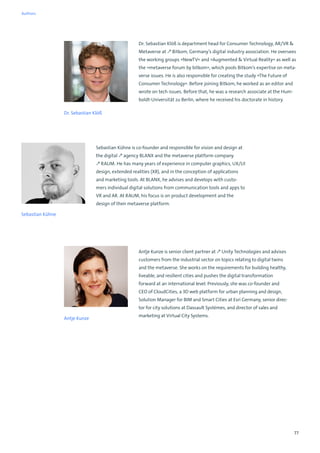
Dr. Sebastian Klöß
T +49 (0)30 27576-210
s.kloess@bitkom.org
Responsible Bitkom department
AG Metaverse Forum
Project head
Dr. Sebastian Klöß, Bitkom
Translation support
The translation of the Bitkom Guide into English was made possible by the kind support
of CMS Hasche Sigle Partnerschaft von Rechtsanwälten und Steuerberatern, DB Systel,
Fraunhofer-Institut für Arbeitswirtschaft und Arbeitsorganisation (IAO) and Meta.
Layout
Anna Stolz
Cover photo
© Julien Tromeur – unsplash.com
Copyright
Bitkom 2022
This publication contains general and non-binding information. The content of this
publication reflects the opinions of Bitkom at the time of the publication. The infor-
mation has been compiled applying greatest possible care, but Bitkom does not
warrant its factual accuracy, completeness, or currency. In particular, this publication
cannot take into account the specific circumstances of individual cases. Using this
publication, therefore, ultimately, lies in the responsibility of the reader. Bitkom
hereby denies any and all liability. All rights reserved to Bitkom, including partial
reproduction.
3
Table of contents
1
2
3
4
5
6
What then is the metaverse?
Six messages for getting started	 5
The current state of the metaverse	 8
2.1 Why is the metaverse so timely, what has made it possible?8
2.2 What is the metaverse today – and what will it become?9
2.3 The metaverse as the next evolutionary stage of the internet –
the web 3(.0)?11
2.4 Which technologies form the basis of the metaverse?12
Players, business models, and use cases	 19
3.1 Introduction 19
3.2 Actors in the metaverse 20
3.3 Business models in metaverse23
3.4 Use cases in the metaverse28
Law and taxes in the metaverse	46
4.1 Selected legal issues46
4.2 Taxes in the metaverse56
The relevance of the metaverse for society	 63
5.1 One metaverse for everyone63
5.2 A summary look at the metaverse’s relevance for society66
Outlook of the authors:
The metaverse in five and ten years	 69
Authors	73
7
4
Figure 1: Components of the metaverse: content, hardware, software,
services, IT infrastructure, network12
Figure 2: Building blocks of artificial intelligence15
Figure 3: Outline of a digital assets ecosystem21
Figure 4: The metaverse’s areas of application: usage and diffusion pyramid29
Figure 5: Merging of the real-world EXPO premises and a virtual falcon35
Figure 6: Visitors of the Expo premises can bring up friends who are not
on location as avatars and communicate with them36
Figure 7: A metaverse for electronic music37
Figure 8: Configuring a car in a VR environment39
Figure 9: Holodeck by Audi, realised by Lightshape40
Figure 10: Visualising important information about the infrastructure44
Table 1: Evolution of the web11
Illustrations and tables
5
What then is the metaverse? Six messages for getting started
Message 1: The Metaverse is more than just a buzzword
The metaverse. There is scarcely a news channel that hasn’t showcased, discussed, and
analysed this phenomenon yet. Large companies are committing their strategies to the
development of the metaverse, therefore heralding the next stage in the evolution of
the internet and the digital world. There is, in the best sense of the word, a palpable
pioneering and optimistic spirit. Those who were around at the turn of the millennium
like to remind everybody of the hype and the painful bursting of the dotcom bubble.
Moreover, the intensity with which the metaverse phenomenon is currently being
discussed has many people suspecting the next buzzword hype cycle and turning
away, disinterestedly, thinking it will »go away soon«.
With this guide, we want to look behind the buzzword, because we are convinced that
the metaverse phenomenon is an umbrella term for a range of developments that are
already happening today and have a potential for innovation in and around the digital
transformation that must be taken seriously.
Message 2: The metaverse is only just being created – there
cannot (yet) be a clear definition
A crucial problem of the metaverse phenomenon is that it lacks a generally agreed-
upon definition, something that especially us Germans, a self-proclaimed »nation of
poets and thinkers«, like very much because it gives us a sense of safety and stability.
However, precise definitions require certain intellectual authorities and a negotiation
process. Since, conspicuously, such an authority on the metaverse is not in place and
we are in the midst of a negotiation process across various communities, it should
come as no surprise that such a definition is not (yet) available. The absence of a
definition, however, should not be seen as a weakness. Rather, a look at the various
attempts at finding a definition reveals the many facets that the metaverse could have
and thus highlights its innovative potential.
1 What then is the metaverse?
Six messages for getting started
6
Message 3: The metaverse is about virtual worlds
A consensus among all the ongoing debates is that the metaverse will be experienced
in form of a virtual world. For our purposes, it is irrelevant whether this will be exactly
one or several parallel virtual words, as some are discussing. More importantly, we see
that the character and self-image of virtual worlds are currently changing. We have
known virtual worlds for a long time; computer games are a good example of this. It
would be a mistake, however, to dismiss the metaverse as a gaming trend. For younger
generations, the virtual worlds of Minecraft, Fortnite, and Roblox have taken on a new
layer of meaning. They are not merely entertainment but places of social interaction.
People are fixing to meet in Minecraft, in Oberurselcraft, for example, to build a new
station in Oberursel. Brushing this and other examples off as childish gimmicks would
be a fatal mistake. When talking to teenagers about their buildings in Minecraft, they
take pride in their achievements because real work went into those buildings, albeit
only virtual. The spirit of creation and ownership among them is palpable. In the
metaverse debate, this spirit is described using the term »creator«.
Message 4: The metaverse is about (virtual) ownership and trade
The notion of copyright leads us to another important aspect. We are currently obser-
ving a type of ownership developing in the virtual sphere. This seems to contradict the
usual understanding of digitality as a material with the potential for infinite duplicati-
on. Indeed, the term »copy and paste« has transcended the language of the digital and
has become synonymous with this. However, facilitated by non-fungible tokens (NFTs)
based on blockchain technology, there are now countless examples of unique owners
being assigned to digital objects. Digital artists, for example, are selling virtual works
based on NFTs. This development, too, must be taken seriously. Selling virtual goods
such as skins in Fortnite is already an important component of the business model for
virtual worlds and is likely to grow more.
NFTs will become innovation drivers for an exchange and financial economy in the
metaverse. On the one hand, because one of their key features is transparent trackab-
ility and high security; on the other, because of their functional development – as
described below in the Chapter on use cases. In addition to the aforementioned
gaming and arts sector, NFT portals and exchanges like opensea.io or crypto.com/nft
will be creating their own trends. However, the blockchain will not contain all the
stored data, including images, photos, videos, audio, and text, but only the transactio-
nal data as well as »smart contracts« and »ownership certificates«.
What then is the metaverse? Six messages for getting started
7
Message 5: The metaverse is not a (virtual) parallel world
The metaverse will not exist as a virtual parallel world with no connection to the »real«
world. Instead, there will be a multitude of connections in both directions. In one
direction, real physical objects will be mirrored by virtual equivalents. Think of real
shoes or handbags with a virtual equivalent, which can be worn by the user’s avatar in
the metaverse. Similarly, digital twins of real facilities and machines in the metaverse
are conceivable. In the other direction, augmented reality can be used to blend virtual
objects with our real-life environment. This allows interacting with those objects as if
they were physically around us.
Message 6: The metaverse must be taken seriously; the boundaries
of our world are currently expanding.
This list of examples could be easily continued. At its heart, the current development is
about the boundaries of our world expanding. It is doing so not so much in the sense
of what is possible technologically. Many technical aspects mentioned in the metaver-
se debate have been known to us, particularly virtual worlds. More importantly, social
acceptance must be paired with the widespread availability of technological means.
It is very likely that this combination will result in the creation of diverse new business
models and new creative solutions in and around virtual worlds. We are firmly convin-
ced that we must take these developments seriously and that every company that is
somehow linked to digital transformation should take a critical and open-minded look
at them to identify and use the potential for their own business. The German industrial
sector, in particular, was too late in recognising the potential of the internet. The same
mistake should not happen again with the developments surrounding the metaverse.
It would be a fundamental mistake to brush off the metaverse and file it away in the
»this will go away soon« category.
In this sense, we would like this guide to be viewed as an important building block of
gathering information on metaverse-related developments. We aim to draw attention
to those developments that we deem timely and relevant. First, the current state of
the metaverse will be sketched out in Chapter 2. We will highlight the foundations on
which it is built, why it is so timely, and which technologies make it possible. In Chapter
3, we will address concrete implementation of the metaverse. We will examine in
greater detail the players who it is relevant for, who are already focusing on it, which
business models are made possible by the metaverse, and which metaverse use cases
exist. Chapter 4 will elaborate on the legal and tax-related dimensions of the metaver-
se before, in Chapter 5, we will highlight the social dimension of the metaverse with an
emphasis on the societal needs that need to be addressed when establishing it.
What then is the metaverse? Six messages for getting started
8
The current state of the
metaverse
2
2.1 Why is the metaverse so timely, what has
made it possible?
The term metaverse and the idea of virtual 3D worlds have been around for decades. In
the 1990s, when the internet first became accessible to a broader audience, there was
frequent mentioning of data highways and cyberspace. The term cyberspace was
already evoking images of a virtual 3D space. The term goes back to »Burning Chrome«,
a short story by writer William Gibson from the early 1980s. In the story, he talks about
virtual 3D worlds. The term metaverse also originated in literature. Here, it was Neal
Stephenson and his novel »Snow Crash« that coined the term in 1992. In the following
years, however, virtually nobody spoke about the metaverse. The technological means
to realise 3D worlds have also been around for a while. We have come a long way from
the metaverse’s very early predecessors like Laterna Magica, Morton Leonard Heilig’s
Sensorama, or Ivan Sutherland’s Sword of Damocles, to the first headset and cave
experiments in the 1990s, and today’s possibilities of augmented and virtual reality.
If neither the term metaverse nor the technology for creating virtual worlds is new –
why is there suddenly so much talk of the metaverse? And why is the metaverse
concept so relevant for the economy and society today?
There are currently five factors that have helped the metaverse term and concept to
attract so much attention:
1. Market timing: Two years after the coronavirus pandemic and with the increasing
extension of the workplace into the cloud, the notion that a workplace does not
have to be bound to a certain location has received an extreme boost. This has
facilitated the development of moving work into virtual words and thus the meta-
verse.
2. Generational readiness: In addition, the way the current and following generations
(Z and Alpha) interact has changed profoundly. For them, interacting in the virtual
world has been part of their identity for years. They are also part of the so-called
creator community.
The current state of the metaverse
9
3. The value of content has a significance now that it didn’t have, say, during the second-
life boom in the 2000s. Billions are now being earned by creating digital assets, be
it through virtual clothing, worlds, artworks, or the like. Moreover, users of computer
games have become accustomed to spending real money on virtual objects.
4. Technical requirements: Augmented and virtual reality have reached the necessary
technological maturity and are becoming more widespread. Oculus jumping to
number one of the free apps in the iOS app store around Christmas in 2021 is a good
example of this. Additionally, new technologies that are important for maintaining
a digital identity, such as blockchain and NFTs, are also becoming more widespread.
By facilitating ownership and interoperability of digital assets, blockchain is ena-
bling a digital economy in the metaverse. Buying, selling, and other financial use
cases can be replicated, and assets can be used in different types of the metaverse.
Market forces are thus accelerating the current developments.
5. Regulatory framework: Only through the extension of the German Electronic
Securities Act (eWPG) have businesses achieved legal certainty when handling
digital assets. The »Markets in Crypto-Assets« (MiCA) framework, which is currently
under development, will contribute to EU-wide harmonisation in dealing with
digital assets in both the physical and the virtual world.
2.2 What is the metaverse today – and what will
it become?
We are still at the very beginning of the metaverse’s development, but it promises
great things. For this reason, we cannot say what the metaverse will become in the
end. However, a comparison with the late 1990s and the state of the internet then is
instructive. All things needed to access the internet had then been available, including
the necessary hardware, software, and (data) infrastructure. Today’s situation is similar
regarding the metaverse. In the early days of the internet, too, people had ideas and
visions about what the internet, cyberspace, and the data highway would bring. Some
happened, others didn’t – and many things turned out very differently to what was
expected at the time. Most were probably not aware of the rapid development the
internet, which we now carry around with us at all times using our smartphones and
use it to organise large parts of our everyday life.
With today's knowledge, the metaverse can be seen as the next logical stage of the
internet, a three-dimensional internet that is permanent and happens in real time. Its
virtual rooms will be available 24/7. On the one hand, they will exist in completely
virtual form (i. e., exist in virtual reality) and be immersive, but, at the same time, the
virtual and analogue world will continue to fuse. We will use augmented reality to
interact with digital content in our real-world environment. Virtual and real world will
The current state of the metaverse
10
become increasingly interlaced because real objects, like clothing, will have a digital
counterpart in the virtual world. Users will wear the same pullover, for example, as
their avatar, their digital copy. Digital twins, too, will create a direct connection bet-
ween the real world and the virtual image, for example, when real machines and
buildings and their operating modes are mirrored in the virtual world. Technicians will
be able to access them there and control machines and buildings.
Another key feature of the metaverse is that it will give rise to new forms of user-gene-
rated content, especially in the form of three-dimensional objects. Three-dimensional
objects in the metaverse will be transferrable, transportable, and tradeable. This is one
of the significant differences to the digital equipment that can be purchased in compu-
ter games, the availability of which is limited to said games. In an ideal metaverse, such
virtual goods and real goods could be owned and taken everywhere. They are also
interoperable, another central property of an ideal type metaverse. Let’s stick with the
sweater example: Once purchased, the avatar can wear it anywhere in the metaverse
and not just within a self-contained game. To facilitate real ownership of virtual
objects or even plots of land, the blockchain plays a central role, particularly NFTs. This
points to another characteristic of the metaverse in its ideal form: It is decentralised.
Unlike today's internet, there are to be no closed platforms.
The current state of the metaverse
11
2.3 The metaverse as the next evolutionary 		
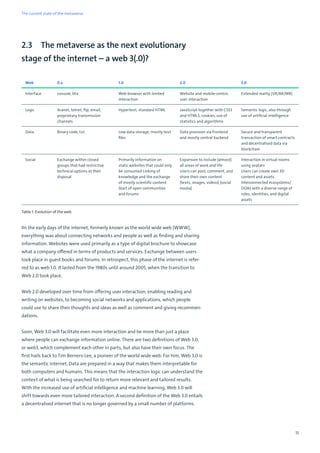
stage of the internet – a web 3(.0)?
Web 0.x 1.0 2.0 3.0
Interface console, btx Web browser with limited
interaction
Website and mobile-centric
user interaction
Extended reality (VR/AR/MR)
Logic Aranet, telnet, ftp, email,
proprietary transmission
channels
Hypertext, standard HTML JavaScript together with CSS3
and HTML5, cookies, use of
statistics and algorithms
Semantic logic, also through
use of artificial intelligence
Data Binary code, txt Low data storage, mostly text
files
Data provision via frontend
and mostly central backend
Secure and transparent
transaction of smart contracts
and decentralised data via
blockchain
Social Exchange within closed
groups that had restrictive
technical options at their
disposal
Primarily information on
static websites that could only
be consumed Linking of
knowledge and the exchange
of mostly scientific content
Start of open communities
and forums
Expansion to include (almost)
all areas of work and life
Users can post, comment, and
share their own content
(texts, images, videos) (social
media)
Interaction in virtual rooms
using avatars
Users can create own 3D
content and assets
Interconnected ecosystems/
DOAs with a diverse range of
roles, identities, and digital
assets
Table 1: Evolution of the web
IIn the early days of the internet, formerly known as the world wide web (WWW),
everything was about connecting networks and people as well as finding and sharing
information. Websites were used primarily as a type of digital brochure to showcase
what a company offered in terms of products and services. Exchange between users
took place in guest books and forums. In retrospect, this phase of the internet is refer-
red to as web 1.0. It lasted from the 1980s until around 2005, when the transition to
Web 2.0 took place.
Web 2.0 developed over time from offering user interaction, enabling reading and
writing on websites, to becoming social networks and applications, which people
could use to share their thoughts and ideas as well as comment and giving recommen-
dations.
Soon, Web 3.0 will facilitate even more interaction and be more than just a place
where people can exchange information online. There are two definitions of Web 3.0,
or web3, which complement each other in parts, but also have their own focus. The
first hails back to Tim Berners-Lee, a pioneer of the world wide web. For him, Web 3.0 is
the semantic internet. Data are prepared in a way that makes them interpretable for
both computers and humans. This means that the interaction logic can understand the
context of what is being searched for to return more relevant and tailored results.
With the increased use of artificial intelligence and machine learning, Web 3.0 will
shift towards even more tailored interaction. A second definition of the Web 3.0 entails
a decentralised internet that is no longer governed by a small number of platforms.
The current state of the metaverse
12
Instead, it uses blockchain. A token-based economy, including NFTs, decentralised auto-
nomous organisations (DAOs), and decentralised finance (DeFi) as well as self-determi-
ned identities are central components of this concept. It goes back to Gavin Wood,
co-founder of the Ethereum blockchain, who first used the spelling »web3«. In practice,
the spellings Web3, Web 3.0 and web3 are often used synonymously.
The metaverse draws on both notions of Web 3.0. It will function as a model of inter-
action based on the Web 3.0 framework. It will encompass aspects of the semantic
internet, decentrality, and a token-based economic model.
2.4 Which technologies form the basis of
the metaverse?
To realise the overall vision for a metaverse ecosystem, a combination of several com-
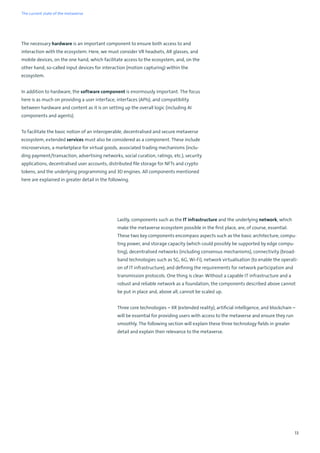
ponents should be considered and brought together. The following diagram and its
respective explanations serve this end.
Figure 1: Components of the metaverse: content, hardware, software, services, IT infrastructure, network
At its heart is the content component. It includes virtual worlds (including associated
experiences such as games, events, social interaction, and sports), digital avatars, and
3D-based goods (such as NFTs).
SERVICES
Microservices, marketplace, security applications,
interoperability through decentral applications,
programming languages, 3D design engines
IT INFRASTRUCTURE
Architecture, computing power and storage
capacity, decentral infrastructure
(incl. consensus mechanisms)
NETWORK
Connectivity/broadband networks (incl. 5G, 6G, Wi-Fi), network
virtualisation, requirements for network participation,
transmission protocols
CONTENT
Virtual worlds  experiences
(events, social interaction, sports, work, and
many more), 3D-based goods (e. g., NFTs)
HARDWARE
Display devices (VR/AR), haptic and motion
sensing input devices (wearables)
SOFTWARE
User interfaces, APIs, algorithms, trading mechanisms,
spatial audio, 3D modelling
The current state of the metaverse
13
The necessary hardware is an important component to ensure both access to and
interaction with the ecosystem. Here, we must consider VR headsets, AR glasses, and
mobile devices, on the one hand, which facilitate access to the ecosystem, and, on the
other hand, so-called input devices for interaction (motion capturing) within the
ecosystem.
In addition to hardware, the software component is enormously important. The focus
here is as much on providing a user interface, interfaces (APIs), and compatibility
between hardware and content as it is on setting up the overall logic (including AI
components and agents).
To facilitate the basic notion of an interoperable, decentralised and secure metaverse
ecosystem, extended services must also be considered as a component. These include
microservices, a marketplace for virtual goods, associated trading mechanisms (inclu-
ding payment/transaction, advertising networks, social curation, ratings, etc.), security
applications, decentralised user accounts, distributed file storage for NFTs and crypto
tokens, and the underlying programming and 3D engines. All components mentioned
here are explained in greater detail in the following.
Lastly, components such as the IT infrastructure and the underlying network, which
make the metaverse ecosystem possible in the first place, are, of course, essential.
These two key components encompass aspects such as the basic architecture, compu-
ting power, and storage capacity (which could possibly be supported by edge compu-
ting), decentralised networks (including consensus mechanisms), connectivity (broad-
band technologies such as 5G, 6G, Wi-Fi), network virtualisation (to enable the operati-
on of IT infrastructure), and defining the requirements for network participation and
transmission protocols. One thing is clear: Without a capable IT infrastructure and a
robust and reliable network as a foundation, the components described above cannot
be put in place and, above all, cannot be scaled up.
Three core technologies – XR (extended reality), artificial intelligence, and blockchain –
will be essential for providing users with access to the metaverse and ensure they run
smoothly. The following section will explain these three technology fields in greater
detail and explain their relevance to the metaverse.
The current state of the metaverse
14
Extended reality
What it is
XR is the abbreviation for extended reality, which is an umbrella term encompassing
virtual reality (VR), mixed reality (MR), and augmented reality (AR) technologies. VR
means being immersed in a virtual world, for example, using a VR headset, often
referred to as VR glasses. With AR, on the other hand, additional information is display-
ed in the real world such as on top of the camera image of a smartphone or tablet or
using special AR headsets. MR is essentially synonymous with AR; the term is often
used to emphasise that virtual objects can be not only looked at but also interacted
with.
All three technologies use three-dimensional objects and place them in a space, both
physically and virtually. This allows one to interact with these objects and touch, move,
and even edit them depending on their programmed functions. Persons move through
the virtual words using an avatar, a virtual copy of themselves.
Relevance to the metaverse
XR, the combination of AR, MR and VR technologies, acts as the gateway to the virtual
world. The metaverse can only be fully experienced with one of these three technolo-
gies. Computer screens may also be used, but they don't create such an immersive
experience. VR facilitates complete immersion and makes possible a complete expe-
rience of the metaverse, i.e., in a completely virtual 3D world. With AR and MR, virtual
3D objects are brought into the real world. These, too, can be offshoots or content of
the metaverse.
Conclusion
The metaverse combines elements of AR, MR, and VR with the traditional internet in
order to present content to users according to their needs. Depending on the technolo-
gy used, the metaverse is an extension of our reality using AR and MR technologies or
a complete immersion (VR).
The current state of the metaverse
15
Artificial intelligence
What it is
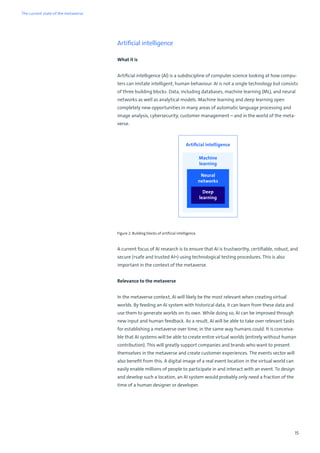
Artificial intelligence (AI) is a subdiscipline of computer science looking at how compu-
ters can imitate intelligent, human behaviour. AI is not a single technology but consists
of three building blocks: Data, including databases, machine learning (ML), and neural
networks as well as analytical models. Machine learning and deep learning open
completely new opportunities in many areas of automatic language processing and
image analysis, cybersecurity, customer management – and in the world of the meta-
verse.
Figure 2: Building blocks of artificial intelligence
A current focus of AI research is to ensure that AI is trustworthy, certifiable, robust, and
secure (»safe and trusted AI«) using technological testing procedures. This is also
important in the context of the metaverse.
Relevance to the metaverse
In the metaverse context, AI will likely be the most relevant when creating virtual
worlds. By feeding an AI system with historical data, it can learn from these data and
use them to generate worlds on its own. While doing so, AI can be improved through
new input and human feedback. As a result, AI will be able to take over relevant tasks
for establishing a metaverse over time, in the same way humans could. It is conceiva-
ble that AI systems will be able to create entire virtual worlds (entirely without human
contribution). This will greatly support companies and brands who want to present
themselves in the metaverse and create customer experiences. The events sector will
also benefit from this. A digital image of a real event location in the virtual world can
easily enable millions of people to participate in and interact with an event. To design
and develop such a location, an AI system would probably only need a fraction of the
time of a human designer or developer.
Artificial intelligence
Machine
learning
Neural
networks
Deep
learning
The current state of the metaverse
16
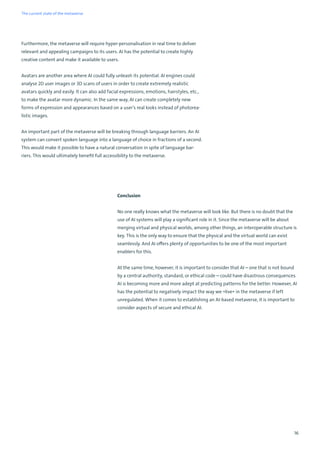
Furthermore, the metaverse will require hyper-personalisation in real time to deliver
relevant and appealing campaigns to its users. AI has the potential to create highly
creative content and make it available to users.
Avatars are another area where AI could fully unleash its potential. AI engines could
analyse 2D user images or 3D scans of users in order to create extremely realistic
avatars quickly and easily. It can also add facial expressions, emotions, hairstyles, etc.,
to make the avatar more dynamic. In the same way, AI can create completely new
forms of expression and appearances based on a user’s real looks instead of photorea-
listic images.
An important part of the metaverse will be breaking through language barriers. An AI
system can convert spoken language into a language of choice in fractions of a second.
This would make it possible to have a natural conversation in spite of language bar-
riers. This would ultimately benefit full accessibility to the metaverse.
Conclusion
No one really knows what the metaverse will look like. But there is no doubt that the
use of AI systems will play a significant role in it. Since the metaverse will be about
merging virtual and physical worlds, among other things, an interoperable structure is
key. This is the only way to ensure that the physical and the virtual world can exist
seamlessly. And AI offers plenty of opportunities to be one of the most important
enablers for this.
At the same time, however, it is important to consider that AI – one that is not bound
by a central authority, standard, or ethical code – could have disastrous consequences.
AI is becoming more and more adept at predicting patterns for the better. However, AI
has the potential to negatively impact the way we »live« in the metaverse if left
unregulated. When it comes to establishing an AI-based metaverse, it is important to
consider aspects of secure and ethical AI.
The current state of the metaverse
17
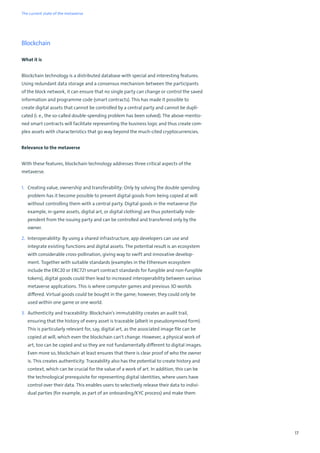
Blockchain
What it is
Blockchain technology is a distributed database with special and interesting features.
Using redundant data storage and a consensus mechanism between the participants
of the block network, it can ensure that no single party can change or control the saved
information and programme code (smart contracts). This has made it possible to
create digital assets that cannot be controlled by a central party and cannot be dupli-
cated (i. e., the so-called double-spending problem has been solved). The above-mentio-
ned smart contracts will facilitate representing the business logic and thus create com-
plex assets with characteristics that go way beyond the much-cited cryptocurrencies.
Relevance to the metaverse
With these features, blockchain technology addresses three critical aspects of the
metaverse.
1. Creating value, ownership and transferability: Only by solving the double spending
problem has it become possible to prevent digital goods from being copied at will
without controlling them with a central party. Digital goods in the metaverse (for
example, in-game assets, digital art, or digital clothing) are thus potentially inde-
pendent from the issuing party and can be controlled and transferred only by the
owner.
2. Interoperability: By using a shared infrastructure, app developers can use and
integrate existing functions and digital assets. The potential result is an ecosystem
with considerable cross-pollination, giving way to swift and innovative develop-
ment. Together with suitable standards (examples in the Ethereum ecosystem
include the ERC20 or ERC721 smart contract standards for fungible and non-fungible
tokens), digital goods could then lead to increased interoperability between various
metaverse applications. This is where computer games and previous 3D worlds
differed. Virtual goods could be bought in the game; however, they could only be
used within one game or one world.
3. Authenticity and traceability: Blockchain’s immutability creates an audit trail,
ensuring that the history of every asset is traceable (albeit in pseudonymised form).
This is particularly relevant for, say, digital art, as the associated image file can be
copied at will, which even the blockchain can't change. However, a physical work of
art, too can be copied and so they are not fundamentally different to digital images.
Even more so, blockchain at least ensures that there is clear proof of who the owner
is. This creates authenticity. Traceability also has the potential to create history and
context, which can be crucial for the value of a work of art. In addition, this can be
the technological prerequisite for representing digital identities, where users have
control over their data. This enables users to selectively release their data to indivi-
dual parties (for example, as part of an onboarding/KYC process) and make them
The current state of the metaverse
18
verifiable. This is referred to as self-sovereign identity (SSI). A verifiable identity that
also safeguards data protection is another crucial component of a future decentrali-
sed metaverse.
Conclusion
Blockchain and digital assets have the potential to become the enablers of the meta-
verse by adding a crucial component: a metaverse economy. Digital assets can be
produced, sold, and owned, and services in the metaverse can be paid for. Economic
incentives could cause the metaverse to develop rapidly.
The current state of the metaverse
19
Players, business models,
and use cases
3.1 Introduction
The chapter at hand deals with economic aspects of the metaverse and aims at
answering the following crucial questions:
■ Where will the metaverse have a particular impact? Where can it change something?
■ Who is already active in Metaverse – for what reason? Who is the metaverse relevant
for?
■ Which business models are/will be possible? How should a company take action
that wants to break through in the metaverse?
■ Which industries are breaking through the fastest? How far along are they?
■ What is already available in the metaverse? What is already doable today? What is
imaginable today? Which future applications are conceivable?
The following characteristics of the metaverse are relevant to answer these questions
(see Chapter 1):
■ The metaverse is organised in a decentralised manner and is not self-contained.
■ The metaverse won't go away again. It is persistent (24/7).
■ In the metaverse, the nature of ownership is changing (think virtual goods).
■ The metaverse is global (huge scope, billions of people).
■ The metaverse is synchronous and asynchronous:
■ Content is increasingly being developed and designed for synchronous consump-
tion such as interaction with services like bots and social interactions in real time
via avatars, with digital goods, etc. – live and in real time.
■ The challenge for providers is to develop content for both synchronous and
asynchronous interaction and to tailor their business models to both modes.
Gaming, for example, can be asynchronous (on demand.
■ The metaverse is immersive:
■ Immersion contributes to the fusion of digital and analogue worlds through new
technology.
■ Customer experience in the metaverse is determined by individual sensory
perception.
3
Players, business models, and use cases
20
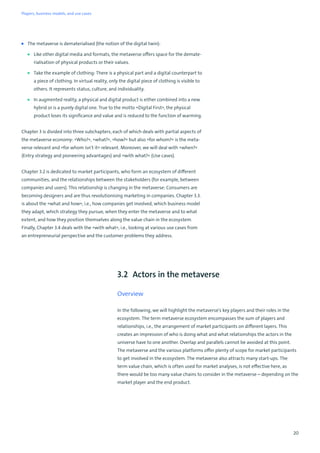
■ The metaverse is dematerialised (the notion of the digital twin):
■ Like other digital media and formats, the metaverse offers space for the demate-
rialisation of physical products or their values.
■ Take the example of clothing: There is a physical part and a digital counterpart to
a piece of clothing. In virtual reality, only the digital piece of clothing is visible to
others. It represents status, culture, and individuality.
■ In augmented reality, a physical and digital product is either combined into a new
hybrid or is a purely digital one. True to the motto »Digital First«, the physical
product loses its significance and value and is reduced to the function of warming.
Chapter 3 is divided into three subchapters, each of which deals with partial aspects of
the metaverse economy: »Who?«, »what?«, »how?« but also »for whom?« is the meta-
verse relevant and »for whom isn’t it« relevant. Moreover, we will deal with »when?«
(Entry strategy and pioneering advantages) and »with what?« (Use cases).
Chapter 3.2 is dedicated to market participants, who form an ecosystem of different
communities, and the relationships between the stakeholders (for example, between
companies and users). This relationship is changing in the metaverse: Consumers are
becoming designers and are thus revolutionising marketing in companies. Chapter 3.3.
is about the »what and how«, i.e., how companies get involved, which business model
they adapt, which strategy they pursue, when they enter the metaverse and to what
extent, and how they position themselves along the value chain in the ecosystem.
Finally, Chapter 3.4 deals with the »with what«, i.e., looking at various use cases from
an entrepreneurial perspective and the customer problems they address.
3.2 Actors in the metaverse
Overview
In the following, we will highlight the metaverse’s key players and their roles in the
ecosystem. The term metaverse ecosystem encompasses the sum of players and
relationships, i.e., the arrangement of market participants on different layers. This
creates an impression of who is doing what and what relationships the actors in the
universe have to one another. Overlap and parallels cannot be avoided at this point.
The metaverse and the various platforms offer plenty of scope for market participants
to get involved in the ecosystem. The metaverse also attracts many start-ups. The
term value chain, which is often used for market analyses, is not effective here, as
there would be too many value chains to consider in the metaverse – depending on the
market player and the end product.
Players, business models, and use cases
21
Ecosystem – Methods for structuring
Particular attention should be paid to the role that a market participant takes on in the
metaverse ecosystem (cf. below and the six technological components of the metaver-
se in Chapter 1). In the metaverse, one company can take on many different roles. In
addition, there will be specialists who only have one role. Such a model, which divides
the metaverse into layers, could even depict use cases. User need X is met by actor ABC
in their role Z in layer 1 and layer 2. When depicting a metaverse ecosystem, the follo-
wing taxonomy by EY can help to structure digital assets:
Figure 3: Outline of a digital assets ecosystem
An alternative way of structuring the metaverse is to use groups of actors. The
following actor taxonomy follows a classic structure and is fairly comprehensive:
1. Research facilities
■ Universities
■ Non-university research institutions, application-oriented
2. Technology providers, manufacturers, system integrators
■ Hardware – user interfaces, controllers, XR glasses, and headsets, wearables,
laser scanners, microphones, chips and processors, hand tracking sensors,
antennas, wireless modules, etc.
Digital Assets
Market Infrastructure
Services  Applications
Participants
Regulators  Issuers
Players, business models, and use cases
22
■ Software – spatial audio, video/immersion, 3D modelling, photogrammetry, 3D
animation, motion/MR capture tools, coding and scripting, avatars and identi-
ties, mobile edge computing, blockchain, AI/algorithms, etc.
■ Systems, interfaces, and services (for example, interoperability)
3. Service providers (creators  developers, professional services, etc.)
4. Operators of metaverse platforms and gateways (centralised, decentralised)
5. Providers of social media and content, marketplaces, marketing and advertising,
economy and finance (payment services, crypto wallets, play-to-earn/collect), etc.
6. Users
■ Industrial end users
■ Consumers
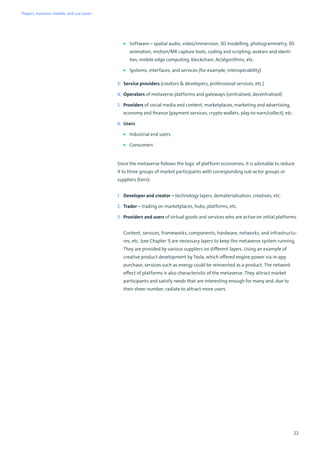
Since the metaverse follows the logic of platform economies, it is advisable to reduce
it to three groups of market participants with corresponding sub-actor groups or
suppliers (tiers):
1. Developer and creator – technology layers, dematerialisation, creatives, etc.
2. Trader – trading on marketplaces, hubs, platforms, etc.
3. Providers and users of virtual goods and services who are active on initial platforms.
Content, services, frameworks, components, hardware, networks, and infrastructu-
res, etc. (see Chapter 1) are necessary layers to keep the metaverse system running.
They are provided by various suppliers on different layers. Using an example of
creative product development by Tesla, which offered engine power via in-app
purchase, services such as energy could be reinvented as a product. The network
effect of platforms is also characteristic of the metaverse: They attract market
participants and satisfy needs that are interesting enough for many and, due to
their sheer number, radiate to attract more users.
Players, business models, and use cases
23
3.3 Business models in metaverse
Overview
The metaverse can be viewed as a paradigm shift towards the principle of »everything
that can be digitised, will be digitised.« From this, each company must derive individual
business models and products.
This chapter focuses on the following questions:
■ Which business models are possible to shape the relationship between provider and
customer?
■ How do I kick off as a company in the metaverse (competencies, investments, test
projects, strategy, business cases, etc.)? Where do we start, where do we stop? What
should the company part of the metaverse contain?
■ Which business models are key companies such as Meta or Unity pursuing in the
metaverse? What can others learn for their business model development? What
does that mean for a company’s partnering strategy in the ecosystem?
Fundamental types of business models
The monetisation models in the digital industry are typically different than in the
analogue world of products and services: Flat rates, subscriptions, donations, prepaid,
credits, affiliate marketing, premium models, in-app purchases, and other models
known from the gaming industry, for example, have as much a chance as transaction
fees and ownership-based business models (NFT).
In principle, the following business models can be differentiated: financing through
ads, subscription-based models, and transactional models (transaction, in-app purcha-
ses, etc.). The business models in the metaverse are essentially a further development
of business models from the platform economy (transaction, smart contract, etc.). The
metaverse corresponds to a platform economy and does not add any further dimensi-
on. What may be added are monetisation methods derived from the gaming industry
(reward systems, etc.), which are transferred to the business context. If we see the
metaverse as the consistent next development stage of today’s world wide web, we
can take many business models into the new world with us. Platform economies, in
particular, lend themselves as models for becoming the dominant business models in
the metaverse. Global or platform-based currency systems, such as those in the crypto
and game industries, complement today's platform economies.
Players, business models, and use cases
24
In summary, it can be stated that there will be not one but several business models in
the metaverse. Business models essentially result from the roles taken on by metaver-
se players in the ecosystem.
Some questions remain unanswered for the metaverse:
1. Until now, platform providers have tried to keep customers on their platforms. How
could the metaverse change this? Will the metaverse achieve what the internet
hasn’t succeeded in creating for 30 years, namely a unified value system?
2. Who pays for, say, the concert tickets in the metaverse at the end of the day? On
social media, it tended to feel like everything was free. Influencers can use plat-
forms for free, get benefits, etc. In the end, however, they are paid for by advertisers
(transaction from brand to influencer, affiliate links) and through participation
models (percentage of the advertising share).
The dynamics of business models
Business models in the metaverse are highly dynamic. How money can be made with
the metaverse will, from the companies’ perspective, continuously change over time,
i.e., change according to the development of the metaverse. We know such develop-
ments from the platform economy and the new economy. There are numerous models
and guidelines in the literature for developing new business models. Well-known
models include McKinsey's 3-stage model (three horizons) and Alexander Osterwal-
der's business canvas model.
In this publication, we will pick out two phases of the metaverse. The expected busi-
ness models that we describe below relate to the phase in which the metaverse initial-
ly develops (approximately within a horizon of ten years). It is difficult to forecast
business models for the period beyond that. In the forecast chapter (Chapter 5), we
highlight the direction in which the metaverse can develop, what role it will play for
companies and society in the future, and where the technology is heading. From this,
new future business models in the metaverse can be deduced. In general, it can be said
that business models are role-specific and use-case-specific. In the following use case
chapter, we, therefore, propose a diffusion model that highlights the penetration of
metaverse concepts, technologies, and applications for different industries. This is
based on various monetisation options and business models in the respective industry
ecosystems.
Players, business models, and use cases
25
Metaverse business models using company examples
In the following, we will highlight business models using the examples of the companies
Meta and Unity.
Within a company like Meta, the aspect of monetisation is viewed from different
perspectives (E-commerce, entertainment, creator economy). The hitherto widespread
2D apps are also still in use. Meta is also experimenting with creator bonus schemes in
Horizon World (transactional business models).
■ Commerce: E-commerce is growing rapidly and the metaverse will open new possi-
bilities for both shoppers and retailers. Shops on Instagram, for example, will
become more immersive by offering options for buying physical as well as digital
products.
■ Entertainment: It is already possible to host paid online events on Facebook. This
can now become a hybrid experience with people participating face-to-face and
virtually. Meta presented how this works at the Connect developer conference: Two
friends could visit the same concert, one on location and the other in the metaverse.
■ Creator economy: Since April 2022, Meta has been testing the sale of virtual objects
and effects across its different »worlds« together with a small group of creators.
Someone could, for example, manufacture and sell accessories for the fashion
industry or offer paid access to a new part of the world. Purchasing items in Horizon
Worlds is available to people aged 18 and over in the US and Canada, where Horizon
Worlds is currently available.
The second example of a metaverse business model comes from Unity. The democrati-
sation of game development and user-generated content is resulting in a network
effect that is never boring, always entertaining. Gaming platforms such as Roblox offer
both game developers and gamers open access to create new games and digital
experiences in the world itself.
These open gaming platforms enable users to create their own stories and interact
with friends and strangers (connect and communicate) within the unique limits of the
same online world while saving the day or winning the battle, either alone or as a team
(conquer and collaborate), while collecting points and unlocking (collecting) exclusive
digital goods.
Such platforms are thus very close to the metaverse experience on today's market.
Brands that are typically sought out by users in their spare time must now compete for
a small amount of that time more than ever. This competition for time will result in
companies reinventing their brand experience for traditional end consumers but also
non-consumer brands by opening up a 3D-ready, digital world (for example, large
music labels that introduce their own interactive worlds to replace or supplement sales
channels of third-party distributors).
Players, business models, and use cases
26
Unity's business model builds on this in the form of a product and partnership vision.
First, they identified areas undergoing existential changes:
1. How people use their time for work, play, and life priorities;
2. Which activities are carried out in which time category;
3. Where they primarily go to carry out these human activities; and
4. Why they rather go to one place to do carry out these activities than to another
place.
Unity's business model provides a one-stop shop for brands that want to build the
metaverse today and on their own terms. The way they achieve this goal is two-fold:
One is through partnerships and an open partner ecosystem, the other is product-dri-
ven. Both should mutually cross-pollinate each other. This strengthens an ecosystem of
partners or service providers: agencies, developers and professional creatives. These
certified providers will enable brands,
■ to build brand worlds from scratch with Unity,
■ to give developers the opportunity to create and share games and experiences in
the brand world,
■ to create brand experiences on other metaverse platforms using the Unity toolset
such as Fortnite, Snap Lens, Oculus, etc.,
■ to supplement brand worlds and experiences with user-generated and professional
content.
How to get started: Guidebook for companies in the metaverse
Many companies are uncertain about the benefits of Metaverse – be it as a supplier or
as a user. The strategy teams of companies should find answers to the following
questions:
■ Why should I deal with the metaverse now and not in five years’ time? Do I want to
be a first mover or a fast follower?
■ What is my perspective (end consumer vs. outfitter perspective) and which role do I
play in the ecosystem (developer, creator, business owner, VCs, consumer)? How do I
want to position myself? Do I want to offer or use products or services in the meta-
verse?
■ Where do I start, where do I stop? This includes the development of skills, the level
of investment, the development of testing facilities, the development of a metaver-
se strategy, and the definition of suitable use cases.
■ Which daily business use cases exist today that directly benefit me as a company or
as its customers? The next subchapter will provide some guidance on this.
Players, business models, and use cases
27
■ Which platforms are there that show me as an industrial customer what already
exists and who I can work with?
■ What are the things I need already today as an enterprise/SME?
Companies are well-advised to set up metaverse task forces today to address their
virtual futures. Companies that are active in the metaverse secure their future, while
new business development and start-ups benefit. Nokia, for example, has learned from
losing to the iPhone that it is important to keep an eye on new technologies and trends
so as not to be made obsolete by something that simply wasn’t on the radar or taken
seriously enough. Since then, Nokia has been working intensely on the issue of trend
scouting. They can thus provide internal and external advice to customers on how to
trigger the next disruption themselves.
Generally, every company would do well demystifying the metaverse and moving it
away from the hype (»chasing problems, not trends«). They should try out more meta-
verse technologies. VR/AR is still undertested, underaccepted, and underused in the
industry. There are many VR trainings to help companies learn how to work a virtual
environment but also to better understand it.
The metaverse needs many specialists. Companies should invest heavily into skills
development of their staff for development and application. There is an enormous
need for skilled workers to design the metaverse. The biggest demand will be in the
areas of AR/VR and gaming. This results not least from the scale of the metaverse in a
globally connected economy.
Players, business models, and use cases
28
3.4 Use cases in the metaverse
Overview
The final subchapter of Chapter 3 is about the opportunities the metaverse provides to
both companies and consumers. It is guided by the following questions:
■ Which use case scenarios can the metaverse actuate? Which use cases are available
today? Which can be expected in the short and medium term?
■ Why does the metaverse make sense for companies? Which industries will generally
benefit from the metaverse? Which industries are breaking through first?
■ What are the prospects for companies (such as user and company relationships,
marketing)?
The aim of this chapter is to provide,
1. An overview of use cases in terms of a vision. On the one hand, it will present
opportunities and use case scenarios that are possible in an »ideal« metaverse – in a
decentralised world that cannot be switched off, one that exists 24/7. One the other
hand, we will highlight use cases that already exist in their initial forms – based on
AR/VR, blockchain but also related to the metaverse. This applies to fields of social
interaction with VR/blockchain, etc., collaboration in business life, marketing and
sales, in the working world.
2. Concrete case examples pointing to how companies can use the metaverse to solve
their customers’ problems today.
The idea behind this is that companies at the beginning of the metaverse can learn
from concrete examples.
Areas of application and industries benefiting from the metaverse
The metaverse has huge disruptive potential. Some industries, whose products are
easy to dematerialise, will benefit massively from the opportunities offered by the
metaverse to their businesses, while other industries will have a harder time, for
example, the food and beverage industry. As the internet advances to become a 3D
internet, the metaverse offers many more possibilities than today’s internet, for exam-
ple, through creative business models. The potential for dematerialisation of products
will be crucial for the metaverse. Dematerialisation (also known as zero gravity thin-
king) describes the process of transforming analogue information and physical pro-
ducts into digital formats, which takes place in companies across many industries.
Dematerialisation makes it possible to dissolve the typical limitations of objects and
products in companies, which are also limitations of growth in the digital age. Physical
means of payment, for example, are increasingly disintegrating, while the relevance of
digital products increases (streaming, downloads, digital services, etc.).
Players, business models, and use cases
29
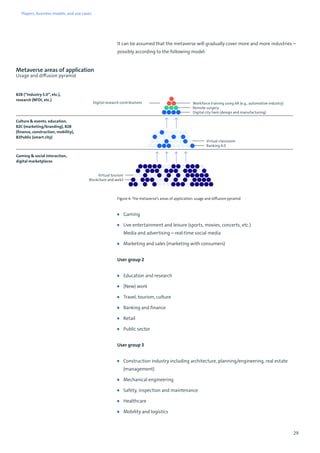
It can be assumed that the metaverse will gradually cover more and more industries –
possibly according to the following model:
Figure 4: The metaverse’s areas of application: usage and diffusion pyramid
■ Gaming
■ Live entertainment and leisure (sports, movies, concerts, etc.)
Media and advertising – real-time social media
■ Marketing and sales (marketing with consumers)
User group 2
■ Education and research
■ (New) work
■ Travel, tourism, culture
■ Banking and finance
■ Retail
■ Public sector
User group 3
■ Construction industry including architecture, planning/engineering, real estate
(management)
■ Mechanical engineering
■ Safety, inspection and maintenance
■ Healthcare
■ Mobility and logistics
B2B (“Industry 5.0”, etc.),
research (NFDI, etc.)
Culture  events, education,
B2C (marketing/branding), B2B
(finance, construction, mobility),
B2Public (smart city)
Gaming  social interaction,
digital marketplaces
Metaverse areas of application
Usage and diffusion pyramid
Digital research contributions Workforce training using AR (e.g., automotive industry)
Remote surgery
Digital city twin (design and manufacturing)
Virtual classroom
Banking 4.0
Virtual tourism
Blockchain and web3
Players, business models, and use cases
30
The metaverse evolution will turn some of these industries into winners. These will
probably include the fields of work, education, research, and health. In medicine, a
digital medical record can be used to track user movements. This offers great opportu-
nities for prevention and diagnostics. Other industries have a lot to lose and must be
careful not to be disrupt into irrelevance (such as traditional banking, travel and tou-
rism). Lastly, they will be losing industries – industries in which many things are at risk
of becoming obsolete (for example, the traditional mobility and construction industry).
Use case scenarios in the metaverse – an overview
Here are a few examples meant as overview of various use case scenarios in some user
industries of the metaverse:
World of work
■ New work (general trend of deurbanisation, digital nomads): virtual offices (telepre-
sence, remote work, virtual workspaces), seamless remote/hybrid collaboration
(asynchronous collaboration, collaborative work on 3D models, collaborative work in
3D environments)
■ Recruiting and onboarding of skilled workers/young talent
■ Digital space orchestration, virtual appraisal of the construction/real estate industry
(building development, office redesign from CAD drawings via 3D models)
■ Financial trading with VR glasses
Digital life and digital society
■ Cultural exchange, digital art, virtual tourism, 360-degree virtual tours, making
accessible and preserving cultural heritage, interactive museum tours
■ Health and fitness
■ Urban assistance, safety avatars, urban planning, simulation of footprints (such as
CO2 in city quarters)
Education
■ Digital transformation of research services, research data infrastructures
■ Education and training (vocational training): virtual learning environments at
schools, universities and for further education (better transfer of knowledge
through direct experience)
Players, business models, and use cases
31
Security
■ Inspection of critical infrastructures, spatial connection in maintenance
■ Predictive maintenance (anticipating risks, anomaly detection, announcing plant or
asset failures)
Manufacturing and digital manufacturing (Industry 4.0)
■ Remote expertise: assembly, service, and maintenance through AR expertise
■ Video analysis-based quality assurance with 5G video cameras during the manufac-
turing process
■ HMI improvement (human machine interaction/interface) with software (mobile
robots, driverless goods vehicles, autonomous drones)
■ Camera-based assistance systems, for example, in container and intralogistics
(transfer point for intralogistics, use of cameras, and AR/VR)
■ Autonomous navigation of driverless goods vehicles, container control in ports,
factory yards
■ Design of work processes, detection of inefficiencies, warehouse simulation, logis-
tics processes and supply chain procedures with digital twins and XR
■ Data visualisation, product design, product demonstration
Healthcare
■ Tracking and health data management
■ Telemedicine and remote support (particularly in areas with poor medical care)
Some of these use cases are not native metaverse applications but pure AR, VR, or
computer vision applications. However: This is where we are today. The metaverse
evolution will add additional features and these use cases will become metaverse
applications.
Specific use cases in the metaverse
In the following, we will describe use cases from selected fields in greater detail. The
selection is supposed to serve as a source of inspiration for companies for identifying
those areas that could be relevant for the metaverse.
Business collaboration
The metaverse is a suitable space for collaboration between the staff of one or more
companies. Colleagues or customers that are geographically dispersed can meet in a
virtual space to deal with a variety of application cases in real time. Using a VR head-
set, the users will have their laptops right in front of their eyes. Metaverse collaborati-
Players, business models, and use cases
32
on platforms offer a high degree of freedom and flexibility. They will include work tools
such as virtual post-its, whiteboards, pens, but also desks. In creative virtual environ-
ment like this, in principle, everything is possible that is possible in a real-life office
building. Internal meetings can be held in the same way as larger conferences. Moreo-
ver, HR training, team building and coaching events, brainstorming sessions, sales
meetings, or informal meetings can be held in this way.
The metaverse will be able to build on existing collaboration platforms using virtual
reality. Contrary to classic videoconferencing, VR environments convey a different
feeling of being present and offer more opportunities for remote collaboration. It is
more successful in creating the feeling of being in one room with people and facilita-
tes interacting with each other more directly. Users can examine and modify virtual
objects, jot down thoughts on whiteboards, or simply shake hands or give each other
high-fives. Such existing collaboration platforms are only the first step towards a more
comprehensive metaverse, in which – ideally – people can cooperate across platforms
and bring virtual objects with them.
Banking and finance
From the perspective of banks and other financial service providers, the obvious option
is to provide customers with secure access to the metaverse (wallet, identity) and to
securely store assets in the metaverse, making them purchasable there, and to use
them for payment purposes. Banks, specifically, must ask themselves which processes,
ranging from payment, identity services to finance, they could facilitate as a »metaver-
se bank« in the future. Virtual bank offices and consulting could be a new form of
interacting with customers – with the potential of fully integrating a digital experien-
ce, including identity, consulting, signing contracts, and payment. From an asset
management perspective, investment products can be developed for metaverse
assets, ranging from digital property to works of art. The possibilities are endless, and
some banks are already exploring this field.
Hybrid shopping and remote retail with sales staff
Shopping experiences in the virtual world result in product experiences and services in
the real world. Products and services can be examined virtually, bought, and then used
in the real world. Sales staff in the metaverse can advise their customers and motivate
them to buy either in real time or by using pre-produced content. Other customers can
share their experiences. In the hotel industry, for example, the metaverse would
contain a digital copy of any hotel. This would enable those interested to get a realistic
but virtual impression of a hotel room or other relevant hotel areas like the lobby, the
restaurant, or the gym, on a 1:1 scale. The same principle can be applied to the restau-
rant industry. This use case is therefore ideal for intensifying the customer journey
during the selection and booking phase.
Players, business models, and use cases
33
Virtual locations as starting points for physical travel
The metaverse can realise a fully accessible, virtual world of experiences that enables
its visitors to meet people from all over the world and to subsequently plan activities,
including, for example, travelling the real world together. These worlds of experience
can be designed in a way that facilitates bringing those people together who are
interested in the same event or travel destination. The metaverse, here, is a place to
get to know people as well as the starting point for planning later activities in the real
world. Hotels can strive to position themselves as the providers of such worlds of
experiences, creating financial benefits for themselves either directly from providing
the digital service or, indirectly, from the resulting bookings and services in the real
world. This use case, too, is therefore ideal for intensifying the customer journey during
the selection and booking phase.
Concept development for hotels or restaurants together with the community
New hotel and restaurant concepts can be jointly developed in the metaverse’s creati-
ve hubs, enabling different stakeholders and interest groups to get involved or track
this development and creation process, either continuously or selectively. This process
may include, at an early stage, experts, specialised planners and other specialists, thus
facilitating high planning security, improved overall quality, and early cost analysis.
This use case can be applied to the entire process along the customer journey.
Cooking classes, tastings and cocktail training for remote groups
Another scenario are tastings at special locations, a chateau in Bordeaux, say, where
people from all over the world could join in and meet the people who are present on
location. They could speak to the sommelier in real time, exchange experiences with
other people in the metaverse, and enjoy the mood and atmosphere of a special place.
Moreover, it could be possible to have private chats with other participants via livestre-
am or avatars. The wines to be tasted could, for example, be sent to the participants in
advance. This use case also applies to the attendance phase of the customer journey.
Hybrid tours through museums, cultural institutions, and destinations
The metaverse can facilitate live guided tours that are also hybrid, either remotely or on
location. Real people as well as people represented by robots together experience
museums, cultural institutions, and other destinations. The metaverse could make
possible to spawn into different rooms much like teleportation. This would enable
people to experience remote but enticing destinations realistically and in real time as
well as reacting to real events from the comfort of their own home. This use case is very
helpful in view of the inclusion of people with limited mobility, to create access to places
and experience that either wouldn’t be accessible to them or only with disproportional
effort. This use case also applies to the attendance phase of the customer journey.
Players, business models, and use cases
34
Involvement and participation in urban development
The use of new technologies makes it possible to create new experiences for people
and audiences as an inspiration for the production of cultural content and to use
creative content to test the technology. Digital transformation facilitates building
relationships to members of one’s own community, to create cultural and economic
capital, and to improve the life and work of many stakeholders. It can also be used, for
example, to enable local actors to participate in redesigning public spaces. The meta-
verse as a space for inclusive, co-creative participation formats can generate an added
value by creating more diverse and more inclusive urban quarters for local residents,
the extended community, and other stakeholders.
Digital twin in the metaverse
A digital twin is a virtual representation – a realistic simulation of the physics and
materials – of a real physical object or system, which is continuously being updated.
Digital copies can range from a single building component to a complete three-dimen-
sional visualisation of an entire planet. In current usage, the term digital twin is used to
describe two different complex images of real objects. The simpler one is aimed purely
at visualisation, the more complex one also encompasses interaction. Pure visualisati-
on, for example, for the purpose of a virtual tour, for training applications, or game
development, requires little information that is hard to access, in addition to some
accuracy in dimensions or georeferencing. To achieve it, a CAD model of a workpiece,
for example, or a precise 3D plan of a building (created using photogrammetry or laser
scans, for example), or satellite or aerial image data of an entire region are often
sufficient to create a usable model. However, the higher value of a digital twin lies in
the integration of sensors and the interaction with them. Machines and devices con-
nected with it can exchange data with their digital twin, for example. Lastly, this
makes possible to implement information and processes that wouldn’t be possible in
real life.
This, too, underscores the added value of the metaverse. Much like the digital twin
itself, it cannot be reduced to a simple 3D representation. It would make possible
monitoring and controlling highly complex manufacturing processes remotely but also
visualise contextual information that wouldn’t be there otherwise. It facilitates optimi-
sing and automating processes. Moreover, it promotes collaboration across national
borders. Data are stored, accessed, modified, and expanded via data platforms that are
as interoperable as possible to enable their application, regardless of hardware and
software licenses. Permeability of information takes place in the virtual space but can
be displayed simultaneously on a variety of other platforms, ranging from complete VR
immersion, to using AR for augmenting reality, to simplifying the use of a website. This
interoperability of visualisation and interaction with data, including through physical
properties (such as gravity, wind, pressure, etc.), is what makes the integration of
digital twins into the metaverse so valuable as an extension of the value chain.
Players, business models, and use cases
35
Metaverse use cases implemented by companies
Events and visitor experiences: physical and digital words for the 2020 Expo in Dubai
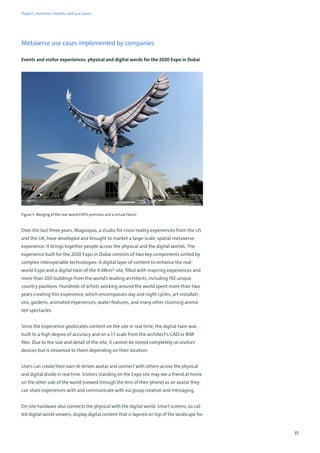
Figure 5: Merging of the real-world EXPO premises and a virtual falcon
Over the last three years, Magnopus, a studio for cross-reality experiences from the US
and the UK, have developed and brought to market a large-scale, spatial metaverse
experience. It brings together people across the physical and the digital worlds. The
experience built for the 2020 Expo in Dubai consists of two key components united by
complex interoperable technologies: A digital layer of content to enhance the real-
world Expo and a digital twin of the 4.38km²-site, filled with inspiring experiences and
more than 200 buildings from the world’s leading architects, including 192 unique
country pavilions. Hundreds of artists working around the world spent more than two
years creating this experience, which encompasses day and night cycles, art installati-
ons, gardens, animated experiences, water features, and many other stunning anima-
ted spectacles.
Since the experience geolocates content on the site in real time, the digital twin was
built to a high degree of accuracy and on a 1:1 scale from the architect’s CAD or BIM
files. Due to the size and detail of the site, it cannot be stored completely on visitors'
devices but is streamed to them depending on their location.
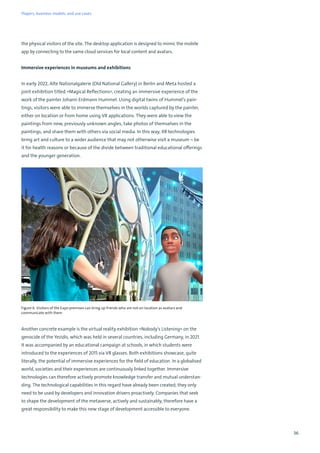
Users can create their own AI-driven avatar and connect with others across the physical
and digital divide in real time. Visitors standing on the Expo site may see a friend at home
on the other side of the world (viewed through the lens of their phone) as an avatar they
can share experiences with and communicate with via group creation and messaging.
On-site hardware also connects the physical with the digital world. Smart screens, so-cal-
led digital world viewers, display digital content that is layered on top of the landscape for
Players, business models, and use cases
36
the physical visitors of the site. The desktop application is designed to mimic the mobile
app by connecting to the same cloud services for local content and avatars.
Immersive experiences in museums and exhibitions
In early 2022, Alte Nationalgalerie (Old National Gallery) in Berlin and Meta hosted a
joint exhibition titled »Magical Reflections«, creating an immersive experience of the
work of the painter Johann Erdmann Hummel. Using digital twins of Hummel’s pain-
tings, visitors were able to immerse themselves in the worlds captured by the painter,
either on location or from home using VR applications. They were able to view the
paintings from new, previously unknown angles, take photos of themselves in the
paintings, and share them with others via social media. In this way, XR technologies
bring art and culture to a wider audience that may not otherwise visit a museum – be
it for health reasons or because of the divide between traditional educational offerings
and the younger generation.
Figure 6: Visitors of the Expo premises can bring up friends who are not on location as avatars and
communicate with them
Another concrete example is the virtual reality exhibition »Nobody's Listening« on the
genocide of the Yezidis, which was held in several countries, including Germany, in 2021.
It was accompanied by an educational campaign at schools, in which students were
introduced to the experiences of 2015 via VR glasses. Both exhibitions showcase, quite
literally, the potential of immersive experiences for the field of education. In a globalised
world, societies and their experiences are continuously linked together. Immersive
technologies can therefore actively promote knowledge transfer and mutual understan-
ding. The technological capabilities in this regard have already been created; they only
need to be used by developers and innovation drivers proactively. Companies that seek
to shape the development of the metaverse, actively and sustainably, therefore have a
great responsibility to make this new stage of development accessible to everyone.
Players, business models, and use cases
37
Digital concerts in the metaverse
Building a metaverse to reinvent live events with game engine technologies and to use
them for live events in sports and music – that is the goal of a joint project between
the real-time 3D platform Unity and Insomniac Entertainment, the electronic dance
music division of Live Nation. The aim is to create a persistent metaverse world for fans
of electronic music.
Figure 7: A metaverse for electronic music
The goal is to expand the potential audience of Insomniac events to dozens if not hun-
dreds of millions of people from all over the world, who would otherwise have no chance
of attending festivals like the Electric Daisy Carnival (EDC) in Las Vegas. The underlying
technology can be applied to all forms of live entertainment and, for example, be expan-
ded to include existing sports broadcasts with real-time technologies. In the same way,
viewers from all over the world can be given the opportunity to experience Broadway
shows and to be on stage virtually during, for example, a showing of Hamilton.
Hybrid sporting events and activities, major events
Here, one the one hand, tickets to events could be tokenised as NFTs to control their
dissemination and to use the ticket as a hybrid access key to the metaverse. This would
also make possible to fend off ticket bots. On the other hand, athletes could visualise
and collect their own performance at sporting events in the form of NFTs and make
them public in a portfolio. This enables people to make their passion visible in the
metaverse and event organisers can reach out to and interact with their community.
The added value of such a solution is a verifiable display of achievements, tighter
Players, business models, and use cases
38
controls on ticket sales, and a seamless hybrid event experience. It thus offers great
potential for sports events, music festivals, trade fairs, corporations, and clubs with
their own community.
Sports clubs, for example, could give out discounts to their fans based on digital
interactions. In collaboration with white label technology providers, such as Kollektor.
io, they could also integrate digital assets into their own user experiences in the meta-
verse. This can turn fans into brand ambassadors, creating a pecuniary benefit for
them with their favourite club without leaving the club's digital ecosystem. One
example from the music industry is the American music festival Coachella. They issued
10 limited VIP passes, which included, among other things, life-long free VIP tickets to
the festival for two and free access to every future virtual Coachella event. Access
authorisation depends solely on the ownership of the NFT, which can also be sold. The
real world is thus linked to NFTs and creates follow-up experiences in the metaverse.
Gaming
The relevance of NFTs for the metaverse can be highlighted using two examples for
play-to-earn gaming. In Sunflower Farmers, a play-to-earn game in the metaverse, the
farm is an NFT as well as the user’s own ecosystem. It is visible on OpenSea and can be
exchanged or sold there. This ecosystem contains values in the form of farmable plants
(and animals), which can be grown and resold. The user’s farm, in turn, generates its
own NFTs, which can accelerate the growth of plants, for example. The harvest can
either be converted back into new seeds, using the ecosystem’s own currency called
SFF (Sunflowers Farm token). Or the harvest can be converted back into fiat money, like
dollars, at the integrated bank. To prevent farming by automated bots, which has led
to massive problems and even the disruption of the game in the past, the community
has generated creative ideas – which were, in turn, implemented by the game’s develo-
pers. From time to time, the game randomly generates a goblin, who appears at
different locations on the farm and steals the player’s shovel needed for harvesting.
This must then be found and retrieved to the farmland. Players can also view each
other's farms and donate to the SFL developer community.
A second example with more complex game principles is Defi Kingdom (DFK), which is
more like a crypto finance game than a classic city-building game. In this ecosystem,
heroes are upgradeable NFTs with various attributes such as strength, endurance,
intelligence, etc. Heroes can be sent on quests to improve their attributes and collect
valuable items, including for preparing magic potions. Heroes can also be sold or
borrowed by other players. By combining NFTs in this way, new heroes are created. In
the current beta version, heroes can also enter combat and fight each other.
These two examples are intended to show the creative possibilities with functional
NFTs (and are no way to be seen as financial advice). Both games are still at the begin-
ning, as their roadmaps show. However, they give us an idea of where metaverse
ecosystems could be or are already heading. Examples such as Minecraft or The Sand-
box (acquiring land with integrated events) have already been mentioned in this
publication several times.
Players, business models, and use cases
39
Configuration and sales in virtual worlds
The metaverse of the future will certainly have an impact on how we acquire things –
both in our private and our professional lives. The technological progress in virtual and
augmented reality is currently so far advanced that it is easily possible to view objects
of any kind as full-size 3D models – before one decides whether to buy them. In times
when mass customisation and made-to-order are more standard than the exception,
such possibilities are of enormous advantage for both producers and consumers.
The Future Labs of CAS Software AG have already carried out initial research in this
direction in the area of B2B sales and developed prototypes. While in the classic scena-
rio, the customer sits in front of a screen, either alone or together with a sales repre-
sentative, and puts together a product using various buttons in the configurator, the
whole thing becomes much more interesting, intuitive and customer-focused using VR
glasses. The prototype consists of a brightly lit sales area, where 3D objects can be
loaded as a whole or in individual parts. The customer and the sales representative
meet in this virtual room and can talk about the options and equipment of the item of
sale as if they were on site together – with the advantage that, in the virtual world, the
object (see Figure 8) can also be changed in real time. Initial tests have shown that the
adjustments that can be made directly to the property provide customers with an
added value in sales situations regarding their decision to buy. In the long term, more
and more products with complex configuration and equipment options will move into
the virtual, three-dimensional world and thus into the metaverse. The experiences
buyers can make there will not be comparable with today’s.
Figure 8: Configuring a car in a VR environment
Players, business models, and use cases
40
Figure 9: Holodeck by Audi, realised by Lightshape
Direct-to-Consumer-Vermarktung von digitalen Assets
BMW Group, which operates 31 factories worldwide, is working together with NVIDIA
to create digital twins to simulate manufacturing and thus optimise processes. The
factories offer more than 100 options for every vehicle and every one of the 40 BMW
models, resulting in 2,100 possible configurations for a new car. Around 99 percent of
the vehicles produced in BMW factories are custom-made, which poses a challenge for
the supply of materials on the assembly line.
To maintain the material flow in its factories, BMW Group uses the NVIDIA Isaac
robotics platform to deploy a fleet of robots for logistics and to improve material
distribution in the manufacturing environment. These human-assisted robots, which
are used in pre-production in simulation scenarios involving digital humans, enable the
company to safely test robot applications on the digital twin factory floor before they
are incorporated into manufacturing.
Virtual simulations also enable the company to optimise the assembly line as well as
the ergonomics and safety of employees. Planning experts from different regions can
come together virtually in the NVIDIA Omniverse, enabling global 3D design teams to
work together in a joint virtual space, using several different software suites.
Players, business models, and use cases
41
Direct-to-consumer marketing of digital assets
Whether it's a YouTube channel or Instagram profile: Creators are making their own
communities on social media. There, they can sell digital goods (from cooking recipes
to digital images or self-composed songs) directly to their followers. Tokenised goods
supplement or replace tips and subscriptions. The added value lies in an immediate
satisfaction of the needs on both sides. For creators, existing assets are transformed
into valuable commodities. Fans are able to secure an original from their favourite crea-
tors and – in contrast to subscribers and streamers – own the original.
One example is the artist, Verena Kandler. She offers her art both purely physically and
purely digitally as NFTs and as hybrid NFTs, which makes owners eligible to purchase a
limited-edition art print. The NFTs can be integrated into metaverse worlds and be
displayed there, for example, in a gallery or in your own office. Artists can thus create a
closer bond with their fans, while content creators can increase their international
visibility, helped along by the diverse opportunities for interaction created by the NFT.
Merging real products and virtual objects via NFTs
On 16 December 2021, the German sports manufacturer Adidas announced its first
web3 activity: »Into the Metaverse«, a NFT project. Another motivation for this project
was to change as well as act quickly as a company, making sure that it can continue to
appeal to future (new) generations. It was thought to let in the new and act with
rebellious optimism.
The sale of 30,000 NFTs at a price of 0.2 Ethereum (ETH) each resulted in revenues of
23 million dollars in just a few hours. In addition to sales, however, the positive effect
on the company’s reputation in the web3 scene also played an important role in rea-
ching a new – and primarily young – generation. As of 8 May 2022, the »Into the Meta-
verse NFT« of Adidas Originals ranked on 40th place of the world’s best-selling NFT pro-
jects. Additionally, the NFT’s value had increased from 0.2 ETH to 1.68 ETH. Adidas also
receives a pro rata compensation of four percent per NFT trade on the secondary
market OpenSea.
But what is the connection between selling the NFT and the metaverse? With the
purchase of a (phase 1) NFT, each buyer is entitled to three physical products, provided
that the NFT is upgraded to phase 2: a black hoodie, an orange beanie (cap), and a
neon-coloured tracksuit. Furthermore, these real-life products can be worn in digital
form on avatars as virtual garments on The Sandbox platform. It is also quite possible
that the virtual country in The Sandbox (also known as ADiverse among experts) will
only be accessible to owners of the Adidas NFT.
In the months since its launch, Adidas has shown that established, traditional compa-
nies can operate successfully in the web3. Based on this example, it can be stated that
a well-planned metaverse strategy:
Players, business models, and use cases
42
■ can build a remarkable community, particularly with the help of established collabo-
ration partners,
■ appeals to different generations and bind them more closely to a company if it was
successful,
■ appeals to users on a physical as well as digital layer and, above all, offer them
added value in both the real as well as the digital world, and
■ generates significant revenue in addition to brand positioning.
It might seem strange to some to spend, at one point, 4,077 euros for three – cynically
speaking – fairly basic products. However, it should be noted that value is always
based on supply and demand. Just as with limited-edition vehicles, designer handbags,
or luxury watches, the value of the Adidas NFT is to own a limited, unique product that
can also be regarded as a status symbol.
Luxury virtual watches in the metaverse
Axonic GmbH's »Metawatches« project shows that not only large corporations, but
also medium-sized German companies can operate in the metaverse. With »Metawat-
ches,« Axonic is building a global luxury watch brand – which initially exists only
virtually. Axonic launched its first watch collection in 2021. The first 1,200 NFT watches
sold within 35 minutes with sales of almost 300,000 euros. Many well-known NFT
collectors already own Metawatches. NFT watches have fetched sums of up to 5,000
euros. But what makes these watches so special? On the one hand, the watches – like
every NFT – are truly unique. On the other hand, they can be used across platforms: on
a smartphone, smartwatch, in a Zoom meeting, or simply in a web browser. Alternati-
vely, you can equip your avatar with the watch in the metaverse (for example, in The
Sandbox or Decentraland) in the future.
The next stage of development would be to no longer have to carry watches on one’s
wrist, as they could be switched on and off in real time. For this to be possible, VR and
AR technology must be established on the market (for example, through mass-produ-
ced VR/AR glasses). While this sounds futuristic, it is being tested today.
In recent months, many luxury brands (such as Gucci or Prada) have been seeking
access to the metaverse. This is currently being done in two ways: Firstly, by putting
out NFTs and, secondly, by building virtual shops/locations in the metaverse. In an era
of remote working environments, luxury brands for fashion and everyday objects will
possibly become integral parts of the metaverse of the future. Much like the physical
world, these objects help to express oneself in the virtual world.
Players, business models, and use cases
43
Digital certificates of authenticity and product-related services
The aim of digital certificates of authenticity is to digitally prove the authenticity and
ownership of an object. In addition, it facilitates using digital and hybrid services. This
creates added value for manufacturers, buyers, and the second-hand market. To achie-
ve this, the manufacturer issues an NFT associated with the object. This replaces a
paper certificate. When reselling, the seller also transfers the NFT. The NFT also serves
as a ticket for additional digital and hybrid offerings, which can be implemented in
both Web 2.0 and web3. It is also the ID of a user's profile that allows a digital version
of the brand product to be used and presented publicly in the metaverse.
The added value of digital certificates of authenticity is digital protection against
forgery and the link to virtual representation of the object. Other advantages are data
protection (decentral access control) and easy transferability. It also makes it possible
to build new service-oriented business models and a community around the brand.
Finally, it creates exclusivity and opens up new sales channels. Digital certificates of
authenticity offer special potential for luxury goods, design manufacturers, manufac-
turers, and high-quality brands.
Digital certificates of authenticity via NFTs have already been implemented by some
manufacturers and brands. For example, Bacardi had its tequila brand Patrón burn a
Chairman's Reserve limited to 150 bottles in 2021, the authenticity of which was ensu-
red by the respective NFT. Breitling watches are another example, where the warranty
for the watch was linked to an NFT. The NFT also included the serial number of the
watch. The French winery Château Darius also uses digital certificates of authenticity.
It sells its vintage wines with NFTs that are linked to a crypto tag on the bottle. They
entitle the bottle to be properly stored at the winery. Brands like Tommy Hilfiger and
Hogan sold their clothes at Fashion Week in the metaverse in March 2022. Buyers
received NFTs that visualise the digital garments and entitles them to have the real
garments be sent to their homes.
Players, business models, and use cases
44
Sustainability in building, district, and urban planning
Climate change is a global threat, and developers, planners, engineers, and architects can
play a decisive role in combating it. The construction industry is one of the largest consu-
mers of raw materials and natural resources. The World Green Building Council estimates
that it causes 39 percent of global carbon emissions. Furthermore, according to the
United Nations, up to 70 percent of the world's population will live in cities by 2050.
Figure 10: Visualising important information about the infrastructure
The metaverse and immersive 3D visualisations open great opportunities here. Envi-
ronmental aspects can be better taken into account right from the planning stage,
subsequent construction errors can be avoided, and feedback from citizens can also be
obtained and incorporated more easily. There are further advantages when operating
buildings, districts, and cities. The use of a digital twin enables city planners, engineers,
city management, and other stakeholders to use and share important information
about the infrastructure in order to feel the »digital pulse of the city.« These data can
be used to control, simulate, optimise, predict, and support intelligent data-driven
decisions. One example of this is Sitowise, a built environment expert from Finland,
which uses a digital twin solution with a 3D interface that offers visualisation, data
management, and collaboration.
Players, business models, and use cases
45
Collecting donations and achieving sustainability goals
With charity NFTs, charitable organizations can tap into the passion for collecting among
their donors. Percentages on resales, for example, can generate additional income for
the organisation. NFTs can be purchased for certified contributions to the United Nations
Sustainability Goals, for example. This creates international visibility for non-profit
organisations, NGOs, political organizations, and social institutions. It also improves the
interaction and involvement of supporters and makes the use of funding verifiable.
One example of this is the digital assets from Kollektor.io, which are very successfully
sold to supporters for donations or programme activities on behalf of NGOs. By collec-
ting, donors support a cause that is important to them; by interacting with the NFT,
they become an international voice for their NGO in the metaverse. Companies can
collect points for supporting projects that are proven to drive the Sustainable Develop-
ment Goals (SDGs) forward.
Players, business models, and use cases
46
Law and taxes in the metaverse
4
4.1 Selected legal issues
The metaverse will change our lives in many ways. This raises several legal challenges,
which – like the metaverse itself – are extremely complex. In general, it can be said that
most of legal challenges accompanying the introduction of Web 2.0 (for example, data
protection problems or the question of how to master the balancing act between
personal rights and the freedom of expression on the internet) will continue to be
present in the metaverse. Moreover, new and yet unprobed legal questions will arise –
including trading virtual property in the form of NFTs.
The following presents a current selection of what are likely to be the most relevant
legal issues.
Subject matter 1: Which law applies in a globally interconnected
virtual world?
One thing must be said beforehand: Like the internet, the metaverse is not a legal
vacuum. Therefore, it must be clarified and – as far as possible – regulated by contract
which law applies in a realm that is accessible to all nations and operated compatibly
by multiple platforms.
a) Considering mandatory rules of law
First of all, one must consider all mandatory laws which prohibit the applicants of that
law to act outside of its jurisdiction, but rather determine their specific scope of action
in a binding manner. This applies, in particular, to public law and criminal law.
Article 3 of the European General Data Protection Regulation (GDPR) specifies, for
example, to which data processors the GDPR applies. Contractual deviations from this,
for example, in individual user agreements on the platform, are not permitted. The
GDPR is therefore a mandatory law within its defined scope of action. For data proces-
sors based within the EU (their applicability of the GDPR is generated through the
principle of establishment), this is neither surprising nor a novelty: They have been
adapting to the requirements of the GDPR since at least 2018. For data processors
based outside the EU, however, the applicability often comes as a surprise, as they are
generally not subject to European law. However, since the GDPR also regulates the
so-called marketplace principle in addition to the establishment principle, the GDPR
may also be applicable in the metaverse if services are provided from abroad but to EU
Law and taxes in the metaverse
47
citizens. In this case, the service provider located outside the EU must appoint a union
representative within the EU who, for example, receives inquiries from affected users
or complaints from supervisory authorities. Since the metaverse will also be aimed at
EU citizens, compliance with the GDPR is an essential element that both platform
operators and the companies processing data within the metaverse must adhere to.
b) Making use of options for customisation and choice of law
Even if a law is mandatorily applicable, certain options for customisation remain within
its legal framework, which can be used to best adapt these laws to the specificities of its
operational sphere – in this case, to the specifics of the metaverse. Even if, the applicabi-
lity of the GDPR cannot be abstained from, numerous practical options for customisati-
on exist, catering to the implementation of individual duties (for example, which provisi-
ons are included in commission processing contracts or joint accountability contracts or
how the individual user's rights and information disclosures are implemented).
In civil law, under the so-called Rome I Regulation, it is even possible to discern agree-
ments in international contractual relationships concerning the applicable legal frame-
work, i.e., to specify by contract which national law is to apply to contractual rights and
obligations. However, there are again mandatory rules to be considered, such as the
primacy of federal consumer protection law.
c) Creating a separate metaverse law
Within the customisation potential of the applicable law (i.e., within the limits of the
mandatory legal framework), it is also possible to create a specific law for the metaver-
se to which the individual platforms of the metaverse can submit and to which the
users and companies within the metaverse must agree to upon registration. The aim
here, however, is not to abstain from state law. In contrast, the metaverse law is
intended to create a legal system that can consider the special features of the metaver-
se most effectively, whilst making more concrete or supplementing state law. For
example, violations of behavioural conduct in the metaverse could be punished with
metaverse-specific sanctions such as the temporary blocking of the user – however –
state criminal law is not to be replaced by this but rather supplemented.
Such a metaverse law would contain vertical regulations, i.e., govern the rights and
obligations of individual users in relation to the platform and vice versa. The contents
of such vertical regulations could be, for example:
■ Users against the platform:
■ Protecting duties of the platform in favour of the users (such as ensuring a high
level of data protection, implementing IT security regulations, protecting busi-
ness secrets, securing freedom of expression, ensuring the users' right to legal
protection against decisions of the platform, etc.)
Law and taxes in the metaverse
48
■ Liability of the platform to pay compensations to its users in the event of brea-
ches of conduct
■ Platform against users:
■ Behavioural obligations and prohibitions for users of the metaverse
■ Possibilities of sanctions for users in the event of breaching conduct
■ Legal appeals and procedures:
■ Basic principles of procedural law for decisions by the platform (for example,
regulation of responsibilities, the make-up of decision-making bodies, operatio-
nal decision-making processes, mandatory hearing of the affected user, etc.)
■ Legal appeals for users against decisions of the platform, arbitration, out-of-
court dispute resolution procedures, self-regulatory mechanisms
Furthermore, such a legal system for the metaverse could also include horizontal
regulations that apply to the relationship between the users themselves such as:
■ Regulations on the choice of law according to the Rome I Regulation for contracts
between the users
■ Regulation of a metaverse-specific law of sale for trade in virtual goods as a deviati-
on from the statutory law of sale and commercial law
■ Introduction of a separate warranty and damage compensation law
■ Creation of arbitration courts for the resolution of civil disputes (users would thus
have the choice of having disputes resolved either in front of the metaverse arbitra-
tion courts or in front of the state courts)
■ Appeals against decisions of the arbitration tribunals
Since interoperability is one of the essential features of the metaverse, the metaverse
law itself should also be interoperable, i.e., supported by a variety of platforms (at best,
by all of them), therefore creating a uniform legal framework for the metaverse.
Law and taxes in the metaverse
49
Subject matter 2: Rights to virtual goods/NFTs
Another essential feature of the metaverse is the possibility of owning virtual items in
the form of so-called non-fungible tokens (NFTs). This is also the biggest difference to
previous virtual 3D worlds, in which in-game items could also be purchased in some
cases (renting virtual land was also possible in Second Life, for example), but these
in-game items were nothing more than debt claims against the respective platform
and therefore ultimately dependent on the fate of the individual platform. In addition,
these in-game items could only exist and be used within that specific virtual world, so
they were not interoperable and could only be traded to a limited extent.
NFTs are a small revolution in this case. For the first time, virtual items can be tokeni-
sed and assigned to a specific person (or their wallet) independently of the individual
virtual world from which they originate – at least if one assumes that the metaverse
will be based on a public blockchain. This not only ensures that NFTs are independent
of the individual platforms but also that they can be taken to different virtual worlds
(as far as those worlds support the respective token standard) and are therefore inter-
operable. This would allow virtual assets to be traded outside of the virtual worlds (for
example, on secondary markets) or to be transferred directly from wallet to wallet.
a) Quasi-property protection of NFTs
From a legal point of view, NFTs are special because their tokenisation allows virtual
assets to be assigned to a specific person which excludes all other people from using
them. The issuer of the NFT itself is often simultaneously deprived of access rights to
the respective NFT once it has been put on the market. Virtual assets represented by
means of NFTs are thus more than mere claims under the law of conduct against the
issuer or the platform but comparable to absolute rights which only the respective
owner can dispose of. This is at the very least close to the concept of ownership.
Indeed, NFTs are still not subject to ownership in the legal sense. Under German law,
ownership can only exist in things (governed by Article 903 of the German Civil Code),
and things are, in turn, only physical objects (governed by Article 90 of the German Civil
Code. Physicality in this sense, however, presupposes that an object is palpable and
sensually perceptible, which is precisely not the case with NFTs. For this reason, NFTs
can certainly embody assets protected by ownership law, for example, when physical
objects of the real world (paintings, vintage cars, raw materials) are tokenised (NFTs are
not limited to virtual assets). However, NFTs themselves do not currently represent
ownership in the legal sense. That NFTs might eventually be equated as subject to
ownership in the future is far from impossible. As paragraph 2, subparagraph 3 of the
German Electronic Securities Act (eWPG), already implies: »An electronic security is
deemed to be a thing within the meaning of Article 90 of the German Civil Code.«
It is nevertheless conceivable that the property law provisions of the German Civil Code
are already applied to most NFTs today in this way – this is referred to as an analogous
implementation. This would have the advantage that, for example, the statutory
Law and taxes in the metaverse
50
regulations on tort compensation claims, surrender claims, or injunctive relief and
removal claims would also apply to NFTs (for example, if virtual land is no longer surren-
dered by the tenant after a lease or if NFTs are stolen from wallets). An analogous/
physical application of law becomes possible when a legal requirement is not directly
applicable to a matter but fits in terms of its content (a comparable position of interest)
and when the legislator could not yet take the factual circumstance into account at the
time of the creation of the law (»unplanned regulatory gap«). All this becomes conceiva-
ble in the case of NFTs, as the above-mentioned essential features of NFTs, the possibili-
ty of assigning an NFT to a certain person (or to his or her wallet) to the exclusion of all
other uses, etc., are precisely also the defining elements in the legislation of the owner-
ship of things. At the time of the creation of Article 903 of the German Civil Code the
legislator could not yet have considered NFTs for obvious reasons.
b) Distinction between rights to the NFT and rights to the content
Technically, NFTs are a new, digital method of embodying content. NFTs are content-
neutral, i.e., they can represent any assets, or they can be an empty shell consisting
only of an ID with no other content.
NFTs are thus the digital equivalent of a sheet of paper (or a book, or a canvas, etc.):
This can either be blank (and thus content-neutral) or contain an image (protected by
copyrights) or a company logo (protected by trademark rights) or personal data (pro-
tected by data protection regulation) or trade secrets (protected by the Trade Secrets
Act). The possibility of ownership of the sheet of paper must not be confused with
ownership of the rights to the contents contained on the sheet of paper (these belong
to the author or creator, trademark owner, the person affected by data protection
rights, or owner of secrets). The ownership of the embodied object and the rights to
the embodied content may be – but do not have to be – coextensive and therefore
belong either to the same person or to different people. Similarly, the transfer of
ownership of the sheet of paper and the granting of rights to use the content are two
separate transactions in legal terms but may coincide in practical terms.
In the case of NFTs, ownership of the NFT does not say anything about ownership of
the rights to the content embodied by the NFT. NFTs themselves are not copyrighted
(according to current legal regulations) but may represent copyrighted works. Thus,
which copyrights the buyer of a particular NFT obtains is determined solely by the
licensing terms agreed upon by the seller and the buyer of the NFT.
Law and taxes in the metaverse
51
c) The necessity of transparent licensing regulations
The fact that the mere sale of an NFT does not indicate which rights of use under
copyright law are to be granted to the buyer of the original results in the need for
transparent licensing regulations. Buyers of NFTs should be able to distinguish imme-
diately what rights of use are associated with the purchase of an NFT artwork, for
example, and what they are allowed to do with the NFT (such as exhibit it publicly in
the metaverse and/or in the physical world).
Unfortunately, this is not common practice yet. Today, NFTs are often sold without spe-
cifying the transfer of copyright that accompanies the sale. Buyers of NFTs therefore
often wonder what rights they have simultaneously purchased. Established standard
licenses, such as those that have existed for years for ordinary forms of copyright use,
for example, with the Creative Commons licenses, are still lacking. The only alternative
then is to have recourse to legally regulated rights of use.
d) The observation of regulatory requirements
The initial issuing or sale (emission) and other activities in connection with NFTs and
other tokens may give rise to supervisory responsibilities. Depending on the legal
structure of the tokens, various permission or prospectus obligations may result from
regulatory and capital market law.
I.) Permit obligations (»BaFin license«)
Certain activities involving financial instruments are subject to permits. It follows from
this activity-based approach that activities relevant to the financial law may exist in
connection with tokens. For this, however, the tokens must qualify as financial instru-
ments. An expansion of the legal catalogue of financial instruments now includes the
term crypto assets. Financial instruments in the form of crypto assets refer to all digital
representations of a value that has not been issued or guaranteed by any central bank
or public body, does not have the legal status of currency or money, and can be trans-
ferred, stored, and traded electronically.
Additionally, the value must be accepted by natural or legal persons as a means of
exchange or payment based on an agreement or actual practice or serve investment
purposes.
When classifying tokens, the criterion of serving investment purposes is particularly
relevant. Experience has shown that BaFin interprets this criterion very broadly and
that it is often sufficient that a higher-priced repurchase is intended and appears
possible. However, the qualification of NFTs as crypto assets often fails due to the
notion of tradability (as opposed to mere transferability) if the NFTs are indeed unique
(However, beware of any workaround solutions!).
Law and taxes in the metaverse
52
If NFTs or other tokens fall under the definition of crypto assets, numerous grounds for
justification come into consideration. Proprietary trading subject to authorisation
exists, for example, in the case of a continuous purchase and sale of crypto assets at
prices set by the company itself for its account and using its own capital. However, the
issuance of own crypto assets, for which the issuer does not require the cooperation of
third parties, is generally not subject to licensing. In contrast, the operation of a plat-
form through which users trade cryptocurrencies independently usually requires at
least an investment brokerage license.
Investment brokering covers the brokering of declarations aimed at the purchase and
sale of crypto assets. The operation of an IT infrastructure may already suffice for this
purpose.
The metaverse will require crypto custodians, whose activities require a permit. Crypto
custody is provided by anyone who holds, manages, or secures crypto assets or private
cryptographic keys used to hold, store, or transfer crypto assets for others. Custody in
this context means the service of custody of crypto values for third parties. Adminis-
trating means the ongoing management of rights arising from the crypto value.
Securing primarily includes the digital storage of private keys provided as a service.
However, the storage of physical data carriers on which private keys are stored or
deposited also constitutes a security. It is important to note that a service must expli-
citly offer the storage of private keys to provide crypto storage. Providers of mere
storage space are not considered crypto custodians as soon as a user stores his or her
private keys with the provider. In particular, providers of software wallets or other
service providers that store and manage third-party crypto assets for the holders will
generally be subject to the permit requirement if they are able to access the tokens.
II.) Prospectus requirements
More rarely, the issuance of tokens may require the publication of a prospectus or
information sheets. This is the case particularly if the tokens are securities or assets.
Their public offering requires the publication of a securities prospectus or sales pro-
spectus. Whether and to what extent prospectus obligations exist for NFTs is decided
based on the legal form of the token in the individual case.
A token is a security if it has the constituent elements of the concept of security:
transferability, tradability on the financial markets, and the embodiment of rights
similar to securities. As a rule, transferability exists: It is sufficient that the token can be
transferred without changing its legal and technical characteristics. However, the
securities nature of certain NFTs will already fail due to tradability, which requires a
minimum degree of standardisation in addition to an abstract trading possibility.
Consequently, securities must have the same rights and be interchangeable. This is not
the case for unique and non-exchangeable NFTs such as those representing the right
to a specific digital property. Identical NFTs that embody the same rights, on the other
hand, are regularly tradable. This applies, for example, to NFTs that give their holders
access to the same skin (texture for the digital character) – whether the designated
NFT is then still appropriate is, of course, questionable.
Law and taxes in the metaverse
53
Transferable and standardised tradable NFTs then require the embodiment of rights
similar to those of securities to qualify as securities. The holders must be given equity
interests similar to those of shareholders or debt interests comparable to those of a
debt creditor. Thus, a detailed examination of the rights and functions of the token is
necessary. If asset-like or membership-like rights are embodied that are functionally
comparable to traditional securities, they qualify as securities. BaFin mentions, for
example, dividend-like claims or possibilities to influence the company associated with
the issue, where functional comparability can be considered. Furthermore, prospectus
requirements exist if NFTs fulfil the requirements of asset investment. This is conceiva-
ble, for example, in the case of NFTs representing shares in a trust. Such a trust asset
means an asset that is held or managed by the issuer or a third party in its name and for
the account of a third party. It is also possible to have NFTs that represent profit partici-
pation rights or some other investment that grants or promises interest or otherwise an
asset-based cash settlement in exchange for the temporary transfer of money.
III.) E-money
Special attention must be given to tokens that are intended to perform a payment
function. For example, tokens may be used as a means of payment in certain video
games. If such tokens fall under the definition of e-money, there are different permissi-
on requirements. E-money means any electronically stored monetary value in the form
of a claim on the issuer which is emitted against payment of an equivalent amount of
money to carry out payment transactions within the meaning of Article 675f (4) (1) of
the German Civil Code and which is also accepted by users other than the issuer.
IV.) Looking towards the future: MiCA
The Regulation on Markets in Crypto Assets (MiCA) is a regulatory draft that is expec-
ted to come into effect in Europe towards the end of 2022. The objective of this draft is
to harmonise the legal framework for crypto assets in Europe. In addition to creating
legal certainty, it is to ensure consumer and investor protection and strengthen market
integrity, catering to the financial stability of crypto assets. So far, the draft regulation
differentiates between certain types of crypto assets and creates a kind of prospectus
duty for issuers with the obligation of producing a white paper. In addition, there is to
be a conditional authorisation for the emission of crypto assets as well as for certain
crypto asset services.
Law and taxes in the metaverse
54
Subject matter 3: Data protection regulation in a globally intercon-
nected virtual world
Not just since the General Data Protection Regulation (GDPR) came into effect in May
2018, with its high fines of up to 4 percent of the total annual turnover generated
worldwide (or 20 million euros, depending on which of the amounts is higher), data
protection law has become a key compliance requirement for companies. European
supervisory authorities are making extensive use of imposing fines on companies (see,
for example, the ↗ CMS Enforcement Tracker).
Data protection regulation has thus become an everyday companion outside the
metaverse and the internet. However, ensuring a high level of data privacy plays a
particularly important role in the metaverse. Here, data privacy law is not just a com-
pliance requirement, but an important building block for the trust and acceptance of
users, who are expected to shift numerous areas of their own lives into virtual worlds.
In addition to the question which of the world’s existing data privacy laws applies to
the metaverse (see Subject matter 1), the metaverse poses the challenge that some
best practices from the Web 2.0 cannot be adopted on a 1:1 basis but require partial
rethinking. Some of the things that are common practice on two-dimensional websites
today must be rethought and translated into the three-dimensional metaverse.
a) Fulfilment of information obligations in the metaverse
We must begin with the question of how data protection obligations, as mentioned
under Article 13 (14) GDPR, can be fulfilled in the metaverse – the place where everyt-
hing seems possible. In Web 2.0 (which has a track record of sub-par solutions), people
got used to signing off on pages over pages of data privacy statements when registe-
ring on a website. These statements (were to) contain detailed information on the
processing of personal data and its purpose by the controller.
In the metaverse, this ruling will probably no longer be applicable in the form of an
all-encompassing privacy statement. At the time of the user's registration, it is usually
not yet predictable what they will do in the metaverse exactly and which of their
personal data will be processed. After all, this too depends on the exact purposes for
which the user uses the metaverse, for example, which companies he or she interacts
with, which NFTs he or she buys, and which virtual department stores, concerts, spor-
ting events, trade fairs, exhibitions, or libraries he or she visits. The »information on
registration« approach should therefore be replaced with a »notification on event«
approach, in which users are duly informed about the basic data processing procedures
during registration, but this basic information is then supplemented with brief event-
specific information while in use (for example, when the user enters a virtual store, and
the owner of the store wants to evaluate user behaviour). This should be helped along
(as for the NFT standard licenses, see above) by easily and internationally understanda-
ble symbolism.
Law and taxes in the metaverse
55
b) Processing special types of data in the metaverse
In the metaverse and through the peripherals connected to the metaverse (for exam-
ple, VR/AR headsets), it will be possible to process numerous sensitive datasets that
have not yet (in traditional Web 2.0) been the subject of data processing.
On the one hand, this includes data about the user's spatial environment in the physi-
cal world (collected, for example, by 3D cameras or LIDAR sensors built into VR/AR
headsets). On the other hand, it concerns the user's behaviour in the metaverse itself:
When a user enters a virtual department store, for example, numerous data about him
or her can be collected by the department store operator and linked to create a com-
prehensive user profile. This begins by registering the specific store through which the
department store was entered, how long the user stayed there, which products he or
she was interested in (i.e., which product categories, models, colours, price categories,
etc.), and extends to information about how the user's avatar is dressed (does he or she
wear expensive brand-name NFT shoes, for example?). This information can be combi-
ned with information collected outside the virtual department store (for example:
Does the user own land in the virtual world? If so, in which area? How many NFTs does
he or she own?).
These conceivable data processing operations must be steered towards sensible paths
by designing the metaverse accordingly. On the one hand, it should comprehensively
consider the rights of users but not undermine legitimate business models in the
metaverse, on the other. In particular, a privacy-by-design approach plays a role here as
does the basic data protection legal principles of necessity and data minimisation.
Users of the metaverse must not be subjected to constant monitoring pressure but
should feel that they and their data are safe. This is the only way to make sure they can
trust the metaverse and transfer parts of their private lives to the metaverse. This
balancing of interests between the rights of the users in the metaverse and the com-
panies operating (in) the metaverse must be taken into account already during the
development of the metaverse and should begin with the first line of code.
c) International data transfers and contracts between data processors
The processing situations in the metaverse will be multilateral and international. If a user
enters a virtual department store and then a single store within that, it is imaginable that
both the platform and the department store as well as the individual store will process
data about the user or have it processed by third parties (such as advertising agencies).
Hence, the processing constellations within the metaverse will be quite complex.
When classifying these processing constellations under data protection law, it is
important to take into account the technical and structural characteristics of the meta-
verse to ensure a meaningful and effective level of data protection. Otherwise, there is
Law and taxes in the metaverse
56
a risk of slowing down innovation by applying frameworks and best practices designed
for the centralised design forms of the Web 2.0.
Nevertheless, many processing constellations will be similar to those of Web 2.0. This
means that appropriate data protection contracts will have to be signed between
individual participants (for example, order processing contracts, joint controller agree-
ments, as well as standard contractual clauses). To avoid creating unnecessary bureau-
cratic hurdles here (for example, by having to conclude individual contracts between
the parties involved), these multilateral contractual relationships must already be
considered in the underlying infrastructure of the metaverse itself.
While doing so, the issue of international data transfers will prove to be a particular
challenge. There are currently numerous legal uncertainties when personal data are
transferred to countries outside the EU. In 2020, the European Court of Justice ruled that
the privacy shield agreement between the EU and the US was invalid and that data
transfers based on so-called standard contractual clauses required additional safegu-
ards against access to data by foreign intelligence services. It remains to be seen what
will come sooner: a new transfer agreement between the EU and the US (already
announced) or the metaverse as we envision it here (already somewhat real).
4.2 Taxes in the metaverse
So far, neither the German tax legislator nor the German fiscal authorities have com-
mented on taxation issues in the metaverse, which is both good news for tax-permit-
ted arrangements and bad news in terms of legal certainty. As for now, there is only
one ruling made by the Cologne Fiscal Court as well as the Federal Fiscal Court regar-
ding Second Life as the pioneer of the metaverse.
General application of German tax law
The starting point for the following general outline is that all taxpayers who have their
residence (Article 8 Fiscal Code) or »habitual abode« (Article 9 Fiscal Code), manage-
ment (Article 10 Fiscal Code), or registered office (Article 11 Fiscal Code) in Germany, fall
subject to the German income tax law. For individuals or companies who are obliged to
pay taxes in Germany based on the factors mentioned above, the so-called world
income principle applies, according to which income earned worldwide must be taxed
in Germany. In the case of cross-border income, the German tax authorities' right of
taxation is restricted by treaties for the avoidance of double taxation, i.e., treaties
under international law between the taxing jurisdictions involved. For the metaverse,
there is – as yet – no double taxation treaty.
An assessment based on the German Turnover Tax Act is possible if the place of supply
or other service is located in Germany (Article 3 German Turnover Tax Act).
Law and taxes in the metaverse
57
Income tax, trade tax, and corporate tax law
According to the German Income Tax Act, income is only taxable if it falls under one of
the seven types of income (Article 2 (1) German Income Tax Act). At least in terms of
income tax, the case law of the fiscal courts has already shown that it is perfectly
possible, and courts are willing, to apply the current physical tax law standards to
purely digital matters (Federal Fiscal Court 2.2.2022 – IR 22/20; Cologne Fiscal Court
25.11.2021 – 14 K 1178/20, rev. pending – IX R 3/22).
Taxpayers who generate income in the metaverse and wish to comply with tax law
should examine which type of income their profits pertain to:
1. Income from agriculture and forestry
2. Income from a commercial enterprise
3. Income from self-employment
4. Income from employment
5. Income from capital assets
6. Income from renting and leasing
7. Other sources of income
Income exceeding 10,347 euros in the 2022 calendar year (20,694 euros in the case of
joint assessment of spouses/registered civil partners) is subject – except for no 5 – to
the personal, standard tax rate of 14 percent up to 42 percent (Top tax rate: 45 percent
as of 277,826 euros) plus solidarity surcharge and church tax, if applicable.
Based on the tax law currently in force, income under no 2 and no 7, in particular, is like-
ly to be relevant to the metaverse:
a) Income from a commercial enterprise
Income from a commercial enterprise applies when the taxpayer undertakes an inde-
pendent, sustainable activity to make a profit and if this activity constitutes participa-
tion in general economic transactions. In addition, it must not be regarded as practi-
cing agriculture or forestry, freelance work, or as any other self-employed work, and
must exceed the scope of private asset management (Article 15 (2) (1) German Income
Tax Act).
The classification of a commercial enterprise refers to any trade or business, as far as it
is conducted in Germany, making it subject to trade tax (7 percent to over 17 percent,
depending on the municipality in which the trade or business is conducted). If the
taxpayer is a natural person, there is a tax-free allowance of 24,500 euros (Article 11 (1)
(3) (1) German Trade Tax Act) and the possibility of (partially) offsetting the trade tax
against the standard income tax.
Law and taxes in the metaverse
58
b) Other sources of income
Publications made by the tax authorities on the taxation of income from crypto assets
that do not exceed the threshold of commerciality show that broad use can be made of
the application of standard income tax regulations (Article 22 (3) German Inheritance
and Gift Tax) if the taxpayer provides a service. According to the case law of the Fede-
ral Fiscal Court, a service is defined very broadly as »any action, tolerance, or omission
that can be the subject of a paid transaction and triggers a reward«.
Whether and to what extent a private sale transaction also comes into consideration
if, for example, the virtual property is sold within one year of its acquisition depends,
above all, on its qualification as a so-called »other asset«. According to the established
case law of the German Federal Fiscal Court, the term includes not only objects and
rights but also actual conditions and concrete possibilities, i.e., all financial benefits
that the taxpayer incurs as an obtainable cost and that are available for an indepen-
dent valuation. Independent valuation refers to the acquirer of the entire holding who
considers the benefit of having a tangible value for which he or she recognises a
significant consideration in the total price.
For private individuals, the key will likely be whether a substance-generating seconda-
ry market is established, in which income can be earned, and the extent to which the
market is willing to find ways to receive renumeration – for example, in the form of
virtual property.
In addition, the question will arise as to whom the virtual property is to be allocated
for tax purposes (Article 39 Fiscal Code). According to the Federal Fiscal Court
(02.02.2022 – I R 22/20), the principles developed by case law on the allocation to the
owner under civil or economic law (i.e., as a result of actual control, other users besides
the owner him- or herself, can economically exclude his or her influence on the general
economic good) remain relevant even in cases where an asset »exists only digitally«.
c) Income tax implications when using crypto values
Insofar as virtual objects or services are paid for with cryptocurrencies, the previous
decisions in case law (Fiscal Court Cologne 25.11.2021 – 14 K 1178/20, Rev. pending- IX R
3/22; FG Baden-Wuerttemberg 11.6.2021 – 5 K 1996/19; Fiscal Court Berlin-Brandenburg
20.6.2019 – 13 V 13100/19) and fiscal administration (draft of a Federal Fiscal Court
letter on individual questions regarding the income tax treatment of virtual currencies
and tokens 17.6.2021; North Rhine-Westphalia Regional Finance Office 20.4.2018 – brief
information ESt no 4/2018, brief information on the income tax treatment of virtual
currencies [cryptocurrencies]; Ministry of Finance of the Free and Hanseatic City of
Hamburg 11.12.2017 – S 2256 – 2017/003-52) concerning correct taxations (Think: other
income from private sales transactions) imply, that the profit made from the exchange
of crypto-tokens for other crypto tokens (currently also NFTs) and the payment of
goods/services with crypto tokens is subject to income tax at the standard rate.
Law and taxes in the metaverse
59
Nevertheless, there must be proof that less than one year has passed between acquisi-
tion and sale and the sum of all profitable gains throughout that calendar year must
exceed 600 euros (Article 23 (1) (1) (2), Article 22 (2) German Inheritance and Gift Tax
Act).
If several acquisitions and sale transactions were made at different times, the so-called
First In, First Out (FIFO) applies.
d) Corporate income tax
If the taxpayer is economically active within the metaverse in the form of a domestic
corporation and generates profits, the above-mentioned trade tax and corporate
income tax (15 percent, plus solidarity surcharge) must always be considered (Article 1
(1) German Corporate Income Tax Act).
Gift tax
If the subsumption under the seven types of income is not applicable, a receipt or
gratuity could also turn out to be a transaction relevant to gift tax law. In addition to
the tax-exempt amount of 20,000 euros among unrelated third parties (Article 16 (1)
(7) German Inheritance and Gift Tax Act), it should be noted that both the giver and the
benefactor are liable for gift tax (Article 20 (1) (1) German Inheritance and Gift Tax Act).
Turnover tax
a) Relevant regulations of the German turnover tax law
As a rule, entrepreneurial activities within the metaverse are likely to be classified as
miscellaneous services pertaining to Article 3 (9) of the German Turnover Tax Act. It
states that miscellaneous services are all services that are not deliveries. They may also
consist of an omission or the acquiescence of an action or a condition. Since deliveries
refer to the acquisition of the right to dispose of an object or a thing (or such assets
that are at least treated as such), the existence of deliveries in the metaverse can be
mostly ruled out.
The applicability of German turnover tax law then depends on whether the miscella-
neous service is deemed as having been performed in Germany. The place-of-delivery
regulation of Article 3a et seq. of the German Turnover Tax Act must be examined,
whereby, in principle, an entrepreneur provides the service to an end customer at the
place where he or she operates his or her business (Article 3a (1) of the German Turn-
over Tax Act). If the service is performed to another entrepreneur, the country of
residence of the recipient is decisive – considering certain exceptions (Article 3a (3–8),
Article 3b, Article 3e of the German Turnover Tax Act) (Article 3 (2) of the German
Turnover Tax Act).
Law and taxes in the metaverse
60
However, German turnover tax law also contains many special regulations for deter-
mining the place of business, which could potentially be relevant in the metaverse.
According to Article 3a (5) of the German Turnover Tax Act, for example, the destinati-
on principle applies, i.e., it is the recipient of the service that matters, if the service is
classified as an »other service« provided electronically by an entrepreneur to an end
customer (B2C). This, for the most part, includes the transfer of digital products, the
provision of which requires the internet or an electronic network. However, this rule
cannot be applied if there is human involvement in the service transaction.
Hence, interestingly, the Cologne Fiscal Court (13.8.2019 – 8 K 1565/18) denied such a
miscellaneous service rendered electronically in the case of letting out virtual land in
Second Life since the taxpayer had performed a creative service. He had created a
parcel of land from an unworked virtual land purchased, which was immediately
usable within the online game.
However, the Cologne Fiscal Court invoked another special regulation that could have
significance in the metaverse and assumed the granting, transfer, and exercise of
patents, copyrights, trademark rights, and similar rights. At any rate, in the case of non-
entrepreneurs outside the EU, this leads to the application of the destination principle
(Article 3a (4) of the German Turnover Tax Act).
b) Federal Fiscal Court: No turnover tax in the metaverse?
Recent implications made by the Federal Fiscal Court (18.11.2021 – administrative review
38/19) have raised doubts about the extent to which the principles presented above
will apply to entrepreneurial activities within the metaverse.
In the revision of the ruling of the Fiscal Court in Cologne, the Federal Fiscal Court
decided that letting out virtual land could not be seen as a service under European VAT
law, as – in the case of purely intra-game sales – there was no provision of a consuma-
ble benefit within the meaning of this law. According to the Federal Fiscal Court,
transactions between individuals that are limited to mere participation in the online
computer game and thus shape the gaming experience through interaction with other
game participants do not generally constitute participation in real economic life. By
doing so, the Federal Fiscal Court has opened up a question regarding the demarcation
between real and digital, which could have significant implications for turnover tax-
related rulings as well as the metaverse in general.
However, the conclusion that VAT laws will not apply to the metaverse is likely to be
premature if only because, in that same ruling, the Federal Fiscal Court stated that the
exchange of in-game currency for fiat will in any case involve a service that could be
made subject to VAT law. The in-game currency is a limited license right, the redempti-
on of which in fiat constitutes an act of transfer for renumeration and thus a service
Law and taxes in the metaverse
61
within the meaning of Article 1(1)(1) of the German Turnover Tax Act. Unlike the in-
game letting of virtual land, the transaction of the in-game currency took place on a
real market and was thus not merely within the game.
More in-depth considerations of VAT rulings concerning digital activities therefore
remain indispensable.
Pillar one
In future, tax-related consequences for the metaverse may arise due to the internatio-
nal tax reform initiated by the G20 countries and the OECD within the so-called two-
pillar solution.
The first pillar (Pillar One) provides for a partial redistribution of taxation rights in
deviation from the previous principles of physical presence and is intended to enable
source or market states to participate more strongly in the joint profits of the largest
globally active corporations. The issue of where goods or services were used or consu-
med, based on the residency of their users, will be the crucial one.
Pillar One will apply across industries and technologies, despite originally being limited
to certain digital business models and consumer-facing businesses.
For the time being, only globally active corporations will be subject to the redistributi-
on of taxation right that generate turnover of more than 20 billion euros and whose
pre-tax return on sales exceeds 10 percent. The OECD assumes that only around 100
international corporations meet these criteria and will therefore fall under the scope of
these new rules. Seven years after Pillar One coming into effect, however, the OECD
aims at revising its framework and extending its scope, in particular, by lowering the
turnover threshold to 10 billion euros. Major metaverse players may be affected by this.
Miscellaneous
If the taxpayer earns an income from his or her business on the metaverse, he or she is
required to file an income tax return by the 31 July of the following year in which the
income was earned (if assisted by a tax consultant, this deadline extends to late
February of the year after that).
However, suppose the taxpayer follows a common purpose in unison with several
individuals. In that case, the question within company law arises, whether these partici-
pants wish to establish a corporation of civil law by conclusive action (i.e., not expressly
by means of a written corporation agreement). From a tax perspective, the income is
then not taxable at the civil-law corporation level (except for trade tax) but at the level
of the corporative partners. Under tax procedure law, the submission of a tax return is
required for both the unified and separate assessment of the bases of taxation.
Law and taxes in the metaverse
62
Outlook
In recent years, the European Commission (and the OECD) have increasingly developed
regulations aimed at enforcing general tax fairness. While it may be difficult for many
taxing jurisdictions to agree on uniform taxation, it appears easier to agree on the
exchange of information. Presumably, once the taxing jurisdictions have recognized
the tax relevance of activities in the metaverse, they will agree on the exchange of
information, which can be used to create investigative approaches for tax audits and
extended reporting obligations.
At the time of this publication, it is more than unlikely that the German tax legislator
will enact special taxation provisions for the metaverse. Rather, they will attempt to
subsume the activities under the above-mentioned principles.
Law and taxes in the metaverse
63
The relevance of the metaverse
for society
5
5.1 One metaverse for everyone
As the next chapter in the history of the internet, the metaverse heralds a new way of
experiencing virtual and digitally expanded realities – and thus bears an enormous
potential for changing social interaction as well as many areas of life, including lear-
ning, travelling, and culture. It will not be a virtual parallel world but the next develop-
ment step of the mobile internet, which we are already always connected with – whet-
her we are at home, in the car, or on the train. The metaverse as the next development
step of the internet will interconnect these applications and make them more immersi-
ve, therefore integrating them ever more seamlessly into our everyday life over the
next decade. Screens and smartphones will continue to play a role in this in addition to
new technologies like AR and VR glasses. The point is not that people spend more time
online but to improve the way they use this time. The immersive technologies of the
metaverse, of which AR and VR are current examples, offer many possibilities to make
our society more creative, more inclusive, and even more sustainable, and to open up
economic opportunities for more people.
Opportunities for digital participation
Leaps in innovation on the path to the metaverse not only create new jobs and genera-
te growth but also expand entrepreneurial and social opportunity. Wherever people
network and interact, be it for professional or private reasons, new opportunities for
inclusive products and services arise. They give people who were previously excluded
for a variety of reasons access to social and economic participation, for example, in
education. Augmented reality and especially virtual reality appeal to our senses much
more directly than a mere text. They are also capable of depicting complex issues close
to real life. Realistic simulations will thus be accessible to the broader population. AR
and VR can thus knowledge transfer easier, faster, and more effective. When pupils
read about something, they often want to experience it for themselves. With AR and
VR, they are not limited to written descriptions or illustrations in books; they can
research the topic themselves and understand it better because of it. Imagine, for
example, a geography class that can visit any place in the world. This can enrich one’s
experience beyond mere reading. In addition to schools, these experiences could also
be used in exhibition projects.
Even today, XR technologies can facilitate digital participation in many areas. During
the COVID-19 pandemic, especially during its peak phases, face-to-face interaction and
busy events were hardly possible. However, people who are restricted in their freedom
The relevance of the metaverse for society
64
of social movement for health or physical reasons will rightfully continue to seek
social participation. Here, immersive technologies offer a new type of accessibility.
Shared activities using VR applications, hybrid concerts, or virtual trade fairs and
exhibitions are just a few examples of a wide range of exciting possibilities that are
changing our everyday social lives and that have the potential to tear down the barrier
between distant places, between urban and rural communities, and between reality
and depiction.
Like the internet, the metaverse, too, will not be owned by any one company or indivi-
dual. It is a collaborative project that many companies, developers and organisations
around the world are currently working on. All the stakeholders doing so carry a special
responsibility to develop and implement these novel technologies responsibly. Compa-
nies and developers can only create trust and broad social acceptance if digital innova-
tions are secure, transparent, and inclusive.
Developing hardware, apps, and security standards for the metaverse will require acces-
sible, inclusive, and intersectional thinking. This facilitates taking into account the
individual needs of the users and avoid possible barriers for use and participation right
off the bat. The extraordinary opportunity to design the metaverse as a space for everyo-
ne, which enables participation, creativity and social involvement, should be used.
Participation and accessibility in practice
The metaverse should be open to everyone. In reality, however, it will not be possible
to break down all barriers, for example, in everyday mobility as well as those at or after
work. If immersive technologies are to reach their full potential, they must contribute
to practical accessibility. Their use must facilitate interaction between people with
different abilities, like sight or hearing, mobility, or cognitive capacity. Much like acces-
sibility in the analogue world, responsible social standards are required here so that
everyone can use the metaverse. Dialogue formats and cooperation with civil society
groups help to ensure that technological developments carry responsibility for human
needs in the digital space. Naturally, the development of these solutions, like the
metaverse as a whole, is still ongoing. It is all the more important to get constructive
feedback and exchange knowledge and experience now.
If these innovations are to offer added value to the broadest and most diverse audien-
ce possible, their individual use must also be barrier-free. In the US, the broadly repre-
sented XR Association has developed detailed guidelines on how XR developers can be
considerate of accessibility for people with disabilities, describing best practices and
potential solutions for key disability categories. People with disabilities in their vision,
hearing, mobility, or cognitive abilities are thus included right from the start. In practi-
cal development, too, companies must work hand in hand with VR developers to take
digital accessibility into account. People should be able to interact with the application
and use it the way the developers intended.
The relevance of the metaverse for society
65
For free and self-determined development in an immersive reality, it is important
that people can depict their avatars as they are: unique and diverse. Users should
therefore have a very diverse range of options to change their avatars, be it facial
expressions, individual physical characteristics, or even everyday companions
such as wheelchairs. These concrete and simple cases make clear that »responsi-
ble innovation« must also be the companion of all stages of development and
application.
Building a culture of safety and respect
In addition to technological components, users must be able to identify the
added value of the innovations in their everyday lives. Above all, this entails
secure and transparent applications that consider their needs. Responsible inno-
vation encompasses more than adapting technologies in their development to
the necessary conditions of the present. Evaluating and developing them is an
ongoing task, one that is necessary to face up to current challenges. This includes,
for example, establishing joint feedback forums, in which developers and users
can exchange their experiences to learn from undesirable developments. Issues
like hate speech, cybermobbing, or disinformation have rightly and increasingly
been put in the focus of the public eye in recent years. The immersive merging of
the real and virtual worlds creates new experiences that are particularly new for
young users. Issues of »youth media protection« as well as data protection must
be considered. We now have the opportunity to address the developments from
the outset, allowing users to decide for themselves how they want to configure
their digital sphere according to their own ideas. Companies from the VR and
metaverse industry are doing this, for example, by offering customisable distan-
cing options. Users can make sure that other avatars cannot get too close. Users
can also often specify which interaction options they allow, thus creating indivi-
dual zones of protection. Some will use this option less in their everyday digital
life, but for many, who don’t want regulated social interaction due to, for exam-
ple, negative personal experiences, such functions create noticeable added value.
One thing is clear: The technologies that make the metaverse possible are not –
and should never be – an exclusive project of digital platform companies. Many
users worldwide participate in the opportunities provided to them by immersive
innovations every day. Decentralised developer platforms like Spark AR are alrea-
dy highlighting how important it is to pursue an open, horizontal approach to
innovation today. Instead of having a few technological gatekeepers, such
development platforms for augmented reality are open to anybody who is inte-
rested in participating. The fact that half of Spark AR’s users are female also
underscores very clearly that previous research and development structures have
come to end. In general, it will be crucial that the community is fostered and
recognised by organisation and companies in the metaverse. After all, the com-
munity generates many innovations, gives feedback on products, or creates new
assets. Simply taking community-created assets without giving would quickly
result in the abandonment of metaverses created by businesses, especially if
The relevance of the metaverse for society
66
people’s needs like recognition, reward, or utility are not found there. We recommend
promoting the creativity of the community and involving them in decisions (e.g.,
regarding product development, events, etc.). Moreover, digital platforms facilitate the
development of innovative ideas and applications worldwide and not just in a few
countries with the appropriate research budgets.
A common path to the metaverse
Today’s exponential growth in the use of digital and immersive products and services
will only accelerate in the years to come. On this path, social and economic inclusion
must be safeguarded and brought together to comprehensively assess opportunities
and challenges. For social players, the integration of immersive technologies into our
everyday lives creates a duty to be aware of their economic and social responsibility.
Private companies, in particular, must draw up guidelines that institutionalise a conti-
nuous improvement process for their products and applications. At an early stage, they
must leverage synergies, bring in feedback, and tackle problems to make sure that the
metaverse is a secure and enabling space. Creating the right conditions for this remains
the task of every company co-designing the metaverse. Users, too, must be able to
contribute. All stakeholders, creators, and users bear responsibility for an inclusive and
secure internet of the future. Now is the time to come up with ideas and be vocal
about problems or shortcomings. This is the only way that we can make sure to unle-
ash the full potential of the immersive metaverse and do right by our aspiration to
create a metaverse for everybody. Let’s start now!
5.2 A summary look at the metaverse’s relevance
for society
The coronavirus pandemic has shown that we as a society can shift many areas of our
everyday social lives into the digital space if we want to. This includes working from
home with virtual meetings, to digital distance learning at schools and universities, to
family celebrations in social distancing mode using Zoom and other tools. This rapid
shift into the digital realm has activated a potential for resilience without which the
impact of the pandemic would have been far more devastating. A look at Ukraine also
shows that a good digital infrastructure facilitates many functions of society in a virtual
space, even under the most difficult conditions. While these are examples of extreme
situations, they still serve as proof of the potential of virtual spaces for society.
It is certain that society will change as a result of the metaverse. This claim is suppor-
ted by the fact that the technical possibilities for creating virtual worlds based on the
metaverse model are available, the technology creates a tangible added value, and this
added value in combination with the technology are socially accepted. The success of
Fortnite can be used as an early example of this.
The relevance of the metaverse for society
67
A first essential factor of social change is the change in perception. Regarding the
digital and the metaverse, we can recognise that many people have not only discove-
red the digital/virtual space but recognized it as a space of equal value. As a result,
digital experiences (e.g., esports) are becoming increasingly relevant. In addition to
experiences, our perception of ownership is also changing. While, until now, money
was the only iteration of virtual ownership (after all, money in the bank only exists as
bits and numbers), many are now realising that other forms of virtual ownership are
becoming more relevant (for example, NFTs) and socially accepted and recognised.
This change in perception has already resulted in changes in how we live our lives.
Esports and concerts in Fortnite or Roblox are merely the first examples of a new
lifestyle taking shape. Virtual art is also gaining importance alongside real-life art.
Plausible examples have already been mentioned in this guidebook. Naturally, new
opportunities also create new risks. Internet addiction is a well-known phenomenon
that is being taken seriously. Just as internet addiction exists today, it will be an
important issue for the metaverse to address.
The world of work as part of our lived-in world deserves special consideration. In
addition to the new business models (see above) emerging in the metaverse, we also
see other changes. The pandemic and virtual working were just harbingers of how
digital worlds can change the world of work. Already today, there are companies that
operate all-remotely and no longer use analogue office space.
Metaverse technologies will likely amplify this trend and continue to decentralise our
working environments, at least in professions where this is possible. The result will be
an increasing melding of work and play will all its advantages and disadvantages. This
virtualisation is almost inevitably followed by further globalisation of work across
national borders. The first harbingers of this development were the digital nomads,
who go about their work from anywhere they want. A second harbinger is the afore-
mentioned all-remote company, which no longer has physical headquarters but is
distributed across the globe.
These developments will probably lead to changes in our everyday life and work struc-
tures. Freelance portals such as 99designs underscore that services that are virtualisa-
ble will be virtualised. An optimistic perspective on this development emphasises that
a shift of activities to the virtual space enables more people to participate in a working
life. A more pessimistic perspective highlights the risk of an – already existing – crow-
dworker proletariat, who work under precarious conditions to earn their livelihoods. An
interesting approach is being discussed where services could be offered, paid for, or
exchanged in the form of tokens or NFTs without leaving the metaverse ecosystem,
i.e., without any connection to the traditional »wage systems«. It is also conceivable
that it will become much more attractive, especially for talented people, to invest their
potential and creativity in these new worlds – and not in the traditional industries with
their sometimes inefficient and sluggish business processes or lack of personal
development opportunities.
The relevance of the metaverse for society
68
Many hope that an open metaverse will facilitate barrier-free access to digital worlds.
However, the risk of a new division of society must not be ignored. Any form of techno-
logy-based access to a virtual world is, by definition, a barrier for those who do not
own the appropriate technology or do not wish to participate in this world. This could
lead to the emergence of a new type of class society: people with and without access
to the metaverse. Whether this risk manifests itself depends very much on how great
the barriers to access will be. The positive perspective offered by this article and the
goal of creating access to the metaverse that is as barrier-free as possible give cause for
optimism in this regard.
Despite our enthusiasm for technology, the digital life during the coronavirus pande-
mic has shown how important face-to-face encounters in the real world are. It is also
clear that the technological possibilities of the metaverse do not increase our lifespan.
Already today, we have to split our lifetime between the analogue and the virtual
world. What is now discussed under the attention economy moniker, the competition
for attention, is likely to be exacerbated by the many new opportunities of the meta-
verse. However, it could, at least partially, be remedied, since the metaverse offers a
chance to bring more closely together digital content and real life (via augmented
reality, say). Ideally, competition between products and services in the analogue world
and those in the digital world will improve both. New offerings in the virtual world will
create new opportunities for people’s private and professional lives. The metaverse in
particular offers the opportunity for analogue and virtual offerings to complement
each other even more. Like in the past, we will see that good options remain, and the
bad ones disappear. This rule applies to both the analogue and the digital world and
will also determine the development of the metaverse.
The relevance of the metaverse for society
69
Outlook of the authors:
The metaverse in five and
in ten years
6
The next five years will mean a discovery phase for the
metaverse or metaverses, in which many parallel meta-
verses will emerge. Each one of them will have its own
reason for being there, which might even be long-term.
In ten years, we will probably be able to carry out many
everyday activities, for which we use our smartphone
today, by using smart glasses due to the rapid progress
in VR and AR technologies. This will facilitate a truly
immersive experience and a real breakthrough for the
metaverse or metaverses.
Stephan R. Bauer, Microsoft
The next five years will be all about the metaverse. The use of
augmented reality (AR) and virtual reality (VR) has arrived in
our everyday lives. Digital twins have gained traction across
industries and are finally getting the attention they deserve.
In ten years, there will be a digital twin of every real object,
environment, and even individual. Every creative has an
appropriate tool to achieve this. I am convinced that immersi-
ve technologies such as real-time 3D (RT3D), AR, VR and
augmented reality (XR) can help creative people understand
the world better and innovate in new ways.
Antje Kunze, Unity Technologies
Trying things out, keeping an open mind, experimenting, and gathering experiences – this is
what the metaverse will be about in the next five years. Technologies and insights from
fields as diverse as gaming and finance, visualisation and the industrial sector, AR/VR and
NFT will come together and create something new. The new will take place on different
platforms initially. Very different things will be tried out and established under the metaver-
se umbrella.
Ten years from now, nobody will be using the term metaverse anymore. Let’s be honest:
Who is seriously still surfing the data highway or travelling through cyberspace? These were
once popular terms, too. But: We now use the technology behind these terms and its oppor-
tunities without even thinking about them. Around the clock. The internet as we know it
has revolutionised our everyday private and professional lives. The next stage of the inter-
net, which we now call the metaverse, will do the same.
Sebastian Klöß, Bitkom
Outlook of the authors: The metaverse in five and in ten years
70
The idea of the metaverse will go through an exciting discovery phase over
the next five years. We will see first ideas (in technology but also applicati-
on) come and go. They will be adopted at an early stage, particularly among
the younger generation, and become a natural part of their lives. By doing
so, they will significantly contribute to continuously developing the ideas of
the metaverse.
Ten years from now, we will be in another phase of reorientation in order to
face the challenges of the 2030s, i.e., climate change and many more. As we
progress, we will discover many new and exciting fields of application
around the metaverse through technical innovations. I am very optimistic
that these possibilities will make an important contribution to enabling us
to tackle the challenges of the 2030s.
Kim Lauenroth, FH Dortmund
The metaverse will make possible numerous new business models but also alternative
recreational activities. Software programmers, designers, business owners and VCs will tend
to dominate over a what will likely be a large majority of consumers. To put it positively: We
will continue to have stars and fans (and, unfortunately, trolls, spammers, hackers, and bots).
Expanding the scope of technology and capturing more and new data, such as 3D and move-
ment data, also expand the risk of their unregulated use. This is worrying from a social point
of view. However, there is also the risk of state overregulation.
Incentives to stay in the metaverse longer and longer, for example, through ongoing 'peer
pressure' or the combination of gaming and earning money, could lead to health problems or
even situations threatening one’s social life (e.g., neglecting work or family).
However, the younger generation has a playful approach to digital life and the metaverse
and will learn from one another away from traditional education systems. They will build
independent communities. For them, mixing private life and work in the metaverse is not a
contradiction but a creative incentive. This will be exemplified by the natural ease with which
they use community tools as well as creating and sharing rules and content. Let us protect
and carefully promote these communities - also as a source of future innovation!
We owe to Sir Tim Berners-Lee the widespread use of the internet through the WWW stan-
dard in 1991. In 2018, he presented a »Magna Carta for the Internet« to make the internet a
better place for everyone. Let's hope we will be able to uphold his principles.
Olaf Garves, T-Systems MMS
Outlook of the authors: The metaverse in five and in ten years
71
The next five years will be marked by many successful and failed experiments as
commercial players try to establish themselves as market leaders in the minds of
consumers. Those organisations will have clear advantage that focus on solving
problems for today’s and the next generation of customers, which will surely
create new areas of applications.
In ten years, we will experience increasing consolidation, promoted by the increa-
sing fragmentation and saturation of the markets as well as the automated
generation of data with the help of AI, which can hopefully be used by everyone
across platforms and borders.
Marco Tillmann, NVIDIA
As the next chapter in the history of the internet, the metaverse
heralds a new way of experiencing virtual and digitally expanded
realities – and thus bears an enormous potential for changing
social interaction as well as many areas of life, including learning,
travelling, and culture. If we want to make these opportunities for
digital participation accessible to a broad audience an create an
added value for society, we need a binding commitment of all
players involved. Developing hardware, apps, and security stan-
dards for the metaverse will require accessible, inclusive, and
intersectional thinking. It will therefore be crucial over the next five
to ten years that companies, scientists, creators, and developers
work closely together.
Constanze Osei  Marie von Stauffenberg, Meta
In five years, the metaverse and virtual worlds will have an increasing impact on our daily
interactions and the world of work. Initial applications will start emerging in niches where,
for example, there is a lot of experimentation with blockchain and digital assets. A significant
part of the population will be spending time in the metaverse on a daily basis as proper
hardware makes its way into the mass market in the years to come. This development could
start with augmented reality glasses, which add a virtual layer to our physical world.
In ten years, we will see an increasing convergence of various virtual environments where we
switch seamlessly between, say, a work meeting and a private date using the same or a
different identity. Although we are spending more and more time in virtual worlds, we will
continue to spend most of the day in the real world. Blockchain technology and digital assets
will have a significant impact on how we interact and make transactions in this environment.
Matthias Hirtschulz, d-fine
Outlook of the authors: The metaverse in five and in ten years
72
Over the next five years, we will witness the first exciting use cases in the metaverse
being implemented across a wide range of areas in a B2C and B2B context. More and
more providers will try out new service concepts and business models and make them
available for the end customer to experience. Individual metaverses from different
providers will be linked, spaces will become »experience scapes«, and the connection
with real environments will also progress. This will create new jobs like immersive
experience consultants and designers. Blockchain and crypto experts will consult
institutions on how to establish metaverse infrastructures; creators will provide the
content for the metaverse.
In ten years’ time, the metaverse could have manifested itself as a force to be reckoned
with in our everyday lives. Much like the internet today has done through computers,
smartphones, tablets, smartwatches, and IoT devices. Even the use of brain interfaces is
now possible since companies from the neurotechnology industry, such as Neuralink,
founded by Elon Musk, have made significant advances. Entirely new rules and proto-
cols based on blockchain technology determine the economic processes in the metaver-
se and beyond. They have established their own ethical guidelines. Smart contracts
have increasingly eliminated intermediaries in all conceivable contractual relationships.
A new type of credit point system, based on trust and values, replaces the function and
understanding of the traditional monetary system in the metaverse.
We are in the process of opening up a whole new galaxy that we can all help shape
creatively.
Vanessa Borkmann, Fraunhofer IAO
Outlook of the authors: The metaverse in five and in ten years
73
Authors
7
Hendrik Arendt specialises in tax law at ↗ CMS Hasche Sigle and advises
national and international clients in the digital economy on issues of income
and sales tax law as well as transactions and structuring. He focuses on tax
issues relating to blockchain technology. His experience in this field includes
blockchain-based business models (NFT marketplaces, ICOs, tokenisation of
assets), income tax issues for private crypto investors, and investment funds
with crypto assets. He publishes regularly on tax issues related to the taxati-
on of crypto assets and blockchain-based business models. He is also a
member of the Bitkom working groups »Blockchain« and »Taxes«
Hendrik Arendt
Elmar Arunov is research manager at ↗ Telekom Labs, the RD depart-
ment of Deutsche Telekom AG. Since 2012, he has held several positions
there with a focus on strategy and business development, technology
scouting, and product and programme management. Topics related to
AI, VR/AR, blockchain, and future networks have crossed his path him
again and again. He has taken part in several product developments (for
example, in VR education, VR collaboration, and AR maintenance and
published numerous trend publications, particularly in the VR/AR field.
Elmar Arunov
Stephan R. Bauer
Stephan R. Bauer works at ↗ Microsoft Germany as marke-
ting communications manager in experiential marketing.
Part of his work is to rethink hybrid events, i.e., seamless,
mutual exchanges and the integration of digital and real
participants in equal proportions. In previous positions, he
designed virtual worlds and held events in them. At the same
time, he is studying business consulting  digital manage-
ment and is currently researching the metaverse as part of
his master’s thesis.
Authors
74
Borkmann Vanessa
Dr.-Ing. Vanessa Borkmann is a researcher at ↗ Fraunhofer Institu-
te for Industrial Engineering and a professor of tourism with a
focus on hotel management at the SRH Berlin University of
Applied Sciences. She leads research work in the fields of tourism,
hotel industry, culture, museums, as well as inner city and neig-
hbourhood development. Her focus is on innovation development
and the sensible use of digital tools and technology. As a user
representative and innovation driver for the new building of the
Center for Virtual Engineering ZVE, she developed and piloted the
virtual architecture engineering with a team of experts from 2004
to 2012. She is also co-editor of the book »Center for Virtual Engi-
neering ZVE« and an internationally sought-after keynote speaker.
Daniel Classen is co-founder and CEO of the ↗ Lightshape agency, a
company that has been involved in visualisation and interactive media
since 2007. Topics such as augmented and virtual reality applications as
well as digital showrooms and interactive city guides are part of the
everyday life of the agency. Most of the projects take place in a B2B
environment. Before founding the XR agency Lightshape, Daniel Clas-
sen studied architecture and worked in an agency together with the
other two managing directors.
Daniel Classen
Martin Friedberg specialises in tax law at ↗ CMS Hasche Sigle
and advises medium-sized companies and international
corporations on national and international corporate tax law,
tax compliance issues, and on tax law issues related to the
digital transformation, digital economy, and the use of block-
chain technology. His expertise includes tax structuring of
initial coin offerings (ICOs), non-fungible token platforms (NFT
platforms), investments through the tokenisation of assets,
and income tax issues relating to trading in crypto assets.
Martin Friedberg
Authors
75
Olaf Garves
Olaf Garves is head of the Agile  Cloud Logistic Services department at ↗ T-Sys-
tems MMS. With his diploma thesis titled »About technical images«, he completed
an interdisciplinary education at HbK Braunschweig. He was one of the two foun-
ding members of one of the first online agencies in that region. In addition to
working in university teaching and research, freelance multimedia and computer
animation projects, and performing as a VJ, he started working as a project mana-
ger at MMS in 1996, where he focused on iTV and video telephony, and then
headed a software development unit for web-based solutions. In 2003, he laid the
foundation for a support department that oversees web solutions. Since 2013, he
has been involved with DevOps and has further developed his area in terms of
organisation and processes accordingly. In his free time, he is involved with block-
chain ecosystems and NFT-based games. Fascinated by the innovative power – but
also the contradictions – of the community, he gave a lecture on an up-and-
coming NFT game as part of the second Bitkom roundtable on the metaverse.
Lara-Louissa Genz
Lara-Louissa Genz is an expert in crypto, digital assets and virtual
worlds. She is part of the ↗ Deloitte Blockchain Institute and a foun-
ding member of the Deloitte MetaverseLab. She has many years of
blockchain experience with a focus on tokens, custody solutions, and
business models in the field of digital platforms. What she finds most
exciting are the beginnings of the design of metaverses in which
decentralised infrastructures are an essential building block. Lara-Louis-
sa Genz supports companies across industries in dealing with block-
chain and metaverse issues and regularly appears as a speaker at
professional events.
Konstantin Graf
Konstantin Graf is managing partner of ↗ CHAINSTEP GmbH
and co-founder of ↗ collector.io. After working in manage-
ment and technology consulting with Altran/Capgemini for
12 years, most recently focusing on digital manufacturing
(Industry 4.0), he has been a member of CHAINSTEP manage-
ment since 2019. He advises clients in the area of blockchain-
based services and business models. Since 2022, he has also
been part of the founding team of Kollektor.io with the
mission of making NFT-based digital assets available to all
creators, users and companies as easily as possible.
Authors
76
Dr. Matthias Hirtschulz
Dr. Matthias Hirtschulz is a theoretical physicist and partner at d-fine.
He is in charge of ↗ d-fine's blockchain and digital asset activities and,
in this role, supports blockchain-related projects in various industries –
from conception to implementation. With over 50 blockchain projects,
Dr. Hirtschulz has extensive experience in this sector. Examples include
the implementation of a debt capital markets platform, the safe custo-
dy of digital assets, or the tokenisation of real estate.
Benedikt Holl
Benedikt Holl specialises in IT law at ↗ CMS Hasche Sigle and
provides consulting on innovative business models created by
the rapid digital transformation and the use of new technolo-
gies (smart contracts, AI, cloud, IoT, SaaS, etc.). He mainly deals
with topics related to blockchains/crypto, such as the structu-
ring of token-based business models, decentralised autono-
mous organizations (DAOs), token sales, and decentralised
financial applications (DeFi). His clients include large German
and international companies and start-ups.
Markus Kaulartz specialises in a range of issues
related to blockchain/crypto and classic IT law at
↗ CMS Hasche Sigle. His work focuses on contract
negotiations, designing token-based business
models, decentralized autonomous organizations
(DAOs), token sales, decentralised finance (DeFi),
crypto exchanges (crypto exchanges, DEXs), the
metaverse, and legal reviews of smart contracts
(legal audit). As a former software developer, he
has a profound technical understanding that he
incorporates into his legal advice practice at the
interface of technology and law. He is the editor of
the legal manual »Smart Contracts«.
Markus Kaulartz
Authors
77
Dr. Sebastian Klöß
Dr. Sebastian Klöß is department head for Consumer Technology, AR/VR 
Metaverse at ↗ Bitkom, Germany’s digital industry association. He oversees
the working groups »NewTV« and »Augmented  Virtual Reality« as well as
the »metaverse forum by bitkom«, which pools Bitkom’s expertise on meta-
verse issues. He is also responsible for creating the study »The Future of
Consumer Technology«. Before joining Bitkom, he worked as an editor and
wrote on tech issues. Before that, he was a research associate at the Hum-
boldt-Universität zu Berlin, where he received his doctorate in history.
Antje Kunze is senior client partner at ↗ Unity Technologies and advises
customers from the industrial sector on topics relating to digital twins
and the metaverse. She works on the requirements for building healthy,
liveable, and resilient cities and pushes the digital transformation
forward at an international level. Previously, she was co-founder and
CEO of CloudCities, a 3D web platform for urban planning and design,
Solution Manager for BIM and Smart Cities at Esri Germany, senior direc-
tor for city solutions at Dassault Systèmes, and director of sales and
marketing at Virtual City Systems.
Antje Kunze
Sebastian Kühne is co-founder and responsible for vision and design at
the digital ↗ agency BLANX and the metaverse platform company
↗ RAUM. He has many years of experience in computer graphics, UX/UI
design, extended realities (XR), and in the conception of applications
and marketing tools. At BLANX, he advises and develops with custo-
mers individual digital solutions from communication tools and apps to
VR and AR. At RAUM, his focus is on product development and the
design of their metaverse platform.
Sebastian Kühne
Authors
78
Dr. Kim Lauenroth is a visiting professor for digital design at the
↗ Dortmund University of Applied Sciences and Arts. Until late 2021,
he was chief requirements engineer at adesso SE. He is a volunteer
at IREB e. V., an association promoting education and training in require-
ments engineering and digital design. He is also the chair of the steering
committee on software at Bitkom and is involved in establishing
new job profiles for the digital transformation. Kim Lauenroth studied
computer science, business management, and psychology at Tech-
nical University Dortmund and received his doctorate in requirements
engineering for product lines at the University of Duisburg-Essen.
Dr. Kim Lauenroth
As Head of Society  Innovation Policy at ↗ Meta, Constanze
Osei is responsible for social and innovation policy work for
Germany, Austria, and Switzerland. This includes a dialogue
with policymakers and civil society on new technologies in the
field of AR/VR and AI. She previously worked as head of the
economic and innovation policy department at the digital
industry association Bitkom, the German Bundestag, and at
SAP AG. At Meta, Constanze Osei is also part of the Women@
EMEA Leadership Team. She is involved in various initiatives
against discrimination and racism as well as for inclusion both
inside and outside the company.
Constanze Osei
Dr. Dietmar Laß has been working at ↗ Fraunhofer ICT Group since 2018.
Before, he held management positions in consulting, policymaking, start-
ups, SMEs, and corporations (e.g., Siemens and Deutsche Telekom). At Fraun-
hofer ICT Group, which pools the competencies in research, development,
and application of 21 Fraunhofer Society institutes, he is responsible for
business development and governmental affairs as a research manager. The
group is a contact point for representatives of policymaking, industry, and
funding bodies in all areas of the digital transformation, for example, RD
projects, the preparation of trend and feasibility studies, and the placement
of experts in consortia. For the institutes of the ICT Group, Dietmar Laß
coordinates overarching strategic topics like AI, 5G/6G, and quantum tech-
nologies in the key sectors industry, energy, and smart cities. Since 2022, he
has been in charge of bringing together Fraunhofer’s activities on metaverse
technologies and applications.
Dr. Dietmar Laß
Authors
79
Dr. Francesco Pisani works at the Service Line Strategy and Transaction
department at ↗ EY Parthenon, where he focuses on business model
analysis and innovation, pricing strategies, and digital ecosystems. In
the past he has been involved in several due diligence and strategic pro-
jects. He is deputy EMEIA start-up leader at EY, co-initiator and pro-
gramme manager of the EY Startup Academy, and guest lecturer at
various universities. Francesco holds a PhD from the Frankfurt School of
Finance  Management. In addition, he has an M.Sc. in finance with a
specialisation in capital markets from the Frankfurt School of Finance 
Management, an M.Sc. in economics and business management from
LUISS Guido Carli, and a B.Sc. in business administration from La
Sapienza University in Rome. Francesco Pisani gained further professio-
nal and academic experience in China, England, France, Italy, and Spain.
Dr. Francesco Pisani
Alexander Schmid
Alexander Schmid specialises in IT law at ↗ CMS Hasche Sigle and
advises listed companies, medium-sized companies, and start-ups on
issues related to German and European IT, online, and data privacy law.
He has particular expertise in topics including digital business models,
digital manufacturing (Industry 4.0), and IT outsourcing. For blockchain
technology and web3, he provides cross-industry consulting on topics
such as non-fungible tokens (NFTs), smart contracts, data protection, as
well as contractual and copyright issues.
Tobias Ostertag is Future Labs Scientist at ↗ CAS Software AG in
Karlsruhe. At the Future Devices Lab, he researches everything that
has to do with the devices and technologies of the future. His focus
areas include augmented and virtual reality, digital manufacturing
(Industry 4.0), IoT and IIoT, additive manufacturing as well as the
metaverse and web3. Most projects and prototypes of the Future
Labs are developed and published together with partners from
science and research as part of research projects, academic publica-
tions, or conferences. He also teaches at the computer science and
business information systems faculty of Karlsruhe University of
Applied Sciences.
Tobias Ostertag
Authors
80
Marco Tillmann has been product manager for omniverse and digital twins
at ↗ NVIDIA since May 2022. Previously, he worked as a product manager at
Blackshark.ai, a start-up that creates 3D twins of the world using machine
learning. He has also worked as a product manager at HERE Technologies in
Frankfurt am Main and Maxon Computer GmbH in Friedrichsdorf, as part-
nership manager at Apple Ltd in Uxbridge, England, and as product manager
and artist at Integrated Computing Engines Inc. in Waltham, MA. Prior to
that, he earned a degree in computer art and animation from the Savannah
College of Art and Design in Savannah, GA.
Marco Tillmann
Sebastian Winkler
Sebastian Winkler is managing director of ↗ Mediaan Deutschland GmbH.
Mediaan offers consulting services on business transformation, the develop-
ment of data-driven organisations, and implements technical innovations
for customers. He is member of the board of the Bitkom working group
»Augmented  Virtual Reality« and, as a serial entrepreneur, deals a lot with
topics relating to technology and society.
Marie von Stauffenberg is public policy manager at
↗ Meta, where she deals with public policy issues
with a focus on user safety – particularly for
women and young people – as well as media
competence and innovation issues. In this context,
she oversees partnerships with NGOs and civil
society groups that aim to make technology safe
and inclusive.
Marie von Stauffenberg
Authors
81
Bitkom e.V.
Albrechtstraße 10
10117 Berlin
T 030 27576-0
bitkom@bitkom.org
Bitkom represents more than 2,700 companies from the digital economy, including a good 2,000
direct members. They achieve annual sales of 190 billion euros, including exports of 50 billion euros,
with their IT and telecommunications services alone. The members of Bitkom employ more than
two million people in Germany. Our membership spans more than 1,000 SMEs, over 500 start-ups,
and virtually all global players. Our members offer software, telecommunications, and internet
services, produce hardware and consumer electronics, operate in the digital media sector or are in
other ways affiliated with the digital economy. 80 percent of the companies are headquartered in
Germany, while eight percent come from the rest of Europe or the US, respectively. 4 percent come
from other regions. Bitkom fosters and drives the digital transformation of the German economy
forward and is committed to broad social participation in digital developments. It is our mission to
make Germany a globally leading location for digital business.
bitkom.org

A guidebook to the metaverse (by Bitkom, 2022)

  • 1.
    1 A guidebook tothe metaverse Technological and legal basics, potential for business, relevance to society
  • 2.
    2 Publisher Bitkom e. V. Albrechtstraße10 10117 Berlin Tel.: +49 (0)30 27576-0 bitkom@bitkom.org www.bitkom.org Contact person Dr. Sebastian Klöß T +49 (0)30 27576-210 s.kloess@bitkom.org Responsible Bitkom department AG Metaverse Forum Project head Dr. Sebastian Klöß, Bitkom Translation support The translation of the Bitkom Guide into English was made possible by the kind support of CMS Hasche Sigle Partnerschaft von Rechtsanwälten und Steuerberatern, DB Systel, Fraunhofer-Institut für Arbeitswirtschaft und Arbeitsorganisation (IAO) and Meta. Layout Anna Stolz Cover photo © Julien Tromeur – unsplash.com Copyright Bitkom 2022 This publication contains general and non-binding information. The content of this publication reflects the opinions of Bitkom at the time of the publication. The infor- mation has been compiled applying greatest possible care, but Bitkom does not warrant its factual accuracy, completeness, or currency. In particular, this publication cannot take into account the specific circumstances of individual cases. Using this publication, therefore, ultimately, lies in the responsibility of the reader. Bitkom hereby denies any and all liability. All rights reserved to Bitkom, including partial reproduction.
  • 3.
    3 Table of contents 1 2 3 4 5 6 Whatthen is the metaverse? Six messages for getting started 5 The current state of the metaverse 8 2.1 Why is the metaverse so timely, what has made it possible?8 2.2 What is the metaverse today – and what will it become?9 2.3 The metaverse as the next evolutionary stage of the internet – the web 3(.0)?11 2.4 Which technologies form the basis of the metaverse?12 Players, business models, and use cases 19 3.1 Introduction 19 3.2 Actors in the metaverse 20 3.3 Business models in metaverse23 3.4 Use cases in the metaverse28 Law and taxes in the metaverse 46 4.1 Selected legal issues46 4.2 Taxes in the metaverse56 The relevance of the metaverse for society 63 5.1 One metaverse for everyone63 5.2 A summary look at the metaverse’s relevance for society66 Outlook of the authors: The metaverse in five and ten years 69 Authors 73 7
  • 4.
    4 Figure 1: Componentsof the metaverse: content, hardware, software, services, IT infrastructure, network12 Figure 2: Building blocks of artificial intelligence15 Figure 3: Outline of a digital assets ecosystem21 Figure 4: The metaverse’s areas of application: usage and diffusion pyramid29 Figure 5: Merging of the real-world EXPO premises and a virtual falcon35 Figure 6: Visitors of the Expo premises can bring up friends who are not on location as avatars and communicate with them36 Figure 7: A metaverse for electronic music37 Figure 8: Configuring a car in a VR environment39 Figure 9: Holodeck by Audi, realised by Lightshape40 Figure 10: Visualising important information about the infrastructure44 Table 1: Evolution of the web11 Illustrations and tables
  • 5.
    5 What then isthe metaverse? Six messages for getting started Message 1: The Metaverse is more than just a buzzword The metaverse. There is scarcely a news channel that hasn’t showcased, discussed, and analysed this phenomenon yet. Large companies are committing their strategies to the development of the metaverse, therefore heralding the next stage in the evolution of the internet and the digital world. There is, in the best sense of the word, a palpable pioneering and optimistic spirit. Those who were around at the turn of the millennium like to remind everybody of the hype and the painful bursting of the dotcom bubble. Moreover, the intensity with which the metaverse phenomenon is currently being discussed has many people suspecting the next buzzword hype cycle and turning away, disinterestedly, thinking it will »go away soon«. With this guide, we want to look behind the buzzword, because we are convinced that the metaverse phenomenon is an umbrella term for a range of developments that are already happening today and have a potential for innovation in and around the digital transformation that must be taken seriously. Message 2: The metaverse is only just being created – there cannot (yet) be a clear definition A crucial problem of the metaverse phenomenon is that it lacks a generally agreed- upon definition, something that especially us Germans, a self-proclaimed »nation of poets and thinkers«, like very much because it gives us a sense of safety and stability. However, precise definitions require certain intellectual authorities and a negotiation process. Since, conspicuously, such an authority on the metaverse is not in place and we are in the midst of a negotiation process across various communities, it should come as no surprise that such a definition is not (yet) available. The absence of a definition, however, should not be seen as a weakness. Rather, a look at the various attempts at finding a definition reveals the many facets that the metaverse could have and thus highlights its innovative potential. 1 What then is the metaverse? Six messages for getting started
  • 6.
    6 Message 3: Themetaverse is about virtual worlds A consensus among all the ongoing debates is that the metaverse will be experienced in form of a virtual world. For our purposes, it is irrelevant whether this will be exactly one or several parallel virtual words, as some are discussing. More importantly, we see that the character and self-image of virtual worlds are currently changing. We have known virtual worlds for a long time; computer games are a good example of this. It would be a mistake, however, to dismiss the metaverse as a gaming trend. For younger generations, the virtual worlds of Minecraft, Fortnite, and Roblox have taken on a new layer of meaning. They are not merely entertainment but places of social interaction. People are fixing to meet in Minecraft, in Oberurselcraft, for example, to build a new station in Oberursel. Brushing this and other examples off as childish gimmicks would be a fatal mistake. When talking to teenagers about their buildings in Minecraft, they take pride in their achievements because real work went into those buildings, albeit only virtual. The spirit of creation and ownership among them is palpable. In the metaverse debate, this spirit is described using the term »creator«. Message 4: The metaverse is about (virtual) ownership and trade The notion of copyright leads us to another important aspect. We are currently obser- ving a type of ownership developing in the virtual sphere. This seems to contradict the usual understanding of digitality as a material with the potential for infinite duplicati- on. Indeed, the term »copy and paste« has transcended the language of the digital and has become synonymous with this. However, facilitated by non-fungible tokens (NFTs) based on blockchain technology, there are now countless examples of unique owners being assigned to digital objects. Digital artists, for example, are selling virtual works based on NFTs. This development, too, must be taken seriously. Selling virtual goods such as skins in Fortnite is already an important component of the business model for virtual worlds and is likely to grow more. NFTs will become innovation drivers for an exchange and financial economy in the metaverse. On the one hand, because one of their key features is transparent trackab- ility and high security; on the other, because of their functional development – as described below in the Chapter on use cases. In addition to the aforementioned gaming and arts sector, NFT portals and exchanges like opensea.io or crypto.com/nft will be creating their own trends. However, the blockchain will not contain all the stored data, including images, photos, videos, audio, and text, but only the transactio- nal data as well as »smart contracts« and »ownership certificates«. What then is the metaverse? Six messages for getting started
  • 7.
    7 Message 5: Themetaverse is not a (virtual) parallel world The metaverse will not exist as a virtual parallel world with no connection to the »real« world. Instead, there will be a multitude of connections in both directions. In one direction, real physical objects will be mirrored by virtual equivalents. Think of real shoes or handbags with a virtual equivalent, which can be worn by the user’s avatar in the metaverse. Similarly, digital twins of real facilities and machines in the metaverse are conceivable. In the other direction, augmented reality can be used to blend virtual objects with our real-life environment. This allows interacting with those objects as if they were physically around us. Message 6: The metaverse must be taken seriously; the boundaries of our world are currently expanding. This list of examples could be easily continued. At its heart, the current development is about the boundaries of our world expanding. It is doing so not so much in the sense of what is possible technologically. Many technical aspects mentioned in the metaver- se debate have been known to us, particularly virtual worlds. More importantly, social acceptance must be paired with the widespread availability of technological means. It is very likely that this combination will result in the creation of diverse new business models and new creative solutions in and around virtual worlds. We are firmly convin- ced that we must take these developments seriously and that every company that is somehow linked to digital transformation should take a critical and open-minded look at them to identify and use the potential for their own business. The German industrial sector, in particular, was too late in recognising the potential of the internet. The same mistake should not happen again with the developments surrounding the metaverse. It would be a fundamental mistake to brush off the metaverse and file it away in the »this will go away soon« category. In this sense, we would like this guide to be viewed as an important building block of gathering information on metaverse-related developments. We aim to draw attention to those developments that we deem timely and relevant. First, the current state of the metaverse will be sketched out in Chapter 2. We will highlight the foundations on which it is built, why it is so timely, and which technologies make it possible. In Chapter 3, we will address concrete implementation of the metaverse. We will examine in greater detail the players who it is relevant for, who are already focusing on it, which business models are made possible by the metaverse, and which metaverse use cases exist. Chapter 4 will elaborate on the legal and tax-related dimensions of the metaver- se before, in Chapter 5, we will highlight the social dimension of the metaverse with an emphasis on the societal needs that need to be addressed when establishing it. What then is the metaverse? Six messages for getting started
  • 8.
    8 The current stateof the metaverse 2 2.1 Why is the metaverse so timely, what has made it possible? The term metaverse and the idea of virtual 3D worlds have been around for decades. In the 1990s, when the internet first became accessible to a broader audience, there was frequent mentioning of data highways and cyberspace. The term cyberspace was already evoking images of a virtual 3D space. The term goes back to »Burning Chrome«, a short story by writer William Gibson from the early 1980s. In the story, he talks about virtual 3D worlds. The term metaverse also originated in literature. Here, it was Neal Stephenson and his novel »Snow Crash« that coined the term in 1992. In the following years, however, virtually nobody spoke about the metaverse. The technological means to realise 3D worlds have also been around for a while. We have come a long way from the metaverse’s very early predecessors like Laterna Magica, Morton Leonard Heilig’s Sensorama, or Ivan Sutherland’s Sword of Damocles, to the first headset and cave experiments in the 1990s, and today’s possibilities of augmented and virtual reality. If neither the term metaverse nor the technology for creating virtual worlds is new – why is there suddenly so much talk of the metaverse? And why is the metaverse concept so relevant for the economy and society today? There are currently five factors that have helped the metaverse term and concept to attract so much attention: 1. Market timing: Two years after the coronavirus pandemic and with the increasing extension of the workplace into the cloud, the notion that a workplace does not have to be bound to a certain location has received an extreme boost. This has facilitated the development of moving work into virtual words and thus the meta- verse. 2. Generational readiness: In addition, the way the current and following generations (Z and Alpha) interact has changed profoundly. For them, interacting in the virtual world has been part of their identity for years. They are also part of the so-called creator community. The current state of the metaverse
  • 9.
    9 3. The valueof content has a significance now that it didn’t have, say, during the second- life boom in the 2000s. Billions are now being earned by creating digital assets, be it through virtual clothing, worlds, artworks, or the like. Moreover, users of computer games have become accustomed to spending real money on virtual objects. 4. Technical requirements: Augmented and virtual reality have reached the necessary technological maturity and are becoming more widespread. Oculus jumping to number one of the free apps in the iOS app store around Christmas in 2021 is a good example of this. Additionally, new technologies that are important for maintaining a digital identity, such as blockchain and NFTs, are also becoming more widespread. By facilitating ownership and interoperability of digital assets, blockchain is ena- bling a digital economy in the metaverse. Buying, selling, and other financial use cases can be replicated, and assets can be used in different types of the metaverse. Market forces are thus accelerating the current developments. 5. Regulatory framework: Only through the extension of the German Electronic Securities Act (eWPG) have businesses achieved legal certainty when handling digital assets. The »Markets in Crypto-Assets« (MiCA) framework, which is currently under development, will contribute to EU-wide harmonisation in dealing with digital assets in both the physical and the virtual world. 2.2 What is the metaverse today – and what will it become? We are still at the very beginning of the metaverse’s development, but it promises great things. For this reason, we cannot say what the metaverse will become in the end. However, a comparison with the late 1990s and the state of the internet then is instructive. All things needed to access the internet had then been available, including the necessary hardware, software, and (data) infrastructure. Today’s situation is similar regarding the metaverse. In the early days of the internet, too, people had ideas and visions about what the internet, cyberspace, and the data highway would bring. Some happened, others didn’t – and many things turned out very differently to what was expected at the time. Most were probably not aware of the rapid development the internet, which we now carry around with us at all times using our smartphones and use it to organise large parts of our everyday life. With today's knowledge, the metaverse can be seen as the next logical stage of the internet, a three-dimensional internet that is permanent and happens in real time. Its virtual rooms will be available 24/7. On the one hand, they will exist in completely virtual form (i. e., exist in virtual reality) and be immersive, but, at the same time, the virtual and analogue world will continue to fuse. We will use augmented reality to interact with digital content in our real-world environment. Virtual and real world will The current state of the metaverse
  • 10.
    10 become increasingly interlacedbecause real objects, like clothing, will have a digital counterpart in the virtual world. Users will wear the same pullover, for example, as their avatar, their digital copy. Digital twins, too, will create a direct connection bet- ween the real world and the virtual image, for example, when real machines and buildings and their operating modes are mirrored in the virtual world. Technicians will be able to access them there and control machines and buildings. Another key feature of the metaverse is that it will give rise to new forms of user-gene- rated content, especially in the form of three-dimensional objects. Three-dimensional objects in the metaverse will be transferrable, transportable, and tradeable. This is one of the significant differences to the digital equipment that can be purchased in compu- ter games, the availability of which is limited to said games. In an ideal metaverse, such virtual goods and real goods could be owned and taken everywhere. They are also interoperable, another central property of an ideal type metaverse. Let’s stick with the sweater example: Once purchased, the avatar can wear it anywhere in the metaverse and not just within a self-contained game. To facilitate real ownership of virtual objects or even plots of land, the blockchain plays a central role, particularly NFTs. This points to another characteristic of the metaverse in its ideal form: It is decentralised. Unlike today's internet, there are to be no closed platforms. The current state of the metaverse
  • 11.
    11 2.3 The metaverseas the next evolutionary stage of the internet – a web 3(.0)? Web 0.x 1.0 2.0 3.0 Interface console, btx Web browser with limited interaction Website and mobile-centric user interaction Extended reality (VR/AR/MR) Logic Aranet, telnet, ftp, email, proprietary transmission channels Hypertext, standard HTML JavaScript together with CSS3 and HTML5, cookies, use of statistics and algorithms Semantic logic, also through use of artificial intelligence Data Binary code, txt Low data storage, mostly text files Data provision via frontend and mostly central backend Secure and transparent transaction of smart contracts and decentralised data via blockchain Social Exchange within closed groups that had restrictive technical options at their disposal Primarily information on static websites that could only be consumed Linking of knowledge and the exchange of mostly scientific content Start of open communities and forums Expansion to include (almost) all areas of work and life Users can post, comment, and share their own content (texts, images, videos) (social media) Interaction in virtual rooms using avatars Users can create own 3D content and assets Interconnected ecosystems/ DOAs with a diverse range of roles, identities, and digital assets Table 1: Evolution of the web IIn the early days of the internet, formerly known as the world wide web (WWW), everything was about connecting networks and people as well as finding and sharing information. Websites were used primarily as a type of digital brochure to showcase what a company offered in terms of products and services. Exchange between users took place in guest books and forums. In retrospect, this phase of the internet is refer- red to as web 1.0. It lasted from the 1980s until around 2005, when the transition to Web 2.0 took place. Web 2.0 developed over time from offering user interaction, enabling reading and writing on websites, to becoming social networks and applications, which people could use to share their thoughts and ideas as well as comment and giving recommen- dations. Soon, Web 3.0 will facilitate even more interaction and be more than just a place where people can exchange information online. There are two definitions of Web 3.0, or web3, which complement each other in parts, but also have their own focus. The first hails back to Tim Berners-Lee, a pioneer of the world wide web. For him, Web 3.0 is the semantic internet. Data are prepared in a way that makes them interpretable for both computers and humans. This means that the interaction logic can understand the context of what is being searched for to return more relevant and tailored results. With the increased use of artificial intelligence and machine learning, Web 3.0 will shift towards even more tailored interaction. A second definition of the Web 3.0 entails a decentralised internet that is no longer governed by a small number of platforms. The current state of the metaverse
  • 12.
    12 Instead, it usesblockchain. A token-based economy, including NFTs, decentralised auto- nomous organisations (DAOs), and decentralised finance (DeFi) as well as self-determi- ned identities are central components of this concept. It goes back to Gavin Wood, co-founder of the Ethereum blockchain, who first used the spelling »web3«. In practice, the spellings Web3, Web 3.0 and web3 are often used synonymously. The metaverse draws on both notions of Web 3.0. It will function as a model of inter- action based on the Web 3.0 framework. It will encompass aspects of the semantic internet, decentrality, and a token-based economic model. 2.4 Which technologies form the basis of the metaverse? To realise the overall vision for a metaverse ecosystem, a combination of several com- ponents should be considered and brought together. The following diagram and its respective explanations serve this end. Figure 1: Components of the metaverse: content, hardware, software, services, IT infrastructure, network At its heart is the content component. It includes virtual worlds (including associated experiences such as games, events, social interaction, and sports), digital avatars, and 3D-based goods (such as NFTs). SERVICES Microservices, marketplace, security applications, interoperability through decentral applications, programming languages, 3D design engines IT INFRASTRUCTURE Architecture, computing power and storage capacity, decentral infrastructure (incl. consensus mechanisms) NETWORK Connectivity/broadband networks (incl. 5G, 6G, Wi-Fi), network virtualisation, requirements for network participation, transmission protocols CONTENT Virtual worlds experiences (events, social interaction, sports, work, and many more), 3D-based goods (e. g., NFTs) HARDWARE Display devices (VR/AR), haptic and motion sensing input devices (wearables) SOFTWARE User interfaces, APIs, algorithms, trading mechanisms, spatial audio, 3D modelling The current state of the metaverse
  • 13.
    13 The necessary hardwareis an important component to ensure both access to and interaction with the ecosystem. Here, we must consider VR headsets, AR glasses, and mobile devices, on the one hand, which facilitate access to the ecosystem, and, on the other hand, so-called input devices for interaction (motion capturing) within the ecosystem. In addition to hardware, the software component is enormously important. The focus here is as much on providing a user interface, interfaces (APIs), and compatibility between hardware and content as it is on setting up the overall logic (including AI components and agents). To facilitate the basic notion of an interoperable, decentralised and secure metaverse ecosystem, extended services must also be considered as a component. These include microservices, a marketplace for virtual goods, associated trading mechanisms (inclu- ding payment/transaction, advertising networks, social curation, ratings, etc.), security applications, decentralised user accounts, distributed file storage for NFTs and crypto tokens, and the underlying programming and 3D engines. All components mentioned here are explained in greater detail in the following. Lastly, components such as the IT infrastructure and the underlying network, which make the metaverse ecosystem possible in the first place, are, of course, essential. These two key components encompass aspects such as the basic architecture, compu- ting power, and storage capacity (which could possibly be supported by edge compu- ting), decentralised networks (including consensus mechanisms), connectivity (broad- band technologies such as 5G, 6G, Wi-Fi), network virtualisation (to enable the operati- on of IT infrastructure), and defining the requirements for network participation and transmission protocols. One thing is clear: Without a capable IT infrastructure and a robust and reliable network as a foundation, the components described above cannot be put in place and, above all, cannot be scaled up. Three core technologies – XR (extended reality), artificial intelligence, and blockchain – will be essential for providing users with access to the metaverse and ensure they run smoothly. The following section will explain these three technology fields in greater detail and explain their relevance to the metaverse. The current state of the metaverse
  • 14.
    14 Extended reality What itis XR is the abbreviation for extended reality, which is an umbrella term encompassing virtual reality (VR), mixed reality (MR), and augmented reality (AR) technologies. VR means being immersed in a virtual world, for example, using a VR headset, often referred to as VR glasses. With AR, on the other hand, additional information is display- ed in the real world such as on top of the camera image of a smartphone or tablet or using special AR headsets. MR is essentially synonymous with AR; the term is often used to emphasise that virtual objects can be not only looked at but also interacted with. All three technologies use three-dimensional objects and place them in a space, both physically and virtually. This allows one to interact with these objects and touch, move, and even edit them depending on their programmed functions. Persons move through the virtual words using an avatar, a virtual copy of themselves. Relevance to the metaverse XR, the combination of AR, MR and VR technologies, acts as the gateway to the virtual world. The metaverse can only be fully experienced with one of these three technolo- gies. Computer screens may also be used, but they don't create such an immersive experience. VR facilitates complete immersion and makes possible a complete expe- rience of the metaverse, i.e., in a completely virtual 3D world. With AR and MR, virtual 3D objects are brought into the real world. These, too, can be offshoots or content of the metaverse. Conclusion The metaverse combines elements of AR, MR, and VR with the traditional internet in order to present content to users according to their needs. Depending on the technolo- gy used, the metaverse is an extension of our reality using AR and MR technologies or a complete immersion (VR). The current state of the metaverse
  • 15.
    15 Artificial intelligence What itis Artificial intelligence (AI) is a subdiscipline of computer science looking at how compu- ters can imitate intelligent, human behaviour. AI is not a single technology but consists of three building blocks: Data, including databases, machine learning (ML), and neural networks as well as analytical models. Machine learning and deep learning open completely new opportunities in many areas of automatic language processing and image analysis, cybersecurity, customer management – and in the world of the meta- verse. Figure 2: Building blocks of artificial intelligence A current focus of AI research is to ensure that AI is trustworthy, certifiable, robust, and secure (»safe and trusted AI«) using technological testing procedures. This is also important in the context of the metaverse. Relevance to the metaverse In the metaverse context, AI will likely be the most relevant when creating virtual worlds. By feeding an AI system with historical data, it can learn from these data and use them to generate worlds on its own. While doing so, AI can be improved through new input and human feedback. As a result, AI will be able to take over relevant tasks for establishing a metaverse over time, in the same way humans could. It is conceiva- ble that AI systems will be able to create entire virtual worlds (entirely without human contribution). This will greatly support companies and brands who want to present themselves in the metaverse and create customer experiences. The events sector will also benefit from this. A digital image of a real event location in the virtual world can easily enable millions of people to participate in and interact with an event. To design and develop such a location, an AI system would probably only need a fraction of the time of a human designer or developer. Artificial intelligence Machine learning Neural networks Deep learning The current state of the metaverse
  • 16.
    16 Furthermore, the metaversewill require hyper-personalisation in real time to deliver relevant and appealing campaigns to its users. AI has the potential to create highly creative content and make it available to users. Avatars are another area where AI could fully unleash its potential. AI engines could analyse 2D user images or 3D scans of users in order to create extremely realistic avatars quickly and easily. It can also add facial expressions, emotions, hairstyles, etc., to make the avatar more dynamic. In the same way, AI can create completely new forms of expression and appearances based on a user’s real looks instead of photorea- listic images. An important part of the metaverse will be breaking through language barriers. An AI system can convert spoken language into a language of choice in fractions of a second. This would make it possible to have a natural conversation in spite of language bar- riers. This would ultimately benefit full accessibility to the metaverse. Conclusion No one really knows what the metaverse will look like. But there is no doubt that the use of AI systems will play a significant role in it. Since the metaverse will be about merging virtual and physical worlds, among other things, an interoperable structure is key. This is the only way to ensure that the physical and the virtual world can exist seamlessly. And AI offers plenty of opportunities to be one of the most important enablers for this. At the same time, however, it is important to consider that AI – one that is not bound by a central authority, standard, or ethical code – could have disastrous consequences. AI is becoming more and more adept at predicting patterns for the better. However, AI has the potential to negatively impact the way we »live« in the metaverse if left unregulated. When it comes to establishing an AI-based metaverse, it is important to consider aspects of secure and ethical AI. The current state of the metaverse
  • 17.
    17 Blockchain What it is Blockchaintechnology is a distributed database with special and interesting features. Using redundant data storage and a consensus mechanism between the participants of the block network, it can ensure that no single party can change or control the saved information and programme code (smart contracts). This has made it possible to create digital assets that cannot be controlled by a central party and cannot be dupli- cated (i. e., the so-called double-spending problem has been solved). The above-mentio- ned smart contracts will facilitate representing the business logic and thus create com- plex assets with characteristics that go way beyond the much-cited cryptocurrencies. Relevance to the metaverse With these features, blockchain technology addresses three critical aspects of the metaverse. 1. Creating value, ownership and transferability: Only by solving the double spending problem has it become possible to prevent digital goods from being copied at will without controlling them with a central party. Digital goods in the metaverse (for example, in-game assets, digital art, or digital clothing) are thus potentially inde- pendent from the issuing party and can be controlled and transferred only by the owner. 2. Interoperability: By using a shared infrastructure, app developers can use and integrate existing functions and digital assets. The potential result is an ecosystem with considerable cross-pollination, giving way to swift and innovative develop- ment. Together with suitable standards (examples in the Ethereum ecosystem include the ERC20 or ERC721 smart contract standards for fungible and non-fungible tokens), digital goods could then lead to increased interoperability between various metaverse applications. This is where computer games and previous 3D worlds differed. Virtual goods could be bought in the game; however, they could only be used within one game or one world. 3. Authenticity and traceability: Blockchain’s immutability creates an audit trail, ensuring that the history of every asset is traceable (albeit in pseudonymised form). This is particularly relevant for, say, digital art, as the associated image file can be copied at will, which even the blockchain can't change. However, a physical work of art, too can be copied and so they are not fundamentally different to digital images. Even more so, blockchain at least ensures that there is clear proof of who the owner is. This creates authenticity. Traceability also has the potential to create history and context, which can be crucial for the value of a work of art. In addition, this can be the technological prerequisite for representing digital identities, where users have control over their data. This enables users to selectively release their data to indivi- dual parties (for example, as part of an onboarding/KYC process) and make them The current state of the metaverse
  • 18.
    18 verifiable. This isreferred to as self-sovereign identity (SSI). A verifiable identity that also safeguards data protection is another crucial component of a future decentrali- sed metaverse. Conclusion Blockchain and digital assets have the potential to become the enablers of the meta- verse by adding a crucial component: a metaverse economy. Digital assets can be produced, sold, and owned, and services in the metaverse can be paid for. Economic incentives could cause the metaverse to develop rapidly. The current state of the metaverse
  • 19.
    19 Players, business models, anduse cases 3.1 Introduction The chapter at hand deals with economic aspects of the metaverse and aims at answering the following crucial questions: ■ Where will the metaverse have a particular impact? Where can it change something? ■ Who is already active in Metaverse – for what reason? Who is the metaverse relevant for? ■ Which business models are/will be possible? How should a company take action that wants to break through in the metaverse? ■ Which industries are breaking through the fastest? How far along are they? ■ What is already available in the metaverse? What is already doable today? What is imaginable today? Which future applications are conceivable? The following characteristics of the metaverse are relevant to answer these questions (see Chapter 1): ■ The metaverse is organised in a decentralised manner and is not self-contained. ■ The metaverse won't go away again. It is persistent (24/7). ■ In the metaverse, the nature of ownership is changing (think virtual goods). ■ The metaverse is global (huge scope, billions of people). ■ The metaverse is synchronous and asynchronous: ■ Content is increasingly being developed and designed for synchronous consump- tion such as interaction with services like bots and social interactions in real time via avatars, with digital goods, etc. – live and in real time. ■ The challenge for providers is to develop content for both synchronous and asynchronous interaction and to tailor their business models to both modes. Gaming, for example, can be asynchronous (on demand. ■ The metaverse is immersive: ■ Immersion contributes to the fusion of digital and analogue worlds through new technology. ■ Customer experience in the metaverse is determined by individual sensory perception. 3 Players, business models, and use cases
  • 20.
    20 ■ The metaverseis dematerialised (the notion of the digital twin): ■ Like other digital media and formats, the metaverse offers space for the demate- rialisation of physical products or their values. ■ Take the example of clothing: There is a physical part and a digital counterpart to a piece of clothing. In virtual reality, only the digital piece of clothing is visible to others. It represents status, culture, and individuality. ■ In augmented reality, a physical and digital product is either combined into a new hybrid or is a purely digital one. True to the motto »Digital First«, the physical product loses its significance and value and is reduced to the function of warming. Chapter 3 is divided into three subchapters, each of which deals with partial aspects of the metaverse economy: »Who?«, »what?«, »how?« but also »for whom?« is the meta- verse relevant and »for whom isn’t it« relevant. Moreover, we will deal with »when?« (Entry strategy and pioneering advantages) and »with what?« (Use cases). Chapter 3.2 is dedicated to market participants, who form an ecosystem of different communities, and the relationships between the stakeholders (for example, between companies and users). This relationship is changing in the metaverse: Consumers are becoming designers and are thus revolutionising marketing in companies. Chapter 3.3. is about the »what and how«, i.e., how companies get involved, which business model they adapt, which strategy they pursue, when they enter the metaverse and to what extent, and how they position themselves along the value chain in the ecosystem. Finally, Chapter 3.4 deals with the »with what«, i.e., looking at various use cases from an entrepreneurial perspective and the customer problems they address. 3.2 Actors in the metaverse Overview In the following, we will highlight the metaverse’s key players and their roles in the ecosystem. The term metaverse ecosystem encompasses the sum of players and relationships, i.e., the arrangement of market participants on different layers. This creates an impression of who is doing what and what relationships the actors in the universe have to one another. Overlap and parallels cannot be avoided at this point. The metaverse and the various platforms offer plenty of scope for market participants to get involved in the ecosystem. The metaverse also attracts many start-ups. The term value chain, which is often used for market analyses, is not effective here, as there would be too many value chains to consider in the metaverse – depending on the market player and the end product. Players, business models, and use cases
  • 21.
    21 Ecosystem – Methodsfor structuring Particular attention should be paid to the role that a market participant takes on in the metaverse ecosystem (cf. below and the six technological components of the metaver- se in Chapter 1). In the metaverse, one company can take on many different roles. In addition, there will be specialists who only have one role. Such a model, which divides the metaverse into layers, could even depict use cases. User need X is met by actor ABC in their role Z in layer 1 and layer 2. When depicting a metaverse ecosystem, the follo- wing taxonomy by EY can help to structure digital assets: Figure 3: Outline of a digital assets ecosystem An alternative way of structuring the metaverse is to use groups of actors. The following actor taxonomy follows a classic structure and is fairly comprehensive: 1. Research facilities ■ Universities ■ Non-university research institutions, application-oriented 2. Technology providers, manufacturers, system integrators ■ Hardware – user interfaces, controllers, XR glasses, and headsets, wearables, laser scanners, microphones, chips and processors, hand tracking sensors, antennas, wireless modules, etc. Digital Assets Market Infrastructure Services Applications Participants Regulators Issuers Players, business models, and use cases
  • 22.
    22 ■ Software –spatial audio, video/immersion, 3D modelling, photogrammetry, 3D animation, motion/MR capture tools, coding and scripting, avatars and identi- ties, mobile edge computing, blockchain, AI/algorithms, etc. ■ Systems, interfaces, and services (for example, interoperability) 3. Service providers (creators developers, professional services, etc.) 4. Operators of metaverse platforms and gateways (centralised, decentralised) 5. Providers of social media and content, marketplaces, marketing and advertising, economy and finance (payment services, crypto wallets, play-to-earn/collect), etc. 6. Users ■ Industrial end users ■ Consumers Since the metaverse follows the logic of platform economies, it is advisable to reduce it to three groups of market participants with corresponding sub-actor groups or suppliers (tiers): 1. Developer and creator – technology layers, dematerialisation, creatives, etc. 2. Trader – trading on marketplaces, hubs, platforms, etc. 3. Providers and users of virtual goods and services who are active on initial platforms. Content, services, frameworks, components, hardware, networks, and infrastructu- res, etc. (see Chapter 1) are necessary layers to keep the metaverse system running. They are provided by various suppliers on different layers. Using an example of creative product development by Tesla, which offered engine power via in-app purchase, services such as energy could be reinvented as a product. The network effect of platforms is also characteristic of the metaverse: They attract market participants and satisfy needs that are interesting enough for many and, due to their sheer number, radiate to attract more users. Players, business models, and use cases
  • 23.
    23 3.3 Business modelsin metaverse Overview The metaverse can be viewed as a paradigm shift towards the principle of »everything that can be digitised, will be digitised.« From this, each company must derive individual business models and products. This chapter focuses on the following questions: ■ Which business models are possible to shape the relationship between provider and customer? ■ How do I kick off as a company in the metaverse (competencies, investments, test projects, strategy, business cases, etc.)? Where do we start, where do we stop? What should the company part of the metaverse contain? ■ Which business models are key companies such as Meta or Unity pursuing in the metaverse? What can others learn for their business model development? What does that mean for a company’s partnering strategy in the ecosystem? Fundamental types of business models The monetisation models in the digital industry are typically different than in the analogue world of products and services: Flat rates, subscriptions, donations, prepaid, credits, affiliate marketing, premium models, in-app purchases, and other models known from the gaming industry, for example, have as much a chance as transaction fees and ownership-based business models (NFT). In principle, the following business models can be differentiated: financing through ads, subscription-based models, and transactional models (transaction, in-app purcha- ses, etc.). The business models in the metaverse are essentially a further development of business models from the platform economy (transaction, smart contract, etc.). The metaverse corresponds to a platform economy and does not add any further dimensi- on. What may be added are monetisation methods derived from the gaming industry (reward systems, etc.), which are transferred to the business context. If we see the metaverse as the consistent next development stage of today’s world wide web, we can take many business models into the new world with us. Platform economies, in particular, lend themselves as models for becoming the dominant business models in the metaverse. Global or platform-based currency systems, such as those in the crypto and game industries, complement today's platform economies. Players, business models, and use cases
  • 24.
    24 In summary, itcan be stated that there will be not one but several business models in the metaverse. Business models essentially result from the roles taken on by metaver- se players in the ecosystem. Some questions remain unanswered for the metaverse: 1. Until now, platform providers have tried to keep customers on their platforms. How could the metaverse change this? Will the metaverse achieve what the internet hasn’t succeeded in creating for 30 years, namely a unified value system? 2. Who pays for, say, the concert tickets in the metaverse at the end of the day? On social media, it tended to feel like everything was free. Influencers can use plat- forms for free, get benefits, etc. In the end, however, they are paid for by advertisers (transaction from brand to influencer, affiliate links) and through participation models (percentage of the advertising share). The dynamics of business models Business models in the metaverse are highly dynamic. How money can be made with the metaverse will, from the companies’ perspective, continuously change over time, i.e., change according to the development of the metaverse. We know such develop- ments from the platform economy and the new economy. There are numerous models and guidelines in the literature for developing new business models. Well-known models include McKinsey's 3-stage model (three horizons) and Alexander Osterwal- der's business canvas model. In this publication, we will pick out two phases of the metaverse. The expected busi- ness models that we describe below relate to the phase in which the metaverse initial- ly develops (approximately within a horizon of ten years). It is difficult to forecast business models for the period beyond that. In the forecast chapter (Chapter 5), we highlight the direction in which the metaverse can develop, what role it will play for companies and society in the future, and where the technology is heading. From this, new future business models in the metaverse can be deduced. In general, it can be said that business models are role-specific and use-case-specific. In the following use case chapter, we, therefore, propose a diffusion model that highlights the penetration of metaverse concepts, technologies, and applications for different industries. This is based on various monetisation options and business models in the respective industry ecosystems. Players, business models, and use cases
  • 25.
    25 Metaverse business modelsusing company examples In the following, we will highlight business models using the examples of the companies Meta and Unity. Within a company like Meta, the aspect of monetisation is viewed from different perspectives (E-commerce, entertainment, creator economy). The hitherto widespread 2D apps are also still in use. Meta is also experimenting with creator bonus schemes in Horizon World (transactional business models). ■ Commerce: E-commerce is growing rapidly and the metaverse will open new possi- bilities for both shoppers and retailers. Shops on Instagram, for example, will become more immersive by offering options for buying physical as well as digital products. ■ Entertainment: It is already possible to host paid online events on Facebook. This can now become a hybrid experience with people participating face-to-face and virtually. Meta presented how this works at the Connect developer conference: Two friends could visit the same concert, one on location and the other in the metaverse. ■ Creator economy: Since April 2022, Meta has been testing the sale of virtual objects and effects across its different »worlds« together with a small group of creators. Someone could, for example, manufacture and sell accessories for the fashion industry or offer paid access to a new part of the world. Purchasing items in Horizon Worlds is available to people aged 18 and over in the US and Canada, where Horizon Worlds is currently available. The second example of a metaverse business model comes from Unity. The democrati- sation of game development and user-generated content is resulting in a network effect that is never boring, always entertaining. Gaming platforms such as Roblox offer both game developers and gamers open access to create new games and digital experiences in the world itself. These open gaming platforms enable users to create their own stories and interact with friends and strangers (connect and communicate) within the unique limits of the same online world while saving the day or winning the battle, either alone or as a team (conquer and collaborate), while collecting points and unlocking (collecting) exclusive digital goods. Such platforms are thus very close to the metaverse experience on today's market. Brands that are typically sought out by users in their spare time must now compete for a small amount of that time more than ever. This competition for time will result in companies reinventing their brand experience for traditional end consumers but also non-consumer brands by opening up a 3D-ready, digital world (for example, large music labels that introduce their own interactive worlds to replace or supplement sales channels of third-party distributors). Players, business models, and use cases
  • 26.
    26 Unity's business modelbuilds on this in the form of a product and partnership vision. First, they identified areas undergoing existential changes: 1. How people use their time for work, play, and life priorities; 2. Which activities are carried out in which time category; 3. Where they primarily go to carry out these human activities; and 4. Why they rather go to one place to do carry out these activities than to another place. Unity's business model provides a one-stop shop for brands that want to build the metaverse today and on their own terms. The way they achieve this goal is two-fold: One is through partnerships and an open partner ecosystem, the other is product-dri- ven. Both should mutually cross-pollinate each other. This strengthens an ecosystem of partners or service providers: agencies, developers and professional creatives. These certified providers will enable brands, ■ to build brand worlds from scratch with Unity, ■ to give developers the opportunity to create and share games and experiences in the brand world, ■ to create brand experiences on other metaverse platforms using the Unity toolset such as Fortnite, Snap Lens, Oculus, etc., ■ to supplement brand worlds and experiences with user-generated and professional content. How to get started: Guidebook for companies in the metaverse Many companies are uncertain about the benefits of Metaverse – be it as a supplier or as a user. The strategy teams of companies should find answers to the following questions: ■ Why should I deal with the metaverse now and not in five years’ time? Do I want to be a first mover or a fast follower? ■ What is my perspective (end consumer vs. outfitter perspective) and which role do I play in the ecosystem (developer, creator, business owner, VCs, consumer)? How do I want to position myself? Do I want to offer or use products or services in the meta- verse? ■ Where do I start, where do I stop? This includes the development of skills, the level of investment, the development of testing facilities, the development of a metaver- se strategy, and the definition of suitable use cases. ■ Which daily business use cases exist today that directly benefit me as a company or as its customers? The next subchapter will provide some guidance on this. Players, business models, and use cases
  • 27.
    27 ■ Which platformsare there that show me as an industrial customer what already exists and who I can work with? ■ What are the things I need already today as an enterprise/SME? Companies are well-advised to set up metaverse task forces today to address their virtual futures. Companies that are active in the metaverse secure their future, while new business development and start-ups benefit. Nokia, for example, has learned from losing to the iPhone that it is important to keep an eye on new technologies and trends so as not to be made obsolete by something that simply wasn’t on the radar or taken seriously enough. Since then, Nokia has been working intensely on the issue of trend scouting. They can thus provide internal and external advice to customers on how to trigger the next disruption themselves. Generally, every company would do well demystifying the metaverse and moving it away from the hype (»chasing problems, not trends«). They should try out more meta- verse technologies. VR/AR is still undertested, underaccepted, and underused in the industry. There are many VR trainings to help companies learn how to work a virtual environment but also to better understand it. The metaverse needs many specialists. Companies should invest heavily into skills development of their staff for development and application. There is an enormous need for skilled workers to design the metaverse. The biggest demand will be in the areas of AR/VR and gaming. This results not least from the scale of the metaverse in a globally connected economy. Players, business models, and use cases
  • 28.
    28 3.4 Use casesin the metaverse Overview The final subchapter of Chapter 3 is about the opportunities the metaverse provides to both companies and consumers. It is guided by the following questions: ■ Which use case scenarios can the metaverse actuate? Which use cases are available today? Which can be expected in the short and medium term? ■ Why does the metaverse make sense for companies? Which industries will generally benefit from the metaverse? Which industries are breaking through first? ■ What are the prospects for companies (such as user and company relationships, marketing)? The aim of this chapter is to provide, 1. An overview of use cases in terms of a vision. On the one hand, it will present opportunities and use case scenarios that are possible in an »ideal« metaverse – in a decentralised world that cannot be switched off, one that exists 24/7. One the other hand, we will highlight use cases that already exist in their initial forms – based on AR/VR, blockchain but also related to the metaverse. This applies to fields of social interaction with VR/blockchain, etc., collaboration in business life, marketing and sales, in the working world. 2. Concrete case examples pointing to how companies can use the metaverse to solve their customers’ problems today. The idea behind this is that companies at the beginning of the metaverse can learn from concrete examples. Areas of application and industries benefiting from the metaverse The metaverse has huge disruptive potential. Some industries, whose products are easy to dematerialise, will benefit massively from the opportunities offered by the metaverse to their businesses, while other industries will have a harder time, for example, the food and beverage industry. As the internet advances to become a 3D internet, the metaverse offers many more possibilities than today’s internet, for exam- ple, through creative business models. The potential for dematerialisation of products will be crucial for the metaverse. Dematerialisation (also known as zero gravity thin- king) describes the process of transforming analogue information and physical pro- ducts into digital formats, which takes place in companies across many industries. Dematerialisation makes it possible to dissolve the typical limitations of objects and products in companies, which are also limitations of growth in the digital age. Physical means of payment, for example, are increasingly disintegrating, while the relevance of digital products increases (streaming, downloads, digital services, etc.). Players, business models, and use cases
  • 29.
    29 It can beassumed that the metaverse will gradually cover more and more industries – possibly according to the following model: Figure 4: The metaverse’s areas of application: usage and diffusion pyramid ■ Gaming ■ Live entertainment and leisure (sports, movies, concerts, etc.) Media and advertising – real-time social media ■ Marketing and sales (marketing with consumers) User group 2 ■ Education and research ■ (New) work ■ Travel, tourism, culture ■ Banking and finance ■ Retail ■ Public sector User group 3 ■ Construction industry including architecture, planning/engineering, real estate (management) ■ Mechanical engineering ■ Safety, inspection and maintenance ■ Healthcare ■ Mobility and logistics B2B (“Industry 5.0”, etc.), research (NFDI, etc.) Culture events, education, B2C (marketing/branding), B2B (finance, construction, mobility), B2Public (smart city) Gaming social interaction, digital marketplaces Metaverse areas of application Usage and diffusion pyramid Digital research contributions Workforce training using AR (e.g., automotive industry) Remote surgery Digital city twin (design and manufacturing) Virtual classroom Banking 4.0 Virtual tourism Blockchain and web3 Players, business models, and use cases
  • 30.
    30 The metaverse evolutionwill turn some of these industries into winners. These will probably include the fields of work, education, research, and health. In medicine, a digital medical record can be used to track user movements. This offers great opportu- nities for prevention and diagnostics. Other industries have a lot to lose and must be careful not to be disrupt into irrelevance (such as traditional banking, travel and tou- rism). Lastly, they will be losing industries – industries in which many things are at risk of becoming obsolete (for example, the traditional mobility and construction industry). Use case scenarios in the metaverse – an overview Here are a few examples meant as overview of various use case scenarios in some user industries of the metaverse: World of work ■ New work (general trend of deurbanisation, digital nomads): virtual offices (telepre- sence, remote work, virtual workspaces), seamless remote/hybrid collaboration (asynchronous collaboration, collaborative work on 3D models, collaborative work in 3D environments) ■ Recruiting and onboarding of skilled workers/young talent ■ Digital space orchestration, virtual appraisal of the construction/real estate industry (building development, office redesign from CAD drawings via 3D models) ■ Financial trading with VR glasses Digital life and digital society ■ Cultural exchange, digital art, virtual tourism, 360-degree virtual tours, making accessible and preserving cultural heritage, interactive museum tours ■ Health and fitness ■ Urban assistance, safety avatars, urban planning, simulation of footprints (such as CO2 in city quarters) Education ■ Digital transformation of research services, research data infrastructures ■ Education and training (vocational training): virtual learning environments at schools, universities and for further education (better transfer of knowledge through direct experience) Players, business models, and use cases
  • 31.
    31 Security ■ Inspection ofcritical infrastructures, spatial connection in maintenance ■ Predictive maintenance (anticipating risks, anomaly detection, announcing plant or asset failures) Manufacturing and digital manufacturing (Industry 4.0) ■ Remote expertise: assembly, service, and maintenance through AR expertise ■ Video analysis-based quality assurance with 5G video cameras during the manufac- turing process ■ HMI improvement (human machine interaction/interface) with software (mobile robots, driverless goods vehicles, autonomous drones) ■ Camera-based assistance systems, for example, in container and intralogistics (transfer point for intralogistics, use of cameras, and AR/VR) ■ Autonomous navigation of driverless goods vehicles, container control in ports, factory yards ■ Design of work processes, detection of inefficiencies, warehouse simulation, logis- tics processes and supply chain procedures with digital twins and XR ■ Data visualisation, product design, product demonstration Healthcare ■ Tracking and health data management ■ Telemedicine and remote support (particularly in areas with poor medical care) Some of these use cases are not native metaverse applications but pure AR, VR, or computer vision applications. However: This is where we are today. The metaverse evolution will add additional features and these use cases will become metaverse applications. Specific use cases in the metaverse In the following, we will describe use cases from selected fields in greater detail. The selection is supposed to serve as a source of inspiration for companies for identifying those areas that could be relevant for the metaverse. Business collaboration The metaverse is a suitable space for collaboration between the staff of one or more companies. Colleagues or customers that are geographically dispersed can meet in a virtual space to deal with a variety of application cases in real time. Using a VR head- set, the users will have their laptops right in front of their eyes. Metaverse collaborati- Players, business models, and use cases
  • 32.
    32 on platforms offera high degree of freedom and flexibility. They will include work tools such as virtual post-its, whiteboards, pens, but also desks. In creative virtual environ- ment like this, in principle, everything is possible that is possible in a real-life office building. Internal meetings can be held in the same way as larger conferences. Moreo- ver, HR training, team building and coaching events, brainstorming sessions, sales meetings, or informal meetings can be held in this way. The metaverse will be able to build on existing collaboration platforms using virtual reality. Contrary to classic videoconferencing, VR environments convey a different feeling of being present and offer more opportunities for remote collaboration. It is more successful in creating the feeling of being in one room with people and facilita- tes interacting with each other more directly. Users can examine and modify virtual objects, jot down thoughts on whiteboards, or simply shake hands or give each other high-fives. Such existing collaboration platforms are only the first step towards a more comprehensive metaverse, in which – ideally – people can cooperate across platforms and bring virtual objects with them. Banking and finance From the perspective of banks and other financial service providers, the obvious option is to provide customers with secure access to the metaverse (wallet, identity) and to securely store assets in the metaverse, making them purchasable there, and to use them for payment purposes. Banks, specifically, must ask themselves which processes, ranging from payment, identity services to finance, they could facilitate as a »metaver- se bank« in the future. Virtual bank offices and consulting could be a new form of interacting with customers – with the potential of fully integrating a digital experien- ce, including identity, consulting, signing contracts, and payment. From an asset management perspective, investment products can be developed for metaverse assets, ranging from digital property to works of art. The possibilities are endless, and some banks are already exploring this field. Hybrid shopping and remote retail with sales staff Shopping experiences in the virtual world result in product experiences and services in the real world. Products and services can be examined virtually, bought, and then used in the real world. Sales staff in the metaverse can advise their customers and motivate them to buy either in real time or by using pre-produced content. Other customers can share their experiences. In the hotel industry, for example, the metaverse would contain a digital copy of any hotel. This would enable those interested to get a realistic but virtual impression of a hotel room or other relevant hotel areas like the lobby, the restaurant, or the gym, on a 1:1 scale. The same principle can be applied to the restau- rant industry. This use case is therefore ideal for intensifying the customer journey during the selection and booking phase. Players, business models, and use cases
  • 33.
    33 Virtual locations asstarting points for physical travel The metaverse can realise a fully accessible, virtual world of experiences that enables its visitors to meet people from all over the world and to subsequently plan activities, including, for example, travelling the real world together. These worlds of experience can be designed in a way that facilitates bringing those people together who are interested in the same event or travel destination. The metaverse, here, is a place to get to know people as well as the starting point for planning later activities in the real world. Hotels can strive to position themselves as the providers of such worlds of experiences, creating financial benefits for themselves either directly from providing the digital service or, indirectly, from the resulting bookings and services in the real world. This use case, too, is therefore ideal for intensifying the customer journey during the selection and booking phase. Concept development for hotels or restaurants together with the community New hotel and restaurant concepts can be jointly developed in the metaverse’s creati- ve hubs, enabling different stakeholders and interest groups to get involved or track this development and creation process, either continuously or selectively. This process may include, at an early stage, experts, specialised planners and other specialists, thus facilitating high planning security, improved overall quality, and early cost analysis. This use case can be applied to the entire process along the customer journey. Cooking classes, tastings and cocktail training for remote groups Another scenario are tastings at special locations, a chateau in Bordeaux, say, where people from all over the world could join in and meet the people who are present on location. They could speak to the sommelier in real time, exchange experiences with other people in the metaverse, and enjoy the mood and atmosphere of a special place. Moreover, it could be possible to have private chats with other participants via livestre- am or avatars. The wines to be tasted could, for example, be sent to the participants in advance. This use case also applies to the attendance phase of the customer journey. Hybrid tours through museums, cultural institutions, and destinations The metaverse can facilitate live guided tours that are also hybrid, either remotely or on location. Real people as well as people represented by robots together experience museums, cultural institutions, and other destinations. The metaverse could make possible to spawn into different rooms much like teleportation. This would enable people to experience remote but enticing destinations realistically and in real time as well as reacting to real events from the comfort of their own home. This use case is very helpful in view of the inclusion of people with limited mobility, to create access to places and experience that either wouldn’t be accessible to them or only with disproportional effort. This use case also applies to the attendance phase of the customer journey. Players, business models, and use cases
  • 34.
    34 Involvement and participationin urban development The use of new technologies makes it possible to create new experiences for people and audiences as an inspiration for the production of cultural content and to use creative content to test the technology. Digital transformation facilitates building relationships to members of one’s own community, to create cultural and economic capital, and to improve the life and work of many stakeholders. It can also be used, for example, to enable local actors to participate in redesigning public spaces. The meta- verse as a space for inclusive, co-creative participation formats can generate an added value by creating more diverse and more inclusive urban quarters for local residents, the extended community, and other stakeholders. Digital twin in the metaverse A digital twin is a virtual representation – a realistic simulation of the physics and materials – of a real physical object or system, which is continuously being updated. Digital copies can range from a single building component to a complete three-dimen- sional visualisation of an entire planet. In current usage, the term digital twin is used to describe two different complex images of real objects. The simpler one is aimed purely at visualisation, the more complex one also encompasses interaction. Pure visualisati- on, for example, for the purpose of a virtual tour, for training applications, or game development, requires little information that is hard to access, in addition to some accuracy in dimensions or georeferencing. To achieve it, a CAD model of a workpiece, for example, or a precise 3D plan of a building (created using photogrammetry or laser scans, for example), or satellite or aerial image data of an entire region are often sufficient to create a usable model. However, the higher value of a digital twin lies in the integration of sensors and the interaction with them. Machines and devices con- nected with it can exchange data with their digital twin, for example. Lastly, this makes possible to implement information and processes that wouldn’t be possible in real life. This, too, underscores the added value of the metaverse. Much like the digital twin itself, it cannot be reduced to a simple 3D representation. It would make possible monitoring and controlling highly complex manufacturing processes remotely but also visualise contextual information that wouldn’t be there otherwise. It facilitates optimi- sing and automating processes. Moreover, it promotes collaboration across national borders. Data are stored, accessed, modified, and expanded via data platforms that are as interoperable as possible to enable their application, regardless of hardware and software licenses. Permeability of information takes place in the virtual space but can be displayed simultaneously on a variety of other platforms, ranging from complete VR immersion, to using AR for augmenting reality, to simplifying the use of a website. This interoperability of visualisation and interaction with data, including through physical properties (such as gravity, wind, pressure, etc.), is what makes the integration of digital twins into the metaverse so valuable as an extension of the value chain. Players, business models, and use cases
  • 35.
    35 Metaverse use casesimplemented by companies Events and visitor experiences: physical and digital words for the 2020 Expo in Dubai Figure 5: Merging of the real-world EXPO premises and a virtual falcon Over the last three years, Magnopus, a studio for cross-reality experiences from the US and the UK, have developed and brought to market a large-scale, spatial metaverse experience. It brings together people across the physical and the digital worlds. The experience built for the 2020 Expo in Dubai consists of two key components united by complex interoperable technologies: A digital layer of content to enhance the real- world Expo and a digital twin of the 4.38km²-site, filled with inspiring experiences and more than 200 buildings from the world’s leading architects, including 192 unique country pavilions. Hundreds of artists working around the world spent more than two years creating this experience, which encompasses day and night cycles, art installati- ons, gardens, animated experiences, water features, and many other stunning anima- ted spectacles. Since the experience geolocates content on the site in real time, the digital twin was built to a high degree of accuracy and on a 1:1 scale from the architect’s CAD or BIM files. Due to the size and detail of the site, it cannot be stored completely on visitors' devices but is streamed to them depending on their location. Users can create their own AI-driven avatar and connect with others across the physical and digital divide in real time. Visitors standing on the Expo site may see a friend at home on the other side of the world (viewed through the lens of their phone) as an avatar they can share experiences with and communicate with via group creation and messaging. On-site hardware also connects the physical with the digital world. Smart screens, so-cal- led digital world viewers, display digital content that is layered on top of the landscape for Players, business models, and use cases
  • 36.
    36 the physical visitorsof the site. The desktop application is designed to mimic the mobile app by connecting to the same cloud services for local content and avatars. Immersive experiences in museums and exhibitions In early 2022, Alte Nationalgalerie (Old National Gallery) in Berlin and Meta hosted a joint exhibition titled »Magical Reflections«, creating an immersive experience of the work of the painter Johann Erdmann Hummel. Using digital twins of Hummel’s pain- tings, visitors were able to immerse themselves in the worlds captured by the painter, either on location or from home using VR applications. They were able to view the paintings from new, previously unknown angles, take photos of themselves in the paintings, and share them with others via social media. In this way, XR technologies bring art and culture to a wider audience that may not otherwise visit a museum – be it for health reasons or because of the divide between traditional educational offerings and the younger generation. Figure 6: Visitors of the Expo premises can bring up friends who are not on location as avatars and communicate with them Another concrete example is the virtual reality exhibition »Nobody's Listening« on the genocide of the Yezidis, which was held in several countries, including Germany, in 2021. It was accompanied by an educational campaign at schools, in which students were introduced to the experiences of 2015 via VR glasses. Both exhibitions showcase, quite literally, the potential of immersive experiences for the field of education. In a globalised world, societies and their experiences are continuously linked together. Immersive technologies can therefore actively promote knowledge transfer and mutual understan- ding. The technological capabilities in this regard have already been created; they only need to be used by developers and innovation drivers proactively. Companies that seek to shape the development of the metaverse, actively and sustainably, therefore have a great responsibility to make this new stage of development accessible to everyone. Players, business models, and use cases
  • 37.
    37 Digital concerts inthe metaverse Building a metaverse to reinvent live events with game engine technologies and to use them for live events in sports and music – that is the goal of a joint project between the real-time 3D platform Unity and Insomniac Entertainment, the electronic dance music division of Live Nation. The aim is to create a persistent metaverse world for fans of electronic music. Figure 7: A metaverse for electronic music The goal is to expand the potential audience of Insomniac events to dozens if not hun- dreds of millions of people from all over the world, who would otherwise have no chance of attending festivals like the Electric Daisy Carnival (EDC) in Las Vegas. The underlying technology can be applied to all forms of live entertainment and, for example, be expan- ded to include existing sports broadcasts with real-time technologies. In the same way, viewers from all over the world can be given the opportunity to experience Broadway shows and to be on stage virtually during, for example, a showing of Hamilton. Hybrid sporting events and activities, major events Here, one the one hand, tickets to events could be tokenised as NFTs to control their dissemination and to use the ticket as a hybrid access key to the metaverse. This would also make possible to fend off ticket bots. On the other hand, athletes could visualise and collect their own performance at sporting events in the form of NFTs and make them public in a portfolio. This enables people to make their passion visible in the metaverse and event organisers can reach out to and interact with their community. The added value of such a solution is a verifiable display of achievements, tighter Players, business models, and use cases
  • 38.
    38 controls on ticketsales, and a seamless hybrid event experience. It thus offers great potential for sports events, music festivals, trade fairs, corporations, and clubs with their own community. Sports clubs, for example, could give out discounts to their fans based on digital interactions. In collaboration with white label technology providers, such as Kollektor. io, they could also integrate digital assets into their own user experiences in the meta- verse. This can turn fans into brand ambassadors, creating a pecuniary benefit for them with their favourite club without leaving the club's digital ecosystem. One example from the music industry is the American music festival Coachella. They issued 10 limited VIP passes, which included, among other things, life-long free VIP tickets to the festival for two and free access to every future virtual Coachella event. Access authorisation depends solely on the ownership of the NFT, which can also be sold. The real world is thus linked to NFTs and creates follow-up experiences in the metaverse. Gaming The relevance of NFTs for the metaverse can be highlighted using two examples for play-to-earn gaming. In Sunflower Farmers, a play-to-earn game in the metaverse, the farm is an NFT as well as the user’s own ecosystem. It is visible on OpenSea and can be exchanged or sold there. This ecosystem contains values in the form of farmable plants (and animals), which can be grown and resold. The user’s farm, in turn, generates its own NFTs, which can accelerate the growth of plants, for example. The harvest can either be converted back into new seeds, using the ecosystem’s own currency called SFF (Sunflowers Farm token). Or the harvest can be converted back into fiat money, like dollars, at the integrated bank. To prevent farming by automated bots, which has led to massive problems and even the disruption of the game in the past, the community has generated creative ideas – which were, in turn, implemented by the game’s develo- pers. From time to time, the game randomly generates a goblin, who appears at different locations on the farm and steals the player’s shovel needed for harvesting. This must then be found and retrieved to the farmland. Players can also view each other's farms and donate to the SFL developer community. A second example with more complex game principles is Defi Kingdom (DFK), which is more like a crypto finance game than a classic city-building game. In this ecosystem, heroes are upgradeable NFTs with various attributes such as strength, endurance, intelligence, etc. Heroes can be sent on quests to improve their attributes and collect valuable items, including for preparing magic potions. Heroes can also be sold or borrowed by other players. By combining NFTs in this way, new heroes are created. In the current beta version, heroes can also enter combat and fight each other. These two examples are intended to show the creative possibilities with functional NFTs (and are no way to be seen as financial advice). Both games are still at the begin- ning, as their roadmaps show. However, they give us an idea of where metaverse ecosystems could be or are already heading. Examples such as Minecraft or The Sand- box (acquiring land with integrated events) have already been mentioned in this publication several times. Players, business models, and use cases
  • 39.
    39 Configuration and salesin virtual worlds The metaverse of the future will certainly have an impact on how we acquire things – both in our private and our professional lives. The technological progress in virtual and augmented reality is currently so far advanced that it is easily possible to view objects of any kind as full-size 3D models – before one decides whether to buy them. In times when mass customisation and made-to-order are more standard than the exception, such possibilities are of enormous advantage for both producers and consumers. The Future Labs of CAS Software AG have already carried out initial research in this direction in the area of B2B sales and developed prototypes. While in the classic scena- rio, the customer sits in front of a screen, either alone or together with a sales repre- sentative, and puts together a product using various buttons in the configurator, the whole thing becomes much more interesting, intuitive and customer-focused using VR glasses. The prototype consists of a brightly lit sales area, where 3D objects can be loaded as a whole or in individual parts. The customer and the sales representative meet in this virtual room and can talk about the options and equipment of the item of sale as if they were on site together – with the advantage that, in the virtual world, the object (see Figure 8) can also be changed in real time. Initial tests have shown that the adjustments that can be made directly to the property provide customers with an added value in sales situations regarding their decision to buy. In the long term, more and more products with complex configuration and equipment options will move into the virtual, three-dimensional world and thus into the metaverse. The experiences buyers can make there will not be comparable with today’s. Figure 8: Configuring a car in a VR environment Players, business models, and use cases
  • 40.
    40 Figure 9: Holodeckby Audi, realised by Lightshape Direct-to-Consumer-Vermarktung von digitalen Assets BMW Group, which operates 31 factories worldwide, is working together with NVIDIA to create digital twins to simulate manufacturing and thus optimise processes. The factories offer more than 100 options for every vehicle and every one of the 40 BMW models, resulting in 2,100 possible configurations for a new car. Around 99 percent of the vehicles produced in BMW factories are custom-made, which poses a challenge for the supply of materials on the assembly line. To maintain the material flow in its factories, BMW Group uses the NVIDIA Isaac robotics platform to deploy a fleet of robots for logistics and to improve material distribution in the manufacturing environment. These human-assisted robots, which are used in pre-production in simulation scenarios involving digital humans, enable the company to safely test robot applications on the digital twin factory floor before they are incorporated into manufacturing. Virtual simulations also enable the company to optimise the assembly line as well as the ergonomics and safety of employees. Planning experts from different regions can come together virtually in the NVIDIA Omniverse, enabling global 3D design teams to work together in a joint virtual space, using several different software suites. Players, business models, and use cases
  • 41.
    41 Direct-to-consumer marketing ofdigital assets Whether it's a YouTube channel or Instagram profile: Creators are making their own communities on social media. There, they can sell digital goods (from cooking recipes to digital images or self-composed songs) directly to their followers. Tokenised goods supplement or replace tips and subscriptions. The added value lies in an immediate satisfaction of the needs on both sides. For creators, existing assets are transformed into valuable commodities. Fans are able to secure an original from their favourite crea- tors and – in contrast to subscribers and streamers – own the original. One example is the artist, Verena Kandler. She offers her art both purely physically and purely digitally as NFTs and as hybrid NFTs, which makes owners eligible to purchase a limited-edition art print. The NFTs can be integrated into metaverse worlds and be displayed there, for example, in a gallery or in your own office. Artists can thus create a closer bond with their fans, while content creators can increase their international visibility, helped along by the diverse opportunities for interaction created by the NFT. Merging real products and virtual objects via NFTs On 16 December 2021, the German sports manufacturer Adidas announced its first web3 activity: »Into the Metaverse«, a NFT project. Another motivation for this project was to change as well as act quickly as a company, making sure that it can continue to appeal to future (new) generations. It was thought to let in the new and act with rebellious optimism. The sale of 30,000 NFTs at a price of 0.2 Ethereum (ETH) each resulted in revenues of 23 million dollars in just a few hours. In addition to sales, however, the positive effect on the company’s reputation in the web3 scene also played an important role in rea- ching a new – and primarily young – generation. As of 8 May 2022, the »Into the Meta- verse NFT« of Adidas Originals ranked on 40th place of the world’s best-selling NFT pro- jects. Additionally, the NFT’s value had increased from 0.2 ETH to 1.68 ETH. Adidas also receives a pro rata compensation of four percent per NFT trade on the secondary market OpenSea. But what is the connection between selling the NFT and the metaverse? With the purchase of a (phase 1) NFT, each buyer is entitled to three physical products, provided that the NFT is upgraded to phase 2: a black hoodie, an orange beanie (cap), and a neon-coloured tracksuit. Furthermore, these real-life products can be worn in digital form on avatars as virtual garments on The Sandbox platform. It is also quite possible that the virtual country in The Sandbox (also known as ADiverse among experts) will only be accessible to owners of the Adidas NFT. In the months since its launch, Adidas has shown that established, traditional compa- nies can operate successfully in the web3. Based on this example, it can be stated that a well-planned metaverse strategy: Players, business models, and use cases
  • 42.
    42 ■ can builda remarkable community, particularly with the help of established collabo- ration partners, ■ appeals to different generations and bind them more closely to a company if it was successful, ■ appeals to users on a physical as well as digital layer and, above all, offer them added value in both the real as well as the digital world, and ■ generates significant revenue in addition to brand positioning. It might seem strange to some to spend, at one point, 4,077 euros for three – cynically speaking – fairly basic products. However, it should be noted that value is always based on supply and demand. Just as with limited-edition vehicles, designer handbags, or luxury watches, the value of the Adidas NFT is to own a limited, unique product that can also be regarded as a status symbol. Luxury virtual watches in the metaverse Axonic GmbH's »Metawatches« project shows that not only large corporations, but also medium-sized German companies can operate in the metaverse. With »Metawat- ches,« Axonic is building a global luxury watch brand – which initially exists only virtually. Axonic launched its first watch collection in 2021. The first 1,200 NFT watches sold within 35 minutes with sales of almost 300,000 euros. Many well-known NFT collectors already own Metawatches. NFT watches have fetched sums of up to 5,000 euros. But what makes these watches so special? On the one hand, the watches – like every NFT – are truly unique. On the other hand, they can be used across platforms: on a smartphone, smartwatch, in a Zoom meeting, or simply in a web browser. Alternati- vely, you can equip your avatar with the watch in the metaverse (for example, in The Sandbox or Decentraland) in the future. The next stage of development would be to no longer have to carry watches on one’s wrist, as they could be switched on and off in real time. For this to be possible, VR and AR technology must be established on the market (for example, through mass-produ- ced VR/AR glasses). While this sounds futuristic, it is being tested today. In recent months, many luxury brands (such as Gucci or Prada) have been seeking access to the metaverse. This is currently being done in two ways: Firstly, by putting out NFTs and, secondly, by building virtual shops/locations in the metaverse. In an era of remote working environments, luxury brands for fashion and everyday objects will possibly become integral parts of the metaverse of the future. Much like the physical world, these objects help to express oneself in the virtual world. Players, business models, and use cases
  • 43.
    43 Digital certificates ofauthenticity and product-related services The aim of digital certificates of authenticity is to digitally prove the authenticity and ownership of an object. In addition, it facilitates using digital and hybrid services. This creates added value for manufacturers, buyers, and the second-hand market. To achie- ve this, the manufacturer issues an NFT associated with the object. This replaces a paper certificate. When reselling, the seller also transfers the NFT. The NFT also serves as a ticket for additional digital and hybrid offerings, which can be implemented in both Web 2.0 and web3. It is also the ID of a user's profile that allows a digital version of the brand product to be used and presented publicly in the metaverse. The added value of digital certificates of authenticity is digital protection against forgery and the link to virtual representation of the object. Other advantages are data protection (decentral access control) and easy transferability. It also makes it possible to build new service-oriented business models and a community around the brand. Finally, it creates exclusivity and opens up new sales channels. Digital certificates of authenticity offer special potential for luxury goods, design manufacturers, manufac- turers, and high-quality brands. Digital certificates of authenticity via NFTs have already been implemented by some manufacturers and brands. For example, Bacardi had its tequila brand Patrón burn a Chairman's Reserve limited to 150 bottles in 2021, the authenticity of which was ensu- red by the respective NFT. Breitling watches are another example, where the warranty for the watch was linked to an NFT. The NFT also included the serial number of the watch. The French winery Château Darius also uses digital certificates of authenticity. It sells its vintage wines with NFTs that are linked to a crypto tag on the bottle. They entitle the bottle to be properly stored at the winery. Brands like Tommy Hilfiger and Hogan sold their clothes at Fashion Week in the metaverse in March 2022. Buyers received NFTs that visualise the digital garments and entitles them to have the real garments be sent to their homes. Players, business models, and use cases
  • 44.
    44 Sustainability in building,district, and urban planning Climate change is a global threat, and developers, planners, engineers, and architects can play a decisive role in combating it. The construction industry is one of the largest consu- mers of raw materials and natural resources. The World Green Building Council estimates that it causes 39 percent of global carbon emissions. Furthermore, according to the United Nations, up to 70 percent of the world's population will live in cities by 2050. Figure 10: Visualising important information about the infrastructure The metaverse and immersive 3D visualisations open great opportunities here. Envi- ronmental aspects can be better taken into account right from the planning stage, subsequent construction errors can be avoided, and feedback from citizens can also be obtained and incorporated more easily. There are further advantages when operating buildings, districts, and cities. The use of a digital twin enables city planners, engineers, city management, and other stakeholders to use and share important information about the infrastructure in order to feel the »digital pulse of the city.« These data can be used to control, simulate, optimise, predict, and support intelligent data-driven decisions. One example of this is Sitowise, a built environment expert from Finland, which uses a digital twin solution with a 3D interface that offers visualisation, data management, and collaboration. Players, business models, and use cases
  • 45.
    45 Collecting donations andachieving sustainability goals With charity NFTs, charitable organizations can tap into the passion for collecting among their donors. Percentages on resales, for example, can generate additional income for the organisation. NFTs can be purchased for certified contributions to the United Nations Sustainability Goals, for example. This creates international visibility for non-profit organisations, NGOs, political organizations, and social institutions. It also improves the interaction and involvement of supporters and makes the use of funding verifiable. One example of this is the digital assets from Kollektor.io, which are very successfully sold to supporters for donations or programme activities on behalf of NGOs. By collec- ting, donors support a cause that is important to them; by interacting with the NFT, they become an international voice for their NGO in the metaverse. Companies can collect points for supporting projects that are proven to drive the Sustainable Develop- ment Goals (SDGs) forward. Players, business models, and use cases
  • 46.
    46 Law and taxesin the metaverse 4 4.1 Selected legal issues The metaverse will change our lives in many ways. This raises several legal challenges, which – like the metaverse itself – are extremely complex. In general, it can be said that most of legal challenges accompanying the introduction of Web 2.0 (for example, data protection problems or the question of how to master the balancing act between personal rights and the freedom of expression on the internet) will continue to be present in the metaverse. Moreover, new and yet unprobed legal questions will arise – including trading virtual property in the form of NFTs. The following presents a current selection of what are likely to be the most relevant legal issues. Subject matter 1: Which law applies in a globally interconnected virtual world? One thing must be said beforehand: Like the internet, the metaverse is not a legal vacuum. Therefore, it must be clarified and – as far as possible – regulated by contract which law applies in a realm that is accessible to all nations and operated compatibly by multiple platforms. a) Considering mandatory rules of law First of all, one must consider all mandatory laws which prohibit the applicants of that law to act outside of its jurisdiction, but rather determine their specific scope of action in a binding manner. This applies, in particular, to public law and criminal law. Article 3 of the European General Data Protection Regulation (GDPR) specifies, for example, to which data processors the GDPR applies. Contractual deviations from this, for example, in individual user agreements on the platform, are not permitted. The GDPR is therefore a mandatory law within its defined scope of action. For data proces- sors based within the EU (their applicability of the GDPR is generated through the principle of establishment), this is neither surprising nor a novelty: They have been adapting to the requirements of the GDPR since at least 2018. For data processors based outside the EU, however, the applicability often comes as a surprise, as they are generally not subject to European law. However, since the GDPR also regulates the so-called marketplace principle in addition to the establishment principle, the GDPR may also be applicable in the metaverse if services are provided from abroad but to EU Law and taxes in the metaverse
  • 47.
    47 citizens. In thiscase, the service provider located outside the EU must appoint a union representative within the EU who, for example, receives inquiries from affected users or complaints from supervisory authorities. Since the metaverse will also be aimed at EU citizens, compliance with the GDPR is an essential element that both platform operators and the companies processing data within the metaverse must adhere to. b) Making use of options for customisation and choice of law Even if a law is mandatorily applicable, certain options for customisation remain within its legal framework, which can be used to best adapt these laws to the specificities of its operational sphere – in this case, to the specifics of the metaverse. Even if, the applicabi- lity of the GDPR cannot be abstained from, numerous practical options for customisati- on exist, catering to the implementation of individual duties (for example, which provisi- ons are included in commission processing contracts or joint accountability contracts or how the individual user's rights and information disclosures are implemented). In civil law, under the so-called Rome I Regulation, it is even possible to discern agree- ments in international contractual relationships concerning the applicable legal frame- work, i.e., to specify by contract which national law is to apply to contractual rights and obligations. However, there are again mandatory rules to be considered, such as the primacy of federal consumer protection law. c) Creating a separate metaverse law Within the customisation potential of the applicable law (i.e., within the limits of the mandatory legal framework), it is also possible to create a specific law for the metaver- se to which the individual platforms of the metaverse can submit and to which the users and companies within the metaverse must agree to upon registration. The aim here, however, is not to abstain from state law. In contrast, the metaverse law is intended to create a legal system that can consider the special features of the metaver- se most effectively, whilst making more concrete or supplementing state law. For example, violations of behavioural conduct in the metaverse could be punished with metaverse-specific sanctions such as the temporary blocking of the user – however – state criminal law is not to be replaced by this but rather supplemented. Such a metaverse law would contain vertical regulations, i.e., govern the rights and obligations of individual users in relation to the platform and vice versa. The contents of such vertical regulations could be, for example: ■ Users against the platform: ■ Protecting duties of the platform in favour of the users (such as ensuring a high level of data protection, implementing IT security regulations, protecting busi- ness secrets, securing freedom of expression, ensuring the users' right to legal protection against decisions of the platform, etc.) Law and taxes in the metaverse
  • 48.
    48 ■ Liability ofthe platform to pay compensations to its users in the event of brea- ches of conduct ■ Platform against users: ■ Behavioural obligations and prohibitions for users of the metaverse ■ Possibilities of sanctions for users in the event of breaching conduct ■ Legal appeals and procedures: ■ Basic principles of procedural law for decisions by the platform (for example, regulation of responsibilities, the make-up of decision-making bodies, operatio- nal decision-making processes, mandatory hearing of the affected user, etc.) ■ Legal appeals for users against decisions of the platform, arbitration, out-of- court dispute resolution procedures, self-regulatory mechanisms Furthermore, such a legal system for the metaverse could also include horizontal regulations that apply to the relationship between the users themselves such as: ■ Regulations on the choice of law according to the Rome I Regulation for contracts between the users ■ Regulation of a metaverse-specific law of sale for trade in virtual goods as a deviati- on from the statutory law of sale and commercial law ■ Introduction of a separate warranty and damage compensation law ■ Creation of arbitration courts for the resolution of civil disputes (users would thus have the choice of having disputes resolved either in front of the metaverse arbitra- tion courts or in front of the state courts) ■ Appeals against decisions of the arbitration tribunals Since interoperability is one of the essential features of the metaverse, the metaverse law itself should also be interoperable, i.e., supported by a variety of platforms (at best, by all of them), therefore creating a uniform legal framework for the metaverse. Law and taxes in the metaverse
  • 49.
    49 Subject matter 2:Rights to virtual goods/NFTs Another essential feature of the metaverse is the possibility of owning virtual items in the form of so-called non-fungible tokens (NFTs). This is also the biggest difference to previous virtual 3D worlds, in which in-game items could also be purchased in some cases (renting virtual land was also possible in Second Life, for example), but these in-game items were nothing more than debt claims against the respective platform and therefore ultimately dependent on the fate of the individual platform. In addition, these in-game items could only exist and be used within that specific virtual world, so they were not interoperable and could only be traded to a limited extent. NFTs are a small revolution in this case. For the first time, virtual items can be tokeni- sed and assigned to a specific person (or their wallet) independently of the individual virtual world from which they originate – at least if one assumes that the metaverse will be based on a public blockchain. This not only ensures that NFTs are independent of the individual platforms but also that they can be taken to different virtual worlds (as far as those worlds support the respective token standard) and are therefore inter- operable. This would allow virtual assets to be traded outside of the virtual worlds (for example, on secondary markets) or to be transferred directly from wallet to wallet. a) Quasi-property protection of NFTs From a legal point of view, NFTs are special because their tokenisation allows virtual assets to be assigned to a specific person which excludes all other people from using them. The issuer of the NFT itself is often simultaneously deprived of access rights to the respective NFT once it has been put on the market. Virtual assets represented by means of NFTs are thus more than mere claims under the law of conduct against the issuer or the platform but comparable to absolute rights which only the respective owner can dispose of. This is at the very least close to the concept of ownership. Indeed, NFTs are still not subject to ownership in the legal sense. Under German law, ownership can only exist in things (governed by Article 903 of the German Civil Code), and things are, in turn, only physical objects (governed by Article 90 of the German Civil Code. Physicality in this sense, however, presupposes that an object is palpable and sensually perceptible, which is precisely not the case with NFTs. For this reason, NFTs can certainly embody assets protected by ownership law, for example, when physical objects of the real world (paintings, vintage cars, raw materials) are tokenised (NFTs are not limited to virtual assets). However, NFTs themselves do not currently represent ownership in the legal sense. That NFTs might eventually be equated as subject to ownership in the future is far from impossible. As paragraph 2, subparagraph 3 of the German Electronic Securities Act (eWPG), already implies: »An electronic security is deemed to be a thing within the meaning of Article 90 of the German Civil Code.« It is nevertheless conceivable that the property law provisions of the German Civil Code are already applied to most NFTs today in this way – this is referred to as an analogous implementation. This would have the advantage that, for example, the statutory Law and taxes in the metaverse
  • 50.
    50 regulations on tortcompensation claims, surrender claims, or injunctive relief and removal claims would also apply to NFTs (for example, if virtual land is no longer surren- dered by the tenant after a lease or if NFTs are stolen from wallets). An analogous/ physical application of law becomes possible when a legal requirement is not directly applicable to a matter but fits in terms of its content (a comparable position of interest) and when the legislator could not yet take the factual circumstance into account at the time of the creation of the law (»unplanned regulatory gap«). All this becomes conceiva- ble in the case of NFTs, as the above-mentioned essential features of NFTs, the possibili- ty of assigning an NFT to a certain person (or to his or her wallet) to the exclusion of all other uses, etc., are precisely also the defining elements in the legislation of the owner- ship of things. At the time of the creation of Article 903 of the German Civil Code the legislator could not yet have considered NFTs for obvious reasons. b) Distinction between rights to the NFT and rights to the content Technically, NFTs are a new, digital method of embodying content. NFTs are content- neutral, i.e., they can represent any assets, or they can be an empty shell consisting only of an ID with no other content. NFTs are thus the digital equivalent of a sheet of paper (or a book, or a canvas, etc.): This can either be blank (and thus content-neutral) or contain an image (protected by copyrights) or a company logo (protected by trademark rights) or personal data (pro- tected by data protection regulation) or trade secrets (protected by the Trade Secrets Act). The possibility of ownership of the sheet of paper must not be confused with ownership of the rights to the contents contained on the sheet of paper (these belong to the author or creator, trademark owner, the person affected by data protection rights, or owner of secrets). The ownership of the embodied object and the rights to the embodied content may be – but do not have to be – coextensive and therefore belong either to the same person or to different people. Similarly, the transfer of ownership of the sheet of paper and the granting of rights to use the content are two separate transactions in legal terms but may coincide in practical terms. In the case of NFTs, ownership of the NFT does not say anything about ownership of the rights to the content embodied by the NFT. NFTs themselves are not copyrighted (according to current legal regulations) but may represent copyrighted works. Thus, which copyrights the buyer of a particular NFT obtains is determined solely by the licensing terms agreed upon by the seller and the buyer of the NFT. Law and taxes in the metaverse
  • 51.
    51 c) The necessityof transparent licensing regulations The fact that the mere sale of an NFT does not indicate which rights of use under copyright law are to be granted to the buyer of the original results in the need for transparent licensing regulations. Buyers of NFTs should be able to distinguish imme- diately what rights of use are associated with the purchase of an NFT artwork, for example, and what they are allowed to do with the NFT (such as exhibit it publicly in the metaverse and/or in the physical world). Unfortunately, this is not common practice yet. Today, NFTs are often sold without spe- cifying the transfer of copyright that accompanies the sale. Buyers of NFTs therefore often wonder what rights they have simultaneously purchased. Established standard licenses, such as those that have existed for years for ordinary forms of copyright use, for example, with the Creative Commons licenses, are still lacking. The only alternative then is to have recourse to legally regulated rights of use. d) The observation of regulatory requirements The initial issuing or sale (emission) and other activities in connection with NFTs and other tokens may give rise to supervisory responsibilities. Depending on the legal structure of the tokens, various permission or prospectus obligations may result from regulatory and capital market law. I.) Permit obligations (»BaFin license«) Certain activities involving financial instruments are subject to permits. It follows from this activity-based approach that activities relevant to the financial law may exist in connection with tokens. For this, however, the tokens must qualify as financial instru- ments. An expansion of the legal catalogue of financial instruments now includes the term crypto assets. Financial instruments in the form of crypto assets refer to all digital representations of a value that has not been issued or guaranteed by any central bank or public body, does not have the legal status of currency or money, and can be trans- ferred, stored, and traded electronically. Additionally, the value must be accepted by natural or legal persons as a means of exchange or payment based on an agreement or actual practice or serve investment purposes. When classifying tokens, the criterion of serving investment purposes is particularly relevant. Experience has shown that BaFin interprets this criterion very broadly and that it is often sufficient that a higher-priced repurchase is intended and appears possible. However, the qualification of NFTs as crypto assets often fails due to the notion of tradability (as opposed to mere transferability) if the NFTs are indeed unique (However, beware of any workaround solutions!). Law and taxes in the metaverse
  • 52.
    52 If NFTs orother tokens fall under the definition of crypto assets, numerous grounds for justification come into consideration. Proprietary trading subject to authorisation exists, for example, in the case of a continuous purchase and sale of crypto assets at prices set by the company itself for its account and using its own capital. However, the issuance of own crypto assets, for which the issuer does not require the cooperation of third parties, is generally not subject to licensing. In contrast, the operation of a plat- form through which users trade cryptocurrencies independently usually requires at least an investment brokerage license. Investment brokering covers the brokering of declarations aimed at the purchase and sale of crypto assets. The operation of an IT infrastructure may already suffice for this purpose. The metaverse will require crypto custodians, whose activities require a permit. Crypto custody is provided by anyone who holds, manages, or secures crypto assets or private cryptographic keys used to hold, store, or transfer crypto assets for others. Custody in this context means the service of custody of crypto values for third parties. Adminis- trating means the ongoing management of rights arising from the crypto value. Securing primarily includes the digital storage of private keys provided as a service. However, the storage of physical data carriers on which private keys are stored or deposited also constitutes a security. It is important to note that a service must expli- citly offer the storage of private keys to provide crypto storage. Providers of mere storage space are not considered crypto custodians as soon as a user stores his or her private keys with the provider. In particular, providers of software wallets or other service providers that store and manage third-party crypto assets for the holders will generally be subject to the permit requirement if they are able to access the tokens. II.) Prospectus requirements More rarely, the issuance of tokens may require the publication of a prospectus or information sheets. This is the case particularly if the tokens are securities or assets. Their public offering requires the publication of a securities prospectus or sales pro- spectus. Whether and to what extent prospectus obligations exist for NFTs is decided based on the legal form of the token in the individual case. A token is a security if it has the constituent elements of the concept of security: transferability, tradability on the financial markets, and the embodiment of rights similar to securities. As a rule, transferability exists: It is sufficient that the token can be transferred without changing its legal and technical characteristics. However, the securities nature of certain NFTs will already fail due to tradability, which requires a minimum degree of standardisation in addition to an abstract trading possibility. Consequently, securities must have the same rights and be interchangeable. This is not the case for unique and non-exchangeable NFTs such as those representing the right to a specific digital property. Identical NFTs that embody the same rights, on the other hand, are regularly tradable. This applies, for example, to NFTs that give their holders access to the same skin (texture for the digital character) – whether the designated NFT is then still appropriate is, of course, questionable. Law and taxes in the metaverse
  • 53.
    53 Transferable and standardisedtradable NFTs then require the embodiment of rights similar to those of securities to qualify as securities. The holders must be given equity interests similar to those of shareholders or debt interests comparable to those of a debt creditor. Thus, a detailed examination of the rights and functions of the token is necessary. If asset-like or membership-like rights are embodied that are functionally comparable to traditional securities, they qualify as securities. BaFin mentions, for example, dividend-like claims or possibilities to influence the company associated with the issue, where functional comparability can be considered. Furthermore, prospectus requirements exist if NFTs fulfil the requirements of asset investment. This is conceiva- ble, for example, in the case of NFTs representing shares in a trust. Such a trust asset means an asset that is held or managed by the issuer or a third party in its name and for the account of a third party. It is also possible to have NFTs that represent profit partici- pation rights or some other investment that grants or promises interest or otherwise an asset-based cash settlement in exchange for the temporary transfer of money. III.) E-money Special attention must be given to tokens that are intended to perform a payment function. For example, tokens may be used as a means of payment in certain video games. If such tokens fall under the definition of e-money, there are different permissi- on requirements. E-money means any electronically stored monetary value in the form of a claim on the issuer which is emitted against payment of an equivalent amount of money to carry out payment transactions within the meaning of Article 675f (4) (1) of the German Civil Code and which is also accepted by users other than the issuer. IV.) Looking towards the future: MiCA The Regulation on Markets in Crypto Assets (MiCA) is a regulatory draft that is expec- ted to come into effect in Europe towards the end of 2022. The objective of this draft is to harmonise the legal framework for crypto assets in Europe. In addition to creating legal certainty, it is to ensure consumer and investor protection and strengthen market integrity, catering to the financial stability of crypto assets. So far, the draft regulation differentiates between certain types of crypto assets and creates a kind of prospectus duty for issuers with the obligation of producing a white paper. In addition, there is to be a conditional authorisation for the emission of crypto assets as well as for certain crypto asset services. Law and taxes in the metaverse
  • 54.
    54 Subject matter 3:Data protection regulation in a globally intercon- nected virtual world Not just since the General Data Protection Regulation (GDPR) came into effect in May 2018, with its high fines of up to 4 percent of the total annual turnover generated worldwide (or 20 million euros, depending on which of the amounts is higher), data protection law has become a key compliance requirement for companies. European supervisory authorities are making extensive use of imposing fines on companies (see, for example, the ↗ CMS Enforcement Tracker). Data protection regulation has thus become an everyday companion outside the metaverse and the internet. However, ensuring a high level of data privacy plays a particularly important role in the metaverse. Here, data privacy law is not just a com- pliance requirement, but an important building block for the trust and acceptance of users, who are expected to shift numerous areas of their own lives into virtual worlds. In addition to the question which of the world’s existing data privacy laws applies to the metaverse (see Subject matter 1), the metaverse poses the challenge that some best practices from the Web 2.0 cannot be adopted on a 1:1 basis but require partial rethinking. Some of the things that are common practice on two-dimensional websites today must be rethought and translated into the three-dimensional metaverse. a) Fulfilment of information obligations in the metaverse We must begin with the question of how data protection obligations, as mentioned under Article 13 (14) GDPR, can be fulfilled in the metaverse – the place where everyt- hing seems possible. In Web 2.0 (which has a track record of sub-par solutions), people got used to signing off on pages over pages of data privacy statements when registe- ring on a website. These statements (were to) contain detailed information on the processing of personal data and its purpose by the controller. In the metaverse, this ruling will probably no longer be applicable in the form of an all-encompassing privacy statement. At the time of the user's registration, it is usually not yet predictable what they will do in the metaverse exactly and which of their personal data will be processed. After all, this too depends on the exact purposes for which the user uses the metaverse, for example, which companies he or she interacts with, which NFTs he or she buys, and which virtual department stores, concerts, spor- ting events, trade fairs, exhibitions, or libraries he or she visits. The »information on registration« approach should therefore be replaced with a »notification on event« approach, in which users are duly informed about the basic data processing procedures during registration, but this basic information is then supplemented with brief event- specific information while in use (for example, when the user enters a virtual store, and the owner of the store wants to evaluate user behaviour). This should be helped along (as for the NFT standard licenses, see above) by easily and internationally understanda- ble symbolism. Law and taxes in the metaverse
  • 55.
    55 b) Processing specialtypes of data in the metaverse In the metaverse and through the peripherals connected to the metaverse (for exam- ple, VR/AR headsets), it will be possible to process numerous sensitive datasets that have not yet (in traditional Web 2.0) been the subject of data processing. On the one hand, this includes data about the user's spatial environment in the physi- cal world (collected, for example, by 3D cameras or LIDAR sensors built into VR/AR headsets). On the other hand, it concerns the user's behaviour in the metaverse itself: When a user enters a virtual department store, for example, numerous data about him or her can be collected by the department store operator and linked to create a com- prehensive user profile. This begins by registering the specific store through which the department store was entered, how long the user stayed there, which products he or she was interested in (i.e., which product categories, models, colours, price categories, etc.), and extends to information about how the user's avatar is dressed (does he or she wear expensive brand-name NFT shoes, for example?). This information can be combi- ned with information collected outside the virtual department store (for example: Does the user own land in the virtual world? If so, in which area? How many NFTs does he or she own?). These conceivable data processing operations must be steered towards sensible paths by designing the metaverse accordingly. On the one hand, it should comprehensively consider the rights of users but not undermine legitimate business models in the metaverse, on the other. In particular, a privacy-by-design approach plays a role here as does the basic data protection legal principles of necessity and data minimisation. Users of the metaverse must not be subjected to constant monitoring pressure but should feel that they and their data are safe. This is the only way to make sure they can trust the metaverse and transfer parts of their private lives to the metaverse. This balancing of interests between the rights of the users in the metaverse and the com- panies operating (in) the metaverse must be taken into account already during the development of the metaverse and should begin with the first line of code. c) International data transfers and contracts between data processors The processing situations in the metaverse will be multilateral and international. If a user enters a virtual department store and then a single store within that, it is imaginable that both the platform and the department store as well as the individual store will process data about the user or have it processed by third parties (such as advertising agencies). Hence, the processing constellations within the metaverse will be quite complex. When classifying these processing constellations under data protection law, it is important to take into account the technical and structural characteristics of the meta- verse to ensure a meaningful and effective level of data protection. Otherwise, there is Law and taxes in the metaverse
  • 56.
    56 a risk ofslowing down innovation by applying frameworks and best practices designed for the centralised design forms of the Web 2.0. Nevertheless, many processing constellations will be similar to those of Web 2.0. This means that appropriate data protection contracts will have to be signed between individual participants (for example, order processing contracts, joint controller agree- ments, as well as standard contractual clauses). To avoid creating unnecessary bureau- cratic hurdles here (for example, by having to conclude individual contracts between the parties involved), these multilateral contractual relationships must already be considered in the underlying infrastructure of the metaverse itself. While doing so, the issue of international data transfers will prove to be a particular challenge. There are currently numerous legal uncertainties when personal data are transferred to countries outside the EU. In 2020, the European Court of Justice ruled that the privacy shield agreement between the EU and the US was invalid and that data transfers based on so-called standard contractual clauses required additional safegu- ards against access to data by foreign intelligence services. It remains to be seen what will come sooner: a new transfer agreement between the EU and the US (already announced) or the metaverse as we envision it here (already somewhat real). 4.2 Taxes in the metaverse So far, neither the German tax legislator nor the German fiscal authorities have com- mented on taxation issues in the metaverse, which is both good news for tax-permit- ted arrangements and bad news in terms of legal certainty. As for now, there is only one ruling made by the Cologne Fiscal Court as well as the Federal Fiscal Court regar- ding Second Life as the pioneer of the metaverse. General application of German tax law The starting point for the following general outline is that all taxpayers who have their residence (Article 8 Fiscal Code) or »habitual abode« (Article 9 Fiscal Code), manage- ment (Article 10 Fiscal Code), or registered office (Article 11 Fiscal Code) in Germany, fall subject to the German income tax law. For individuals or companies who are obliged to pay taxes in Germany based on the factors mentioned above, the so-called world income principle applies, according to which income earned worldwide must be taxed in Germany. In the case of cross-border income, the German tax authorities' right of taxation is restricted by treaties for the avoidance of double taxation, i.e., treaties under international law between the taxing jurisdictions involved. For the metaverse, there is – as yet – no double taxation treaty. An assessment based on the German Turnover Tax Act is possible if the place of supply or other service is located in Germany (Article 3 German Turnover Tax Act). Law and taxes in the metaverse
  • 57.
    57 Income tax, tradetax, and corporate tax law According to the German Income Tax Act, income is only taxable if it falls under one of the seven types of income (Article 2 (1) German Income Tax Act). At least in terms of income tax, the case law of the fiscal courts has already shown that it is perfectly possible, and courts are willing, to apply the current physical tax law standards to purely digital matters (Federal Fiscal Court 2.2.2022 – IR 22/20; Cologne Fiscal Court 25.11.2021 – 14 K 1178/20, rev. pending – IX R 3/22). Taxpayers who generate income in the metaverse and wish to comply with tax law should examine which type of income their profits pertain to: 1. Income from agriculture and forestry 2. Income from a commercial enterprise 3. Income from self-employment 4. Income from employment 5. Income from capital assets 6. Income from renting and leasing 7. Other sources of income Income exceeding 10,347 euros in the 2022 calendar year (20,694 euros in the case of joint assessment of spouses/registered civil partners) is subject – except for no 5 – to the personal, standard tax rate of 14 percent up to 42 percent (Top tax rate: 45 percent as of 277,826 euros) plus solidarity surcharge and church tax, if applicable. Based on the tax law currently in force, income under no 2 and no 7, in particular, is like- ly to be relevant to the metaverse: a) Income from a commercial enterprise Income from a commercial enterprise applies when the taxpayer undertakes an inde- pendent, sustainable activity to make a profit and if this activity constitutes participa- tion in general economic transactions. In addition, it must not be regarded as practi- cing agriculture or forestry, freelance work, or as any other self-employed work, and must exceed the scope of private asset management (Article 15 (2) (1) German Income Tax Act). The classification of a commercial enterprise refers to any trade or business, as far as it is conducted in Germany, making it subject to trade tax (7 percent to over 17 percent, depending on the municipality in which the trade or business is conducted). If the taxpayer is a natural person, there is a tax-free allowance of 24,500 euros (Article 11 (1) (3) (1) German Trade Tax Act) and the possibility of (partially) offsetting the trade tax against the standard income tax. Law and taxes in the metaverse
  • 58.
    58 b) Other sourcesof income Publications made by the tax authorities on the taxation of income from crypto assets that do not exceed the threshold of commerciality show that broad use can be made of the application of standard income tax regulations (Article 22 (3) German Inheritance and Gift Tax) if the taxpayer provides a service. According to the case law of the Fede- ral Fiscal Court, a service is defined very broadly as »any action, tolerance, or omission that can be the subject of a paid transaction and triggers a reward«. Whether and to what extent a private sale transaction also comes into consideration if, for example, the virtual property is sold within one year of its acquisition depends, above all, on its qualification as a so-called »other asset«. According to the established case law of the German Federal Fiscal Court, the term includes not only objects and rights but also actual conditions and concrete possibilities, i.e., all financial benefits that the taxpayer incurs as an obtainable cost and that are available for an indepen- dent valuation. Independent valuation refers to the acquirer of the entire holding who considers the benefit of having a tangible value for which he or she recognises a significant consideration in the total price. For private individuals, the key will likely be whether a substance-generating seconda- ry market is established, in which income can be earned, and the extent to which the market is willing to find ways to receive renumeration – for example, in the form of virtual property. In addition, the question will arise as to whom the virtual property is to be allocated for tax purposes (Article 39 Fiscal Code). According to the Federal Fiscal Court (02.02.2022 – I R 22/20), the principles developed by case law on the allocation to the owner under civil or economic law (i.e., as a result of actual control, other users besides the owner him- or herself, can economically exclude his or her influence on the general economic good) remain relevant even in cases where an asset »exists only digitally«. c) Income tax implications when using crypto values Insofar as virtual objects or services are paid for with cryptocurrencies, the previous decisions in case law (Fiscal Court Cologne 25.11.2021 – 14 K 1178/20, Rev. pending- IX R 3/22; FG Baden-Wuerttemberg 11.6.2021 – 5 K 1996/19; Fiscal Court Berlin-Brandenburg 20.6.2019 – 13 V 13100/19) and fiscal administration (draft of a Federal Fiscal Court letter on individual questions regarding the income tax treatment of virtual currencies and tokens 17.6.2021; North Rhine-Westphalia Regional Finance Office 20.4.2018 – brief information ESt no 4/2018, brief information on the income tax treatment of virtual currencies [cryptocurrencies]; Ministry of Finance of the Free and Hanseatic City of Hamburg 11.12.2017 – S 2256 – 2017/003-52) concerning correct taxations (Think: other income from private sales transactions) imply, that the profit made from the exchange of crypto-tokens for other crypto tokens (currently also NFTs) and the payment of goods/services with crypto tokens is subject to income tax at the standard rate. Law and taxes in the metaverse
  • 59.
    59 Nevertheless, there mustbe proof that less than one year has passed between acquisi- tion and sale and the sum of all profitable gains throughout that calendar year must exceed 600 euros (Article 23 (1) (1) (2), Article 22 (2) German Inheritance and Gift Tax Act). If several acquisitions and sale transactions were made at different times, the so-called First In, First Out (FIFO) applies. d) Corporate income tax If the taxpayer is economically active within the metaverse in the form of a domestic corporation and generates profits, the above-mentioned trade tax and corporate income tax (15 percent, plus solidarity surcharge) must always be considered (Article 1 (1) German Corporate Income Tax Act). Gift tax If the subsumption under the seven types of income is not applicable, a receipt or gratuity could also turn out to be a transaction relevant to gift tax law. In addition to the tax-exempt amount of 20,000 euros among unrelated third parties (Article 16 (1) (7) German Inheritance and Gift Tax Act), it should be noted that both the giver and the benefactor are liable for gift tax (Article 20 (1) (1) German Inheritance and Gift Tax Act). Turnover tax a) Relevant regulations of the German turnover tax law As a rule, entrepreneurial activities within the metaverse are likely to be classified as miscellaneous services pertaining to Article 3 (9) of the German Turnover Tax Act. It states that miscellaneous services are all services that are not deliveries. They may also consist of an omission or the acquiescence of an action or a condition. Since deliveries refer to the acquisition of the right to dispose of an object or a thing (or such assets that are at least treated as such), the existence of deliveries in the metaverse can be mostly ruled out. The applicability of German turnover tax law then depends on whether the miscella- neous service is deemed as having been performed in Germany. The place-of-delivery regulation of Article 3a et seq. of the German Turnover Tax Act must be examined, whereby, in principle, an entrepreneur provides the service to an end customer at the place where he or she operates his or her business (Article 3a (1) of the German Turn- over Tax Act). If the service is performed to another entrepreneur, the country of residence of the recipient is decisive – considering certain exceptions (Article 3a (3–8), Article 3b, Article 3e of the German Turnover Tax Act) (Article 3 (2) of the German Turnover Tax Act). Law and taxes in the metaverse
  • 60.
    60 However, German turnovertax law also contains many special regulations for deter- mining the place of business, which could potentially be relevant in the metaverse. According to Article 3a (5) of the German Turnover Tax Act, for example, the destinati- on principle applies, i.e., it is the recipient of the service that matters, if the service is classified as an »other service« provided electronically by an entrepreneur to an end customer (B2C). This, for the most part, includes the transfer of digital products, the provision of which requires the internet or an electronic network. However, this rule cannot be applied if there is human involvement in the service transaction. Hence, interestingly, the Cologne Fiscal Court (13.8.2019 – 8 K 1565/18) denied such a miscellaneous service rendered electronically in the case of letting out virtual land in Second Life since the taxpayer had performed a creative service. He had created a parcel of land from an unworked virtual land purchased, which was immediately usable within the online game. However, the Cologne Fiscal Court invoked another special regulation that could have significance in the metaverse and assumed the granting, transfer, and exercise of patents, copyrights, trademark rights, and similar rights. At any rate, in the case of non- entrepreneurs outside the EU, this leads to the application of the destination principle (Article 3a (4) of the German Turnover Tax Act). b) Federal Fiscal Court: No turnover tax in the metaverse? Recent implications made by the Federal Fiscal Court (18.11.2021 – administrative review 38/19) have raised doubts about the extent to which the principles presented above will apply to entrepreneurial activities within the metaverse. In the revision of the ruling of the Fiscal Court in Cologne, the Federal Fiscal Court decided that letting out virtual land could not be seen as a service under European VAT law, as – in the case of purely intra-game sales – there was no provision of a consuma- ble benefit within the meaning of this law. According to the Federal Fiscal Court, transactions between individuals that are limited to mere participation in the online computer game and thus shape the gaming experience through interaction with other game participants do not generally constitute participation in real economic life. By doing so, the Federal Fiscal Court has opened up a question regarding the demarcation between real and digital, which could have significant implications for turnover tax- related rulings as well as the metaverse in general. However, the conclusion that VAT laws will not apply to the metaverse is likely to be premature if only because, in that same ruling, the Federal Fiscal Court stated that the exchange of in-game currency for fiat will in any case involve a service that could be made subject to VAT law. The in-game currency is a limited license right, the redempti- on of which in fiat constitutes an act of transfer for renumeration and thus a service Law and taxes in the metaverse
  • 61.
    61 within the meaningof Article 1(1)(1) of the German Turnover Tax Act. Unlike the in- game letting of virtual land, the transaction of the in-game currency took place on a real market and was thus not merely within the game. More in-depth considerations of VAT rulings concerning digital activities therefore remain indispensable. Pillar one In future, tax-related consequences for the metaverse may arise due to the internatio- nal tax reform initiated by the G20 countries and the OECD within the so-called two- pillar solution. The first pillar (Pillar One) provides for a partial redistribution of taxation rights in deviation from the previous principles of physical presence and is intended to enable source or market states to participate more strongly in the joint profits of the largest globally active corporations. The issue of where goods or services were used or consu- med, based on the residency of their users, will be the crucial one. Pillar One will apply across industries and technologies, despite originally being limited to certain digital business models and consumer-facing businesses. For the time being, only globally active corporations will be subject to the redistributi- on of taxation right that generate turnover of more than 20 billion euros and whose pre-tax return on sales exceeds 10 percent. The OECD assumes that only around 100 international corporations meet these criteria and will therefore fall under the scope of these new rules. Seven years after Pillar One coming into effect, however, the OECD aims at revising its framework and extending its scope, in particular, by lowering the turnover threshold to 10 billion euros. Major metaverse players may be affected by this. Miscellaneous If the taxpayer earns an income from his or her business on the metaverse, he or she is required to file an income tax return by the 31 July of the following year in which the income was earned (if assisted by a tax consultant, this deadline extends to late February of the year after that). However, suppose the taxpayer follows a common purpose in unison with several individuals. In that case, the question within company law arises, whether these partici- pants wish to establish a corporation of civil law by conclusive action (i.e., not expressly by means of a written corporation agreement). From a tax perspective, the income is then not taxable at the civil-law corporation level (except for trade tax) but at the level of the corporative partners. Under tax procedure law, the submission of a tax return is required for both the unified and separate assessment of the bases of taxation. Law and taxes in the metaverse
  • 62.
    62 Outlook In recent years,the European Commission (and the OECD) have increasingly developed regulations aimed at enforcing general tax fairness. While it may be difficult for many taxing jurisdictions to agree on uniform taxation, it appears easier to agree on the exchange of information. Presumably, once the taxing jurisdictions have recognized the tax relevance of activities in the metaverse, they will agree on the exchange of information, which can be used to create investigative approaches for tax audits and extended reporting obligations. At the time of this publication, it is more than unlikely that the German tax legislator will enact special taxation provisions for the metaverse. Rather, they will attempt to subsume the activities under the above-mentioned principles. Law and taxes in the metaverse
  • 63.
    63 The relevance ofthe metaverse for society 5 5.1 One metaverse for everyone As the next chapter in the history of the internet, the metaverse heralds a new way of experiencing virtual and digitally expanded realities – and thus bears an enormous potential for changing social interaction as well as many areas of life, including lear- ning, travelling, and culture. It will not be a virtual parallel world but the next develop- ment step of the mobile internet, which we are already always connected with – whet- her we are at home, in the car, or on the train. The metaverse as the next development step of the internet will interconnect these applications and make them more immersi- ve, therefore integrating them ever more seamlessly into our everyday life over the next decade. Screens and smartphones will continue to play a role in this in addition to new technologies like AR and VR glasses. The point is not that people spend more time online but to improve the way they use this time. The immersive technologies of the metaverse, of which AR and VR are current examples, offer many possibilities to make our society more creative, more inclusive, and even more sustainable, and to open up economic opportunities for more people. Opportunities for digital participation Leaps in innovation on the path to the metaverse not only create new jobs and genera- te growth but also expand entrepreneurial and social opportunity. Wherever people network and interact, be it for professional or private reasons, new opportunities for inclusive products and services arise. They give people who were previously excluded for a variety of reasons access to social and economic participation, for example, in education. Augmented reality and especially virtual reality appeal to our senses much more directly than a mere text. They are also capable of depicting complex issues close to real life. Realistic simulations will thus be accessible to the broader population. AR and VR can thus knowledge transfer easier, faster, and more effective. When pupils read about something, they often want to experience it for themselves. With AR and VR, they are not limited to written descriptions or illustrations in books; they can research the topic themselves and understand it better because of it. Imagine, for example, a geography class that can visit any place in the world. This can enrich one’s experience beyond mere reading. In addition to schools, these experiences could also be used in exhibition projects. Even today, XR technologies can facilitate digital participation in many areas. During the COVID-19 pandemic, especially during its peak phases, face-to-face interaction and busy events were hardly possible. However, people who are restricted in their freedom The relevance of the metaverse for society
  • 64.
    64 of social movementfor health or physical reasons will rightfully continue to seek social participation. Here, immersive technologies offer a new type of accessibility. Shared activities using VR applications, hybrid concerts, or virtual trade fairs and exhibitions are just a few examples of a wide range of exciting possibilities that are changing our everyday social lives and that have the potential to tear down the barrier between distant places, between urban and rural communities, and between reality and depiction. Like the internet, the metaverse, too, will not be owned by any one company or indivi- dual. It is a collaborative project that many companies, developers and organisations around the world are currently working on. All the stakeholders doing so carry a special responsibility to develop and implement these novel technologies responsibly. Compa- nies and developers can only create trust and broad social acceptance if digital innova- tions are secure, transparent, and inclusive. Developing hardware, apps, and security standards for the metaverse will require acces- sible, inclusive, and intersectional thinking. This facilitates taking into account the individual needs of the users and avoid possible barriers for use and participation right off the bat. The extraordinary opportunity to design the metaverse as a space for everyo- ne, which enables participation, creativity and social involvement, should be used. Participation and accessibility in practice The metaverse should be open to everyone. In reality, however, it will not be possible to break down all barriers, for example, in everyday mobility as well as those at or after work. If immersive technologies are to reach their full potential, they must contribute to practical accessibility. Their use must facilitate interaction between people with different abilities, like sight or hearing, mobility, or cognitive capacity. Much like acces- sibility in the analogue world, responsible social standards are required here so that everyone can use the metaverse. Dialogue formats and cooperation with civil society groups help to ensure that technological developments carry responsibility for human needs in the digital space. Naturally, the development of these solutions, like the metaverse as a whole, is still ongoing. It is all the more important to get constructive feedback and exchange knowledge and experience now. If these innovations are to offer added value to the broadest and most diverse audien- ce possible, their individual use must also be barrier-free. In the US, the broadly repre- sented XR Association has developed detailed guidelines on how XR developers can be considerate of accessibility for people with disabilities, describing best practices and potential solutions for key disability categories. People with disabilities in their vision, hearing, mobility, or cognitive abilities are thus included right from the start. In practi- cal development, too, companies must work hand in hand with VR developers to take digital accessibility into account. People should be able to interact with the application and use it the way the developers intended. The relevance of the metaverse for society
  • 65.
    65 For free andself-determined development in an immersive reality, it is important that people can depict their avatars as they are: unique and diverse. Users should therefore have a very diverse range of options to change their avatars, be it facial expressions, individual physical characteristics, or even everyday companions such as wheelchairs. These concrete and simple cases make clear that »responsi- ble innovation« must also be the companion of all stages of development and application. Building a culture of safety and respect In addition to technological components, users must be able to identify the added value of the innovations in their everyday lives. Above all, this entails secure and transparent applications that consider their needs. Responsible inno- vation encompasses more than adapting technologies in their development to the necessary conditions of the present. Evaluating and developing them is an ongoing task, one that is necessary to face up to current challenges. This includes, for example, establishing joint feedback forums, in which developers and users can exchange their experiences to learn from undesirable developments. Issues like hate speech, cybermobbing, or disinformation have rightly and increasingly been put in the focus of the public eye in recent years. The immersive merging of the real and virtual worlds creates new experiences that are particularly new for young users. Issues of »youth media protection« as well as data protection must be considered. We now have the opportunity to address the developments from the outset, allowing users to decide for themselves how they want to configure their digital sphere according to their own ideas. Companies from the VR and metaverse industry are doing this, for example, by offering customisable distan- cing options. Users can make sure that other avatars cannot get too close. Users can also often specify which interaction options they allow, thus creating indivi- dual zones of protection. Some will use this option less in their everyday digital life, but for many, who don’t want regulated social interaction due to, for exam- ple, negative personal experiences, such functions create noticeable added value. One thing is clear: The technologies that make the metaverse possible are not – and should never be – an exclusive project of digital platform companies. Many users worldwide participate in the opportunities provided to them by immersive innovations every day. Decentralised developer platforms like Spark AR are alrea- dy highlighting how important it is to pursue an open, horizontal approach to innovation today. Instead of having a few technological gatekeepers, such development platforms for augmented reality are open to anybody who is inte- rested in participating. The fact that half of Spark AR’s users are female also underscores very clearly that previous research and development structures have come to end. In general, it will be crucial that the community is fostered and recognised by organisation and companies in the metaverse. After all, the com- munity generates many innovations, gives feedback on products, or creates new assets. Simply taking community-created assets without giving would quickly result in the abandonment of metaverses created by businesses, especially if The relevance of the metaverse for society
  • 66.
    66 people’s needs likerecognition, reward, or utility are not found there. We recommend promoting the creativity of the community and involving them in decisions (e.g., regarding product development, events, etc.). Moreover, digital platforms facilitate the development of innovative ideas and applications worldwide and not just in a few countries with the appropriate research budgets. A common path to the metaverse Today’s exponential growth in the use of digital and immersive products and services will only accelerate in the years to come. On this path, social and economic inclusion must be safeguarded and brought together to comprehensively assess opportunities and challenges. For social players, the integration of immersive technologies into our everyday lives creates a duty to be aware of their economic and social responsibility. Private companies, in particular, must draw up guidelines that institutionalise a conti- nuous improvement process for their products and applications. At an early stage, they must leverage synergies, bring in feedback, and tackle problems to make sure that the metaverse is a secure and enabling space. Creating the right conditions for this remains the task of every company co-designing the metaverse. Users, too, must be able to contribute. All stakeholders, creators, and users bear responsibility for an inclusive and secure internet of the future. Now is the time to come up with ideas and be vocal about problems or shortcomings. This is the only way that we can make sure to unle- ash the full potential of the immersive metaverse and do right by our aspiration to create a metaverse for everybody. Let’s start now! 5.2 A summary look at the metaverse’s relevance for society The coronavirus pandemic has shown that we as a society can shift many areas of our everyday social lives into the digital space if we want to. This includes working from home with virtual meetings, to digital distance learning at schools and universities, to family celebrations in social distancing mode using Zoom and other tools. This rapid shift into the digital realm has activated a potential for resilience without which the impact of the pandemic would have been far more devastating. A look at Ukraine also shows that a good digital infrastructure facilitates many functions of society in a virtual space, even under the most difficult conditions. While these are examples of extreme situations, they still serve as proof of the potential of virtual spaces for society. It is certain that society will change as a result of the metaverse. This claim is suppor- ted by the fact that the technical possibilities for creating virtual worlds based on the metaverse model are available, the technology creates a tangible added value, and this added value in combination with the technology are socially accepted. The success of Fortnite can be used as an early example of this. The relevance of the metaverse for society
  • 67.
    67 A first essentialfactor of social change is the change in perception. Regarding the digital and the metaverse, we can recognise that many people have not only discove- red the digital/virtual space but recognized it as a space of equal value. As a result, digital experiences (e.g., esports) are becoming increasingly relevant. In addition to experiences, our perception of ownership is also changing. While, until now, money was the only iteration of virtual ownership (after all, money in the bank only exists as bits and numbers), many are now realising that other forms of virtual ownership are becoming more relevant (for example, NFTs) and socially accepted and recognised. This change in perception has already resulted in changes in how we live our lives. Esports and concerts in Fortnite or Roblox are merely the first examples of a new lifestyle taking shape. Virtual art is also gaining importance alongside real-life art. Plausible examples have already been mentioned in this guidebook. Naturally, new opportunities also create new risks. Internet addiction is a well-known phenomenon that is being taken seriously. Just as internet addiction exists today, it will be an important issue for the metaverse to address. The world of work as part of our lived-in world deserves special consideration. In addition to the new business models (see above) emerging in the metaverse, we also see other changes. The pandemic and virtual working were just harbingers of how digital worlds can change the world of work. Already today, there are companies that operate all-remotely and no longer use analogue office space. Metaverse technologies will likely amplify this trend and continue to decentralise our working environments, at least in professions where this is possible. The result will be an increasing melding of work and play will all its advantages and disadvantages. This virtualisation is almost inevitably followed by further globalisation of work across national borders. The first harbingers of this development were the digital nomads, who go about their work from anywhere they want. A second harbinger is the afore- mentioned all-remote company, which no longer has physical headquarters but is distributed across the globe. These developments will probably lead to changes in our everyday life and work struc- tures. Freelance portals such as 99designs underscore that services that are virtualisa- ble will be virtualised. An optimistic perspective on this development emphasises that a shift of activities to the virtual space enables more people to participate in a working life. A more pessimistic perspective highlights the risk of an – already existing – crow- dworker proletariat, who work under precarious conditions to earn their livelihoods. An interesting approach is being discussed where services could be offered, paid for, or exchanged in the form of tokens or NFTs without leaving the metaverse ecosystem, i.e., without any connection to the traditional »wage systems«. It is also conceivable that it will become much more attractive, especially for talented people, to invest their potential and creativity in these new worlds – and not in the traditional industries with their sometimes inefficient and sluggish business processes or lack of personal development opportunities. The relevance of the metaverse for society
  • 68.
    68 Many hope thatan open metaverse will facilitate barrier-free access to digital worlds. However, the risk of a new division of society must not be ignored. Any form of techno- logy-based access to a virtual world is, by definition, a barrier for those who do not own the appropriate technology or do not wish to participate in this world. This could lead to the emergence of a new type of class society: people with and without access to the metaverse. Whether this risk manifests itself depends very much on how great the barriers to access will be. The positive perspective offered by this article and the goal of creating access to the metaverse that is as barrier-free as possible give cause for optimism in this regard. Despite our enthusiasm for technology, the digital life during the coronavirus pande- mic has shown how important face-to-face encounters in the real world are. It is also clear that the technological possibilities of the metaverse do not increase our lifespan. Already today, we have to split our lifetime between the analogue and the virtual world. What is now discussed under the attention economy moniker, the competition for attention, is likely to be exacerbated by the many new opportunities of the meta- verse. However, it could, at least partially, be remedied, since the metaverse offers a chance to bring more closely together digital content and real life (via augmented reality, say). Ideally, competition between products and services in the analogue world and those in the digital world will improve both. New offerings in the virtual world will create new opportunities for people’s private and professional lives. The metaverse in particular offers the opportunity for analogue and virtual offerings to complement each other even more. Like in the past, we will see that good options remain, and the bad ones disappear. This rule applies to both the analogue and the digital world and will also determine the development of the metaverse. The relevance of the metaverse for society
  • 69.
    69 Outlook of theauthors: The metaverse in five and in ten years 6 The next five years will mean a discovery phase for the metaverse or metaverses, in which many parallel meta- verses will emerge. Each one of them will have its own reason for being there, which might even be long-term. In ten years, we will probably be able to carry out many everyday activities, for which we use our smartphone today, by using smart glasses due to the rapid progress in VR and AR technologies. This will facilitate a truly immersive experience and a real breakthrough for the metaverse or metaverses. Stephan R. Bauer, Microsoft The next five years will be all about the metaverse. The use of augmented reality (AR) and virtual reality (VR) has arrived in our everyday lives. Digital twins have gained traction across industries and are finally getting the attention they deserve. In ten years, there will be a digital twin of every real object, environment, and even individual. Every creative has an appropriate tool to achieve this. I am convinced that immersi- ve technologies such as real-time 3D (RT3D), AR, VR and augmented reality (XR) can help creative people understand the world better and innovate in new ways. Antje Kunze, Unity Technologies Trying things out, keeping an open mind, experimenting, and gathering experiences – this is what the metaverse will be about in the next five years. Technologies and insights from fields as diverse as gaming and finance, visualisation and the industrial sector, AR/VR and NFT will come together and create something new. The new will take place on different platforms initially. Very different things will be tried out and established under the metaver- se umbrella. Ten years from now, nobody will be using the term metaverse anymore. Let’s be honest: Who is seriously still surfing the data highway or travelling through cyberspace? These were once popular terms, too. But: We now use the technology behind these terms and its oppor- tunities without even thinking about them. Around the clock. The internet as we know it has revolutionised our everyday private and professional lives. The next stage of the inter- net, which we now call the metaverse, will do the same. Sebastian Klöß, Bitkom Outlook of the authors: The metaverse in five and in ten years
  • 70.
    70 The idea ofthe metaverse will go through an exciting discovery phase over the next five years. We will see first ideas (in technology but also applicati- on) come and go. They will be adopted at an early stage, particularly among the younger generation, and become a natural part of their lives. By doing so, they will significantly contribute to continuously developing the ideas of the metaverse. Ten years from now, we will be in another phase of reorientation in order to face the challenges of the 2030s, i.e., climate change and many more. As we progress, we will discover many new and exciting fields of application around the metaverse through technical innovations. I am very optimistic that these possibilities will make an important contribution to enabling us to tackle the challenges of the 2030s. Kim Lauenroth, FH Dortmund The metaverse will make possible numerous new business models but also alternative recreational activities. Software programmers, designers, business owners and VCs will tend to dominate over a what will likely be a large majority of consumers. To put it positively: We will continue to have stars and fans (and, unfortunately, trolls, spammers, hackers, and bots). Expanding the scope of technology and capturing more and new data, such as 3D and move- ment data, also expand the risk of their unregulated use. This is worrying from a social point of view. However, there is also the risk of state overregulation. Incentives to stay in the metaverse longer and longer, for example, through ongoing 'peer pressure' or the combination of gaming and earning money, could lead to health problems or even situations threatening one’s social life (e.g., neglecting work or family). However, the younger generation has a playful approach to digital life and the metaverse and will learn from one another away from traditional education systems. They will build independent communities. For them, mixing private life and work in the metaverse is not a contradiction but a creative incentive. This will be exemplified by the natural ease with which they use community tools as well as creating and sharing rules and content. Let us protect and carefully promote these communities - also as a source of future innovation! We owe to Sir Tim Berners-Lee the widespread use of the internet through the WWW stan- dard in 1991. In 2018, he presented a »Magna Carta for the Internet« to make the internet a better place for everyone. Let's hope we will be able to uphold his principles. Olaf Garves, T-Systems MMS Outlook of the authors: The metaverse in five and in ten years
  • 71.
    71 The next fiveyears will be marked by many successful and failed experiments as commercial players try to establish themselves as market leaders in the minds of consumers. Those organisations will have clear advantage that focus on solving problems for today’s and the next generation of customers, which will surely create new areas of applications. In ten years, we will experience increasing consolidation, promoted by the increa- sing fragmentation and saturation of the markets as well as the automated generation of data with the help of AI, which can hopefully be used by everyone across platforms and borders. Marco Tillmann, NVIDIA As the next chapter in the history of the internet, the metaverse heralds a new way of experiencing virtual and digitally expanded realities – and thus bears an enormous potential for changing social interaction as well as many areas of life, including learning, travelling, and culture. If we want to make these opportunities for digital participation accessible to a broad audience an create an added value for society, we need a binding commitment of all players involved. Developing hardware, apps, and security stan- dards for the metaverse will require accessible, inclusive, and intersectional thinking. It will therefore be crucial over the next five to ten years that companies, scientists, creators, and developers work closely together. Constanze Osei Marie von Stauffenberg, Meta In five years, the metaverse and virtual worlds will have an increasing impact on our daily interactions and the world of work. Initial applications will start emerging in niches where, for example, there is a lot of experimentation with blockchain and digital assets. A significant part of the population will be spending time in the metaverse on a daily basis as proper hardware makes its way into the mass market in the years to come. This development could start with augmented reality glasses, which add a virtual layer to our physical world. In ten years, we will see an increasing convergence of various virtual environments where we switch seamlessly between, say, a work meeting and a private date using the same or a different identity. Although we are spending more and more time in virtual worlds, we will continue to spend most of the day in the real world. Blockchain technology and digital assets will have a significant impact on how we interact and make transactions in this environment. Matthias Hirtschulz, d-fine Outlook of the authors: The metaverse in five and in ten years
  • 72.
    72 Over the nextfive years, we will witness the first exciting use cases in the metaverse being implemented across a wide range of areas in a B2C and B2B context. More and more providers will try out new service concepts and business models and make them available for the end customer to experience. Individual metaverses from different providers will be linked, spaces will become »experience scapes«, and the connection with real environments will also progress. This will create new jobs like immersive experience consultants and designers. Blockchain and crypto experts will consult institutions on how to establish metaverse infrastructures; creators will provide the content for the metaverse. In ten years’ time, the metaverse could have manifested itself as a force to be reckoned with in our everyday lives. Much like the internet today has done through computers, smartphones, tablets, smartwatches, and IoT devices. Even the use of brain interfaces is now possible since companies from the neurotechnology industry, such as Neuralink, founded by Elon Musk, have made significant advances. Entirely new rules and proto- cols based on blockchain technology determine the economic processes in the metaver- se and beyond. They have established their own ethical guidelines. Smart contracts have increasingly eliminated intermediaries in all conceivable contractual relationships. A new type of credit point system, based on trust and values, replaces the function and understanding of the traditional monetary system in the metaverse. We are in the process of opening up a whole new galaxy that we can all help shape creatively. Vanessa Borkmann, Fraunhofer IAO Outlook of the authors: The metaverse in five and in ten years
  • 73.
    73 Authors 7 Hendrik Arendt specialisesin tax law at ↗ CMS Hasche Sigle and advises national and international clients in the digital economy on issues of income and sales tax law as well as transactions and structuring. He focuses on tax issues relating to blockchain technology. His experience in this field includes blockchain-based business models (NFT marketplaces, ICOs, tokenisation of assets), income tax issues for private crypto investors, and investment funds with crypto assets. He publishes regularly on tax issues related to the taxati- on of crypto assets and blockchain-based business models. He is also a member of the Bitkom working groups »Blockchain« and »Taxes« Hendrik Arendt Elmar Arunov is research manager at ↗ Telekom Labs, the RD depart- ment of Deutsche Telekom AG. Since 2012, he has held several positions there with a focus on strategy and business development, technology scouting, and product and programme management. Topics related to AI, VR/AR, blockchain, and future networks have crossed his path him again and again. He has taken part in several product developments (for example, in VR education, VR collaboration, and AR maintenance and published numerous trend publications, particularly in the VR/AR field. Elmar Arunov Stephan R. Bauer Stephan R. Bauer works at ↗ Microsoft Germany as marke- ting communications manager in experiential marketing. Part of his work is to rethink hybrid events, i.e., seamless, mutual exchanges and the integration of digital and real participants in equal proportions. In previous positions, he designed virtual worlds and held events in them. At the same time, he is studying business consulting digital manage- ment and is currently researching the metaverse as part of his master’s thesis. Authors
  • 74.
    74 Borkmann Vanessa Dr.-Ing. VanessaBorkmann is a researcher at ↗ Fraunhofer Institu- te for Industrial Engineering and a professor of tourism with a focus on hotel management at the SRH Berlin University of Applied Sciences. She leads research work in the fields of tourism, hotel industry, culture, museums, as well as inner city and neig- hbourhood development. Her focus is on innovation development and the sensible use of digital tools and technology. As a user representative and innovation driver for the new building of the Center for Virtual Engineering ZVE, she developed and piloted the virtual architecture engineering with a team of experts from 2004 to 2012. She is also co-editor of the book »Center for Virtual Engi- neering ZVE« and an internationally sought-after keynote speaker. Daniel Classen is co-founder and CEO of the ↗ Lightshape agency, a company that has been involved in visualisation and interactive media since 2007. Topics such as augmented and virtual reality applications as well as digital showrooms and interactive city guides are part of the everyday life of the agency. Most of the projects take place in a B2B environment. Before founding the XR agency Lightshape, Daniel Clas- sen studied architecture and worked in an agency together with the other two managing directors. Daniel Classen Martin Friedberg specialises in tax law at ↗ CMS Hasche Sigle and advises medium-sized companies and international corporations on national and international corporate tax law, tax compliance issues, and on tax law issues related to the digital transformation, digital economy, and the use of block- chain technology. His expertise includes tax structuring of initial coin offerings (ICOs), non-fungible token platforms (NFT platforms), investments through the tokenisation of assets, and income tax issues relating to trading in crypto assets. Martin Friedberg Authors
  • 75.
    75 Olaf Garves Olaf Garvesis head of the Agile Cloud Logistic Services department at ↗ T-Sys- tems MMS. With his diploma thesis titled »About technical images«, he completed an interdisciplinary education at HbK Braunschweig. He was one of the two foun- ding members of one of the first online agencies in that region. In addition to working in university teaching and research, freelance multimedia and computer animation projects, and performing as a VJ, he started working as a project mana- ger at MMS in 1996, where he focused on iTV and video telephony, and then headed a software development unit for web-based solutions. In 2003, he laid the foundation for a support department that oversees web solutions. Since 2013, he has been involved with DevOps and has further developed his area in terms of organisation and processes accordingly. In his free time, he is involved with block- chain ecosystems and NFT-based games. Fascinated by the innovative power – but also the contradictions – of the community, he gave a lecture on an up-and- coming NFT game as part of the second Bitkom roundtable on the metaverse. Lara-Louissa Genz Lara-Louissa Genz is an expert in crypto, digital assets and virtual worlds. She is part of the ↗ Deloitte Blockchain Institute and a foun- ding member of the Deloitte MetaverseLab. She has many years of blockchain experience with a focus on tokens, custody solutions, and business models in the field of digital platforms. What she finds most exciting are the beginnings of the design of metaverses in which decentralised infrastructures are an essential building block. Lara-Louis- sa Genz supports companies across industries in dealing with block- chain and metaverse issues and regularly appears as a speaker at professional events. Konstantin Graf Konstantin Graf is managing partner of ↗ CHAINSTEP GmbH and co-founder of ↗ collector.io. After working in manage- ment and technology consulting with Altran/Capgemini for 12 years, most recently focusing on digital manufacturing (Industry 4.0), he has been a member of CHAINSTEP manage- ment since 2019. He advises clients in the area of blockchain- based services and business models. Since 2022, he has also been part of the founding team of Kollektor.io with the mission of making NFT-based digital assets available to all creators, users and companies as easily as possible. Authors
  • 76.
    76 Dr. Matthias Hirtschulz Dr.Matthias Hirtschulz is a theoretical physicist and partner at d-fine. He is in charge of ↗ d-fine's blockchain and digital asset activities and, in this role, supports blockchain-related projects in various industries – from conception to implementation. With over 50 blockchain projects, Dr. Hirtschulz has extensive experience in this sector. Examples include the implementation of a debt capital markets platform, the safe custo- dy of digital assets, or the tokenisation of real estate. Benedikt Holl Benedikt Holl specialises in IT law at ↗ CMS Hasche Sigle and provides consulting on innovative business models created by the rapid digital transformation and the use of new technolo- gies (smart contracts, AI, cloud, IoT, SaaS, etc.). He mainly deals with topics related to blockchains/crypto, such as the structu- ring of token-based business models, decentralised autono- mous organizations (DAOs), token sales, and decentralised financial applications (DeFi). His clients include large German and international companies and start-ups. Markus Kaulartz specialises in a range of issues related to blockchain/crypto and classic IT law at ↗ CMS Hasche Sigle. His work focuses on contract negotiations, designing token-based business models, decentralized autonomous organizations (DAOs), token sales, decentralised finance (DeFi), crypto exchanges (crypto exchanges, DEXs), the metaverse, and legal reviews of smart contracts (legal audit). As a former software developer, he has a profound technical understanding that he incorporates into his legal advice practice at the interface of technology and law. He is the editor of the legal manual »Smart Contracts«. Markus Kaulartz Authors
  • 77.
    77 Dr. Sebastian Klöß Dr.Sebastian Klöß is department head for Consumer Technology, AR/VR Metaverse at ↗ Bitkom, Germany’s digital industry association. He oversees the working groups »NewTV« and »Augmented Virtual Reality« as well as the »metaverse forum by bitkom«, which pools Bitkom’s expertise on meta- verse issues. He is also responsible for creating the study »The Future of Consumer Technology«. Before joining Bitkom, he worked as an editor and wrote on tech issues. Before that, he was a research associate at the Hum- boldt-Universität zu Berlin, where he received his doctorate in history. Antje Kunze is senior client partner at ↗ Unity Technologies and advises customers from the industrial sector on topics relating to digital twins and the metaverse. She works on the requirements for building healthy, liveable, and resilient cities and pushes the digital transformation forward at an international level. Previously, she was co-founder and CEO of CloudCities, a 3D web platform for urban planning and design, Solution Manager for BIM and Smart Cities at Esri Germany, senior direc- tor for city solutions at Dassault Systèmes, and director of sales and marketing at Virtual City Systems. Antje Kunze Sebastian Kühne is co-founder and responsible for vision and design at the digital ↗ agency BLANX and the metaverse platform company ↗ RAUM. He has many years of experience in computer graphics, UX/UI design, extended realities (XR), and in the conception of applications and marketing tools. At BLANX, he advises and develops with custo- mers individual digital solutions from communication tools and apps to VR and AR. At RAUM, his focus is on product development and the design of their metaverse platform. Sebastian Kühne Authors
  • 78.
    78 Dr. Kim Lauenrothis a visiting professor for digital design at the ↗ Dortmund University of Applied Sciences and Arts. Until late 2021, he was chief requirements engineer at adesso SE. He is a volunteer at IREB e. V., an association promoting education and training in require- ments engineering and digital design. He is also the chair of the steering committee on software at Bitkom and is involved in establishing new job profiles for the digital transformation. Kim Lauenroth studied computer science, business management, and psychology at Tech- nical University Dortmund and received his doctorate in requirements engineering for product lines at the University of Duisburg-Essen. Dr. Kim Lauenroth As Head of Society Innovation Policy at ↗ Meta, Constanze Osei is responsible for social and innovation policy work for Germany, Austria, and Switzerland. This includes a dialogue with policymakers and civil society on new technologies in the field of AR/VR and AI. She previously worked as head of the economic and innovation policy department at the digital industry association Bitkom, the German Bundestag, and at SAP AG. At Meta, Constanze Osei is also part of the Women@ EMEA Leadership Team. She is involved in various initiatives against discrimination and racism as well as for inclusion both inside and outside the company. Constanze Osei Dr. Dietmar Laß has been working at ↗ Fraunhofer ICT Group since 2018. Before, he held management positions in consulting, policymaking, start- ups, SMEs, and corporations (e.g., Siemens and Deutsche Telekom). At Fraun- hofer ICT Group, which pools the competencies in research, development, and application of 21 Fraunhofer Society institutes, he is responsible for business development and governmental affairs as a research manager. The group is a contact point for representatives of policymaking, industry, and funding bodies in all areas of the digital transformation, for example, RD projects, the preparation of trend and feasibility studies, and the placement of experts in consortia. For the institutes of the ICT Group, Dietmar Laß coordinates overarching strategic topics like AI, 5G/6G, and quantum tech- nologies in the key sectors industry, energy, and smart cities. Since 2022, he has been in charge of bringing together Fraunhofer’s activities on metaverse technologies and applications. Dr. Dietmar Laß Authors
  • 79.
    79 Dr. Francesco Pisaniworks at the Service Line Strategy and Transaction department at ↗ EY Parthenon, where he focuses on business model analysis and innovation, pricing strategies, and digital ecosystems. In the past he has been involved in several due diligence and strategic pro- jects. He is deputy EMEIA start-up leader at EY, co-initiator and pro- gramme manager of the EY Startup Academy, and guest lecturer at various universities. Francesco holds a PhD from the Frankfurt School of Finance Management. In addition, he has an M.Sc. in finance with a specialisation in capital markets from the Frankfurt School of Finance Management, an M.Sc. in economics and business management from LUISS Guido Carli, and a B.Sc. in business administration from La Sapienza University in Rome. Francesco Pisani gained further professio- nal and academic experience in China, England, France, Italy, and Spain. Dr. Francesco Pisani Alexander Schmid Alexander Schmid specialises in IT law at ↗ CMS Hasche Sigle and advises listed companies, medium-sized companies, and start-ups on issues related to German and European IT, online, and data privacy law. He has particular expertise in topics including digital business models, digital manufacturing (Industry 4.0), and IT outsourcing. For blockchain technology and web3, he provides cross-industry consulting on topics such as non-fungible tokens (NFTs), smart contracts, data protection, as well as contractual and copyright issues. Tobias Ostertag is Future Labs Scientist at ↗ CAS Software AG in Karlsruhe. At the Future Devices Lab, he researches everything that has to do with the devices and technologies of the future. His focus areas include augmented and virtual reality, digital manufacturing (Industry 4.0), IoT and IIoT, additive manufacturing as well as the metaverse and web3. Most projects and prototypes of the Future Labs are developed and published together with partners from science and research as part of research projects, academic publica- tions, or conferences. He also teaches at the computer science and business information systems faculty of Karlsruhe University of Applied Sciences. Tobias Ostertag Authors
  • 80.
    80 Marco Tillmann hasbeen product manager for omniverse and digital twins at ↗ NVIDIA since May 2022. Previously, he worked as a product manager at Blackshark.ai, a start-up that creates 3D twins of the world using machine learning. He has also worked as a product manager at HERE Technologies in Frankfurt am Main and Maxon Computer GmbH in Friedrichsdorf, as part- nership manager at Apple Ltd in Uxbridge, England, and as product manager and artist at Integrated Computing Engines Inc. in Waltham, MA. Prior to that, he earned a degree in computer art and animation from the Savannah College of Art and Design in Savannah, GA. Marco Tillmann Sebastian Winkler Sebastian Winkler is managing director of ↗ Mediaan Deutschland GmbH. Mediaan offers consulting services on business transformation, the develop- ment of data-driven organisations, and implements technical innovations for customers. He is member of the board of the Bitkom working group »Augmented Virtual Reality« and, as a serial entrepreneur, deals a lot with topics relating to technology and society. Marie von Stauffenberg is public policy manager at ↗ Meta, where she deals with public policy issues with a focus on user safety – particularly for women and young people – as well as media competence and innovation issues. In this context, she oversees partnerships with NGOs and civil society groups that aim to make technology safe and inclusive. Marie von Stauffenberg Authors
  • 81.
    81 Bitkom e.V. Albrechtstraße 10 10117Berlin T 030 27576-0 bitkom@bitkom.org Bitkom represents more than 2,700 companies from the digital economy, including a good 2,000 direct members. They achieve annual sales of 190 billion euros, including exports of 50 billion euros, with their IT and telecommunications services alone. The members of Bitkom employ more than two million people in Germany. Our membership spans more than 1,000 SMEs, over 500 start-ups, and virtually all global players. Our members offer software, telecommunications, and internet services, produce hardware and consumer electronics, operate in the digital media sector or are in other ways affiliated with the digital economy. 80 percent of the companies are headquartered in Germany, while eight percent come from the rest of Europe or the US, respectively. 4 percent come from other regions. Bitkom fosters and drives the digital transformation of the German economy forward and is committed to broad social participation in digital developments. It is our mission to make Germany a globally leading location for digital business. bitkom.org