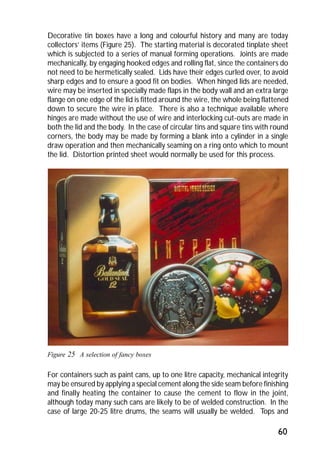
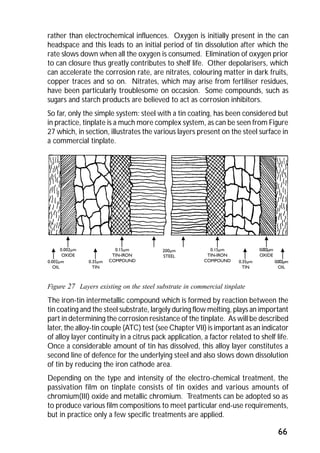
Guide to Tinplate 
138
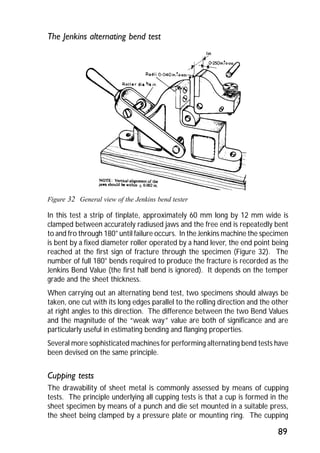
133 
ITRI Ltd 
ITRI Ltd is the world’s foremost authority on tin and its applications and is 
recognised by the UK government as a Scientific Research Organisation. ITRI is 
sponsored by the world-wide tin industry, both miners and smelters, to support 
and expand the use of tin metal, through continuous improvement of the 
technological processes involved in its applications, the development of new 
uses and promotion through conferences, seminars etc. ITRI research is ongoing 
in the following main areas: 
Tinplate packaging 
Tin alloy coatings 
Solder technology 
Chemical applications 
Environmentally driven projects
Providing 
expertise 
in tin 
technology 
and 
applications 
137 
ITRA is a membership based organisation providing 
contact research, testing, analytical and 
information services to the tin industry. 
For more informtion contact Dr Steve Blunden 
ITRA Ltd. Kingston Lane, Uxbridge, Middlesex UB8 3PJ 
Tel: + 44 1895 272 406 Fax: + 44 1895 251 841 www.itri.co.uk
134 
ITRA Ltd (Tinplate Panel) 
ITRA Ltd is a membership-based organisation, established in 1993, to service 
the needs of the tin consuming industries. Member companies have access to 
the services and expertise of ITRI, as well as the results of its chemical and 
metallurgical R & D programmes. In addition, Industry Group Panels devoted to 
either tinplate packaging, chemical applications or solder technology (Soldertec), 
provide a forum for discussion and collaboration. 
The ITRA Tinplate Panel aims to help the tinplate industry maintain and develop 
its market share through technical support and collaboration, and represents all 
segments of the tinplate packaging industry (tinplate producers, electrolyte 
suppliers, can makers, lacquer manufacturers etc), throughout all regions of the 
world. Collaborative programmes cover such topics as: 
Lacquer performance 
Corrosion resistance 
Can decoration / product differentiation 
Environmental issues 
Full details of membership of the ITRA Ltd Tinplate Panel may be obtained 
from: 
ITRA Ltd (Tinplate Panel) 
Kingston Lane 
Uxbridge 
Middlesex 
UB8 3PJ 
UK 
Tel: +44 (0) 1895 272406 
Fax: +44 (0) 1895 251841 
Copyright © 2000 ITRA Ltd. 
Printed in the UK 
Published by ITRA Ltd., 
Kingston Lane, Uxbridge, Middlesex, UB8 3PJ, United Kingdom.
135 
ACKNOWLEDGEMENTS 
This 2nd Edition of the Guide to Tinplate was prepared using contributions written 
by technical experts from companies and organisations involved in the tinplate 
packaging industry, all of whom are members of the ITRA Ltd, Tinplate Panel. 
The following are therefore gratefully acknowledged: 
Corus (UK & Netherlands) 
Crown Cork & Seal (UK) 
ICI Packaging Coatings (UK) 
Lawson Mardon Can (UK) 
National Steel (USA) 
PPG Packaging Coatings (UK) 
Rasselstein Hoesch (Germany) 
Shipley Ronal (USA) 
Usinor (Belgium) 
VAI Industries (UK) Ltd 
The Association of European Producers of Steel for Packaging (APEAL), Belgium 
are also thanked and in particular Mr. Bev Page (Consultant) is thanked for his 
contributions and editorial review.
Acknowledgements to Figures 
Figures 2, 4, 5, 7, 9, VAI (UK) Ltd. 
Figures 3, 6, Rasselstein Hoesch GmbH. 
Figure 8, Blaw-Knox Co., Aetna-Standard Div. 
Figure 10, The Head Wrightson Machine Co. Ltd. 
Figure 11, “From The Making, Shaping and Treating of Steel, © Association of 
Iron Steel Engineers, with permission”. 
Figure 17, 18, Continental Can European Industries SA. 
Figures, 19, 20, 22, Crown Cork & Seal Company, Inc. 
Figure 21, Krupp Kunststofftechnik GmbH. 
Figures 23, 24, 25, The Association of European Producers of Steel for Packaging 
(APEAL). 
136 
Cover photograph by kind permission of 
Rasselstein Hoesch GmbH
1 
INTRODUCTION 
Tinplate is light gauge, cold-reduced low-carbon steel sheet or strip, coated on 
both faces with commercially pure tin. It thus combines in one material the 
strength and formability of steel and the corrosion resistance, solderability and 
good appearance of tin. Within this broad description, there exists today an 
extremely wide range of products, tailor-made to meet particular end-use 
requirements. Production of the steel base and its subsequent coating with tin 
are independent of each other, so that any set of properties in the steel, can in 
theory be combined with any tin coating. The composition of the steel used for 
tinplate is closely controlled and according to the grade chosen and its manner 
of processing, various types with different formabilities (“tempers”) can be 
produced. Tinplate is sold in a range of steel thicknesses, from around 0.5 mm 
to 0.13 mm. The steel can be coated with differing thicknesses of tin, and even 
different thicknesses on the two faces (differential coatings) may be produced 
to cater for varying conditions at the internal and external surfaces of a container. 
A variety of surface finishes are also produced for diverse applications. Tinplate 
has a special passivation treatment to stabilise the surface and improve adhesion 
of lacquers; it also carries a very thin film of an oil to improve its handling and 
fabrication properties. This oil is, of course, compatible with food products. 
The resulting wide variety of materials gives the user a great flexibility in choice 
and the ability to select precisely the right material for a given end use. 
Historical development 
The origins of tinplate can be traced to the tinning of hammered iron sheet, 
carried out in Bavaria in the fourteenth century. The industry spread to Saxony 
and Bohemia and by the seventeenth century a flourishing tinplate trade was 
centred around Dresden, with exports to many countries, including England. In 
1720 a tinplate works was set up in South Wales, and this used hot-rolled iron 
sheets as the basis metal; this innovation, together with improved pickling and 
tinning processes, enabled the British manufacturers to produce good quality 
plate and by the beginning of the nineteenth century, Britain was firmly established 
as the world’s principal producer of tinplate, the industry being centred in South 
Wales.
The substitution of steel for iron as basis metal, together with the advent of 
mechanical tinning machines, lessened the dependence on cheap labour and 
increased productivity. After 1891 the U.S. domestic industry got under way 
and by the beginning of the twentieth century, United States production was 
sufficient to meet the demands of the home market. In the first half of the 
present century, the most significant developments were in the production 
methods of the steel base, in particular the continuous rolling of steel strip. Hot 
dipped tinplate, however, was still tinned on a sheet-by-sheet basis. The next 
major development in the tinplate industry was the introduction of electrotinning. 
An experimental electrotinning plant had been constructed in Germany as early 
as 1915, but it was not until the 1930s that cold-rolled steel strip was being 
electrotinned on a commercial scale, initially in Germany. World War II, when 
tin supplies became short, provided the impetus for the widespread development 
of the electrotinning process, with its possibilities for more economical tin 
coatings. The first commercial plant in the U.S.A. was put into operation in 
1943; within five years, half of United States tinplate output was being produced 
electrolytically. 
The trend to the replacement of hot-dipping tinplate units by continuous 
electrolytic lines continued steadily throughout the world over the next thirty 
years. Further technical developments, such as continuous annealing and “double 
reduction” of the cold-rolled steel strip before tinning, together with the use of 
differential coatings aided the remarkable expansion of the industry during this 
period. By the 1980s over 13 million tonnes of tinplate were being produced 
each year, and manufacture had spread to some 37 countries. 
Although the principal application is in packaging, tinplate also has a considerable 
diversity of minor uses. These include light engineering applications, domestic 
appliances and toys. 
Tinplate is a very 
important outlet for tin 
since it represents about 
30% of total tin 
consumption. Today 
there are many 
alternative materials in 
the packaging market, 
particularly aluminium 
and PET. There has been 
a trend towards the use 
of thinner tin coatings 
and lighter yet equally 
strong steel substrates. 
2 
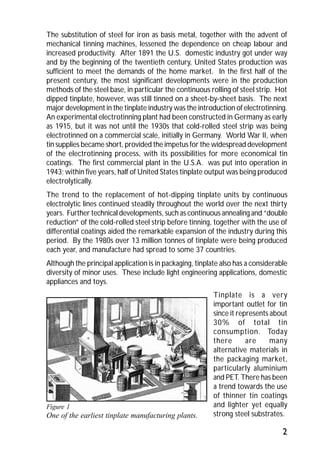
Figure 1 
One of the earliest tinplate manufacturing plants.
In the following pages, the production, properties and uses of tinplate are 
considered in some detail, in order to provide a guide to the often complex 
technology associated with this material. Some of the newer trends and 
developments are also discussed. 
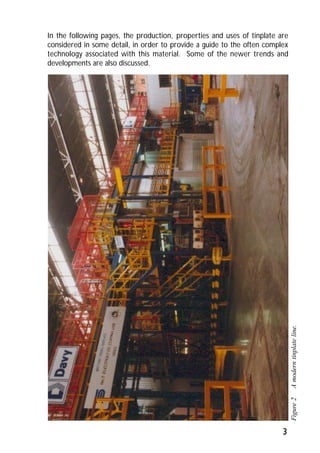
3 
Figure 2 A modern tinplate line.
5 
TINPLATE PRODUCTION 
Tinplate is basically a steel product, since it is essentially light gauge steel strip 
coated with tin on both surfaces. The manufacture of tinplate therefore 
conveniently falls into two main stages; the production of thin mild steel strip or 
sheet having the required dimensions and mechanical properties, and the coating 
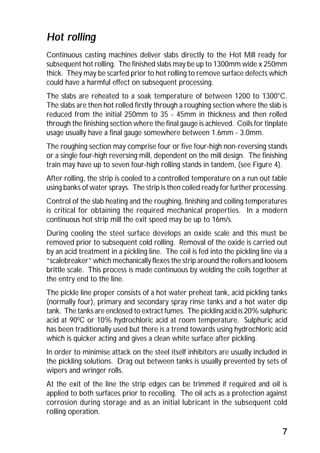
process. Figure 3 is a diagram indicating the principal steps in the manufacturing 
process. 
The steel base 
The steel base used for tinplate manufacture is a low carbon mild steel typically 
containing 0.003 - 0.12% carbon. This is now largely made by the basic oxygen 
steelmaking (B.O.S.) process. 
Modern steelmaking furnaces can produce steel at rates up to 400 tonnes/hour. 
The basic oxygen process produces steel with low residuals and with good 
formability and mechanical properties. 
Continuously cast steel 
Although ingot casting can be used, the steels for tinplate use are almost 
exclusively made from slabs produced by continuous casting. In this process 
the molten steel is cast directly in slab form by casting into a water cooled 
copper mould. An outer solidified skin on steel is formed and this is then drawn 
through the caster by water cooled rolls where further solidification progresses 
until a solid slab is formed. 
The steel prior to casting is fully killed i.e. the excess oxygen from the steelmaking 
process is removed by the addition of an oxide former, usually aluminium. 
The advantages of continuous casting over the previously used ingot route are 
the freedom from segregation and the internal cleanliness of the steel. This is 
of great importance for two piece can manufacture.
6 
Hot rolled strip 
Temper rolling 
Figure 3 Principal steps in the manufacturing process 
Pickling 
Batch Annealing 
Cleaning 
Cold rolling Continuous Annealing 
Warehouse 
Laminating 
Tinning/Chromium Coating 
Slitting 
Shearing Printing, Lacquering
Hot rolling 
Continuous casting machines deliver slabs directly to the Hot Mill ready for 
subsequent hot rolling. The finished slabs may be up to 1300mm wide x 250mm 
thick. They may be scarfed prior to hot rolling to remove surface defects which 
could have a harmful effect on subsequent processing. 
The slabs are reheated to a soak temperature of between 1200 to 1300°C. 
The slabs are then hot rolled firstly through a roughing section where the slab is 
reduced from the initial 250mm to 35 - 45mm in thickness and then rolled 
through the finishing section where the final gauge is achieved. Coils for tinplate 
usage usually have a final gauge somewhere between 1.6mm - 3.0mm. 
The roughing section may comprise four or five four-high non-reversing stands 
or a single four-high reversing mill, dependent on the mill design. The finishing 
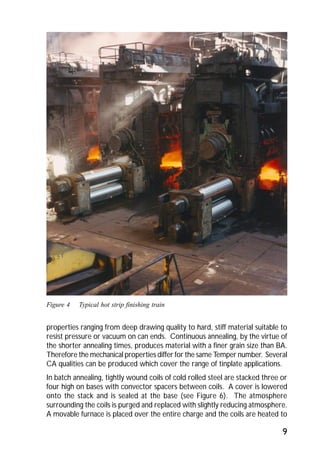
train may have up to seven four-high rolling stands in tandem, (see Figure 4). 
After rolling, the strip is cooled to a controlled temperature on a run out table 
using banks of water sprays. The strip is then coiled ready for further processing. 
Control of the slab heating and the roughing, finishing and coiling temperatures 
is critical for obtaining the required mechanical properties. In a modern 
continuous hot strip mill the exit speed may be up to 16m/s. 
During cooling the steel surface develops an oxide scale and this must be 
removed prior to subsequent cold rolling. Removal of the oxide is carried out 
by an acid treatment in a pickling line. The coil is fed into the pickling line via a 
“scalebreaker” which mechanically flexes the strip around the rollers and loosens 
brittle scale. This process is made continuous by welding the coils together at 
the entry end to the line. 
The pickle line proper consists of a hot water preheat tank, acid pickling tanks 
(normally four), primary and secondary spray rinse tanks and a hot water dip 
tank. The tanks are enclosed to extract fumes. The pickling acid is 20% sulphuric 
acid at 900C or 10% hydrochloric acid at room temperature. Sulphuric acid 
has been traditionally used but there is a trend towards using hydrochloric acid 
which is quicker acting and gives a clean white surface after pickling. 
In order to minimise attack on the steel itself inhibitors are usually included in 
the pickling solutions. Drag out between tanks is usually prevented by sets of 
wipers and wringer rolls. 
At the exit of the line the strip edges can be trimmed if required and oil is 
applied to both surfaces prior to recoiling. The oil acts as a protection against 
corrosion during storage and as an initial lubricant in the subsequent cold 
rolling operation. 
7
Cold reduction 
All modern tinplate has a cold reduced steel base and almost all is rolled in a 
multi-stand mill. Most operators use a five-stand, four-high tandem mill for 
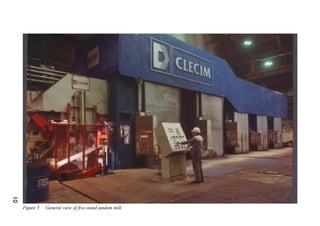
cold rolling, although there are some six- and four-stand mills, (see Figure 5). 
The feedstock for the cold reduction mill is the pickled and oiled hot rolled coil 
and normally individual coils are rolled separately. About 90% cold reduction is 
imparted. For conventional tinplate, as opposed to double-reduced, the steel 
is rolled roughly to the final ordered thickness in this cold rolling stage. 
Modern cold reduction mills operate at speeds up to 2400 m/min. Many factors 
such as load, inter-stand tension, lubrication, cooling and roll contour are closely 
monitored and controlled in order to produce a high yield of prime product. 
Most producers have installed automatic control equipment. 
Cleaning 
For cold reduction, lubrication is necessary and lubricating oil and water are 
applied to the strip and rolls either separately or as an emulsion. All traces of 
this lubricant must be removed from the strip before annealing, since residual 
oil can cause staining or discoloration of the strip, preventing good tinning. 
Material destined for batch annealing is treated in a cleaning line in which the 
strip passes through dip or spray tanks, followed by rinsing and scrubbing, then 
onto an electrolytic treatment section. The solutions used in strip cleaning lines 
are usually made up from proprietary mixtures containing alkaline phosphates 
or silicates together with sodium hydroxide and wetting agents. Finally the 
strip is rinsed and dried in a blast of hot air. Fume extraction facilities are essential. 
In the case of steel destined for continuous strand annealing a cleaning section is 
incorporated in the annealing line. 
Annealing 
The mechanical working which the steel undergoes during cold rolling has a 
profound effect on the mechanical properties. In cold working, the grain 
structure is distorted and the metal becomes harder and stronger but less ductile. 
In order to soften the steel and restore its ductility, recrystallisation of the grains 
is required. This can be induced by a controlled heat treatment cycle (process 
annealing) to produce the required grain structure. 
Two types of annealing may be used in tinplate manufacture, batch (or box) 
annealing (BA) or continuous annealing (CA). By suitably selecting the steel 
grade and the annealing cycle, batch annealing can produce steel having 
8
9 
Figure 4 Typical hot strip finishing train 
properties ranging from deep drawing quality to hard, stiff material suitable to 
resist pressure or vacuum on can ends. Continuous annealing, by the virtue of 
the shorter annealing times, produces material with a finer grain size than BA. 
Therefore the mechanical properties differ for the same Temper number. Several 
CA qualities can be produced which cover the range of tinplate applications. 
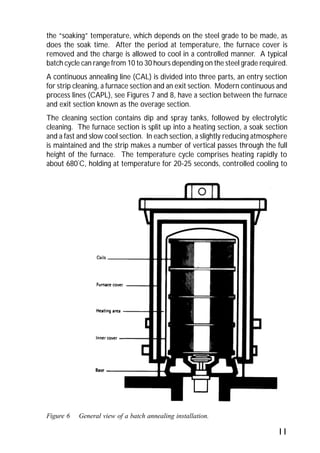
In batch annealing, tightly wound coils of cold rolled steel are stacked three or 
four high on bases with convector spacers between coils. A cover is lowered 
onto the stack and is sealed at the base (see Figure 6). The atmosphere 
surrounding the coils is purged and replaced with slightly reducing atmosphere. 
A movable furnace is placed over the entire charge and the coils are heated to
10 
Figure 5 General view of five-stand tandem mill.
the “soaking” temperature, which depends on the steel grade to be made, as 
does the soak time. After the period at temperature, the furnace cover is 
removed and the charge is allowed to cool in a controlled manner. A typical 
batch cycle can range from 10 to 30 hours depending on the steel grade required. 
A continuous annealing line (CAL) is divided into three parts, an entry section 
for strip cleaning, a furnace section and an exit section. Modern continuous and 
process lines (CAPL), see Figures 7 and 8, have a section between the furnace 
and exit section known as the overage section. 
The cleaning section contains dip and spray tanks, followed by electrolytic 
cleaning. The furnace section is split up into a heating section, a soak section 
and a fast and slow cool section. In each section, a slightly reducing atmosphere 
is maintained and the strip makes a number of vertical passes through the full 
height of the furnace. The temperature cycle comprises heating rapidly to 
about 680°C, holding at temperature for 20-25 seconds, controlled cooling to 
11 
Figure 6 General view of a batch annealing installation.
12 
Figure 7 Continuous annealing line
480°C and then rapid cooling to room 
temperature. This cycle is for a CAL; for 
the CAPL the strip is cooled to an 
overage temperature of between 370 to 
400°C and held to allow carbon to 
precipitate out of solution. It is cooled 
to near room temperature. The 
precipitation out of carbon softens the 
steel and makes it more ductile for two-piece 
13 
can manufacture. 
To allow the process to be continuous, 
looping towers or accumulators are 
found at the entry and exit end. These 
towers contain sufficient metal to allow 
welding up of coils at the entry end and 
cropping to length at the exit end. 
Temper rolling 
After annealing, the steel strip is in a very 
soft condition and it is given a very light 
rolling treatment, usually in a two-stand 
mill operated without strip lubrication. 
This is known as “temper rolling” or “skin 
pass rolling” This process defines the final 
gauge and imparts mechanical properties 
appropriate to the end use. It also 
improves the strip shape and produces 
the desired surface finish on the strip. 
The overall reduction is of the order of 
0.5 to 4%. 
Temper rolling also removes the 
pronounced yield point noted on CA 
products. This allows ends and bodies 
to be produced without “Luders” lines/ 
bands being visible 
Figure 8 
Schematic diagram of a typical line for 
continuous annealing of tinplate strip. 
ENTRY SECTION 
RECOIL SECTION 
WELDER 
CLEANING - SCRUBBING & RINSE SECTION 
EXIT 
ENTRY 
FURNACE ACCUMULATOR 
ACCUMULATOR
Double reduction 
Large quantities of relatively strong tinplate are now manufactured world-wide 
by the technique of double reduction. Thinner yet stronger tinplate can be 
produced, which allows for more efficient materials utilisation in can making. 
After an initial cold rolling and annealing, instead of temper rolling, the steel is 
given a second cold reduction, with lubrication, of about 10-50%. The work 
hardening effect gives the steel additional strength, whilst the strip retains 
sufficient ductility for it to be formed into can ends and bodies. Final thickness 
can be as low as 0.12mm, the typical range being 0.14 - 0.24mm. 
A two-stand or three-stand mill may be used for double reduction. Some 
companies operate a dual purpose mill which can produce double-reduced 
material and operate as a conventional temper mill. 
Double-reduced steel exhibits very marked directional properties and the grain 
direction should always be indicated and taken into account during forming 
operations with the final tinplate. 
Coil preparation 
Before entering the tinning line the strip may be edge trimmed and inspected 
on a coil preparation line. A strip thickness gauge may also be installed and off-gauge 
or sub standard plate may be cut out. Coils of optimum weight are 
produced by welding strip lengths together. 
Electrolytic tinning 
Tinplate is now virtually all produced by the electroplating of tin on to the steel 
base in a continuous process. The major reasons why electrotinning of steel 
strip superseded hot-dip tinning, were because it can give a very much higher 
degree of thickness control, including different thicknesses on the two sides of 
the steel sheet, and much higher outputs of tinplate, at higher quality and lower 
manufacturing cost. As plating technology and steel chemistry have improved, 
steel base and tin coating thickness have been gradually reduced, significantly 
lowering the cost of production; today a typical coating thickness is in the range 
0.1 to 1.5 microns depending on the end use. 
The most widely used process is the Ferrostan process (the trade name of US 
Steel) and this currently accounts for some 70% of world manufacturing output. 
This general description of electrolytic tinning is based on the Ferrostan process, 
with differences in line layout for other process types being discussed later. 
14
Blackplate coils weighing between 5 and 15 tonnes are fed onto the tinning line, 
being loaded onto the two uncoilers required to allow continuous operation. 
The tail end of the coil being processed is welded to the leading end of the next 
coil to be processed; this necessitates the two coils being stationary during 
welding. To avoid shut down during welding, lines are fitted with looping towers 
or accumulators that can hold varying amounts of uncoiled plate (often up to 
600 m). Most modern lines incorporate side trimmers after the accumulator to 
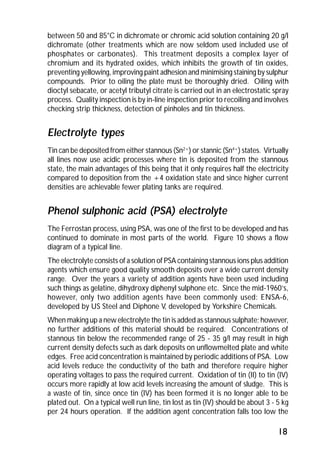
cut the strip to the correct width. Many lines now incorporate tension or stretch 
levellers (Figure 9), which apply controlled tension across the strip to remove 
distortions. 
Because cleaning times are very short i.e. 1 - 2 seconds, effective cleaning 
requires the use of electrolysis to aid chemical dissolution of rolling oil residues 
and other organic contaminants. Passage of heavy current produces gases at 
the strip surface which undermine the soil and lift it from the strip. The cleaner 
is usually a 1-5 % solution in water of a mixture of phosphates, wetting agents 
and emulsifiers in a sodium hydroxide / carbonate base. Temperatures are 
normally 80-90°C with current densities of 10 A/dm2 usually adequate. After 
cleaning the strip is thoroughly washed, ideally in hot water (70°C) using high-pressure 
15 
sprays. 
Pickling removes oxide and rust layers and leaves the surface etched for better 
deposition of tin; during the process the strip is normally made anodic then 
cathodic with current densities between 5 and 30 A/dm2 being employed. 
Various electrolytes can be used in the tinplating section and these are covered 
more fully later. The plating cells consist of a series of vertical tanks through 
which the strip passes in serpentine fashion. The number of plating tank passes 
in use, the anode length and the strip width determine the effective plating 
area. This, together with the available plating current, is mainly responsible for 
fixing the maximum line speed for any coating weight. Modern tinning lines 
achieve speeds of 600 m/min with reports of new lines being designed to run 
even faster; typical strip widths are between 1 and 1.25 m. The steel strip is 
guided through the tanks by sink rolls located at the bottom of the tanks and 
conductor rollers with rubber covered hold-down rollers at the top; these collect 
electrolyte from the strip and return it to the plating cell. The conductor rolls 
must have good electrical conductivity and low contact resistance between the 
roll and the wet strip; they are normally made from steel coated with copper 
and then chromium. 
Each plating tank has four anode bus bars and four banks of anodes, one for 
each face of the down and up passes of the strip. Traditional anodes are made 
of 99.9% pure tin and are 76 mm wide, 50 mm thick and about 1.8 m long. 
The anode is consumed in the process and is replaced when reduced in thickness
by about 70%. A worn anode is removed from one end of the bank and a new 
one inserted at the other, the others being moved across to make room. 
Inert anodes made from titanium coated with platinum or iridium oxide have 
become more frequently used in recent years. Nippon Steel was the first to 
use a line totally employing inert anodes. In this case stannous ions are produced 
off line in a generation plant in which high pressure oxygen is bubbled through 
the electrolyte solution containing pure tin beads, dissolving the tin and making 
fresh electrolyte. Inert anodes are positioned parallel to the steel strip in a 
fixed position and do not need to be frequently renewed. This means that 
variations in tin coating thickness across the strip width are minimised; adjustable 
edge masks ensure correct anode width to avoid tin build-up on the edges of 
the strip. Since there is no need to cast and replace tin anodes, use of inert 
anodes also enables manning levels to be lowered. 
An alternative system of parallel tin anodes was developed by Rasselstein and 
has also been used by British Steel (now Corus). In this system the anode 
bridges are aligned parallel to the strip and are loaded with conventional tin 
anodes. The anode bank is placed close to the strip reducing the initial voltages 
required. As the anodes slowly dissolve the voltage is increased to maintain a 
given current. When the anodes have been reduced to a specified thickness 
the whole bank is replaced. This system is claimed to give similar control over 
tin thickness as with inert anodes. 
At the end of the plating section there is a drag-out control section which 
essentially removes residual electrolyte from the strip for subsequent recovery. 
Tin is deposited as a whitish coating having a slight metallic lustre; where required 
this is flow melted by induction or resistance heating (or a combination) to 
produce a bright mirror-like finish. In resistance heating, a high alternating current 
is passed through the strip via conductor rolls. With induction heating the strip 
passes through a series of internally cooled copper coils through which a high 
frequency current is passed. The induced eddy current and hysteresis losses 
heat up the strip and melt the tin coating. This flow melting process enhances 
the corrosion resistance of the product by formation of an inert tin-iron alloy 
layer. Prior to flow melting the plate may be fluxed by treating with dilute 
electrolyte or proprietary chemicals to prevent surface defects such as woodgrain 
appearing on the plate. Virtually all DWI plate (drawn and wall ironed) is non-flow 
brightened, and this can be a significant part of the output for many 
manufacturers. 
Flow melted tin plate has a thin tin oxide film on the surface, which if untreated 
can grow on storage. In order to improve the tarnish resistance and laquerability 
a chemical or electrochemical passivation is applied to the strip. The most 
common form of passivation involves cathodic treatment at temperatures 
16
17 
Figure 9 Tension levellers
between 50 and 85°C in dichromate or chromic acid solution containing 20 g/l 
dichromate (other treatments which are now seldom used included use of 
phosphates or carbonates). This treatment deposits a complex layer of 
chromium and its hydrated oxides, which inhibits the growth of tin oxides, 
preventing yellowing, improving paint adhesion and minimising staining by sulphur 
compounds. Prior to oiling the plate must be thoroughly dried. Oiling with 
dioctyl sebacate, or acetyl tributyl citrate is carried out in an electrostatic spray 
process. Quality inspection is by in-line inspection prior to recoiling and involves 
checking strip thickness, detection of pinholes and tin thickness. 
Electrolyte types 
Tin can be deposited from either stannous (Sn2+) or stannic (Sn4+) states. Virtually 
all lines now use acidic processes where tin is deposited from the stannous 
state, the main advantages of this being that it only requires half the electricity 
compared to deposition from the +4 oxidation state and since higher current 
densities are achievable fewer plating tanks are required. 
Phenol sulphonic acid (PSA) electrolyte 
The Ferrostan process, using PSA, was one of the first to be developed and has 
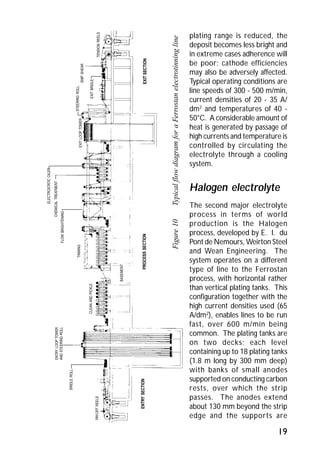
continued to dominate in most parts of the world. Figure 10 shows a flow 
diagram of a typical line. 
The electrolyte consists of a solution of PSA containing stannous ions plus addition 
agents which ensure good quality smooth deposits over a wide current density 
range. Over the years a variety of addition agents have been used including 
such things as gelatine, dihydroxy diphenyl sulphone etc. Since the mid-1960’s, 
however, only two addition agents have been commonly used: ENSA-6, 
developed by US Steel and Diphone V, developed by Yorkshire Chemicals. 
When making up a new electrolyte the tin is added as stannous sulphate; however, 
no further additions of this material should be required. Concentrations of 
stannous tin below the recommended range of 25 - 35 g/l may result in high 
current density defects such as dark deposits on unflowmelted plate and white 
edges. Free acid concentration is maintained by periodic additions of PSA. Low 
acid levels reduce the conductivity of the bath and therefore require higher 
operating voltages to pass the required current. Oxidation of tin (II) to tin (IV) 
occurs more rapidly at low acid levels increasing the amount of sludge. This is 
a waste of tin, since once tin (IV) has been formed it is no longer able to be 
plated out. On a typical well run line, tin lost as tin (IV) should be about 3 - 5 kg 
per 24 hours operation. If the addition agent concentration falls too low the 
18
19 
Figure 10 Typical flow diagram for a Ferrostan electrotinning line 
plating range is reduced, the 
deposit becomes less bright and 
in extreme cases adherence will 
be poor; cathode efficiencies 
may also be adversely affected. 
Typical operating conditions are 
line speeds of 300 - 500 m/min, 
current densities of 20 - 35 A/ 
dm2 and temperatures of 40 - 
50°C. A considerable amount of 
heat is generated by passage of 
high currents and temperature is 
controlled by circulating the 
electrolyte through a cooling 
system. 
Halogen electrolyte 
The second major electrolyte 
process in terms of world 
production is the Halogen 
process, developed by E. I. du 
Pont de Nemours, Weirton Steel 
and Wean Engineering. The 
system operates on a different 
type of line to the Ferrostan 
process, with horizontal rather 
than vertical plating tanks. This 
configuration together with the 
high current densities used (65 
A/dm2), enables lines to be run 
fast, over 600 m/min being 
common. The plating tanks are 
on two decks; each level 
containing up to 18 plating tanks 
(1.8 m long by 300 mm deep) 
with banks of small anodes 
supported on conducting carbon 
rests, over which the strip 
passes. The anodes extend 
about 130 mm beyond the strip 
edge and the supports are 
TENSION REELS 
PAY-OFF REELS 
BRIDLE ROLL 
FLOW BRIGHTENING 
CLEAN AND PICKLE 
ENTRY LOOP TOWER 
AND STEERING ROLL 
BASEMENT 
TINNING 
CHEMICAL TREATMENT 
ENTRY SECTION PROCESS SECTION 
ELECTROSTATIC OILER 
STEERING ROLL 
EXIT BRIDLE 
SNIP SHEAR 
EXIT LOOP TOWER 
EXIT SECTION
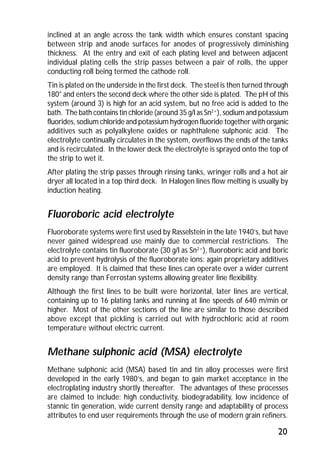
inclined at an angle across the tank width which ensures constant spacing 
between strip and anode surfaces for anodes of progressively diminishing 
thickness. At the entry and exit of each plating level and between adjacent 
individual plating cells the strip passes between a pair of rolls, the upper 
conducting roll being termed the cathode roll. 
Tin is plated on the underside in the first deck. The steel is then turned through 
180° and enters the second deck where the other side is plated. The pH of this 
system (around 3) is high for an acid system, but no free acid is added to the 
bath. The bath contains tin chloride (around 35 g/l as Sn2+), sodium and potassium 
fluorides, sodium chloride and potassium hydrogen fluoride together with organic 
additives such as polyalkylene oxides or naphthalene sulphonic acid. The 
electrolyte continually circulates in the system, overflows the ends of the tanks 
and is recirculated. In the lower deck the electrolyte is sprayed onto the top of 
the strip to wet it. 
After plating the strip passes through rinsing tanks, wringer rolls and a hot air 
dryer all located in a top third deck. In Halogen lines flow melting is usually by 
induction heating. 
Fluoroboric acid electrolyte 
Fluoroborate systems were first used by Rasselstein in the late 1940’s, but have 
never gained widespread use mainly due to commercial restrictions. The 
electrolyte contains tin fluoroborate (30 g/l as Sn2+), fluoroboric acid and boric 
acid to prevent hydrolysis of the fluoroborate ions: again proprietary additives 
are employed. It is claimed that these lines can operate over a wider current 
density range than Ferrostan systems allowing greater line flexibility. 
Although the first lines to be built were horizontal, later lines are vertical, 
containing up to 16 plating tanks and running at line speeds of 640 m/min or 
higher. Most of the other sections of the line are similar to those described 
above except that pickling is carried out with hydrochloric acid at room 
temperature without electric current. 
Methane sulphonic acid (MSA) electrolyte 
Methane sulphonic acid (MSA) based tin and tin alloy processes were first 
developed in the early 1980’s, and began to gain market acceptance in the 
electroplating industry shortly thereafter. The advantages of these processes 
are claimed to include: high conductivity, biodegradability, low incidence of 
stannic tin generation, wide current density range and adaptability of process 
attributes to end user requirements through the use of modern grain refiners. 
20
21 
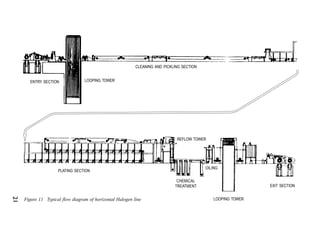
PLATING SECTION 
Figure 11 Typical flow diagram of horizontal Halogen line 
REFLOW TOWER 
OILING 
CHEMICAL 
TREATMENT EXIT SECTION 
LOOPING TOWER 
ENTRY SECTION LOOPING TOWER 
CLEANING AND PICKLING SECTION
By the end of the decade, most tin alloy electrodeposits produced by the 
electronics industry in Europe and the United States were from MSA based 
processes, which had replaced the more traditional fluoborate electrolytes. 
The success of MSA processes in the electronics industry led to further 
developments for applications in heavy industry. In November, 1989, the first 
commercial tinplate production line using a patented MSA process (Ronastan 
TP) developed by LeaRonal (now Shipley Ronal) began plating steel strip at 
Hoogovens (now Corus), Ijmuiden, The Netherlands. 
The MSA tinplate process has undergone several improvements in recent years, 
and has been installed in both vertical and horizontal cell tinplate lines, an attribute 
shared by no other tinplate electroplating process. Although the chemistry is 
tailored to meet each individual line’s requirements, the general operating 
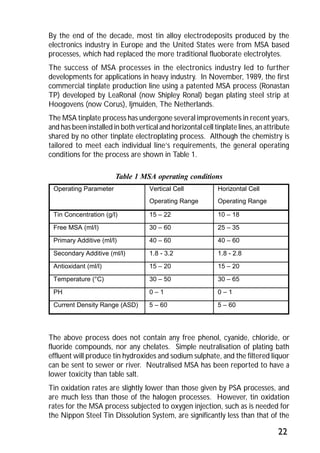
conditions for the process are shown in Table 1. 
22 
Table 1 MSA operating conditions 
Operating Parameter Vertical Cell 
Operating Range 
Horizontal Cell 
Operating Range 
Tin Concentration (g/l) 15 – 22 10 – 18 
Free MSA (ml/l) 30 – 60 25 – 35 
Primary Additive (ml/l) 40 – 60 40 – 60 
Secondary Additive (ml/l) 1.8 - 3.2 1.8 - 2.8 
Antioxidant (ml/l) 15 – 20 15 – 20 
Temperature (°C) 30 – 50 30 – 65 
PH 0 – 1 0 – 1 
Current Density Range (ASD) 5 – 60 5 – 60 
The above process does not contain any free phenol, cyanide, chloride, or 
fluoride compounds, nor any chelates. Simple neutralisation of plating bath 
effluent will produce tin hydroxides and sodium sulphate, and the filtered liquor 
can be sent to sewer or river. Neutralised MSA has been reported to have a 
lower toxicity than table salt. 
Tin oxidation rates are slightly lower than those given by PSA processes, and 
are much less than those of the halogen processes. However, tin oxidation 
rates for the MSA process subjected to oxygen injection, such as is needed for 
the Nippon Steel Tin Dissolution System, are significantly less than that of the
PSA processes, when iron contamination levels in these plating baths exceed 10 
g/l. The conductivity of MSA is approximately 30% higher than for PSA at 
equivalent acid strengths and temperatures. Operating advantages, such as higher 
production rates and prime yields have been reported by a number of tinplate 
producers and these advantages have overcome the increased chemical costs 
of the MSA process. 
The alkaline stannate electrolyte 
Although still widely used for component tin plating this process is now virtually 
obsolete for plating of steel strip. Brief details are included here for 
completeness. 
The main advantages of alkaline stannate processes are that the electrolyte is 
non-corrosive to steel and that addition agents are not required to give a smooth 
good quality deposit. However, these benefits are now seen to be outweighed 
by a number of disadvantages, the main one of which is that twice the theoretical 
amount of electricity is required to deposit tin from the Sn4+ as from the Sn2+ 
state; this is obviously very costly. Other disadvantages include the lower 
operable current density range and the lower efficiencies obtained. In alkaline 
electrolytes at low current density, tin anodes would dissolve as stannite but if 
the current density is increased above a critical value, a film forms on the surface 
and tin then dissolves entirely as stannate. In practice, filming is achieved by 
raising the anode voltage for a few seconds at the outset. 
23
25 
BUYER’S GUIDE TO TINPLATE 
In the production of tinplate, the manufacture of the steel base and the application 
of the tin coating are independent of each other so that theoretically any tin 
coating, or combination of coatings, may be applied to any steel base. Thus the 
range of materials classified as tinplate can run into many thousands, indeed 
tinplate is available in more qualities than virtually any other light gauge sheet 
metal product. 
In practice the range of steel base thickness is from 0.13 mm to 0.50 mm and 
the tin coating from 0.5 g/m2 to 15.2 g/m2 tin per surface. 
There are international and national standards which specify the ranges and 
tolerances for the various characteristics, and methods of verifying them. The 
information in this chapter is based on the more widely used standards but for 
official requirements, readers are referred to the appropriate standard 
specifications (tinplate standards are listed in the Appendix). 
The steel base 
The low carbon steel used for tinplate manufacture is produced and processed 
as outlined in Chapter II. The steel composition and its method of production 
are normally matters for the producer, who should however, be given full details 
of the intended use, so that the optimum material can be supplied. 
National and international specifications do not normally stipulate composition 
requirements. However, some standards such as ASTM A623 give a general 
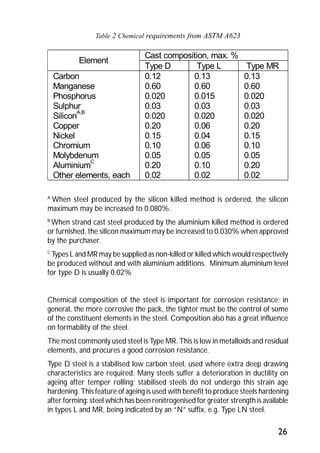
guide to the types of steel most generally used. Table 2 outlines the chemical 
requirements for three steel types. It should be noted that the percentages 
quoted are maximal and normally the actual amounts are much lower, e.g. the 
carbon is frequently well below 0.10%C. The generalisation of continuous casting 
requires that steel formulation must be able to produce the highest steel qualities. 
All the tinplate produced in Europe is now “continuously cast”.
26 
Table 2 Chemical requirements from ASTM A623 
Cast composition, max. % 
Element 
Type D Type L Type MR 
Carbon 
Manganese 
Phosphorus 
Sulphur 
SiliconA,B 
Copper 
Nickel 
Chromium 
Molybdenum 
AluminiumC 
Other elements, each 
0.12 
0.60 
0.020 
0.03 
0.020 
0.20 
0.15 
0.10 
0.05 
0.20 
0.02 
0.13 
0.60 
0.015 
0.03 
0.020 
0.06 
0.04 
0.06 
0.05 
0.10 
0.02 
0.13 
0.60 
0.020 
0.03 
0.020 
0.20 
0.15 
0.10 
0.05 
0.20 
0.02 
A When steel produced by the silicon killed method is ordered, the silicon 
maximum may be increased to 0.080%. 
B When strand cast steel produced by the aluminium killed method is ordered 
or furnished, the silicon maximum may be increased to 0.030% when approved 
by the purchaser. 
C Types L and MR may be supplied as non-killed or killed which would respectively 
be produced without and with aluminium additions. Minimum aluminium level 
for type D is usually 0.02% 
Chemical composition of the steel is important for corrosion resistance; in 
general, the more corrosive the pack, the tighter must be the control of some 
of the constituent elements in the steel. Composition also has a great influence 
on formability of the steel. 
The most commonly used steel is Type MR. This is low in metalloids and residual 
elements, and procures a good corrosion resistance. 
Type D steel is a stabilised low carbon steel, used where extra deep drawing 
characteristics are required. Many steels suffer a deterioration in ductility on 
ageing after temper rolling; stabilised steels do not undergo this strain age 
hardening. This feature of ageing is used with benefit to produce steels hardening 
after forming: steel which has been renitrogenised for greater strength is available 
in types L and MR, being indicated by an “N” suffix, e.g. Type LN steel.
Thickness 
The tin coating on tinplate is so thin that for practical purposes it can be ignored 
in considering thickness, so that the specified thickness is essentially that of the 
steel base. Conventional tinplate, as defined in international standards, falls within 
the range 0.15 mm to 0.49 mm; double reduced tinplate from 0.13 mm to 0.29 
mm. Lower gauges down to 0.08mm are now available for special uses, either 
in single- or double-reduced base materials. Heavier gauges of conventional 
tinplate are available from a number of sources, up to 0.6 mm. However, in 
some cases, notably in the U.S.A. and Europe, material above 0.5 mm thick is 
described as “tinned sheets”, rather than as “tinplate”. 
Tinplate is today described principally in terms of metric dimensions, e.g. the 
SITA (System International Tinplate Area) which is 100 square metres. However, 
until a few years ago, the unit of trade was the basis box (base box in U.S.A.) 
and the nomenclature still persists within some parts of the industry. 
The basis box is an area of sheet of 31,360 square inches (20.2325 m2). It 
derives from the time when weighing was the accepted method of 
measuring both sheet and coating thickness and corresponds to a unit of 112 
sheets each of the (then) standard size 20x14 in. The surface area of a basis box 
is 62,720 in2. 
Table 3 Nominal base weight (substance) 
27 
for tinplate 
Nominal weight Theoretical thickness 
Ib/base box In Mm 
45 
0.0050 
0.127 
50 
0.0055 
0.140 
55 
0.0061 
0.155 
60 
0.0066 
0.168 
65 
0.0072 
0.183 
70 
0.0077 
0.196 
75 
0.0083 
0.211 
80 
0.0088 
0.224 
85 
0.0094 
0.239 
90 
0.0099 
0.251 
95 
0.0105 
0.267 
100 
0.0110 
0.279 
103 
0.0113 
0.287 
107 
0.0118 
0.300 
112 
0.0123 
0.312 
118 
0.0130 
0.330 
128 
0.0141 
0.358 
135 
0.0149 
0.378 
155 
0.0170 
0.432 
175 
0.0192 
0.488 
195 
0.0214 
0.544 
215 
0.0236 
0.600 
235 
0.0258 
0.655 
235 
0.0280 
0.711 
When tinplate is sold by 
the basis box, the 
thickness is known as the 
“substance” or 
“baseweight”. It is defined 
in terms of pounds 
avoirdupois per basis box 
(lb/bb). Material sold in 
terms of “substance”, or in 
Imperial measurements, is 
normally available in a 
specified range of 
thickness as shown in 
Table 3 which gives the 
inter-conversion between 
metric thickness, 
fractional inch thickness 
and substances expressed 
in Ib/bb.
Mechanical properties 
Tinplate is available in a wide range of forming grades or “tempers”. The 
mechanical properties depend on a number of factors including steel 
composition, rolling practice, the annealing cycle and the degree of skin-pass, 
or temper rolling. 
The term “temper” when applied to tinplate, summarises a combination of 
interrelated mechanical properties. There is no single mechanical test that can 
measure all the factors that contribute to the fabrication characteristics of the 
material. However, the Rockwell 30T Hardness Test is in general use as a quick 
test which serves as a guide to the properties of the material. For single-reduced 
tinplate only the Rockwell superficial hardness test is at present specified. 
However, the determination of tensile strength of the product is a more 
technically sound and meaningful measure of the mechanical behaviour. This 
technique is more and more practised and will become by 2001 the Euronorm 
base for material designation. For double-reduced tinplate the determination 
of tensile properties is already used to determine mechanical properties. The 
methods of carrying out these tests are described in Chapter VII together with 
other supplementary tests. 
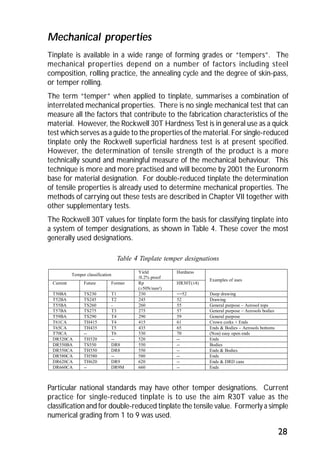
The Rockwell 30T values for tinplate form the basis for classifying tinplate into 
a system of temper designations, as shown in Table 4. These cover the most 
generally used designations. 
28 
Table 4 Tinplate temper designations 
Temper classification Yield 
/0.2% proof 
Hardness 
Current Future Former Rp 
(±50N/mm²) 
HR30T(±4) 
Examples of uses 
T50BA TS230 T1 230 <=52 Deep drawing 
T52BA TS245 T2 245 52 Drawing 
T55BA TS260 - 260 55 General purpose – Aerosol tops 
T57BA TS275 T3 275 57 General purpose – Aerosols bodies 
T59BA TS290 T4 290 59 General purpose 
T61CA TH415 T4 415 61 Crown corks + Ends 
T65CA TH435 T5 435 65 Ends & Bodies – Aerosols bottoms 
T70CA -- T6 530 70 (Non) easy open ends 
DR520CA TH520 -- 520 -- Ends 
DR550BA TS550 DR8 550 -- Bodies 
DR550CA TH550 DR8 550 -- Ends & Bodies 
DR580CA TH580 -- 580 -- Ends 
DR620CA TH620 DR9 620 -- Ends & DRD cans 
DR660CA -- DR9M 660 -- Ends 
Particular national standards may have other temper designations. Current 
practice for single-reduced tinplate is to use the aim R30T value as the 
classification and for double-reduced tinplate the tensile value. Formerly a simple 
numerical grading from 1 to 9 was used.
It should be noted that, primarily due to the differences in grain size and shape, 
the mechanical properties of batch annealed and continuously annealed material 
of the same R30T value are not identical. A further point is that since the R30T 
test does not measure all the factors that contribute to the fabrication 
characteristics of tinplate, it is customary to specify the R30T value in terms of 
an aim value or range rather than an exact value. The principal criterion for 
acceptance is that the tinplate should satisfactorily make the required part. 
Therefore the purchaser is advised to give the supplier full details of the part to 
be made and of the method of fabrication. Similarly, any changes in these should 
be discussed and recorded. 
As described in Chapter II, double-reduced tinplate is manufactured by giving 
the steel a second cold-reduction, of the order of 15 to 50%, following annealing. 
This operation replaces temper rolling. The resultant DR product is stiff and 
strong; it also has marked directional properties, i.e. its formability is very 
different in the rolling direction and transversely to it. For this reason, it is 
especially important to specify the rolling direction and to use the DR tinplate 
correctly. 
Surface finish 
Single-reduced tinplate is available in a range of surface finishes. The practice 
and new standards recognise five basic surface finishes, viz: 
Bright finish - A surface provided by a flow-brightened tin coating on a smooth 
finish steel base (steel roughness lower than 0.35μmRa). 
Light stone finish - A surface provided by a flow-brightened tin coating on a 
steel base finish characterised by a light directional pattern (steel roughness 
between 0.25 and 0.45μmRa). 
Stone finish - A surface provided by a flow-brightened tin coating on a steel 
base finish characterised by a directional pattern (steel roughness between 0.35 
and 0.60μmRa). 
Matt finish – A surface provided by an un-melted coating generally on a shot 
blast finish steel base (steel roughness over 0.90μmRa). 
Silver finish - A matt finish product that has been flow melted. 
Double reduced tinplate is customarily supplied with a finish corresponding to 
stone-finish. It may however, also be available with an un-melted tin coating. 
Certain manufacturers use a numerical system to classify the various surface 
finishes. 
29
The tin coating 
The tin used for the coating of tinplate has to be at least 99.85% pure. This 
defines the tin used to make the anodes for electrolytic tinplate production (or 
the grade of tin used to make up the baths in the hot dipping process). 
In the US, ASTM B339-95, standard specification of pig tin, gives the composition 
of Grade “A” tin for the manufacture of tinplate. The minimum tin concentration 
is 99.85% and the maximum lead concentration is 0.010%. 
Tin coating masses (formerly coating weight) are now customarily expressed in 
grams per square metre of surface (g/m2.face). 
Mention has been made of the older practice of expressing tinplate area in 
terms of the basis box of 31,360 square inches of material. This system was also 
used to express tin coating masses. It is still widely used and understood and 
indeed the standard tin coating masses, which involve the use of decimal fractions 
in the metric system, are based on whole numbers or exact fractions in terms 
of pounds per basis box (lb/bb). It should especially be noted that when tin 
coating masses are expressed in lb/bb they may relate to the total coating mass 
on both surfaces, even in the case of equally coated electrolytic tinplate. In the 
case of differentially coated tinplate (i.e. electrolytic tinplate with a different 
coating mass on each surface) the situation can be even more confusing. Originally 
the coating mass (in lb/bb) referred to the equivalent coating on equally coated 
tinplate; i.e. it represented the equivalent of double the coating for each surface. 
As an example, 1.00 lb/bb equally coated tinplate carries 0.5 Ib/bb (11.2 g/m2) 
per surface and 1.00/0.50 lb/bb differentially coated carries 0.50/0.25 lb/bb (11.2/ 
5.6 g/ m2) per surface. More recently, (e.g. in ASTM A624) the nominal coating 
in lb/bb is expressed per surface, although the designation number still 
perpetuates the earlier system. 
Table 5 Tinplate coating masses expressed in lb/bb (from ASTM A624) 
30 
Designation Nominal coating weight each surface Minimum av erage coating mass test value 
No. Ib/base box g/m2 Ib/base box g/m2 
10 
0.05/0.05 
1.1/1.1 
0.08 
1.8 
25 
0.125/0.125 
2.8/2.8 
0.22 
4.9 
35 
0.175/0.175 
3.9/3.9 
0.32 
7.2 
50 
0.25/0.25 
5.6/5.6 
.047 
10.5 
50/25 
0.25/0.125 
5.6/2.8 
0.47/0.22 
10.5/4.9 
75 
0.375/0.375 
8.4/8.4 
0.70 
15.7 
75/25 
0.375/0.125 
8.4/2.8 
0.70/0.22 
15.7/4.9 
100 
0.50/0.50 
11.2/11.2 
0.90 
20.2 
100/25 
0.50/0.125 
11.2/2.8 
0.90/0.22 
20.2/4.9 
100/50 
0.50/0.25 
11.2/5.6 
0.90/0.47 
20.2/10.5 
135/25 
0675/0.125 
15.15/2.8 
1.25/0.22 
28.0/4.9
Low-tin coatings 
Most of the manufacturers can supply conventional tinplate with coatings below 
2.8 g/m2 per surface. These lower coated tinplates are suitable for certain 
applications. For details on the availability and performance characteristics of 
these new materials, suppliers should be consulted. 
Special grades of tinplate with low tin coating combined with modified 
passivations are being developed by some manufacturers. These products are 
customised and are to be used very carefully. 
Discussions are taking place internationally to agree upon a new series of 
standard coating masses to replace the present series. To introduce a new 
coating however, requires a lengthy testing programme to ensure performance 
capability. 
Differentially coated tinplate 
Differentially coated tinplate, often called ‘differential tinplate’, is electrolytic 
tinplate, one surface of which carries a heavier coating than the other. This 
material is used principally for the manufacture of containers which require 
higher corrosion resistance inside than outside, but may occasionally be used 
“inside out”, for example, in packaging inert materials for shipment to tropical 
regions, or any other application to optimise the cost of the products. 
In order to distinguish material having differential coatings it is customary to 
mark one surface. Normally the heavier coated surface is marked, since this 
usually forms the interior of the can, but the purchaser can arrange with the 
supplier for the lighter surface to be marked if required. 
Various systems of marking have been used but the most common is to produce 
on the tinplate a series of parallel lines about 1 mm wide. This is accomplished 
by roller “printing”, using a dichromate solution, on the tinplate surface prior to 
flow-melting. After melting the marking appears as a slightly dull line pattern 
against a bright background. 
The normal way is to issue a simple line (75mm spaced) marking to indicate 
that the material is differential, and not equally coated tinplate. Some users 
prefer to identify the tin coating masses by a coded pattern of lines (Figure 12), 
but this system is now quite obsolete due to the occurrence of new coating 
standards. 
When marking is on the lighter coated surface, at least the alternate lines should 
be interrupted; on the heavier face continuous lines are used. 
31
12.5 
25 
Marking line spaces in mm 
25 12.5 
37.5 
37.5 12.5 
50 
Coating 
codes 
D5.6/2.8 
D8.4/2.8 
D8.4/5.6 
D11.2/2.8 
D11.2/5.6 
D15.1/2.8 
It is extremely important for the purchaser to stipulate clearly to the 
manufacturer both the surface to be marked and the surface which is to be 
piled uppermost (for sheets) or to be the exterior surface in material shipped in 
coil form. It is why the new European system identifies the marked face by the 
position of the differential letter in the coating description: 
D5.6/2.8 is : marking of the face coated with “5.6 g/m²” 
5.6/2.8D is : marking of the face coated with “2.8 g/m²” 
Inspection 
Finished tinplates are inspected instrumentally and by visual examination. 
Inspection includes the detection of pin-holes, surface defects, blemishes, 
mechanical damage, and measurement of gauge, weight and dimensions. 
Grades of tinplate 
Electrolytic tinplate, standard grade: represents the normal production of 
lines employing the usual inspection and classification procedures. It permits 
lacquering and printing over the entire surface. 
Electrolytic tinplate, second grade: is available in certain countries. This 
represents the best sheets rejected from the standard grade and may contain 
32 
Figure 12 Coding system for differentially coated tinplate
sheets exhibiting surface imperfections, tinning defects and shape and other 
minor defects. Second grade does not, however, include off-gauge material, 
nor sheets with pinholes. 
There is no official third grade, but off-gauge and pinholed material may be 
suitable for some non-critical purposes and is sometimes sold as “waste 
category”. 
National and international specifications prescribe a sampling scheme for 
assessing tinplate grades. 
Passivation 
A chemical or electrochemical passivation treatment is normally applied to the 
surface of electrolytic tinplate. The principal purpose of the treatment is to 
stabilise the surface and thus to inhibit the growth of tin oxide on the surface. 
Excessive oxide can produce discoloration in prolonged storage and especially 
during stoving operations associated with lacquering or printing. 
The passivation treatment is applied to the strip in the electrolytic tinplate line 
after flow brightening and before oiling. The treatment consists of passing the 
strip through an aqueous chemical solution, with or without applied current. 
The most commonly applied treatment uses a sodium dichromate solution with 
applied current, the strip being negative. An alternative treatment comprises a 
simple dip, without current, in a similar solution or in a chromic acid solution. A 
cathodic treatment in sodium carbonate solution is occasionally used when milk 
products are packed and there are other treatments which may be used from 
time to time, but are non standard and not available from every supplier. 
Normally, unless otherwise agreed by the purchaser, the first of the above 
treatments, viz. cathodic sodium dichromate, is applied. Many tinplate producers 
adopt a numerical code to define passivation treatments. A typical system is 
one based on a three digit code. Where the first digit is used to indicate the 
solution used (1 - chromic acid, 2 – chromate phosphate, 3 – sodium dichromate, 
4 – sodium carbonate.), the second digit refers to the polarity of the tinplate in 
the solution (0 – non-electrolytic, 1 – cathodic, 2 – cathodic/anodic) and the 
third digit refers loosely to the coulomb level employed. 
Oiling 
Electrolytic tinplate normally carries a very thin coating of oil, in order to 
facilitate the separation of sheets or wraps of a coil. The oil must be of a type 
33
that is acceptable for use in food packaging. The materials in most common use 
are dioctyl sebacate (DOS), butylstearate (BSO) or acetyl tributyl citrate (ATBC). 
Whilst not normally specified when ordering, the oil film is usually in the range 
0.0025 to 0.0099 g/m2 of surface. 
Geometrical features 
As described in Chapter II, electrolytic tinplate is produced in the form of 
continuous strip and the majority of high speed tinplate lines have in-line re-coiling 
at the exit. There is a rapidly growing tendency for tinplate to be shipped 
to users in the form of large, full-width coils, but many deliveries of tinplate are 
often cut into sheets, classified and packed by the producer. 
Sheet sizes 
A wide range of suitable sheet sizes is available, the limits depending on the 
producers concerned. The strip width is a limiting dimension and is generally 
within the range 675 to 1000 mm (27 to 40 in). 
A growing number of producers can now offer a strip width up to 1200 mm (47 
in). 
The cut length varies from around 460 to 1100 mm. For technical reasons, not 
all dimensions are produced in all grades and the supplier should be consulted 
as to availability. In ordering sheet dimensions, care must be taken to ensure 
that the grain directionality is taken into account with reference to the 
manufacture of the finished product. 
Most standard specifications stipulate that a rectangle of the ordered dimension 
should be available in each sheet. This stipulation is intended to take care of any 
irregularities in the rectilinearity of the sheet. 
This led, in former times, to the practice of allowing “overage” when ordering 
tinplate. The “overage” was a shearing allowance on each sheet, such that the 
actual sheets delivered would be sheared to 1/8 in (3 mm) over the ordered 
width and ¼ in (6 mm) over the ordered length. “Overage” is not applied to 
tinplate ordered and specified in metric dimensions. 
The tolerance for such sheets is -0+3 mm on the coil width dimension and 
normally -0+3 mm on the drum cut dimension. Tighter tolerances are generally 
available on request and should be specified in the order. 
Various national and international specifications permit other tolerances. 
Purchasers should consult the appropriate Standard Specification for details. 
34
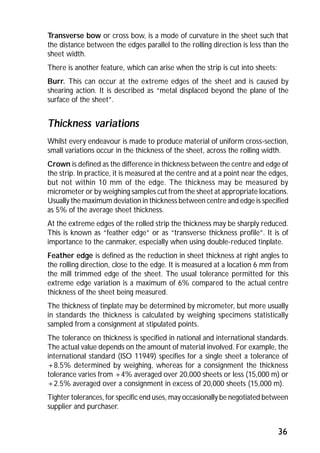
Squareness and camber 
The modern, high-speed machines used in manufacturing containers demand 
precise sheet registration to ensure accuracy. Therefore, it is important to ensure 
rectilinearity of the tinplate sheets to within precise tolerance. Two parameters, 
which are customarily specified, are “out-of-squareness” and camber. 
“Out-of-squareness” is defined as the deviation of an edge from a straight line 
drawn at a right angle to the other edge of the sheet, touching one corner and 
extending to the opposite edge. It is normally expressed as a percentage 
deviation ´ 100% 
or as a maximum linear value for any edge measurement. 
Camber is defined as the maximum deviation of a sheet edge from a straight 
line touching both corners and forming a chord to the edge. Camber is measured 
in the plane of the sheet and is a measure of the straightness of the edge. It 
should not be confused with bow, which describes the flatness of the sheet. 
Camber may be expressed as a percentage 
deviation ´ 100% 
or as a maximum deviation for a given length of sheet edge. 
Other sheet features 
The sheets, when cut from the strip, have to lie flat. Several types of deviation 
from a perfectly plane surface are recognised, which may depend for their origin 
on residual stresses in the sheet. They are described as follows: 
Edge wave. This is an intermittent vertical displacement occurring at the sheet 
edge when the sheet is laid on a flat surface. 
Centre buckle or full centre, is an intermittent vertical displacement or wave 
in the sheet occurring other than at the edges. 
Longitudinal bow or line bow. This is the residual curvature in the sheet 
remaining along the direction of rolling. 
35 
length of perpendicular 
length of chord
Transverse bow or cross bow, is a mode of curvature in the sheet such that 
the distance between the edges parallel to the rolling direction is less than the 
sheet width. 
There is another feature, which can arise when the strip is cut into sheets: 
Burr. This can occur at the extreme edges of the sheet and is caused by 
shearing action. It is described as “metal displaced beyond the plane of the 
surface of the sheet”. 
Thickness variations 
Whilst every endeavour is made to produce material of uniform cross-section, 
small variations occur in the thickness of the sheet, across the rolling width. 
Crown is defined as the difference in thickness between the centre and edge of 
the strip. In practice, it is measured at the centre and at a point near the edges, 
but not within 10 mm of the edge. The thickness may be measured by 
micrometer or by weighing samples cut from the sheet at appropriate locations. 
Usually the maximum deviation in thickness between centre and edge is specified 
as 5% of the average sheet thickness. 
At the extreme edges of the rolled strip the thickness may be sharply reduced. 
This is known as “feather edge” or as “transverse thickness profile”. It is of 
importance to the canmaker, especially when using double-reduced tinplate. 
Feather edge is defined as the reduction in sheet thickness at right angles to 
the rolling direction, close to the edge. It is measured at a location 6 mm from 
the mill trimmed edge of the sheet. The usual tolerance permitted for this 
extreme edge variation is a maximum of 6% compared to the actual centre 
thickness of the sheet being measured. 
The thickness of tinplate may be determined by micrometer, but more usually 
in standards the thickness is calculated by weighing specimens statistically 
sampled from a consignment at stipulated points. 
The tolerance on thickness is specified in national and international standards. 
The actual value depends on the amount of material involved. For example, the 
international standard (ISO 11949) specifies for a single sheet a tolerance of 
+8.5% determined by weighing, whereas for a consignment the thickness 
tolerance varies from +4% averaged over 20,000 sheets or less (15,000 m) or 
+2.5% averaged over a consignment in excess of 20,000 sheets (15,000 m). 
Tighter tolerances, for specific end uses, may occasionally be negotiated between 
supplier and purchaser. 
36
Tinplate in coil 
As mentioned previously, a lot of tinplate is shipped in the form of large wide 
coils normally weighing between 4,000 and 18,000 kg. Whilst the producer 
may use in-line inspection techniques to monitor the strip during processing, 
despatching the material in coils does not afford the opportunity to remove all 
material not conforming to dimensions, nor to remove material having surface 
or steel base defects. 
A coil of tinplate, when received may contain short unusable areas which the 
producer has been unable to cut out. These arise from imperfections or 
blemishes, which may not be detectable until the coil is uncoiled for use. In 
addition, a single coil may contain a number of welds; these are kept to a minimum 
and in no case should exceed three per 6000 metres of coil length. Such joins 
should be indicated clearly by an agreed method, usually by insertion of a marker 
(plastic or thin metallic flag). 
In addition to the various geometrical features that are common to sheet tinplate, 
two dimensions are of particular importance when considering ordering coils. 
These are the internal core diameter, which may range from 405 to 508 mm 
(16 to 20 in), and the external core diameter. The latter depends on the coil 
weight (limitation can come from the size, or from the weight). In general, the 
larger the coil that can be handled, the more economically it can be processed, 
the limitations being the purchaser’s handling facilities. 
At the present time, the majority of tinplate fabrication operations are sheet-fed 
although some two-piece canmaking lines and non-container lines have 
continuous strip feed. Therefore, one of the first operations undertaken by the 
can manufacturer is to cut the strip into sheets. These may be rectangular sheets, 
when the component to be produced is rectangular, or scrolled sheets. The 
latter are used when circular components such as can ends are to be produced. 
When ordering tinplate in coils it is customary to specify the quantity of material 
in terms of area, expressed in square metres or in base boxes. The area is 
defined as the product of the ordered width multiplied by the measured length. 
The measured length should be within ±1% of the ordered length for large 
orders. Methods for determining coil length are laid down in the appropriate 
standards. 
37
Packaging 
Electrolytic tinplate shipped in sheet form is customarily packed on a wooden 
stillage platform forming a bulk package weighing between approximately 1,000 
and 2,000 kg. The number of sheets in each bulk package is usually a multiple of 
100. 
Tinplate coils are usually packed on a platform to form a package weighing 
between 4,000 and 18,000 kg. The coils are normally despatched with the core 
vertical, unless otherwise requested. 
The direction of the runners of the stillage platform is stipulated by the purchaser. 
Various types of overwrap may be used, depending on the method of shipment, 
distance transported and climatic conditions. The outer wrap may be of stout 
cardboard, or for arduous conditions, light gauge steel. 
All packaging materials and constructional materials in stores should be dry and 
free from volatile aggressive matter. Ventilation of stores, as a means of preventing 
condensation, is also important. In transport, packages are completely sealed 
and enclose the minimum quantity of air. Sheets are packed in such a way that 
vibration during transport is minimised, to prevent fretting corrosion, which is 
local damage produced by very small relative movement of two metal surfaces 
pressed into close contact with one another. Trucks, wagons and vessels used 
for transport are chosen with this in mind. 
Each stillage or full width coil wrapping should contain a packing slip which fully 
identifies the material. Information should be provided on: customer, destination, 
sales order and item number, size, thickness, steel grade, surface finish and 
grade and number of packages. 
Ordering 
It is recommended that consultations are held with the supplier before the 
purchaser embarks on using a new product. The intended purpose should be 
clearly stated, together with details of the method of fabrication of the part. 
Any subsequent modifications should also be discussed with the supplier; in 
turn, he should notify the user of any alterations in his practice which would 
significantly affect how the tinplate would be used. 
The following factors may particularly need to be taken into account in ordering: 
Form of tinplate: cut sheet, whole coil, or slit coil. Selection will depend on 
the end use manufacturing operation, thus coil may be more economical in 
38
material and may be more suited to an in-line continuous process. However, it 
must be borne in mind that a coil may contain some defective material, which is 
normally sorted and removed during production of individual cut sheets, so 
that inspection is important. 
Type of steel: the continuously cast steel now commonly used for the tinplate 
production is chemically in accordance with the most severe applications; the 
formability of the product of course imposes specific formulations in accordance 
with the producer’s practice. 
Reduction type and temper grade: This must be selected carefully in relation 
to the degree of formability required in the product. Whether the steel strip is 
continuously annealed, or batch annealed can have a bearing on the mechanical 
properties. 
Surface finish: When special decorative effects are required in the finished 
product, a matt finish may be specified; for general can-making operations, a 
bright or stone finish is customary. Various manufacturers employ their own 
designations for types of finish. 
Coating mass: Selection of a tin coating mass depends on the severity of the 
corrosion conditions which may be encountered in use. In general, heavier tin 
coatings offer better protection. For tinplate used in the manufacture of DWI 
cans (and to some extent unlacquered DRD cans) a criterion is lubrication 
requirements. The thickness of the alloy layer may also need to be borne in 
mind. Differential coatings may have economic advantages when the corrosive 
conditions to be encountered by the two surfaces differ in severity. The 
application of an organic coating is of course to be taken into account in the 
global system performance, for determining the optimum tin coating. 
Passivation: Unless otherwise specified, the manufacturer will apply a standard 
passivation procedure. Special treatments appropriate to the application, to 
which the tinplate will be put, may be requested in consultation with the supplier. 
39
41 
USES OF TINPLATE 
Tinplate in packaging 
By far the largest application of tinplate is in packaging and it is ideally suited for 
this purpose, by virtue of it being non-toxic, light in weight, strong, corrosion 
resistant and easily formed, soldered and welded; it also provides an excellent 
printing surface. The tin coating has a low melting point, possesses lubricant 
qualities and imparts a good appearance. Cans made from tinplate are easy to 
handle, store and recycle. Tinplate is primarily used for packing foodstuffs and 
beverages, but it is also used in containers for oils, grease, paints, powders, 
polishes, waxes, chemicals and many other products. Aerosol containers and 
caps and closures are also made from tinplate. 
Evolution of the tinplate can 
Tinplate has a long and interesting history as a packaging material, in fact, tinplate 
containers were used for preserving cooked meats as long ago as the eighteenth 
century. However, it was not until the first decade of the nineteenth century 
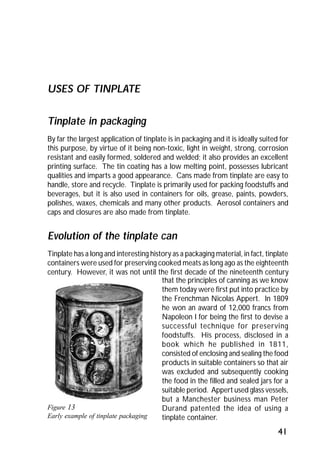
Figure 13 
Early example of tinplate packaging 
that the principles of canning as we know 
them today were first put into practice by 
the Frenchman Nicolas Appert. In 1809 
he won an award of 12,000 francs from 
Napoleon I for being the first to devise a 
successful technique for preserving 
foodstuffs. His process, disclosed in a 
book which he published in 1811, 
consisted of enclosing and sealing the food 
products in suitable containers so that air 
was excluded and subsequently cooking 
the food in the filled and sealed jars for a 
suitable period. Appert used glass vessels, 
but a Manchester business man Peter 
Durand patented the idea of using a 
tinplate container.
The first true canning factory in the world was set up in Bermondsey, London, 
by two English engineers, John Hall and Bryan Donkin, using tinplate from the 
Worcester Tinplate works; by 1812, a variety of perishable foods packed in 
“boxes of tinned iron” were on sale to the public. Cans of this type were taken 
by Captain Parry on his voyages of Arctic Exploration and on return from the 
first voyage, which led to discovery of the North West Passage, Parry himself 
wrote letters testifying to the excellence of the preserved foods. The “tins” 
used by Captain Parry were far removed from the cans of today. They were 
made from a tinplate which comprised wrought iron sheet coated by hot dipping 
with layers of tin about 0.1 mm thick (considerably thicker than modern coatings). 
The cylindrical can body was made from a rectangular tinplate sheet, the seamed 
joint being secured by soldering on the inside surface of the can. The lower end 
of the can consisted of a flanged tinplate disc and this was secured to the body 
by soldering it to the flange around the bottom edge. The top was soldered in 
place after solid food had been inserted and the liquid contents were added 
through a hole about 25 mm in diameter which was left in the centre of this lid. 
Finally, a small tinplate disc was soldered over this hole, to close the can 
completely. Opening these early cans required a chisel and some degree of 
strength; various patent closures and methods of opening them (the first can 
openers) were devised over the ensuing years. These first cans were expensive, 
since a skilled craftsman could only make 5 or 6 cans per hour. 
42 
Figure 14 An early cannery
With the enormous expansion of the American canning industry in the second 
half of the nineteenth century, developments, both in can design and rate of 
production, came rapidly. Whilst William Underwood was credited with making 
the first can sold in America in 1819, it was Gail Borden who was largely 
responsible for the wide acceptance of the can as a food container in the 1850s. 
He introduced canned condensed milk in 1853 and this was responsible for a 
significant lowering of the infant mortality figures, particularly in areas where 
fresh milk was not readily available, and helped to make the American consumer 
see the can as a safe, healthy preserver of food. After 1860, the art of canning 
was well on the way to becoming the science that it is today. 
A major development was the introduction in the 1890s, of the first complete 
mechanised system for making cans, starting from sheets of tinplate and 
producing up to 6000 cans per hour. Up until the early part of the twentieth 
century the side seam solder had always been applied to the inside surface of 
the can. However, at this time, the “sanitary” can was developed, so called 
because the solder was now only applied to the external surface and the end 
was fixed by a mechanical double seam. 
Whilst the can makers were developing their techniques, materials were also 
evolving. Between 1875 and 1885 steel gradually replaced iron as the basic 
material for tinplate. From then until 1929, there was a slow but steady evolution 
in the procedure for making tinplate. In 1929 cold reduced steel was introduced, 
thereby providing a more uniform and higher quality product. The importance 
was realised of controlling the chemical composition of the steel. When 
electroplating was introduced by a German chemist in the 1930s as a means of 
applying the tin coating, it represented a major advance in the technology of 
tinplate, but it was not widely adopted until 1942, when wartime shortages 
forced its acceptance, as a means of conserving tin. 
A significant new market for the can had become apparent after 1935 when, 
following the development of suitable internal coatings, the first beer cans were 
test marketed. 
The tinplate can was further improved in the decade and a half following World 
War II. Line speed was increased to over 500 cans per minute for each soldering 
bodymaker and this was accompanied by an increase in quality and reliability. 
The first semi-automatic side-seam welding machine for can bodies was 
manufactured in 1959, but it was not until 1975 that the first three-piece food 
and beverage can bodies were capable of being continuously welded at high 
speeds. 
Organic coatings, which had already been introduced to increase the resistance 
of the can to certain aggressive products, were vastly improved by the 
introduction of acrylics, vinyls, epoxies and phenolics. The introduction of an 
43
aluminium “easy- open” end in 1962 was highly significant in improving the 
convenience aspect and led to increasing sales of beverage cans. The process 
of drawing and ironing two-piece cans was perfected in 1963, initially in 
aluminium and, by the early 1970s, in tinplate also. The lighter weight, thin-walled, 
D&I cans offered many economic advantages. The aerosol container, 
first introduced commercially in the 1940s, has represented another major outlet 
for tinplate, where today it is made by both three-piece welding and two-piece 
D&I techniques. 
Since 1970, canmaking technology has been transformed by the continual 
development of the modern techniques of two-piece and three-piece 
manufacturing. These are leading to a more economical and cost effective use 
of materials and consequent reduction in environmental impact. Details of these 
and of the older can making techniques are given in the following section. 
Three-piece can 
The three piece can is so called because it consists of a cylindrical body and two 
ends. The first modern can design had a soldered side seam on the body but in 
recent years this has almost totally been replaced by a can having a welded side 
seam body. 
Three-piece can - soldered side seam 
The first stage in making a soldered three-piece can is the forming of the cylinder 
which constitutes the body. Flat sheets of tinplate are slit into blanks. These 
are notched at each corner of one edge, slits being cut a little way from the 
ends at the outer edge; the edges are then hooked over, one up and one down, 
at 28° to the blank. Flux is applied to these hooked edges by contact with a 
revolving wheel partly immersed in flux. 
On the bodymaker, the blank is folded over a mandrel so that the hooked edges 
engage, whereupon the mandrel expands to tighten the joint and form a cylinder. 
This lock seam, located on the underside of the can, is next hammered down 
flat. In the soldering station, the cylinders pass over a gas heater, to pre-heat 
the seam, which then slides in tangential contact with the top of the rotating 
roll immersed to its centre line in a bath of molten solder. Extra heating 
afterwards helps the solder to flow through the seam and a wiper removes 
excess solder. A splash eliminator ensures that wipings do not contaminate the 
can following the one being wiped. A 98% lead-2% tin solder was commonly 
used. However, for certain products other solder compositions, even those 
including pure tin side seam solder, have been used. 
44
When a fully lacquered interior is required, the side seam may be protected by 
a side stripe of lacquer, which is applied immediately downstream of the 
bodymaker. On a soldered can, the heat of soldering is sufficient to cure the 
side stripe. 
Further operations to complete the manufacture of a three-piece soldered can 
are identical to those used for a welded can and are described in the next 
section. 
Three-piece can - welded side seam 
Because of its greater integrity and total absence of solder, which may have 
contained lead, welding is now the most accepted method of creating the side 
seam of a three-piece can (Figure 16). The technique of welding side seams on 
can bodies involves producing a series of overlapping weld nuggets along the 
length of the seam, using a suitable alternating current supply and copper 
electrode wheels. A problem with welding tinplate with copper electrodes is 
that as the tin melts it tends to alloy with the copper, thus altering the electrical 
characteristics. This has been overcome by using a copper wire as an 
intermediate electrode material. The wire is threaded over the rims of two 
electrode wheels and being slightly proud of the surface of the electrode makes 
direct contact with the tinplate surface; as the tin melts it is carried away on the 
wire and fresh copper is available for further welding. Immediately prior to the 
welding operation, the wire is flattened to a rectilinear cross section so as to 
provide a greater surface area. 
On the bodymaker line, a tinplate blank is formed into a cylinder with suitable 
overlaps, approximately 0.4 mm, and firmly held in position by calibration rollers 
during passage through the unit. The welding electrodes (wheels carrying copper 
wire as described above) are situated one above the other. The lower electrode 
is smaller in diameter than that of the can body and the cylinder moves in such 
a way that the lower electrode is inside it; the seam thus lies between the two 
electrodes. When the current is passed between the electrodes, a series of 
spot welds is produced as the container moves, these constituting a continuous 
weld. The upper electrode, which is outside the can, is mechanically loaded so 
that the two layers of overlapping tinplate are squeezed together as they pass 
between the two electrode wheels. The result of this is a mechanical weld 
with total thickness equivalent to approximately 1.4 thicknesses of body metal. 
After the welding process has been completed a layer of oxide will form over 
the weld on both the inside and outside of the can. If it is necessary to provide 
a lacquer coating over the side seam weld and to later form beads in the wall of 
the can, it is usually necessary to prevent the build-up of a heavy oxide layer on 
the weld by providing an inert gas shield for the welding process. Failure to do 
45
46 
Figure 15 
Selection of tinplate cans showing the diversity of packaged products 
Figure 16 
A Soudronic machine for making three-piece welded tinplate cans
this may result in lacquer breaking away from the weld area during the 
subsequent beading operation. 
The quality of the weld may be continuously checked by an in-line electronic 
weld monitor device. This checks that the electrical current conditions for 
each nugget of the weld are within the parameters set by the operator for 
production of a satisfactory weld. The device may be set to alarm or 
automatically remove cans from the line when the weld conditions fall outside 
the set parameters. 
Many tinplate cans are protected on their internal surface by a lacquer system; 
the types of lacquer and number of coatings applied depend on the intended 
contents of the can and the specific processing requirements. The exterior 
may be protected by a decorative system which may be a combination of a 
clear size coat, or solid base coat, plus printing inks and over varnish. Lacquers 
are formulated to give corrosion and process resistance in conjunction with 
adhesion, flexibility, non-toxicity and freedom from taint. Film thicknesses 
generally lie in the range 1.5-10 mm. The essentials of the lacquering processes 
are described in standard texts. (See also Chapter VI). 
Many tinplate cans have a plain exterior, with paper labels applied to identify 
the products. However, where the exterior of three-piece cans are to be 
decorated, the tinplate sheets are printed in the flat, prior to being slit into 
body blanks. Similarly, internal lacquer coatings are applied by roller coating to 
the flat sheets, normally in a stencil pattern to leave the seam margins free from 
lacquer. 
Side seam lacquering on the welded can is carried out immediately after making 
the welded joint. It may be done using either a liquid or a powder coating 
material. In each case the coating is then cured by a gas fired heating device. 
Following body forming, the subsequent operations are identical for both 
soldered and welded side seam cans. 
When the height of a three-piece can is equal to or less than its diameter it is 
relatively unstable when being fed at high speed through a bodymaker with the 
axis of the can horizontal. For this reason, it is common to initially form a 
seamed can body which is two or three times the height of a single can. After 
the soldering or welding operation this long body is then passed through a parting 
machine which separates the long body into two or three short bodies, as 
appropriate. From this point onwards the can bodies are then conveyed with 
their axes in the vertical position. 
Three-piece beverage can bodies are very often necked in at both top and 
bottom, so that the diameter over the seam is equal to or less than that of the 
body itself. There are a number of reasons why this is done; the uninterrupted 
47
body wall allows for easier handling of cans at high speed, particularly during 
collating of filled cans into cardboard trays, and permits the cans to be packed 
into a smaller volume; also the reduced flange diameter permits smaller diameter 
and, sometimes, thinner ends to be fitted with a consequent reduction in metal 
usage and therefore cost. 
For food cans, inward necking of the top (opening end) of the can body may be 
done if the product consistency is such that emptying the can is not made difficult 
by the reduced diameter of the seam. In some cases the top of a food can may 
be necked outwards to facilitate product removal, particularly when a full 
aperture easy-open end is fitted. Inward necking, of the bottom end only, of a 
three-piece food can is done to permit easy stacking of filled cans. 
The next step is to flange the top and bottom edges of the cylinder so that a 
rim is formed at 90° to the vertical axis of the cylinder; the condition of the 
base steel, in particular freedom from inclusions and the correct temper, as 
well as rolling direction of the steel, are important if flange cracking is to be 
avoided. The use of spin flanging as opposed to die flanging is also important in 
this respect. 
The bottom end is fixed on to the body at the double seaming machine, where 
the closure is attached by the operation of two-stage seaming rolls whilst the 
can is spinning about its vertical axis. For beverage cans it is usual for the 
canmaker to fix the easy open end to the can at this point, leaving the plain end 
to be fixed by the can filler. This sequence of events permits the easy open end 
to be pressure tested after it is fixed to the can and as a routine part of the can 
making operation. Manufacture of can ends is described in a later section of this 
Chapter. 
For food cans, which will be passed though a heat processing cycle after filling 
with product, the side wall must have sufficient strength to withstand the 
considerable external forces acting on it during the sterilisation process. This 
may be achieved by either making the wall of sufficiently thick material that it 
will withstand these forces as a plain cylinder, or reinforcing the wall by addition 
of numerous circumferential beads and then utilising a much lower gauge of 
material. For economic reasons the latter route is the more common way of 
making processed food cans today. 
For non-beaded cans that may require further body shaping operations, such as 
bulging or embossing, the appropriate operation will generally be introduced at 
this point in the process. 
Finally, the can’s integrity is checked in a leak tester, typically, a rotating carousel 
arrangement on which cans are mounted; testing occupies one full turn of the 
carousel and consists of electronically monitoring the rate of pressure loss 
48
when the open end of the can is sealed by a pad and compressed air introduced. 
Defective cans are rejected whilst sound cans are either fed directly to the 
filling lines or to a palletising station for onward shipment to a can filler. 
Shallow drawn cans 
Shallow containers, made by a single draw from a flat sheet of tinplate, may be 
finished cans for products like sardines or pies or they may be the first step in 
the manufacture of two-piece deep drawn containers which are described next. 
Shallow drawn cans may be round or square in cross-section and, with the 
application of special forming techniques may be produced with tapered walls 
in a single draw. Tapered walls permit the empty cans to be nested for more 
economical shipment over long distances. Single draw cans for food or general 
line purposes provide an ideal application for the use of distortion printed 
tinplate. 
Drawn and wall-ironed cans 
The development of the draw and wall ironed (D&I) can began in Switzerland 
during the Second World war when tinplate became virtually unobtainable for 
package manufacturing and 
aluminium was the only other 
material available. As aluminium 
could not be used for making 
three-piece cans, it was necessary 
to develop a seamless form of can 
body instead. Some twenty years 
later, in 1963, the first commercial 
aluminium D&I beer cans were 
made and filled in the USA. Only 
when the steel substrate could be 
made clean enough could the D&I 
process be adapted to use tinplate. 
The major application for the D&I 
can is for beer and beverage cans, 
although the use of tinplate D&I 
cans for both human and pet foods 
is now well established in both the 
USA and the UK. D&I cans are 
most appropriate where large 
volumes of cans with similar 
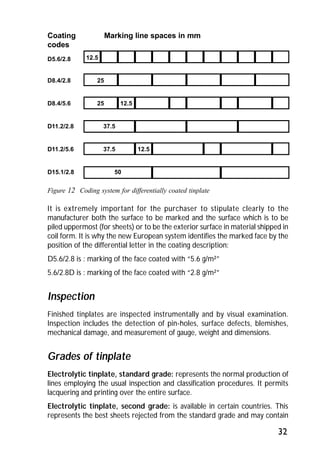
49 
Figure 17 
Flow line for the manufacture of a 
drawn and ironed two-piece tinplate can
specifications are required. In these situations, where cans with a large height 
to diameter ratio are required, the D&I process is the most economical of all 
the known can manufacturing processes in terms of metal utilisation. 
Plain tinplate, in coils of 
approximately 10 tonnes 
weight and up to 1200 mm in 
width, is the starting material 
for D&I can manufacture 
(Figure 17). The tin coating is 
normally left in the 
unflowmelted state to 
maximise the amount of free tin 
available to act as a lubricant 
during the wall ironing process. 
Prior to the first forming 
operation a water based 
drawing lubricant is applied to 
both sides of the metal. Using 
a double action cupping press, 
multiple discs are blanked-out 
across the full width of the coil 
and then, in the same tooling 
stations, drawn into shallow 
cups (for 33cl cans, dimensions 
at this stage are typically 82mm 
diameter and 34mm height). 
Figure 18 
Schematic view of the wall ironing process 
in two-piece D & I can manufacture 
The cups then enter the wall ironing bodymaker. Modern commercial units 
are single action horizontal power presses, with redraw facility, capable of 
operating at 300 - 500 strokes/min. depending on can type and size. A special 
punch, which has the same external diameter as the inside of the finished can, 
forces the cup through a series of annular dies (Figure 18), the first of which 
redraws the cup to the finished can diameter; the remaining dies iron the wall 
of the can, reducing its thickness and at the same time increasing the overall 
body length. The base remains constant in thickness and diameter during the 
ironing process. At the end of the forward stroke, after the can has passed 
through all the wall ironing dies, its base is domed to give it greater strength. 
The ironing results in a very bright finish on the formed body. The can is 
removed from the punch, after forming, by a stripping mechanism. It then 
passes to a trimmer which removes the irregular top edge and leaves a can shell 
with the precise wall height required for later forming operations. Trimmed 
cans travel to a washing unit where they are chemically cleaned, to prepare the 
surface for receiving exterior and interior organic coatings. Because of the 
50
extreme deformation which the metal had to undergo during the drawing and 
ironing process, it was necessary to virtually submerge the can in a continuously 
circulating lubricant / coolant. All traces must therefore now be removed 
during the washing operation. Proprietary chemical cleaners are used for this 
purpose followed by rinses in fresh and finally de-ionised water. 
The next stages are coating and decorating. Unlike three-piece cans, the metal 
cannot be decorated in the flat and special coating and printing units are employed 
to operate on the external surface of the cylindrical body. Whilst the decoration 
is still wet, a coat of varnish is also applied to the bottom rim and part of the 
concave dome of the base. The whole is then cured. Protective lacquer is 
sprayed inside the cans followed by baking to remove all the solvent and cure 
the coating. Two interior coatings may be applied, with curing after each 
application, especially when soft drinks are to be packed. For drinks cans, the 
final operations involve a reduction in diameter of the top of the can (necking-in), 
followed by outward spin flanging to prepare the can for closure. Necking-in 
allows the end seam to be kept within the diameter of the can body for ease 
of stacking. It also allows a smaller diameter can end to be used, providing 
material savings. For processed food packaging, the D&I can is not necked-in 
but has a flange formed by spinning. The walls are then beaded for additional 
strength, to prevent implosion of the can during the thermal sterilisation process. 
Finally, all cans are tested to ensure freedom from leaks. 
51 
Figure 19 The drawn and ironed tinplate can: stages of manufacture
52 
Figure 20 Commercial DRD cans
This D&I can-making process imposes severe requirements on the quality of 
the steel substrate. It must be clean to avoid an unacceptable level of wall splits 
or flange cracks; composition must be controlled to give correct temper and 
formability; drawability and earring can influence operational performance, e.g. 
stripping from punches; the number of pinholes and welds must be controlled; 
gauge control within strict tolerances is essential. 
Draw-redraw cans 
Seamless two-piece cans are also produced by a sequential drawing operation 
known as draw-redraw (DRD). In this process, the can walls are not thinned 
and therefore containers may have sufficient strength to withstand processing 
without body beading. These cans are suitable for holding foodstuffs such as 
tuna fish, salmon, some fruits, vegetables and meats. However, the walls of 
DRD cans are thicker than is strictly needed which is wasteful in material. Sizes 
are best restricted to those with small height to diameter ratios where the 
material contained in the can wall represents a lesser proportion of the total. 
The process has considerably lower installation costs than drawing and ironing 
and is generally best suited to smaller annual production volumes e.g. 50-200 
million per annum. Line speeds for DRD are normally in the range of 50-1000 
cans per minute. 
In the draw-redraw process, can bodies are produced in two or more stages 
from flat pre-coated tinplate. The number of drawing stages depends on the 
height to diameter ratio of the container required. The material used for DRD 
cans is usually pre-coated with lacquer or polymer film on both sides in either 
coil or sheet form. 
The material is fed into the first stage, which cuts a circular blank and draws a 
shallow cup in one operation. The press used for this operation is similar to 
that used for cupping in the D&I process. These cups are then transferred to a 
second press for redrawing. Normally this press will also form the base panel in 
the can. The last drawing operation is usually not completed, leaving a flange of 
uneven width. The flange is then die trimmed to leave a clean edge of consistent 
width for seaming. 
Cans may be beaded to give the walls extra rigidity. The bottom portion of the 
can wall may be stepped-in to permit easy stacking. Tapered cans have also 
been developed, principally for salmon products, which are fully nestable to 
reduce shipping costs. Irregular (oval and rectangular) DRD cans are also 
produced by the same basic process for various fish and meat products. 
53
Can ends 
Ends for two and three-piece cans are usually stamped from scrolled sheets, 
i.e. sheets sheared in a pattern which minimises scrap loss by allowing staggered 
rows of circular ends to be stamped. The sheets are then inspected for surface 
appearance, correct gauge and absence of pinholes. High speed presses for 
making can ends stamp the end into the required profile. Leaving the stamp 
press, the ends are fed into a curling unit and then to a machine which applies 
a sealing compound around the inside of the curled edges; this ensures an 
hermetic seal when the closure is seamed on the can body. The ends are cured 
for 2-3 minutes. Bottom ends meet three-piece can bodies in can-making 
plants; top ends meet both two-piece and three-piece cans at the end of the 
filling line. 
54 
Figure 21 Seaming can ends
Ecology easy-open ends [“Stay-on-tab”] are widely made in aluminium for 
beverage cans. For such ends, the limits of the aperture are scored in the metal 
and a tab is riveted in place so that on lifting the tab, the aperture is ruptured 
inwards allowing access to the contents. The tab and aperture remain attached 
to the end. Different aperture shapes are available, the most common being 
oval. Increasingly, a “Gulper” or large opening end [LOE] is being used as this 
allows the product to be dispensed more rapidly from the can. Manufacturing 
speeds continue to rise substantially with multi-die shell and conversion presses 
predominating. 
A number of beverage tinplate easy-open ends have been developed though 
not widely commercialised; with a harder, springy material like steel, the scoring 
operation is even more critical since the scoring must be deep enough to 
permit detachment by pulling, yet not so severe as to introduce a risk of leakage. 
Furthermore, there must be no damage to fingers from sharp edges. One 
design developed in Australia has a press-button can end for beer and soft 
drinks cans. There are two circular press tabs of different sizes. These tabs are 
integrally hinged to the end and cannot be detached, thus they neither fall into 
the can contents nor add to litter problems. The end is opened by first depressing 
the smaller tab to release gas pressure and then depressing the larger tab to 
allow the contents to be poured. In a modification the smaller tab is situated 
55 
Figure 22 Easy-open can end
inside the larger opening; this obviates the risk of contents spurting out when 
the buttons are pressed in. These ends are manufactured by subjecting a normal 
end to a series of stamping operations, using transfer presses to form the tabs 
and apertures, applying a sealant around the internal cut edges to prevent 
corrosion and to provide an hermetic seal and coating the external cut edges 
with a repair lacquer. Tolerances for the die stages are said to be less critical 
than in the case of ring-pull openings and only low press tonnages are needed. 
Aluminium and tinplate full aperture easy-open ends have been developed for 
both dry and processed foodstuffs. Normally, the full-aperture end is operated 
by a riveted ring-pull, similar to that used for beverage containers but detaching 
with the centre panel of the end. The end is scored circumferentially close to 
the end seam, so that the maximum area of the end is open when the panel is 
removed. Steel provides better performance for a given end thickness and is 
therefore more common where the food processing produces high internal can 
pressures. Harder steels have been the trend with much development around 
the industry currently focused toward using double-reduced steel. This latter 
material is already common for classic [non-easy open] ends. With steel in 
particular, careful attention must be paid to all stages of the manufacturing process 
if a high level of end consistency is to be achieved. The achievement of acceptably 
low opening forces requires similar attention to product design. 
Some aluminium full aperture ends have folds along one or both of the score 
edges as a safety feature. These are generally manufactured by collapsing a 
stepped shell profile in the conversion press during end manufacture. 
Certain meat and fish packs have key opening. In the case of the meat packs, 
normally in rectangular cans, a narrow strip is scored into the can wall. This is 
removed from the body by inserting a tag from the strip into a metal “key” and 
winding off a metal strip, thus releasing one end of the container. In the case of 
shallow drawn containers for fish, one end is scored around the perimeter and 
the entire end is wound off using a detachable “key”. 
Closures 
In addition to ends for cans, tinplate is used to make bottle closures e.g. crown 
corks with characteristic corrugated rims and cork or plastic pad as sealant, 
ensuring a tight hermetic seal when applied to a bottle. Sheets of tinplate 
decorated with the bottle top pattern, are coated with wax and then passed to 
automatic presses which produce the bottletops from a series of dies. A blanking 
punch cuts out the cap and the drawing punch passes through to form the 
crown. After blanking and forming, the closures are lined with composition 
cork, or moulded polythene reseals, or flowed-in plastic liners. 
56
A wide range of other glassware closures is produced in pre-decorated tinplate. 
Pre-formed screw caps are produced on special presses from decorated and 
lacquered tinplate and contain a plastic liner to ensure an hermetic seal. “Twist-off” 
57 
closures are also made from tinplate stamped from sheet. 
Aerosol containers 
The aerosol container has been a recognised form of packaging since it was first 
introduced during World War II as a heavy gauge dispenser designed to withstand 
low pressure. Since then, it has undergone many modifications in design and 
construction and its use is constantly increasing at an annual rate of 3 to 5% 
world-wide (production of roughly 10 billion units in 1996/1997) to pack a wide 
range of products, including personal care, household, automotive, industrial, 
paints and varnish, pharmaceutical and recently food products. 
Metal is the predominant material used in the manufacturing of aerosol containers 
and steel for packaging (tinplate and electrolytic chromium coated steel) has by 
far the greatest share of the market world-wide. 
The standard steel aerosol container is a 3-piece can, with diameters varying 
from 45 to 65mm. It offers a range of internal pressure resistance from 12 to 
18 bars with the advantage that the can body does not need to be changed no 
matter what the pressure is. Indeed, only the cone and/or the dome have to be 
modified when pressure specifications vary. 
The thickness of the steel for packaging used for aerosol applications ranges 
from 0.18 to 0.23 mm for the body and from 0.26 to 0.36 mm for the end 
components. Tin coating weight is most usually E 2.8/2.8. 
The tinplate base of the aerosol container has a concave profile to increase its 
pressure resistance and safety requirements for internal pressure resistance up 
to 18 bars imply that pressures at least twice these must be withstood in testing. 
After the curl has been lined with sealing compound and cured, it is double 
seamed in place in the usual manner. 
Constant technical developments have helped in improving the technical 
performance and appearance of the welded seam of the 3-piece steel aerosol 
can body. Indeed, today the electrical welding process is constantly being used, 
which allows printing closer to the seam. Moreover, the use of powder coatings 
applied internally on the side-stripe area of the welded can protect the inner 
face of the weld seam from highly corrosive products. 
The top section of the aerosol container is a much more complex shape and 
its production may involve as many as seven successive tooling stages in a 
transfer feed press, starting from a flat steel disc. The disc is first drawn to a
dome shape, then re-drawn in a more complex profile, pierced at the centre, 
“blocked and guttered”, trimmed to restore exact circularity, curled at the top 
edge and finally curled at the bottom edge, for attaching to the body in a double 
seam. The tops are lined and cured before being attached to the body. After 
leak testing, the containers are palletised for despatch to the filler. Contents 
are inserted through the top aperture and a valve cup, also usually in tinplate, is 
swaged in position to complete the closure. 
Butane/propane is today the standard propellant used in aerosol containers. 
There are various ways of inserting the propellant, by injection into the completed 
can through the valve system or by inserting the propellant through the aperture 
just before swaging on the valve cup (as refrigerated propellant or after creating 
a vacuum in the container). 
Recent years have seen many technical and technological developments in steel 
aerosol can manufacturing, and among these major changes are the following: 
The 38mm diameter 2-piece steel aerosol can, consisting of a welded body and 
dome, opens the market of small size aerosol applications to steel cans. This 
was made possible by the development of a new process enabling welding of 
the body of narrow steel cans electrically. Moreover, the coneless aerosol can 
required the development of an ultrasonic necking process which allows standard 
aerosol valves to be used. 
The 2-piece steel aerosol can uses the DWI technique, which means a can body 
without seam. Together with economic benefits which mainly result from 
58 
Figure 23 DWI aerosol cans
material weight gain of about 20%, this product offers a number of interesting 
characteristics, such as an environment friendly can, its richly coloured decoration 
provided by a 360° rotation dry offset press with six prints. This new aerosol 
container is expected to widen the use of steel aerosols in the personal care 
segment where the appearance of aluminium aerosol cans had prevailed so far 
(Figure 23). 
Finally, the shaped aerosol steel cans offer brand differentiation (Figure 24). 
Figure 24 Shaped aerosol cans 
The use of aerosol containers to dispense food products such as cream topping, 
has been slow to develop. Either a completely non-toxic propellant must be 
used, or the foodstuff must be enclosed in a sealed pouch within the container, 
the propellant being located outside the pouch. 
General line containers (industrial & decorative) 
An important use for tinplate is in general line containers, which are used for 
the storage of chemicals, dry goods, paints, tobaccos, oils, and other products. 
The size and shape of these containers can vary considerably, from boot polish 
tins to large oil drums and the methods of manufacture are equally varied 
including mechanical seaming, soldering, welding and cementing. However, in 
general, production rates are nowhere near as high as in making cans for food, 
beverages or aerosols and semi-automatic equipment is often employed to form 
individual containers. Automated assembly lines, however, are used for many 
standard products such as round and square boxes, and also rectangular 
containers. Welding methods have also largely been introduced for containers 
which need to be liquid tight. 
59
Decorative tin boxes have a long and colourful history and many are today 
collectors’ items (Figure 25). The starting material is decorated tinplate sheet 
which is subjected to a series of manual forming operations. Joints are made 
mechanically, by engaging hooked edges and rolling flat, since the containers do 
not need to be hermetically sealed. Lids have their edges curled over, to avoid 
sharp edges and to ensure a good fit on bodies. When hinged lids are needed, 
wire may be inserted in specially made flaps in the body wall and an extra large 
flange on one edge of the lid is fitted around the wire, the whole being flattened 
down to secure the wire in place. There is also a technique available where 
hinges are made without the use of wire and interlocking cut-outs are made in 
both the lid and the body. In the case of circular tins and square tins with round 
corners, the body may be made by forming a blank into a cylinder in a single 
draw operation and then mechanically seaming on a ring onto which to mount 
the lid. Distortion printed sheet would normally be used for this process. 
60 
Figure 25 A selection of fancy boxes 
For containers such as paint cans, up to one litre capacity, mechanical integrity 
may be ensured by applying a special cement along the side seam before finishing 
and finally heating the container to cause the cement to flow in the joint, 
although today many such cans are likely to be of welded construction. In the 
case of large 20-25 litre drums, the seams will usually be welded. Tops and
bases are stamped from tinplate sheet and seamed in place. Handles are also 
made from tinplate and are secured by spot welding. Depending upon the 
application, the tinplate thickness may vary from 0.18 to 0.41 mm and the tin 
coating masses from E1.4/1.4 to E8.4/8.4. 
Special technical packs 
The fabricability and the corrosion resistance of tinplate, lacquered if necessary, 
make it particularly suitable for containing chemical and other industrial products 
such as adhesives, sealants and fuels. Rectangular packs provide a better 
utilisation of transport volume: 30 litre rectangular containers allow twelve to 
be stacked on a standard pallet, as opposed to six cylindrical ones. They also 
have good rigidity. Tinplate screw caps are often used for chemical packs; tests 
have demonstrated that such closures can withstand considerable deformation 
before any leakage is observed. Two-piece cans with a diameter of 72 mm and 
a height of 112 mm have been produced by drawing in a multi-stage operation, 
starting from 0.34 mm thick killed steel base material with an E 8.4/8.4 tin 
coating. This type of can is stated to be resistant to 10 atm pressure without 
permanent deformation and is approved in Germany for use with poisonous 
products up to 370ml volume. Two-component containers have been produced 
for packaging two compounds which have to be reacted together shortly before 
use. In one design, the upper portion constitutes both the lid for the lower 
vessel and a container for one of the reactants. The upper container has a 
conical form and is made by a combination of drawing and spinning, using tinplate 
with a tin coating of E 8.4/8.4 or E 11.2/11.2. 
Engineering uses of tinplate 
The excellent fabricability of tinplate, its solderability, attractive appearance, 
and corrosion resistance have led to a diversity of other uses besides packaging, 
although none of these individual uses represents a large tonnage outlet. A 
number of automotive applications exist, such as in the manufacture of engine 
gaskets, brake line tubes and oil filters. 
61
63 
CAN PERFORMANCE 
Tinplate’s long and successful record as a packaging material is due to its 
consistent performance in preserving packaged goods so that they are intact 
and still in good condition when the container is opened. The favourable 
properties of tinplate are important in this connection, but just as important is 
the research and development work which goes into understanding the 
interactions which can take place between the container and its contents and 
into tailoring the properties of the packaging material so as to overcome possible 
corrosion problems. In order to understand the can/product system, it is useful 
first to look briefly at the canning process. 
Canning of foodstuffs 
The purpose of canning foodstuffs is to preserve the freshness of the product. 
Close co-operation is maintained between farms and canneries and the latter 
are usually situated in the principal farming areas. Once fruit or vegetables are 
picked, care is taken to see that the food is packed within a few hours whilst in 
the peak of condition. It is interesting to note that whereas “canned” foods are 
commonly contrasted with “fresh foods”, in fact the contents of the can are 
often hygienically and nutritionally superior to fresh foodstuffs which have been 
on display for a day or so at a retail outlet. 
The principal foodstuffs, which are canned, comprise: fish, fruit, meat, milk 
products, pet foods, soups and vegetables. At the cannery the food is inspected, 
cleaned and graded; when necessary it is prepared by peeling, shelling, cutting-up, 
etc. In some cases the food is given a short cook so that any initial shrinkage 
takes place before the can is filled. As will be seen later, the amount of air in 
the headspace must be kept as low as possible, to avoid corrosion problems 
and after filling, the can closure is seamed on. The vital step in the canning of 
foodstuffs is that of sterilisation. The filled and sealed cans are passed through 
a processing unit in which they reach the required temperature (typically 115- 
127°C for vegetables) to kill bacteria which could be harmful to health, or 
cause spoilage of the contents. The contents are also cooked during this 
processing so that they require little or no further preparation. The slight 
vacuum in the can prior to this heating helps to avoid expansion of the container
during processing and the cans are rapidly cooled after the heating stage. 
In general, meat, fish and soups in cans may be stored for some years without 
any deterioration in quality. In the case of beverages, these are pasteurised by 
heating the can, and a sterilisation cooking process is not required. 
The container/product system 
Food products and beverages are all extremely complex systems, which can 
differ with respect to pH, buffering properties, content of corrosion inhibitors 
or accelerators, and consistency of product. Foodstuffs may be broadly classified 
into categories such as “highly corrosive”, “moderately corrosive”, “slightly 
corrosive”, “highly detinning” etc., on account of their typical behaviour. 
However, a number of variables may intervene to alter the pattern of behaviour. 
These factors include: biological variance in the natural product; trace residues 
from exterior influences such as heavy use of fertilizer, use of pesticides, feeding; 
processing effects, e.g. pre-treatment with sulphur dioxide; and specific filling 
conditions which influence the amount of oxygen in the headspace of the can. 
Can performance 
Optimum can performance depends on controlling the electrochemical reactions, 
which tend to occur within the can/product system. Some effects, which may 
appear, are general type corrosion, which proceeds gradually and tends to spread 
laterally rather than penetrating metal at localised points. It can be controlled 
within acceptable quality limits by good canning, storage and distribution 
practices. Pitting type corrosion occurs at sharply localised areas and tends to 
perforate the metal with very little visible evidence and without noticeable effect 
on product appearance, although it may eventually result in leakage and 
e - icorr bacteriological spoilage of the 
64 
CATHODE ANODE 
Fe 
FLOW 
OF ELECTRONS 
- Sn2+ 
H2 EVOLUTION 
ELECTROLYTE 
UNATTACKED 
IRON 
Sn 
TIN SLOWLY 
DISSOLVES 
Figure 26 
Schematic representation of electrochemical 
processes taking place in a tinplate can 
can contents. It can be avoided 
by proper matching of product 
and can material systems. 
To visualise the corrosion 
processes which may occur in a 
filled can, it is helpful to consider 
a simple model (Figure 26). In 
the case shown, when tin and 
iron electrodes are immersed in 
an electrolyte, each will develop 
an uncoupled potential, which
can be measured by suitable means. In connecting the two electrodes, electrons 
will flow through the circuit and polarisation will take place at the electrodes. 
At equilibrium the electron flow will constitute the corrosion current icorr. At 
the tin electrode tin will pass into solution slowly as ions and electrons will be 
released to electrolyte at the iron electrode resulting in evolution of molecular 
hydrogen. One would expect iron to be anodic to tin and in fact in solutions of 
mineral salts or in the atmosphere, this is the case. Fortunately, in the presence 
of many natural products and with limited oxygen supply in the food can, the 
reverse is the case. This is because the complexes which tin forms with 
carboxylic acids reduce the concentration of free tin ions to low levels, and the 
self-corrosion of tin in the absence of cathode depolarisers is very small, due to 
its high hydrogen overpotential. Therefore, in unlacquered cans, when steel is 
exposed to the can contents (at pores or scratches), in the absence of oxygen, 
tin dissolves preferentially. In view of the relatively large area of tin compared 
to exposed iron, this tin dissolution occurs smoothly and slowly; the presence 
of dissolved tin also inhibits the cathodic reaction on exposed steel and the net 
effect is a long period of an almost steady corrosion rate lasting until substantial 
areas of steel are exposed and iron begins to pass into solution. Hydrogen 
evolved at a slow rate in the initial period of corrosion seems to pass into, or 
through, the steel but at the later, faster, stages of corrosion, considerable 
quantities of hydrogen are produced, which will eventually distort the shape of 
the can. Such “hydrogen swells” are considered unacceptable since they cannot 
be distinguished visually from those which would arise from bacterial activity in 
the can, and such damaged containers must be discarded. However, due to the 
protective action of the tin in a largely oxygen-free environment and since in 
many natural products tin complexes are formed which inhibit corrosion, 
hydrogen swells normally occur only after a longer period than the expected 
shelf life of the product at the point of sale. 
In some foods, the difference in corrosion potential between tin and steel may 
be small; coupling tin and steel together in such a foodstuff alters the steel 
potential but not sufficiently to provide complete cathodic protection. Thus, 
iron exposed at pores may dissolve and the cans fail by perforation. The 
formation of films on tinplate, for example by reaction with sulphur-bearing 
compounds, may also result in pitting; film formation hinders the anodic reaction 
on tin and hence its ability to protect exposed steel. 
An important influence on the rate of dissolution of tin is the presence of cathode 
depolarisers such as oxygen, nitrate or sulphur dioxide, which permit an 
alternative cathodic reaction to the reduction of hydrogen ions to hydrogen. 
The presence of dissolved oxygen in the electrolyte thus greatly increases the 
corrosion rate of tinplate. Oxygen reduction to hydroxyl ions proceeds rapidly 
on tin, the rate of the reaction being frequently governed by mass transport 
65
rather than electrochemical influences. Oxygen is initially present in the can 
headspace and this leads to an initial period of tin dissolution after which the 
rate slows down when all the oxygen is consumed. Elimination of oxygen prior 
to can closure thus greatly contributes to shelf life. Other depolarisers, which 
can accelerate the corrosion rate, are nitrates, colouring matter in dark fruits, 
copper traces and so on. Nitrates, which may arise from fertiliser residues, 
have been particularly troublesome on occasion. Some compounds, such as 
sugars and starch products are believed to act as corrosion inhibitors. 
So far, only the simple system: steel with a tin coating, has been considered but 
in practice, tinplate is a much more complex system, as can be seen from Figure 
27 which, in section, illustrates the various layers present on the steel surface in 
a commercial tinplate. 
0.002µm 
OXIDE 
0.002µm 
OIL 
0.35µm 
TIN 
0.15µm 
TIN-IRON 
COMPOUND 
200µm 
STEEL 
The iron-tin intermetallic compound which is formed by reaction between the 
tin coating and the steel substrate, largely during flow melting, plays an important 
part in determining the corrosion resistance of the tinplate. As will be described 
later, the alloy-tin couple (ATC) test (see Chapter VII) is important as an indicator 
of alloy layer continuity in a citrus pack application, a factor related to shelf life. 
Once a considerable amount of tin has dissolved, this alloy layer constitutes a 
second line of defence for the underlying steel and also slows down dissolution 
of tin by reducing the iron cathode area. 
Depending on the type and intensity of the electro-chemical treatment, the 
passivation film on tinplate consists of tin oxides and various amounts of 
chromium(III) oxide and metallic chromium. Treatments can be adopted so as 
to produce various film compositions to meet particular end-use requirements, 
but in practice only a few specific treatments are applied. 
66 
Figure 27 Layers existing on the steel substrate in commercial tinplate 
0.002µm 
OIL 
0.002µm 
OXIDE 
0.35µm 
TIN 
0.15µm 
TIN-IRON 
COMPOUND
Performance of lacquered cans 
Many cans today are protected with internal lacquers (sometimes called enamels) 
and this changes the whole corrosion situation. One of the prime reasons for 
employing a lacquer coating is to prevent tin dissolution, enabling a lower tin 
coating mass to be used. Lacquers improve the appearance of the can at the 
moment of opening; they also allow lower tin coating thicknesses to be adopted. 
However, this means that a large tin area is no longer freely available as an 
anodic protective surface, and the integrity of the lacquer coating becomes 
important for complete protection. For many foodstuffs, the porosity of a 
lacquer is not important. However, for aggressive products lacquer helps to 
protect the can during its life. If the products modify the electrochemical 
behaviour so that iron is preferentially attacked, then lacquer improves the 
situation. Care must be taken, however, for if there is a tendency for pitting to 
occur in a plain, unlacquered can, then a thin lacquer coating can only accentuate 
this effect. 
The question of whether to employ a plain or a lacquered can depends on a 
number of factors, including the type of product to be packed, the intended 
shelf life and the wishes and requirements of the consumer. For certain 
applications some tin dissolution is desirable, both to retain flavour and 
appearance of a product. In the absence of dissolved tin, some darkening 
frequently occurs in pale products and changes of colour may become visible 
in green vegetables. Dissolved tin may also have a perceptible effect on the 
flavour of many products, sometimes by removal of sulphides, sometimes by 
suppressing the adverse effects of dissolved iron. Thus ideally, the canner seeks 
to reconcile requirements for a good can appearance, dissolved metal contents 
within acceptable limits and desired appearance and flavour. One approach has 
been to employ a plain tinplate can body, with lacquered ends; another device 
consists of the so-called “high tin fillet” which is a fully lacquered can but with 
a special side seam so sealed with pure tin, that some tin is exposed within the 
can. 
Acidic aggressive products may be protected by a combination of lacquer 
coatings, for example a roller coating applied to the starting tinplate sheet, a 
side stripe applied over a side seam and a final overall spray coating. This 
procedure is usually adopted with beverage cans and containers for beer, whose 
taste is particularly susceptible to the presence of small amounts of dissolved 
metal. 
67
Factors influencing lacquer performance 
Failure of a lacquer to wet the tinplate surface completely produces circular or 
elliptical gaps in the cured coating, commonly known as “eye-holes”. 
Causes include the presence of dust particles, excessive residues of oil, 
application to chilled sheets and surface incompatibilities. Difficulties in wetting 
may sometimes be overcome by a preliminary heating of the tinplate before 
applying the lacquer; this is rather expensive and is only adopted as an interim 
measure until compatibility can be assured. 
Adhesion is an important lacquer property and failure may take at least three 
forms. Cracking and lifting may occur during mechanical deformation, for 
example at a seam, bead or ring. Detachment may occur during heat processing, 
particularly in the case of exterior coatings. Undermining may occur by corrosion, 
often by spread from a scratch or other discontinuity in the lacquer coating. 
The passivation treatment, which the tinplate receives, has a significant effect 
on lacquer adhesion. Both weak and very strong passivation treatments may be 
deleterious under certain conditions and a treatment which gives a total surface 
chromium of about 0.5 mg/cm2 is often favoured for tinplate which is to be 
lacquered. This provides a surface that remains adequately stable in storage 
and can be produced consistently. 
The surface roughness of the tinplate and possibly the thickness of the tin coating 
may be influential as regards lacquer adhesion. Deliberately rough, special surface 
finishes may have disadvantages, whilst very thin tin coatings may produce 
adhesion failures at points of intense deformation where the free tin coating 
may be dispersed. Tests which are commonly adopted to assess lacquer 
performance are described in Chapter VII. These are concerned with coating 
continuity and with adhesion and its loss by deformation or undermining. 
Protecting can contents 
Whereas protecting the integrity of the container is an essential requirement, 
no less important is the need to ensure that the can contents are protected 
from bacteriological attack and from contamination by traces of harmful 
substances. It is important, when tinplate containers are opened by the 
consumer, that they show no changes in appearance internally or in the character 
of the can contents. Even if certain changes are not associated with harmful 
effects, nevertheless they are not acceptable if they suggest deterioration to 
the consumer. There must be no uncharacteristic changes in flavour, colour or 
texture of the foodstuff and the pack must conform with regulations regarding 
metal content of the packed product. 
68
As has been shown, the electrochemical processes taking place within a can 
often involve the dissolution of some tin. It is well established that no ill effects 
can be attributed to regular long term ingestion of tin at the levels normally 
encountered with good canning practice. A few instances have been reported 
of temporary irritation of the gastro-intestinal tract caused by ingestion of 
products with abnormally high tin contents. However, once the tin was voided, 
no long term harmful effects were experienced. It should be emphasised that 
only tin in solution appears to cause these temporary upsets at high levels; in 
solid foods, most of the tin appears to be combined with food constituents such 
as proteins and is rendered innocuous. In many countries, a limit of 250 ppm tin 
has been accepted for many years as a working recommendation for tin in 
foodstuffs. In the UK, a tin in food legislation was published in 1992, setting the 
limit for the level of tin in food at 200ppm. It has been suggested that lower 
limits might be applied to some special categories of canned products, for 
example baby foods and fruit juices. Extremely small amounts of tin may cause 
some loss of clarity in beer and the flavour of this product is extremely sensitive 
to trace metal content, so that multiple lacquer coatings are used for the interior 
of such cans. 
Restrictions on the metal content of foodstuffs are under constant review, either 
as legislation or as recommendations which have some legal significance. National 
and international standards are continually being revised and changes in permitted 
levels are made from time to time. 
Sulphur-containing compounds, including proteins and allied substances, occur 
naturally in most animal and vegetable products. During heat processing, these 
can break down to give free sulphide and hydrosulphide ions and evolution of 
hydrogen sulphide. Serious discolouration may occur on unpassivated tinplate 
or at scratches on passivated surfaces. Hydrogen sulphide in the headspace 
may, at pH less than 6, cause formation of iron sulphide, which may detach so as 
to discolour the contents of the can. Lacquering should overcome the problem 
of sulphide staining; for products known to produce this effect strongly, internal 
lacquers pigmented with zinc oxide may be used. These have only a slight 
pearly appearance and the zinc sulphide which is formed, is similarly a white 
product, so that no colour change occurs. It should be noted that sulphide 
staining affects only the appearance of the can interior and has no actual harmful 
effect on the foodstuff. 
When considering grades of tinplate for packing particular products, it is possible 
only to provide general guidelines. Natural products vary in their corrosive 
effect with place of origin, with season, and with harvesting and other processes 
that precede canning. Other factors, which play a part, include canning 
technology, period of storage and transport of filled cans and requirements for 
can performance as influenced by national marketing conditions or legislation. 
69
Assessing container/product compatibility 
When assessing whether a particular grade of tinplate will be suitable for 
packaging a certain product, it is customary to determine the relevant properties 
of the tinplate. One important factor is the purity of the base steel, since the 
sites of pores in the initial tin coating are likely to be associated with inclusions 
in the steel. 
The tin coating mass has a considerable effect on performance since the thicker 
the tin coating the less chance there is to be discontinuities and the more tin 
must be dissolved before serious changes in the can interior occur. However, 
other measures are adopted nowadays to ensure adequate protection with 
thinner tin coatings. 
A number of special property tests have been developed to indicate 
characteristics that influence the shelf-life, determined by occurrence of 
hydrogen swells, for citrus fruit packs in plain cans. They also have some general 
relevance and tinplate meeting prescribed levels in some or all of the tests may 
be given special designations, such as “Grade K” and often gives a superior 
performance for plain cans with products other than citrus fruits. Again, although 
performance in lacquered cans may be more closely related to surface treatments 
than to the special properties, some of these tests (ISV and Pickle Lag) may 
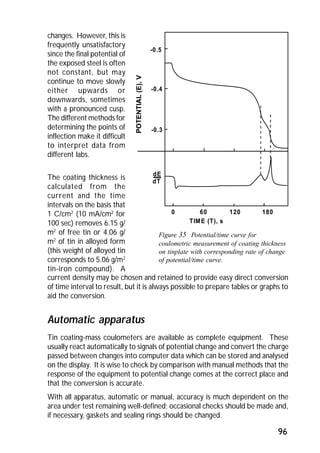
have a bearing on the dissolution of iron. Experimental details relating to these 
tests are given in Chapter VII. 
External can corrosion 
The major corrosion risk for can exteriors is rusting occurring at pores in the tin 
coating, but the tin surface may sometimes be impaired in other ways. Examples 
are contamination from contents of a leaking can nearby or from alkaline 
processing water. Rusting produced during processing often takes the form of 
a thinly spread film of iron compounds, showing interference colours, with a 
staining effect. Precautions include avoidance of build-up of impurities in the 
processing waters, minimising the oxygen content in the vicinity of the can and 
restriction of time that the cans are in the processing unit. The cooling period 
should be kept to a minimum and addition of a wetting agent to the cooling 
water facilitates drainage and quick drying. Poor storage and transportation 
conditions (for example, misuse of shrink wrapping) can also accelerate rusting. 
The risk of external corrosion increases with a reduction in the tin coating mass. 
Good passivation treatments can improve the resistance to atmospheric 
corrosion, but these coatings may have been damaged by the time the can has 
been made, filled and processed. 
70
Tinplate containers for general purposes 
In addition to the large use of hermetically-sealed tinplate containers for food 
and drink, containers closed with a replaceable cap or lever lid are widely used 
to pack oils, paints, chemicals, tobacco, cosmetics and some dry goods. Since 
the containers almost invariably contain some oxygen and the tin offers only 
mechanical protection to the steel, the main concern is with corrosion at pores 
in the tin coating. On the other hand, the effects of metal dissolution are usually 
less important than they are with food products, the main sources of trouble 
being container perforation or discoloration of contents. Lacquering is a means 
of protection for many products. Most dry solid products give no trouble, but 
those that absorb moisture can cause rusting, at least around the rim of the 
container. 
71
73 
TINPLATE LACQUERING AND DECORATING 
Electrolytic tinplate containers are frequently lacquered to provide additional 
protection and/or to enable thinner tin coatings to be used. For internal can 
surfaces, a lacquer must provide an inert barrier between the metal of the 
container and its contents, and must not convey any odour or taint to the food 
and drink coming into contact with it. Important properties required in all 
lacquers include an ability to spread evenly, completely over tinplate surfaces, 
which have received no special pre-treatment, and to adhere to the surfaces 
under what may be adverse conditions. For processed food cans, any external 
coating or decoration system must be capable of withstanding subjection to 
steam / water mixtures for periods up to approximately one hour at temperatures 
in the range 120 - 132°C. Historically virtually all lacquers have been solvent-based, 
containing up to 80% solvent in the wet state. Over recent years, many 
of these have been replaced by water-based materials, which contain 10 - 15% 
solvent and are therefore more environmentally friendly. Many types of lacquer 
are now in general use and new or modified formulations are continually being 
introduced. 
Oleoresinous types are still much used in the U.S.A. for cans for packaging 
fruit and vegetables, but are not widely employed in Europe. They are based 
on natural products, so that the composition may vary somewhat, but they are 
cheap. They are not very effective against sulphide staining unless pigmented 
with zinc oxide. They dry by oxidation and by thermal polymerisation. 
Vinylic types are vinyl copolymers, reinforced by thermoplastic resins. Principal 
qualities include adherence, flexibility (useful in deep drawing applications) and 
lack of taint. This type is not very temperature resistant; it dries by evaporation 
of solvent. Vinylic lacquers are often used as second coats, for example on beer 
and beverage cans or biscuit tins, where lack of odour or taint is important. 
They cure at 170 - 175°C, to avoid thermal degradation in contact with steel at 
pores. 
Phenolic resins give good coverage and have excellent chemical resistance. 
They are impermeable to sulphide ions and will resist the heat of soldering. A 
limitation is the sensitivity of their adherence properties to the surface condition 
of the tinplate and their low flexibility in coatings thicker than 3-4mm. Phenolics
cannot be heated above 190°C without degradation; drying occurs by heating. 
Vinyls and phenolics are often used in combination for optimum properties. 
Organosols are vinylic resins of high molecular weight dispersed in solvent 
mixtures, to give, typically, 55% dry solids. By fusion, at the time of heating the 
resins form a thick (10 - 20mm) continuous film. They are often used inside 
cans, for bases of aerosols or on beer cans or DRD cans. 
Acrylics are particularly used where high heat resistance and colour retention 
is needed. They are used for exterior decoration and increasingly in recent 
years as a white coating for food cans, where they give an attractive ceramic 
appearance. 
Epxoy phenolics lacquers are the most widely used types. They have good 
resistance to acid products and the epoxy component confers adherence and 
flexibility. They are cured at about 200°C. A wide range of formulations are 
commercially available, differing in ratios of the two resins. They are used in 
cans for packing soups, meats, fish, fruits and fruit juices, and internally and 
externally on crown corks and other closures. They are suitable for deep 
drawing. Certain formulations resist the action of polyphosphates which can 
reduce the adherence of phenolics, and they can be pigmented with aluminium 
or with zinc carbonate to counteract sulphide staining. 
Other epoxy based materials have had a major impact in the market place in 
recent years. Concern over Volatile Organic Compound (VOC) emissions (see 
Chapter VIII) has been a driving force to reduce the level of organic solvents 
present in coatings systems and this has led to the introduction of water based 
epoxy acrylate emulsions which now play a major role within the beer and 
beverage market. More recent developments in terms of improved flexibility 
have extended the use of these materials into the food can market. Requirements 
for improved performance white internal coatings have led to the development 
of solvent based epoxy anhydride based systems. However, recent concerns 
over the environmental impact of epoxy based systems, including epoxy 
phenolics, has led to pressures within the industry to review the use of bisphenol 
A and bisphenol F based materials. Although no definite evidence supporting 
these concerns has materialised, it is likely that polyester and acrylic based 
polymer systems may well become more widely used in the future as 
replacements for epoxy materials in certain applications. 
Except for D&I cans, virtually all lacquering and decorating of tinplate is applied 
to flat sheets, prior to the forming operations. The coatings are applied via a 
roller system, as described below, and then enter a stoving oven. They are 
taken on a continuous conveyor which carries the sheets vertically on edge 
through a tunnel oven, which has a series of temperature controlled zones. 
The actual temperatures and total stoving times depend on the curing 
74
75 
General type of resin and 
components blended to produce it 
Flexibility Sulphide-stain 
resistance 
Typical uses Comments 
Oleo-resinous Poor Poor Acid fruits General purpose, relatively low cost 
Sulphur-resistant oleo-resinous 
Good Good Vegetables, soups, (can end, 
Not for use with acid products: 
(added zinc oxide) 
topcoat over epoxy-phenolic) 
Phenolic (phenol or substituted phenol 
with formaldehyde) 
Very good Very good Meat, fish, vegetables, soups Good at relatively low cost but film 
thickness restricted by flexibility 
Epoxy-phenolic (epoxy resins with 
phenolic resins) 
Poor Poor Meat, fish, vegetables, soups, 
beer and beverages (first coat) 
Wide range of properties may be 
obtained by modifications 
Epoxy-phenolic with zinc oxide (zinc 
oxide added) 
Good Good Vegetables, soups (especially 
can ends) 
Not used with acid products: 
Aluminized epoxy-phenolic (metallic 
aluminium powder added) 
Good Very good Meat products Clean but rather dull appearance 
Epoxy anhydride Good Good Vegetables Normally pigmented with titanium 
dioxide 
Epoxy acrylate Good Poor Vegetables (roller coated for 
can bodies and ends) beer & 
beverage (spray application) 
Supplied as water based systems 
Vinyl, solution (vinyl acetate co-polymers) 
Excellent Not 
applicable 
Spray on can bodies, roller 
coating on ends, as topcoat for 
beer and beverages 
Free from flavour taints; sensitive to 
soldering heat and not usually 
suitable for direct application to 
tinplate 
Vinyl, organosol or plastisol, (high 
molecular weight vinyl resins 
suspended in a non-solvent) 
Good Not 
applicable 
Beer and beverage topcoat on 
ends, bottle closures, drawn 
cans for sweets, tobacco 
As for vinyl solutions but giving a 
thicker, tougher layer 
Acrylic (acrylic resin, usually 
pigmented white) 
Very good 
on some 
ranges 
Very good 
when 
pigmented 
Vegetable, soups, prepared 
foods containing sulphide 
stainers 
Attractive clean appearance of 
opened cans 
Polybutadiene (hydrocarbon resins) Moderate 
– poor 
Very good if 
zinc oxide is 
added 
Beer and beverages first coat. 
Vegetables and soups if with 
ZnO 
Cost and, hence, popularity depends 
on country 
Table 6 Main types of internal can lacquer
requirements of the particular coating. Temperatures must be below the melting 
point of tin, and for this reason a maximum of 205°C is normally never exceeded. 
Time at peak metal temperature is of the order of 10 minutes. At the exit of 
the stoving oven the cured sheets are stacked on pallets. They may require 
several stages of lacquering and/or decorating, necessitating several stoving 
treatments. Some plants have installed lines for continuous lacquering of tinplate 
coil: on these high-speed lines the melting point of tin may be momentarily 
exceeded. 
The decoration of tinplate requires the printing of coloured designs on the 
surface. Tinplate has an excellent surface for printing and in this respect is 
superior to many high quality papers. However, there are certain fundamental 
differences between printing on tinplate and printing on paper. In the first place 
tinplate is non-absorbent, so that ink or lacquer remains on the surface and has 
to be dried by the application of heat or other form of energy. Secondly, the 
metal has a hard inflexible surface compared to paper, so that direct contact 
between printing plate and the tinplate surface is not practicable. Thirdly, in 
terms of its spectral response, tinplate can be considered as being essentially 
black: this means that if reproduction similar to that achieved on white paper is 
required, a white base must first be applied to the metal surface. However, for 
special decorative effects, use may be made of the surface appearance of the 
tinplate itself. Another important fact to be borne in mind is the functional 
nature of the printed tinplate which is subsequently formed into various shapes, 
to be used as containers or other items. Coatings must remain adherent and 
undamaged even after forming operations which may involve quite severe 
deformation of the surface. 
The tinplate surface makes possible a wide diversity of colour effects when 
used in conjunction with the range of opaque and transparent printing inks 
available and the printing process itself has evolved to allow the precise 
registration of fine detail at high line speeds. 
The decorating process consists of two operations; roller coating and printing. 
A number of coatings may be applied to tinplate before printing and a final over-varnish 
76 
coating may also be applied after printing. 
Printing on tinplate is not only for decorative purposes, but the creative and 
appealing design of a packaged product is vitally important for its sales potential 
and this is especially true for the large range of foods, beverages and household 
products marketed in cans. Although many food cans use separately applied 
paper labels, the use of labels printed directly onto the can is increasing and is 
already universal for beer and beverage cans. Printed tinplate has a variety of 
other uses including battery cases, trays, large container tins (for sweets, biscuits, 
etc.), bottle caps, ash-trays, and advertising signs.
Roller coating machines deposit an even layer of the appropriate material at a 
controlled thickness. They are used for applying lacquers and for base coats in 
decorative systems. They can be operated independently, with their own 
feeders, or in line with a printing press. The principle of operation is shown in 
the diagram (Figure 28). A steel fountain roller rotates in a feed tray containing 
coating material which is transferred to a distributor roller and an applicator 
roller. A pressure roller acts in conjunction with the applicator roller to drive 
77 
Roller coating 
Figure 28 
Diagrammatic representation of roller coating 
the sheet through the nip. Film weight is controlled by a gap between the 
fountain, transfer and application rollers; a heater is often fitted to maintain the 
correct viscosity. Surplus coating material is removed from the pressure roller 
by a scraper and recycled. When sheets are covered over the full width of the 
applicator roller, a plain coating roller is used. An application roller with margins 
cut into it is used when longitudinal margins without lacquer are required for 
soldered and welded can body seams. A spot coating roller system is used 
where coating material is only required on discrete areas of the sheet (for 
example when white base coating is needed for the centre panel of a circular 
can or end where the remainder of the design is not to be coated). This system 
may also be utilised as a way of reducing lacquer usage when multiple circular 
areas require to be spot coated on each tinplate sheet. 
Typical coatings which may be applied include clear size, lacquer, pigmented 
base coat and over-varnish. 
A sizing varnish is often applied first, to ensure that subsequent coatings are 
sufficiently keyed to the surface so that they will not crack when the sheet is 
distorted and to improve the appearance of print when a pigmented base coat 
is not required.
Lacquers are generally applied to one side of a sheet to form the internal surface 
of a container. However, lacquers are also used in printing to give a metallic 
external decorative effect (commonly gold) and may also be required for external 
corrosion protection. Lacquers are cured by stoving in the range 180 - 205°C, 
depending upon formulation. 
Pigmented base coats consist of one or more pigments dispersed in an organic 
base. When this is white, it provides a bright base for successive colours. Stoving 
temperatures may be in a wide range up to about 160°C. 
Over-varnish is applied as a final coating to protect the inks from scratching 
during tooling and subsequent handling and to provide lubrication to the surfaces 
during forming processes. In addition to their toughness and tack-free curing, 
varnishes must also be able to withstand the stoving temperature (up to 170°C) 
without discolouring. 
After each pass through the roller-coater, the tinplate sheets are picked up by a 
series of closely-spaced racks (wickets) on an endless chain which hold them in 
a near vertical position and carry them through the curing oven. The ovens, 
which are usually gas-fired, direct blasts of hot air at the sheets and consist of 
three zones. In the first (come-up) zone, the sheets are raised to the stoving 
temperature. In the second zone, they are held at this temperature for the 
required time. In the final zone, the sheets are cooled sufficiently to be handled 
by automatic unloaders. As the sheets pass continuously through the oven, this 
necessitates the use of ovens 24-30 metres in length to accommodate throughput 
rates of 4000-7000 sheets per hour. 
Photo-lithography 
Flat tinplate sheet is printed by the photo-lithographic process. Lithography 
depends upon the fact that some materials (e.g. copper) are receptive to 
greasy liquids such as printing ink, whilst others (e.g. chromium) are more 
receptive to water (or water / alcohol mixture) and repel ink. Since grease and 
water are immiscible, ink will not adhere to moist surface areas and will print 
selectively from grease receptive areas. Thus to apply a printed design by 
lithography, a printing plate must be produced, whose surface is composed of 
grease receptive areas carrying the design, surrounded by non-printing areas 
which are kept moist. As has been already stated, tinplate is too hard to print in 
direct contact with a printing plate, and the design is in fact “off-set” on to a 
rubber covered blanket, which in turn contacts the tinplate, transferring the 
design onto the surface, and acting as a carrier of the design between plate and 
metal sheet. This is known as “off-set lithography” and its introduction 
revolutionised printing on tinplate. 
78
In order to replicate the desired image on a printing plate, the original artwork 
is first photographed and reproduced as a series of transparencies, the size and 
number of which will depend on the complexity of the design. A simple block 
of colour, for example, may be photographed as a continuous image which is 
then reproduced as such on the printing plate; this is termed line printing. If the 
artwork has variations of light and shade or complex colouring (as in a 
photograph) then the image is reproduced by “half-tone” printing where the 
variations in intensity and colour are conveyed by breaking up the image into a 
series of minute dots. The darkness or lightness is conveyed by the number 
and size of the dots within a particular area. Colours in the original design are 
reproduced by printing a series of dot images, one for each of the component 
colours, as appropriate. Thus a full colour half-tone design may be reconstituted 
by printing successive images in the three primary colours (yellow, cyan blue, 
magenta) plus black, using a separate printing plate for each colour. A design 
may also incorporate a mixture of line and half-tone components. 
For both monochrome and colour work, the half-tone dot pattern may be 
produced by interposing a special magenta screen between the light source and 
the film surface. For a colour design, a series of negatives is produced, one for 
each printing colour, these colour separations being effected by the use of 
appropriate filters when the design is photographed. It is now common to use 
electronic scanning of artwork to carry out colour separation and density 
determination. The artwork is mounted on a drum and scanned by a beam of 
light which passes through one of a number of colour filters. Information on the 
various light intensities is transmitted to a computer which weighs and balances 
the signals so as to produce image transparencies with a precise colour separation 
and an accurate density reproduction. Printing plates are next prepared from 
the various component transparencies (either negatives or positives, depending 
on the type of plate). 
Plate production 
The key to precise and accurate printing lies in the quality of the printing plate. 
A bi-metallic type of plate is sometimes still used, for example copper plated 
with chromium in non-printing areas. The copper, initially plated all over with 
chromium, is coated by a specialised technique with a light-sensitive resin. A 
positive of the required image is placed in contact with the light-sensitive surface 
and the plate is located in a vacuum frame and exposed to an ultra-violet light 
source. The exposed (i.e. non-printing) areas become hardened and resistant 
to the developer which is subsequently used to dissolve away the unexposed 
resin, revealing the chromium layer. The hardened resin now acts as an etch 
resist to the acid solution which is used to strip away the chromium, revealing 
79
the underlying copper surface. Finally the hardened resin is removed using a 
suitable solvent, to leave the underlying chromium areas. This type of plate is 
very durable and can be used for long printing runs of 100,000 sheets or more. 
The most commonly used type of lithographic plate consists of anodised 
aluminium coated with a special light-sensitive material. The plate is prepared 
by placing the image negative in contact with the coated side and exposing the 
surface (under vacuum) to UV light which, as before, hardens the ink-receptive 
exposed areas. The unexposed coating is subsequently washed off to reveal 
the underlying metal surface which does not print. 
A variation on the above systems is the waterless plate, which has recently 
been introduced into the tinplate printing industry. This reduces spoilage and 
set-up time, improves quality and gives a more consistent product. Instead of 
relying on the presence of water to reject the greasy ink the waterless plate 
employs a silicone rubber surface to produce the same effect. The basic plate 
is made from thin aluminium and has both photo-sensitive and silicone rubber 
coatings, which are selectively removed in the same way as the previously 
described plate systems. For this system to work satisfactorily, it is necessary 
to control the temperature of the printing plate within the range 23 - 28°C. 
This is done by chilling the print roller with cold water or air. There is an 
environmental benefit with the use of the waterless plate as its use obviates the 
need to employ alcohol as a damping agent. 
It is often advantageous to produce multiple identical images on a printing plate. 
A “step and repeat” machine is used, in which the plate, clamped into a movable 
frame, executes a series of precise movements relative to the transparency and 
light source. An exposure is made at each position and the plate is then developed 
in the normal manner. 
Printing 
General principles of the wet-lithographic offset printing unit are shown in the 
diagram (Figure 29). Three cylinders are involved, the plate cylinder around 
which is wrapped the metal printing plate, the blanket cylinder, which transfers 
the design and which has either one or two rubber blankets tensioned around 
it, and the impression cylinder, which acts with the blanket cylinder to impart 
the desired “nip” to the sheet. Inked and damping units are mounted over the 
plate cylinder, onto which the inking and damping rollers are lowered during 
printing to transfer water (or water / alcohol mix) and ink onto the printing 
plate, which in turn, transfers the image onto the blanket cylinder. The sheet 
passes under pressure through the nip between blanket and impression cylinder 
and receives its impression. The impression and blanket cylinders are mounted 
80
E 
sheet pass 
81 
on eccentric bearings, 
enabling pressure to be 
applied or withheld as 
desired. 
When waterless plates 
are used the general 
principles of operation 
are the same as above 
except for the damping 
cylinder, which is no 
longer required. 
Printing inks are 
intimate mixtures of 
pigments, dyes, oils and 
varnishes, and much of 
the improved 
productivity in printing 
has been due to 
advances in ink 
B 
C 
D 
A PLATE CYLINDER 
B BLANKET CYLINDER 
C IMPRESSION CYLINDER 
D INKING UNIT 
E DAMPING UNIT 
Figure 29 
Representation of a typical roll arrangement for 
printing on tinplate 
formulation which allow faster running speed and curing. Special inks have also 
been developed for particular applications such as outdoor signs (non-fading) 
and processed pack containers (resistant to prolonged heating in steam / water 
mixtures). Stoving takes place in ovens of the same type as those described for 
roller coatings at a temperature of about 130°C. 
Until the 1950s, the single colour was almost exclusively used, and each coat 
had to be cured before application of the next. Since that time there has been 
continual development of both printing inks and machines such that four colours 
can now be applied wet-on-wet in one in-line machine. Stoving then takes 
place in ovens of the same type as those described for roller coatings. Some of 
the latest multi-colour printing machines are based on paper printing technology, 
permitting sheet thicknesses down to 0.10 mm to be handled at high speed 
without damage. 
Ultra-violet curing 
The introduction of inks and lacquers that may be cured by exposure for a few 
seconds to UV radiation has had a major impact on the metal decorating industry. 
A photo-curable formulation typically contains a mixture of a low molecular 
weight unsaturated polymer (an acrylated polyester, acrylated epoxy or acrylated 
polyurethane) dissolved in a blend of reactive monomers such as acrylates or
methacrylates. Photo-initiators start a vinyl-type polymerisation reaction on 
exposure to UV radiation. Advantages include savings in energy consumption, 
less pollution from solvent fumes, faster curing and hence production rate and 
savings in space. For multi-colour in-line printing, inter-deck UV curing ensures 
each colour is fully cured before the next colour is applied. 
Disadvantages at present include the expense of UV lamps and inks, the need 
for a wider range of suitable inks and the need to meet legislation regarding 
safety of UV inks for use with food and beverage cans. Also because of the 
extremely short curing time these inks are not so flexible as thermally cured 
inks. This may be important where deep forming of the tinplate takes place 
after printing (as in distortion printing work, which is described in the next 
section). 
Considerable research is being undertaken into many aspects of the UV curing 
technology, including formulations, UV lamp characteristics, and the effect of 
substrate. 
Distortion printing 
Before leaving the printing of flat sheets, the distortion printing technique should 
be mentioned. This permits a design to be printed in the flat in such a way that 
only after forming the tinplate into a can shape does the printed design takes on 
its final intended appearance. This is achieved by first forming a sheet of tinplate 
printed with a square grid pattern into the final article. The distortion undergone 
by each particular area of sheet can then be evaluated accurately, allowing the 
initial artwork to be modified to allow for the distortion effects. This process of 
calculating the amount of distortion to be built into the artwork is now largely 
done by utilising computer techniques. 
Coating formed two-piece drawn and wall ironed cans 
For drawn and wall ironed food cans it is necessary to cover all of the outside 
surfaces with a polymer coating to give adequate corrosion protection and 
good surface slip characteristics. This is achieved by placing the washed cans, 
with the base uppermost, on an endless stainless steel woven belt and then 
passing them through a series of falling curtains of water-based coating material. 
These ensure that the can external surfaces are completely covered with lacquer. 
The bulk of the lacquer then drains off to leave the correct film weight on the 
cans. The external coating is then cured by passing the cans through a gas fired 
tunnel oven. 
82
For drawn and ironed beverage cans it is also necessary to apply an external 
coating. However in this case, as the side walls will be decorated by a protective 
print / coating system, it is only necessary to apply a separate coating to the 
base area. This may be done by either a roller coat or spraying process, in 
conjunction with the internal coating system described below. 
For both drawn and wall ironed food and beverage cans it is necessary to apply 
an internal coating material to provide an inert barrier between the can and the 
product contained within. This is applied by an airless spraying process, the 
cans being spun at high speed during the spraying operation to ensure the coating 
is evenly spread over the whole surface. Following this, the cans are placed, 
open end up, on an endless stainless steel wire mesh belt, which conveys the 
cans through a tunnel oven, to cure the internal coating. Depending on the 
product contained in the can, and specifically for beverage cans, it may be 
necessary to apply a second coat of internal lacquer and carry out another full 
curing operation. 
Decorating formed two-piece cans 
In the case of seamless two-piece cans, formed by drawing and ironing, the 
degree of deformation is such that the tinplate cannot be printed beforehand. 
A non-lithographic “dry-offset” process is adopted in this case which has been 
adapted from the technique widely used in the paper industry. The plate consists 
of a photopolymer coating which is bonded to a steel backing by means of an 
adhesive. The plate is exposed to a negative, using ordinary fluorescent light 
which hardens the exposed area. The unexposed areas are dissolved away by 
spraying the plate with alcohol, leaving behind the hardened portions in relief. 
Since the design is in raised relief on the plate, it can be coated with ink from a 
roller and will print directly on the offset blanket without the need for damping. 
The first stage of the printing process may require the application of a background 
coating to form the main colour of the artwork. This can be applied directly to 
the metal surface; no size need be used because the tinplate is quite clean and 
will not undergo any appreciable further deformation. Each can is coated by 
rotating to complete one to two revolutions against a rubber roller, which is 
continuously inked by rotating in contact with a metal feeder drum. The cans 
are then off-loaded onto pins which carry them through a gas fired “pin oven” 
to dry the coating; up to 1500 cans per minute can be processed in this way. 
On emerging, the cans are taken off their pins by a magnetic belt which then 
feeds them into the conveyor system that carries them to the printing machine. 
The printing machine consists of six separate printing heads arranged around a 
large revolving drum, the latter carrying a greater number of offset blankets 
83
around its perimeter. Each printing head incorporates one component plate of 
the design so that a maximum of six colours may be applied over the base coat. 
As the drum rotates, the blankets contact each printing plate cylinder in turn, 
causing the complete artwork to be transferred to the blankets. Each blanket 
then prints the complete image onto one can body as it passes the drum. The 
arrangement is shown here diagrammatically (Figure 30). This printing system 
is capable of high output, matching can-making speeds in excess of 1500 cans / 
minute. 
After printing, a wet-on-wet overvarnish may be applied as the final operation 
before the cans are transferred to a “pin chain” which conveys them through a 
“pin oven”. where the complete decoration is cured. This may take, on average, 
just one minute at 170°C. However, some ovens are capable of an even faster 
cure and stoving time may be reduced to as little as six seconds. The necking 
and spin-necking operations, which are done after all the internal and external 
coating and decoration has been completed, put great demands on the coating 
materials, and it is often necessary to use coatings and inks specially developed 
for this purpose. 
Figure 30 
Diagram showing the principle of operation of a unit for printing on formed, 
cylindrical, can bodies 
84 
Four printing plates 
Cans 
Drum with 6 offset 
blankets
85 
TINPLATE TESTING 
The tests which may be applied to tinplate can broadly be classified into two 
groups, objective, or quality tests and subjective, or performance tests. Many 
of these tests, especially the former, are routinely carried out during manufacture, 
as part of a quality control programme. Other, more sophisticated tests are 
used for research purposes or to investigate problems which may have arisen in 
service. The validity of any testing procedure is based on the assumption that 
the samples selected are representative of the bulk of the material to be tested. 
Sampling procedures for selecting sheets for mechanical property and coating 
thickness tests are outlined in the international and national standards. 
Mechanical property tests 
A number of different mechanical properties may be determined for tinplate. 
No single mechanical test can measure all the factors which may determine its 
performance, nor is it possible to apply any single test satisfactorily to the range 
of tinplate products that is available on the market. The term “temper” which 
is used to classify tinplate products, summarises a combination of interrelated 
properties. The performance of tinplate in processing and use is significantly 
determined by individual mechanical properties, which will vary on the steel 
type, methods of casting, rolling, annealing, temper rolling employed. 
The test considered to provide the best overall guide to mechanical properties 
is the tensile test. This test is often preferred as the referee method. For more 
routine testing, the Rockwell hardness testing method is used for single-reduced 
material and the Springback test is used for double-reduced tinplate. 
Other, more specific tests can be used to set additional demands on the forming 
properties of tinplate. 
The tensile test 
The conventional tensile test provides the more accurate measure for the tensile 
properties of tinplate, but is relatively slow and requires very careful skilled 
preparation of the test specimens
The test consists of straining a specially prepared test piece, having parallel 
sides, by tensile stress, generally to fracture. As the tinplate is strained, it 
elongates, initially in proportion to the load applied. At a certain point (the limit 
of elasticity), the elongation proceeds more rapidly. The proof stress (Rp) is 
defined as the stress at which a non-proportional elongation equal to a given 
percentage of the original gauge length occurs. For tinplate testing the value 
customarily measured is 0.2% (Rp0.2). The tensile test is performed in the normal 
way, using wedge grips, but due to the light gauges commonly used for double-reduced 
86 
tinplate, certain special precautions should be observed. 
It is advisable to finish the preparation of the edges carefully with fine emery 
paper, to remove any burrs. 
The gauge length (effective length with parallel edges) used is 50 mm ± 0.5 mm 
and the width 12.5 mm ± 1 mm. 
The rate of straining is usually 1 mm/min. 
The grips employed should be capable of securing the sample such that no 
skew occurs during straining, to ensure that the applied stress is aligned centrally 
along the major axis of the test specimen. 
The value recorded is the proof stress (Rp0.2). 
Hardness 
The Rockwell Superficial Hardness Test is used to assess single-reduced tinplate 
temper grades; the hardness ranges specified for the various temper grades are 
given in Chapter Ill. This test is specified in international standards, normally on 
de-tinned specimens. 
The Rockwell hardness tester is a direct reading instrument which measures 
the incremental depth of penetration of a ball indentor forced into the metal by 
a primary and a secondary load. In the Superficial Tester, as used for tinplate, 
the minor load is 3 kg and the major load a total of 30 kg or 15 kg. The loads are 
applied via a system of levers and at a controlled rate. The hardness value is 
read directly on a calibrated dial. 
To carry out the test, place the specimen on the diamond centre spot of the 
anvil, avoiding testing near the edges of the specimen because of a possible 
cantilever effect. Bring the specimen into contact with the ball indentor by 
turning the hand wheel until the indicator on the dial shows that the minor 
load is applied. Then turn the adjustable rim of the dial until the pointer reads 
zero, and apply the major load by operating the handle. The rate of loading is 
controlled by a dash-pot incorporated in the machine. As soon as the loading is
complete, remove the major load by pulling the handle forward and read the 
Rockwell hardness number on the appropriate scale. 
Due to the light gauge of tinplate sheet, the Rockwell 30T Hardness test is 
sensitive to the “anvil” effect in which the measured apparent hardness is affected 
by the thickness of the test specimen; for very thin sheet (e.g. < 0.20 mm.) a 
15 kg major load (15T Scale) may be used as described in the relevant standards. 
Samples of continuously annealed material used for Rockwell hardness testing 
must be adequately aged. Artificial ageing will normally be necessary where the 
material has not been pre-stoved through a lacquering or printing process. 
Artificial ageing can be achieved by heating the specimen to 200OC for 20 
minutes. 
Other hardness tests used for sheet metal (e.g. Vickers) are not advised for 
tinplate testing since it is not possible to convert values accurately to Rockwell 
values. 
The Springback test 
The Springback test was devised to enable the proof stress of double reduced 
tinplate to be determined conveniently. It is frequently used as a routine test 
and is also cited in the appropriate standards. 
87 
MANDREL 
Figure 31 Principle of operation of a springback tester
To perform the test, a tinplate specimen 150 mm x 25 mm wide, of known 
thickness is clamped at one end and the free end is bent through 180 deg. 
around a 25 mm diameter mandrel with the aid of a forming roller pivoted so as 
to follow the mandrel (Figure 31). The free end of the specimen is then released 
and the springback angle read directly on the calibrated scale. 
The amount of the springback angle and the thickness of the specimen are then 
used to obtain the “springback index” in terms of the proof stress. Suitable 
conversion formulae are published for this purpose. 
Formability tests 
In addition to the tests which are stipulated in specifications, tinplate 
manufacturers and users customarily carry out certain other tests on the steel 
base to assess the suitability of the product for a given application. Among 
these tests are the following. 
Fluting test 
In the manufacture of three-piece cans the rectangular body blank is formed 
into a cylindrical body. If the correct tinplate grade is not used the resultant 
cylinder will not be of smooth appearance, but the body wall will exhibit “flutes” 
or flat irregularities in its circumference. To check this the so-called fluting test 
is used. 
In this test the specimen is simply formed into a cylinder of about 50mm diameter 
by a standard three-roll forming machine. After forming, the cylinder is examined 
visually for evidence of “flats” or irregularities in the circumference of the cylinder. 
This type of test is normally applied only to those grades of tinplate used for 
circular bodies where fluting is undesirable. 
Bend tests 
The simplest form of bend test used for sheet metal is the single bend test in 
which a specimen is doubled on itself and hammered flat, to induce cracking. 
This type of test is not sufficiently sensitive for tinplate, all grades of which bend 
and seam readily. However, since in fabricating, for example a can body, side 
seaming and end flanging involve bending the sheet both parallel and transverse 
to the rolling direction, it may be necessary to assess the degree of directionality 
of its forming properties. This may be determined by an alternating bend test 
applied to specimens cut along the rolling direction (“strong way”) and transverse 
to it (“weak way”). 
88
89 
The Jenkins alternating bend test 
Figure 32 General view of the Jenkins bend tester 
In this test a strip of tinplate, approximately 60 mm long by 12 mm wide is 
clamped between accurately radiused jaws and the free end is repeatedly bent 
to and fro through 180° until failure occurs. In the Jenkins machine the specimen 
is bent by a fixed diameter roller operated by a hand lever, the end point being 
reached at the first sign of fracture through the specimen (Figure 32). The 
number of full 180° bends required to produce the fracture is recorded as the 
Jenkins Bend Value (the first half bend is ignored). It depends on the temper 
grade and the sheet thickness. 
When carrying out an alternating bend test, two specimens should always be 
taken, one cut with its long edges parallel to the rolling direction and the other 
at right angles to this direction. The difference between the two Bend Values 
and the magnitude of the “weak way” value are both of significance and are 
particularly useful in estimating bending and flanging properties. 
Several more sophisticated machines for performing alternating bend tests have 
been devised on the same principle. 
Cupping tests 
The drawability of sheet metal is commonly assessed by means of cupping 
tests. The principle underlying all cupping tests is that a cup is formed in the 
sheet specimen by means of a punch and die set mounted in a suitable press, 
the sheet being clamped by a pressure plate or mounting ring. The cupping
value is normally taken as the depth of impression required to produce fracture, 
although other criteria may be used, e.g. the drop in load on the punch which 
occurs at the moment of fracture. 
Cupping test values are not normally included in tinplate specifications, but for 
routine testing the test most frequently used for tinplate is the Erichsen cupping 
test. 
Erichsen test 
In the Erichsen test the test piece is a 76 mm diameter blank, held between an 
annular ring (blankholder) and the die; the punch is a 20 mm diameter hemisphere 
and it is advanced against the specimen mechanically or hydraulically to form a 
depression or “cup”. The end point is normally taken as the point at which the 
cup wall just fractures. The depth of impression, in millimetres, is the Erichsen 
value. It is related to the tinplate temper grade and the thickness of the material. 
The Erichsen test method is defined in various national and international 
specifications. For tinplate the standard method may be used except that, 
since tinplate carries an oil film, no additional lubrication is applied to the test 
specimen. 
Metallography 
The steel base of tinplate may be examined by standard optical 
micro-examination procedures. Features of special interest are the shape and 
size of the grain structure, to check the temper grade and the correctness of 
the annealing cycle; and the degree and distribution of non-metallic inclusions, 
which can affect formability. 
Electron microscopy and scanning electron microscopy are widely used to study 
the continuity of the alloy coating on tinplate. 
Details of polishing and etching techniques for steel are beyond the scope of 
this booklet. They may be found in any standard metallographic textbook. 
The coating of tinplate 
The majority of tinplate is flow-melted, as described in Chapter II. The resultant 
coating is therefore composite, comprising a thin layer of tin over an even thinner 
layer composed of the alloy FeSn2 formed by reaction between the electroplated 
tin and the steel substrate. Each layer is metallurgically and tightly bonded to 
the adjacent one. 
90
The passivation treatment customarily applied to electrolytic tinplate, is intended 
to convert part of the naturally occurring tin oxide film into a layer containing 
chromium and chromium oxides. This treatment is beneficial in improving both 
storage and lacquering performances. It is important to be able to characterise 
the passivation films. 
Both the tin coating of tinplate and the surface films, may be determined by 
coulometric techniques. Before describing the details specific to a given 
determination, it is of interest to consider, in general terms, the principles of 
the coulometric technique. 
Coulometric methods - general 
Several of the laboratory inspection tests used for tinplate may be made by 
measurement of the charge passed in the performance of some particular 
oxidation or reduction. For this type of test, the basic equipment is always the 
same: a source of controlled constant current, a suitable voltage recorder and 
an electrolysis cell which can contain the test sample, a counter-electrode, usually 
of platinum or carbon, and a reference electrode, usually silver/silver chloride 
or saturated calomel. Modern equipment usually integrates the voltage source 
and measuring functions in a computer controlled unit, which also has data-handling, 
storage and output functions. The solutions used, the current densities 
and the direction of current, and the range of voltage to be measured differ 
from test to test, but it is possible to use the same general equipment for various 
tests. Therefore, a preliminary description of the basic apparatus is given now 
so that it need not be repeated in dealing with the several tests for which it may 
be used. It should be mentioned, that commercially available coulometric 
instruments for coating thickness measurement, are usually not easily adaptable 
to other measurements. However, the electrolysis cell, one of the most 
important parts of the apparatus, is often general purpose. 
91
92 
Electrolysis test cell 
Figure 33 
Diagram of simple cell for 
coulometric measurements on 
tinplate. 
The components are: 
A-test piece; 
B-O-ring; 
C-brass base; 
D-cell body, a cylinder of 
transparent plastics material; 
E-counter electrode of 
platinum wire; 
F-tip of calomel reference 
electrode; 
G-inlet and outlet tubes for 
inert gas. Electrical 
connection to the test piece is 
made through the brass base. 
The essential feature of the test cell is a holder for the test specimen which can 
make a watertight joint around a precisely measured area of surface. This is 
accomplished almost invariably by lining the edge of an aperture cut into plastics 
material with an O-ring or other form of gasket against which the test piece is 
pressed by tightening a screw thread, by a spring or by other means. A common 
form of holder is a cylinder made of Perspex of length about 3 cm, with a circular 
aperture in one end and closed at the other end by a threaded plug which 
presses a tinplate disc of 5 cm diameter against a gasket surrounding the aperture. 
Electrical connection to the test specimen is by a light spring connected to a 
wire passing through an insulated sleeve attached to the holder. A holder of 
this type is separate from the cell and must be held in place during tests, but has 
the advantage that electrolyte can be left in the cell between tests. However, 
many laboratories have preferred to use a cell in which the test specimen is 
exposed through an aperture at one end of the cell. This method has advantages 
in that the position of the test specimen is always the same, that the cell can be 
more easily closed for operation in oxygen-free conditions and that the test 
specimen does not have to be cut to a precise shape or size to fit a holder. A 
common type of cell used has the test specimen covering an aperture in the 
base of a cyclindrical cell closed at the upper end by a removable cap which 
carries the counter-electrode, the reference electrode and means for introducing 
nitrogen and test solution. 
Cell bodies are made with several sizes of aperture ranging from 1 cm to 5 cm 
to permit tests on different areas. The use of small test areas, provided that
they are precisely limited by the cell aperture, has some advantages for surveying 
variations across a surface and for making measurements on manufactured cans 
which have only small plane surfaces. The test specimen rests on a circular 
metal plate by which it is pressed into contact with the cell base by an interlocking 
collar engaging a flange on the base. A diagram of the cell is shown in Figure 35. 
Electrical connection to the test piece is made via the metal plate. 
A general circuit diagram for the operation of several forms of coulometric test 
with the basic equipment is shown in Figure 34. 
Current source and measurement 
The range of currents required for testing various properties over areas of 
different sizes is from 25mA to 200 mA. It is possible to cover this range with 
93 
Figure 34 
Circuit diagram for coulometric analysis 
one of the constant voltage/ 
current power sources available 
ready-made from laboratory 
suppliers if the smaller constant 
currents are obtained by using a 
constant high voltage of 100-200 
V with resistance of several 
megohms in series with the cell 
and the larger currents are made 
to rely on direct control of the 
current by the source. If a general 
duty source is not available, the 
same plan can be followed using 
smoothed rectified mains voltage 
or a dry battery as a high voltage 
source and batteries or other 
convenient D.C. source with potential dividers to give the higher currents. 
Potential measurement 
A potential recorder with a fast response and a chart speed of at least 30 mm/ 
min is required and either the recorder must have the capability of showing 
changes up to + 1 V from base-lines ranging from -1 to 0 V or means of applying 
a controlled backing-off voltage must be provided. The recorder, if connected 
directly to the electrodes must have an input impedance of more than 1 megohm: 
otherwise a voltmeter of high input impedance may be used and its readings 
fed to a general-purpose recorder. An additional useful refinement is to obtain 
or make equipment which converts the signal to the recorder to the rate of
change of potential with time. Such a device produces a sharpened indication 
of potential changes. 
As mentioned, more modern potentiostats integrate the current source and 
measuring functions, together with the proper data-handling and analysing 
software. 
Tin coating mass determination 
The free tin and the alloy layers may be determined separately or together. For 
specification purposes it is the total tin (i.e. free tin plus tin-in-alloy) which is 
determined. However, since certain characteristics, such as solderability or 
corrosion resistance, may depend on the relative amounts of the two layers it is 
customary to determine them separately, by, for example, coulometric 
techniques, and to sum the results. 
Most standard specifications permit any of the recognised coating mass tests to 
be employed as routine. Many fast and reliable methods can be used for routine 
measuring. Usually these methods give consistent results if used by the same 
laboratory under steady conditions. For arbitration purposes, wet chemistry 
has been proven to give the most certain results, so the Referee method (see 
later) must be used. 
The coulometric method 
This method is widely used for the determination of both free tin and tin-in-alloy. 
The principle of the method is that the coating is dissolved by the action of an 
anodic current in hydrochloric acid and the time intervals required for dissolution 
of the free tin layer of the coating and of the alloy layer are indicated by changes 
of potential between the test piece and a reference electrode. Usually the 
current density on the test-piece is held constant and the charge required to 
remove a layer of the coating is obtained by multiplying the value of the current 
by the time taken for dissolution of the layer. It is possible to measure the 
charge directly with a wattmeter with automatic or manual separation of readings 
for the two layers; in this instance exact control of the current is unnecessary. 
The apparatus required is that described for general coulometric methods. 
Current densities in the range 4-10 mA/cm2 are required. The reference 
electrode may be a silver rod or saturated calomel. 
The solution used is 1.0 M hydrochloric acid. The solution may be used many 
times, perhaps 10-50 depending on the cell capacity. It should be changed after 
it has stood idle for some hours or whenever potential measurements indicate 
deterioration. 
94
For research purposes, when precise measurements of potential and 
curve-shapes may be required, a fresh solution should be used for each 
determination. 
Procedure 
When the apparatus is first set up, and occasionally thereafter, make a dummy 
run with known material to establish that controls of current and the recording 
of the potential are satisfactorily established. The current density may range 
from 4-10 mA/cm2 and a value at the upper end of this range is usually suitable. 
The potential measured will be negative to the reference electrode and the 
change from the start of stripping the free tin layer to the final exposure of steel 
will be about 180 mV. Whether the apparatus is automatically or manually 
controlled, it is wise to check occasionally the calculated coating mass against 
reliable direct measurements for each layer of the coating. Attention should 
also be paid to the uniformity of removal of the coating over the tested area, 
and, if necessary, the position of the cathode should be adjusted. 
Cut a test piece of the shape and size appropriate to the cell used and clean it 
cathodically in 1% sodium carbonate solution at room temperature. Place the 
cleaned test piece in position in the cell together with the counter-electrode 
and reference electrode. Introduce sufficient solution to cover the test area 
and the electrodes and immediately start the potential recorder and switch on 
the current. When coating removal is complete switch off current, remove the 
test piece and examine the surface for any evidence of incomplete or 
non-uniform stripping. 
(The sequence described for placing specimen and electrodes and for introducing 
solutions are those suitable for the type of cell in which the specimen is held 
against an aperture in the cell body; the operations will be different when the 
specimen is held in a removable holder and the solution remains in the cell 
between tests.) 
Results 
A typical potential time curve is shown in Figure 35 together with a plot of the 
rate of change of potential against time. The ideal end points for dissolution of 
the free tin layer and of the alloy layer are the points of inflection before the 
change to the next potential step. The point of inflection is usually easily 
perceptible in the potential/time trace and is made sharply apparent by the 
differential curve which may be obtained automatically by suitable analysing 
software. ASTM A630-68 uses intersections of extensions of the lines of the 
potential steps with lines following the maximum slope during the major potential 
95
96 
changes. However, this is 
frequently unsatisfactory 
since the final potential of 
the exposed steel is often 
not constant, but may 
continue to move slowly 
either upwards or 
downwards, sometimes 
with a pronounced cusp. 
The different methods for 
determining the points of 
inflection make it difficult 
to interpret data from 
different labs. 
The coating thickness is 
calculated from the 
current and the time 
intervals on the basis that 
1 C/cm2 (10 mA/cm2 for 
100 sec) removes 6.15 g/ 
m2 of free tin or 4.06 g/ 
m2 of tin in alloyed form 
(this weight of alloyed tin 
corresponds to 5.06 g/m2 
tin-iron compound). A 
0 60 120 180 
TIME (T), s 
-0.5 
-0.4 
-0.3 
dE 
dT 
Figure 35 Potential/time curve for 
coulometric measurement of coating thickness 
on tinplate with corresponding rate of change 
of potential/time curve. 
current density may be chosen and retained to provide easy direct conversion 
of time interval to result, but it is always possible to prepare tables or graphs to 
aid the conversion. 
Automatic apparatus 
Tin coating-mass coulometers are available as complete equipment. These 
usually react automatically to signals of potential change and convert the charge 
passed between changes into computer data which can be stored and analysed 
on the display. It is wise to check by comparison with manual methods that the 
response of the equipment to potential change comes at the correct place and 
that the conversion is accurate. 
With all apparatus, automatic or manual, accuracy is much dependent on the 
area under test remaining well-defined; occasional checks should be made and, 
if necessary, gaskets and sealing rings should be changed.
X-ray fluorescence technique 
In the X-ray fluorescence method, the sample of tinplate is irradiated with X-rays 
which penetrate the tin coating and excite fluorescent secondary radiation on 
the steel surface. The intensity of the emergent fluorescent beam depends on 
the thickness of the coating through which it passes and measurement by means 
of a suitable counter enables a rapid and nondestructive means of thickness 
determination. 
There are several commercial examples of apparatus using this principle. As a 
non-destructive test it may be used as a laboratory tool for monitoring the 
coating mass on individual sheets at localised areas. The technique has also 
been adapted for in-line monitoring of coating thickness in electrolytic tinplate 
lines. In this form the apparatus customarily travels systematically across the 
strip width and monitors at frequent intervals the coating at selected points. 
The Referee method 
National and international standards specify a Referee method to be used in 
cases of dispute. In most standards it is a volumetric method, which involves 
dissolution of the tin coating in hydrochloric acid. The tin in solution is reduced 
to the tin (II) form with pure aluminium wire, and determined by titration with 
standard potassium iodate-iodide solution under an atmosphere of carbon 
dioxide. The effective range of the method is from 2.5 g/m2 up to 50 g/m2, the 
reproducibility being ± 0.1 g/m2. Other (proposed) standards specify the 
previously described coulometric method as the referee method. 
The detailed procedure is fully described in various national and international 
standards to which reference should be made. A summary of the volumetric 
method is as follows. 
From each of the selected sheets, accurately punch three specimens each of an 
area not less than 25 cm2, one from the centre of the sheet and the other two 
from diagonally opposed corners. Degrease these specimens with ether. Form 
a flat spiral of two turns and approx. 12.5cm diameter from a length of about 
75cm of platinum wire of 0.6mm diameter and place centrally in a shallow dish. 
Place six of the discs in a circle on the platinum wire and pour 150ml of 
hydrochloric acid (750g/l prepared by diluting 750ml of the concentrated acid 
(d 1.16) to 1 litre with water) into the dish. When the tin coating is dissolved 
(3-15 min according to its thickness) transfer the acid to a 1 litre volumetric 
flask, wash twice with 25ml of water, transferring the washings to the flask. 
Repeat the procedure with successive lots of six discs, combining the acid and 
washings in the same flask and finally diluting to the mark with water. 
97
Transfer a 100 ml aliquot of the solution to a 750 ml conical flask, add 30 ml of 
hydrochloric acid (d. 1.16), dilute to 250 ml and heat to nearly boiling. Add 2 
g of aluminium (99.5%, tin free, and in the form of heavy foil, coarse millings or 
drillings) in small amounts, and before complete dissolution of the last addition 
of aluminium, close the flask with a Contat-Göckel trap filled with a saturated 
solution of sodium hydrogen carbonate. Boil gently for 30 min to redissolve the 
precipitated tin metal, cool slightly and close the outer tube with a rubber cap. 
Cool in running water to room temperature (20°C), remove the trap, add 5 ml 
of a 1% starch solution and 10 ml of a 10% potassium iodide solution and 
titrate with standard potassium iodate solution to a permanent blue colour. 
The procedure differs slightly depending on whether electrolytic, differential, 
or hot dipped tinplate is to be determined. Thus for equally coated electrolytic 
tinplate, 12 specimens from four sheets are taken and the standard potassium 
iodate solution is 0.05 N* (1.7835 g/l; 1 ml º 0.0029675 g Sn). For differentially 
coated tinplate, a similar 12 specimens are taken, but each surface coating is 
determined separately, the alternate side being masked with a suitable lacquer. 
The alternate face is subsequently determined, using the same (delacquered) 
specimens. The standard potassium iodate solution is 0.025 N* (0.8918 g/l; 
1ml º 0.00148375 g Sn). 
The average coating mass is given by the expression, 
( / ) = ´ 
where: 
V = volume of potassium iodate in ml 
N = normality of the potassium iodate solution 
A = total specimen area in cm2 
*The term “normality” rather than “molarity” is used with regard to the strength 
of the KI03 solution because this, together with the factor for tin (1 mI of 0.1N 
KI03 º 0.005935 mg Sn) indicates to the analyst the reaction being used in this 
titration. 
The Bendix method 
(Ind. Eng. Chem. (Anal. Edn.) 1943, 15, 501). 
This procedure may be used as a reasonably rapid test to check the validity of 
tests such as the X-ray fluorescence method, or where complex instrumentation 
is not available. 
98 
A 
VN 
Tin coating mass g m 
3 
2 5.935 10
In this method tin from the test piece is anodically dissolved in dilute hydrochloric 
acid solution containing a measured excess of standard potassium 
iodate-potassium iodide solution. Excess iodate from the iodate-iodide solution 
is then back-titrated with sodium thiosulphate solution using a starch indicator. 
Care is needed during the anodic dissolution process to determine the point at 
which the coating is fully removed. It is possible to halt the dissolution when 
only the free tin has been removed; however, the point at which the alloy layer 
is completely dissolved is not easily detected visually; since continuing the 
electrolysis further leads to dissolution of the steel base, erroneous values may 
result. 
99 
A and A’ – Porous filters 
filled with 1:4 HCl 
B and B’ – cylindrical carbon 
cathodes 
C – Small electromagnet 
which holds sample at its 
edge without covering the tin 
surface 
D – Tinplate sample 
E – Containing beaker 
Figure 36 Detinning cell: 
The detinning cell consists essentially of two carbon rod cathodes (e.g. 150 
mm x 6 mm diameter), each enclosed in a porous pot (e.g. 120 mm x 20 mm 
diameter). These are mounted about 25 mm apart on a suitable framework, 
the test sample being suspended midway between the cathodes by a small glass 
enclosed magnet. A movable platform is arranged so that a 500 ml beaker of 
electrolyte can be brought up around the assembly so that the sample will be 
completely immersed (Figure 36). 
Weight loss method (Clarke’s method) 
The weight loss method gives a very rough indication of the tin coating thickness. 
It is probably the simplest method to use when only occasional coating mass 
determinations are required. For modern, low coating weights the method is
not suited. However, dissolving the tin coating in Clarke’s solution provides a 
useful practice to obtain the uncoated product. In this direct method, an addition 
of antimony to hydrochloric acid is used for the dual purpose of accelerating 
the dissolution of tin and of inhibiting dissolution of the steel base. 
A sample of convenient size, say 50-100 cm2 is degreased, dried and weighed. 
It is then immersed in 100 ml of HCl containing 2 g Sb203 and allowed to remain 
in the stripping solution for about 1 minute after gas evolution has ceased. It is 
then washed, the black deposit of antimony removed by swabbing with cotton 
wool, dried and re-weighed. The weight loss represents the sum of the free tin 
and the alloy layer, so that a correction is needed for the amount of iron in the 
alloy layer, though for electrolytic tinplate this correction may usually be 
neglected. For hot dipped tinplate the correction is about 1.4 g/m2 and for 
electrolytic tinplate about 0.4 g/m2. If considered necessary the correction may 
be found from a determination of the alloy layer. 
Assessment of tin oxide film 
Tinplate surfaces are always to some extent covered by tin oxide which may 
contain one or both of stannous and stannic oxide together with their hydrated 
forms. Electrolytic tinplate, cathodically passivated, should have, immediately 
after treatment, only a very small amount of tin oxide on the surface and the 
measurement of this oxide may give some indication of the effectiveness of the 
treatment. A non uniform treatment or an over-long passage through the 
dichromate solution after the cathodic treatment section may produce 
abnormally high oxide. Although tin oxide may be measured on newly produced 
tinplate to help to check departures from correct procedure, the formation of 
added oxide during storage is most likely to cause troubles with appearance, 
lacquerability and solderability. Tin oxide measurements are therefore rather 
more valuable to users than to producers. Part of the object of passivation 
treatments is to prevent or restrict tin oxide growth and assessment of the 
passivation film itself, by chromium determination or resistance to heat 
discoloration, is a more useful means of assessing future behaviour than 
measurement of the initial tin oxide. 
Positive identification of particular oxides is only possible by electron or X-ray 
diffraction and not always by these means, but it is more useful to have a measure 
of the quantity with some indication of the nature and the simpler means of 
controlled cathodic reduction can provide this information. 
100
101 
Coulometric method 
Principle 
Tin oxide is reduced by a controlled small cathodic current in a solution free 
from oxygen and inert to tin oxides. The progress of reduction of the oxide is 
followed by potential measurement and the charge passed for the complete 
reduction serves as a measure of the tin oxide on the surface. 
Apparatus 
The equipment is that described for general coulometric measurements with 
tinplate but provision must be made for removal of oxygen from the test cell 
and for the introduction into the cell of oxygen-free solution. With the type of 
cell described earlier, for coulometric measurements, the closure to the top of 
the cell is fitted with an exit and entry tube, through which nitrogen passes 
after bubbling through the test solution contained in a suitable flask. 
Solution 
0.001N hydrobromic acid, freed from oxygen by, for example, boiling and cooling 
whilst scrubbed with nitrogen. This solution is widely used for routine 
measurements and gives reliable results but other solutions may be used for 
research purposes, for example, a sodium phosphate solution buffered to near 
neutrality. 
Procedure 
When the apparatus is first set up, it is useful to carry out a dummy run with an 
oxidised tin surface to ensure that the current and potential range are correctly 
set. The directions given are those applying to the cell previously described, 
but the necessary modifications for any other form of cell should be clear. A 
convenient current density is 25 mA/cm2 and the potential range to be recorded 
will usually be 400-1000 mV negative to a calomel electrode. 
Rinse the test piece with a neutral solvent and place it in the dry test cell. 
Close the cell and pass through it a stream of nitrogen which has already 
bubbled through the test solution contained in a flask joined to the cell by a 
flexible tube. After two minutes, invert the flask containing the solution so that 
a quantity sufficient to cover the test piece and electrodes is forced into the 
test cell. The delivery tube should remain above the surface of the solution and 
should be partly withdrawn if too much is delivered. Switch on the recorder 
and then the current with the test piece as cathode. Record the potential until
the reduction is complete. The reduction may take place at more than one 
potential and it is necessary to ensure that the potential corresponding to bare 
tin is reached. 
Results 
The curve showing the relation of potential to time frequently has two or 
102 
4 6 0 2 4 0 2 4 
m in 
0 2 
0.6 
0.8 
1.0 
Figure 37 
Forms of potential/time curve obtained for 
reduction of tin oxide 
sometimes three 
potential steps. The 
first two steps, 
occurring at -600 to 
-700 mV relative to 
saturated calomel, may 
refer to the reduction of 
either stannous or 
stannic oxides. The 
third step which rarely 
appears for electrolytic 
tinplate, but is often 
seen for hot-dipped 
tinplate, relates to 
stannic oxide and may 
be associated with the oxidation of particular crystal faces. In view of the 
uncertainty of the oxide composition, it is common practice to record the oxide 
as a reduction value in mC/cm2 corresponding to the time interval between the 
start of current and the inflection in the potential/time curve immediately before 
the bare tin potential is reached. Examples of reduction curves are shown in 
Figure 37. The reduction values obtained for new electrolytic tinplate are usually 
less than 1 mC/cm2 and the possibility of some trouble arising from tin oxide 
may be expected when the value exceeds about 3 mC/cm2. 
Assessment of chromium in passivation films 
The passivation treatments applied to tinplate deposit on its surface a thin 
layer which contains chromium in at least two forms. Part of the chromium 
can be removed by extraction with hot alkaline solutions and the other part 
can be removed by anodic oxidation to the soluble hexavalent form or by 
extraction with mineral acid. It is likely that the fraction soluble in acids or by 
anodic oxidation is metallic chromium and that the remainder is a mixture of 
more or less hydrated oxides. Although doubts have been expressed about the 
nature of the two components, it is convenient to refer to one as chromium 
metal (Cr°) and the other as chromium oxides (CrIIl). The resistance of the
tinplate to sulphur staining benefits more from the presence of Cr° than from 
the presence of CrIIl and there is therefore some interest in measuring the two 
components separately. However, the tinplate produced on one line with the 
same passivation conditions maintains a nearly constant ratio of the amounts of 
the two components and this same relationship may hold good for a number of 
other lines also operating a similar cathodic passivation process. 
It is therefore possible to obtain a good approximation to the total amount of 
chromium on the surface by measuring only the component which may be 
oxidised anodically and this measurement may be made rapidly by coulometry. 
The coulometric method is suitable for most routine checks of production or of 
suitability for particular purposes but it will not yield information about the 
separate components. Other tests for determining the chromium on tinplate 
are by direct dissolution in sulphuric acid and determining the chromium contents 
by means of Atomic Absorption Spectrometry or by the chemical 
diphenylcarbazide method. 
103 
Coulometric method 
Principle 
One of the components of the passivation film and a small fraction of another is 
oxidised by anodic applied current to soluble hexavalent chromium. Because 
other oxidation processes are taking place, the theoretical yield from the charge 
passed on oxidation from CrO to CrVI is not obtained but a calibration made 
against chemical analysis holds good for a wide range of tinplates. 
Apparatus 
The general purpose coulometric apparatus may be used. Special requirements 
are that any reference electrode must not leak chloride appreciably into the 
test solution, although a saturated calomel electrode with one of the better 
wick-sealed capillaries on its sheath is satisfactory, and that the potential measurer 
shall be capable of covering a range up to +2000 mV. 
Solution 
A phosphate buffer of pH 7.4 is suitable and may be prepared by mixing 200 ml 
of a sodium dihydrogen phosphate solution, 8 g/l, with 800 ml disodium hydrogen 
phosphate solution, 9.5 g/l. Other solutions may be used but the pH should be 
between 6 and 8.5 and the calibration should be made for the solution that is to 
be used.
Procedure 
Set up the apparatus to give a constant anodic current of 25 mA/cm2 on the 
selected test area and to make possible the recording of potential change from 
-200 mV to + 1500 mV. 
Place the specimen in position in the electrolysis cell add the test solution and 
put the electrodes in place with solution open to air. (It is not usually necessary 
to clean test material but sometimes especially heavy oil films, some form of 
contamination or lacquer may have to be removed and this should be done only 
by the use of solvents, since electrolytic cleaning or strong alkalis may remove 
some chromium.) Switch on the current and continue until the potential against 
saturated calomel electrode is in the region + 1300 to 1500 mV with a straight 
104 
0 180 360 
TIME .s 0 
1.5 
1.0 
0.5 
Figure 38 
Potential/time curve for the coulometric 
oxidation of chromium in the passivation 
layer of tinplate 
line relating time to potential over the 
final 200 mV at least. 
Result 
The typical potential/time curve 
obtained (as Figure 38) shows a sharp 
rise in potential with a sudden break, 
often with a cusp, to a stage of 
nonexistent or much slower change of 
potential as the chromium is oxidised, 
usually in the region of +700 mV. As 
oxidation proceeds the potential begins 
again to increase more quickly and a 
region of linear potential/time 
relationship is reached before ultimately 
there is a further step of very slow 
potential increase when oxygen 
evolution starts. The time taken by the 
oxidation of the chromium is the 
interval between the first sharp break 
and the final change to a linear 
relationship. For the solution and 
conditions described, a typical value equivalence would be that 1 mC/cm2, i.e. 
40 sec. at 25 mA/cm2 indicates 0.1mA/cm2 of chromium on the surface. It must, 
however, again be stated that this is an approximate measurement depending 
for its accuracy on calibration against a chemical method.
Diphenylcarbazide method 
The chromium on tinplate may also be determined by a chemical method. The 
diphenylcarbazide method is described in detail in the American Specification 
ASTM A623:98. For completeness, brief details of the method are given below. 
A sample disc having a diameter of 5.75 cm is used. This provides a surface area 
on each face of 26 cm2. (Total surface 52 cm2.) 
Place the sample in a beaker, with 25 ml of a mixed sodium hydroxide, trisodium 
phosphate solution (1 N NaOH, 5% Na3PO4,) and boil for about 1½ min. 
Transfer the alkaline solution to a fresh vessel. To the original beaker and sample, 
add 25 ml H2SO4, (25% solution by vol.) and boil again. Combine the two 
solutions again, bring to boiling point and add 1-2 drops KMn04 solution to 
produce a pink colour. Boil to oxidise the chrome (usually 3-4 min). Add 5 
drops HCl (SG 1.19) and continue to boil until pink colour disappears. 
Transfer to a 100 ml volumetric flask, cool to approximately 21°C. Add 3 ml 
diphenylcarbazide reagent, make up to the mark with water. 
Determine the optical density at 540 nm. The ASTM recommends carrying out 
the tests in conjunction with reagent blanks and a standard using all solutions 
employed. The spectrophotometer is calibrated against standard K2Cr2O7, 
solutions. 
ASTM A623:98 also includes formulae for the calculation of the amount of 
chromium on tinplate in terms of micrograms chromium per square foot of 
surface: 
105 
Calibration of spectrophotometer: 
Calculate a constant, K for the instrument as follows: 
K = (mg Cr) / (O.D.1 - O.D.2) 
Where: 
O.D.1 = optical density for the standard, and 
O.D.2 = optical density for the blank. 
Calculation of chromium on tinplate: 
Report chromium on tinplate as micrograms of chromium per square foot of 
surface area, as follows: 
Cr, mg/ft2 = [144 K (O.D.1 - O.D.2)) /A
Where: 
K = constant for spectrophotometer and cell used to determine optical 
density 
O.D.1 = optical density of sample 
O.D.2 = optical density of reagent blank, and 
A = area of sample used in ft2. 
Special property tests 
This group of tests has been designed to assess characteristics that influence 
the shelf lives of citrus fruit packs in plain cans. Special property test values are 
not normally specified in national or international standards, although detailed 
procedures are described in ASTM A623. These properties are only specified 
and tested in very specific purposes. In this overview only a rough description 
is given. More specific details can be found in the standard given above. 
The alloy tin couple (ATC) test 
The ATC test is designed to measure certain characteristics of electrolytic tinplate 
affecting internal can corrosion resistance. The test is applicable to tinplate 
having a nominal coating mass 5.6/2.8 g/m2 or heavier. It is not applicable to 
2.8/2.8 g/m2 or lighter coated tinplate. 
The ATC test is an electrochemical procedure which involves measuring the 
current flowing between a pure tin electrode and an FeSn2 electrode, prepared 
by removing the free tin from a specimen of tinplate so as to expose the alloy 
layer. The current measurement is made after 20 hours exposure of the 
electrodes in an electrolyte comprising de-aerated grapefruit juice. 
A serious drawback to the test is its dependence on a natural medium. However, 
synthetic electrolytes not only give numerically different results, but also may 
put a range of tinplates into a different order of merit. 
The aerated medium polarisation (AMP) test 
One disadvantage of the ATC test is the considerable time (20 hr) taken to 
obtain results. The AMP test has been developed which can give a rough guide 
within a matter of minutes. 
In this test, a specimen prepared as for the ATC test is cathodically polarised at 
high current density, the high polarisation current serving to remove oxygen 
106
from the grapefruit juice medium near the surface of the electrode. For a given 
current density, the polarisation (change in potential after current is switched 
on) depends on the proportion of steel exposed, as steel is less strongly polarised 
than iron-tin alloy. 
The AMP value may then be converted to an “ATC value” using calibration 
curves prepared by running the two tests with the same material but it should 
be emphasised that “ATC values” obtained in this way have no validity on their 
own account, being merely rapid estimates of what the true ATC value may 
turn out to be. 
Iron solution value (ISV) test 
Like the ATC (and AMP) tests, the ISV test is only applicable to the heavier 
coated tinplate grades. The ISV test involves the colorimetric determination of 
the iron dissolved when a controlled area of tinplate is exposed for two hours 
at 27°C to 50 ml of a solution that is a mixture of dilute sulphuric acid, hydrogen 
peroxide and ammonium thiocyanate. The ISV is defined as the number of 
micrograms of iron dissolved. 
The pickle lag test 
The pickle lag test (also referred to as Rate of Pickling Test or Induction Period 
Test), is a test performed on the steel base of tinplate (i.e. on detinned material). 
Nonetheless as for the other special property tests, the test results should not 
be considered to be significant for the lower coating mass tinplates. 
Tin crystal size (TCS) test 
For some purposes it may be desirable to measure the grain size of the free tin 
surface (TCS). This is readily done by lightly etching the surface with a suitable 
etchant and comparing the grain size against standard grain size charts (ASTM), 
a useful predictor of tinplate performance. A suitable etchant contains in one 
litre, 84 ml concentrated hydrochloric acid, 100 g hydrated iron (III) chloride 
and 0.5-1.0 g sodium sulphide or sodium bisulphite. Although the solution is 
reusable, it should be replaced when etching of a correctly prepared specimen 
takes longer than 30 seconds or when the solution turns green. 
Samples of about 25 cm2 area are taken, identification marks being put on the 
face opposite to that to be tested. Samples are cleaned cathodically in 0.5-1% 
sodium carbonate solution for 15-30 seconds at room temperature, rinsed and 
dried. The cleaned samples are then dipped into the etching solution until the 
107
grain pattern can just be seen (usually 5-15 seconds), withdrawn, rinsed 
thoroughly in water and dried. The tin crystal size, as viewed with the unaided 
eye is compared directly with the ASTM macro grain size number standards 
(test method ASTM E112). The result is usually expressed as a grade number 
on the ASTM chart, and for tinplate a typical number is in the range 6 to 12. 
Porosity tests 
In general, the porosity of a plated coating is inversely related to its thickness. 
However, for comparison purposes it is sometimes desirable to assign a numerical 
value to, or to assess visually, the porosity of a given sample of tinplate. There 
are many suitable tests, among them the following. 
Thiocyanate test 
The test sample is immersed in an acid solution containing ammonium thiocyanate 
designed to be inert to tin but aggressive to steel exposed at coating pores. 
The amount of iron entering solution is estimated colorimetrically as iron (III) 
thiocyanate. 
Scratch-free tinplate samples, say 100 mm by 50 mm in area, are selected to be 
representative of the undamaged surface. The samples are first cleaned by a 
cathodic-anodic-cathodic treatment in 1% sodium carbonate solution at room 
temperature. This treatment removes deposits introduced into pores by the 
passivation treatment. After rinsing and drying, cut edges of the sample should 
be coated with wax or lacquer. The sample supported by non-metallic material, 
should then be immersed in the test solution (250 ml) left undisturbed for 15 
minutes then moved briskly in the solution and removed. The test solution 
consists of 100 ml thiocyanate solution (50 g of ammonium thiocyanate in 1 litre 
of water), 100 ml acetic acid solution (25 g acetic acid per litre of water) and 50 
ml hydrogen peroxide solution (3 g hydrogen peroxide per litre of water). After 
removal of the sample, add 5 ml of dilute sulphuric acid (400 ml concentrated 
sulphuric acid in 1 litre of water) and compare the intensity of the red colour 
with that produced by standard solutions. The results of the thiocyanate test 
are normally expressed as mg Fe/dm2 of surface. 
Sulphur dioxide test 
The sample is exposed for a fixed period to an atmosphere containing a small 
amount of sulphur dioxide. Under these conditions, rust spots form at pores, 
whereas areas of continuous tin coating are unaffected. 
108
The test sample is first cleaned cathodically-anodically-cathodically in 1% sodium 
carbonate solution, as for the thiocyanate test, and then well rinsed (in water, 
followed by acetone or ethanol) and dried. 
Test samples are suspended, by means of glass hooks hanging from a plastic 
frame, within a vessel fitted with an airtight closure. The vessel contains a 
volume of sodium thiosulphate solution (10 g sodium thiosulphate per litre 
water) equal to 1/20th of the vessel’s capacity, to which has been added 0.1 N 
sulphuric acid (4.9 g/l H2SO4) in the ratio 1 part acid for every 10 parts 
thiosulphate solution. The ambient temperature is maintained at 23±3°C. The 
samples are suspended in such a way that no part of their surface will be more 
than 300 mm or less than 100 mm from the surface of the solution, making 
sure that each specimen is separated from its neighbours or the wall of the 
vessel by at least 20 mm. After adding the sulphuric acid, the specimens are 
suspended in position within 5 minutes, the vessel is then closed and left 
undisturbed for a suitable period. Usually 16-24 hours is sufficient to allow rust 
to develop at all pores, if longer periods are employed, spread of rust may 
obscure single pore sites. At the end of the test period, the test samples are 
removed and inspected. 
They may be compared with previously prepared reference samples; 
alternatively a pore count may be made. Because pore densities may be of the 
order of 1000/cm2, it may be impracticable to count each pore separately; the 
surface may be covered by a grid marked in 0.5 cm squares, and the pores 
counted at a magnification of x5 on a number of squares distributed at random 
over the test area. 
The sulphur dioxide test can also be used as a direct measure of the corrosion 
resistance of passivated tinplate. In this case, the test pieces are not cleaned 
before exposure, and the exposed samples are compared with reference 
standards. Surface heterogeneity revealed in this way can be of value in indicating 
defects in the steel substrate or variations in the passivation or oil films. 
Sulphide stain resistance 
One of the functions of surface chromium metal in passivation films is to protect 
against the formation of unsightly tin sulphide deposits that may form during 
the heat processing of canned meats or other sulphur-containing foods. Surface 
chromium content is one useful guide to the likely resistance to sulphide staining 
(about 1 mg chromium/cm2 being needed for good resistance); another direct 
measure of sulphide stain resistance is the cysteine staining test. Cysteine is a 
sulphur-containing amino acid, present in some natural products, and the test 
involves exposure of samples to neutralised cysteine solution at 110°C for 30 
109
minutes under pressure. The test solution consists of cysteine hydrochloride 
solution (3g per litre in distilled water of low oxygen content) neutralised to 
pH7 by addition of 0.2 M trisodium phosphate. The test is carried out in 
fruit-preserving jars within a pressure vessel. The test-pieces are circular 50 
mm diameter discs or squares of side 40 mm with central holes to accommodate 
2-3 mm diameter glass rods. Spools of samples are prepared by threading the 
discs on glass rods that are expanded at one end and slipping 15 mm long lengths 
of tubing after each sample to act as spacers. Blank specimens are fitted to 
each end of each rod. 
The jars and pressure vessel are heated to 100°C, the cysteine solution, just 
neutralised, being brought to the boil in a separate beaker. A spool of samples 
is placed in a jar which is then flushed through with nitrogen. The hot cysteine 
solution is poured into the jar which is quickly transferred to the pressure vessel 
full of boiling water. When all the jars for the test are in place, the pressure 
vessel is closed and, after venting of air, its temperature is raised to 110°C, this 
temperature being maintained for 30 minutes. After releasing the pressure, the 
vessel is opened, the jars removed and allowed to cool. When cool enough, 
test samples are removed, rinsed with hot water, dried and inspected. The 
sample may either be compared with a set of standards or the sulphide estimated 
coulometrically by reduction to tin metal. 
If a quantitative result is required, the sulphide on the surface of each specimen 
is measured. This may be done chemically, but a coulometric estimation is 
convenient. For coulometric measurement, the apparatus described earlier for 
general coulometric measurements may be used. The area which can be tested 
is limited by the form of test piece and usually 2 or 3 areas of 10 mm diameter 
are examined on each specimen. The electrolyte is deoxygenated 1 N sodium 
carbonate solution and the current density is 250 mA/cm2. 
Results 
For simple inspection procedures, the test samples may be compared with set 
standards. For coulometric measurements, the sulphide reduction curve is 
usually two-stepped; the first, least negative step often appearing as a sharp 
cusp at -1250 to -1300 mV, is the reduction of oxide and the second step, in the 
region -1350 to -1600 mV relative to the saturated calomel electrode, must be 
taken. The step is usually spread over a potential range but the inflections of 
the time/potential curve which mark its start and end are sufficiently well defined. 
The result may be expressed as mC/cm2. The sample with a value above 5 
usually has a visible stain and a value above 10, a severe stain. 
110
Oil film determination 
The oil film customarily present on electrolytic tinplate is dioctyl sebacate or 
acetyl tributyl citrate. 
The simplest test, which merely indicates the presence or absence of oil, is the 
“water-break” test, in which tinplate sheet is momentarily dipped in water, and 
then examined for areas where the water remains. There are, however, a 
number of quantitative tests which may be applied. The results of these are 
sensitive to the treatment received by the sheet in question, for example a 
single sheet withdrawn from stack and exposed to air for only a short while 
may give a different result from others left in the stack. To reduce these 
problems, a convenient practice in sampling for oil film determination is to take 
a sample of three consecutive sheets, using the outer two as cover sheets and 
making determinations on the inner sheet only. The cover sheets should be 
retained as far as possible during the cutting operations and used for carrying 
the sample sheet. 
Ellipsometer 
The most common method employed for oil film determination used by tinplate 
producers and many major consumers makes use of an instrument know as the 
ellipsometer. 
This is an adaptation of an optical method used for examining thin films on 
metal. When polarised light is reflected from a surface, the components parallel 
and perpendicular to the plane of incidence undergo relative changes of phase 
and amplitude. If the surface is covered by a transparent film, the extent of 
each of these changes is affected by the thickness and refractive index of the 
film. If the incident light is plane polarised, the reflected light is elliptically 
polarised, to a degree which can be measured and hence the film thickness can 
be determined. This measurement is made in the ellipsometer. 
To determine oil film thickness by the technique, the reflections are obtained 
from the same spot on a piece of tinplate both before and after the oil film has 
been removed (by a solvent). The results are compared and used to determine 
the oil film thickness. The instrument is calibrated using one of the basic methods. 
The Soxhlet method 
This is the most basic method of measuring the oil film on tinplate. Formerly 
used as a routine control method, it has now largely been superseded by more 
111
rapid methods. It is however, described in ASTM A623, where full details of 
the procedure may be found. 
The principle of the method is that the oil on a known area of tinplate is removed 
with a boiling solvent (ASTM specifies chloroform or an equivalent solvent). 
The solvent containing the oil is then evaporated to dryness and the residue 
(the extracted oil) is weighed. The determination is carried out in parallel with 
a blank. 
The Hydrophil balance 
This method, or a modification of it, may be used to determine oil film mass. It 
is sensitive to “ageing” of the oil. 
The Hydrophil balance method involves the spreading of the oil as a 
monomolecular film on a clean water surface, the area covered giving a measure 
of the mass of the oil. The equipment is a slightly modified Langmuir trough 
obtainable from certain suppliers of specialised test equipment. It consists 
essentially of a rectangular shallow tray, filled with water, a light strip floating on 
the water so as to extend across almost the whole width of the tray, whose 
movements, indicated by a light vane, can be controlled by a torsion wire with 
a regulating torque head. A sliding barrier rests on the tray’s edges, and there 
is a well about 90 mm deep and 10 mm wide in the bottom of the tray. After 
filling the well-cleaned tray with distilled water, the water surface is swept by 
several movements of a slide to remove surface contamination. The moving 
barrier is placed at the end of the tray far from the float and a tinplate sample of 
known area is vertically passed through the water surface into the well and 
then withdrawn. This procedure is repeated 5 or 6 times for the same sample, 
allowing 8-10 seconds for each cycle. The effect of this operation is to transfer 
a high proportion of the oil from the tinplate to the water surface. The torque 
head controlling the floating strip is turned through 3°, so deflecting the indicating 
vane attached to the float. The sliding barrier is then moved towards the float 
until the indicating vane returns to the zero position, the position of the sliding 
barrier then being noted. The procedure should be repeated for at least 5 
samples from the tinplate sheet under test. The hydrophil balance is calibrated 
by carrying out measurements on known quantities of the same oil. A convenient 
calibration solution contains 0.5 g/litre of oil in benzene; this is applied to the 
water surface with a micro-syringe able to dispose multiples of 0.01 ml. Because 
the areas occupied by monomolecular oil films are directly proportional to the 
masses of oil involved, the calibration result can be expressed as mass of oil per 
unit length of tray, and the measured length of the unknown oil film can be 
converted directly to mass of oil on the sample, the result being expressed in 
grams per square metre. 
112
A variant of the Hydrophil balance method is to extract the oil from a known 
area of tinplate, using a suitable solvent, and to micro-pipette an aliquot on to 
the water surface, as described in the calibration procedure. This minimises 
difficulties due to the changes in characteristics of the oil due to ageing. 
Solderability testing 
An important attribute of tinplate is its ability to be soldered with ease and 
rapidity. Although general solderability testing methods involving wetting 
time or area of spread measurements are also applicable to tinplate, there is a 
simple capillary rise tinplate solderability test that is commonly used. 
In this capillary rise 
test, a strip of tinplate, 
about 75 mm long by 
25 mm wide is folded 
lengthwise to form a 
tube of pear-shaped 
cross-section such 
that the gap between 
CAPILLARY 
RISE 
the opposing surfaces 
tapers from 0 to about 
5 mm. The gap is 
fluxed and one end of 
the specimen is 
immersed vertically to 
a depth of about 30 
Figure 39 Simple test for assessing solderability by 
mm in a small bath of 
observation of rise of molten solder within a fold of 
molten solder (Figure 
tinplate 
39). A draught shield 
is used to minimise temperature fluctuations. After a brief period, which may 
be varied to obtain a relation of the result to time, the folded test-piece is 
withdrawn and allowed to cool. The fold is slit open and the height to which 
the solder has risen in the capillary is measured. This test gives a relative 
assessment of solderability, it does not provide absolute values. 
The wetting balance has also been used in solderability testing. This measures 
the wetting forces which occur when a specimen is immersed in a solder bath 
and records them as a function of time. When the specimen is first immersed, 
a buoyancy upthrust occurs giving a positive force that changes to a negative 
force as wetting takes place. Eventually the solder rises up the specimen to 
reach an equilibrium position. Measurements frequently taken are the elapsed 
time from the point of immersion for the wetting force to pass through the 
upthrust stage and to return to zero force. In the case of differentially coated 
113 
DRAUGHT 
SHIELD 
PEEL 
OPEN 
CUT ALONG 
THIS LINE 
SOLDER BATH SOLDER
tinplate, a more complicated procedure is needed and interpretation of results 
is more difficult. 
Joint strength is an important parameter and a number of tests may be used to 
assess this. Normally such laboratory tests involve making a controlled lap joint 
and testing it by tearing in a tensile test. 
In one such test two strips of tinplate, about 75 mm X 25 mm are used. A strip 
of aluminium foil is wrapped around one of the tinplate strips so as to leave the 
centre portion bare. This area is fluxed and the other tinplate strip placed 
against it; the assembly is clamped together, in an unsolderable jig, to leave a 
controlled gap. The whole is immersed in molten solder, withdrawn and allowed 
to cool. The aluminium foil is removed and two unsoldered ends parted, to 
give a T-shaped specimen. The free ends are clamped in a tensile machine, and 
the force required to peel open the joint is measured. The test values depend 
on a number of factors, including coating mass, tinplate thickness and temper 
grade. It can however, provide a useful guide to the soldering properties of a 
given specification of tinplate. 
In practice, it is rare to obtain poor test results with tinplate. Where poor joint 
strength is found, poor steel preparation or discontinuous or otherwise abnormal 
iron-tin alloy layer may be responsible. 
Testing of tinplate lacquers 
With most tinplate containers having interior protective coatings, tests of 
lacquers and tinplate properties that may affect lacquer behaviour are becoming 
increasingly important. The control of lacquers themselves is beyond the 
scope of this handbook, here only those aspects will be discussed that are of 
particular relevance to the tinplate user. The wetting of tinplate sufaces by 
lacquers is a complex process, depending on the surface chemistry of the plate 
and the quantity and the composition of the oil and the chemistry of the 
lacquer. A number of tests have been developed to quantify the “surface 
energy“ of tinplate with respect to wetting by lacquers, including the use of a 
surface tension balance. 
Tests of lacquer continuity 
Many of the tests in use to reveal eyeholes and other gaps in the lacquer 
coating depend upon making the gaps visible by means of a suitable coloration, 
and then counting them. In this way local areas of dewetting or damage are 
immediately apparent. Acidified aqueous copper sulphate solutions are 
commonly used for this purpose. The use of sulphuric acid solutions (5 g 
114
copper sulphate crystals, 1.5 ml concentrated sulphuric acid in 1 litre of water) 
provides a firmly adherent deposit of copper in lacquer discontinuities after 
immersion of a test-piece in the solution for 30 minutes. Hydrochloric acid 
based solutions (200g copper sulphate crystals and 10 ml concentrated 
hydrochloric acid in 1 litre water), act more quickly, an immersion of 2-5 minutes 
proving sufficient, but the copper deposits do not adhere as firmly as in the case 
of sulphuric acid treatment. Another method is to immerse the test-piece in 
an acid tinplating solution with a tin anode and apply a current of about 0.1 A/ 
dm2 to the tested surface so as to deposit visible tufts of tin on discontinuities in 
the lacquer. 
Whereas the methods described above provide no indication as to whether or 
not the discontinuity extends through the tin coating to the steel base, other 
methods provide separate information on exposed steel and tin areas. The 
sulphur dioxide test already described in the section on tinplate corrosion testing 
may be used for lacquered plate. It is particularly useful for revealing areas of 
exposed steel where lacquer protection has been diminished by drawing or 
deformation, but the test is too slow for routine control measures. Another 
method of determining the area of exposed steel is the anodic porosity test. In 
one such test, a test cell of the kind used for general coulometric measurements 
is set up. The cell includes a calomel reference electrode and a platinum wire 
counter-electrode together with arrangements for holding the test piece. The 
electrolyte is 0.5M ammonium thiocyanate, maintained at constant temperature, 
preferably 25°C. Cut edges and any exposed connecting wire must be well 
protected by wax or otherwise excluded from contact with the solution. The 
test piece is connected in series with a direct current source, a microammeter 
and the counter-electrode. The reference electrode with its tip near the test 
piece is connected to the test piece through a voltmeter with high input 
impedance. If there is no exposed steel, the voltmeter will give an unstable 
reading, but usually it will settle down to a potential of around -700 mV. Current 
is then passed and increased so as to displace the potential to a selected test 
value, which may conveniently be -500 mV. The current then passing is an 
index of the exposed steel area. 
To estimate area of tin exposed by lacquer discontinuities, an anodic test may 
be made using a 10 g/litre sodium hydroxide solution as electrolyte. A fixed 
voltage is applied to the sample as anode and the current recorded. The value 
of the current provides a measure of the exposed tin area. 
All these electrolytic lacquer discontinuity tests may be performed using the 
can whose internal coating is to be tested as the test cell. The can is made 
cathodic with respect to a central anode, the electrolyte typically being sodium 
chloride solution (10 g sodium chloride per litre of water). A fixed voltage, 
usually 5 V, is applied across the cell, the current flowing between the can and 
115
the carbon electrode being measured with a milli-ammeter. A commercial 
form of this test is available which allows measurements in 5 seconds, the value 
of the current flow permitted for satisfactory performance depending upon the 
particular requirements of the intended service. 
AC impedance is another technique that has been used by many major companies 
especially as a quality control method. 
Lacquer adhesion tests 
Loss of lacquer adhesion may take the form of detachment caused by 
deformation during canmaking or undermining of the coating by the corrosive 
action of the can contents. For external lacquers, undermining may be caused 
by exposure to steam, hot water or other sterilising media. Ideally, the method 
of test should reproduce service conditions as closely as possible, with suitable 
control and perhaps with some intensification. Thus, if can making machinery 
is available, the most effective test of resistance to canmaking operations is to 
stamp a few ends from the lacquered sheet and then to examine the coating for 
discontinuities. For particular applications it may be worthwhile to immerse 
sample ends in some convenient product or solution to reveal any extension of 
damage that is produced. If canmaking machinery is not available, an impact 
test can be performed with laboratory apparatus. A test-piece of lacquered 
tinplate is bent round a radius of 5 mm and then deformed by a weight of 0.75 
kg dropping from a height of about 500 mm so that the radius of curvature of 
the test sample varies continuously from 0 to 5 mm. The deformed test piece 
is then examined for lacquer discontinuities. 
A simple test generally used to estimate the degree of lacquer adhesion is the 
Scotch-tape test. A length of 25 mm wide pressure-sensitive adhesive tape is 
firmly applied to a pattern of scratches penetrating the lacquer film and then 
pulled away with a sharp jerk carrying with it particles of lacquer from poorly 
adherent films. The scratch pattern should be made in repeatable form, close 
spacing of the scratches helping to give a more definite result. A steel comb 
with 20 teeth spaced 1 mm apart, used to make two sets of scratches at right 
angles to one another, gives a suitable pattern. 
Alternatively, one of the scratch testers produced for laboratory testing of the 
resistance of paint coatings to penetration by a loaded needle may be adapted. 
Such equipment gives a reproducible pattern of parallel scratches, but the 
ballheaded needle usually specified for these devices must be replaced by a 
pointed one. Such testers are commonly provided with an electrical circuit 
including a battery and small light bulb, the circuit being completed by the 
needle-testpiece contact in such a way that the bulb lights when the needle 
116
penetrates through the lacquer film to the electrically conductive tin coating. 
Using such equipment, a pattern of scratches can be made that extends through 
the lacquer film but does not damage the tin coating. The appearance of the 
test pieces, after the Scotch-tape has been pulled away, will give a rough guide 
to lacquer adhesion, but interpretation of the results is aided if they are compared 
with a set of reference standards. 
To assess failure of adhesion during heat processing, Scotch-tape tests may be 
made after test samples have been exposed either to boiling water for 30 minutes 
or to steam in a pressure vessel. For the pressure vessel test, it is common 
practice to immerse part of the test piece in water and, after treatment for 30 
minutes at 120°C, to inspect separately the parts of the lacquered surface 
exposed to water and steam. 
For coatings on crown corks to be used as closures to bottles, which pass 
through a cleansing and sterilising treatment, a test solution similar to that 
used for the treatment may be employed. A common form of test is to 
immerse the crown corks in sodium hydroxide solution (25g sodium hydroxide 
per litre water) for 30 minutes at 70°C and then inspect for signs of lacquer 
detachment. 
To test the undermining resistance of internal lacquer coatings for food cans, 
the lacquered test piece may be immersed in reagents such as starch solution 
or citric acid solution and heat processed before subjection to a Scotch tape 
test. Alternatively, the lacquered test piece may be scratched, (as described 
previously for the Scotch tape test), before immersion in the test solution, so 
yielding a more positive result. For even faster results, an anodic current of 10- 
30mA/cm2 may be applied to the scratched lacquered test piece while immersed 
in solution. A cathodic polarisation test is often employed in the Institute’s 
laboratories. 
Surface finish 
Tinplate is available in a variety of surface finishes which depend on the texture 
of the steel base and on whether the tin coating is flow-melted. 
The usual type of instrument for evaluating the microtopography of a sheet 
metal surface is a profile measuring device. The principle is that a lightly loaded 
stylus is drawn across the surface to be examined, traversing the surface contours 
and generating a fluctuating voltage signal proportional to its deflection. 
The signal produced by the tracer head may be used to actuate a pen recorder 
which draws a magnified image of the surface. Alternatively, the signal may be 
processed to yield a numerical value representative of the average surface 
117
roughness. The meter is usually calibrated in micro-inches or micrometres 
CLA (Centre Line Average) or RMS (Root Mean Square) of the total deviations. 
Whilst it is convenient to express surface roughness in terms of numerical value, 
this does not define the surface completely, since it is possible that two surfaces 
of quite different topography could have similar CLA or RMS values. Thus for 
complete definition a recorded trace of the surface profile is preferred. 
118
119 
TINPLATE AND THE ENVIRONMENT 
Tinplate is totally recyclable and all tinplate cans contain approximately 25% 
recycled metal. World-wide, an estimated 355 million tonnes of steel is recycled 
every year, representing a recycling rate of 45%. Both types of steelmaking, 
Basic Oxygen Steelmaking (BOS) and Electric Arc steelmaking use steel scrap 
as an essential ingredient. 
On a global scale Electric Arc Furnace production (which uses steel scrap for 
virtually 100% of its charge) is, according to the International Iron & Steel 
Insitute, increasing by around 50 million tonnes (1996 to 2001). This growth 
indicates that the demand for used steel products for recycling is set to increase 
in the long term 
The use of scrap steel saves up to 75% of the energy needed to make steel 
from virgin materials and it saves on valuable, natural resources by not going to 
landfill. 
Steel’s exceptionally high recycling rate also provides the following savings for 
every tonne of steel cans recycled: 
1.5 tonnes of iron ore 
0.5 tonnes of coal 
40% of water required in production 
Steel is the only common metal that is magnetic and this makes it the easiest 
and most economical packaging material to recover wherever it arises in the 
waste stream - and it can be routinely recovered using simple electromagnets. 
Local authorities are keen to include steel in their recycling plans because it can 
be cost-effectively recovered through a number of different schemes, helping 
to achieve Government recycling targets. Steel cans may be recovered through 
one or more of the following systems: 
Magnetic extraction - steel cans are recovered automatically from domestic 
(‘black bag’) waste using simple electromagnets. 
Kerbside collection - materials for recycling are sorted at home and collected
from the doorstep, and undergo a further sorting at a Material Recycling Facility 
(MRF) where the steel cans are magnetically separated from the other recovered 
recyclable materials. 
In 1997 the proportion of steel packaging recycled in Europe reached a level of 
52% and is predicted to grow to 60% by 2005. Germany leads the European 
recycling league with a rate of 84%, followed by Austria (75%) and Sweden 
(70%). France, the UK and Spain are all making significant improvements with 
46%, 31% and 25% respectively. In Belgium and the Netherlands metal 
packaging recycling rates (including steel and aluminium) attained 59% and 67% 
respectively. By comparison, Japan and the USA recycle 80% and 61% of their 
steel packaging respectively. 
Over recent years, the walls of steel cans have become thinner and the overall 
weight of a drinks can has been reduced by 40% in the past 30 years, in turn 
decreasing the weight of packaging produced. This is another excellent example 
of how steel cans have minimised their impact on the environment by the use 
of less raw material resources. 
Steel cans reduce waste by protecting products and keeping food and drink 
clean, safe and fresh. 
Detinning of tinplate 
Although detinning technology is available, it is not necessary to remove the tin 
layer from the surface of the steel can before it is recycled. Tin usage in tinplate 
manufacture has reduced and many steel makers in Europe and the rest of the 
world now routinely recycle all tinplate packaging, back into new steel without 
detinning. 
Steel makers have carried out sophisticated computer modelling in order to 
estimate the likely levels of tin that may build up over time in the steel melt as 
a result of recycling. Levels are likely to increase from a current typical level of 
of 0.003% although future increases are forecast to remain well below 
specification maxima. The extent to which tin levels will increase will depend 
on the extent to which tinplated packaging is recycled in one or more plants but 
it is unlikely to exceed around 0.015% even under a worse case scenario. 
In recent years, steel producers have monitored the amount of tin in the steel 
melt and have carried out extensive studies on the effects on properties of steel 
products made with tinplate scrap. They do not envisage any detrimental effects 
on properties. As a result of all of the technical work, the industry is committed 
to recycling as much steel packaging scrap as necessary for the achievement of 
recycling targets in the future. 
120
Lacquers and the environment 
Typical compositions and properties of the lacquers used in coating tinplate 
cans have been described elsewhere in this booklet. 
Since the middle 1970’s the major environmental consideration has been the 
reduction of the amount of solvents emitted to atmosphere from the coating 
operation. Typical coatings may have comprised between 40% and 80% solvent, 
which was emitted to atmosphere from the ovens used to cure the coatings. 
These emissions are only a small fraction of total Volatile Organic Compounds 
(VOC’s) emitted to atmosphere from all sources, see Table 6, nevertheless, 
there is an ongoing effort to change the traditional lacquers/coatings, for new 
technologies with a lower VOC (solvent) content. 
121 
Table 7 Typical annual European VOC emissions in early 1990s 
Typical Annual European VOC Emissions in Early 1990s 
Total VOC Emissions 
Man-made VOC Emissions 
Traffic Industrial Solvents/Fuels 
Traffic 
Coatings 
Metal Coatings 
Can Coatings 
17 million tonnes/year 
10 million tonnes/year 
3.4 million tonnes/year 
1.7 million tonnes/year 
1.15 million tonnes/year 
0.53 million tonnes/year 
0.052 million tonnes/year 
100% 
60% 
20% 
10% 
7% 
3% 
0.3% 
In the presence of Nitrous Oxides (e.g. car emissions) and sunlight, VOC’s can 
react to form ozone. 
The generation of ozone at street level in highly populated cities is known as 
photochemical smog. Ozone is a human poison by inhalation, is irritant to skin, 
eyes, upper respiratory system and mucous membranes; it has acute effects, 
e.g. causes coughing, but not chronic (long-term) effects. 
For this reason, some cities control the use of cars on the sunniest days of the 
year. In 1994 and 1995, there were 3,000 instances recorded where ozone 
levels exceeded 180 mg/m3 (1hr TWA), the level at which the population should 
be informed. It is calculated that an 80% reduction in NOx and VOC emissions 
(versus 1990) is necessary to reduce ozone below threshold limit values. 
National Governments have adopted their own laws to control VOC emissions, 
e.g. German T.A. Luft regulations (1986) and the U.K. Environmental Protection
Act (1991). The E.C. are also drafting European Legislation to control VOC 
emissions. In the USA, the Environmental Protection Agency and State 
Legislation force VOC emissions continuously downwards. 
The coatings and lacquer manufacturers have responded to this challenge by 
developing new coating technologies, see Figure 40, which also shows the major 
methods of VOC abatement, so called “end of pipe” ways of capturing VOC to 
prevent emission to atmosphere. 
ABATEMENT LOW/ZERO VOC COATINGS 
“Post treatment” “Elimination of VOC at source” 
122 
COATINGS APPLICATIONS 
Approaches to reduce VOC emissions 
* Thermal incineration 
* Catalytic incineration 
* Adsorption 
* Condensation 
* Biological 
* Waterborne 
* Electrocoat 
* Powder 
* Radcure 
* High(er) solids/NAD 
* Laminate/hot melt extrusion 
Figure 40 Approaches to reduce VOC emissions 
The choice for the canmakers is between abatement and low or zero VOC 
coatings. Abatement or post treatment is a short-term solution and does not 
tackle the solvent emission problem at source. The choice of compliant organic 
coatings is wide and includes waterborne, electrocoat, high solids, powder, 
radiation curing or lamination/hot melt extrusion. 
The choice of organic coatings is wide and each of these has a niche area in our 
market. Certainly the approach of using low or zero VOC coatings such as UV 
is far more attractive than expensive abatement. The threatened implementation 
of a carbon tax will also encourage the use of compliant coatings rather than 
incinerating expensive solvents.
123 
National and International tinplate standards 
AS 1517 Tinplate and blackplate 
ASTM A623 Specifications for tin mill products, general requirements 
ASTM A624 Specification for tin mill products, electrolytic tinplate, 
single reduced 
ASTM A626 Specification for tin mill products, electrolytic tinplate, 
double reduced 
JIS G 3303 Tinplate and blackplate 
EN 10203 Cold reduced electrolytic tinplate 
EN 10205 Cold reduced blackplate in coil form for the production 
of tinplate or electrolytic chromium/chromium oxide 
coated steel 
ISO 11949 Cold-reduced electrolytic tinplate 
ISO 11951 Cold-reduced blackplate in coil form for the production 
of tinplate or electrolytic chromium/chromium oxide 
coated steel

Guide to tinplate

  • 1.
  • 2.
    133 ITRI Ltd ITRI Ltd is the world’s foremost authority on tin and its applications and is recognised by the UK government as a Scientific Research Organisation. ITRI is sponsored by the world-wide tin industry, both miners and smelters, to support and expand the use of tin metal, through continuous improvement of the technological processes involved in its applications, the development of new uses and promotion through conferences, seminars etc. ITRI research is ongoing in the following main areas: Tinplate packaging Tin alloy coatings Solder technology Chemical applications Environmentally driven projects
  • 3.
    Providing expertise intin technology and applications 137 ITRA is a membership based organisation providing contact research, testing, analytical and information services to the tin industry. For more informtion contact Dr Steve Blunden ITRA Ltd. Kingston Lane, Uxbridge, Middlesex UB8 3PJ Tel: + 44 1895 272 406 Fax: + 44 1895 251 841 www.itri.co.uk
  • 4.
    134 ITRA Ltd(Tinplate Panel) ITRA Ltd is a membership-based organisation, established in 1993, to service the needs of the tin consuming industries. Member companies have access to the services and expertise of ITRI, as well as the results of its chemical and metallurgical R & D programmes. In addition, Industry Group Panels devoted to either tinplate packaging, chemical applications or solder technology (Soldertec), provide a forum for discussion and collaboration. The ITRA Tinplate Panel aims to help the tinplate industry maintain and develop its market share through technical support and collaboration, and represents all segments of the tinplate packaging industry (tinplate producers, electrolyte suppliers, can makers, lacquer manufacturers etc), throughout all regions of the world. Collaborative programmes cover such topics as: Lacquer performance Corrosion resistance Can decoration / product differentiation Environmental issues Full details of membership of the ITRA Ltd Tinplate Panel may be obtained from: ITRA Ltd (Tinplate Panel) Kingston Lane Uxbridge Middlesex UB8 3PJ UK Tel: +44 (0) 1895 272406 Fax: +44 (0) 1895 251841 Copyright © 2000 ITRA Ltd. Printed in the UK Published by ITRA Ltd., Kingston Lane, Uxbridge, Middlesex, UB8 3PJ, United Kingdom.
  • 5.
    135 ACKNOWLEDGEMENTS This2nd Edition of the Guide to Tinplate was prepared using contributions written by technical experts from companies and organisations involved in the tinplate packaging industry, all of whom are members of the ITRA Ltd, Tinplate Panel. The following are therefore gratefully acknowledged: Corus (UK & Netherlands) Crown Cork & Seal (UK) ICI Packaging Coatings (UK) Lawson Mardon Can (UK) National Steel (USA) PPG Packaging Coatings (UK) Rasselstein Hoesch (Germany) Shipley Ronal (USA) Usinor (Belgium) VAI Industries (UK) Ltd The Association of European Producers of Steel for Packaging (APEAL), Belgium are also thanked and in particular Mr. Bev Page (Consultant) is thanked for his contributions and editorial review.
  • 6.
    Acknowledgements to Figures Figures 2, 4, 5, 7, 9, VAI (UK) Ltd. Figures 3, 6, Rasselstein Hoesch GmbH. Figure 8, Blaw-Knox Co., Aetna-Standard Div. Figure 10, The Head Wrightson Machine Co. Ltd. Figure 11, “From The Making, Shaping and Treating of Steel, © Association of Iron Steel Engineers, with permission”. Figure 17, 18, Continental Can European Industries SA. Figures, 19, 20, 22, Crown Cork & Seal Company, Inc. Figure 21, Krupp Kunststofftechnik GmbH. Figures 23, 24, 25, The Association of European Producers of Steel for Packaging (APEAL). 136 Cover photograph by kind permission of Rasselstein Hoesch GmbH
  • 7.
    1 INTRODUCTION Tinplateis light gauge, cold-reduced low-carbon steel sheet or strip, coated on both faces with commercially pure tin. It thus combines in one material the strength and formability of steel and the corrosion resistance, solderability and good appearance of tin. Within this broad description, there exists today an extremely wide range of products, tailor-made to meet particular end-use requirements. Production of the steel base and its subsequent coating with tin are independent of each other, so that any set of properties in the steel, can in theory be combined with any tin coating. The composition of the steel used for tinplate is closely controlled and according to the grade chosen and its manner of processing, various types with different formabilities (“tempers”) can be produced. Tinplate is sold in a range of steel thicknesses, from around 0.5 mm to 0.13 mm. The steel can be coated with differing thicknesses of tin, and even different thicknesses on the two faces (differential coatings) may be produced to cater for varying conditions at the internal and external surfaces of a container. A variety of surface finishes are also produced for diverse applications. Tinplate has a special passivation treatment to stabilise the surface and improve adhesion of lacquers; it also carries a very thin film of an oil to improve its handling and fabrication properties. This oil is, of course, compatible with food products. The resulting wide variety of materials gives the user a great flexibility in choice and the ability to select precisely the right material for a given end use. Historical development The origins of tinplate can be traced to the tinning of hammered iron sheet, carried out in Bavaria in the fourteenth century. The industry spread to Saxony and Bohemia and by the seventeenth century a flourishing tinplate trade was centred around Dresden, with exports to many countries, including England. In 1720 a tinplate works was set up in South Wales, and this used hot-rolled iron sheets as the basis metal; this innovation, together with improved pickling and tinning processes, enabled the British manufacturers to produce good quality plate and by the beginning of the nineteenth century, Britain was firmly established as the world’s principal producer of tinplate, the industry being centred in South Wales.
  • 8.
    The substitution ofsteel for iron as basis metal, together with the advent of mechanical tinning machines, lessened the dependence on cheap labour and increased productivity. After 1891 the U.S. domestic industry got under way and by the beginning of the twentieth century, United States production was sufficient to meet the demands of the home market. In the first half of the present century, the most significant developments were in the production methods of the steel base, in particular the continuous rolling of steel strip. Hot dipped tinplate, however, was still tinned on a sheet-by-sheet basis. The next major development in the tinplate industry was the introduction of electrotinning. An experimental electrotinning plant had been constructed in Germany as early as 1915, but it was not until the 1930s that cold-rolled steel strip was being electrotinned on a commercial scale, initially in Germany. World War II, when tin supplies became short, provided the impetus for the widespread development of the electrotinning process, with its possibilities for more economical tin coatings. The first commercial plant in the U.S.A. was put into operation in 1943; within five years, half of United States tinplate output was being produced electrolytically. The trend to the replacement of hot-dipping tinplate units by continuous electrolytic lines continued steadily throughout the world over the next thirty years. Further technical developments, such as continuous annealing and “double reduction” of the cold-rolled steel strip before tinning, together with the use of differential coatings aided the remarkable expansion of the industry during this period. By the 1980s over 13 million tonnes of tinplate were being produced each year, and manufacture had spread to some 37 countries. Although the principal application is in packaging, tinplate also has a considerable diversity of minor uses. These include light engineering applications, domestic appliances and toys. Tinplate is a very important outlet for tin since it represents about 30% of total tin consumption. Today there are many alternative materials in the packaging market, particularly aluminium and PET. There has been a trend towards the use of thinner tin coatings and lighter yet equally strong steel substrates. 2 Figure 1 One of the earliest tinplate manufacturing plants.
  • 9.
    In the followingpages, the production, properties and uses of tinplate are considered in some detail, in order to provide a guide to the often complex technology associated with this material. Some of the newer trends and developments are also discussed. 3 Figure 2 A modern tinplate line.
  • 10.
    5 TINPLATE PRODUCTION Tinplate is basically a steel product, since it is essentially light gauge steel strip coated with tin on both surfaces. The manufacture of tinplate therefore conveniently falls into two main stages; the production of thin mild steel strip or sheet having the required dimensions and mechanical properties, and the coating process. Figure 3 is a diagram indicating the principal steps in the manufacturing process. The steel base The steel base used for tinplate manufacture is a low carbon mild steel typically containing 0.003 - 0.12% carbon. This is now largely made by the basic oxygen steelmaking (B.O.S.) process. Modern steelmaking furnaces can produce steel at rates up to 400 tonnes/hour. The basic oxygen process produces steel with low residuals and with good formability and mechanical properties. Continuously cast steel Although ingot casting can be used, the steels for tinplate use are almost exclusively made from slabs produced by continuous casting. In this process the molten steel is cast directly in slab form by casting into a water cooled copper mould. An outer solidified skin on steel is formed and this is then drawn through the caster by water cooled rolls where further solidification progresses until a solid slab is formed. The steel prior to casting is fully killed i.e. the excess oxygen from the steelmaking process is removed by the addition of an oxide former, usually aluminium. The advantages of continuous casting over the previously used ingot route are the freedom from segregation and the internal cleanliness of the steel. This is of great importance for two piece can manufacture.
  • 11.
    6 Hot rolledstrip Temper rolling Figure 3 Principal steps in the manufacturing process Pickling Batch Annealing Cleaning Cold rolling Continuous Annealing Warehouse Laminating Tinning/Chromium Coating Slitting Shearing Printing, Lacquering
  • 12.
    Hot rolling Continuouscasting machines deliver slabs directly to the Hot Mill ready for subsequent hot rolling. The finished slabs may be up to 1300mm wide x 250mm thick. They may be scarfed prior to hot rolling to remove surface defects which could have a harmful effect on subsequent processing. The slabs are reheated to a soak temperature of between 1200 to 1300°C. The slabs are then hot rolled firstly through a roughing section where the slab is reduced from the initial 250mm to 35 - 45mm in thickness and then rolled through the finishing section where the final gauge is achieved. Coils for tinplate usage usually have a final gauge somewhere between 1.6mm - 3.0mm. The roughing section may comprise four or five four-high non-reversing stands or a single four-high reversing mill, dependent on the mill design. The finishing train may have up to seven four-high rolling stands in tandem, (see Figure 4). After rolling, the strip is cooled to a controlled temperature on a run out table using banks of water sprays. The strip is then coiled ready for further processing. Control of the slab heating and the roughing, finishing and coiling temperatures is critical for obtaining the required mechanical properties. In a modern continuous hot strip mill the exit speed may be up to 16m/s. During cooling the steel surface develops an oxide scale and this must be removed prior to subsequent cold rolling. Removal of the oxide is carried out by an acid treatment in a pickling line. The coil is fed into the pickling line via a “scalebreaker” which mechanically flexes the strip around the rollers and loosens brittle scale. This process is made continuous by welding the coils together at the entry end to the line. The pickle line proper consists of a hot water preheat tank, acid pickling tanks (normally four), primary and secondary spray rinse tanks and a hot water dip tank. The tanks are enclosed to extract fumes. The pickling acid is 20% sulphuric acid at 900C or 10% hydrochloric acid at room temperature. Sulphuric acid has been traditionally used but there is a trend towards using hydrochloric acid which is quicker acting and gives a clean white surface after pickling. In order to minimise attack on the steel itself inhibitors are usually included in the pickling solutions. Drag out between tanks is usually prevented by sets of wipers and wringer rolls. At the exit of the line the strip edges can be trimmed if required and oil is applied to both surfaces prior to recoiling. The oil acts as a protection against corrosion during storage and as an initial lubricant in the subsequent cold rolling operation. 7
  • 13.
    Cold reduction Allmodern tinplate has a cold reduced steel base and almost all is rolled in a multi-stand mill. Most operators use a five-stand, four-high tandem mill for cold rolling, although there are some six- and four-stand mills, (see Figure 5). The feedstock for the cold reduction mill is the pickled and oiled hot rolled coil and normally individual coils are rolled separately. About 90% cold reduction is imparted. For conventional tinplate, as opposed to double-reduced, the steel is rolled roughly to the final ordered thickness in this cold rolling stage. Modern cold reduction mills operate at speeds up to 2400 m/min. Many factors such as load, inter-stand tension, lubrication, cooling and roll contour are closely monitored and controlled in order to produce a high yield of prime product. Most producers have installed automatic control equipment. Cleaning For cold reduction, lubrication is necessary and lubricating oil and water are applied to the strip and rolls either separately or as an emulsion. All traces of this lubricant must be removed from the strip before annealing, since residual oil can cause staining or discoloration of the strip, preventing good tinning. Material destined for batch annealing is treated in a cleaning line in which the strip passes through dip or spray tanks, followed by rinsing and scrubbing, then onto an electrolytic treatment section. The solutions used in strip cleaning lines are usually made up from proprietary mixtures containing alkaline phosphates or silicates together with sodium hydroxide and wetting agents. Finally the strip is rinsed and dried in a blast of hot air. Fume extraction facilities are essential. In the case of steel destined for continuous strand annealing a cleaning section is incorporated in the annealing line. Annealing The mechanical working which the steel undergoes during cold rolling has a profound effect on the mechanical properties. In cold working, the grain structure is distorted and the metal becomes harder and stronger but less ductile. In order to soften the steel and restore its ductility, recrystallisation of the grains is required. This can be induced by a controlled heat treatment cycle (process annealing) to produce the required grain structure. Two types of annealing may be used in tinplate manufacture, batch (or box) annealing (BA) or continuous annealing (CA). By suitably selecting the steel grade and the annealing cycle, batch annealing can produce steel having 8
  • 14.
    9 Figure 4Typical hot strip finishing train properties ranging from deep drawing quality to hard, stiff material suitable to resist pressure or vacuum on can ends. Continuous annealing, by the virtue of the shorter annealing times, produces material with a finer grain size than BA. Therefore the mechanical properties differ for the same Temper number. Several CA qualities can be produced which cover the range of tinplate applications. In batch annealing, tightly wound coils of cold rolled steel are stacked three or four high on bases with convector spacers between coils. A cover is lowered onto the stack and is sealed at the base (see Figure 6). The atmosphere surrounding the coils is purged and replaced with slightly reducing atmosphere. A movable furnace is placed over the entire charge and the coils are heated to
  • 15.
    10 Figure 5General view of five-stand tandem mill.
  • 16.
    the “soaking” temperature,which depends on the steel grade to be made, as does the soak time. After the period at temperature, the furnace cover is removed and the charge is allowed to cool in a controlled manner. A typical batch cycle can range from 10 to 30 hours depending on the steel grade required. A continuous annealing line (CAL) is divided into three parts, an entry section for strip cleaning, a furnace section and an exit section. Modern continuous and process lines (CAPL), see Figures 7 and 8, have a section between the furnace and exit section known as the overage section. The cleaning section contains dip and spray tanks, followed by electrolytic cleaning. The furnace section is split up into a heating section, a soak section and a fast and slow cool section. In each section, a slightly reducing atmosphere is maintained and the strip makes a number of vertical passes through the full height of the furnace. The temperature cycle comprises heating rapidly to about 680°C, holding at temperature for 20-25 seconds, controlled cooling to 11 Figure 6 General view of a batch annealing installation.
  • 17.
    12 Figure 7Continuous annealing line
  • 18.
    480°C and thenrapid cooling to room temperature. This cycle is for a CAL; for the CAPL the strip is cooled to an overage temperature of between 370 to 400°C and held to allow carbon to precipitate out of solution. It is cooled to near room temperature. The precipitation out of carbon softens the steel and makes it more ductile for two-piece 13 can manufacture. To allow the process to be continuous, looping towers or accumulators are found at the entry and exit end. These towers contain sufficient metal to allow welding up of coils at the entry end and cropping to length at the exit end. Temper rolling After annealing, the steel strip is in a very soft condition and it is given a very light rolling treatment, usually in a two-stand mill operated without strip lubrication. This is known as “temper rolling” or “skin pass rolling” This process defines the final gauge and imparts mechanical properties appropriate to the end use. It also improves the strip shape and produces the desired surface finish on the strip. The overall reduction is of the order of 0.5 to 4%. Temper rolling also removes the pronounced yield point noted on CA products. This allows ends and bodies to be produced without “Luders” lines/ bands being visible Figure 8 Schematic diagram of a typical line for continuous annealing of tinplate strip. ENTRY SECTION RECOIL SECTION WELDER CLEANING - SCRUBBING & RINSE SECTION EXIT ENTRY FURNACE ACCUMULATOR ACCUMULATOR
  • 19.
    Double reduction Largequantities of relatively strong tinplate are now manufactured world-wide by the technique of double reduction. Thinner yet stronger tinplate can be produced, which allows for more efficient materials utilisation in can making. After an initial cold rolling and annealing, instead of temper rolling, the steel is given a second cold reduction, with lubrication, of about 10-50%. The work hardening effect gives the steel additional strength, whilst the strip retains sufficient ductility for it to be formed into can ends and bodies. Final thickness can be as low as 0.12mm, the typical range being 0.14 - 0.24mm. A two-stand or three-stand mill may be used for double reduction. Some companies operate a dual purpose mill which can produce double-reduced material and operate as a conventional temper mill. Double-reduced steel exhibits very marked directional properties and the grain direction should always be indicated and taken into account during forming operations with the final tinplate. Coil preparation Before entering the tinning line the strip may be edge trimmed and inspected on a coil preparation line. A strip thickness gauge may also be installed and off-gauge or sub standard plate may be cut out. Coils of optimum weight are produced by welding strip lengths together. Electrolytic tinning Tinplate is now virtually all produced by the electroplating of tin on to the steel base in a continuous process. The major reasons why electrotinning of steel strip superseded hot-dip tinning, were because it can give a very much higher degree of thickness control, including different thicknesses on the two sides of the steel sheet, and much higher outputs of tinplate, at higher quality and lower manufacturing cost. As plating technology and steel chemistry have improved, steel base and tin coating thickness have been gradually reduced, significantly lowering the cost of production; today a typical coating thickness is in the range 0.1 to 1.5 microns depending on the end use. The most widely used process is the Ferrostan process (the trade name of US Steel) and this currently accounts for some 70% of world manufacturing output. This general description of electrolytic tinning is based on the Ferrostan process, with differences in line layout for other process types being discussed later. 14
  • 20.
    Blackplate coils weighingbetween 5 and 15 tonnes are fed onto the tinning line, being loaded onto the two uncoilers required to allow continuous operation. The tail end of the coil being processed is welded to the leading end of the next coil to be processed; this necessitates the two coils being stationary during welding. To avoid shut down during welding, lines are fitted with looping towers or accumulators that can hold varying amounts of uncoiled plate (often up to 600 m). Most modern lines incorporate side trimmers after the accumulator to cut the strip to the correct width. Many lines now incorporate tension or stretch levellers (Figure 9), which apply controlled tension across the strip to remove distortions. Because cleaning times are very short i.e. 1 - 2 seconds, effective cleaning requires the use of electrolysis to aid chemical dissolution of rolling oil residues and other organic contaminants. Passage of heavy current produces gases at the strip surface which undermine the soil and lift it from the strip. The cleaner is usually a 1-5 % solution in water of a mixture of phosphates, wetting agents and emulsifiers in a sodium hydroxide / carbonate base. Temperatures are normally 80-90°C with current densities of 10 A/dm2 usually adequate. After cleaning the strip is thoroughly washed, ideally in hot water (70°C) using high-pressure 15 sprays. Pickling removes oxide and rust layers and leaves the surface etched for better deposition of tin; during the process the strip is normally made anodic then cathodic with current densities between 5 and 30 A/dm2 being employed. Various electrolytes can be used in the tinplating section and these are covered more fully later. The plating cells consist of a series of vertical tanks through which the strip passes in serpentine fashion. The number of plating tank passes in use, the anode length and the strip width determine the effective plating area. This, together with the available plating current, is mainly responsible for fixing the maximum line speed for any coating weight. Modern tinning lines achieve speeds of 600 m/min with reports of new lines being designed to run even faster; typical strip widths are between 1 and 1.25 m. The steel strip is guided through the tanks by sink rolls located at the bottom of the tanks and conductor rollers with rubber covered hold-down rollers at the top; these collect electrolyte from the strip and return it to the plating cell. The conductor rolls must have good electrical conductivity and low contact resistance between the roll and the wet strip; they are normally made from steel coated with copper and then chromium. Each plating tank has four anode bus bars and four banks of anodes, one for each face of the down and up passes of the strip. Traditional anodes are made of 99.9% pure tin and are 76 mm wide, 50 mm thick and about 1.8 m long. The anode is consumed in the process and is replaced when reduced in thickness
  • 21.
    by about 70%.A worn anode is removed from one end of the bank and a new one inserted at the other, the others being moved across to make room. Inert anodes made from titanium coated with platinum or iridium oxide have become more frequently used in recent years. Nippon Steel was the first to use a line totally employing inert anodes. In this case stannous ions are produced off line in a generation plant in which high pressure oxygen is bubbled through the electrolyte solution containing pure tin beads, dissolving the tin and making fresh electrolyte. Inert anodes are positioned parallel to the steel strip in a fixed position and do not need to be frequently renewed. This means that variations in tin coating thickness across the strip width are minimised; adjustable edge masks ensure correct anode width to avoid tin build-up on the edges of the strip. Since there is no need to cast and replace tin anodes, use of inert anodes also enables manning levels to be lowered. An alternative system of parallel tin anodes was developed by Rasselstein and has also been used by British Steel (now Corus). In this system the anode bridges are aligned parallel to the strip and are loaded with conventional tin anodes. The anode bank is placed close to the strip reducing the initial voltages required. As the anodes slowly dissolve the voltage is increased to maintain a given current. When the anodes have been reduced to a specified thickness the whole bank is replaced. This system is claimed to give similar control over tin thickness as with inert anodes. At the end of the plating section there is a drag-out control section which essentially removes residual electrolyte from the strip for subsequent recovery. Tin is deposited as a whitish coating having a slight metallic lustre; where required this is flow melted by induction or resistance heating (or a combination) to produce a bright mirror-like finish. In resistance heating, a high alternating current is passed through the strip via conductor rolls. With induction heating the strip passes through a series of internally cooled copper coils through which a high frequency current is passed. The induced eddy current and hysteresis losses heat up the strip and melt the tin coating. This flow melting process enhances the corrosion resistance of the product by formation of an inert tin-iron alloy layer. Prior to flow melting the plate may be fluxed by treating with dilute electrolyte or proprietary chemicals to prevent surface defects such as woodgrain appearing on the plate. Virtually all DWI plate (drawn and wall ironed) is non-flow brightened, and this can be a significant part of the output for many manufacturers. Flow melted tin plate has a thin tin oxide film on the surface, which if untreated can grow on storage. In order to improve the tarnish resistance and laquerability a chemical or electrochemical passivation is applied to the strip. The most common form of passivation involves cathodic treatment at temperatures 16
  • 22.
    17 Figure 9Tension levellers
  • 23.
    between 50 and85°C in dichromate or chromic acid solution containing 20 g/l dichromate (other treatments which are now seldom used included use of phosphates or carbonates). This treatment deposits a complex layer of chromium and its hydrated oxides, which inhibits the growth of tin oxides, preventing yellowing, improving paint adhesion and minimising staining by sulphur compounds. Prior to oiling the plate must be thoroughly dried. Oiling with dioctyl sebacate, or acetyl tributyl citrate is carried out in an electrostatic spray process. Quality inspection is by in-line inspection prior to recoiling and involves checking strip thickness, detection of pinholes and tin thickness. Electrolyte types Tin can be deposited from either stannous (Sn2+) or stannic (Sn4+) states. Virtually all lines now use acidic processes where tin is deposited from the stannous state, the main advantages of this being that it only requires half the electricity compared to deposition from the +4 oxidation state and since higher current densities are achievable fewer plating tanks are required. Phenol sulphonic acid (PSA) electrolyte The Ferrostan process, using PSA, was one of the first to be developed and has continued to dominate in most parts of the world. Figure 10 shows a flow diagram of a typical line. The electrolyte consists of a solution of PSA containing stannous ions plus addition agents which ensure good quality smooth deposits over a wide current density range. Over the years a variety of addition agents have been used including such things as gelatine, dihydroxy diphenyl sulphone etc. Since the mid-1960’s, however, only two addition agents have been commonly used: ENSA-6, developed by US Steel and Diphone V, developed by Yorkshire Chemicals. When making up a new electrolyte the tin is added as stannous sulphate; however, no further additions of this material should be required. Concentrations of stannous tin below the recommended range of 25 - 35 g/l may result in high current density defects such as dark deposits on unflowmelted plate and white edges. Free acid concentration is maintained by periodic additions of PSA. Low acid levels reduce the conductivity of the bath and therefore require higher operating voltages to pass the required current. Oxidation of tin (II) to tin (IV) occurs more rapidly at low acid levels increasing the amount of sludge. This is a waste of tin, since once tin (IV) has been formed it is no longer able to be plated out. On a typical well run line, tin lost as tin (IV) should be about 3 - 5 kg per 24 hours operation. If the addition agent concentration falls too low the 18
  • 24.
    19 Figure 10Typical flow diagram for a Ferrostan electrotinning line plating range is reduced, the deposit becomes less bright and in extreme cases adherence will be poor; cathode efficiencies may also be adversely affected. Typical operating conditions are line speeds of 300 - 500 m/min, current densities of 20 - 35 A/ dm2 and temperatures of 40 - 50°C. A considerable amount of heat is generated by passage of high currents and temperature is controlled by circulating the electrolyte through a cooling system. Halogen electrolyte The second major electrolyte process in terms of world production is the Halogen process, developed by E. I. du Pont de Nemours, Weirton Steel and Wean Engineering. The system operates on a different type of line to the Ferrostan process, with horizontal rather than vertical plating tanks. This configuration together with the high current densities used (65 A/dm2), enables lines to be run fast, over 600 m/min being common. The plating tanks are on two decks; each level containing up to 18 plating tanks (1.8 m long by 300 mm deep) with banks of small anodes supported on conducting carbon rests, over which the strip passes. The anodes extend about 130 mm beyond the strip edge and the supports are TENSION REELS PAY-OFF REELS BRIDLE ROLL FLOW BRIGHTENING CLEAN AND PICKLE ENTRY LOOP TOWER AND STEERING ROLL BASEMENT TINNING CHEMICAL TREATMENT ENTRY SECTION PROCESS SECTION ELECTROSTATIC OILER STEERING ROLL EXIT BRIDLE SNIP SHEAR EXIT LOOP TOWER EXIT SECTION
  • 25.
    inclined at anangle across the tank width which ensures constant spacing between strip and anode surfaces for anodes of progressively diminishing thickness. At the entry and exit of each plating level and between adjacent individual plating cells the strip passes between a pair of rolls, the upper conducting roll being termed the cathode roll. Tin is plated on the underside in the first deck. The steel is then turned through 180° and enters the second deck where the other side is plated. The pH of this system (around 3) is high for an acid system, but no free acid is added to the bath. The bath contains tin chloride (around 35 g/l as Sn2+), sodium and potassium fluorides, sodium chloride and potassium hydrogen fluoride together with organic additives such as polyalkylene oxides or naphthalene sulphonic acid. The electrolyte continually circulates in the system, overflows the ends of the tanks and is recirculated. In the lower deck the electrolyte is sprayed onto the top of the strip to wet it. After plating the strip passes through rinsing tanks, wringer rolls and a hot air dryer all located in a top third deck. In Halogen lines flow melting is usually by induction heating. Fluoroboric acid electrolyte Fluoroborate systems were first used by Rasselstein in the late 1940’s, but have never gained widespread use mainly due to commercial restrictions. The electrolyte contains tin fluoroborate (30 g/l as Sn2+), fluoroboric acid and boric acid to prevent hydrolysis of the fluoroborate ions: again proprietary additives are employed. It is claimed that these lines can operate over a wider current density range than Ferrostan systems allowing greater line flexibility. Although the first lines to be built were horizontal, later lines are vertical, containing up to 16 plating tanks and running at line speeds of 640 m/min or higher. Most of the other sections of the line are similar to those described above except that pickling is carried out with hydrochloric acid at room temperature without electric current. Methane sulphonic acid (MSA) electrolyte Methane sulphonic acid (MSA) based tin and tin alloy processes were first developed in the early 1980’s, and began to gain market acceptance in the electroplating industry shortly thereafter. The advantages of these processes are claimed to include: high conductivity, biodegradability, low incidence of stannic tin generation, wide current density range and adaptability of process attributes to end user requirements through the use of modern grain refiners. 20
  • 26.
    21 PLATING SECTION Figure 11 Typical flow diagram of horizontal Halogen line REFLOW TOWER OILING CHEMICAL TREATMENT EXIT SECTION LOOPING TOWER ENTRY SECTION LOOPING TOWER CLEANING AND PICKLING SECTION
  • 27.
    By the endof the decade, most tin alloy electrodeposits produced by the electronics industry in Europe and the United States were from MSA based processes, which had replaced the more traditional fluoborate electrolytes. The success of MSA processes in the electronics industry led to further developments for applications in heavy industry. In November, 1989, the first commercial tinplate production line using a patented MSA process (Ronastan TP) developed by LeaRonal (now Shipley Ronal) began plating steel strip at Hoogovens (now Corus), Ijmuiden, The Netherlands. The MSA tinplate process has undergone several improvements in recent years, and has been installed in both vertical and horizontal cell tinplate lines, an attribute shared by no other tinplate electroplating process. Although the chemistry is tailored to meet each individual line’s requirements, the general operating conditions for the process are shown in Table 1. 22 Table 1 MSA operating conditions Operating Parameter Vertical Cell Operating Range Horizontal Cell Operating Range Tin Concentration (g/l) 15 – 22 10 – 18 Free MSA (ml/l) 30 – 60 25 – 35 Primary Additive (ml/l) 40 – 60 40 – 60 Secondary Additive (ml/l) 1.8 - 3.2 1.8 - 2.8 Antioxidant (ml/l) 15 – 20 15 – 20 Temperature (°C) 30 – 50 30 – 65 PH 0 – 1 0 – 1 Current Density Range (ASD) 5 – 60 5 – 60 The above process does not contain any free phenol, cyanide, chloride, or fluoride compounds, nor any chelates. Simple neutralisation of plating bath effluent will produce tin hydroxides and sodium sulphate, and the filtered liquor can be sent to sewer or river. Neutralised MSA has been reported to have a lower toxicity than table salt. Tin oxidation rates are slightly lower than those given by PSA processes, and are much less than those of the halogen processes. However, tin oxidation rates for the MSA process subjected to oxygen injection, such as is needed for the Nippon Steel Tin Dissolution System, are significantly less than that of the
  • 28.
    PSA processes, wheniron contamination levels in these plating baths exceed 10 g/l. The conductivity of MSA is approximately 30% higher than for PSA at equivalent acid strengths and temperatures. Operating advantages, such as higher production rates and prime yields have been reported by a number of tinplate producers and these advantages have overcome the increased chemical costs of the MSA process. The alkaline stannate electrolyte Although still widely used for component tin plating this process is now virtually obsolete for plating of steel strip. Brief details are included here for completeness. The main advantages of alkaline stannate processes are that the electrolyte is non-corrosive to steel and that addition agents are not required to give a smooth good quality deposit. However, these benefits are now seen to be outweighed by a number of disadvantages, the main one of which is that twice the theoretical amount of electricity is required to deposit tin from the Sn4+ as from the Sn2+ state; this is obviously very costly. Other disadvantages include the lower operable current density range and the lower efficiencies obtained. In alkaline electrolytes at low current density, tin anodes would dissolve as stannite but if the current density is increased above a critical value, a film forms on the surface and tin then dissolves entirely as stannate. In practice, filming is achieved by raising the anode voltage for a few seconds at the outset. 23
  • 29.
    25 BUYER’S GUIDETO TINPLATE In the production of tinplate, the manufacture of the steel base and the application of the tin coating are independent of each other so that theoretically any tin coating, or combination of coatings, may be applied to any steel base. Thus the range of materials classified as tinplate can run into many thousands, indeed tinplate is available in more qualities than virtually any other light gauge sheet metal product. In practice the range of steel base thickness is from 0.13 mm to 0.50 mm and the tin coating from 0.5 g/m2 to 15.2 g/m2 tin per surface. There are international and national standards which specify the ranges and tolerances for the various characteristics, and methods of verifying them. The information in this chapter is based on the more widely used standards but for official requirements, readers are referred to the appropriate standard specifications (tinplate standards are listed in the Appendix). The steel base The low carbon steel used for tinplate manufacture is produced and processed as outlined in Chapter II. The steel composition and its method of production are normally matters for the producer, who should however, be given full details of the intended use, so that the optimum material can be supplied. National and international specifications do not normally stipulate composition requirements. However, some standards such as ASTM A623 give a general guide to the types of steel most generally used. Table 2 outlines the chemical requirements for three steel types. It should be noted that the percentages quoted are maximal and normally the actual amounts are much lower, e.g. the carbon is frequently well below 0.10%C. The generalisation of continuous casting requires that steel formulation must be able to produce the highest steel qualities. All the tinplate produced in Europe is now “continuously cast”.
  • 30.
    26 Table 2Chemical requirements from ASTM A623 Cast composition, max. % Element Type D Type L Type MR Carbon Manganese Phosphorus Sulphur SiliconA,B Copper Nickel Chromium Molybdenum AluminiumC Other elements, each 0.12 0.60 0.020 0.03 0.020 0.20 0.15 0.10 0.05 0.20 0.02 0.13 0.60 0.015 0.03 0.020 0.06 0.04 0.06 0.05 0.10 0.02 0.13 0.60 0.020 0.03 0.020 0.20 0.15 0.10 0.05 0.20 0.02 A When steel produced by the silicon killed method is ordered, the silicon maximum may be increased to 0.080%. B When strand cast steel produced by the aluminium killed method is ordered or furnished, the silicon maximum may be increased to 0.030% when approved by the purchaser. C Types L and MR may be supplied as non-killed or killed which would respectively be produced without and with aluminium additions. Minimum aluminium level for type D is usually 0.02% Chemical composition of the steel is important for corrosion resistance; in general, the more corrosive the pack, the tighter must be the control of some of the constituent elements in the steel. Composition also has a great influence on formability of the steel. The most commonly used steel is Type MR. This is low in metalloids and residual elements, and procures a good corrosion resistance. Type D steel is a stabilised low carbon steel, used where extra deep drawing characteristics are required. Many steels suffer a deterioration in ductility on ageing after temper rolling; stabilised steels do not undergo this strain age hardening. This feature of ageing is used with benefit to produce steels hardening after forming: steel which has been renitrogenised for greater strength is available in types L and MR, being indicated by an “N” suffix, e.g. Type LN steel.
  • 31.
    Thickness The tincoating on tinplate is so thin that for practical purposes it can be ignored in considering thickness, so that the specified thickness is essentially that of the steel base. Conventional tinplate, as defined in international standards, falls within the range 0.15 mm to 0.49 mm; double reduced tinplate from 0.13 mm to 0.29 mm. Lower gauges down to 0.08mm are now available for special uses, either in single- or double-reduced base materials. Heavier gauges of conventional tinplate are available from a number of sources, up to 0.6 mm. However, in some cases, notably in the U.S.A. and Europe, material above 0.5 mm thick is described as “tinned sheets”, rather than as “tinplate”. Tinplate is today described principally in terms of metric dimensions, e.g. the SITA (System International Tinplate Area) which is 100 square metres. However, until a few years ago, the unit of trade was the basis box (base box in U.S.A.) and the nomenclature still persists within some parts of the industry. The basis box is an area of sheet of 31,360 square inches (20.2325 m2). It derives from the time when weighing was the accepted method of measuring both sheet and coating thickness and corresponds to a unit of 112 sheets each of the (then) standard size 20x14 in. The surface area of a basis box is 62,720 in2. Table 3 Nominal base weight (substance) 27 for tinplate Nominal weight Theoretical thickness Ib/base box In Mm 45 0.0050 0.127 50 0.0055 0.140 55 0.0061 0.155 60 0.0066 0.168 65 0.0072 0.183 70 0.0077 0.196 75 0.0083 0.211 80 0.0088 0.224 85 0.0094 0.239 90 0.0099 0.251 95 0.0105 0.267 100 0.0110 0.279 103 0.0113 0.287 107 0.0118 0.300 112 0.0123 0.312 118 0.0130 0.330 128 0.0141 0.358 135 0.0149 0.378 155 0.0170 0.432 175 0.0192 0.488 195 0.0214 0.544 215 0.0236 0.600 235 0.0258 0.655 235 0.0280 0.711 When tinplate is sold by the basis box, the thickness is known as the “substance” or “baseweight”. It is defined in terms of pounds avoirdupois per basis box (lb/bb). Material sold in terms of “substance”, or in Imperial measurements, is normally available in a specified range of thickness as shown in Table 3 which gives the inter-conversion between metric thickness, fractional inch thickness and substances expressed in Ib/bb.
  • 32.
    Mechanical properties Tinplateis available in a wide range of forming grades or “tempers”. The mechanical properties depend on a number of factors including steel composition, rolling practice, the annealing cycle and the degree of skin-pass, or temper rolling. The term “temper” when applied to tinplate, summarises a combination of interrelated mechanical properties. There is no single mechanical test that can measure all the factors that contribute to the fabrication characteristics of the material. However, the Rockwell 30T Hardness Test is in general use as a quick test which serves as a guide to the properties of the material. For single-reduced tinplate only the Rockwell superficial hardness test is at present specified. However, the determination of tensile strength of the product is a more technically sound and meaningful measure of the mechanical behaviour. This technique is more and more practised and will become by 2001 the Euronorm base for material designation. For double-reduced tinplate the determination of tensile properties is already used to determine mechanical properties. The methods of carrying out these tests are described in Chapter VII together with other supplementary tests. The Rockwell 30T values for tinplate form the basis for classifying tinplate into a system of temper designations, as shown in Table 4. These cover the most generally used designations. 28 Table 4 Tinplate temper designations Temper classification Yield /0.2% proof Hardness Current Future Former Rp (±50N/mm²) HR30T(±4) Examples of uses T50BA TS230 T1 230 <=52 Deep drawing T52BA TS245 T2 245 52 Drawing T55BA TS260 - 260 55 General purpose – Aerosol tops T57BA TS275 T3 275 57 General purpose – Aerosols bodies T59BA TS290 T4 290 59 General purpose T61CA TH415 T4 415 61 Crown corks + Ends T65CA TH435 T5 435 65 Ends & Bodies – Aerosols bottoms T70CA -- T6 530 70 (Non) easy open ends DR520CA TH520 -- 520 -- Ends DR550BA TS550 DR8 550 -- Bodies DR550CA TH550 DR8 550 -- Ends & Bodies DR580CA TH580 -- 580 -- Ends DR620CA TH620 DR9 620 -- Ends & DRD cans DR660CA -- DR9M 660 -- Ends Particular national standards may have other temper designations. Current practice for single-reduced tinplate is to use the aim R30T value as the classification and for double-reduced tinplate the tensile value. Formerly a simple numerical grading from 1 to 9 was used.
  • 33.
    It should benoted that, primarily due to the differences in grain size and shape, the mechanical properties of batch annealed and continuously annealed material of the same R30T value are not identical. A further point is that since the R30T test does not measure all the factors that contribute to the fabrication characteristics of tinplate, it is customary to specify the R30T value in terms of an aim value or range rather than an exact value. The principal criterion for acceptance is that the tinplate should satisfactorily make the required part. Therefore the purchaser is advised to give the supplier full details of the part to be made and of the method of fabrication. Similarly, any changes in these should be discussed and recorded. As described in Chapter II, double-reduced tinplate is manufactured by giving the steel a second cold-reduction, of the order of 15 to 50%, following annealing. This operation replaces temper rolling. The resultant DR product is stiff and strong; it also has marked directional properties, i.e. its formability is very different in the rolling direction and transversely to it. For this reason, it is especially important to specify the rolling direction and to use the DR tinplate correctly. Surface finish Single-reduced tinplate is available in a range of surface finishes. The practice and new standards recognise five basic surface finishes, viz: Bright finish - A surface provided by a flow-brightened tin coating on a smooth finish steel base (steel roughness lower than 0.35μmRa). Light stone finish - A surface provided by a flow-brightened tin coating on a steel base finish characterised by a light directional pattern (steel roughness between 0.25 and 0.45μmRa). Stone finish - A surface provided by a flow-brightened tin coating on a steel base finish characterised by a directional pattern (steel roughness between 0.35 and 0.60μmRa). Matt finish – A surface provided by an un-melted coating generally on a shot blast finish steel base (steel roughness over 0.90μmRa). Silver finish - A matt finish product that has been flow melted. Double reduced tinplate is customarily supplied with a finish corresponding to stone-finish. It may however, also be available with an un-melted tin coating. Certain manufacturers use a numerical system to classify the various surface finishes. 29
  • 34.
    The tin coating The tin used for the coating of tinplate has to be at least 99.85% pure. This defines the tin used to make the anodes for electrolytic tinplate production (or the grade of tin used to make up the baths in the hot dipping process). In the US, ASTM B339-95, standard specification of pig tin, gives the composition of Grade “A” tin for the manufacture of tinplate. The minimum tin concentration is 99.85% and the maximum lead concentration is 0.010%. Tin coating masses (formerly coating weight) are now customarily expressed in grams per square metre of surface (g/m2.face). Mention has been made of the older practice of expressing tinplate area in terms of the basis box of 31,360 square inches of material. This system was also used to express tin coating masses. It is still widely used and understood and indeed the standard tin coating masses, which involve the use of decimal fractions in the metric system, are based on whole numbers or exact fractions in terms of pounds per basis box (lb/bb). It should especially be noted that when tin coating masses are expressed in lb/bb they may relate to the total coating mass on both surfaces, even in the case of equally coated electrolytic tinplate. In the case of differentially coated tinplate (i.e. electrolytic tinplate with a different coating mass on each surface) the situation can be even more confusing. Originally the coating mass (in lb/bb) referred to the equivalent coating on equally coated tinplate; i.e. it represented the equivalent of double the coating for each surface. As an example, 1.00 lb/bb equally coated tinplate carries 0.5 Ib/bb (11.2 g/m2) per surface and 1.00/0.50 lb/bb differentially coated carries 0.50/0.25 lb/bb (11.2/ 5.6 g/ m2) per surface. More recently, (e.g. in ASTM A624) the nominal coating in lb/bb is expressed per surface, although the designation number still perpetuates the earlier system. Table 5 Tinplate coating masses expressed in lb/bb (from ASTM A624) 30 Designation Nominal coating weight each surface Minimum av erage coating mass test value No. Ib/base box g/m2 Ib/base box g/m2 10 0.05/0.05 1.1/1.1 0.08 1.8 25 0.125/0.125 2.8/2.8 0.22 4.9 35 0.175/0.175 3.9/3.9 0.32 7.2 50 0.25/0.25 5.6/5.6 .047 10.5 50/25 0.25/0.125 5.6/2.8 0.47/0.22 10.5/4.9 75 0.375/0.375 8.4/8.4 0.70 15.7 75/25 0.375/0.125 8.4/2.8 0.70/0.22 15.7/4.9 100 0.50/0.50 11.2/11.2 0.90 20.2 100/25 0.50/0.125 11.2/2.8 0.90/0.22 20.2/4.9 100/50 0.50/0.25 11.2/5.6 0.90/0.47 20.2/10.5 135/25 0675/0.125 15.15/2.8 1.25/0.22 28.0/4.9
  • 35.
    Low-tin coatings Mostof the manufacturers can supply conventional tinplate with coatings below 2.8 g/m2 per surface. These lower coated tinplates are suitable for certain applications. For details on the availability and performance characteristics of these new materials, suppliers should be consulted. Special grades of tinplate with low tin coating combined with modified passivations are being developed by some manufacturers. These products are customised and are to be used very carefully. Discussions are taking place internationally to agree upon a new series of standard coating masses to replace the present series. To introduce a new coating however, requires a lengthy testing programme to ensure performance capability. Differentially coated tinplate Differentially coated tinplate, often called ‘differential tinplate’, is electrolytic tinplate, one surface of which carries a heavier coating than the other. This material is used principally for the manufacture of containers which require higher corrosion resistance inside than outside, but may occasionally be used “inside out”, for example, in packaging inert materials for shipment to tropical regions, or any other application to optimise the cost of the products. In order to distinguish material having differential coatings it is customary to mark one surface. Normally the heavier coated surface is marked, since this usually forms the interior of the can, but the purchaser can arrange with the supplier for the lighter surface to be marked if required. Various systems of marking have been used but the most common is to produce on the tinplate a series of parallel lines about 1 mm wide. This is accomplished by roller “printing”, using a dichromate solution, on the tinplate surface prior to flow-melting. After melting the marking appears as a slightly dull line pattern against a bright background. The normal way is to issue a simple line (75mm spaced) marking to indicate that the material is differential, and not equally coated tinplate. Some users prefer to identify the tin coating masses by a coded pattern of lines (Figure 12), but this system is now quite obsolete due to the occurrence of new coating standards. When marking is on the lighter coated surface, at least the alternate lines should be interrupted; on the heavier face continuous lines are used. 31
  • 36.
    12.5 25 Markingline spaces in mm 25 12.5 37.5 37.5 12.5 50 Coating codes D5.6/2.8 D8.4/2.8 D8.4/5.6 D11.2/2.8 D11.2/5.6 D15.1/2.8 It is extremely important for the purchaser to stipulate clearly to the manufacturer both the surface to be marked and the surface which is to be piled uppermost (for sheets) or to be the exterior surface in material shipped in coil form. It is why the new European system identifies the marked face by the position of the differential letter in the coating description: D5.6/2.8 is : marking of the face coated with “5.6 g/m²” 5.6/2.8D is : marking of the face coated with “2.8 g/m²” Inspection Finished tinplates are inspected instrumentally and by visual examination. Inspection includes the detection of pin-holes, surface defects, blemishes, mechanical damage, and measurement of gauge, weight and dimensions. Grades of tinplate Electrolytic tinplate, standard grade: represents the normal production of lines employing the usual inspection and classification procedures. It permits lacquering and printing over the entire surface. Electrolytic tinplate, second grade: is available in certain countries. This represents the best sheets rejected from the standard grade and may contain 32 Figure 12 Coding system for differentially coated tinplate
  • 37.
    sheets exhibiting surfaceimperfections, tinning defects and shape and other minor defects. Second grade does not, however, include off-gauge material, nor sheets with pinholes. There is no official third grade, but off-gauge and pinholed material may be suitable for some non-critical purposes and is sometimes sold as “waste category”. National and international specifications prescribe a sampling scheme for assessing tinplate grades. Passivation A chemical or electrochemical passivation treatment is normally applied to the surface of electrolytic tinplate. The principal purpose of the treatment is to stabilise the surface and thus to inhibit the growth of tin oxide on the surface. Excessive oxide can produce discoloration in prolonged storage and especially during stoving operations associated with lacquering or printing. The passivation treatment is applied to the strip in the electrolytic tinplate line after flow brightening and before oiling. The treatment consists of passing the strip through an aqueous chemical solution, with or without applied current. The most commonly applied treatment uses a sodium dichromate solution with applied current, the strip being negative. An alternative treatment comprises a simple dip, without current, in a similar solution or in a chromic acid solution. A cathodic treatment in sodium carbonate solution is occasionally used when milk products are packed and there are other treatments which may be used from time to time, but are non standard and not available from every supplier. Normally, unless otherwise agreed by the purchaser, the first of the above treatments, viz. cathodic sodium dichromate, is applied. Many tinplate producers adopt a numerical code to define passivation treatments. A typical system is one based on a three digit code. Where the first digit is used to indicate the solution used (1 - chromic acid, 2 – chromate phosphate, 3 – sodium dichromate, 4 – sodium carbonate.), the second digit refers to the polarity of the tinplate in the solution (0 – non-electrolytic, 1 – cathodic, 2 – cathodic/anodic) and the third digit refers loosely to the coulomb level employed. Oiling Electrolytic tinplate normally carries a very thin coating of oil, in order to facilitate the separation of sheets or wraps of a coil. The oil must be of a type 33
  • 38.
    that is acceptablefor use in food packaging. The materials in most common use are dioctyl sebacate (DOS), butylstearate (BSO) or acetyl tributyl citrate (ATBC). Whilst not normally specified when ordering, the oil film is usually in the range 0.0025 to 0.0099 g/m2 of surface. Geometrical features As described in Chapter II, electrolytic tinplate is produced in the form of continuous strip and the majority of high speed tinplate lines have in-line re-coiling at the exit. There is a rapidly growing tendency for tinplate to be shipped to users in the form of large, full-width coils, but many deliveries of tinplate are often cut into sheets, classified and packed by the producer. Sheet sizes A wide range of suitable sheet sizes is available, the limits depending on the producers concerned. The strip width is a limiting dimension and is generally within the range 675 to 1000 mm (27 to 40 in). A growing number of producers can now offer a strip width up to 1200 mm (47 in). The cut length varies from around 460 to 1100 mm. For technical reasons, not all dimensions are produced in all grades and the supplier should be consulted as to availability. In ordering sheet dimensions, care must be taken to ensure that the grain directionality is taken into account with reference to the manufacture of the finished product. Most standard specifications stipulate that a rectangle of the ordered dimension should be available in each sheet. This stipulation is intended to take care of any irregularities in the rectilinearity of the sheet. This led, in former times, to the practice of allowing “overage” when ordering tinplate. The “overage” was a shearing allowance on each sheet, such that the actual sheets delivered would be sheared to 1/8 in (3 mm) over the ordered width and ¼ in (6 mm) over the ordered length. “Overage” is not applied to tinplate ordered and specified in metric dimensions. The tolerance for such sheets is -0+3 mm on the coil width dimension and normally -0+3 mm on the drum cut dimension. Tighter tolerances are generally available on request and should be specified in the order. Various national and international specifications permit other tolerances. Purchasers should consult the appropriate Standard Specification for details. 34
  • 39.
    Squareness and camber The modern, high-speed machines used in manufacturing containers demand precise sheet registration to ensure accuracy. Therefore, it is important to ensure rectilinearity of the tinplate sheets to within precise tolerance. Two parameters, which are customarily specified, are “out-of-squareness” and camber. “Out-of-squareness” is defined as the deviation of an edge from a straight line drawn at a right angle to the other edge of the sheet, touching one corner and extending to the opposite edge. It is normally expressed as a percentage deviation ´ 100% or as a maximum linear value for any edge measurement. Camber is defined as the maximum deviation of a sheet edge from a straight line touching both corners and forming a chord to the edge. Camber is measured in the plane of the sheet and is a measure of the straightness of the edge. It should not be confused with bow, which describes the flatness of the sheet. Camber may be expressed as a percentage deviation ´ 100% or as a maximum deviation for a given length of sheet edge. Other sheet features The sheets, when cut from the strip, have to lie flat. Several types of deviation from a perfectly plane surface are recognised, which may depend for their origin on residual stresses in the sheet. They are described as follows: Edge wave. This is an intermittent vertical displacement occurring at the sheet edge when the sheet is laid on a flat surface. Centre buckle or full centre, is an intermittent vertical displacement or wave in the sheet occurring other than at the edges. Longitudinal bow or line bow. This is the residual curvature in the sheet remaining along the direction of rolling. 35 length of perpendicular length of chord
  • 40.
    Transverse bow orcross bow, is a mode of curvature in the sheet such that the distance between the edges parallel to the rolling direction is less than the sheet width. There is another feature, which can arise when the strip is cut into sheets: Burr. This can occur at the extreme edges of the sheet and is caused by shearing action. It is described as “metal displaced beyond the plane of the surface of the sheet”. Thickness variations Whilst every endeavour is made to produce material of uniform cross-section, small variations occur in the thickness of the sheet, across the rolling width. Crown is defined as the difference in thickness between the centre and edge of the strip. In practice, it is measured at the centre and at a point near the edges, but not within 10 mm of the edge. The thickness may be measured by micrometer or by weighing samples cut from the sheet at appropriate locations. Usually the maximum deviation in thickness between centre and edge is specified as 5% of the average sheet thickness. At the extreme edges of the rolled strip the thickness may be sharply reduced. This is known as “feather edge” or as “transverse thickness profile”. It is of importance to the canmaker, especially when using double-reduced tinplate. Feather edge is defined as the reduction in sheet thickness at right angles to the rolling direction, close to the edge. It is measured at a location 6 mm from the mill trimmed edge of the sheet. The usual tolerance permitted for this extreme edge variation is a maximum of 6% compared to the actual centre thickness of the sheet being measured. The thickness of tinplate may be determined by micrometer, but more usually in standards the thickness is calculated by weighing specimens statistically sampled from a consignment at stipulated points. The tolerance on thickness is specified in national and international standards. The actual value depends on the amount of material involved. For example, the international standard (ISO 11949) specifies for a single sheet a tolerance of +8.5% determined by weighing, whereas for a consignment the thickness tolerance varies from +4% averaged over 20,000 sheets or less (15,000 m) or +2.5% averaged over a consignment in excess of 20,000 sheets (15,000 m). Tighter tolerances, for specific end uses, may occasionally be negotiated between supplier and purchaser. 36
  • 41.
    Tinplate in coil As mentioned previously, a lot of tinplate is shipped in the form of large wide coils normally weighing between 4,000 and 18,000 kg. Whilst the producer may use in-line inspection techniques to monitor the strip during processing, despatching the material in coils does not afford the opportunity to remove all material not conforming to dimensions, nor to remove material having surface or steel base defects. A coil of tinplate, when received may contain short unusable areas which the producer has been unable to cut out. These arise from imperfections or blemishes, which may not be detectable until the coil is uncoiled for use. In addition, a single coil may contain a number of welds; these are kept to a minimum and in no case should exceed three per 6000 metres of coil length. Such joins should be indicated clearly by an agreed method, usually by insertion of a marker (plastic or thin metallic flag). In addition to the various geometrical features that are common to sheet tinplate, two dimensions are of particular importance when considering ordering coils. These are the internal core diameter, which may range from 405 to 508 mm (16 to 20 in), and the external core diameter. The latter depends on the coil weight (limitation can come from the size, or from the weight). In general, the larger the coil that can be handled, the more economically it can be processed, the limitations being the purchaser’s handling facilities. At the present time, the majority of tinplate fabrication operations are sheet-fed although some two-piece canmaking lines and non-container lines have continuous strip feed. Therefore, one of the first operations undertaken by the can manufacturer is to cut the strip into sheets. These may be rectangular sheets, when the component to be produced is rectangular, or scrolled sheets. The latter are used when circular components such as can ends are to be produced. When ordering tinplate in coils it is customary to specify the quantity of material in terms of area, expressed in square metres or in base boxes. The area is defined as the product of the ordered width multiplied by the measured length. The measured length should be within ±1% of the ordered length for large orders. Methods for determining coil length are laid down in the appropriate standards. 37
  • 42.
    Packaging Electrolytic tinplateshipped in sheet form is customarily packed on a wooden stillage platform forming a bulk package weighing between approximately 1,000 and 2,000 kg. The number of sheets in each bulk package is usually a multiple of 100. Tinplate coils are usually packed on a platform to form a package weighing between 4,000 and 18,000 kg. The coils are normally despatched with the core vertical, unless otherwise requested. The direction of the runners of the stillage platform is stipulated by the purchaser. Various types of overwrap may be used, depending on the method of shipment, distance transported and climatic conditions. The outer wrap may be of stout cardboard, or for arduous conditions, light gauge steel. All packaging materials and constructional materials in stores should be dry and free from volatile aggressive matter. Ventilation of stores, as a means of preventing condensation, is also important. In transport, packages are completely sealed and enclose the minimum quantity of air. Sheets are packed in such a way that vibration during transport is minimised, to prevent fretting corrosion, which is local damage produced by very small relative movement of two metal surfaces pressed into close contact with one another. Trucks, wagons and vessels used for transport are chosen with this in mind. Each stillage or full width coil wrapping should contain a packing slip which fully identifies the material. Information should be provided on: customer, destination, sales order and item number, size, thickness, steel grade, surface finish and grade and number of packages. Ordering It is recommended that consultations are held with the supplier before the purchaser embarks on using a new product. The intended purpose should be clearly stated, together with details of the method of fabrication of the part. Any subsequent modifications should also be discussed with the supplier; in turn, he should notify the user of any alterations in his practice which would significantly affect how the tinplate would be used. The following factors may particularly need to be taken into account in ordering: Form of tinplate: cut sheet, whole coil, or slit coil. Selection will depend on the end use manufacturing operation, thus coil may be more economical in 38
  • 43.
    material and maybe more suited to an in-line continuous process. However, it must be borne in mind that a coil may contain some defective material, which is normally sorted and removed during production of individual cut sheets, so that inspection is important. Type of steel: the continuously cast steel now commonly used for the tinplate production is chemically in accordance with the most severe applications; the formability of the product of course imposes specific formulations in accordance with the producer’s practice. Reduction type and temper grade: This must be selected carefully in relation to the degree of formability required in the product. Whether the steel strip is continuously annealed, or batch annealed can have a bearing on the mechanical properties. Surface finish: When special decorative effects are required in the finished product, a matt finish may be specified; for general can-making operations, a bright or stone finish is customary. Various manufacturers employ their own designations for types of finish. Coating mass: Selection of a tin coating mass depends on the severity of the corrosion conditions which may be encountered in use. In general, heavier tin coatings offer better protection. For tinplate used in the manufacture of DWI cans (and to some extent unlacquered DRD cans) a criterion is lubrication requirements. The thickness of the alloy layer may also need to be borne in mind. Differential coatings may have economic advantages when the corrosive conditions to be encountered by the two surfaces differ in severity. The application of an organic coating is of course to be taken into account in the global system performance, for determining the optimum tin coating. Passivation: Unless otherwise specified, the manufacturer will apply a standard passivation procedure. Special treatments appropriate to the application, to which the tinplate will be put, may be requested in consultation with the supplier. 39
  • 44.
    41 USES OFTINPLATE Tinplate in packaging By far the largest application of tinplate is in packaging and it is ideally suited for this purpose, by virtue of it being non-toxic, light in weight, strong, corrosion resistant and easily formed, soldered and welded; it also provides an excellent printing surface. The tin coating has a low melting point, possesses lubricant qualities and imparts a good appearance. Cans made from tinplate are easy to handle, store and recycle. Tinplate is primarily used for packing foodstuffs and beverages, but it is also used in containers for oils, grease, paints, powders, polishes, waxes, chemicals and many other products. Aerosol containers and caps and closures are also made from tinplate. Evolution of the tinplate can Tinplate has a long and interesting history as a packaging material, in fact, tinplate containers were used for preserving cooked meats as long ago as the eighteenth century. However, it was not until the first decade of the nineteenth century Figure 13 Early example of tinplate packaging that the principles of canning as we know them today were first put into practice by the Frenchman Nicolas Appert. In 1809 he won an award of 12,000 francs from Napoleon I for being the first to devise a successful technique for preserving foodstuffs. His process, disclosed in a book which he published in 1811, consisted of enclosing and sealing the food products in suitable containers so that air was excluded and subsequently cooking the food in the filled and sealed jars for a suitable period. Appert used glass vessels, but a Manchester business man Peter Durand patented the idea of using a tinplate container.
  • 45.
    The first truecanning factory in the world was set up in Bermondsey, London, by two English engineers, John Hall and Bryan Donkin, using tinplate from the Worcester Tinplate works; by 1812, a variety of perishable foods packed in “boxes of tinned iron” were on sale to the public. Cans of this type were taken by Captain Parry on his voyages of Arctic Exploration and on return from the first voyage, which led to discovery of the North West Passage, Parry himself wrote letters testifying to the excellence of the preserved foods. The “tins” used by Captain Parry were far removed from the cans of today. They were made from a tinplate which comprised wrought iron sheet coated by hot dipping with layers of tin about 0.1 mm thick (considerably thicker than modern coatings). The cylindrical can body was made from a rectangular tinplate sheet, the seamed joint being secured by soldering on the inside surface of the can. The lower end of the can consisted of a flanged tinplate disc and this was secured to the body by soldering it to the flange around the bottom edge. The top was soldered in place after solid food had been inserted and the liquid contents were added through a hole about 25 mm in diameter which was left in the centre of this lid. Finally, a small tinplate disc was soldered over this hole, to close the can completely. Opening these early cans required a chisel and some degree of strength; various patent closures and methods of opening them (the first can openers) were devised over the ensuing years. These first cans were expensive, since a skilled craftsman could only make 5 or 6 cans per hour. 42 Figure 14 An early cannery
  • 46.
    With the enormousexpansion of the American canning industry in the second half of the nineteenth century, developments, both in can design and rate of production, came rapidly. Whilst William Underwood was credited with making the first can sold in America in 1819, it was Gail Borden who was largely responsible for the wide acceptance of the can as a food container in the 1850s. He introduced canned condensed milk in 1853 and this was responsible for a significant lowering of the infant mortality figures, particularly in areas where fresh milk was not readily available, and helped to make the American consumer see the can as a safe, healthy preserver of food. After 1860, the art of canning was well on the way to becoming the science that it is today. A major development was the introduction in the 1890s, of the first complete mechanised system for making cans, starting from sheets of tinplate and producing up to 6000 cans per hour. Up until the early part of the twentieth century the side seam solder had always been applied to the inside surface of the can. However, at this time, the “sanitary” can was developed, so called because the solder was now only applied to the external surface and the end was fixed by a mechanical double seam. Whilst the can makers were developing their techniques, materials were also evolving. Between 1875 and 1885 steel gradually replaced iron as the basic material for tinplate. From then until 1929, there was a slow but steady evolution in the procedure for making tinplate. In 1929 cold reduced steel was introduced, thereby providing a more uniform and higher quality product. The importance was realised of controlling the chemical composition of the steel. When electroplating was introduced by a German chemist in the 1930s as a means of applying the tin coating, it represented a major advance in the technology of tinplate, but it was not widely adopted until 1942, when wartime shortages forced its acceptance, as a means of conserving tin. A significant new market for the can had become apparent after 1935 when, following the development of suitable internal coatings, the first beer cans were test marketed. The tinplate can was further improved in the decade and a half following World War II. Line speed was increased to over 500 cans per minute for each soldering bodymaker and this was accompanied by an increase in quality and reliability. The first semi-automatic side-seam welding machine for can bodies was manufactured in 1959, but it was not until 1975 that the first three-piece food and beverage can bodies were capable of being continuously welded at high speeds. Organic coatings, which had already been introduced to increase the resistance of the can to certain aggressive products, were vastly improved by the introduction of acrylics, vinyls, epoxies and phenolics. The introduction of an 43
  • 47.
    aluminium “easy- open”end in 1962 was highly significant in improving the convenience aspect and led to increasing sales of beverage cans. The process of drawing and ironing two-piece cans was perfected in 1963, initially in aluminium and, by the early 1970s, in tinplate also. The lighter weight, thin-walled, D&I cans offered many economic advantages. The aerosol container, first introduced commercially in the 1940s, has represented another major outlet for tinplate, where today it is made by both three-piece welding and two-piece D&I techniques. Since 1970, canmaking technology has been transformed by the continual development of the modern techniques of two-piece and three-piece manufacturing. These are leading to a more economical and cost effective use of materials and consequent reduction in environmental impact. Details of these and of the older can making techniques are given in the following section. Three-piece can The three piece can is so called because it consists of a cylindrical body and two ends. The first modern can design had a soldered side seam on the body but in recent years this has almost totally been replaced by a can having a welded side seam body. Three-piece can - soldered side seam The first stage in making a soldered three-piece can is the forming of the cylinder which constitutes the body. Flat sheets of tinplate are slit into blanks. These are notched at each corner of one edge, slits being cut a little way from the ends at the outer edge; the edges are then hooked over, one up and one down, at 28° to the blank. Flux is applied to these hooked edges by contact with a revolving wheel partly immersed in flux. On the bodymaker, the blank is folded over a mandrel so that the hooked edges engage, whereupon the mandrel expands to tighten the joint and form a cylinder. This lock seam, located on the underside of the can, is next hammered down flat. In the soldering station, the cylinders pass over a gas heater, to pre-heat the seam, which then slides in tangential contact with the top of the rotating roll immersed to its centre line in a bath of molten solder. Extra heating afterwards helps the solder to flow through the seam and a wiper removes excess solder. A splash eliminator ensures that wipings do not contaminate the can following the one being wiped. A 98% lead-2% tin solder was commonly used. However, for certain products other solder compositions, even those including pure tin side seam solder, have been used. 44
  • 48.
    When a fullylacquered interior is required, the side seam may be protected by a side stripe of lacquer, which is applied immediately downstream of the bodymaker. On a soldered can, the heat of soldering is sufficient to cure the side stripe. Further operations to complete the manufacture of a three-piece soldered can are identical to those used for a welded can and are described in the next section. Three-piece can - welded side seam Because of its greater integrity and total absence of solder, which may have contained lead, welding is now the most accepted method of creating the side seam of a three-piece can (Figure 16). The technique of welding side seams on can bodies involves producing a series of overlapping weld nuggets along the length of the seam, using a suitable alternating current supply and copper electrode wheels. A problem with welding tinplate with copper electrodes is that as the tin melts it tends to alloy with the copper, thus altering the electrical characteristics. This has been overcome by using a copper wire as an intermediate electrode material. The wire is threaded over the rims of two electrode wheels and being slightly proud of the surface of the electrode makes direct contact with the tinplate surface; as the tin melts it is carried away on the wire and fresh copper is available for further welding. Immediately prior to the welding operation, the wire is flattened to a rectilinear cross section so as to provide a greater surface area. On the bodymaker line, a tinplate blank is formed into a cylinder with suitable overlaps, approximately 0.4 mm, and firmly held in position by calibration rollers during passage through the unit. The welding electrodes (wheels carrying copper wire as described above) are situated one above the other. The lower electrode is smaller in diameter than that of the can body and the cylinder moves in such a way that the lower electrode is inside it; the seam thus lies between the two electrodes. When the current is passed between the electrodes, a series of spot welds is produced as the container moves, these constituting a continuous weld. The upper electrode, which is outside the can, is mechanically loaded so that the two layers of overlapping tinplate are squeezed together as they pass between the two electrode wheels. The result of this is a mechanical weld with total thickness equivalent to approximately 1.4 thicknesses of body metal. After the welding process has been completed a layer of oxide will form over the weld on both the inside and outside of the can. If it is necessary to provide a lacquer coating over the side seam weld and to later form beads in the wall of the can, it is usually necessary to prevent the build-up of a heavy oxide layer on the weld by providing an inert gas shield for the welding process. Failure to do 45
  • 49.
    46 Figure 15 Selection of tinplate cans showing the diversity of packaged products Figure 16 A Soudronic machine for making three-piece welded tinplate cans
  • 50.
    this may resultin lacquer breaking away from the weld area during the subsequent beading operation. The quality of the weld may be continuously checked by an in-line electronic weld monitor device. This checks that the electrical current conditions for each nugget of the weld are within the parameters set by the operator for production of a satisfactory weld. The device may be set to alarm or automatically remove cans from the line when the weld conditions fall outside the set parameters. Many tinplate cans are protected on their internal surface by a lacquer system; the types of lacquer and number of coatings applied depend on the intended contents of the can and the specific processing requirements. The exterior may be protected by a decorative system which may be a combination of a clear size coat, or solid base coat, plus printing inks and over varnish. Lacquers are formulated to give corrosion and process resistance in conjunction with adhesion, flexibility, non-toxicity and freedom from taint. Film thicknesses generally lie in the range 1.5-10 mm. The essentials of the lacquering processes are described in standard texts. (See also Chapter VI). Many tinplate cans have a plain exterior, with paper labels applied to identify the products. However, where the exterior of three-piece cans are to be decorated, the tinplate sheets are printed in the flat, prior to being slit into body blanks. Similarly, internal lacquer coatings are applied by roller coating to the flat sheets, normally in a stencil pattern to leave the seam margins free from lacquer. Side seam lacquering on the welded can is carried out immediately after making the welded joint. It may be done using either a liquid or a powder coating material. In each case the coating is then cured by a gas fired heating device. Following body forming, the subsequent operations are identical for both soldered and welded side seam cans. When the height of a three-piece can is equal to or less than its diameter it is relatively unstable when being fed at high speed through a bodymaker with the axis of the can horizontal. For this reason, it is common to initially form a seamed can body which is two or three times the height of a single can. After the soldering or welding operation this long body is then passed through a parting machine which separates the long body into two or three short bodies, as appropriate. From this point onwards the can bodies are then conveyed with their axes in the vertical position. Three-piece beverage can bodies are very often necked in at both top and bottom, so that the diameter over the seam is equal to or less than that of the body itself. There are a number of reasons why this is done; the uninterrupted 47
  • 51.
    body wall allowsfor easier handling of cans at high speed, particularly during collating of filled cans into cardboard trays, and permits the cans to be packed into a smaller volume; also the reduced flange diameter permits smaller diameter and, sometimes, thinner ends to be fitted with a consequent reduction in metal usage and therefore cost. For food cans, inward necking of the top (opening end) of the can body may be done if the product consistency is such that emptying the can is not made difficult by the reduced diameter of the seam. In some cases the top of a food can may be necked outwards to facilitate product removal, particularly when a full aperture easy-open end is fitted. Inward necking, of the bottom end only, of a three-piece food can is done to permit easy stacking of filled cans. The next step is to flange the top and bottom edges of the cylinder so that a rim is formed at 90° to the vertical axis of the cylinder; the condition of the base steel, in particular freedom from inclusions and the correct temper, as well as rolling direction of the steel, are important if flange cracking is to be avoided. The use of spin flanging as opposed to die flanging is also important in this respect. The bottom end is fixed on to the body at the double seaming machine, where the closure is attached by the operation of two-stage seaming rolls whilst the can is spinning about its vertical axis. For beverage cans it is usual for the canmaker to fix the easy open end to the can at this point, leaving the plain end to be fixed by the can filler. This sequence of events permits the easy open end to be pressure tested after it is fixed to the can and as a routine part of the can making operation. Manufacture of can ends is described in a later section of this Chapter. For food cans, which will be passed though a heat processing cycle after filling with product, the side wall must have sufficient strength to withstand the considerable external forces acting on it during the sterilisation process. This may be achieved by either making the wall of sufficiently thick material that it will withstand these forces as a plain cylinder, or reinforcing the wall by addition of numerous circumferential beads and then utilising a much lower gauge of material. For economic reasons the latter route is the more common way of making processed food cans today. For non-beaded cans that may require further body shaping operations, such as bulging or embossing, the appropriate operation will generally be introduced at this point in the process. Finally, the can’s integrity is checked in a leak tester, typically, a rotating carousel arrangement on which cans are mounted; testing occupies one full turn of the carousel and consists of electronically monitoring the rate of pressure loss 48
  • 52.
    when the openend of the can is sealed by a pad and compressed air introduced. Defective cans are rejected whilst sound cans are either fed directly to the filling lines or to a palletising station for onward shipment to a can filler. Shallow drawn cans Shallow containers, made by a single draw from a flat sheet of tinplate, may be finished cans for products like sardines or pies or they may be the first step in the manufacture of two-piece deep drawn containers which are described next. Shallow drawn cans may be round or square in cross-section and, with the application of special forming techniques may be produced with tapered walls in a single draw. Tapered walls permit the empty cans to be nested for more economical shipment over long distances. Single draw cans for food or general line purposes provide an ideal application for the use of distortion printed tinplate. Drawn and wall-ironed cans The development of the draw and wall ironed (D&I) can began in Switzerland during the Second World war when tinplate became virtually unobtainable for package manufacturing and aluminium was the only other material available. As aluminium could not be used for making three-piece cans, it was necessary to develop a seamless form of can body instead. Some twenty years later, in 1963, the first commercial aluminium D&I beer cans were made and filled in the USA. Only when the steel substrate could be made clean enough could the D&I process be adapted to use tinplate. The major application for the D&I can is for beer and beverage cans, although the use of tinplate D&I cans for both human and pet foods is now well established in both the USA and the UK. D&I cans are most appropriate where large volumes of cans with similar 49 Figure 17 Flow line for the manufacture of a drawn and ironed two-piece tinplate can
  • 53.
    specifications are required.In these situations, where cans with a large height to diameter ratio are required, the D&I process is the most economical of all the known can manufacturing processes in terms of metal utilisation. Plain tinplate, in coils of approximately 10 tonnes weight and up to 1200 mm in width, is the starting material for D&I can manufacture (Figure 17). The tin coating is normally left in the unflowmelted state to maximise the amount of free tin available to act as a lubricant during the wall ironing process. Prior to the first forming operation a water based drawing lubricant is applied to both sides of the metal. Using a double action cupping press, multiple discs are blanked-out across the full width of the coil and then, in the same tooling stations, drawn into shallow cups (for 33cl cans, dimensions at this stage are typically 82mm diameter and 34mm height). Figure 18 Schematic view of the wall ironing process in two-piece D & I can manufacture The cups then enter the wall ironing bodymaker. Modern commercial units are single action horizontal power presses, with redraw facility, capable of operating at 300 - 500 strokes/min. depending on can type and size. A special punch, which has the same external diameter as the inside of the finished can, forces the cup through a series of annular dies (Figure 18), the first of which redraws the cup to the finished can diameter; the remaining dies iron the wall of the can, reducing its thickness and at the same time increasing the overall body length. The base remains constant in thickness and diameter during the ironing process. At the end of the forward stroke, after the can has passed through all the wall ironing dies, its base is domed to give it greater strength. The ironing results in a very bright finish on the formed body. The can is removed from the punch, after forming, by a stripping mechanism. It then passes to a trimmer which removes the irregular top edge and leaves a can shell with the precise wall height required for later forming operations. Trimmed cans travel to a washing unit where they are chemically cleaned, to prepare the surface for receiving exterior and interior organic coatings. Because of the 50
  • 54.
    extreme deformation whichthe metal had to undergo during the drawing and ironing process, it was necessary to virtually submerge the can in a continuously circulating lubricant / coolant. All traces must therefore now be removed during the washing operation. Proprietary chemical cleaners are used for this purpose followed by rinses in fresh and finally de-ionised water. The next stages are coating and decorating. Unlike three-piece cans, the metal cannot be decorated in the flat and special coating and printing units are employed to operate on the external surface of the cylindrical body. Whilst the decoration is still wet, a coat of varnish is also applied to the bottom rim and part of the concave dome of the base. The whole is then cured. Protective lacquer is sprayed inside the cans followed by baking to remove all the solvent and cure the coating. Two interior coatings may be applied, with curing after each application, especially when soft drinks are to be packed. For drinks cans, the final operations involve a reduction in diameter of the top of the can (necking-in), followed by outward spin flanging to prepare the can for closure. Necking-in allows the end seam to be kept within the diameter of the can body for ease of stacking. It also allows a smaller diameter can end to be used, providing material savings. For processed food packaging, the D&I can is not necked-in but has a flange formed by spinning. The walls are then beaded for additional strength, to prevent implosion of the can during the thermal sterilisation process. Finally, all cans are tested to ensure freedom from leaks. 51 Figure 19 The drawn and ironed tinplate can: stages of manufacture
  • 55.
    52 Figure 20Commercial DRD cans
  • 56.
    This D&I can-makingprocess imposes severe requirements on the quality of the steel substrate. It must be clean to avoid an unacceptable level of wall splits or flange cracks; composition must be controlled to give correct temper and formability; drawability and earring can influence operational performance, e.g. stripping from punches; the number of pinholes and welds must be controlled; gauge control within strict tolerances is essential. Draw-redraw cans Seamless two-piece cans are also produced by a sequential drawing operation known as draw-redraw (DRD). In this process, the can walls are not thinned and therefore containers may have sufficient strength to withstand processing without body beading. These cans are suitable for holding foodstuffs such as tuna fish, salmon, some fruits, vegetables and meats. However, the walls of DRD cans are thicker than is strictly needed which is wasteful in material. Sizes are best restricted to those with small height to diameter ratios where the material contained in the can wall represents a lesser proportion of the total. The process has considerably lower installation costs than drawing and ironing and is generally best suited to smaller annual production volumes e.g. 50-200 million per annum. Line speeds for DRD are normally in the range of 50-1000 cans per minute. In the draw-redraw process, can bodies are produced in two or more stages from flat pre-coated tinplate. The number of drawing stages depends on the height to diameter ratio of the container required. The material used for DRD cans is usually pre-coated with lacquer or polymer film on both sides in either coil or sheet form. The material is fed into the first stage, which cuts a circular blank and draws a shallow cup in one operation. The press used for this operation is similar to that used for cupping in the D&I process. These cups are then transferred to a second press for redrawing. Normally this press will also form the base panel in the can. The last drawing operation is usually not completed, leaving a flange of uneven width. The flange is then die trimmed to leave a clean edge of consistent width for seaming. Cans may be beaded to give the walls extra rigidity. The bottom portion of the can wall may be stepped-in to permit easy stacking. Tapered cans have also been developed, principally for salmon products, which are fully nestable to reduce shipping costs. Irregular (oval and rectangular) DRD cans are also produced by the same basic process for various fish and meat products. 53
  • 57.
    Can ends Endsfor two and three-piece cans are usually stamped from scrolled sheets, i.e. sheets sheared in a pattern which minimises scrap loss by allowing staggered rows of circular ends to be stamped. The sheets are then inspected for surface appearance, correct gauge and absence of pinholes. High speed presses for making can ends stamp the end into the required profile. Leaving the stamp press, the ends are fed into a curling unit and then to a machine which applies a sealing compound around the inside of the curled edges; this ensures an hermetic seal when the closure is seamed on the can body. The ends are cured for 2-3 minutes. Bottom ends meet three-piece can bodies in can-making plants; top ends meet both two-piece and three-piece cans at the end of the filling line. 54 Figure 21 Seaming can ends
  • 58.
    Ecology easy-open ends[“Stay-on-tab”] are widely made in aluminium for beverage cans. For such ends, the limits of the aperture are scored in the metal and a tab is riveted in place so that on lifting the tab, the aperture is ruptured inwards allowing access to the contents. The tab and aperture remain attached to the end. Different aperture shapes are available, the most common being oval. Increasingly, a “Gulper” or large opening end [LOE] is being used as this allows the product to be dispensed more rapidly from the can. Manufacturing speeds continue to rise substantially with multi-die shell and conversion presses predominating. A number of beverage tinplate easy-open ends have been developed though not widely commercialised; with a harder, springy material like steel, the scoring operation is even more critical since the scoring must be deep enough to permit detachment by pulling, yet not so severe as to introduce a risk of leakage. Furthermore, there must be no damage to fingers from sharp edges. One design developed in Australia has a press-button can end for beer and soft drinks cans. There are two circular press tabs of different sizes. These tabs are integrally hinged to the end and cannot be detached, thus they neither fall into the can contents nor add to litter problems. The end is opened by first depressing the smaller tab to release gas pressure and then depressing the larger tab to allow the contents to be poured. In a modification the smaller tab is situated 55 Figure 22 Easy-open can end
  • 59.
    inside the largeropening; this obviates the risk of contents spurting out when the buttons are pressed in. These ends are manufactured by subjecting a normal end to a series of stamping operations, using transfer presses to form the tabs and apertures, applying a sealant around the internal cut edges to prevent corrosion and to provide an hermetic seal and coating the external cut edges with a repair lacquer. Tolerances for the die stages are said to be less critical than in the case of ring-pull openings and only low press tonnages are needed. Aluminium and tinplate full aperture easy-open ends have been developed for both dry and processed foodstuffs. Normally, the full-aperture end is operated by a riveted ring-pull, similar to that used for beverage containers but detaching with the centre panel of the end. The end is scored circumferentially close to the end seam, so that the maximum area of the end is open when the panel is removed. Steel provides better performance for a given end thickness and is therefore more common where the food processing produces high internal can pressures. Harder steels have been the trend with much development around the industry currently focused toward using double-reduced steel. This latter material is already common for classic [non-easy open] ends. With steel in particular, careful attention must be paid to all stages of the manufacturing process if a high level of end consistency is to be achieved. The achievement of acceptably low opening forces requires similar attention to product design. Some aluminium full aperture ends have folds along one or both of the score edges as a safety feature. These are generally manufactured by collapsing a stepped shell profile in the conversion press during end manufacture. Certain meat and fish packs have key opening. In the case of the meat packs, normally in rectangular cans, a narrow strip is scored into the can wall. This is removed from the body by inserting a tag from the strip into a metal “key” and winding off a metal strip, thus releasing one end of the container. In the case of shallow drawn containers for fish, one end is scored around the perimeter and the entire end is wound off using a detachable “key”. Closures In addition to ends for cans, tinplate is used to make bottle closures e.g. crown corks with characteristic corrugated rims and cork or plastic pad as sealant, ensuring a tight hermetic seal when applied to a bottle. Sheets of tinplate decorated with the bottle top pattern, are coated with wax and then passed to automatic presses which produce the bottletops from a series of dies. A blanking punch cuts out the cap and the drawing punch passes through to form the crown. After blanking and forming, the closures are lined with composition cork, or moulded polythene reseals, or flowed-in plastic liners. 56
  • 60.
    A wide rangeof other glassware closures is produced in pre-decorated tinplate. Pre-formed screw caps are produced on special presses from decorated and lacquered tinplate and contain a plastic liner to ensure an hermetic seal. “Twist-off” 57 closures are also made from tinplate stamped from sheet. Aerosol containers The aerosol container has been a recognised form of packaging since it was first introduced during World War II as a heavy gauge dispenser designed to withstand low pressure. Since then, it has undergone many modifications in design and construction and its use is constantly increasing at an annual rate of 3 to 5% world-wide (production of roughly 10 billion units in 1996/1997) to pack a wide range of products, including personal care, household, automotive, industrial, paints and varnish, pharmaceutical and recently food products. Metal is the predominant material used in the manufacturing of aerosol containers and steel for packaging (tinplate and electrolytic chromium coated steel) has by far the greatest share of the market world-wide. The standard steel aerosol container is a 3-piece can, with diameters varying from 45 to 65mm. It offers a range of internal pressure resistance from 12 to 18 bars with the advantage that the can body does not need to be changed no matter what the pressure is. Indeed, only the cone and/or the dome have to be modified when pressure specifications vary. The thickness of the steel for packaging used for aerosol applications ranges from 0.18 to 0.23 mm for the body and from 0.26 to 0.36 mm for the end components. Tin coating weight is most usually E 2.8/2.8. The tinplate base of the aerosol container has a concave profile to increase its pressure resistance and safety requirements for internal pressure resistance up to 18 bars imply that pressures at least twice these must be withstood in testing. After the curl has been lined with sealing compound and cured, it is double seamed in place in the usual manner. Constant technical developments have helped in improving the technical performance and appearance of the welded seam of the 3-piece steel aerosol can body. Indeed, today the electrical welding process is constantly being used, which allows printing closer to the seam. Moreover, the use of powder coatings applied internally on the side-stripe area of the welded can protect the inner face of the weld seam from highly corrosive products. The top section of the aerosol container is a much more complex shape and its production may involve as many as seven successive tooling stages in a transfer feed press, starting from a flat steel disc. The disc is first drawn to a
  • 61.
    dome shape, thenre-drawn in a more complex profile, pierced at the centre, “blocked and guttered”, trimmed to restore exact circularity, curled at the top edge and finally curled at the bottom edge, for attaching to the body in a double seam. The tops are lined and cured before being attached to the body. After leak testing, the containers are palletised for despatch to the filler. Contents are inserted through the top aperture and a valve cup, also usually in tinplate, is swaged in position to complete the closure. Butane/propane is today the standard propellant used in aerosol containers. There are various ways of inserting the propellant, by injection into the completed can through the valve system or by inserting the propellant through the aperture just before swaging on the valve cup (as refrigerated propellant or after creating a vacuum in the container). Recent years have seen many technical and technological developments in steel aerosol can manufacturing, and among these major changes are the following: The 38mm diameter 2-piece steel aerosol can, consisting of a welded body and dome, opens the market of small size aerosol applications to steel cans. This was made possible by the development of a new process enabling welding of the body of narrow steel cans electrically. Moreover, the coneless aerosol can required the development of an ultrasonic necking process which allows standard aerosol valves to be used. The 2-piece steel aerosol can uses the DWI technique, which means a can body without seam. Together with economic benefits which mainly result from 58 Figure 23 DWI aerosol cans
  • 62.
    material weight gainof about 20%, this product offers a number of interesting characteristics, such as an environment friendly can, its richly coloured decoration provided by a 360° rotation dry offset press with six prints. This new aerosol container is expected to widen the use of steel aerosols in the personal care segment where the appearance of aluminium aerosol cans had prevailed so far (Figure 23). Finally, the shaped aerosol steel cans offer brand differentiation (Figure 24). Figure 24 Shaped aerosol cans The use of aerosol containers to dispense food products such as cream topping, has been slow to develop. Either a completely non-toxic propellant must be used, or the foodstuff must be enclosed in a sealed pouch within the container, the propellant being located outside the pouch. General line containers (industrial & decorative) An important use for tinplate is in general line containers, which are used for the storage of chemicals, dry goods, paints, tobaccos, oils, and other products. The size and shape of these containers can vary considerably, from boot polish tins to large oil drums and the methods of manufacture are equally varied including mechanical seaming, soldering, welding and cementing. However, in general, production rates are nowhere near as high as in making cans for food, beverages or aerosols and semi-automatic equipment is often employed to form individual containers. Automated assembly lines, however, are used for many standard products such as round and square boxes, and also rectangular containers. Welding methods have also largely been introduced for containers which need to be liquid tight. 59
  • 63.
    Decorative tin boxeshave a long and colourful history and many are today collectors’ items (Figure 25). The starting material is decorated tinplate sheet which is subjected to a series of manual forming operations. Joints are made mechanically, by engaging hooked edges and rolling flat, since the containers do not need to be hermetically sealed. Lids have their edges curled over, to avoid sharp edges and to ensure a good fit on bodies. When hinged lids are needed, wire may be inserted in specially made flaps in the body wall and an extra large flange on one edge of the lid is fitted around the wire, the whole being flattened down to secure the wire in place. There is also a technique available where hinges are made without the use of wire and interlocking cut-outs are made in both the lid and the body. In the case of circular tins and square tins with round corners, the body may be made by forming a blank into a cylinder in a single draw operation and then mechanically seaming on a ring onto which to mount the lid. Distortion printed sheet would normally be used for this process. 60 Figure 25 A selection of fancy boxes For containers such as paint cans, up to one litre capacity, mechanical integrity may be ensured by applying a special cement along the side seam before finishing and finally heating the container to cause the cement to flow in the joint, although today many such cans are likely to be of welded construction. In the case of large 20-25 litre drums, the seams will usually be welded. Tops and
  • 64.
    bases are stampedfrom tinplate sheet and seamed in place. Handles are also made from tinplate and are secured by spot welding. Depending upon the application, the tinplate thickness may vary from 0.18 to 0.41 mm and the tin coating masses from E1.4/1.4 to E8.4/8.4. Special technical packs The fabricability and the corrosion resistance of tinplate, lacquered if necessary, make it particularly suitable for containing chemical and other industrial products such as adhesives, sealants and fuels. Rectangular packs provide a better utilisation of transport volume: 30 litre rectangular containers allow twelve to be stacked on a standard pallet, as opposed to six cylindrical ones. They also have good rigidity. Tinplate screw caps are often used for chemical packs; tests have demonstrated that such closures can withstand considerable deformation before any leakage is observed. Two-piece cans with a diameter of 72 mm and a height of 112 mm have been produced by drawing in a multi-stage operation, starting from 0.34 mm thick killed steel base material with an E 8.4/8.4 tin coating. This type of can is stated to be resistant to 10 atm pressure without permanent deformation and is approved in Germany for use with poisonous products up to 370ml volume. Two-component containers have been produced for packaging two compounds which have to be reacted together shortly before use. In one design, the upper portion constitutes both the lid for the lower vessel and a container for one of the reactants. The upper container has a conical form and is made by a combination of drawing and spinning, using tinplate with a tin coating of E 8.4/8.4 or E 11.2/11.2. Engineering uses of tinplate The excellent fabricability of tinplate, its solderability, attractive appearance, and corrosion resistance have led to a diversity of other uses besides packaging, although none of these individual uses represents a large tonnage outlet. A number of automotive applications exist, such as in the manufacture of engine gaskets, brake line tubes and oil filters. 61
  • 65.
    63 CAN PERFORMANCE Tinplate’s long and successful record as a packaging material is due to its consistent performance in preserving packaged goods so that they are intact and still in good condition when the container is opened. The favourable properties of tinplate are important in this connection, but just as important is the research and development work which goes into understanding the interactions which can take place between the container and its contents and into tailoring the properties of the packaging material so as to overcome possible corrosion problems. In order to understand the can/product system, it is useful first to look briefly at the canning process. Canning of foodstuffs The purpose of canning foodstuffs is to preserve the freshness of the product. Close co-operation is maintained between farms and canneries and the latter are usually situated in the principal farming areas. Once fruit or vegetables are picked, care is taken to see that the food is packed within a few hours whilst in the peak of condition. It is interesting to note that whereas “canned” foods are commonly contrasted with “fresh foods”, in fact the contents of the can are often hygienically and nutritionally superior to fresh foodstuffs which have been on display for a day or so at a retail outlet. The principal foodstuffs, which are canned, comprise: fish, fruit, meat, milk products, pet foods, soups and vegetables. At the cannery the food is inspected, cleaned and graded; when necessary it is prepared by peeling, shelling, cutting-up, etc. In some cases the food is given a short cook so that any initial shrinkage takes place before the can is filled. As will be seen later, the amount of air in the headspace must be kept as low as possible, to avoid corrosion problems and after filling, the can closure is seamed on. The vital step in the canning of foodstuffs is that of sterilisation. The filled and sealed cans are passed through a processing unit in which they reach the required temperature (typically 115- 127°C for vegetables) to kill bacteria which could be harmful to health, or cause spoilage of the contents. The contents are also cooked during this processing so that they require little or no further preparation. The slight vacuum in the can prior to this heating helps to avoid expansion of the container
  • 66.
    during processing andthe cans are rapidly cooled after the heating stage. In general, meat, fish and soups in cans may be stored for some years without any deterioration in quality. In the case of beverages, these are pasteurised by heating the can, and a sterilisation cooking process is not required. The container/product system Food products and beverages are all extremely complex systems, which can differ with respect to pH, buffering properties, content of corrosion inhibitors or accelerators, and consistency of product. Foodstuffs may be broadly classified into categories such as “highly corrosive”, “moderately corrosive”, “slightly corrosive”, “highly detinning” etc., on account of their typical behaviour. However, a number of variables may intervene to alter the pattern of behaviour. These factors include: biological variance in the natural product; trace residues from exterior influences such as heavy use of fertilizer, use of pesticides, feeding; processing effects, e.g. pre-treatment with sulphur dioxide; and specific filling conditions which influence the amount of oxygen in the headspace of the can. Can performance Optimum can performance depends on controlling the electrochemical reactions, which tend to occur within the can/product system. Some effects, which may appear, are general type corrosion, which proceeds gradually and tends to spread laterally rather than penetrating metal at localised points. It can be controlled within acceptable quality limits by good canning, storage and distribution practices. Pitting type corrosion occurs at sharply localised areas and tends to perforate the metal with very little visible evidence and without noticeable effect on product appearance, although it may eventually result in leakage and e - icorr bacteriological spoilage of the 64 CATHODE ANODE Fe FLOW OF ELECTRONS - Sn2+ H2 EVOLUTION ELECTROLYTE UNATTACKED IRON Sn TIN SLOWLY DISSOLVES Figure 26 Schematic representation of electrochemical processes taking place in a tinplate can can contents. It can be avoided by proper matching of product and can material systems. To visualise the corrosion processes which may occur in a filled can, it is helpful to consider a simple model (Figure 26). In the case shown, when tin and iron electrodes are immersed in an electrolyte, each will develop an uncoupled potential, which
  • 67.
    can be measuredby suitable means. In connecting the two electrodes, electrons will flow through the circuit and polarisation will take place at the electrodes. At equilibrium the electron flow will constitute the corrosion current icorr. At the tin electrode tin will pass into solution slowly as ions and electrons will be released to electrolyte at the iron electrode resulting in evolution of molecular hydrogen. One would expect iron to be anodic to tin and in fact in solutions of mineral salts or in the atmosphere, this is the case. Fortunately, in the presence of many natural products and with limited oxygen supply in the food can, the reverse is the case. This is because the complexes which tin forms with carboxylic acids reduce the concentration of free tin ions to low levels, and the self-corrosion of tin in the absence of cathode depolarisers is very small, due to its high hydrogen overpotential. Therefore, in unlacquered cans, when steel is exposed to the can contents (at pores or scratches), in the absence of oxygen, tin dissolves preferentially. In view of the relatively large area of tin compared to exposed iron, this tin dissolution occurs smoothly and slowly; the presence of dissolved tin also inhibits the cathodic reaction on exposed steel and the net effect is a long period of an almost steady corrosion rate lasting until substantial areas of steel are exposed and iron begins to pass into solution. Hydrogen evolved at a slow rate in the initial period of corrosion seems to pass into, or through, the steel but at the later, faster, stages of corrosion, considerable quantities of hydrogen are produced, which will eventually distort the shape of the can. Such “hydrogen swells” are considered unacceptable since they cannot be distinguished visually from those which would arise from bacterial activity in the can, and such damaged containers must be discarded. However, due to the protective action of the tin in a largely oxygen-free environment and since in many natural products tin complexes are formed which inhibit corrosion, hydrogen swells normally occur only after a longer period than the expected shelf life of the product at the point of sale. In some foods, the difference in corrosion potential between tin and steel may be small; coupling tin and steel together in such a foodstuff alters the steel potential but not sufficiently to provide complete cathodic protection. Thus, iron exposed at pores may dissolve and the cans fail by perforation. The formation of films on tinplate, for example by reaction with sulphur-bearing compounds, may also result in pitting; film formation hinders the anodic reaction on tin and hence its ability to protect exposed steel. An important influence on the rate of dissolution of tin is the presence of cathode depolarisers such as oxygen, nitrate or sulphur dioxide, which permit an alternative cathodic reaction to the reduction of hydrogen ions to hydrogen. The presence of dissolved oxygen in the electrolyte thus greatly increases the corrosion rate of tinplate. Oxygen reduction to hydroxyl ions proceeds rapidly on tin, the rate of the reaction being frequently governed by mass transport 65
  • 68.
    rather than electrochemicalinfluences. Oxygen is initially present in the can headspace and this leads to an initial period of tin dissolution after which the rate slows down when all the oxygen is consumed. Elimination of oxygen prior to can closure thus greatly contributes to shelf life. Other depolarisers, which can accelerate the corrosion rate, are nitrates, colouring matter in dark fruits, copper traces and so on. Nitrates, which may arise from fertiliser residues, have been particularly troublesome on occasion. Some compounds, such as sugars and starch products are believed to act as corrosion inhibitors. So far, only the simple system: steel with a tin coating, has been considered but in practice, tinplate is a much more complex system, as can be seen from Figure 27 which, in section, illustrates the various layers present on the steel surface in a commercial tinplate. 0.002µm OXIDE 0.002µm OIL 0.35µm TIN 0.15µm TIN-IRON COMPOUND 200µm STEEL The iron-tin intermetallic compound which is formed by reaction between the tin coating and the steel substrate, largely during flow melting, plays an important part in determining the corrosion resistance of the tinplate. As will be described later, the alloy-tin couple (ATC) test (see Chapter VII) is important as an indicator of alloy layer continuity in a citrus pack application, a factor related to shelf life. Once a considerable amount of tin has dissolved, this alloy layer constitutes a second line of defence for the underlying steel and also slows down dissolution of tin by reducing the iron cathode area. Depending on the type and intensity of the electro-chemical treatment, the passivation film on tinplate consists of tin oxides and various amounts of chromium(III) oxide and metallic chromium. Treatments can be adopted so as to produce various film compositions to meet particular end-use requirements, but in practice only a few specific treatments are applied. 66 Figure 27 Layers existing on the steel substrate in commercial tinplate 0.002µm OIL 0.002µm OXIDE 0.35µm TIN 0.15µm TIN-IRON COMPOUND
  • 69.
    Performance of lacqueredcans Many cans today are protected with internal lacquers (sometimes called enamels) and this changes the whole corrosion situation. One of the prime reasons for employing a lacquer coating is to prevent tin dissolution, enabling a lower tin coating mass to be used. Lacquers improve the appearance of the can at the moment of opening; they also allow lower tin coating thicknesses to be adopted. However, this means that a large tin area is no longer freely available as an anodic protective surface, and the integrity of the lacquer coating becomes important for complete protection. For many foodstuffs, the porosity of a lacquer is not important. However, for aggressive products lacquer helps to protect the can during its life. If the products modify the electrochemical behaviour so that iron is preferentially attacked, then lacquer improves the situation. Care must be taken, however, for if there is a tendency for pitting to occur in a plain, unlacquered can, then a thin lacquer coating can only accentuate this effect. The question of whether to employ a plain or a lacquered can depends on a number of factors, including the type of product to be packed, the intended shelf life and the wishes and requirements of the consumer. For certain applications some tin dissolution is desirable, both to retain flavour and appearance of a product. In the absence of dissolved tin, some darkening frequently occurs in pale products and changes of colour may become visible in green vegetables. Dissolved tin may also have a perceptible effect on the flavour of many products, sometimes by removal of sulphides, sometimes by suppressing the adverse effects of dissolved iron. Thus ideally, the canner seeks to reconcile requirements for a good can appearance, dissolved metal contents within acceptable limits and desired appearance and flavour. One approach has been to employ a plain tinplate can body, with lacquered ends; another device consists of the so-called “high tin fillet” which is a fully lacquered can but with a special side seam so sealed with pure tin, that some tin is exposed within the can. Acidic aggressive products may be protected by a combination of lacquer coatings, for example a roller coating applied to the starting tinplate sheet, a side stripe applied over a side seam and a final overall spray coating. This procedure is usually adopted with beverage cans and containers for beer, whose taste is particularly susceptible to the presence of small amounts of dissolved metal. 67
  • 70.
    Factors influencing lacquerperformance Failure of a lacquer to wet the tinplate surface completely produces circular or elliptical gaps in the cured coating, commonly known as “eye-holes”. Causes include the presence of dust particles, excessive residues of oil, application to chilled sheets and surface incompatibilities. Difficulties in wetting may sometimes be overcome by a preliminary heating of the tinplate before applying the lacquer; this is rather expensive and is only adopted as an interim measure until compatibility can be assured. Adhesion is an important lacquer property and failure may take at least three forms. Cracking and lifting may occur during mechanical deformation, for example at a seam, bead or ring. Detachment may occur during heat processing, particularly in the case of exterior coatings. Undermining may occur by corrosion, often by spread from a scratch or other discontinuity in the lacquer coating. The passivation treatment, which the tinplate receives, has a significant effect on lacquer adhesion. Both weak and very strong passivation treatments may be deleterious under certain conditions and a treatment which gives a total surface chromium of about 0.5 mg/cm2 is often favoured for tinplate which is to be lacquered. This provides a surface that remains adequately stable in storage and can be produced consistently. The surface roughness of the tinplate and possibly the thickness of the tin coating may be influential as regards lacquer adhesion. Deliberately rough, special surface finishes may have disadvantages, whilst very thin tin coatings may produce adhesion failures at points of intense deformation where the free tin coating may be dispersed. Tests which are commonly adopted to assess lacquer performance are described in Chapter VII. These are concerned with coating continuity and with adhesion and its loss by deformation or undermining. Protecting can contents Whereas protecting the integrity of the container is an essential requirement, no less important is the need to ensure that the can contents are protected from bacteriological attack and from contamination by traces of harmful substances. It is important, when tinplate containers are opened by the consumer, that they show no changes in appearance internally or in the character of the can contents. Even if certain changes are not associated with harmful effects, nevertheless they are not acceptable if they suggest deterioration to the consumer. There must be no uncharacteristic changes in flavour, colour or texture of the foodstuff and the pack must conform with regulations regarding metal content of the packed product. 68
  • 71.
    As has beenshown, the electrochemical processes taking place within a can often involve the dissolution of some tin. It is well established that no ill effects can be attributed to regular long term ingestion of tin at the levels normally encountered with good canning practice. A few instances have been reported of temporary irritation of the gastro-intestinal tract caused by ingestion of products with abnormally high tin contents. However, once the tin was voided, no long term harmful effects were experienced. It should be emphasised that only tin in solution appears to cause these temporary upsets at high levels; in solid foods, most of the tin appears to be combined with food constituents such as proteins and is rendered innocuous. In many countries, a limit of 250 ppm tin has been accepted for many years as a working recommendation for tin in foodstuffs. In the UK, a tin in food legislation was published in 1992, setting the limit for the level of tin in food at 200ppm. It has been suggested that lower limits might be applied to some special categories of canned products, for example baby foods and fruit juices. Extremely small amounts of tin may cause some loss of clarity in beer and the flavour of this product is extremely sensitive to trace metal content, so that multiple lacquer coatings are used for the interior of such cans. Restrictions on the metal content of foodstuffs are under constant review, either as legislation or as recommendations which have some legal significance. National and international standards are continually being revised and changes in permitted levels are made from time to time. Sulphur-containing compounds, including proteins and allied substances, occur naturally in most animal and vegetable products. During heat processing, these can break down to give free sulphide and hydrosulphide ions and evolution of hydrogen sulphide. Serious discolouration may occur on unpassivated tinplate or at scratches on passivated surfaces. Hydrogen sulphide in the headspace may, at pH less than 6, cause formation of iron sulphide, which may detach so as to discolour the contents of the can. Lacquering should overcome the problem of sulphide staining; for products known to produce this effect strongly, internal lacquers pigmented with zinc oxide may be used. These have only a slight pearly appearance and the zinc sulphide which is formed, is similarly a white product, so that no colour change occurs. It should be noted that sulphide staining affects only the appearance of the can interior and has no actual harmful effect on the foodstuff. When considering grades of tinplate for packing particular products, it is possible only to provide general guidelines. Natural products vary in their corrosive effect with place of origin, with season, and with harvesting and other processes that precede canning. Other factors, which play a part, include canning technology, period of storage and transport of filled cans and requirements for can performance as influenced by national marketing conditions or legislation. 69
  • 72.
    Assessing container/product compatibility When assessing whether a particular grade of tinplate will be suitable for packaging a certain product, it is customary to determine the relevant properties of the tinplate. One important factor is the purity of the base steel, since the sites of pores in the initial tin coating are likely to be associated with inclusions in the steel. The tin coating mass has a considerable effect on performance since the thicker the tin coating the less chance there is to be discontinuities and the more tin must be dissolved before serious changes in the can interior occur. However, other measures are adopted nowadays to ensure adequate protection with thinner tin coatings. A number of special property tests have been developed to indicate characteristics that influence the shelf-life, determined by occurrence of hydrogen swells, for citrus fruit packs in plain cans. They also have some general relevance and tinplate meeting prescribed levels in some or all of the tests may be given special designations, such as “Grade K” and often gives a superior performance for plain cans with products other than citrus fruits. Again, although performance in lacquered cans may be more closely related to surface treatments than to the special properties, some of these tests (ISV and Pickle Lag) may have a bearing on the dissolution of iron. Experimental details relating to these tests are given in Chapter VII. External can corrosion The major corrosion risk for can exteriors is rusting occurring at pores in the tin coating, but the tin surface may sometimes be impaired in other ways. Examples are contamination from contents of a leaking can nearby or from alkaline processing water. Rusting produced during processing often takes the form of a thinly spread film of iron compounds, showing interference colours, with a staining effect. Precautions include avoidance of build-up of impurities in the processing waters, minimising the oxygen content in the vicinity of the can and restriction of time that the cans are in the processing unit. The cooling period should be kept to a minimum and addition of a wetting agent to the cooling water facilitates drainage and quick drying. Poor storage and transportation conditions (for example, misuse of shrink wrapping) can also accelerate rusting. The risk of external corrosion increases with a reduction in the tin coating mass. Good passivation treatments can improve the resistance to atmospheric corrosion, but these coatings may have been damaged by the time the can has been made, filled and processed. 70
  • 73.
    Tinplate containers forgeneral purposes In addition to the large use of hermetically-sealed tinplate containers for food and drink, containers closed with a replaceable cap or lever lid are widely used to pack oils, paints, chemicals, tobacco, cosmetics and some dry goods. Since the containers almost invariably contain some oxygen and the tin offers only mechanical protection to the steel, the main concern is with corrosion at pores in the tin coating. On the other hand, the effects of metal dissolution are usually less important than they are with food products, the main sources of trouble being container perforation or discoloration of contents. Lacquering is a means of protection for many products. Most dry solid products give no trouble, but those that absorb moisture can cause rusting, at least around the rim of the container. 71
  • 74.
    73 TINPLATE LACQUERINGAND DECORATING Electrolytic tinplate containers are frequently lacquered to provide additional protection and/or to enable thinner tin coatings to be used. For internal can surfaces, a lacquer must provide an inert barrier between the metal of the container and its contents, and must not convey any odour or taint to the food and drink coming into contact with it. Important properties required in all lacquers include an ability to spread evenly, completely over tinplate surfaces, which have received no special pre-treatment, and to adhere to the surfaces under what may be adverse conditions. For processed food cans, any external coating or decoration system must be capable of withstanding subjection to steam / water mixtures for periods up to approximately one hour at temperatures in the range 120 - 132°C. Historically virtually all lacquers have been solvent-based, containing up to 80% solvent in the wet state. Over recent years, many of these have been replaced by water-based materials, which contain 10 - 15% solvent and are therefore more environmentally friendly. Many types of lacquer are now in general use and new or modified formulations are continually being introduced. Oleoresinous types are still much used in the U.S.A. for cans for packaging fruit and vegetables, but are not widely employed in Europe. They are based on natural products, so that the composition may vary somewhat, but they are cheap. They are not very effective against sulphide staining unless pigmented with zinc oxide. They dry by oxidation and by thermal polymerisation. Vinylic types are vinyl copolymers, reinforced by thermoplastic resins. Principal qualities include adherence, flexibility (useful in deep drawing applications) and lack of taint. This type is not very temperature resistant; it dries by evaporation of solvent. Vinylic lacquers are often used as second coats, for example on beer and beverage cans or biscuit tins, where lack of odour or taint is important. They cure at 170 - 175°C, to avoid thermal degradation in contact with steel at pores. Phenolic resins give good coverage and have excellent chemical resistance. They are impermeable to sulphide ions and will resist the heat of soldering. A limitation is the sensitivity of their adherence properties to the surface condition of the tinplate and their low flexibility in coatings thicker than 3-4mm. Phenolics
  • 75.
    cannot be heatedabove 190°C without degradation; drying occurs by heating. Vinyls and phenolics are often used in combination for optimum properties. Organosols are vinylic resins of high molecular weight dispersed in solvent mixtures, to give, typically, 55% dry solids. By fusion, at the time of heating the resins form a thick (10 - 20mm) continuous film. They are often used inside cans, for bases of aerosols or on beer cans or DRD cans. Acrylics are particularly used where high heat resistance and colour retention is needed. They are used for exterior decoration and increasingly in recent years as a white coating for food cans, where they give an attractive ceramic appearance. Epxoy phenolics lacquers are the most widely used types. They have good resistance to acid products and the epoxy component confers adherence and flexibility. They are cured at about 200°C. A wide range of formulations are commercially available, differing in ratios of the two resins. They are used in cans for packing soups, meats, fish, fruits and fruit juices, and internally and externally on crown corks and other closures. They are suitable for deep drawing. Certain formulations resist the action of polyphosphates which can reduce the adherence of phenolics, and they can be pigmented with aluminium or with zinc carbonate to counteract sulphide staining. Other epoxy based materials have had a major impact in the market place in recent years. Concern over Volatile Organic Compound (VOC) emissions (see Chapter VIII) has been a driving force to reduce the level of organic solvents present in coatings systems and this has led to the introduction of water based epoxy acrylate emulsions which now play a major role within the beer and beverage market. More recent developments in terms of improved flexibility have extended the use of these materials into the food can market. Requirements for improved performance white internal coatings have led to the development of solvent based epoxy anhydride based systems. However, recent concerns over the environmental impact of epoxy based systems, including epoxy phenolics, has led to pressures within the industry to review the use of bisphenol A and bisphenol F based materials. Although no definite evidence supporting these concerns has materialised, it is likely that polyester and acrylic based polymer systems may well become more widely used in the future as replacements for epoxy materials in certain applications. Except for D&I cans, virtually all lacquering and decorating of tinplate is applied to flat sheets, prior to the forming operations. The coatings are applied via a roller system, as described below, and then enter a stoving oven. They are taken on a continuous conveyor which carries the sheets vertically on edge through a tunnel oven, which has a series of temperature controlled zones. The actual temperatures and total stoving times depend on the curing 74
  • 76.
    75 General typeof resin and components blended to produce it Flexibility Sulphide-stain resistance Typical uses Comments Oleo-resinous Poor Poor Acid fruits General purpose, relatively low cost Sulphur-resistant oleo-resinous Good Good Vegetables, soups, (can end, Not for use with acid products: (added zinc oxide) topcoat over epoxy-phenolic) Phenolic (phenol or substituted phenol with formaldehyde) Very good Very good Meat, fish, vegetables, soups Good at relatively low cost but film thickness restricted by flexibility Epoxy-phenolic (epoxy resins with phenolic resins) Poor Poor Meat, fish, vegetables, soups, beer and beverages (first coat) Wide range of properties may be obtained by modifications Epoxy-phenolic with zinc oxide (zinc oxide added) Good Good Vegetables, soups (especially can ends) Not used with acid products: Aluminized epoxy-phenolic (metallic aluminium powder added) Good Very good Meat products Clean but rather dull appearance Epoxy anhydride Good Good Vegetables Normally pigmented with titanium dioxide Epoxy acrylate Good Poor Vegetables (roller coated for can bodies and ends) beer & beverage (spray application) Supplied as water based systems Vinyl, solution (vinyl acetate co-polymers) Excellent Not applicable Spray on can bodies, roller coating on ends, as topcoat for beer and beverages Free from flavour taints; sensitive to soldering heat and not usually suitable for direct application to tinplate Vinyl, organosol or plastisol, (high molecular weight vinyl resins suspended in a non-solvent) Good Not applicable Beer and beverage topcoat on ends, bottle closures, drawn cans for sweets, tobacco As for vinyl solutions but giving a thicker, tougher layer Acrylic (acrylic resin, usually pigmented white) Very good on some ranges Very good when pigmented Vegetable, soups, prepared foods containing sulphide stainers Attractive clean appearance of opened cans Polybutadiene (hydrocarbon resins) Moderate – poor Very good if zinc oxide is added Beer and beverages first coat. Vegetables and soups if with ZnO Cost and, hence, popularity depends on country Table 6 Main types of internal can lacquer
  • 77.
    requirements of theparticular coating. Temperatures must be below the melting point of tin, and for this reason a maximum of 205°C is normally never exceeded. Time at peak metal temperature is of the order of 10 minutes. At the exit of the stoving oven the cured sheets are stacked on pallets. They may require several stages of lacquering and/or decorating, necessitating several stoving treatments. Some plants have installed lines for continuous lacquering of tinplate coil: on these high-speed lines the melting point of tin may be momentarily exceeded. The decoration of tinplate requires the printing of coloured designs on the surface. Tinplate has an excellent surface for printing and in this respect is superior to many high quality papers. However, there are certain fundamental differences between printing on tinplate and printing on paper. In the first place tinplate is non-absorbent, so that ink or lacquer remains on the surface and has to be dried by the application of heat or other form of energy. Secondly, the metal has a hard inflexible surface compared to paper, so that direct contact between printing plate and the tinplate surface is not practicable. Thirdly, in terms of its spectral response, tinplate can be considered as being essentially black: this means that if reproduction similar to that achieved on white paper is required, a white base must first be applied to the metal surface. However, for special decorative effects, use may be made of the surface appearance of the tinplate itself. Another important fact to be borne in mind is the functional nature of the printed tinplate which is subsequently formed into various shapes, to be used as containers or other items. Coatings must remain adherent and undamaged even after forming operations which may involve quite severe deformation of the surface. The tinplate surface makes possible a wide diversity of colour effects when used in conjunction with the range of opaque and transparent printing inks available and the printing process itself has evolved to allow the precise registration of fine detail at high line speeds. The decorating process consists of two operations; roller coating and printing. A number of coatings may be applied to tinplate before printing and a final over-varnish 76 coating may also be applied after printing. Printing on tinplate is not only for decorative purposes, but the creative and appealing design of a packaged product is vitally important for its sales potential and this is especially true for the large range of foods, beverages and household products marketed in cans. Although many food cans use separately applied paper labels, the use of labels printed directly onto the can is increasing and is already universal for beer and beverage cans. Printed tinplate has a variety of other uses including battery cases, trays, large container tins (for sweets, biscuits, etc.), bottle caps, ash-trays, and advertising signs.
  • 78.
    Roller coating machinesdeposit an even layer of the appropriate material at a controlled thickness. They are used for applying lacquers and for base coats in decorative systems. They can be operated independently, with their own feeders, or in line with a printing press. The principle of operation is shown in the diagram (Figure 28). A steel fountain roller rotates in a feed tray containing coating material which is transferred to a distributor roller and an applicator roller. A pressure roller acts in conjunction with the applicator roller to drive 77 Roller coating Figure 28 Diagrammatic representation of roller coating the sheet through the nip. Film weight is controlled by a gap between the fountain, transfer and application rollers; a heater is often fitted to maintain the correct viscosity. Surplus coating material is removed from the pressure roller by a scraper and recycled. When sheets are covered over the full width of the applicator roller, a plain coating roller is used. An application roller with margins cut into it is used when longitudinal margins without lacquer are required for soldered and welded can body seams. A spot coating roller system is used where coating material is only required on discrete areas of the sheet (for example when white base coating is needed for the centre panel of a circular can or end where the remainder of the design is not to be coated). This system may also be utilised as a way of reducing lacquer usage when multiple circular areas require to be spot coated on each tinplate sheet. Typical coatings which may be applied include clear size, lacquer, pigmented base coat and over-varnish. A sizing varnish is often applied first, to ensure that subsequent coatings are sufficiently keyed to the surface so that they will not crack when the sheet is distorted and to improve the appearance of print when a pigmented base coat is not required.
  • 79.
    Lacquers are generallyapplied to one side of a sheet to form the internal surface of a container. However, lacquers are also used in printing to give a metallic external decorative effect (commonly gold) and may also be required for external corrosion protection. Lacquers are cured by stoving in the range 180 - 205°C, depending upon formulation. Pigmented base coats consist of one or more pigments dispersed in an organic base. When this is white, it provides a bright base for successive colours. Stoving temperatures may be in a wide range up to about 160°C. Over-varnish is applied as a final coating to protect the inks from scratching during tooling and subsequent handling and to provide lubrication to the surfaces during forming processes. In addition to their toughness and tack-free curing, varnishes must also be able to withstand the stoving temperature (up to 170°C) without discolouring. After each pass through the roller-coater, the tinplate sheets are picked up by a series of closely-spaced racks (wickets) on an endless chain which hold them in a near vertical position and carry them through the curing oven. The ovens, which are usually gas-fired, direct blasts of hot air at the sheets and consist of three zones. In the first (come-up) zone, the sheets are raised to the stoving temperature. In the second zone, they are held at this temperature for the required time. In the final zone, the sheets are cooled sufficiently to be handled by automatic unloaders. As the sheets pass continuously through the oven, this necessitates the use of ovens 24-30 metres in length to accommodate throughput rates of 4000-7000 sheets per hour. Photo-lithography Flat tinplate sheet is printed by the photo-lithographic process. Lithography depends upon the fact that some materials (e.g. copper) are receptive to greasy liquids such as printing ink, whilst others (e.g. chromium) are more receptive to water (or water / alcohol mixture) and repel ink. Since grease and water are immiscible, ink will not adhere to moist surface areas and will print selectively from grease receptive areas. Thus to apply a printed design by lithography, a printing plate must be produced, whose surface is composed of grease receptive areas carrying the design, surrounded by non-printing areas which are kept moist. As has been already stated, tinplate is too hard to print in direct contact with a printing plate, and the design is in fact “off-set” on to a rubber covered blanket, which in turn contacts the tinplate, transferring the design onto the surface, and acting as a carrier of the design between plate and metal sheet. This is known as “off-set lithography” and its introduction revolutionised printing on tinplate. 78
  • 80.
    In order toreplicate the desired image on a printing plate, the original artwork is first photographed and reproduced as a series of transparencies, the size and number of which will depend on the complexity of the design. A simple block of colour, for example, may be photographed as a continuous image which is then reproduced as such on the printing plate; this is termed line printing. If the artwork has variations of light and shade or complex colouring (as in a photograph) then the image is reproduced by “half-tone” printing where the variations in intensity and colour are conveyed by breaking up the image into a series of minute dots. The darkness or lightness is conveyed by the number and size of the dots within a particular area. Colours in the original design are reproduced by printing a series of dot images, one for each of the component colours, as appropriate. Thus a full colour half-tone design may be reconstituted by printing successive images in the three primary colours (yellow, cyan blue, magenta) plus black, using a separate printing plate for each colour. A design may also incorporate a mixture of line and half-tone components. For both monochrome and colour work, the half-tone dot pattern may be produced by interposing a special magenta screen between the light source and the film surface. For a colour design, a series of negatives is produced, one for each printing colour, these colour separations being effected by the use of appropriate filters when the design is photographed. It is now common to use electronic scanning of artwork to carry out colour separation and density determination. The artwork is mounted on a drum and scanned by a beam of light which passes through one of a number of colour filters. Information on the various light intensities is transmitted to a computer which weighs and balances the signals so as to produce image transparencies with a precise colour separation and an accurate density reproduction. Printing plates are next prepared from the various component transparencies (either negatives or positives, depending on the type of plate). Plate production The key to precise and accurate printing lies in the quality of the printing plate. A bi-metallic type of plate is sometimes still used, for example copper plated with chromium in non-printing areas. The copper, initially plated all over with chromium, is coated by a specialised technique with a light-sensitive resin. A positive of the required image is placed in contact with the light-sensitive surface and the plate is located in a vacuum frame and exposed to an ultra-violet light source. The exposed (i.e. non-printing) areas become hardened and resistant to the developer which is subsequently used to dissolve away the unexposed resin, revealing the chromium layer. The hardened resin now acts as an etch resist to the acid solution which is used to strip away the chromium, revealing 79
  • 81.
    the underlying coppersurface. Finally the hardened resin is removed using a suitable solvent, to leave the underlying chromium areas. This type of plate is very durable and can be used for long printing runs of 100,000 sheets or more. The most commonly used type of lithographic plate consists of anodised aluminium coated with a special light-sensitive material. The plate is prepared by placing the image negative in contact with the coated side and exposing the surface (under vacuum) to UV light which, as before, hardens the ink-receptive exposed areas. The unexposed coating is subsequently washed off to reveal the underlying metal surface which does not print. A variation on the above systems is the waterless plate, which has recently been introduced into the tinplate printing industry. This reduces spoilage and set-up time, improves quality and gives a more consistent product. Instead of relying on the presence of water to reject the greasy ink the waterless plate employs a silicone rubber surface to produce the same effect. The basic plate is made from thin aluminium and has both photo-sensitive and silicone rubber coatings, which are selectively removed in the same way as the previously described plate systems. For this system to work satisfactorily, it is necessary to control the temperature of the printing plate within the range 23 - 28°C. This is done by chilling the print roller with cold water or air. There is an environmental benefit with the use of the waterless plate as its use obviates the need to employ alcohol as a damping agent. It is often advantageous to produce multiple identical images on a printing plate. A “step and repeat” machine is used, in which the plate, clamped into a movable frame, executes a series of precise movements relative to the transparency and light source. An exposure is made at each position and the plate is then developed in the normal manner. Printing General principles of the wet-lithographic offset printing unit are shown in the diagram (Figure 29). Three cylinders are involved, the plate cylinder around which is wrapped the metal printing plate, the blanket cylinder, which transfers the design and which has either one or two rubber blankets tensioned around it, and the impression cylinder, which acts with the blanket cylinder to impart the desired “nip” to the sheet. Inked and damping units are mounted over the plate cylinder, onto which the inking and damping rollers are lowered during printing to transfer water (or water / alcohol mix) and ink onto the printing plate, which in turn, transfers the image onto the blanket cylinder. The sheet passes under pressure through the nip between blanket and impression cylinder and receives its impression. The impression and blanket cylinders are mounted 80
  • 82.
    E sheet pass 81 on eccentric bearings, enabling pressure to be applied or withheld as desired. When waterless plates are used the general principles of operation are the same as above except for the damping cylinder, which is no longer required. Printing inks are intimate mixtures of pigments, dyes, oils and varnishes, and much of the improved productivity in printing has been due to advances in ink B C D A PLATE CYLINDER B BLANKET CYLINDER C IMPRESSION CYLINDER D INKING UNIT E DAMPING UNIT Figure 29 Representation of a typical roll arrangement for printing on tinplate formulation which allow faster running speed and curing. Special inks have also been developed for particular applications such as outdoor signs (non-fading) and processed pack containers (resistant to prolonged heating in steam / water mixtures). Stoving takes place in ovens of the same type as those described for roller coatings at a temperature of about 130°C. Until the 1950s, the single colour was almost exclusively used, and each coat had to be cured before application of the next. Since that time there has been continual development of both printing inks and machines such that four colours can now be applied wet-on-wet in one in-line machine. Stoving then takes place in ovens of the same type as those described for roller coatings. Some of the latest multi-colour printing machines are based on paper printing technology, permitting sheet thicknesses down to 0.10 mm to be handled at high speed without damage. Ultra-violet curing The introduction of inks and lacquers that may be cured by exposure for a few seconds to UV radiation has had a major impact on the metal decorating industry. A photo-curable formulation typically contains a mixture of a low molecular weight unsaturated polymer (an acrylated polyester, acrylated epoxy or acrylated polyurethane) dissolved in a blend of reactive monomers such as acrylates or
  • 83.
    methacrylates. Photo-initiators starta vinyl-type polymerisation reaction on exposure to UV radiation. Advantages include savings in energy consumption, less pollution from solvent fumes, faster curing and hence production rate and savings in space. For multi-colour in-line printing, inter-deck UV curing ensures each colour is fully cured before the next colour is applied. Disadvantages at present include the expense of UV lamps and inks, the need for a wider range of suitable inks and the need to meet legislation regarding safety of UV inks for use with food and beverage cans. Also because of the extremely short curing time these inks are not so flexible as thermally cured inks. This may be important where deep forming of the tinplate takes place after printing (as in distortion printing work, which is described in the next section). Considerable research is being undertaken into many aspects of the UV curing technology, including formulations, UV lamp characteristics, and the effect of substrate. Distortion printing Before leaving the printing of flat sheets, the distortion printing technique should be mentioned. This permits a design to be printed in the flat in such a way that only after forming the tinplate into a can shape does the printed design takes on its final intended appearance. This is achieved by first forming a sheet of tinplate printed with a square grid pattern into the final article. The distortion undergone by each particular area of sheet can then be evaluated accurately, allowing the initial artwork to be modified to allow for the distortion effects. This process of calculating the amount of distortion to be built into the artwork is now largely done by utilising computer techniques. Coating formed two-piece drawn and wall ironed cans For drawn and wall ironed food cans it is necessary to cover all of the outside surfaces with a polymer coating to give adequate corrosion protection and good surface slip characteristics. This is achieved by placing the washed cans, with the base uppermost, on an endless stainless steel woven belt and then passing them through a series of falling curtains of water-based coating material. These ensure that the can external surfaces are completely covered with lacquer. The bulk of the lacquer then drains off to leave the correct film weight on the cans. The external coating is then cured by passing the cans through a gas fired tunnel oven. 82
  • 84.
    For drawn andironed beverage cans it is also necessary to apply an external coating. However in this case, as the side walls will be decorated by a protective print / coating system, it is only necessary to apply a separate coating to the base area. This may be done by either a roller coat or spraying process, in conjunction with the internal coating system described below. For both drawn and wall ironed food and beverage cans it is necessary to apply an internal coating material to provide an inert barrier between the can and the product contained within. This is applied by an airless spraying process, the cans being spun at high speed during the spraying operation to ensure the coating is evenly spread over the whole surface. Following this, the cans are placed, open end up, on an endless stainless steel wire mesh belt, which conveys the cans through a tunnel oven, to cure the internal coating. Depending on the product contained in the can, and specifically for beverage cans, it may be necessary to apply a second coat of internal lacquer and carry out another full curing operation. Decorating formed two-piece cans In the case of seamless two-piece cans, formed by drawing and ironing, the degree of deformation is such that the tinplate cannot be printed beforehand. A non-lithographic “dry-offset” process is adopted in this case which has been adapted from the technique widely used in the paper industry. The plate consists of a photopolymer coating which is bonded to a steel backing by means of an adhesive. The plate is exposed to a negative, using ordinary fluorescent light which hardens the exposed area. The unexposed areas are dissolved away by spraying the plate with alcohol, leaving behind the hardened portions in relief. Since the design is in raised relief on the plate, it can be coated with ink from a roller and will print directly on the offset blanket without the need for damping. The first stage of the printing process may require the application of a background coating to form the main colour of the artwork. This can be applied directly to the metal surface; no size need be used because the tinplate is quite clean and will not undergo any appreciable further deformation. Each can is coated by rotating to complete one to two revolutions against a rubber roller, which is continuously inked by rotating in contact with a metal feeder drum. The cans are then off-loaded onto pins which carry them through a gas fired “pin oven” to dry the coating; up to 1500 cans per minute can be processed in this way. On emerging, the cans are taken off their pins by a magnetic belt which then feeds them into the conveyor system that carries them to the printing machine. The printing machine consists of six separate printing heads arranged around a large revolving drum, the latter carrying a greater number of offset blankets 83
  • 85.
    around its perimeter.Each printing head incorporates one component plate of the design so that a maximum of six colours may be applied over the base coat. As the drum rotates, the blankets contact each printing plate cylinder in turn, causing the complete artwork to be transferred to the blankets. Each blanket then prints the complete image onto one can body as it passes the drum. The arrangement is shown here diagrammatically (Figure 30). This printing system is capable of high output, matching can-making speeds in excess of 1500 cans / minute. After printing, a wet-on-wet overvarnish may be applied as the final operation before the cans are transferred to a “pin chain” which conveys them through a “pin oven”. where the complete decoration is cured. This may take, on average, just one minute at 170°C. However, some ovens are capable of an even faster cure and stoving time may be reduced to as little as six seconds. The necking and spin-necking operations, which are done after all the internal and external coating and decoration has been completed, put great demands on the coating materials, and it is often necessary to use coatings and inks specially developed for this purpose. Figure 30 Diagram showing the principle of operation of a unit for printing on formed, cylindrical, can bodies 84 Four printing plates Cans Drum with 6 offset blankets
  • 86.
    85 TINPLATE TESTING The tests which may be applied to tinplate can broadly be classified into two groups, objective, or quality tests and subjective, or performance tests. Many of these tests, especially the former, are routinely carried out during manufacture, as part of a quality control programme. Other, more sophisticated tests are used for research purposes or to investigate problems which may have arisen in service. The validity of any testing procedure is based on the assumption that the samples selected are representative of the bulk of the material to be tested. Sampling procedures for selecting sheets for mechanical property and coating thickness tests are outlined in the international and national standards. Mechanical property tests A number of different mechanical properties may be determined for tinplate. No single mechanical test can measure all the factors which may determine its performance, nor is it possible to apply any single test satisfactorily to the range of tinplate products that is available on the market. The term “temper” which is used to classify tinplate products, summarises a combination of interrelated properties. The performance of tinplate in processing and use is significantly determined by individual mechanical properties, which will vary on the steel type, methods of casting, rolling, annealing, temper rolling employed. The test considered to provide the best overall guide to mechanical properties is the tensile test. This test is often preferred as the referee method. For more routine testing, the Rockwell hardness testing method is used for single-reduced material and the Springback test is used for double-reduced tinplate. Other, more specific tests can be used to set additional demands on the forming properties of tinplate. The tensile test The conventional tensile test provides the more accurate measure for the tensile properties of tinplate, but is relatively slow and requires very careful skilled preparation of the test specimens
  • 87.
    The test consistsof straining a specially prepared test piece, having parallel sides, by tensile stress, generally to fracture. As the tinplate is strained, it elongates, initially in proportion to the load applied. At a certain point (the limit of elasticity), the elongation proceeds more rapidly. The proof stress (Rp) is defined as the stress at which a non-proportional elongation equal to a given percentage of the original gauge length occurs. For tinplate testing the value customarily measured is 0.2% (Rp0.2). The tensile test is performed in the normal way, using wedge grips, but due to the light gauges commonly used for double-reduced 86 tinplate, certain special precautions should be observed. It is advisable to finish the preparation of the edges carefully with fine emery paper, to remove any burrs. The gauge length (effective length with parallel edges) used is 50 mm ± 0.5 mm and the width 12.5 mm ± 1 mm. The rate of straining is usually 1 mm/min. The grips employed should be capable of securing the sample such that no skew occurs during straining, to ensure that the applied stress is aligned centrally along the major axis of the test specimen. The value recorded is the proof stress (Rp0.2). Hardness The Rockwell Superficial Hardness Test is used to assess single-reduced tinplate temper grades; the hardness ranges specified for the various temper grades are given in Chapter Ill. This test is specified in international standards, normally on de-tinned specimens. The Rockwell hardness tester is a direct reading instrument which measures the incremental depth of penetration of a ball indentor forced into the metal by a primary and a secondary load. In the Superficial Tester, as used for tinplate, the minor load is 3 kg and the major load a total of 30 kg or 15 kg. The loads are applied via a system of levers and at a controlled rate. The hardness value is read directly on a calibrated dial. To carry out the test, place the specimen on the diamond centre spot of the anvil, avoiding testing near the edges of the specimen because of a possible cantilever effect. Bring the specimen into contact with the ball indentor by turning the hand wheel until the indicator on the dial shows that the minor load is applied. Then turn the adjustable rim of the dial until the pointer reads zero, and apply the major load by operating the handle. The rate of loading is controlled by a dash-pot incorporated in the machine. As soon as the loading is
  • 88.
    complete, remove themajor load by pulling the handle forward and read the Rockwell hardness number on the appropriate scale. Due to the light gauge of tinplate sheet, the Rockwell 30T Hardness test is sensitive to the “anvil” effect in which the measured apparent hardness is affected by the thickness of the test specimen; for very thin sheet (e.g. < 0.20 mm.) a 15 kg major load (15T Scale) may be used as described in the relevant standards. Samples of continuously annealed material used for Rockwell hardness testing must be adequately aged. Artificial ageing will normally be necessary where the material has not been pre-stoved through a lacquering or printing process. Artificial ageing can be achieved by heating the specimen to 200OC for 20 minutes. Other hardness tests used for sheet metal (e.g. Vickers) are not advised for tinplate testing since it is not possible to convert values accurately to Rockwell values. The Springback test The Springback test was devised to enable the proof stress of double reduced tinplate to be determined conveniently. It is frequently used as a routine test and is also cited in the appropriate standards. 87 MANDREL Figure 31 Principle of operation of a springback tester
  • 89.
    To perform thetest, a tinplate specimen 150 mm x 25 mm wide, of known thickness is clamped at one end and the free end is bent through 180 deg. around a 25 mm diameter mandrel with the aid of a forming roller pivoted so as to follow the mandrel (Figure 31). The free end of the specimen is then released and the springback angle read directly on the calibrated scale. The amount of the springback angle and the thickness of the specimen are then used to obtain the “springback index” in terms of the proof stress. Suitable conversion formulae are published for this purpose. Formability tests In addition to the tests which are stipulated in specifications, tinplate manufacturers and users customarily carry out certain other tests on the steel base to assess the suitability of the product for a given application. Among these tests are the following. Fluting test In the manufacture of three-piece cans the rectangular body blank is formed into a cylindrical body. If the correct tinplate grade is not used the resultant cylinder will not be of smooth appearance, but the body wall will exhibit “flutes” or flat irregularities in its circumference. To check this the so-called fluting test is used. In this test the specimen is simply formed into a cylinder of about 50mm diameter by a standard three-roll forming machine. After forming, the cylinder is examined visually for evidence of “flats” or irregularities in the circumference of the cylinder. This type of test is normally applied only to those grades of tinplate used for circular bodies where fluting is undesirable. Bend tests The simplest form of bend test used for sheet metal is the single bend test in which a specimen is doubled on itself and hammered flat, to induce cracking. This type of test is not sufficiently sensitive for tinplate, all grades of which bend and seam readily. However, since in fabricating, for example a can body, side seaming and end flanging involve bending the sheet both parallel and transverse to the rolling direction, it may be necessary to assess the degree of directionality of its forming properties. This may be determined by an alternating bend test applied to specimens cut along the rolling direction (“strong way”) and transverse to it (“weak way”). 88
  • 90.
    89 The Jenkinsalternating bend test Figure 32 General view of the Jenkins bend tester In this test a strip of tinplate, approximately 60 mm long by 12 mm wide is clamped between accurately radiused jaws and the free end is repeatedly bent to and fro through 180° until failure occurs. In the Jenkins machine the specimen is bent by a fixed diameter roller operated by a hand lever, the end point being reached at the first sign of fracture through the specimen (Figure 32). The number of full 180° bends required to produce the fracture is recorded as the Jenkins Bend Value (the first half bend is ignored). It depends on the temper grade and the sheet thickness. When carrying out an alternating bend test, two specimens should always be taken, one cut with its long edges parallel to the rolling direction and the other at right angles to this direction. The difference between the two Bend Values and the magnitude of the “weak way” value are both of significance and are particularly useful in estimating bending and flanging properties. Several more sophisticated machines for performing alternating bend tests have been devised on the same principle. Cupping tests The drawability of sheet metal is commonly assessed by means of cupping tests. The principle underlying all cupping tests is that a cup is formed in the sheet specimen by means of a punch and die set mounted in a suitable press, the sheet being clamped by a pressure plate or mounting ring. The cupping
  • 91.
    value is normallytaken as the depth of impression required to produce fracture, although other criteria may be used, e.g. the drop in load on the punch which occurs at the moment of fracture. Cupping test values are not normally included in tinplate specifications, but for routine testing the test most frequently used for tinplate is the Erichsen cupping test. Erichsen test In the Erichsen test the test piece is a 76 mm diameter blank, held between an annular ring (blankholder) and the die; the punch is a 20 mm diameter hemisphere and it is advanced against the specimen mechanically or hydraulically to form a depression or “cup”. The end point is normally taken as the point at which the cup wall just fractures. The depth of impression, in millimetres, is the Erichsen value. It is related to the tinplate temper grade and the thickness of the material. The Erichsen test method is defined in various national and international specifications. For tinplate the standard method may be used except that, since tinplate carries an oil film, no additional lubrication is applied to the test specimen. Metallography The steel base of tinplate may be examined by standard optical micro-examination procedures. Features of special interest are the shape and size of the grain structure, to check the temper grade and the correctness of the annealing cycle; and the degree and distribution of non-metallic inclusions, which can affect formability. Electron microscopy and scanning electron microscopy are widely used to study the continuity of the alloy coating on tinplate. Details of polishing and etching techniques for steel are beyond the scope of this booklet. They may be found in any standard metallographic textbook. The coating of tinplate The majority of tinplate is flow-melted, as described in Chapter II. The resultant coating is therefore composite, comprising a thin layer of tin over an even thinner layer composed of the alloy FeSn2 formed by reaction between the electroplated tin and the steel substrate. Each layer is metallurgically and tightly bonded to the adjacent one. 90
  • 92.
    The passivation treatmentcustomarily applied to electrolytic tinplate, is intended to convert part of the naturally occurring tin oxide film into a layer containing chromium and chromium oxides. This treatment is beneficial in improving both storage and lacquering performances. It is important to be able to characterise the passivation films. Both the tin coating of tinplate and the surface films, may be determined by coulometric techniques. Before describing the details specific to a given determination, it is of interest to consider, in general terms, the principles of the coulometric technique. Coulometric methods - general Several of the laboratory inspection tests used for tinplate may be made by measurement of the charge passed in the performance of some particular oxidation or reduction. For this type of test, the basic equipment is always the same: a source of controlled constant current, a suitable voltage recorder and an electrolysis cell which can contain the test sample, a counter-electrode, usually of platinum or carbon, and a reference electrode, usually silver/silver chloride or saturated calomel. Modern equipment usually integrates the voltage source and measuring functions in a computer controlled unit, which also has data-handling, storage and output functions. The solutions used, the current densities and the direction of current, and the range of voltage to be measured differ from test to test, but it is possible to use the same general equipment for various tests. Therefore, a preliminary description of the basic apparatus is given now so that it need not be repeated in dealing with the several tests for which it may be used. It should be mentioned, that commercially available coulometric instruments for coating thickness measurement, are usually not easily adaptable to other measurements. However, the electrolysis cell, one of the most important parts of the apparatus, is often general purpose. 91
  • 93.
    92 Electrolysis testcell Figure 33 Diagram of simple cell for coulometric measurements on tinplate. The components are: A-test piece; B-O-ring; C-brass base; D-cell body, a cylinder of transparent plastics material; E-counter electrode of platinum wire; F-tip of calomel reference electrode; G-inlet and outlet tubes for inert gas. Electrical connection to the test piece is made through the brass base. The essential feature of the test cell is a holder for the test specimen which can make a watertight joint around a precisely measured area of surface. This is accomplished almost invariably by lining the edge of an aperture cut into plastics material with an O-ring or other form of gasket against which the test piece is pressed by tightening a screw thread, by a spring or by other means. A common form of holder is a cylinder made of Perspex of length about 3 cm, with a circular aperture in one end and closed at the other end by a threaded plug which presses a tinplate disc of 5 cm diameter against a gasket surrounding the aperture. Electrical connection to the test specimen is by a light spring connected to a wire passing through an insulated sleeve attached to the holder. A holder of this type is separate from the cell and must be held in place during tests, but has the advantage that electrolyte can be left in the cell between tests. However, many laboratories have preferred to use a cell in which the test specimen is exposed through an aperture at one end of the cell. This method has advantages in that the position of the test specimen is always the same, that the cell can be more easily closed for operation in oxygen-free conditions and that the test specimen does not have to be cut to a precise shape or size to fit a holder. A common type of cell used has the test specimen covering an aperture in the base of a cyclindrical cell closed at the upper end by a removable cap which carries the counter-electrode, the reference electrode and means for introducing nitrogen and test solution. Cell bodies are made with several sizes of aperture ranging from 1 cm to 5 cm to permit tests on different areas. The use of small test areas, provided that
  • 94.
    they are preciselylimited by the cell aperture, has some advantages for surveying variations across a surface and for making measurements on manufactured cans which have only small plane surfaces. The test specimen rests on a circular metal plate by which it is pressed into contact with the cell base by an interlocking collar engaging a flange on the base. A diagram of the cell is shown in Figure 35. Electrical connection to the test piece is made via the metal plate. A general circuit diagram for the operation of several forms of coulometric test with the basic equipment is shown in Figure 34. Current source and measurement The range of currents required for testing various properties over areas of different sizes is from 25mA to 200 mA. It is possible to cover this range with 93 Figure 34 Circuit diagram for coulometric analysis one of the constant voltage/ current power sources available ready-made from laboratory suppliers if the smaller constant currents are obtained by using a constant high voltage of 100-200 V with resistance of several megohms in series with the cell and the larger currents are made to rely on direct control of the current by the source. If a general duty source is not available, the same plan can be followed using smoothed rectified mains voltage or a dry battery as a high voltage source and batteries or other convenient D.C. source with potential dividers to give the higher currents. Potential measurement A potential recorder with a fast response and a chart speed of at least 30 mm/ min is required and either the recorder must have the capability of showing changes up to + 1 V from base-lines ranging from -1 to 0 V or means of applying a controlled backing-off voltage must be provided. The recorder, if connected directly to the electrodes must have an input impedance of more than 1 megohm: otherwise a voltmeter of high input impedance may be used and its readings fed to a general-purpose recorder. An additional useful refinement is to obtain or make equipment which converts the signal to the recorder to the rate of
  • 95.
    change of potentialwith time. Such a device produces a sharpened indication of potential changes. As mentioned, more modern potentiostats integrate the current source and measuring functions, together with the proper data-handling and analysing software. Tin coating mass determination The free tin and the alloy layers may be determined separately or together. For specification purposes it is the total tin (i.e. free tin plus tin-in-alloy) which is determined. However, since certain characteristics, such as solderability or corrosion resistance, may depend on the relative amounts of the two layers it is customary to determine them separately, by, for example, coulometric techniques, and to sum the results. Most standard specifications permit any of the recognised coating mass tests to be employed as routine. Many fast and reliable methods can be used for routine measuring. Usually these methods give consistent results if used by the same laboratory under steady conditions. For arbitration purposes, wet chemistry has been proven to give the most certain results, so the Referee method (see later) must be used. The coulometric method This method is widely used for the determination of both free tin and tin-in-alloy. The principle of the method is that the coating is dissolved by the action of an anodic current in hydrochloric acid and the time intervals required for dissolution of the free tin layer of the coating and of the alloy layer are indicated by changes of potential between the test piece and a reference electrode. Usually the current density on the test-piece is held constant and the charge required to remove a layer of the coating is obtained by multiplying the value of the current by the time taken for dissolution of the layer. It is possible to measure the charge directly with a wattmeter with automatic or manual separation of readings for the two layers; in this instance exact control of the current is unnecessary. The apparatus required is that described for general coulometric methods. Current densities in the range 4-10 mA/cm2 are required. The reference electrode may be a silver rod or saturated calomel. The solution used is 1.0 M hydrochloric acid. The solution may be used many times, perhaps 10-50 depending on the cell capacity. It should be changed after it has stood idle for some hours or whenever potential measurements indicate deterioration. 94
  • 96.
    For research purposes,when precise measurements of potential and curve-shapes may be required, a fresh solution should be used for each determination. Procedure When the apparatus is first set up, and occasionally thereafter, make a dummy run with known material to establish that controls of current and the recording of the potential are satisfactorily established. The current density may range from 4-10 mA/cm2 and a value at the upper end of this range is usually suitable. The potential measured will be negative to the reference electrode and the change from the start of stripping the free tin layer to the final exposure of steel will be about 180 mV. Whether the apparatus is automatically or manually controlled, it is wise to check occasionally the calculated coating mass against reliable direct measurements for each layer of the coating. Attention should also be paid to the uniformity of removal of the coating over the tested area, and, if necessary, the position of the cathode should be adjusted. Cut a test piece of the shape and size appropriate to the cell used and clean it cathodically in 1% sodium carbonate solution at room temperature. Place the cleaned test piece in position in the cell together with the counter-electrode and reference electrode. Introduce sufficient solution to cover the test area and the electrodes and immediately start the potential recorder and switch on the current. When coating removal is complete switch off current, remove the test piece and examine the surface for any evidence of incomplete or non-uniform stripping. (The sequence described for placing specimen and electrodes and for introducing solutions are those suitable for the type of cell in which the specimen is held against an aperture in the cell body; the operations will be different when the specimen is held in a removable holder and the solution remains in the cell between tests.) Results A typical potential time curve is shown in Figure 35 together with a plot of the rate of change of potential against time. The ideal end points for dissolution of the free tin layer and of the alloy layer are the points of inflection before the change to the next potential step. The point of inflection is usually easily perceptible in the potential/time trace and is made sharply apparent by the differential curve which may be obtained automatically by suitable analysing software. ASTM A630-68 uses intersections of extensions of the lines of the potential steps with lines following the maximum slope during the major potential 95
  • 97.
    96 changes. However,this is frequently unsatisfactory since the final potential of the exposed steel is often not constant, but may continue to move slowly either upwards or downwards, sometimes with a pronounced cusp. The different methods for determining the points of inflection make it difficult to interpret data from different labs. The coating thickness is calculated from the current and the time intervals on the basis that 1 C/cm2 (10 mA/cm2 for 100 sec) removes 6.15 g/ m2 of free tin or 4.06 g/ m2 of tin in alloyed form (this weight of alloyed tin corresponds to 5.06 g/m2 tin-iron compound). A 0 60 120 180 TIME (T), s -0.5 -0.4 -0.3 dE dT Figure 35 Potential/time curve for coulometric measurement of coating thickness on tinplate with corresponding rate of change of potential/time curve. current density may be chosen and retained to provide easy direct conversion of time interval to result, but it is always possible to prepare tables or graphs to aid the conversion. Automatic apparatus Tin coating-mass coulometers are available as complete equipment. These usually react automatically to signals of potential change and convert the charge passed between changes into computer data which can be stored and analysed on the display. It is wise to check by comparison with manual methods that the response of the equipment to potential change comes at the correct place and that the conversion is accurate. With all apparatus, automatic or manual, accuracy is much dependent on the area under test remaining well-defined; occasional checks should be made and, if necessary, gaskets and sealing rings should be changed.
  • 98.
    X-ray fluorescence technique In the X-ray fluorescence method, the sample of tinplate is irradiated with X-rays which penetrate the tin coating and excite fluorescent secondary radiation on the steel surface. The intensity of the emergent fluorescent beam depends on the thickness of the coating through which it passes and measurement by means of a suitable counter enables a rapid and nondestructive means of thickness determination. There are several commercial examples of apparatus using this principle. As a non-destructive test it may be used as a laboratory tool for monitoring the coating mass on individual sheets at localised areas. The technique has also been adapted for in-line monitoring of coating thickness in electrolytic tinplate lines. In this form the apparatus customarily travels systematically across the strip width and monitors at frequent intervals the coating at selected points. The Referee method National and international standards specify a Referee method to be used in cases of dispute. In most standards it is a volumetric method, which involves dissolution of the tin coating in hydrochloric acid. The tin in solution is reduced to the tin (II) form with pure aluminium wire, and determined by titration with standard potassium iodate-iodide solution under an atmosphere of carbon dioxide. The effective range of the method is from 2.5 g/m2 up to 50 g/m2, the reproducibility being ± 0.1 g/m2. Other (proposed) standards specify the previously described coulometric method as the referee method. The detailed procedure is fully described in various national and international standards to which reference should be made. A summary of the volumetric method is as follows. From each of the selected sheets, accurately punch three specimens each of an area not less than 25 cm2, one from the centre of the sheet and the other two from diagonally opposed corners. Degrease these specimens with ether. Form a flat spiral of two turns and approx. 12.5cm diameter from a length of about 75cm of platinum wire of 0.6mm diameter and place centrally in a shallow dish. Place six of the discs in a circle on the platinum wire and pour 150ml of hydrochloric acid (750g/l prepared by diluting 750ml of the concentrated acid (d 1.16) to 1 litre with water) into the dish. When the tin coating is dissolved (3-15 min according to its thickness) transfer the acid to a 1 litre volumetric flask, wash twice with 25ml of water, transferring the washings to the flask. Repeat the procedure with successive lots of six discs, combining the acid and washings in the same flask and finally diluting to the mark with water. 97
  • 99.
    Transfer a 100ml aliquot of the solution to a 750 ml conical flask, add 30 ml of hydrochloric acid (d. 1.16), dilute to 250 ml and heat to nearly boiling. Add 2 g of aluminium (99.5%, tin free, and in the form of heavy foil, coarse millings or drillings) in small amounts, and before complete dissolution of the last addition of aluminium, close the flask with a Contat-Göckel trap filled with a saturated solution of sodium hydrogen carbonate. Boil gently for 30 min to redissolve the precipitated tin metal, cool slightly and close the outer tube with a rubber cap. Cool in running water to room temperature (20°C), remove the trap, add 5 ml of a 1% starch solution and 10 ml of a 10% potassium iodide solution and titrate with standard potassium iodate solution to a permanent blue colour. The procedure differs slightly depending on whether electrolytic, differential, or hot dipped tinplate is to be determined. Thus for equally coated electrolytic tinplate, 12 specimens from four sheets are taken and the standard potassium iodate solution is 0.05 N* (1.7835 g/l; 1 ml º 0.0029675 g Sn). For differentially coated tinplate, a similar 12 specimens are taken, but each surface coating is determined separately, the alternate side being masked with a suitable lacquer. The alternate face is subsequently determined, using the same (delacquered) specimens. The standard potassium iodate solution is 0.025 N* (0.8918 g/l; 1ml º 0.00148375 g Sn). The average coating mass is given by the expression, ( / ) = ´ where: V = volume of potassium iodate in ml N = normality of the potassium iodate solution A = total specimen area in cm2 *The term “normality” rather than “molarity” is used with regard to the strength of the KI03 solution because this, together with the factor for tin (1 mI of 0.1N KI03 º 0.005935 mg Sn) indicates to the analyst the reaction being used in this titration. The Bendix method (Ind. Eng. Chem. (Anal. Edn.) 1943, 15, 501). This procedure may be used as a reasonably rapid test to check the validity of tests such as the X-ray fluorescence method, or where complex instrumentation is not available. 98 A VN Tin coating mass g m 3 2 5.935 10
  • 100.
    In this methodtin from the test piece is anodically dissolved in dilute hydrochloric acid solution containing a measured excess of standard potassium iodate-potassium iodide solution. Excess iodate from the iodate-iodide solution is then back-titrated with sodium thiosulphate solution using a starch indicator. Care is needed during the anodic dissolution process to determine the point at which the coating is fully removed. It is possible to halt the dissolution when only the free tin has been removed; however, the point at which the alloy layer is completely dissolved is not easily detected visually; since continuing the electrolysis further leads to dissolution of the steel base, erroneous values may result. 99 A and A’ – Porous filters filled with 1:4 HCl B and B’ – cylindrical carbon cathodes C – Small electromagnet which holds sample at its edge without covering the tin surface D – Tinplate sample E – Containing beaker Figure 36 Detinning cell: The detinning cell consists essentially of two carbon rod cathodes (e.g. 150 mm x 6 mm diameter), each enclosed in a porous pot (e.g. 120 mm x 20 mm diameter). These are mounted about 25 mm apart on a suitable framework, the test sample being suspended midway between the cathodes by a small glass enclosed magnet. A movable platform is arranged so that a 500 ml beaker of electrolyte can be brought up around the assembly so that the sample will be completely immersed (Figure 36). Weight loss method (Clarke’s method) The weight loss method gives a very rough indication of the tin coating thickness. It is probably the simplest method to use when only occasional coating mass determinations are required. For modern, low coating weights the method is
  • 101.
    not suited. However,dissolving the tin coating in Clarke’s solution provides a useful practice to obtain the uncoated product. In this direct method, an addition of antimony to hydrochloric acid is used for the dual purpose of accelerating the dissolution of tin and of inhibiting dissolution of the steel base. A sample of convenient size, say 50-100 cm2 is degreased, dried and weighed. It is then immersed in 100 ml of HCl containing 2 g Sb203 and allowed to remain in the stripping solution for about 1 minute after gas evolution has ceased. It is then washed, the black deposit of antimony removed by swabbing with cotton wool, dried and re-weighed. The weight loss represents the sum of the free tin and the alloy layer, so that a correction is needed for the amount of iron in the alloy layer, though for electrolytic tinplate this correction may usually be neglected. For hot dipped tinplate the correction is about 1.4 g/m2 and for electrolytic tinplate about 0.4 g/m2. If considered necessary the correction may be found from a determination of the alloy layer. Assessment of tin oxide film Tinplate surfaces are always to some extent covered by tin oxide which may contain one or both of stannous and stannic oxide together with their hydrated forms. Electrolytic tinplate, cathodically passivated, should have, immediately after treatment, only a very small amount of tin oxide on the surface and the measurement of this oxide may give some indication of the effectiveness of the treatment. A non uniform treatment or an over-long passage through the dichromate solution after the cathodic treatment section may produce abnormally high oxide. Although tin oxide may be measured on newly produced tinplate to help to check departures from correct procedure, the formation of added oxide during storage is most likely to cause troubles with appearance, lacquerability and solderability. Tin oxide measurements are therefore rather more valuable to users than to producers. Part of the object of passivation treatments is to prevent or restrict tin oxide growth and assessment of the passivation film itself, by chromium determination or resistance to heat discoloration, is a more useful means of assessing future behaviour than measurement of the initial tin oxide. Positive identification of particular oxides is only possible by electron or X-ray diffraction and not always by these means, but it is more useful to have a measure of the quantity with some indication of the nature and the simpler means of controlled cathodic reduction can provide this information. 100
  • 102.
    101 Coulometric method Principle Tin oxide is reduced by a controlled small cathodic current in a solution free from oxygen and inert to tin oxides. The progress of reduction of the oxide is followed by potential measurement and the charge passed for the complete reduction serves as a measure of the tin oxide on the surface. Apparatus The equipment is that described for general coulometric measurements with tinplate but provision must be made for removal of oxygen from the test cell and for the introduction into the cell of oxygen-free solution. With the type of cell described earlier, for coulometric measurements, the closure to the top of the cell is fitted with an exit and entry tube, through which nitrogen passes after bubbling through the test solution contained in a suitable flask. Solution 0.001N hydrobromic acid, freed from oxygen by, for example, boiling and cooling whilst scrubbed with nitrogen. This solution is widely used for routine measurements and gives reliable results but other solutions may be used for research purposes, for example, a sodium phosphate solution buffered to near neutrality. Procedure When the apparatus is first set up, it is useful to carry out a dummy run with an oxidised tin surface to ensure that the current and potential range are correctly set. The directions given are those applying to the cell previously described, but the necessary modifications for any other form of cell should be clear. A convenient current density is 25 mA/cm2 and the potential range to be recorded will usually be 400-1000 mV negative to a calomel electrode. Rinse the test piece with a neutral solvent and place it in the dry test cell. Close the cell and pass through it a stream of nitrogen which has already bubbled through the test solution contained in a flask joined to the cell by a flexible tube. After two minutes, invert the flask containing the solution so that a quantity sufficient to cover the test piece and electrodes is forced into the test cell. The delivery tube should remain above the surface of the solution and should be partly withdrawn if too much is delivered. Switch on the recorder and then the current with the test piece as cathode. Record the potential until
  • 103.
    the reduction iscomplete. The reduction may take place at more than one potential and it is necessary to ensure that the potential corresponding to bare tin is reached. Results The curve showing the relation of potential to time frequently has two or 102 4 6 0 2 4 0 2 4 m in 0 2 0.6 0.8 1.0 Figure 37 Forms of potential/time curve obtained for reduction of tin oxide sometimes three potential steps. The first two steps, occurring at -600 to -700 mV relative to saturated calomel, may refer to the reduction of either stannous or stannic oxides. The third step which rarely appears for electrolytic tinplate, but is often seen for hot-dipped tinplate, relates to stannic oxide and may be associated with the oxidation of particular crystal faces. In view of the uncertainty of the oxide composition, it is common practice to record the oxide as a reduction value in mC/cm2 corresponding to the time interval between the start of current and the inflection in the potential/time curve immediately before the bare tin potential is reached. Examples of reduction curves are shown in Figure 37. The reduction values obtained for new electrolytic tinplate are usually less than 1 mC/cm2 and the possibility of some trouble arising from tin oxide may be expected when the value exceeds about 3 mC/cm2. Assessment of chromium in passivation films The passivation treatments applied to tinplate deposit on its surface a thin layer which contains chromium in at least two forms. Part of the chromium can be removed by extraction with hot alkaline solutions and the other part can be removed by anodic oxidation to the soluble hexavalent form or by extraction with mineral acid. It is likely that the fraction soluble in acids or by anodic oxidation is metallic chromium and that the remainder is a mixture of more or less hydrated oxides. Although doubts have been expressed about the nature of the two components, it is convenient to refer to one as chromium metal (Cr°) and the other as chromium oxides (CrIIl). The resistance of the
  • 104.
    tinplate to sulphurstaining benefits more from the presence of Cr° than from the presence of CrIIl and there is therefore some interest in measuring the two components separately. However, the tinplate produced on one line with the same passivation conditions maintains a nearly constant ratio of the amounts of the two components and this same relationship may hold good for a number of other lines also operating a similar cathodic passivation process. It is therefore possible to obtain a good approximation to the total amount of chromium on the surface by measuring only the component which may be oxidised anodically and this measurement may be made rapidly by coulometry. The coulometric method is suitable for most routine checks of production or of suitability for particular purposes but it will not yield information about the separate components. Other tests for determining the chromium on tinplate are by direct dissolution in sulphuric acid and determining the chromium contents by means of Atomic Absorption Spectrometry or by the chemical diphenylcarbazide method. 103 Coulometric method Principle One of the components of the passivation film and a small fraction of another is oxidised by anodic applied current to soluble hexavalent chromium. Because other oxidation processes are taking place, the theoretical yield from the charge passed on oxidation from CrO to CrVI is not obtained but a calibration made against chemical analysis holds good for a wide range of tinplates. Apparatus The general purpose coulometric apparatus may be used. Special requirements are that any reference electrode must not leak chloride appreciably into the test solution, although a saturated calomel electrode with one of the better wick-sealed capillaries on its sheath is satisfactory, and that the potential measurer shall be capable of covering a range up to +2000 mV. Solution A phosphate buffer of pH 7.4 is suitable and may be prepared by mixing 200 ml of a sodium dihydrogen phosphate solution, 8 g/l, with 800 ml disodium hydrogen phosphate solution, 9.5 g/l. Other solutions may be used but the pH should be between 6 and 8.5 and the calibration should be made for the solution that is to be used.
  • 105.
    Procedure Set upthe apparatus to give a constant anodic current of 25 mA/cm2 on the selected test area and to make possible the recording of potential change from -200 mV to + 1500 mV. Place the specimen in position in the electrolysis cell add the test solution and put the electrodes in place with solution open to air. (It is not usually necessary to clean test material but sometimes especially heavy oil films, some form of contamination or lacquer may have to be removed and this should be done only by the use of solvents, since electrolytic cleaning or strong alkalis may remove some chromium.) Switch on the current and continue until the potential against saturated calomel electrode is in the region + 1300 to 1500 mV with a straight 104 0 180 360 TIME .s 0 1.5 1.0 0.5 Figure 38 Potential/time curve for the coulometric oxidation of chromium in the passivation layer of tinplate line relating time to potential over the final 200 mV at least. Result The typical potential/time curve obtained (as Figure 38) shows a sharp rise in potential with a sudden break, often with a cusp, to a stage of nonexistent or much slower change of potential as the chromium is oxidised, usually in the region of +700 mV. As oxidation proceeds the potential begins again to increase more quickly and a region of linear potential/time relationship is reached before ultimately there is a further step of very slow potential increase when oxygen evolution starts. The time taken by the oxidation of the chromium is the interval between the first sharp break and the final change to a linear relationship. For the solution and conditions described, a typical value equivalence would be that 1 mC/cm2, i.e. 40 sec. at 25 mA/cm2 indicates 0.1mA/cm2 of chromium on the surface. It must, however, again be stated that this is an approximate measurement depending for its accuracy on calibration against a chemical method.
  • 106.
    Diphenylcarbazide method Thechromium on tinplate may also be determined by a chemical method. The diphenylcarbazide method is described in detail in the American Specification ASTM A623:98. For completeness, brief details of the method are given below. A sample disc having a diameter of 5.75 cm is used. This provides a surface area on each face of 26 cm2. (Total surface 52 cm2.) Place the sample in a beaker, with 25 ml of a mixed sodium hydroxide, trisodium phosphate solution (1 N NaOH, 5% Na3PO4,) and boil for about 1½ min. Transfer the alkaline solution to a fresh vessel. To the original beaker and sample, add 25 ml H2SO4, (25% solution by vol.) and boil again. Combine the two solutions again, bring to boiling point and add 1-2 drops KMn04 solution to produce a pink colour. Boil to oxidise the chrome (usually 3-4 min). Add 5 drops HCl (SG 1.19) and continue to boil until pink colour disappears. Transfer to a 100 ml volumetric flask, cool to approximately 21°C. Add 3 ml diphenylcarbazide reagent, make up to the mark with water. Determine the optical density at 540 nm. The ASTM recommends carrying out the tests in conjunction with reagent blanks and a standard using all solutions employed. The spectrophotometer is calibrated against standard K2Cr2O7, solutions. ASTM A623:98 also includes formulae for the calculation of the amount of chromium on tinplate in terms of micrograms chromium per square foot of surface: 105 Calibration of spectrophotometer: Calculate a constant, K for the instrument as follows: K = (mg Cr) / (O.D.1 - O.D.2) Where: O.D.1 = optical density for the standard, and O.D.2 = optical density for the blank. Calculation of chromium on tinplate: Report chromium on tinplate as micrograms of chromium per square foot of surface area, as follows: Cr, mg/ft2 = [144 K (O.D.1 - O.D.2)) /A
  • 107.
    Where: K =constant for spectrophotometer and cell used to determine optical density O.D.1 = optical density of sample O.D.2 = optical density of reagent blank, and A = area of sample used in ft2. Special property tests This group of tests has been designed to assess characteristics that influence the shelf lives of citrus fruit packs in plain cans. Special property test values are not normally specified in national or international standards, although detailed procedures are described in ASTM A623. These properties are only specified and tested in very specific purposes. In this overview only a rough description is given. More specific details can be found in the standard given above. The alloy tin couple (ATC) test The ATC test is designed to measure certain characteristics of electrolytic tinplate affecting internal can corrosion resistance. The test is applicable to tinplate having a nominal coating mass 5.6/2.8 g/m2 or heavier. It is not applicable to 2.8/2.8 g/m2 or lighter coated tinplate. The ATC test is an electrochemical procedure which involves measuring the current flowing between a pure tin electrode and an FeSn2 electrode, prepared by removing the free tin from a specimen of tinplate so as to expose the alloy layer. The current measurement is made after 20 hours exposure of the electrodes in an electrolyte comprising de-aerated grapefruit juice. A serious drawback to the test is its dependence on a natural medium. However, synthetic electrolytes not only give numerically different results, but also may put a range of tinplates into a different order of merit. The aerated medium polarisation (AMP) test One disadvantage of the ATC test is the considerable time (20 hr) taken to obtain results. The AMP test has been developed which can give a rough guide within a matter of minutes. In this test, a specimen prepared as for the ATC test is cathodically polarised at high current density, the high polarisation current serving to remove oxygen 106
  • 108.
    from the grapefruitjuice medium near the surface of the electrode. For a given current density, the polarisation (change in potential after current is switched on) depends on the proportion of steel exposed, as steel is less strongly polarised than iron-tin alloy. The AMP value may then be converted to an “ATC value” using calibration curves prepared by running the two tests with the same material but it should be emphasised that “ATC values” obtained in this way have no validity on their own account, being merely rapid estimates of what the true ATC value may turn out to be. Iron solution value (ISV) test Like the ATC (and AMP) tests, the ISV test is only applicable to the heavier coated tinplate grades. The ISV test involves the colorimetric determination of the iron dissolved when a controlled area of tinplate is exposed for two hours at 27°C to 50 ml of a solution that is a mixture of dilute sulphuric acid, hydrogen peroxide and ammonium thiocyanate. The ISV is defined as the number of micrograms of iron dissolved. The pickle lag test The pickle lag test (also referred to as Rate of Pickling Test or Induction Period Test), is a test performed on the steel base of tinplate (i.e. on detinned material). Nonetheless as for the other special property tests, the test results should not be considered to be significant for the lower coating mass tinplates. Tin crystal size (TCS) test For some purposes it may be desirable to measure the grain size of the free tin surface (TCS). This is readily done by lightly etching the surface with a suitable etchant and comparing the grain size against standard grain size charts (ASTM), a useful predictor of tinplate performance. A suitable etchant contains in one litre, 84 ml concentrated hydrochloric acid, 100 g hydrated iron (III) chloride and 0.5-1.0 g sodium sulphide or sodium bisulphite. Although the solution is reusable, it should be replaced when etching of a correctly prepared specimen takes longer than 30 seconds or when the solution turns green. Samples of about 25 cm2 area are taken, identification marks being put on the face opposite to that to be tested. Samples are cleaned cathodically in 0.5-1% sodium carbonate solution for 15-30 seconds at room temperature, rinsed and dried. The cleaned samples are then dipped into the etching solution until the 107
  • 109.
    grain pattern canjust be seen (usually 5-15 seconds), withdrawn, rinsed thoroughly in water and dried. The tin crystal size, as viewed with the unaided eye is compared directly with the ASTM macro grain size number standards (test method ASTM E112). The result is usually expressed as a grade number on the ASTM chart, and for tinplate a typical number is in the range 6 to 12. Porosity tests In general, the porosity of a plated coating is inversely related to its thickness. However, for comparison purposes it is sometimes desirable to assign a numerical value to, or to assess visually, the porosity of a given sample of tinplate. There are many suitable tests, among them the following. Thiocyanate test The test sample is immersed in an acid solution containing ammonium thiocyanate designed to be inert to tin but aggressive to steel exposed at coating pores. The amount of iron entering solution is estimated colorimetrically as iron (III) thiocyanate. Scratch-free tinplate samples, say 100 mm by 50 mm in area, are selected to be representative of the undamaged surface. The samples are first cleaned by a cathodic-anodic-cathodic treatment in 1% sodium carbonate solution at room temperature. This treatment removes deposits introduced into pores by the passivation treatment. After rinsing and drying, cut edges of the sample should be coated with wax or lacquer. The sample supported by non-metallic material, should then be immersed in the test solution (250 ml) left undisturbed for 15 minutes then moved briskly in the solution and removed. The test solution consists of 100 ml thiocyanate solution (50 g of ammonium thiocyanate in 1 litre of water), 100 ml acetic acid solution (25 g acetic acid per litre of water) and 50 ml hydrogen peroxide solution (3 g hydrogen peroxide per litre of water). After removal of the sample, add 5 ml of dilute sulphuric acid (400 ml concentrated sulphuric acid in 1 litre of water) and compare the intensity of the red colour with that produced by standard solutions. The results of the thiocyanate test are normally expressed as mg Fe/dm2 of surface. Sulphur dioxide test The sample is exposed for a fixed period to an atmosphere containing a small amount of sulphur dioxide. Under these conditions, rust spots form at pores, whereas areas of continuous tin coating are unaffected. 108
  • 110.
    The test sampleis first cleaned cathodically-anodically-cathodically in 1% sodium carbonate solution, as for the thiocyanate test, and then well rinsed (in water, followed by acetone or ethanol) and dried. Test samples are suspended, by means of glass hooks hanging from a plastic frame, within a vessel fitted with an airtight closure. The vessel contains a volume of sodium thiosulphate solution (10 g sodium thiosulphate per litre water) equal to 1/20th of the vessel’s capacity, to which has been added 0.1 N sulphuric acid (4.9 g/l H2SO4) in the ratio 1 part acid for every 10 parts thiosulphate solution. The ambient temperature is maintained at 23±3°C. The samples are suspended in such a way that no part of their surface will be more than 300 mm or less than 100 mm from the surface of the solution, making sure that each specimen is separated from its neighbours or the wall of the vessel by at least 20 mm. After adding the sulphuric acid, the specimens are suspended in position within 5 minutes, the vessel is then closed and left undisturbed for a suitable period. Usually 16-24 hours is sufficient to allow rust to develop at all pores, if longer periods are employed, spread of rust may obscure single pore sites. At the end of the test period, the test samples are removed and inspected. They may be compared with previously prepared reference samples; alternatively a pore count may be made. Because pore densities may be of the order of 1000/cm2, it may be impracticable to count each pore separately; the surface may be covered by a grid marked in 0.5 cm squares, and the pores counted at a magnification of x5 on a number of squares distributed at random over the test area. The sulphur dioxide test can also be used as a direct measure of the corrosion resistance of passivated tinplate. In this case, the test pieces are not cleaned before exposure, and the exposed samples are compared with reference standards. Surface heterogeneity revealed in this way can be of value in indicating defects in the steel substrate or variations in the passivation or oil films. Sulphide stain resistance One of the functions of surface chromium metal in passivation films is to protect against the formation of unsightly tin sulphide deposits that may form during the heat processing of canned meats or other sulphur-containing foods. Surface chromium content is one useful guide to the likely resistance to sulphide staining (about 1 mg chromium/cm2 being needed for good resistance); another direct measure of sulphide stain resistance is the cysteine staining test. Cysteine is a sulphur-containing amino acid, present in some natural products, and the test involves exposure of samples to neutralised cysteine solution at 110°C for 30 109
  • 111.
    minutes under pressure.The test solution consists of cysteine hydrochloride solution (3g per litre in distilled water of low oxygen content) neutralised to pH7 by addition of 0.2 M trisodium phosphate. The test is carried out in fruit-preserving jars within a pressure vessel. The test-pieces are circular 50 mm diameter discs or squares of side 40 mm with central holes to accommodate 2-3 mm diameter glass rods. Spools of samples are prepared by threading the discs on glass rods that are expanded at one end and slipping 15 mm long lengths of tubing after each sample to act as spacers. Blank specimens are fitted to each end of each rod. The jars and pressure vessel are heated to 100°C, the cysteine solution, just neutralised, being brought to the boil in a separate beaker. A spool of samples is placed in a jar which is then flushed through with nitrogen. The hot cysteine solution is poured into the jar which is quickly transferred to the pressure vessel full of boiling water. When all the jars for the test are in place, the pressure vessel is closed and, after venting of air, its temperature is raised to 110°C, this temperature being maintained for 30 minutes. After releasing the pressure, the vessel is opened, the jars removed and allowed to cool. When cool enough, test samples are removed, rinsed with hot water, dried and inspected. The sample may either be compared with a set of standards or the sulphide estimated coulometrically by reduction to tin metal. If a quantitative result is required, the sulphide on the surface of each specimen is measured. This may be done chemically, but a coulometric estimation is convenient. For coulometric measurement, the apparatus described earlier for general coulometric measurements may be used. The area which can be tested is limited by the form of test piece and usually 2 or 3 areas of 10 mm diameter are examined on each specimen. The electrolyte is deoxygenated 1 N sodium carbonate solution and the current density is 250 mA/cm2. Results For simple inspection procedures, the test samples may be compared with set standards. For coulometric measurements, the sulphide reduction curve is usually two-stepped; the first, least negative step often appearing as a sharp cusp at -1250 to -1300 mV, is the reduction of oxide and the second step, in the region -1350 to -1600 mV relative to the saturated calomel electrode, must be taken. The step is usually spread over a potential range but the inflections of the time/potential curve which mark its start and end are sufficiently well defined. The result may be expressed as mC/cm2. The sample with a value above 5 usually has a visible stain and a value above 10, a severe stain. 110
  • 112.
    Oil film determination The oil film customarily present on electrolytic tinplate is dioctyl sebacate or acetyl tributyl citrate. The simplest test, which merely indicates the presence or absence of oil, is the “water-break” test, in which tinplate sheet is momentarily dipped in water, and then examined for areas where the water remains. There are, however, a number of quantitative tests which may be applied. The results of these are sensitive to the treatment received by the sheet in question, for example a single sheet withdrawn from stack and exposed to air for only a short while may give a different result from others left in the stack. To reduce these problems, a convenient practice in sampling for oil film determination is to take a sample of three consecutive sheets, using the outer two as cover sheets and making determinations on the inner sheet only. The cover sheets should be retained as far as possible during the cutting operations and used for carrying the sample sheet. Ellipsometer The most common method employed for oil film determination used by tinplate producers and many major consumers makes use of an instrument know as the ellipsometer. This is an adaptation of an optical method used for examining thin films on metal. When polarised light is reflected from a surface, the components parallel and perpendicular to the plane of incidence undergo relative changes of phase and amplitude. If the surface is covered by a transparent film, the extent of each of these changes is affected by the thickness and refractive index of the film. If the incident light is plane polarised, the reflected light is elliptically polarised, to a degree which can be measured and hence the film thickness can be determined. This measurement is made in the ellipsometer. To determine oil film thickness by the technique, the reflections are obtained from the same spot on a piece of tinplate both before and after the oil film has been removed (by a solvent). The results are compared and used to determine the oil film thickness. The instrument is calibrated using one of the basic methods. The Soxhlet method This is the most basic method of measuring the oil film on tinplate. Formerly used as a routine control method, it has now largely been superseded by more 111
  • 113.
    rapid methods. Itis however, described in ASTM A623, where full details of the procedure may be found. The principle of the method is that the oil on a known area of tinplate is removed with a boiling solvent (ASTM specifies chloroform or an equivalent solvent). The solvent containing the oil is then evaporated to dryness and the residue (the extracted oil) is weighed. The determination is carried out in parallel with a blank. The Hydrophil balance This method, or a modification of it, may be used to determine oil film mass. It is sensitive to “ageing” of the oil. The Hydrophil balance method involves the spreading of the oil as a monomolecular film on a clean water surface, the area covered giving a measure of the mass of the oil. The equipment is a slightly modified Langmuir trough obtainable from certain suppliers of specialised test equipment. It consists essentially of a rectangular shallow tray, filled with water, a light strip floating on the water so as to extend across almost the whole width of the tray, whose movements, indicated by a light vane, can be controlled by a torsion wire with a regulating torque head. A sliding barrier rests on the tray’s edges, and there is a well about 90 mm deep and 10 mm wide in the bottom of the tray. After filling the well-cleaned tray with distilled water, the water surface is swept by several movements of a slide to remove surface contamination. The moving barrier is placed at the end of the tray far from the float and a tinplate sample of known area is vertically passed through the water surface into the well and then withdrawn. This procedure is repeated 5 or 6 times for the same sample, allowing 8-10 seconds for each cycle. The effect of this operation is to transfer a high proportion of the oil from the tinplate to the water surface. The torque head controlling the floating strip is turned through 3°, so deflecting the indicating vane attached to the float. The sliding barrier is then moved towards the float until the indicating vane returns to the zero position, the position of the sliding barrier then being noted. The procedure should be repeated for at least 5 samples from the tinplate sheet under test. The hydrophil balance is calibrated by carrying out measurements on known quantities of the same oil. A convenient calibration solution contains 0.5 g/litre of oil in benzene; this is applied to the water surface with a micro-syringe able to dispose multiples of 0.01 ml. Because the areas occupied by monomolecular oil films are directly proportional to the masses of oil involved, the calibration result can be expressed as mass of oil per unit length of tray, and the measured length of the unknown oil film can be converted directly to mass of oil on the sample, the result being expressed in grams per square metre. 112
  • 114.
    A variant ofthe Hydrophil balance method is to extract the oil from a known area of tinplate, using a suitable solvent, and to micro-pipette an aliquot on to the water surface, as described in the calibration procedure. This minimises difficulties due to the changes in characteristics of the oil due to ageing. Solderability testing An important attribute of tinplate is its ability to be soldered with ease and rapidity. Although general solderability testing methods involving wetting time or area of spread measurements are also applicable to tinplate, there is a simple capillary rise tinplate solderability test that is commonly used. In this capillary rise test, a strip of tinplate, about 75 mm long by 25 mm wide is folded lengthwise to form a tube of pear-shaped cross-section such that the gap between CAPILLARY RISE the opposing surfaces tapers from 0 to about 5 mm. The gap is fluxed and one end of the specimen is immersed vertically to a depth of about 30 Figure 39 Simple test for assessing solderability by mm in a small bath of observation of rise of molten solder within a fold of molten solder (Figure tinplate 39). A draught shield is used to minimise temperature fluctuations. After a brief period, which may be varied to obtain a relation of the result to time, the folded test-piece is withdrawn and allowed to cool. The fold is slit open and the height to which the solder has risen in the capillary is measured. This test gives a relative assessment of solderability, it does not provide absolute values. The wetting balance has also been used in solderability testing. This measures the wetting forces which occur when a specimen is immersed in a solder bath and records them as a function of time. When the specimen is first immersed, a buoyancy upthrust occurs giving a positive force that changes to a negative force as wetting takes place. Eventually the solder rises up the specimen to reach an equilibrium position. Measurements frequently taken are the elapsed time from the point of immersion for the wetting force to pass through the upthrust stage and to return to zero force. In the case of differentially coated 113 DRAUGHT SHIELD PEEL OPEN CUT ALONG THIS LINE SOLDER BATH SOLDER
  • 115.
    tinplate, a morecomplicated procedure is needed and interpretation of results is more difficult. Joint strength is an important parameter and a number of tests may be used to assess this. Normally such laboratory tests involve making a controlled lap joint and testing it by tearing in a tensile test. In one such test two strips of tinplate, about 75 mm X 25 mm are used. A strip of aluminium foil is wrapped around one of the tinplate strips so as to leave the centre portion bare. This area is fluxed and the other tinplate strip placed against it; the assembly is clamped together, in an unsolderable jig, to leave a controlled gap. The whole is immersed in molten solder, withdrawn and allowed to cool. The aluminium foil is removed and two unsoldered ends parted, to give a T-shaped specimen. The free ends are clamped in a tensile machine, and the force required to peel open the joint is measured. The test values depend on a number of factors, including coating mass, tinplate thickness and temper grade. It can however, provide a useful guide to the soldering properties of a given specification of tinplate. In practice, it is rare to obtain poor test results with tinplate. Where poor joint strength is found, poor steel preparation or discontinuous or otherwise abnormal iron-tin alloy layer may be responsible. Testing of tinplate lacquers With most tinplate containers having interior protective coatings, tests of lacquers and tinplate properties that may affect lacquer behaviour are becoming increasingly important. The control of lacquers themselves is beyond the scope of this handbook, here only those aspects will be discussed that are of particular relevance to the tinplate user. The wetting of tinplate sufaces by lacquers is a complex process, depending on the surface chemistry of the plate and the quantity and the composition of the oil and the chemistry of the lacquer. A number of tests have been developed to quantify the “surface energy“ of tinplate with respect to wetting by lacquers, including the use of a surface tension balance. Tests of lacquer continuity Many of the tests in use to reveal eyeholes and other gaps in the lacquer coating depend upon making the gaps visible by means of a suitable coloration, and then counting them. In this way local areas of dewetting or damage are immediately apparent. Acidified aqueous copper sulphate solutions are commonly used for this purpose. The use of sulphuric acid solutions (5 g 114
  • 116.
    copper sulphate crystals,1.5 ml concentrated sulphuric acid in 1 litre of water) provides a firmly adherent deposit of copper in lacquer discontinuities after immersion of a test-piece in the solution for 30 minutes. Hydrochloric acid based solutions (200g copper sulphate crystals and 10 ml concentrated hydrochloric acid in 1 litre water), act more quickly, an immersion of 2-5 minutes proving sufficient, but the copper deposits do not adhere as firmly as in the case of sulphuric acid treatment. Another method is to immerse the test-piece in an acid tinplating solution with a tin anode and apply a current of about 0.1 A/ dm2 to the tested surface so as to deposit visible tufts of tin on discontinuities in the lacquer. Whereas the methods described above provide no indication as to whether or not the discontinuity extends through the tin coating to the steel base, other methods provide separate information on exposed steel and tin areas. The sulphur dioxide test already described in the section on tinplate corrosion testing may be used for lacquered plate. It is particularly useful for revealing areas of exposed steel where lacquer protection has been diminished by drawing or deformation, but the test is too slow for routine control measures. Another method of determining the area of exposed steel is the anodic porosity test. In one such test, a test cell of the kind used for general coulometric measurements is set up. The cell includes a calomel reference electrode and a platinum wire counter-electrode together with arrangements for holding the test piece. The electrolyte is 0.5M ammonium thiocyanate, maintained at constant temperature, preferably 25°C. Cut edges and any exposed connecting wire must be well protected by wax or otherwise excluded from contact with the solution. The test piece is connected in series with a direct current source, a microammeter and the counter-electrode. The reference electrode with its tip near the test piece is connected to the test piece through a voltmeter with high input impedance. If there is no exposed steel, the voltmeter will give an unstable reading, but usually it will settle down to a potential of around -700 mV. Current is then passed and increased so as to displace the potential to a selected test value, which may conveniently be -500 mV. The current then passing is an index of the exposed steel area. To estimate area of tin exposed by lacquer discontinuities, an anodic test may be made using a 10 g/litre sodium hydroxide solution as electrolyte. A fixed voltage is applied to the sample as anode and the current recorded. The value of the current provides a measure of the exposed tin area. All these electrolytic lacquer discontinuity tests may be performed using the can whose internal coating is to be tested as the test cell. The can is made cathodic with respect to a central anode, the electrolyte typically being sodium chloride solution (10 g sodium chloride per litre of water). A fixed voltage, usually 5 V, is applied across the cell, the current flowing between the can and 115
  • 117.
    the carbon electrodebeing measured with a milli-ammeter. A commercial form of this test is available which allows measurements in 5 seconds, the value of the current flow permitted for satisfactory performance depending upon the particular requirements of the intended service. AC impedance is another technique that has been used by many major companies especially as a quality control method. Lacquer adhesion tests Loss of lacquer adhesion may take the form of detachment caused by deformation during canmaking or undermining of the coating by the corrosive action of the can contents. For external lacquers, undermining may be caused by exposure to steam, hot water or other sterilising media. Ideally, the method of test should reproduce service conditions as closely as possible, with suitable control and perhaps with some intensification. Thus, if can making machinery is available, the most effective test of resistance to canmaking operations is to stamp a few ends from the lacquered sheet and then to examine the coating for discontinuities. For particular applications it may be worthwhile to immerse sample ends in some convenient product or solution to reveal any extension of damage that is produced. If canmaking machinery is not available, an impact test can be performed with laboratory apparatus. A test-piece of lacquered tinplate is bent round a radius of 5 mm and then deformed by a weight of 0.75 kg dropping from a height of about 500 mm so that the radius of curvature of the test sample varies continuously from 0 to 5 mm. The deformed test piece is then examined for lacquer discontinuities. A simple test generally used to estimate the degree of lacquer adhesion is the Scotch-tape test. A length of 25 mm wide pressure-sensitive adhesive tape is firmly applied to a pattern of scratches penetrating the lacquer film and then pulled away with a sharp jerk carrying with it particles of lacquer from poorly adherent films. The scratch pattern should be made in repeatable form, close spacing of the scratches helping to give a more definite result. A steel comb with 20 teeth spaced 1 mm apart, used to make two sets of scratches at right angles to one another, gives a suitable pattern. Alternatively, one of the scratch testers produced for laboratory testing of the resistance of paint coatings to penetration by a loaded needle may be adapted. Such equipment gives a reproducible pattern of parallel scratches, but the ballheaded needle usually specified for these devices must be replaced by a pointed one. Such testers are commonly provided with an electrical circuit including a battery and small light bulb, the circuit being completed by the needle-testpiece contact in such a way that the bulb lights when the needle 116
  • 118.
    penetrates through thelacquer film to the electrically conductive tin coating. Using such equipment, a pattern of scratches can be made that extends through the lacquer film but does not damage the tin coating. The appearance of the test pieces, after the Scotch-tape has been pulled away, will give a rough guide to lacquer adhesion, but interpretation of the results is aided if they are compared with a set of reference standards. To assess failure of adhesion during heat processing, Scotch-tape tests may be made after test samples have been exposed either to boiling water for 30 minutes or to steam in a pressure vessel. For the pressure vessel test, it is common practice to immerse part of the test piece in water and, after treatment for 30 minutes at 120°C, to inspect separately the parts of the lacquered surface exposed to water and steam. For coatings on crown corks to be used as closures to bottles, which pass through a cleansing and sterilising treatment, a test solution similar to that used for the treatment may be employed. A common form of test is to immerse the crown corks in sodium hydroxide solution (25g sodium hydroxide per litre water) for 30 minutes at 70°C and then inspect for signs of lacquer detachment. To test the undermining resistance of internal lacquer coatings for food cans, the lacquered test piece may be immersed in reagents such as starch solution or citric acid solution and heat processed before subjection to a Scotch tape test. Alternatively, the lacquered test piece may be scratched, (as described previously for the Scotch tape test), before immersion in the test solution, so yielding a more positive result. For even faster results, an anodic current of 10- 30mA/cm2 may be applied to the scratched lacquered test piece while immersed in solution. A cathodic polarisation test is often employed in the Institute’s laboratories. Surface finish Tinplate is available in a variety of surface finishes which depend on the texture of the steel base and on whether the tin coating is flow-melted. The usual type of instrument for evaluating the microtopography of a sheet metal surface is a profile measuring device. The principle is that a lightly loaded stylus is drawn across the surface to be examined, traversing the surface contours and generating a fluctuating voltage signal proportional to its deflection. The signal produced by the tracer head may be used to actuate a pen recorder which draws a magnified image of the surface. Alternatively, the signal may be processed to yield a numerical value representative of the average surface 117
  • 119.
    roughness. The meteris usually calibrated in micro-inches or micrometres CLA (Centre Line Average) or RMS (Root Mean Square) of the total deviations. Whilst it is convenient to express surface roughness in terms of numerical value, this does not define the surface completely, since it is possible that two surfaces of quite different topography could have similar CLA or RMS values. Thus for complete definition a recorded trace of the surface profile is preferred. 118
  • 120.
    119 TINPLATE ANDTHE ENVIRONMENT Tinplate is totally recyclable and all tinplate cans contain approximately 25% recycled metal. World-wide, an estimated 355 million tonnes of steel is recycled every year, representing a recycling rate of 45%. Both types of steelmaking, Basic Oxygen Steelmaking (BOS) and Electric Arc steelmaking use steel scrap as an essential ingredient. On a global scale Electric Arc Furnace production (which uses steel scrap for virtually 100% of its charge) is, according to the International Iron & Steel Insitute, increasing by around 50 million tonnes (1996 to 2001). This growth indicates that the demand for used steel products for recycling is set to increase in the long term The use of scrap steel saves up to 75% of the energy needed to make steel from virgin materials and it saves on valuable, natural resources by not going to landfill. Steel’s exceptionally high recycling rate also provides the following savings for every tonne of steel cans recycled: 1.5 tonnes of iron ore 0.5 tonnes of coal 40% of water required in production Steel is the only common metal that is magnetic and this makes it the easiest and most economical packaging material to recover wherever it arises in the waste stream - and it can be routinely recovered using simple electromagnets. Local authorities are keen to include steel in their recycling plans because it can be cost-effectively recovered through a number of different schemes, helping to achieve Government recycling targets. Steel cans may be recovered through one or more of the following systems: Magnetic extraction - steel cans are recovered automatically from domestic (‘black bag’) waste using simple electromagnets. Kerbside collection - materials for recycling are sorted at home and collected
  • 121.
    from the doorstep,and undergo a further sorting at a Material Recycling Facility (MRF) where the steel cans are magnetically separated from the other recovered recyclable materials. In 1997 the proportion of steel packaging recycled in Europe reached a level of 52% and is predicted to grow to 60% by 2005. Germany leads the European recycling league with a rate of 84%, followed by Austria (75%) and Sweden (70%). France, the UK and Spain are all making significant improvements with 46%, 31% and 25% respectively. In Belgium and the Netherlands metal packaging recycling rates (including steel and aluminium) attained 59% and 67% respectively. By comparison, Japan and the USA recycle 80% and 61% of their steel packaging respectively. Over recent years, the walls of steel cans have become thinner and the overall weight of a drinks can has been reduced by 40% in the past 30 years, in turn decreasing the weight of packaging produced. This is another excellent example of how steel cans have minimised their impact on the environment by the use of less raw material resources. Steel cans reduce waste by protecting products and keeping food and drink clean, safe and fresh. Detinning of tinplate Although detinning technology is available, it is not necessary to remove the tin layer from the surface of the steel can before it is recycled. Tin usage in tinplate manufacture has reduced and many steel makers in Europe and the rest of the world now routinely recycle all tinplate packaging, back into new steel without detinning. Steel makers have carried out sophisticated computer modelling in order to estimate the likely levels of tin that may build up over time in the steel melt as a result of recycling. Levels are likely to increase from a current typical level of of 0.003% although future increases are forecast to remain well below specification maxima. The extent to which tin levels will increase will depend on the extent to which tinplated packaging is recycled in one or more plants but it is unlikely to exceed around 0.015% even under a worse case scenario. In recent years, steel producers have monitored the amount of tin in the steel melt and have carried out extensive studies on the effects on properties of steel products made with tinplate scrap. They do not envisage any detrimental effects on properties. As a result of all of the technical work, the industry is committed to recycling as much steel packaging scrap as necessary for the achievement of recycling targets in the future. 120
  • 122.
    Lacquers and theenvironment Typical compositions and properties of the lacquers used in coating tinplate cans have been described elsewhere in this booklet. Since the middle 1970’s the major environmental consideration has been the reduction of the amount of solvents emitted to atmosphere from the coating operation. Typical coatings may have comprised between 40% and 80% solvent, which was emitted to atmosphere from the ovens used to cure the coatings. These emissions are only a small fraction of total Volatile Organic Compounds (VOC’s) emitted to atmosphere from all sources, see Table 6, nevertheless, there is an ongoing effort to change the traditional lacquers/coatings, for new technologies with a lower VOC (solvent) content. 121 Table 7 Typical annual European VOC emissions in early 1990s Typical Annual European VOC Emissions in Early 1990s Total VOC Emissions Man-made VOC Emissions Traffic Industrial Solvents/Fuels Traffic Coatings Metal Coatings Can Coatings 17 million tonnes/year 10 million tonnes/year 3.4 million tonnes/year 1.7 million tonnes/year 1.15 million tonnes/year 0.53 million tonnes/year 0.052 million tonnes/year 100% 60% 20% 10% 7% 3% 0.3% In the presence of Nitrous Oxides (e.g. car emissions) and sunlight, VOC’s can react to form ozone. The generation of ozone at street level in highly populated cities is known as photochemical smog. Ozone is a human poison by inhalation, is irritant to skin, eyes, upper respiratory system and mucous membranes; it has acute effects, e.g. causes coughing, but not chronic (long-term) effects. For this reason, some cities control the use of cars on the sunniest days of the year. In 1994 and 1995, there were 3,000 instances recorded where ozone levels exceeded 180 mg/m3 (1hr TWA), the level at which the population should be informed. It is calculated that an 80% reduction in NOx and VOC emissions (versus 1990) is necessary to reduce ozone below threshold limit values. National Governments have adopted their own laws to control VOC emissions, e.g. German T.A. Luft regulations (1986) and the U.K. Environmental Protection
  • 123.
    Act (1991). TheE.C. are also drafting European Legislation to control VOC emissions. In the USA, the Environmental Protection Agency and State Legislation force VOC emissions continuously downwards. The coatings and lacquer manufacturers have responded to this challenge by developing new coating technologies, see Figure 40, which also shows the major methods of VOC abatement, so called “end of pipe” ways of capturing VOC to prevent emission to atmosphere. ABATEMENT LOW/ZERO VOC COATINGS “Post treatment” “Elimination of VOC at source” 122 COATINGS APPLICATIONS Approaches to reduce VOC emissions * Thermal incineration * Catalytic incineration * Adsorption * Condensation * Biological * Waterborne * Electrocoat * Powder * Radcure * High(er) solids/NAD * Laminate/hot melt extrusion Figure 40 Approaches to reduce VOC emissions The choice for the canmakers is between abatement and low or zero VOC coatings. Abatement or post treatment is a short-term solution and does not tackle the solvent emission problem at source. The choice of compliant organic coatings is wide and includes waterborne, electrocoat, high solids, powder, radiation curing or lamination/hot melt extrusion. The choice of organic coatings is wide and each of these has a niche area in our market. Certainly the approach of using low or zero VOC coatings such as UV is far more attractive than expensive abatement. The threatened implementation of a carbon tax will also encourage the use of compliant coatings rather than incinerating expensive solvents.
  • 124.
    123 National andInternational tinplate standards AS 1517 Tinplate and blackplate ASTM A623 Specifications for tin mill products, general requirements ASTM A624 Specification for tin mill products, electrolytic tinplate, single reduced ASTM A626 Specification for tin mill products, electrolytic tinplate, double reduced JIS G 3303 Tinplate and blackplate EN 10203 Cold reduced electrolytic tinplate EN 10205 Cold reduced blackplate in coil form for the production of tinplate or electrolytic chromium/chromium oxide coated steel ISO 11949 Cold-reduced electrolytic tinplate ISO 11951 Cold-reduced blackplate in coil form for the production of tinplate or electrolytic chromium/chromium oxide coated steel