1
TOPICS :
GST Returns
Prepared and Presented by :
Aditi shah & CA Pranali Mukkawar
S D B A & CO.
CHARTERED ACCOUNTANT
Contact on : pranalim406@gmail.com
WHAT IS GST RETURN?
• A return is a document
containing details of
income which a taxpayer
is required to file with the
tax administrative
authorities. This is used
by tax authorities to
calculate tax liability.
2
CA PRANALI P MUKKAWAR
DETAILS REQUIRED FOR GST RETURNS
• Purchases details
• Sales details
• Debit note/credit note details
• Output GST (on sales)
• Input tax credit (GST paid on purchases)
• To file GST returns, GST compliant sales and purchase invoices
are required.
3CA PRANALI P MUKKAWAR
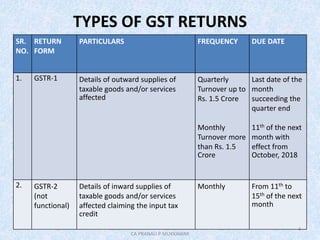
TYPES OF GST RETURNS
SR.
NO.
RETURN
FORM
PARTICULARS FREQUENCY DUE DATE
1. GSTR-1 Details of outward supplies of
taxable goods and/or services
affected
Quarterly
Turnover up to
Rs. 1.5 Crore
Monthly
Turnover more
than Rs. 1.5
Crore
Last date of the
month
succeeding the
quarter end
11th of the next
month with
effect from
October, 2018
2. GSTR-2
(not
functional)
Details of inward supplies of
taxable goods and/or services
affected claiming the input tax
credit
Monthly From 11th to
15th of the next
month
4
CA PRANALI P MUKKAWAR
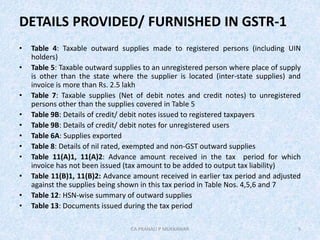
• Table 4: Taxable outward supplies made to registered persons (including UIN
holders)
• Table 5: Taxable outward supplies to an unregistered person where place of supply
is other than the state where the supplier is located (inter-state supplies) and
invoice is more than Rs. 2.5 lakh
• Table 7: Taxable supplies (Net of debit notes and credit notes) to unregistered
persons other than the supplies covered in Table 5
• Table 9B: Details of credit/ debit notes issued to registered taxpayers
• Table 9B: Details of credit/ debit notes for unregistered users
• Table 6A: Supplies exported
• Table 8: Details of nil rated, exempted and non-GST outward supplies
• Table 11(A)1, 11(A)2: Advance amount received in the tax period for which
invoice has not been issued (tax amount to be added to output tax liability)
• Table 11(B)1, 11(B)2: Advance amount received in earlier tax period and adjusted
against the supplies being shown in this tax period in Table Nos. 4,5,6 and 7
• Table 12: HSN-wise summary of outward supplies
• Table 13: Documents issued during the tax period
5
DETAILS PROVIDED/ FURNISHED IN GSTR-1
CA PRANALI P MUKKAWAR
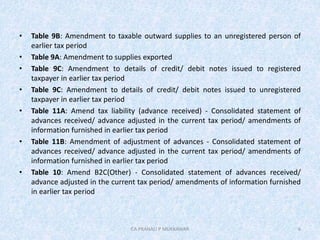
• Table 9B: Amendment to taxable outward supplies to an unregistered person of
earlier tax period
• Table 9A: Amendment to supplies exported
• Table 9C: Amendment to details of credit/ debit notes issued to registered
taxpayer in earlier tax period
• Table 9C: Amendment to details of credit/ debit notes issued to unregistered
taxpayer in earlier tax period
• Table 11A: Amend tax liability (advance received) - Consolidated statement of
advances received/ advance adjusted in the current tax period/ amendments of
information furnished in earlier tax period
• Table 11B: Amendment of adjustment of advances - Consolidated statement of
advances received/ advance adjusted in the current tax period/ amendments of
information furnished in earlier tax period
• Table 10: Amend B2C(Other) - Consolidated statement of advances received/
advance adjusted in the current tax period/ amendments of information furnished
in earlier tax period
6CA PRANALI P MUKKAWAR
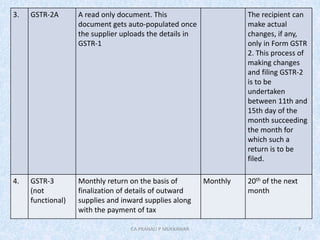
3. GSTR-2A A read only document. This
document gets auto-populated once
the supplier uploads the details in
GSTR-1
The recipient can
make actual
changes, if any,
only in Form GSTR
2. This process of
making changes
and filing GSTR-2
is to be
undertaken
between 11th and
15th day of the
month succeeding
the month for
which such a
return is to be
filed.
4. GSTR-3
(not
functional)
Monthly return on the basis of
finalization of details of outward
supplies and inward supplies along
with the payment of tax
Monthly 20th of the next
month
7CA PRANALI P MUKKAWAR
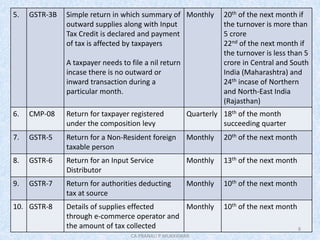
5. GSTR-3B Simple return in which summary of
outward supplies along with Input
Tax Credit is declared and payment
of tax is affected by taxpayers
A taxpayer needs to file a nil return
incase there is no outward or
inward transaction during a
particular month.
Monthly 20th of the next month if
the turnover is more than
5 crore
22nd of the next month if
the turnover is less than 5
crore in Central and South
India (Maharashtra) and
24th incase of Northern
and North-East India
(Rajasthan)
6. CMP-08 Return for taxpayer registered
under the composition levy
Quarterly 18th of the month
succeeding quarter
7. GSTR-5 Return for a Non-Resident foreign
taxable person
Monthly 20th of the next month
8. GSTR-6 Return for an Input Service
Distributor
Monthly 13th of the next month
9. GSTR-7 Return for authorities deducting
tax at source
Monthly 10th of the next month
10. GSTR-8 Details of supplies effected
through e-commerce operator and
the amount of tax collected
Monthly 10th of the next month
8
CA PRANALI P MUKKAWAR
9
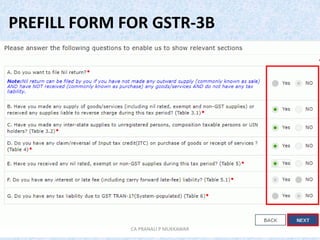
PREFILL FORM FOR GSTR-3B
CA PRANALI P MUKKAWAR
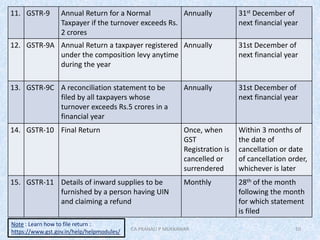
11. GSTR-9 Annual Return for a Normal
Taxpayer if the turnover exceeds Rs.
2 crores
Annually 31st December of
next financial year
12. GSTR-9A Annual Return a taxpayer registered
under the composition levy anytime
during the year
Annually 31st December of
next financial year
13. GSTR-9C A reconciliation statement to be
filed by all taxpayers whose
turnover exceeds Rs.5 crores in a
financial year
Annually 31st December of
next financial year
14. GSTR-10 Final Return Once, when
GST
Registration is
cancelled or
surrendered
Within 3 months of
the date of
cancellation or date
of cancellation order,
whichever is later
15. GSTR-11 Details of inward supplies to be
furnished by a person having UIN
and claiming a refund
Monthly 28th of the month
following the month
for which statement
is filed
10
Note : Learn how to file return :
https://www.gst.gov.in/help/helpmodules/ CA PRANALI P MUKKAWAR
11
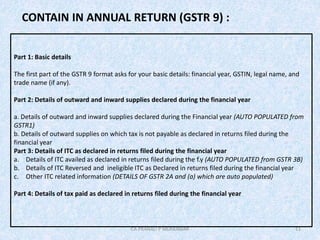
CONTAIN IN ANNUAL RETURN (GSTR 9) :
Part 1: Basic details
The first part of the GSTR 9 format asks for your basic details: financial year, GSTIN, legal name, and
trade name (if any).
Part 2: Details of outward and inward supplies declared during the financial year
a. Details of outward and inward supplies declared during the Financial year (AUTO POPULATED from
GSTR1)
b. Details of outward supplies on which tax is not payable as declared in returns filed during the
financial year
Part 3: Details of ITC as declared in returns filed during the financial year
a. Details of ITC availed as declared in returns filed during the f.y (AUTO POPULATED from GSTR 3B)
b. Details of ITC Reversed and ineligible ITC as Declared in returns filed during the financial year
c. Other ITC related information (DETAILS OF GSTR 2A and (a) which are auto populated)
Part 4: Details of tax paid as declared in returns filed during the financial year
CA PRANALI P MUKKAWAR
12
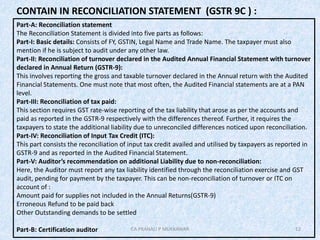
CONTAIN IN RECONCILIATION STATEMENT (GSTR 9C ) :
Part-A: Reconciliation statement
The Reconciliation Statement is divided into five parts as follows:
Part-I: Basic details: Consists of FY, GSTIN, Legal Name and Trade Name. The taxpayer must also
mention if he is subject to audit under any other law.
Part-II: Reconciliation of turnover declared in the Audited Annual Financial Statement with turnover
declared in Annual Return (GSTR-9):
This involves reporting the gross and taxable turnover declared in the Annual return with the Audited
Financial Statements. One must note that most often, the Audited Financial statements are at a PAN
level.
Part-III: Reconciliation of tax paid:
This section requires GST rate-wise reporting of the tax liability that arose as per the accounts and
paid as reported in the GSTR-9 respectively with the differences thereof. Further, it requires the
taxpayers to state the additional liability due to unreconciled differences noticed upon reconciliation.
Part-IV: Reconciliation of Input Tax Credit (ITC):
This part consists the reconciliation of input tax credit availed and utilised by taxpayers as reported in
GSTR-9 and as reported in the Audited Financial Statement.
Part-V: Auditor’s recommendation on additional Liability due to non-reconciliation:
Here, the Auditor must report any tax liability identified through the reconciliation exercise and GST
audit, pending for payment by the taxpayer. This can be non-reconciliation of turnover or ITC on
account of :
Amount paid for supplies not included in the Annual Returns(GSTR-9)
Erroneous Refund to be paid back
Other Outstanding demands to be settled
Part-B: Certification auditor CA PRANALI P MUKKAWAR
LATE FILING OF GST RETURNS
Return filing is mandatory under GST. Even if there is no transaction, you must
file a nil return.
• You cannot file a return if you do not file previous month/quarter’s
return. (Except GSTR 1)
• The late filing fee of the gstr-1 is populated in the liability ledger of
gstr-3b filed immediately after such delay.
13CA PRANALI P MUKKAWAR
Late Fees under GST
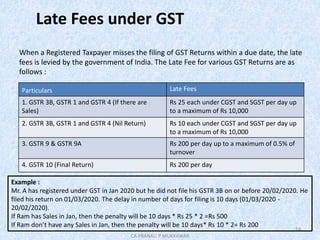
When a Registered Taxpayer misses the filing of GST Returns within a due date, the late
fees is levied by the government of India. The Late Fee for various GST Returns are as
follows :
14
Particulars Late Fees
1. GSTR 3B, GSTR 1 and GSTR 4 (If there are
Sales)
Rs 25 each under CGST and SGST per day up
to a maximum of Rs 10,000
2. GSTR 3B, GSTR 1 and GSTR 4 (Nil Return) Rs 10 each under CGST and SGST per day up
to a maximum of Rs 10,000
3. GSTR 9 & GSTR 9A Rs 200 per day up to a maximum of 0.5% of
turnover
4. GSTR 10 (Final Return) Rs 200 per day
Example :
Mr. A has registered under GST in Jan 2020 but he did not file his GSTR 3B on or before 20/02/2020. He
filed his return on 01/03/2020. The delay in number of days for filing is 10 days (01/03/2020 -
20/02/2020).
If Ram has Sales in Jan, then the penalty will be 10 days * Rs 25 * 2 =Rs 500
If Ram don’t have any Sales in Jan, then the penalty will be 10 days* Rs 10 * 2= Rs 200
CA PRANALI P MUKKAWAR
15
Interest under GSTR
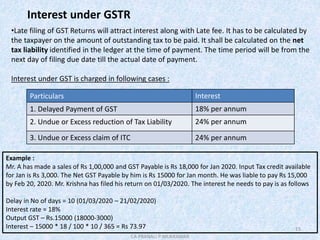
•Late filing of GST Returns will attract interest along with Late fee. It has to be calculated by
the taxpayer on the amount of outstanding tax to be paid. It shall be calculated on the net
tax liability identified in the ledger at the time of payment. The time period will be from the
next day of filing due date till the actual date of payment.
Interest under GST is charged in following cases :
Particulars Interest
1. Delayed Payment of GST 18% per annum
2. Undue or Excess reduction of Tax Liability 24% per annum
3. Undue or Excess claim of ITC 24% per annum
Example :
Mr. A has made a sales of Rs 1,00,000 and GST Payable is Rs 18,000 for Jan 2020. Input Tax credit available
for Jan is Rs 3,000. The Net GST Payable by him is Rs 15000 for Jan month. He was liable to pay Rs 15,000
by Feb 20, 2020. Mr. Krishna has filed his return on 01/03/2020. The interest he needs to pay is as follows
Delay in No of days = 10 (01/03/2020 – 21/02/2020)
Interest rate = 18%
Output GST – Rs.15000 (18000-3000)
Interest – 15000 * 18 / 100 * 10 / 365 = Rs 73.97
CA PRANALI P MUKKAWAR
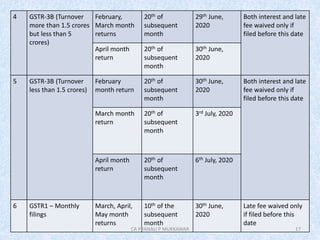
EXTENTION OF DUE DATE DUE TO COVID-19
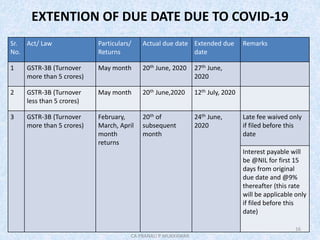
Sr.
No.
Act/ Law Particulars/
Returns
Actual due date Extended due
date
Remarks
1 GSTR-3B (Turnover
more than 5 crores)
May month 20th June, 2020 27th June,
2020
2 GSTR-3B (Turnover
less than 5 crores)
May month 20th June,2020 12th July, 2020
3 GSTR-3B (Turnover
more than 5 crores)
February,
March, April
month
returns
20th of
subsequent
month
24th June,
2020
Late fee waived only
if filed before this
date
Interest payable will
be @NIL for first 15
days from original
due date and @9%
thereafter (this rate
will be applicable only
if filed before this
date)
16
CA PRANALI P MUKKAWAR
4 GSTR-3B (Turnover
more than 1.5 crores
but less than 5
crores)
February,
March month
returns
20th of
subsequent
month
29th June,
2020
Both interest and late
fee waived only if
filed before this date
April month
return
20th of
subsequent
month
30th June,
2020
5 GSTR-3B (Turnover
less than 1.5 crores)
February
month return
20th of
subsequent
month
30th June,
2020
Both interest and late
fee waived only if
filed before this date
March month
return
20th of
subsequent
month
3rd July, 2020
April month
return
20th of
subsequent
month
6th July, 2020
6 GSTR1 – Monthly
filings
March, April,
May month
returns
10th of the
subsequent
month
30th June,
2020
Late fee waived only
if filed before this
date
17CA PRANALI P MUKKAWAR
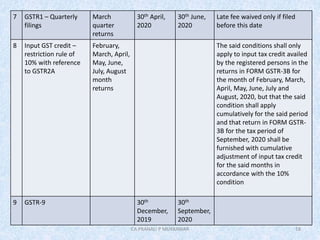
7 GSTR1 – Quarterly
filings
March
quarter
returns
30th April,
2020
30th June,
2020
Late fee waived only if filed
before this date
8 Input GST credit –
restriction rule of
10% with reference
to GSTR2A
February,
March, April,
May, June,
July, August
month
returns
The said conditions shall only
apply to input tax credit availed
by the registered persons in the
returns in FORM GSTR-3B for
the month of February, March,
April, May, June, July and
August, 2020, but that the said
condition shall apply
cumulatively for the said period
and that return in FORM GSTR-
3B for the tax period of
September, 2020 shall be
furnished with cumulative
adjustment of input tax credit
for the said months in
accordance with the 10%
condition
9 GSTR-9 30th
December,
2019
30th
September,
2020
18CA PRANALI P MUKKAWAR
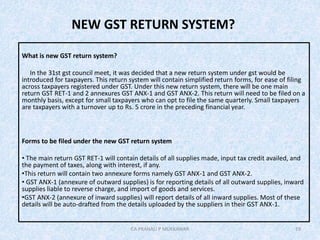
NEW GST RETURN SYSTEM?
What is new GST return system?
In the 31st gst council meet, it was decided that a new return system under gst would be
introduced for taxpayers. This return system will contain simplified return forms, for ease of filing
across taxpayers registered under GST. Under this new return system, there will be one main
return GST RET-1 and 2 annexures GST ANX-1 and GST ANX-2. This return will need to be filed on a
monthly basis, except for small taxpayers who can opt to file the same quarterly. Small taxpayers
are taxpayers with a turnover up to Rs. 5 crore in the preceding financial year.
Forms to be filed under the new GST return system
• The main return GST RET-1 will contain details of all supplies made, input tax credit availed, and
the payment of taxes, along with interest, if any.
•This return will contain two annexure forms namely GST ANX-1 and GST ANX-2.
• GST ANX-1 (annexure of outward supplies) is for reporting details of all outward supplies, inward
supplies liable to reverse charge, and import of goods and services.
•GST ANX-2 (annexure of inward supplies) will report details of all inward supplies. Most of these
details will be auto-drafted from the details uploaded by the suppliers in their GST ANX-1.
19CA PRANALI P MUKKAWAR
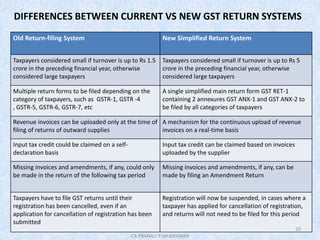
Old Return-filing System New Simplified Return System
Taxpayers considered small if turnover is up to Rs 1.5
crore in the preceding financial year, otherwise
considered large taxpayers
Taxpayers considered small if turnover is up to Rs 5
crore in the preceding financial year, otherwise
considered large taxpayers
Multiple return forms to be filed depending on the
category of taxpayers, such as GSTR-1, GSTR -4
, GSTR-5, GSTR-6, GSTR-7, etc
A single simplified main return form GST RET-1
containing 2 annexures GST ANX-1 and GST ANX-2 to
be filed by all categories of taxpayers
Revenue invoices can be uploaded only at the time of
filing of returns of outward supplies
A mechanism for the continuous upload of revenue
invoices on a real-time basis
Input tax credit could be claimed on a self-
declaration basis
Input tax credit can be claimed based on invoices
uploaded by the supplier
Missing invoices and amendments, if any, could only
be made in the return of the following tax period
Missing invoices and amendments, if any, can be
made by filing an Amendment Return
Taxpayers have to file GST returns until their
registration has been cancelled, even if an
application for cancellation of registration has been
submitted
Registration will now be suspended, in cases where a
taxpayer has applied for cancellation of registration,
and returns will not need to be filed for this period
DIFFERENCES BETWEEN CURRENT VS NEW GST RETURN SYSTEMS
20
CA PRANALI P MUKKAWAR
21
Contact on : pranalim406@gmail.com

Gst returns

  • 1.
    1 TOPICS : GST Returns Preparedand Presented by : Aditi shah & CA Pranali Mukkawar S D B A & CO. CHARTERED ACCOUNTANT Contact on : pranalim406@gmail.com
  • 2.
    WHAT IS GSTRETURN? • A return is a document containing details of income which a taxpayer is required to file with the tax administrative authorities. This is used by tax authorities to calculate tax liability. 2 CA PRANALI P MUKKAWAR
  • 3.
    DETAILS REQUIRED FORGST RETURNS • Purchases details • Sales details • Debit note/credit note details • Output GST (on sales) • Input tax credit (GST paid on purchases) • To file GST returns, GST compliant sales and purchase invoices are required. 3CA PRANALI P MUKKAWAR
  • 4.
    TYPES OF GSTRETURNS SR. NO. RETURN FORM PARTICULARS FREQUENCY DUE DATE 1. GSTR-1 Details of outward supplies of taxable goods and/or services affected Quarterly Turnover up to Rs. 1.5 Crore Monthly Turnover more than Rs. 1.5 Crore Last date of the month succeeding the quarter end 11th of the next month with effect from October, 2018 2. GSTR-2 (not functional) Details of inward supplies of taxable goods and/or services affected claiming the input tax credit Monthly From 11th to 15th of the next month 4 CA PRANALI P MUKKAWAR
  • 5.
    • Table 4:Taxable outward supplies made to registered persons (including UIN holders) • Table 5: Taxable outward supplies to an unregistered person where place of supply is other than the state where the supplier is located (inter-state supplies) and invoice is more than Rs. 2.5 lakh • Table 7: Taxable supplies (Net of debit notes and credit notes) to unregistered persons other than the supplies covered in Table 5 • Table 9B: Details of credit/ debit notes issued to registered taxpayers • Table 9B: Details of credit/ debit notes for unregistered users • Table 6A: Supplies exported • Table 8: Details of nil rated, exempted and non-GST outward supplies • Table 11(A)1, 11(A)2: Advance amount received in the tax period for which invoice has not been issued (tax amount to be added to output tax liability) • Table 11(B)1, 11(B)2: Advance amount received in earlier tax period and adjusted against the supplies being shown in this tax period in Table Nos. 4,5,6 and 7 • Table 12: HSN-wise summary of outward supplies • Table 13: Documents issued during the tax period 5 DETAILS PROVIDED/ FURNISHED IN GSTR-1 CA PRANALI P MUKKAWAR
  • 6.
    • Table 9B:Amendment to taxable outward supplies to an unregistered person of earlier tax period • Table 9A: Amendment to supplies exported • Table 9C: Amendment to details of credit/ debit notes issued to registered taxpayer in earlier tax period • Table 9C: Amendment to details of credit/ debit notes issued to unregistered taxpayer in earlier tax period • Table 11A: Amend tax liability (advance received) - Consolidated statement of advances received/ advance adjusted in the current tax period/ amendments of information furnished in earlier tax period • Table 11B: Amendment of adjustment of advances - Consolidated statement of advances received/ advance adjusted in the current tax period/ amendments of information furnished in earlier tax period • Table 10: Amend B2C(Other) - Consolidated statement of advances received/ advance adjusted in the current tax period/ amendments of information furnished in earlier tax period 6CA PRANALI P MUKKAWAR
  • 7.
    3. GSTR-2A Aread only document. This document gets auto-populated once the supplier uploads the details in GSTR-1 The recipient can make actual changes, if any, only in Form GSTR 2. This process of making changes and filing GSTR-2 is to be undertaken between 11th and 15th day of the month succeeding the month for which such a return is to be filed. 4. GSTR-3 (not functional) Monthly return on the basis of finalization of details of outward supplies and inward supplies along with the payment of tax Monthly 20th of the next month 7CA PRANALI P MUKKAWAR
  • 8.
    5. GSTR-3B Simplereturn in which summary of outward supplies along with Input Tax Credit is declared and payment of tax is affected by taxpayers A taxpayer needs to file a nil return incase there is no outward or inward transaction during a particular month. Monthly 20th of the next month if the turnover is more than 5 crore 22nd of the next month if the turnover is less than 5 crore in Central and South India (Maharashtra) and 24th incase of Northern and North-East India (Rajasthan) 6. CMP-08 Return for taxpayer registered under the composition levy Quarterly 18th of the month succeeding quarter 7. GSTR-5 Return for a Non-Resident foreign taxable person Monthly 20th of the next month 8. GSTR-6 Return for an Input Service Distributor Monthly 13th of the next month 9. GSTR-7 Return for authorities deducting tax at source Monthly 10th of the next month 10. GSTR-8 Details of supplies effected through e-commerce operator and the amount of tax collected Monthly 10th of the next month 8 CA PRANALI P MUKKAWAR
  • 9.
    9 PREFILL FORM FORGSTR-3B CA PRANALI P MUKKAWAR
  • 10.
    11. GSTR-9 AnnualReturn for a Normal Taxpayer if the turnover exceeds Rs. 2 crores Annually 31st December of next financial year 12. GSTR-9A Annual Return a taxpayer registered under the composition levy anytime during the year Annually 31st December of next financial year 13. GSTR-9C A reconciliation statement to be filed by all taxpayers whose turnover exceeds Rs.5 crores in a financial year Annually 31st December of next financial year 14. GSTR-10 Final Return Once, when GST Registration is cancelled or surrendered Within 3 months of the date of cancellation or date of cancellation order, whichever is later 15. GSTR-11 Details of inward supplies to be furnished by a person having UIN and claiming a refund Monthly 28th of the month following the month for which statement is filed 10 Note : Learn how to file return : https://www.gst.gov.in/help/helpmodules/ CA PRANALI P MUKKAWAR
  • 11.
    11 CONTAIN IN ANNUALRETURN (GSTR 9) : Part 1: Basic details The first part of the GSTR 9 format asks for your basic details: financial year, GSTIN, legal name, and trade name (if any). Part 2: Details of outward and inward supplies declared during the financial year a. Details of outward and inward supplies declared during the Financial year (AUTO POPULATED from GSTR1) b. Details of outward supplies on which tax is not payable as declared in returns filed during the financial year Part 3: Details of ITC as declared in returns filed during the financial year a. Details of ITC availed as declared in returns filed during the f.y (AUTO POPULATED from GSTR 3B) b. Details of ITC Reversed and ineligible ITC as Declared in returns filed during the financial year c. Other ITC related information (DETAILS OF GSTR 2A and (a) which are auto populated) Part 4: Details of tax paid as declared in returns filed during the financial year CA PRANALI P MUKKAWAR
  • 12.
    12 CONTAIN IN RECONCILIATIONSTATEMENT (GSTR 9C ) : Part-A: Reconciliation statement The Reconciliation Statement is divided into five parts as follows: Part-I: Basic details: Consists of FY, GSTIN, Legal Name and Trade Name. The taxpayer must also mention if he is subject to audit under any other law. Part-II: Reconciliation of turnover declared in the Audited Annual Financial Statement with turnover declared in Annual Return (GSTR-9): This involves reporting the gross and taxable turnover declared in the Annual return with the Audited Financial Statements. One must note that most often, the Audited Financial statements are at a PAN level. Part-III: Reconciliation of tax paid: This section requires GST rate-wise reporting of the tax liability that arose as per the accounts and paid as reported in the GSTR-9 respectively with the differences thereof. Further, it requires the taxpayers to state the additional liability due to unreconciled differences noticed upon reconciliation. Part-IV: Reconciliation of Input Tax Credit (ITC): This part consists the reconciliation of input tax credit availed and utilised by taxpayers as reported in GSTR-9 and as reported in the Audited Financial Statement. Part-V: Auditor’s recommendation on additional Liability due to non-reconciliation: Here, the Auditor must report any tax liability identified through the reconciliation exercise and GST audit, pending for payment by the taxpayer. This can be non-reconciliation of turnover or ITC on account of : Amount paid for supplies not included in the Annual Returns(GSTR-9) Erroneous Refund to be paid back Other Outstanding demands to be settled Part-B: Certification auditor CA PRANALI P MUKKAWAR
  • 13.
    LATE FILING OFGST RETURNS Return filing is mandatory under GST. Even if there is no transaction, you must file a nil return. • You cannot file a return if you do not file previous month/quarter’s return. (Except GSTR 1) • The late filing fee of the gstr-1 is populated in the liability ledger of gstr-3b filed immediately after such delay. 13CA PRANALI P MUKKAWAR
  • 14.
    Late Fees underGST When a Registered Taxpayer misses the filing of GST Returns within a due date, the late fees is levied by the government of India. The Late Fee for various GST Returns are as follows : 14 Particulars Late Fees 1. GSTR 3B, GSTR 1 and GSTR 4 (If there are Sales) Rs 25 each under CGST and SGST per day up to a maximum of Rs 10,000 2. GSTR 3B, GSTR 1 and GSTR 4 (Nil Return) Rs 10 each under CGST and SGST per day up to a maximum of Rs 10,000 3. GSTR 9 & GSTR 9A Rs 200 per day up to a maximum of 0.5% of turnover 4. GSTR 10 (Final Return) Rs 200 per day Example : Mr. A has registered under GST in Jan 2020 but he did not file his GSTR 3B on or before 20/02/2020. He filed his return on 01/03/2020. The delay in number of days for filing is 10 days (01/03/2020 - 20/02/2020). If Ram has Sales in Jan, then the penalty will be 10 days * Rs 25 * 2 =Rs 500 If Ram don’t have any Sales in Jan, then the penalty will be 10 days* Rs 10 * 2= Rs 200 CA PRANALI P MUKKAWAR
  • 15.
    15 Interest under GSTR •Latefiling of GST Returns will attract interest along with Late fee. It has to be calculated by the taxpayer on the amount of outstanding tax to be paid. It shall be calculated on the net tax liability identified in the ledger at the time of payment. The time period will be from the next day of filing due date till the actual date of payment. Interest under GST is charged in following cases : Particulars Interest 1. Delayed Payment of GST 18% per annum 2. Undue or Excess reduction of Tax Liability 24% per annum 3. Undue or Excess claim of ITC 24% per annum Example : Mr. A has made a sales of Rs 1,00,000 and GST Payable is Rs 18,000 for Jan 2020. Input Tax credit available for Jan is Rs 3,000. The Net GST Payable by him is Rs 15000 for Jan month. He was liable to pay Rs 15,000 by Feb 20, 2020. Mr. Krishna has filed his return on 01/03/2020. The interest he needs to pay is as follows Delay in No of days = 10 (01/03/2020 – 21/02/2020) Interest rate = 18% Output GST – Rs.15000 (18000-3000) Interest – 15000 * 18 / 100 * 10 / 365 = Rs 73.97 CA PRANALI P MUKKAWAR
  • 16.
    EXTENTION OF DUEDATE DUE TO COVID-19 Sr. No. Act/ Law Particulars/ Returns Actual due date Extended due date Remarks 1 GSTR-3B (Turnover more than 5 crores) May month 20th June, 2020 27th June, 2020 2 GSTR-3B (Turnover less than 5 crores) May month 20th June,2020 12th July, 2020 3 GSTR-3B (Turnover more than 5 crores) February, March, April month returns 20th of subsequent month 24th June, 2020 Late fee waived only if filed before this date Interest payable will be @NIL for first 15 days from original due date and @9% thereafter (this rate will be applicable only if filed before this date) 16 CA PRANALI P MUKKAWAR
  • 17.
    4 GSTR-3B (Turnover morethan 1.5 crores but less than 5 crores) February, March month returns 20th of subsequent month 29th June, 2020 Both interest and late fee waived only if filed before this date April month return 20th of subsequent month 30th June, 2020 5 GSTR-3B (Turnover less than 1.5 crores) February month return 20th of subsequent month 30th June, 2020 Both interest and late fee waived only if filed before this date March month return 20th of subsequent month 3rd July, 2020 April month return 20th of subsequent month 6th July, 2020 6 GSTR1 – Monthly filings March, April, May month returns 10th of the subsequent month 30th June, 2020 Late fee waived only if filed before this date 17CA PRANALI P MUKKAWAR
  • 18.
    7 GSTR1 –Quarterly filings March quarter returns 30th April, 2020 30th June, 2020 Late fee waived only if filed before this date 8 Input GST credit – restriction rule of 10% with reference to GSTR2A February, March, April, May, June, July, August month returns The said conditions shall only apply to input tax credit availed by the registered persons in the returns in FORM GSTR-3B for the month of February, March, April, May, June, July and August, 2020, but that the said condition shall apply cumulatively for the said period and that return in FORM GSTR- 3B for the tax period of September, 2020 shall be furnished with cumulative adjustment of input tax credit for the said months in accordance with the 10% condition 9 GSTR-9 30th December, 2019 30th September, 2020 18CA PRANALI P MUKKAWAR
  • 19.
    NEW GST RETURNSYSTEM? What is new GST return system? In the 31st gst council meet, it was decided that a new return system under gst would be introduced for taxpayers. This return system will contain simplified return forms, for ease of filing across taxpayers registered under GST. Under this new return system, there will be one main return GST RET-1 and 2 annexures GST ANX-1 and GST ANX-2. This return will need to be filed on a monthly basis, except for small taxpayers who can opt to file the same quarterly. Small taxpayers are taxpayers with a turnover up to Rs. 5 crore in the preceding financial year. Forms to be filed under the new GST return system • The main return GST RET-1 will contain details of all supplies made, input tax credit availed, and the payment of taxes, along with interest, if any. •This return will contain two annexure forms namely GST ANX-1 and GST ANX-2. • GST ANX-1 (annexure of outward supplies) is for reporting details of all outward supplies, inward supplies liable to reverse charge, and import of goods and services. •GST ANX-2 (annexure of inward supplies) will report details of all inward supplies. Most of these details will be auto-drafted from the details uploaded by the suppliers in their GST ANX-1. 19CA PRANALI P MUKKAWAR
  • 20.
    Old Return-filing SystemNew Simplified Return System Taxpayers considered small if turnover is up to Rs 1.5 crore in the preceding financial year, otherwise considered large taxpayers Taxpayers considered small if turnover is up to Rs 5 crore in the preceding financial year, otherwise considered large taxpayers Multiple return forms to be filed depending on the category of taxpayers, such as GSTR-1, GSTR -4 , GSTR-5, GSTR-6, GSTR-7, etc A single simplified main return form GST RET-1 containing 2 annexures GST ANX-1 and GST ANX-2 to be filed by all categories of taxpayers Revenue invoices can be uploaded only at the time of filing of returns of outward supplies A mechanism for the continuous upload of revenue invoices on a real-time basis Input tax credit could be claimed on a self- declaration basis Input tax credit can be claimed based on invoices uploaded by the supplier Missing invoices and amendments, if any, could only be made in the return of the following tax period Missing invoices and amendments, if any, can be made by filing an Amendment Return Taxpayers have to file GST returns until their registration has been cancelled, even if an application for cancellation of registration has been submitted Registration will now be suspended, in cases where a taxpayer has applied for cancellation of registration, and returns will not need to be filed for this period DIFFERENCES BETWEEN CURRENT VS NEW GST RETURN SYSTEMS 20 CA PRANALI P MUKKAWAR
  • 21.
    21 Contact on :pranalim406@gmail.com