GST
Goods and Service
Taxes
GOODS AND SERVICE TAXES
Dr. Harishchandra S B
MBA, M.Phil, PhD
Dept of Management Studies [MBA], APPA Institute of
Engineering & Technology, Kalaburagi, Karnataka-
India
harish.bramhaver@gmail.com 09945678951
ABSTRACT ON GST
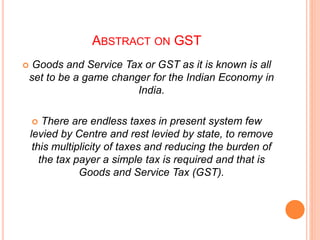
 Goods and Service Tax or GST as it is known is all
set to be a game changer for the Indian Economy in
India.
 There are endless taxes in present system few
levied by Centre and rest levied by state, to remove
this multiplicity of taxes and reducing the burden of
the tax payer a simple tax is required and that is
Goods and Service Tax (GST).
INTRODUCTION
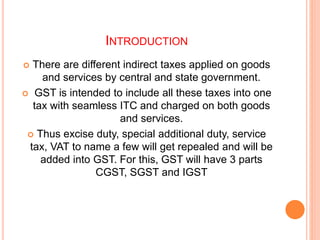
 There are different indirect taxes applied on goods
and services by central and state government.
 GST is intended to include all these taxes into one
tax with seamless ITC and charged on both goods
and services.
 Thus excise duty, special additional duty, service
tax, VAT to name a few will get repealed and will be
added into GST. For this, GST will have 3 parts
CGST, SGST and IGST
GST HAS 5 CATEGORIES IN INDIA
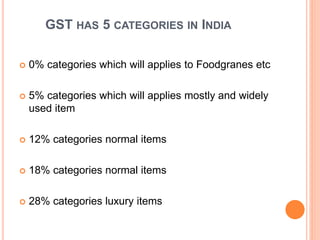
 0% categories which will applies to Foodgranes etc
 5% categories which will applies mostly and widely
used item
 12% categories normal items
 18% categories normal items
 28% categories luxury items
TERMINOLOGY OF GST
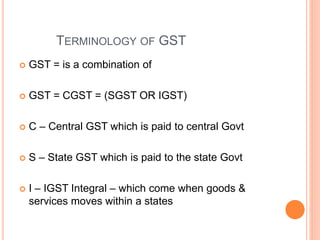
 GST = is a combination of
 GST = CGST = (SGST OR IGST)
 C – Central GST which is paid to central Govt
 S – State GST which is paid to the state Govt
 I – IGST Integral – which come when goods &
services moves within a states
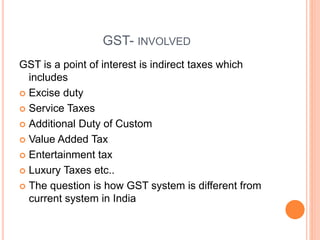
GST- INVOLVED
GST is a point of interest is indirect taxes which
includes
 Excise duty
 Service Taxes
 Additional Duty of Custom
 Value Added Tax
 Entertainment tax
 Luxury Taxes etc..
 The question is how GST system is different from
current system in India
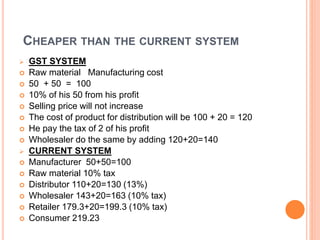
CHEAPER THAN THE CURRENT SYSTEM
 GST SYSTEM
 Raw material Manufacturing cost
 50 + 50 = 100
 10% of his 50 from his profit
 Selling price will not increase
 The cost of product for distribution will be 100 + 20 = 120
 He pay the tax of 2 of his profit
 Wholesaler do the same by adding 120+20=140
 CURRENT SYSTEM
 Manufacturer 50+50=100
 Raw material 10% tax
 Distributor 110+20=130 (13%)
 Wholesaler 143+20=163 (10% tax)
 Retailer 179.3+20=199.3 (10% tax)
 Consumer 219.23
Retailers add his 140+20=160 and pay the tax of his
10%
So the product is compare the product is 59.23 Rs.
CONCLUSION
GST is a consumption based tax, therefore, taxes are
paid to the state which the goods or services are
consumed not the state in which they were
produced. IGST complicates tax collection for State
Governments by disabling them to collect the tax
owed to them directly from the Central Government.
Under the previous system, a state would have to
only deal with a single government in order to
collect tax revenue.

GST presentation

  • 1.
  • 2.
    GOODS AND SERVICETAXES Dr. Harishchandra S B MBA, M.Phil, PhD Dept of Management Studies [MBA], APPA Institute of Engineering & Technology, Kalaburagi, Karnataka- India harish.bramhaver@gmail.com 09945678951
  • 3.
    ABSTRACT ON GST Goods and Service Tax or GST as it is known is all set to be a game changer for the Indian Economy in India.  There are endless taxes in present system few levied by Centre and rest levied by state, to remove this multiplicity of taxes and reducing the burden of the tax payer a simple tax is required and that is Goods and Service Tax (GST).
  • 4.
    INTRODUCTION  There aredifferent indirect taxes applied on goods and services by central and state government.  GST is intended to include all these taxes into one tax with seamless ITC and charged on both goods and services.  Thus excise duty, special additional duty, service tax, VAT to name a few will get repealed and will be added into GST. For this, GST will have 3 parts CGST, SGST and IGST
  • 5.
    GST HAS 5CATEGORIES IN INDIA  0% categories which will applies to Foodgranes etc  5% categories which will applies mostly and widely used item  12% categories normal items  18% categories normal items  28% categories luxury items
  • 6.
    TERMINOLOGY OF GST GST = is a combination of  GST = CGST = (SGST OR IGST)  C – Central GST which is paid to central Govt  S – State GST which is paid to the state Govt  I – IGST Integral – which come when goods & services moves within a states
  • 7.
    GST- INVOLVED GST isa point of interest is indirect taxes which includes  Excise duty  Service Taxes  Additional Duty of Custom  Value Added Tax  Entertainment tax  Luxury Taxes etc..  The question is how GST system is different from current system in India
  • 8.
    CHEAPER THAN THECURRENT SYSTEM  GST SYSTEM  Raw material Manufacturing cost  50 + 50 = 100  10% of his 50 from his profit  Selling price will not increase  The cost of product for distribution will be 100 + 20 = 120  He pay the tax of 2 of his profit  Wholesaler do the same by adding 120+20=140  CURRENT SYSTEM  Manufacturer 50+50=100  Raw material 10% tax  Distributor 110+20=130 (13%)  Wholesaler 143+20=163 (10% tax)  Retailer 179.3+20=199.3 (10% tax)  Consumer 219.23
  • 9.
    Retailers add his140+20=160 and pay the tax of his 10% So the product is compare the product is 59.23 Rs.
  • 10.
    CONCLUSION GST is aconsumption based tax, therefore, taxes are paid to the state which the goods or services are consumed not the state in which they were produced. IGST complicates tax collection for State Governments by disabling them to collect the tax owed to them directly from the Central Government. Under the previous system, a state would have to only deal with a single government in order to collect tax revenue.